EP0141028A2 - Digitale Anordnung für ein Daten-Lesesystem von einem magnetischen Träger - Google Patents
Digitale Anordnung für ein Daten-Lesesystem von einem magnetischen Träger Download PDFInfo
- Publication number
- EP0141028A2 EP0141028A2 EP84107390A EP84107390A EP0141028A2 EP 0141028 A2 EP0141028 A2 EP 0141028A2 EP 84107390 A EP84107390 A EP 84107390A EP 84107390 A EP84107390 A EP 84107390A EP 0141028 A2 EP0141028 A2 EP 0141028A2
- Authority
- EP
- European Patent Office
- Prior art keywords
- interval
- signal
- duration
- nominal
- code
- Prior art date
- Legal status (The legal status is an assumption and is not a legal conclusion. Google has not performed a legal analysis and makes no representation as to the accuracy of the status listed.)
- Granted
Links
Images





Classifications
-
- G—PHYSICS
- G11—INFORMATION STORAGE
- G11B—INFORMATION STORAGE BASED ON RELATIVE MOVEMENT BETWEEN RECORD CARRIER AND TRANSDUCER
- G11B5/00—Recording by magnetisation or demagnetisation of a record carrier; Reproducing by magnetic means; Record carriers therefor
- G11B5/02—Recording, reproducing, or erasing methods; Read, write or erase circuits therefor
- G11B5/09—Digital recording
-
- G—PHYSICS
- G11—INFORMATION STORAGE
- G11B—INFORMATION STORAGE BASED ON RELATIVE MOVEMENT BETWEEN RECORD CARRIER AND TRANSDUCER
- G11B20/00—Signal processing not specific to the method of recording or reproducing; Circuits therefor
- G11B20/10—Digital recording or reproducing
- G11B20/10009—Improvement or modification of read or write signals
- G11B20/10046—Improvement or modification of read or write signals filtering or equalising, e.g. setting the tap weights of an FIR filter
- G11B20/10212—Improvement or modification of read or write signals filtering or equalising, e.g. setting the tap weights of an FIR filter compensation for data shift, e.g. pulse-crowding effects
-
- G—PHYSICS
- G11—INFORMATION STORAGE
- G11B—INFORMATION STORAGE BASED ON RELATIVE MOVEMENT BETWEEN RECORD CARRIER AND TRANSDUCER
- G11B20/00—Signal processing not specific to the method of recording or reproducing; Circuits therefor
- G11B20/10—Digital recording or reproducing
- G11B20/14—Digital recording or reproducing using self-clocking codes
- G11B20/1403—Digital recording or reproducing using self-clocking codes characterised by the use of two levels
- G11B20/1407—Digital recording or reproducing using self-clocking codes characterised by the use of two levels code representation depending on a single bit, i.e. where a one is always represented by a first code symbol while a zero is always represented by a second code symbol
- G11B20/1419—Digital recording or reproducing using self-clocking codes characterised by the use of two levels code representation depending on a single bit, i.e. where a one is always represented by a first code symbol while a zero is always represented by a second code symbol to or from biphase level coding, i.e. to or from codes where a one is coded as a transition from a high to a low level during the middle of a bit cell and a zero is encoded as a transition from a low to a high level during the middle of a bit cell or vice versa, e.g. split phase code, Manchester code conversion to or from biphase space or mark coding, i.e. to or from codes where there is a transition at the beginning of every bit cell and a one has no second transition and a zero has a second transition one half of a bit period later or vice versa, e.g. double frequency code, FM code
-
- G—PHYSICS
- G11—INFORMATION STORAGE
- G11B—INFORMATION STORAGE BASED ON RELATIVE MOVEMENT BETWEEN RECORD CARRIER AND TRANSDUCER
- G11B20/00—Signal processing not specific to the method of recording or reproducing; Circuits therefor
- G11B20/10—Digital recording or reproducing
- G11B20/14—Digital recording or reproducing using self-clocking codes
- G11B20/1403—Digital recording or reproducing using self-clocking codes characterised by the use of two levels
- G11B20/1423—Code representation depending on subsequent bits, e.g. delay modulation, double density code, Miller code
Definitions
- the present invention relates to a digital apparatus for the recove ry of binary information recorded on magnetical supports, such as disks, diskettes, tapes.
- FM frequency modulation
- MFM simple density and modified frequency modulation
- Subsequent bits 1 or 0 recorded in FM are identified, when read out; owing to the presence or the lack, respectively, of a pulse in the center of contiguous recording cells.
- Each cell is defined by two timing pulses, the first one defining the beginning of the cell and the second one defining the beginning of the subsequent one.
- the time interval related to a cell varies according to the used media.
- the cell has a nominal length of 4 ⁇ sec. therefore the nominal time intervals between two subsequent pulses may be of 2 ⁇ sec. or 4 ⁇ sec.
- the MFM recording is such that the timing pulse, defining the beginning of a cell, is lacking if in the center of such cell or of the preceding one the pulse related to information bit 1 is present.
- the nominal length of the cell is 2 ⁇ sec. and therefore the nominal in terval time between two subsequent pulses can be 2, 3, 4 ⁇ sec.
- Further information on FM and MFM recording methods can be found in the document GA 21-9257-1 of IBM entitled "IBM Two Side Diskette Original Equipment Manufacturers Information - Second edition” (November 1977).
- the pulse sequence read out from the magnetical support is applied to the input of a recovering system which supplies in output the bi nary information related to the imputted sequence.
- Such pulse sequence periodically has a so-called synchronization field (generally of 6 or 12 bytes), that is a predetermined number of pulses related to a plurality of contiguous cells where all "1" information bits or all "O" information bits have been recorded.
- the synchronization field is used by the recovery system for locking and for establishing if a determined pulse in input is a timing one or a pulse related to the recorded information bit.
- the recovery system is therefore able to correctly detect the infor mation recorded on the magnetical support on the basis of the time interval between two subsequent pulses and of the nature of such pulses.
- the first one is due to speed changes of the magnetical support, that is to the rotational speed tolerances of the motor which drives the magne tical support.
- the second one is due to the so-called phenanenon of peak-shift of the recorded pulse, well known in the art, such shift being especial ly due to the mutual influence of adjacent pulses.
- the recovery system therefore need apparatuses able to correct for such error causes.
- the window signal is modified in order to maintain a preestablished phase relation with the input pulses.
- the window signal and the pulse sequence are then applied to a logical network of the recovery system and suitably decoded.
- a reading pulse occurring when the window signal is at a first electri cal level is interpreted as information bit.
- a reading pulse occurring when the window signal is at a second : electrical level is interpreted as timing pulse.
- the phase lock apparatuses generally comprise a phase comparator receiving in input the pulse sequence and the window signal and supplying, in output, a signal proportional to their phase difference.
- Such signal is applied, through suitable filters, to a voltage controlled oscillator (VCO) generating the window signal.
- VCO voltage controlled oscillator
- US patent N. 4.357.707 discloses a digital phase lock apparatus to be used together with a diskette digital controller for recovering information recorded both in FM and in MFM.
- the nominal interval between two window si gnal transitions is given by the sum of a variable number of periods of a timing signal with fixed frequency.
- the circuit counts the number of timing signal periods occurring bet ween the last window signal transition and the instant in which the next following read out pulse is received.
- the apparatus disclosed in the mentioned patent varies the length of the interval between two window signal transitions, owing to the reception of a nth pulse, not only taking. in account the interval, between the last transition of the window signal and such nth pulse, but also the interval between the (n-1) th pulse and the window signal transition immediately preceding such (n-1) th pulse.
- intrinsecally expen sive (such as control memory with minimum access time) is affected by several limitations in the recovery of MFM recorded binary infor_ mation.
- the mentioned circuit tends to propagate the indetermination error or measuresnent uncertainty, affecting the measurement of the interval between a pulse and the previous window signal transition, to the sub sequent intervals.
- the digital apparatus object of the present invention overcomes such inconvenients.
- the apparatus firstly measures the time interval between the last and the last but one read out pulse. Thereafter, from such measurement it recovers the error due to the speed variation and to the peak shift phenomenon and, fi nally, it generates the window signal and produces a last read out pulse in correct phase relation as to the window signal.
- the digital phase lock recovers the error due to the rotational speed variation and to the peak shift phenomenon during two separated phases, so avoiding that the recovery of the error due to the speed variation can be affec ted by the error due to the peak shift phenomenon.
- a quantity representative of the rotational speed error is added to or deducted from the dura tion measurement of the last detected interval.
- Such quantity is not fixed but is updated each time the apparatus detects a suitable number of subsequent pulses having a constant recording density and therefore not affected by peak shift error. Subsequently to the recovery of the error due to the speed variations, the apparatus of the present invention analysesthe duration measurement of the last interval and, according to such measurement, deter mines the nominal length to be associated to the last interval. .In the case of recovery of MFM recorded. data, the apparatus determines the nominal length to be coupled to the last interval by additio nally taking in account the measurement of the last but one interval duration, the nominal duration associated to the last but one inter val and the nominal duration associated to the last but third inter val.
- the so effected recovery of the error due to the peak shift phenome non avoids that the indetermination error present in the length mea surement of an interval can propagate and affect the determination of the nominal length to be associated to the subsequent intervals, and it further allows the recovery of peak shift errors within a wi de range of possible values.
- Such apparatus is assembled between a mass storage driving device 2 and a controller 3.
- the system of fig. 1 further comprises a central processor 4, a peri pheral controller 5 and a central memory 6.
- Central processor 4, memory 6 and controllers 3, 5 are connected one another by means of a plurality of leads or system bus 7 through which data, addresses and control signals can be exchanged.
- system mass storage is supposed to be con stituted by an 8" diskette.
- Controller 3 and driving device 2 can exchange a plurality of control and information signals through channel 8.
- the recovery apparatus must supply the controller with a square wave window signal RDCLK and with a pul se train RD DATA at logical level O, each pulse corresponding to a magnetic flux transition detected on recording support.
- Pulses RD DATA and the window signal RD CLK have only to fulfil the condition that each pulse RD DATA be entirely comprised within a half wave (or window) of signal RD CLK.
- the pulse position relative to the window signal and the pulse length can be arbitrary, though, in preference, the length of a pulse RD DATA should range from 100 to 250 nsec., and the delay of a pulse beginning or termination, as to the window signal transition, should be longer than 40 nsec.
- Controller 3 does not need to be informed if each of the pulses RD DATA corresponds to a timing transition or to a datum .
- the controller itself is able to make such distinction according to the pattern read out in correspondence of the well known synchronization and "address mark" fields.
- the period of the timing or window signal can be variable and the two signal half waves may have a different length the one from the other.
- Device 2 supplies digital apparatus 1 with a pulse RAW DATA in corrispondence of each detected magnetic flux transition.
- the time intervals between subsequent pulses RAW DATA are indicative of such information.
- Apparatus 1 according to the pulse train RAW DATA received in input supplies controller 3 with the window signal RD CLK and with the pul ses RD DATA corresponding to the pulses RAW DATA and suitably positioned relative to window signal RD CLK.
- Controller 3 thanks to signal RD CLK, discriminates the information bits within the pulse train RD DATA and makes them available, with an established parallelism, on system bus 7.
- Fig. 2 shows, in block diagram, the digital apparatus 1 of fig. 1 which is the object of the present invention.
- Essentially apparatus 1 comprises an oscillator 10, a timing unit 20, a logical unit 30 for the measurement of the interval duration between subsequent input pulses and the recovery of possible errors present in such interval duration due to the speed variations and to the peak shift phenomenon, a logical unit 40 for reconstruction of the read pulse train RD DATA and for generation of window signal RD CLK.
- Oscillator 10 supplies units 20, 30, 40 with a square wave signal CLOCK having a 16 MHz frequency.
- Timing unit 20 is activated by each of the pulses RAW DATA and supplies one or more timing signals to units 30, 40 in order to control and synchronize their operation.
- Fig. 2 shows that unit 30 is constituted by a logical unit 31 for measurement of the interval duration, a logical unit 32 for the compensation of the error due to speed variation, a logical unit 33 for the compensation of the error due to the "peak shift" phenomenon and a logical unit 34 determining the rotational speed variation.
- RAW DATA in corrispondence with the rising edge of pulse RAW DATA supplies, on output channel 31A, a first information indicative of the interval duration between such rising edge and the one of the preceding pulse.
- Compensation unit 32 sums or subtracts from the first infonnation on channel 31A a second information available on output channel 34A of unit 34, said second information being indicative of the speed error.
- a third infor mation is thus present, indicative of the last interval duration the re the error due to the speed variation has been recovered.
- control signal NOM INT is also avai lable indicating, when present at a first logical level, that the bi nary information in output from unit 31 is representative of an in terval whose duration differs from a prefixed nominal duration, for instance 2 ⁇ sec. in MFM or 4 ⁇ sec. in FM, no more than a prefixed value.
- Unit 34 receives signal NOM INT and, if such signal is active for a certain number of subsequent intervals, the unit 34 arranges the up dating of the information indicative of the detected error speed and makes it available on output channel 34A.
- FM recording unit 33 determines from such information the last interval nominal duration and supplies logical unit 40, through channel 33A, with a digital information specifying whether signals RD CLK and RD DATA to be generated are related to an interval of nominal duration of 2 or 4 ⁇ sec.
- MFM recording unit 33 determines the last interval nominal duration from the information in output from unit 32 and from the previously received information, indicative of the last but one interval duration, of the nominal duration associated to such last but one interval and of the nominal duration associated to the last but two interval.
- the last interval nominal duration which may be 2, 3, 4 ⁇ sec is supplied to logical unit 40, through channel 33A.
- Unit 40 generates RD CLK window and RD DATA signal in accordance with such nominal duration.
- unit 40 could receive from unit 33 information indicative of the last interval while the generation of signals RD CLK and RD DATA re lated to the previous interval is still outstanding, it is provided with means able to avoid such information loss.
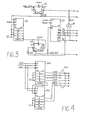
- Figure 3 shows in detail logical timing unit 20.
- It comprises two J,K flip-flops 21, 23, a 4 bit counter 22, a 4 bit shift register 25, a 2 input NAND gate 26 and a NOT gate 24.
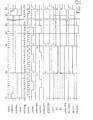
- fig. 6 shows in timing diagram the signal present in some points of the circuits of fig. 3, 4, 5 and facilitate the understanding of their operation.
- All J, K flip-flops shown herein are of the kind triggered by the po sitive edge of a signal applied to clock input CK. Such edge sets them or keeps them in-set if the logical level on their inputs J, K is 1, 1 respectively. They are reset/kept in reset if the logical level on inputs J, K is O,O respectively. They toggle if the logical level on inputs J, K is 1, O respectively. They do not toggle if the logical level on inputs J, K is O, 1 respectively.
- the set and reset inputs must be at logical level 1. These flip-flops are set, reset in an asynchronous way when a logical level 0 is applied to set, reset input respectively.
- 4 bit counters are of the kind triggered by the positive edge of a signal applied to clock input CK and are provided with a load input LD, an enabling input EN and data inputs.
- the counters have a CARRY output which, normally at logical level 1, falls to 0 when the counter is in the status of maximum count (that is 15).
- flip-flop 21 receives signal CLOCK with a 16 MHz frequency at the clock input, signal RAW DATA, in an asynchro nous way, at the J input and signal REST at the reset input. (Diagram CLOCK, RAW DATA, REST of fig. 6).
- Set input and K input of flip-flop 21 receive a signal permanently at logical level 1.
- a signal at logical level O is permanently applied to enabling input EN and to data input of counter 22.
- Output CARRY of counter 22 falls to logical level 0 after a time period corresponding to the reception of 15 CLOCK pulses.
- Such output is connected to flip-flop 23 K input.
- Flip-flop 23 receoves the clock signal at the clock input and a si- gnal T2 at the set input.
- T2 is obtained by inverting a signal T2 through NOT gate 24.
- a signal at logical level 1 and 0 is respectively applied to the reset input and to the J input of flip-flop 23.
- Flip-flop 23 delivers a signal LOAD OUT on its inverted output Q.
- Signal LOAD OUT rises from logical level 0 to logical level 1 with the rising edge of the CLOCK pulse subsequent to the one which lowe red output CARRY of counter 22 to logical level 0.
- signal LOAD OUT falls again to logical level 0 when signal T2 falls to logical level O.
- Signal LOAD OUT is sent to units 30, 40 of fig. 2.
- serial input (SI) of shift register 25 which receives the CLOCK signal on its timing input CK and a signal RESGE on its reset input R.
- RESGE falls to logical level 0 only during the initializing reset phase of the apparatus.
- Logical level 1 of signal LOAD OUT is transferred to output QA of shift register 25 with the rising edge of the CLOCK signal subsequent to the one which rose signal LOAD OUT to logical level 1.
- level 1 is shifted to outputs QB, QC of shift register 25 and to output QD in inverted form.
- timing signals T1, T2, T3, T4 (Diagram T1, T2, T3, T4 of fig. 6) are therefore present respectively.
- Such timing signals are sent to unit 30 of fig. 2.
- signal T2 resets flip-flop 23 through NOT 24, while signals T3, T4 are applied to the inputs of NAND gate 26.
- a signal REST is present on the output of such NAND gate 26 which among other things, resets flip-flop 21.
- timing unit 20 is activated by the reception of a read out pulse RAW DATA in synchronism with the next occurring CLOCK pulse and it supplies suitable timing signals STOP, LOAD OUT, T1, ... T4, REST of preestablished duration multiple of the CLOCK period.
- Figure 4 shows in detail the measurement unit 31 of fig. 2.
- It substantially consists of 2 counters 310, 311 having 4 bits suitably connected in cascade in order to constitute an 8 bit counter where the 4 bits supplied by counter 311 are the most significative ones.
- Counter 310 enabling input EN receives signal STOP while the one of counter 311 is connected to the output CARRY of counter 310.
- Each of the data inputs of counters 310, 311 receives a signal permanently at logical level 0 so as to be reset when loaded, that is at the occurrence of a rising edge of CLOCK signal with LD input at logical level 0.
- signals CNTl,... CNT6, in output from coun ters 310, 311 indicate in binary code and for multiples of 62,5 nsec. the time interval duration measured between the last and the last but one RAW DATA pulse received, less 1250 nsec.
- the binary code corresponding to decimal number N (with 0 ⁇ N ⁇ 63) in output from counter 310, 311 means a time inter val measured between two subsequent RAW DATA pulses equal to 1250+N 62,5 nsec.
- timing si gnal STOP stays at logical level 1 and for the imnediately subsequent CLOCK period.
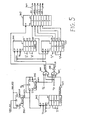
- Figure 5 shows in detail logical unit 34 detecting the speed variation that is the speed error as to the nominal one.
- Unit 34 has to operate only during the reading of preestablished fields recorded on the magnetical support, where the pulses are not affected by "peak shift” errors but only by speed errors.
- activation field for unit 34.
- the signal NOM INT rises t Q logical level 1 each time the interval between two subsequent RAW DATA pulses (in the fol lowing named "interval") differs from a nominal interval of 2 ⁇ sec. in MFM and 4 ⁇ sec. in FM, for a value not greater than a preestabli shed one, for instance ⁇ 12%
- Counter 342. and flip-flop 340, 341 constitute a network which verifies the persistence of the NOM INT condition for 17 intervals.
- Counters 346, 347 constitute a network measuring the difference between the actual duration of 16 of such 17 intervals (the first of such 17 intervals is omitted as certainly affected by peak shift error) and the duration of 16 subsequent nominal intervals.
- the measured difference is recorded into register 349 which is updated at each new difference measurement effected in correspondence of an activation field.
- Flip-flop 340 receives on its timing input the signal LOAD OUT on its inputs J, K the signal NOM INT and on its reset input the reset signal RESGE.
- a signal permanently at logical level 1 is applied to the set input of flip-flop 340.
- a signal NOM DATA present on the direct output Q of flip-flop 340, rises to logical level 1 with the rising edge of signal LOAD OUT if signal NOM INT is at logical level 1.
- the signal NOM DATA is applied to the load input LD of counter 342 which receives the signal T1 on its timing input and a signal perma nently at logical level 0 on its enabling input.
- Each of counter 342 data input receives a suitable logical level 0 or 1 in order that, at the rising edge of T1 and with signal NOM DAta at logical level 0, the counter is set at a binary value correspon ding to decimal number 14.
- Signal NOM DATA is further applied to inputs J,K and to the reset input of flip-flop 341.
- Such flip-flop receives signal T4 on its timing input and a signal permanently at logical level 1 on its set input.
- Counter 342 and flip-flop 340, 341 operation is the following.
- NOM INT is at logical level O
- flip -flop 340 is reset or kept in reset and, therefore, the logical level of signal NOM DATA at the output Q of flip-flop 34 is O.
- counter 341 is set to the binary value equivalent to number 14 and it does not increment.
- Output CARRY of counter 342 stays at logical level 1.
- Counter 342 is put in a status indicative of decimal value 15 by the immediately subsequent T1 rising edge and CARRY 342 output of counter falls to logical level O.
- signal NOM INT is kept at logical level 1 for further 16 subsequent intervals, that is during further 16 subsequent rising edges of signal LOAD OUT, signal NORM stays at logical level 1 for all those further 16 intervals and counter 342 goes on incrementing at the reception of each pulse T1.
- Figure 6 shows in timing diagram signals NOM DATA, NORM, and CARRY 342 in the case that NOM INT is kept at logical level 1 for 17 inter val at least.
- flip-flops 340, 341 are reset and counter 342 goes to the status corresponding to numeric value 14.
- Signal CARRY 342 and NORM control the operation of counters 346, 347 and register 349.
- the signal NORM is applied to a first input of NAND gate 345 which respectively receives, on the other two inputs, signal T3 and, through NOT gate 343, the signal present on the output CARRY of counter 342.
- Signal T3 and the signal present on the output of NOT gate 343 are al so respectively applied to two inputs of NAND gate 344 which receives, on a third input signal T4.
- NAND gate 345 output is connected to the input of NOT gate 348 which supplies in output a signal CLK 16.
- Signal CLK 16 is normally at 0 and rises to level 1,for the duration of two CLOCK periods,with signal T3 only after that 17 subsequent nominal intervals have been detected.
- Signal LOAD 16 is applied to load inputs LD of 4 bit counters 346, 347 which receive signal CLOCK on their timing input.
- Such counters are cascade connected in order to constitute a 8 bit counter where the most significant 4 bits are the ones of counter 347.
- the enabling input of counter 347 is connected to the output CARRY of counter 346.
- the enabling input EN of counter 346 receives signal T2.
- Each of counters 346, 347 data inputs receives a suitable level O or 1 in order that they may be preset at decimal count value 163 with rising edge of CLOCK signal when signal LOAD 16 is at logical level O.
- the counter content is then incremented by one at each rising edge of CLOCK signal when signal T2 is at logical level 0.
- Outputs C4 + C7 of counter 347 and the output C 3 of counter 346 are con, nected to as many inputs of the latchirig register 349 which receives on its clock input T signal CLK 16.
- counters 346, 347 operation is the following.
- Signal LOAD 16 falls to 0 after acknowledging of a first interval whose actual length differs from a preestablished nominal duration no more than a certain per cent value.
- Signal LOAD 16 falling to 0 causes the loading of counters 346, 347 which, straight after, as T2 is at O,start to increment at each posi tive edge of signal CLOCK.
- Counters 346, 347 are necessary to assure a stable configuration on such counter outputs at the rising edge of CLK 16.
- Counters 346, 347 therefore count the CLOCK pulses contained in an interval between two RAW DATA pulses less 2 pulses, that is 125 nsec If NOM INT is kept at 1 for further 16 intervals at least the counters continue to increment.
- tables I and II respectively supply a correspondence between some of the decimal values indicated by signals ⁇ 0 + ⁇ 4 (where ⁇ 4 is the most significant bit), the corresponding decimal values related to the information present on outputs CO + C7 (where C7 is the most significant bit) of coun ters 346, 347 and the actual number M of signal CLOCK periods detected within interval TO by counters 346, 347.
- E indicates (with an approxi mation of 1/4 of the CLOCK period) the average duration error of an in terval expressed in CLOCK periods by bits ⁇ O... ⁇ 4 as to a nominal interval having a length of 2000 nsec. in MFM and 4000 nsec in FM.
- the fifth column of tables I and II indicates the per cent error speed ⁇ V% which is related to each value ( ⁇ O + ⁇ 4) D .
- Fig. 6 shows in timing diagram sane signals men tioned in figures 3, 4; 5 description.
- signals CARRY 22, CARRY 342 are indicative of the signals present on output CARRY of counters 22, 342 respectively while (OUT 22) D and (OUT 342) D are indicative of the decimal value related to the count of counter 22 of fig. 3 and counter 342 of fig. 5 respec tively, at each CLOCK signal period.
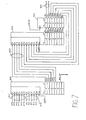
- Fig. 7 shows in detail compensation units 32 and 33 of fig. 2.
- Compensation unit 32 consists of a programmable read only memory 320 having a 4K byte capacity
- compensation unit 33 consists of pro grammable read only memory 330 having a 4K byte capacity and of a 8 bit latching register 331.
- Memory 320 receives signals CNT1 + CNT6 on its least significant address inputs IO + I5 through channel 31A, and signals do + ⁇ 4 on its most significant address inputs I6 +.I10; through channel 34A. Memory 320 receives, on its most significant address input Ill, a signal FM/MFM at logical level 1(0) in the case of information recorded in FM -(MFM) recovery.
- code CNT1 + CNT6 stands for an interval duration which differs from the nominal interval duration of 2 ⁇ sec. in FM or of 4 ⁇ sec. in MFM, by a value not higher than a certain per cent value ( ⁇ 12,5 in MFM and -11,7%+ +12,5% in FM).
- Such bit is available at a further output of memory 320 which supplies signal NOM INT to speed error detecting unit 34.
- memory 320 For each measured interval (CNT1 + CNT6) memory 320 is steadily addres sed with the rising edge of signal STOP and for the whole time such signal remains at logical level 1.
- Signal LOAD OUT which sets/resets flip-flop 340 according to the logical level of NOM INT, is generated with a delay of 1000 nsec. as to the rising edge of STOP.
- any kind of programmable memory even slow, provided it has an address selection and reading out time lower than 1000 nsec. could be used as memory 320 to assure the stable generation of signal NOM INT before signal LOAD OUT.
- Each of the possible 32 codes present at outputs SR1 + SR5 is prefera bly indicative of interval durations corrected as to speed error and variable from 2000 msec. to 3937,5 risec. by increments of 62,5 nsec.
- the peak shift phenomenon lacking speed errors, causes an in terval duration increase as to a corresponding nominal intervals of 2 ⁇ sec. and a reebuction of the intervals as to a corresponding nominal intervals of 4 ⁇ sec.
- Memory 320 programmation is obvious. Each possible code CNT1 + CNT6 is indicative of a measured interval duration.
- Such duration must be percentually reduced or increased according to the speed per cent error indicated by code ⁇ O + ⁇ 4.
- the corrected duration is indicated by its representative code and re corded into the memory location addressed by the correspondent codes CNTl + CNT6 and ⁇ 0 + ⁇ 4 and by bit FM/MFM.
- outputs SR1 + SR5 of memory 320 are connected, through channel 32A to address input IO + I4 of memory 330 and supplies them, each time, with a code indicative of the actual du ration (corrected as to speed) of the measured interval; such code is in dicated by DE N and marked with order number N.
- Memory 330 further receives signal FM/MFM on its most significant input Ill.
- the recovery that memory 330 has to perform is the reckoning of the nominal duration to be associated to code DE N bearing in mind that the duration indicated by DE N is affected by the peak shift phenomenon.
- Memory 330 also receives, on its input I5, .... I10, sane signal which will be considered later on.
- memory 330 When memory 330 is addressed by code DE N (and by the other information), it generates, on outputs AO, BO, a binary code DN N indicative of the nominal duration to be associated to the actual duration signified by code DE N .
- the information present on outputs PR1 + PR6 of memory 330 is indicative of the actual duration (corrected as to speed) of interval N, in coded form, as well as of the nominal duration associated to it and of the nominal previous duration of the interval (N-1).
- Output AO, BO PR1 PR6 of memory 330 are connected to corresponding inputs of register 331, which latches and makes the information present at its inputs available on its outputs with the rising edge of signal LOAD OUT.
- Outputs Al, A2 of register 331 are connected to unit 40 of fig. 2 through channel 33A, whi le outputs FB1 + FB6 (corresponding to outputs PR1 + FR6 of memory 330) are connected to the address inputs I6 Il0 of the same unit 40.
- the compensation operation of unit 33 is therefore the following.
- preceding signal LOAD OUT memory 330 receives in input information DEN as well as information DE N-1 , DN N-1 , DN N-2 (in case of MFM) or a non significant information (in case of FM) in feedback from register 331 outputs.
- the nominal duration DN of interval N is therefore available and it N is used by unit 40 for generating timing window signal RD CLK and for re-generating the reading pulses RD DATA.
- outputs FB1 +FB6 of register 331 are used for readdressing memory 330 and establishing the nominal duration DN N+1 of the subsequent interval N+1.
- Such code processed by unit 40, can cause a wrong generation of signals RD DATA and RD CLOCK (window).
- controller 3 (fig. 1) ignores these signals untill it detects a suitable number of synchronization field bytes (that is 2 bytes of 0 in FM or 4 bytes of 1 or 0 in MFM) and then, a preestablished code named "Address Mark” within a preestablished number of bytes.
- memory 330 when a synchronization field is read out, memory 330 generates at outputs PR1 + PR6, one of the allowable codes corresponding to the measured interval DE equal to the nominal interval DN and, during the reading out of two subsequent intervals, the code generated at outputs PR1 + PR6 is univocally established.
- the acknowledgment of a first part of the synchronization field allows to preset the speed correction unit 3 2 and the immediately sub sequent ackmowledgment of other two synchronization field intervals enables compensation unit 33 to lock to effective data stream.
- E N has a maximum absolute value when both intervals N-1, N+1 have a nominal length of 2 ⁇ sec while interval N has a nominal length of 4 ⁇ sec, or when intervals N+1, N-1 have a nominal length of 4 ⁇ sec. while interval N has a naninal length of 2 ⁇ sec.
- each pulse peak shift cannot be longer than 500 nsec, as absolute value.
- DN N (DE N -PS n-1 )-PS n is known apart from a variable factor PS shorter (in absolute value) than 500 nsec., and n the association to DN N of a nominal length of 2, 3, 4 ⁇ sec is urmista kable.
- PS n-1 F 1 (DE N-1 , DN N-1 , DN N-2 ) where F 1 is a func - tional relation which can be defined experimentally even if not easy to be analytically expressed.
- the functional relation F 2 is processed by memory 330:
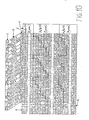
- each location is identified by a row address and a column address.
- the row address is indicative of the dura tion DE N of an interval, in coded form.
- the interval duration DE N is quoted in column A.
- the column address shown in decimal form in row C, is indicative (in coded form) of the set of information given by the actual duration DE N-1 and by the nominal durations DN N-1 , DN N-2 .
- each one of such pieces of information is the same associated to the column codes, except that the intervals to which such information refers are those of order N and N-1 instead of N-1 and N-2.
- Such code is available at outputs AO, BO of memory 330 and is quoted in column F.
- the real value is implicitily applied to PS n by an increase correction of DE N , and the longer the length DE N is the higher is the correction applied.
- Fig. 11 shows in detail regeneration logical unit 40.
- Such unit generates the square wave window signal RD CLK and the read out data or timing pulse RD DATA according to signals A1, Bl which defines the nominal duration of the measured interval and of signal LOAD OUT (such signal being generated by timing unit 20 on reception of each pulse RAW DATA with a delay of 1250 nsec rounded down to less than 62,5 nsec.).
- FM RD CLK signal In FM RD CLK signal must be respectively constituted by one, two half waves or phases for each interval of nominal duration 2, 4 ⁇ sec.
- the pulse RD DATA must be completely included within the first (and sole) or second phase of the window signal respectively.
- the window signal RD CLK must be constituted for each interval of nominal length 2, 3, 4 ⁇ sec. by two, three, four or phases half waves or phases respectively and the pulse RD DATA must be completely inclu ded within the last phase of the window signal corresponding to the in terval.
- Unit 40 consists of six J, K flip-flops 401, 402, 404, 405, 406, 409, 2 4bit counters 403, 408, a two input AND gate 411, a two input NAND gate 407 and a three input NAND gate 410.
- Flip-flop 401 receives on its timing input the signal LOAD OUT and on its reset input R a signal RES DATA.
- a signal permanently at logical level 1 is received by flip-flop 401 on the remaining inputs.
- Signal DATA PRES is present on the inverted output Q of flip-flop 401.
- Signal DATA PRES drops to logical level O with the rising edge of si- ngal LOAD OUT.
- Signal DATA PRES is applied to the set input of flip flop 402 which re ceives on its timing input a signal ACNTFF and on its reset input an initializing reset signal RESGE which is at logical level 0 only during the initializing phase.
- the J, K inputs of flip-flop 402 are connected to the CARRY output. of counter 408.
- Signal START is applied to the enabling input of counter 403 which recei ves on its clock input signal CLOCK.
- the loading input LD of counter 403 is connected to the output of AND gate 411.
- Such gate receives at its two inputs signal RESGE and a si gnal ACNTCLKFF respectively.
- Each of counter 403 data inputs receives a suitable level in order that with the rising edge of signal CLOCK and with input LD at logical le vel 0, counter 403 is preset at decimal count value 4.
- counter 403 increments the infor mation present on its outputs by one unit at each rising edge of signal CLOCK.
- Outputs CNTIA, CNT4A of counter 403 are connected to the clock input and to the J, K inputs respectively of flip-flop 404.
- Such flip-flop further receives signal RESGE and a signal permanently at logical level 1 on its set and reset inputs respectively.
- signal ACNTFF is applied to the timing input of flip-flop 402.
- the CARRY output of counter 403 is connected to inputs J, K of flip-flop 405 which further receives signal CLOCK on its clock input and a signal permanently at logical level 1 on its set S and reset R inputs.
- Signals ACNTCLKFF, ACNTCLKFF are present on outputs Q and Q respectively of flip-flop 405.
- Signal ACNTCLKFF besides being provided to an input of AND gate 411 is applied to the clock input of flip-flop 406 whose J, K inputs are con nected to the CARRY output of counter 408.
- Set and reset inputs of flip-flop 406 receive signal RESGE and a signal permanently at logical level 1 respectively.
- Signal LDCNT is applied to an input of NAND gate 407 which receives si gnal ACNTCLKFF on its second input.
- Signal ACNTCLKFF besides being provided to the input of NAND gate 407, is applied to the timing inputs of counter 408 and of flip-flop 409.
- Flip-flop 409 receives on its J, K inputs a signal at logical level 1, 0 respectively.
- flip-flop 409 receives on its set and reset inputs a signal an logical level 1, 0 respectively.
- Counter 408 receives signal LDCNT on its load input and a signal at logical level 0 on its enabling input.
- the two least significant data inputs of counter 408 are connected to outputs A1, B1 of register 331 of unit 33 of fig. 7.
- Counter 408 transfers on its outputs the information present on its da ta inputs in correspondence of the rising edge of signal ACNTCLKFF when signal LDCNT is at logical level 0.
- counter 408 increments the information present on its outputs by one unit in correspondence of a rising edge of signal ACNTCLKFF when LDCNT is at logical level 1.
- Outputs A2,-B2 of counter 408 are connected to two inputs of NAND gate 410 which receives signal ACNTFF on its third input.
- Unit 40 operatiorn can be easily understood by examining the timing dia gram of fig. 12 which shows some of the signals of fig. 11, starting from an initial reset status.
- the sequence (OUT 403) H is indicative of counter 403 status in hexadecimal code.
- Flip-flop 401 is set at the reception of the first pulse LOAD OUT (instant t1) therefore DATA PRES falls to 0 and sets flip-flop 402. START falls to 0 and enables counter 403 to count.
- ACNTCLKFF causes the reset of flip-flop 406 and LD CNT falls to 0.
- Diagram in fig. 12 shows that such pulse is received at instant t6.
- Flip-flop 401 is set at the reception of signal LOAD OUT and DATA PRES falls to 0.
- Flip-flop 402 is set and START falls to 0.
- Counter 403 starts to increment, this time starting from status D.
- (instant t7) flip-flop 405 is reset and ACNTCLKFF falls to O while ACNTCLKFF rises to 1.
- unit 40 operation is the following.
- Unit 40 is enabled by a pulse LOAD OUT.
- This first sequence is performed 1, 2, 3 times depending on the nominal duration loaded in counter 408 which may be 2, 3, 4 ⁇ sec respect vely.
- signal RD CLK toggles at the beginning of the sequence. In other words 1, 2, 3 window signal phases are generated.
- Such signal RD DATA is always within the corresponding phase.
- the diagram of fig. 12 shows the case of pulses LOAD OUT received when unit 40 is not active.
- pulse LOAD OUT may be received when the unit is still active. For instance this may occur when, in MFM, a nominal interval of 4 or 3 ⁇ sec. is followed by a nominal interval of 2 ⁇ sec.
- Unit 40 correctly operates also in this case, without information loss, if the speed error is within the range of ⁇ 12,5%.
- the second pulse is therefore received when repetition of the first se quence is still running and flip-flop 401 is already reset.
- unit 40 At the reception of the second pulse LOAD OUT flip-flop 401 is set again so, at instant t5 of the second sequence (Fig. 12), unit 40, in stead of stopping, goes on completing the second sequence.
- phase length can be obviously reduced or flip-flop 401 substituted by a FIFO memory (First In, First Out) with a logical network for reading out the information stored therein.
- FIFO memory First In, First Out
- some codes can be recorded in memory 330 which are read out by outputs PR1 + PR6 and which express in coded form the actual DE N-1 and nominal D N-1 duration of interval N-1.
Landscapes
- Engineering & Computer Science (AREA)
- Signal Processing (AREA)
- Signal Processing For Digital Recording And Reproducing (AREA)
Applications Claiming Priority (2)
| Application Number | Priority Date | Filing Date | Title |
|---|---|---|---|
| IT2341183 | 1983-10-25 | ||
| IT8323411A IT1206332B (it) | 1983-10-25 | 1983-10-25 | Apparato digitale per sistema di recupero di informazioni binarie registrate su supporti magnetici. |
Publications (3)
| Publication Number | Publication Date |
|---|---|
| EP0141028A2 true EP0141028A2 (de) | 1985-05-15 |
| EP0141028A3 EP0141028A3 (en) | 1987-12-09 |
| EP0141028B1 EP0141028B1 (de) | 1990-06-06 |
Family
ID=11206854
Family Applications (1)
| Application Number | Title | Priority Date | Filing Date |
|---|---|---|---|
| EP84107390A Expired - Lifetime EP0141028B1 (de) | 1983-10-25 | 1984-06-27 | Digitale Anordnung für ein Daten-Lesesystem von einem magnetischen Träger |
Country Status (6)
| Country | Link |
|---|---|
| US (1) | US4672482A (de) |
| EP (1) | EP0141028B1 (de) |
| JP (1) | JPS60253064A (de) |
| KR (1) | KR920003520B1 (de) |
| DE (1) | DE3482431D1 (de) |
| IT (1) | IT1206332B (de) |
Cited By (4)
| Publication number | Priority date | Publication date | Assignee | Title |
|---|---|---|---|---|
| EP0222132A3 (en) * | 1985-10-10 | 1988-10-26 | Honeywell Bull Italia S.P.A. | Digital data separator |
| EP0222133A3 (en) * | 1985-10-10 | 1988-10-26 | Honeywell Bull Italia S.P.A. | Digital data separator |
| EP0242166A3 (de) * | 1986-04-12 | 1988-12-14 | Sony Corporation | Gerät zur Übertragung von digitalen Daten |
| EP0242576A3 (en) * | 1986-04-25 | 1989-12-06 | International Business Machines Corporation | Restoring and clocking pulse width modulated data |
Families Citing this family (8)
| Publication number | Priority date | Publication date | Assignee | Title |
|---|---|---|---|---|
| US4780844A (en) * | 1986-07-18 | 1988-10-25 | Commodore-Amiga, Inc. | Data input circuit with digital phase locked loop |
| JPS6352307A (ja) * | 1986-08-20 | 1988-03-05 | Toshiba Corp | 磁気デイスク装置 |
| US4851932A (en) * | 1988-01-29 | 1989-07-25 | Storage Technology Corporation | Adaptive compensation circuit for moving data storage media |
| JP2554719B2 (ja) * | 1988-09-30 | 1996-11-13 | 株式会社東芝 | 記録データ読取り方式 |
| US5025457A (en) * | 1989-04-21 | 1991-06-18 | Codex Corporation | Synchronizing continuous bit stream oriented terminals in a communications network |
| US5543975A (en) * | 1993-11-12 | 1996-08-06 | Hewlett-Packard Company | Removal of precompensation in a write data signal from a flexible disk controller |
| JP3345515B2 (ja) * | 1994-08-31 | 2002-11-18 | アイワ株式会社 | ピークシフト補正回路およびそれを使用した磁気記録媒体再生装置 |
| US6419554B2 (en) * | 1999-06-24 | 2002-07-16 | Micron Technology, Inc. | Fixed abrasive chemical-mechanical planarization of titanium nitride |
Family Cites Families (9)
| Publication number | Priority date | Publication date | Assignee | Title |
|---|---|---|---|---|
| DE2234203A1 (de) * | 1972-07-12 | 1974-01-31 | Licentia Gmbh | Verfahren und vorrichtung zum empfang seriell ankommender, digitaler, phasenkodierter signale |
| IT1007175B (it) * | 1973-02-08 | 1976-10-30 | Siemens Ag | Circuito correttore digitale per correggere le sequenze di impulsi di lettura fornite da una memoria a strato magnetico |
| US3864735A (en) * | 1973-09-12 | 1975-02-04 | Burroughs Corp | Read/write system for high density magnetic recording |
| US4222080A (en) * | 1978-12-21 | 1980-09-09 | International Business Machines Corporation | Velocity tolerant decoding technique |
| US4344039A (en) * | 1979-03-13 | 1982-08-10 | Sanyo Electric Co., Ltd. | Demodulating circuit for self-clocking-information |
| US4298956A (en) * | 1979-05-14 | 1981-11-03 | Honeywell Information Systems Inc. | Digital read recovery with variable frequency compensation using read only memories |
| US4393458A (en) * | 1980-02-06 | 1983-07-12 | Sperry Corporation | Data recovery method and apparatus using variable window |
| JPS5720052A (en) * | 1980-07-11 | 1982-02-02 | Toshiba Corp | Input data synchronizing circuit |
| US4547890A (en) * | 1982-09-28 | 1985-10-15 | Abraham M. Gindi | Apparatus and method for forming d.c. free codes |
-
1983
- 1983-10-25 IT IT8323411A patent/IT1206332B/it active
-
1984
- 1984-06-27 DE DE8484107390T patent/DE3482431D1/de not_active Expired - Lifetime
- 1984-06-27 EP EP84107390A patent/EP0141028B1/de not_active Expired - Lifetime
- 1984-10-09 US US06/659,112 patent/US4672482A/en not_active Expired - Fee Related
- 1984-10-25 KR KR1019840006640A patent/KR920003520B1/ko not_active Expired
- 1984-10-25 JP JP59225063A patent/JPS60253064A/ja active Granted
Cited By (4)
| Publication number | Priority date | Publication date | Assignee | Title |
|---|---|---|---|---|
| EP0222132A3 (en) * | 1985-10-10 | 1988-10-26 | Honeywell Bull Italia S.P.A. | Digital data separator |
| EP0222133A3 (en) * | 1985-10-10 | 1988-10-26 | Honeywell Bull Italia S.P.A. | Digital data separator |
| EP0242166A3 (de) * | 1986-04-12 | 1988-12-14 | Sony Corporation | Gerät zur Übertragung von digitalen Daten |
| EP0242576A3 (en) * | 1986-04-25 | 1989-12-06 | International Business Machines Corporation | Restoring and clocking pulse width modulated data |
Also Published As
| Publication number | Publication date |
|---|---|
| EP0141028B1 (de) | 1990-06-06 |
| KR850003022A (ko) | 1985-05-28 |
| KR920003520B1 (ko) | 1992-05-02 |
| DE3482431D1 (de) | 1990-07-12 |
| JPS60253064A (ja) | 1985-12-13 |
| IT8323411A0 (it) | 1983-10-25 |
| JPH0566676B2 (de) | 1993-09-22 |
| EP0141028A3 (en) | 1987-12-09 |
| US4672482A (en) | 1987-06-09 |
| IT1206332B (it) | 1989-04-14 |
Similar Documents
| Publication | Publication Date | Title |
|---|---|---|
| US4596981A (en) | Synchronizing signal detecting circuit in a digital signal transmitting system | |
| US4626670A (en) | Method and system for decoding time-varying, two-frequency, coherent-phase data | |
| EP0141028A2 (de) | Digitale Anordnung für ein Daten-Lesesystem von einem magnetischen Träger | |
| US4215430A (en) | Fast synchronization circuit for phase locked looped decoder | |
| US4425646A (en) | Input data synchronizing circuit | |
| US5204513A (en) | Decoder for magnetic stripe recording | |
| US4879731A (en) | Apparatus and method for sync detection in digital data | |
| US4462051A (en) | Demodulator for an asynchronous binary signal | |
| CA1108709A (en) | Apparatus for digital data recovery from mass storage devices | |
| US4920547A (en) | Stuff synchronization circuit | |
| US3729708A (en) | Error detecting and correcting apparatus for use in a system wherein phase encoded binary information is recorded on a plural track | |
| US4516164A (en) | Apparatus for decoding video address code signals | |
| US4344039A (en) | Demodulating circuit for self-clocking-information | |
| EP0034055A2 (de) | Vorrichtung und Verfahren zur Decodierung von Daten mittels eines variablen Fensters | |
| US4443883A (en) | Data synchronization apparatus | |
| EP0195368B1 (de) | Digitales Gerät für ein Datenwiedergewinnungssystem | |
| US3815108A (en) | Self-clocking nrz recording and reproduction system | |
| US5175655A (en) | Method and apparatus for verifying a signal recorded in an encoded form on a medium | |
| EP0119445A2 (de) | Gerät zur Dekodierung phasenmodulierter Daten | |
| EP0222132B1 (de) | Trennschaltung für digitale Daten | |
| US4060837A (en) | Variable cell width recording | |
| US4053738A (en) | Programmable data envelope detector | |
| US3810233A (en) | Apparatus to detect phase encoded data being read from a data storage subsystem | |
| EP0206766B1 (de) | Aufspüren von schnellen Geschwindigkeitsänderungen bei einem Bandantrieb | |
| US3947878A (en) | Self-clocking NRZ recording and reproduction system |
Legal Events
| Date | Code | Title | Description |
|---|---|---|---|
| PUAI | Public reference made under article 153(3) epc to a published international application that has entered the european phase |
Free format text: ORIGINAL CODE: 0009012 |
|
| AK | Designated contracting states |
Designated state(s): BE CH DE FR GB LI NL SE |
|
| PUAL | Search report despatched |
Free format text: ORIGINAL CODE: 0009013 |
|
| RAP1 | Party data changed (applicant data changed or rights of an application transferred) |
Owner name: HONEYWELL BULL ITALIA S.P.A. |
|
| AK | Designated contracting states |
Kind code of ref document: A3 Designated state(s): BE CH DE FR GB LI NL SE |
|
| 17P | Request for examination filed |
Effective date: 19871201 |
|
| RAP1 | Party data changed (applicant data changed or rights of an application transferred) |
Owner name: BULL HN INFORMATION SYSTEMS ITALIA S.P.A. |
|
| 17Q | First examination report despatched |
Effective date: 19890809 |
|
| GRAA | (expected) grant |
Free format text: ORIGINAL CODE: 0009210 |
|
| AK | Designated contracting states |
Kind code of ref document: B1 Designated state(s): BE CH DE FR GB LI NL SE |
|
| PG25 | Lapsed in a contracting state [announced via postgrant information from national office to epo] |
Ref country code: SE Effective date: 19900606 Ref country code: LI Effective date: 19900606 Ref country code: CH Effective date: 19900606 Ref country code: BE Effective date: 19900606 |
|
| REF | Corresponds to: |
Ref document number: 3482431 Country of ref document: DE Date of ref document: 19900712 |
|
| ET | Fr: translation filed | ||
| REG | Reference to a national code |
Ref country code: CH Ref legal event code: PL |
|
| PLBE | No opposition filed within time limit |
Free format text: ORIGINAL CODE: 0009261 |
|
| STAA | Information on the status of an ep patent application or granted ep patent |
Free format text: STATUS: NO OPPOSITION FILED WITHIN TIME LIMIT |
|
| 26N | No opposition filed | ||
| PGFP | Annual fee paid to national office [announced via postgrant information from national office to epo] |
Ref country code: DE Payment date: 19920413 Year of fee payment: 9 |
|
| PGFP | Annual fee paid to national office [announced via postgrant information from national office to epo] |
Ref country code: GB Payment date: 19920505 Year of fee payment: 9 |
|
| PGFP | Annual fee paid to national office [announced via postgrant information from national office to epo] |
Ref country code: FR Payment date: 19920625 Year of fee payment: 9 |
|
| PGFP | Annual fee paid to national office [announced via postgrant information from national office to epo] |
Ref country code: NL Payment date: 19920630 Year of fee payment: 9 |
|
| PG25 | Lapsed in a contracting state [announced via postgrant information from national office to epo] |
Ref country code: GB Effective date: 19930627 |
|
| PG25 | Lapsed in a contracting state [announced via postgrant information from national office to epo] |
Ref country code: NL Effective date: 19940101 |
|
| NLV4 | Nl: lapsed or anulled due to non-payment of the annual fee | ||
| GBPC | Gb: european patent ceased through non-payment of renewal fee |
Effective date: 19930627 |
|
| PG25 | Lapsed in a contracting state [announced via postgrant information from national office to epo] |
Ref country code: FR Effective date: 19940228 |
|
| PG25 | Lapsed in a contracting state [announced via postgrant information from national office to epo] |
Ref country code: DE Effective date: 19940301 |
|
| REG | Reference to a national code |
Ref country code: FR Ref legal event code: ST |