EP0141173A1 - Dispergierbares Berliner Blau-Pigment - Google Patents
Dispergierbares Berliner Blau-Pigment Download PDFInfo
- Publication number
- EP0141173A1 EP0141173A1 EP84110723A EP84110723A EP0141173A1 EP 0141173 A1 EP0141173 A1 EP 0141173A1 EP 84110723 A EP84110723 A EP 84110723A EP 84110723 A EP84110723 A EP 84110723A EP 0141173 A1 EP0141173 A1 EP 0141173A1
- Authority
- EP
- European Patent Office
- Prior art keywords
- pigment
- solution
- berlin blue
- fatty acid
- salt
- Prior art date
- Legal status (The legal status is an assumption and is not a legal conclusion. Google has not performed a legal analysis and makes no representation as to the accuracy of the status listed.)
- Granted
Links
- DCYOBGZUOMKFPA-UHFFFAOYSA-N iron(2+);iron(3+);octadecacyanide Chemical compound [Fe+2].[Fe+2].[Fe+2].[Fe+3].[Fe+3].[Fe+3].[Fe+3].N#[C-].N#[C-].N#[C-].N#[C-].N#[C-].N#[C-].N#[C-].N#[C-].N#[C-].N#[C-].N#[C-].N#[C-].N#[C-].N#[C-].N#[C-].N#[C-].N#[C-].N#[C-] DCYOBGZUOMKFPA-UHFFFAOYSA-N 0.000 title claims abstract description 33
- 239000001055 blue pigment Substances 0.000 title claims abstract description 17
- 239000000049 pigment Substances 0.000 claims abstract description 47
- -1 polysiloxane Polymers 0.000 claims abstract description 22
- 239000010445 mica Substances 0.000 claims abstract description 18
- 229910052618 mica group Inorganic materials 0.000 claims abstract description 18
- 235000014113 dietary fatty acids Nutrition 0.000 claims abstract description 16
- 239000000194 fatty acid Substances 0.000 claims abstract description 16
- 229930195729 fatty acid Natural products 0.000 claims abstract description 16
- 150000004665 fatty acids Chemical class 0.000 claims abstract description 16
- 229910000000 metal hydroxide Inorganic materials 0.000 claims abstract description 15
- 150000004692 metal hydroxides Chemical class 0.000 claims abstract description 15
- 229920001296 polysiloxane Polymers 0.000 claims abstract description 14
- DIZPMCHEQGEION-UHFFFAOYSA-H aluminium sulfate (anhydrous) Chemical compound [Al+3].[Al+3].[O-]S([O-])(=O)=O.[O-]S([O-])(=O)=O.[O-]S([O-])(=O)=O DIZPMCHEQGEION-UHFFFAOYSA-H 0.000 claims abstract description 12
- 239000000203 mixture Substances 0.000 claims abstract description 8
- 239000000725 suspension Substances 0.000 claims description 23
- 238000000576 coating method Methods 0.000 claims description 16
- 239000011248 coating agent Substances 0.000 claims description 13
- 238000000034 method Methods 0.000 claims description 10
- XSQUKJJJFZCRTK-UHFFFAOYSA-N Urea Chemical compound NC(N)=O XSQUKJJJFZCRTK-UHFFFAOYSA-N 0.000 claims description 8
- 239000004202 carbamide Substances 0.000 claims description 8
- 229910052751 metal Inorganic materials 0.000 claims description 7
- 239000002184 metal Substances 0.000 claims description 7
- 238000002360 preparation method Methods 0.000 claims description 7
- 150000003839 salts Chemical class 0.000 claims description 6
- AZDRQVAHHNSJOQ-UHFFFAOYSA-N alumane Chemical class [AlH3] AZDRQVAHHNSJOQ-UHFFFAOYSA-N 0.000 claims description 5
- 229910052782 aluminium Inorganic materials 0.000 claims description 5
- XAGFODPZIPBFFR-UHFFFAOYSA-N aluminium Chemical compound [Al] XAGFODPZIPBFFR-UHFFFAOYSA-N 0.000 claims description 5
- 150000002505 iron Chemical class 0.000 claims description 5
- QAOWNCQODCNURD-UHFFFAOYSA-L Sulfate Chemical compound [O-]S([O-])(=O)=O QAOWNCQODCNURD-UHFFFAOYSA-L 0.000 claims description 4
- 239000002585 base Substances 0.000 claims description 4
- 125000004432 carbon atom Chemical group C* 0.000 claims description 3
- XLYOFNOQVPJJNP-UHFFFAOYSA-M hydroxide Chemical compound [OH-] XLYOFNOQVPJJNP-UHFFFAOYSA-M 0.000 claims description 3
- 239000007900 aqueous suspension Substances 0.000 claims description 2
- 229910052783 alkali metal Inorganic materials 0.000 claims 1
- 229940024548 aluminum oxide Drugs 0.000 claims 1
- 150000001735 carboxylic acids Chemical class 0.000 claims 1
- 150000003751 zinc Chemical class 0.000 claims 1
- UGZADUVQMDAIAO-UHFFFAOYSA-L zinc hydroxide Chemical compound [OH-].[OH-].[Zn+2] UGZADUVQMDAIAO-UHFFFAOYSA-L 0.000 claims 1
- 229910021511 zinc hydroxide Inorganic materials 0.000 claims 1
- 229940007718 zinc hydroxide Drugs 0.000 claims 1
- 239000000243 solution Substances 0.000 description 34
- XLYOFNOQVPJJNP-UHFFFAOYSA-N water Substances O XLYOFNOQVPJJNP-UHFFFAOYSA-N 0.000 description 28
- VEXZGXHMUGYJMC-UHFFFAOYSA-N Hydrochloric acid Chemical compound Cl VEXZGXHMUGYJMC-UHFFFAOYSA-N 0.000 description 9
- HEMHJVSKTPXQMS-UHFFFAOYSA-M Sodium hydroxide Chemical compound [OH-].[Na+] HEMHJVSKTPXQMS-UHFFFAOYSA-M 0.000 description 9
- 239000004721 Polyphenylene oxide Substances 0.000 description 7
- 239000002245 particle Substances 0.000 description 7
- 229920000570 polyether Polymers 0.000 description 7
- XEEYBQQBJWHFJM-UHFFFAOYSA-N Iron Chemical compound [Fe] XEEYBQQBJWHFJM-UHFFFAOYSA-N 0.000 description 6
- 238000001816 cooling Methods 0.000 description 5
- 238000003756 stirring Methods 0.000 description 5
- NLXLAEXVIDQMFP-UHFFFAOYSA-N Ammonium chloride Substances [NH4+].[Cl-] NLXLAEXVIDQMFP-UHFFFAOYSA-N 0.000 description 4
- VHUUQVKOLVNVRT-UHFFFAOYSA-N Ammonium hydroxide Chemical compound [NH4+].[OH-] VHUUQVKOLVNVRT-UHFFFAOYSA-N 0.000 description 4
- 235000011114 ammonium hydroxide Nutrition 0.000 description 4
- KPUWHANPEXNPJT-UHFFFAOYSA-N disiloxane Chemical class [SiH3]O[SiH3] KPUWHANPEXNPJT-UHFFFAOYSA-N 0.000 description 4
- UETZVSHORCDDTH-UHFFFAOYSA-N iron(2+);hexacyanide Chemical compound [Fe+2].N#[C-].N#[C-].N#[C-].N#[C-].N#[C-].N#[C-] UETZVSHORCDDTH-UHFFFAOYSA-N 0.000 description 4
- 238000001556 precipitation Methods 0.000 description 4
- CWYNVVGOOAEACU-UHFFFAOYSA-N Fe2+ Chemical compound [Fe+2] CWYNVVGOOAEACU-UHFFFAOYSA-N 0.000 description 3
- 125000000217 alkyl group Chemical group 0.000 description 3
- 238000001035 drying Methods 0.000 description 3
- QAOWNCQODCNURD-UHFFFAOYSA-N sulfuric acid Substances OS(O)(=O)=O QAOWNCQODCNURD-UHFFFAOYSA-N 0.000 description 3
- HCHKCACWOHOZIP-UHFFFAOYSA-N Zinc Chemical compound [Zn] HCHKCACWOHOZIP-UHFFFAOYSA-N 0.000 description 2
- 230000002378 acidificating effect Effects 0.000 description 2
- 150000001447 alkali salts Chemical class 0.000 description 2
- 239000013011 aqueous formulation Substances 0.000 description 2
- 229920001400 block copolymer Polymers 0.000 description 2
- 230000000694 effects Effects 0.000 description 2
- 230000007062 hydrolysis Effects 0.000 description 2
- 238000006460 hydrolysis reaction Methods 0.000 description 2
- 150000004679 hydroxides Chemical class 0.000 description 2
- 229910052725 zinc Inorganic materials 0.000 description 2
- 239000011701 zinc Substances 0.000 description 2
- VYZAMTAEIAYCRO-UHFFFAOYSA-N Chromium Chemical compound [Cr] VYZAMTAEIAYCRO-UHFFFAOYSA-N 0.000 description 1
- IAYPIBMASNFSPL-UHFFFAOYSA-N Ethylene oxide Chemical compound C1CO1 IAYPIBMASNFSPL-UHFFFAOYSA-N 0.000 description 1
- VTLYFUHAOXGGBS-UHFFFAOYSA-N Fe3+ Chemical class [Fe+3] VTLYFUHAOXGGBS-UHFFFAOYSA-N 0.000 description 1
- 101100323029 Neurospora crassa (strain ATCC 24698 / 74-OR23-1A / CBS 708.71 / DSM 1257 / FGSC 987) alc-1 gene Proteins 0.000 description 1
- GOOHAUXETOMSMM-UHFFFAOYSA-N Propylene oxide Chemical compound CC1CO1 GOOHAUXETOMSMM-UHFFFAOYSA-N 0.000 description 1
- 229910010413 TiO 2 Inorganic materials 0.000 description 1
- ATJFFYVFTNAWJD-UHFFFAOYSA-N Tin Chemical compound [Sn] ATJFFYVFTNAWJD-UHFFFAOYSA-N 0.000 description 1
- 230000002730 additional effect Effects 0.000 description 1
- 238000004220 aggregation Methods 0.000 description 1
- 230000002776 aggregation Effects 0.000 description 1
- 229910052784 alkaline earth metal Inorganic materials 0.000 description 1
- 150000001342 alkaline earth metals Chemical class 0.000 description 1
- 239000007864 aqueous solution Substances 0.000 description 1
- 150000001732 carboxylic acid derivatives Chemical class 0.000 description 1
- 238000006243 chemical reaction Methods 0.000 description 1
- 229910052804 chromium Inorganic materials 0.000 description 1
- 239000011651 chromium Substances 0.000 description 1
- 229910017052 cobalt Inorganic materials 0.000 description 1
- 239000010941 cobalt Substances 0.000 description 1
- GUTLYIVDDKVIGB-UHFFFAOYSA-N cobalt atom Chemical compound [Co] GUTLYIVDDKVIGB-UHFFFAOYSA-N 0.000 description 1
- 239000003086 colorant Substances 0.000 description 1
- 230000000052 comparative effect Effects 0.000 description 1
- 239000002537 cosmetic Substances 0.000 description 1
- 230000006866 deterioration Effects 0.000 description 1
- 239000004205 dimethyl polysiloxane Substances 0.000 description 1
- 239000006185 dispersion Substances 0.000 description 1
- 239000000839 emulsion Substances 0.000 description 1
- YAGKRVSRTSUGEY-UHFFFAOYSA-N ferricyanide Chemical compound [Fe+3].N#[C-].N#[C-].N#[C-].N#[C-].N#[C-].N#[C-] YAGKRVSRTSUGEY-UHFFFAOYSA-N 0.000 description 1
- 238000009472 formulation Methods 0.000 description 1
- 239000008240 homogeneous mixture Substances 0.000 description 1
- 229910052742 iron Inorganic materials 0.000 description 1
- 238000004519 manufacturing process Methods 0.000 description 1
- 229910044991 metal oxide Inorganic materials 0.000 description 1
- 150000004706 metal oxides Chemical class 0.000 description 1
- 239000003973 paint Substances 0.000 description 1
- 230000019612 pigmentation Effects 0.000 description 1
- 239000004033 plastic Substances 0.000 description 1
- 229920003023 plastic Polymers 0.000 description 1
- 229920000435 poly(dimethylsiloxane) Polymers 0.000 description 1
- 229920000642 polymer Polymers 0.000 description 1
- 239000000843 powder Substances 0.000 description 1
- 239000012266 salt solution Substances 0.000 description 1
- 229920006395 saturated elastomer Polymers 0.000 description 1
- 239000000344 soap Substances 0.000 description 1
- RYYKJJJTJZKILX-UHFFFAOYSA-M sodium octadecanoate Chemical compound [Na+].CCCCCCCCCCCCCCCCCC([O-])=O RYYKJJJTJZKILX-UHFFFAOYSA-M 0.000 description 1
- 159000000000 sodium salts Chemical class 0.000 description 1
- 239000007858 starting material Substances 0.000 description 1
- 239000011135 tin Substances 0.000 description 1
- 229910052718 tin Inorganic materials 0.000 description 1
Classifications
-
- C—CHEMISTRY; METALLURGY
- C09—DYES; PAINTS; POLISHES; NATURAL RESINS; ADHESIVES; COMPOSITIONS NOT OTHERWISE PROVIDED FOR; APPLICATIONS OF MATERIALS NOT OTHERWISE PROVIDED FOR
- C09C—TREATMENT OF INORGANIC MATERIALS, OTHER THAN FIBROUS FILLERS, TO ENHANCE THEIR PIGMENTING OR FILLING PROPERTIES ; PREPARATION OF CARBON BLACK ; PREPARATION OF INORGANIC MATERIALS WHICH ARE NO SINGLE CHEMICAL COMPOUNDS AND WHICH ARE MAINLY USED AS PIGMENTS OR FILLERS
- C09C1/00—Treatment of specific inorganic materials other than fibrous fillers; Preparation of carbon black
- C09C1/22—Compounds of iron
- C09C1/26—Iron blues
-
- C—CHEMISTRY; METALLURGY
- C09—DYES; PAINTS; POLISHES; NATURAL RESINS; ADHESIVES; COMPOSITIONS NOT OTHERWISE PROVIDED FOR; APPLICATIONS OF MATERIALS NOT OTHERWISE PROVIDED FOR
- C09C—TREATMENT OF INORGANIC MATERIALS, OTHER THAN FIBROUS FILLERS, TO ENHANCE THEIR PIGMENTING OR FILLING PROPERTIES ; PREPARATION OF CARBON BLACK ; PREPARATION OF INORGANIC MATERIALS WHICH ARE NO SINGLE CHEMICAL COMPOUNDS AND WHICH ARE MAINLY USED AS PIGMENTS OR FILLERS
- C09C3/00—Treatment in general of inorganic materials, other than fibrous fillers, to enhance their pigmenting or filling properties
- C09C3/12—Treatment with organosilicon compounds
-
- C—CHEMISTRY; METALLURGY
- C09—DYES; PAINTS; POLISHES; NATURAL RESINS; ADHESIVES; COMPOSITIONS NOT OTHERWISE PROVIDED FOR; APPLICATIONS OF MATERIALS NOT OTHERWISE PROVIDED FOR
- C09C—TREATMENT OF INORGANIC MATERIALS, OTHER THAN FIBROUS FILLERS, TO ENHANCE THEIR PIGMENTING OR FILLING PROPERTIES ; PREPARATION OF CARBON BLACK ; PREPARATION OF INORGANIC MATERIALS WHICH ARE NO SINGLE CHEMICAL COMPOUNDS AND WHICH ARE MAINLY USED AS PIGMENTS OR FILLERS
- C09C1/00—Treatment of specific inorganic materials other than fibrous fillers; Preparation of carbon black
- C09C1/0015—Pigments exhibiting interference colours, e.g. transparent platelets of appropriate thinness or flaky substrates, e.g. mica, bearing appropriate thin transparent coatings
-
- C—CHEMISTRY; METALLURGY
- C01—INORGANIC CHEMISTRY
- C01P—INDEXING SCHEME RELATING TO STRUCTURAL AND PHYSICAL ASPECTS OF SOLID INORGANIC COMPOUNDS
- C01P2006/00—Physical properties of inorganic compounds
- C01P2006/22—Rheological behaviour as dispersion, e.g. viscosity, sedimentation stability
-
- C—CHEMISTRY; METALLURGY
- C09—DYES; PAINTS; POLISHES; NATURAL RESINS; ADHESIVES; COMPOSITIONS NOT OTHERWISE PROVIDED FOR; APPLICATIONS OF MATERIALS NOT OTHERWISE PROVIDED FOR
- C09C—TREATMENT OF INORGANIC MATERIALS, OTHER THAN FIBROUS FILLERS, TO ENHANCE THEIR PIGMENTING OR FILLING PROPERTIES ; PREPARATION OF CARBON BLACK ; PREPARATION OF INORGANIC MATERIALS WHICH ARE NO SINGLE CHEMICAL COMPOUNDS AND WHICH ARE MAINLY USED AS PIGMENTS OR FILLERS
- C09C2200/00—Compositional and structural details of pigments exhibiting interference colours
- C09C2200/10—Interference pigments characterized by the core material
- C09C2200/102—Interference pigments characterized by the core material the core consisting of glass or silicate material like mica or clays, e.g. kaolin
-
- C—CHEMISTRY; METALLURGY
- C09—DYES; PAINTS; POLISHES; NATURAL RESINS; ADHESIVES; COMPOSITIONS NOT OTHERWISE PROVIDED FOR; APPLICATIONS OF MATERIALS NOT OTHERWISE PROVIDED FOR
- C09C—TREATMENT OF INORGANIC MATERIALS, OTHER THAN FIBROUS FILLERS, TO ENHANCE THEIR PIGMENTING OR FILLING PROPERTIES ; PREPARATION OF CARBON BLACK ; PREPARATION OF INORGANIC MATERIALS WHICH ARE NO SINGLE CHEMICAL COMPOUNDS AND WHICH ARE MAINLY USED AS PIGMENTS OR FILLERS
- C09C2200/00—Compositional and structural details of pigments exhibiting interference colours
- C09C2200/30—Interference pigments characterised by the thickness of the core or layers thereon or by the total thickness of the final pigment particle
- C09C2200/301—Thickness of the core
-
- C—CHEMISTRY; METALLURGY
- C09—DYES; PAINTS; POLISHES; NATURAL RESINS; ADHESIVES; COMPOSITIONS NOT OTHERWISE PROVIDED FOR; APPLICATIONS OF MATERIALS NOT OTHERWISE PROVIDED FOR
- C09C—TREATMENT OF INORGANIC MATERIALS, OTHER THAN FIBROUS FILLERS, TO ENHANCE THEIR PIGMENTING OR FILLING PROPERTIES ; PREPARATION OF CARBON BLACK ; PREPARATION OF INORGANIC MATERIALS WHICH ARE NO SINGLE CHEMICAL COMPOUNDS AND WHICH ARE MAINLY USED AS PIGMENTS OR FILLERS
- C09C2200/00—Compositional and structural details of pigments exhibiting interference colours
- C09C2200/40—Interference pigments comprising an outermost surface coating
- C09C2200/401—Inorganic protective coating
-
- C—CHEMISTRY; METALLURGY
- C09—DYES; PAINTS; POLISHES; NATURAL RESINS; ADHESIVES; COMPOSITIONS NOT OTHERWISE PROVIDED FOR; APPLICATIONS OF MATERIALS NOT OTHERWISE PROVIDED FOR
- C09C—TREATMENT OF INORGANIC MATERIALS, OTHER THAN FIBROUS FILLERS, TO ENHANCE THEIR PIGMENTING OR FILLING PROPERTIES ; PREPARATION OF CARBON BLACK ; PREPARATION OF INORGANIC MATERIALS WHICH ARE NO SINGLE CHEMICAL COMPOUNDS AND WHICH ARE MAINLY USED AS PIGMENTS OR FILLERS
- C09C2200/00—Compositional and structural details of pigments exhibiting interference colours
- C09C2200/40—Interference pigments comprising an outermost surface coating
- C09C2200/402—Organic protective coating
- C09C2200/403—Low molecular weight materials, e.g. fatty acids
-
- C—CHEMISTRY; METALLURGY
- C09—DYES; PAINTS; POLISHES; NATURAL RESINS; ADHESIVES; COMPOSITIONS NOT OTHERWISE PROVIDED FOR; APPLICATIONS OF MATERIALS NOT OTHERWISE PROVIDED FOR
- C09C—TREATMENT OF INORGANIC MATERIALS, OTHER THAN FIBROUS FILLERS, TO ENHANCE THEIR PIGMENTING OR FILLING PROPERTIES ; PREPARATION OF CARBON BLACK ; PREPARATION OF INORGANIC MATERIALS WHICH ARE NO SINGLE CHEMICAL COMPOUNDS AND WHICH ARE MAINLY USED AS PIGMENTS OR FILLERS
- C09C2200/00—Compositional and structural details of pigments exhibiting interference colours
- C09C2200/40—Interference pigments comprising an outermost surface coating
- C09C2200/402—Organic protective coating
- C09C2200/407—Organosilicon materials, e.g. silanes, silicones
-
- Y—GENERAL TAGGING OF NEW TECHNOLOGICAL DEVELOPMENTS; GENERAL TAGGING OF CROSS-SECTIONAL TECHNOLOGIES SPANNING OVER SEVERAL SECTIONS OF THE IPC; TECHNICAL SUBJECTS COVERED BY FORMER USPC CROSS-REFERENCE ART COLLECTIONS [XRACs] AND DIGESTS
- Y10—TECHNICAL SUBJECTS COVERED BY FORMER USPC
- Y10T—TECHNICAL SUBJECTS COVERED BY FORMER US CLASSIFICATION
- Y10T428/00—Stock material or miscellaneous articles
- Y10T428/29—Coated or structually defined flake, particle, cell, strand, strand portion, rod, filament, macroscopic fiber or mass thereof
- Y10T428/2982—Particulate matter [e.g., sphere, flake, etc.]
- Y10T428/2991—Coated
- Y10T428/2993—Silicic or refractory material containing [e.g., tungsten oxide, glass, cement, etc.]
Definitions
- the invention relates to a dispersible Berlin blue pigment, Berlin blue being deposited on mica platelets.
- the task therefore was to find Berlin blue pigments that can be dispersed well not only in aqueous formulations but also in organic formulations.
- the invention therefore relates to a dispersible Berlin blue pigment, Berlin blue being deposited on mica platelets, which is characterized in that the pigment is additionally coated with a first layer of basic aluminum sulfate and a second layer of a mixture of a metal hydroxide with a polysiloxane or a fatty acid is coated.
- the invention also relates to a process for the preparation of a dispersible Berlin blue pigment, in which mica in aqueous suspension is mixed with the solution of a cyanoferrate and an iron salt and then optionally oxidized, and the mica pigment thus coated with Berlin blue is separated off, washed and dried , which is characterized in that after coating with Berlin blue, the suspension first with an aluminum salt, a sulfate and a base and then simultaneously with the solution of a poorly soluble hydroxide-forming metal salt and the solution of a polysiloxane or the solution of an alkali salt of a fatty acid is added and the pigment is then separated off, washed and dried.
- the invention also relates to the use of such a pigment in the preparation of preparations containing organic media.
- the production of the pigments according to the invention is based on the z. B. known processes described in DE 23 13 332, US 40 47 969 and US 43 09 480.
- mica platelets with a size of approximately 1 to 200 ⁇ m and a thickness of approximately 0.1 to 5 ⁇ m are suspended in water and, at a suitable pH approximately between 3 and 9, one after the other or simultaneously with an iron salt solution and a hexacyanoferrate solution.
- a layer of a poorly soluble iron (II) or iron (III) salt or oxide hydrate can first be deposited, which can then be mixed with a hexacyanoferrate (II) or hexacyanoferrate (III) directly to Berlin blue or initially to colorless iron (II ) -Hexacyanoferrat (II) is implemented, which is then oxidized to Berlin blue.
- Berlin blue or iron (II) hexacyanoferrate (II) can also be deposited directly, in the latter case again being oxidized to Berlin blue.
- the precipitation can optionally be carried out with an excess of iron salt corresponding to US 40 47 969 or in the presence of an aluminum salt corresponding to US 43 09 480.
- Mica as the starting material can also be used with metal oxides, in particular TiO 2 , coated mica platelets. All of these processes are described in the patents mentioned and the literature cited therein and are used in the same manner in the process according to the invention.
- the pigments obtained in this way generally have a Berlin blue content of about 4 to 50, preferably about 20 to 40,% by weight.
- these pigments are first coated with a thin layer of basic aluminum sulfate.
- the pigment suspension is adjusted to a pH of about 3 to about 8 and a solution of an aluminum salt and a solution of a sulfate are added, the pH of the suspension being kept constant by adding a base.
- a preferred procedure in which a particularly homogeneous precipitation is achieved is that the aluminum salt and the sulfate of the acidic pigment suspension are added, with no precipitation taking place yet, and that the precipitation is induced by adding urea and its hydrolysis at elevated temperature. In this way, about 0.01 to 2, preferably about 0.1 to 1% by weight of basic aluminum sulfate, based on the aluminum contained therein and based on the total pigment weight, is applied.
- the coating with the basic aluminum sulfate alone brings about a significant improvement in the dispersibility.
- an additional effect can be achieved by a second coating with a polysiloxane and a metal hydroxide or a fatty acid and a metal hydroxide.
- the pigment suspension is adjusted to a pH of about 2 to about 7 and mixed with the solution of a polysiloxane and the solution of a metal salt which forms a poorly soluble hydroxide.
- polyorganosiloxanes are used as polysiloxanes, e.g. Polyether siloxanes. These are block copolymers made from a linear or branched polysiloxane block, e.g. a polydimethylsiloxane, and one or more polyether blocks.
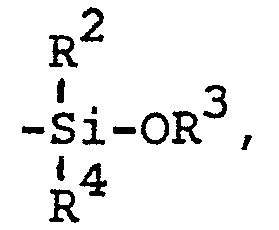
- Polysiloxanes for the purposes of this application are accordingly branched block copolymers consisting of polysiloxane sequences of the type where R 1 and R 3 are the same H, alkyl or polyether and R 2 and R 4 are the same Means alkyl or polyether.
- the polymers have a viscosity of approximately 20 - 20,000 mm2. sec at 25 ° C, molecular weights of about 500 to 5000 and are water and oil-soluble due to the ratio of branched to unbranched alkyl chains in the polyether sequences of, for example, 50% ethylene oxide to 50% propylene oxide.
- the polyether side chains attached to the polysiloxane skeleton in a comb-like manner are at least partially cleaved hydrolytically under the reaction conditions, as a result of which coordination points on the polysiloxane skeleton for the precipitated metal hydroxide are released.
- the polysiloxane is used in an approximately 2 to approximately 20% by weight solution or emulsion.
- the amount of the solution added to the pigment suspension is measured so that the polysiloxane contained in the solution makes up about 0.1 to about 40% by weight of the pigment. It should be noted that not all of the amount of siloxane is deposited on the pigment, but some remains in solution.
- the coated pigment therefore generally contains about 0.01 to about 5, in particular about 0.1 to 2,% by weight, based on Si0 2 and based on the total pigment weight.
- the metal hydroxides to be precipitated at the same time are the hydroxides of the alkaline earth metals, of aluminum, tin, zinc, iron, cobalt and chromium. Aluminum and zinc are particularly preferred. It is essential that the solution of the metal salts which form these hydroxides is added to the pigment suspension at the same time as the polysiloxane solution so that a homogeneous mixture can take place.
- the metal hydroxides are generally found in amounts of approximately 0.1 to 5% by weight, preferably approximately 0.5 to 3% by weight.
- the pigment suspension is adjusted to a pH of about 3 to about 7 and with the solution of an alkali salt of a fatty acid, in particular a monobasic, saturated or unsaturated carboxylic acid 4 to 30, preferably 10 to 20 carbon atoms added.
- the approximately 0.5 to approximately 5% by weight solution is added in an amount such that a content of approximately 0.01 to 2, preferably approximately 0.1 to 1% by weight of the respective fatty acid results in the finished pigment .
- a metal hydroxide is precipitated together with the fatty acid, it also being essential that the addition of the fatty acid and the metal salt which forms a poorly soluble hydroxide is carried out simultaneously.
- the corresponding metal soaps are mainly formed on the pigment surface.
- the type and amount of metal hydroxides are selected in the same way as for the siloxane post-coating.
- With relatively high levels of basic aluminum sulfate and metal hydroxide plus fatty acid there is a further surprising advantage of the pigments according to the invention. It is known that in Berlin blue pigments there is a dependence of the body color on the residual water content of the sample. This is noticeable in the fact that with increasing drying time there is both a shift in color to the reddish tinge and a decrease in brightness.
- the content of basic aluminum sulfate should be about 0.5-20% by weight, preferably 5-10% by weight, based on the total pigment weight.
- the metal hydroxide used for the second post-coating is used to achieve this effect in quantities of about 0.1-5% by weight, preferably about 0.5-2% by weight, based in each case on the total weight of the finished pigment.
- the pigment suspension is optionally stirred for some time, and the pigments are then separated off in a customary manner, optionally washed and dried.
- the pigments can then be used for all purposes, e.g. in cosmetics, but also in the pigmentation of plastics, paints and colors. Because of the significantly improved dispersibility in organic media, the use in preparations containing such media is also preferred.
- a suspension of 105 g of a pigment produced according to Example 4 of US Pat. No. 4,3 09,480 with a particle size of 1 to 15 ⁇ m and a Berlin blue content of 5.7% by weight in 900 ml of water is prepared analogously to Example 1 using 18 g urea, 4 g AlC1 3 x 6 H 2 O, 24 g NH 4 Cl and 2 g (NH 4 ) 2 S0 4 coated with basic aluminum sulfate.
- the pH of the suspension is adjusted to 5.0 with concentrated hydrochloric acid, and a solution of 4 g of siloxane Tego 281 and 4.75 g of A1C1 3 ⁇ 6 H 2 0 in is obtained within 27 minutes 250 ml of water were added dropwise, the pH being kept largely constant by simultaneous addition of 1% sodium hydroxide solution. After stirring for 1.5 hours, the mixture is separated off, washed with 8 l of water and dried at 120.degree.
- a suspension of 50 g of a Berlin blue pigment produced according to Example 8 of DOS 23 13 332 with a particle size of 1 to 15 ⁇ m and a content of Berlin blue of approximately 31% by weight in 600 ml of water is analogous to Example 1 using 9 g urea, 2 g A1C1 3 x 6 H 2 0, 12 g NH 4 C1 and 1 g (NH 4 ) 2 SO 4 coated with basic aluminum sulfate. After cooling to 60 ° C., coating is carried out analogously to Example 2 using 2 g of Tego 281 siloxane and 2.4 g of AlCl 3 ⁇ 6 H 2 O.
- a suspension of 13 g of a corresponding to Example 1 using 9 g of mica, 4.5 g of FeSO 4 x 7 H 2 O, 0.2 ml of concentrated sulfuric acid and 6 g of K 4 [Fe (CN) 6 ] x 3 H 2 Berlin blue pigments produced with a particle size of 1 to 15 ⁇ m in 200 ml of water are also prepared in accordance with Example 1 using 1.6 g of urea, 0.4 g of AlC13 ⁇ 6 H 2 O, 2.2 g of NH 4 Cl and 0.2 g (NH 4 ) 2 S0 4 coated with basic aluminum sulfate.
- the pH of the suspension is adjusted to 7.0 with a 2% ammonia solution, and a solution of 0.4 g of Siloxan Tego 281 in 50 ml of water and a solution of 0 are obtained within 16 minutes , 58 g of ZnS0 4 x 7 H 2 0 were simultaneously added dropwise in 50 ml of water, the pH being kept largely constant by the simultaneous addition of 2% ammonia solution. After stirring for 45 minutes, the mixture is separated off, washed and dried at 120.degree.
- a suspension of 50 g of one according to Example 1 using 34.5 g of mica, 17.25 g of FeSO 4 x 7 H 2 O, 0.7 ml of concentrated sulfuric acid and 23.2 g of K 4 [Fe (Cn) 6 ] x 3 H 2 0 prepared Berlin blue pigment with a particle size of 1 to 15 pm in 850 ml of water is also according to Example 1 using 6.2 g of urea, 1.4 g of AlCl 3 x 6 H 2 0, 8, 3 g NH 4 Cl and 0.7 g (NH 4 ) 2 SO 4 coated with basic aluminum sulfate.
- the pH of the suspension is adjusted to 5.0 with 10% hydrochloric acid, and within 20 minutes a solution of 1.9 g of A1C13 x 6 H 2 0 in 100 ml of water and a solution of 0.5 g of a mixture of the sodium salts of C 14 to C 18 fatty acids (Edenor SJ from Henkel) are added dropwise in 100 ml of water, the pH being kept largely constant by simultaneous addition of dilute hydrochloric acid. After stirring for an hour, the mixture is separated off, washed and dried at 120.degree.
- a Berlin blue pigment produced according to Example 6a) was separated off without further coating, washed with water and dried at 110 ° C.
- a pigment coated according to Example 6b shows improved dispersibility and, when applied to the skin, a softer one Feeling.
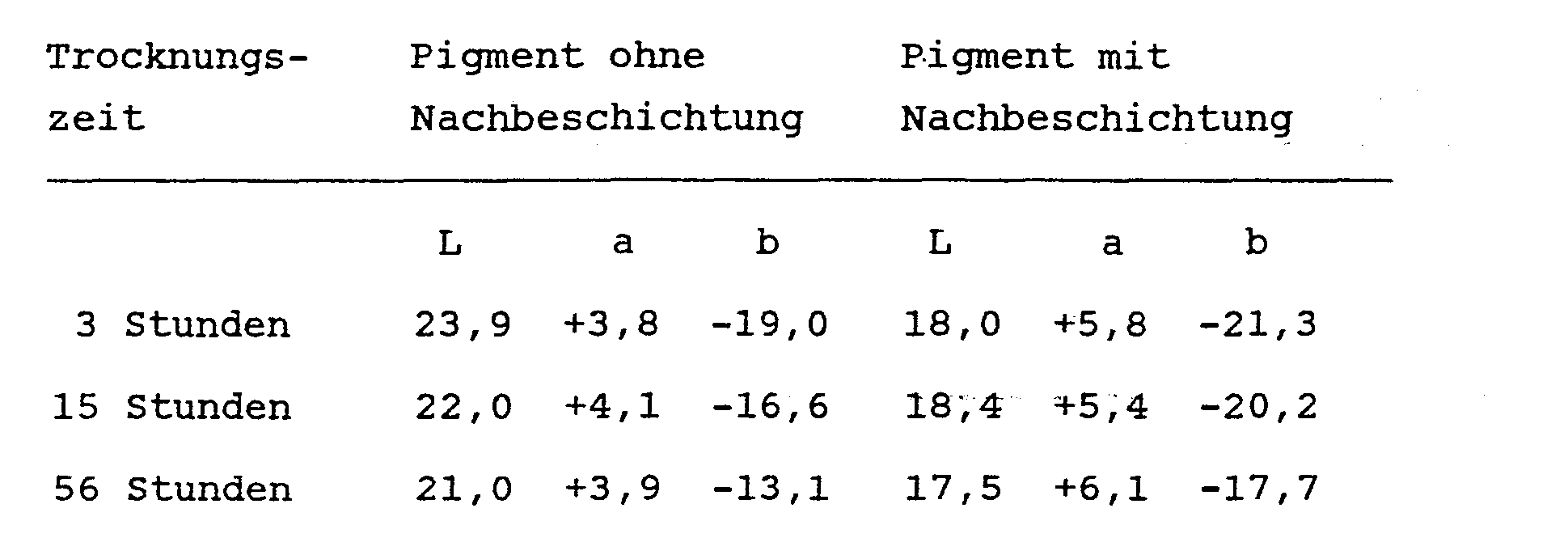
- the color values of the post-coated sample compared to the uncoated pigment, measured with a color measuring device (Hunterlab) on the powders show the higher color strength of the post-coated pigment and the lower decrease in the brightness of this sample during drying.
- the following table shows the L, a, b values as a function of the drying time at 110 ° C.
Landscapes
- Chemical & Material Sciences (AREA)
- Organic Chemistry (AREA)
- Pigments, Carbon Blacks, Or Wood Stains (AREA)
Abstract
Description
- Die Erfindung betrifft ein disperigierbares Berliner Blau-Pigment, wobei Berliner Blau auf Glimmerplättchen abgeschieden ist.
- Es ist bekannt, daß die schlechte Dispergierbarkeit von pulverförmigen Berliner Blau-Pigmenten dadurch verbessert werden kann, daß man das Berliner Blau-Pigment in dünner Schicht auf Glimmerplättchen fixiert. Solche Pigmente,. die z.B. in den Patenten DE 23 13 332, US 4 047 969 und US 43 09 480 beschrieben sind, bestehen aus Glimmerplättchen, die mit unlöslichem Berliner Blau beschichtet sind. Durch Fixierung der Pigmentteilchen auf der Glimmeroberfläche wird deren Zusammenlagerung zu grösseren Aggregaten, die bei der Dispergierung wieder zerlegt werden müßten, vermieden. Tatsächlich lassen sich solche Pigmente gut in Wasser dispergieren. Die Dispergierbarkeit in organischen Medien ist jedoch nach wie vor nicht zufriedenstellend.
- Es bestand deshalb die Aufgabe, Berliner Blau-Pigmente zu finden, die nicht nur in wässerigen, sondern auch in organischen Formulierungen gut dispergiert werden können.
- Diese Aufgabe wurde dadurch gelöst, daß die bekannten Pigmente mit einer in zwei Stufen aufgebrachten Nachbeschichtung belegt werden, wodurch eine teilweise Hydrophobierung erreicht wird.
- Gegenstand der Erfindung ist daher eine dispergierbares Berliner Blau-Pigment, wobei Berliner Blau auf Glimmerplättchen abgeschieden ist, das dadurch gekennzeichnet ist, daß das Pigment zusätzlich mit einer ersten Schicht von basischem Aluminiumsulfat und einer zweiten Schicht einer Mischung eines Metallhydroxids mit einem Polysiloxan oder einer Fettsäure beschichtet ist.
- Gegenstand der Erfindung ist auch ein Verfahren zur Herstellung eines dispergierbaren Berliner Blau-Pigments, wobei Glimmer in wässeriger Suspension mit der Lösung eines Cyanoferrats und eines Eisensalzes versetzt und danach gegebenenfalls oxidiert wird und das so erhaltene mit Berliner Blau beschichtete Glimmerpigment abgetrennt, gewaschen und getrockent wird, das dadurch gekennzeichnet ist, daß nach der Beschichtung mit Berliner Blau die Suspension zunächst mit einem Aluminiumsalz, einem Sulfat und einer Base und danach gleichzeitig mit der Lösung eines ein schwer lösliches Hydroxid bildenden Metallsalzes und der Lösung eines Polysiloxans oder der Lösung eines Alkalisalzes einer Fettsäure versetzt wird und das Pigment danach abgetrennt, gewaschen und getrocknet wird.
- Schließlich ist Gegenstand der Erfindung auch die Verwendung eines solchen Pigments bei der Herstellung von organische Medien enthaltenden Zubereitungen.
- Überraschenderweise muß durch die erfindungsgemäße Verbesserung der Dispergierbarkeit in organischen Medien keine Verschlechterung der Dispergierbarkeit in wässerigen Formulierungen in Kauf genommen werden. Weiterhin wird überraschenderweise festgestellt, daß die Pigmente durch die erfindungsgemäße Nachbeschichtung eine intensivere Körperfarbe erhalten.
- Die Herstellung der erfindungsgemäßen Pigmente orientiert sich an den z. B. in DE 23 13 332, US 40 47 969 und US 43 09 480 beschriebenen bekannten Verfahren. Dabei werden Glimmerplättchen einer Größe von etwa 1 bis 200 pm und einer Dicke von etwa 0,1 bis 5 µm in Wasser suspendiert und bei einem geeigneten pH-Wert etwa zwischen 3 und 9 nacheinander oder gleichzeitig mit einer Eisensalzlösung und einer Hexacyanoferrat-lösung versetzt. Dabei kann zunächst eine Schicht eines schwer löslichen Eisen(II)- oder Eisen(III)-Salzes bzw. Oxidhydrats abgeschieden werden, die dann mit einem Hexacyanoferrat(II) oder Hexacyanoferrat(III) direkt zu Berliner Blau oder zunächst zum farblosen Eisen(II)-Hexacyanoferrat(II) umgesetzt wird, das dann zu Berliner Blau oxidiert wird. Es kann aber durch gleichzeitige Zugabe des Eisensalzes und der Hexacyanoferrat-Lösung auch direkt die Abscheidung von Berliner Blau bzw. Eisen(II)-Hexacyanoferrat(II) erfolgen, wobei sich im letzteren Fall wieder eine Oxidation zum Berliner Blau anschließt. Die Fällung kann gegebenenfalls mit einem Überschuß von Eisensalz entsprechend US 40 47 969 oder auch in Gegenwart eines Aluminiumsalzes entsprechend US 43 09 480 erfolgen. Anstelle von Glimmer als Ausgangsmaterial können auch mit Metalloxiden, insbesondere Ti02, überzogene Glimmerplättchen eingesetzt werden. Alle diese Verfahren sind in den genannten Patenten und der darin zitierten Literatur beschrieben und werden im erfindungsgemäßen Verfahren in gleicher Weise verwendet. Die dabei erhaltenen Pigmente haben in der Regel einen Gehalt an Berliner Blau von etwa 4 bis 50, vorzugsweise etwa 20 bis 40 Gew.%.
- Nach dem erfindungsgemäßen Verfahren werden diese Pigmente zunächst mit einer dünnen Schicht von basischem Aluminiumsulfat überzogen. Dazu wird die Pigmentsuspension auf einen pH-Wert von etwa 3 bis etwa 8 eingestellt und mit der Lösung eines Aluminiumsalzes und der Lösung eines Sulfats versetzt, wobei durch Zugabe einer Base der pH-Wert der Suspension konstant gehalten wird. Eine bevorzugte Verfahrensweise, bei der eine besonders homogene Fällung erzielt wird, besteht darin, daß man das Aluminiumsalz und das Sulfat der sauren Pigmentsuspension zugibt, wobei noch keine Ausfällung erfolgt und daß man die Fällung durch Zugabe von Harnstoff und dessen Hydrolyse bei erhöhter Temperatur induziert. Auf diese Weise werden etwa 0,01 bis 2, vorzugsweise etwa 0,1 bis 1 Gew.% an basischem Aluminiumsulfat, bezogen auf das darin enthaltene Aluminium und bezogen auf-das gesamte Pigmentgewicht, aufgebracht.
- Die Beschichtung mit dem basischen Aluminiumsulfat allein bringt bereits eine wesentliche Verbesserung der Dispergierbarkeit. Ein zusätzlicher Effekt kann jedoch noch durch eine Zweitbeschichtung mit einem Polysiloxan und einem Metallhydroxid oder einer Fettsäure und einem Metallhydroxid erzielt werden.
- Zur Beschichtung mit dem Polysiloxan und einem Metallhydroxid wird die Pigmentsuspension auf einen pH-Wert von etwa 2 bis etwa 7 eingestellt und mit der Lösung eines Polysiloxans und der Lösung eines ein schwerlösliches Hydroxid bildenden Metallsalzes versetzt. Als Polysiloxane werden insbesondere Polyorganosiloxane eingesetzt, wie z.B. Polyethersiloxane. Dies sind Blockcopolymere, die aus einem linearen oder verzweigten Polysiloxanblock, z.B. einem Polydimethylsiloxan, und einem oder mehreren Polyetherblöcken aufgebaut sind.
- Polysiloxane im Sinne dieser Anmeldung sind demgemäß verzweigte Blockcopolymere bestehend aus Polysiloxanseqmenten des Typs


- Die kammartig an dem Polysiloxangerüst angebrachten Polyetherseitenketten werden unter den Reaktionsbedingungen zumindest teilweise hydrolytisch abgespalten, wodurch an dem Polysiloxangerüst Koordinationsstellen für das mitgefällte Metallhydroxid frei werden.
- Das Polysiloxan wird in einer etwa 2 bis etwa 20 Gew.%- igen Lösung bzw. Emulsion eingesetzt. Die Menge der zu der Pigmentsuspension zugegebenen Lösung wird so bemessen, daß das in der Lösung enthaltene Polysiloxan etwa 0,1 bis etwa 40 Gew.% des Pigments ausmacht. Dabei ist zu beachten, daß nicht die gesamte Siloxanmenge auf dem Pigment abgeschieden wird, sondern ein Teil in Lösung verbleibt. Im beschichteten Pigment finden sich daher in der Regel etwa 0,01 bis etwa 5, insbesondere etwa 0,1 bis 2 Gew.%, bezogen auf Si02 und bezogen auf das gesamte Pigmentgewicht.
- Als gleichzeitig zu fällende Metallhydroxide kommen die Hydroxide der Erdalkalimetalle, von Aluminium, Zinn, Zink, Eisen, Kobalt und Chrom in Frage. Bevorzugt werden insbesondere Aluminium und Zink. Wesentlich ist, daß die Lösung der Metallsalze, die diese Hydroxide bilden, gleichzeitig mit der Polysiloxan-Lösung der Pigmentsuspension zugegeben wird, damit eine homogene Mischung erfolgen kann. Die Metallhydroxide werden in der Regel in Mengen von etwa 0,1 bis 5 Gew.%, vorzugsweise von etwa 0,5 bis 3 Gew.% aufgefällt.
- Falls als zweite Nachbeschichtung eine Beschichtung mit Fettsäure plus Metallhydroxid erfolgt wird die Pigmentsuspension auf einen pH-Wert von etwa 3 bis etwa 7 eingestellt und mit der Lösung eines Alkalisalzes einer Fettsäure, insbesondere einer einbasischen, gesättigten oder ungesättigten Carbonsäure mit 4 bis 30, vorzugsweise 10 bis 20 C-Atomen versetzt. Die etwa 0,5 bis etwa 5 Gew.%ige Lösung wird in einer solchen Menge zugegeben, daß sich ein Gehalt von etwa 0,01 bis 2, vorzugsweise von etwa 0,1 bis 1 Gew.% der jeweiligen Fettsäure im fertigen Pigment ergibt.
- Zusammen mit der Fettsäure wird auch hier ein Metallhydroxid zur Ausfällung gebracht, wobei ebenfalls wesentlich ist, daß die Zugabe der Fettsäure und des ein schwerlösliches Hydroxid bildenden Metallsalzes gleichzeitig erfolgt. Auf der Pigmentoberfläche kommt es dabei hauptsächlich zur Bildung der entsprechenden Metallseifen. Art und Menge der Metallhydroxide werden in gleicher Weise gewählt wie bei der Siloxannachbeschichtung. Bei relativ hohen Gehalten an basischem Aluminiumsulfat und an Metallhydroxid plus Fettsäure ergibt sich ein weiterer überraschender Vorteil der erfindungsgemäßen Pigmente. Es ist nämlich bekannt, daß bei Berliner Blau-Pigmenten eine Abhängigkeit der Körperfarbe vom Restwassergehalt der Probe besteht. Dies macht sich dadurch bemerkbar, daß mit zunehmender Trocknungsdauer sowohl eine Farbverschiebung ins Rotstichige als auch eine Abnahme der Helligkeit eintritt.
- Es wurde nun gefunden, daß dieser Effekt deutlich verringert werden kann, wenn das Pigment mit einem relativ hohen Gehalt an den Nachbeschichtungen versehen wird. Der Gehalt an basischem Aluminiumsulfat soll dabei etwa 0,5 - 20 Gew.%, vorzugsweise 5 - 10 Gew.%, bezogen auf das gesamte Pigmentgewicht, betragen. Das für die zweite Nachbeschichtung verwendete Metallhydroxid wird zur Erreichung dieses Effekts in Mengen von etwa 0,1 - 5 Gew.%, vorzugsweise etwa 0,5 - 2 Gew.%, jeweils bezogen auf das Gesamtgewicht des fertigen Pigments, aufgefällt.
- Nach Beendigung der Beschichtungen wird jeweils die Pigmentsuspension gegebenenfalls noch einige Zeit nachgerührt und es werden die Pigmente dann auf übliche Weise abgetrennt, gegebenenfalls noch gewaschen und getrocknet. Die Pigmente können danach für alle Verwendungszwecke eingesetzt werden, wie z.B. in der Kosmetik, aber auch bei der Pigmentierung von Kunststoffen, Lacken und Farben. Aufgrund der deutlich verbesserten Dispergierbarkeit in organischen Medien ist auch die Verwendung in solche Medien enthaltenden Zubereitungen bevorzugt.
- Zu einer Suspension von 160 g Glimmer mit einer Teilchengröße von etwa 1 bis 15 µm in 2240 ml Wasser werden bei 70° C und einem pH-Wert von 5,0 innerhalb von 270 Minuten gleichzeitig eine Lösung von 80 g FeS04 x 7 H20 und 3,2 ml konzentrierter Schwefelsäure in 800 ml Wasser und eine Lösung von 107,4 g K4[Fe(CN)6] x 3 H20 in 800 ml Wasser gegeben, wobei der pH-Wert der Suspension durch gleichzeitige Zugabe einer 5 %igen Natronlauge weitgehend konstant gehalten wird. Danach wird mit 10 %iger Salzsäure ein pH-Wert von 3,0 eingestellt und durch Zugabe von 4,2 g KClO3 105 Minuten bei 70° C oxidiert.
- Zu der so erhaltenen Suspension eines Berliner Blau-Pigments gibt man 28,8 g Harnstoff, 6,4 g A1C13 x 6 H20, 38,4 g NH4Cl und 3,2 g (NH4)2SO4 und erhitzt für 2,5 Stunden auf 97° C. Nach Abkühlen auf 60° C wird mit konzentrierter Salzsäure ein pH-Wert von 5,0 eingestellt und es wird innerhalb von 21 Minuten eine Lösung von 20 g Polysiloxanpolyethercopolymer (Siloxan Tego 281 der Fa. Goldschmidt AG) in 200 ml Wasser und eine Lösung von 5,6 g A1C13 x6 H20 in 200 ml Wasser gleichzeitig zugegeben, wobei der pH-Wert durch Zugabe einer 1 %igen Natronlauge weitgehend konstant gehalten wird. Nach 3stündigem Nachrühren wird das Produkt abgetrennt, mit Wasser gewaschen und bei 120° C getrocknet.
- Eine Suspension von 105 g eines nach Beispiel 4 des US-Patents 43 09 480 hergestellten Pigments mit einer Teilchengröße von 1 bis 15 µm und einem Gehalt an Berliner Blau von 5,7 Gew.% in 900 ml Wasser wird analog Beispiel 1 unter Einsatz von 18 g Harnstoff, 4 g AlC13 x 6 H2O, 24 g NH4Cl und 2 g (NH4)2S04 mit basischem Aluminiumsulfat beschichtet.
- Nach Abkühlen auf 60° C wird der pH-Wert der Suspension mit konzentrierter Salzsäure auf 5,0 eingestellt, und es wird innerhalb von 27 Minuten eine Lösung von 4 g Siloxan Tego 281 und 4,75 g A1C13 x 6 H20 in 250 ml Wasser zugetropft, wobei der pH-Wert durch gleichzeitige Zugabe von 1 %iger Natronlauge weitgehend konstant gehalten wird. Nach l,5stündigem Nachrühren wird abgetrennt, mit 8 1 Wasser gewaschen und bei 120° C getrocknet.
- Eine Suspension von 50 g eines nach Beispiel 8 der DOS 23 13 332 hergestellten Berliner Blau-Pigments mit einer Teilchengröße von 1 bis 15 µm und einem Gehalt an Berliner Blau von etwa 31 Gew.% in 600 ml Wasser wird analog Beispiel 1 unter Einsatz von 9 g Harnstoff, 2 g A1C13 x 6 H20, 12 g NH4C1 und 1 g (NH4)2SO4 mit basischem Aluminiumsulfat beschichtet. Nach Abkühlen auf 60° C wird analog Beispiel 2 unter Einsatz von 2 g Siloxan Tego 281 und 2,4 g AlCl3 x 6 H20 nachbeschichtet.
- Eine Suspension von 13 g eines entsprechend Beispiel 1 unter Verwendung von 9 g Glimmer, 4,5 g FeSO4 x 7 H2O, 0,2 ml konzentrierter Schwefelsäure und 6 g K4[Fe(CN)6] x 3 H20 hergestellten Berliner Blau-Pigments mit einer Teilchengröße von 1 bis 15 µm in 200 ml Wasser wird ebenfalls entsprechend Beispiel 1 unter Verwendung von 1,6 g Harnstoff, 0,4 g AlC13 x 6 H20, 2,2 g NH4Cl und 0,2 g (NH4)2S04 mit basischem Aluminiumsulfat beschichtet.
- Nach Abkühlen auf 60° C wird der pH-Wert der Suspension mit 2 %iger Ammoniaklösung auf 7,0 eingestellt, und es wird innerhalb von 16 Minuten eine Lösung von 0,4 g Siloxan Tego 281 in 50 ml Wasser und eine Lösung von 0,58 g ZnS04 x 7 H20 in 50 ml Wasser gleichzeitig zugetropft, wobei der pH-Wert durch gleichzeitige Zugabe von 2 %iger Ammoniaklösung weitgehend konstant gehalten wird. Nach 45minütigem Nachrühren wird abgetrennt, gewaschen und bei 120° C getrocknet.
- Eine Suspension von 50 g eines entsprechend Beispiel 1 unter Verwendung von 34,5 g Glimmer, 17,25 g FeSO4 x 7 H20, 0,7 ml konzentrierter Schwefelsäure und 23,2 g K4[Fe(Cn)6] x 3 H20 hergestellten Berliner Blau-Pigments mit einer Teilchengröße von 1 bis 15 pm in 850 ml Wasser wird ebenfalls entsprechend Beispiel 1 unter Verwendung von 6,2 g Harnstoff, 1,4 g AlCl3 x 6 H20, 8,3 g NH4Cl und 0,7 g (NH4)2SO4 mit basischem Aluminiumsulfat beschichtet. Danach wird der pH-Wert der Suspension mit 10 %iger Salzsäure auf 5,0 eingestellt, und es wird innerhalb von 20 Minuten eine Lösung von 1,9 g A1C13 x 6 H20 in 100 ml Wasser und eine Lösung von 0,5 g eines Gemisches der Natriumsalze von C14 bis C18 Fettsäuren (Edenor SJ der Fa. Henkel) in 100 ml Wasser zugetropft, wobei der pH-Wert durch gleichzeitige Zugabe verdünnter Salzsäure weitgehend konstant gehalten wird. Nach lstündigem Nachrühren wird abgetrennt, gewaschen und bei 120° C getrocknet.
-
- a) Zu einer Suspension von 750 g Glimmer mit einer Teilchengröße von etwa 1 - 15 µm in 4,47 1 Wasser werden bei Raumtemperatur und einem pH-Wert von 5,0 innerhalb von 12 Stunden gleichzeitig eine Lösung von 140 g FeCl3· 6 H20 in 3720 ml und eine Lösung von 218,8 g K4[Fe(CN)6]. 3 H20 in 3720 ml Wasser gegeben, wobei der pH-Wert der Suspension durch gleichzeitige Zugabe einer 2 %igen Ammoniaklösung weitgehend konstant gehalten wird.
- b) Zu 1444 ml einer so erhaltenen.Suspension eines Berliner Blau-Pigments (enthält 100 g Pigment) gibt man 600 ml Wasser, 36 g Harnstoff, 48,2 g NH4C1, 1,8 g (NH4)2SO4 und erhitzt auf 98 °C. Bei dieser Temperatur wird dann eine Lösung von 8 g AlCl3. 6 H20 in 300 ml Wasser so zudosiert, daß der pH-Wert nicht unter 5,0 sinkt. Nach Abkühlen auf 70 °C wird ein pH-Wert von 5,0 eingestellt und innerhalb von 90 min gleichzeitig eine Lösung von 1,4 g Natriumstearat in 300 ml Wasser sowie 6 g A1C13 . 6 H20 in 300 ml Wasser zudosiert, wobei durch Zugabe einer verdünnten Ammoniaklösung der pH-Wert weitgehend konstant gehalten wurde. Nach einstündigem Nachrühren wird das Produkt abgetrennt, mit Wasser gewaschen und bei 110 °C getrocknet.
- Ein nach Beispiel 6a) hergestelltes Berliner Blau-Pigment wurde ohne weitere Nachbeschichtung abgetrennt, mit Wasser gewaschen und bei 110 °C getrocknet.
- Im Vergleich zu diesem Pigment zeigt ein nach Beispiel 6b) nachbeschichtetes Pigment eine verbesserte Dispergierbarkeit und beim Aufbringen auf die Haut ein weicheres Feeling. Darüberhinaus zeigen die Farbwerte der nachbeschichteten Probe gegenüber dem unbeschichteten Pigment, gemessen mit einem Farbmeßgerät (Hunterlab) an den Pulvern, die höhere Farbstärke des nachbeschichteten Pigments sowie die geringere Abnahme der Helligkeit dieser Probe während des Trocknens.
- In der folgenden Tabelle sind die L, a, b-Werte in Abhängigkeit von der Trocknungszeit bei 110 °C aufgeführt.
Claims (9)
Applications Claiming Priority (2)
| Application Number | Priority Date | Filing Date | Title |
|---|---|---|---|
| DE19833334596 DE3334596A1 (de) | 1983-09-24 | 1983-09-24 | Dispergierbares berliner blau-pigment |
| DE3334596 | 1983-09-24 |
Publications (2)
| Publication Number | Publication Date |
|---|---|
| EP0141173A1 true EP0141173A1 (de) | 1985-05-15 |
| EP0141173B1 EP0141173B1 (de) | 1987-12-09 |
Family
ID=6209952
Family Applications (1)
| Application Number | Title | Priority Date | Filing Date |
|---|---|---|---|
| EP84110723A Expired EP0141173B1 (de) | 1983-09-24 | 1984-09-08 | Dispergierbares Berliner Blau-Pigment |
Country Status (15)
| Country | Link |
|---|---|
| US (1) | US4545821A (de) |
| EP (1) | EP0141173B1 (de) |
| JP (1) | JPS6092358A (de) |
| KR (1) | KR850002590A (de) |
| AU (1) | AU573759B2 (de) |
| BR (1) | BR8404766A (de) |
| CA (1) | CA1229528A (de) |
| CS (1) | CS250670B2 (de) |
| DE (2) | DE3334596A1 (de) |
| ES (1) | ES8608022A1 (de) |
| FI (1) | FI75854C (de) |
| HU (1) | HU194576B (de) |
| IN (1) | IN162364B (de) |
| PL (1) | PL138378B2 (de) |
| ZA (1) | ZA847469B (de) |
Cited By (6)
| Publication number | Priority date | Publication date | Assignee | Title |
|---|---|---|---|---|
| EP1254928A1 (de) * | 2001-04-24 | 2002-11-06 | MERCK PATENT GmbH | Farbige Pigmente |
| EP1281732A1 (de) | 2001-08-02 | 2003-02-05 | MERCK PATENT GmbH | Mehrschichtige Interferenzpigmente |
| WO2006021528A2 (en) | 2004-08-23 | 2006-03-02 | Ciba Specialty Chemicals Holding Inc. | Process for preparing flake-form pigments based on aluminium and on sioz (z=0 . 7-2.0) |
| WO2011051122A1 (en) | 2009-10-28 | 2011-05-05 | Basf Se | Pigments with improved sparkling effect |
| WO2011095447A2 (en) | 2010-02-04 | 2011-08-11 | Basf Se | Pigment compositions with improved sparkling effect |
| US9963593B2 (en) | 2007-07-12 | 2018-05-08 | Basf Corporation | Interference pigments on the basis of perlite flakes |
Families Citing this family (12)
| Publication number | Priority date | Publication date | Assignee | Title |
|---|---|---|---|---|
| DE4222372A1 (de) * | 1992-07-08 | 1994-01-13 | Merck Patent Gmbh | Rußhaltige Pigmente |
| US5855661A (en) * | 1995-10-03 | 1999-01-05 | Videojet Systems International, Inc. | Pigment dispersion |
| US5922121A (en) * | 1995-10-03 | 1999-07-13 | Videojet Systems International, Inc. | Hydrophobic treatment of pigments |
| US5849074A (en) * | 1996-07-19 | 1998-12-15 | Videojet Systems International, Inc. | Method for preparing magnetic ink and dry pigment particles used therefor |
| US5759255A (en) * | 1996-02-07 | 1998-06-02 | Engelhard Corporation | Pearlescent pigment for exterior use |
| US5865885A (en) * | 1996-10-08 | 1999-02-02 | Videojet Systems International, Inc. | Hydrophilic treatment of pigments |
| US6179907B1 (en) | 1998-05-29 | 2001-01-30 | Marconi Data Systems Inc. | Black iron oxide with improved heat stability and method of preparing same |
| US6235829B1 (en) | 1998-07-24 | 2001-05-22 | Marconi Data Systems Inc. | Modification of chargeable pigment particles |
| JP2001302942A (ja) * | 2000-02-14 | 2001-10-31 | Miyoshi Kasei Kk | 新規複合粉体及びこれを配合した化粧料 |
| DE10310736A1 (de) | 2003-03-10 | 2004-09-23 | Merck Patent Gmbh | Interferenzpigmente mit Körperfarbe |
| CN100420721C (zh) * | 2004-09-24 | 2008-09-24 | 林一中 | 供外部使用的珠光颜料 |
| JP2014070091A (ja) * | 2012-09-27 | 2014-04-21 | Nippon Shokubai Co Ltd | 基材粒子表面にフッ素を含む無機顔料粒子 |
Citations (3)
| Publication number | Priority date | Publication date | Assignee | Title |
|---|---|---|---|---|
| FR1270320A (fr) * | 1959-10-12 | 1961-08-25 | Ici Ltd | Procédé pour rendre hydrophobes des charges et pigments particulaires |
| FR2291258A1 (fr) * | 1974-11-06 | 1976-06-11 | Ici Ltd | Pigments de chrome |
| GB2070636A (en) * | 1980-02-28 | 1981-09-09 | Mearl Corp | Iron blue nacreous pigments |
Family Cites Families (4)
| Publication number | Priority date | Publication date | Assignee | Title |
|---|---|---|---|---|
| BE759469A (fr) * | 1969-11-29 | 1971-05-26 | Merck Patent Gmbh | Pigment a brillant nacre et leurs procedes de |
| DE2313332C3 (de) * | 1973-03-17 | 1978-10-05 | Merck Patent Gmbh, 6100 Darmstadt | Farbige Pigmente |
| US4047969A (en) * | 1976-10-05 | 1977-09-13 | The Mearl Corporation | Iron blue nacreous coated pigments |
| JPS5876461A (ja) * | 1981-10-26 | 1983-05-09 | メルク・パテント・ゲゼルシヤフト・ミツト・ベシユレンクテル・ハフツング | 透明性着色顔料およびその製造法 |
-
1983
- 1983-09-24 DE DE19833334596 patent/DE3334596A1/de not_active Withdrawn
-
1984
- 1984-07-18 IN IN517/CAL/84A patent/IN162364B/en unknown
- 1984-09-08 DE DE8484110723T patent/DE3468043D1/de not_active Expired
- 1984-09-08 EP EP84110723A patent/EP0141173B1/de not_active Expired
- 1984-09-20 HU HU843540A patent/HU194576B/hu unknown
- 1984-09-20 AU AU33356/84A patent/AU573759B2/en not_active Expired - Fee Related
- 1984-09-21 BR BR8404766A patent/BR8404766A/pt unknown
- 1984-09-21 CS CS847141A patent/CS250670B2/cs unknown
- 1984-09-21 JP JP59196958A patent/JPS6092358A/ja active Pending
- 1984-09-21 FI FI843711A patent/FI75854C/fi not_active IP Right Cessation
- 1984-09-21 US US06/653,126 patent/US4545821A/en not_active Expired - Fee Related
- 1984-09-21 PL PL1984249687A patent/PL138378B2/xx unknown
- 1984-09-21 ZA ZA847469A patent/ZA847469B/xx unknown
- 1984-09-21 ES ES536134A patent/ES8608022A1/es not_active Expired
- 1984-09-24 KR KR1019840005852A patent/KR850002590A/ko not_active Withdrawn
- 1984-09-24 CA CA000463910A patent/CA1229528A/en not_active Expired
Patent Citations (3)
| Publication number | Priority date | Publication date | Assignee | Title |
|---|---|---|---|---|
| FR1270320A (fr) * | 1959-10-12 | 1961-08-25 | Ici Ltd | Procédé pour rendre hydrophobes des charges et pigments particulaires |
| FR2291258A1 (fr) * | 1974-11-06 | 1976-06-11 | Ici Ltd | Pigments de chrome |
| GB2070636A (en) * | 1980-02-28 | 1981-09-09 | Mearl Corp | Iron blue nacreous pigments |
Cited By (7)
| Publication number | Priority date | Publication date | Assignee | Title |
|---|---|---|---|---|
| EP1254928A1 (de) * | 2001-04-24 | 2002-11-06 | MERCK PATENT GmbH | Farbige Pigmente |
| KR100864456B1 (ko) * | 2001-04-24 | 2008-10-22 | 메르크 파텐트 게엠베하 | 유색 안료 |
| EP1281732A1 (de) | 2001-08-02 | 2003-02-05 | MERCK PATENT GmbH | Mehrschichtige Interferenzpigmente |
| WO2006021528A2 (en) | 2004-08-23 | 2006-03-02 | Ciba Specialty Chemicals Holding Inc. | Process for preparing flake-form pigments based on aluminium and on sioz (z=0 . 7-2.0) |
| US9963593B2 (en) | 2007-07-12 | 2018-05-08 | Basf Corporation | Interference pigments on the basis of perlite flakes |
| WO2011051122A1 (en) | 2009-10-28 | 2011-05-05 | Basf Se | Pigments with improved sparkling effect |
| WO2011095447A2 (en) | 2010-02-04 | 2011-08-11 | Basf Se | Pigment compositions with improved sparkling effect |
Also Published As
| Publication number | Publication date |
|---|---|
| HUT36162A (en) | 1985-08-28 |
| HU194576B (en) | 1988-02-29 |
| ES8608022A1 (es) | 1986-06-01 |
| FI75854B (fi) | 1988-04-29 |
| PL138378B2 (en) | 1986-09-30 |
| EP0141173B1 (de) | 1987-12-09 |
| DE3334596A1 (de) | 1985-04-18 |
| DE3468043D1 (de) | 1988-01-21 |
| US4545821A (en) | 1985-10-08 |
| ES536134A0 (es) | 1986-06-01 |
| FI843711A0 (fi) | 1984-09-21 |
| FI843711L (fi) | 1985-03-25 |
| JPS6092358A (ja) | 1985-05-23 |
| ZA847469B (en) | 1985-04-24 |
| KR850002590A (ko) | 1985-05-15 |
| PL249687A2 (en) | 1985-05-07 |
| CS250670B2 (en) | 1987-05-14 |
| BR8404766A (pt) | 1985-08-13 |
| IN162364B (de) | 1988-05-14 |
| FI75854C (fi) | 1988-08-08 |
| AU3335684A (en) | 1985-05-09 |
| CA1229528A (en) | 1987-11-24 |
| AU573759B2 (en) | 1988-06-23 |
Similar Documents
| Publication | Publication Date | Title |
|---|---|---|
| EP0141173B1 (de) | Dispergierbares Berliner Blau-Pigment | |
| EP0141174B1 (de) | Witterungsbeständige Perlglanzpigmente | |
| EP0075186B1 (de) | Perlglanzpigmente, ihre Herstellung und ihre Verwendung | |
| EP0406657B1 (de) | Plättchenförmige Substrate | |
| EP0082984B1 (de) | Perlglanzpigmente mit verbesserter Lichtbeständigkeit, ihre Herstellung und Verwendung | |
| DE68905953T2 (de) | Witterungsbestaendige perlglanzpigmente und verfahren zu deren herstellung. | |
| EP0090259B1 (de) | Verfahren zur Hydrophobierung von Perlglanzpigmenten | |
| DE3107593C2 (de) | ||
| EP0142695B1 (de) | Schuppenpigmente, Verfahren zu ihrer Herstellung und ihre Verwendung | |
| DE3137808A1 (de) | Perlglanzpigmente mit verbesserter lichtechtheit, verfahren zur herstellung und verwendung | |
| EP0211351A2 (de) | Eisenoxidbeschichtete Perlglanzpigmente | |
| DE4429797A1 (de) | Oberflächenmodifizierte Pigmente und deren Verwendung zur Vergilbungsinhibierung von pigmentierten Kunststoffen | |
| EP0750021A2 (de) | Goldfarbiges Pigment auf Basis von mit Metalloxiden überzogenen Substraten | |
| EP0675175B1 (de) | Kohlenstoffhaltige Pigmente | |
| DE2922919A1 (de) | Oberflaechenbehandlungsverfahren | |
| DE2200654A1 (de) | Pigment mit Korrosionsschutzeigenschaften,Verfahren zu seiner Herstellung und seine Verwendung | |
| EP0199975B1 (de) | Eisenoxidrotpigmente mit verbesserten koloristischen Eigenschaften, Verfahren zu deren Herstellung sowie ihre Verwendung | |
| DE4121789A1 (de) | Temperaturstabiles schwarzpigment, verfahren zu seiner herstellung sowie dessen verwendung | |
| EP0023265B1 (de) | Feinteilige Festkörper, ihre Herstellung und Verwendung | |
| EP0074563A2 (de) | Halogenarme Zinkferrit-Pigmente, Verfahren zu ihrer Herstellung sowie ihre Verwendung | |
| DE60012151T2 (de) | Deodorantzusammensetzungen | |
| DE4212950B4 (de) | Leitfähiges Pigment, Verfahren zur Herstellung und Verwendung | |
| EP0327923B1 (de) | Neue oxidationsstabile hitzebeständige Eisenoxidschwarzpigmente, Verfahren zu ihrer Herstellung sowie deren Verwendung | |
| DE19546058A1 (de) | Nicht glänzende Farbpigmente | |
| DE4434973A1 (de) | Höchsttransparente gelbe Eisenoxidpigmente, Verfahren zu ihrer Herstellung sowie deren Verwendung |
Legal Events
| Date | Code | Title | Description |
|---|---|---|---|
| PUAI | Public reference made under article 153(3) epc to a published international application that has entered the european phase |
Free format text: ORIGINAL CODE: 0009012 |
|
| AK | Designated contracting states |
Designated state(s): BE CH DE FR GB IT LI NL |
|
| 17P | Request for examination filed |
Effective date: 19850917 |
|
| 17Q | First examination report despatched |
Effective date: 19860710 |
|
| GRAA | (expected) grant |
Free format text: ORIGINAL CODE: 0009210 |
|
| AK | Designated contracting states |
Kind code of ref document: B1 Designated state(s): BE CH DE FR GB IT LI NL |
|
| REF | Corresponds to: |
Ref document number: 3468043 Country of ref document: DE Date of ref document: 19880121 |
|
| ET | Fr: translation filed | ||
| ITF | It: translation for a ep patent filed | ||
| GBT | Gb: translation of ep patent filed (gb section 77(6)(a)/1977) | ||
| PLBE | No opposition filed within time limit |
Free format text: ORIGINAL CODE: 0009261 |
|
| STAA | Information on the status of an ep patent application or granted ep patent |
Free format text: STATUS: NO OPPOSITION FILED WITHIN TIME LIMIT |
|
| 26N | No opposition filed | ||
| PG25 | Lapsed in a contracting state [announced via postgrant information from national office to epo] |
Ref country code: LI Effective date: 19890930 Ref country code: CH Effective date: 19890930 Ref country code: BE Effective date: 19890930 |
|
| BERE | Be: lapsed |
Owner name: MERCK PATENT G.M.B.H. Effective date: 19890930 |
|
| PG25 | Lapsed in a contracting state [announced via postgrant information from national office to epo] |
Ref country code: NL Effective date: 19900401 |
|
| NLV4 | Nl: lapsed or anulled due to non-payment of the annual fee | ||
| REG | Reference to a national code |
Ref country code: CH Ref legal event code: PL |
|
| PGFP | Annual fee paid to national office [announced via postgrant information from national office to epo] |
Ref country code: GB Payment date: 19920828 Year of fee payment: 9 |
|
| PGFP | Annual fee paid to national office [announced via postgrant information from national office to epo] |
Ref country code: FR Payment date: 19920909 Year of fee payment: 9 |
|
| PGFP | Annual fee paid to national office [announced via postgrant information from national office to epo] |
Ref country code: DE Payment date: 19920923 Year of fee payment: 9 |
|
| PG25 | Lapsed in a contracting state [announced via postgrant information from national office to epo] |
Ref country code: GB Effective date: 19930908 |
|
| GBPC | Gb: european patent ceased through non-payment of renewal fee |
Effective date: 19930908 |
|
| PG25 | Lapsed in a contracting state [announced via postgrant information from national office to epo] |
Ref country code: FR Free format text: LAPSE BECAUSE OF NON-PAYMENT OF DUE FEES Effective date: 19940531 |
|
| PG25 | Lapsed in a contracting state [announced via postgrant information from national office to epo] |
Ref country code: DE Effective date: 19940601 |
|
| REG | Reference to a national code |
Ref country code: FR Ref legal event code: ST |