EP0141321B1 - Composés organiques du silicium et préparations pour fibres textiles les contenant - Google Patents
Composés organiques du silicium et préparations pour fibres textiles les contenant Download PDFInfo
- Publication number
- EP0141321B1 EP0141321B1 EP84112296A EP84112296A EP0141321B1 EP 0141321 B1 EP0141321 B1 EP 0141321B1 EP 84112296 A EP84112296 A EP 84112296A EP 84112296 A EP84112296 A EP 84112296A EP 0141321 B1 EP0141321 B1 EP 0141321B1
- Authority
- EP
- European Patent Office
- Prior art keywords
- radical
- compounds
- carbon atoms
- group
- weight
- Prior art date
- Legal status (The legal status is an assumption and is not a legal conclusion. Google has not performed a legal analysis and makes no representation as to the accuracy of the status listed.)
- Expired
Links
- 238000002360 preparation method Methods 0.000 title claims description 43
- 239000000835 fiber Substances 0.000 title description 9
- 239000004753 textile Substances 0.000 title description 4
- 150000003377 silicon compounds Chemical class 0.000 title 1
- 150000001875 compounds Chemical class 0.000 claims description 44
- -1 alkyl radical Chemical group 0.000 claims description 26
- 150000003254 radicals Chemical class 0.000 claims description 23
- 238000002074 melt spinning Methods 0.000 claims description 15
- 125000004432 carbon atom Chemical group C* 0.000 claims description 13
- CIUQDSCDWFSTQR-UHFFFAOYSA-N [C]1=CC=CC=C1 Chemical compound [C]1=CC=CC=C1 CIUQDSCDWFSTQR-UHFFFAOYSA-N 0.000 claims description 8
- 239000003921 oil Substances 0.000 claims description 7
- 239000000654 additive Substances 0.000 claims description 5
- 239000000470 constituent Substances 0.000 claims description 5
- 150000005840 aryl radicals Chemical class 0.000 claims description 4
- 239000002563 ionic surfactant Substances 0.000 claims description 2
- 239000002736 nonionic surfactant Substances 0.000 claims 1
- 239000000203 mixture Substances 0.000 description 18
- YXFVVABEGXRONW-UHFFFAOYSA-N Toluene Chemical compound CC1=CC=CC=C1 YXFVVABEGXRONW-UHFFFAOYSA-N 0.000 description 12
- 150000001412 amines Chemical class 0.000 description 12
- 238000005191 phase separation Methods 0.000 description 10
- 239000010696 ester oil Substances 0.000 description 7
- 238000009472 formulation Methods 0.000 description 6
- 125000002496 methyl group Chemical group [H]C([H])([H])* 0.000 description 6
- 150000003961 organosilicon compounds Chemical class 0.000 description 6
- 229920000570 polyether Polymers 0.000 description 6
- 229920002545 silicone oil Polymers 0.000 description 6
- QGZKDVFQNNGYKY-UHFFFAOYSA-N Ammonia Chemical compound N QGZKDVFQNNGYKY-UHFFFAOYSA-N 0.000 description 4
- 229920003043 Cellulose fiber Polymers 0.000 description 4
- 239000004721 Polyphenylene oxide Substances 0.000 description 4
- 125000004429 atom Chemical group 0.000 description 4
- 235000014113 dietary fatty acids Nutrition 0.000 description 4
- 239000000194 fatty acid Substances 0.000 description 4
- 229930195729 fatty acid Natural products 0.000 description 4
- 238000003756 stirring Methods 0.000 description 4
- 239000004094 surface-active agent Substances 0.000 description 4
- IAYPIBMASNFSPL-UHFFFAOYSA-N Ethylene oxide Chemical class C1CO1 IAYPIBMASNFSPL-UHFFFAOYSA-N 0.000 description 3
- PEDCQBHIVMGVHV-UHFFFAOYSA-N Glycerine Chemical compound OCC(O)CO PEDCQBHIVMGVHV-UHFFFAOYSA-N 0.000 description 3
- 125000000217 alkyl group Chemical group 0.000 description 3
- 238000006243 chemical reaction Methods 0.000 description 3
- 239000000839 emulsion Substances 0.000 description 3
- 150000004665 fatty acids Chemical class 0.000 description 3
- 239000007788 liquid Substances 0.000 description 3
- GSGDTSDELPUTKU-UHFFFAOYSA-N nonoxybenzene Chemical compound CCCCCCCCCOC1=CC=CC=C1 GSGDTSDELPUTKU-UHFFFAOYSA-N 0.000 description 3
- 229920001296 polysiloxane Polymers 0.000 description 3
- 239000000047 product Substances 0.000 description 3
- 239000000126 substance Substances 0.000 description 3
- DCERHCFNWRGHLK-UHFFFAOYSA-N C[Si](C)C Chemical compound C[Si](C)C DCERHCFNWRGHLK-UHFFFAOYSA-N 0.000 description 2
- LYCAIKOWRPUZTN-UHFFFAOYSA-N Ethylene glycol Chemical compound OCCO LYCAIKOWRPUZTN-UHFFFAOYSA-N 0.000 description 2
- 229910019142 PO4 Inorganic materials 0.000 description 2
- 150000001447 alkali salts Chemical class 0.000 description 2
- 229910021529 ammonia Inorganic materials 0.000 description 2
- 239000003795 chemical substances by application Substances 0.000 description 2
- 235000013870 dimethyl polysiloxane Nutrition 0.000 description 2
- 150000002148 esters Chemical class 0.000 description 2
- 150000002170 ethers Chemical class 0.000 description 2
- 239000000706 filtrate Substances 0.000 description 2
- 238000001914 filtration Methods 0.000 description 2
- 125000002887 hydroxy group Chemical group [H]O* 0.000 description 2
- 125000003010 ionic group Chemical group 0.000 description 2
- 238000000034 method Methods 0.000 description 2
- 239000002480 mineral oil Substances 0.000 description 2
- 125000005702 oxyalkylene group Chemical group 0.000 description 2
- SSZBUIDZHHWXNJ-UHFFFAOYSA-N palmityl stearate Chemical compound CCCCCCCCCCCCCCCCCC(=O)OCCCCCCCCCCCCCCCC SSZBUIDZHHWXNJ-UHFFFAOYSA-N 0.000 description 2
- 150000002989 phenols Chemical class 0.000 description 2
- 235000021317 phosphate Nutrition 0.000 description 2
- 125000005498 phthalate group Chemical class 0.000 description 2
- 229920000435 poly(dimethylsiloxane) Polymers 0.000 description 2
- 150000003467 sulfuric acid derivatives Chemical class 0.000 description 2
- 230000008646 thermal stress Effects 0.000 description 2
- QLAJNZSPVITUCQ-UHFFFAOYSA-N 1,3,2-dioxathietane 2,2-dioxide Chemical compound O=S1(=O)OCO1 QLAJNZSPVITUCQ-UHFFFAOYSA-N 0.000 description 1
- WPWHSFAFEBZWBB-UHFFFAOYSA-N 1-butyl radical Chemical compound [CH2]CCC WPWHSFAFEBZWBB-UHFFFAOYSA-N 0.000 description 1
- KDMAJIXYCNOVJB-UHFFFAOYSA-N 2,2-bis(nonanoyloxymethyl)butyl nonanoate Chemical compound CCCCCCCCC(=O)OCC(CC)(COC(=O)CCCCCCCC)COC(=O)CCCCCCCC KDMAJIXYCNOVJB-UHFFFAOYSA-N 0.000 description 1
- KWSLGOVYXMQPPX-UHFFFAOYSA-N 5-[3-(trifluoromethyl)phenyl]-2h-tetrazole Chemical compound FC(F)(F)C1=CC=CC(C2=NNN=N2)=C1 KWSLGOVYXMQPPX-UHFFFAOYSA-N 0.000 description 1
- QGZKDVFQNNGYKY-UHFFFAOYSA-O Ammonium Chemical compound [NH4+] QGZKDVFQNNGYKY-UHFFFAOYSA-O 0.000 description 1
- OKTJSMMVPCPJKN-UHFFFAOYSA-N Carbon Chemical group [C] OKTJSMMVPCPJKN-UHFFFAOYSA-N 0.000 description 1
- FBPFZTCFMRRESA-JGWLITMVSA-N D-glucitol Chemical class OC[C@H](O)[C@@H](O)[C@H](O)[C@H](O)CO FBPFZTCFMRRESA-JGWLITMVSA-N 0.000 description 1
- IGFHQQFPSIBGKE-UHFFFAOYSA-N Nonylphenol Natural products CCCCCCCCCC1=CC=C(O)C=C1 IGFHQQFPSIBGKE-UHFFFAOYSA-N 0.000 description 1
- 239000004698 Polyethylene Substances 0.000 description 1
- 229920000297 Rayon Polymers 0.000 description 1
- QAOWNCQODCNURD-UHFFFAOYSA-L Sulfate Chemical compound [O-]S([O-])(=O)=O QAOWNCQODCNURD-UHFFFAOYSA-L 0.000 description 1
- BAECOWNUKCLBPZ-HIUWNOOHSA-N Triolein Natural products O([C@H](OCC(=O)CCCCCCC/C=C\CCCCCCCC)COC(=O)CCCCCCC/C=C\CCCCCCCC)C(=O)CCCCCCC/C=C\CCCCCCCC BAECOWNUKCLBPZ-HIUWNOOHSA-N 0.000 description 1
- PHYFQTYBJUILEZ-UHFFFAOYSA-N Trioleoylglycerol Natural products CCCCCCCCC=CCCCCCCCC(=O)OCC(OC(=O)CCCCCCCC=CCCCCCCCC)COC(=O)CCCCCCCC=CCCCCCCCC PHYFQTYBJUILEZ-UHFFFAOYSA-N 0.000 description 1
- WERKSKAQRVDLDW-ANOHMWSOSA-N [(2s,3r,4r,5r)-2,3,4,5,6-pentahydroxyhexyl] (z)-octadec-9-enoate Chemical compound CCCCCCCC\C=C/CCCCCCCC(=O)OC[C@H](O)[C@@H](O)[C@H](O)[C@H](O)CO WERKSKAQRVDLDW-ANOHMWSOSA-N 0.000 description 1
- TUCNEACPLKLKNU-UHFFFAOYSA-N acetyl Chemical compound C[C]=O TUCNEACPLKLKNU-UHFFFAOYSA-N 0.000 description 1
- 229910052783 alkali metal Inorganic materials 0.000 description 1
- 125000003545 alkoxy group Chemical group 0.000 description 1
- 125000005600 alkyl phosphonate group Chemical class 0.000 description 1
- 125000005211 alkyl trimethyl ammonium group Chemical group 0.000 description 1
- 235000011130 ammonium sulphate Nutrition 0.000 description 1
- 239000002280 amphoteric surfactant Substances 0.000 description 1
- 125000000129 anionic group Chemical group 0.000 description 1
- 239000003945 anionic surfactant Substances 0.000 description 1
- 239000002216 antistatic agent Substances 0.000 description 1
- 125000003118 aryl group Chemical group 0.000 description 1
- ULBTUVJTXULMLP-UHFFFAOYSA-N butyl octadecanoate Chemical compound CCCCCCCCCCCCCCCCCC(=O)OCCCC ULBTUVJTXULMLP-UHFFFAOYSA-N 0.000 description 1
- 239000003054 catalyst Substances 0.000 description 1
- 125000002091 cationic group Chemical group 0.000 description 1
- 239000003093 cationic surfactant Substances 0.000 description 1
- KPUWHANPEXNPJT-UHFFFAOYSA-N disiloxane Chemical class [SiH3]O[SiH3] KPUWHANPEXNPJT-UHFFFAOYSA-N 0.000 description 1
- 230000000694 effects Effects 0.000 description 1
- 239000003995 emulsifying agent Substances 0.000 description 1
- 230000007613 environmental effect Effects 0.000 description 1
- 150000002191 fatty alcohols Chemical class 0.000 description 1
- 230000002349 favourable effect Effects 0.000 description 1
- 238000001879 gelation Methods 0.000 description 1
- 238000009998 heat setting Methods 0.000 description 1
- 238000010438 heat treatment Methods 0.000 description 1
- 229930195733 hydrocarbon Natural products 0.000 description 1
- 150000002430 hydrocarbons Chemical class 0.000 description 1
- 229910052739 hydrogen Inorganic materials 0.000 description 1
- 239000001257 hydrogen Substances 0.000 description 1
- 230000002209 hydrophobic effect Effects 0.000 description 1
- WGCNASOHLSPBMP-UHFFFAOYSA-N hydroxyacetaldehyde Natural products OCC=O WGCNASOHLSPBMP-UHFFFAOYSA-N 0.000 description 1
- 230000001771 impaired effect Effects 0.000 description 1
- 239000003112 inhibitor Substances 0.000 description 1
- 239000000314 lubricant Substances 0.000 description 1
- 238000004519 manufacturing process Methods 0.000 description 1
- 239000000155 melt Substances 0.000 description 1
- WCYWZMWISLQXQU-UHFFFAOYSA-N methyl Chemical compound [CH3] WCYWZMWISLQXQU-UHFFFAOYSA-N 0.000 description 1
- SNQQPOLDUKLAAF-UHFFFAOYSA-N nonylphenol Chemical compound CCCCCCCCCC1=CC=CC=C1O SNQQPOLDUKLAAF-UHFFFAOYSA-N 0.000 description 1
- BARWIPMJPCRCTP-UHFFFAOYSA-N oleic acid oleyl ester Natural products CCCCCCCCC=CCCCCCCCCOC(=O)CCCCCCCC=CCCCCCCCC BARWIPMJPCRCTP-UHFFFAOYSA-N 0.000 description 1
- BARWIPMJPCRCTP-CLFAGFIQSA-N oleyl oleate Chemical compound CCCCCCCC\C=C/CCCCCCCCOC(=O)CCCCCCC\C=C/CCCCCCCC BARWIPMJPCRCTP-CLFAGFIQSA-N 0.000 description 1
- 230000003647 oxidation Effects 0.000 description 1
- 238000007254 oxidation reaction Methods 0.000 description 1
- 125000001997 phenyl group Chemical group [H]C1=C([H])C([H])=C(*)C([H])=C1[H] 0.000 description 1
- NBIIXXVUZAFLBC-UHFFFAOYSA-K phosphate Chemical compound [O-]P([O-])([O-])=O NBIIXXVUZAFLBC-UHFFFAOYSA-K 0.000 description 1
- 239000010452 phosphate Substances 0.000 description 1
- 229920000728 polyester Polymers 0.000 description 1
- 229920000573 polyethylene Polymers 0.000 description 1
- 229920005862 polyol Polymers 0.000 description 1
- 229920000098 polyolefin Polymers 0.000 description 1
- 150000003077 polyols Chemical class 0.000 description 1
- 229920001451 polypropylene glycol Polymers 0.000 description 1
- 238000001556 precipitation Methods 0.000 description 1
- 150000003138 primary alcohols Chemical class 0.000 description 1
- 239000002964 rayon Substances 0.000 description 1
- 150000003333 secondary alcohols Chemical class 0.000 description 1
- 229910001379 sodium hypophosphite Inorganic materials 0.000 description 1
- 239000002904 solvent Substances 0.000 description 1
- 238000009987 spinning Methods 0.000 description 1
- 230000003068 static effect Effects 0.000 description 1
- 125000001424 substituent group Chemical group 0.000 description 1
- 229920002994 synthetic fiber Polymers 0.000 description 1
- 239000012209 synthetic fiber Substances 0.000 description 1
- KSBAEPSJVUENNK-UHFFFAOYSA-L tin(ii) 2-ethylhexanoate Chemical compound [Sn+2].CCCCC(CC)C([O-])=O.CCCCC(CC)C([O-])=O KSBAEPSJVUENNK-UHFFFAOYSA-L 0.000 description 1
- PHYFQTYBJUILEZ-IUPFWZBJSA-N triolein Chemical compound CCCCCCCC\C=C/CCCCCCCC(=O)OCC(OC(=O)CCCCCCC\C=C/CCCCCCCC)COC(=O)CCCCCCC\C=C/CCCCCCCC PHYFQTYBJUILEZ-IUPFWZBJSA-N 0.000 description 1
- 150000004670 unsaturated fatty acids Chemical class 0.000 description 1
- 235000021122 unsaturated fatty acids Nutrition 0.000 description 1
- 238000004383 yellowing Methods 0.000 description 1
Classifications
-
- C—CHEMISTRY; METALLURGY
- C08—ORGANIC MACROMOLECULAR COMPOUNDS; THEIR PREPARATION OR CHEMICAL WORKING-UP; COMPOSITIONS BASED THEREON
- C08G—MACROMOLECULAR COMPOUNDS OBTAINED OTHERWISE THAN BY REACTIONS ONLY INVOLVING UNSATURATED CARBON-TO-CARBON BONDS
- C08G77/00—Macromolecular compounds obtained by reactions forming a linkage containing silicon with or without sulfur, nitrogen, oxygen or carbon in the main chain of the macromolecule
- C08G77/04—Polysiloxanes
- C08G77/38—Polysiloxanes modified by chemical after-treatment
-
- C—CHEMISTRY; METALLURGY
- C08—ORGANIC MACROMOLECULAR COMPOUNDS; THEIR PREPARATION OR CHEMICAL WORKING-UP; COMPOSITIONS BASED THEREON
- C08G—MACROMOLECULAR COMPOUNDS OBTAINED OTHERWISE THAN BY REACTIONS ONLY INVOLVING UNSATURATED CARBON-TO-CARBON BONDS
- C08G77/00—Macromolecular compounds obtained by reactions forming a linkage containing silicon with or without sulfur, nitrogen, oxygen or carbon in the main chain of the macromolecule
- C08G77/42—Block-or graft-polymers containing polysiloxane sequences
- C08G77/46—Block-or graft-polymers containing polysiloxane sequences containing polyether sequences
Definitions
- the invention relates to new organosilicon compounds. It also relates to preparations for the treatment of fibers which contain these new compounds, the preparations being particularly suitable for the preparation of synthetic fibers obtained from the melt, in particular polyester fibers.
- Polydimethylsiloxanes are used in spinning mills to prepare melt-spun fibers. This use is made possible by the fact that polydimethylsiloxanes, usually simply called silicone oils, give the fibers treated with them a low coefficient of friction, particularly at high yarn take-off speeds, this coefficient of friction having a low temperature dependence. In addition, silicone oils are exceptionally heat-stable and have a low viscosity temperature coefficient.
- the preparation of melt-spun yarns directly after their manufacture enables the subsequent drawing and texturing processes.
- the preparation must be a lubricant and antistatic.
- preparation components are thrown onto the heating units and subjected to thermal stress there for a long time.
- the preparation must therefore be thermally stable.
- the spin-off preparation should preferably not gel, yellow and evaporate, the most important thing being that no gelation takes place.
- the preparation components should be well compatible with one another. This is particularly problematic when it comes to the compatibility between the polar, surfactant components, which are primarily responsible for the antistatic activity, and the non-polar methyl silicone oils, which are mainly responsible for the sliding properties.
- the compatibility of the methyl silicone oils can be improved if the methyl groups are partially replaced by longer-chain alkyl groups. The resulting oils are then no longer sufficiently thermally stable. The viscosity temperature coefficient of such modified methyl silicone oils also increases sharply.
- melt spinning preparations which contain these compounds of DE-PS 2645890 show improved compatibility of the organosilicon compounds with the oils and surfactants which are usually contained in melt spinning preparations.
- This increased compatibility is due to the content of oxyalkylene units in the organosilicon compounds, which, however, reduce the thermal stability of the melt spinning preparations compared to those of DE-B-26 45 459.
- the compounds of DE-B-26 45 890 are therefore to be used particularly advantageously in cases where high compatibility with other additives of the melt spinning preparation is required, but the thermal stress is relatively low.
- the object of the present invention is to eliminate this disadvantage and thus to improve the compatibility of the organosilicon compounds with other customary preparation agents, in particular oxyalkylated fatty amines.
- the thermal stability of the compounds according to DE-B-26 45 459 and that of the compounds of DE-B-26 45 890 should not be reduced.
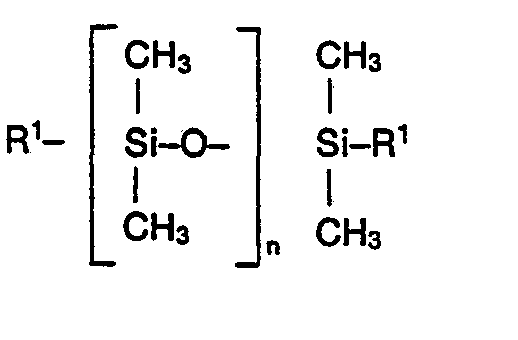
- the above formula I is the average formula of the molar molecule.
- the radical R 1 can thus have different meanings, but it can also have the same meaning.
- the radical R 1 has the same meaning in the new compounds, it means the radical II.
- the radical R 2 is an alkylphenyl radical, where the phenyl radical can contain 1, 2 or 3 alkyl radicals, the sum of the alkyl carbon atoms in the phenyl radical is 6 to 12.
- Preferred alkylphenyl radicals are the nonylphenyl radical and the di-sec-butylphenyl radical.
- the index a has a value from 1 to 2.
- R 3 is an alkyl radical with 1 to 16 carbon atoms, preferably a methyl or a butyl radical, an organoacyl radical with 1 to 12 carbon atoms, preferably an acetyl radical, or an aryl radical, preferably a nonylphenyl radical.
- the index b has a value from 1 to 2, the index c from 1 to 30.
- R 1 can thus have different meanings are related to the compounds described in DE-B-26 45 890. They therefore have a thermal stability which is reduced compared to that of the compounds of DE-B-2645459, but also show the improved compatibility, which is now also improved compared to compounds of the oxyalkylated fatty amine type.
- the compounds defined in their structure by the formula of claim 1 thus have the common property of improved compatibility with other constituents of melt spinning preparations, in particular in a mixture with oxyalkylated fatty amines, while maintaining the temperature resistance of the individual compounds.
- the compounds according to the invention can be prepared in the manner known to the person skilled in the art.
- the connections can e.g. according to US Pat. No. 3,115,512, by reacting equilibrated chlorosiloxanes or chlorosiloxanyl sulfates with propoxylated alkylphenols, optionally in a mixture with polyoxyalkylene monools.
- Another known way of producing the compounds according to the invention is based on the reaction of the propoxylated phenols, optionally in a mixture with the polyether monools with equilibrated hydrogen siloxanes in the presence of suitable catalysts, such as, for. B. tin octoate, according to GB-PS 954 041.
- the invention further relates to textile fiber preparations, in particular melt spinning preparations, which contain the organosilicon compounds according to the invention (hereinafter referred to as group A substances).
- group A compounds may contain, as members of group B, substances which are non-polar and which have a favorable effect on the sliding properties even at very high yarn take-off speeds.
- This group includes e.g. the so-called ester oils, such as fatty acid esters of polyols. Representatives of such compounds are trimethylolpropane tripelargonate or esters of monools, such as stearic acid hexadecyl ester, stearic acid butyl ester or oleyl oleate.
- Dialkyl phthalates can also be referred to as ester oils, dialkyl phthalates which are derived from branched secondary or primary alcohols being of interest.
- Ester oils derived from aliphatic dicarboxylic acids can also be used.
- Mineral oils or liquid oligomeric polyolefins are cheaper non-polar preparation components. Such preparation components are inferior to the ester oils in terms of their thermal stability.
- Hydrophobic polypropylene glycols can also be described as essentially non-polar constituents, but they also have disadvantages compared to the ester oils with regard to their thermal resistance.
- the viscosities (at 20 ° C.) of the nonpolar or weakly polar oils of this group B are generally between 5 and 100 cP, preferably 10 to 60 cP.
- Melt spinning preparations often contain polar components which, depending on their more or less pronounced polarity, can be divided into group C and group D compounds.
- the moderately polar, nonionic components of group C have the task, inter alia, of improving the antistatic action and, if appropriate, improving the compatibility of the nonpolar components (group B) with the strongly polar, ionic components (group D).
- the latter components are particularly useful as antistatic agents.
- Typical representatives of nonionic preparation components are water-soluble or water-dispersible ethylene oxide adducts with fatty acids, fatty alcohols, fatty amines or fatty acid amides, the liquid, low-viscosity representatives of this group being preferred.
- C 12 H 25 N (CH 2 CH 2 OH) 2 is particularly suitable, the C 12 H 25 radical being a mixture of C 8 H 17 -, C 10 H 21 -, C 12 H 25 -, C 14 H 29 -, C 16 H 33 -, C 1a H 37 residues.
- the OH groups can be partially or completely esterified or etherified.
- Particularly thermostable, nonionic preparation constituents are ethylene oxide adducts with alkylphenols, such as, for example, nonylphenol.
- Glycol monoaryl ethers are particularly suitable as thermally stable preparation components, and the aryl radical can be a phenyl radical.
- the moderately polar, nonionic components of group C also include the silicone polyethers according to the invention, which are shown here as a special group A, on account of their particular thermal stability and sliding properties.
- the strongly polar preparation components of group D which consist of mostly liquid organic surfactants containing ionic groups, can be anionic, amphoteric or cationic. These compounds have become particularly important as antistatic additives.
- Typical anionic surfactants from this group are alkali metal salts of alkyl phosphates or alkyl phosphonates, for example Na-octyl-1 1/2 phosphate.
- sulfurized mineral oils or fatty alcohol sulfates or alkyl polyether sulfates can also be used.
- Alkali salts of optionally unsaturated fatty acids also belong to this group.
- Other representatives of this group are alkali salts of alkylbenzenesulfonates.
- Typical amphoteric surfactants in this group are the surfactant betaines.
- Cationic surfactants have become particularly important as melt spinning preparation components.
- Typical representatives of this group are alkyl trimethyl ammonium sulfates, for example cocostrimethyl ammonium methosulfate. Is particularly well suited where the C 12 H 25 residue results from C 8 , C io , C 12 , C 14 , C 16 and C la fractions as a statistical mean.
- the OH groups can be partially or completely esterified or etherified. Due to the low thermal stability of the strongly polar Group D components having ionic groups and their poor compatibility, only the minimum amount required in each case is taken from these compounds.
- Antistatic compounds of groups C and D are summarized by W. Biedermann, Plaste and Kautschuk, 16, 8-15 (1969) and by LR Kumar in Silk, Rayon Ind., India 12, 315-333 (1969).
- these substances can be used undiluted or diluted in the mixture described above in the form of solutions, hydrocarbons preferably being suitable as solvents, or in the form of emulsions, and in the case of the emulsions suitable emulsifiers familiar to the person skilled in the art can also be used .
- these preparations can also contain other customary additives, such as oxidation inhibitors, e.g. B. phenols (z. B. dicresylpropane) or sodium hypophosphite can be added.
- the preparations according to the invention are distinguished from the preparations of the prior art with conventional silicone ethers by their reduced susceptibility to gelling and yellowing when heated over a long period to 200 ° C. and above.
- solvent-free melt-spinning preparations which are self-emulsifying and therefore easy to wash out and well tolerated, can be produced within the scope of the compositions shown.
- Solvent-free, 100% preparations are preferable to solutions and emulsions because of the lower environmental impact.
- the bare filtrate is replaced and the flask is evacuated.
- the entire distillate which passes over to a bottom temperature of 100 ° C., is removed with vigorous stirring. If no more distillate is obtained, the mixture is stirred in vacuo (20 mm Hg) after 1 ⁇ 2 hour at the bottom temperature of 100 ° C.
- the contents of the flask are then cooled to approx. 30 ° C and then aerated. It is filtered again through a filter layer made of cellulose fibers.
- the bare product thus produced has a viscosity (at 20 ° C) of 240 cP.
- the non-inventive connection according to No. 5 is not very stable thermally. Phase separation occurs in formulations with oxyethylated fatty amines.
- the non-inventive connections under Nos. 8 and 9 do not show the lack of phase separation or clouding; however, they have a significantly reduced thermal stability compared to the compound under No. 6 or No. 7.
- the corresponding compounds according to the invention under numbers 15 to 18 again have both advantages: they are thermally just as stable as the compounds according to DE-B-26 45 890 and show in formulations with ethoxylated fatty amines, such as C 12 H 25 N (CH 2 CH 2 OH) 2 , no phase separations or clouding. The compatibility of these compounds with white oil or ester oils is not affected.
Landscapes
- Chemical & Material Sciences (AREA)
- Health & Medical Sciences (AREA)
- Chemical Kinetics & Catalysis (AREA)
- Medicinal Chemistry (AREA)
- Polymers & Plastics (AREA)
- Organic Chemistry (AREA)
- General Chemical & Material Sciences (AREA)
- Treatments For Attaching Organic Compounds To Fibrous Goods (AREA)
- Silicon Polymers (AREA)
Claims (3)


Applications Claiming Priority (2)
| Application Number | Priority Date | Filing Date | Title |
|---|---|---|---|
| DE3338663 | 1983-10-25 | ||
| DE3338663A DE3338663C1 (de) | 1983-10-25 | 1983-10-25 | Siliciumorganische Verbindungen und diese enthaltende Textilfaserpraeparationen |
Publications (3)
| Publication Number | Publication Date |
|---|---|
| EP0141321A2 EP0141321A2 (fr) | 1985-05-15 |
| EP0141321A3 EP0141321A3 (en) | 1986-03-05 |
| EP0141321B1 true EP0141321B1 (fr) | 1988-06-01 |
Family
ID=6212656
Family Applications (1)
| Application Number | Title | Priority Date | Filing Date |
|---|---|---|---|
| EP84112296A Expired EP0141321B1 (fr) | 1983-10-25 | 1984-10-12 | Composés organiques du silicium et préparations pour fibres textiles les contenant |
Country Status (3)
| Country | Link |
|---|---|
| US (1) | US4578116A (fr) |
| EP (1) | EP0141321B1 (fr) |
| DE (1) | DE3338663C1 (fr) |
Families Citing this family (17)
| Publication number | Priority date | Publication date | Assignee | Title |
|---|---|---|---|---|
| DE3722375A1 (de) * | 1987-07-07 | 1989-01-19 | Hoechst Ag | Fluor und polysiloxan enthaltende urethane, verfahren zu ihrer herstellung und ihre verwendung |
| US5247044A (en) * | 1989-09-01 | 1993-09-21 | General Electric Company | Synthetic method for the synthesis of silicon polyether copolymers |
| JP2597474B2 (ja) * | 1991-04-12 | 1997-04-09 | アライド−シグナル・インコーポレーテッド | ブラックガラスの製造方法 |
| CA2103362C (fr) * | 1991-06-05 | 2002-04-16 | Achilles Chiotis | Compositions gelifiees ignifuges |
| DE4133358A1 (de) * | 1991-10-09 | 1993-04-15 | Pfersee Chem Fab | Waessrige zusammensetzungen mit stickstoffhaltigen polysiloxanen |
| US5175327A (en) * | 1992-01-27 | 1992-12-29 | Siltech Inc. | Process for the preparation of silonal alkoxylates |
| US5232742A (en) * | 1992-05-15 | 1993-08-03 | Bridgestone/Firestone, Inc. | Spin finish composition |
| US5194452A (en) * | 1992-05-26 | 1993-03-16 | Dow Corning Corporation | Acyloxy endblocked polyethers having improved hydrolytic stability |
| US5383903A (en) * | 1992-08-20 | 1995-01-24 | United States Surgical Corporation | Dimethylsiloxane-alkylene oxide copolymer coatings for filaments |
| GB2270919B (en) * | 1992-09-26 | 1996-04-24 | Sandoz Ltd | Aqueous wax and silicone dispersions,their production and use |
| DE4330725A1 (de) * | 1993-09-10 | 1995-03-16 | Bayer Ag | Verfahren zur Herstellung von Elastanfasern durch Einspinnen einer Kombination von PDMS und ethoxyliertem PDMS |
| US5358648A (en) * | 1993-11-10 | 1994-10-25 | Bridgestone/Firestone, Inc. | Spin finish composition and method of using a spin finish composition |
| DE19628018A1 (de) * | 1996-07-11 | 1998-01-15 | Wacker Chemie Gmbh | Hydrophile, permanente Organosiliciumverbindungen |
| AU5156698A (en) * | 1996-10-29 | 1998-05-22 | Grant Industries, Inc. | Grafted rubber-like silicone gel with enhanced oil compatibility and its synthetic process |
| US6558409B1 (en) | 2001-09-28 | 2003-05-06 | Tyco Healthcare Group Lp | Plasma treated surgical needles and methods for their manufacture |
| US7294357B2 (en) * | 2001-09-28 | 2007-11-13 | Tyco Healthcare Group Lp | Plasma coated sutures |
| JP2013199114A (ja) * | 2012-02-24 | 2013-10-03 | Canon Inc | 画像記録方法 |
Family Cites Families (6)
| Publication number | Priority date | Publication date | Assignee | Title |
|---|---|---|---|---|
| US3115512A (en) * | 1960-02-18 | 1963-12-24 | Goldschmidt Ag Th | Process for the production of polyalkyl silicic acid esters |
| GB954041A (en) * | 1960-10-19 | 1964-04-02 | Ici Ltd | Organosilicon polymeric materials |
| GB1521309A (en) * | 1975-12-10 | 1978-08-16 | Goldschmidt Ag Th | Textile fibre dressings containing organosilicon compound |
| US4172186A (en) * | 1976-01-08 | 1979-10-23 | Olin Corporation | Glycol and silicate-based surfactant composition for stabilizing polyurethane foam |
| GB1548224A (en) * | 1976-02-12 | 1979-07-04 | Goldschmidt Ag Th | Organosilicon compounds and textile fibre dressings which contain these compounds |
| DE2929588A1 (de) * | 1979-07-21 | 1981-02-05 | Bayer Ag | Verfahren zur herstellung von polysiloxan-polyoxyalkylen-mischpolymerisaten und deren verwendung bei der herstellung von polyurethan-schaumstoffen |
-
1983
- 1983-10-25 DE DE3338663A patent/DE3338663C1/de not_active Expired
-
1984
- 1984-10-12 EP EP84112296A patent/EP0141321B1/fr not_active Expired
- 1984-10-25 US US06/664,705 patent/US4578116A/en not_active Expired - Lifetime
Also Published As
| Publication number | Publication date |
|---|---|
| US4578116A (en) | 1986-03-25 |
| DE3338663C1 (de) | 1985-05-23 |
| EP0141321A3 (en) | 1986-03-05 |
| EP0141321A2 (fr) | 1985-05-15 |
Similar Documents
| Publication | Publication Date | Title |
|---|---|---|
| DE2645890B2 (de) | Siliciumorganische Verbindungen und diese enthaltende Textilf aserpräparationen | |
| DE3338663C1 (de) | Siliciumorganische Verbindungen und diese enthaltende Textilfaserpraeparationen | |
| EP0662334B1 (fr) | Utilisation de polysiloxanes modifiés par des organofonctions pour le traitement des anti mousses de gazole | |
| DE69730417T2 (de) | Dieseltreibstoff mit antischaummittel und verwendungsmethoden | |
| EP0339179B1 (fr) | Composition pour le finissage de fibres textiles ou des produits à base de fibres textiles | |
| EP0161537A2 (fr) | Alcoxylates d'alcool gras ayant des groupes terminaux pour les procédés industriels de nettoyage spécialement pour le lavage de bouteilles et pour le nettoyage du métal | |
| EP0578144A2 (fr) | Organosiloxanes ayant des restes contenant de l'azote et des restes contenant des groupes éther | |
| EP0511589B1 (fr) | Polyesters d'acide carbonique, solubles dans l'eau et biodégradables et leur utilisation comme apprêt et lubrifiant pour des fibres synthétiques | |
| DE2645459C3 (de) | Textilfaserpräparationen | |
| DE2746903A1 (de) | Oxalkylierte polyglycerine und daraus hergestellte schmiermittel auf wasserbasis | |
| DE102007015372A1 (de) | Polysiloxan und Textilhilfsmittel enthaltend ein Polysiloxan | |
| DE2518053C3 (de) | Schaumregulierendes Mittel | |
| DE2900396A1 (de) | Textilfaserpraeparationen | |
| EP0641833A1 (fr) | Dispersions aqueuses de cires et de silicones, leur fabrication et leur utilisation | |
| DE102009042971A1 (de) | Alkoxylierte cyclische Diamine und deren Verwendung als Emulsionsspalter | |
| DE3842471A1 (de) | Verfahren zur herstellung einer oel-in-wasser emulsion eines polyorganosiloxans | |
| DE4117864A1 (de) | Waessrige dispersionen von polysiloxanen | |
| DE3912879A1 (de) | Feines pulver aus einem oberflaechenbehandelten polyorganosilsesquioxan | |
| DE60103296T2 (de) | Polysiloxane mit quartären stickstoffgruppen | |
| EP0597320B1 (fr) | Emulsion antimoussante contenant un colloide protecteur | |
| DE4404176A1 (de) | Spinnpräparationen für synthetische Filamentfasern | |
| DE1040251B (de) | Verfahren zur Herstellung von Polysiloxan-Polyoxyalkylen-Mischpolymeren | |
| EP1464371A1 (fr) | Compositions aqueuses anti-mousse améliorées | |
| DE2233818C3 (de) | Schaumbekämpfungsmittel | |
| DE1093095B (de) | Verfahren zur Herstellung eines Mischpolymerisates auf Grundlage von Organopolysiloxanen und Oxylalkylenpolymeren |
Legal Events
| Date | Code | Title | Description |
|---|---|---|---|
| PUAI | Public reference made under article 153(3) epc to a published international application that has entered the european phase |
Free format text: ORIGINAL CODE: 0009012 |
|
| 17P | Request for examination filed |
Effective date: 19841019 |
|
| AK | Designated contracting states |
Designated state(s): BE FR IT NL |
|
| PUAL | Search report despatched |
Free format text: ORIGINAL CODE: 0009013 |
|
| RHK1 | Main classification (correction) |
Ipc: C08G 77/18 |
|
| AK | Designated contracting states |
Kind code of ref document: A3 Designated state(s): BE FR IT NL |
|
| 17Q | First examination report despatched |
Effective date: 19870515 |
|
| ITF | It: translation for a ep patent filed | ||
| GRAA | (expected) grant |
Free format text: ORIGINAL CODE: 0009210 |
|
| AK | Designated contracting states |
Kind code of ref document: B1 Designated state(s): BE FR IT NL |
|
| ET | Fr: translation filed | ||
| PLBE | No opposition filed within time limit |
Free format text: ORIGINAL CODE: 0009261 |
|
| STAA | Information on the status of an ep patent application or granted ep patent |
Free format text: STATUS: NO OPPOSITION FILED WITHIN TIME LIMIT |
|
| 26N | No opposition filed | ||
| ITTA | It: last paid annual fee | ||
| PGFP | Annual fee paid to national office [announced via postgrant information from national office to epo] |
Ref country code: FR Payment date: 19981009 Year of fee payment: 15 |
|
| PGFP | Annual fee paid to national office [announced via postgrant information from national office to epo] |
Ref country code: NL Payment date: 19981028 Year of fee payment: 15 |
|
| PGFP | Annual fee paid to national office [announced via postgrant information from national office to epo] |
Ref country code: BE Payment date: 19981216 Year of fee payment: 15 |
|
| PG25 | Lapsed in a contracting state [announced via postgrant information from national office to epo] |
Ref country code: BE Free format text: LAPSE BECAUSE OF NON-PAYMENT OF DUE FEES Effective date: 19991031 |
|
| BERE | Be: lapsed |
Owner name: TH. GOLDSCHMIDT A.G. Effective date: 19991031 |
|
| PG25 | Lapsed in a contracting state [announced via postgrant information from national office to epo] |
Ref country code: NL Free format text: LAPSE BECAUSE OF NON-PAYMENT OF DUE FEES Effective date: 20000501 |
|
| PG25 | Lapsed in a contracting state [announced via postgrant information from national office to epo] |
Ref country code: FR Free format text: LAPSE BECAUSE OF NON-PAYMENT OF DUE FEES Effective date: 20000630 |
|
| NLV4 | Nl: lapsed or anulled due to non-payment of the annual fee |
Effective date: 20000501 |
|
| REG | Reference to a national code |
Ref country code: FR Ref legal event code: ST |