EP0141668A2 - Organotonmaterialien - Google Patents
Organotonmaterialien Download PDFInfo
- Publication number
- EP0141668A2 EP0141668A2 EP84307632A EP84307632A EP0141668A2 EP 0141668 A2 EP0141668 A2 EP 0141668A2 EP 84307632 A EP84307632 A EP 84307632A EP 84307632 A EP84307632 A EP 84307632A EP 0141668 A2 EP0141668 A2 EP 0141668A2
- Authority
- EP
- European Patent Office
- Prior art keywords
- organoclay
- reaction
- value
- examples
- clay
- Prior art date
- Legal status (The legal status is an assumption and is not a legal conclusion. Google has not performed a legal analysis and makes no representation as to the accuracy of the status listed.)
- Granted
Links
Images

Classifications
-
- C—CHEMISTRY; METALLURGY
- C04—CEMENTS; CONCRETE; ARTIFICIAL STONE; CERAMICS; REFRACTORIES
- C04B—LIME, MAGNESIA; SLAG; CEMENTS; COMPOSITIONS THEREOF, e.g. MORTARS, CONCRETE OR LIKE BUILDING MATERIALS; ARTIFICIAL STONE; CERAMICS; REFRACTORIES; TREATMENT OF NATURAL STONE
- C04B14/00—Use of inorganic materials as fillers, e.g. pigments, for mortars, concrete or artificial stone; Treatment of inorganic materials specially adapted to enhance their filling properties in mortars, concrete or artificial stone
-
- C—CHEMISTRY; METALLURGY
- C01—INORGANIC CHEMISTRY
- C01B—NON-METALLIC ELEMENTS; COMPOUNDS THEREOF; METALLOIDS OR COMPOUNDS THEREOF NOT COVERED BY SUBCLASS C01C
- C01B33/00—Silicon; Compounds thereof
- C01B33/20—Silicates
- C01B33/36—Silicates having base-exchange properties but not having molecular sieve properties
- C01B33/38—Layered base-exchange silicates, e.g. clays, micas or alkali metal silicates of kenyaite or magadiite type
- C01B33/44—Products obtained from layered base-exchange silicates by ion-exchange with organic compounds such as ammonium, phosphonium or sulfonium compounds or by intercalation of organic compounds, e.g. organoclay material
-
- C—CHEMISTRY; METALLURGY
- C09—DYES; PAINTS; POLISHES; NATURAL RESINS; ADHESIVES; COMPOSITIONS NOT OTHERWISE PROVIDED FOR; APPLICATIONS OF MATERIALS NOT OTHERWISE PROVIDED FOR
- C09D—COATING COMPOSITIONS, e.g. PAINTS, VARNISHES OR LACQUERS; FILLING PASTES; CHEMICAL PAINT OR INK REMOVERS; INKS; CORRECTING FLUIDS; WOODSTAINS; PASTES OR SOLIDS FOR COLOURING OR PRINTING; USE OF MATERIALS THEREFOR
- C09D5/00—Coating compositions, e.g. paints, varnishes or lacquers, characterised by their physical nature or the effects produced; Filling pastes
- C09D5/04—Thixotropic paints
Definitions
- organoclay materials that is to say materials formed by the reaction of a smectite clay, such as bentonite or montmorilonite, with a quaternary ammonium compound. These materials are used for example as additives in the manufacture of paints and other coating compositions for the purpose of providing or modifying thixotropic properties.
- a smectite clay such as bentonite or montmorilonite
- quaternary ammonium compound such as bentonite or montmorilonite
- the modified clays which tend to be rather difficult to disperse are typically made by reacting a quaternary ammonium compound with the clay in an amount in the range 90 to 100 milli-equivalents per 100 grams clay.(dry weight).
- the product normally requires grinding into the material to which it is to be added in the same manner as for-example a pigment. Alternatively it may be incorporated into a pre-gel in a high-shear mixer. Additionally it is necessary to incorporate a polar compound, such as ethyl alcohol, into the product, but the quantity required in any given system is rather critical and this may cause production problems.
- quaternary ammonium compound e.g. up to about 150 milli-equivalents per 100 grams clay (dry weight) with the clay and an organic anion derived from various organic acids or salts thereof.
- quaternary ammonium compound e.g. up to about 150 milli-equivalents per 100 grams clay (dry weight) with the clay and an organic anion derived from various organic acids or salts thereof.
- the pH of the reaction mixture is adjusted to a predetermined value. Typically this value is in the range 8 to 10 and may be achieved by the addition of sodium carbonate or other appropriate substance, such as hydrochloric acid.
- pH 9.0 a critical predetermined optimum value for any given type of clay
- this in itself may be sufficient to ensure that the product has consistent properties in use.
- a further substance including an unsubstituted or substituted amino or amido group reduces the criticality of the pH so that similar results can be achieved with less accurate pH control, e.g. pH 9.0 + 0.5.
- the reaction between a smectite-type clay and a quaternary ammonium compound to form an organoclay material is carried out in the presence of a further substance including an unsubstituted or substituted amino or amido group.
- the further substance may be present in an amount of approximately l% by weight, typically in the range 0.2% to 5.0%, and preferably in the range 0.4% to 2.0%, e.g. about 20 to 50 mini-equivalents per 100 grams clay (dry weight).
- the further substance comprises urea.
- Sulphamic acid may also be used instead of or in combination with urea.
- substituted ureas may be used.
- More generally similar substances, having an amino group adjacent to an electrophilic (electron-seeking) group, may be used, including compounds such as benzamide, and n-methyl pyrrolidone.
- an organoclay material comprises the reaction product of a smectite clay and an aqueous quaternary ammonium compound present in a quantity in the range 90 - 180 milli-equivalents of said compound per 100g (dry weight) of said clay, the reaction being carried out at a controlled pH preferably in the range 8 to 10.
- an organoclay material comprises the reaction product of a smectite clay, a quaternary ammonium compound and a further substance including an unsubstituted or substituted amino or amido group.
- the above methods of preparing an organoclay material include a step wherein the material is dried at a temperature not less than 30°C and not exceeding 100°C, preferably within the range 50°C to 80°C, and typically 65°C, in contrast to flash drying techniques currently used which involve high temperatures and adversely affect ease of dispersion.
- a modified organoclay material made in accordance with the invention present improved ease of dispersion, but surprisingly, the same materials can be used in both aliphatic and aromatic systems, and moreover can be useful in some polar systems, i.e. those containing ketones, esters, alcohols and the like, for example in nitrocellulose lacquers.
- the basic composition may comprise bentonite clay and an aqueous quaternary compound present in a quantity in the range 90 - 180 multi-equivalents per 100g (dry weight) of the clay.
- the quaternary ammonium compound employed may be a commercially available product comprising a di-(hydrogenated tallow) dimethyl ammonium chloride, or other suitable quarternary ammonium salts such as dimethyl-. benzyl (hydrogenated tallow) ammonium chloride.
- the pH is adjusted by addition of sodium carbonate or hydrochloric acid, for example, to bring it to a selected value in the range 8 to 10, preferably 9.
- the mixture may also include urea in a quantity in the range 20 - 50 milli-equivalents to further improve the dispersion characteristics of the product.
- Sulphamic acid and mixtures of urea and sulphamic acid in various ratios have also proved effective for this purpose and it is thought that substituted ureas could also be employed successfully.
- Other compounds which it is contemplated may be satisfactory would likewise afford an amino group adjacent to an electrohilic group as previously mentioned.
- smectite clays conventionally used for the manufacture of organoclays for use as thixotropic agents, such as hectorite and montmorilonite, or mixtures of such clays could be employed.
- organoclays were made in the laboratory using a sodium bentonite of Wyoming origin with the addition of 125 m.Eq., 75% dimethyl di-(hydrogenerated tallow) ammonium chloride (DMDHT) and 25 m.Eq. urea. The pH was adjusted at 60°C with either hydrochloric acid or sodium carbonate and the reaction with the quaternary compound carried out.. All the organoclays were processed in the same way, i.e. by fluid bed drying and sieving.
- DMDHT dimethyl di-(hydrogenerated tallow) ammonium chloride
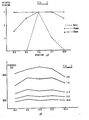
- the organoclays so produced were dispersed in a proprietary white gloss paint at 0.5% w/w and at 2500 rpm using a propellor type stirrer. To determine the degree of dispersion, Hegman grind gauge readings were taken at 5 minute intervals for 15 minutes in the course of the dispersion process. Viscosities were also measured after standing overnight at 25 0 C using a Brookfield viscosmeter with spindle 2.
- the pH value at which the reaction is carried out as closely as possible to the optimum value, in this case 9.0, the time required for dispersion of the organoclay material when it is incorporated into a paint by the paint manufacturer can be minimised, that is in this case reduced to approximately 5 minutes for the quantities tested.
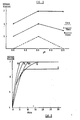
- urea, n-methyl pyrrolidone, and benzamide which all afford an unsubstituted or substituted amino or amido group adjacent to an electrophyllic carbonyl group give rise to an improvement in the required dispersion time.
- pyridine in which the N atom is part of an aromatic ring, no such improvement was observed.
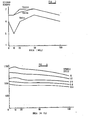
- organoclays in accordance with the invention are used as additives for modifying the rheological properties of three different systems, and for comparison the same systems have been tested with a conventional organoclay and without any additive.
- the organoclay used in Examples 25 and 26 is made in accordance with the invention substantially as described in Example 3, except that the quantity of DMDHT is raised to 135 m.Eq. and the pH is adjusted to 9 + 0.5 whilst that used in Examples 27 and 28 is a commercially available product comprising a Bentonite reacted with 96 m.Eq. DMDHT.
- the organoclay used in Examples 30 and 31 is the same as in Examples 25 and 26.
- the additive used in Examples 32 and 33 is a commercially available composition formulated for use in aromatic systems and comprising an Hectorite clay (a magnesium silicate type of Smectite clay) reacted with 98 m.Eq dimethyl di(hydrogenated tallow) ammonium chloride.
- Example 31 The superiority of Example 31 is apparent.
- the organoclay used in Examples 35 and 36 is the same as in Examples 25,26, 29 and 31.
- the organoclay used in Examples 37 and 38 is a commercially available composition formulated for use in polar systems and comprising a Bentonite clay reacted with 98 m.Eq dimethyl hydrogenated tallow benzyl ammonium chloride.
Landscapes
- Chemical & Material Sciences (AREA)
- Organic Chemistry (AREA)
- Engineering & Computer Science (AREA)
- Materials Engineering (AREA)
- Wood Science & Technology (AREA)
- Life Sciences & Earth Sciences (AREA)
- Inorganic Chemistry (AREA)
- General Health & Medical Sciences (AREA)
- Health & Medical Sciences (AREA)
- Ceramic Engineering (AREA)
- Civil Engineering (AREA)
- Structural Engineering (AREA)
- Silicates, Zeolites, And Molecular Sieves (AREA)
- Paper (AREA)
- Paints Or Removers (AREA)
- Pigments, Carbon Blacks, Or Wood Stains (AREA)
Applications Claiming Priority (4)
| Application Number | Priority Date | Filing Date | Title |
|---|---|---|---|
| GB8329604 | 1983-11-05 | ||
| GB08329604A GB2151219A (en) | 1983-11-05 | 1983-11-05 | Organoclay materials |
| GB8422854 | 1984-09-11 | ||
| GB848422854A GB8422854D0 (en) | 1984-09-11 | 1984-09-11 | Organoclay materials |
Publications (3)
| Publication Number | Publication Date |
|---|---|
| EP0141668A2 true EP0141668A2 (de) | 1985-05-15 |
| EP0141668A3 EP0141668A3 (en) | 1985-08-21 |
| EP0141668B1 EP0141668B1 (de) | 1989-03-15 |
Family
ID=26286980
Family Applications (1)
| Application Number | Title | Priority Date | Filing Date |
|---|---|---|---|
| EP84307632A Expired EP0141668B1 (de) | 1983-11-05 | 1984-11-05 | Organotonmaterialien |
Country Status (5)
| Country | Link |
|---|---|
| US (1) | US4752342A (de) |
| EP (1) | EP0141668B1 (de) |
| DE (1) | DE3477183D1 (de) |
| DK (1) | DK158147C (de) |
| WO (1) | WO1985001946A1 (de) |
Cited By (1)
| Publication number | Priority date | Publication date | Assignee | Title |
|---|---|---|---|---|
| FR2589162A1 (fr) * | 1985-10-28 | 1987-04-30 | Nl Chemicals Inc | Gelifiant preactive a base d'argile organophile pour graisses lubrifiantes, graisse lubrifiante epaissie par un gelifiant preactive a base d'argile organophile et procede de preparation des gelifiants preactives a base d'argile |
Families Citing this family (12)
| Publication number | Priority date | Publication date | Assignee | Title |
|---|---|---|---|---|
| US5137568A (en) * | 1989-05-02 | 1992-08-11 | J.M. Huber Corporation | Organokaolin pigments in ink formulations |
| US20040106741A1 (en) * | 2002-09-17 | 2004-06-03 | Kriesel Joshua W. | Nanofilm compositions with polymeric components |
| US8398306B2 (en) * | 2005-11-07 | 2013-03-19 | Kraft Foods Global Brands Llc | Flexible package with internal, resealable closure feature |
| US20110143133A1 (en) * | 2005-11-07 | 2011-06-16 | Panagiotis Kinigakis | Polymeric Base Having an Adhered Low-Tack Adhesive Thereon |
| US7871697B2 (en) | 2006-11-21 | 2011-01-18 | Kraft Foods Global Brands Llc | Peelable composite thermoplastic sealants in packaging films |
| US7871696B2 (en) * | 2006-11-21 | 2011-01-18 | Kraft Foods Global Brands Llc | Peelable composite thermoplastic sealants in packaging films |
| US9232808B2 (en) | 2007-06-29 | 2016-01-12 | Kraft Foods Group Brands Llc | Processed cheese without emulsifying salts |
| US8475584B1 (en) | 2009-10-12 | 2013-07-02 | Raymond Lee Nip | Zinc clays, zinc organoclays, methods for making the same, and compositions containing the same |
| EP2538781B1 (de) | 2010-02-23 | 2016-08-03 | Clariant S.A. | Verfahren zur gemeinsamen einkapselung von biozid wirksamen verbindungen in durch stickstoffverbindungen funktionalisierten tonmineralien |
| RU2557614C2 (ru) | 2010-02-26 | 2015-07-27 | Интерконтинентал Грейт Брэндс ЛЛС | Уф-отверждаемый самоклеющийся материал с низкой липкостью для повторно укупориваемых упаковок |
| PH12012501694A1 (en) * | 2010-02-26 | 2012-11-05 | Intercontinental Great Brands Llc | Reclosable package using low tack adhesive |
| US9533472B2 (en) | 2011-01-03 | 2017-01-03 | Intercontinental Great Brands Llc | Peelable sealant containing thermoplastic composite blends for packaging applications |
Family Cites Families (9)
| Publication number | Priority date | Publication date | Assignee | Title |
|---|---|---|---|---|
| SU623825A1 (ru) * | 1973-08-30 | 1978-09-15 | Институт Коллоидной Химии И Химии Воды Ан Украинской Сср | Способ получени модифицированного каолина |
| US3936537A (en) * | 1974-11-01 | 1976-02-03 | The Procter & Gamble Company | Detergent-compatible fabric softening and antistatic compositions |
| US4292035A (en) * | 1978-11-13 | 1981-09-29 | The Procter & Gamble Company | Fabric softening compositions |
| US4308151A (en) * | 1980-05-12 | 1981-12-29 | The Procter & Gamble Company | Detergent-compatible fabric softening and antistatic compositions |
| US4569923A (en) * | 1980-10-03 | 1986-02-11 | Southern Clay Products, Inc. | Process for manufacturing organoclays having enhanced gelling properties |
| US4434075A (en) * | 1981-10-19 | 1984-02-28 | Nl Industries, Inc. | Anionically modified organophilic clays and their preparation |
| US4374203A (en) * | 1982-03-10 | 1983-02-15 | Yara Engineering Corporation | Stable clay slurries |
| US4473407A (en) * | 1983-06-07 | 1984-09-25 | Georgia Kaolin Company, Inc. | Rheological control of polyester-styrene resin compositions by addition of an organoclay and preparation thereof |
| FR2547826B1 (fr) * | 1983-06-27 | 1986-12-26 | Ceca Sa | Argiles organophiles modifiees |
-
1984
- 1984-11-05 EP EP84307632A patent/EP0141668B1/de not_active Expired
- 1984-11-05 DE DE8484307632T patent/DE3477183D1/de not_active Expired
- 1984-11-05 WO PCT/GB1984/000380 patent/WO1985001946A1/en not_active Ceased
-
1985
- 1985-07-04 DK DK306285A patent/DK158147C/da not_active IP Right Cessation
-
1987
- 1987-08-03 US US07/081,566 patent/US4752342A/en not_active Expired - Fee Related
Cited By (1)
| Publication number | Priority date | Publication date | Assignee | Title |
|---|---|---|---|---|
| FR2589162A1 (fr) * | 1985-10-28 | 1987-04-30 | Nl Chemicals Inc | Gelifiant preactive a base d'argile organophile pour graisses lubrifiantes, graisse lubrifiante epaissie par un gelifiant preactive a base d'argile organophile et procede de preparation des gelifiants preactives a base d'argile |
Also Published As
| Publication number | Publication date |
|---|---|
| DK158147C (da) | 1990-09-03 |
| EP0141668A3 (en) | 1985-08-21 |
| DK306285A (da) | 1985-07-04 |
| DK306285D0 (da) | 1985-07-04 |
| DK158147B (da) | 1990-04-02 |
| US4752342A (en) | 1988-06-21 |
| DE3477183D1 (en) | 1989-04-20 |
| EP0141668B1 (de) | 1989-03-15 |
| WO1985001946A1 (en) | 1985-05-09 |
Similar Documents
| Publication | Publication Date | Title |
|---|---|---|
| EP0141668A2 (de) | Organotonmaterialien | |
| JPS6250511B2 (de) | ||
| US4769078A (en) | Organophilic clay modified with betaine type compounds | |
| US3977894A (en) | Rheological agent for non-aqueous fluid systems | |
| US4450095A (en) | Organophilic clay gellant having enhanced dispersibility | |
| US4743305A (en) | Organoclays | |
| DE60212374T2 (de) | Vernetzung der stärke | |
| US3967563A (en) | Process for producing precipitated thickener silica | |
| US4402881A (en) | Method of making organophilic clays | |
| EP0541477A1 (de) | Antiabsetzmittel für wässrige Beschichtungszusammensetzungen | |
| CA1064677A (en) | Process for preparing prilled porous ammonium nitrate | |
| JP2988826B2 (ja) | 非水組成物の増粘方法と該方法によって増粘された組成物 | |
| US3407072A (en) | Process for preparing an active, dry powdery yeast | |
| EP0234014A2 (de) | Verfahren zur Verätherung von Galaktomannanen | |
| EP0887396A1 (de) | Feststoff-Zusammensetzung auf Basis von Tonmineralien und deren Verwendung | |
| US4036663A (en) | Inorganic pigments and methods for producing the pigments and aqueous slurries thereof | |
| US4473675A (en) | Thixotropic cross-linkable unsaturated polyester compositions and method of production | |
| US4156717A (en) | Process for producing precipitated thickener silica | |
| US4312843A (en) | Dicalcium phosphate dihydrate having improved monofluorophosphate compatibility and process for the preparation thereof | |
| US4472365A (en) | Dicalcium phosphate dihydrate having improved monofluorophosphate compatibility and process for the preparation thereof | |
| JPH041779B2 (de) | ||
| US4473407A (en) | Rheological control of polyester-styrene resin compositions by addition of an organoclay and preparation thereof | |
| US3993497A (en) | Coating compositions containing precipitated silica | |
| US4487749A (en) | Dicalcium phosphate dihydrate having improved monofluorophosphate compatibility and process for the preparation thereof | |
| CN112852390A (zh) | 一种有机粘土及其制备方法和应用 |
Legal Events
| Date | Code | Title | Description |
|---|---|---|---|
| PUAI | Public reference made under article 153(3) epc to a published international application that has entered the european phase |
Free format text: ORIGINAL CODE: 0009012 |
|
| AK | Designated contracting states |
Designated state(s): BE DE FR GB IT LU NL SE |
|
| PUAL | Search report despatched |
Free format text: ORIGINAL CODE: 0009013 |
|
| RHK1 | Main classification (correction) |
Ipc: C01B 33/26 |
|
| AK | Designated contracting states |
Designated state(s): BE DE FR GB IT LU NL SE |
|
| 17P | Request for examination filed |
Effective date: 19860206 |
|
| 17Q | First examination report despatched |
Effective date: 19861216 |
|
| RAP1 | Party data changed (applicant data changed or rights of an application transferred) |
Owner name: AKZO N.V. |
|
| GRAA | (expected) grant |
Free format text: ORIGINAL CODE: 0009210 |
|
| AK | Designated contracting states |
Kind code of ref document: B1 Designated state(s): BE DE FR GB IT LU NL SE |
|
| ITF | It: translation for a ep patent filed | ||
| REF | Corresponds to: |
Ref document number: 3477183 Country of ref document: DE Date of ref document: 19890420 |
|
| ET | Fr: translation filed | ||
| PLBE | No opposition filed within time limit |
Free format text: ORIGINAL CODE: 0009261 |
|
| STAA | Information on the status of an ep patent application or granted ep patent |
Free format text: STATUS: NO OPPOSITION FILED WITHIN TIME LIMIT |
|
| 26N | No opposition filed | ||
| ITTA | It: last paid annual fee | ||
| EPTA | Lu: last paid annual fee | ||
| EAL | Se: european patent in force in sweden |
Ref document number: 84307632.4 |
|
| REG | Reference to a national code |
Ref country code: GB Ref legal event code: 732E |
|
| REG | Reference to a national code |
Ref country code: FR Ref legal event code: TP Ref country code: FR Ref legal event code: CD |
|
| NLS | Nl: assignments of ep-patents |
Owner name: LAPORTE INDUSTRIES LIMITED |
|
| NLT1 | Nl: modifications of names registered in virtue of documents presented to the patent office pursuant to art. 16 a, paragraph 1 |
Owner name: AKZO NOBEL N.V. |
|
| PGFP | Annual fee paid to national office [announced via postgrant information from national office to epo] |
Ref country code: GB Payment date: 19981029 Year of fee payment: 15 |
|
| PGFP | Annual fee paid to national office [announced via postgrant information from national office to epo] |
Ref country code: SE Payment date: 19981103 Year of fee payment: 15 Ref country code: BE Payment date: 19981103 Year of fee payment: 15 |
|
| PGFP | Annual fee paid to national office [announced via postgrant information from national office to epo] |
Ref country code: FR Payment date: 19981104 Year of fee payment: 15 |
|
| PGFP | Annual fee paid to national office [announced via postgrant information from national office to epo] |
Ref country code: DE Payment date: 19981123 Year of fee payment: 15 |
|
| PGFP | Annual fee paid to national office [announced via postgrant information from national office to epo] |
Ref country code: LU Payment date: 19981126 Year of fee payment: 15 |
|
| PGFP | Annual fee paid to national office [announced via postgrant information from national office to epo] |
Ref country code: NL Payment date: 19981130 Year of fee payment: 15 |
|
| BECH | Be: change of holder |
Free format text: 980915 *LAPORTE INDUSTRIES LTD |
|
| PG25 | Lapsed in a contracting state [announced via postgrant information from national office to epo] |
Ref country code: LU Free format text: LAPSE BECAUSE OF NON-PAYMENT OF DUE FEES Effective date: 19991105 Ref country code: GB Free format text: LAPSE BECAUSE OF NON-PAYMENT OF DUE FEES Effective date: 19991105 |
|
| PG25 | Lapsed in a contracting state [announced via postgrant information from national office to epo] |
Ref country code: SE Free format text: LAPSE BECAUSE OF NON-PAYMENT OF DUE FEES Effective date: 19991106 |
|
| PG25 | Lapsed in a contracting state [announced via postgrant information from national office to epo] |
Ref country code: BE Free format text: LAPSE BECAUSE OF NON-PAYMENT OF DUE FEES Effective date: 19991130 |
|
| BERE | Be: lapsed |
Owner name: LAPORTE INDUSTRIES LTD Effective date: 19991130 |
|
| PG25 | Lapsed in a contracting state [announced via postgrant information from national office to epo] |
Ref country code: NL Free format text: LAPSE BECAUSE OF NON-PAYMENT OF DUE FEES Effective date: 20000601 |
|
| GBPC | Gb: european patent ceased through non-payment of renewal fee |
Effective date: 19991105 |
|
| EUG | Se: european patent has lapsed |
Ref document number: 84307632.4 |
|
| PG25 | Lapsed in a contracting state [announced via postgrant information from national office to epo] |
Ref country code: FR Free format text: LAPSE BECAUSE OF NON-PAYMENT OF DUE FEES Effective date: 20000731 |
|
| NLV4 | Nl: lapsed or anulled due to non-payment of the annual fee |
Effective date: 20000601 |
|
| PG25 | Lapsed in a contracting state [announced via postgrant information from national office to epo] |
Ref country code: DE Free format text: LAPSE BECAUSE OF NON-PAYMENT OF DUE FEES Effective date: 20000901 |
|
| REG | Reference to a national code |
Ref country code: FR Ref legal event code: ST |