EP0141996A2 - Triphendioxazine reactive dyes - Google Patents
Triphendioxazine reactive dyes Download PDFInfo
- Publication number
- EP0141996A2 EP0141996A2 EP84111706A EP84111706A EP0141996A2 EP 0141996 A2 EP0141996 A2 EP 0141996A2 EP 84111706 A EP84111706 A EP 84111706A EP 84111706 A EP84111706 A EP 84111706A EP 0141996 A2 EP0141996 A2 EP 0141996A2
- Authority
- EP
- European Patent Office
- Prior art keywords
- formula
- dyes
- meaning given
- benzoquinone
- benzochinon
- Prior art date
- Legal status (The legal status is an assumption and is not a legal conclusion. Google has not performed a legal analysis and makes no representation as to the accuracy of the status listed.)
- Granted
Links
- 0 C**(C=C(*)CC1=C(C)OC2=C(C)C3=NC(CC(*)(*)C(**)=C4)=C4OC3=CC2=N1)=C Chemical compound C**(C=C(*)CC1=C(C)OC2=C(C)C3=NC(CC(*)(*)C(**)=C4)=C4OC3=CC2=N1)=C 0.000 description 8
Classifications
-
- C—CHEMISTRY; METALLURGY
- C09—DYES; PAINTS; POLISHES; NATURAL RESINS; ADHESIVES; COMPOSITIONS NOT OTHERWISE PROVIDED FOR; APPLICATIONS OF MATERIALS NOT OTHERWISE PROVIDED FOR
- C09B—ORGANIC DYES OR CLOSELY-RELATED COMPOUNDS FOR PRODUCING DYES, e.g. PIGMENTS; MORDANTS; LAKES
- C09B62/00—Reactive dyes, i.e. dyes which form covalent bonds with the substrates or which polymerise with themselves
- C09B62/44—Reactive dyes, i.e. dyes which form covalent bonds with the substrates or which polymerise with themselves with the reactive group not directly attached to a heterocyclic ring
- C09B62/503—Reactive dyes, i.e. dyes which form covalent bonds with the substrates or which polymerise with themselves with the reactive group not directly attached to a heterocyclic ring the reactive group being an esterified or non-esterified hydroxyalkyl sulfonyl or mercaptoalkyl sulfonyl group, a quaternised or non-quaternised aminoalkyl sulfonyl group, a heterylmercapto alkyl sulfonyl group, a vinyl sulfonyl or a substituted vinyl sulfonyl group, or a thiophene-dioxide group
-
- C—CHEMISTRY; METALLURGY
- C09—DYES; PAINTS; POLISHES; NATURAL RESINS; ADHESIVES; COMPOSITIONS NOT OTHERWISE PROVIDED FOR; APPLICATIONS OF MATERIALS NOT OTHERWISE PROVIDED FOR
- C09B—ORGANIC DYES OR CLOSELY-RELATED COMPOUNDS FOR PRODUCING DYES, e.g. PIGMENTS; MORDANTS; LAKES
- C09B62/00—Reactive dyes, i.e. dyes which form covalent bonds with the substrates or which polymerise with themselves
- C09B62/44—Reactive dyes, i.e. dyes which form covalent bonds with the substrates or which polymerise with themselves with the reactive group not directly attached to a heterocyclic ring
- C09B62/503—Reactive dyes, i.e. dyes which form covalent bonds with the substrates or which polymerise with themselves with the reactive group not directly attached to a heterocyclic ring the reactive group being an esterified or non-esterified hydroxyalkyl sulfonyl or mercaptoalkyl sulfonyl group, a quaternised or non-quaternised aminoalkyl sulfonyl group, a heterylmercapto alkyl sulfonyl group, a vinyl sulfonyl or a substituted vinyl sulfonyl group, or a thiophene-dioxide group
- C09B62/5033—Dioxazine dyes
-
- C—CHEMISTRY; METALLURGY
- C09—DYES; PAINTS; POLISHES; NATURAL RESINS; ADHESIVES; COMPOSITIONS NOT OTHERWISE PROVIDED FOR; APPLICATIONS OF MATERIALS NOT OTHERWISE PROVIDED FOR
- C09B—ORGANIC DYES OR CLOSELY-RELATED COMPOUNDS FOR PRODUCING DYES, e.g. PIGMENTS; MORDANTS; LAKES
- C09B19/00—Oxazine dyes
- C09B19/02—Bisoxazines prepared from aminoquinones
Definitions
- Suitable radicals W 1 are, in addition to those mentioned for W 3 , for example the following: wherein X has the meaning given above and aralkylene for optionally further substituted C 1 -C 6 -alkylenephenylene, phenylene-C 1 -C 6 -alkylene, C 1 -C 6 -alkylene-naphthylene or naphthylene-C 1 -C 6 -alkylene stands, or or where R has the meaning given and the benzene or naphthalene nucleus G may be substituted.
- Preferred residues W 3 are residues
- the optionally substituted sulfonamide radical E in formula (1) preferably contains water-solubilizing groups such as SO 3 H, COOH.
- R examples include CH 3 , C 2 H 5 , nC 3 H 7 , nC 4 H 9 , which can be substituted by OH, OCH 3 , COOH and SO 3 H.
- Suitable araliphatic radicals are, for example, phenylalkylene radicals whose alkylene chain can be interrupted by heteroatoms or groups containing heteroatoms, such as
- Interrupting heteroatoms are preferably O, S and N.
- the invention further relates to processes for the preparation of the dyes of the formulas (2), (2a), (3), (3a), (4), (5), (5a) and (5b), which is characterized in that the diarylides of the formulas treated with an acidic condensation agent effective under What g erstoffabspaltung the ring closure to Triphendioxazinsystem. 10 to 50% oleum is used as the acidic condensing agent.
- the reaction temperature is 0 to 80 ° C, preferably 20 to 60 ° C.
- the diarylides can be cyclized with 5 to 10 times the amount by weight of 30-50%, preferably 35-40% oleum at temperatures of 10 to 50 ° C., preferably 20 to 40 ° C.
- the diarylides can also be cyclized according to the specifications of British Patent 1,589,915, with 1-3 mols of persulfate per mol of diarylide being used in 5 to 30% oleum at 0 to 60 ° C.
- the diarylides of the formulas (6) to (9c) can be prepared by known methods, as are mentioned, for example, in German Offenlegungsschriften 2 302 382, 2 344 781, 2 503 611, 2 823 828 and in British Patent 2,059,985 .
- the new dyes of the formula (1) are suitable for dyeing and printing materials containing hydroxyl or amide groups, such as textile fibers, threads and fabrics made of wool, silk, synthetic polyamide and polyurethane fibers, and for washing and dyeing and printing native or regenerated cellulose , wherein the treatment of cellulose materials is expediently carried out in the presence of acid-binding agents and, if appropriate, by the action of heat by the methods which have become known for reactive dyes of the type according to the invention.
- the formulas given are those of the corresponding free acids.
- the dyes were generally isolated in the form of the alkali salts, especially the Na salts, and used for dyeing.
- the weights given in the examples refer to the free acid.
- the color indicators given in the examples refer to the Color Index Hue Indication Chart (Indicator Numbers).
- 0.05 mol of the dianilide of the formula are introduced into 200 ml of 25% oleum at 25 to 40 ° C.
- the mixture is heated to 60 ° C. in 15 minutes and stirred at this temperature for 1 hour.
- the mixture is poured onto 1 kg of ice and the dye is salted out by adding 10% by volume of sodium chloride.
- the paste is stirred again in water and adjusted to pH 5-6 with sodium hydrogen carbonate.
- salting out vacuuming, drying in a vacuum drying cabinet at 60 ° C. and grinding, a blue powder is obtained which dyes cotton in brilliant shades of blue (color code 14).
- the dye corresponds to the formula
- the dye corresponds to the formula given in Example 2a.
- Dyes with sulfonamide groups are expediently prepared by methods 2b and 2c.
- the sulfo group in T 3 in Examples 13, 28, 26 is introduced into the oleum during ring closure.
- B stands for SO 2 CH 2 CH 2 OSO 3 H and B 2 for SO 2 CH 2 CH 2 OH.
- Color code 13 clear reddish blue
Landscapes
- Chemical & Material Sciences (AREA)
- Organic Chemistry (AREA)
- Coloring (AREA)
- Nitrogen And Oxygen Or Sulfur-Condensed Heterocyclic Ring Systems (AREA)
- Plural Heterocyclic Compounds (AREA)
Abstract
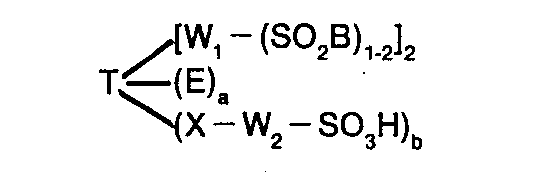
Farbstoffe der Formel:
Description
Die vorliegende Erfindung betrifft neue, reaktivgruppenhaltige Triphendioxazinfarbstoffe der allgemeinen Formel


- T1, T2 = H, Cl, Br, F, C1-C4-Alkoxy, C1-C4-Alkyl, gegebenenfalls substituiertes Phenyl oder Phenoxy, vorzugsweise Cl,
und worin
die Benzolringe D und die Naphthalinringe noch weiter substituiert sein können,
und worin
- B = SO2CH=CH2 oder SO2CH2CH2Z worin Z = abspaltbare Gruppe wie OS03H, Cl, S203H, OCCH3, OP03H2, -N(CH3)3, bevorzugt OSO3H, O
- E = SO3H, COOH oder gegebenenfalls substituierte Sulfonamidgruppe
- W1 = direkte Bindung oder von heterocyclischen Gruppen freies Brückenglied zu einem aromatisch-carbocyclischen C-Atom in T, wobei SO2B an ein C-Atom in W1 oder im Falle W1 = direkte Bindung an ein aromatisch-carbocyclisches C-Atom in T gebunden ist,
- X = O, NR oder S, wobei R = H oder gegebenenfalls substituiertes C1-C4-Alkyl,
- W2 = aliphatisches, araliphatisches oder aromatisch-carbocyclisches Brückenglied,
- a = 0 bis 2,
- b = 0 bis 2, wobei a + b = 0 oder 2 ist, wobei für a + b = 0,
- W1 mindestens eine wasserlöslich machende anionische Gruppe, insbesondere eine Sulfogruppe aufweist oder 2 S02B-Gruppen an W1 gebunden sind
und worin für den Fall, daß E = SO3H und a = 2 ist, W1 für W3 steht, wobei

- X die angegebene Bedeutung hat,
- Y = direkte Bindung, gegebenenfalls substiuiertes und/oder gegebenenfalls durch Heteroatome unterbrochenes C1-C6-Alkylen,
- X1 = direkte Bindung, O oder NR, vorzugsweise NH
und
der Benzol- bzw. Naphthalinkern A substituiert sein kann, oder
worin X die oben angegebene Bedeutung hat und - Y1 = gegebenenfalls durch Heteroatome unterbrochenes C2-C6-Alkylen.
- T 1 , T 2 = H, Cl, Br, F, C 1 -C 4 alkoxy, C 1 -C 4 alkyl, optionally substituted phenyl or phenoxy, preferably Cl,
and in what
the benzene rings D and the naphthalene rings can be further substituted,
and in what
- B = SO 2 CH = CH 2 or SO 2 CH 2 CH 2 Z where Z = cleavable group such as OS0 3 H, Cl, S 2 0 3 H, OCCH 3 , OP0 3 H 2 , -N (CH 3 ) 3 , preferably OSO 3 H, O
- E = SO 3 H, COOH or optionally substituted sulfonamide group
- W 1 = direct bond or bridge member free of heterocyclic groups to an aromatic-carbocyclic carbon atom in T, where SO 2 B to a carbon atom in W 1 or in the case of W 1 = direct bond to an aromatic-carbocyclic carbon atom is bound in T
- X = O, NR or S, where R = H or optionally substituted C 1 -C 4 alkyl,
- W 2 = aliphatic, araliphatic or aromatic-carbocyclic bridge member,
- a = 0 to 2,
- b = 0 to 2, where a + b = 0 or 2, where for a + b = 0,
- W 1 has at least one water-solubilizing anionic group, in particular a sulfo group, or 2 SO 2 B groups are bonded to W 1
and in the case where E = SO 3 H and a = 2, W 1 stands for W 3 , where
- X has the meaning given,
- Y = direct bond, optionally substituted and / or optionally interrupted by heteroatoms C 1 -C 6 alkylene,
- X 1 = direct bond, O or NR, preferably NH
and
the benzene or naphthalene nucleus A can be substituted, or
where X has the meaning given above and - Y 1 = C 2 -C 6 alkylene optionally interrupted by heteroatoms.
Geeignete Reste W1 sind neben den für W3 genannten beispielsweise die folgenden:


Der gegebenenfalls substituierte Sulfonamidrest E in Formel (1) enthält bevorzugt wasserlöslich machende Gruppen wie SO3H, COOH.The optionally substituted sulfonamide radical E in formula (1) preferably contains water-solubilizing groups such as SO 3 H, COOH.
Insbesondere steht E für folgende Gruppierungen E1:
- a) Rest der Formel

- b) Rest der Formel SO2-NH-SO2R1 wobei R1 für gegebenenfalls substituiertes Alkyl (vorzugsweise für CH3) oder für gegebenenfalls substituiertes Aryl (insbesondere Phenyl) steht,
- c) Rest der Formel

- a) rest of the formula
- b) radical of the formula SO 2 -NH-SO 2 R 1 where R 1 represents optionally substituted alkyl (preferably CH 3 ) or optionally substituted aryl (especially phenyl),
- c) rest of the formula
Beispiele für gegebenenfalls substituiertes R sind: CH3, C2H5, n-C3H7, n-C4H9, die durch OH, OCH3, COOH und SO3H substituiert sein können.Examples of optionally substituted R are: CH 3 , C 2 H 5 , nC 3 H 7 , nC 4 H 9 , which can be substituted by OH, OCH 3 , COOH and SO 3 H.
Substituenten der gegebenenfalls substituierten Phenyl-und Phenoxyreste T1 bzw. T2 sind z.B.:
- Cl, CH3, C2H5, OCH3, OC2H5.
- Cl, CH 3 , C 2 H 5 , OCH 3 , OC 2 H 5 .
Beispiele für Substituenten der Benzolringe D und der Naphthalinringe in Formel (la) bzw. (lb) sind:
- Cl, Br, CH3, C2H5, CH30, C2H5O, COOH.
- Cl, Br, CH 3 , C 2 H 5 , CH 3 0, C 2 H 5 O, COOH.
Beispiele für Substituenten der Benzol- bzw. Naphthalinringe A bzw. G sind:
- Cl, Br, CH3, OCH3, COOH, SO3H, SO2NHCH3, SO2NH2, OC2H5, C2H5.
- Cl, Br, CH 3 , OCH 3 , COOH, SO 3 H, SO 2 NHCH 3 , SO 2 NH 2 , OC 2 H 5 , C 2 H 5 .
Bevorzugt steht in Formel (la) der Substituent W1-(SO2B)1-2 in o-Stellung zu einem der beiden Sub- stituenten E oder -X-W2-SO3H.Preferably the substituent W 1 in formula (la) - (SO 2 B) 1-2 UB in o-position to one of the two substituents E S or -Xw 2 -SO 3 H.
Bevorzugte Farbstoffe (1) sind solche der Formeln (2) bis (5b):


- Y1 = gegebenenfalls durch Heteroatome unterbrochenes C2-C6-Alkylen und worin die Sulfogruppe in Formel (3) bzw. der Rest E1 in Formel (3a) in o-Stellung zum Stubstituenten -X-Y1-SO2B steht;


- X2 = direkte Bindung oder ein beispielsweise durch S03H, Cl, OCH3, CH3, C2H5, COOH, NH2 substituierter Arylenrest (vorzugsweise Phenylen) oder ein araliphatischer Rest,
die SO2B-Gruppe in o-Stellung zum Substituenten -X-Y-X2-SO3H steht
und X, Y, B, T1 und T2 und D die angegebene Bedeutung haben


- Y 1 = C 2 -C 6 alkylene optionally interrupted by heteroatoms and in which the sulfo group in formula (3) or the radical E 1 in formula (3a) is in the o-position to the stub substituent -XY 1 -SO 2 B;
- X 2 = direct bond or an arylene radical (preferably phenylene) or an araliphatic radical, for example substituted by S0 3 H, Cl, OCH 3 , CH 3 , C 2 H 5 , COOH, NH 2 ,
the SO 2 B group is in the o-position to the substituent -XYX 2 -SO 3 H.
and X, Y, B, T 1 and T 2 and D have the meaning given
Geeignete araliphatische Reste sind beispielsweise Phenylalkylenreste deren Alkylenkette durch Heteroatome oder Heteroatome enthaltende Gruppen unterbrochen sein können, wie

Als Substituenten für Y = C1-C6-Alkylen sind bevorzugt COOH, S03H, Halogen, gegebenenfalls durch SO3H substituiertes Phenyl. Unterbrechende Heteroatome sind vorzugsweise O, S und N.


Gegenstand der Erfindung sind auch Farbstoffe der Formel

K = COOH,
-SO2NH-SO2R1, worin R1 die oben genannte Bedeutung hat und worin die Gruppe -SO2B in o-Stellung zur Gruppe -X-W2-K steht.The invention also relates to dyes of the formula
K = COOH,
-SO 2 NH-SO 2 R 1 , in which R 1 has the meaning given above and in which the group -SO 2 B is in the o-position to the group -XW 2 -K.
Bei den Formeln (1) bis (5c) haben folgende Gruppierungen eine bevorzugte Bedeutung:
- (1), (2) bis (5c) : B = CH2CH2OSO3H
- (2) bis (5c) : T1, T2 = Cl
- (2) bis (3a), (5) bis
- (5c) : X = NH, D ist unsubstituiert
- (2) und (2a) : X1 = direkte Bindung Y = direkte Bindung oder -CH2-, -CH2-CH2- der Rest


- (3), (3a) : Y1 = -CH2-CH2-
- (5), (5a), (5b) :X2 = direkte Bindung und Y = -CH2-CH2-oder Y = direkte Bindung und


- (1), (2) to (5c): B = CH 2 CH 2 OSO 3 H
- (2) to (5c): T 1 , T 2 = Cl
- (2) to (3a), (5) to
- (5c): X = NH, D is unsubstituted
- (2) and (2a): X 1 = direct bond Y = direct bond or -CH 2 -, -CH 2 -CH 2 - the rest
- (3), (3a): Y 1 = -CH 2 -CH 2 -
- (5), (5a), (5b): X 2 = direct bond and Y = -CH 2 -CH 2 - or Y = direct bond and
Gegenstand der Erfindung sind weiterhin Verfahren zur Herstellung der Farbstoffe der Formeln (2), (2a), (3), (3a), (4), (5), (5a) und (5b), das dadurch gekennzeichnet ist, daß man die Diarylide der Formeln


Die Diarylide lassen sich auch nach den Angaben der Britischen Patentschrift 1 589 915 cyclisieren, wobei in 5 bis 30 %igem Oleum bei 0 bis 60°C mit 1 - 3 Mol Persulfat pro Mol Diarylid gearbeitet wird.The diarylides can also be cyclized according to the specifications of British Patent 1,589,915, with 1-3 mols of persulfate per mol of diarylide being used in 5 to 30% oleum at 0 to 60 ° C.
Beispiele für Ringschlüsse mit Oleum findet man in der Deutschen Offenlegungsschrift 25 03 611.Examples of ring closures with oleum can be found in German Offenlegungsschrift 25 03 611.
Besonders bevorzugt ist die Herstellung der Verbindungen der Formeln (2) bis (5c), in denen B = CH2CH2OSO3, wobei man als Ausgangsmaterial solche Verbindungen der Formeln (6) bis (9c) verwendet, in denen B = CH2CH2OH.Particular preference is given to the preparation of the compounds of the formulas (2) to (5c) in which B = CH 2 CH 2 OSO 3 , the starting material used being those compounds of the formulas (6) to (9c) in which B = CH 2 CH 2 OH.
Dabei wird gleichzeitig mit dem Ringschluß in Oleum eine Sulfatierung der OH-Gruppe zum Schwefelsäureester bewirkt.At the same time as the ring closure in oleum, sulfation of the OH group to the sulfuric acid ester is effected.
Unter den Bedingungen des Ringschlußes werden weitere aliphatische OH-Gruppen sulfatiert und es kann zu Sulfierungen aromatischer Ringe kommen.Under the conditions of ring closure, further aliphatic OH groups are sulfated and aromatic rings can be sulfated.
Die Diarylide der Formeln (6) bis (9c) können nach bekannten Methoden hergestellt werden, wie sie z.B. in den Deutschen Offenlegungsschriften 2 302 382, 2 344 781, 2 503 611, 2 823 828 und in der Britischen Patentschrift 2 059 985 erwähnt sind. So kann man beispielsweise 1 Mol eines p-Benzochinons, insbesondere des 2,3,5,6-Tetrachlor-1,4-benzochinons mit 2 Mol einer Verbindung der Formel


zu den Diaryliden der Formel (6) bis (9c) umsetzen.convert to the diarylides of formula (6) to (9c).
Beispiele für Amine der Formel (10) bis (13c) sind folgende:Examples of amines of the formulas (10) to (13c) are as follows:


Für die Kondensation mit den Aminen der Formel (10) bis (13c) geeignete p-Benzochinone sind außer dem bereits erwähnten 2,3,5,6-Tetrachlorbenzochinon folgende (Reaktionen dieser Art sind ausführlich in der Deutschen Offenlegungsschrift 2 823 828 beschrieben):
- 1,4-Benzochinon,
- 2-Methyl-1,4-benzochinon,
- 2-Ethyl-1,4-benzochinon,
- 2-n-Propyl-1,4-benzochinon,
- 2-Isopropyl-1,4-benzochinon,
- 2,2'-Ethoxyethyl-1,4-benzochinon,
- 2-Phenyl-1,4-benzochinon,
- 2-(41-Methylphenyl)-1,4-benzochinon,
- 2-(41-Methoxyphenyl)-1,4-benzochinon,
- 2-(3'-Chlorophenyl)-1,4-benzochinon,
- 2-(41-Nitrophenyl)-1,4-benzochinon,
- 2,5-Dimethyl-1,4-benzochinon,
- 2-Methyl-5-ethyl-1,4-benzochinon,
- 2-Methyl-3-chloro-1,4-benzochinon,
- 2-Methyl-6-chloro-l,4-benzochinon,
- 2-Methyl-3,5-dichloro-1,4-benzochinon,
- 2-Methyl-3,5,6-tribomo-1,4-benzochinon,
- 2-(41-Methylphenoxy)-3,6-dibromo-1,4-benzochinon,
- 2-(3'-Methylphenoxy)-3,6-dibromo-1,4-benzochinon,
- 2-Methyl-3,5,6-trichloro-1,4-benzochinon,
- 2-Methyl-3-chloro-5-bromo-1,4-benzochinon,
- 2-Methyl-3,6-dichloro-1,4-benzochinon,
- 2-Methyl-3,6-dichloro-5-bromo-1,4-benzochinon,
- 2-Phenyl-3,6-dichloro-1,4-benzochinon,
- 2-(41-Methoxyphenyl)-3,6-dichloro-1,4-benzochinon,
- 2-(4'-Chlorophenyl)-3,6-dichloro-1,4-benzochinon,
- 2-(41-Nitrophenyl)-3,6-dichloro-1,4-benzochinon,
- 2-(4'-Nitrophenyl)-3,5,6-trichloro-1,4-benzochinon,
- 2,5-Dimethyl-3,6-dibromo-1,4-benzochinon,
- 2,5-Dimethyl-3-chloro-1,4-benzochinon,
- 2-Methyl-5-n-propyl-6-bromo-1,4-benzochinon,
- 2-Methyl-5-isopropyl-3-chloro-1,4-benzochinon,
- 2-Methyl-5-isopropyl-6-bromo-1,4-benzochinon und
- 2-(2'-Chlorophenyl)-3,5,6-tribromo-1,4-benzochinon,
- 2-Methyl-3-methoxy-1,4-benzochinon,
- 2,3,5,6-Tetramethoxy-1,4-benzochinon,
- 2,3,5,6-Tetraphenoxy-1,4-benzochinon,
- 2,3,5,6-Tetra-(4'-methylphenoxy)-1,4-benzochinon,
- 2,3,5,6-Tetra-(4'-methoxyphenoxy)-1,4-benzochinon,
- 2,3,s,6-Tetra-(41-chlorophenoxy)-1,4-benzochinon,
- 2,3,5,6-Tetra-4-(3'-methyl-4'-chlorophenoxy)-1,4-benzochinon,
- 2-Ethyl-3,6-dimethoxy-1,4-benzochinon,
- 2-Chloro-3,6-dimethoxy-1,4-benzochinon,
- 2,3,5-Trimethoxy-1,4-benzochinon,
- 2,5-Dimethyl-3,6-dimethoxy-1,4-benzochinon,
- 2,5-Dimethyl-3,6-dimethoxy-1,4-benzochinon,
- 2-Methyl-3,6-dimethoxy-1,4-benzochinon,
- 2-Methyl-5,6-dimethoxy-1,4-benzochinon,
- 2-Ethyl-3,6-dimethoxy-1,4-benzochinon,
- 2-Chloro-3-n-propyl-5-methoxy-1,4-benzochinon,
- 2-Chloro-3,5-dimethoxy-1,4-benzochinon,
- 2,3,5,6-Tetrabrom-1,4-benzochinon.
- 1,4-benzoquinone,
- 2-methyl - 1,4-benzoquinone,
- 2-ethyl-1,4-benzoquinone,
- 2-n-propyl-1,4-benzoquinone,
- 2-isopropyl-1,4-benzoquinone,
- 2,2'-ethoxyethyl-1,4-benzoquinone,
- 2-phenyl-1,4-benzoquinone,
- 2- (4 1- methylphenyl) -1,4-benzoquinone,
- 2- (4 1- methoxyphenyl) -1,4-benzoquinone,
- 2- (3'-chlorophenyl) -1,4-benzoquinone,
- 2- (4 1- nitrophenyl) -1,4-benzoquinone,
- 2,5-dimethyl-1,4-benzoquinone,
- 2-methyl-5-ethyl-1,4-benzoquinone,
- 2-methyl-3-chloro-1,4-benzoquinone,
- 2-methyl-6-chloro-l, 4-benzoquinone,
- 2-methyl-3,5-dichloro-1,4-benzoquinone,
- 2-methyl-3,5,6-tribomo-1,4-benzoquinone,
- 2- (4 1- methylphenoxy) -3,6-dibromo-1,4-benzoquinone,
- 2- (3'-methylphenoxy) -3,6-dibromo-1,4-benzoquinone,
- 2-methyl-3,5,6-trichloro-1,4-benzoquinone,
- 2-methyl-3-chloro-5-bromo-1,4-benzoquinone,
- 2-methyl-3,6-dichloro-1,4-benzoquinone,
- 2-methyl-3,6-dichloro-5-bromo-1,4-benzoquinone,
- 2-phenyl-3,6-dichloro-1,4-benzoquinone,
- 2- (4 1- methoxyphenyl) -3,6-dichloro-1,4-benzoquinone,
- 2- (4'-chlorophenyl) -3,6-dichloro-1,4-benzoquinone,
- 2- (4 1- nitrophenyl) -3,6-dichloro-1,4-benzoquinone,
- 2- (4'-nitrophenyl) -3,5,6-trichloro-1,4-benzoquinone,
- 2,5-dimethyl-3,6-dibromo-1,4-benzoquinone,
- 2,5-dimethyl-3-chloro-1,4-benzoquinone,
- 2-methyl-5-n-propyl-6-bromo-1,4-benzoquinone,
- 2-methyl-5-isopropyl-3-chloro-1,4-benzoquinone,
- 2-methyl-5-isopropyl-6-bromo-1,4-benzoquinone and
- 2- (2'-chlorophenyl) -3,5,6-tribromo-1,4-benzoquinone,
- 2-methyl-3-methoxy-1,4-benzoquinone,
- 2,3,5,6-tetramethoxy-1,4-benzoquinone,
- 2,3,5,6-tetraphenoxy-1,4-benzoquinone,
- 2,3,5,6-tetra- (4'-methylphenoxy) -1,4-benzoquinone,
- 2,3,5,6-tetra- (4'-methoxyphenoxy) -1,4-benzoquinone,
- 2,3, s, 6-tetra- (4 1- chlorophenoxy) -1,4-benzoquinone,
- 2,3,5,6-tetra-4- (3'-methyl-4'-chlorophenoxy) -1,4-benzoquinone,
- 2-ethyl-3,6-dimethoxy-1,4-benzoquinone,
- 2-chloro-3,6-dimethoxy-1,4-benzoquinone,
- 2,3,5-trimethoxy-1,4-benzoquinone,
- 2,5-dimethyl-3,6-dimethoxy-1,4-benzoquinone,
- 2,5-dimethyl-3,6-dimethoxy-1,4-benzoquinone,
- 2-methyl-3,6-dimethoxy-1,4-benzoquinone,
- 2-methyl-5,6-dimethoxy-1,4-benzoquinone,
- 2-ethyl-3,6-dimethoxy-1,4-benzoquinone,
- 2-chloro-3-n-propyl-5-methoxy-1,4-benzoquinone,
- 2-chloro-3,5-dimethoxy-1,4-benzoquinone,
- 2,3,5,6-tetrabromo-1,4-benzoquinone.
Die neuen Farbstofe der Formel (1) eignen sich zum Färben und Bedrucken von Hydroxyl- oder Amidgruppen enthaltenden Materialien, wie Textilfasern-, Fäden und Geweben aus Wolle, Seide, synthetischen Polyamid- und Polyurethanfasern und zum waschechten Färben und Bedrucken von nativer oder regenerierter Cellulose, wobei die Behandlung von Cellulosematerialien zweckmäßigerweise in Gegenwart säurebindender Mittel und gegebenenfalls durch Hitzeeinwirkung nach den für Reaktivfarbstoffe der erfindungsgemäßen Art bekanntgewordenen Verfahren erfolgt.The new dyes of the formula (1) are suitable for dyeing and printing materials containing hydroxyl or amide groups, such as textile fibers, threads and fabrics made of wool, silk, synthetic polyamide and polyurethane fibers, and for washing and dyeing and printing native or regenerated cellulose , wherein the treatment of cellulose materials is expediently carried out in the presence of acid-binding agents and, if appropriate, by the action of heat by the methods which have become known for reactive dyes of the type according to the invention.
Die angegebenen Formeln sind die der entsprechenden freien Säuren. Die Farbstoffe wurden im allgemeinen in der Form der Alkalisalze, insbesondere der Na-Salze isoliert und zum Färben eingesetzt.The formulas given are those of the corresponding free acids. The dyes were generally isolated in the form of the alkali salts, especially the Na salts, and used for dyeing.
Die in den Beispielen genannten Gewichte beziehen sich auf die freie Säure. Die in den Beispielen angegebenen Farbkennzahlen beziehen sich auf Colour Index Hue-Indication Chart (Indicator Numbers).The weights given in the examples refer to the free acid. The color indicators given in the examples refer to the Color Index Hue Indication Chart (Indicator Numbers).
Die in den folgenden Beispielen angegebenen Formeln beziehen sich auf jeweils eines der bei der Umsetzung entstehenden isomeren Reaktionsprodukte, wobei bezüglich der Stellung der Substituenten in den beiden äußeren aromatischen Ringen des Triphendioxazin-Systems der isomeren Reaktionsprodukte auf das unter Formel (2) bis (5c) Gesagte verwiesen wird.The formulas given in the following examples each relate to one of the isomeric reaction products formed during the reaction, with respect to the position of the substituents in the two outer aromatic rings of the triphendioxazine system of the isomeric reaction products to the formula (2) to (5c) Said is referred.
0,05 Mol des Dianilides der Formel

Der Farbstoff entspricht der Formel

Nach den Angaben dieses Beispiels erhält man weitere wertvolle Farbstoffe, die Baumwolle in brillanten Blautönen färben, wenn man die folgenden Diarylide einsetzt:


41,05 g (0,05 Mol) des Dianilides der Formel

Nach dem Abkühlen auf Raumtemperatur trägt man auf 2 kg Eiswasser aus und setzt 10 Volumen % Natrium- oder Kaliumchlorid zu. Nach dem Absaugen wird die Paste in Eiswasser angerührt und mit Natriumhydrogencarbonat auf pH 5-6 gestellt. Nach dem Aussalzen, Absaugen, Trocknen im Vakuumtrockenschrank bei 60°C und Mahlen erhält man ein blaues Pulver, das Baumwolle in brillanten Blautönen (Farbkennzahl 13). Der Farbstoff entspricht der Formel

41,05 g des Dianilides aus Beispiel 2a werden in 15 Minuten in 400 g 20 %iges Oleum unter Rühren bei 20 bis 25°C eingetragen. 22,8 g Ammoniumpersulfat werden dann in 7 gleichgroßen Portionen im Abstand von je einer Stunde bei 20 bis 30°C eingetragen. Man rührt noch 1 Stunde bei 20 bis 30°C nach. Das Reaktionsgemisch wird auf 1 kg Eiswasser ausgetragen und dann mit 10 Volumen % Natrium- oder Kaliumchlorid versetzt. Nach dem Absaugen wird die Paste in Eiswasser angerührt und mit Natriumhydrogencarbonat auf pH 5-6 gestellt. Nach dem Aussalzen, Absaugen, Trocknen im Vakuumtrockenschrank bei 60°C und Mahlen erhält man ein blaues Pulver, das Baumwolle gleichfalls in brillanten Blautönen färbt (Farbkennzahl 19). Der Farbstoff entspricht der bei Beispiel 2a angegebenen Formel.41.05 g of the dianilide from Example 2a are introduced into 400 g of 20% oleum with stirring at 20 to 25 ° C. in 15 minutes. 22.8 g of ammonium persulfate are then introduced in 7 equally large portions at an interval of one hour at 20 to 30 ° C. The mixture is stirred at 20 to 30 ° C for 1 hour. The reaction mixture is poured onto 1 kg of ice water and then mixed with 10% by volume sodium or potassium chloride. After this The paste is suctioned off in ice water and adjusted to pH 5-6 with sodium hydrogen carbonate. After salting out, vacuuming, drying in a vacuum drying cabinet at 60 ° C. and grinding, a blue powder is obtained, which also dyes cotton in brilliant shades of blue (color code 19). The dye corresponds to the formula given in Example 2a.
41,05 g des Dianilides aus Beispiel 2b werden mit 10 g Kieselgur innig vermischt und in 40 Minuten unter gutem Rühren bei 20 bis 30°C in ein Gemisch aus 80 ml 20 %igem und 60 ml 65 %igem Oleum eingetragen. Bei 20°C werden 1 g Kaliumjodid zugesetzt. Man rührt 45 Minuten bei 20°C bis 23°C und läßt dann die Schmelze in 1000 g Eis und 200 ml Wasser einlaufen, sodaß die Temperaturen nicht über 10° steigt. Man fügt dann 10 Volumen % Natrium- oder Kaliumchlorid zu. Man saugt den Niederschlag ab und trägt die Paste in Eiswasser ein. Durch Zugabe von Natriumhydrogencarbonat wird der pH auf 5-6 gestellt. Nach dem Aussalzen, Absaugen, Trocknen im Vakuumtrockenschrank bei 60° und Mahlen erhält man ein blaues Pulver, das Baumwolle gleichfalls in brillanten Blautönen färbt (Farbkennzahl 13).41.05 g of the dianilide from Example 2b are intimately mixed with 10 g of diatomaceous earth and introduced in 40 minutes with good stirring at 20 to 30 ° C. into a mixture of 80 ml of 20% and 60 ml of 65% oleum. 1 g of potassium iodide is added at 20 ° C. The mixture is stirred at 20 ° C. to 23 ° C. for 45 minutes and then the melt is run into 1000 g of ice and 200 ml of water, so that the temperature does not rise above 10 °. Then 10 volume% sodium or potassium chloride is added. The precipitate is filtered off and the paste is added to ice water. The pH is adjusted to 5-6 by adding sodium hydrogen carbonate. After salting out, vacuuming, drying in a vacuum drying cabinet at 60 ° and grinding, a blue powder is obtained which also dyes cotton in brilliant shades of blue (color code 13).
Der Farbstoff entspricht der bei Beispiel 2a angegebenen Formel.The dye corresponds to the formula given in Example 2a.
Farbstoffe mit Sulfonamidgruppen werden zweckmäßigerweise nach Verfahren 2b und 2c hergestellt.Dyes with sulfonamide groups are expediently prepared by methods 2b and 2c.
Weitere wertvolle Farbstoffe erhält man nach den Angaben der Beispiele 2a, 2b oder 2c, wenn man die nachfolgend aufgeführten Dianilide einsetzt, wobei die Ausgangs-und Endprodukte durch die folgenden Formeln charakterisiert sind. (Beispiele für Farbstoffe der Unterformel 5, 5a, 5b und 5c, Tabelle 1).Further valuable dyes are obtained according to the information in Examples 2a, 2b or 2c if the dianilides listed below are used, the starting and end products being characterized by the following formulas. (Examples of dyes of sub-formula 5, 5a, 5b and 5c, Table 1).

Die Sulfogruppe in T3 in den Beispielen 13, 28, 26 wird beim Ringschluß in Oleum eingeführt.


Weitere wertvolle Farbstoffe erhält man nach den Angaben der Beispiele 2a, 2b und 2c, wenn man der nachfolgend aufgeführten Dianilide einsetzt, woher die Ausgangsprodukte und Endprodukte durch die folgenden Formeln charakterisiert sind (Beispiele für Farbstoffe der Unterformeln 2 und 3, Tabelle 2)

Farbkennzahl 13 = klares rotstichiges Blau " 14 = klares Blau


Weitere wertvolle Farbstoffe erhält man nach den Angaben der Beispiele 2a, 2b oder 2c, wenn man die nachfolgend aufgeführten Dianilide einsetzt, wobei die Ausgangs- und Endprodukte durch die folgende Formel charakterisiert sind (Beispiele für Unterformel 2a und 3a, Tabelle 3).

Farbkennzahl 13 = klares rotstichiges Blau " 14 = klares Blau


Weitere wertvolle Farbstoffe erhält man nach den Angaben des Beispiele 2a, 2b oder 2c, wenn man die nachfolgend aufgeführten Diarylide einsetzt, wobei die Ausgangs- und Endprodukte durch die folgende Formel charakterisiert sind (Beispiele für Farbstoffe der Unterformel 4, Tabelle 4)

In der Tabelle steht B für SO2CH2CH2OSO3H und B2 für SO2CH2CH2OH.In the table, B stands for SO 2 CH 2 CH 2 OSO 3 H and B 2 for SO 2 CH 2 CH 2 OH.
Farbkennzahl 13 = klares rotstichiges Blau

Claims (14)


die Benzolringe D und die Naphthalinringe noch weiter substituiert sein können,


worin
the benzene rings D and the naphthalene rings can be further substituted,
wherein

n = 1 oder 2, und E in o-Stellung zum Substituenten -X-Y-X1

n = 1 or 2, and E in the o-position to the substituent -XYX 1


X2 = direkte Bindung oder ein beispielsweise durch S0 3 H, Cl, OCH3, CH3, C2H5, NH2 substituierter Arylrest (vorzugsweise Phenylen) oder ein araliphatischer Rest
und die SO2B-Gruppe in o-Stellung zum Substituenten -X-Y-X2-SO3H steht.5. Triphendioxazine dyes of the formula
X 2 = direct bond or an aryl radical (preferably phenylene) or an araliphatic radical, for example substituted by S0 3 H, Cl, OCH 3 , CH 3 , C 2 H 5 , NH 2
and the SO 2 B group is in the o-position to the substituent -XYX 2 -SO 3 H.


und solche der Ansprüche 2, 3, 5, 6 und 7, in denen X = NH.8. triphendioxazine dyes of claims 1 to 7, in which
and those of claims 2, 3, 5, 6 and 7, in which X = NH.


Applications Claiming Priority (6)
| Application Number | Priority Date | Filing Date | Title |
|---|---|---|---|
| DE3336844 | 1983-10-11 | ||
| DE3336844 | 1983-10-11 | ||
| DE19833344253 DE3344253A1 (en) | 1983-10-11 | 1983-12-07 | Triphendioxazine dyes containing reactive groups |
| DE3344253 | 1983-12-07 | ||
| DE19843404855 DE3404855A1 (en) | 1984-02-11 | 1984-02-11 | Reactive dyes of the triphendioxazine type |
| DE3404855 | 1984-02-11 |
Publications (3)
| Publication Number | Publication Date |
|---|---|
| EP0141996A2 true EP0141996A2 (en) | 1985-05-22 |
| EP0141996A3 EP0141996A3 (en) | 1985-12-11 |
| EP0141996B1 EP0141996B1 (en) | 1987-11-25 |
Family
ID=27191340
Family Applications (1)
| Application Number | Title | Priority Date | Filing Date |
|---|---|---|---|
| EP84111706A Expired EP0141996B1 (en) | 1983-10-11 | 1984-10-01 | Triphendioxazine reactive dyes |
Country Status (10)
| Country | Link |
|---|---|
| US (1) | US4629788A (en) |
| EP (1) | EP0141996B1 (en) |
| JP (2) | JPH0649837B2 (en) |
| KR (1) | KR910001686B1 (en) |
| BR (1) | BR8405098A (en) |
| CA (1) | CA1240678A (en) |
| DE (1) | DE3467766D1 (en) |
| ES (1) | ES8607445A1 (en) |
| HK (1) | HK27188A (en) |
| PT (1) | PT79297B (en) |
Cited By (15)
| Publication number | Priority date | Publication date | Assignee | Title |
|---|---|---|---|---|
| EP0141359A3 (en) * | 1983-11-04 | 1986-03-12 | Bayer Ag | Process for preparing triphenyldioxazine compounds |
| DE3537629A1 (en) * | 1984-10-25 | 1986-04-30 | Sandoz-Patent-GmbH, 7850 Lörrach | Oxazine compounds and preparation and use thereof |
| EP0212635A1 (en) * | 1985-08-29 | 1987-03-04 | Hoechst Aktiengesellschaft | Water soluble triphenedioxazine compounds, process for their preparation and their use as dyestuffs |
| EP0234778A3 (en) * | 1986-02-17 | 1987-10-07 | Sumitomo Chemical Company, Limited | Dioxazine compound having vinylsulfone type fiber reactive group |
| EP0256331A1 (en) * | 1986-07-26 | 1988-02-24 | Hoechst Aktiengesellschaft | N1-substituted 1H-benzotriazole-hydroxyethyl-sulfone compounds, process for their preparation and their use in the preparation of dyes |
| US4774333A (en) * | 1986-08-19 | 1988-09-27 | Hoechst Aktiengesellschaft | Water-soluble triphendioxazine compounds and sulfonyl-containing precursors thereof, processes for the preparation thereof and use of the triphendioxazines as dyes |
| US4782150A (en) * | 1986-08-13 | 1988-11-01 | Hoechst Aktiengesellschaft | Water-soluble triphendioxazine compounds |
| US4785098A (en) * | 1984-07-20 | 1988-11-15 | Hoechst Aktiengesellschaft | Water-soluble triphendioxazine compounds |
| US4786728A (en) * | 1985-09-19 | 1988-11-22 | Hoechst Aktiengesellschaft | Water-soluble triphendioxazine compounds |
| EP0292906A3 (en) * | 1987-05-27 | 1989-03-22 | Hoechst Aktiengesellschaft | Process for the preparation of triphendioxazine compounds |
| US4816574A (en) * | 1986-07-26 | 1989-03-28 | Hoechst Aktiengesellschaft | Water-soluble triphendioxazine compounds |
| EP0278320A3 (en) * | 1987-02-07 | 1991-01-16 | Bayer Ag | Process for the manufacture of an aqueous, concentrated solution of a reactive dye |
| EP0311969A3 (en) * | 1987-10-16 | 1991-04-24 | BASF Aktiengesellschaft | Process for preparing triphenyl dioxazines |
| EP0568816A1 (en) * | 1992-04-14 | 1993-11-10 | Bayer Ag | Symmetrical azo dyes |
| EP3162859A1 (en) | 2015-11-02 | 2017-05-03 | DyStar Colours Distribution GmbH | Heavy metal free, blue and navy fibre-reactive dye mixtures |
Families Citing this family (9)
| Publication number | Priority date | Publication date | Assignee | Title |
|---|---|---|---|---|
| US4629788A (en) * | 1983-10-11 | 1986-12-16 | Bayer Aktiengesellschaft | Triphendioxazine reactive dyestuffs |
| DE3542025A1 (en) * | 1985-11-28 | 1987-06-11 | Hoechst Ag | MIXTURES OF WATER SOLUBLE FIBER REACTIVE DYES AND THEIR USE FOR COLORING |
| US5171852A (en) * | 1987-01-20 | 1992-12-15 | Imperial Chemical Industries Plc | Triphenodioxazine reactive dyes having sulphonate ester groups |
| DE3827530A1 (en) * | 1988-08-13 | 1990-03-15 | Bayer Ag | REACTIVE DYES |
| EP0365482A1 (en) * | 1988-10-20 | 1990-04-25 | Ciba-Geigy Ag | Reactive dyes, their preparation and their use |
| EP0531968A1 (en) * | 1991-09-13 | 1993-03-17 | Hoechst Aktiengesellschaft | Mixture of water soluble reactive dyes and its use |
| CN106349127A (en) * | 2016-08-24 | 2017-01-25 | 天津德凯化工股份有限公司 | Novel dye intermediate and active dye prepared from dye intermediate |
| CN106349129A (en) * | 2016-08-24 | 2017-01-25 | 天津德凯化工股份有限公司 | Dye intermediate and active dye prepared from intermediate |
| CN106432010A (en) * | 2016-08-24 | 2017-02-22 | 天津德凯化工股份有限公司 | Dye intermediate namely (3-beta-hydroxyethylsulfonyl)aniline-4-aminobenzenesulfonic acid and preparation method thereof |
Family Cites Families (11)
| Publication number | Priority date | Publication date | Assignee | Title |
|---|---|---|---|---|
| DE1292272B (en) * | 1959-10-12 | 1969-04-10 | Ici Ltd | Process for the production of water-soluble fiber-reactive dyes |
| DE1280809B (en) * | 1963-11-25 | 1968-10-24 | Hoechst Ag | Process for the production of dyeings and prints on fibers containing hydroxyl groups |
| FR1416127A (en) * | 1963-11-25 | 1965-10-29 | Hoechst Ag | Dyeing and printing on polyhydric fibers |
| GB1450746A (en) * | 1974-01-31 | 1976-09-29 | Ici Ltd | Tripendioxazine dyestuffs |
| AU497288B2 (en) * | 1975-04-15 | 1978-12-07 | Imperial Chemical Industries Limited | Dyestuffs |
| CH606349A5 (en) * | 1976-08-03 | 1978-10-31 | Hoechst Ag | |
| GB1559752A (en) * | 1977-07-12 | 1980-01-23 | Ici Ltd | Triphendioxazine dyestuffs |
| US4336377A (en) * | 1979-02-02 | 1982-06-22 | Ciba-Geigy Corporation | Basic dioxazine compounds |
| DE3045471A1 (en) * | 1980-12-02 | 1982-07-08 | Bayer Ag, 5090 Leverkusen | DIOXAZINE REACTIVE DYES, METHOD FOR THE PRODUCTION THEREOF AND THEIR USE FOR DYING AND PRINTING FIBER MATERIALS CONTAINING HYDROXYL OR AMIDE GROUPS |
| EP0084718B1 (en) * | 1982-01-27 | 1986-04-16 | Imperial Chemical Industries Plc | Triphendioxazine dyestuffs |
| US4629788A (en) * | 1983-10-11 | 1986-12-16 | Bayer Aktiengesellschaft | Triphendioxazine reactive dyestuffs |
-
1984
- 1984-09-20 US US06/652,784 patent/US4629788A/en not_active Expired - Lifetime
- 1984-10-01 PT PT79297A patent/PT79297B/en active IP Right Revival
- 1984-10-01 DE DE8484111706T patent/DE3467766D1/en not_active Expired
- 1984-10-01 EP EP84111706A patent/EP0141996B1/en not_active Expired
- 1984-10-09 JP JP59210606A patent/JPH0649837B2/en not_active Expired - Lifetime
- 1984-10-09 CA CA000464932A patent/CA1240678A/en not_active Expired
- 1984-10-10 ES ES536666A patent/ES8607445A1/en not_active Expired
- 1984-10-10 BR BR8405098A patent/BR8405098A/en not_active IP Right Cessation
- 1984-10-11 KR KR1019840006295A patent/KR910001686B1/en not_active Expired
-
1988
- 1988-04-14 HK HK271/88A patent/HK27188A/en not_active IP Right Cessation
-
1992
- 1992-01-23 JP JP4032669A patent/JPH0794613B2/en not_active Expired - Lifetime
Cited By (23)
| Publication number | Priority date | Publication date | Assignee | Title |
|---|---|---|---|---|
| EP0141359A3 (en) * | 1983-11-04 | 1986-03-12 | Bayer Ag | Process for preparing triphenyldioxazine compounds |
| EP0168751B1 (en) * | 1984-07-20 | 1989-02-08 | Hoechst Aktiengesellschaft | Water soluble triphenedioxazine compounds, process for their preparation and their use as dyestuffs |
| US4785098A (en) * | 1984-07-20 | 1988-11-15 | Hoechst Aktiengesellschaft | Water-soluble triphendioxazine compounds |
| DE3537629A1 (en) * | 1984-10-25 | 1986-04-30 | Sandoz-Patent-GmbH, 7850 Lörrach | Oxazine compounds and preparation and use thereof |
| DE3537629C2 (en) * | 1984-10-25 | 2003-01-16 | Clariant Finance Bvi Ltd | Oxazine compounds, their production and use |
| EP0212635A1 (en) * | 1985-08-29 | 1987-03-04 | Hoechst Aktiengesellschaft | Water soluble triphenedioxazine compounds, process for their preparation and their use as dyestuffs |
| US4851527A (en) * | 1985-08-29 | 1989-07-25 | Hoechst Aktiengesellschaft | Water-soluble triphendioxazine compounds |
| US4786728A (en) * | 1985-09-19 | 1988-11-22 | Hoechst Aktiengesellschaft | Water-soluble triphendioxazine compounds |
| EP0234778A3 (en) * | 1986-02-17 | 1987-10-07 | Sumitomo Chemical Company, Limited | Dioxazine compound having vinylsulfone type fiber reactive group |
| US4841048A (en) * | 1986-02-17 | 1989-06-20 | Sumitomo Chemical Company, Limited | Dioxazine compound having vinylsulfone type fiber reactive group |
| EP0256331A1 (en) * | 1986-07-26 | 1988-02-24 | Hoechst Aktiengesellschaft | N1-substituted 1H-benzotriazole-hydroxyethyl-sulfone compounds, process for their preparation and their use in the preparation of dyes |
| US4816574A (en) * | 1986-07-26 | 1989-03-28 | Hoechst Aktiengesellschaft | Water-soluble triphendioxazine compounds |
| US4851542A (en) * | 1986-07-26 | 1989-07-25 | Hoechst Aktiengesellschaft | N1 -substituted 1H-benzytriazole hydroxyethyl sulfone compounds, a process for their preparation and their use for the preparation of dyestudds |
| US4782150A (en) * | 1986-08-13 | 1988-11-01 | Hoechst Aktiengesellschaft | Water-soluble triphendioxazine compounds |
| US4885385A (en) * | 1986-08-19 | 1989-12-05 | Hoechst Aktiengesellschaft | Sulfonyl containing compounds suitable as precurors for water-soluble fiber-reactive triphendioxazine compounds |
| US4774333A (en) * | 1986-08-19 | 1988-09-27 | Hoechst Aktiengesellschaft | Water-soluble triphendioxazine compounds and sulfonyl-containing precursors thereof, processes for the preparation thereof and use of the triphendioxazines as dyes |
| EP0278320A3 (en) * | 1987-02-07 | 1991-01-16 | Bayer Ag | Process for the manufacture of an aqueous, concentrated solution of a reactive dye |
| EP0292906A3 (en) * | 1987-05-27 | 1989-03-22 | Hoechst Aktiengesellschaft | Process for the preparation of triphendioxazine compounds |
| EP0311969A3 (en) * | 1987-10-16 | 1991-04-24 | BASF Aktiengesellschaft | Process for preparing triphenyl dioxazines |
| EP0568816A1 (en) * | 1992-04-14 | 1993-11-10 | Bayer Ag | Symmetrical azo dyes |
| EP3162859A1 (en) | 2015-11-02 | 2017-05-03 | DyStar Colours Distribution GmbH | Heavy metal free, blue and navy fibre-reactive dye mixtures |
| WO2017076713A1 (en) | 2015-11-02 | 2017-05-11 | Dystar Colours Distribution Gmbh | Heavy metal free, blue and navy fibre- reactive dye mixtures |
| US10301475B2 (en) | 2015-11-02 | 2019-05-28 | DryStar Colours Distribution GmbH | Heavy metal free, blue and navy fibre-reactive dye mixtures |
Also Published As
| Publication number | Publication date |
|---|---|
| KR850003418A (en) | 1985-06-17 |
| PT79297A (en) | 1984-11-01 |
| US4629788A (en) | 1986-12-16 |
| ES8607445A1 (en) | 1986-05-16 |
| KR910001686B1 (en) | 1991-03-18 |
| JPH0593146A (en) | 1993-04-16 |
| CA1240678A (en) | 1988-08-16 |
| JPH0794613B2 (en) | 1995-10-11 |
| JPS60108471A (en) | 1985-06-13 |
| ES536666A0 (en) | 1986-05-16 |
| PT79297B (en) | 1986-09-10 |
| EP0141996A3 (en) | 1985-12-11 |
| BR8405098A (en) | 1985-08-20 |
| JPH0649837B2 (en) | 1994-06-29 |
| HK27188A (en) | 1988-04-22 |
| DE3467766D1 (en) | 1988-01-07 |
| EP0141996B1 (en) | 1987-11-25 |
Similar Documents
| Publication | Publication Date | Title |
|---|---|---|
| EP0141996B1 (en) | Triphendioxazine reactive dyes | |
| EP0170838B1 (en) | Reactive dyes of the dioxazine-type, their preparation and use | |
| DE1148341B (en) | Process for the production of dyes | |
| US3349097A (en) | Water-soluble phthalocyanine dyestuffs and process for preparing them | |
| EP0075905A2 (en) | Water-soluble reactive phthalocyanine compounds; process for their preparation and their use as dyestuffs | |
| US4512773A (en) | Cationic triphendioxazine dyes, methods for their manufacture and their use for dyeing cellulosic substrates | |
| EP0144580A2 (en) | Triphendioxazine dyes | |
| DE1955849C3 (en) | Water-soluble, reactive xanthene dyes, processes for their preparation and their use for dyeing or printing | |
| CH630945A5 (en) | AQUEOUS DYE PREPARATIONS FOR CELLULOSE OR FIBER MATERIAL CONTAINING CELLULOSE. | |
| EP0019728A1 (en) | Utilisation of reactive dyestuffs in dyeing and printing blended fabrics polyester/cotton | |
| EP0258493B1 (en) | Water soluble triphene dioxazine compounds and their starting compounds containing sulfonyl groups, process for their preparation and use of the triphene dioxazines as dyestuffs | |
| EP0144896B1 (en) | Triphendioxazine dyes | |
| EP0229339B1 (en) | Water soluble triphene dioxazine compounds, their starting compounds containing sulphonyl groups, process for their preparation and use of the triphene dioxazines as dyestuffs | |
| DE3344253A1 (en) | Triphendioxazine dyes containing reactive groups | |
| EP0355735B1 (en) | Water soluble tripheno dioxazine compounds and their starting products containing sulfonyl groups, process for their preparation and use of these tripheno dioxazines as dyestuffs | |
| DE1224423B (en) | Process for the production of dyes | |
| DE3404855A1 (en) | Reactive dyes of the triphendioxazine type | |
| EP0258686B1 (en) | Water soluble triphendioxazine compounds, process for their preparation and their use as dyestuffs | |
| DE2337488C2 (en) | Process for the preparation of reactive xanthene dyes | |
| DE2422465A1 (en) | AZO DYES | |
| EP0198349A1 (en) | Reactive disazo dyes | |
| EP0448815B1 (en) | Triphenyl dioxazine dyes | |
| EP0076922A1 (en) | Water-soluble disazo compounds and their new coupling components, process for their manufacture and use of the disazo compounds as dyestuffs | |
| DE728487C (en) | Process for the preparation of N, N-dialkyl- or N-alkyl-N-aralkyldipyrazole anthronyls | |
| DE2623361A1 (en) | REACTIVE COLORS |
Legal Events
| Date | Code | Title | Description |
|---|---|---|---|
| PUAI | Public reference made under article 153(3) epc to a published international application that has entered the european phase |
Free format text: ORIGINAL CODE: 0009012 |
|
| 17P | Request for examination filed |
Effective date: 19841001 |
|
| AK | Designated contracting states |
Designated state(s): BE CH DE FR GB IT LI NL |
|
| RTI1 | Title (correction) | ||
| PUAL | Search report despatched |
Free format text: ORIGINAL CODE: 0009013 |
|
| AK | Designated contracting states |
Designated state(s): BE CH DE FR GB IT LI NL |
|
| 17Q | First examination report despatched |
Effective date: 19860527 |
|
| GRAA | (expected) grant |
Free format text: ORIGINAL CODE: 0009210 |
|
| AK | Designated contracting states |
Kind code of ref document: B1 Designated state(s): BE CH DE FR GB IT LI NL |
|
| ITF | It: translation for a ep patent filed | ||
| REF | Corresponds to: |
Ref document number: 3467766 Country of ref document: DE Date of ref document: 19880107 |
|
| GBT | Gb: translation of ep patent filed (gb section 77(6)(a)/1977) | ||
| ET | Fr: translation filed | ||
| PLBE | No opposition filed within time limit |
Free format text: ORIGINAL CODE: 0009261 |
|
| STAA | Information on the status of an ep patent application or granted ep patent |
Free format text: STATUS: NO OPPOSITION FILED WITHIN TIME LIMIT |
|
| 26N | No opposition filed | ||
| ITTA | It: last paid annual fee | ||
| PGFP | Annual fee paid to national office [announced via postgrant information from national office to epo] |
Ref country code: NL Payment date: 19931031 Year of fee payment: 10 |
|
| PG25 | Lapsed in a contracting state [announced via postgrant information from national office to epo] |
Ref country code: NL Effective date: 19950501 |
|
| NLV4 | Nl: lapsed or anulled due to non-payment of the annual fee | ||
| REG | Reference to a national code |
Ref country code: GB Ref legal event code: IF02 |
|
| PGFP | Annual fee paid to national office [announced via postgrant information from national office to epo] |
Ref country code: CH Payment date: 20030930 Year of fee payment: 20 |
|
| PGFP | Annual fee paid to national office [announced via postgrant information from national office to epo] |
Ref country code: GB Payment date: 20031001 Year of fee payment: 20 |
|
| PGFP | Annual fee paid to national office [announced via postgrant information from national office to epo] |
Ref country code: FR Payment date: 20031003 Year of fee payment: 20 |
|
| PGFP | Annual fee paid to national office [announced via postgrant information from national office to epo] |
Ref country code: DE Payment date: 20031009 Year of fee payment: 20 |
|
| PGFP | Annual fee paid to national office [announced via postgrant information from national office to epo] |
Ref country code: BE Payment date: 20031211 Year of fee payment: 20 |
|
| PG25 | Lapsed in a contracting state [announced via postgrant information from national office to epo] |
Ref country code: LI Free format text: LAPSE BECAUSE OF EXPIRATION OF PROTECTION Effective date: 20040930 Ref country code: GB Free format text: LAPSE BECAUSE OF EXPIRATION OF PROTECTION Effective date: 20040930 Ref country code: CH Free format text: LAPSE BECAUSE OF EXPIRATION OF PROTECTION Effective date: 20040930 |
|
| REG | Reference to a national code |
Ref country code: GB Ref legal event code: PE20 |
|
| REG | Reference to a national code |
Ref country code: CH Ref legal event code: PL |
|
| BE20 | Be: patent expired |
Owner name: *BAYER A.G. Effective date: 20041001 |