EP0142111A2 - Fluorierte Thiolcarbamate - Google Patents
Fluorierte Thiolcarbamate Download PDFInfo
- Publication number
- EP0142111A2 EP0142111A2 EP84113275A EP84113275A EP0142111A2 EP 0142111 A2 EP0142111 A2 EP 0142111A2 EP 84113275 A EP84113275 A EP 84113275A EP 84113275 A EP84113275 A EP 84113275A EP 0142111 A2 EP0142111 A2 EP 0142111A2
- Authority
- EP
- European Patent Office
- Prior art keywords
- carbon atoms
- alkyl
- formula
- cycloalkyl
- optionally substituted
- Prior art date
- Legal status (The legal status is an assumption and is not a legal conclusion. Google has not performed a legal analysis and makes no representation as to the accuracy of the status listed.)
- Withdrawn
Links
- 0 C[C@](C[C@@]1[C@@]2C1)[C@](C1)[C@@](*3)[C@@]1C[C@@](C1)[C@@]31C2=C Chemical compound C[C@](C[C@@]1[C@@]2C1)[C@](C1)[C@@](*3)[C@@]1C[C@@](C1)[C@@]31C2=C 0.000 description 2
- VJBKBBDQFUUHET-UHFFFAOYSA-N CSC(N1CCCC1)=O Chemical compound CSC(N1CCCC1)=O VJBKBBDQFUUHET-UHFFFAOYSA-N 0.000 description 1
Classifications
-
- C—CHEMISTRY; METALLURGY
- C07—ORGANIC CHEMISTRY
- C07D—HETEROCYCLIC COMPOUNDS
- C07D295/00—Heterocyclic compounds containing polymethylene-imine rings with at least five ring members, 3-azabicyclo [3.2.2] nonane, piperazine, morpholine or thiomorpholine rings, having only hydrogen atoms directly attached to the ring carbon atoms
- C07D295/16—Heterocyclic compounds containing polymethylene-imine rings with at least five ring members, 3-azabicyclo [3.2.2] nonane, piperazine, morpholine or thiomorpholine rings, having only hydrogen atoms directly attached to the ring carbon atoms acylated on ring nitrogen atoms
- C07D295/20—Heterocyclic compounds containing polymethylene-imine rings with at least five ring members, 3-azabicyclo [3.2.2] nonane, piperazine, morpholine or thiomorpholine rings, having only hydrogen atoms directly attached to the ring carbon atoms acylated on ring nitrogen atoms by radicals derived from carbonic acid, or sulfur or nitrogen analogues thereof
- C07D295/21—Radicals derived from sulfur analogues of carbonic acid
-
- A—HUMAN NECESSITIES
- A01—AGRICULTURE; FORESTRY; ANIMAL HUSBANDRY; HUNTING; TRAPPING; FISHING
- A01N—PRESERVATION OF BODIES OF HUMANS OR ANIMALS OR PLANTS OR PARTS THEREOF; BIOCIDES, e.g. AS DISINFECTANTS, AS PESTICIDES OR AS HERBICIDES; PEST REPELLANTS OR ATTRACTANTS; PLANT GROWTH REGULATORS
- A01N47/00—Biocides, pest repellants or attractants, or plant growth regulators containing organic compounds containing a carbon atom not being member of a ring and having no bond to a carbon or hydrogen atom, e.g. derivatives of carbonic acid
- A01N47/08—Biocides, pest repellants or attractants, or plant growth regulators containing organic compounds containing a carbon atom not being member of a ring and having no bond to a carbon or hydrogen atom, e.g. derivatives of carbonic acid the carbon atom having one or more single bonds to nitrogen atoms
- A01N47/10—Carbamic acid derivatives, i.e. containing the group —O—CO—N<; Thio analogues thereof
- A01N47/12—Carbamic acid derivatives, i.e. containing the group —O—CO—N<; Thio analogues thereof containing a —O—CO—N< group, or a thio analogue thereof, neither directly attached to a ring nor the nitrogen atom being a member of a heterocyclic ring
-
- A—HUMAN NECESSITIES
- A01—AGRICULTURE; FORESTRY; ANIMAL HUSBANDRY; HUNTING; TRAPPING; FISHING
- A01N—PRESERVATION OF BODIES OF HUMANS OR ANIMALS OR PLANTS OR PARTS THEREOF; BIOCIDES, e.g. AS DISINFECTANTS, AS PESTICIDES OR AS HERBICIDES; PEST REPELLANTS OR ATTRACTANTS; PLANT GROWTH REGULATORS
- A01N47/00—Biocides, pest repellants or attractants, or plant growth regulators containing organic compounds containing a carbon atom not being member of a ring and having no bond to a carbon or hydrogen atom, e.g. derivatives of carbonic acid
- A01N47/08—Biocides, pest repellants or attractants, or plant growth regulators containing organic compounds containing a carbon atom not being member of a ring and having no bond to a carbon or hydrogen atom, e.g. derivatives of carbonic acid the carbon atom having one or more single bonds to nitrogen atoms
- A01N47/10—Carbamic acid derivatives, i.e. containing the group —O—CO—N<; Thio analogues thereof
- A01N47/16—Carbamic acid derivatives, i.e. containing the group —O—CO—N<; Thio analogues thereof the nitrogen atom being part of a heterocyclic ring
-
- A—HUMAN NECESSITIES
- A01—AGRICULTURE; FORESTRY; ANIMAL HUSBANDRY; HUNTING; TRAPPING; FISHING
- A01N—PRESERVATION OF BODIES OF HUMANS OR ANIMALS OR PLANTS OR PARTS THEREOF; BIOCIDES, e.g. AS DISINFECTANTS, AS PESTICIDES OR AS HERBICIDES; PEST REPELLANTS OR ATTRACTANTS; PLANT GROWTH REGULATORS
- A01N47/00—Biocides, pest repellants or attractants, or plant growth regulators containing organic compounds containing a carbon atom not being member of a ring and having no bond to a carbon or hydrogen atom, e.g. derivatives of carbonic acid
- A01N47/08—Biocides, pest repellants or attractants, or plant growth regulators containing organic compounds containing a carbon atom not being member of a ring and having no bond to a carbon or hydrogen atom, e.g. derivatives of carbonic acid the carbon atom having one or more single bonds to nitrogen atoms
- A01N47/10—Carbamic acid derivatives, i.e. containing the group —O—CO—N<; Thio analogues thereof
- A01N47/18—Carbamic acid derivatives, i.e. containing the group —O—CO—N<; Thio analogues thereof containing a —O—CO—N< group, or a thio analogue thereof, directly attached to a heterocyclic or cycloaliphatic ring
-
- C—CHEMISTRY; METALLURGY
- C07—ORGANIC CHEMISTRY
- C07C—ACYCLIC OR CARBOCYCLIC COMPOUNDS
- C07C323/00—Thiols, sulfides, hydropolysulfides or polysulfides substituted by halogen, oxygen or nitrogen atoms, or by sulfur atoms not being part of thio groups
-
- C—CHEMISTRY; METALLURGY
- C07—ORGANIC CHEMISTRY
- C07C—ACYCLIC OR CARBOCYCLIC COMPOUNDS
- C07C329/00—Thiocarbonic acids; Halides, esters or anhydrides thereof
-
- C—CHEMISTRY; METALLURGY
- C07—ORGANIC CHEMISTRY
- C07D—HETEROCYCLIC COMPOUNDS
- C07D211/00—Heterocyclic compounds containing hydrogenated pyridine rings, not condensed with other rings
- C07D211/04—Heterocyclic compounds containing hydrogenated pyridine rings, not condensed with other rings with only hydrogen or carbon atoms directly attached to the ring nitrogen atom
- C07D211/06—Heterocyclic compounds containing hydrogenated pyridine rings, not condensed with other rings with only hydrogen or carbon atoms directly attached to the ring nitrogen atom having no double bonds between ring members or between ring members and non-ring members
- C07D211/08—Heterocyclic compounds containing hydrogenated pyridine rings, not condensed with other rings with only hydrogen or carbon atoms directly attached to the ring nitrogen atom having no double bonds between ring members or between ring members and non-ring members with hydrocarbon or substituted hydrocarbon radicals directly attached to ring carbon atoms
- C07D211/10—Heterocyclic compounds containing hydrogenated pyridine rings, not condensed with other rings with only hydrogen or carbon atoms directly attached to the ring nitrogen atom having no double bonds between ring members or between ring members and non-ring members with hydrocarbon or substituted hydrocarbon radicals directly attached to ring carbon atoms with radicals containing only carbon and hydrogen atoms attached to ring carbon atoms
- C07D211/16—Heterocyclic compounds containing hydrogenated pyridine rings, not condensed with other rings with only hydrogen or carbon atoms directly attached to the ring nitrogen atom having no double bonds between ring members or between ring members and non-ring members with hydrocarbon or substituted hydrocarbon radicals directly attached to ring carbon atoms with radicals containing only carbon and hydrogen atoms attached to ring carbon atoms with acylated ring nitrogen atom
Definitions
- the invention relates to new fluorinated thiol carbamates, a process for their preparation and their use as herbicides.
- the substances according to the invention show a better selective herbicidal activity than the hexahydro-1-H-azepine-1-carbamic acid thiolethyl ester, which is a constitutionally similar active ingredient with an analogous action.
- R 1 preferably represents straight-chain or branched alkyl with 1 to 12 carbon atoms, cycloalkyl with 3 to 8 carbon atoms or for phenyl, which can be substituted one or more times, in the same way or differently, by halogen, alkyl with 1 to 4 carbon atoms, haloalkyl with 1 to 4 carbon atoms and 1 to 5 halogen atoms, alkoxy with 1 to 4 carbon atoms, haloalkoxy with 1 to 4 carbon atoms and 1 to 5 halogen atoms, alkylthio with 1 to 4 carbon atoms, haloalkylthio with 1 to 4 carbon atoms and 1 to 5 halogen atoms and / or nitro.
- the radicals R 2 and R 3 independently of one another preferably represent hydrogen or straight-chain or branched alkyl having 1 to 4 carbon atoms.
- the radicals R and R together also preferably represent an alkylene chain having 3 to 5 carbon atoms.
- the radicals R 4 and R 5 are, independently of one another, preferably hydrogen, AlKyl having 1 to 4 carbon atoms, alkenyl having 2 to 4 carbon atoms, alkynyl having 2 to 4 carbon atoms, alkoxyalkyl having 1 to 4 carbon atoms in the alkoxy part and 1 to 4 carbon atoms in the alkyl part, alkylthioalkyl with 1 to 4 carbon atoms in the alkylthio part and 1 to 4 carbon atoms in the alkyl part, cycloalkyl with 3 to 8 carbon atoms or for a saturated or unsaturated, optionally by halogen, alkyl with 1 to 4 carbon atoms, alkoxy with 1 to 4 carbon atoms and
- radicals R 4 and R 5 together with the adjacent nitrogen atom, preferably also represent a saturated or unsaturated, optionally by halogen, alkyl 1 to 4 carbon atoms, alkoxy with 1 to 4 carbon atoms and / or phenyl substituted heterocycle with 5 to 8 ring members and 1 to 3 heteroatoms or heteroatom groups, such as oxygen, nitrogen, sulfur, SO, SO 2 and / or NR, in which R represents hydrogen or alkyl having 1 to 4 carbon atoms.
- R represents straight-chain or branched alkyl having 1 to 8 carbon atoms, cycloalkyl having 3 to 7 carbon atoms or phenyl, which can be substituted one or more times, in the same way or differently, by fluorine , Chlorine, haloalkyl with 1 or 2 carbon atoms and 1 to 3 fluorine or chlorine atoms, alkyl with 1 to 3 carbon atoms, haloalkoxy with 1 or 2 carbon atoms and 1 to 3 fluorine or chlorine atoms, alkoxy with 1 to 3 carbon atoms, alkylthio with 1 up to 3 carbon atoms, haloalkylthio with 1 or 2 carbon atoms and 1 to 3 fluorine or chlorine atoms and / or nitro, R 2 and R 3 independently of one another represent hydrogen or straight-chain or branched alkyl having 1 to 3 carbon atoms,
- R 1 and R 2 together represent an alkylene chain with 3 or 4 carbon atoms
- R 4 and R 5 independently of one another are hydrogen, alkyl with 1 to 3 carbon atoms, alkenyl with 2 or 3 carbon atoms, alkynyl with 2 or 3 carbon atoms, alkoxyalkyl with 1 up to 3 carbon atoms in the alkoxy part and 1 to 3 carbon atoms in the alkyl part, alkylthioalkyl with 1 to 3 carbon atoms in the alkylthio part and 1 to 3 carbon atoms in the alkyl part, Cycloalkyl with 3 to 7 carbon atoms or for a saturated or unsaturated, optionally substituted by fluorine, chlorine, alkyl with 1 to 3 carbon atoms, alkoxy with 1 to 3 carbon atoms and / or phenyl substituted heterocycle with 5 to 8 ring members and 1 to 3 heteroatoms or Heteroatom groups, such as oxygen, sulfur, nitrogen, SO, SO 2 and / or
- heterocyclic radicals in this connection are: pyrrolyl, pyrrolidinyl, furanyl, tetrahydrofuranyl, thiophenyl, tetrahydrothiophenyl, piperidyl, pyridinyl, pyrazolyl, imidazol-1-yl, 1,2,4-triazol-1-yl, 1,3 , 4-triazol-1-yl, morpholinyl, thiamorpholinyl, thiamorpholinyl dioxide, hexamethyleneiminyl, heptamethyleneiminyl, piperazinyl, thiazolyl, oxazolyl and isoxazolyl, where each of these radicals can be substituted one or more times, identically or differently, by fluorine, chlorine, methyl, ethyl , Methoxy, ethoxy and / or phenyl.
- Formula (II) provides a general definition of the fluorinated thiocarbonic acid ester fluorides required as starting materials in the process according to the invention.
- R 1 , R 2 and R 3 preferably have those meanings which have already been mentioned for these radicals in connection with the description of the substances of the formula (I) according to the invention.
- Formula (IV) provides a general definition of the B-keto-trihalomethyl thioethers required as starting materials in the process for the preparation of the fluorinated thiocarbonic acid ester fluorides of the formula (II).
- R ', R 2 and R 3 preferably have those meanings which have preferably been mentioned for these radicals in connection with the description of the substances of the formula (I) according to the invention.
- X stands for fluorine or chlorine, but at least one X stands for chlorine.
- R 6 preferably represents phenyl which can be substituted one or more times, in the same way or differently, by halogen, alkyl having 1 to 4 carbon atoms, haloalkyl having 1 to 4 carbon atoms and 1 to 5 halogen atoms, alkoxy with 1 to 4 carbon atoms, haloalkoxy with 1 to 4 carbon atoms and 1 to 4 halogen atoms, alkylthio with 1 to 4 carbon atoms, haloalkylthio with 1 to 4 carbon atoms and 1 to 5 halogen atoms and / or nitro.
- R6 is phenyl which can be substituted one or more times, in the same way or differently, by fluorine, chlorine, alkyl having 1 to 3 carbon atoms, haloalkyl having 1 or 2 carbon atoms and 1 to 3 fluorine or chlorine atoms, alkoxy with 1 to 3 carbon atoms, haloalkoxy with 1 or 2 carbon atoms and 1 to 3 fluorine or chlorine atoms, alkylthio with 1 to 3 carbon atoms, haloalkylthio with 1 or 2 carbon atoms and 1 to 3 fluoro-3 or chlorine atoms and / or nitro.
- the radicals R, R 3 and X preferably have those meanings which have already been mentioned as preferred or as particularly preferred above.
- R preferably represents straight-chain or branched alkyl having 1 to 12 carbon atoms or cycloalkyl having 3 to 8 carbon atoms.
- R 7 represents straight-chain or branched alkyl having 1 to 8 carbon atoms or cycloalkyl having 3 to 7 carbon atoms are particularly preferred.
- anhydrous hydrofluoric acid serves as the fluorinating agent.
- the reaction described above for the preparation of the compounds of the formula (II) can, if appropriate, be carried out in the presence of a diluent which is inert under the reaction conditions.
- Solvents which can preferably be used here are chlorinated hydrocarbons, such as methylene chloride, chloroform and chlorobenzene.
- the reaction temperature can be carried out when carrying out the above process for producing the compounds of the Formula (II) can be varied within a certain range. In general, temperatures between -20 ° C and + 100 ° C, preferably between -10 ° C and + 60 ° C.
- the reaction for the preparation of the compounds of the formula (II) can be carried out either under normal pressure or under increased pressure.
- the overpressure can be up to 6 b-ar.
- reaction for the preparation of the compounds of the formula (II) is carried out in apparatus which are customarily used for reactions for exchanging chlorine for fluorine.
- the procedure is generally such that the anhydrous hydrofluoric acid is initially taken and the B-ketotrihalomethylthioethers of the formula (IV) are added at low temperature.
- the use of an additional solvent is generally dispensed with.
- this is expediently carried out by adding the substances in question in a solvent which is inert under the reaction conditions.
- the reaction proceeds very quickly even at low temperatures; it is under pressure loose conditions usually ended within a few hours. If relatively unreactive starting materials are used, it is expedient to work under increased pressure at somewhat higher temperatures. It must be ensured that the hydrogen chloride released can be released via a controllable valve.
- the amount of hydrofluoric acid to be used depends on the number of chlorine atoms to be exchanged. Using 1 mole of B-Ketotrihalogenmethyl-thioether of the formula (IV) must be at least 1 M ol used in anhydrous hydrofluoric acid per chlorine atom to be exchanged. However, it is expedient to use an excess so that the hydrofluoric acid can simultaneously act as a solvent. In general, the formula (I V) per chlorine atom to be exchanged 10 using hydrofluoric acid with the use of 1 mole of B-keto-trihalogenomethyl-thioethers to 20 mol. However, a larger surplus does not make implementation difficult.
- reaction mixture obtained after the fluorination is worked up by customary methods. In general, the reaction products are isolated by distillation.
- the organic phase obtained after the extraction is, if appropriate after evaporation and drying, evaporated and optionally distilled.
- Formula (III) provides a general definition of the compounds which are further required as starting materials in the process according to the invention.
- R 4 and R 5 preferably have those meanings which have already been mentioned preferably in connection with the description of the substances of the formula (I) according to the invention for these radicals.
- the compounds of formula (III) are generally known substances in organic chemistry.
- Aliphatic and aromatic, optionally chlorinated hydrocarbons such as gasoline, benzene, toluene, xylene, methylene chloride, chloroform, carbon tetrachloride, chlorobenzene and o-dichlorobenzene, ethers such as diethyl and dibutyl ether, tetrahydrofuran are preferred and dioxane, ketones such as acetone, methyl ethyl, methyl isopropyl and methyl isobutyl ketone, nitriles such as acetonitrile and propionitrile, esters such as methyl acetate or ethyl acetate, and formamides such as dimethylformamide.
- water can also act as a diluent.
- All customary acid binders can be used as acid acceptors.
- Alkali carbonates and alcoholates such as sodium and potassium carbonate, sodium and potassium methylate or ethylate, and also aliphatic, aromatic or heterocyclic amines, for example triethylamine, trimethylamine, dimethylaniline, dimethylbenzylamine, pyridine, 1,5-diazabicyclo- [4,3, o] -non-5-ene and 1,8-diaza-bicyclo- [5,4,0] -undec-7-ene.
- the reactants of the formula (III) which can be used in a corresponding excess in this case can also act as acid binders.
- the reaction temperature can be varied within a wide range. Generally one works between -20 and + 100 ° C , preferably between 0 and + 50 ° C.
- the process according to the invention is generally carried out at normal pressure.
- 1 mole of fluorinated thiocarbonic acid ester fluoride of the formula (II) is generally 1 to 2 moles, preferably 1 to 1.5 moles of a compound of the formula (III) and optionally 1 to 2 moles or even a larger one Excess of acid binder.
- the processing takes place according to usual methods. In general, the procedure is such that the reaction mixture is washed with water, if appropriate after being previously mixed with a water-immiscible organic solvent, the organic phase is dried, concentrated and the remaining residue is distilled or purified in some other way.
- the active compounds according to the invention can be used as defoliants, desiccants, haulm killers and in particular as weed killers. Weeds in the broadest sense are understood to mean all plants that grow up in places where they are undesirable. Whether the substances according to the invention act as total or selective herbicides depends essentially on the amount used.
- the compounds are suitable for total weed control, for example on industrial and rail tracks and on paths and squares with and without tree cover.
- the compounds for weed control in permanent crops for example forest, ornamental, Fruit, wine, citrus, nut, banana, coffee, tea, gum, oil palm, cocoa, berry fruit and hop plants and for selective weed control are used in annual crops.
- the active compounds according to the invention are particularly suitable for the selective control of cyperaceae.
- the active compounds can be converted into the customary formulations, such as solutions, emulsions, wettable powders, suspensions, powders, dusts, pastes, soluble powders, granules, suspension emulsion concentrates, active substance-impregnated natural and synthetic substances and very fine encapsulations in polymeric substances.
- formulations are made in a known manner, e.g. by mixing the active ingredients with extenders, that is to say liquid solvents and / or solid carriers, optionally using surface-active agents, that is to say emulsifiers and / or dispersants and / or foam-generating agents.
- extenders that is to say liquid solvents and / or solid carriers
- surface-active agents that is to say emulsifiers and / or dispersants and / or foam-generating agents.
- organic solvents can, for example, also be used as auxiliary solvents.
- auxiliary solvents essentially suitable as liquid solvents: aromatics, such as xylene, toluene, or alkylnaphthalenes, chlorinated aromatics and chlorinated aliphatic hydrocarbons, such as chlorobenzenes, chloroethylene or methylene chloride, aliphatic table hydrocarbons such as cyclohexane or paraffins, e.g.
- Adhesives such as carboxymethyl cellulose and natural and synthetic polymers in the form of powders, granules or latices, such as gum arabic, polyvinyl alcohol and polyvinyl acetate, and the like can be used in the formulations natural phospholipids such as cephalins and lecithins and synthetic phospholipids.
- Other additives can be mineral and vegetable oils.
- Dyes such as inorganic pigments, e.g. Iron oxide, titanium oxide, ferrocyan blue and organic dyes such as alizarin, azo and metal phthalocyanine dyes and trace nutrients such as salts of iron, manganese, boron, copper, cobalt, molybdenum and zinc can be used.
- the formulations generally contain between 0.1 and 95 percent by weight of active compound, preferably between 0.5 and 90%.
- the active compounds according to the invention can also be used for weed control in a mixture with known herbicides, finished formulations or tank mixes being possible.
- Known herbicides such as e.g. 1-amino-6-ethylthio-3- (2,2-dimethylpropyl) -1,3,5-triazine-2,4 (1H, 3H) -dione or N- (2-benzothiazolyl) -N, N'- dimethyl urea for weed control in cereals; 4-amino-3-methyl-6-phenyl-1,2,4-triazin-5 (4H) -one for weed control in sugar beets and 4-amino-6- (1,1-dimethylethyl) -3-methylthio-1 , 2,4-triazin-5 (4H) -one for weed control in soybeans, in question. Surprisingly, some mixtures also show a synergistic effect.
- a mixture with other known active compounds such as fungicides, insecticides, acaricides, nematicides, bird repellants, plant nutrients and agents which improve soil structure, is also possible.
- the active compounds can be used as such, in the form of their formulations or in the use forms prepared therefrom by further dilution, such as ready-to-use solutions, suspensions, emulsions, powders, pastes and granules. They are used in the usual way, e.g. by pouring, spraying, spraying, sprinkling.
- the active compounds according to the invention can be applied both before and after the plants emerge.
- the amount of active ingredient used can vary over a wide range. It essentially depends on the type of effect desired. In general, the application rates are between 0.01 and 15 kg of active ingredient per hectare of soil, preferably between 0.05 and 10 kg per ha.
- the yield is calculated at 87%, based on the acetophenone converted.
- the reaction product can also be used for fluorination with hydrofluoric acid without additional purification after removal of the unchanged acetophenone.
- Example 40 In the reaction with the hydrofluoric acid, the compound described in Example 40 is formed from the substance mixture indicated above.
- Solvent 5 parts by weight of acetone emulsifier: 1 part by weight of alkylaryl polyglycol ether
- active compound 1 part by weight of active compound is mixed with the stated amount of solvent, the stated amount of emulsifier is added and the concentrate is diluted with water to the desired concentration.
Landscapes
- Organic Chemistry (AREA)
- Chemical & Material Sciences (AREA)
- Life Sciences & Earth Sciences (AREA)
- Health & Medical Sciences (AREA)
- Plant Pathology (AREA)
- Engineering & Computer Science (AREA)
- Dentistry (AREA)
- General Health & Medical Sciences (AREA)
- Wood Science & Technology (AREA)
- Zoology (AREA)
- Environmental Sciences (AREA)
- Pest Control & Pesticides (AREA)
- Agronomy & Crop Science (AREA)
- Agricultural Chemicals And Associated Chemicals (AREA)
- Organic Low-Molecular-Weight Compounds And Preparation Thereof (AREA)
- Plural Heterocyclic Compounds (AREA)
Abstract

- R' für Alkyl, Cycloalkyl oder gegebenenfalls substirtuiertes Aryl steht,
- R2 und R3 unabhängig voneinander für Wasserstoff oder Alkyl stehen oder
- R1 und R2 gemeinsam für eine Alkylenkette stehen und
- R4 und R6 unabhängig voneinander für Wasserstoff, Alkyl, Alkenyl, Alkinyl, Alkoxyalkyl, Alkylthioalkyl, Cycloalkyl oder einen gesättigten oder ungesättigten, gegebenenfalls substituierten heterocyclischen Ring mit 5 bis 8 Ringgliedern stehen, oder
- R4 und R6 gemeinsam mit dem angrenzenden Stickstoffatom für einen gegebenenfalls substituierten, gesättigten oder ungesättigten heterocyclischen Ring mit 5 bis 8 Ringgliedem stehen,
- ein Verfahren zur Herstellung dieser neuen Stoffe und deren Verwendung als Herbizide.
Description
- Die Erfindung betrifft neue fluorierte Thiolcarbamate, ein Verfahren zu deren Herstellung und deren Verwendung als Herbizide.
- Es ist bereits bekannt geworden, daß zahlreiche Thiolcarbamate herbizide Eigenschaften besitzen (vgl. US-PS 3 198 786). So läßt sich zum Beispiel Hexahydro-1-H-azepin-1-carbamidsäure-thiolethylester zur Unkrautbekämpfung verwenden. Die selektive herbizide Wirksamkeit dieses Stoffes ist jedoch vor allem bei niedrigen Aufwandmengen nicht immer ausreichend.
- Es wurden jetzt neue fluorierte Thiolcarbamate der Formel

- R1 für Alkyl, Cycloalkyl oder gegebenenfalls substituiertes Aryl steht,
- R 2 und R 3 unabhängig voneinander für Wasserstoff oder Alkyl stehen dder
- R1 und R2 gemeinsam für eine Alkylenkette stehen und
- R 4 und R S unabhängig voneinander für Wasserstoff, Alkyl, Alkenyl, Alkinyl, Alkoxyalkyl, Alkylthioalkyl, Cycloalkyl oder einen gesättigten oder ungesättigten, gegebenenfalls substituierten heterocyclischen Ring mit 5 bis 8 Ringgliedern stehen, oder
- Rund R5 gemeinsam mit dem angrenzenden Stickstoffatom für einen gegebenenfalls substituierten, gesättigten oder ungesättigten heterocyclischen Ring mit 5 bis 8 Ring- gliedern stehen,
gefunden. - Weiterhin wurde gefunden, daß man die neuen fluorierten Thiolcarbamate der Formel (I) erhält, wenn man fluorierte Thiokohlensäureesterfluoride der Formel

- R1, R 2 und R die oben angegebene Bedeutung haben, mit Verbindungen der Formel

- R4 und R5 die oben angegebene Bedeutung haben,
gegebenenfalls in Gegenwart eines Verdünnungsmittels sowie gegebenenfalls in Gegenwart eines Säurebindemittels umsetzt. - Schließlich wurde gefunden, daß die neuen fluorierten Thiolcarbamate der Formel (I) sehr gute herbizide Eigenschaften besitzen und vor allem zur selektiven Unkrautbekämpfung geeignet sind.
- Es ist als äußerst überraschend zu bezeichnen, daß die erfindungsgemäßen Stoffe eine bessere selektive herbizide Wirksamkeit zeigen als der Hexahydro-1-H-azepin-1-carbamidsäure-thiolethylester, welches ein konstitutionell ähnlicher Wirkstoff analoger Wirkungsrichtung ist.
- Die erfindungsgemäßen Wirkstoffe sind durch die Formel (I) allgemein definiert. In dieser Formel steht R 1 vorzugsweise für geradkettiges oder verzweigtes Alkyl mit 1 bis 12 Kohlenstoffatomen, Cycloalkyl mit 3 bis 8 Kohlenstoffatomen oder für Phenyl, welches ein- oder mehrfach, gleichartig oder verschieden substituiert sein kann durch Halogen, Alkyl mit 1 bis 4 Kohlenstoffatomen, Halogenalkyl mit 1 bis 4 Kohlenstoffatomen und 1 bis 5 Halogenatomen, Alkoxy mit 1 bis 4 Kohlenstoffatomen, Halogenalkoxy mit 1 bis 4 Kohlenstoffatomen und 1 bis 5 Halogenatomen, Alkylthio mit 1 bis 4 Kohlenstoffatomen, Halogenalkylthio mit 1 bis 4 Kohlenstoffatomen und 1 bis 5 Halogenatomen und/oder Nitro. Die Reste R2 und R3 stehen unabhängig voneinander vorzugsweise für Wasserstoff oder geradkettiges oder verzweigtes Alkyl mit 1 bis 4 Kohlenstoffatomen. Die Reste R und R stehen auch gemeinsam vorzugsweise für eine Alkylenkette mit 3 bis 5 Kohlenstoffatomen. Die Reste R4 und R5 stehen unabhängig von- einander vorzugsweise für Wasserstotf, AlKyl mit 1 bis 4 Kohlenstoffatomen, Alkenyl mit 2 bis 4 Kohlenstoffatomen, Alkinyl mit 2 bis 4 Kohlenstoffatomen, Alkoxyalkyl mit 1 bis 4 Kohlenstoffatomen im Alkoxyteil und 1 bis 4 Kohlenstoffatomen im Alkylteil, Alkylthioalkyl mit 1 bis 4 Kohlenstoffatomen im Alkylthioteil und 1 bis 4 Kohlenstoffatomen im Alkylteil, Cycloalkyl mit 3 bis 8 Kohlenstoffatomen oder für einen gesättigten oder ungesättigten, gegebenenfalls durch Halogen, Alkyl mit 1 bis 4 Kohlenstoffatomen, Alkoxy mit 1 bis 4 Kohlenstoffatomen und/oder Phenyl substituierten heterocyclischen Ring mit 5 bis 8 Ring-Gliedern und 1 bis 3 Heteroatomen bzw. Heteroatom-Gruppen, wie Sauerstoff, stickstoff Schwefel, SO2, SO und/oder NR, worin R für Wasserstoff oder Alkyl mit 1 bis 4 Kohlenstoffatomen steht. Außerdem stehen die Reste R4 und R5 auch gemeinsam mit dem angrenzenden Stickstoffatom vorzugsweise für einen gesättigten oder ungesättigten, gegebenenfalls durch Halogen, Alkyl mit 1 bis 4 Kohlenstoffatomen, Alkoxy mit 1 bis 4 Kohlenstoffatomen und/oder Phenyl substituierten Heterocyclus mit 5 bis 8 Ringgliedern und 1 bis 3 Heteroatomen bzw. Heteroatom-Gruppen, wie Sauerstoff, Stickstoff, Schwefel, SO, SO2 und/oder NR, worin R für Wasserstoff oder Alkyl mit 1 bis 4 Kohlenstoffatomen steht.
- Besonders bevorzugt sind diejenigen Verbindungen der Formel (I), in denen R für geradkettiges oder verzweigtes Alkyl mit 1 bis 8 Kohlenstoffatomen, Cycloalkyl mit 3 bis 7 Kohlenstoffatomen oder für Phenyl steht, welches ein- oder mehrfach, gleichartig oder verschieden substituiert sein kann durch Fluor, Chlor, Halogenalkyl mit 1 oder 2 Kohlenstoffatomen und 1 bis 3 Fluor- oder Chloratomen, Alkyl mit 1 bis 3 Kohlenstoffatomen, Halogenalkoxy mit 1 oder 2 Kohlenstoffatomen und 1 bis 3 Fluor-oder Chloratomen, Alkoxy mit 1 bis 3 Kohlenstoffatomen, Alkylthio mit 1 bis 3 Kohlenstoffatomen, Halogenalkylthio mit 1 oder 2 Kohlenstoffatomen und 1 bis 3 Fluor-oder Chloratomen und/oder Nitro, R 2 und R3 unabhängig voneinander für Wasserstoff oder geradkettiges oder verzweigtes Alkyl mit 1 bis 3 Kohlenstoffatomen stehen,
- R1 und R2 gemeinsam für eine Alkylenkette mit 3 oder 4 Kohlenstoffatomen stehen, R 4 und R5 unabhängig voneinander für Wasserstoff, Alkyl mit 1 bis 3 Kohlenetoffatomen, Alkenyl mit 2 oder 3 Kohlenstoffatomen, Alkinyl mit 2 oder 3 Kohlenstoffatomen, Alkoxyalkyl mit 1 bis 3 Kohlenstoffatomen im Alkoxyteil und 1 bis 3 Kohlenstoffatomen im Alkylteil, Alkylthioalkyl mit 1 bis 3 Kohlenstoffatomen im Alkylthioteil und 1 bis 3 Kohlenstoffatomen im Alkylteil, Cycloalkyl mit 3 bis 7 Kohlenstoffatomen oder für einen gesättigten oder ungesättigten, gegebenenfalls durch Fluor, Chlor, Alkyl mit 1 bis 3 Kohlenstoffatomen, Alkoxy mit 1 bis 3 Kohlenstoffatomen und/oder Phenyl substituierten Heterocyclus mit 5 bis 8 Ringgliedern und 1 bis 3 Heteroatomen bzw. Heteroatom-Gruppen, wie Sauerstoff, Schwefel, Stickstoff, SO, S02 und/oder NR stehen, worin R für Wasserstoff, Methyl oder Ethyl steht, oder
R 4 und R 5 gemeinsam mit dem angrenzenden Stickstoffatom für einen gesättigten oder ungesättigten, gegebenenfalls durch Fluor, Chlor, Alkyl mit 1 bis 3 Kohlenstoffatomen, Alkoxy mit 1 bis 3 Kohlenstoffatomen und/oder Phenyl substituierten Heterocyclus mit 5 bis 8 Ringgliedern und 1 bis 3 Heteroatomen bzw. Heteroatom-Gruppen, wie Sauerstoff, Schwefel, Stickstoff, SO, S02 und/oder NR stehen, worin R für Wasserstoff, Methyl oder Ethyl steht. - Als Beispiele für heterocyclische Reste seien in diesem Zusammenhang genannt: Pyrrolyl, Pyrrolidinyl, Furanyl, Tetrahydrofuranyl, Thiophenyl, Tetrahydrothiophenyl, Piperidyl, Pyridinyl, Pyrazolyl, Imidazol-1-yl, 1,2,4-Triazol-1-yl, 1,3,4-Triazol-1-yl, Morpholinyl, Thiamorpholinyl, Thiamorpholinyldioxid, Hexamethyleniminyl, Heptamethyleniminyl, Piperazinyl, Thiazolyl, Oxazolyl und Isoxazolyl, wobei jeder dieser Reste ein- oder mehrfach, gleichartig oder verschieden substituiert sein kann durch Fluor, Chlor, Methyl, Ethyl, Methoxy, Ethoxy und/oder Phenyl.
- Verwendet man 2,2-Difluorpropanthiol-kohlensäureesterfluorid und Di-n-propylamin als Ausgangsstoffe, so kann der Verlauf des erfindungsgemäßen Verfahrens durch das folgende Formelschema veranschaulicht werden:

- Die bei dem erfindungsgemäßen Verfahren als Ausgangsstoffe benötigten fluorierten Thiokohlensäureesterfluoride sind durch die Formel (II) allgemein definiert. In dieser Formel haben R1, R2 und R3 vorzugsweise diejenigen Bedeutungen, die bereits im Zusammenhang mit der Beschreibung der erfindungsgemäßen Stoffe der Formel (I) vorzugsweise für diese Reste genannt wurden.
- Die fluorierten Thiokohlensäureesterfluoride der Formel (II) sind bisher noch nicht bekannt. Sie lassen sich jedoch herstellen, indem man B-Keto-trihalogenmethyl-thioether der Formel

- R1, R 2 und R 3 die oben angegebene Bedeutung haben und X für Fluor oder Chlor steht, wobei mindestens ein X für Chlor steht,
- mit wasserfreier Flußsäure, gegebenenfalls in Gegenwart eines Verdünnungsmittels, umsetzt.
- Die bei dem Verfahren zur Herstellung der fluorierten Thiokohlensäureesterfluoride der Formel (II) als Ausgangsstoffe benötigten B-Keto-trihalogenmethyl-thioether sind durch die Formel (IV) allgemein definiert. In dieser Formel haben R', R2 und R3 vorzugsweise diejenigen Bedeutungen, die bereits im Zusammenhang mit der Beschreibung der erfindungsgemäßen Stoffe der Formel (I) vorzugsweise für diese Reste genannt wurden. X steht für Fluor oder Chlor, wobei jedoch mindestens ein X für Chlor steht.
- Als Beispiele für ß-Keto-trihalogenmethyl-thioether der Formel (IV) seien die in den beiden folgenden Tabellen aufgeführten Stoffe erwähnt.


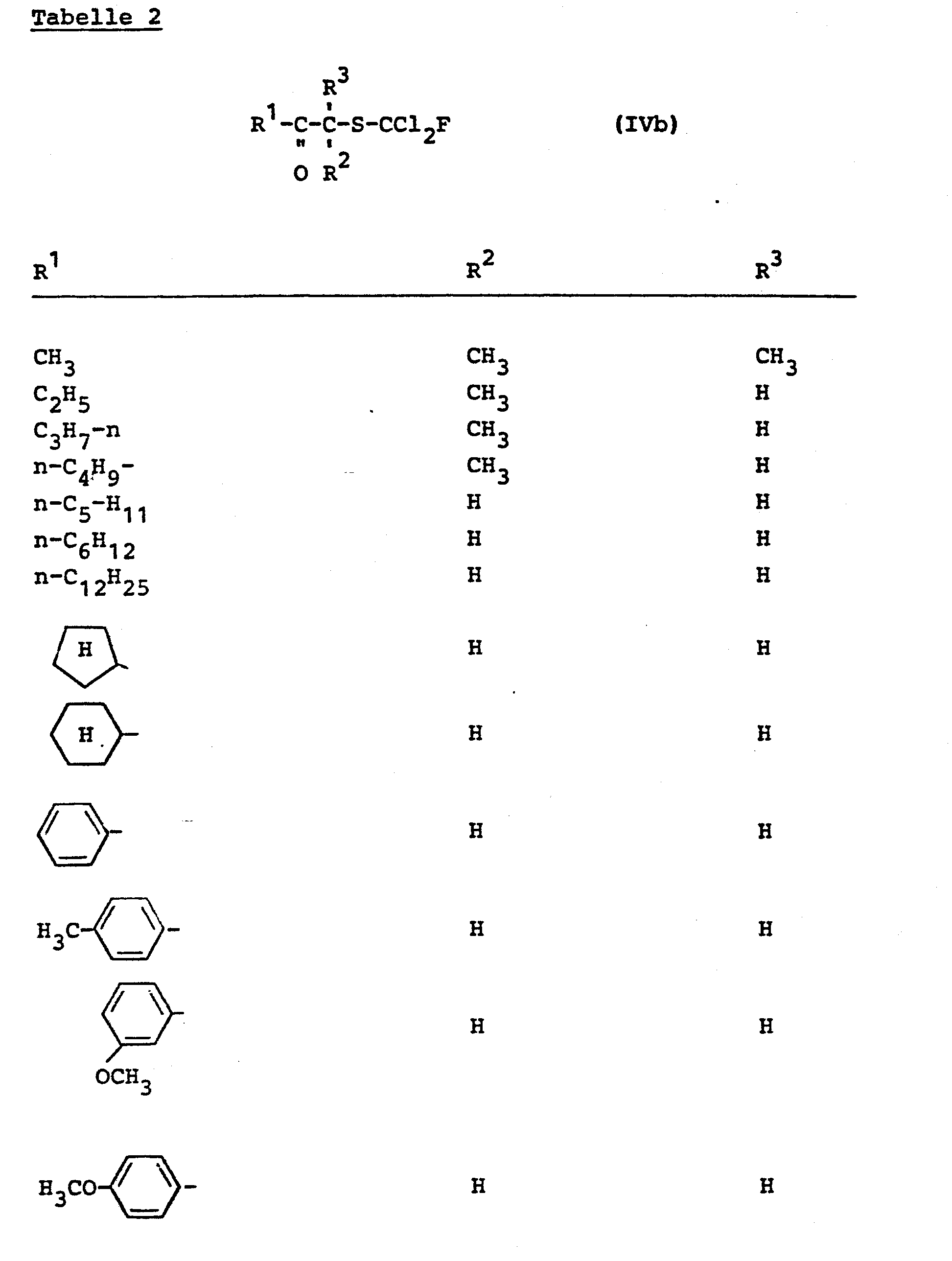
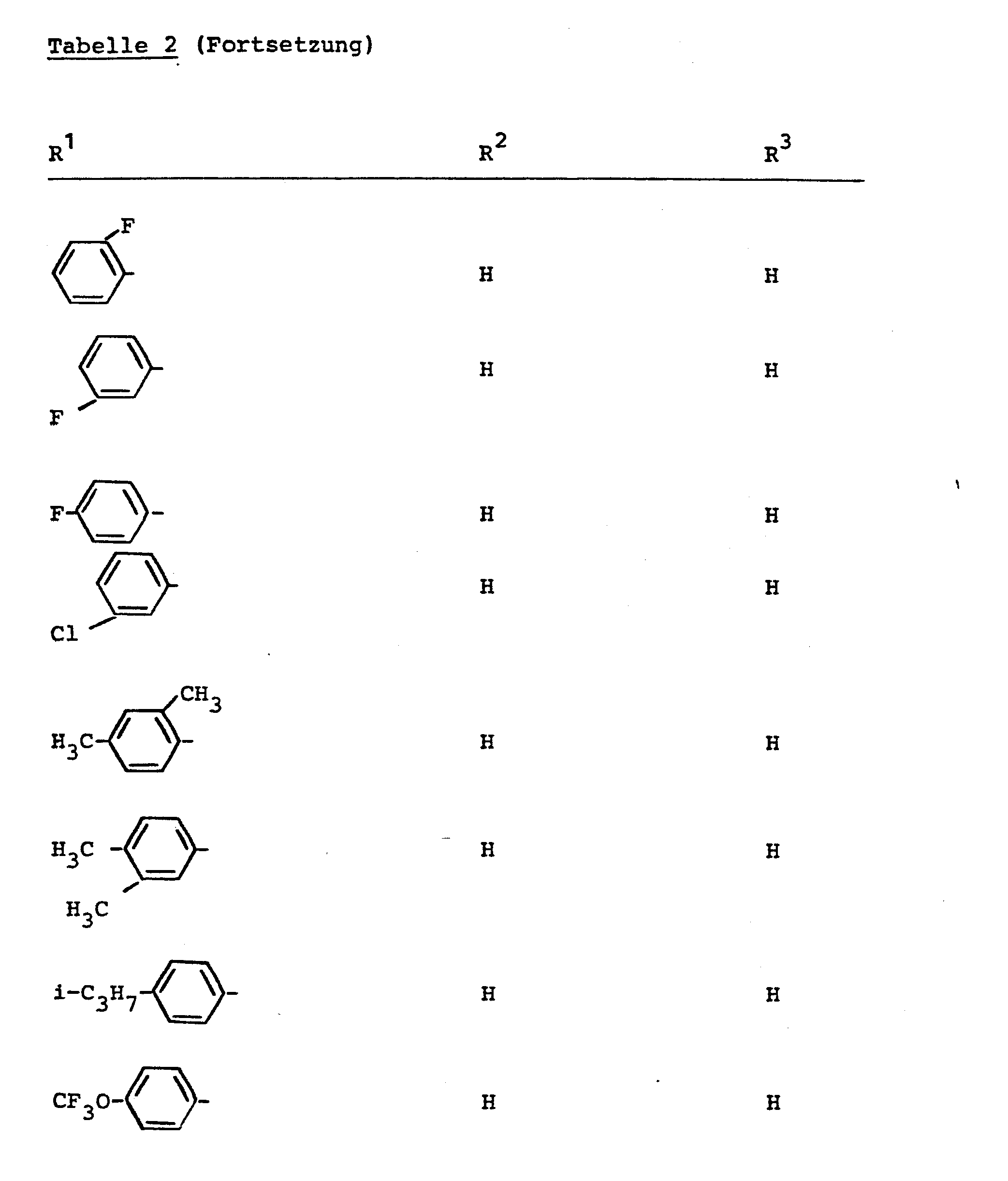

- Die ß-Keto-trihalogenmethyl-thioether der Formel (IV) eind teilweise bekannt (Vgl. US-PS 3 937 738 und E. Kühle "The Chemistry of the Sulfenic Acids", Georg Thieme Publ. Stuttgart, 1973, Seite 95).
- Die B-Keto-trihalogenmethyl-thioether der Formel

R2, R3 und X die oben angegebene Bedeutung haben und R6 für gegebenenfalls substituiertes Aryl steht, sind bisher noch nicht beschrieben worden. - In den Verbindungen der Formel (IVc) steht R6 vorzugsweise für Phenyl, welches ein- oder mehrfach, gleichartig oder verschieden substituiert sein kann durch Halogen, Alkyl mit 1 bis 4 Kohlenstoffatomen, Halogenalkyl mit 1 bis 4 Kohlenstoffatomen und 1 bis 5 Halogenatomen, Alkoxy mit 1 bis 4 Kohlenstoffatomen, Halogenalkoxy mit 1 bis 4 Kohlenstoffatomen und 1 bis 4 Halogenatomen, Alkylthio mit 1 bis 4 Kohlenstoffatomen, Halogenalkylthio mit 1 bis 4 Kohlenstoffatomen und 1 bis 5 Halogenatomen und/oder Nitro.
- Besonders bevorzugt sind diejenigen Verbindungen der Formel (IVc), in denen R6für Phenyl steht, welches ein- oder mehrfach, gleichartig oder verschieden substituiert sein kann durch Fluor, Chlor, Alkyl mit 1 bis 3 Kohlenstoffatomen, Halogenalkyl mit 1 oder 2 Kohlenstoffatomen und 1 bis 3 Fluor- oder Chloratomen, Alkoxy mit 1 bis 3 Kohlenstoffatomen, Halogenalkoxy mit 1 oder 2 Kohlenstoffatomen und 1 bis 3 Fluor- oder Chloratomen, Alkylthio mit 1 bis 3 Kohlenstoffatomen, Halogenalkylthio mit 1 oder 2 Kohlenstoffatomen und 1 bis 3 Fluor-3 oder Chloratomen und/oder Nitro. Die Reste R , R3 und X haben vorzugsweise diejenigen Bedeutungen, die oben bereits als bevorzugt beziehungsweise als besonders bevorzugt genannt wurden.
- Die Verbindungen der Formel (IVc) lassen sich herstellen, indem man Ketone der Formel

- R 2, R 3 und R 6 die oben angegebene Bedeutung haben, mit Trihalogenmethyl-sulfenyl-chloriden der Formel

- X die oben angegebene Bedeutung hat, gegebenenfalls in Gegenwart eines Verdünnungsmittels, wie zum Beispiel Chloroform, bei Temperaturen zwischen 0°C und 100°C umsetzt. Die Aufarbeitung erfolgt nach üblichen Methoden.
- Auch die B-Keto-trihalogenmethyl-thioether der Formel

- R 2 und R 3 die oben angegebene Bedeutung haben und R7 für Alkyl oder Cycloalkyl steht,
sind neu. - In den Verbindungen der Formel (IVd) steht R vorzugsweise für geradkettiges oder verzweigtes Alkyl mit 1 bis 12 Kohlenstoffatomen oder für Cycloalkyl mit 3 bis 8 Kohlenstoffatomen. Besonders bevorzugt sind diejenigen Verbindungen der Formel (IVd), in denen R7 für geradkettiges oder-verzweigtes Alkyl mit 1 bis 8 Kohlenstoffatomen oder für Cycloalkyl mit 3 bis 7 Kohlenstoffatomen steht.
- Die Verbindungen der Formel (IVd) lassen sich herstellen, indem man Ketone der Formel

- R 2, R 3 und R 7 die oben angegebene Bedeutung haben, mit Trichlormethyl-sulfenyl-chlorid der Formel

- Bei dem Verfahren zur Herstellung der fluorierten Thiokohlensäureesterfluoride der Formel (II) dient wasserfreie Flußsäure als Fluorierungsmittel.
- Die oben beschriebene Umsetzung zur Herstellung der Verbindungen der Formel (II) kann gegebenenfalls in Gegenwart eines Verdünnungsmittels durchgeführt werden, das unter den Reaktionsbedingungen inert ist. Vorzugsweise verwendbare Solventien sind hierbei chlorierte Kohlenwasserstoffe, wie Methylenchlorid, Chloroform und Chlorbenzol.
- Die Reaktionstemperatur kann bei der Durchführung des obigen Verfahrens zur Herstellung der Verbindungen der Formel (II) innerhalb eines bestimmten Bereiches variiert werden. Im allgemeinen arbeitet man bei Temperaturen zwischen -20°C und +100°C, vorzugsweise zwischen -10°C und +60°C.
- Die Umsetzung zur Herstellung der Verbindungen der Formel (II) kann sowohl unter Normaldruck als auch unter erhöhtem Druck vorgenommen werden. Der Überdruck kann dabei bis zu 6 b-ar betragen.
- Die Umsetzung zur Herstellung der Verbindungen der Formel (II) wird in Apparaturen durchgeführt, die üblicherweise für Reaktionen zum Austausch von Chlor gegen Fluor gebräuchlich sind.
- Bei der Durchführung des obigen Verfahrens zur Synthese der fluorierten Thiolkohlensäureesterfluoride der Formel (II) geht man im allgemeinen so vor, daß man die wasserfreie Flußsäure vorlegt und die B-Keto- trihalogenmethyl-thioether der Formel (IV) bei niedriger Temperatur zugibt. Dabei wird im allgemeinen auf die Verwendung eines zusätzlichen Lösungsmittels verzichtet. Sollen jedoch kristalline Ausgangssubstanzen zugegeben werden, so geschieht dieses zweckmäßigerweise so, daß man die betreffenden Substanzen in einem unter den Reaktionsbedingungen inerten Solvens gelöst hinzugibt.
- Die Umsetzung verläuft im allgemeinen bereits bei niedrigen Temperaturen recht zügig; sie ist unter drucklosen Bedingungen zumeist schon innerhalb weniger Stunden beendet. Verwendet man relativ reaktionsträge Ausgangsmaterialien, so arbeitet man zweckmäßigerweise unter erhöhtem Druck bei etwas höheren Temperaturen. Dabei ist dafür zu sorgen, daß der frei werdende Chlorwasserstoff über ein regelbares Ventil entspannt werden kann.
- Die Menge der einzusetzenden Flußsäure richtet sich nach der Zahl der auszutauschenden Chloratome. Bei Verwendung von 1 Mol an B-Ketotrihalogenmethyl-thioether der Formel (IV) muß pro auszutauschendem Chloratom mindestens 1 Mol an wasserfreier Flußsäure eingesetzt werden. Zweckmäßigerweise verwendet man jedoch einen Überschuß, so daß die Flußsäure gleichzeitig als Lösungsmittel fungieren kann. Im allgemeinen verwendet man beim Einsatz von 1 Mol an B-Keto-trihalogenmethyl-thioether der Formel (IV) pro auszutauschendem Chloratom 10 bis 20 Mol Flußsäure. Ein größerer Überschuß ist jedoch nicht erschwerend für die Umsetzung.
- Die Aufarbeitung des nach der Fluorierung anfallenden Reaktionsgemisches erfolgt nach üblichen Methoden. Im allgemeinen werden die Reaktionsprodukte durch Destillation isoliert.
- Es ist jedoch auch möglich, das Reaktionsgemisch zunächst mit einem Lösungsmittel zu extrahieren, das mit Flußsäure nur wenig mischbar ist. Derartige Lösungsmittel sind zum Beispiel Methylenchlorid, Chloroform, Tetrachlorkohlenstoff, Benzin, Benzol und Chlorbenzol.
- Die nach der Extraktion erhaltene organische Phase wird gegebenenfalls nach vorherigem Waschen und Trocknen eingedampft und gegebenenfalls destilliert.
- Die bei dem erfindungsgemäßen Verfahren weiterhin als Ausgangsstoffe benötigten Verbindungen sind durch die Formel (III) allgemein definiert. In dieser Formel haben R4 und R5 vorzugsweise diejenigen Bedeutungen, die bereits im Zusammenhang mit der Beschreibung der erfindungsgemäßen Stoffe der Formel (I) vorzugsweise für diese Reste genannt wurden.
- Die Verbindungen der Formel (III) sind allgemein bekannte Stoffe in der organischen Chemie.
- Als Verdünnungsmittel können bei der Durchführung des erfindungsgemäßen Verfahrens praktisch alle inerten organischen Solventien verwendet werden. Vorzugsweise in Frage kommen aliphatische und aromatische, gegebenenfalls chlorierte Kohlenwasserstoffe, wie Benzin, Benzol, Toluol, Xylol, Methylenchlorid, Chloroform, Tetrachlorkohlenstoff, Chlorbenzol und o-Dichlorbenzol, Ether wie Diethyl- und Dibutylether, Tetrahydrofuran und Dioxan, Ketone wie Aceton, Methylethyl-, Methylisopropyl- und Methylisobutylketon, Nitrile wie Acetonitril und Propionitril, Ester wie Essigsäuremethylester oder -ethylester, sowie Formamide wie Dimethylformamid.
- In manchen Fällen kann auch Wasser als Verdünnungsmittel fungieren.
- Als Säureakzeptoren können alle üblichen Säurebindemittel Verwendung finden. Vorzugsweise verwendbar sind Alkalicarbonate und -alkoholate, wie Natrium- und Kaliumcarbonat, Natrium- und Kaliummethylat bzw. -ethylat, ferner aliphatische, aromatische oder heterocyclische Amine, beispielsweise Triethylamin, Trimethylamin, Dimethylanilin, Dimethylbenzylamin, Pyridin, 1,5-Diaza- bicyclo-[4,3,o]-non-5-en und 1,8-Diaza-bicyclo-[5,4,0]-undec-7-en.
- An Stelle der oben genannten Säureakzeptoren können auch die in diesem Falle in entsprechendem überschuß einzusetzenden Reaktanden der Formel (III) als Säurebindemittel fungieren.
- Die Reaktionstemperatur kann innerhalb eines größeren Bereichs variiert werden. Im allgemeinen arbeitet man zwischen -20 und +100°C, vorzugsweise zwischen 0 und +50°C.
- Das erfindungsgemäße Verfahren wird im allgemeinen bei Normaldruck durchgeführt.
- Bei der Durchführung des erfindungsgemäßen Verfahrens setzt man auf 1 Mol an fluoriertem Thiokohlensäureesterfluorid der Formel (II) im allgemeinen 1 bis 2 Mol, vorzugsweise 1 bis 1,5 Mol einer Verbindung der Formel (III) sowie gegebenenfalls 1 bis 2 Mol oder auch einen größeren Überschuß an Säurebindemittel ein. Die Aufarbeitung erfolgt nach üblichen Methoden. Im allgemeinen geht man so vor, daß man das Reaktionsgemisch, gegebenenfalls nach vorherigem Versetzen mit einem mit Wasser nicht mischbaren organischen Solvens, mit Wasser wäscht, die organische Phase trocknet, einengt und den verbleibenden Rückstand destilliert oder in anderer Weise reinigt.
- Die erfindungsgemäßen Wirkstoffe können als Defoliants, Desiccants, Krautabtötungsmittel und insbesondere als Unkrautvernichtungsmittel verwendet werden. Unter Unkraut im weitesten Sinne sind alle Pflanzen zu verstehen, die an Orten aufwachsen, wo sie unerwünscht sind. Ob die erfindungsgemäßen Stoffe als totale oder selektive Herbizide wirken, hängt im wesentlichen von der angewendeten Menge ab.
- Die erfindungsgemäßen Wirkstoffe können z.B. bei den folgenden Pflanzen verwendet werden:
- Dikotyle Unkräuter der Gattungen: Sinapis, Lepidium, Galium, Stellaria, Matricaria, Anthemis, Galinsoga, Chenopodium, Urtica, Senecio, Amaranthus, Portulaca, Xanthium, Convolvulus, Ipomoea, Polygonum, Sesbania, Ambrosia, Cir-
- Dikotyle Kulturen der Gattungen: Gossypium, Glycine, Beta, Daucus, Phaseolus, Pisum, Solanum, Linum, Ipomoea, Vicia, Nicotiana, Lycopersicon, Arachis, Brassica, Lactuca, Cucumis, Cucurbita.
- Monokotyle Unkräuter der Gattungen: Echinochloa, Setaria, Panicum, Digitaria, Phleum, Poa, Festuca, Eleusine, Brachiaria, Lolium, Bromus, Avena, Cyperus, Sorghum, Agropyron, Cynodon, Monochoria, Fimbristylis, Sagittaria, Eleocharis, Scirpus, Paspalum, Ischaemum, Sphenoclea, Dactyloctenium, Agrostis, Alopecurus, Apera.
- Monokotyle Kulturen der Gattungen: Oryza, Zea, Triticum, Hordeum, Avena, Secale, Sorghum, Panicum, Saccharum, Ananas, Asparagus, Allium.
- Die Verwendung der erfindungsgemäßen Wirkstoffe ist jedoch keineswegs auf diese Gattungen beschränkt, sondern erstreckt sich in gleicher Weise auch auf andere Pflanzen.
- Die Verbindungen eignen sich in Abhängigkeit von der Konzentration zur Totalunkrautbekämpfung z.B. auf Industrie-und Gleisanlagen und auf Wegen und Plätzen mit und ohne Baumbewuchs. Ebenso können die Verbindungen zur Unkrautbekämpfung in Dauerkulturen, z.B. Forst-, Ziergehölz-, Obst-, Wein-, Citrus-, Nuß-, Bananen-, Kaffee-, Tee-, Gummi-, ölpalm-, Kakao-, Beerenfrucht- und Hopfenanlagen und zur selektiven Unkrautbekämpfung in einjährigen Kulturen eingesetzt werden.
- Die erfindungsgemäßen Wirkstoffe eignen sich insbesondere zur selektiven Bekämpfung von Cyperaceen.
- Die Wirkstoffe können in die üblichen Formulierungen überführt werden, wie Lösungen, Emulsionen, Spritzpulver, Suspensionen, Pulver, Stäubemittel, Pasten, lösliche Pulver, Granulate, Suspensions-Emulsions-Konzentrate, wirkstoffimprägnierte Natur- und synthetische Stoffe sowie Feinstverkapselungen in polymeren Stoffen.
- Diese Formulierungen werden in bekannter Weise hergestellt, z.B. durch Vermischen der Wirkstoffe mit Streckmitteln, also flüssigen Lösungsmitteln und/oder festen Trägerstoffen, gegebenenfalls unter Verwendung von oberflächenaktiven Mitteln, also Emulgiermitteln und/oder Dispergiermitteln und/oder schaumerzeugenden Mitteln.
- Im Falle der Benutzung von Wasser als Streckmittel können z.B. auch organische Lösungsmittel als Hilfslösungsmittel verwendet werden. Als flüssige Lösungsmittel kommen im wesentlichen in Frage: Aromaten, wie Xylol, Toluol, oder Alkylnaphthaline, chlorierte Aromaten und chlorierte aliphatische Kohlenwasserstoffe, wie Chlorbenzole, Chlorethylene oder Methylenchlorid, aliphatische Kohlenwasserstoffe, wie Cyclohexan oder Paraffine, z.B. Erdölfraktionen, mineralische und pflanzliche öle, Alkohole, wie Butanol oder Glycol sowie deren Ether und Ester, Ketone wie Aceton, Methylethylketon, Methylisobutylketon oder Cyclohexanon, stark polare Lösungsmittel, wie Dimethylformamid und Dimethylsulfoxid, sowie Wasser.
- Als feste Trägerstoffe kommen in Frage:
- z. B. Ammoniumsalze und natürliche Gesteinsmehle, wie Kaoline, Tonerden, Talkum, Kreide, Quarz, Attapulgit, Montmorillonit oder Diatomeenerde und synthetische Gesteinsmehle, wie hochdisperse Kieselsäure, Aluminiumoxid und Silikate, als feste Trägerstoffe für Granulate kommen in Frage: z.B. gebrochene und fraktionierte natürliche Gesteine wie Calcit, Marmor, Bims, Sepiolith, Dolomit sowie synthetische Granulate aus anorganischen und organischen Mehlen sowie Granulate aus organischem Material wie Sägemehl, Kokosnußschalen, Maiskolben und Tabakstengeln; als Emulgier- und/oder schaumerzeugende Mittel kommen in Frage: z.B. nichtionogene und anionische Emulgatoren, wie Polyoxyethylen-Fettsäure-Ester, Polyoxyethylen-FettalkoholEther, z.B. Alkylaryl-polyglykolether, Alkylsulfonate, Alkylsulfate, Arylsulfonate sowie Eiweißhydrolysate; als Dispergiermittel kommen in Frage: z.B. Lignin-Sulfitablaugen und Methylcellulose.
- Es können in den Formulierungen Haftmittel wie Carboxymethylcellulose, natürliche und synthetische pulvrige, körnige oder latexförmige Polymere verwendet werden, wie Gummiarabicum, Polyvinylalkohol, Polyvinylacetat, sowie natürliche Phospholipide, wie Kephaline und Lecithine und synthetische Phospholipide. Weitere Additive können mineralische und vegetabile öle sein.
- Es können Farbstoffe wie anorganische Pigmente, z.B. Eisenoxid, Titanoxid, Ferrocyanblau und organische Farbstoffe, wie Alizarin-, Azo- und Metallphthalocyaninfarbstoffe und Spurennährstoffe wie Salze von Eisen, Mangan, Bor, Kupfer, Kobalt, Molybdän und Zink verwendet werden.
- Die Formulierungen enthalten im allgemeinen zwischen 0,1 und 95 Gewichtsprozent Wirkstoff, vorzugsweise zwischen 0,5 und 90 %.
- Die erfindungsgemäßen Wirkstoffe können als solche oder in ihren Formulierungen auch in Mischung mit bekannten Herbiziden zur Unkrautbekämpfung Verwendung finden, wobei Fertigformulierungen oder Tankmischungen möglich sind.
- Für die Mischungen kommen bekannte Herbizide wie z.B. 1-Amino-6-ethylthio-3-(2,2-dimethylpropyl)-1,3,5-triazin-2,4(1H,3H)-dion oder N-(2-Benzthiazolyl)-N,N'-dimethyl-harnstoff zur Unkrautbekämpfung in Getreide; 4-Amino-3-methyl-6-phenyl-1,2,4-triazin-5(4H)-on zur Unkrautbekämpfung in Zuckerrüben und 4-Amino-6-(1,1-dimethylethyl)-3-methylthio-1,2,4-triazin-5(4H)-on zur Unkrautbekämpfung in Sojabohnen, in Frage. Einige Mischungen zeigen überraschenderweise auch synergistische Wirkung.
- Auch eine Mischung mit anderen bekannten Wirkstoffen, wie Fungiziden, Insektiziden, Akariziden, Nematiziden, Schutzstoffen gegen Vogelfraß, Pflanzennährstoffen und Bodenstrukturverbesserungsmitteln ist möglich.
- Die Wirkstoffe können als solche, in Form ihrer Formulierungen oder den daraus durch weiteres Verdünnen bereiteten Anwendungsformen, wie gebrauchsfertige Lösungen, Suspensionen, Emulsionen, Pulver, Pasten und Granulate angewandt werden. Die Anwendung geschieht in üblicher Weise, z.B. durch Gießen, Spritzen, Sprühen, Streuen.
- Die erfindungsgemäßen Wirkstoffe können sowohl vor als auch nach dem Auflaufen der Pflanzen appliziert werden.
- Sie können auch vor der Saat in den Boden eingearbeitet werden.
- Die angewandte Wirkstoffmenge kann in einem größeren Bereich schwanken. Sie hängt im wesentlichen von der Art des gewünschten Effektes ab. Im allgemeinen liegen die Aufwandmengen zwischen 0,01 und 15 kg Wirkstoff pro Hektar Bodenfläche, vorzugsweise zwischen 0,05 und 10 kg pro ha.
- Die Herstellung und die Verwendung der erfindungsgemäßen Wirkstoffe geht aus den nachfolgenden Beispielen hervor.
-

- Nach der im Beispiel 1 angegebenen Methode wurden auch in der folgenden Tabelle 3 formelmäßig aufgeführten Stoffe hergestellt.
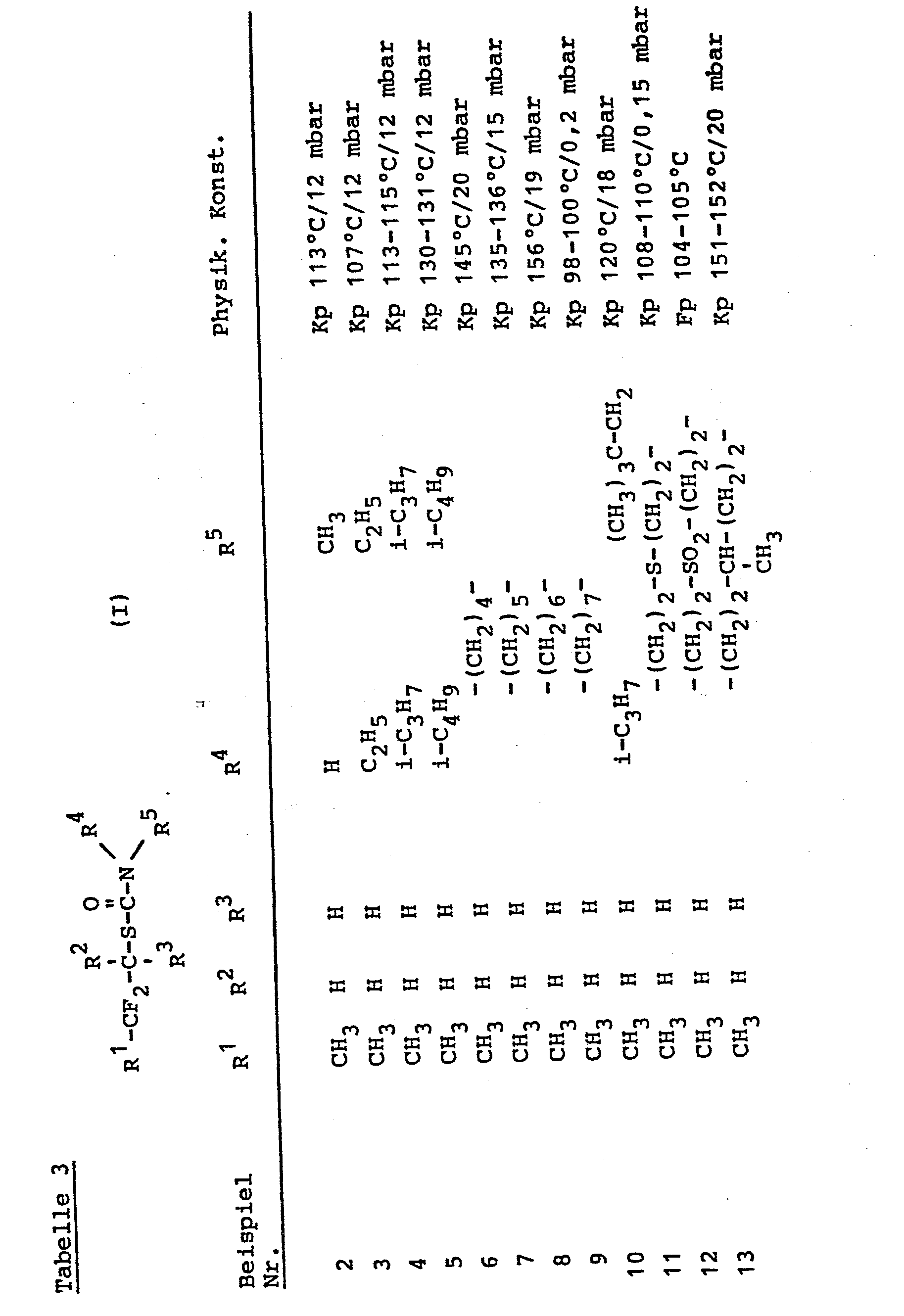

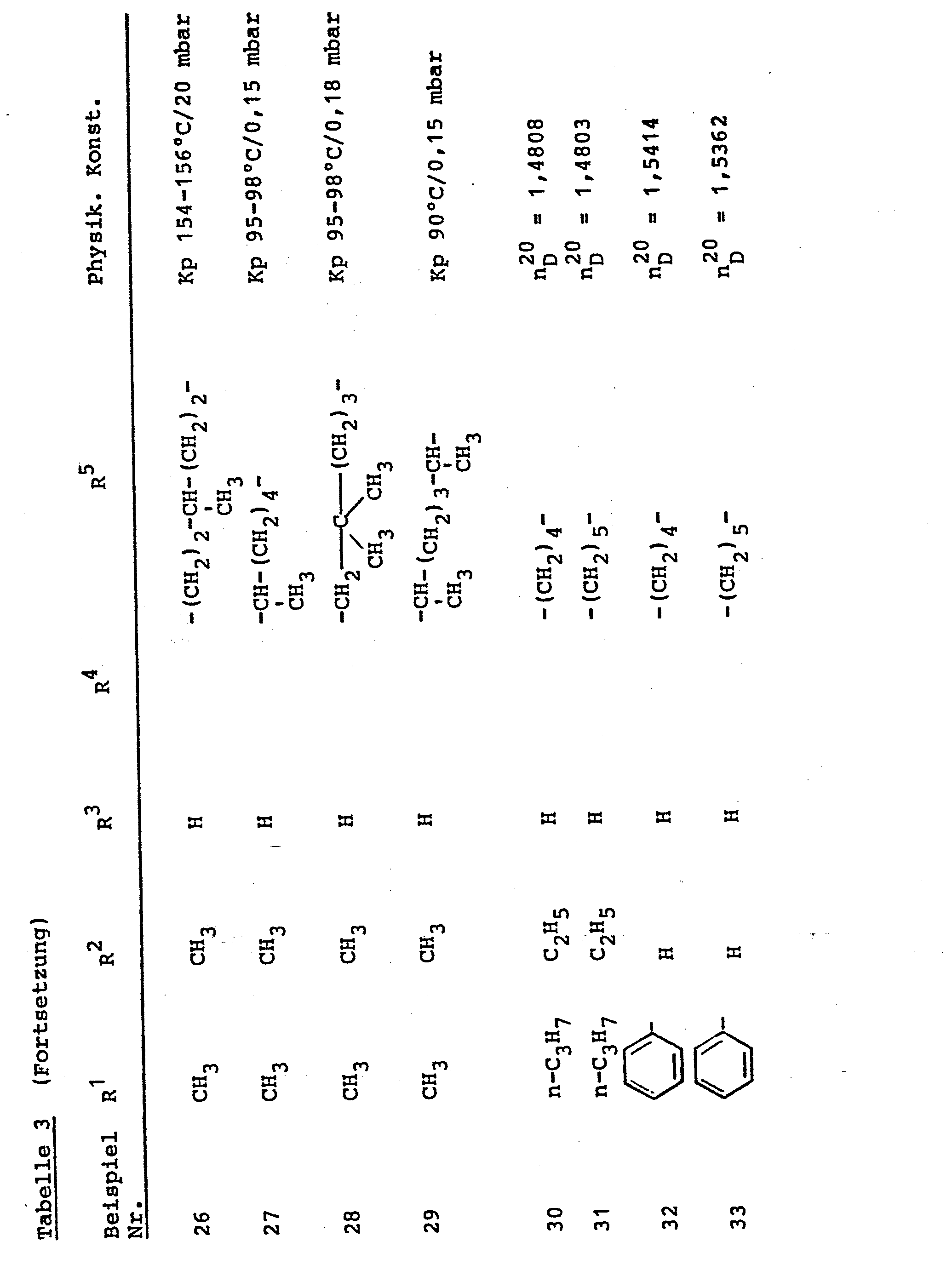
-

- 1,6 - 2,5 ppm (Multiplett) Protonen der Ringmethylen-Gruppen 3,4 ppm (Multiplett) Protonen der zu M α-ständigen CH2-Gruppen 4,1 ppm (Multiplett) Proton der Ringmethin-Gruppe Beispiel 35

- Die Verbindung zeigt im 60 MHz H-NMR-Spektrum folgende Signale:
- 1,17 ppm (Triplett) Protonen der CH3-Gruppen 1,6 - 2,5 ppm (Multiplett) Protonen der Ringmethylen-Gruppen
- 3,37 ppm (Quartett) Protonen der CH2-Gruppen der Ethyl-Gruppen
- 4,1 ppm (Multiplett) Protonen der Ringmethin-Gruppe
-

- Kp. 53°C/100 mbar n20 D 1,3907
- Nach der im Beispiel 36 angegebenen Methode wurden auch die in der folgenden Tabelle 4 formelmäßig aufgeführten Stoffe hergestellt.
-

-

- Kp = 106°C/18 mbar n20 D = 1,4891
- Herstellung des Vorproduktes der Formel

- 240 g (2 Mol) Acetophenon wurden in 300 ml Chloroform gelöst und nach Zugabe von 3 ml Ethanol und 109 g (0,64 Mol) Fluordichlormethan-sulfenchlorid bis zur Rückflußtemperatur aufgeheizt. Innerhalb von 30 Minuten ließ man noch 400 g (2,36 Mol) an Fluordichlormethan-sulfenchlorid zutropfen und erhitzte dann 5 Stunden unter Rückfluß. Zur anschließenden Aufarbeitung wurde das Reaktionsgemisch einer fraktionierten Destillation unter vermindertem Druck unterworfen. Nach Vorläufen von unverändertem Ausgangsmaterial erhielt man 126 g an (Fluordichlormethyl-mercapto-methyl)-phenyl-keton in Form einer Flüssigkeit vom Siedepunkt 128"C/0,4 mbar.
- Brechungsindex: n20 D = 1,5653
- Die Ausbeute errechnet sich zu 87 %, bezogen auf umgesetztes Acetophenon.
- Das Reaktionsprodukt kann auch ohne zusätzliche Reinigung nach Abtrennung des unveränderten Acetophenons für die Fluorierung mit Flußsäure eingesetzt werden.
-

- Kp = 126°C/16 mbar n20 D= 1,5083
-

- Kp = 107°C/14 mbar n20 D= 1,4839
- Synthese des Ausgangsproduktes der Formel

- Ein Gemisch aus 171 g (1,5 Mol) Di-n-propylketon und 186 g (1 Mol) Perchlormethylmercaptan wurde 14 Stunden auf 100°C erhitzt. Dabei beobachtete man eine schwache, aber regelmäßige Chlorwasserstoff-Entwicklung. Zur anschließenden Aufarbeitung wurde das Reaktionsgemisch einer fraktionierten Destillation unter vermindertem Druck unterworfen. Man erhielt auf diese Weise 80 g . eines Produktes, das im wesentlichen aus dem B-Ketotrichlormethyl-thioether der Formel (IV-2) bestand, jedoch noch durch die Substanz der Formel

- verunreinigt war.
- Kp = 109°C/0,1 mbar n20 D= 1,5156
- Bei der Umsetzung mit der Flußsäure bildet sich aus dem oben angegebenen Substanzgemisch die im Beispiel 40 beschriebene Verbindung.
- In dem nachstehend beschriebenen biologischen Test wurde die folgende Verbindung als Vergleichssubstanz eingesetzt:

- Hexahydro-1-H-azepin-1-carbamidsäure-thiolethylester (bekannt aus US PS 3 198 786).
- Lösungsmittel: 5 Gewichtsteile Aceton Emulgator: 1 Gewichtsteil Alkylarylpolyglykolether
- Zur Herstellung einer zweckmäßigen Wirkstoffzubereitung vermischt man 1 Gewichtsteil Wirkstoff mit der angegebenen Menge Lösungsmittel, gibt die angegebene Menge Emulgator zu und verdünnt das Konzentrat mit Wasser auf die gewünschte Konzentration.
- Samen der Testpflanzen werden in normalen Boden ausgesät und nach 24 Stunden mit der Wirkstoffzubereitung begossen. Dabei hält man die Wassermenge pro Flächeneinheit zweckmäßigerweise konstant. Die Wirkstoffkonzentration in der Zubereitung spielt keine Rolle, entscheidend ist nur die Aufwandmenge des Wirkstoffs pro Flächeneinheit. Nach drei Wochen wird der Schädigungsgrad der Pflanzen bonitiert in % Schädigung im Vergleich zur Entwicklung der unbehandelten Kontrolle. Es bedeuten:
- O % = keine Wirkung (wie unbehandelte Kontrolle) 100 % = totale Vernichtung
- In diesem Test zeigte die Verbindung gemäß Beispiel 19 bei der Bekämpfung von Cyperus und Setaria in Mais und Baumwolle eine deutlich bessere selektive herbizide Wirksamkeit als die Vergleichssubstanz (A).
Claims (9)


Applications Claiming Priority (2)
| Application Number | Priority Date | Filing Date | Title |
|---|---|---|---|
| DE3341515 | 1983-11-17 | ||
| DE19833341515 DE3341515A1 (de) | 1983-11-17 | 1983-11-17 | Fluorierte thiolcarbamate |
Publications (2)
| Publication Number | Publication Date |
|---|---|
| EP0142111A2 true EP0142111A2 (de) | 1985-05-22 |
| EP0142111A3 EP0142111A3 (de) | 1986-07-16 |
Family
ID=6214521
Family Applications (1)
| Application Number | Title | Priority Date | Filing Date |
|---|---|---|---|
| EP84113275A Withdrawn EP0142111A3 (de) | 1983-11-17 | 1984-11-05 | Fluorierte Thiolcarbamate |
Country Status (6)
| Country | Link |
|---|---|
| EP (1) | EP0142111A3 (de) |
| JP (1) | JPS60116664A (de) |
| BR (1) | BR8405849A (de) |
| DE (1) | DE3341515A1 (de) |
| IL (1) | IL73513A0 (de) |
| ZA (1) | ZA848948B (de) |
Family Cites Families (3)
| Publication number | Priority date | Publication date | Assignee | Title |
|---|---|---|---|---|
| US3318676A (en) * | 1959-07-10 | 1967-05-09 | Monsanto Co | Controlling vegetation with haloalkyl thiolcarbamates |
| US3687997A (en) * | 1969-03-27 | 1972-08-29 | Karl Kiehs | Ethyl n-cyclohexyl n-propargyl-thiolcarbamate as a herbicide |
| US3654333A (en) * | 1969-12-18 | 1972-04-04 | Stauffer Chemical Co | 3 4 4-trifluoro-3-butenylthio methylidene compounds and their utility |
-
1983
- 1983-11-17 DE DE19833341515 patent/DE3341515A1/de not_active Withdrawn
-
1984
- 1984-11-05 EP EP84113275A patent/EP0142111A3/de not_active Withdrawn
- 1984-11-13 JP JP59237700A patent/JPS60116664A/ja active Pending
- 1984-11-14 IL IL73513A patent/IL73513A0/xx unknown
- 1984-11-16 BR BR8405849A patent/BR8405849A/pt unknown
- 1984-11-16 ZA ZA848948A patent/ZA848948B/xx unknown
Also Published As
| Publication number | Publication date |
|---|---|
| BR8405849A (pt) | 1985-09-17 |
| ZA848948B (en) | 1985-07-31 |
| EP0142111A3 (de) | 1986-07-16 |
| IL73513A0 (en) | 1985-02-28 |
| DE3341515A1 (de) | 1985-05-30 |
| JPS60116664A (ja) | 1985-06-24 |
Similar Documents
| Publication | Publication Date | Title |
|---|---|---|
| EP0005501B1 (de) | Heteroaryl-oxyessigsäureamide, Verfahren zu ihrer Herstellung und ihre Verwendung als Herbizide | |
| EP0161602A2 (de) | 6-Chlorbenzazolyloxyacetamide | |
| EP0029183A1 (de) | Tetrazolyloxycarbonsäureamide, Verfahren zu ihrer Herstellung und ihre Verwendung als Herbizide | |
| EP0030676B1 (de) | Phenoxybenzoesäure-Derivate, Verfahren zu ihrer Herstellung sowie ihre Verwendung als Herbizide und Pflanzenwuchsregulatoren | |
| EP0096354B1 (de) | Substituierte Pyridyl-phenyl-ether | |
| DE2822155A1 (de) | Substituierte carbonsaeureamide, verfahren zu ihrer herstellung und ihre verwendung als herbizide | |
| EP0297378A2 (de) | 2,5-Dihydropyrrole | |
| EP0300344B1 (de) | Halogenierte Thiadiazolyl-oxyessig-säureamide, Verfahren und Zwischenprodukte zu ihrer Herstellung und ihre Verwendung als Herbizide | |
| EP0348734A1 (de) | Neue Difluormethyl-thiadiazolyl-oxyessigsäureamiden | |
| EP0112531B1 (de) | Optisch aktive Phenoxypropionsäure-Derivate | |
| EP0422369A2 (de) | Substituierte Carbamoyltriazole | |
| DE3505902A1 (de) | 4,5-disubstituierte 1,3-thiazol-2-yloxyacetamide | |
| EP0173312A1 (de) | 1-(2-Trifluormethoxy-phenylsulfonyl)-3-heteroaryl-(thio)-harnstoffe | |
| EP0348735A2 (de) | 5-Chlor-4-cyano-thiazol-2-yl-oxyessigsäureamide | |
| EP0290902A2 (de) | Anellierte (Thio)Hydantoine | |
| EP0089538B1 (de) | Optisch aktive Phenoxybenzoesäure-Derivate, Verfahren zu ihrer Herstellung und ihre Verwendung als Herbizide | |
| EP0460479A1 (de) | Cycloalkyl-substituierte Thiadiazolyloxyessigsäureamide | |
| DE3219789A1 (de) | Phenoxypropionsaeure-derivate, verfahren zu ihrer herstellung und ihre verwendung als herbizide | |
| EP0271780A2 (de) | Substituierte 1-Benzylsulfonyl-3-heteroaryl-(thio)harnstoffe | |
| EP0063741A1 (de) | 5-(2,6-Dichlor-4-trifluormethyl-phenoxy)-2-nitro-benzoesäure-Derivate, Verfahren zu ihrer Herstellung sowie ihre Verwendung als Herbizide und Pflanzenwachstumsregulatoren | |
| EP0127808A1 (de) | Optisch aktive Phenoxypropionsäure-Derivate | |
| EP0035638A2 (de) | Halogenalkylamide, Verfahren zu deren Herstellung und deren Verwendung als Gegenmittel zum Schutz von Kulturpflanzen vor Schädigungen durch Herbizide | |
| EP0307753A2 (de) | Sulfonyliso(thio)harnstoffe sowie ein Verfahren und neue Zwischenprodukte zu ihrer Herstellung | |
| EP0173323A1 (de) | Amidinoazole | |
| DE3341515A1 (de) | Fluorierte thiolcarbamate |
Legal Events
| Date | Code | Title | Description |
|---|---|---|---|
| PUAI | Public reference made under article 153(3) epc to a published international application that has entered the european phase |
Free format text: ORIGINAL CODE: 0009012 |
|
| 17P | Request for examination filed |
Effective date: 19841105 |
|
| AK | Designated contracting states |
Designated state(s): BE CH DE FR GB IT LI NL |
|
| RTI1 | Title (correction) | ||
| PUAL | Search report despatched |
Free format text: ORIGINAL CODE: 0009013 |
|
| AK | Designated contracting states |
Kind code of ref document: A3 Designated state(s): BE CH DE FR GB IT LI NL |
|
| STAA | Information on the status of an ep patent application or granted ep patent |
Free format text: STATUS: THE APPLICATION HAS BEEN WITHDRAWN |
|
| 18W | Application withdrawn |
Withdrawal date: 19860719 |
|
| R18W | Application withdrawn (corrected) |
Effective date: 19860719 |
|
| RIN1 | Information on inventor provided before grant (corrected) |
Inventor name: KLAUKE, ERICH, DR. Inventor name: SCHMIDT, ROBERT R., DR. Inventor name: KUEHLE, ENGELBERT, DR. Inventor name: EUE, LUDWIG, DR. |