EP0142140A2 - Bande abrasive avec jonction renforcée par une bande de résine synthétique - Google Patents
Bande abrasive avec jonction renforcée par une bande de résine synthétique Download PDFInfo
- Publication number
- EP0142140A2 EP0142140A2 EP84113528A EP84113528A EP0142140A2 EP 0142140 A2 EP0142140 A2 EP 0142140A2 EP 84113528 A EP84113528 A EP 84113528A EP 84113528 A EP84113528 A EP 84113528A EP 0142140 A2 EP0142140 A2 EP 0142140A2
- Authority
- EP
- European Patent Office
- Prior art keywords
- synthetic resin
- belt
- fibers
- tape
- sanding
- Prior art date
- Legal status (The legal status is an assumption and is not a legal conclusion. Google has not performed a legal analysis and makes no representation as to the accuracy of the status listed.)
- Withdrawn
Links
Images

Classifications
-
- B—PERFORMING OPERATIONS; TRANSPORTING
- B24—GRINDING; POLISHING
- B24D—TOOLS FOR GRINDING, BUFFING OR SHARPENING
- B24D11/00—Constructional features of flexible abrasive materials; Special features in the manufacture of such materials
- B24D11/06—Connecting the ends of materials, e.g. for making abrasive belts
-
- F—MECHANICAL ENGINEERING; LIGHTING; HEATING; WEAPONS; BLASTING
- F16—ENGINEERING ELEMENTS AND UNITS; GENERAL MEASURES FOR PRODUCING AND MAINTAINING EFFECTIVE FUNCTIONING OF MACHINES OR INSTALLATIONS; THERMAL INSULATION IN GENERAL
- F16G—BELTS, CABLES, OR ROPES, PREDOMINANTLY USED FOR DRIVING PURPOSES; CHAINS; FITTINGS PREDOMINANTLY USED THEREFOR
- F16G3/00—Belt fastenings, e.g. for conveyor belts
- F16G3/10—Joining belts by sewing, sticking, vulcanising, or the like; Constructional adaptations of the belt ends for this purpose
Definitions
- the invention relates to an abrasive belt with a connection point bridged by a synthetic resin belt containing reinforcing fibers.
- Endless sanding belts are made by joining the ends of a piece of sanding belt.
- the connection must have sufficient strength and dimensional stability without significantly changing the properties of the tape at the connection point.
- the connection point must not be, or not significantly thicker than, the other sanding belt.
- the connection of the ends of the sanding belt is known by a synthetic resin belt bridging the connection point, which is glued to the adjacent edges of the back of the sanding belt (DE-OS 24 50 775). It is known to provide this tape with fabric to give it greater strength and possibly also to allow a reduction in its thickness compared to unreinforced synthetic resin tape (DE-OS 20 22 316; DE-OS 24 52 589).
- a direction deviating from the cross-band direction is chosen for the direction of the connection in the form of a so-called diagonal butt joint. This is to prevent the connection point from running simultaneously on a deflection roller over the entire bandwidth, which can not only lead to considerable noise pollution, but also reduces the processing quality and the durability of the grinding belt.
- the synthetic resin band bridging the connection point also runs correspondingly obliquely. If the thread direction of the reinforcing fabric contained therein corresponds to the longitudinal direction of the synthetic resin belt, which is the simplest for the production, then the fabric threads run obliquely to the longitudinal direction of the grinding belt and thus also obliquely to the main direction of stress of the connection, which can lead to undesirable stretching and loss of strength.
- the invention is therefore based on the object of an abrasive belt of the type mentioned or a synthetic resin to connect the ends of the ends or to create a method for producing such an abrasive belt, which, with a small thickness of the synthetic resin band, combine high strength with little thickening of the connection point regardless of the helix angle of the abrasive belt connection.
- the solution according to the invention consists in that the fibers reinforcing the synthetic resin tape are oriented to a substantial extent in a confused manner.
- the solution seems to be in contrast to the experience that when reinforcing the fabric with threads running at an angle to the longitudinal direction of the tape, sufficient strength and elongation values are not achieved, because even with the tangled arrangement of the reinforcing fibers, it can be expected that the majority of the Fibers run at an angle to the longitudinal direction of the tape.
- the invention has recognized that, in known fabric-reinforced synthetic resin tapes, the strength of the fabric, measured in the longitudinal direction of the thread, is generally much higher than is required for the connection purposes and as to forces on the reinforcing threads by the synthetic resin material of the tape containing them or by the adhesive connecting the synthetic resin belt to the back of the sanding belt can be transferred.
- the invention also includes the knowledge that the tangled arrangement of the reinforcing fibers facilitates the transmission of force to that (in itself small) portion of the fibers that run in the longitudinal direction of the tape.
- each individual fiber is anchored more securely within the matrix surrounding it due to its curvatures and the large number of evenly distributed fiber crossing points than the individual fibers of a straight thread, of which at most the outer fibers (and also often only partially) are a direct bond with the surrounding synthetic resin.
- each individual reinforcing fiber running in the longitudinal direction of the sanding belt is significantly more involved in the power transmission in a tangled arrangement than in a thread fabric arrangement. This is also an explanation for the fact that in a tangled fiber arrangement the number of fibers running in the longitudinal direction of the sanding belt does not have to be nearly as large as in the case of a fabric reinforcement in order to achieve sufficient connection strength.
- the suitability of a fiber-reinforced plastic belt for increased force absorption in any direction in sanding belt connections can also be particularly advantageous because sanding belts in general and, consequently, their connection points when grinding curved objects are frequently exposed to forces that do not only run in the longitudinal direction.
- the suitability of tangled fiber-reinforced synthetic resin tapes is particularly valuable for such abrasive tape connections, the joint of which does not run straight, but wavy serrated or interlocking, because the forces to be transmitted through the bridging synthetic resin tape can be directed differently depending on the local direction of the joint.
- synthetic resin is understood to mean any synthetic, polymeric material that is suitable in tape form for force-transmitting joint bridging and for embedding fiber material.
- polyesters, polyamides and polyimides are primarily suitable.
- Asl fiber material is primarily suitable for glass, carbon and high-strength synthetic resins such as aramid, but also mineral and metallic fibers.
- Their length is preferably in the range of 0.3-50 mm.
- the titer is expediently chosen between 2 den and 80 den.
- the choice of fiber lengths and thicknesses is of course also dependent to a certain extent on the thickness of the tape film used, which is advantageously between 0.025 mm and 0.35 mm.
- the reinforcing fibers are distributed substantially uniformly in the synthetic resin band.
- a tape with reinforcing fibers distributed substantially uniformly over the cross section can be obtained, for example, by extrusion or casting of melted synthetic resin containing the fibers. If there is a certain transverse orientation of the fibers as a result of the flow processes in the nozzle, this does not necessarily have to be disadvantageous because, on the one hand, a sufficient proportion of fibers with different orientations remains and, on the other hand, the transversely oriented fibers are predominant with regard to the predominantly transverse fibers ongoing stress on the synthetic resin tape may well be appropriate. Furthermore, such predominant transverse orientation may achbearbeitungshabilit by N, which tend to increase the longitudinal orientation, such as calendering, can be compensated.
- Such an embodiment can also be expedient, in which the fibers in the synthetic resin belt are predominantly arranged on its cross-sectional side facing the grinding belt, so that the connecting forces have to be transmitted in the form of shear stresses over a smaller thickness range of the synthetic resin belt. On the one hand, this gives greater security; secondly, less elongation.
- the reinforcing fibers can be at least partially exposed on the surface of the synthetic resin belt facing the grinding belt.
- the strength of the connection of the synthetic resin belt with a binder layer located between the latter and the back of the grinding belt can be improved.
- a layered structure of the synthetic resin tape is advisable, but it can also have advantages in another context.
- the synthetic resin belt can be glued to the adjacent edges of the sanding belt ends to be connected.
- the adhesives which have been tried and tested in the prior art can be used for this.
- the prefabricated synthetic resin belt can also be pressed onto the abrasive belt, optionally provided with an adhesion promoter or adhesive, in the uncured state and left to harden.
- synthetic resin that is not or only partially polymerized can be used. It can also be applied as a melt when using a thermoplastic material. If the synthetic resin belt is built up in layers, there is also the possibility that the uncured state when applying the belt only relates to the layer facing the grinding belt. This process has a particular advantage not only in that an intimate connection between the synthetic resin belt and the back of the grinding belt can be achieved, possibly without thicker layers of binder, but that in many cases a cross-sectional shaping of the belt can also take place.
- the overlapping band can be pressed into the flat cavity formed thereby. so that it has a complementary double wedge-shaped cross section.
- a preformed tape is placed on the connection point in the plastic state and then pressed. Instead, it can be applied directly from a nozzle in the plastic state, distributed and - with or without applying pressure - allowed to harden without preforming.
- one possibility for applying the synthetic resin tape on the back of the sanding belt is that the synthetic resin tape is built up in layers on the sanding belt by at least partially pressing a tangled nonwoven into an initially applied plastic synthetic resin layer, after which the synthetic resin layer is allowed to harden.
- One or more further layers, the last as a top layer, can also be applied.
- the fibers can be preformed in a fleece shape or can be sprinkled in loosely.
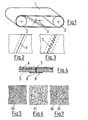
- the grinding belt 1, which runs over deflection rollers 2, is endless from the originally stretched state by connecting its ends in the area of the connection point 3.
- the connection point 3 runs obliquely at an angle 4 with respect to the transverse direction of the grinding belt.
- the joint 7 of the connection point can run in a straight line or not in a straight line; 3 shows a wave cut connection.
- the sanding belt consists of the tensile, flexible base 5 and the abrasive grain covering 6. At 7, the joint between the belt ends to be connected can be seen.
- connection is mediated by the synthetic resin tape 8, which is connected to the adjacent edges 9 of the back of the sanding belt, for example for gluing.
- the synthetic resin tape 8 includes reinforcing fibers may be chopped short, as shown at 10 in Fig. 5 schematically (although much too coarse) F as shown, or may also be very long, ig. 6 illustrated at 11.
- the reinforcing fibers can also be mixed from short to long fibers 10, 11, as shown in FIG. 7. 8, the fibers 10, 11 can be distributed uniformly over the entire cross section of the exaggeratedly thick synthetic resin tape 8. According to FIG. 9, however, they can also have a higher concentration, in particular in the form of a layer, in the vicinity of that surface 12 of the synthetic resin belt which is intended to be glued to the back of the grinding belt.
- the reinforcing fibers are preferably predominantly oriented in the plane of the synthetic resin tape, which can be accomplished, for example, by stretching the tape in the longitudinal and / or transverse direction after casting.
- the fibers 10, 11 according to FIG. 10 protrude beyond the surface 12 or are at least partially exposed in it, they can form an intimate connection with the binder layer 13, which in the example shown is provided between the back of the sanding belt base 5 and the synthetic resin belt 8 is.
- the synthetic resin band 14 is molded into the depression which was formed by wedge-shaped beveling of the edges 15 of the abrasive belt ends to be connected.
Landscapes
- Engineering & Computer Science (AREA)
- Mechanical Engineering (AREA)
- General Engineering & Computer Science (AREA)
- Polishing Bodies And Polishing Tools (AREA)
- Purses, Travelling Bags, Baskets, Or Suitcases (AREA)
Applications Claiming Priority (3)
| Application Number | Priority Date | Filing Date | Title |
|---|---|---|---|
| DE19833340432 DE3340432A1 (de) | 1983-11-09 | 1983-11-09 | Schleifband mit einer durch ein kunstharzband ueberbrueckten verbindungsstelle |
| DE3340432 | 1983-11-09 | ||
| PCT/EP1985/000221 WO1986006671A1 (fr) | 1985-05-13 | 1985-05-13 | Bande abrasive avec jonction collee |
Publications (2)
| Publication Number | Publication Date |
|---|---|
| EP0142140A2 true EP0142140A2 (fr) | 1985-05-22 |
| EP0142140A3 EP0142140A3 (fr) | 1985-06-19 |
Family
ID=25815469
Family Applications (1)
| Application Number | Title | Priority Date | Filing Date |
|---|---|---|---|
| EP84113528A Withdrawn EP0142140A3 (fr) | 1983-11-09 | 1984-11-09 | Bande abrasive avec jonction renforcée par une bande de résine synthétique |
Country Status (1)
| Country | Link |
|---|---|
| EP (1) | EP0142140A3 (fr) |
Cited By (12)
| Publication number | Priority date | Publication date | Assignee | Title |
|---|---|---|---|---|
| EP0213353A1 (fr) * | 1985-07-24 | 1987-03-11 | Norddeutsche Schleifmittel-Industrie Christiansen & Co. (GmbH & Co.) | Bande abrasive à jonction transversale |
| FR2625943A1 (fr) * | 1988-01-14 | 1989-07-21 | Jouffray Jean Claude | Procede pour la realisation de courroies composites, ainsi que courroies composites obtenues |
| EP0529833A1 (fr) * | 1991-08-06 | 1993-03-03 | Minnesota Mining And Manufacturing Company | Courroie abrasive sans fin |
| FR2699417A1 (fr) * | 1992-12-17 | 1994-06-24 | Skid Sa | Dispositif pour poncer les skis, et procédé pour sa fabrication. |
| WO1995022434A1 (fr) * | 1994-02-22 | 1995-08-24 | Minnesota Mining And Manufacturing Company | Abrasifs sur support et leurs procedes de fabrication |
| US5573619A (en) * | 1991-12-20 | 1996-11-12 | Minnesota Mining And Manufacturing Company | Method of making a coated abrasive belt with an endless, seamless backing |
| US5578096A (en) * | 1995-08-10 | 1996-11-26 | Minnesota Mining And Manufacturing Company | Method for making a spliceless coated abrasive belt and the product thereof |
| US5584897A (en) * | 1994-02-22 | 1996-12-17 | Minnesota Mining And Manufacturing Company | Method for making an endless coated abrasive article |
| US5681612A (en) * | 1993-06-17 | 1997-10-28 | Minnesota Mining And Manufacturing Company | Coated abrasives and methods of preparation |
| US6406577B1 (en) | 1991-12-20 | 2002-06-18 | 3M Innovative Properties Company | Method of making abrasive belt with an endless, seamless backing |
| US6406576B1 (en) | 1991-12-20 | 2002-06-18 | 3M Innovative Properties Company | Method of making coated abrasive belt with an endless, seamless backing |
| US7134953B2 (en) | 2004-12-27 | 2006-11-14 | 3M Innovative Properties Company | Endless abrasive belt and method of making the same |
Family Cites Families (5)
| Publication number | Priority date | Publication date | Assignee | Title |
|---|---|---|---|---|
| US2391731A (en) * | 1943-05-17 | 1945-12-25 | Minnesota Mining & Mfg | Spliced abrasive belt, band, and the like |
| FR1154067A (fr) * | 1956-01-31 | 1958-04-02 | Minnesota Mining & Mfg | Joint et procédé d'assemblage |
| US3154897A (en) * | 1961-11-27 | 1964-11-03 | Minnesota Mining & Mfg | Spliced coated abrasive belt |
| SE338933B (fr) * | 1970-01-20 | 1971-09-20 | Fab Ab Eka | |
| US4011358A (en) * | 1974-07-23 | 1977-03-08 | Minnesota Mining And Manufacturing Company | Article having a coextruded polyester support film |
-
1984
- 1984-11-09 EP EP84113528A patent/EP0142140A3/fr not_active Withdrawn
Cited By (18)
| Publication number | Priority date | Publication date | Assignee | Title |
|---|---|---|---|---|
| AU574929B2 (en) * | 1985-07-24 | 1988-07-14 | Hermes - Schleifmittel GmbH & Co. | Abrasive belt and joint thereof |
| EP0213353A1 (fr) * | 1985-07-24 | 1987-03-11 | Norddeutsche Schleifmittel-Industrie Christiansen & Co. (GmbH & Co.) | Bande abrasive à jonction transversale |
| FR2625943A1 (fr) * | 1988-01-14 | 1989-07-21 | Jouffray Jean Claude | Procede pour la realisation de courroies composites, ainsi que courroies composites obtenues |
| US5575873A (en) * | 1991-08-06 | 1996-11-19 | Minnesota Mining And Manufacturing Company | Endless coated abrasive article |
| EP0529833A1 (fr) * | 1991-08-06 | 1993-03-03 | Minnesota Mining And Manufacturing Company | Courroie abrasive sans fin |
| US5573619A (en) * | 1991-12-20 | 1996-11-12 | Minnesota Mining And Manufacturing Company | Method of making a coated abrasive belt with an endless, seamless backing |
| US6406577B1 (en) | 1991-12-20 | 2002-06-18 | 3M Innovative Properties Company | Method of making abrasive belt with an endless, seamless backing |
| US5609706A (en) * | 1991-12-20 | 1997-03-11 | Minnesota Mining And Manufacturing Company | Method of preparation of a coated abrasive belt with an endless, seamless backing |
| US6406576B1 (en) | 1991-12-20 | 2002-06-18 | 3M Innovative Properties Company | Method of making coated abrasive belt with an endless, seamless backing |
| US6066188A (en) * | 1991-12-20 | 2000-05-23 | Minnesota Mining And Manufacturing Company | Coated abrasive belt with an endless seamless backing and method of preparation |
| FR2699417A1 (fr) * | 1992-12-17 | 1994-06-24 | Skid Sa | Dispositif pour poncer les skis, et procédé pour sa fabrication. |
| US5681612A (en) * | 1993-06-17 | 1997-10-28 | Minnesota Mining And Manufacturing Company | Coated abrasives and methods of preparation |
| US5924917A (en) * | 1993-06-17 | 1999-07-20 | Minnesota Mining And Manufacturing Company | Coated abrasives and methods of preparation |
| WO1995022434A1 (fr) * | 1994-02-22 | 1995-08-24 | Minnesota Mining And Manufacturing Company | Abrasifs sur support et leurs procedes de fabrication |
| US5584897A (en) * | 1994-02-22 | 1996-12-17 | Minnesota Mining And Manufacturing Company | Method for making an endless coated abrasive article |
| US5578096A (en) * | 1995-08-10 | 1996-11-26 | Minnesota Mining And Manufacturing Company | Method for making a spliceless coated abrasive belt and the product thereof |
| US5830248A (en) * | 1995-08-10 | 1998-11-03 | Minnesota Mining & Manufacturing Company | Method for making a spliceless coated abrasive belt |
| US7134953B2 (en) | 2004-12-27 | 2006-11-14 | 3M Innovative Properties Company | Endless abrasive belt and method of making the same |
Also Published As
| Publication number | Publication date |
|---|---|
| EP0142140A3 (fr) | 1985-06-19 |
Similar Documents
| Publication | Publication Date | Title |
|---|---|---|
| DE69411389T2 (de) | Verbundbahn aus gegenseitigen parallelen fasern in einer matrix | |
| DE69703882T2 (de) | Verfahren und vorrichtung zum verbinden von thermoplastichen gegenständen | |
| DE69421876T2 (de) | Verstärkender Faserbogen und mit diesem verstärkte Struktur | |
| EP0106249A1 (fr) | Ressort à lames en matériau plastique ainsi que procédé pour sa fabrication | |
| DE2101793A1 (de) | Endloses Schleifband und ein Ver fahren zu seiner Herstellung | |
| EP0603352A1 (fr) | Profile composite en matiere plastique, en particulier longeron d'aile pour la construction aeronautique et les rotors d'eolienne | |
| DE2644454A1 (de) | Band und verfahren zum verbinden zweier enden des bandes | |
| DE2046432B2 (de) | Verfahren zur Herstellung faserverstärkter Bauelemente | |
| DE2610915A1 (de) | Element zum einleiten von zugkraeften in teile aus faserverstaerktem kunststoff | |
| DE4208812A1 (de) | Vorrichtung und verfahren zum herstellen einer leichtbauplatte sowie danach hergestellte leichtbauplatte | |
| EP1000208A1 (fr) | Lamelle de bande plate pour renforcer des elements de construction, ainsi que procede pour poser cette lamelle sur un element de construction | |
| DE3640208C2 (fr) | ||
| DE69717337T2 (de) | Verfahren zur Verstärkung von Konstruktionen durch angeklebte Kohlenstofffasern | |
| DE3003537A1 (de) | Aus schichten zusammengesetzter ski und verfahren zu seiner herstellung | |
| DE3025416A1 (de) | Verfahren zur herstellung von hockeyschlaegern | |
| DE3340432A1 (de) | Schleifband mit einer durch ein kunstharzband ueberbrueckten verbindungsstelle | |
| WO1994026503A1 (fr) | Bande etirable, soudable, en matiere plastique, et structures fabriquees au moyen d'une telle bande | |
| DE2236479A1 (de) | Schichtverbundelement und verfahren zu dessen herstellung | |
| WO1986006671A1 (fr) | Bande abrasive avec jonction collee | |
| EP0031420B1 (fr) | Procédé pour réaliser un raccordement sur des bandes transporteuses ou analogues, et plaque de liaison pour un tel raccordement | |
| DE3238266C2 (de) | Verfahren und Vorrichtung zum Verbinden der Enden eines faserverstärkten Kunststoffriemens | |
| DE1250767B (de) | Verfahren zur kontinuierlichen Herstellung von isolierenden Erzeugnissen aus Fasermaterial und Einrichtung zur Durchführung des Verfahrens | |
| DE20015725U1 (de) | Holzpartikelplatte, insbesondere Schalungsplatte | |
| DE69915032T2 (de) | Verfahren zur herstellung eines sandwichelements und kernmaterial hierfür | |
| DE1780071A1 (de) | Reparaturpflaster fuer Luftreifen |
Legal Events
| Date | Code | Title | Description |
|---|---|---|---|
| PUAI | Public reference made under article 153(3) epc to a published international application that has entered the european phase |
Free format text: ORIGINAL CODE: 0009012 |
|
| PUAL | Search report despatched |
Free format text: ORIGINAL CODE: 0009013 |
|
| AK | Designated contracting states |
Designated state(s): AT BE CH DE FR GB IT LI LU NL SE |
|
| AK | Designated contracting states |
Designated state(s): AT BE CH DE FR GB IT LI LU NL SE |
|
| 17P | Request for examination filed |
Effective date: 19850531 |
|
| 17Q | First examination report despatched |
Effective date: 19860516 |
|
| R17C | First examination report despatched (corrected) |
Effective date: 19870205 |
|
| STAA | Information on the status of an ep patent application or granted ep patent |
Free format text: STATUS: THE APPLICATION IS DEEMED TO BE WITHDRAWN |
|
| 18D | Application deemed to be withdrawn |
Effective date: 19870818 |
|
| RIN1 | Information on inventor provided before grant (corrected) |
Inventor name: TOILLIE, EBERHARD, DIPL.-ING. |