EP0142201B1 - Aufblasbare Matratze und Verfahren zu deren Herstellung - Google Patents
Aufblasbare Matratze und Verfahren zu deren Herstellung Download PDFInfo
- Publication number
- EP0142201B1 EP0142201B1 EP84201585A EP84201585A EP0142201B1 EP 0142201 B1 EP0142201 B1 EP 0142201B1 EP 84201585 A EP84201585 A EP 84201585A EP 84201585 A EP84201585 A EP 84201585A EP 0142201 B1 EP0142201 B1 EP 0142201B1
- Authority
- EP
- European Patent Office
- Prior art keywords
- sheet
- layer
- film
- film layer
- bonded
- Prior art date
- Legal status (The legal status is an assumption and is not a legal conclusion. Google has not performed a legal analysis and makes no representation as to the accuracy of the status listed.)
- Expired - Lifetime
Links
Images

Classifications
-
- A—HUMAN NECESSITIES
- A47—FURNITURE; DOMESTIC ARTICLES OR APPLIANCES; COFFEE MILLS; SPICE MILLS; SUCTION CLEANERS IN GENERAL
- A47C—CHAIRS; SOFAS; BEDS
- A47C27/00—Spring, stuffed or fluid mattresses or cushions specially adapted for chairs, beds or sofas
- A47C27/08—Fluid mattresses
- A47C27/088—Fluid mattresses incorporating elastic bodies, e.g. foam
-
- A—HUMAN NECESSITIES
- A47—FURNITURE; DOMESTIC ARTICLES OR APPLIANCES; COFFEE MILLS; SPICE MILLS; SUCTION CLEANERS IN GENERAL
- A47C—CHAIRS; SOFAS; BEDS
- A47C27/00—Spring, stuffed or fluid mattresses or cushions specially adapted for chairs, beds or sofas
- A47C27/08—Fluid mattresses
- A47C27/081—Fluid mattresses of pneumatic type
- A47C27/084—Fluid mattresses of pneumatic type self inflating
-
- A—HUMAN NECESSITIES
- A47—FURNITURE; DOMESTIC ARTICLES OR APPLIANCES; COFFEE MILLS; SPICE MILLS; SUCTION CLEANERS IN GENERAL
- A47C—CHAIRS; SOFAS; BEDS
- A47C27/00—Spring, stuffed or fluid mattresses or cushions specially adapted for chairs, beds or sofas
- A47C27/14—Spring, stuffed or fluid mattresses or cushions specially adapted for chairs, beds or sofas with foamed material inlays
- A47C27/18—Spring, stuffed or fluid mattresses or cushions specially adapted for chairs, beds or sofas with foamed material inlays in combination with inflatable bodies
-
- Y—GENERAL TAGGING OF NEW TECHNOLOGICAL DEVELOPMENTS; GENERAL TAGGING OF CROSS-SECTIONAL TECHNOLOGIES SPANNING OVER SEVERAL SECTIONS OF THE IPC; TECHNICAL SUBJECTS COVERED BY FORMER USPC CROSS-REFERENCE ART COLLECTIONS [XRACs] AND DIGESTS
- Y10—TECHNICAL SUBJECTS COVERED BY FORMER USPC
- Y10T—TECHNICAL SUBJECTS COVERED BY FORMER US CLASSIFICATION
- Y10T156/00—Adhesive bonding and miscellaneous chemical manufacture
- Y10T156/10—Methods of surface bonding and/or assembly therefor
- Y10T156/1002—Methods of surface bonding and/or assembly therefor with permanent bending or reshaping or surface deformation of self sustaining lamina
- Y10T156/1028—Methods of surface bonding and/or assembly therefor with permanent bending or reshaping or surface deformation of self sustaining lamina by bending, drawing or stretch forming sheet to assume shape of configured lamina while in contact therewith
- Y10T156/103—Encasing or enveloping the configured lamina
-
- Y—GENERAL TAGGING OF NEW TECHNOLOGICAL DEVELOPMENTS; GENERAL TAGGING OF CROSS-SECTIONAL TECHNOLOGIES SPANNING OVER SEVERAL SECTIONS OF THE IPC; TECHNICAL SUBJECTS COVERED BY FORMER USPC CROSS-REFERENCE ART COLLECTIONS [XRACs] AND DIGESTS
- Y10—TECHNICAL SUBJECTS COVERED BY FORMER USPC
- Y10T—TECHNICAL SUBJECTS COVERED BY FORMER US CLASSIFICATION
- Y10T428/00—Stock material or miscellaneous articles
- Y10T428/23—Sheet including cover or casing
- Y10T428/233—Foamed or expanded material encased
-
- Y—GENERAL TAGGING OF NEW TECHNOLOGICAL DEVELOPMENTS; GENERAL TAGGING OF CROSS-SECTIONAL TECHNOLOGIES SPANNING OVER SEVERAL SECTIONS OF THE IPC; TECHNICAL SUBJECTS COVERED BY FORMER USPC CROSS-REFERENCE ART COLLECTIONS [XRACs] AND DIGESTS
- Y10—TECHNICAL SUBJECTS COVERED BY FORMER USPC
- Y10T—TECHNICAL SUBJECTS COVERED BY FORMER US CLASSIFICATION
- Y10T428/00—Stock material or miscellaneous articles
- Y10T428/23—Sheet including cover or casing
- Y10T428/239—Complete cover or casing
-
- Y—GENERAL TAGGING OF NEW TECHNOLOGICAL DEVELOPMENTS; GENERAL TAGGING OF CROSS-SECTIONAL TECHNOLOGIES SPANNING OVER SEVERAL SECTIONS OF THE IPC; TECHNICAL SUBJECTS COVERED BY FORMER USPC CROSS-REFERENCE ART COLLECTIONS [XRACs] AND DIGESTS
- Y10—TECHNICAL SUBJECTS COVERED BY FORMER USPC
- Y10T—TECHNICAL SUBJECTS COVERED BY FORMER US CLASSIFICATION
- Y10T428/00—Stock material or miscellaneous articles
- Y10T428/24—Structurally defined web or sheet [e.g., overall dimension, etc.]
- Y10T428/24942—Structurally defined web or sheet [e.g., overall dimension, etc.] including components having same physical characteristic in differing degree
-
- Y—GENERAL TAGGING OF NEW TECHNOLOGICAL DEVELOPMENTS; GENERAL TAGGING OF CROSS-SECTIONAL TECHNOLOGIES SPANNING OVER SEVERAL SECTIONS OF THE IPC; TECHNICAL SUBJECTS COVERED BY FORMER USPC CROSS-REFERENCE ART COLLECTIONS [XRACs] AND DIGESTS
- Y10—TECHNICAL SUBJECTS COVERED BY FORMER USPC
- Y10T—TECHNICAL SUBJECTS COVERED BY FORMER US CLASSIFICATION
- Y10T428/00—Stock material or miscellaneous articles
- Y10T428/249921—Web or sheet containing structurally defined element or component
- Y10T428/249953—Composite having voids in a component [e.g., porous, cellular, etc.]
- Y10T428/249955—Void-containing component partially impregnated with adjacent component
- Y10T428/249958—Void-containing component is synthetic resin or natural rubbers
-
- Y—GENERAL TAGGING OF NEW TECHNOLOGICAL DEVELOPMENTS; GENERAL TAGGING OF CROSS-SECTIONAL TECHNOLOGIES SPANNING OVER SEVERAL SECTIONS OF THE IPC; TECHNICAL SUBJECTS COVERED BY FORMER USPC CROSS-REFERENCE ART COLLECTIONS [XRACs] AND DIGESTS
- Y10—TECHNICAL SUBJECTS COVERED BY FORMER USPC
- Y10T—TECHNICAL SUBJECTS COVERED BY FORMER US CLASSIFICATION
- Y10T428/00—Stock material or miscellaneous articles
- Y10T428/249921—Web or sheet containing structurally defined element or component
- Y10T428/249953—Composite having voids in a component [e.g., porous, cellular, etc.]
- Y10T428/249981—Plural void-containing components
-
- Y—GENERAL TAGGING OF NEW TECHNOLOGICAL DEVELOPMENTS; GENERAL TAGGING OF CROSS-SECTIONAL TECHNOLOGIES SPANNING OVER SEVERAL SECTIONS OF THE IPC; TECHNICAL SUBJECTS COVERED BY FORMER USPC CROSS-REFERENCE ART COLLECTIONS [XRACs] AND DIGESTS
- Y10—TECHNICAL SUBJECTS COVERED BY FORMER USPC
- Y10T—TECHNICAL SUBJECTS COVERED BY FORMER US CLASSIFICATION
- Y10T428/00—Stock material or miscellaneous articles
- Y10T428/249921—Web or sheet containing structurally defined element or component
- Y10T428/249953—Composite having voids in a component [e.g., porous, cellular, etc.]
- Y10T428/249982—With component specified as adhesive or bonding agent
- Y10T428/249985—Composition of adhesive or bonding component specified
-
- Y—GENERAL TAGGING OF NEW TECHNOLOGICAL DEVELOPMENTS; GENERAL TAGGING OF CROSS-SECTIONAL TECHNOLOGIES SPANNING OVER SEVERAL SECTIONS OF THE IPC; TECHNICAL SUBJECTS COVERED BY FORMER USPC CROSS-REFERENCE ART COLLECTIONS [XRACs] AND DIGESTS
- Y10—TECHNICAL SUBJECTS COVERED BY FORMER USPC
- Y10T—TECHNICAL SUBJECTS COVERED BY FORMER US CLASSIFICATION
- Y10T428/00—Stock material or miscellaneous articles
- Y10T428/249921—Web or sheet containing structurally defined element or component
- Y10T428/249953—Composite having voids in a component [e.g., porous, cellular, etc.]
- Y10T428/249987—With nonvoid component of specified composition
- Y10T428/249991—Synthetic resin or natural rubbers
- Y10T428/249992—Linear or thermoplastic
Definitions
- the present invention relates to an inflatable member, such as a self-inflating air mattress, and a method of making the same, but more particularly to an improvement for the method of making the sheet material for the inflatable member and the member utilizing such preferred sheet material.
- the air mattress comprises an airtight flexible jacket enclosing a core of a resilient, open cell, lightweight foam material.
- the upper and lower portions of the foam material are bonded to the envelope.
- the process of making this mattress comprises first making a prebonded assembly made up of two sheets of an air impermeable plastic coated fabric, with the foam core positioned between the two sheets. Heated platens are applied to this lay up, followed by applying a vacuum to the interior. The assembly is then cooled, and then moderate pressure is applied to the inside of the bonded assembly.
- the mattress made according to the process described above functions quite effectively as a self-inflating air mattress, particularly adapted for use by campers or anywhere that weight and storage bulk are at a premium.
- the foam core is compressible, so the mattress can be rolled up into a relatively compact package.
- By closing the inflating valve with the mattress so rolled into a package the mattress will remain in that rolled, compact configuration.
- the expanding force exerted bythefoam will cause the mattress to unroll to its extended use position, with the inflating air being drawn into the mattress.
- the mattress can be inflated by mouth and then the inflating valve is closed.
- the mattress in its inflated condition provides very effective support for a person lying thereon.
- the foam core being reliably bonded to the outer sheets, when a person lies on one part of the mattress so as to moderately compress the same, the other portions of the mattress tend to expand outwardly.
- the foam core being bonded to the sheets or skin of the mattress, acts in tension to limit the movement of the two sheets away from one another, and at the same time maintains a moderate increase of air pressure within the mattress giving support to the person on the mattress. This increase in pressure resists further downward compression of the mattress under the person's weight, so that the mattress thus provides effective support.
- it must of course be air impervious.
- the foam core must be reliably bonded to the upper and lower sheets which form the envelope.
- the sheets which have been used in this process are generally made in layers.
- the first layer is a relatively nonstretching sheet, such as a fabric.
- the second layer is a thin base (or tie coat or coats) which bonds strongly to the first layer or fabric.
- the third layer is an intermediate coating or series of coatings of a thermoset material, or a thermoplastic material of a relatively high melting temperature.
- the fourth layer is a coating or series of coatings of a thermoplastic material having a melting temperature moderately below that of the intermediate coating(s).
- the inner coating softens to some extent to permit some of the filaments of the foam core to bond to or actually penetrate into the softened fourth layer, with other filaments coming into bonding contact againstthe surface of the fourth layer.
- the filaments then become securely bonded to the inner or fourth layer.
- the formation of the sheets has been a critical factor.
- the sheets For reasons of material costs, and also to make the air mattress flexible and lightweight, the sheets must be made quite thin.
- the total thickness of the sheet may be as low as 0,254 mm with the two film layers each being as small as 0,025 to 0,051 mm in thickness.
- the two films of the sheet must be of sufficiently consistent quality to provide reliable bonding to the foam, and yet the total construction must be air impervious.
- the common prior art method of forming the sheets used in the process noted above is to coat a fabric layer with successive layers of a liquid solution of a material such as polyurethane dissolved in a suitable solvent.
- a thin coat of the solution is applied to one side ofthefabric, and the fabric with the thin liquid coating is then dried at a moderately elevated temperature to drive off the solvent, thus leaving a thin coating of the cured polyurethane.
- a second layer of the liquid is applied in the same manner, and subsequently heated to form an additional coating of the cured polyurethane.
- the base coat is formed.
- the same procedure is used repeatedly using resins of different melting temperatures to build up the intermediate and inner layers to adequate thickness to function satisfactorily.
- U.S. 3,666,615, Toshiharu et al discloses a layered sheet material to be used as electrical insulation. There is a thermosetting resin layer and a hardening agent layer, these two layers being separated by a contact-preventive film layer which melts on heating and allows the thermosetting resin layer and the hardening layer to react.
- U.S. 4,056,422 illustrates a two-stage process for laminating a polyester-polyethylene film to a substrate, such as a photograph.
- the substrate with the film being applied thereto is passed through a lower temperature set of rolls and then through a higher temperature set of rolls.
- the patent states that this eliminates an undesired "blush” that would otherwise interfere with the aesthetics of the underlying member (e.g. a photograph), and yet prevents the formation of bubbles.
- U.S. 4,273,827, Sweeney et al discloses an adhesive assembly having first and second adhesives with a barrier separating the two adhesives.
- the first and second film layers are applied by successively applying very thin layers of liquid material and by drying said layers each time they have been applied to drive off the solvent from the liquid material.
- the aim of the present invention is to alleviate the problems mentioned above.
- first film layer is a solid polymer film layer
- second film layer is a solid polymer film layer
- the two sheet sections are bonded one to another along the edge portion so as to form the T-joint configuration at the edge portions of the sections.
- the temperature difference is at least approximately 16,7°C (30°F).
- a coating of base film material is applied to the first fabric layer, after which the first film layer is bonded to the first fabric layer by being bonded to the base coating.
- the first and second film layers are desirably made of a material selected from a group consisting of polyethylene, polyvinylchloride, polyvinylidene chloride, and/or vinylidene chloride copolymers, polypropylene, polybutylene, polyester and combinations thereof.
- At least one of the first and second film layers is applied as a plurality of film layer sheet portions which are bonded to one another.
- the first film layer is a thermoplastic material having a melting temperature at least approximately 16,7°C (30°F) greater than the melting temperature of the second film layer.
- the inflatable member made according to the method described above is characterised in that surface portions of the foam core are interengaged with the second film layer so as to be securely adhered thereto, with the first layer providing an air impervious barrier for the sheet.
- the more critical aspects of the present invention involve the formation and utilization of the laminated sheet material in making an inflatable member. More particularly, the present invention was conceived as part of an overall effort to make improvements in the method of making a self-inflating air mattress, such as that described in the aforementioned U.S. Patent 4,025,974. Accordingly, while the broader aspects of the present invention go beyond the application to the precise process described in that patent, it is believed that a clearer understanding of the unique features and advantages of the present invention will be achieved by describing it as applied particularly to the method and air mattress disclosed in U.S. 4,025,974.
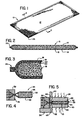
- an air mattress 10 having a flat, rectangular configuration and comprising upper and lower sheets or skin sections 12 and 14, respectively, which are bonded one to another about their entire perimeter to provide an air impervious envelope enclosing a core 16 of a lightweight, resilient, open cell foam material.
- each of the sheets or skins 12 and 14 comprises an outer layer of a substantially non- stretchable fabric 18 made of nylon or some other stretch resistant material, next a base or tie layer to facilitate subsequent lamination to fabric 18 an air impervious intermediate layer 20, and a third innermost layer of material 22 to which the foam core 16 is bonded and which facilitates the peripheral bond.
- the formation of the two sheets or skin sections 12 and 14 is critical to the present invention, and this will be discussed more fully later herein.
- the edge joint or seal 24 at which the two sheets 12 and 14 are joined about their entire perimeter is made by bonding the two inner surfaces of the sheets 12 and 14 together about their entire perimeter to form a "T" joint or seam.
- a valve 25 comprising a thermoplastic polyurethane housing and a conventional valve member mounted therein. This valve 25 is bonded into one corner of the air mattress 10 during the manufacturing process.
- the sheet material is prepared in accordance with specific teachings of the present invention which will be discussed later herein.
- This sheet material is cut or otherwise made into two rectangular sections 26 and 28 having dimensions moderately larger than the sheets or skin sections 12 and 14which are part of the end product which is the mattress 10.
- a section of foam core 30 is provided, this core having the same rectangular configuration as the core 16 which is in the finished air mattress 10.
- the core 30 and the two sheet sections 26 and 28 are formed in a sandwich-like prebonded assembly, as shown in Figure 4. More specifically, there is provided upper and lower perimeter frames 32 and 34 which grip the edge portions of the sheet sections 26 and 28. (For convenience, only one part of the perimeter frames 32 and 34 are shown in edge section, it being understood that the perimeter frames 32 and 34 have a general rectangular configuration moderately larger than that of the air mattress 10.)
- the prebonded assembly 36 made up of the frames 32 and 34, the sheet sections 26 and 28, the core 30 and vent tube 25 positioned therebetween, is placed between upper and lower heated platens 38 and 40, and the platens 38 and 40 are moved against one another so that the main flat surfaces 42 and 44 of the platens 38 and 40, respectively, press against the rectangular sheet sections 26 and 28 with moderate pressure.
- the heat from the platens 38 and 40 causes the inner film layer 22 of the two sheet sections 12 and 14 to soften moderately so that some of the filaments of the core 16 protrude moderately into the film layer 22, while other come into bonding contact with the surface of the film laminant 22.
- two perimeter portions 46 and 48 of the platens 38 and 40 press against upper and lower edge portions 50 and 52 of the sheet sections 26 and 28 to press these together into bonding engagement.
- the section 26 comprises an upper fabric layer 18, a relatively thin base layer 19, an intermediate layer 20, and an inner layer 22.
- the sheet section 26 presses against the foam core 30 only very lightly, so there is substantially no compression of the core 30.
- the heated platen 38 is pressed against the sheet section 26, as shown in Figure 5, the foam core 30 is compressed moderately, and at the same time, the heat from the platen 38 softens the innermost layer 22. The result is that some of the filaments 60 that are adjacent the innermost layer 22 are pushed into the softened inner layer 22, while other filaments 60 press against the surface of the softened layer 22.
- the innermost layer 22 hardens so that the filaments 60 become bonded to the sheet section 26 by adhering to the innermost layer 22.
- the upper and lower sheet sections 26 and 28 (which become the skin sections 12 and 14, respectively, of the finished mattress) are pushed away from each other moderately, thus applying moderate tension loads on the foam core 30 (which becomes the core 16 of the finished mattress 10).
- the result is that some of the unwanted filament bonds break away from the sheet sections 26 and 28 allowing the film to return to full loft or thickness.
- FIG 10 is a somewhat schematic side elevational view of an apparatus which is used to make the prior art material from which the sheet sections 26 and 28 are cut.
- a long sheet of fabric 62 which is unwound from a first roll 64 and wound onto a second roll 66.
- the fabric 62 travels from the roll 64 over a backing roll 68, above which is a doctor knife 70.
- a liquid material 72 is applied in a suitable manner at the front side of the doctor knife 70 so that as the fabric 62 travels beneath the liquid material 72 and then beneath the doctor knife 70, a very thin layer of the liquid material is applied to the surface of the fabric 62.
- the fabric 62 with the liquid material applied thereon passes through an oven 74 which heats the fabric 62 with the material 72 thereon to drive off the solvent from the liquid material 72.
- This oven 74 could be at a temperature of approximately 104°C, and the oven 74 may be made up of two or more heating zones, where the temperature becomes successively greater as the fabric 62 moves through the oven 74.
- the fabric 62 leaving the oven 74 is then wound onto the second roll 66.
- the liquid material 72 can be made up of, for example, a solvent such as dimethylformamide, and the solute can be, for example, polyurethane, with a suitable cross linking agent such as melamine.
- the liquid material could be, by weight, approximately 70% solvent, and 30% solute.
- the same process as described above can be repeated several more times to apply successive thin layers of polyurethane.
- the intermediate air impervious layer 20 which is applied to the base or tie coat is made of a thermoset polyurethane material or a thermoplastic polyurethane material having a higher melting point of about 182°C.
- the innermost layer 22 is formed by following the same process as indicated above, but the polyurethane material which is the solute that is deposited on the surface has a moderately lower melting temperature (e.g. 143,3°C to 160°C).
- the sheet material made in accordance with the prior art process noted above has been used for a number of years to make air mattress, such as shown in Figure 1, of generally highly consistent quality.
- an inflatable member such as the self-inflating air mattress described above, where, as a preliminary step in the process, the sheet material is formed by bonding to a fabric two or more solid film sheets made of a thermoplastic material such as polyurethane, where the melting temperature of the inner layer 22 is at least approximately 16,7°C less than the temperature of the intermediate film.
- the nylon fabric 78 has a thin base coat of polyurethane applied thereto. This can be accomplished by dissolving the polyurethane in a suitable solvent (as indicated above). The liquid is applied to the surface of the nylon fabric in the manner shown in Figure 10, which is then cured at a temperature of about 104°C, as previously explained.
- This thin base coat is the surface to which a subsequent thin film sheet 20 of polyurethane can be bonded.
- the two or more films can be applied to the underlying fabric in a conventional manner, as illustratd in Figure 11.
- a roll 76 upon which is wound a long sheet of fabric 78.
- a second roll 80 there is wound a solid thin film sheet 82 made of polyurethane of a relatively high melting temperature.
- the two sheets 78 and 82 are fed over a larger hot roller 84, and the two sheets are pressed by a mating roll 86 against the hot roller 84.
- the temperature of the hot roller 84 is sufficiently high to soften the sheet 82 to the extent that it becomes bonded to the fabric sheet 78.
- the sheet can pass over a number of guide (or idler) rolls 90 and be wound onto a collecting roll 92.
- the sheet 88 (made up of the fabric sheet 78 and the film sheet 82 bonded thereto) is again passed over the hot roller 84, and a second thin film sheet is applied to the surface of the high melt temperature thin film sheet 82 in the same manner as described above with reference to Figure 11.
- the temperature of the roller 84 is somewhat lower, so that it is just sufficient to cause bonding of the lower melt temperature film to the higher melt temperature film 82. This then becomes the innermost film layer 58.
- the sheet material 94 which is formed from the process recited above thus, in effect, has four layers, namely a) an outer fabric layer 96, b) a thin base coat(s) 98, c) an intermediate, air impervious, high melting temperature film 100, and d) a lower melting temperature film 102.
- This sheet 94 is cut into sections 26 and 28 of the appropriate dimensions and then used quite effectively in making the air mattress 10 in accordance with the steps described with reference to Figures 3-6.
- any entrapped bubbles have little if any effect on the inner film 100, so that it remains substantially air impervious. It may be that some of these air bubbles do migrate through the inner film 102, and through the nonimpervious fabric coating. But this does not destroy the air impervious integrity of the overall sheet 94. Further, even though some of the bubbles 104 may remain entrapped within the sheet 94, after the finished mattress 10 is made, these entrapped bubbles do not have any significant effect on the structural integrity of the upper and lower sheets 12 and 14 of the finished mattress 10.
- the fabric 96 is desirably a conventional nylon fabric, having an overall thickness of approximately 0,152 mm.
- the base or tie coating is similar to the base or tie coatings used in the prior art completely solvent coated system.
- the two films 100 and 102 are desirably each made of a solid sheet of polyethylene.
- the melting temperature of the intermediate film 100 is generally between about 185°C to 196°C.
- the melting temperature of the innermost film 102 is generally between about 160°C to 171°C. These melting temperatures are generally controlled by selection of polyurethanes which have higher molecular weight for the high melting point film 100 and lower molecular weight for the lower melting point film 102.
- the sheet 94 should be made so that the difference between the two melting temperatures of the films 100 and 102 should be at least about 16,7°C.
- this melting temperature difference could be made smaller (e.g. possibly 13,9°C or even 11,1°C), provided that processing conditions and quality control is watched very closely.
- the reliability of the overall process is substantially enhanced.
- thermoplastic materials such as polyethylene, polyvinylchloride, polyvinylidene chloride, and/or vinylidene chloride copolymers, polypropylene, polybutylene, and polyester.
- nylon fabric instead of using a nylon fabric, within the broader scope of the present invention, it would be possible to use other suitable fabric having similar qualities, such as polyester, cotton, polypropylene, wool, cellulose, and polyvinylidene chloride and/or vinylidene chloride copolymers.
- the sheet 94 made in accordance with the process described herein can also be used quite effectively in an inflatable member where there is not a foam core.
- the inflatable member may be made having an edge joint or seam as illustrated in Figure 3.
- Analysis and tests performed in conjunction with the present invention has indicated that even though the main surfaces of such an inflatable member (i.e. one not having a foam core) might not be subjected to processing conditions which would result in the formation of leaks due to bubbles, the sheet material at, or adjacent to, the bonding areas can be subjected to conditions which would cause the formation of bubbles and leaks in the material.
- the sheet material 94 and the method of making the same would also be applicable to inflatable members which do not have a foam core, as described above.
- the present invention has proven to be particularly effective for use in the process of forming the particular mattress 10, as described above.
- the sheet 94 can be examined as follows. First, the thickness of the sheet 94 is measured within tolerances of at least 0,127 mm. Then the temperature of the sheet is raised toward the predetermined melting temperature of the innermost film layer 102. At the same time, the inner surface of the sheet 94 is scraped by any suitable scraping tool, and the thickness is measured. (The thickness can be conveniently be measured by a micrometer gauge or other suitable measuring device).
- the thickness of the sheet 94 is reduced by an amount which is nearly equal to the thickness of the innermost layer 102, then it can be assumed that this innermost layer 102 will reach a suitable bonding temperature at the temperature where the innermost layer can be scraped off.
- the heating of the sheet 94 can be continued to increase the temperature to determine if the intermediate layer 100 remains intact at a temperature about 16,7°C higher than required to scrape off layer 102. This again can be done by applying a scraping tool to the inner surface of the sheet 94.
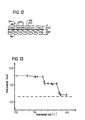
- FIG. 13 A graph illustrating this process is shown in Figure 13. It can be seen that the thickness of the sheet 94 remains relatively constant until a temperature of approximately 160°C. Then, with light scraping, the thickness drops rapidly as film 102 is removed. As the temperature approaches 185°C, the thickness of the sheet 94 again drops.
- the thickness of the sheet 94 remains substantially constant until it reaches a much higher temperature where the base or tie coats begin to deteriorate, leaving only the original uncoated fabric thickness, as indicated by the phantom line.
- the base coats may be made up of several different melt temperature layers to facilitate bonding to the high melt temperature film 100.
Landscapes
- Laminated Bodies (AREA)
- Lining Or Joining Of Plastics Or The Like (AREA)
- Mattresses And Other Support Structures For Chairs And Beds (AREA)
- Pharmaceuticals Containing Other Organic And Inorganic Compounds (AREA)
Claims (14)
Priority Applications (1)
| Application Number | Priority Date | Filing Date | Title |
|---|---|---|---|
| AT84201585T ATE57599T1 (de) | 1983-11-04 | 1984-11-02 | Aufblasbare matratze und verfahren zu deren herstellung. |
Applications Claiming Priority (2)
| Application Number | Priority Date | Filing Date | Title |
|---|---|---|---|
| US06/549,238 US4624877A (en) | 1983-11-04 | 1983-11-04 | Inflatable mattress and method of making the same |
| US549238 | 1983-11-04 |
Publications (3)
| Publication Number | Publication Date |
|---|---|
| EP0142201A2 EP0142201A2 (de) | 1985-05-22 |
| EP0142201A3 EP0142201A3 (en) | 1985-07-10 |
| EP0142201B1 true EP0142201B1 (de) | 1990-10-24 |
Family
ID=24192177
Family Applications (1)
| Application Number | Title | Priority Date | Filing Date |
|---|---|---|---|
| EP84201585A Expired - Lifetime EP0142201B1 (de) | 1983-11-04 | 1984-11-02 | Aufblasbare Matratze und Verfahren zu deren Herstellung |
Country Status (4)
| Country | Link |
|---|---|
| US (1) | US4624877A (de) |
| EP (1) | EP0142201B1 (de) |
| AT (1) | ATE57599T1 (de) |
| DE (1) | DE3483454D1 (de) |
Cited By (3)
| Publication number | Priority date | Publication date | Assignee | Title |
|---|---|---|---|---|
| USD386036S (en) | 1996-04-04 | 1997-11-11 | Medical Support Systems Limited | Cushion |
| USD396981S (en) | 1997-06-04 | 1998-08-18 | Medical Support Systems Limited | Cushion |
| USD399694S (en) | 1996-10-02 | 1998-10-20 | Medical Support Systems Limited | Cushion |
Families Citing this family (41)
| Publication number | Priority date | Publication date | Assignee | Title |
|---|---|---|---|---|
| GB2185681B (en) * | 1986-01-10 | 1989-01-18 | Mountain Equipment Ltd | Inflatable products |
| US5216768A (en) * | 1988-11-17 | 1993-06-08 | Oliver H. Bodine, Jr. | Bed system |
| US4930171A (en) * | 1989-05-03 | 1990-06-05 | International Healthcare Products, Inc. | Contour retaining support cushion |
| US5028468A (en) * | 1989-09-27 | 1991-07-02 | Pandel, Inc. | Surgical mat with disposable cover |
| US5152018A (en) * | 1989-12-15 | 1992-10-06 | Cascade Designs, Inc. | Batting filled self inflatable body |
| US5044030A (en) * | 1990-06-06 | 1991-09-03 | Fabrico Manufacturing Corporation | Multiple layer fluid-containing cushion |
| DE4100033C1 (de) * | 1991-01-03 | 1992-06-11 | Autoflug Gmbh & Co, 2084 Rellingen, De | |
| US5154418A (en) * | 1991-03-28 | 1992-10-13 | Alex Wortman | Deflecting cushion for bowling alley |
| US5196242A (en) * | 1991-05-29 | 1993-03-23 | Vicino Robert K | Self-inflating foam structure |
| CA2076728C (en) * | 1991-09-30 | 2003-04-08 | David C. Newkirk | Mattress for birthing bed |
| US5458516A (en) * | 1994-06-08 | 1995-10-17 | M.E.T.A. Research Inc. | Atmospheric self inflatable suit |
| US5709766A (en) * | 1995-07-10 | 1998-01-20 | Press; Stuart | Process for preparing a polyurethane coated fabric |
| US5991949A (en) * | 1995-08-15 | 1999-11-30 | Foamex L.P. | Hoseless air bed |
| GB9711276D0 (en) * | 1997-06-03 | 1997-07-30 | Medical Support Systems Limite | Cushion |
| US6073290A (en) * | 1997-11-12 | 2000-06-13 | Foamex L.P. | Air mattress and method of making same |
| AU4990700A (en) * | 1999-05-05 | 2000-11-17 | Cascade Designs, Inc. | Composite foam mattress having multiple laminate construction |
| US6767060B2 (en) | 2001-05-03 | 2004-07-27 | Pent Products, Inc. | Article of furniture having a support member with an adjustable contour |
| DE10127077B4 (de) * | 2001-06-02 | 2005-08-11 | Hartmut Ortlieb | Selbstaufblasende Liegematte |
| EP1523259A1 (de) | 2002-06-22 | 2005-04-20 | ORTLIEB, Hartmut | Selbstaufblasende liegematte |
| NZ574045A (en) * | 2002-12-09 | 2010-12-24 | Cascade Designs Inc | Film-based cellular matrix |
| US7427109B2 (en) * | 2004-11-09 | 2008-09-23 | General Motors Corporation | Pneumatic foam cushion |
| DE202006013633U1 (de) * | 2006-08-11 | 2007-09-20 | Sks Sitzkomponenten Gmbh & Co. Kg | Dreidimensionales Hohlraumformteil mit mehrschichtigem Aufbau |
| NZ575574A (en) * | 2006-09-18 | 2012-07-27 | Cascade Designs Inc | Valve assembly for inflatable bodies having a vent body defining an external and internal orfice |
| US7717520B2 (en) * | 2006-12-29 | 2010-05-18 | The Boeing Company | Aircraft passenger seat cushions |
| US7914352B2 (en) * | 2007-01-24 | 2011-03-29 | C2Mp, Inc. | Cover for a flotation device and flotation device employing same |
| US8033600B2 (en) * | 2007-05-29 | 2011-10-11 | Ergoair, Inc. | Seat system with shock- and vibration-reducing bladders |
| IE20090204A1 (en) | 2009-03-18 | 2010-10-27 | Patrick Noel Daly | Infection control cushion structure |
| US20110014406A1 (en) * | 2009-07-15 | 2011-01-20 | James Clyde Coleman | Sheet material exhibiting insulating and cushioning properties |
| DE202009013139U1 (de) | 2009-09-30 | 2010-03-11 | Daly, Patrick Noel, Shanagarry | Kissen und Ausstattung |
| US8584287B2 (en) | 2009-12-24 | 2013-11-19 | Johnson Outdoors Inc. | Air mattresses |
| CA2804588C (en) * | 2010-07-07 | 2018-11-27 | Bj2, Llc | Apparatus and method for making a corrugated product |
| US9314118B2 (en) | 2011-07-19 | 2016-04-19 | Jiajing Usa, Inc. | Comfort customizable pillow |
| KR101418378B1 (ko) | 2012-04-16 | 2014-07-11 | 주식회사 경인 | 모양을 포함하는 이중 공간지의 피브이씨 코팅방법 |
| US10058190B1 (en) | 2012-12-05 | 2018-08-28 | Jiajing Usa, Inc. | Air-foam mattress component |
| JP1611470S (de) * | 2017-12-18 | 2018-08-20 | ||
| USD923973S1 (en) * | 2019-12-21 | 2021-07-06 | Quzhou City Lingshangxing Outdoor Products Co., Ltd. | Inflatable mattress |
| EP4506163A1 (de) * | 2023-08-08 | 2025-02-12 | Bestway Inflatables & Material Corp. | Folie und aufblasbares produkt |
| CN119459066A (zh) * | 2023-08-08 | 2025-02-18 | 上海荣威塑胶工业有限公司 | 片材、充气产品、片材制造设备及片材制造方法 |
| US20250107637A1 (en) * | 2023-10-02 | 2025-04-03 | Comfetravel LLC | Portable inflatable mattress |
| CN221671319U (zh) * | 2023-11-17 | 2024-09-10 | 浙江大自然户外用品股份有限公司 | 一种厚度可变换的弹性绵及充气垫结构 |
| CN117461962A (zh) * | 2023-12-14 | 2024-01-30 | 浙江大自然户外用品股份有限公司 | 海绵、充气床垫及海绵的生产工艺 |
Family Cites Families (5)
| Publication number | Priority date | Publication date | Assignee | Title |
|---|---|---|---|---|
| US4025974A (en) * | 1972-01-10 | 1977-05-31 | Lea James M | Air mattress and method of making the same |
| US4046587A (en) * | 1975-12-23 | 1977-09-06 | Guglielmo Richard J Sr | Primer composition, process for using same and product obtained thereby |
| JPS5619087Y2 (de) * | 1976-04-07 | 1981-05-07 | ||
| SE423304B (sv) * | 1979-01-10 | 1982-05-03 | Becker Wilhelm Ab | Beddunderlag, innefattande en relativt tjock kerna |
| US4350734A (en) * | 1980-10-23 | 1982-09-21 | Colamco, Inc. | Integral composite foam product and method |
-
1983
- 1983-11-04 US US06/549,238 patent/US4624877A/en not_active Expired - Lifetime
-
1984
- 1984-11-02 DE DE8484201585T patent/DE3483454D1/de not_active Expired - Lifetime
- 1984-11-02 EP EP84201585A patent/EP0142201B1/de not_active Expired - Lifetime
- 1984-11-02 AT AT84201585T patent/ATE57599T1/de not_active IP Right Cessation
Cited By (3)
| Publication number | Priority date | Publication date | Assignee | Title |
|---|---|---|---|---|
| USD386036S (en) | 1996-04-04 | 1997-11-11 | Medical Support Systems Limited | Cushion |
| USD399694S (en) | 1996-10-02 | 1998-10-20 | Medical Support Systems Limited | Cushion |
| USD396981S (en) | 1997-06-04 | 1998-08-18 | Medical Support Systems Limited | Cushion |
Also Published As
| Publication number | Publication date |
|---|---|
| EP0142201A3 (en) | 1985-07-10 |
| US4624877A (en) | 1986-11-25 |
| ATE57599T1 (de) | 1990-11-15 |
| DE3483454D1 (de) | 1990-11-29 |
| EP0142201A2 (de) | 1985-05-22 |
Similar Documents
| Publication | Publication Date | Title |
|---|---|---|
| US4624877A (en) | Inflatable mattress and method of making the same | |
| US3551270A (en) | Bonding air-impervious flexible sheets using an adhesive,perforated,inner sheet and article produced thereby | |
| US3550839A (en) | Doubled walled plastic bag | |
| CA1166526A (en) | Shaped materials | |
| US4088805A (en) | Reinforced thermoplastic foam sheet | |
| EP0528981B1 (de) | Nichtblockierende verbindungsbänder | |
| US4425406A (en) | Method and apparatus for producing laminated glass | |
| US4503114A (en) | Laminated adhesive backing for mirrors | |
| US6893529B1 (en) | Method of producing a laminate material | |
| US6080260A (en) | Method and equipment for production of laminated metal sheet | |
| JPH04267145A (ja) | 積層包装材料およびその製造方法 | |
| WO1994005483A1 (en) | Method and machine for laminating a decorative layer to the surface of a three-dimensional object | |
| US3607518A (en) | Method of producing expanded double-faced honeycomb panels | |
| US4780159A (en) | Method of laminating multi-layer noise suppression structures | |
| US3669786A (en) | Method of laminating plastic foam | |
| KR940004028B1 (ko) | 수지오버레이판의 제조방법 | |
| US20160016386A1 (en) | Reflective Insulation | |
| JP2003011220A (ja) | ラミネート方法 | |
| US4857400A (en) | Stratiform press pads and methods for use thereof in laminating flexible printed circuits | |
| WO1985002371A1 (en) | Method and apparatus for producing laminated glass | |
| JP4092762B2 (ja) | レトルトパウチ用包装材料の製造方法 | |
| JPS6017338B2 (ja) | 接着方法 | |
| JPH0218041A (ja) | 積層シート及びその製造方法 | |
| EP0174949A4 (de) | Verfahren und vorrichtung zum laminieren biegsamer gedruckter schaltungen. | |
| JPH0466695B2 (de) |
Legal Events
| Date | Code | Title | Description |
|---|---|---|---|
| PUAI | Public reference made under article 153(3) epc to a published international application that has entered the european phase |
Free format text: ORIGINAL CODE: 0009012 |
|
| PUAL | Search report despatched |
Free format text: ORIGINAL CODE: 0009013 |
|
| AK | Designated contracting states |
Designated state(s): AT BE CH DE FR GB IT LI LU NL SE |
|
| AK | Designated contracting states |
Designated state(s): AT BE CH DE FR GB IT LI LU NL SE |
|
| 17P | Request for examination filed |
Effective date: 19851122 |
|
| 17Q | First examination report despatched |
Effective date: 19880725 |
|
| GRAA | (expected) grant |
Free format text: ORIGINAL CODE: 0009210 |
|
| AK | Designated contracting states |
Kind code of ref document: B1 Designated state(s): AT BE CH DE FR GB IT LI LU NL SE |
|
| PG25 | Lapsed in a contracting state [announced via postgrant information from national office to epo] |
Ref country code: SE Effective date: 19901024 Ref country code: NL Effective date: 19901024 Ref country code: IT Free format text: LAPSE BECAUSE OF FAILURE TO SUBMIT A TRANSLATION OF THE DESCRIPTION OR TO PAY THE FEE WITHIN THE PRESCRIBED TIME-LIMIT;WARNING: LAPSES OF ITALIAN PATENTS WITH EFFECTIVE DATE BEFORE 2007 MAY HAVE OCCURRED AT ANY TIME BEFORE 2007. THE CORRECT EFFECTIVE DATE MAY BE DIFFERENT FROM THE ONE RECORDED. Effective date: 19901024 Ref country code: FR Effective date: 19901024 Ref country code: BE Effective date: 19901024 Ref country code: AT Effective date: 19901024 |
|
| REF | Corresponds to: |
Ref document number: 57599 Country of ref document: AT Date of ref document: 19901115 Kind code of ref document: T |
|
| REF | Corresponds to: |
Ref document number: 3483454 Country of ref document: DE Date of ref document: 19901129 |
|
| PG25 | Lapsed in a contracting state [announced via postgrant information from national office to epo] |
Ref country code: LU Free format text: LAPSE BECAUSE OF NON-PAYMENT OF DUE FEES Effective date: 19901130 |
|
| EN | Fr: translation not filed | ||
| NLV1 | Nl: lapsed or annulled due to failure to fulfill the requirements of art. 29p and 29m of the patents act | ||
| PLBE | No opposition filed within time limit |
Free format text: ORIGINAL CODE: 0009261 |
|
| STAA | Information on the status of an ep patent application or granted ep patent |
Free format text: STATUS: NO OPPOSITION FILED WITHIN TIME LIMIT |
|
| 26N | No opposition filed | ||
| REG | Reference to a national code |
Ref country code: GB Ref legal event code: IF02 |
|
| PGFP | Annual fee paid to national office [announced via postgrant information from national office to epo] |
Ref country code: GB Payment date: 20031104 Year of fee payment: 20 |
|
| PGFP | Annual fee paid to national office [announced via postgrant information from national office to epo] |
Ref country code: DE Payment date: 20031128 Year of fee payment: 20 |
|
| PGFP | Annual fee paid to national office [announced via postgrant information from national office to epo] |
Ref country code: CH Payment date: 20031202 Year of fee payment: 20 |
|
| PG25 | Lapsed in a contracting state [announced via postgrant information from national office to epo] |
Ref country code: LI Free format text: LAPSE BECAUSE OF EXPIRATION OF PROTECTION Effective date: 20041101 Ref country code: GB Free format text: LAPSE BECAUSE OF EXPIRATION OF PROTECTION Effective date: 20041101 Ref country code: CH Free format text: LAPSE BECAUSE OF EXPIRATION OF PROTECTION Effective date: 20041101 |
|
| REG | Reference to a national code |
Ref country code: GB Ref legal event code: PE20 |
|
| REG | Reference to a national code |
Ref country code: CH Ref legal event code: PL |