EP0142275A2 - Verfahren zum katalytischen Cracken mit hoher Verweilzeit - Google Patents
Verfahren zum katalytischen Cracken mit hoher Verweilzeit Download PDFInfo
- Publication number
- EP0142275A2 EP0142275A2 EP84306968A EP84306968A EP0142275A2 EP 0142275 A2 EP0142275 A2 EP 0142275A2 EP 84306968 A EP84306968 A EP 84306968A EP 84306968 A EP84306968 A EP 84306968A EP 0142275 A2 EP0142275 A2 EP 0142275A2
- Authority
- EP
- European Patent Office
- Prior art keywords
- catalyst
- stripping
- sulfur
- regenerator
- temperature
- Prior art date
- Legal status (The legal status is an assumption and is not a legal conclusion. Google has not performed a legal analysis and makes no representation as to the accuracy of the status listed.)
- Granted
Links
- 238000000034 method Methods 0.000 title claims abstract description 20
- 238000004523 catalytic cracking Methods 0.000 title claims abstract description 19
- 239000003054 catalyst Substances 0.000 claims abstract description 129
- NINIDFKCEFEMDL-UHFFFAOYSA-N Sulfur Chemical compound [S] NINIDFKCEFEMDL-UHFFFAOYSA-N 0.000 claims abstract description 37
- 229910052717 sulfur Inorganic materials 0.000 claims abstract description 34
- 239000011593 sulfur Substances 0.000 claims abstract description 34
- 239000000571 coke Substances 0.000 claims abstract description 23
- 230000008929 regeneration Effects 0.000 claims abstract description 20
- 238000011069 regeneration method Methods 0.000 claims abstract description 20
- 238000005336 cracking Methods 0.000 claims abstract description 17
- 229910052815 sulfur oxide Inorganic materials 0.000 claims abstract description 17
- XTQHKBHJIVJGKJ-UHFFFAOYSA-N sulfur monoxide Chemical class S=O XTQHKBHJIVJGKJ-UHFFFAOYSA-N 0.000 claims abstract description 8
- 239000007789 gas Substances 0.000 claims description 13
- QVGXLLKOCUKJST-UHFFFAOYSA-N atomic oxygen Chemical compound [O] QVGXLLKOCUKJST-UHFFFAOYSA-N 0.000 claims description 10
- 229930195733 hydrocarbon Natural products 0.000 claims description 10
- 150000002430 hydrocarbons Chemical class 0.000 claims description 10
- 229910052760 oxygen Inorganic materials 0.000 claims description 10
- 239000001301 oxygen Substances 0.000 claims description 10
- 150000003464 sulfur compounds Chemical class 0.000 claims description 10
- 239000004215 Carbon black (E152) Substances 0.000 claims description 8
- CURLTUGMZLYLDI-UHFFFAOYSA-N Carbon dioxide Chemical compound O=C=O CURLTUGMZLYLDI-UHFFFAOYSA-N 0.000 claims description 8
- 229910002092 carbon dioxide Inorganic materials 0.000 claims description 7
- 229910021536 Zeolite Inorganic materials 0.000 claims description 6
- HNPSIPDUKPIQMN-UHFFFAOYSA-N dioxosilane;oxo(oxoalumanyloxy)alumane Chemical compound O=[Si]=O.O=[Al]O[Al]=O HNPSIPDUKPIQMN-UHFFFAOYSA-N 0.000 claims description 6
- 239000010457 zeolite Substances 0.000 claims description 6
- OKTJSMMVPCPJKN-UHFFFAOYSA-N Carbon Chemical compound [C] OKTJSMMVPCPJKN-UHFFFAOYSA-N 0.000 claims description 5
- 238000006243 chemical reaction Methods 0.000 claims description 5
- JTJMJGYZQZDUJJ-UHFFFAOYSA-N phencyclidine Chemical class C1CCCCN1C1(C=2C=CC=CC=2)CCCCC1 JTJMJGYZQZDUJJ-UHFFFAOYSA-N 0.000 claims description 4
- 239000000654 additive Substances 0.000 claims description 3
- 239000001569 carbon dioxide Substances 0.000 claims description 3
- 229910002090 carbon oxide Inorganic materials 0.000 claims description 3
- 238000000926 separation method Methods 0.000 claims description 3
- 238000011109 contamination Methods 0.000 claims description 2
- 230000005484 gravity Effects 0.000 claims description 2
- 239000007787 solid Substances 0.000 claims 1
- UGFAIRIUMAVXCW-UHFFFAOYSA-N Carbon monoxide Chemical compound [O+]#[C-] UGFAIRIUMAVXCW-UHFFFAOYSA-N 0.000 description 15
- 239000003546 flue gas Substances 0.000 description 14
- 239000003795 chemical substances by application Substances 0.000 description 11
- 230000000694 effects Effects 0.000 description 7
- 239000000047 product Substances 0.000 description 6
- RWSOTUBLDIXVET-UHFFFAOYSA-N Dihydrogen sulfide Chemical compound S RWSOTUBLDIXVET-UHFFFAOYSA-N 0.000 description 5
- 229910000037 hydrogen sulfide Inorganic materials 0.000 description 5
- 230000003647 oxidation Effects 0.000 description 5
- 238000007254 oxidation reaction Methods 0.000 description 5
- FCEHBMOGCRZNNI-UHFFFAOYSA-N 1-benzothiophene Chemical compound C1=CC=C2SC=CC2=C1 FCEHBMOGCRZNNI-UHFFFAOYSA-N 0.000 description 4
- IJGRMHOSHXDMSA-UHFFFAOYSA-N Atomic nitrogen Chemical compound N#N IJGRMHOSHXDMSA-UHFFFAOYSA-N 0.000 description 4
- 238000013459 approach Methods 0.000 description 4
- 229910052799 carbon Inorganic materials 0.000 description 4
- DIOQZVSQGTUSAI-UHFFFAOYSA-N decane Chemical compound CCCCCCCCCC DIOQZVSQGTUSAI-UHFFFAOYSA-N 0.000 description 4
- 239000000376 reactant Substances 0.000 description 4
- UCKMPCXJQFINFW-UHFFFAOYSA-N Sulphide Chemical compound [S-2] UCKMPCXJQFINFW-UHFFFAOYSA-N 0.000 description 3
- 238000011161 development Methods 0.000 description 3
- 230000018109 developmental process Effects 0.000 description 3
- VYPSYNLAJGMNEJ-UHFFFAOYSA-N Silicium dioxide Chemical compound O=[Si]=O VYPSYNLAJGMNEJ-UHFFFAOYSA-N 0.000 description 2
- 238000002474 experimental method Methods 0.000 description 2
- 239000012263 liquid product Substances 0.000 description 2
- 229910052751 metal Inorganic materials 0.000 description 2
- 239000002184 metal Substances 0.000 description 2
- 239000000203 mixture Substances 0.000 description 2
- 238000012986 modification Methods 0.000 description 2
- 230000004048 modification Effects 0.000 description 2
- 229910052757 nitrogen Inorganic materials 0.000 description 2
- 238000012545 processing Methods 0.000 description 2
- 238000001179 sorption measurement Methods 0.000 description 2
- 238000012360 testing method Methods 0.000 description 2
- MYMOFIZGZYHOMD-UHFFFAOYSA-N Dioxygen Chemical compound O=O MYMOFIZGZYHOMD-UHFFFAOYSA-N 0.000 description 1
- 241000282326 Felis catus Species 0.000 description 1
- 238000010521 absorption reaction Methods 0.000 description 1
- PNEYBMLMFCGWSK-UHFFFAOYSA-N aluminium oxide Inorganic materials [O-2].[O-2].[O-2].[Al+3].[Al+3] PNEYBMLMFCGWSK-UHFFFAOYSA-N 0.000 description 1
- 229910002091 carbon monoxide Inorganic materials 0.000 description 1
- 229910000420 cerium oxide Inorganic materials 0.000 description 1
- 238000004939 coking Methods 0.000 description 1
- 238000002485 combustion reaction Methods 0.000 description 1
- 238000001816 cooling Methods 0.000 description 1
- 230000007423 decrease Effects 0.000 description 1
- 230000009977 dual effect Effects 0.000 description 1
- 238000002347 injection Methods 0.000 description 1
- 239000007924 injection Substances 0.000 description 1
- 239000011159 matrix material Substances 0.000 description 1
- 150000002739 metals Chemical class 0.000 description 1
- BMMGVYCKOGBVEV-UHFFFAOYSA-N oxo(oxoceriooxy)cerium Chemical compound [Ce]=O.O=[Ce]=O BMMGVYCKOGBVEV-UHFFFAOYSA-N 0.000 description 1
- 230000000750 progressive effect Effects 0.000 description 1
- 230000001737 promoting effect Effects 0.000 description 1
- 230000001172 regenerating effect Effects 0.000 description 1
- 239000000377 silicon dioxide Substances 0.000 description 1
- 238000004088 simulation Methods 0.000 description 1
- 238000002791 soaking Methods 0.000 description 1
- 239000000243 solution Substances 0.000 description 1
- 238000010561 standard procedure Methods 0.000 description 1
- 238000013022 venting Methods 0.000 description 1
- XLYOFNOQVPJJNP-UHFFFAOYSA-N water Substances O XLYOFNOQVPJJNP-UHFFFAOYSA-N 0.000 description 1
Images
Classifications
-
- C—CHEMISTRY; METALLURGY
- C10—PETROLEUM, GAS OR COKE INDUSTRIES; TECHNICAL GASES CONTAINING CARBON MONOXIDE; FUELS; LUBRICANTS; PEAT
- C10G—CRACKING HYDROCARBON OILS; PRODUCTION OF LIQUID HYDROCARBON MIXTURES, e.g. BY DESTRUCTIVE HYDROGENATION, OLIGOMERISATION, POLYMERISATION; RECOVERY OF HYDROCARBON OILS FROM OIL-SHALE, OIL-SAND, OR GASES; REFINING MIXTURES MAINLY CONSISTING OF HYDROCARBONS; REFORMING OF NAPHTHA; MINERAL WAXES
- C10G11/00—Catalytic cracking, in the absence of hydrogen, of hydrocarbon oils
- C10G11/14—Catalytic cracking, in the absence of hydrogen, of hydrocarbon oils with preheated moving solid catalysts
- C10G11/18—Catalytic cracking, in the absence of hydrogen, of hydrocarbon oils with preheated moving solid catalysts according to the "fluidised-bed" technique
- C10G11/187—Controlling or regulating
-
- Y—GENERAL TAGGING OF NEW TECHNOLOGICAL DEVELOPMENTS; GENERAL TAGGING OF CROSS-SECTIONAL TECHNOLOGIES SPANNING OVER SEVERAL SECTIONS OF THE IPC; TECHNICAL SUBJECTS COVERED BY FORMER USPC CROSS-REFERENCE ART COLLECTIONS [XRACs] AND DIGESTS
- Y02—TECHNOLOGIES OR APPLICATIONS FOR MITIGATION OR ADAPTATION AGAINST CLIMATE CHANGE
- Y02A—TECHNOLOGIES FOR ADAPTATION TO CLIMATE CHANGE
- Y02A50/00—TECHNOLOGIES FOR ADAPTATION TO CLIMATE CHANGE in human health protection, e.g. against extreme weather
- Y02A50/20—Air quality improvement or preservation, e.g. vehicle emission control or emission reduction by using catalytic converters
Definitions
- This invention relates to a fluidized catalytic cracking (FCC) process wherein coke deactivated catalyst is subjected to stripping prior to coke burnoff.
- FCC fluidized catalytic cracking
- the present invention provides a process for catalytic cracking of a sulfur containing hydrocarbon charge by contacting the charge at cracking temperature with a circulating inventory of cracking catalyst to produce cracked vapor product and spent catalyst with deposits of coke and sulfur compounds, wherein at least a portion of the spent catalyst is regenerated with an oxygen-containing gas at regeneration conditions including a regeneration temperature higher than the cracking temperature and sufficient to burn at least a portion of the coke and the sulfur deposits to generate oxides of carbon and sulfur oxides and provide regenerated catalyst with reduced coke content which is recycled to contact the hydrocarbon charge, characterized by subjecting the spent catalyst to contact at a temperature of 500°to 700°C with steam for from 1 to 10 minutes, and further characterized by the absence of oxygen during the stripping and the absence of any SO removal additives on the catalyst.
- the conventional FCC catalyst is withdrawn from the FCC reactor, along with the sulfide of the metallic agent and subjected to steam stripping at temperatures of 454° to 649°C (850° to 1200°F).
- the sulfide of the metallic agent reacts with water to form hydrogen sulfide gas and restore the metallic agent to a form in which it can react with additional sulfur oxides in the FCC regenerator.
- the present invention provides a process for catalytic cracking of a sulfur containing hydrocarbon charge by contacting the charge at cracking temperature with a circulating inventory of cracking catalyst to produce cracked vapor product and spent catalyst with deposits of coke and sulfur compounds, wherein at least a portion of the spent catalyst is regenerated with an oxygen-containing gas at regeneration conditions including a regeneration temperature higher than the cracking temperature and sufficient to burn at least a portion of the coke and the sulfur deposits to generate oxides of carbon and sulfur oxides and provide regenerated catalyst with reduced coke content which is recycled to contact the hydrocarbon charge, characterized by subjecting the spent catalyst to contact at a temperature of 500°to 700°C with steam for from 1 to 10 minutes, and further characterized by the absence of oxygen during the stripping and the absence of any SO removal additives on the catalyst.
- the present invention also provides a process for the fluidized catalytic cracking of sulfur containing hydrocarbon feed comprising
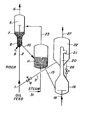
- the drawing is a simplified representation of one embodiment of the present invention showing a conventional riser reactor, a long residence time stripping zone and a conventional FCC regenerator.
- Any conventional FCC catalyst can be used.
- Use of zeolite catalysts in an amorphous base is preferred.
- Many suitable catalysts are discussed in U.S. Patent No. 3,926,778.
- the catalyst should not contain any metallic agents designed to adsorb or react with SO in the FCC regenerator. It is the purpose of the present invention to avoid the necessity for inclusion of such agents with the FCC catalyst.
- the FCC reactor preferably, contains a conventional stripping zone in the bottom of the reactor, as shown in the drawing, or immediately outside of the reactor, as shown in U.S. Patent No. 3,838,036.
- the FCC regenerator is conventional.
- the regenerator can operate in a CO burning mode in a single vessel, as shown in U.S. Patent No. 4,238,317 or a dual vessel regenerator connected by a vertical riser may be used such as is disclosed in U.S. Patent No. 3,926,778.
- Other conventional FCC regenerators include those operating in a non-afterburning mode of operation in which coke is combusted to a mixture of CO and C02. These regenerators do not do as thorough a job regenerating the catalyst and the SO emission problems are somewhat less with these type regenerators as opposed to CO afterburning regenerators. However, the practice of the present invention will still be of some benefit even with these older FCC regenerators.
- Any conventional catalyst gas contacting vessel which will permit contact of FCC catalyst from the reactor with a stripping gas, preferably steam, for from one half to ten minutes, preferably one to five minutes, may be used.
- a stripping gas preferably steam
- An example of a suitable catalyst stripper is given in U.S. Patent No. 3,728,239.
- the stripper must be sized large enough to hold the expected flow of catalyst for a relatively long residence time within the stripper. Because of the long residence time requirement, the catalyst stripper of the present invention will be a relatively large vessel, with a catalyst inventory on the same order of magnitude as the FCC regenerator.
- the long residence time stripper is placed on an elevation intermediate the catalyst withdrawal point from the reactor and the spent catalyst feedpoint to the FCC regenerator.
- a pneumatic conveyer or other conventional means for transporting catalyst from a low point to a high point to allow all three major components, namely the reactor, stripper, and regenerator, to be at ground level.
- the vessel should be significantly smaller than the FCC regenerator. This is because it is possible to operate with very low vapor velocities in the long residence time stripper, promoting relatively dense bed operation, with very little disengaging space above the dense bed. Cyclones may be provided above the stripping zone dense bed but these may be eliminated in favor of simply venting all of the gas from the long residence time stripper into the FCC reactor, or alternatively, a cyclone could be installed within the FCC reactor to help separate entrained catalysts from stripping vapors.
- the entire reactor effluent vapor may be passed through the top of the stripping zone.
- the stripping zone preferably contains secondary cyclones facilitating removal of entrained catalysts from riser reactor vapors and stripper vapors.
- the weight ratio of steam to catalyst is 1:100 to 1:10.
- An oil feed is added to the base of riser reactor 2 where it is mixed with hot regenerated catalyst added via line 3 and valve 4.
- the catalyst and oil rise as a dilute phase mixture through riser 2 and enter separation zone 5 above the riser discharge.
- the riser may discharge into a cyclone or there may be one or more cyclone separators above the riser. It is preferred to quickly separate hydrocarbons from catalysts and, for this reason, the riser preferably discharges directly into a cyclone (not shown in the drawing).
- a dense bed of catalyst 7 forms around riser reactor 2. Catalyst passes down through a conventional stripping zone 8 and is stripped by steam added via line 9. Stripped spent catalyst is removed via line 10 and charged to long residence time stripper 11. The stripper is intermediate in elevation between the point of withdrawal of stripped spent catalyst and the bottom of catalyst regenerator 16.
- Stripper vapors comprising relatively small amounts of volatile hydrocarbons and sulfur compounds are removed from stripper 11 via line 23 and discharged into separation zone 5 in the FCC reactor.
- the catalyst has by now been doubly stripped, first conventionally in stripping zone 8 and then, to a much greater extent, in long residence time stripper 11. This doubly stripped catalyst is removed via line 15 and discharged into combustor 16. Air is added to combustor 16 via line 18. Coke on catalyst is burned in the dense phase of catalyst within catalyst combuster 16 and also within the dilute phase transport riser 20 to which the catalyst is transported, and discharged via outlet 21 into disengaging zone 22.
- a dense bed of hot regenerated catalyst collects around transport riser 20 in the bottom of space 22, and, from this point, is returned to the reactor via line 3 or recycled via line 26 to combustor 16. Recycle of hot regenerated catalyst via line 26 helps promote rapid coke combustion and CO afterburning in combustor 16 and riser 20. Flue gas is removed from catalyst disengaging space 22 via line 27.
- n-decane containing 8 weight percent thianaphthene.
- n-decane was 99% grade obtained from The Humphrey Chemical Co. and thianaphthene was 97% grade obtained from Aldrich Chemical Co.
- the catalyst was a commercial FCC catalyst removed from an FCC unit in an equilibrated activity state. It was completely regenerated in a muffle furnace at 649°C (1200°F) before use. Its activity level, based on the FAI catalyst activity test, is 63.2 vol. % conversion with 0.44 wt % C on catalyst.
- the FAI catalyst activity test is defined as the conversion of a light East Texas gas oil (LETGO) at a 2 C/0, 454°C (850°F), 6 WHSV for 5 minutes on stream time to a 180°C (356°F) at 90% ASTM gasoline product. Conversion is defined as 100%-LV% cycle oil product.
- the FCC reactor stripper and regenerator were simulated using VYCOR micro reactor.
- a single VYCOR micro reactor was used to simulate all three major components of the present invention, namely, the FCC reactor, the long residence time stripper and the conventional regenerator.
- the FCC reactor was simulated by passing the feed over the clean burned catalyst at 538°C, at atmospheric pressure for 185 seconds at a cat/oil ratio of 5.2. The resulting oil contact time was 2.9 seconds. The reactor was then flushed with cool nitrogen and very quickly cooled to a given stripping temperature. After stripping was completed, nitrogen flow was stopped and the temperature rapidly increased to 649°C for catalyst regeneration. Catalyst regeneration was conducted by passing pure oxygen through the reactor using 325 cc of oxygen over a period of 17 minutes.
- Catalyst samples were taken after the coking, or FCC reactor- simulation, was completed, after long residence time stripping, and after regeneration.
- the gases removed from the microreactor were analyzed using standard techniques so that carbon and sulfur balances could be completed.
- the stripping conditions have a surprising effect on the CO/CO 2 ratio as measured during catalyst regeneration.
- Lower temperature stripping and longer stripping time result in lower CO/CO 2 ratios in the regenerator.
- Example 3 less than 1 percent of the sulfur in the feed ended up as SO emissions in the FCC regenerator. In Example 8, 2.3 percent of the sulfur in the feed ended up as SO x emissions showing that reducing the temperature of steam stripping favors a reduction in SO X emissions from the regenerator.
- a long residence time sulfur stripping unit were installed today on a unit, we would use it in conjunction with a riser reactor FCC unit operating in conjunction with a CO afterburning regenerator.
- Any of the commercially available zeolite containing catalysts e.g., REY zeolite in a silica/alumina matrix could be used.
- the size of the long residence time stripper would be sufficient to permit a catalyst residence time of about 5 minutes. Stripping temperature would be around 530 to 550 C. Stripped vapors from the long residence time stripper would simply be combined with the FCC reactor effluent vapor for further conventional processing.
Landscapes
- Chemical & Material Sciences (AREA)
- Oil, Petroleum & Natural Gas (AREA)
- Engineering & Computer Science (AREA)
- Chemical Kinetics & Catalysis (AREA)
- General Chemical & Material Sciences (AREA)
- Organic Chemistry (AREA)
- Production Of Liquid Hydrocarbon Mixture For Refining Petroleum (AREA)
Applications Claiming Priority (2)
| Application Number | Priority Date | Filing Date | Title |
|---|---|---|---|
| US543666 | 1983-10-19 | ||
| US06/543,666 US4481103A (en) | 1983-10-19 | 1983-10-19 | Fluidized catalytic cracking process with long residence time steam stripper |
Publications (3)
| Publication Number | Publication Date |
|---|---|
| EP0142275A2 true EP0142275A2 (de) | 1985-05-22 |
| EP0142275A3 EP0142275A3 (en) | 1986-06-25 |
| EP0142275B1 EP0142275B1 (de) | 1990-03-28 |
Family
ID=24169038
Family Applications (1)
| Application Number | Title | Priority Date | Filing Date |
|---|---|---|---|
| EP84306968A Expired - Lifetime EP0142275B1 (de) | 1983-10-19 | 1984-10-12 | Verfahren zum katalytischen Cracken mit hoher Verweilzeit |
Country Status (6)
| Country | Link |
|---|---|
| US (1) | US4481103A (de) |
| EP (1) | EP0142275B1 (de) |
| JP (1) | JPS60108494A (de) |
| AU (1) | AU562844B2 (de) |
| CA (1) | CA1237088A (de) |
| DE (1) | DE3481774D1 (de) |
Families Citing this family (31)
| Publication number | Priority date | Publication date | Assignee | Title |
|---|---|---|---|---|
| US4789458A (en) * | 1984-12-27 | 1988-12-06 | Mobil Oil Corporation | Fluid catalytic cracking with plurality of catalyst stripping zones |
| US4600700A (en) * | 1984-12-28 | 1986-07-15 | Mobil Oil Corporation | Regeneration of platinum-containing zeolite catalysts which includes oxidation of coke in the presence of water |
| JPS63383A (ja) * | 1986-05-27 | 1988-01-05 | エンゲルハ−ド・コ−ポレ−シヨン | Fcc装置の煙道ガスから硫黄酸化物類を除去するための改良方法 |
| US4990314A (en) * | 1986-09-03 | 1991-02-05 | Mobil Oil Corporation | Process and apparatus for two-phase fluid catalytic cracking system |
| US4787967A (en) * | 1986-09-03 | 1988-11-29 | Mobil Oil Corporation | Process for two-phase fluid catalytic cracking system |
| US5474669A (en) * | 1988-12-16 | 1995-12-12 | Uop | Side mounted FCC stripper with two-zone stripping |
| US5314611A (en) * | 1990-11-15 | 1994-05-24 | Uop | External integrated disengager stripper and its use in fluidized catalytic cracking process |
| US5449498A (en) * | 1990-11-15 | 1995-09-12 | Uop | FCC stripper with multiple integrated disengager |
| US5158669A (en) * | 1990-11-15 | 1992-10-27 | Uop | Disengager stripper |
| US5316662A (en) * | 1990-11-15 | 1994-05-31 | Uop | Integrated disengager stripper and its use in fluidized catalytic cracking process |
| US5260034A (en) * | 1992-04-24 | 1993-11-09 | Shell Oil Company | Stage catalyst concentric annular stripper |
| US5320740A (en) * | 1993-01-08 | 1994-06-14 | Mobil Oil Corporation | Quenched multistage FCC catalyst stripping |
| US5346613A (en) * | 1993-09-24 | 1994-09-13 | Uop | FCC process with total catalyst blending |
| US5462652A (en) * | 1993-09-24 | 1995-10-31 | Uop | Short contact FCC process with catalyst blending |
| US6027696A (en) * | 1997-04-11 | 2000-02-22 | Indian Oil Corporation Ltd. | Fluidized catalytic cracking apparatus |
| US6267873B1 (en) | 1997-04-11 | 2001-07-31 | Indian Oil Corporation, Ltd. | Fluidized catalytic cracking process |
| US6740227B2 (en) | 1999-12-29 | 2004-05-25 | Uop Llc | Stripping process with fully distributed openings on baffles |
| US6680030B2 (en) | 1999-12-29 | 2004-01-20 | Uop Llc | Stripping process with horizontal baffles |
| US6780308B1 (en) | 2001-11-21 | 2004-08-24 | Uop Llc | Stripping process with disproportionately distributed openings on baffles |
| US7022221B1 (en) | 2002-08-16 | 2006-04-04 | Uop Llc | Stripping apparatus and process |
| US7077997B1 (en) | 2002-08-16 | 2006-07-18 | Uop Llc | Stripping apparatus |
| US7431825B2 (en) | 2003-12-05 | 2008-10-07 | Intercat, Inc. | Gasoline sulfur reduction using hydrotalcite like compounds |
| CA2548500C (en) | 2003-12-05 | 2010-01-12 | Intercat, Inc. | Mixed metal oxide sorbents |
| JP4067503B2 (ja) * | 2004-03-17 | 2008-03-26 | 本田技研工業株式会社 | 触媒活性の制御方法 |
| US7332132B2 (en) * | 2004-03-19 | 2008-02-19 | Uop Llc | Stripping apparatus and process |
| TWI342335B (en) | 2004-06-02 | 2011-05-21 | Intercat Inc | Mixed metal oxide additives |
| US20070129234A1 (en) * | 2005-12-02 | 2007-06-07 | Stockwell David M | Lower temperature CO promoters for FCC with low NOx |
| US7972565B2 (en) * | 2008-09-25 | 2011-07-05 | Uop Llc | Stripping apparatus with multi-sloped baffles |
| US8062507B2 (en) | 2008-09-25 | 2011-11-22 | Uop Llc | Stripping process with multi-sloped baffles |
| US20110162951A1 (en) * | 2009-07-13 | 2011-07-07 | Inventure Chemical, Inc. | Partial pressure distillation process |
| US9446398B2 (en) | 2014-12-05 | 2016-09-20 | Uop Llc | Stripping vessel for removing hydrocarbons entrained in catalyst particles |
Family Cites Families (16)
| Publication number | Priority date | Publication date | Assignee | Title |
|---|---|---|---|---|
| NL105540C (de) * | 1954-02-09 | |||
| NL198013A (de) * | 1954-06-16 | |||
| US3150075A (en) * | 1961-01-11 | 1964-09-22 | Sinclair Research Inc | Method of cracking hydrocarbons and reactivating the metallic contaminated catalyst |
| DE1281614B (de) * | 1962-01-02 | 1968-10-31 | Pullman Inc | Verfahren zur Gewinnung schwer verdampfbarer Erdoelkohlenwasserstoffe |
| US3428550A (en) * | 1966-08-10 | 1969-02-18 | Sinclair Research Inc | Crystalline aluminosilicate-containing catalyst and methods of treating and using same |
| US3433732A (en) * | 1967-05-17 | 1969-03-18 | Mobil Oil Corp | Catalytic hydrocracking process and steam regeneration of catalyst to produce hydrogen |
| US3607127A (en) * | 1968-04-05 | 1971-09-21 | Pullman Inc | Apparatus for conversion of hydrocarbons |
| US3661799A (en) * | 1970-01-26 | 1972-05-09 | Standard Oil Co | Oxidative fluidized regeneration of petroleum conversion catalyst in separate dilute and dense phase zones |
| US3791962A (en) * | 1971-04-22 | 1974-02-12 | Mobil Oil Corp | Selective catalytic cracking with crystalline zeolites |
| US3926778A (en) * | 1972-12-19 | 1975-12-16 | Mobil Oil Corp | Method and system for controlling the activity of a crystalline zeolite cracking catalyst |
| US4284494A (en) * | 1978-05-01 | 1981-08-18 | Engelhard Minerals & Chemicals Corporation | Control of emissions in FCC regenerator flue gas |
| US4274942A (en) * | 1979-04-04 | 1981-06-23 | Engelhard Minerals & Chemicals Corporation | Control of emissions in FCC regenerator flue gas |
| US4276149A (en) * | 1979-06-25 | 1981-06-30 | Mobil Oil Corporation | Steam passivation of metal contaminants on cracking catalysts |
| US4272402A (en) * | 1979-07-16 | 1981-06-09 | Cosden Technology, Inc. | Process for regenerating fluidizable particulate cracking catalysts |
| US4238317A (en) * | 1979-08-20 | 1980-12-09 | Standard Oil Company (Indiana) | Catalytic cracking with reduced emission of noxious gases |
| US4385985A (en) * | 1981-04-14 | 1983-05-31 | Mobil Oil Corporation | FCC Reactor with a downflow reactor riser |
-
1983
- 1983-10-19 US US06/543,666 patent/US4481103A/en not_active Expired - Lifetime
-
1984
- 1984-10-11 AU AU34132/84A patent/AU562844B2/en not_active Ceased
- 1984-10-12 DE DE8484306968T patent/DE3481774D1/de not_active Expired - Lifetime
- 1984-10-12 EP EP84306968A patent/EP0142275B1/de not_active Expired - Lifetime
- 1984-10-18 CA CA000465782A patent/CA1237088A/en not_active Expired
- 1984-10-19 JP JP59218806A patent/JPS60108494A/ja active Granted
Also Published As
| Publication number | Publication date |
|---|---|
| US4481103A (en) | 1984-11-06 |
| EP0142275A3 (en) | 1986-06-25 |
| CA1237088A (en) | 1988-05-24 |
| AU3413284A (en) | 1985-04-26 |
| JPS60108494A (ja) | 1985-06-13 |
| JPH0546874B2 (de) | 1993-07-15 |
| DE3481774D1 (de) | 1990-05-03 |
| AU562844B2 (en) | 1987-06-18 |
| EP0142275B1 (de) | 1990-03-28 |
Similar Documents
| Publication | Publication Date | Title |
|---|---|---|
| US4481103A (en) | Fluidized catalytic cracking process with long residence time steam stripper | |
| US5000841A (en) | Heavy oil catalytic cracking process and apparatus | |
| EP0420967B1 (de) | Vorrichtung und katalytisches crackverfahren für schwere öle | |
| CA1137908A (en) | Control of emissions in fcc regenerator flue gas | |
| US5032252A (en) | Process and apparatus for hot catalyst stripping in a bubbling bed catalyst regenerator | |
| AU649268B2 (en) | Process for control of multistage catalyst regeneration with full then partial CO combustion | |
| US5128109A (en) | Heavy oil catalytic cracking apparatus | |
| EP0539529A4 (en) | Process and apparatus for control of multistage catalyst regeneration with partial co combustion | |
| JPS6313730B2 (de) | ||
| JPH1043608A (ja) | 分配空気システムを使用する制御したfcc触媒再生 | |
| US4448674A (en) | Control of emissions in FCC regenerator flue gas | |
| US4895637A (en) | Resid cracking process and apparatus | |
| US5021222A (en) | Resid cracking apparatus | |
| US5043055A (en) | Process and apparatus for hot catalyst stripping above a bubbling bed catalyst regenerator | |
| WO1992001511A1 (en) | Process and apparatus for control of multistage catalyst regeneration with full co combustion | |
| KR900000891B1 (ko) | 유체촉매적 분해유니트에 있어서 재생대역의 온도를 감소시키는 공정 | |
| CA1135206A (en) | Control of emissions in fcc regenerator flue gas | |
| AU8221391A (en) | A process for stripping and regenerating fluidized catalytic cracking catalyst |
Legal Events
| Date | Code | Title | Description |
|---|---|---|---|
| PUAI | Public reference made under article 153(3) epc to a published international application that has entered the european phase |
Free format text: ORIGINAL CODE: 0009012 |
|
| AK | Designated contracting states |
Designated state(s): BE DE FR GB IT NL |
|
| PUAL | Search report despatched |
Free format text: ORIGINAL CODE: 0009013 |
|
| AK | Designated contracting states |
Kind code of ref document: A3 Designated state(s): BE DE FR GB IT NL |
|
| 17P | Request for examination filed |
Effective date: 19861120 |
|
| 17Q | First examination report despatched |
Effective date: 19880212 |
|
| GRAA | (expected) grant |
Free format text: ORIGINAL CODE: 0009210 |
|
| AK | Designated contracting states |
Kind code of ref document: B1 Designated state(s): BE DE FR GB IT NL |
|
| REF | Corresponds to: |
Ref document number: 3481774 Country of ref document: DE Date of ref document: 19900503 |
|
| ET | Fr: translation filed | ||
| ITF | It: translation for a ep patent filed | ||
| PLBE | No opposition filed within time limit |
Free format text: ORIGINAL CODE: 0009261 |
|
| STAA | Information on the status of an ep patent application or granted ep patent |
Free format text: STATUS: NO OPPOSITION FILED WITHIN TIME LIMIT |
|
| 26N | No opposition filed | ||
| ITTA | It: last paid annual fee | ||
| PGFP | Annual fee paid to national office [announced via postgrant information from national office to epo] |
Ref country code: FR Payment date: 19971001 Year of fee payment: 14 |
|
| PGFP | Annual fee paid to national office [announced via postgrant information from national office to epo] |
Ref country code: GB Payment date: 19971006 Year of fee payment: 14 |
|
| PGFP | Annual fee paid to national office [announced via postgrant information from national office to epo] |
Ref country code: DE Payment date: 19971017 Year of fee payment: 14 |
|
| PGFP | Annual fee paid to national office [announced via postgrant information from national office to epo] |
Ref country code: BE Payment date: 19971028 Year of fee payment: 14 |
|
| PGFP | Annual fee paid to national office [announced via postgrant information from national office to epo] |
Ref country code: NL Payment date: 19971031 Year of fee payment: 14 |
|
| PG25 | Lapsed in a contracting state [announced via postgrant information from national office to epo] |
Ref country code: GB Free format text: LAPSE BECAUSE OF NON-PAYMENT OF DUE FEES Effective date: 19981012 |
|
| PG25 | Lapsed in a contracting state [announced via postgrant information from national office to epo] |
Ref country code: BE Free format text: LAPSE BECAUSE OF NON-PAYMENT OF DUE FEES Effective date: 19981031 |
|
| BERE | Be: lapsed |
Owner name: MOBIL OIL CORP. Effective date: 19981031 |
|
| PG25 | Lapsed in a contracting state [announced via postgrant information from national office to epo] |
Ref country code: NL Free format text: LAPSE BECAUSE OF NON-PAYMENT OF DUE FEES Effective date: 19990501 |
|
| GBPC | Gb: european patent ceased through non-payment of renewal fee |
Effective date: 19981012 |
|
| PG25 | Lapsed in a contracting state [announced via postgrant information from national office to epo] |
Ref country code: FR Free format text: LAPSE BECAUSE OF NON-PAYMENT OF DUE FEES Effective date: 19990630 |
|
| NLV4 | Nl: lapsed or anulled due to non-payment of the annual fee |
Effective date: 19990501 |
|
| REG | Reference to a national code |
Ref country code: FR Ref legal event code: ST |
|
| PG25 | Lapsed in a contracting state [announced via postgrant information from national office to epo] |
Ref country code: DE Free format text: LAPSE BECAUSE OF NON-PAYMENT OF DUE FEES Effective date: 19990803 |