EP0142341A1 - Strangguss - Google Patents
Strangguss Download PDFInfo
- Publication number
- EP0142341A1 EP0142341A1 EP19840307741 EP84307741A EP0142341A1 EP 0142341 A1 EP0142341 A1 EP 0142341A1 EP 19840307741 EP19840307741 EP 19840307741 EP 84307741 A EP84307741 A EP 84307741A EP 0142341 A1 EP0142341 A1 EP 0142341A1
- Authority
- EP
- European Patent Office
- Prior art keywords
- coolant
- ingot
- lithium
- moisture content
- direct chill
- Prior art date
- Legal status (The legal status is an assumption and is not a legal conclusion. Google has not performed a legal analysis and makes no representation as to the accuracy of the status listed.)
- Granted
Links
Images


Classifications
-
- C—CHEMISTRY; METALLURGY
- C22—METALLURGY; FERROUS OR NON-FERROUS ALLOYS; TREATMENT OF ALLOYS OR NON-FERROUS METALS
- C22F—CHANGING THE PHYSICAL STRUCTURE OF NON-FERROUS METALS AND NON-FERROUS ALLOYS
- C22F1/00—Changing the physical structure of non-ferrous metals or alloys by heat treatment or by hot or cold working
- C22F1/002—Changing the physical structure of non-ferrous metals or alloys by heat treatment or by hot or cold working by rapid cooling or quenching; cooling agents used therefor
-
- B—PERFORMING OPERATIONS; TRANSPORTING
- B22—CASTING; POWDER METALLURGY
- B22D—CASTING OF METALS; CASTING OF OTHER SUBSTANCES BY THE SAME PROCESSES OR DEVICES
- B22D11/00—Continuous casting of metals, i.e. casting in indefinite lengths
- B22D11/12—Accessories for subsequent treating or working cast stock in situ
- B22D11/124—Accessories for subsequent treating or working cast stock in situ for cooling
- B22D11/1245—Accessories for subsequent treating or working cast stock in situ for cooling using specific cooling agents
Definitions
- This invention relates to the continuous casting of high strength, light metal alloys and to the continuous casting of lithium-containing alloys such as aluminum-lithium alloys.
- the process of continuously casting high strength, light metal alloys into acceptable ingots of large size depends on the manner of cooling.
- Large size ingots include ingots having a cross section larger than about six inches in thickness (e.g., rectangular ingot for rolling mill stock) or larger than about 15.2 cm (six inches) in diamter. (e.g., round ingot for forgings or extrusions). Cooling method and rate influence the ingot's tendency to form undesirably brittle or low strength structures, such as edge cracking or surface cracking when the large cross section ingot subsequently is rolled.
- a continuous ingot having a solid surface but a core which is still molten is formed in a water- cooled mold. After passing through the mold, water exits directly on the hot solid ingot surface to provide a direct chill cooling. The water then separates or falls from the ingot after extracting heat. Typically, this water is collected in a pool or reservoir in the casting pit.
- a Tarset e.g., a coal tar epoxy
- an equivalent protective coating is applied to steel and concrete surfaces in the casting pit, which.surfaces otherwise would be exposed to water and molten metal spilled in the pit.
- the Tarset provides significant protection from explosion.
- Lithium-containing alloys are considered to have substantial promise for high technology applications such as aircraft plate, sheet, forgings, and extrusions.
- Light metal lithium-containing alloys such as aluminum-lithium alloys, are highly regarded by reason of material properties such as low density, high strengthr, high modulus of elasticity, and high fracture toughness. The combination of these material properties can reduce the weight of large commercial airliners by as much as six tons or more. The resulting weight savings can reduce an aircraft's fuel consumption by 833,000 1 (220,000 gallons) or more during a typical year of operation.
- Tarset coating as used in the casting pit in conventional continuous casting of aluminum to prevent explosions provides inadequate protection from aluminum-lithium alloy explosions. None of the protective coatings used conventionally for aluminum alloys with water provides dependable explosion protection for large size aluminum-lithium alloy ingots.
- the present invention is concerned with forming a continuously cast ingot produced from high strength, light metal alloy; having dendrite arm spacing providing high strength, good fracture toughness, and high modulus; and capable of being fabricated into large lightweight structures, such as rolled plate and sheet, forgings, or extrusions.
- a concern of the present invention is to form a continuously cast ingot produced from lithium-containing alloy in a manner as safe as conventional continuous casting processes. It is further desired to form a large scale, high quality ingot of lithium-containing alloy while avoiding explosions by providing rapid quenching, including quenching by high nucleate boiling heat transfer and while reducing ingot cracking tendencies by subsequent lower convective heat transfer.
- a method of continuously casting a lithium-containing alloy, especially an aluminum-lithium alloy comprising:
- the present invention provides a method of continuously casting lithium-containing alloy including cooling the alloy sufficiently to form a continuous ingot having a solid shell and further cooling the ingot by direct chill with an organic coolant.
- the organic coolant in one aspect includes a modified hydrocarbon fluid having less than a predetermined moisture content.
- a preferred coolant includes ethylene glycol containing less than about 25 volume percent water and, preferably, less than about 10 volume percent water.
- the method includes recirculating coolant and controlling its moisture content.
- the present invention also provides a continuously cast ingot formed by the direct chill cooling of a high strength, light metal alloy by the method and process of the present invention and, in one aspect, by direct chill cooling with a modified hydrocarbon such as ethylene glycol.
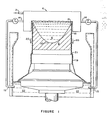
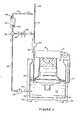
- FIG. 1 a schematic apparatus is illustrated for the purpose of describing the present invention as applied to castina an aluminum alloy containing lithium.Molten metal at about 715°C. (1320°F.) is passed in line 2 through direct chill casting device 4 to interior 6 of ingot 8.
- Interior 6 includes a molten pool having solidus line 10 which forms initially as arsolid shell 12 at a solidus temperature, e.g., on the order of about 593°C. (1100°F.).
- Coolant at a temperature substantially below 593°C. (1100°F.) is passed in line 14 to casting device 4 which is adapted to place the coolant in thermal contact, such as including but not limited to heat transfer through a mold surface (not shown), such that molten metal 6 is continuously cast as shell 12.
- Starting block 19 initially is placed directly under or inside casting device 4 to form a base 21 of ingot 8.
- Starting block 19 then is withdrawn to a position under the casting device (as shown) thereby permitting the continuous casting process.
- Shell 12 grows in thickness while ingot 8 is cooled by direct chill.
- Figure 1 illustrates a vertical continuous or semicontinuous casting process using the direct chill principle.
- the process and coolant of the present invention and the product- formed thereby also can be employed in a horizontal continuous casting process or in other directional flows of a direct chill process.
- Detailed descriptions of various embodiments intended to be included in the present process are found in U.S. 2,301,027; U.S. 3,286,309; U.S. 3,327,768; U.S. 3,329,200; U.S. 3,381,741; U.S. 3,441,079; U.S. 3,455,3.69; U.S. 3;506,059; and U.S. 4,166,495.
- coolant at a temperature by way of example, of about 49°C. (120° F .) is applied at 18 to the surface of shell 12 of the continuously forming ingot.
- Higher coolant temperatures are operable up to limits imposed by reason of reduced heat transfer and, in the case of lithium-containing alloys, by reason of higher fire hazard attributable to higher vapor pressure in the coolant.
- a coolant composition comprising ethylene glycol is operable at a temperature of about 82°C. (180°F.) or higher, but a lowar temperature, below about 54°C. (1.30°F.) such as at about 49°C. (120°F.), is preferred for safety considerations.
- Vapor pressure is increased significantly from 49°C.to 82°C. (120°F. to 180°F.) with an accompanying increase in fire hazard. Coolant temperature similarly should be held below a substantial fire hazard temperature for other coolant compositions.
- Coolant flows down the solid surface of the ingot as indicated by directional arrow 20 and cools ingot 8 by direct contact or direct chill.
- the coolant increases in temperature as it flows down the solid ingot surface.
- Warmed coolant separates from the ingot by falling into the casting pit where it collects as a.pool or reservoir 22.
- Coolant is recirculated in line 15 from reservoir 22 to join line 14.
- An oil separator (not shownl can be added to separate oil, e.g., mold lubricant oil, from coolant entering line 15.
- a mold lubricant such as castor oil.is applied to the casting surface of the mold to reduce the friction between the thin moving ingot shell and the mold, e.g., as illustrated by shell 12 in Figure 1. Otherwise, the continuously forming ingot may tear on the mold surface. Such tears should be avoided since the tears facilitate bleed-outs of molten metal in direct contact with coolant.
- warmed coolant collects in the casting pit in pool or reservoir 22.
- a preferred depth of coolant reservoir 22 is about 1.5 m (five feet).
- the warmed coolant can be cooled by a heat exchange with a secondary coolant.
- Warmed primary coolant from reservoir 22 is passed in line 23 and is elevated by pump 24 through line 25 to heat exchanger 26 where it is cooled as by indirect heat exchange with a secondary coolant such as water entering the heat exchanger at 28 and exiting in line 30. Cooled primary coolant is recirculated through lines 27 and 31 to reservoir 22 for further use in the continuous casting process.
- Certain preferred casting coolants e.g., ethylene glycol
- ethylene glycol are hygroscopic, and moisture will accumulate in the coolant, e.g., even when exposed to normal atmospheric conditions.
- the moisture content of the coolant should be controlled to maintain a preferred level, such as within a predetermined range of water content in the coolant.
- Certain hygroscopic casting coolants e.g., ethylene glycol
- a barrier layer 34 of castor oil or other immiscible lubricant can be provided on the coolant in the reservoir, e.g., by floating. Barrier layer 34 acts as substantially impermeable barrier to moisture absorption by the ethylene glycol.
- Controlling moisture content includes monitoring the moisture such as by determining the refractive index using a commercially available refractometer. For example, recirculated coolant in line 27 or initial or make-up coolant in line 29 is passed in line 31 to refractometer 32 prior to being fed in line 33 to reservoir 22 in the casting pit.
- the coolant can be dried by many different drying techniques.
- One example of a suitable drying technique includes sparging with a dry sparging fluid such as air or any inert, i.e., nonreacting, dry gas.
- sparging is combined with heating, e.g., by actuating diverter valve 35, and passing the coolant in line 36 through heater 38, such as an electric heater, to raise coolant temperature.
- heater 38 such as an electric heater
- dry air with a low dew point e.g., preferably of about -20° C or below
- spargers 42 capable of introducing a fluid such as dry air into the coolant.
- the sparger as illustrated in Figure 2 is located in the casting pit. This location provides sparging to more coolant than when locating the sparging reservoir separate from the casting pit (not shown).
- a sparging reservoir separate from the casting pit facilitates a continuous sparging step while casting. In such a continuous sparging system, warmed coolant may be heated further, sparged, and then cooled prior to introduction into the casting device while direct chill casting continues.
- Aluminum-lithium alloy having a lithium content on the order of about 1.2% by weight lithium (Aluminum Association Alloy 2020) conventionally has been cast in a continuous ingot by direct chill with water, i.e., substantially 100% water.
- molten aluminum-lithium alloys containing even slightly higher amounts of lithium, such as about 1.5% to 2% or higher by weight lithium can react with a violent reaction or explosion when brought into direct contact with water as may occur with a bleed-out during a continuous direct chill casting process.
- the process of the present invention avoids such a violent reaction and cools the ingot in the direct chill step with organic coolant.
- Water can be used as the shell forming coolant, if the water is held separate and apart from the molten metal forming into the shell and further if it is not subsequently used to cool the lithium-containing alloy by direct chill.
- water can be used as a mold coolant separated from contact with the molten lithium-containing alloy.
- the moisture or water content in the organic coolant must be held below a predetermined maximum level to avoid explosive reaction when direct chill casting lithium-containing alloys.
- Explosion tests were performed by pouring about 23 kg molten metal at about 760°C. (1400°F.) into about 14 liters of coolant in a Tarset-coated steel pan.
- Tested coolants included water, "Gulf Superquench 70" (TM) which is a hydrocarbon quench liquid for cooling steel, a phosphate ester selected for high flame resistance, mineral oil, and ethylene glycol at various moisture contents. It was found that ethylene glycol containing water in an amount of substantially more than about 25% by volume in contact with molten aluminum-lithium alloy containing about 2 or more weight percent lithium results in explosion. Explosions did not occur from aluminum-lithium alloy containing 2 to 3 weight percent lithium in contact with ethylene glycol containing less than about 25% water by volume.
- the predetermined maximum moisture content should be held less than an explosive reaction-forming amount of water, e.g., usually less than about 25 volume percent water, preferably less than about 10% water by volume, and more preferably less than about 5% water by volume in ethylene glycol.
- an explosive reaction-forming amount of water e.g., usually less than about 25 volume percent water, preferably less than about 10% water by volume, and more preferably less than about 5% water by volume in ethylene glycol.
- the explosion limit is somewhat variable over a range of moisture content, including in the range above about 10% to about 25% by volume water, by other factors such as metal temperature, coolant temperature, weight percent lithium in the alloy, molten metal volume, and other explosion-related characteristics. For this reason, it is important to observe and maintain the moisture or water content in the coolant below an explosive reaction-forming amount, i.e., such as an amount which will result in an explosion.
- Aluminum-lithium alloy was found to be an ignition source for flammable coolants. In the explosion tests, all of the tested coolants burned when molten aluminum-lithium alloy metal was dropped into the coolant, with the exception of water which produced violent explosion. However, ethylene glycol did not exhibit malodorous characteristics and was found to be self-extinguishing when the heat Source was removed. Such features are important safety considerations in the event of a metal spill in a direct chill casting operation.
- Gulf Superquench 70 coolant ignited and burned in a self-sustaining manner with a dense black smoke.
- Ethylene glycol ignited when mixed with molten aluminum-lithium alloy, but ethylene glycol did not sustain combustion, i.e., the flames extinguished when the heat source was taken away.
- the phosphate ester in the explosion test had a noxious odor.
- the organic coolant should be capable of providing a direct chill comprising an initially rapid quench for shell formation such as by a high nucleate boiling-heat-transfer mechanism and by a subsequent lower convective heat transfer for stress relief.
- the initial rapid quench provides a shell of sufficient thickness to avoid bleed-outs.
- Such controlled cooling reduces ingot cracking and provides an advantage in the quality of the ingot produced.
- Ethylene glycol provides such a controlled cooling, resulting in high quality ingot product for high strength alloys including high strength, light metal alloys of aluminum or magnesium and others. Examples of high strength, light metal alloys which may take advantage of this feature of the present invention are aluminum alloys of 7075, 7050, or 2024, aluminum-lithium alloys and magnesium-lithium alloys.
- modified hydrocarbon fluids can be selected for the organic coolant in a process of the present invention.
- modified hydrocarbon fluids include glycols such as ethylene glycol, propylene glycol, bipropylene glycol, triethylene glycol, hexylene glycol, and others, or other modified hydrocarbons such as phosphate ester, mineral oil, and others.
- glycols such as ethylene glycol, propylene glycol, bipropylene glycol, triethylene glycol, hexylene glycol, and others
- modified hydrocarbons such as phosphate ester, mineral oil, and others.
- bipropylene glycol provides low hygroscopicity, high boiling point, and high viscosity.
- Triethylene glycol provides a high boiling point and high viscosity.
- Ethylene glycol has been found to provide advantages of superior quenching rate, particularly in the shell formation temperature range of continuously cast ingots of aluminum-lithium alloys.
- Ethylene glycol also provides a controlled quenching rate in a convective heat transfer zone which reduces the residual stresses generated in the solidified ingot, thereby minimizing any cracking in crack-sensitive aluminum-lithium alloys.
- This controlled quenching rate also provides an advantage to a continuous casting process for other crack-sensitive aluminum alloys in addition to aluminum-lithium alloys, e.g., such as 7075, 7050, and 2024.
- the aluminum alloy missile was heated to 593°C. (1100°F.) and then was dropped into 900 ml of coolant. Missile temperature was recorded on magnetic tape in a computer. Missile temperature and quench (heat flux) curves were plotted with a"Calcomp 565"'(TM) plotter.
- Various coolants were tested, including "Gulf Superquench 70" (TM), a hydrocarbon quench for steel cooling; a phosphate ester selected for high flame resistance; ethylene glycol; propylene glycol; mineral oil; and water.
- Figure 3 presents a graph depicting missile temperature as a function of time while the missile was quenched by each of the various fluid coolants. Ethylene glycol provided a more rapid quench rate as shown by the lower missile temperatures over less time than the other organic coolants tested.
- Figure 4 presents a graphical illustration of a quench curve of each coolant showing heat transfer rate versus temperature. It was found that ethylene glycol provided superior quench rates, particularly in the range of about 482 to 260°C. (900 to 500°F.) which is the critical range for thick shell formation during the continuous casting of lithium-containing light metal alloys such as aluminum-lithium alloys.. In this range, ethylene glycol was found to have a quench capability 10-12 times that of propylene glycol. The superior quenching by ethylene glycol appears to be attributable to a nucleate boiling-heat-transfer mechanism in the particular temperature range of about 482 to 260°C. (900 to 500°F.). "Gulf Superquench 70" (TM) exhibited a wide film boiling-heat-transfer temperature range which produces an unstable, low heat transfer. The phosphate ester had a narrow boiling-heat-transfer temperature range.
- the average quench capability of ethylene glycol over the-range.of about 593 to 2600°C. (1100°F. to 500°F.) is preferred over that of the other potential coolants.
- This range encompasses the critical temperature range for forming a strong shell during the continuous casting process for forming aluminum-lithium alloy ingot.
- propylene glycol coolant In direct chill casting aluminum-lithium alloy, propylene glycol coolant generates heat transfer rates in the shell formation temperature range as shown in Figure 4 which are undesirably slower than ethylene glycol.
- the slower propylene glycol rates are attributable to film boiling heat transfer, and such low rates create large dendrite arm spacing.
- Ethylene glycol provides heat transfer rates as shown in Figure 4 which create significantly smaller dendrites similar to those generated in an ingot cast with water.
- the slower propylene glycol heat transfer rates produce a coarse structure which cannot be eliminated during thermal processing, e.g., macrosegregation, in which the aluminum cools and solidifies in the center of the dendrite while the alloying material is rejected and pushed out to the surface of the dendrite while the metal is solidifying.
- Thermal treatments or homogenization as can be performed on microsegregation, cannot dependably cure such a macrosegregation problem.
- the low propylene glycol heat transfer rates shown in Figures 3 and 4 can be modified by higher coolant flow rates on the ingot to break the film boiling-heat-transfer mechanism.
- the coolant of the present invention in one aspect preferably contains a predetermined minimum level of water content.
- the coolant--for casting aluminum-lithium alloy e.g., ethylene glycol
- the minimum water content generally provides increased heat transfer rates.
- Such an addition of water also lowers viscosity in many cases such as with ethylene glycol.
- Lower viscosity and higher heat transfer rates provide more rapid cooling below the shell formation temperatures, and this should be. avoided when casting crack-sensitive alloys.
- a glycol would have been a suitable coolant for the continuous casting of lithium-containing alloy.
- Lithium is known to react with chemicals containing hydroxyl groups. It has been observed,-however, that the use of ethylene glycol as a direct chill coolant for the continuous direct chill casting of aluminum-lithium alloy produces only a thin black surface on the ingot, which can be readily removed by washing or scalping. The ethylene glycol is not substantially affected and can be recirculated for further use in the process. Ethylene glycol vapor also is less toxic than other potential coolants.
Landscapes
- Chemical & Material Sciences (AREA)
- Engineering & Computer Science (AREA)
- Mechanical Engineering (AREA)
- Physics & Mathematics (AREA)
- Thermal Sciences (AREA)
- Crystallography & Structural Chemistry (AREA)
- Materials Engineering (AREA)
- Metallurgy (AREA)
- Organic Chemistry (AREA)
- Continuous Casting (AREA)
Applications Claiming Priority (3)
| Application Number | Priority Date | Filing Date | Title |
|---|---|---|---|
| US550466 | 1983-11-10 | ||
| US06/550,466 US4610295A (en) | 1983-11-10 | 1983-11-10 | Direct chill casting of aluminum-lithium alloys |
| EP86100510A EP0229211A1 (de) | 1984-10-09 | 1986-01-16 | Stranggussverfahren bei dem Flammbildung unterdrückt wird |
Publications (2)
| Publication Number | Publication Date |
|---|---|
| EP0142341A1 true EP0142341A1 (de) | 1985-05-22 |
| EP0142341B1 EP0142341B1 (de) | 1988-07-13 |
Family
ID=26101605
Family Applications (1)
| Application Number | Title | Priority Date | Filing Date |
|---|---|---|---|
| EP19840307741 Expired EP0142341B1 (de) | 1983-11-10 | 1984-11-09 | Strangguss |
Country Status (1)
| Country | Link |
|---|---|
| EP (1) | EP0142341B1 (de) |
Cited By (8)
| Publication number | Priority date | Publication date | Assignee | Title |
|---|---|---|---|---|
| EP0229211A1 (de) * | 1984-10-09 | 1987-07-22 | Aluminum Company Of America | Stranggussverfahren bei dem Flammbildung unterdrückt wird |
| EP0337769A3 (en) * | 1988-04-15 | 1990-12-27 | Norsk Hydro A.S. | Continuous or semi-continuous casting apparatus for casting metallic materials |
| EP0707081A1 (de) * | 1994-10-14 | 1996-04-17 | Fmc Corporation | Verfahren zum Abschrecken von Metallen |
| CN102325611A (zh) * | 2009-02-20 | 2012-01-18 | 法国肯联铝业 | 铝合金的铸造方法 |
| US8365808B1 (en) | 2012-05-17 | 2013-02-05 | Almex USA, Inc. | Process and apparatus for minimizing the potential for explosions in the direct chill casting of aluminum lithium alloys |
| US8479802B1 (en) | 2012-05-17 | 2013-07-09 | Almex USA, Inc. | Apparatus for casting aluminum lithium alloys |
| US9616493B2 (en) | 2013-02-04 | 2017-04-11 | Almex USA, Inc. | Process and apparatus for minimizing the potential for explosions in the direct chill casting of aluminum lithium alloys |
| US9936541B2 (en) | 2013-11-23 | 2018-04-03 | Almex USA, Inc. | Alloy melting and holding furnace |
Citations (4)
| Publication number | Priority date | Publication date | Assignee | Title |
|---|---|---|---|---|
| DE891725C (de) * | 1941-09-27 | 1953-10-01 | Wieland Werke Ag | Verfahren zum stetigen Giessen metallischer Werkstoffe |
| FR2477923A1 (fr) * | 1980-03-11 | 1981-09-18 | Compiegne Universite Technolog | Procede de refroidissement par pulverisation d'eau en coulee continue ou dans des domaines techniques voisins |
| DE3146684C1 (de) * | 1981-11-25 | 1982-11-04 | Schweizerische Aluminium AG, 3965 Chippis | Verfahren zum Kühlen eines Gußstranges während des Stranggießens |
| DE3146683C1 (de) * | 1981-11-25 | 1982-11-04 | Schweizerische Aluminium AG, 3965 Chippis | Verfahren zum Kühlen eines Gußstranges während des Stranggießens |
-
1984
- 1984-11-09 EP EP19840307741 patent/EP0142341B1/de not_active Expired
Patent Citations (4)
| Publication number | Priority date | Publication date | Assignee | Title |
|---|---|---|---|---|
| DE891725C (de) * | 1941-09-27 | 1953-10-01 | Wieland Werke Ag | Verfahren zum stetigen Giessen metallischer Werkstoffe |
| FR2477923A1 (fr) * | 1980-03-11 | 1981-09-18 | Compiegne Universite Technolog | Procede de refroidissement par pulverisation d'eau en coulee continue ou dans des domaines techniques voisins |
| DE3146684C1 (de) * | 1981-11-25 | 1982-11-04 | Schweizerische Aluminium AG, 3965 Chippis | Verfahren zum Kühlen eines Gußstranges während des Stranggießens |
| DE3146683C1 (de) * | 1981-11-25 | 1982-11-04 | Schweizerische Aluminium AG, 3965 Chippis | Verfahren zum Kühlen eines Gußstranges während des Stranggießens |
Cited By (17)
| Publication number | Priority date | Publication date | Assignee | Title |
|---|---|---|---|---|
| EP0229211A1 (de) * | 1984-10-09 | 1987-07-22 | Aluminum Company Of America | Stranggussverfahren bei dem Flammbildung unterdrückt wird |
| EP0337769A3 (en) * | 1988-04-15 | 1990-12-27 | Norsk Hydro A.S. | Continuous or semi-continuous casting apparatus for casting metallic materials |
| EP0707081A1 (de) * | 1994-10-14 | 1996-04-17 | Fmc Corporation | Verfahren zum Abschrecken von Metallen |
| CN102325611A (zh) * | 2009-02-20 | 2012-01-18 | 法国肯联铝业 | 铝合金的铸造方法 |
| CN102325611B (zh) * | 2009-02-20 | 2013-09-04 | 法国肯联铝业 | 铝合金的铸造方法 |
| US10646919B2 (en) | 2012-05-17 | 2020-05-12 | Almex USA, Inc. | Process and apparatus for direct chill casting |
| US8365808B1 (en) | 2012-05-17 | 2013-02-05 | Almex USA, Inc. | Process and apparatus for minimizing the potential for explosions in the direct chill casting of aluminum lithium alloys |
| US8479802B1 (en) | 2012-05-17 | 2013-07-09 | Almex USA, Inc. | Apparatus for casting aluminum lithium alloys |
| US10946440B2 (en) | 2012-05-17 | 2021-03-16 | Almex USA, Inc. | Process and apparatus for minimizing the potential for explosions in the direct chill casting aluminum alloys |
| US9849507B2 (en) | 2012-05-17 | 2017-12-26 | Almex USA, Inc. | Process and apparatus for minimizing the potential for explosions in the direct chill casting of aluminum lithium alloys |
| US9895744B2 (en) | 2012-05-17 | 2018-02-20 | Almex USA, Inc. | Process and apparatus for direct chill casting |
| US9764380B2 (en) | 2013-02-04 | 2017-09-19 | Almex USA, Inc. | Process and apparatus for direct chill casting |
| US9950360B2 (en) | 2013-02-04 | 2018-04-24 | Almex USA, Inc. | Process and apparatus for minimizing the potential for explosions in the direct chill casting of lithium alloys |
| US10864576B2 (en) | 2013-02-04 | 2020-12-15 | Almex USA, Inc. | Process and apparatus for minimizing the potential for explosions in the direct chill casting of lithium alloys |
| US9616493B2 (en) | 2013-02-04 | 2017-04-11 | Almex USA, Inc. | Process and apparatus for minimizing the potential for explosions in the direct chill casting of aluminum lithium alloys |
| US9936541B2 (en) | 2013-11-23 | 2018-04-03 | Almex USA, Inc. | Alloy melting and holding furnace |
| US10932333B2 (en) | 2013-11-23 | 2021-02-23 | Almex USA, Inc. | Alloy melting and holding furnace |
Also Published As
| Publication number | Publication date |
|---|---|
| EP0142341B1 (de) | 1988-07-13 |
Similar Documents
| Publication | Publication Date | Title |
|---|---|---|
| US4882831A (en) | Method of producing aircraft plate and sheet | |
| US4610295A (en) | Direct chill casting of aluminum-lithium alloys | |
| US4709740A (en) | Direct chill casting of aluminum-lithium alloys | |
| US4724887A (en) | Direct chill casting of lithium-containing alloys | |
| US10864576B2 (en) | Process and apparatus for minimizing the potential for explosions in the direct chill casting of lithium alloys | |
| US20050236135A1 (en) | Twin roll casting of magnesium and magnesium alloys | |
| EP0142341B1 (de) | Strangguss | |
| EP2878399B1 (de) | Verfahren und vorrichtung zur minimierung des explosionspotentials beim giessen von aluminium-litium-legierungen mit direkter kühlung | |
| US4593745A (en) | Fire retardant continuous casting process | |
| EP0229211A1 (de) | Stranggussverfahren bei dem Flammbildung unterdrückt wird | |
| US4607679A (en) | Providing oligomer moisture barrier in direct chill casting of aluminum-lithium alloy | |
| EP2664398B1 (de) | Vorrichtung zum Gießen von Aluminium-Lithium-Legierungen | |
| Page et al. | The safety of molten aluminum-lithium alloys in the presence of coolants | |
| Sommerhofer et al. | A New Continuous Casting Process | |
| Yu | A process to reduce DC ingot butt curl and swell | |
| Rooy | Aluminum alloy ingot casting and continuous processes | |
| Page et al. | The safety of molten aluminium-lithium alloys in the presence of coolants | |
| POTTORE | The evolution of microstructure during the solidification and subsequent cooling of low alloy steels | |
| Butnariu et al. | STUDIES AND RESEARCHES ON QUALITY IMPROVEMENT OF CONTINUOUSLY CAST BILLETS UNALLOYED AND LOW ALLOYED STEELS | |
| Weinberg | Continuous casting | |
| Beeley | Alloy composition in relation to casting | |
| Wang | Mould taper for high speed continuous casting of stainless steel billets | |
| MILTON | to be able to withstand the slightest bending. In two such |
Legal Events
| Date | Code | Title | Description |
|---|---|---|---|
| PUAI | Public reference made under article 153(3) epc to a published international application that has entered the european phase |
Free format text: ORIGINAL CODE: 0009012 |
|
| AK | Designated contracting states |
Designated state(s): DE FR GB IT |
|
| 17P | Request for examination filed |
Effective date: 19850909 |
|
| 17Q | First examination report despatched |
Effective date: 19860919 |
|
| GRAA | (expected) grant |
Free format text: ORIGINAL CODE: 0009210 |
|
| AK | Designated contracting states |
Kind code of ref document: B1 Designated state(s): DE FR GB IT |
|
| ITF | It: translation for a ep patent filed | ||
| REF | Corresponds to: |
Ref document number: 3472638 Country of ref document: DE Date of ref document: 19880818 |
|
| ET | Fr: translation filed | ||
| PLBE | No opposition filed within time limit |
Free format text: ORIGINAL CODE: 0009261 |
|
| STAA | Information on the status of an ep patent application or granted ep patent |
Free format text: STATUS: NO OPPOSITION FILED WITHIN TIME LIMIT |
|
| 26N | No opposition filed | ||
| REG | Reference to a national code |
Ref country code: GB Ref legal event code: IF02 |
|
| PGFP | Annual fee paid to national office [announced via postgrant information from national office to epo] |
Ref country code: GB Payment date: 20031002 Year of fee payment: 20 |
|
| PGFP | Annual fee paid to national office [announced via postgrant information from national office to epo] |
Ref country code: FR Payment date: 20031105 Year of fee payment: 20 |
|
| PGFP | Annual fee paid to national office [announced via postgrant information from national office to epo] |
Ref country code: DE Payment date: 20031128 Year of fee payment: 20 |
|
| PG25 | Lapsed in a contracting state [announced via postgrant information from national office to epo] |
Ref country code: GB Free format text: LAPSE BECAUSE OF EXPIRATION OF PROTECTION Effective date: 20041108 |
|
| REG | Reference to a national code |
Ref country code: GB Ref legal event code: PE20 |