EP0142374B1 - Dispositif numérique pour ajouter une microstructure expressive à une partition musicale - Google Patents
Dispositif numérique pour ajouter une microstructure expressive à une partition musicale Download PDFInfo
- Publication number
- EP0142374B1 EP0142374B1 EP84307892A EP84307892A EP0142374B1 EP 0142374 B1 EP0142374 B1 EP 0142374B1 EP 84307892 A EP84307892 A EP 84307892A EP 84307892 A EP84307892 A EP 84307892A EP 0142374 B1 EP0142374 B1 EP 0142374B1
- Authority
- EP
- European Patent Office
- Prior art keywords
- tone
- amplitude
- tones
- calculating means
- duration
- Prior art date
- Legal status (The legal status is an assumption and is not a legal conclusion. Google has not performed a legal analysis and makes no representation as to the accuracy of the status listed.)
- Expired
Links
- 239000011159 matrix material Substances 0.000 claims description 15
- 230000033001 locomotion Effects 0.000 claims description 14
- 238000000034 method Methods 0.000 claims description 12
- 238000007493 shaping process Methods 0.000 claims description 10
- 238000013479 data entry Methods 0.000 claims description 8
- 230000008569 process Effects 0.000 claims description 8
- 238000012545 processing Methods 0.000 claims description 7
- 230000000007 visual effect Effects 0.000 claims description 6
- 239000011295 pitch Substances 0.000 claims 10
- 230000001419 dependent effect Effects 0.000 claims 3
- 239000003086 colorant Substances 0.000 claims 1
- 230000000694 effects Effects 0.000 description 9
- 230000014509 gene expression Effects 0.000 description 9
- 230000008451 emotion Effects 0.000 description 5
- 238000004364 calculation method Methods 0.000 description 4
- 238000006243 chemical reaction Methods 0.000 description 4
- 150000001875 compounds Chemical class 0.000 description 4
- 239000000203 mixture Substances 0.000 description 3
- 230000008859 change Effects 0.000 description 2
- 238000004590 computer program Methods 0.000 description 2
- 230000000881 depressing effect Effects 0.000 description 2
- 230000007935 neutral effect Effects 0.000 description 2
- 238000010422 painting Methods 0.000 description 2
- 230000002123 temporal effect Effects 0.000 description 2
- 208000019901 Anxiety disease Diseases 0.000 description 1
- 241000228740 Procrustes Species 0.000 description 1
- 206010037180 Psychiatric symptoms Diseases 0.000 description 1
- 230000001944 accentuation Effects 0.000 description 1
- 239000000654 additive Substances 0.000 description 1
- 230000000996 additive effect Effects 0.000 description 1
- 230000036506 anxiety Effects 0.000 description 1
- 238000013459 approach Methods 0.000 description 1
- 230000002238 attenuated effect Effects 0.000 description 1
- 230000003796 beauty Effects 0.000 description 1
- 230000006399 behavior Effects 0.000 description 1
- 210000004556 brain Anatomy 0.000 description 1
- 230000002301 combined effect Effects 0.000 description 1
- 239000004020 conductor Substances 0.000 description 1
- 238000010586 diagram Methods 0.000 description 1
- 230000003467 diminishing effect Effects 0.000 description 1
- 230000002996 emotional effect Effects 0.000 description 1
- 238000002474 experimental method Methods 0.000 description 1
- 230000008921 facial expression Effects 0.000 description 1
- 239000012467 final product Substances 0.000 description 1
- 239000000796 flavoring agent Substances 0.000 description 1
- 235000019634 flavors Nutrition 0.000 description 1
- 230000000977 initiatory effect Effects 0.000 description 1
- 230000010354 integration Effects 0.000 description 1
- 230000003993 interaction Effects 0.000 description 1
- 235000020130 leben Nutrition 0.000 description 1
- 239000003550 marker Substances 0.000 description 1
- 238000012986 modification Methods 0.000 description 1
- 230000004048 modification Effects 0.000 description 1
- 230000004044 response Effects 0.000 description 1
- 230000033764 rhythmic process Effects 0.000 description 1
- 230000001020 rhythmical effect Effects 0.000 description 1
- 230000000630 rising effect Effects 0.000 description 1
- 238000000926 separation method Methods 0.000 description 1
- 239000013589 supplement Substances 0.000 description 1
- 239000000725 suspension Substances 0.000 description 1
- 230000002459 sustained effect Effects 0.000 description 1
- 230000009897 systematic effect Effects 0.000 description 1
- 230000001052 transient effect Effects 0.000 description 1
Images


Classifications
-
- G—PHYSICS
- G10—MUSICAL INSTRUMENTS; ACOUSTICS
- G10H—ELECTROPHONIC MUSICAL INSTRUMENTS; INSTRUMENTS IN WHICH THE TONES ARE GENERATED BY ELECTROMECHANICAL MEANS OR ELECTRONIC GENERATORS, OR IN WHICH THE TONES ARE SYNTHESISED FROM A DATA STORE
- G10H5/00—Instruments in which the tones are generated by means of electronic generators
- G10H5/002—Instruments using voltage controlled oscillators and amplifiers or voltage controlled oscillators and filters, e.g. Synthesisers
-
- G—PHYSICS
- G10—MUSICAL INSTRUMENTS; ACOUSTICS
- G10H—ELECTROPHONIC MUSICAL INSTRUMENTS; INSTRUMENTS IN WHICH THE TONES ARE GENERATED BY ELECTROMECHANICAL MEANS OR ELECTRONIC GENERATORS, OR IN WHICH THE TONES ARE SYNTHESISED FROM A DATA STORE
- G10H1/00—Details of electrophonic musical instruments
- G10H1/02—Means for controlling the tone frequencies, e.g. attack or decay; Means for producing special musical effects, e.g. vibratos or glissandos
Definitions
- This invention relates generally to a technique for manipulating the nominal notational values of a musical score with respect to the amplitude contour of individual tones, the relative loudness of different tones, slight changes in tone duration and other deviations from the nominal values which together constitute the expressive microstructure or music. More particularly, the invention deals with a computerized system capable of manual or automatic operation for impressing an expressive microstructure on a musical score inputted therein in terms of nominal notational values, the system being usable for composing music that includes microstructure.
- the macrostructure of a musical composition is defined in the score by standard notation. If, therefore, one executes this score by being assiduously faithful to its macrostructure, the resultant performance, however expertly executed, will be bereft of vitality and expression.
- the term "microstructure” as used herein encompasses all subtle deviations from the nominal values of the macrostructure in terms of amplitude shaping, timing, timbre, vibrato and all other factors which impart expressiveness to music. The relationships which constitute the microstructure in music, though not explicit in the score, are vital to its appreciation.
- a essentic forms that is, the dynamic expressive forms of specific emotions
- B the inner pulse of composers
- the inner pulse of specific composers such as Beethoven, Mozart and Schubert, are expressed by sentographic forms obtained by having a sensitive musician think the music of a selected composer in his mind and by concurrently expressing the pulse by "conducting the music on a sentograph with finger pressure".
- the resultant sentograms indicate that major composers, such as those previously identified, impart individual pulse forms to their music which characterize their creativity identity or personal idiom.
- This inner pulse characteristic of each composer is, to a degree, analogous to individualistic brush strokes which distinguish one painter from another, regardless of the subject matter of their paintings. (See M. Clynes, "Sentics, The Touch of Emotions" - published by Doubleday - 1977.)
- US-A-4 178 822 discloses electronic apparatus for producing music in which the characteristics of the notes are produced by digital circuitry.
- the apparatus comprises a keyboard, a key switch and volume number generator assembly, a waveshape number generator, an attack-delay envelope number generator, conversion circuits, and an output system.
- the apparatus basically divides the characteristics of each note into two parts, a volume component and a waveshape-frequency characteristic.
- the amplitude characteristic is divided into a volume component and an attack or decay envelope component.
- the waveshape number generator generates numbers representing the waveshape-frequency characteristic
- the key switch and volume number generator assembly generates numbers representing the volume component of the note amplitude
- the envelope number generator generates numbers representing the envelope component of the note amplitude.
- a circuit produces time-spaced volume numbers representing the average volume of the note.
- the performer can change the volume number by depressing the key to a greater or lesser extent and can generate a time-spaced series of digital volume numbers representing the volume component of the note amplitude.
- a frequency synthesizer receives a separate key signal from the key switches operated by each of the keys and produces a different series of output pulses for each different note on the keyboard.
- the volume numbers associated with each key are transmitted to a read control assigner.
- the read control assigner recognizes the presence of volume number signals on one of the volume number lines from the volume number generators and connects that line to a conversion circuit which is not in use.
- the attack-delay envelope generator is responsible for generating a time-spaced series of digital envelope numbers representing the attack or decay envelope component of the amplitude of a note at discrete instants in time.
- Each of the conversion circuits is used to produce a tone signal corresponding to a single note indicated by the depression of a single key on the keyboard.
- An exemplary conversion circuit includes digital latches and multiplying D-to-A converters.
- a first D-to-A converter multiplies the value of a DC reference signal by the digital volume numbers present on a data line in order to produce an analog volume signal.
- the volume signal is transmitted as the analog input to a second converter which multiplies the volume signal by the value of the envelope numbers transmitted over a data line to produce an analog amplitude signal having an amplitude which represents the combined volume and envelope characteristics of the desired tone signal.
- a third converter multiplies the value of the amplitude signal by the wave numbers transmitted over a data line in order to produce an analog tone signal which corresponds to the volume, envelope, waveshape and fundamental frequency characteristics represented by particular volume, envelope, and waveshape numbers.
- Tone signals are transmitted to a conventional audio mixer and the mixed tone signals are amplified by a conventional audio amplifier and converted into audible sound by a conventional loudspeaker transducer.
- the main object of this invention is to provide a computerized system for processing the nominal values of a musical score to impart an expressive microstructure thereto.
- the present invention provides a computerized system for processing a musical score whose notation provides the nominal value for each tone in regard to its pitch and duration, the system comprising:
- the invention also provides a computerized system for processing a musical score whose notation provides the nominal value for each tone in regard to its pitch and duration, the system comprising:
- Such systems are operable in an automatic mode wherein microstructure values are calculated from a shaping function responsive to the melodic contour and by means of pulse matrices having certain values relating to the amplitude and duration of pulse component tones stored in the system.
- a computerized system into which is fed the nominal values of a musical score, the system acting to process these values with respect to the amplitude contour of individual tones, the relative loudness of different tones in a succession thereof, changes in the duration of the tones and other deviations from the nominal values which together constitute the microstructure of the music notated by the score.
- the system performs the specified tones in the score as modified by the microstructure, thereby imparting expressivity to the music that is lacking in the absence of the microstructure.
- the microstructure may include changes in pitch or vibrato, individually shaped for each tone.
- Amplitude modulation appears to be a basic mode of dynamic expression and the understanding of this should precede the analysis of the expressive effects of vibrato, timbre and of timbre variation. It has been found that a significant degree of expressiveness is indeed possible with these very simple means, and that many of the subtlest nuances can be realized.
- Beta Function is defined as: and is normalized for a maximum amplitude of 1 by dividing by a constant. for a particular set or values or p1 and p2. p1, p2 have values ⁇ 0.
- the resulting shape is multiplied by a parameter G to give the amplitude size of the particular tone.
- the shape stretches over a number of points determined by the duration of the tone.
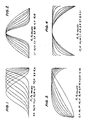
- a shape may be selected from families of shapes such as the ones shown in Figs. 1 to 6. Choosing the value 1 for both parameters gives rise to a symmetical, rounded form, and 0.89 for both parameters produces a form very close to a sine half wave. Smaller values of p1 result in steeper rises; zero being a step function. Larger values than 1 for either p1 or p2 make the curve concave, at the corresponding regions. A combination of zero and 1 results in a sawtooth.
- Beta Functions may be added to produce the desired shape--this is seldom necessary, however.
- Figs. 1 to 4 illustrate different families of Beta Function shapes, showing some of the kinds of shapes readily obtained by choosing appropriate p1 and p2 values.
- pairs of p1, p2 values are given starting from the leftmost curve.
- Maximum amplitude is normalized as 1.
- Figs. 5 and 6 are Beta Function shapes illustrating degrees of skewness, starting from a symmetrical (1, 1) form, with pairs of p values forming a series as shown. These are types of shapes used for the amplitude of many musical tones (called A [left group] and P [right group] types).
- the Beta Function is used in a computer program that calculates individual tone shapes.
- the amplitude character of a tone is specified by three numbers, respectively denoting the amplitude magnitude G, and parameters p1 and p2.
- each tone is specified by the number of points it occupies over which the Beta Function is calculated. The calculation for each tone is done without affecting the duration and number of points of other tones.
- the temporal resolution of tones is usually better than 1 millisecond.
- the amplitude contour may be constituted by a 12 bit DA Converter and modulates a voltage-controlled amplifier (VCA) of linearity better than 0.1% over a dynamic range of 1 to 4096.
- VCA voltage-controlled amplifier
- the frequency of the tones is set by another channel or a DA Converter which modulates a voltage-controlled oscillator (VCO).
- the invention may be realized with D to A Converters having 8 to 16 bits.
- One may also use a digitally-controlled VCA and VCO which can, in effect, be integrated within a digital synthesizer, in which event there is no need for a D to A Converter to operate the VCA and VCO.
- the FORTRAN IV program was run on a PDP 11-23 computer.
- the tempo can be varied over a very wide range. Parameters of any tone can be readily varied and the changed result listened to in a few seconds, typically 2 - 10 seconds. Any desired portion of the music can be listened to.
- the maximum length of the piece to be played is only limited by the length of the microscore that can be stored on the disc. In practice, many tens of thousands of tones can be stored.
- the method of sculpturing tones and melodies allows a musical artist, or music lover who cannot play a conventional instrument, to perfect the expression in much the same manner as a painter or a sculptor can, working with a painting for long periods of time, gradually perfecting the forms so that they correspond to his inner vision, a vision which itself becomes more perfect as the interaction grows. At what stage to say "it is enough" depends on a higher level of integration where another vision and its realization interact in a like manner.
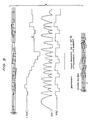
- the stave on top shows the notes of the melody.
- Graph 2 is the amplitude contour (in linear scale from 0 to 4096, the 200 point being thus equivalent to -26 dB referred to as the loudest level; 1000 being played at about 50 dB above threshold normally).
- Graph 3 represents the temporal deviations from the nominal values for each tone, in percent, upward deflection being slower. (Micropauses are often included in the representation.) The time marker at the bottom of all figures represents 1 second.
- the digital printout prints only every sixth point of the fucntions--actual resolution is thus six times greater than that shown in the illustration.
- Beta Functions are used to span only part of the duraction of the tone, as may occur for staccato tones, the sound duration of staccato tones is given in parenthesis next to the total tone duration. Micropauses are indicated as “P”, Rests as “R”. When more than one Beta Function is used for a tone amplitude, they are listed in vertical sequence for that tone. Metronome mark for the nominal unit used (often a subdivision of a quarter note) is also given.
- the chosen unit of time in the melody (in this case, an eighth note) is assigned 100 points duration nominally, so that a quarter note becomes 200 points nominally, a half note 400 points, and so forth.
- the actual duration of each tone is modified from these so that a particular eighth tone may have a duration of 96, say, a halt tone 220; and so on, depending on its position and expressive requirements.
- the program allows us to play any portion or the entire theme, and will repeat as many times as desired (with a short pause between repetitions).
- the metronome mark entered i.e. 230 refers to the nominal chosen unit of duration (in the present example, 100 points for an eighth note). If an actual tone has more or fewer number of points than 100, it will have a correspondingly different duration. Minute tempo variations within the theme arise from the differences from nominal values in the number of points for each of the tones. In this example, we may note the following:
- the amplitude relationship between the four eighth notes of the first bar shows that the second and fourth tones are much smaller, the fourth one being a little less than the second.
- the third tone is considerbly larger in amplitude than the second and fourth but less than the first.
- a similar pattern is repeated in the third bar, but the accentuation of the first tone is even greater.
- the first tone of each bar is considerably larger in amplitude.
- the peak amplitudes form a descending curve from bar 3 to bar 4.
- the form of this descending curve combines with the frequency contour to produce an essentic form related to grief (this form may well be considered to be a mixed emotion: predominantly sad, with aspects of loneliness, anxiety, and perhaps regret).
- Bars 1 and 2 provide similar forms of diminishing amplitude, but in bar 1 combined with rising frequency. Pain and sadness are implicit in bar 2. Bar 1 suggests a resigned view, accepting fate, without the quality of hope; "this is how it is; there is nothing that can be done about it". The combined effect is a combination of grief with a stoical, strong acceptance of what is; without defiance or fever.
- each individual tone are governed by their place in the melodic context.
- the shorter tones may seem similar in shape on the graph, but in tact they are varied, as can be seen from the p values in Table 3. (Small changes in the p values noticeably affect the quality of the sound.)
- the shape of the termination of the tone is as important as its rise, for appropriate expression.
- the termination phase of the tone relates to the degree of legato that is achieved. Smaller p values result in greater legato. It is not generally necessary to include a DC component to maintain a legato between successive tones. The momentary drop in amplitude between tones shaped by the Beta Function is not perceived by the ear if it is quite short, as is the case for appropriately low p values.
- first notes in each bar are lengthened, the second shortened.
- Hardly any tones correspond in duration to the actual note value.
- Some tones are lengthened by as much as 39% (first tone bar 3).
- Specially lengthened are first notes of beats 5, 9, that correspond to accentuated dissonant tones, which like suspensions are resolved in the following, second tone of the bar. Such prolongations induce a lamenting quality in the expression.
- the opening theme of Chopin's Ballade Number 3 in A flat shows how a melody written for piano, an instrument of limited ability to vary amplitude shapes, can be expressed by varying amplitude shapes according to its character and not in violation of it.
- amplitude tone shapes are realized that are implicit in the melody, and are heard inwardly even when they are not actually produced.
- This melody is the strong rubato in the second part of the first bar. This quickening reaches its maximum extent on the fourth eighth note and is counterweighed by a slowing down in much of the second bar.
- the microscore for this Chopin piece is as follows:
- Fig. 9 illustrates the first movement, second subject of the Beethoven Piano Concerto No. 1.
- the microscore for this piece which illustrates the automatic mode of operation, using both pulse matrix and automatic amplitude and shape calculations (p1 & p2 values) is as follows:
- the deviation from a base shape for a particular tone is seen to be a function of the slope of the pitch contour (essentic form) at that tone: both pitch and duration determine the deviation in such a way that:
- the slope is measured from the beginning of the tone considered to the following tone .
- the amplitude shape acquires a predictive function.
- the first derivative of a function has a predictive property (lead in phase).
- the amplitude shape associated with a particular slope leads us to expect a melodic step in accordance with it. The movement of the melodic line is thus prepared.
- the proportionality constant needs to be an approximately 10% change in the p values per semitone, for tones of 250 msec duration.
- the shift is, of course, to be expected to be linear only over a limited range; a degree of nonlinearity for both the duration and pitch factors existing over a broader range.
- Equation 3 relates to the use of Beta Functions to obtain the desired shift in amplitude shape.
- the amplitude shape may be modified as a function of the slope of melodic form using traditional expedients for individually shaping the component tones of a melody; that is, such expedients as attack, decay, sustain and release, which are appropriately varied.
- the inner pulse of a given composer is not the same as the rhythm or meter of a piece; it is found in slow movements, in fast movements; in duple time, in triple time, or compound time.
- the tempo of the pulse has generally been considered to be in the range of 50 - 80 per minute.
- one pulse may correspond to an eighth note, even a sixteenth in a very slow movement; in a fast movement a half note; and in a moderate movement a quarter note.
- the inner pulse as a specific signature of a composer became established in Western music around the middle of the eighteenth century and continued until the advent of music in whose rhythmic motion there no longer was interfused an intimate revelation of the personality of the composer.
- the music of Mozart, Haydn, Beethoven, Schubert, Schumann, Chopin, Brahms we find a clear and unique personal pulse which the composer has impregnated successfully into his music (the knowledge of which we ultimately acquire from the score). Indeed, because of the time course of the inner pulse (.7 - 1.2 sec. approx. per cycle), the matrix of its wave form is most prominently expressed in microstructure.
- the inner pulse can carry through the musical piece without need for further specific initiation of form, although the rate will be caused to vary to a degree. Small pauses can momentarily suspend the pulse, and act as punctuation, as it were, in the musical phrasing. "Neutral" passages acquire from the pulse the characteristic "flavor" of the composer.
- the inner pulse affects
- the following matrices specify the influence of the inner pulse for Mozart, Beethoven and Schubert, respectively, for the 4/4/meter. For each tone, two numbers are given. One specifies the amplitude size ratio, referred to the first tone as 1. The other gives the duration referred to as 100 as a mean duration for the 4 components.
- Pulse matrix values for triple meters are as follows for the three composers illustrated:
- Values for duple meter are derived simply from the quadruple values by adding the duration of tones 1 and 2, and of tones 3 and 4, respectively, to obtain the duration proportions, and keeping the amplitude values for tones 1 and 3, which now become 1 and 2.
- amplitude ratio A c (i,j) A1(i)A2(j) n duration factors values of n and m in the range of .7 to .8 are found to be often appropriate.
- each group of 3 tones constitutes a small 3-pulse and the two groups of 3 tones form a 2-pulse.
- a third level of hierarchy involving bar-sized units may be similarly incorporated.
- the third level numerical values are piece specific however, not composer specific.
- the pulse and its effects in microstructure as described herein is in no way to be considered a binding Procrustes bed, but rather as a level from where fine artistic realization of the music can be more readily attempted, taking into account the individual concept of the piece, and personal interpretive preferences.
- Timbre is essential for melodic expressiveness when there is more than one melodic line.
- Several sinusoids tend to coalesce and fuse--for distinctness of voice leading and contrast sounds with different dynamic proportions of harmonics are required.
- timbre and also vibrato
- Such individually-shaped time varying functions of timbre and vibrato augment expressiveness.
- the realisation of the pulse and its effects is seen to be necessary for the life, power and beauty of music.
- the invention is also useful to a serious or amateur composer, for it allows the composer to incorporate his own realization of microstructure into the macrostructure of his own composition, and it also allows him to experiment with inner pulse forms.
- the final product thereby reflects the imagination, feeling and discernment of the individual who shaped a musical composition.
- the computerized system serves as a tool which assists its user in thinking musically in a manner somewhat analogous to the relationship of an electronic calculator to a mathematical concept.
- Fig. 10 there is shown a manually-operated computerized system in accordance with the invention based on the technique disclosed hereinabove for processing the nominal tones of a raw score entered therein to impart an expressive microstructure thereto.
- the system includes a Beta Function calculator 10.
- the calculator is entered by way of a computer keyboard or floppy disk represented by entry station 11, the successive tones of a music score in terms of their nominal pitch and duration values expressed in alpha-numeric terms.
- the pitch of a given note which depends on its position on the staff, is represented by an appropriate value, as is the duration of the same note.
- an electronic piano keyboard may be used. By depressing a selected key, there is produced an appropriate value for entry into the calculator. In that case, the tone duration will have to be normalized.
- microscore digital values representing desired deviations from the nominal values of the note necessary to its processing to impart a microstructure thereto.
- Beta Function the p1 and p2 values required by the Beta Function to shape the amplitude contour of each note is entered as well as digital values representing changes in the duration of each note and values representing the relative amplitude of successive notes in the score. Also entered are micropauses and whatever other variables are to be processed by the system, such as timbre.
- channel C1 conveying the amplitude and timing data
- channel C2 the pitch and timbre data for each note.
- Calculaor 10 is programmed to process the data supplied thereto and to yield a series of equi-spaced digital values V during a specified interval, as shown in fig. 11, that represent the successive amplitude levels in the contoured tone T whose microstructure duration is interval P.
- V equi-spaced digital values
- its form would be represented by a square wave of constant amplitude and predetermined duration, which depends on whether it is a whole note, a half note or whatever else is notated.
- the series of digital values V which outline the amplitude shape, are applied to a D-to-A converter 12 to yield an analog voltage A1 reflecting the amplitude contour or envelope of the processed note.
- Analog voltage A1 representing the amplitude contour is applied to a voltage-controlled amplifier 13 (VCA) whose output is applied to a loudspeaker 14.
- Analog voltage A2 representing the pitch is applied to a voltage-controlled oscillator 15 whose output frequency is in accordance with the pitch of the tone.
- the sinusoidal output of this oscillator may be applied directly to amplifer 13, in which event the reproduced tone is without a harmonic content but has the desired microstructure impressed thereon.
- the oscillator output may be applied to the amplifier through a timbre network 16 which changes the sinusoidal wave shape so that the resultant tone is rich in harmonics and therefore has a timbre depending on its harmonic content.
- Any known means may be used for introducing a varying harmonic content.
- One approach is to combine a sinusoidal wave SW, as shown in Fig. 12, with the differentiated form DW of a square wave having the same period, the resultant sharp pulses being adjustably clipped and rectified to provide sharp peaks which, when summed with the sinusoidal wave, produce a non-sinusoidal wave having a desired harmonic content that depends on the adjustment of clipping and rectification.
- the resultant sum may be further variably rectified to provide preponderantly even or odd harmonics.
- the timbre is varied through a number of D to A control channels, typically up to 4 channels, each output of which is shaped by Beta Functions or equivalent means. All of these functions can also be carried out in an entirely digital manner in a digital synthesizer.
- calculator 10 is advantageously operated in accordance with the Beta Function disclosed herein requiring only two parameters (p1 and p2), in order to produce a desired amplitude contour, any known electronic means to effect amplitude shaping in response to applied digital parameters may be used for the same purpose.
- all of the digital values with respect to amplitude and duration necessary to impart a microstructure to the nominal note values of the raw musical score entered therein may be stored, as shown in Fig. 13, in a pulse matrix 17 which in one output channel A3 yields the amplitude and timing data required to process each note, and in another output channel A4 yields the necessary pitch data for each note.
- the digital data from channel A3 is applied to an amplitude-shape calculator 18, while digital data from channel A4 is applied to a timbre calculator 19.
- the amplitude envelope from amplitude shape calculator 18 is applied to a tone generator 20, while tone shape data from timbre calculator 19 is also applied to the tone generator which generates tones having the desired microstructure.
- the shaping function related to the melodic and essentic form is calculated as a deviation from a base shape in accordance with Equation 3, as explained previously.
- microstructure elements set forth herein may be used to modulate visual presentations so that by employing video graphics, the shape, brightness and color of visually displayed forms may be variously modified to express visual counterparts to the expressiveness imparted to music by the microstructure. Simultaneous presentations of such sound and visual forms may further enhance their expressive quality.
- the visual presentations may assume free or abstract forms which, by reason of microstructural modulation, become more expressive and appear to move or dance and thereby take on a more animated character.
- the visual presentation may be in the form of a conductor's baton whose movement is related to a musical score and its microstructure. Human body or facial expressions may be made responsive to microstructural modulations. Such microstructure can also be used to supplement or refine existing dance notation, such as Laban notation.
Landscapes
- Physics & Mathematics (AREA)
- Engineering & Computer Science (AREA)
- Acoustics & Sound (AREA)
- Multimedia (AREA)
- Electrophonic Musical Instruments (AREA)
Claims (17)
- Un système sur ordinateur pour transformer une partition musicale dont la notation donne la valeur nominale pour chaque ton par rapport a sa hauteur at sa durée, ce système comprend:a) un calculateur numerique digitalb) des moyens d'enregistrer les données pur la traduction numerique (10,17) ces données representant l'amplitude des tons succesives de la partition musicale a transformer;c) des moyens d'entrer les données pour la traduction numerique (10,17), données necessaires aux contours de l'amplitude et aux variations de durée successivement pur chaque ton, la traduction numerique ètant programmé afin de produire pour chaque ton de la composition une series de valeurs numeriques representant la course d'amplitude desirée de ce ton.d) une modulation (20) corresponant a cet enregistrement pour produire et reproduire les tons de la partition, de façon a créer une microstructure expressive pour la partition entière, le moyen d'entrée des données est exprimé de manière a utiliser dans la traduction numerique, l'amplitudes et la durée de chaque ton successif, et le calculateur digital (10,17) comprenant la fonction de la pulse matrix (17) fonctionant pour introduire des differences d'amplitude relatives et les variations de durée pour les tons et temps quis constitues une mesure musicale, ou une partie d'elle, la measure elementaire et les amplitudes et variations des durées ètant designé , "pulse" et "pulse matrix" respectivement, et fonctionnant pour modifier modifier l'amplitude et l'ajustement des durées nominals entrées des tons succesives de la partition, sur la base de la mesure elementaire enregistrée dans la pulse matrix.
- Un système décrit dans le paragraph 1 dans lequel le calculateur digital (10,17) determine l'envelope de l'amplitude de chaque ton d'une melodie a façon d'une deviation d'une forme de base predeterminée.
- Un système décrit dans le paragraphe 2 dans lequel un système est créer de maniere à donner une courbe d'amplitude pour chaque ton determinée par la pente de la melodie entre ce ton et le ton suivant de la melodie, d'ou la courbe d'amplitude de chaque ton reçoit une fonction preditive pour le movement suivant de la melodie.
- Un système par ordinateur pour augmenter une partition musicale dont la notation donne la valeur nominale pour chaque ton par sa hauter, durée et l'amplitude, ce système comprenanta) un moyen a calculer digitaleb) des moyens d'enregister (10,17) données representant l'hauteur de chaque ton successif de la partition.c) moyens d'enregistrer la traduction (10,17) données representant le contour d'amplitude et les variations de durées de chaque ton successivement, le calculateur numerique (10,17) ètant programmé pour produire une sèries de valeurs numeriques representant le contour d'amplitude de chaque ton dans la succession des tons de la partition, etd) moyens de produire (20) une traduction pour produire et reproduire les tons successifs de la partion; charactreisée par:
Afin de créer une microstructure expressive aux tons de la partition, l'enregistrement, des données ce fait dans le calculateur digital, (10,17) les hauteurs et durées nominals des tons, et ce calculateur digital (10,17) determine la forme de la courbe de l'amplitude de chaque ton, et la calcule en deviation d'une forme base predeterminee, et le système fait des formes d'amplitude pour chaque ton en rapport avec la pente melodique entre ce ton et le ton suivant, cequel produit une fonction predictive a l'auditeur pour le movement de la melodie. - Un système décrit dans aucun des paragraphes precedents, dans lequel les donées de la microstructure entrées dans le calculateur digital (10,17) pour chaque ton determine la courbe d'amplitude du chaque ton par 2 parametres d'une fonction beta, par laquelle le calculateur (10,17) calcule la courbe d'amplitude desirée pur chaque ton.
- Un systeme decrit au paragraphe 5, lequel depends sur paragraphe 3 ou 4, ou la courbe d'amplitude est decidée par une paire de valeurs de p dans l'equation suivant:.


ou
s = nombre de demitons entre le ton et le ton consecutif.
b = const. de p₁ et p₂ par frequence
a = const. de modulation p₁ et p₂ par durée
T = durée du ton en millisecondes.
p1(i),p2(i) sont des parametres de la forme base - Un système décrit au paragraphe 3 ou 4, ou 5 s'il depend du paragraph 3 ou 4, dans lequel des pas descendentes de la hauteure du son devie la courbe standard vers le retour (assertive) et des pas ascendentes vers l'avant, en rapport direct avec les le nombre de demitons entre le ton et le ton suivant; et les deviations sont aussi modulées par la durée du ton, de façon que le ton plus long ait une deviation moindre.
- Un système déscrit dans chaque-un des paragraphes precedentes comprenant aussi une seconde traduction numerique (19) dans lequel sont entrées des données de la microstucture et lequel calcule et produit des variations desirées au timbre pendent la course de chaque ton.
- Un système décrit dans aucun des paragraphes precedentes ou le timbre est produit dans un ton de hauteur nominale par une courbe sinusoidale de meme frequence, en combinant cette onde avec le pic cassé d'une onde carrée differentié, ayant la mème periode que la sinusiodale.
- Un système descrit dans aucun des paragraphes precedents dans lequel le moyen de produire un output inclut un D-A (Digital-Analog) conversion, pour convertir les series de valeurs numeriques en voltages correspondantes.
- Un système décrit au paragraph 10, comprenant aussi un amplificateur controlé par le voltage (VCA) (13), au lequel le voltage analogue est appliqué, et quel amplifie les tons dont l'hauteur est donnée par la partition.
- Un système décrit du pargraphe 9, dans lequel l'onde combinée est rectifiée au degré variable.
- Un système décrit au paragraph 8, dans lequel le timbre varié est produit avec l'utilisation de plusieurs beta fonctions, chaque-un dequel utilise deux parametres
- Un système décrit par aucun des paragraphes prececentes, dans lequel les donées de microstructure qu'il preserve sont utilisées pour moduler des presentations visuelles en leur formes, couleurs, intensité de lumière, et movements, en rapport avec la production du sons.
- Un système décrit dans aucun paragraphe precedent, dans lequel des donnés sont entrées en rapport avec un vibrato desiré pur chaque ton nominal, et des moyens pur modifier le vibrato.
- Un système décrit au paragraph 13, dans lequel les variations du timbre dans chaque ton sont calculées comme en paragraphe 2, avec des parameters et constantes ajustés.
- Un système décrit dans paragraph 1, ou dans aucun paragraph qui depends sur pargraph 1, dans lequel le pulse matrix contiens plusieurs etages, et aussi des facteurs d'attenuation entre ses etages.
Applications Claiming Priority (2)
| Application Number | Priority Date | Filing Date | Title |
|---|---|---|---|
| US06/552,075 US4704682A (en) | 1983-11-15 | 1983-11-15 | Computerized system for imparting an expressive microstructure to succession of notes in a musical score |
| US552075 | 1995-11-02 |
Publications (3)
| Publication Number | Publication Date |
|---|---|
| EP0142374A2 EP0142374A2 (fr) | 1985-05-22 |
| EP0142374A3 EP0142374A3 (en) | 1988-06-08 |
| EP0142374B1 true EP0142374B1 (fr) | 1992-08-26 |
Family
ID=24203832
Family Applications (1)
| Application Number | Title | Priority Date | Filing Date |
|---|---|---|---|
| EP84307892A Expired EP0142374B1 (fr) | 1983-11-15 | 1984-11-14 | Dispositif numérique pour ajouter une microstructure expressive à une partition musicale |
Country Status (4)
| Country | Link |
|---|---|
| US (1) | US4704682A (fr) |
| EP (1) | EP0142374B1 (fr) |
| JP (1) | JPH0631985B2 (fr) |
| DE (1) | DE3485894T2 (fr) |
Families Citing this family (14)
| Publication number | Priority date | Publication date | Assignee | Title |
|---|---|---|---|---|
| US4999773A (en) * | 1983-11-15 | 1991-03-12 | Manfred Clynes | Technique for contouring amplitude of musical notes based on their relationship to the succeeding note |
| US4881440A (en) * | 1987-06-26 | 1989-11-21 | Yamaha Corporation | Electronic musical instrument with editor |
| DE3737822A1 (de) | 1987-11-06 | 1989-05-18 | Schatz Oskar | Ladeverfahren zum betrieb eines verbrennungsmotors und verbrennungsmotor zur durchfuehrung des verfahrens |
| JP2696868B2 (ja) * | 1988-01-11 | 1998-01-14 | ヤマハ株式会社 | 楽音制御用パラメータ発生装置 |
| JPH01115795U (fr) * | 1988-01-30 | 1989-08-03 | ||
| JP2631030B2 (ja) * | 1990-09-25 | 1997-07-16 | 株式会社光栄 | ポインティング・デバイスによる即興演奏方式 |
| US5559927A (en) * | 1992-08-19 | 1996-09-24 | Clynes; Manfred | Computer system producing emotionally-expressive speech messages |
| US5488196A (en) * | 1994-01-19 | 1996-01-30 | Zimmerman; Thomas G. | Electronic musical re-performance and editing system |
| NZ290241A (en) * | 1994-07-18 | 1998-12-23 | Univ Arizona | Immunolgical method for determining the lysine content of seeds using an antibody that recognises ef complex |
| US6727417B2 (en) | 2002-02-28 | 2004-04-27 | Dorly Oren-Chazon | Computerized music teaching instrument |
| JP3775313B2 (ja) * | 2002-03-07 | 2006-05-17 | ソニー株式会社 | 電子楽譜の分析プログラム |
| US7511216B2 (en) * | 2007-07-27 | 2009-03-31 | Manfred Clynes | Shaping amplitude contours of musical notes |
| US8737645B2 (en) | 2012-10-10 | 2014-05-27 | Archibald Doty | Increasing perceived signal strength using persistence of hearing characteristics |
| US9036088B2 (en) | 2013-07-09 | 2015-05-19 | Archibald Doty | System and methods for increasing perceived signal strength based on persistence of perception |
Family Cites Families (22)
| Publication number | Priority date | Publication date | Assignee | Title |
|---|---|---|---|---|
| JPS5339457Y2 (fr) * | 1973-02-19 | 1978-09-25 | ||
| US3908504A (en) * | 1974-04-19 | 1975-09-30 | Nippon Musical Instruments Mfg | Harmonic modulation and loudness scaling in a computer organ |
| US4026180A (en) * | 1974-05-31 | 1977-05-31 | Nippon Gakki Seizo Kabushiki Kaisha | Electronic musical instrument |
| US4022097A (en) * | 1974-07-15 | 1977-05-10 | Strangio Christopher E | Computer-aided musical apparatus and method |
| US3956960A (en) * | 1974-07-25 | 1976-05-18 | Nippon Gakki Seizo Kabushiki Kaisha | Formant filtering in a computor organ |
| US3972259A (en) * | 1974-09-26 | 1976-08-03 | Nippon Gakki Seizo Kabushiki Kaisha | Production of pulse width modulation tonal effects in a computor organ |
| US4058043A (en) * | 1974-11-01 | 1977-11-15 | Nihon Hammond Kabushiki Kaisha | Programmable rhythm apparatus |
| US4177706A (en) * | 1976-09-08 | 1979-12-11 | Greenberger Alan J | Digital real time music synthesizer |
| US4178822A (en) * | 1977-06-07 | 1979-12-18 | Alonso Sydney A | Musical synthesis envelope control techniques |
| JPS542088A (en) * | 1977-06-07 | 1979-01-09 | Seiko Instr & Electronics Ltd | Composite piezo electric oscillator unit |
| CA1095752A (fr) * | 1977-09-12 | 1981-02-17 | Osamu Hamada | Traduction non-disponible |
| JPS5497415A (en) * | 1978-01-18 | 1979-08-01 | Nippon Gakki Seizo Kk | Timbre modulating circuit of electronic musical instruments |
| JPS54130014A (en) * | 1978-03-30 | 1979-10-09 | Nippon Gakki Seizo Kk | Electronic musical instrument |
| JPS5638097A (en) * | 1979-09-06 | 1981-04-13 | Nippon Musical Instruments Mfg | Electronic musical instrument |
| JPS5639593A (en) * | 1979-09-08 | 1981-04-15 | Nippon Musical Instruments Mfg | Electronic musical instrument |
| US4329902A (en) * | 1980-01-24 | 1982-05-18 | Beehler, Mockabee, Arant & Jagger | Electronic method and apparatus for modifying musical sound |
| JPS56109394A (en) * | 1980-02-04 | 1981-08-29 | Casio Computer Co Ltd | Electronic musical instrument |
| US4344347A (en) * | 1980-03-26 | 1982-08-17 | Faulkner Alfred H | Digital envelope generator |
| US4332183A (en) * | 1980-09-08 | 1982-06-01 | Kawai Musical Instrument Mfg. Co., Ltd. | Automatic legato keying for a keyboard electronic musical instrument |
| JPS5754991A (en) * | 1980-09-19 | 1982-04-01 | Nippon Musical Instruments Mfg | Automatic performance device |
| JPS5829519A (ja) * | 1981-08-14 | 1983-02-21 | Hitachi Ltd | 圧延機の入側案内装置 |
| JPS58150986A (ja) * | 1982-03-03 | 1983-09-07 | 株式会社東芝 | 楽譜入力装置 |
-
1983
- 1983-11-15 US US06/552,075 patent/US4704682A/en not_active Expired - Fee Related
-
1984
- 1984-11-14 EP EP84307892A patent/EP0142374B1/fr not_active Expired
- 1984-11-14 DE DE8484307892T patent/DE3485894T2/de not_active Expired - Fee Related
- 1984-11-15 JP JP59239581A patent/JPH0631985B2/ja not_active Expired - Lifetime
Also Published As
| Publication number | Publication date |
|---|---|
| JPS60156096A (ja) | 1985-08-16 |
| DE3485894T2 (de) | 1993-04-01 |
| US4704682A (en) | 1987-11-03 |
| DE3485894D1 (de) | 1992-10-01 |
| EP0142374A2 (fr) | 1985-05-22 |
| JPH0631985B2 (ja) | 1994-04-27 |
| EP0142374A3 (en) | 1988-06-08 |
Similar Documents
| Publication | Publication Date | Title |
|---|---|---|
| Clynes et al. | Neurobiologic functions of rhythm, time, and pulse in music | |
| Fineberg | Guide to the basic concepts and techniques of spectral music | |
| Povel | Temporal structure of performed music: Some preliminary observations | |
| Clynes | Microstructural musical linguistics: composers' pulses are liked most by the best musicians | |
| Gjerdingen | Apparent motion in music? | |
| US4999773A (en) | Technique for contouring amplitude of musical notes based on their relationship to the succeeding note | |
| Bresin | Articulation rules for automatic music performance | |
| EP0142374A2 (fr) | Dispositif numérique pour ajouter une microstructure expressive à une partition musicale | |
| Pressing | The micro-and macrostructural design of improvised music | |
| JP3829439B2 (ja) | アルペジオ発音装置およびアルペジオ発音を制御するためのプログラムを記録したコンピュータ読み取り可能な媒体 | |
| JPH04349497A (ja) | 電子楽器 | |
| JPS6235120B2 (fr) | ||
| US4763257A (en) | Computerized system for imparting an expressive microstructure to successive notes in a musical score | |
| JP2806351B2 (ja) | 演奏情報分析装置及びそれを用いた自動編曲装置 | |
| US4205577A (en) | Implementation of multiple voices in an electronic musical instrument | |
| Howard et al. | Visual displays for the assessment of vocal pitch matching development | |
| EP1638077A1 (fr) | Appareil, méthode et programme d'ordinateur pour la détermination automatique d'un style de rendu | |
| US5763807A (en) | Electronic music system producing vibrato and tremolo effects | |
| US4178822A (en) | Musical synthesis envelope control techniques | |
| JPH07244479A (ja) | 自動演奏装置 | |
| EP0311225B1 (fr) | Méthode et dispositif pour obtenir des sons musicaux complexes | |
| Winckel et al. | The Psycho-acoustical analysis of structure as applied to electronic music | |
| JPS5826037B2 (ja) | 電子歌唱装置 | |
| Howe | Structuring Spectra in Electroacoustic Music | |
| Howe Jr | Compositional limitations of electronic music synthesizers |
Legal Events
| Date | Code | Title | Description |
|---|---|---|---|
| PUAI | Public reference made under article 153(3) epc to a published international application that has entered the european phase |
Free format text: ORIGINAL CODE: 0009012 |
|
| AK | Designated contracting states |
Designated state(s): DE FR GB IT SE |
|
| PUAL | Search report despatched |
Free format text: ORIGINAL CODE: 0009013 |
|
| AK | Designated contracting states |
Kind code of ref document: A3 Designated state(s): DE FR GB IT SE |
|
| 17P | Request for examination filed |
Effective date: 19881205 |
|
| 17Q | First examination report despatched |
Effective date: 19900503 |
|
| GRAA | (expected) grant |
Free format text: ORIGINAL CODE: 0009210 |
|
| AK | Designated contracting states |
Kind code of ref document: B1 Designated state(s): DE FR GB IT SE |
|
| PG25 | Lapsed in a contracting state [announced via postgrant information from national office to epo] |
Ref country code: SE Free format text: THE PATENT HAS BEEN ANNULLED BY A DECISION OF A NATIONAL AUTHORITY Effective date: 19920826 Ref country code: IT Free format text: LAPSE BECAUSE OF FAILURE TO SUBMIT A TRANSLATION OF THE DESCRIPTION OR TO PAY THE FEE WITHIN THE PRESCRIBED TIME-LIMIT;WARNING: LAPSES OF ITALIAN PATENTS WITH EFFECTIVE DATE BEFORE 2007 MAY HAVE OCCURRED AT ANY TIME BEFORE 2007. THE CORRECT EFFECTIVE DATE MAY BE DIFFERENT FROM THE ONE RECORDED. Effective date: 19920826 Ref country code: FR Effective date: 19920826 |
|
| REF | Corresponds to: |
Ref document number: 3485894 Country of ref document: DE Date of ref document: 19921001 |
|
| EN | Fr: translation not filed | ||
| PLBE | No opposition filed within time limit |
Free format text: ORIGINAL CODE: 0009261 |
|
| STAA | Information on the status of an ep patent application or granted ep patent |
Free format text: STATUS: NO OPPOSITION FILED WITHIN TIME LIMIT |
|
| 26N | No opposition filed | ||
| PGFP | Annual fee paid to national office [announced via postgrant information from national office to epo] |
Ref country code: GB Payment date: 19971128 Year of fee payment: 14 |
|
| PGFP | Annual fee paid to national office [announced via postgrant information from national office to epo] |
Ref country code: DE Payment date: 19980126 Year of fee payment: 14 |
|
| PG25 | Lapsed in a contracting state [announced via postgrant information from national office to epo] |
Ref country code: GB Free format text: LAPSE BECAUSE OF NON-PAYMENT OF DUE FEES Effective date: 19981114 |
|
| GBPC | Gb: european patent ceased through non-payment of renewal fee |
Effective date: 19981114 |
|
| PG25 | Lapsed in a contracting state [announced via postgrant information from national office to epo] |
Ref country code: DE Free format text: LAPSE BECAUSE OF NON-PAYMENT OF DUE FEES Effective date: 19990901 |