EP0142800B1 - Verfahren zur Herstelung von N-Alkylphthalimid und Copolymer das es enthält - Google Patents
Verfahren zur Herstelung von N-Alkylphthalimid und Copolymer das es enthält Download PDFInfo
- Publication number
- EP0142800B1 EP0142800B1 EP84113574A EP84113574A EP0142800B1 EP 0142800 B1 EP0142800 B1 EP 0142800B1 EP 84113574 A EP84113574 A EP 84113574A EP 84113574 A EP84113574 A EP 84113574A EP 0142800 B1 EP0142800 B1 EP 0142800B1
- Authority
- EP
- European Patent Office
- Prior art keywords
- formula
- compound
- radicals
- alkylene
- copolymer
- Prior art date
- Legal status (The legal status is an assumption and is not a legal conclusion. Google has not performed a legal analysis and makes no representation as to the accuracy of the status listed.)
- Expired
Links
- 0 CCCC(C)(CC1CC1)N(Cc(cc1)c2cc1OC1C=CC(c(cc3)ccc3Oc(cc3)cc(C(N4*[C@](C)(CC)C=CC)=O)c3C4=O)=CC1)C2=O Chemical compound CCCC(C)(CC1CC1)N(Cc(cc1)c2cc1OC1C=CC(c(cc3)ccc3Oc(cc3)cc(C(N4*[C@](C)(CC)C=CC)=O)c3C4=O)=CC1)C2=O 0.000 description 2
- QMTREXUMAIMKKJ-UHFFFAOYSA-N OC(c(c(C(O)=O)c1)ccc1Oc(cc1)ccc1-c(cc1)ccc1Oc(cc1)cc(C(O)=O)c1C(O)=O)=O Chemical compound OC(c(c(C(O)=O)c1)ccc1Oc(cc1)ccc1-c(cc1)ccc1Oc(cc1)cc(C(O)=O)c1C(O)=O)=O QMTREXUMAIMKKJ-UHFFFAOYSA-N 0.000 description 2
Classifications
-
- C—CHEMISTRY; METALLURGY
- C07—ORGANIC CHEMISTRY
- C07D—HETEROCYCLIC COMPOUNDS
- C07D209/00—Heterocyclic compounds containing five-membered rings, condensed with other rings, with one nitrogen atom as the only ring hetero atom
- C07D209/02—Heterocyclic compounds containing five-membered rings, condensed with other rings, with one nitrogen atom as the only ring hetero atom condensed with one carbocyclic ring
- C07D209/44—Iso-indoles; Hydrogenated iso-indoles
- C07D209/48—Iso-indoles; Hydrogenated iso-indoles with oxygen atoms in positions 1 and 3, e.g. phthalimide
-
- C—CHEMISTRY; METALLURGY
- C08—ORGANIC MACROMOLECULAR COMPOUNDS; THEIR PREPARATION OR CHEMICAL WORKING-UP; COMPOSITIONS BASED THEREON
- C08G—MACROMOLECULAR COMPOUNDS OBTAINED OTHERWISE THAN BY REACTIONS ONLY INVOLVING UNSATURATED CARBON-TO-CARBON BONDS
- C08G73/00—Macromolecular compounds obtained by reactions forming a linkage containing nitrogen with or without oxygen or carbon in the main chain of the macromolecule, not provided for in groups C08G12/00 - C08G71/00
- C08G73/06—Polycondensates having nitrogen-containing heterocyclic rings in the main chain of the macromolecule
- C08G73/10—Polyimides; Polyester-imides; Polyamide-imides; Polyamide acids or similar polyimide precursors
- C08G73/1046—Polyimides containing oxygen in the form of ether bonds in the main chain
- C08G73/1053—Polyimides containing oxygen in the form of ether bonds in the main chain with oxygen only in the tetracarboxylic moiety
-
- C—CHEMISTRY; METALLURGY
- C08—ORGANIC MACROMOLECULAR COMPOUNDS; THEIR PREPARATION OR CHEMICAL WORKING-UP; COMPOSITIONS BASED THEREON
- C08G—MACROMOLECULAR COMPOUNDS OBTAINED OTHERWISE THAN BY REACTIONS ONLY INVOLVING UNSATURATED CARBON-TO-CARBON BONDS
- C08G73/00—Macromolecular compounds obtained by reactions forming a linkage containing nitrogen with or without oxygen or carbon in the main chain of the macromolecule, not provided for in groups C08G12/00 - C08G71/00
- C08G73/06—Polycondensates having nitrogen-containing heterocyclic rings in the main chain of the macromolecule
- C08G73/10—Polyimides; Polyester-imides; Polyamide-imides; Polyamide acids or similar polyimide precursors
- C08G73/1067—Wholly aromatic polyimides, i.e. having both tetracarboxylic and diamino moieties aromatically bound
- C08G73/1071—Wholly aromatic polyimides containing oxygen in the form of ether bonds in the main chain
Definitions
- This invention is directed to a process for the synthesis of N-alkylphthalimides and copolymers derived therefrom.
- aryl and heteroaryl polyhalides may be coupled by using an anhydrous nickel catalyst.
- the polyhalides have been converted into polymers due to the presence of at least two halogen atoms in the starting material.
- Such a process is described in European patent application 79104205.4.
- Nothing in that application suggests the coupling of monohalide compounds to form a bisimide.
- Polyetherimide polymers are known which all are synthesized from biphenol-di (N-methylphthalimide). See for example U.S. 3,983,093. This compound when converted to the dianhydride may be employed to make polyetherimide polymers.
- the applicant has discovered a novel process for making certain bis(N-alkylphthalimides) that is easily carried out in conventional equipment.
- the dianhydride derivatives of these compounds may be utilized in making homopolymers and copolymers using diamine coupling agents.
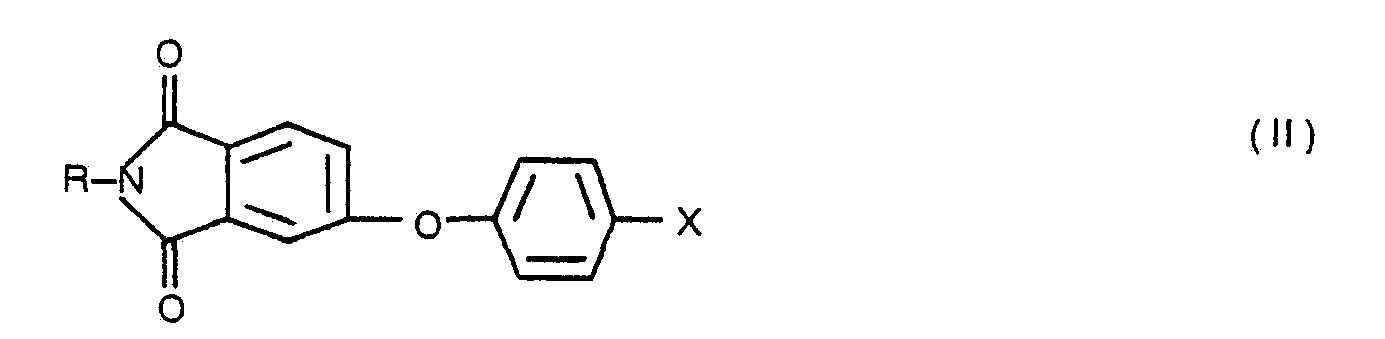
- the process of the invention is directed to the preparation of compounds of formula 1: wherein R is lower alkyl of from one to six carbons such as methyl, ethyl, n-propyl, n-hexyl and the like. These compounds are prepared by heating a compound of formula II: wherein R is the same as set forth hereinabove and X is Br, CI or I in the presence of a solvent and a catalyst that comprises a nickel compound and a reducing compound.
- Suitable solvents for the practice of the invention include saturated aliphatic hydrocarbons and aromatic hydrocarbons such as hexane, pentane, benzene, xylene, etc; ethers such as diethyl ether, tetrahydrofuran etc; dimethylacetamide; dimethyl sulfoxide, dimethylformamide; and the like.
- the useful nickel compounds include complexes of nickel and organometallic nickel compounds. These compounds include nickel halides such as nickel chloride, nickel iodide and nickel bromide; nickel sulfate, nickel carbonate, nickel phosphates and the like. Nickel salts of aliphatic organic acids having from 1-20 carbon atoms such as nickel formate, nickel acetate, nickel stearate; nickel complexes such as nickel acetoacetonate and the like.
- the amount of nickel that is used is from about 0.005 to about 1.0 and preferably from about 0.01 to about 0.5 moles of nickel per mole of compound of formula II.
- An inorganic salt such as an alkali metal bromide may be added to the reaction mixture in an amount of 0.01-500 moles per gram atom of catalyst.
- the useful triarylphosphines include triphenylphosphines.
- the ratio of triarylphosphine to nickel may be from about 0.01 to about 25, and preferably from 1 to 10 moles of triaryl phosphine per mole of nickel.
- the reducing metal may be manganese, magnesium or zinc. These reducing metals may be used in a finely divided form at a ratio of 0.5 moles to 1.5 moles per mole of the compound of formula II. Zinc is the preferred reducing metal.
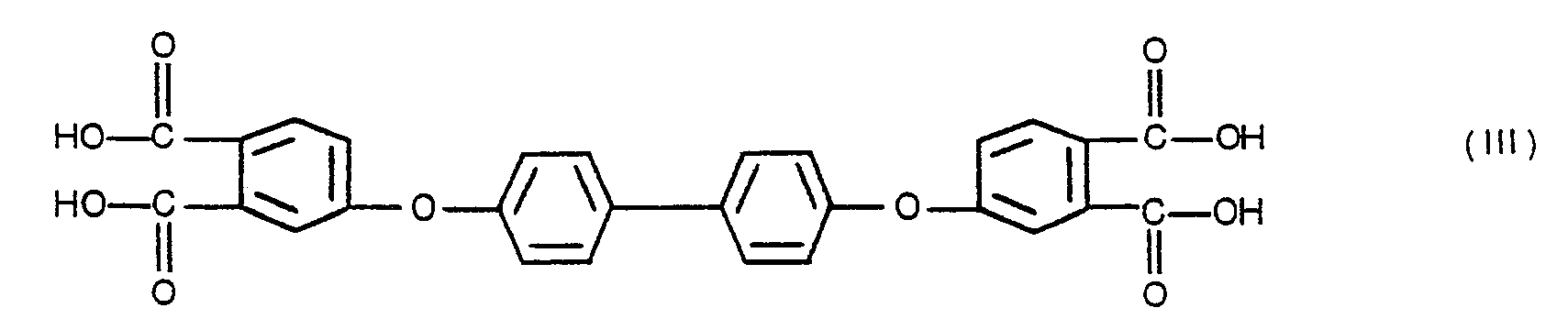
- the compounds of formula I may be used to make homopolymers or copolymers if they are first converted to a tetraacid of formula III. which may be dehydrated to the anhydride of formula IV:
- the homopolymers or copolymers are prepared by reaction with a diamine of formula V.
- R 1 is a divalent organic radical selected from the class consisting of (a) aromatic hydrocarbon radicals having from 6-20 carbon atoms and halogenated derivatives thereof, (b) alkylene radicals and cycloalkylene radicals having from 2-20 carbon atoms. C (2-8) alkylene terminated polydiorganosiloxane, and (c) divalent radicals included by the formula where Q is a member selected from the class consisting of -0-. -S-, and C 2 H 2 , and x is a whole number from 1 to 5 inclusive.
- copolymers may be prepared by utilizing from 10-90 mole% of an anhydride of formula IV with 90-10 mole% of a dianhydride of formula VI and a diamine of formula V: wherein E is selected from phenylene, biphenylene, naphthylene, alkylene or alkylidene.
- E is selected from phenylene, biphenylene, naphthylene, alkylene or alkylidene.
- Useful alkylene groups include methylene, ethylene and the like; alkylidene groups include ethylidene and isopropylidene.
- the preferred group for E is isopropylidene.
- the copolymers may be prepared by combining the diamine of formula V with the dianhydrides of formula IV and formula VI in a suitable reactor in the presence of a suitable solvent.
- the reaction is carried out by heating the reactants in an inert atmosphere such as nitrogen using a suitable means of agitation such as a mechanical stirrer.
- the water formed by the polymer formation is removed by azeotropic distillation and the polymer may be recovered by precipitation with an antisolvent such as methanol.
- the copolymers have repeating units of the formula: wherein R 1 is as defined above; and a represents from 10 to 100 units; and wherein E is selected from the group consisting of phenylene, biphenylene, naphthylene, alkylene or alkylidene and b is from 10 to 100 and R' is as defined above.
- These polymers are thermoplastic and may be molded to form useful articles having a high heat distortion temperature. They may be combined with reinforcing fillers and other fillers such as from 1-50% by weight of fibrous glass, wollastonite, clay, talc, mica, carbon fibers, aramid fibers, calcium carbonate and the like. If desired, flame retardant amounts of flame retardant agents such as those described in U.S. 4,020,124, which is incorporated by reference, may be added.
- the mixture was heated under nitrogen at 100°C for 30 minutes, followed by raising the temperature to 150°C in which the water formed in the reaction was removed by azeotropic distillation. After about 4 hours the temperature was increased to 180°C and held there for one hour, then cooled to room temperature. The viscous mixture was diluted with 100 ml chloroform and the polymer isolated by precipitation in methanol. The precipitate was dried at 125°C to give 6.6 grams of polyetherimide copolymer.
- the polymer exhibited an intrinsic viscosity of 0.56 dl/gram when measured in phenol/tetrachloro- ethane (60/60; w/w), at 30°C and a glass transition temperature of 230°C.
Landscapes
- Chemical & Material Sciences (AREA)
- Organic Chemistry (AREA)
- Health & Medical Sciences (AREA)
- Chemical Kinetics & Catalysis (AREA)
- Medicinal Chemistry (AREA)
- Polymers & Plastics (AREA)
- Macromolecular Compounds Obtained By Forming Nitrogen-Containing Linkages In General (AREA)
- Indole Compounds (AREA)
- Polymers With Sulfur, Phosphorus Or Metals In The Main Chain (AREA)
Claims (17)






Applications Claiming Priority (2)
| Application Number | Priority Date | Filing Date | Title |
|---|---|---|---|
| US553174 | 1983-11-18 | ||
| US06/553,174 US4623732A (en) | 1983-11-18 | 1983-11-18 | Process for the preparation of N-alkylphthalimide and copolymer derived therefrom |
Publications (3)
| Publication Number | Publication Date |
|---|---|
| EP0142800A2 EP0142800A2 (de) | 1985-05-29 |
| EP0142800A3 EP0142800A3 (en) | 1985-07-03 |
| EP0142800B1 true EP0142800B1 (de) | 1988-01-27 |
Family
ID=24208397
Family Applications (1)
| Application Number | Title | Priority Date | Filing Date |
|---|---|---|---|
| EP84113574A Expired EP0142800B1 (de) | 1983-11-18 | 1984-11-10 | Verfahren zur Herstelung von N-Alkylphthalimid und Copolymer das es enthält |
Country Status (4)
| Country | Link |
|---|---|
| US (1) | US4623732A (de) |
| EP (1) | EP0142800B1 (de) |
| JP (2) | JPS60149560A (de) |
| DE (1) | DE3469024D1 (de) |
Families Citing this family (7)
| Publication number | Priority date | Publication date | Assignee | Title |
|---|---|---|---|---|
| GB8332268D0 (en) * | 1983-12-02 | 1984-01-11 | Shell Int Research | Herbicides |
| DE3542797A1 (de) * | 1985-12-04 | 1987-06-11 | Basf Ag | Vollaromatische mesomorphe polyesterimide, deren herstellung sowie verwendung |
| DE3542798A1 (de) * | 1985-12-04 | 1987-06-11 | Basf Ag | Vollaromatische mesomorphe polyesteramidimide, deren herstellung und verwendung |
| DE3542857A1 (de) * | 1985-12-04 | 1987-06-11 | Basf Ag | Vollaromatische mesomorphe polyesterimide |
| US5106938A (en) * | 1989-06-08 | 1992-04-21 | General Electric Company | Melt crystalline polyetherimides |
| EP3917990A1 (de) * | 2019-01-31 | 2021-12-08 | SHPP Global Technologies B.V. | Verfahren zur herstellung einer biphenoldianhydridzusammensetzung, verfahren zur reinigung einer biphenoldianhydridzusammensetzung und aus biphenoldianhydrid gewonnene poly(etherimide) |
| JP2022518951A (ja) * | 2019-01-31 | 2022-03-17 | エスエイチピーピー グローバル テクノロジーズ べスローテン フェンノートシャップ | ビフェノール二無水物組成物の製造方法、ビフェノール二無水物の精製方法、およびビフェノール二無水物から誘導されるポリ(エーテルイミド) |
Family Cites Families (13)
| Publication number | Priority date | Publication date | Assignee | Title |
|---|---|---|---|---|
| US3972902A (en) | 1971-01-20 | 1976-08-03 | General Electric Company | 4,4'-Isopropylidene-bis(3- and 4-phenyleneoxyphthalic anhydride) |
| US3956320A (en) | 1972-08-18 | 1976-05-11 | General Electric Company | Aromatic bis(ether phthalis anhydride) compounds |
| CA1019888A (en) * | 1972-12-29 | 1977-10-25 | General Electric Company | Polyetherimides |
| US3879428A (en) * | 1973-03-30 | 1975-04-22 | Gen Electric | Method for making aromatic bis(ether anhydride)s |
| US3957862A (en) | 1973-03-30 | 1976-05-18 | General Electric Company | Method of making aromatic bis(ether ortho phthalic acid)s |
| US4020124A (en) | 1974-02-15 | 1977-04-26 | General Electric Company | Blends of a polyphenylene ether resin, alkenyl aromatic resins modified with EPDM rubber and graft polymerized high rubber content polymers |
| US3983093A (en) | 1975-05-19 | 1976-09-28 | General Electric Company | Novel polyetherimides |
| US4017511A (en) | 1976-03-24 | 1977-04-12 | General Electric Company | Preparation of aromatic bisimides |
| US4263466A (en) | 1978-10-30 | 1981-04-21 | Union Carbide Corporation | Coupling of aryl and heteroaryl mono chlorides |
| US4273712A (en) | 1979-05-09 | 1981-06-16 | General Electric Company | Method for making aromatic ether imides |
| CA1129418A (en) * | 1979-09-11 | 1982-08-10 | Ismael Colon | Coupling of aryl and heteroaryl polyhalides |
| JPS584057A (ja) * | 1981-06-29 | 1983-01-11 | 三金建材工事株式会社 | 心木なし瓦棒ぶき屋根の熱膨脹対策構造 |
| US4417044A (en) * | 1982-05-25 | 1983-11-22 | General Electric Company | Process for making polyetherimides |
-
1983
- 1983-11-18 US US06/553,174 patent/US4623732A/en not_active Expired - Fee Related
-
1984
- 1984-11-10 DE DE8484113574T patent/DE3469024D1/de not_active Expired
- 1984-11-10 EP EP84113574A patent/EP0142800B1/de not_active Expired
- 1984-11-19 JP JP59242537A patent/JPS60149560A/ja active Granted
-
1990
- 1990-08-03 JP JP2205336A patent/JPH0372529A/ja active Granted
Also Published As
| Publication number | Publication date |
|---|---|
| US4623732A (en) | 1986-11-18 |
| JPH0315631B2 (de) | 1991-03-01 |
| DE3469024D1 (en) | 1988-03-03 |
| EP0142800A3 (en) | 1985-07-03 |
| JPS60149560A (ja) | 1985-08-07 |
| JPH0422932B2 (de) | 1992-04-20 |
| EP0142800A2 (de) | 1985-05-29 |
| JPH0372529A (ja) | 1991-03-27 |
Similar Documents
| Publication | Publication Date | Title |
|---|---|---|
| US4769424A (en) | Polyarylene sulfide block copolymers, method for making, and use | |
| US4273712A (en) | Method for making aromatic ether imides | |
| US4257953A (en) | Method for making bisphenoxide salts and bisimides derived therefrom | |
| US3905942A (en) | Method for making polyetherimides and products produced thereby | |
| US4017511A (en) | Preparation of aromatic bisimides | |
| US4623732A (en) | Process for the preparation of N-alkylphthalimide and copolymer derived therefrom | |
| US4024110A (en) | Method for making polyetherimides | |
| US4675376A (en) | Process for the preparation of n-alkylphthalimide and copolymer derived therefrom | |
| Hsiao et al. | Synthesis and characterization of new diphenylfluorene‐based aromatic polyamides derived from 9, 9‐bis [4‐(4‐carboxy‐phenoxy) phenyl] fluorene | |
| US4302616A (en) | Method for making alkali metal bisphenoxide salts and bisimides derived therefrom | |
| US4864034A (en) | Spiro(bis)indane bis-oxyphthalic acids and functional derivatives thereof | |
| US5386002A (en) | Fluorene based bisimides and thermoplastic polymers thereof | |
| US4724257A (en) | Aromatic polythioetheramide-imide | |
| US5212277A (en) | Polyetherimideimides and a method for manufacturing them | |
| US4463159A (en) | Polyarylene esters containing phosphorus | |
| US5003086A (en) | Process of preparing dioxydiphthalic anhydride | |
| US4837298A (en) | Cyclic imides from spirobiindane diamines and methods of preparation | |
| US5434240A (en) | Poly (imide-ethers) | |
| US4216305A (en) | Aromatic polyformal carbonates and method for making | |
| US4994579A (en) | Aromatic ether imides | |
| EP0293693A2 (de) | Verfahren zur Herstellung von Organobis(thioäthern) und daraus erhaltene Produkte | |
| US4523006A (en) | Polyetherimides of di(phthalic anhydride) derivatives of di(substituted phenol) sulfones | |
| US4536564A (en) | Polyamide from bis-carboxy containing 3,5,3',5'-tetraoxo-1,2-dipiperazine compound and diamine | |
| US5149761A (en) | Aromatic ether imides | |
| US4943642A (en) | Halo-oxydiphthalic anhydrides |
Legal Events
| Date | Code | Title | Description |
|---|---|---|---|
| PUAI | Public reference made under article 153(3) epc to a published international application that has entered the european phase |
Free format text: ORIGINAL CODE: 0009012 |
|
| PUAL | Search report despatched |
Free format text: ORIGINAL CODE: 0009013 |
|
| AK | Designated contracting states |
Designated state(s): DE FR GB IT NL |
|
| AK | Designated contracting states |
Designated state(s): DE FR GB IT NL |
|
| 17P | Request for examination filed |
Effective date: 19851228 |
|
| 17Q | First examination report despatched |
Effective date: 19870408 |
|
| GRAA | (expected) grant |
Free format text: ORIGINAL CODE: 0009210 |
|
| AK | Designated contracting states |
Kind code of ref document: B1 Designated state(s): DE FR GB IT NL |
|
| REF | Corresponds to: |
Ref document number: 3469024 Country of ref document: DE Date of ref document: 19880303 |
|
| ET | Fr: translation filed | ||
| ITF | It: translation for a ep patent filed | ||
| PLBE | No opposition filed within time limit |
Free format text: ORIGINAL CODE: 0009261 |
|
| STAA | Information on the status of an ep patent application or granted ep patent |
Free format text: STATUS: NO OPPOSITION FILED WITHIN TIME LIMIT |
|
| 26N | No opposition filed | ||
| ITTA | It: last paid annual fee | ||
| PGFP | Annual fee paid to national office [announced via postgrant information from national office to epo] |
Ref country code: FR Payment date: 19941013 Year of fee payment: 11 |
|
| PGFP | Annual fee paid to national office [announced via postgrant information from national office to epo] |
Ref country code: GB Payment date: 19941026 Year of fee payment: 11 Ref country code: DE Payment date: 19941026 Year of fee payment: 11 |
|
| PGFP | Annual fee paid to national office [announced via postgrant information from national office to epo] |
Ref country code: NL Payment date: 19941130 Year of fee payment: 11 |
|
| PG25 | Lapsed in a contracting state [announced via postgrant information from national office to epo] |
Ref country code: GB Effective date: 19951110 |
|
| PG25 | Lapsed in a contracting state [announced via postgrant information from national office to epo] |
Ref country code: NL Effective date: 19960601 |
|
| GBPC | Gb: european patent ceased through non-payment of renewal fee |
Effective date: 19951110 |
|
| PG25 | Lapsed in a contracting state [announced via postgrant information from national office to epo] |
Ref country code: FR Effective date: 19960731 |
|
| NLV4 | Nl: lapsed or anulled due to non-payment of the annual fee |
Effective date: 19960601 |
|
| PG25 | Lapsed in a contracting state [announced via postgrant information from national office to epo] |
Ref country code: DE Effective date: 19960801 |
|
| REG | Reference to a national code |
Ref country code: FR Ref legal event code: ST |