EP0143073A1 - Dental-Artikulator - Google Patents
Dental-Artikulator Download PDFInfo
- Publication number
- EP0143073A1 EP0143073A1 EP84810444A EP84810444A EP0143073A1 EP 0143073 A1 EP0143073 A1 EP 0143073A1 EP 84810444 A EP84810444 A EP 84810444A EP 84810444 A EP84810444 A EP 84810444A EP 0143073 A1 EP0143073 A1 EP 0143073A1
- Authority
- EP
- European Patent Office
- Prior art keywords
- support
- movable part
- arm
- articulator according
- articulator
- Prior art date
- Legal status (The legal status is an assumption and is not a legal conclusion. Google has not performed a legal analysis and makes no representation as to the accuracy of the status listed.)
- Withdrawn
Links
- 210000004873 upper jaw Anatomy 0.000 claims abstract description 12
- 238000006073 displacement reaction Methods 0.000 claims abstract description 8
- 238000000465 moulding Methods 0.000 claims description 15
- 238000003801 milling Methods 0.000 claims description 2
- 230000000903 blocking effect Effects 0.000 claims 1
- 210000004373 mandible Anatomy 0.000 abstract description 13
- 210000002050 maxilla Anatomy 0.000 abstract description 2
- 210000001847 jaw Anatomy 0.000 description 4
- 125000006850 spacer group Chemical group 0.000 description 4
- 238000010276 construction Methods 0.000 description 2
- 210000004417 patella Anatomy 0.000 description 2
- 229910000831 Steel Inorganic materials 0.000 description 1
- 230000000712 assembly Effects 0.000 description 1
- 238000000429 assembly Methods 0.000 description 1
- 238000012937 correction Methods 0.000 description 1
- 238000000354 decomposition reaction Methods 0.000 description 1
- 238000004519 manufacturing process Methods 0.000 description 1
- 230000007246 mechanism Effects 0.000 description 1
- 239000002184 metal Substances 0.000 description 1
- 239000008188 pellet Substances 0.000 description 1
- 239000011347 resin Substances 0.000 description 1
- 229920005989 resin Polymers 0.000 description 1
- 230000000717 retained effect Effects 0.000 description 1
- 239000010959 steel Substances 0.000 description 1
- 230000001131 transforming effect Effects 0.000 description 1
Images



Classifications
-
- A—HUMAN NECESSITIES
- A61—MEDICAL OR VETERINARY SCIENCE; HYGIENE
- A61C—DENTISTRY; APPARATUS OR METHODS FOR ORAL OR DENTAL HYGIENE
- A61C11/00—Dental articulators, i.e. for simulating movement of the temporo-mandibular joints; Articulation forms or mouldings
- A61C11/001—Dental articulators, i.e. for simulating movement of the temporo-mandibular joints; Articulation forms or mouldings non-pivoting
Definitions
- the present invention relates to an occlusio-referential articulator, authorizing the analytical decomposition of the mandibular movement, comprising a frame on which are mounted an upper planar support for molding the upper jaw, extending approximately horizontally and fixed in the position of use. , a movable lower planar support for molding the lower jaw and means for moving and positioning the lower planar support relative to the upper planar support, both perpendicular to the upper support and parallel to this support.
- articulators Many types have been proposed with the aim of reproducing the movements of the mandible, previously measured on an individual, relative to the upper maxilla to allow practitioners, in particular prosthetists, to make a dental prosthesis conforming to the kinematics of the individual concerned.
- the articulator is intended to support moldings of the lower and upper jaws.
- the mandible support is movable vertically by means of a vertical screw and a knurled nut. It comprises a movable part in the form of a square comprising two vertical rods cooperating individually with two. rotating caps whose movement is supposed to reproduce the sagittal movement of the mandible. The occlusion position is recorded by reading the angular position of the two rotary caps.
- This system like all other previous mechanical systems, is based on a common principle which consists in wanting to reproduce natural condylar joints.
- these joints are complex and the mechanisms that seek to reproduce them are further beset with an error arising from a lack of knowledge of the exact and complete movement of the mandible when it is closed. Indeed, if the mandible actually has a pivoting movement at the level of the condylar joints when it is closed on the upper jaw, the last phase of this closing movement, more precisely the last millimeters of this closing movement, no longer corresponds to a rotational movement, but a vertical or slightly oblique translational movement.
- the object of the present invention is to allow precise recording and precise reproduction of the position of inclusion of the jaws and closing the mandible, without trying to reproduce the condylar joints.
- the articulator to be produced should also be relatively simple mechanically, easy to manufacture, easy to use, quick and precise positioning.
- the articulator according to the invention is characterized in that the lower support comprises a movable part on a guide member approximately perpendicular to the upper planar support and supporting an arm extending perpendicular to the guide member and mounted vertically sliding on said movable part, with a limited stroke and provided with a manually actuated stop member for its vertical displacement on said movable part, this arm carrying two crossed orthogonal slides each provided with a graduated actuating screw, the slide upper bearing a spherical ball supporting a flat table having positioning means for molding the lower jaw, respectively of its support.
- the slight stroke of the arm on the moving part that supports it allows to reproduce the last phase of the closing movement of the mandible.
- By providing an elastic mounting it is even possible to obtain an automatic displacement of the arm, in the occlusion position, when the laterality is modified, for example during an examination of the diduction.
- the two crossed orthogonal slides make it possible to record in a simple and precise way two rectangular coordinates of central position As for the spherical ball joint, it allows to obtain immediate sagittal inclination or make any corrections, in any direction, so as to obtain perfect occlusion.
- the position of the patella can be recorded by a circular graduation and by graduated meridians and / or parallels drawn on the spherical patella. All the movable elements are preferably provided with a locking handle.
- the assembly consisting of the two supports forms a rigid whole which is preferably pivotally mounted between two columns and lockable in an oblique position, so as to facilitate the work of the practitioner.
- two retractable and orientable tool-carrying arms are mounted on the extension of two columns transforming the device into an ergonomic workstation.
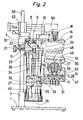
- the articulator comprises a frame consisting of a plate 1 provided with rubber feet carrying two columns 2 and 3 on which the elements of the articulator are mounted. On two bearing surfaces 4 and 5 of columns 2 and 3, two vertical brackets 6 and 7 are fixed forming a bracket and between which is mounted a horizontal spacer 8, pivoting about an axis 9.
- the spacer 8 is crossed by a second axis 10 which also crosses the brackets 6 and 7 through two slots 11 in an arc centered on the axis 9 .
- the spacer 8 can thus pivot around its axis 9 by an angle corresponding to the arc of the light 11. It can be locked in the desired position by means of two knurled nuts 12 and 13.
- a plate 14 constituting the upper planar support for molding the upper jaw. In the working position, this plate 14 rests on the upper flat face of the spacer 8. It can be locked in this position by means of a lever 15 actuating a locking finger 16 engaging under the axis 9.
- the plate 14 further carries. on its underside, a removable plate 17 intended to receive the molding of the upper jaw. This plate is retained by a screw. knurled 18 and positioned by a pin 19.
- the axis 8 carries a plate 20, in the form of a square, which has a variable orientation determined by a stop screw 21 screwed in an extension 22 of the cross member 8. Under the plate 20, is fixed a block 23 by means of 'a screw. This block 23 is integral with a rack 24 and two guide columns, one of which, 25, is visible in FIG. 2. The lower ends of the rack 24 and guide columns 25 are fixed in a lower block 26. The rack 24 and the columns 25 pass through a moving part 27, the detail of which is shown in FIG. 4. This moving part 27 is provided with a horizontal toothed shaft 28 cooperating with the teeth of the rack and is capable of being driven by means of a knurled button 29 (FIG. 1).
- the movable part can be locked at the desired height by means of a lever 30 driving a locking screw acting on the rack 24.
- the movable part 27 supports a horizontal arm 31 carrying the lower planar support for molding the lower jaw.
- This arm 31 is also slidably mounted on the guide columns 25. It is held approximately 3 mm above the moving part 27 by four springs, two of which, 32 and 33, are visible in FIG. 2, the other two springs being arranged in the other two corners of the movable rectangular part 27.
- the spacing of the parts 27 and 31 is limited by a cam 34 secured to an axis 35 mounted in the arm 31 and cooperating with a ramp 36 of the movable part 27.
- This cam 34 can be actuated by means of a lever 37 ( Figure 1) integral with the shaft 35.
- the actuation of the cam 34 makes it possible to bring the arm 31 into contact with the moving part 27 by compressing the springs 32. 33.
- the cam 34 has a stable position in which the arm 31 remains applied against the moving part 27 without auxiliary locking means.
- the moving element constituted by the moving part 27 and the arm 31 is further suspended from two weight compensating springs 38 whose upper ends are attached to the upper block 23 (fig. 2). These springs 38 prevent a rapid and dangerous descent of the moving assembly.
- the rack 24 and the guide columns 25 are housed in two metal bellows 39 and 40 made in known manner of a steel sheet wound in a helix.
- the arm 31 carries two slides 41 and 42 superimposed and crossing orthogonally, similar to the slides of a machine tool table. These slides 41 and 42 are respectively movable by means of two micrometric screws 43 and 44. They each move in front of a graduated scale such as 45 ( Figure 1).
- a spherical ball joint 46 secured to a table 47 constituting the movable lower planar support for molding the lower jaw.
- This table 47 has positioning housings 48 and 49 for a removable plate 50 on which the molding of the lower jaw 51 is fixed.
- the plate 50 can be locked by means of a horizontal screw actuable by a lever 52.
- the ball joint 46 is mounted on the one hand in a spherical housing 53 of the upper slide 42 and on the other hand supported by means of a ball bearing 54 by a central column 55 whose upper end is spherical.
- a vertical finger 56 mounted on a spring and cooperating with a central polar housing of the ball joint 46 ensures identification of the horizontal position of the table 47 and a soft hold in this position.
- the planar upper face of the upper slide 42 has a graduation cooperating with at least one index of the ball joint 46 for determining and recording the position of the table 47 around a vertical axis.
- This graduation can be arbitrary, for example in degrees, or completely arbitrary.
- graduated meridians are also drawn on the ball 46 to determine and recording the inclination of the table 47 relative to the horizontal plane.
- this articulator is particularly convenient.
- the upper support 14 can be raised vertically around the axis 10. This raised position also completely releases the table 47, which allows the molding to be fixed completely freely 51 of the lower jaw on this table 47.
- the upper plate is then folded down and locked by means of lever 15 (fig. 2). This fixed position conforms to the fixed position of the upper jaw.
- the table 47 is then mounted by means of the knurled nut 29 and the rack 24.
- the recording of the mandibular function of the subject whose jaws are mounted on the articulator is carried out very simply and precisely by means two orthogonal slides 41 and 42 and by means of the ball joint 46. These three moving parts make it possible to give table 47 any position, within a certain range of course, and record the position of this table by simply reading the graduated scales.
- the lower support is pivoted around the axis 10 by means of the knurled screw 21 (FIG. 2).
- the arm 31 (fig. 4) is first of all held flat. on the movable part 27.
- the final closing of the jaw is carried out by means of the cam 34. that is to say by releasing the arm 31 which is then lifted elastically by the springs 32 and 33, this vertical stroke corresponding to the translational displacement of approximately 3 mm identified.
- This vertical displacement has the advantage of being elastic, that is to say of being done gently, without risking damaging the molding. respectively the controlled prosthesis.
- the articulation of the assembly around the axis 9 is lockable in an oblique position by means of the knurled nuts 12 and 13 and allows the user to work in a convenient inclined position.
Landscapes
- Health & Medical Sciences (AREA)
- Oral & Maxillofacial Surgery (AREA)
- Dentistry (AREA)
- Epidemiology (AREA)
- Life Sciences & Earth Sciences (AREA)
- Animal Behavior & Ethology (AREA)
- General Health & Medical Sciences (AREA)
- Public Health (AREA)
- Veterinary Medicine (AREA)
- Dental Prosthetics (AREA)
Applications Claiming Priority (2)
| Application Number | Priority Date | Filing Date | Title |
|---|---|---|---|
| CH504783 | 1983-09-16 | ||
| CH5047/83 | 1983-09-16 |
Publications (1)
| Publication Number | Publication Date |
|---|---|
| EP0143073A1 true EP0143073A1 (de) | 1985-05-29 |
Family
ID=4287059
Family Applications (1)
| Application Number | Title | Priority Date | Filing Date |
|---|---|---|---|
| EP84810444A Withdrawn EP0143073A1 (de) | 1983-09-16 | 1984-09-12 | Dental-Artikulator |
Country Status (3)
| Country | Link |
|---|---|
| US (1) | US4573915A (de) |
| EP (1) | EP0143073A1 (de) |
| JP (1) | JPS6096244A (de) |
Cited By (2)
| Publication number | Priority date | Publication date | Assignee | Title |
|---|---|---|---|---|
| EP0667130A3 (de) * | 1994-02-11 | 1995-11-08 | Giorgio Talarico | Zahnärztlicher Artikulator. |
| WO2000042941A1 (en) * | 1999-01-20 | 2000-07-27 | Diego Betlamini | Orthodontic articulator |
Families Citing this family (4)
| Publication number | Priority date | Publication date | Assignee | Title |
|---|---|---|---|---|
| US5141433A (en) * | 1990-05-07 | 1992-08-25 | Peterson Kenneth N | Dental articulator |
| DE59104344D1 (de) * | 1990-08-08 | 1995-03-02 | Michael Heinz Polz | Kiefer-artikulator. |
| US5795152A (en) * | 1996-03-30 | 1998-08-18 | Glatt; Marc J. | Accessory device for a dental articulator and method for use in fabricating dental prosthetics |
| KR101074023B1 (ko) | 2009-11-05 | 2011-10-17 | 부산대학교 산학협력단 | 마이크로미터 다이얼로 조절되는 6축 매뉴얼 스테이지를 이용한 모의 악교정수술장치 |
Citations (5)
| Publication number | Priority date | Publication date | Assignee | Title |
|---|---|---|---|---|
| US2600899A (en) * | 1949-01-07 | 1952-06-17 | Francis L Mcclain | Dental appliance |
| US2613440A (en) * | 1950-03-20 | 1952-10-14 | Addie P Murray | Articulator for making artificial dentures |
| CH390046A (de) * | 1961-10-20 | 1965-03-31 | Schrader Goetz | Stativ für insbesondere photographische Geräte |
| US3176400A (en) * | 1961-03-30 | 1965-04-06 | Medical Electronics And Res Co | Hinge joint for dental articulator |
| US4019708A (en) * | 1975-10-29 | 1977-04-26 | Acoustic Fiber Sound Systems, Inc. | Latchable swivel mount for loudspeaker |
Family Cites Families (4)
| Publication number | Priority date | Publication date | Assignee | Title |
|---|---|---|---|---|
| GB191238A (en) * | 1921-11-22 | 1923-01-11 | Marceline Weiss | Dental articulator |
| US2621407A (en) * | 1951-07-12 | 1952-12-16 | Schlesinger Milton | Dental apparatus |
| US2959857A (en) * | 1953-11-12 | 1960-11-15 | Stoll Victor | Dental analyzer and coordinator |
| US4391589A (en) * | 1981-07-27 | 1983-07-05 | Johnson & Johnson Dental Products Company | Surgical dental articulator |
-
1984
- 1984-09-10 US US06/648,890 patent/US4573915A/en not_active Expired - Fee Related
- 1984-09-12 EP EP84810444A patent/EP0143073A1/de not_active Withdrawn
- 1984-09-17 JP JP59194522A patent/JPS6096244A/ja active Pending
Patent Citations (5)
| Publication number | Priority date | Publication date | Assignee | Title |
|---|---|---|---|---|
| US2600899A (en) * | 1949-01-07 | 1952-06-17 | Francis L Mcclain | Dental appliance |
| US2613440A (en) * | 1950-03-20 | 1952-10-14 | Addie P Murray | Articulator for making artificial dentures |
| US3176400A (en) * | 1961-03-30 | 1965-04-06 | Medical Electronics And Res Co | Hinge joint for dental articulator |
| CH390046A (de) * | 1961-10-20 | 1965-03-31 | Schrader Goetz | Stativ für insbesondere photographische Geräte |
| US4019708A (en) * | 1975-10-29 | 1977-04-26 | Acoustic Fiber Sound Systems, Inc. | Latchable swivel mount for loudspeaker |
Cited By (2)
| Publication number | Priority date | Publication date | Assignee | Title |
|---|---|---|---|---|
| EP0667130A3 (de) * | 1994-02-11 | 1995-11-08 | Giorgio Talarico | Zahnärztlicher Artikulator. |
| WO2000042941A1 (en) * | 1999-01-20 | 2000-07-27 | Diego Betlamini | Orthodontic articulator |
Also Published As
| Publication number | Publication date |
|---|---|
| US4573915A (en) | 1986-03-04 |
| JPS6096244A (ja) | 1985-05-29 |
Similar Documents
| Publication | Publication Date | Title |
|---|---|---|
| EP0069607B1 (de) | Lastträgerführungsstück mit teleskopischem Aufbau und damit verschene Roentgenanlage | |
| US4417873A (en) | Dental articulator | |
| JPH0349745A (ja) | 加工部材、特に歯科医療用のインレー、アンレー及び歯冠を製作する方法及びその装置 | |
| WO2017118797A1 (fr) | Système de génération de déplacement d'une plaque de support selon six degrés de liberté | |
| EP0123597A1 (de) | Prüfstände für Reaktorbrennelemente | |
| CA1305192C (fr) | Appareil de mesure des caracteristiques massiques d'un corps et son application a la mesure des caracteristiques d'un satellite a sec | |
| EP2433085A1 (de) | Dreidimensionale messvorrichtung | |
| EP0143073A1 (de) | Dental-Artikulator | |
| FR2961121A1 (fr) | Dispositif d'assistance au portage d'au moins un outil de poncage et/ou de lustrage | |
| US20030020906A1 (en) | Scanning apparatus | |
| FR2611046A1 (fr) | Extensometre pour machines a tester des materiaux | |
| EP1666832B1 (de) | Motorisierter orientierbarer Messkopf | |
| EP1617172B1 (de) | Lenkbarer Taststift | |
| FR2539025A1 (fr) | Articulateur pour l'art dentaire | |
| CH369545A (fr) | Articulateur dentaire | |
| US5267858A (en) | Average movement articulator capable of being set for free movement | |
| JPH0260335B2 (de) | ||
| US5007830A (en) | Device for determining the occlusal plane | |
| EP0619040B1 (de) | Arm- und handunterstützung für einen benutzer eines tastatur-, zeichen-, strickinstruments oder -geräts | |
| CN216802997U (zh) | 一种光学设备用玻璃透镜粗加工装置 | |
| US1322386A (en) | Dental articulator | |
| WO1995000079A1 (fr) | Appareil de mise en position utilisable en art dentaire | |
| WO1983003962A1 (fr) | Articulateur pour l'art dentaire | |
| FR2662382A1 (fr) | Support vertical pour appareil electroportatif. | |
| CH683505A5 (fr) | Appareil à affûter des instruments tranchants. |
Legal Events
| Date | Code | Title | Description |
|---|---|---|---|
| PUAI | Public reference made under article 153(3) epc to a published international application that has entered the european phase |
Free format text: ORIGINAL CODE: 0009012 |
|
| AK | Designated contracting states |
Designated state(s): AT BE CH DE FR GB IT LI LU NL SE |
|
| 17P | Request for examination filed |
Effective date: 19850706 |
|
| 17Q | First examination report despatched |
Effective date: 19860925 |
|
| STAA | Information on the status of an ep patent application or granted ep patent |
Free format text: STATUS: THE APPLICATION IS DEEMED TO BE WITHDRAWN |
|
| 18D | Application deemed to be withdrawn |
Effective date: 19871217 |
|
| RIN1 | Information on inventor provided before grant (corrected) |
Inventor name: SANDHAUS, SAMI |