EP0143105A2 - Procédé de déhydratation de la tourbe - Google Patents
Procédé de déhydratation de la tourbe Download PDFInfo
- Publication number
- EP0143105A2 EP0143105A2 EP84890207A EP84890207A EP0143105A2 EP 0143105 A2 EP0143105 A2 EP 0143105A2 EP 84890207 A EP84890207 A EP 84890207A EP 84890207 A EP84890207 A EP 84890207A EP 0143105 A2 EP0143105 A2 EP 0143105A2
- Authority
- EP
- European Patent Office
- Prior art keywords
- peat
- centrifuge
- saturated steam
- centrifuges
- bar
- Prior art date
- Legal status (The legal status is an assumption and is not a legal conclusion. Google has not performed a legal analysis and makes no representation as to the accuracy of the status listed.)
- Withdrawn
Links
Images
Classifications
-
- C—CHEMISTRY; METALLURGY
- C10—PETROLEUM, GAS OR COKE INDUSTRIES; TECHNICAL GASES CONTAINING CARBON MONOXIDE; FUELS; LUBRICANTS; PEAT
- C10F—DRYING OR WORKING-UP OF PEAT
- C10F5/00—Drying or de-watering peat
- C10F5/04—Drying or de-watering peat by using presses, handpresses, rolls, or centrifuges
-
- C—CHEMISTRY; METALLURGY
- C10—PETROLEUM, GAS OR COKE INDUSTRIES; TECHNICAL GASES CONTAINING CARBON MONOXIDE; FUELS; LUBRICANTS; PEAT
- C10F—DRYING OR WORKING-UP OF PEAT
- C10F5/00—Drying or de-watering peat
Definitions
- the invention relates to a method for dewatering peat.
- peat extraction and processing the reduction of the high water content of the peat is an essential prerequisite for further processing. So far, the drainage of peat has been carried out almost exclusively in the time-consuming, labor-intensive and weather-dependent natural air drying. For use as a fuel, oil must always be added to partially dried peat to enable combustion.
- the invention now aims to dry peat in such a way that it is mechanically dried to such an extent that combustion without auxiliary firing or any type of further processing, for example to fertilizer, to briquettes for combustion, to peat coke, etc. is made possible.
- the invention consists essentially in that the peat is placed in a pressure-tight lockable centrifuge and is placed under saturated steam at a pressure of 2 to 35 bar, preferably 5 to 20 * bar, during centrifugation.
- saturated steam for drying organic substances has already become known in connection with coal, with particular reference being made, for example, to the Fleissner process.
- the binding of water in coal differs considerably from the binding of water in peat, so that the technology developed for coal does not appear to be directly applicable to peat.
- the AT-PS 366 090, the AT-PS 366 405 and the AT-PS 369 423 also proposed to use centrifuges in a downstream drying stage, which were placed under steam pressure.
- the use of saturated steam in the centrifugal field increases the treatment temperature of the peat through the immediate removal of the condensate and the water released from the peat, which promotes the release of the peat water.
- the separation effect in the peat-water system is positively influenced.
- the compression or compression of the peat cake due to the centrifugal forces during centrifugation leads to the squeezing out of further water contained in the peat.
- a particularly significant increase in the drainage effect could already be achieved here at saturated steam pressures of approximately 10 bar.
- the treatment time in the centrifuge can be chosen freely, and the treatment time in the centrifuge or in the centrifuges is therefore advantageously adapted to the peat quality or the desired residual water content.
- the heat of the condensate discharged from the centrifuge or of the water separated from the peat can advantageously be used for preheating the peat before it is introduced into the centrifuge.
- the wastewater can also be used as a transport medium, for which a slurry of the peat is made with the hot water and introduced into a preheating stage.
- the peat discharged from the centrifuge can be subjected to post-drying in a particularly advantageous manner, and here too, in order to improve the energy balance, the heat of the condensate discharged from the centrifuge or of the water separated from the peat can be used before it is used the preheating of the peat is used for the heating of air for a post-drying of the peat released from the centrifuge.
- the process according to the invention can be carried out in such a way that the centrifuges connected in series are subjected to different saturated steam pressures. This also largely adjusts to the desired degree of coking and the drainage behavior of different peat qualities.
- Table 1 shows the drainage of black peat, ie a peat that is relatively difficult to drain, tests 1, 3, 5, 7 and 9 in an experimental autoclave. were only carried out under the specified saturated steam pressure without using centrifugal forces.
- tests 2, 4, 6, 8 and 10 of Table 1 were carried out with simultaneous application of a centrifugal force, with a test-related cycle time of 5 min for the preheating phase, 15 min for the centrifugal treatment and 5 min for the relaxation phase as well as revolutions of the centrifuge from 750 min -1 in the first phase, 2500 min 1 in the second phase and 750 min 1 in the third phase.
- the water content of the feed sample was 88.7% by weight, or 785 g H 2 0 per 100 g dry substance.
- a peat of the same composition treated comparatively at 20 ° C. without the use of saturated steam in a centrifuge has a water content of 85.0% by weight or 566.7 g H 2 0 per 100 g dry substance.
- Table 2 shows the analogous results of another black peat sample, the experiments labeled with odd numbers again denoting the drainage tests in the autoclave.
- the peat samples used in Table 2 are black peat with relatively easy drainability, the water content of which was 88.5% by weight or 640.7 g H 2 0 per 100 g dry substance.
- a comparative test in a centrifuge at a temperature of 20 ° C without the use of saturated steam has shown drying to 69.8% by weight or 231.1 g of H 2 O per 100 g of dry substance.
- Table 3 shows the key figures for further peat samples that were dewatered in a centrifuge at a saturated steam pressure of 10 and 35 bar.
- black peat L means black peat with easy drainability and black peat S with black peat with difficult drainability.
- Table 4 summarizes the results of an investigation in which the cycle time was varied in the test autoclave. From Table 4 it can be seen that the best results were obtained by increasing the pressure in the second phase and correspondingly extending the duration of this second phase.
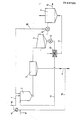
- a plant for the implementation of the method according to the invention is shown schematically.
- the raw peat passes through a feed device 1 into a vessel 2 for preheating and from there into a mechanical pre-dewatering stage 3.
- a belt filter or chamber filter press or a centrifuge can be used for pre-dewatering.
- the wastewater from the preliminary dewatering is discharged via a line 4 and is already at a higher temperature level due to the preheating.
- the pre-dewatered peat is then fed to one or more centrifuges 5, these centrifuges being under saturated steam pressure. After centrifugation, the peat passes through a lock 6 into an after-dryer 7.
- the dried peat is fed to a further use via a discharge device 8.
- the wastewater from the mechanical pre-drainage, which was drawn off via line 4, can be cleaned as usual and passed into the receiving water.
- the condensate or the hot water separated from the peat and the discharge steam are fed to a heat exchanger 10 via a lock 9 and returned to the vessel 2 for preheating via a line 11.
- the heat exchanger 10 is used for the preheating of air, which is fed to the after-dryer 7 via a line 12.
- the introduction of post-drying has the advantage that there is a more favorable heat balance for the entire process.
- the heated wastewater from the mechanical pre-dewatering withdrawn via line 4 can at least partially be returned to the peat task via a line 13, for which purpose a pump 14 is provided.
- This waste water can be mixed with peat to form a slurry, and the hot waste water can be used as a transport medium for the peat. In this way, the wastewater can be largely recycled and the effort required for cleaning the wastewater can be kept lower.
- the steam accumulating in the lock 6 can likewise be returned to the vessel for preheating via a line 15.
- the peat feed can be done at 16 or 17 depending on whether a slurry with the recycled and recycle hot wastewater is desired, or an addition of peat without a slurry with water is desired.
Landscapes
- Chemical & Material Sciences (AREA)
- Oil, Petroleum & Natural Gas (AREA)
- Organic Chemistry (AREA)
- Drying Of Solid Materials (AREA)
- Solid Fuels And Fuel-Associated Substances (AREA)
- Fertilizers (AREA)
- Centrifugal Separators (AREA)
Applications Claiming Priority (2)
| Application Number | Priority Date | Filing Date | Title |
|---|---|---|---|
| AT4017/83 | 1983-11-15 | ||
| AT0401783A AT380268B (de) | 1983-11-15 | 1983-11-15 | Verfahren zum entwaessern von torf durch zentrifugieren unter sattdampf |
Publications (2)
| Publication Number | Publication Date |
|---|---|
| EP0143105A2 true EP0143105A2 (fr) | 1985-05-29 |
| EP0143105A3 EP0143105A3 (fr) | 1986-03-26 |
Family
ID=3558530
Family Applications (1)
| Application Number | Title | Priority Date | Filing Date |
|---|---|---|---|
| EP84890207A Withdrawn EP0143105A3 (fr) | 1983-11-15 | 1984-11-05 | Procédé de déhydratation de la tourbe |
Country Status (9)
| Country | Link |
|---|---|
| US (1) | US4674195A (fr) |
| EP (1) | EP0143105A3 (fr) |
| AT (1) | AT380268B (fr) |
| FI (1) | FI844471A7 (fr) |
| GR (1) | GR80888B (fr) |
| HU (1) | HU192503B (fr) |
| NO (1) | NO844546L (fr) |
| PL (1) | PL250349A1 (fr) |
| SU (1) | SU1389682A3 (fr) |
Cited By (4)
| Publication number | Priority date | Publication date | Assignee | Title |
|---|---|---|---|---|
| US4632731A (en) * | 1985-06-26 | 1986-12-30 | Institute Of Gas Technology | Carbonization and dewatering process |
| FR2745074A1 (fr) * | 1996-02-20 | 1997-08-22 | Dieffenbacher Gmbh Maschf | Dispositif pour reduire la teneur en eau de lignite contenant de l'eau |
| WO1997031082A1 (fr) * | 1996-02-20 | 1997-08-28 | Karl Strauss | Procede de reduction de la teneur en eau de lignite renfermant de l'eau |
| US10436685B2 (en) | 2014-07-30 | 2019-10-08 | Roche Diagnostics Operations, Inc. | Automated system for processing particles |
Families Citing this family (5)
| Publication number | Priority date | Publication date | Assignee | Title |
|---|---|---|---|---|
| US4793656A (en) * | 1987-02-12 | 1988-12-27 | Shell Mining Company | In-situ coal drying |
| DE19914098C2 (de) * | 1999-03-27 | 2002-09-19 | Rwe Energie Ag | Verfahren zur Entwässerung von Rohbraunkohle durch Zentrifugieren |
| KR100621713B1 (ko) * | 2000-09-26 | 2006-09-13 | 테크놀라지칼 리소시스 피티와이. 리미티드. | 고체 물질의 품질개량 방법 및 장치 |
| US20060030830A1 (en) * | 2004-07-21 | 2006-02-09 | Douglas Wright | Method of processing peat moss and products derived therefrom |
| US8021445B2 (en) | 2008-07-09 | 2011-09-20 | Skye Energy Holdings, Inc. | Upgrading carbonaceous materials |
Family Cites Families (11)
| Publication number | Priority date | Publication date | Assignee | Title |
|---|---|---|---|---|
| DE377661C (de) * | 1921-07-30 | 1923-06-23 | Siemens Schuckertwerke G M B H | Verfahren zum Ausschleudern der Fluessigkeit aus feuchtem Torf o. dgl. |
| US2536676A (en) * | 1946-02-21 | 1951-01-02 | Rca Corp | Method of manufacturing penicillin |
| FR1053925A (fr) * | 1950-08-14 | 1954-02-05 | Procédé pour le traitement de la tourbe | |
| US3007254A (en) * | 1953-08-10 | 1961-11-07 | Wilhelm F Schuster | Process and apparatus for drying colloidal substances such as lignite |
| AT369423B (de) * | 1979-11-20 | 1982-12-27 | Voest Alpine Ag | Verfahren zur trocknung und strukturumwandlung von organischen feststoffen, insbesondere braunkohlen |
| GR70664B (fr) * | 1979-10-15 | 1982-12-06 | Voest Alpine Ag | |
| AT366090B (de) * | 1980-01-21 | 1982-03-10 | Voest Alpine Ag | Verfahren zum trocknen und umwandeln von organi- schen feststoffen, wie insbesondere braunkohlen, sowie verwendung der auf diese weise getrockneten und umgewandelten braunkohlen |
| AT366405B (de) * | 1980-01-21 | 1981-04-13 | Voest Alpine Ag | Verfahren zum trocknen und umwandeln von organischen feststoffen, insbesondere braunkohlen mit dampf |
| US4472885A (en) * | 1982-01-28 | 1984-09-25 | Electric Power Development Co., Ltd. | Process and apparatus for dehydrating organic solid material |
| US4536969A (en) * | 1983-09-30 | 1985-08-27 | Kamyr, Inc. | Hot water drying of low rank coal |
| US4514910A (en) * | 1983-02-22 | 1985-05-07 | Kamyr, Inc. | Dehydration of lignite or the like |
-
1983
- 1983-11-15 AT AT0401783A patent/AT380268B/de not_active IP Right Cessation
-
1984
- 1984-11-05 EP EP84890207A patent/EP0143105A3/fr not_active Withdrawn
- 1984-11-08 GR GR80888A patent/GR80888B/el unknown
- 1984-11-08 PL PL25034984A patent/PL250349A1/xx unknown
- 1984-11-12 SU SU843810701A patent/SU1389682A3/ru active
- 1984-11-13 US US06/670,644 patent/US4674195A/en not_active Expired - Fee Related
- 1984-11-13 HU HU844218A patent/HU192503B/hu unknown
- 1984-11-14 NO NO844546A patent/NO844546L/no unknown
- 1984-11-14 FI FI844471A patent/FI844471A7/fi not_active Application Discontinuation
Cited By (4)
| Publication number | Priority date | Publication date | Assignee | Title |
|---|---|---|---|---|
| US4632731A (en) * | 1985-06-26 | 1986-12-30 | Institute Of Gas Technology | Carbonization and dewatering process |
| FR2745074A1 (fr) * | 1996-02-20 | 1997-08-22 | Dieffenbacher Gmbh Maschf | Dispositif pour reduire la teneur en eau de lignite contenant de l'eau |
| WO1997031082A1 (fr) * | 1996-02-20 | 1997-08-28 | Karl Strauss | Procede de reduction de la teneur en eau de lignite renfermant de l'eau |
| US10436685B2 (en) | 2014-07-30 | 2019-10-08 | Roche Diagnostics Operations, Inc. | Automated system for processing particles |
Also Published As
| Publication number | Publication date |
|---|---|
| HUT39766A (en) | 1986-10-29 |
| SU1389682A3 (ru) | 1988-04-15 |
| FI844471L (fi) | 1985-05-16 |
| NO844546L (no) | 1985-05-20 |
| EP0143105A3 (fr) | 1986-03-26 |
| FI844471A7 (fi) | 1985-05-16 |
| GR80888B (en) | 1985-03-11 |
| PL250349A1 (en) | 1985-06-18 |
| ATA401783A (de) | 1985-09-15 |
| AT380268B (de) | 1986-05-12 |
| US4674195A (en) | 1987-06-23 |
| HU192503B (en) | 1987-06-29 |
| FI844471A0 (fi) | 1984-11-14 |
Similar Documents
| Publication | Publication Date | Title |
|---|---|---|
| DE3248372A1 (de) | Verfahren zur kontinuierlichen trocknung und veredelung von organischen feststoffen wie z.b. braunkohlen | |
| DE2732327A1 (de) | Verfahren zur gewinnung von xylan und faserstoffen aus xylanhaltigen pflanzlichen rohstoffen | |
| DE2641143A1 (de) | Verfahren und vorrichtung zum gewinnen von oelen aus oelhaltigen rohstoffen | |
| DD235861A5 (de) | Verfahren zum entwaessern von schlaemmen und/oder organischen stoffen sowie vorrichtung zur durchfuehrung des verfahrens | |
| DE3043085C2 (de) | Verfahren zum Vorbereiten von Braun- oder Steinkohle für das Heißbrikettieren | |
| US4674195A (en) | Process for dehydrating peat | |
| DE3039012C2 (de) | Verfahren zum Trocknen von organischen Feststoffen,z.B. Braunkohle | |
| DE2850825A1 (de) | Verfahren und vorrichtung zum mechanischen entwaessern von torf | |
| DE3045762C2 (de) | Verfahren zum Trocknen von organischen Feststoffen, wie insbesondere Braunkohlen | |
| DE682801C (de) | Verfahren zur Behandlung von Torf | |
| DE3045744C2 (de) | Verfahren zur Herstellung eines festen Brennstoffes mit hoher Energiedichte | |
| DE3024423C2 (de) | Verwendung pikrierbarer Pechfraktionen zur Herstellung von anisotropem Kohlenstoff | |
| DE527519C (de) | Verfahren zur Entwaesserung von feuchten Brennstoffen | |
| DE19914098C2 (de) | Verfahren zur Entwässerung von Rohbraunkohle durch Zentrifugieren | |
| DE724855C (de) | Verfahren zur Verbesserung juengerer, sauerstoffreicher Brennstoffe durch Erhitzung unter Luftabschluss mit nachfolgender Aufbereitung | |
| DE699993C (de) | Verfahren zum Brikettieren von festen Brennstoffen, insbesondere Kohlen juengeren geologischen Alters | |
| DE1088790B (de) | Verfahren zur Aufbereitung von Seetieren, insbesondere Fischen | |
| DE541755C (de) | Verfahren zur Druckextraktion von kohlehaltigen Stoffen | |
| DE268721C (fr) | ||
| DE723859C (de) | Verfahren zum Entaschen von Braunkohle | |
| DE338818C (de) | Verfahren zur Entwaesserung von Teeren, Mineraloelen usw | |
| DE546368C (de) | Verfahren zur Herstellung eines schwarzen Farbstoffes | |
| DE590709C (de) | Verfahren zur mehrstufigen Trocknung zu verschwelender wasserreicher Brennstoffe, insbesondere Braunkohle | |
| DE735518C (de) | Verfahren zum Herstellen von Presslingen | |
| DE285315C (fr) |
Legal Events
| Date | Code | Title | Description |
|---|---|---|---|
| PUAI | Public reference made under article 153(3) epc to a published international application that has entered the european phase |
Free format text: ORIGINAL CODE: 0009012 |
|
| AK | Designated contracting states |
Designated state(s): DE FR GB IT SE |
|
| RTI1 | Title (correction) | ||
| PUAL | Search report despatched |
Free format text: ORIGINAL CODE: 0009013 |
|
| AK | Designated contracting states |
Kind code of ref document: A3 Designated state(s): DE FR GB IT SE |
|
| 17P | Request for examination filed |
Effective date: 19860425 |
|
| 17Q | First examination report despatched |
Effective date: 19870728 |
|
| STAA | Information on the status of an ep patent application or granted ep patent |
Free format text: STATUS: THE APPLICATION IS DEEMED TO BE WITHDRAWN |
|
| 18D | Application deemed to be withdrawn |
Effective date: 19871208 |
|
| RIN1 | Information on inventor provided before grant (corrected) |
Inventor name: JANUSCH, ALOIS, DIPL.-ING. |