EP0143321A1 - Formmassen mit verbesserten Verarbeitungseigenschaften und daraus hergestellte alterungsbeständige Kunststoffolien - Google Patents
Formmassen mit verbesserten Verarbeitungseigenschaften und daraus hergestellte alterungsbeständige Kunststoffolien Download PDFInfo
- Publication number
- EP0143321A1 EP0143321A1 EP84112691A EP84112691A EP0143321A1 EP 0143321 A1 EP0143321 A1 EP 0143321A1 EP 84112691 A EP84112691 A EP 84112691A EP 84112691 A EP84112691 A EP 84112691A EP 0143321 A1 EP0143321 A1 EP 0143321A1
- Authority
- EP
- European Patent Office
- Prior art keywords
- weight
- copolymer
- polymer
- mixture
- acrylonitrile
- Prior art date
- Legal status (The legal status is an assumption and is not a legal conclusion. Google has not performed a legal analysis and makes no representation as to the accuracy of the status listed.)
- Granted
Links
- 238000000465 moulding Methods 0.000 title claims abstract description 29
- 230000032683 aging Effects 0.000 title claims abstract description 7
- 239000011888 foil Substances 0.000 title description 2
- 229920001577 copolymer Polymers 0.000 claims abstract description 58
- 239000000203 mixture Substances 0.000 claims abstract description 55
- 229920000915 polyvinyl chloride Polymers 0.000 claims abstract description 42
- 239000004800 polyvinyl chloride Substances 0.000 claims abstract description 40
- 230000009477 glass transition Effects 0.000 claims abstract description 36
- 229920000642 polymer Polymers 0.000 claims abstract description 30
- 229920002959 polymer blend Polymers 0.000 claims abstract description 26
- 239000000178 monomer Substances 0.000 claims abstract description 23
- 229920003229 poly(methyl methacrylate) Polymers 0.000 claims abstract description 22
- 239000004926 polymethyl methacrylate Substances 0.000 claims abstract description 22
- NIXOWILDQLNWCW-UHFFFAOYSA-M Acrylate Chemical compound [O-]C(=O)C=C NIXOWILDQLNWCW-UHFFFAOYSA-M 0.000 claims abstract description 14
- NLHHRLWOUZZQLW-UHFFFAOYSA-N Acrylonitrile Chemical compound C=CC#N NLHHRLWOUZZQLW-UHFFFAOYSA-N 0.000 claims abstract description 14
- 229920000578 graft copolymer Polymers 0.000 claims abstract description 14
- 238000012545 processing Methods 0.000 claims abstract description 10
- 239000000654 additive Substances 0.000 claims abstract description 7
- 239000000945 filler Substances 0.000 claims abstract description 6
- 238000004519 manufacturing process Methods 0.000 claims abstract description 5
- 229920002285 poly(styrene-co-acrylonitrile) Polymers 0.000 claims description 22
- NIXOWILDQLNWCW-UHFFFAOYSA-N acrylic acid group Chemical group C(C=C)(=O)O NIXOWILDQLNWCW-UHFFFAOYSA-N 0.000 claims description 18
- 229920001038 ethylene copolymer Polymers 0.000 claims description 10
- PYSRRFNXTXNWCD-UHFFFAOYSA-N 3-(2-phenylethenyl)furan-2,5-dione Chemical compound O=C1OC(=O)C(C=CC=2C=CC=CC=2)=C1 PYSRRFNXTXNWCD-UHFFFAOYSA-N 0.000 claims description 9
- 229920000089 Cyclic olefin copolymer Polymers 0.000 claims description 9
- 229920000147 Styrene maleic anhydride Polymers 0.000 claims description 9
- 229920003023 plastic Polymers 0.000 claims description 9
- 239000004033 plastic Substances 0.000 claims description 9
- -1 methylene-styrene-acrylonitrile Chemical compound 0.000 claims description 7
- 239000006057 Non-nutritive feed additive Substances 0.000 claims description 5
- 239000000956 alloy Substances 0.000 claims description 5
- 229910045601 alloy Inorganic materials 0.000 claims description 5
- AICOOMRHRUFYCM-ZRRPKQBOSA-N oxazine, 1 Chemical compound C([C@@H]1[C@H](C(C[C@]2(C)[C@@H]([C@H](C)N(C)C)[C@H](O)C[C@]21C)=O)CC1=CC2)C[C@H]1[C@@]1(C)[C@H]2N=C(C(C)C)OC1 AICOOMRHRUFYCM-ZRRPKQBOSA-N 0.000 claims 2
- BZHJMEDXRYGGRV-UHFFFAOYSA-N Vinyl chloride Chemical compound ClC=C BZHJMEDXRYGGRV-UHFFFAOYSA-N 0.000 abstract description 7
- PPBRXRYQALVLMV-UHFFFAOYSA-N Styrene Chemical compound C=CC1=CC=CC=C1 PPBRXRYQALVLMV-UHFFFAOYSA-N 0.000 abstract description 3
- 239000000463 material Substances 0.000 abstract 2
- 150000001252 acrylic acid derivatives Chemical class 0.000 abstract 1
- 239000003795 chemical substances by application Substances 0.000 abstract 1
- 238000012360 testing method Methods 0.000 description 14
- UGFAIRIUMAVXCW-UHFFFAOYSA-N Carbon monoxide Chemical compound [O+]#[C-] UGFAIRIUMAVXCW-UHFFFAOYSA-N 0.000 description 8
- XTXRWKRVRITETP-UHFFFAOYSA-N Vinyl acetate Chemical compound CC(=O)OC=C XTXRWKRVRITETP-UHFFFAOYSA-N 0.000 description 8
- 238000003490 calendering Methods 0.000 description 8
- 229910002091 carbon monoxide Inorganic materials 0.000 description 8
- 239000002131 composite material Substances 0.000 description 7
- 238000000034 method Methods 0.000 description 7
- 229920001897 terpolymer Polymers 0.000 description 7
- VGGSQFUCUMXWEO-UHFFFAOYSA-N Ethene Chemical compound C=C VGGSQFUCUMXWEO-UHFFFAOYSA-N 0.000 description 6
- 239000005977 Ethylene Substances 0.000 description 6
- 230000008569 process Effects 0.000 description 6
- 238000007792 addition Methods 0.000 description 4
- 229910052799 carbon Inorganic materials 0.000 description 4
- 230000008859 change Effects 0.000 description 4
- 230000002349 favourable effect Effects 0.000 description 4
- 239000002985 plastic film Substances 0.000 description 4
- 229920006255 plastic film Polymers 0.000 description 4
- 230000000052 comparative effect Effects 0.000 description 3
- 239000005038 ethylene vinyl acetate Substances 0.000 description 3
- 239000006260 foam Substances 0.000 description 3
- 238000005187 foaming Methods 0.000 description 3
- 229920001200 poly(ethylene-vinyl acetate) Polymers 0.000 description 3
- 229920000098 polyolefin Polymers 0.000 description 3
- 230000009467 reduction Effects 0.000 description 3
- XECAHXYUAAWDEL-UHFFFAOYSA-N acrylonitrile butadiene styrene Chemical compound C=CC=C.C=CC#N.C=CC1=CC=CC=C1 XECAHXYUAAWDEL-UHFFFAOYSA-N 0.000 description 2
- 229920000122 acrylonitrile butadiene styrene Polymers 0.000 description 2
- 239000004676 acrylonitrile butadiene styrene Substances 0.000 description 2
- 150000001336 alkenes Chemical class 0.000 description 2
- 239000011324 bead Substances 0.000 description 2
- 230000015572 biosynthetic process Effects 0.000 description 2
- 239000006185 dispersion Substances 0.000 description 2
- 230000000694 effects Effects 0.000 description 2
- 229940117927 ethylene oxide Drugs 0.000 description 2
- 238000005259 measurement Methods 0.000 description 2
- 125000005397 methacrylic acid ester group Chemical group 0.000 description 2
- JRZJOMJEPLMPRA-UHFFFAOYSA-N olefin Natural products CCCCCCCC=C JRZJOMJEPLMPRA-UHFFFAOYSA-N 0.000 description 2
- 230000003647 oxidation Effects 0.000 description 2
- 238000007254 oxidation reaction Methods 0.000 description 2
- 238000005096 rolling process Methods 0.000 description 2
- 230000035882 stress Effects 0.000 description 2
- 230000008646 thermal stress Effects 0.000 description 2
- 239000004604 Blowing Agent Substances 0.000 description 1
- 229920005830 Polyurethane Foam Polymers 0.000 description 1
- BAPJBEWLBFYGME-UHFFFAOYSA-N acrylic acid methyl ester Natural products COC(=O)C=C BAPJBEWLBFYGME-UHFFFAOYSA-N 0.000 description 1
- 230000009286 beneficial effect Effects 0.000 description 1
- DQXBYHZEEUGOBF-UHFFFAOYSA-N but-3-enoic acid;ethene Chemical compound C=C.OC(=O)CC=C DQXBYHZEEUGOBF-UHFFFAOYSA-N 0.000 description 1
- CQEYYJKEWSMYFG-UHFFFAOYSA-N butyl acrylate Chemical class CCCCOC(=O)C=C CQEYYJKEWSMYFG-UHFFFAOYSA-N 0.000 description 1
- 230000001609 comparable effect Effects 0.000 description 1
- 238000005336 cracking Methods 0.000 description 1
- 150000001993 dienes Chemical group 0.000 description 1
- 238000009826 distribution Methods 0.000 description 1
- 238000002474 experimental method Methods 0.000 description 1
- 238000001125 extrusion Methods 0.000 description 1
- 239000003063 flame retardant Substances 0.000 description 1
- 238000005338 heat storage Methods 0.000 description 1
- 229920001519 homopolymer Polymers 0.000 description 1
- 239000000314 lubricant Substances 0.000 description 1
- 239000011159 matrix material Substances 0.000 description 1
- 238000012986 modification Methods 0.000 description 1
- 230000004048 modification Effects 0.000 description 1
- 239000004014 plasticizer Substances 0.000 description 1
- 229920000573 polyethylene Polymers 0.000 description 1
- 239000011496 polyurethane foam Substances 0.000 description 1
- 238000002360 preparation method Methods 0.000 description 1
- 230000002035 prolonged effect Effects 0.000 description 1
- SCUZVMOVTVSBLE-UHFFFAOYSA-N prop-2-enenitrile;styrene Chemical compound C=CC#N.C=CC1=CC=CC=C1 SCUZVMOVTVSBLE-UHFFFAOYSA-N 0.000 description 1
- 230000035945 sensitivity Effects 0.000 description 1
- 238000002791 soaking Methods 0.000 description 1
- 239000003381 stabilizer Substances 0.000 description 1
- 229920000638 styrene acrylonitrile Polymers 0.000 description 1
- 238000003856 thermoforming Methods 0.000 description 1
- 238000010792 warming Methods 0.000 description 1
Classifications
-
- C—CHEMISTRY; METALLURGY
- C08—ORGANIC MACROMOLECULAR COMPOUNDS; THEIR PREPARATION OR CHEMICAL WORKING-UP; COMPOSITIONS BASED THEREON
- C08J—WORKING-UP; GENERAL PROCESSES OF COMPOUNDING; AFTER-TREATMENT NOT COVERED BY SUBCLASSES C08B, C08C, C08F, C08G or C08H
- C08J5/00—Manufacture of articles or shaped materials containing macromolecular substances
- C08J5/18—Manufacture of films or sheets
-
- C—CHEMISTRY; METALLURGY
- C08—ORGANIC MACROMOLECULAR COMPOUNDS; THEIR PREPARATION OR CHEMICAL WORKING-UP; COMPOSITIONS BASED THEREON
- C08L—COMPOSITIONS OF MACROMOLECULAR COMPOUNDS
- C08L51/00—Compositions of graft polymers in which the grafted component is obtained by reactions only involving carbon-to-carbon unsaturated bonds; Compositions of derivatives of such polymers
- C08L51/003—Compositions of graft polymers in which the grafted component is obtained by reactions only involving carbon-to-carbon unsaturated bonds; Compositions of derivatives of such polymers grafted on to macromolecular compounds obtained by reactions only involving unsaturated carbon-to-carbon bonds
-
- C—CHEMISTRY; METALLURGY
- C08—ORGANIC MACROMOLECULAR COMPOUNDS; THEIR PREPARATION OR CHEMICAL WORKING-UP; COMPOSITIONS BASED THEREON
- C08J—WORKING-UP; GENERAL PROCESSES OF COMPOUNDING; AFTER-TREATMENT NOT COVERED BY SUBCLASSES C08B, C08C, C08F, C08G or C08H
- C08J2351/00—Characterised by the use of graft polymers in which the grafted component is obtained by reactions only involving carbon-to-carbon unsaturated bonds; Derivatives of such polymers
Definitions
- the present invention relates to molding compositions with improved processing properties and aging-resistant plastic films produced therefrom, in particular flexible deep-drawn films with improved aging behavior, consisting of an alloy or plastic mixture based on polyvinyl chloride grafted with acrylic, with a proportion of the acrylate in the graft polymer of 30 to 60% by weight. %, preferably 35 to 50% by weight (based on 100 parts by weight of polyvinyl chloride or vinyl chloride copolymer), and another polymer or polymer mixture and, if appropriate, with an additional content of fillers, processing aids or other additives known per se.
- the molding compositions and the plastic films produced therefrom consist of certain amounts by weight of the polyvinyl chloride grafted with acrylic and certain amounts by weight of another polymer or polymer mixture which has a glass transition temperature of greater than 70 ° C., preferably greater than 80 ° C., and with the polyvinyl chloride Graft polymer based on vinyl chloride is compatible.
- Laminates with rigid or hard polymers for example hard polyvinyl chloride, have the disadvantage of high rigidity and low cold flexibility.
- thermoformable trim films especially for dashboards, based on acrylonitrile-butadiene-styrene, polyvinyl chloride and plasticizing components, due to the oxidation sensitivity of those present in this mixture Diene structure in the presence of light and / or thermal energy are relatively sensitive to oxidation and also do not fully meet these requirements.
- the aim and object of the present invention was therefore to obtain films and molding compositions for the production of films with a perfect surface on the basis or with the use of polyvinyl chloride, which have improved deformation and relaxation properties.
- the films should preferably be well suited as deep-drawn films with improved aging behavior and should be usable both as mono and composite films.
- these objectives and tasks correspond to molding compositions and plastic films produced from the molding compositions, consisting of an alloy or plastic mixture based on polyvinyl chloride grafted with acrylate, a proportion of the acrylate in the graft polymer of 30 to 60% by weight, preferably 35 to 50% by weight (based on 100 parts by weight of polyvinyl chloride) and another polymer or polymer mixture and possibly with an additional content of fillers, processing aids or other additives known per se.
- the molding composition and the plastic film produced therefrom consists of 90 to 45% by weight, preferably 85 to 50% by weight, of the vinyl chloride polymer grafted with acrylate and 10 to 55% by weight, preferably 15 to 50% by weight. %, of another polymer or polymer mixture which has a glass transition temperature of greater than 70 ° C., preferably greater than 80 ° C., and is compatible with the polyvinyl chloride graft polymer based on vinyl chloride.
- polyvinyl chloride / Acrylate copolymers and the moldings, moldings and the like produced therefrom have other properties, in particular have a lower glass transition temperature than the vinyl chloride homopolymer or copolymer grafted with acrylic and the moldings, moldings and the like produced therefrom.
- a molding composition which contains 10 to 55% by weight, preferably 15 to 50% by weight, of another polymer or polymer mixture which has a glass transition temperature of greater than 70 ° C., preferably greater than 80 ° C, and is compatible with the polyvinyl chloride graft polymer based on vinyl chloride. This obviously reduces the elasticity above the glass transition temperature and improves the viscous flow.
- the molding composition or the film produced therefrom contains a styrene-acrylonitrile copolymer (SAN) as another polymer or as a polymer mixture which has a glass transition temperature of greater than 70 ° C., preferably greater than 80 ° C. a methylstyrene-acrylonitrile copolymer, a styrene-maleic anhydride copolymer, a polymethyl methacrylate (PMMA) and / or a copolymer of one or more acrylic esters with acrylonitrile or a mixture of two or more of these polymers or copolymers.
- SAN styrene-acrylonitrile copolymer
- PMMA polymethyl methacrylate
- the molding composition or the film produced therefrom contains, according to a preferred embodiment, as another polymer mixture which has a glass transition temperature of greater than 70 ° C., preferably greater than 80 ° C., additionally, ie as a component of the polymer mixture at least one copolymer with polar groups or monomers with a glass transition temperature of less than 60 ° C, preferably less than 50 ° C, with the proviso that the glass transition temperature of the polymer mixture (from 2.3 and 2.4) is greater than 70 ° C, preferably greater than 80 ° C, remains.
- olefin copolymers with polar groups or monomers with a glass transition temperature below 60 ° C., preferably below 50 ° C. are used as copolymers with polar groups or monomers for further modification of the processing and deformation properties and for adjusting the required mechanical properties .
- Ethylene copolymers with polar groups or monomers are preferably used.
- the poly holisch which has a glass transition temperature of greater than 70 ° C, preferably greater than 80 ° C, from at least 2.3 a styrene-acrylonitrile copolymer (SAN), an ⁇ methylstyrene-acrylonitrile copolymer, a styrene-maleic anhydride copolymer, one Polymethyl methacrylate (PMMA) and / or a copolymer of one or more acrylic esters with acrylonitrile or a mixture of two or more of these copolymers and at least one olefin copolymer with polar groups and monomers, preferably an ethylene copolymer with polar groups or monomers.
- SAN styrene-acrylonitrile copolymer
- PMMA Polymethyl methacrylate
- PMMA Polymethyl methacrylate
- olefin copolymer with polar groups and monomers preferably an ethylene copolymer with polar groups or monomers.
- olefin - Copolvmerisat with polar monomers fall within the scope of the present invention additionally olefin terpolymers with polar monomers.
- Polymers of ethylene and carbon monoxide containing polar groups are particularly suitable. These include a. Copolymers of ethylene and carbon monoxide with a carbon monoxide content of 9 to 25% by weight, preferably 10 to 20% by weight (based on 100% by weight of polymer).
- Terpolymers of ethylene, carbon monoxide and vinyl acetate are preferred in a proportion of 9 to 20% by weight, preferably 10 to 15% by weight of carbon monoxide, 19 to 35% by weight, preferably 20 to 30% by weight of vinyl acetate and 72 up to 45% by weight, preferably 70 to 55% by weight of ethylene and / or copolymers of ethylene-vinyl acetate with a proportion of 50 to 70% by weight of vinyl acetate, based on the olefin copolymer.
- copolymers of ethylene with acrylic esters are also suitable if the ethylene content is less than 50% by weight, as are terpolymers of vinyl acetate and higher acrylic esters, preferably butyl acrylates.
- the molding composition or the film produced therefrom contains as a polymer mixture, the one Glass transition temperature of greater than 70 ° C, preferably greater than 80 ° C, has at least one styrene-acrylonitrile copolymer (SAN), a methylstyrene-acrylonitrile copolymer, a styrene-maleic anhydride copolymer, a polymethyl methacrylate (PMMA) and / or a Copolymer of one or more acrylic esters with acrylonitrile or a mixture of two or more of these copolymers and at least one olefin copolymer with polar groups or monomers, preferably an ethylene copolymer with polar groups or monomers with a glass transition temperature below 60 ° C.
- SAN styrene-acrylonitrile copolymer
- PMMA polymethyl methacrylate
- Shaped bodies or molded body parts for motor vehicle interiors, dashboards of motor vehicles as well as safety covers, side walls, front and rear wall parts and side posts and their safety covers for motor vehicles and airplanes are preferably produced from the films according to the invention by processes known per se, preferably deep-drawing processes.
- the film is preferably used as a mono film. According to one embodiment, it is in combination with another film and is a composite film.
- the production takes place in such a way that first the composite film according to the invention, which contains one or more film webs, by methods known per se, eg. B. using wide slit dies, calendering or laminated in the coextrusion process.
- the composite film is then deep-drawn or compression-molded in suitable shapes.
- the molds, moldings or moldings obtained from the film or composite film preferably in the form of dashboards, side walls, rear walls the, covers or parts thereof can be used directly or in conjunction with foam films and in the form of the foam-backed molded parts or moldings.
- the moldings and / or parts produced from the film or composite film are foamed directly or placed in a foaming mold for foaming.
- foamable plastics for. B. polyurethane foam and the like.
- blowing agents, flame retardants, auxiliaries and additives are added before foaming.
- the thickness of the foam depends on the intended use and the external shape of the molded part. It can be between 1 mm and 10 cm, preferably between 3 mm and 5 cm.
- a film strip 50 mm long, 20 mm wide and 0.4 mm thick is clamped in a warming cabinet at a temperature of 170 ° C between two movable clamping devices. After a soaking time of 10 minutes, the sample was stretched by 100% and cooled to 120 ° C. within 30 minutes, removed from the cabinet and cooled to room temperature within 3 minutes.
- the mixture according to the invention resulted in a splitting force of 4.7 N and a closed rotating bead in the roll gap up to a rolling time of 43 min. Then there was a jump in viscosity and tongue formation in the roll gap with the result of a rough roll skin.
- the splitting force was 6.5 N in the case of an uneven bead run with tongue formation and resulted in a rough roller skin during the entire rolling time.
- thermoformability of these films was tested on a positive wedge shape with a base area of 150 mm x 200 mm and a height of 120 mm. The following properties were determined: To measure the shrinkage, a test specimen 10 x 10 cm was cut out of the side surface and the longitudinal change in the longitudinal direction (main deformation direction) was measured. The results show that the viscosity was reduced and the processing time was increased by adding the ethylene-carbon monoxide-vinyl acetate terpolymer. The shrinkback of the longitudinally deformed sample is reduced by the addition above and below the glass transition temperature.
- thermoforming test too, the temperature range of the perfect deformation is larger compared to the comparison mixture, the thickness distribution is more favorable and the shrinkback is less. This indicates the more favorable viscous flow behavior in the production and processing of the films.
- acrylic grafted polyvinyl chloride (acrylic ester content approx. 40% by weight, based on 100% by weight of acrylic grafted PVC),
Landscapes
- Chemical & Material Sciences (AREA)
- Engineering & Computer Science (AREA)
- Manufacturing & Machinery (AREA)
- Health & Medical Sciences (AREA)
- Chemical Kinetics & Catalysis (AREA)
- Medicinal Chemistry (AREA)
- Polymers & Plastics (AREA)
- Organic Chemistry (AREA)
- Materials Engineering (AREA)
- Compositions Of Macromolecular Compounds (AREA)
- Manufacture Of Macromolecular Shaped Articles (AREA)
Abstract
Description
- Die vorliegende Erfindung betrifft Formmassen mit verbesserten Verarbeitungseigenschaften und daraus hergestellte alterungsbeständige Kunststoffolien, insbesondere flexible Tiefziehfolien mit verbessertem Alterungsverhalten, bestehend aus einer Legierung oder Kunststoffmischung auf der Basis von mit Acrvlat gepfropftem Polyvinylchlorid mit einem Anteil des Acrylats an dem Pfropfpolymerisat von 30 bis 60 Gew.-%, vorzugsweise 35 bis 50 Gew.-% (bezogen auf 100 Gew.-Teile Polyvinylchlorid oder Vinylchloridmischpolymerisat), und einem anderen Polymeren oder Polymergemisch sowie ggf. mit einem zusätzlichen Gehalt an Füllstoffen, Verarbeitungshilfsmitteln oder anderen an sich bekannten Zuatzmitteln.
- Gemäß der Erfindung bestehen die Formmassen und die daraus hergestellten Kunststoffolien aus bestimmten Gewichtsmengen des mit Acrvlat gepfropften Polyvinvlchlorids sowie bestimmten Gewichtsmengen eines anderen Polymeren oder Polymergemisches, das eine Glasumwandlungstemperatur von größer als 70 °C, vorzugsweise größer als 80 °C, besitzt und mit dem Polyvinylchlorid-Pfropfpolymerisat auf der Basis von Vinvlchlorid verträglich ist.
- Es sind bereits die unterschiedlichsten Folien und Verbundfolien, z. B. auf der Basis von Acrvlnitril-Butadien-Styrol-Copolvmerisaten mit weichmacherhaltigem Polvvinvlchlorid, laminiert mit Hart- und Weich-PVC, bekannt. Diese Folien haben offensichtlich aufgrund ihres Weichmachergehaltes den Nachteil, daß allmählich eine Verringerung der Elastizität, der Kälteflexibilität und bei längerer Wärme- und Lichteinwirkung sogar Rissbildung der Oberfläche eintritt.
- Laminate mit starren bzw. harten Polymerisaten, beispielsweise Hartpolyvinylchlorid, besitzen den Nachteil der hohen Steifigkeit und einer geringen Kälteflexibilität.
- Die Beständigkeit gegen Wärme und Lichtalterung ist jedoch bei Folien, insbesondere Tiefziehfolien, für Automobilverkleidungsteile eine entscheidende Gebrauchseigenschaft, so daß die flexiblen und gleichzeitig gut thermoformbaren Verkleidungsfolien, insbesondere für Armaturenbretter, auf der Basis von Acrylnitril-Butadien-Styrol, Polyvinylchlorid und weichmachenden Komponenten, infolge der Oxidationsempfindlichkeit der in dieser Mischung vorhandenen Dien-Struktur in Anwesenheit von Licht-und/oder Wärmeenergie verhältnismäßig oxidationsempfindlich sind und auch diesen Anforderungen nicht in vollem Umfang entsprechen.
- Ziel und Aufgabe der vorliegenden Erfindung war es daher, Folien und Formmassen zur Herstellung von Folien mit einwandfreier Oberfläche auf der Basis oder unter Mitverwendung von Polyvinylchlorid zu erhalten, die verbesserte Verformungs- und Relaxationseigenschaften aufweisen. Die Folien sollten dabei vorzugsweise als Tiefziehfolien mit verbessertem Alterungsverhalten gut geeignet und sowohl als Mono- als auch Verbundfolie verwendbar sein.
- Erfindungsgemäß wurde festgestellt, daß diesen Zielen und Aufgaben Formmassen und aus den Formmassen hergestellte Kunststoffolien entsprechen, bestehend aus einer Legierung oder Kunststoffmischung auf der Basis von mit Acrylat gepfropftem Polyvinylchlorid, einem Anteil des Acrylats an dem Pfropfpolymerisat von 30 bis 60 Gew.-%, vorzugsweise 35 bis 50 Gew.-%, (bezogen auf 100 Gew.-Teile Polyvinylchlorid) und einem anderen Polymeren oder Polymergemisch sowie ggf. mit einem zusätzlichen Gehalt an Füllstoffen, Verarbeitungshilfsmitteln oder anderen an sich bekannten Zusatzmitteln.
- Gemäß der Erfindung besteht die Formmasse und die daraus hergestellte Kunststoffolie aus 90 bis 45 Gew.-%, vorzugsweise 85 bis 50 Gew.-%, des mit Acrylat gepfropften Vinylchloridpolymerisates und 10 bis 55 Gew.-%, vorzugsweise 15 bis 50 Gew.-%, eines anderen Polymeren oder Polymergemisches, das eine Glasumwandlungstemperatur von größer als 70 °C, vorzugsweise größer als 80 °C, besitzt und mit dem Polyvinylchlorid-Pfropfpolymerisat auf der Basis von Vinylchlorid verträglich ist.
- Es sind bereits zahlreiche Verfahren zur Herstellung von acrylathaltigen Vinylchloridmisch- und -pfropfpolymerisaten bekannt (vgl. u. a. DE-AS 11 22 706).
- Es ist weiterhin bekannt, daß die Polyvinylchlorid/ Acrylatmischpolymerisate und die daraus hergestellten Formteile, Formkörper und dgl. andere Eigenschaften aufweisen, insbesondere eine niedrigere Glasumwandlungstemperatur aufweisen als das mit Acrvlat gepfropfte Vinylchloridhomo- oder -mischpolymerisat und die daraus hergestellten Formteile, Formkörper und dgl..
- Im Rahmen der vorliegenden Erfindung wurden zahlreiche Versuche unter Verwendung mit Acrylester gepfropftem Polyvinylchlorid durchgeführt. Es wurde dabei festgestellt, daß die Extrusion und Kalandrierung von Formmassen, die aus acrylestergepfropftem Polyvinylchlorid mit einem Acrylesteranteil von 30 bis 60 % bestehen, meistens Platten, Profile und Folien mit rauher Oberfläche ergeben. Diese Mischungen zeigen auch bei der Tiefziehverformung ein ausgeprägtes elastisches Verhalten; dies bewirkt ein schmales Intervall der Verformungstemperatur, einen geringen Verformungsgrad und eine verhältnismäßig große Dimensionsänderung des Formteiles bei Wärmebelastung, so daß acrylesterge- Dfropftes Vinylchlorid mit diesem Acrvlesteranteil nur schlecht für die Formeilherstellung aus Folien oder Platten geeignet ist.
- Im Rahmen der Erfindung werden diese Nachteile unter Verwendung einer Formmasse vermieden, die 10 bis 55 Gew.-%, vorzugsweise 15 bis 50 Gew.-%, eines anderen Polymeren oder Polymergemisches enthält, das eine Glasumwandungstemperatur von größer als 70 °C, vorzugsweise größer als 80 °C, besitzt und mit dem Polyvinylchlorid-Pfropfpolymerisat auf der Basis von Vinylchlorid verträglich ist. Dadurch wird offensichtlich oberhalb der Glasumwandlungstemperatur die Elastizität vermindert und das viskose Fließen verbessert.
- Im Rahmen der vorliegenden Erfindung enthält die Formmasse bzw. die daraus hergestellte Folie als anderes Polymere oder als Polymergemisch, das eine Glasumwandlungstemperatur von größer als 70 °C, vorzugsweise größer als 80 °C, besitzt, ein Styrol-Acrvlnitril-Copolymerisat (SAN), ein Methylstyrol-Acrylnitril-Copolymerisat, ein Styrol-Maleinsäureanhydrid-Copolymerisat, ein Polymethylmethacrylat (PMMA) und/oder ein Copolymerisat aus einem oder mehreren Acrylestern mit Acrylnitril oder einer Mischung von zwei oder mehreren dieser Polymerisate oder Copolymerisate. Diese Produkte erhöhen die Verarbeitungstemperaturen und damit die thermische Beanspruchung der Polvvinylehlorid-Matrix. Außerdem weisen die aus den Mischungen hergestellten Folien mit zunehmendem Gewichtsanteil einen gewissen Versteifungseffekt auf. Um besonders flexible Folien zu erzielen, enthält die Formmasse bzw. die daraus hergestellte Folie nach einer bevorzugten Ausfijhrungsform als anderes Polymergemisch, das eine Glasumwandlungstemperatur von größer als 70 °C, vorzugsweise größer als 80 °C, besitzt, zusätzlich, d. h. als Bestandteil des Polymergemisches mindestens ein Copolymerisat mit polaren Gruppen oder Monomeren mit einer Glasumwandlungstemperatur von kleiner als 60 °C, vorzugsweise kleiner als 50 °C, mit der Maßgabe, daß die Glasumwandlungstemperatur des Polymergemisches (aus 2.3 und 2.4) größer als 70 °C, vorzugsweise größer als 80 °C, bleibt. Als Copolymerisate mit polaren Gruppen oder Monomeren werden nach einer vorteilhaften Ausführungsform Olefin-Copolymerisate mit polaren Gruppen oder Monomeren mit einer Glasumwandlungstemperatur unterhalb 60 °C, vorzugsweise unter 50 °C, zur weitergehenden Modifizierung der Verarbeitungs- und Verformungeigenschaften sowie zur Einstellung der geforderten mechanischen Eigenschaften eingesetzt. Bevorzugt werden Ethylencopolymerisate mit polaren Gruppen oder Monomeren verwendet. Nach einer vorzugsweisen Ausführungsform besteht somit das Polymergemisch, das eine Glasumwandlungstemperatur von größer als 70 °C, vorzugsweise größer als 80 °C, besitzt, aus mindestens 2.3 einem Styrol-Acrylnitril-Copolymerisat (SAN), einem α Methylstyrol-Acrylnitril-Copolymerisat, einem Styrol-Maleinsäureanhydrid-Copolymerisat, einem Polymethylmethacrylat (PMMA) und/oder einem Copolymerisat aus einem oder mehreren Acrylestern mit Acrylnitril oder einer Mischung von zwei oder mehreren dieser Copolymerisate und mindestens einem Olefin-Copolymerisat mit polaren Gruppen und Monomeren, vorzugsweise einem Ethylen-Copolymerisat mit polaren Gruppen oder Monomeren.
- Es hat sich gezeigt, daß solche Ethylen-Copolymere, die mit Polyvinylchlorid ein Einphasensystem bilden, besonders geeignet sind. Da diese Ethylen-Copolymere mit den vorgenannten Polymeren mit einer Glasumwandlungstemperatur von größer als 70 OC praktisch nicht verträglich sind, war es deshalb überraschend, daß durch den Zusatz der PVC-verträglichen polaren Polyolefine die Verträglichkeit mit den wärmebeständigkeitsverbessernden Polymeren nicht verändert wird. Dies erkennt man, z. B. bei der Messung des Torsionsmoduls nach DIN 53445 daran, daß kein zusätzliches Dispersionsmaximum auf tritt und die Temperatur der Hauptdispersion (Glasumwandlungstemperatur) erhalten bleibt. Den vorteilhaften Effekt dieser Zusätze von PVC-verträglichen Polyolefinen auf den Abbau von Verformungsspannungen erkennt man an einer stärkeren Abnahme des Schubmoduls mit steigender Temperatur schon im energieelastischen Bereich, die auf Relaxationsvorgänge (viskose Fließvorgänge) schließen läßt.
- Die 10 bis 55 Gew.-%, vorzugsweise 15 bis 50 Gew.-%, des Polymergemisches, das eine Glasumwandlungstemperatur von größer als 70 °C, vorzugsweise größer als 80 °C, besitzt, bestehen aus 3 bis 30 Gew.-Teilen, vorzugsweise 5 bis 25 Gew.-Teilen, (bezogen auf die Kunststoffmischung) eines oder mehrerer Olefincopolymerisate mit polaren Monomeren oder polaren Gruppen, mit einer Glasumwandlungstemperatur kleiner als 60 °C, vorzugsweise kleiner als 50 °C, vorzugsweise aus einem oder mehreren EthylenCopolymerisaten mit polaren Monomeren oder pola ren Gruppen und 3 bis 52 Gew.-Teilen, vorzugsweise 5 bis 45 Gew.-Teilen, (bezogen auf die Kunststoffmischung), eines Styrol-Acrylnitril-Copolymerisates (SAN), eines d Methylstyrol-Acrvlnitril-Copolymerisats, eines Stvrol-Maleinsäureanhydrid-Copolymerisats, eines Polymethylmethacrvlates (PMMA) und/ oder eines Copolymeriats aus einem oder mehreren Acrylestern mit Acrylnitril oder einer Mischung von zwei oder mehreren dieser Copolymerisate.
- Unter den Begriff Olefin-Copolvmerisat mit polaren Monomeren fallen im Rahmen der vorliegenden Erfindung zusätzlich auch Olefin-Terpolymerisate mit polaren Monomeren.
- Bevorzugt geeignet sind polare Gruppen enthaltende Polymerisate aus Ethylen und Kohlenmonoxid (CO-Gehalt ≥ 9 Gew.-%, bezogen auf 100 Gew.-% Polymerisat). Zu diesen gehören u. a. Copolymere aus Ethylen und Kohlenmonoxid mit einem Kohlenmonoxidgehalt von 9 bis 25 Gew.-%, vorzugsweise 10 bis 20 Gew.-% (bezogen auf 100 Gew.-% Polymerisat). Bevorzugt werden Terpolymerisate aus Ethylen, Kohlenmonoxid und Vinvlacetat mit einem Anteil von 9 bis 20 Gew.-%, vorzugsweise 10 bis 15 Gew.-% Kohlenmonoxid, 19 bis 35 Gew.-%, vorzugsweise 20 bis 30 Gew.-% Vinylacetat und 72 bis 45 Gew.-%, vorzugsweise 70 bis 55 Gew.-% Ethylen und/oder Copolymerisate aus Ethylen-Vinylacetat mit einem Anteil von 50 bis 70 Gew.-% Vinvlacetat, bezogen auf das Olefin-Copolymer, eingesetzt.
- Grundsätzlich geeignet sind auch Copolymerisate des Ethvlens mit Acrylestern, wenn der Ethylenanteil kleiner als 50 Gew.-% beträgt, ebenso Terpolymere aus Vinylacetat und höheren Acrylestern, vorzugsweise Butylacrylate.
- Welche Zusatzmengen innerhalb der angegebenen Gewichtsbereiche davon eingesetzt werden, hängt neben der Beeinflussung der Verarbeitungs- und Verformungseigenschaften auch noch von der für das Einsatzgebiet angestrebten Flexibilität bzw. Härte ab.Nach einer bevorzugten Ausführungsform enthält die Formmasse oder die daraus hergestellte Folie als Polymergemisch, das eine Glasumwandlungstemperatur von größer als 70 °C, vorzugsweise größer als 80 °C, besitzt, mindestens ein Styrol-Acrylnitril-Copolymerisat (SAN), ein Methylstyrol-Acrvlnitril-Copolymerisat, ein Styrol-Maleinsäureanhydrid Copolvmerisat, ein Polymethvlmethacrylat (PMMA) und/oder ein Copolymerisat aus einem oder mehreren Acrylestern mit Acrylnitril oder eine Mischung von zwei oder mehreren dieser Copolymerisate und mindestens ein Olefin-Copolymerisat mit polaren Gruppen oder Monomeren, vorzugsweise ein Ethylen-Copolymerisat mit polaren Gruopen oder Monomeren mit einer Glasumwandlungstemperatur unterhalb 60 °C.
- Aus den erfindungsgemäßen Folien werden bevorzugt Formkörper oder Formkörperteile für Kraftfahrzeuginnenräume, Armaturenbretter von Kraftfahrzeugen sowie Sicherheitsabdeckungen, Seitenwände, Vorder- und Rückwandteile sowie Seitenpfosten und deren Sicherheitsabdeckungen für Kraftfahrzeuge und Flugzeuge nach an sich bekannten Verfahren, vorzugsweise Tiefziehverfahren, hergestellt.
- Die Folie wird vorzugsweise als Monofolie eingesetzt. Nach einer Ausführungsform besteht sie in Kombination mit einer anderen Folie und stellt eine Verbundfolie dar.
- Die Herstellung erfolgt in diesem Fall so, daß zunächst die erfindungsgemäße Verbundfolie, die eine oder mehrere Folienbahnen enthält, nach an sich bekannten Verfahren, z. B. unter Verwendung von Breitschlitzdüsen, Kalandriervorrichtungen kaschiert oder im Coextrusionsverfahren hergestellt wird. Nachfolgend erfolgt das Tiefziehen oder Formpressen der Verbundfolie in geeigneten Formen.
- Die aus der Folie oder Verbundfolie erhaltenen Formen, Formteile oder Formkörper, die vorzugsweise in Form von Armaturenbrettern, Seitenwänden, Rückwänden, Abdeckungen oder Teilen davon hergestellt werden, können unmittelbar oder in Verbindung mit Schaumfolien sowie in Form der hinterschäumten Formteile bzw. Formkörper benutzt werden. Im letzteren Fall werden die aus der Folie oder Verbundfolie hergestellten Formkörper und/oder -teile direkt ausgeschäumt oder zum Ausschäumen in eine Ausschäumform eingelegt. Zum Ausschäumen werden die an sich bekannten schäumbaren Kunststoffe, z. B. Polyurethanschaum und dgl. verwendet, denen je nach Art und Zusammensetzung der Kunststoffe Treibmittel, Mittel zum SchWerentflammbarmachen, Hilfs- und Zuatzstoffe vor dem Verschäumen zugesetzt werden.
- Die Dicke des Schaumes richtet sich nach dem vorgesehenen Einsatzzweck und der äußeren Form des Formteiles. Sie kann zwischen 1 mm bis 10 cm, vorzugsweise zwischen 3 mm bis 5 cm, liegen.
- Bezogen auf 100 Gew.-Teile Kunststoff werden 5 bis 30 Gew.-Teile Füllstoffe, 0,5 bis 5 Gew.-Teile Verarbeitungshilfsmittel wie Stabilisatoren, Gleitmittel usw. eingesetzt.
- Die günstigen Auswirkungen des begrenzten viskosen Fließens oberhalb der Glasumwandlungstemperatur auf die Verminderung der Verformungspannung (Rückschrumpfung) wird durch folgende Beispiele und Vergleichsversuche belegt. Beispiel 1 (mit Vergleichsversuch).
- Ein Folienstreifen von 50 mm Länge, 20 mm Breite und 0,4 mm Dicke wird in einem Wärmeschrank mit einer Temperatur von 170 °C zwischen zwei beweglichen Klemmvorrichtungen eingespannt. Nach einer Durchwärmzeit von 10 min wurde die Probe um 100 % gedehnt und innerhalb 30' auf 120 °C abgekühlt, dem Schrank entnommen und innerhalb 3 min auf Raumtemperatur abgekühlt.
- Die Nachschrumpfung wurde nach Wärmelagerung der gedehnten Probe während 15 min bei 120 °C - der üblichen Testtemperatur - gemessen. Dabei ergaben sich folgende Werte:


- Das Ergebnis zeigt, daß Überraschenderweise die weicheren Folien trotz praktisch gleichbleibender Glasumwandlungstemperatur die geringere Nachschrumpfung besitzen.
- Die Zusätze der vorgenannten polaren Polyolefine bewirken im Verarbeitungsbereich eine Erniedrigung der Viskosität und eine geringere Viskositätsänderung in Abhängigkeit von der Verarbeitungszeit.
- 200 g der Vergleichsmischung und der erfindungsgemäßen Mischung 1b wurden jeweils auf einem Meßwalzwerk mit einem Walzenspalt von 0,7 mm bei 190 °C unter gleichen Bedingungen gewalzt und die Spaltkraft sowie ihre zeitliche Veränderung gemessen.
- Die erfindungsgemäße Misehung ergab eine Spaltkraft von 4,7 N und einen geschlossenen drehenden Wulst im Walzenspalt bis zu einer Walzzeit von 43 min.. Dann erfolgte ein Viskositätssprung und eine Zungenbildung im Walzenspalt mit dem Ergebnis eines rauhen Walzenfelles. Bei der Vergleichsmischung betrug die Spaltkraft 6,5 N bei einem ungleichmäßigen Wulstlauf mit Zungenbildung und ergab ein rauhes Walzenfell während der gesamten Walzzeit.
- Aus den vorgenannten Mischungen wurden unter geeigneten Bedingen 0,4 mm dicke Folien kalandriert. Während die erfindungsgemäße Mischung sich problemlos zu einer glatten Folie kalandrieren ließ, war die Vergleichsmischung rauh. An den Folien wurden folgende Eigenschaften gemessen (nach entsprechenden DIN-Normen):


- Auch bei dem Tiefziehversuch ist gegenüber der Vergleichsmischung der Temperaturbereich der einwandfreien Verformung größer, die Dickenverteilung günstiger und die Rückschrumpfung geringer. Dies weist auf das günstigere viskose Fließverhalten bei der Herstellung und Verarbeitung der Folien hin.
- 54 Gew.-Teilen acrvlatgepfropftem Polyvinylchlorid, (Acrylesteranteil ca. 40 Gew.-%, bezogen auf 100 Gew.-% acrylgeofropftes PVC),
- 28 Gew.-Teilen d -Methylstyrol-Acrylnitril-Copolymerisat (Acrylnitrilgehalt ca. 30 %) und
- 18 Gew.-Teilen eines Ethylen-Vinylacetat-Copolymerisats (Vinylacetatgehalt 60 Gew.-%) hergestellt.
- Aus der Mischung wurde unter geeigneten Bedingungen eine 0,4 mm dicke Folie kalandriert. An dieser Folie wurden folgende Werte nach den entsprechenden DIN-Prüfnormen gemessen:

- Die entsprechend Beispiel 1 durchgeführten Tiefziehprüfungen und Messungen der Schrumpfung am Formteil ergaben folgende Ergebnisse:

- Diese Ergebnisse zeigen einen vergleichbaren Effekt durch den Zusatz des Ethylen-Vinylacetat-Copolymerisats.
- Die Polymerisate des Beispiels 1 wurden in folgenden Verhältnissen gemischt:
- 70 Gew.-Teile acrylatgepfropftes Polyvinylchlorid (Acrylesteranteil ca. 40 Gew.-%, bezogen auf 100 Gew.-% acrylgepfropftes PVC),
- 15 Gew.-Teile α Methylstyrol-Acrylnitril-Copolvmerisat (Acrvlnitrilgehalt ca. 30 %),
- 15 Gew.-Teile Ethylen-Kohlenmonoxyd-Vinylacetat-Terpolymerisat (Kohlenmonoxidgehalt ca. 12 %, Vinvlacetatgehalt ca. 28 %).
- Aus dieser Mischung wurde unter geeigneten Bedingungen ein 0,4 mm dicke Folie kalandriert. Diese ergab folgende Prüfwerte nach DIN-Prüfnormen:

- Die entsprechend Beispiel 1 durchgeführten Tiefziehprüfungen und Messungen der Formteilschrumpfung ergaben:


- Diese Ergebnisse zeigen, daß auch die sehr weiche Folie ein günstigeres Verformungsverhalten und eine geringere Rückschrumpfung als die Vergleichsmischung besitzt.
- Anstelle des α Methylstyrol-Acrylnitril-Copolvmerisates wurde hier ein Styrol-Acrylnitril-Copolymerisat mit einem Acrylnitrilgehalt von ca. 30 % zusammen mit den weiteren Polymerisaten (1) und (2) des Beispiels 1 in folgender Mischung verwendet:
- 55 Gew.-Teile acrylatgepfropftes Polvvinvlchlorid Acrylesteranteil ca. 40 Gew.-%, bezogen auf 100 Gew.-% acrylgepfropftes PVC),
- 30 Gew.-Teile Styrol-Acrylnitril-Copolymerisat,
- 15 Gew.-Teile Ethylen-Kohlenmonoxyd-Vinvlacetat-Terpolymerisat (Kohlenmonoxidgehalt ca. 12 %, Vinylacetatgehalt ca. 28 %).
- Die kalandrierten Folien aus dieser Mischung ergaben nach DIN-Prüfnorm folgende Werte:
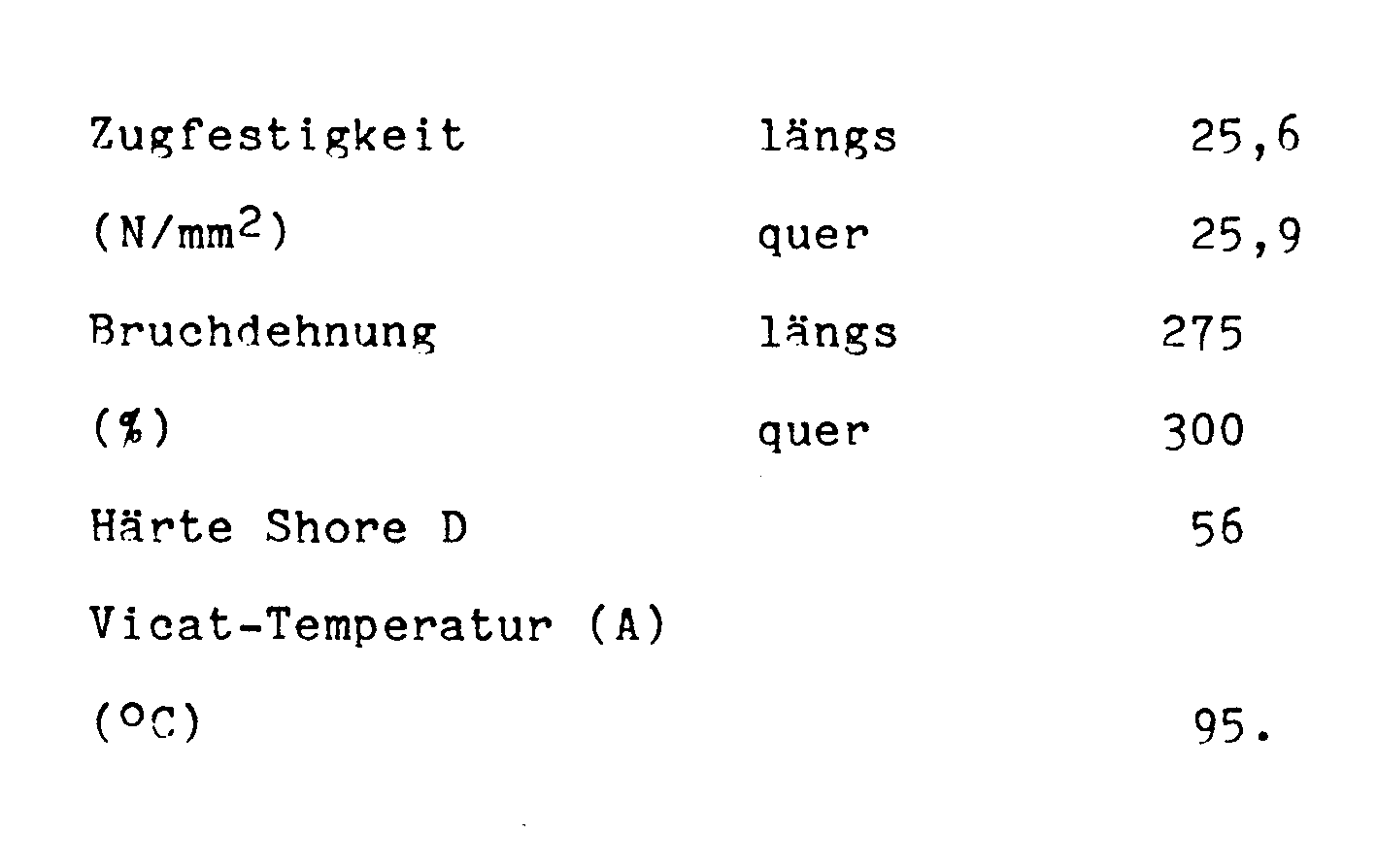
- Die entsprechend Beispiel 1 durchgeführten Tiefzieh-und Warmschrumpfungsprüfungen ergaben folgende Ergebnisse:

- Hieraus ergibt sich ebenfalls die Eignung des Mischpolvmerisats aus Styrol-Acrylnitril.
- Anstelle des Styrol-Copolymerisates wird ein Mischpolymerisat auf der Basis eines Methacrylsäureesters in folgender Mischung verwendet:
- 55 Gew.-Teile acrylgepfropftes Polyvinylchlorid Acrylesteranteil ca. 40 Gew.-%, bezogen auf 100 Gew.-% acrylgepfropftes PVC),
- 30 Gew.-Teile Methycrylsäureester-Copolymerisat,
- 15 Gew.-Teile Ethylen-Kohlenmonoxyd-Vinylacetat-Terpolymerisat (Kohlenmonoxidgehalt ca. 12 %, Vinylacetatgehalt ca. 28 %)
- An dieser Folie wurden folgende Prüfwerte nach DIN-Norm gemessen:


- Die Verwendung des Mischpolymerisates auf der Basis von Methacrylsäureester ergibt, verglichen mit dem δ Methylstyrol-Acrylnitril-Mischpolymerisat, wesentlich weichere Folie, die aber im Verformungsverhalten noch günstiger sind als die Vergleichsmischung.
und daraus eine 0,4 mm dicke Folie kalandriert.
Claims (10)
Priority Applications (1)
| Application Number | Priority Date | Filing Date | Title |
|---|---|---|---|
| AT84112691T ATE40395T1 (de) | 1983-11-24 | 1984-10-20 | Formmassen mit verbesserten verarbeitungseigenschaften und daraus hergestellte alterungsbestaendige kunststoffolien. |
Applications Claiming Priority (2)
| Application Number | Priority Date | Filing Date | Title |
|---|---|---|---|
| DE19833342435 DE3342435A1 (de) | 1983-11-24 | 1983-11-24 | Formmassen mit verbesserten verarbeitungseigenschaften und daraus hergestellte alterungsbestaendige kunststoffolien |
| DE3342435 | 1983-11-24 |
Publications (2)
| Publication Number | Publication Date |
|---|---|
| EP0143321A1 true EP0143321A1 (de) | 1985-06-05 |
| EP0143321B1 EP0143321B1 (de) | 1989-01-25 |
Family
ID=6215113
Family Applications (1)
| Application Number | Title | Priority Date | Filing Date |
|---|---|---|---|
| EP84112691A Expired EP0143321B1 (de) | 1983-11-24 | 1984-10-20 | Formmassen mit verbesserten Verarbeitungseigenschaften und daraus hergestellte alterungsbeständige Kunststoffolien |
Country Status (4)
| Country | Link |
|---|---|
| EP (1) | EP0143321B1 (de) |
| JP (1) | JPS60133045A (de) |
| AT (1) | ATE40395T1 (de) |
| DE (2) | DE3342435A1 (de) |
Cited By (5)
| Publication number | Priority date | Publication date | Assignee | Title |
|---|---|---|---|---|
| EP0204924A1 (de) * | 1985-05-15 | 1986-12-17 | Alkor Gmbh Kunststoffe | Formmassen mit verbesserten Verarbeitungseigenschaften und daraus hergestellte alterungsbeständige Kunststoffolien |
| EP0224913A3 (en) * | 1985-12-03 | 1988-09-28 | Wacker-Chemie Gmbh | Flexible to soft moulded objects based on graft copolymers of acrylates and vinyl chloride |
| US4902557A (en) * | 1988-01-25 | 1990-02-20 | E. I. Du Pont De Nemours And Company | Thermoplastic polyolefin composite structure |
| WO2017005920A1 (en) * | 2015-07-09 | 2017-01-12 | Arkema France | Polymer composition with filler, its method of preparation and use |
| WO2017005922A1 (en) * | 2015-07-09 | 2017-01-12 | Arkema France | Polymer composition, its method of preparation and use |
Families Citing this family (2)
| Publication number | Priority date | Publication date | Assignee | Title |
|---|---|---|---|---|
| DE3714182A1 (de) * | 1987-04-29 | 1988-11-10 | Alkor Gmbh | Kunststoffbahn oder kunststoffolie |
| JP6510906B2 (ja) * | 2014-12-12 | 2019-05-08 | 積水化学工業株式会社 | ポリ塩化ビニル系樹脂シート |
Citations (2)
| Publication number | Priority date | Publication date | Assignee | Title |
|---|---|---|---|---|
| US3959550A (en) * | 1974-07-31 | 1976-05-25 | The Goodyear Tire & Rubber Company | Films prepared from PVC grafted with acrylate-nitrile mixtures |
| GB2045163A (en) * | 1979-02-26 | 1980-10-29 | Grace W R & Co | Compressible press packing containing non-compressible thermosol lamina |
-
1983
- 1983-11-24 DE DE19833342435 patent/DE3342435A1/de not_active Withdrawn
-
1984
- 1984-10-20 AT AT84112691T patent/ATE40395T1/de active
- 1984-10-20 DE DE8484112691T patent/DE3476411D1/de not_active Expired
- 1984-10-20 EP EP84112691A patent/EP0143321B1/de not_active Expired
- 1984-11-22 JP JP59246400A patent/JPS60133045A/ja active Pending
Patent Citations (2)
| Publication number | Priority date | Publication date | Assignee | Title |
|---|---|---|---|---|
| US3959550A (en) * | 1974-07-31 | 1976-05-25 | The Goodyear Tire & Rubber Company | Films prepared from PVC grafted with acrylate-nitrile mixtures |
| GB2045163A (en) * | 1979-02-26 | 1980-10-29 | Grace W R & Co | Compressible press packing containing non-compressible thermosol lamina |
Non-Patent Citations (1)
| Title |
|---|
| CHEMICAL ABSTRACTS, Band 97, Nr. 24 December 1982, Seite 39, Nr. 199073g COLUMBUS, OHIO, (US) * |
Cited By (11)
| Publication number | Priority date | Publication date | Assignee | Title |
|---|---|---|---|---|
| EP0204924A1 (de) * | 1985-05-15 | 1986-12-17 | Alkor Gmbh Kunststoffe | Formmassen mit verbesserten Verarbeitungseigenschaften und daraus hergestellte alterungsbeständige Kunststoffolien |
| US4801648A (en) * | 1985-05-15 | 1989-01-31 | Roland Fink | Molding materials having improved processing properties, and aging-resistant plastic sheets produced from these materials |
| EP0224913A3 (en) * | 1985-12-03 | 1988-09-28 | Wacker-Chemie Gmbh | Flexible to soft moulded objects based on graft copolymers of acrylates and vinyl chloride |
| US4902557A (en) * | 1988-01-25 | 1990-02-20 | E. I. Du Pont De Nemours And Company | Thermoplastic polyolefin composite structure |
| WO2017005920A1 (en) * | 2015-07-09 | 2017-01-12 | Arkema France | Polymer composition with filler, its method of preparation and use |
| WO2017005922A1 (en) * | 2015-07-09 | 2017-01-12 | Arkema France | Polymer composition, its method of preparation and use |
| FR3038612A1 (de) * | 2015-07-09 | 2017-01-13 | Arkema France | |
| FR3038611A1 (de) * | 2015-07-09 | 2017-01-13 | Arkema France | |
| US10851231B2 (en) | 2015-07-09 | 2020-12-01 | Arkema France | Polymer composition with filler, its method of preparation and use |
| EA039094B1 (ru) * | 2015-07-09 | 2021-12-02 | Аркема Франс | Полимерная композиция, способ ее получения и применение |
| EA039176B1 (ru) * | 2015-07-09 | 2021-12-14 | Аркема Франс | Полимерная композиция с наполнителем, способ ее получения и применение |
Also Published As
| Publication number | Publication date |
|---|---|
| DE3476411D1 (en) | 1989-03-02 |
| JPS60133045A (ja) | 1985-07-16 |
| EP0143321B1 (de) | 1989-01-25 |
| ATE40395T1 (de) | 1989-02-15 |
| DE3342435A1 (de) | 1985-06-05 |
Similar Documents
| Publication | Publication Date | Title |
|---|---|---|
| DE69308174T2 (de) | Polyolefin-Formmasse, Verfahren zu ihrer Herstellung und daraus hergestellte Formkörper | |
| EP0224913B2 (de) | Flexible bis weiche Formkörper auf der Basis von Vinylchlorid-Acrylsäureester-Pfropfcopolymerisat | |
| EP0700413B1 (de) | Unter verwendung halogenfreier treibmittel hergestellte schaumstoffplatten | |
| DE4101806A1 (de) | Schockabsorbierende propylenpolymer-verbundformteile | |
| EP0658178B1 (de) | Folie oder formkörper aus einem mehrphasigen kunststoff sowie dessen verwendung zur herstellung von verbundfolien | |
| EP1877471B1 (de) | Formmasse aus einer polyesterharzzusammensetzung, folie hergestellt aus der formmasse und verfahren zur herstellung einer folie oder einer folienbahn | |
| EP0143321B1 (de) | Formmassen mit verbesserten Verarbeitungseigenschaften und daraus hergestellte alterungsbeständige Kunststoffolien | |
| EP0298282B1 (de) | Folie und Verfahren zu deren Herstellung | |
| EP0099455B1 (de) | Verbundfolien | |
| DE69420668T2 (de) | Styrolharzzusammensetzung und Spritzgegossene und stranggepresste Artikel | |
| EP1813645B1 (de) | PVC-Zusammensetzung und deren Verwendung | |
| DE19848683B4 (de) | Verbundschichtplatte | |
| EP0101904B1 (de) | Formmassen aus Vinylchloridpolymerisat, bestimmten Copolymerisaten und polymeren Weichmachern mit hoher Alterungsbeständigkeit | |
| DE4214170A1 (de) | Verwendung eines zusatzes von vernetzten pp-epdm-mischungen zur kraftfahrzeugfolienherstellung | |
| EP0298208B1 (de) | Butadienfreie Folie und Verfahren zur Herstellung derselben | |
| EP0204924B1 (de) | Formmassen mit verbesserten Verarbeitungseigenschaften und daraus hergestellte alterungsbeständige Kunststoffolien | |
| DE3204144C2 (de) | ||
| DE3615028A1 (de) | Thermoformbare folie | |
| EP0377148B1 (de) | Folie, insbesondere tiefziehfähige Folie für Kraftfahrzeuginnenräume | |
| DE3227107A1 (de) | Folien, insbesondere tiefziehfaehige folien, fuer kraftfahrzeuginnenraeume und daraus hergestellte formkoerper oder formkoerperteile fuer den kraftfahrzeuginnenraum | |
| EP0320702A1 (de) | Matte Flächengebilde | |
| DE3517583A1 (de) | Formmassen mit verbesserten verarbeitungseigenschaften und daraus hergestellte alterungsbestaendige kunststoffolien | |
| DE3608661A1 (de) | Waermeformbestaendige formmasse | |
| DE8414600U1 (de) | Formkörper, Formkörperteile oder Folienbahnen für den Kraftfahrzeuginnenraum | |
| EP0742247A2 (de) | Verwendung von kautschukartigen Copolymerisaten aus Basis von Alkylacrylaten und Acrylnitril zur Herstellung von flexiblen Folien |
Legal Events
| Date | Code | Title | Description |
|---|---|---|---|
| PUAI | Public reference made under article 153(3) epc to a published international application that has entered the european phase |
Free format text: ORIGINAL CODE: 0009012 |
|
| 17P | Request for examination filed |
Effective date: 19841105 |
|
| AK | Designated contracting states |
Designated state(s): AT BE CH DE FR GB IT LI LU NL SE |
|
| RTI1 | Title (correction) | ||
| 17Q | First examination report despatched |
Effective date: 19860610 |
|
| R17C | First examination report despatched (corrected) |
Effective date: 19870327 |
|
| ITF | It: translation for a ep patent filed | ||
| GRAA | (expected) grant |
Free format text: ORIGINAL CODE: 0009210 |
|
| AK | Designated contracting states |
Kind code of ref document: B1 Designated state(s): AT BE CH DE FR GB IT LI LU NL SE |
|
| REF | Corresponds to: |
Ref document number: 40395 Country of ref document: AT Date of ref document: 19890215 Kind code of ref document: T |
|
| REF | Corresponds to: |
Ref document number: 3476411 Country of ref document: DE Date of ref document: 19890302 |
|
| GBT | Gb: translation of ep patent filed (gb section 77(6)(a)/1977) | ||
| ET | Fr: translation filed | ||
| PLBE | No opposition filed within time limit |
Free format text: ORIGINAL CODE: 0009261 |
|
| STAA | Information on the status of an ep patent application or granted ep patent |
Free format text: STATUS: NO OPPOSITION FILED WITHIN TIME LIMIT |
|
| 26N | No opposition filed | ||
| ITTA | It: last paid annual fee | ||
| EPTA | Lu: last paid annual fee | ||
| EAL | Se: european patent in force in sweden |
Ref document number: 84112691.5 |
|
| PGFP | Annual fee paid to national office [announced via postgrant information from national office to epo] |
Ref country code: SE Payment date: 19950829 Year of fee payment: 12 |
|
| PGFP | Annual fee paid to national office [announced via postgrant information from national office to epo] |
Ref country code: FR Payment date: 19950915 Year of fee payment: 12 |
|
| PGFP | Annual fee paid to national office [announced via postgrant information from national office to epo] |
Ref country code: BE Payment date: 19950922 Year of fee payment: 12 |
|
| PGFP | Annual fee paid to national office [announced via postgrant information from national office to epo] |
Ref country code: CH Payment date: 19950926 Year of fee payment: 12 |
|
| PGFP | Annual fee paid to national office [announced via postgrant information from national office to epo] |
Ref country code: LU Payment date: 19951001 Year of fee payment: 12 |
|
| PGFP | Annual fee paid to national office [announced via postgrant information from national office to epo] |
Ref country code: AT Payment date: 19951010 Year of fee payment: 12 |
|
| PGFP | Annual fee paid to national office [announced via postgrant information from national office to epo] |
Ref country code: GB Payment date: 19951011 Year of fee payment: 12 |
|
| PGFP | Annual fee paid to national office [announced via postgrant information from national office to epo] |
Ref country code: NL Payment date: 19951031 Year of fee payment: 12 |
|
| PGFP | Annual fee paid to national office [announced via postgrant information from national office to epo] |
Ref country code: DE Payment date: 19960827 Year of fee payment: 13 |
|
| PG25 | Lapsed in a contracting state [announced via postgrant information from national office to epo] |
Ref country code: LU Free format text: LAPSE BECAUSE OF NON-PAYMENT OF DUE FEES Effective date: 19961020 Ref country code: GB Effective date: 19961020 Ref country code: AT Effective date: 19961020 |
|
| PG25 | Lapsed in a contracting state [announced via postgrant information from national office to epo] |
Ref country code: SE Effective date: 19961021 |
|
| PG25 | Lapsed in a contracting state [announced via postgrant information from national office to epo] |
Ref country code: LI Effective date: 19961031 Ref country code: CH Effective date: 19961031 Ref country code: BE Effective date: 19961031 |
|
| BERE | Be: lapsed |
Owner name: ALKOR G.M.B.H. KUNSTSTOFFE Effective date: 19961031 |
|
| PG25 | Lapsed in a contracting state [announced via postgrant information from national office to epo] |
Ref country code: NL Effective date: 19970501 |
|
| GBPC | Gb: european patent ceased through non-payment of renewal fee |
Effective date: 19961020 |
|
| REG | Reference to a national code |
Ref country code: CH Ref legal event code: PL |
|
| PG25 | Lapsed in a contracting state [announced via postgrant information from national office to epo] |
Ref country code: FR Effective date: 19970630 |
|
| NLV4 | Nl: lapsed or anulled due to non-payment of the annual fee |
Effective date: 19970501 |
|
| EUG | Se: european patent has lapsed |
Ref document number: 84112691.5 |
|
| REG | Reference to a national code |
Ref country code: FR Ref legal event code: ST |
|
| PG25 | Lapsed in a contracting state [announced via postgrant information from national office to epo] |
Ref country code: DE Free format text: LAPSE BECAUSE OF NON-PAYMENT OF DUE FEES Effective date: 19980701 |