EP0143598A2 - Système d'enregistrement et de reproduction à bande magnétique avec enfilage automatique de bande - Google Patents
Système d'enregistrement et de reproduction à bande magnétique avec enfilage automatique de bande Download PDFInfo
- Publication number
- EP0143598A2 EP0143598A2 EP84308047A EP84308047A EP0143598A2 EP 0143598 A2 EP0143598 A2 EP 0143598A2 EP 84308047 A EP84308047 A EP 84308047A EP 84308047 A EP84308047 A EP 84308047A EP 0143598 A2 EP0143598 A2 EP 0143598A2
- Authority
- EP
- European Patent Office
- Prior art keywords
- tape
- hub
- cartridge
- bearing
- carriage
- Prior art date
- Legal status (The legal status is an assumption and is not a legal conclusion. Google has not performed a legal analysis and makes no representation as to the accuracy of the status listed.)
- Withdrawn
Links
Images


Classifications
-
- G—PHYSICS
- G11—INFORMATION STORAGE
- G11B—INFORMATION STORAGE BASED ON RELATIVE MOVEMENT BETWEEN RECORD CARRIER AND TRANSDUCER
- G11B15/00—Driving, starting or stopping record carriers of filamentary or web form; Driving both such record carriers and heads; Guiding such record carriers or containers therefor; Control thereof; Control of operating function
- G11B15/675—Guiding containers, e.g. loading, ejecting cassettes
- G11B15/6751—Guiding containers, e.g. loading, ejecting cassettes with movement of the cassette parallel to its main side, i.e. front loading
-
- G—PHYSICS
- G11—INFORMATION STORAGE
- G11B—INFORMATION STORAGE BASED ON RELATIVE MOVEMENT BETWEEN RECORD CARRIER AND TRANSDUCER
- G11B15/00—Driving, starting or stopping record carriers of filamentary or web form; Driving both such record carriers and heads; Guiding such record carriers or containers therefor; Control thereof; Control of operating function
- G11B15/60—Guiding record carrier
- G11B15/66—Threading; Loading; Automatic self-loading
- G11B15/67—Threading; Loading; Automatic self-loading by extracting end of record carrier from container or spool
Definitions
- the present invention provides a small, high performance magnetic tape transport system for use in recording and reproducing data.
- the supply reel for the magnetic tape medium and the tape is carried in a pack or cartridge which is capable of being easily Loaded into the transport system for recording (writing) and reproducing (reading), and which cartridge is also easily removed from the system for storage.
- a take-up reel or hub is permanently carried by the transport.
- means are included for Loading, automaticaLLy positioning and seating a cartridge in contact with a drive mechanism in the transport, and for ejecting a cartridge therefrom.
- the separate cartridge drive and take-up hub are each driven by their own separate motor system in either a counter-clockwise or clockwise direction, as required, with the direction and speed of each motor being interrelated, as set forth in greater detail herein.
- the system includes a tape take-up hub, which hub includes a permanently attached semi-rigid Leader including a coupling portion, while the to-be-threaded magnetic tape includes a complimentary coupling portion.
- the transport system defines a specific path for the Leader to foLLow from the take-up hub so that it will reach and automatically couple with the tape, and then be rewound on the take-up hub.
- a different path is followed by the tape, which tape path places the tape in bearing-guiding system contact with associated transport mechanisms which provide for Low friction and Low stiction between the tape, the tape bearing-guiding system and the transducer over which the tape traverses.
- the system also provides for accurate tape edge guiding without tape edge damage.
- the speed of rotation of the take-up hub is controLLed by a tachometer Located in the take-up hub, while the relative speed of both motors is controLLed by a servo-system, aLL of which is detailed herein.
- a magnetic transducer is positioned adjacent the tape path to record on and/or reproduce data from the magnetic tape medium.
- the present invention contemplates reading and recording high-density data on the tape in a pLuraLity of serpentine paraLLeL tracks, say twenty or more, using an inexpensive magnetic transducer having a smaLL number of tracks.
- a system for both precisely positioning the head tracks and for quickly and accurately moving the head across the tape surface from track-to-track is provided.
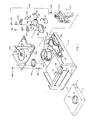
- Fig. 1 sets forth a perspective, schematic, exploded view of the mechanisms of interest in the present invention.
- the transport system 2 is designed to accept a magnetic tape cartridge 4, one cartridge 4 being shown in phantom outside of the transport and a portion of a cartridge shown positioned in the transport waiting to have tape threaded from it.
- Cartridge 4 is Loaded through door 6, shown closed in Fig. 1 (and also shown open in phantom).
- a take-up hub 10 having an attached Leader 40 is Located to receive tape 38 from cartridge 4.
- Leader 40 is semi-rigid, wider than tape 38, and is positioned to traverse threading path 50 defined by upper track 50A, shown in phantom, and Lower track 50B.
- Tape 38 is narrower than the distance between tracks 50A and 50B.
- Tape cartridge 4 includes a central hub 6 terminating in an external drive spline 8, and also includes a swingabLy openable door 11 through which tape 38, which terminates in finger assembly 39, can exit cartridge 4.
- a cartridge receiving chamber 12 exists within transport 2. Cartridge access to chamber 12 is gained only by first opening door 6 which is swingabLy mounted at its Lower end by means of pivots 14 to the system housing. Extending at an angle at each side of the Lower end of door 6 in the vicinity of pivot 14 is a Link arm 16. Within chamber 12 there is a cartridge receiving sleeve 17. SLeeve 17 includes bottom guide and support rails 18 (Fig. 2) along its Lower side, connected but is otherwise open on the bottom. At substantiaLLy the mid-point of each side wall of sleeve 17 is a central fulcrum 20 which rides on Load down adjustment pin 21 secured to base plate 25. At one side of chamber 12 is cartridge door opening wedge 22 (Figs.
- sleeve 17 The end of sleeve 17 which is opposed to door 6 includes a cartridge stop 24.
- BeLow sleeve 17 is a base plate 25 which supports drive spline 26 capable of being rotatably driven by a motor, not shown.
- Drive spline 26 is designed to mate with drive spline 8 of cartridge 4.
- Connected to the distal end of each Link arm 16 at pivot 27 is a one-piece Load-down and ejection spring 28 which terminates in distal portion 29, and which spring 28 is mounted to pass through central fulcrum 20 and guide block 30.
- a cartridge 4 (in phantom) is Loading within sleeve 17 of chamber 12 until its far end bears against stop 24.
- wedge opener 22 bears against a portion of cartridge door 11 as shown in Figs. 1 and 2 and schematically in Figs. 7B - 7G, causing door 11 to open and expose the end of tape 38.
- Link arm 16 rotates counter-clockwise so that Load down spring 28 connected thereto by pivot 27 is urged back and down within chamber 12 through and against central fulcrum 20.
- door 6 includes a Latch receiving opening 32 and system housing 34 carries a mating Locking Latch 36.
- Latch 34 is spring-Loaded to automatically engage Latch 36 when door 6 is closed.
- Latch 36 may be released manuaLLy, or in the preferred embodiment shown, Latch 36 is capable of being released by solenoid 37 in response to either machine controls or by the rewinding and parking of tape 38 within cartridge 4.
- FIG. 7A the elements of the automatic threading operation are shown in-top plan schematic detail as cartridge 4 is being Loaded into the system through door 6.
- tape take-up hub 10 around which semi-rigid Leader 40 is normaLLy wound.
- Hub 10 is indented at 42 (Fig. 9), while Leader 40 is cutout at 44 and carries finger receiving openings 46 for purposes described below.
- cartridge 4 and take-up hub 10 tape threading path 50 which circumnavigates bearing-guide assembly 80 and read/write transducer assembly 120, both of which are discussed in greater detail hereinbelow.
- a longitudinally movable hammer 52 actuable by solenoid 54 is Located in the vicinity of tape threading path 50 terminatus adjacent fuLLy inserted and seated cartridge 4 (Fig. 7B).
- Cartridge 4 includes reel 55 around which a Length of tape 38 carrying finger assembly 39 is wound.
- cartridge 4 includes pivotably openable door 11, while spring clip mounted cartridge door wedge opener 22 is carried within the cartridge receiving portion of the system.
- hub 10 includes an indentation 42 in its outer cylindrical surface. It is now seen that indentation 42 substantially matches the dimensions of finger assembly 39. In a similar manner cutout 44 in Leader 40 also- substantially matches the dimensions of the finger assembly 39 and is an equal Linear distance from both Leader holes 48 and hub indentation 42, which distance is equal to the circumference of hub 10. In preferred embodiments the Linear distance from take-up hub 10 to cartridge 4 is stightly Less than two times the circumference of hub 10. Since the Length of Leader 40 is about twice the circumference of hub 10, when Leader 40 is fuLLy extended it can reach to and within cartridge 4, and when Leader 40 is fully wound on hub 10 it makes only about two wraps on the hub. Other hub circumference, threading path, Leader Length multiples may be used.
- Fig. 10 at which two Leader paths 50X and 50Z are shown. Paths 50X and 50Z are at the termination of path 50 adjacent cartridge 4. Path 50X is the path which semi-rigid Leader 40 wiLL normally foLLow as it is "pushed" by hub 10 to advance into cartridge 4 without any tension on Leader 40. However, during rewinding tape 38 exerts puLL and tension on Leader 40, thus causing Leader 40 to enter path 50Z.
- leader 40 Due to the slightly different angle which Leader 40 takes with regard to finger assembly 39 along path 50Z, once tape 38 and finger assembly 39 are returned to cartridge 4, stopped, and parked in the cartridge at ramp 56, additional forward motion of Leader 40 then causes coupling holes 46 to disengage from fingers 39. Then, due to the separation between Leader 40 and fingers 39 due to path 50Z, Leader 40 and fingers 39 will not re-engage without some additional action occurring. Thus, after rewinding and separation of tape 38 and Leader 40 in the cartridge, counter-clockwise rotation of hub 10 will then cause Leader 40 to be withdrawn from cartridge 4.
- This wiLL in preferred embodiments cause triggering of a processor (not shown) to cause unlatching of door 6 by solenoid 37 through an electrical connection thereto from the processor, and thus allow the removal of cartridge 4 from the transport system.
- tape bearing guide assembly 80 is comprised of a support plate 82 including flat tape reference surfaces 84 to which bearing-guide support blocks 86 and 88, respectively are bonded, for example, with epoxy 89 (Figs. 12 and 14).
- Continuous bearing-guide element 90 is in turn bonded to bearing support block 86 to provide tape bearing-guiding surface 92, while a pair of tape bearing-guide elements 94 and 96 are bonded to support block 88 to provide a pair of adjacent tape bearing-guide surfaces 98 and 100, respectively.
- CompLiant edge guide 102 is secured in overlapping relation to bearing-guide surface 92 at the top of support block 86 and bearing-guide 90 by means of bolt 104.
- CompLiant edge guide 106 is secured in overlapping relation to tape bearing-guide surfaces 98 and 100 at the top of support block 88 and bearing-guides 94 and 96 by means of bolt 108 and a clamp XXX.
- the entire tape guide and bearing assembly 80 is secured to transport base plate deck 25 by bolt 110 and by additional bolts, not shown.
- Support structure 82 including reference surfaces 84, are preferably made of denser smooth, hard material, capable of conducting away static charge, and must be parallel to deck 25 and flat, particuLarLy at reference surfaces 84.
- MateriaLs of choice include hard anodized aluminum and metals which are coated with hard material such as plasma coated ceramic.
- Surfaces 92, 98 and 100 of bearing-guide elements 90, 94 and 96 are designed to provide hydrodynamic bearing to tape 38 when it is in LongitudinaL motion, with a tape to bearing separation of at Least 20 microinches Larger than the common asparities and debries on the tape.
- the arc radius of bearing-guide surfaces 92, 98 and 100 are selected to be equal to or Less than the width of tape 38, and are finished to a surface finish commensurate with a small separation air bearing.
- the height of bearing-guides 90, 94 and 96 are selected to be equal to, or as much as one mil. (O.OOL in.) Less than the minimum width of the tape.
- Adjacent bearing-guides 94 and 96 are Located and designed to provide tangent contact to tape 38 at surfaces 98 and 100, respectively, at points at which the tape is tensioned or moving between them.
- Each bearing-guide surface 98 and 100 is designed to have contact with a Length of tape, at any given moment, which is Less than or equal to the width of the tape.
- Bearing-guide elements 90, 94 and 96 will be made of material which is hard, non-porous, non-wettable by the tape, and capable of conducting away static charge.
- One material of choice for bearing-guide elements 90, 94 and 96 is a hot pressed mixture of aluminum oxide-titanium carbide.
- CompLiant edge guides 102 and 106 are formed from thin webs of non-magnetic spring material. They are designed to overlap the entire surface 92 and 98 of bearing-guide element 90 and the entire tangential bearing-guide portion of tape bearing-guide surfaces 98 and 100. CompLiant guides 102 and 106 provide downward force on the upper edge of tape 38 which to move and maintain the Lower edge of tape 38 against reference surfaces 84. It will be seen that compliant guide 102 includes three arms 111, 112, 113 connected by band 114, while compliant guide 106 includes four arms 115, 116, 117 and 118 connected by band 119.
- arms 112 and 117 are constructed 20-25% stiffer than the other arms to supply a greater guiding force in the region where the tape comes from the supply reel or hub to the bearing-guide system.
- any misalignment of the tape tend to exist from supply cartridge 4 to bearing-guide 90, or between take-up hub 10 and bearing-guide 96, as the tape passes between the compliant guides 102 or 106 and the reference surfaces 84, it is brought into proper alignment for accurate. inter-action with transducer head 122 in head positioning system 120. Furthermore, this is accomplished by deforming compliant guides 102 and 106 to conform to upper tape edge variations, rather than by deforming the tape.
- compliant guides 102 and 106 which come into contact with tape edges may be coated with a thin Layer of hard material to reduce wear, such as non-magnetic electroless nickel or plasma deposited ceramic. Such coatings should not increase stiffness by more than 20X.
- the geometry of the bearing-guide structure is such that the portion of compliant guide 102 on bearing-guide 94 which is closest to cartridge 4, and the portion of compliant guide 106 on bearing-guide 96 which is closest to take-up hub 10 are sLightLy further separated from reference surfaces 84 than is the rest of the compliant guide structures, with that separation gradually decreasing until it is no more than 1 mil Less than the tape width.
- This structure provides for a gradual guiding and realignment of tape which may be misaligned as it moves from cartridge 4 or hub 10 towards head positioning structure 120. This variation in separation is most easily accomplished by placing a shim 99 of the desired height between the appropriate portion of blocks 86 and 88 and support plate 82.
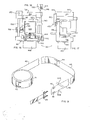
- Head positioning system 120 set forth in Fig. 1 in rear perspective is set forth in additional detail in Figs. 15, 16 and 17.
- Head system 120 including magnetic read/write head 122 is secured within opening 124 of base plate 25 using a plurality of bolts, e.g. 126 through cross-strut 120. When so Located head 122 intercepts and interacts with tape 38, as shown diagramatically in Fig. 7G.
- head system 120 must be provided as a compact, small volume, reliable and accurate package.
- undesired or extraneous movement of head 122 across the width of tape 38 wiLL cause data errors due to cross-talk between adjacent data tracks.
- rotation of the head will reduce the signal strength of data during recording, and/or will similarly reduce the strength of the signal read.
- support structure 130 to which cross-strut 128 is secured is provided.
- Both cross-strut 128 and support 130 are made of strong, non-magnetic material, such as aluminum or reinforced plastic, which has been made to provide a stable vertical connection for head 122 to the system.
- Support 130 includes a base portion 132 and a top portion 134 connected in the form of a C by Leg 136.
- CyLindricaL shaft 138 is fixed in perpendicular relation between base 132 and top 134.
- a second cylindrical shaft 140 is rotatably mounted in perpendicular relation between base 132 and top 134.
- RotatabLe shaft 140 terminates in an integral baLL 142 at its Lower end.
- shaft 140 Precise, angular rotation of shaft 140 is assured by seating ball 142 in angled conical socket 144 in base 132, while the upper body of shaft 140 is secured for rotation within wedge shaped clamp 146 of top 134 or a screw through the shaft 140.
- the azimuth of shaft 140, and therefore of head 122 can be adjusted by placing shims, not shown, between the shaft 140 and the shaft mounting surface at whichever face or faces wiLL cause the required adjustment.
- Stepping or Linear actuator motor 148 is secured to the vertical portion of base 132 by means of bolts 150. Stepping motor 148 drives Lead screw shaft 154 or a Linear actuation shaft through an opening in base 132.
- Head 122 is carried by head carriage 152 which includes an internal nut 156 for the Lead screw shaft (on a Locking nut, for the Linear actuator shaft) through which Lead screw shaft 154 is threaded.
- Loading spring 157 is provided around shaft 154 intermediate the top of base 132 and the bottom of carriage 152 in order to provide stability between carriage 152 and base 132. Such a Load spring could also be placed around shafts 138 and 140.
- CoupLer 158 connected to carriage 152 is slidably mounted on fixed shaft 138. Spring 159 within coupler 158 terminates at one end against carriage 152, and at the other end in hose 160 resting against shaft 138. This coupler arrangement provides stable Loading at the side of carriage 152 as it moves up and down within support 130
- wear of shaft 154 and nut 156 can be compensated. Wear compensation is accomplished by providing stop 161 having a known Location on support 130. By periodically driving carriage 152 against stop 161 to Locate the position of carriage 152 the resulting information can be used to calculate a new reference point.
- Detent 162 is fixed to support 130 by mounting pin 164 and spring arm 166.
- Rack 168 including a plurality of cLoseLy spaced V-shaped grooves 169 is mounted on head carriage 152.
- the force of detent 162 against a groove 169 of rack 168 due to the strength of spring 166 is sufficient to secure head carriage 152, and thus head 122, stable against unwanted perpendicular movement.
- SoLenoid 170 supported by top 134 is Located to strike spring arm 166 when actuated. When solenoid 170 is caused to strike spring arm 166, it causes detent 162 to disengage from rack 168 to allow head carriage 152 and head 132 to be moved perpendicularly.
- solenoid 170 When it is desired to move head carriage 152, solenoid 170 is activated and stepping motor 148 is actuated to cause Lead screw shaft 154 to rotate a predetermined number of turns within nut 156 to move carriage 154 and head 122 a given number of steps. This causes head carriage 152 and associated head 122 to move up or down a predetermined distance. Then, when solenoid 170 is deactivated detent 162 seats within one of the grooves 169 of rack 158 to provide a final precise track Location for head 122. For example, where grooves 169 are separated by about 0.0001 inch the stepping motor is only required to Locate carriage 152 and head 122 to ⁇ 0.003 inch, as the detent will then complete positioning of the carriage and head to within about 250 microinches.
- head 122 can be secured against rotation, and precisely and securely positioned in the desired azimuth. Due to the support and precise positioning provided to head carriage 152 by detent 162 and rack 168 motor 148 need operate with only nominal precision, and since it is required to develop LittLe force, can be quite small, need not be always "on” to hold the carriage in place (thus is done by the detent and rack) and will thus generate LittLe heat and require LittLe cooling.
- Take-up hub 10 has been discussed in substantial detail, above, with regard to its function in carrying Leader 40, of predetermined Length, and using that Leader to automatically thread tape 38 from cartridge 4 to take-up hub 10. Once tape 38 has been connected to hub 10, then hub 10 serves other functions. The other major function of hub 10 is to move tape 38 LongitudinaLLy in two directions by magnetic head 122 to write and read data. In so doing, hub 10 rotates at reLativeLy high speeds and can develop vibrations which can detrimentally affect the systems performance. It has been discovered that such vibrations are dampened by placing one or more ring(s) 172 of energy absorbing material between the drive shaft 174 of the associated motor (not shown) and take-up hub 10, or by bonding such material within the hub.
- the material used for dampening vibrations is selected in response to the bandwidth of vibrations generated by the system.
- MateriaLs of choice include rubber and synthetic rubber such as urethane. By simultaneously using rings of different materials or geometry, different frequency bandwidths of vibration can be dampened simultaneously.
- the inner portion of hub 10 also provides a Location of choice for a tachometer system. This is accomplished by securing tachometer ring 180 having central opening 182 on Ledge 184 within hub 10. Light source-sensor 186 and associated wires 188 are connected to slot 190 in cover plate 192 by means of bolt 194. Cover plate 192 is secured at each of its corners to deck 25 by stand-off bolts 196 and connecting bolts 198. As cover plate 192 is secured in place, Light source-sensor 186 is initially slid to the right in slot 190. Then, after the cover plate 192 is in place, Light source-sensor 180 is slid to the right to slot 190 to bracket tachometer ring 180. This arrangement provides a reliable yet inexpensive means for measuring the speed of revolution of hub 10.
- reel and hub 10 are each driven by a separate motor.
- the Length, say 400 feet, and wound thickness of the tape on each is known.
- the rotational speed of hub 10 is specifically measured by tachometer 180 Light source-sensor 186 and its related processor, not shown.
- a processor constantly tracks the wound radius of reel 55 and hub 10 and feeds adjustment back to each drive motor to adjust and control their relative rotational speed, and thus the LongitudinaL velocity of tape 38 at head 122.
- This same processor system applies current to the supplying reel creating a torque to control the tension of the tape. This is accomplished by the use of a mathematical model which describes tape path 70, including the wrap angle and friction of the tape with elements in its path, and the required tape tension of the head, and then determines the torque at the supply reel to achieve this tension.
- the tape path is also designed to avoid generating torsional and LateraL resonances which are either close to each other (within 20X) or to the exciting range of the drive motors and reels.
- the LateraL tape resonance from cartridge 4 to bearing-guide 90, from bearing-guide 90 to head 122, from head 122 to bearing-guides 94, and from bearing-guide 96 to take-up hub 10 must be greater than the torque ripple excitation frequency of the driving motor.
- There is a critical range of tape Lengths which will give tape 38 Low LateraL forces, and also provide the required high LateraL resonances. This pressure is Low for Low tape and guide wear and so that bending stresses due to tape stiffness are much Less than stress due to tape tension.
- reel 55 to hub 10 LongitudinaL LateraL frequency must be high enough to have the tape 38 to operate as though it were stiff and yet operate in the present desired high tension and velocity stable system. This is controlled by motor and reel inertia between reel 55 and hub 10, and there is a Limited range of tape Length that will meet this criteria.
- motor housings are integral with the Lower side of tape base plate 25 for improved heat transfer and better packaging efficiency.
- the present invention teaches a small, high performance magnetic tape transport system for use in recording and reproducing data.
- the supply reel for the magnetic tape medium and the tape is carried in a cartridge which is capable of being easily Loaded into and removed from the system for storage.
- means are included for Loading, automaticaLLy positioning and seating a cartridge in contact with a drive mechanism in the transport, and for ejecting a cartridge therefrom.
- the systems separate cartridge drive and take-up hub are taught to be driven by their own separate motor system, as required, with the direction and speed of each motor being interrelated.
- Automatic threading of the tape is taught using a semi-rigid Leader including a coupling portion which is permanently attached to the take-up hub.
- the to-be-threaded magnetic tape includes a coupling portion which is complimentary with the coupling portion of the Leader.
- the transport system is taught as defining a specific path for the Leader to foLLow from the take-up hub so that it reaches and couples with the tape, and is then rewound on the take-up hub.
- a different path is foLLowed by the tape after it is threaded, which tape path places the tape in bearing-guide system contact which provide for a Low friction and Low stiction and acceptable resonance between the tape, the tape bearing-guiding system, the transducer over which the tape traverses and the supply and take-up reels.
- the system also teaches accurate tape edge guiding without tape edge damage.
- the speed of rotation of the take-up hub is controlled by a tachometer Located in the take-up hub, while the relative speed of both motors is controlled by
- Magnetic transducer positioning adjacent the tape path is achieved using an inexpensive magnetic transducer mounted in a support system which precisely positions the head tracks and quickly and accurately moves the head across the tape surface.
Landscapes
- Automatic Tape Cassette Changers (AREA)
- Adjustment Of The Magnetic Head Position Track Following On Tapes (AREA)
Applications Claiming Priority (8)
| Application Number | Priority Date | Filing Date | Title |
|---|---|---|---|
| US55492483A | 1983-11-25 | 1983-11-25 | |
| US55493383A | 1983-11-25 | 1983-11-25 | |
| US555183 | 1983-11-25 | ||
| US554933 | 1983-11-25 | ||
| US06/555,183 US4635147A (en) | 1983-11-25 | 1983-11-25 | Cartridge loading and ejecting mechanism for use in a tape transport system |
| US554924 | 1983-11-25 | ||
| US06/554,934 US4646177A (en) | 1983-11-25 | 1983-11-25 | Automatic tape threading system for use in a tape transport system |
| US554934 | 1995-11-09 |
Publications (2)
| Publication Number | Publication Date |
|---|---|
| EP0143598A2 true EP0143598A2 (fr) | 1985-06-05 |
| EP0143598A3 EP0143598A3 (fr) | 1986-09-03 |
Family
ID=27504779
Family Applications (1)
| Application Number | Title | Priority Date | Filing Date |
|---|---|---|---|
| EP84308047A Withdrawn EP0143598A3 (fr) | 1983-11-25 | 1984-11-20 | Système d'enregistrement et de reproduction à bande magnétique avec enfilage automatique de bande |
Country Status (1)
| Country | Link |
|---|---|
| EP (1) | EP0143598A3 (fr) |
Cited By (14)
| Publication number | Priority date | Publication date | Assignee | Title |
|---|---|---|---|---|
| DE3637246A1 (de) * | 1985-11-01 | 1987-05-21 | Matsushita Electric Industrial Co Ltd | Anordnung zum einsetzen und entnehmen einer kassette bei einer elektronischen standbildkamera |
| EP0221762A3 (en) * | 1985-11-01 | 1988-07-27 | Cipher Data Products, Inc. | Transport for tape cartridge with leader block |
| EP0307917A1 (fr) * | 1987-09-17 | 1989-03-22 | Sanyo Electric Co., Ltd. | Mécanisme de porte frontale pour appareil d'enregistrement et/ou de reproduction de signaux à utiliser avec une cassette |
| EP0238260A3 (fr) * | 1986-03-21 | 1989-06-07 | Laser Magnetic Storage International Company | Appareil de transport recevant et actionnant une cassette à bande |
| GB2219427A (en) * | 1988-05-04 | 1989-12-06 | M4 Data Ltd | Tape drive machines |
| EP0359394A3 (fr) * | 1988-09-14 | 1990-08-16 | Cipher Data Products, Inc. | Dispositif d'extraction et d'insertion d'un bloc d'enfilage d'une cassette à bande |
| EP0892401A3 (fr) * | 1997-07-14 | 1999-01-27 | Quantum Corporation | Dispositif de blocage de bobine réceptrice |
| WO2001035401A1 (fr) * | 1999-11-11 | 2001-05-17 | Koninklijke Philips Electronics N.V. | Appareil d'enregistrement et/ou reproduction comprenant un element de retrait mobile sur un element de couplage monte sur cassette contre un sens de retrait |
| EP1098307A3 (fr) * | 1999-11-05 | 2001-07-18 | Nec Corporation | Mécanisme d'enfilage pour appareil d'enregistrement / de reproduction magnétique |
| WO2003032317A1 (fr) * | 2001-10-05 | 2003-04-17 | Quantum Corporation | Amorce de cartouche de bande a performances ameliorees pour cartouches a une seule bobine |
| EP1191534A3 (fr) * | 2000-09-26 | 2003-05-07 | Quantum Corporation | Amorce de bande et bobine d'enroulement pour dispositif d'entraínement de bande |
| WO2006017547A1 (fr) * | 2004-08-06 | 2006-02-16 | Storage Technology Corporation | Unite d’entrainement de bande dotee d’un mecanisme de raccord d’amorces |
| US7168648B2 (en) | 2001-10-05 | 2007-01-30 | Quantum Corporation | Performance tape cartridge leader for single reel tape cartridges |
| US7239474B1 (en) | 2004-05-13 | 2007-07-03 | Storage Technology Corporation | Leader connecting mechanism |
Family Cites Families (9)
| Publication number | Priority date | Publication date | Assignee | Title |
|---|---|---|---|---|
| FR1536787A (fr) * | 1967-01-23 | 1968-08-16 | Grundig Emv | Dispositif pour la mise en place de la bande, dans un appareil d'enregistrement et de restitution, en particulier dans un dictaphone |
| US3797776A (en) * | 1970-03-06 | 1974-03-19 | Victor Company Of Japan | Automatic tape loading type magnetic recording and reproducing apparatus |
| US3637164A (en) * | 1970-03-23 | 1972-01-25 | Singer Co | Cassette for recording medium |
| US3788571A (en) * | 1971-01-08 | 1974-01-29 | Cogar Corp | Tape cartridge loading and positioning system |
| US3848263A (en) * | 1972-09-26 | 1974-11-12 | Matsushita Electric Industrial Co Ltd | Recording and reproducing system with automatic tape threading |
| JPS5539057B2 (fr) * | 1972-12-29 | 1980-10-08 | ||
| JPS5315300Y2 (fr) * | 1973-06-05 | 1978-04-22 | ||
| JPS57117154A (en) * | 1981-01-14 | 1982-07-21 | Hitachi Ltd | Automatic loading device of tape |
| US4477851A (en) * | 1982-06-07 | 1984-10-16 | Microtek Storage Corporation | Magnetic data storage and drive apparatus |
-
1984
- 1984-11-20 EP EP84308047A patent/EP0143598A3/fr not_active Withdrawn
Cited By (22)
| Publication number | Priority date | Publication date | Assignee | Title |
|---|---|---|---|---|
| DE3637246A1 (de) * | 1985-11-01 | 1987-05-21 | Matsushita Electric Industrial Co Ltd | Anordnung zum einsetzen und entnehmen einer kassette bei einer elektronischen standbildkamera |
| EP0221762A3 (en) * | 1985-11-01 | 1988-07-27 | Cipher Data Products, Inc. | Transport for tape cartridge with leader block |
| US4809099A (en) * | 1985-11-01 | 1989-02-28 | Cipher Data Products, Inc. | Transport for tape cartridge with leader block |
| US4812931A (en) * | 1985-11-01 | 1989-03-14 | Matsushita Electric Industrial Co., Ltd. | Arrangement for setting and discharging of a cassette in electronic still camera |
| EP0238260A3 (fr) * | 1986-03-21 | 1989-06-07 | Laser Magnetic Storage International Company | Appareil de transport recevant et actionnant une cassette à bande |
| EP0307917A1 (fr) * | 1987-09-17 | 1989-03-22 | Sanyo Electric Co., Ltd. | Mécanisme de porte frontale pour appareil d'enregistrement et/ou de reproduction de signaux à utiliser avec une cassette |
| US4933790A (en) * | 1987-09-17 | 1990-06-12 | Sanyo Electric Co., Ltd. | Front door mechanism for signal recording-reproducing apparatus for use with cassette |
| GB2219427A (en) * | 1988-05-04 | 1989-12-06 | M4 Data Ltd | Tape drive machines |
| GB2219427B (en) * | 1988-05-04 | 1992-11-18 | M4 Data Ltd | Electric motors |
| EP0359394A3 (fr) * | 1988-09-14 | 1990-08-16 | Cipher Data Products, Inc. | Dispositif d'extraction et d'insertion d'un bloc d'enfilage d'une cassette à bande |
| EP0892401A3 (fr) * | 1997-07-14 | 1999-01-27 | Quantum Corporation | Dispositif de blocage de bobine réceptrice |
| EP1098307A3 (fr) * | 1999-11-05 | 2001-07-18 | Nec Corporation | Mécanisme d'enfilage pour appareil d'enregistrement / de reproduction magnétique |
| US6471150B1 (en) | 1999-11-05 | 2002-10-29 | Nec Corporation | Threading mechanism for magnetic recording/reproducing apparatus |
| WO2001035401A1 (fr) * | 1999-11-11 | 2001-05-17 | Koninklijke Philips Electronics N.V. | Appareil d'enregistrement et/ou reproduction comprenant un element de retrait mobile sur un element de couplage monte sur cassette contre un sens de retrait |
| EP1191534A3 (fr) * | 2000-09-26 | 2003-05-07 | Quantum Corporation | Amorce de bande et bobine d'enroulement pour dispositif d'entraínement de bande |
| WO2003032317A1 (fr) * | 2001-10-05 | 2003-04-17 | Quantum Corporation | Amorce de cartouche de bande a performances ameliorees pour cartouches a une seule bobine |
| GB2398921A (en) * | 2001-10-05 | 2004-09-01 | Quantum Corp | Improved performance tape cartridge leader for single reel tape cartridges |
| GB2398921B (en) * | 2001-10-05 | 2005-04-13 | Quantum Corp | Improved performance tape cartridge leader for single reel tape cartridges |
| US7168648B2 (en) | 2001-10-05 | 2007-01-30 | Quantum Corporation | Performance tape cartridge leader for single reel tape cartridges |
| US7239474B1 (en) | 2004-05-13 | 2007-07-03 | Storage Technology Corporation | Leader connecting mechanism |
| US7334750B2 (en) | 2004-05-13 | 2008-02-26 | Storage Technology Corporation | Tape drive with leader connecting mechanism |
| WO2006017547A1 (fr) * | 2004-08-06 | 2006-02-16 | Storage Technology Corporation | Unite d’entrainement de bande dotee d’un mecanisme de raccord d’amorces |
Also Published As
| Publication number | Publication date |
|---|---|
| EP0143598A3 (fr) | 1986-09-03 |
Similar Documents
| Publication | Publication Date | Title |
|---|---|---|
| US4646177A (en) | Automatic tape threading system for use in a tape transport system | |
| EP0143598A2 (fr) | Système d'enregistrement et de reproduction à bande magnétique avec enfilage automatique de bande | |
| US4635147A (en) | Cartridge loading and ejecting mechanism for use in a tape transport system | |
| CA1270948A (fr) | Dispositif de chargement de bande pour appareil d'enregistrement et/ou de lecture a cassette de bande magnetique | |
| EP0710391B1 (fr) | Element de guidage rotatif de bord de bande magnetique | |
| US7571872B2 (en) | Tape reel, recording tape cartridge, take-up reel, drawing-out member, and drive device | |
| JP3718524B2 (ja) | 弓状走査テープ駆動装置 | |
| JPH0628647A (ja) | 多重トラック方式のテープレコーダ用ヘッド位置合わせ機構 | |
| JPH07302474A (ja) | 共振応答を改善したヘッド・ガイド・アセンブリ | |
| US3913145A (en) | Cassette transport system with drive reel locking means | |
| JPS63503337A (ja) | 磁気記録再生装置 | |
| CA1319426C (fr) | Cartouche de bande magnetique compatible avec un lecteur de disque et dotee d'un guide de positionnement de la bande magnetique par rapport a la tete du lecteur | |
| KR100210336B1 (ko) | 회전 헤드 테이프 기록 및 재생장치 | |
| US5739976A (en) | Magnetic recording and reproducing apparatus | |
| US4747003A (en) | Head shifting device for information recording and/or reproducing apparatus | |
| US6844997B2 (en) | Head feeding mechanism having protrusion engaged with lead screw | |
| JP3590177B2 (ja) | テープ駆動装置 | |
| JP4060852B2 (ja) | データ記憶システム用のギャップ充填ブロック付き巻き取りハブを有するテープ装填装置及び方法 | |
| KR100466752B1 (ko) | 자기테이프카셋트장치 | |
| EP1775727A2 (fr) | Cassette à bande d'enregistrement et lecteur à cassette | |
| JPH01192050A (ja) | 磁気記録再生装置 | |
| US6654199B1 (en) | Recording/reproducing apparatus with reduced number of guide posts | |
| US6710970B2 (en) | Ejection mechanism for use in a tape drive that has an adjustable ejection amount | |
| WO1990014667A1 (fr) | Cartouche compacte a haute capacite de memorisation pour magnetophones de precision | |
| JP2605835Y2 (ja) | 磁気記録再生装置 |
Legal Events
| Date | Code | Title | Description |
|---|---|---|---|
| PUAI | Public reference made under article 153(3) epc to a published international application that has entered the european phase |
Free format text: ORIGINAL CODE: 0009012 |
|
| AK | Designated contracting states |
Designated state(s): DE FR GB IT NL |
|
| PUAL | Search report despatched |
Free format text: ORIGINAL CODE: 0009013 |
|
| AK | Designated contracting states |
Kind code of ref document: A3 Designated state(s): DE FR GB IT NL |
|
| 17P | Request for examination filed |
Effective date: 19870227 |
|
| 17Q | First examination report despatched |
Effective date: 19880420 |
|
| STAA | Information on the status of an ep patent application or granted ep patent |
Free format text: STATUS: THE APPLICATION IS DEEMED TO BE WITHDRAWN |
|
| 18D | Application deemed to be withdrawn |
Effective date: 19881231 |
|
| RIN1 | Information on inventor provided before grant (corrected) |
Inventor name: DURAND, CHARLES D. Inventor name: HEATH, ROBERT THOMPSON Inventor name: LYNCH, DONALD F. Inventor name: GADSBY, LARRY ROBERT Inventor name: PLATTER, SANFORD |