EP0143657B2 - Digitaler Röntgenaufnahmeapparat - Google Patents
Digitaler Röntgenaufnahmeapparat Download PDFInfo
- Publication number
- EP0143657B2 EP0143657B2 EP84308265A EP84308265A EP0143657B2 EP 0143657 B2 EP0143657 B2 EP 0143657B2 EP 84308265 A EP84308265 A EP 84308265A EP 84308265 A EP84308265 A EP 84308265A EP 0143657 B2 EP0143657 B2 EP 0143657B2
- Authority
- EP
- European Patent Office
- Prior art keywords
- image
- high frequency
- voltage
- switching device
- pulses
- Prior art date
- Legal status (The legal status is an assumption and is not a legal conclusion. Google has not performed a legal analysis and makes no representation as to the accuracy of the status listed.)
- Expired - Lifetime
Links
Images




Classifications
-
- H—ELECTRICITY
- H05—ELECTRIC TECHNIQUES NOT OTHERWISE PROVIDED FOR
- H05G—X-RAY TECHNIQUE
- H05G1/00—X-ray apparatus involving X-ray tubes; Circuits therefor
- H05G1/08—Electrical details
- H05G1/10—Power supply arrangements for feeding the X-ray tube
- H05G1/20—Power supply arrangements for feeding the X-ray tube with high-frequency AC; with pulse trains
-
- H—ELECTRICITY
- H04—ELECTRIC COMMUNICATION TECHNIQUE
- H04N—PICTORIAL COMMUNICATION, e.g. TELEVISION
- H04N23/00—Cameras or camera modules comprising electronic image sensors; Control thereof
- H04N23/30—Cameras or camera modules comprising electronic image sensors; Control thereof for generating image signals from X-rays
-
- H—ELECTRICITY
- H05—ELECTRIC TECHNIQUES NOT OTHERWISE PROVIDED FOR
- H05G—X-RAY TECHNIQUE
- H05G1/00—X-ray apparatus involving X-ray tubes; Circuits therefor
- H05G1/08—Electrical details
- H05G1/60—Circuit arrangements for obtaining a series of X-ray photographs or for X-ray cinematography
Definitions
- This invention relates to digital radiography apparatus for processing a plurality of x-ray images to produce a clear diagnostic image, as it is known from EP-A-0 088 609.
- a recent development is an apparatus which develops a diagnostic image of a patient (or other object) by illuminating the patient with x-rays and then uses a television camera employing an x-ray image intensifier to detect the x-ray transmission image of the patient.
- the most widely accepted of these apparatus employs the so-called digital subtraction process, in which the final diagnostic image displayed is the difference between x-ray images of a selected region of the patient obtained before and after the injection of a radiopaque, or x-ray contrast, medium into the region.
- the subtraction process involves first producing an x-ray image of the region before the injection of the contrast medium. This first image is used as a "mask image" to be subtracted from other images. After the injection of the x-ray contrast medium, a second x-ray image of the same region, the contrast image, is produced. Both the mask image and the contrast image are digitised; and then they are subjected to digital subtraction. For example, in angiography of the cranium, digital subtraction is carried between an ordinary cranial x-ray image made before the injection of the radiopaque medium and an x-ray contrast image made after injection in which, in effect, the cranial X-ray image and an angiographic image are superimposed. In this way, the data concerning the cranial X-ray image is eliminated.
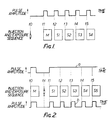
- the contrast medium is injected at a time t0 as shown in Figure 1 and, after the lapse of several seconds in which the contrast medium is allowed to spread, X-ray images are taken at intervals of, for example, 1 second and used to develop mask image M and successive contrast images S1, S2, S3, ....
- the X-rays are generated as pulses by using a tetrode between the high voltage generator and the X-ray tube to switch the power supply to the tube. Because tetrodes are expensive and suffer from the typical short service life of all vacuum tubes, this arrangement is undesirable.
- the present invention seeks to provide digital radiography apparatus which is capable of generating stable x-ray pulses irrespective of the PRI so as to obtain a clear diagnostic image with each pulsed x-ray.
- the high voltage generator used to supply power to the x-ray tube in the present invention does not employ a tetrode but instead includes a resonance-type high frequency inverter controlled in synchronism with the image processor.
- pulses of power can be supplied very effectively to the x-ray tube by switching the inverter. Furthermore, if control of the inverter's output is carried out using nonlinear feedback, the rise time of the pulses can easily be reduced below 1 ms. With such pulses, x-ray exposure of the living body can be reduced to a low level, and stable diagnostic images can be obtained.
- Figure 1 is a diagram of the injection and exposure sequence for digital radiography of a slowly-moving region of a patient.
- Figure 2 is a diagram of the injection and exposure sequence for digital radiography of a rapidly-moving region of a patient.
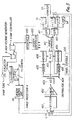
- FIG. 3 is a block diagram showing a typical radiography apparatus which may employ the present invention.
- Figure 4 is a schematic diagram of one embodiment of the high-voltage generator of Figure 3.
- FIG. 5 is a block diagram of the switch drive circuit of Figure 4.
- Figure 6a is a diagram illustrating various waveforms occurring in the image processor of Figure 3.
- Figure 6b is an enlarged diagram of the portion of Figure 6a shown in dashed circle C.
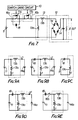
- Figure 7 is a schematic diagram of the equivalent circuit of the high-voltage generator of Figure 4.
- Figure 8 is a diagram showing voltage and current waveforms at various locations in the circuit of Figure 7.
- FIGS 9a-9e are simplified equivalent circuits of the high voltage generator shown in Figure 7 at different times throughout the resonance cycle.
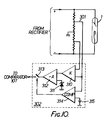
- Figure 10 is a partial schematic diagram illustrating a negative feedback arrangement to control and stabilise the supply voltage to the x-ray tube of Figure 4.
- Figure 11 is a block diagram of one embodiment of the x-ray controller of Figure 3.
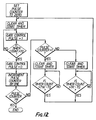
- Figure 12 is a flowchart for the program which would implement another embodiment of the x-ray controller of Figure 3.
- FIG. 3 is a block diagram showing a typical digital radiography apparatus which may employ this invention.
- X-ray tube 1 illuminates a region of patient 2 with x-rays, which penetrate the patient and are detected by a detecting system 3, usually comprising image intensifier 31, optical system 32, x-ray television camera 33 and camera control unit 34.
- Optical system 32 adjusts the quantity of radiation incident on camera 33 in response to x-rays actually detected.
- Camera control unit 34 outputs sequence signals corresponding to the x-ray image of the patient.
- An image processor 4 processes x-ray images obtained by detecting system 3 and generates visible diagnostic images. For example, in the case of diagnosis of blood vessels, images of bone are unnecessary; these are eliminated by digital subtraction in image processor 4.
- FIG 3 a typical image processor is shown which utilizes the digital subtraction process.
- System controller 400 exerts overall control of image processor 4.
- Linear-log converter 402 converts a linear analog input signal to a logarithmic analog output signal; this is then digitalized by A/ D converter 403.
- Distributor 404 distributes the output of A/D converter 403 to adder 405, adder 406, or ALU 407 as instructed by system controller 400.
- Memory 408 stores the digital mask image representing the patient before the injection of the X-ray contrast medium, while memory 409 stores a contrast image representing the patient after the injection of the X-ray contrast medium.
- ALU 407 performs the subtraction and outputs the difference between the mask and contrast images to image emphasis circuit 410, which processes the difference image into a clearer image by emphasizing edges of the image or by gamma adjustment.
- the output of image emphasis circuit 410 is converted into a series of analog signals by D/A converter 411 and displayed as a visual image by monitor 51. Usually only the difference image is displayed; however, one of the images stored in memory 408 or 409 may also be displayed visually by monitor 52, by similarly obtaining analog signals using D/A converter 412. Further, these visual images may be recorded into recording devices such as VTR 53 or VDR 54 or obtained in the form of a hard copy by printer 55.
- Panel console 420 provides for manual control of the digital radiography apparatus by an operator or physician. For example, processing modes may be selected through mode keys (not shown).
- System controller 400 also controls the timing of X-ray pulses; consequently, it is connected to X-ray controller 7 through interface circuit 430. In response to control signals from system controller 400, X-ray controller 7 supplies necessary signals to high voltage generator 6.
- High-voltage generator 6 is constructed, for example as shown in the schematic diagram of Figure 4, with a voltage-resonant-type high frequency inverter.
- the primary winding of transformer 13 is connected to a direct current power source 11 in series with main thyristor switch 16a and auxiliary thyristor switch 16b.
- Direct current power source 11 comprises a commercial alternating current power supply and a rectifier for rectifying the commercial voltage.
- Damping diodes 17a, 17b are connected in parallel (anode-to-cathode) with thyristors 16a and 16b.
- Resonance capacitor 18 is connected in parallel with main thyristor 16a. The switching of thyristors 16a, 16b is controlled by switch drive circuit 10.
- the output of the secondary winding of transformer 13 is rectified by diodes 19 and supplied to x-ray tube 1.
- the transformer secondary winding is divided into a plurality of windings, the outputs of which are rectified by diodes 19, added, and then supplied to x-ray tube 1.
- FIG. 5 is a block diagram of switch drive 10 in Figure 4.
- Drive circuit 10 includes sawtooth oscillator 101, whose frequency is for example 10 kH z , supplying its output to comparator 102, which compares the output with reference voltage 103 so as to output a train of pulses having a constant duty cycle Ton/T, wherein T is the pulse repetition interval (PRI) and Ton is the period during which thyristor 16a becomes conductive.
- the output pulses from comparator 102 are supplied to thyristor 16a through driver 105 when gate 104 is open.
- Gate 104 is controlled by a gate control pulse from x-ray controller 7.
- the output of sawtooth oscillator 101 is also supplied to comparator 107, which compares the output with a delay control voltage from D/A converter 108, which converts delay data from x-ray controller 7 into an analog voltage. Output pulses from comparator 107 are therefore delayed, with respect to the output pulses of comparator 102, by a delay time Td corresponding to the delay data.
- the output of comparator 107 is supplied to monostable multivibrator 109 which establishes its pulse width Tp.
- the output pulses from monostable multivibrator 109 are supplied to auxiliary thyristor 16b. Waveforms of pulses supplied to switches 16a and 16b are shown in Figure 6B.
- Image processor 4 of Fig. 3 has several image processing modes.
- mode 1 may be for obtaining a visual difference image of blood vessels, which are substantially stationary; and mode 2 may be for obtaining a visual difference image of the heart, which has relatively fast movement.
- mode 1 X-ray pulses should be emitted for example with a PRP of 1 second, while the PRP should be for example 33 ms in mode 2, and preferably the pulse amplitude should also be changed between modes. Therefore, system controller 400 contains a plurality of program routines for image processing, each corresponding to a different selectable mode. One program routine is executed in response to depression of each mode key (not shown) on panel console 420. System controller 400 controls image processor 4 according to the stored program routines, in a well known manner.
- the program additionally contains parameter data for the sequence of X-ray pulses corresponding to each mode.
- Parameter data supplied to X-ray controller 7 through interface 430 is synchronized with the image processing operation.
- Parameter data includes, for example, waiting time Tw (the time between the leading edge of the mask image pulse and the leading edge of the first contrast image pulse), pulse width Tq, contrast pulse repetition period Tr, and delay data.
- X-ray controller 7 generates the gate control pulse for controlling gate 104 according to all of the above parameter data except the delay data. (The waveform of the gate control pulse is shown in Figure 6A).
- Controller 7 may be a microprocessor or a combination of timers and pulse generators, as described below.
- the inverter circuit of high voltage generator 6 induces high voltage alternating current in the secondary winding of transformer 13 in Figure 4.
- This high voltage is rectified by diodes 19 and supplied to X-ray tube 1 as direct current power pulses shown in Figure 6A.
- the interval and width of these power pulses are determined by Tw, Tq and Tr, while their height Vh is determined by the delay data.
- System controller 400 controls camera control unit 34 so as to supply a transmission image in response to each X-ray pulse.
- the image obtained by detecting system 3 is stored in memory 408 as the mask image.
- Subsequent images are added by adder 406 and stored in memory 409 in response to X-ray pulses #1, #2, ..., #N.
- ALU 407 subtracts the corresponding picture elements in memories 408, 409 and obtains subtracted images, which may be displayed on monitor 51 or recorded into VTR 53.
- switches 16a and 16b are mutually synchronized, so that they switch ON simultaneously as shown in waveforms 204 and 205 in Figure 8.
- the terminal voltage Eout of capacitor 14 can be regarded as that of cell 14a, and the equivalent circuit is as shown in Figure 9A.
- the current i1 flowing through exciting inductance 13a of transformer 13 increases with time t as shown in waveform 200 in Figure 8, with the ratio of Ein/L1 of the voltage Ein of power source 11 to the value L1 of inductance 13a as coefficient.
- the current i2 flowing through leakage inductance 13b of transformer 13 has the waveform 202 shown in Figure 8, with the ratio (Ein-Eout)/L2 of the difference (Ein-Eout) between the input voltages and the value L2 of inductance 13b as its coefficient.
- the current flowing during the time Ton in switch elements 16a and 16b is therefore the sum of the above currents, namely, T on (Ein/L1)+T on (Ein-Eout)/L2.
- T on (Ein/L1)+T on (Ein-Eout)/L2 After main switch 16a opens, an inertial current flows in leakage inductance 13b for the period T,.
- the equivalent circuit in the period T1 is as shown in Figure 9B.
- the current i1 which was previously flowing in exciting inductance 13a now charges resonant capacitor 18 through input voltage source 11.
- the inertial current flowing in leakage inductance 13b also charges resonant capacitor 18 from cell 14a through input voltage source 11.
- the voltage Vc across resonant capacitor 18 rises as energy is stored in it (see waveform 201 in Figure 8), in a condition of resonance determined by the capacitance of capacitor 18 and the harmonic mean of inductances L1 and L2.
- the inertial current that was flowing in leakage inductance 13b disappears, the voltage across leakage inductance 13b drops to zero and the bridge rectifier in the load circuit turns "off".
- the equivalent circuit is then a single mesh comprising resonance capacitor 18 and exciting inductance 13a, as shown in Figure 9C.
- the period between t3 and t1 may be expressed as (Tmax-T3)-(Ton+T2).
- the range of permissible variation of the switching period is from Tmin to Tmax, and the ratio between the maximum and minimum values of power being supplied to the X-ray tube is about 5. This is one reason why the amount of power supplied in a voltage resonance switching type power supply circuit cannot be altered over a wide range without an auxiliary switch.
- auxiliary switch 16b is inserted in the above circuit in series with main switch 16a and its associated diode 17a and resonance capacitor 18.
- auxiliary switch 16b may be closed ( Figure 9E) within the period of conduction Ton of the main switch but delayed by a fixed amount Td, as shown in waveform 206 of Figure 8.
- Td the time t2 at which the current (i1+i2′) flowing in auxiliary switch 16b becomes zero and the time t4 at which this current again starts to flow.
- auxiliary switch 16a closes at the same time as main switch 16a, the supply of power to load 12 can be controlled by altering the switching cycle within the range Tmin to Tmax, referred to above.
- the amount of power supplied can also be altered by delaying the conduction timing of the auxiliary switch while maintaining the resonance conditions as mentioned above. It is therefore possible to adjust the power supply within a wide range by controlling this delay time.
- the amplitude (intensity) of X-ray pulses can be designated by supplying delay data from system controller 400 corresponding to each mode.
- the supply voltage to the X-ray tube 1 can be stabilized in a very easy and effective manner by detecting this supply voltage and using it to provide negative feedback control of the delay time Td of auxiliary switch 16b as shown, for example, in Figure 10.
- Feedback circuit 302 is a negative feedback loop comprising a coefficient circuit 310, a Zener diode 311, an error amplifier 312, a switch 313 and a comparator 314.
- Coefficient circuit 310 consists of an operational amplifier to receive the detected voltage from voltage divider 301 and to amplify it by a predetermined coefficient K. Both the output of coefficient circuit 13a, and a reference voltage regulated by Zener diode 311, are supplied to error amplifier 312 (also an operational amplifier). Error amplifier 312 outputs an error voltage representing the difference between the reference voltage and the output of the coefficient circuit 310.
- Comparator 314 compares the detected voltage with a standard voltage 315 whose magnitude corresponds to 90% of the rated or target voltage of X-ray tube 10 and outputs a control signal to switch 313 when the detected voltage is higher than the standard voltage. The switch is OFF whenever the detected voltage is less than the standard voltage, so that the negative feedback voltage loop is open. When the supply voltage to X-ray tube 10 reaches 90% of the target voltage, comparator 314 outputs the control signal and switch 313 turns ON, closing the negative feedback loop.
- the error voltage from error amplifier 312 is used for controlling the length of the delay time Td. When the detected voltage is less than the reference voltage, it shortens the delay time Td in response to the error voltage. Delay time Td is lengthened when the detected voltage is greater than the reference voltage.
- the auxiliary switch 16b is used for changing the duty cycle of power supplied by the high frequency inverter circuit.
- the inverter circuit it is possible for the inverter circuit to change the amount of power, and therefore, the voltage supplied to the X-ray tube, merely by changing the conductive timing (i.e., the delay time Td) of the auxiliary switch in regard to that of the main switch.
- FIG 11 is a block diagram of one possible construction of controller 7 using a combination of counters and pulse generators. (The portion of controller 7 which merely supplies digital delay data has been omitted for simplification).
- Clock 601 supplies clock pulses at a rate determined by the desired accuracy of X-ray pulse timing.
- image processor 4 is activated to begin making X-ray exposures of patient 2, system controller 400 applies an initial pulse to counter 603 via OR gate 605.
- the initial pulse resets, or clears, counter 603 which then begins counting clock pulses.
- the initial pulse also passes through OR gate 621 to monostable multivibrator 623, which outputs the mask pulse.
- System controller 400 stores the correct values T w and T r , respectively, in registers 607 and 609.
- T w is the time between the leading edge of the mask pulse and the leading edge of the first contrast pulse.
- T r is the time between the leading edges of successive mask pulses).
- the initial pulse from system controller 400 also resets flip-flop 611, which causes selector 613 to select the T w value for output.
- Comparator 615 continuously compares the output of selector 613 with the value being counted by counter 603; when the value in counter 603 equals or exceeds the value output from selector 613, comparator 615 outputs a pulse on line 617. This pulse performs four separate functions. First, it sets flip-flop 611, which causes selector 613 to select the value in the T r register for output. Second, it resets counter 603 through OR gate 605.
- T q register 629 stores the value of T q , the pulse width, and causes pulses output by monostable 623 to end at a time T q after they begin.
- N register 625 stores a number representing the total number of X-ray pulses to be produced.
- Comparator 627 continuously compares the value stored in register 625 with the value in counter 619. When the latter equals or exceeds the former, comparator 627 outputs an end pulse to system controller 400, which stops the exposure process.
- FIG 12 is a flow chart of the program which would implement controller 7 in the form of a microprocessor. (Once again, the step of simply supplying digital delay data to D/A converter 108 has been omitted for simplicity).
- the microprocessor requires both a timer and a pulse counter. Both are initially set to zero. When the mask pulse is to begin, the time is started, and the active high logic level is established on the gate control pulse line (the gate control pulse is set to one). The timer is then continually monitored to determine when it reaches a count greater than T q , the pulse width. When that occurs, the active low logic level is established on the gate control pulse line (the gate control pulse is set to zero), and the pulse counter is incremented by one, indicating that a pulse has been sent.
- the program determines whether exactly one pulse (the mask pulse) has been sent. If it has, the timer is cleared and started until it reaches a count of T w minus T q , the time between the trailing edge of the mask pulse and the leading edge of the first contrast pulse. At that time, the timer is again cleared and started, and the first contrast pulse is sent.
- the timer is cleared and restarted until it reaches a count of T r minus T q , the time between the trailing edge of one contrast pulse and the leading edge of the next. At that time, the timer is again cleared and started and the next contrast pulse is sent.
Landscapes
- Engineering & Computer Science (AREA)
- Multimedia (AREA)
- Signal Processing (AREA)
- X-Ray Techniques (AREA)
- Closed-Circuit Television Systems (AREA)
- Analysing Materials By The Use Of Radiation (AREA)
Claims (3)
- Digitaler Röntgenaufnahmeapparat zur Darstellung eines Röntgendurchleuchtungsbildes eines Objektes, mit:
einem Generator (6) für Hochspannungs-Gleichstrompulse;
einer Röntgenröhre (1), die durch die Hochspannungs-Gleichstrompulse betrieben wird, um Röntgenstrahlungspulse zu erzeugen;
einer Nachweiseinrichtung (31, 32, 33), die angeordnet ist, um die das Objekt durchdringenden Röntgenstrahlungspulse aufzunehmen, um das Röntgendurchleuchtungsbild in ein digitales Bild umzuwandeln;
einer Verarbeitungseinrichtung (4), die mit der Nachweiseinrichtung verbunden ist, um das digitale Bild mathematisch aufzubereiten; und
einer Anzeigeeinrichtung (51, 52), die mit der Verarbeitungseinrichtung verbunden ist, um das mathematisch aufbereitete Bild in ein sichtbares Bild umzuwandeln;
wobei der Generator für Hochspannungs-Gleichstrompulse einen Hochfrequenzinverter und einen Transformator enthält, um bei Anliegen eines Steuersignals hochfrequente Wechselstrompulse zu erzeugen;
wobei der Inverter eine Gleichstromquelle enthält, die mit der Primärwicklung des Transformators in Serie geschaltet ist;
gekennzeichnet durch
einen Hauptschalter (16a) in Reihe mit der Gleichstromquelle und der Primärwicklung, um bei Anliegen eines hochfrequenten Hauptschaltsignals abwechselnd zu öffnen und zu schließen;
einen Resonanz-Kondensator (18), der parallel zum Hauptschalter geschaltet ist, um zyklisch Energie aufzunehmen und wieder abzugeben;
eine Dämpfungsdiode (17a) in Parallelschaltung zum Kondensator und zum Hauptschalter, um zu ermöglichen, daß Strom in einer Richtung um den Hauptschalter herumgeleitet wird;
einen Hilfsschalter (16b) in Serienschaltung mit dem Hauptschalter, der Gleichstromquelle und der Primärwicklung, um bei Anliegen eines hochfrequenten Hilfsschaltsignals zu öffnen und zu schließen;
eine Hilfsdämpfungsdiode (17b) parallel zum Hilfsschalter, um zu ermöglichen, daß Strom in einer Richtung um den Hilfsschalter herumgeleitet wird; und
einen Schalttreiber (10), um das hochfrequente Hauptschaltsignal und um in einer bestimmten Phasenbeziehung das hochfrequente Hilfsschaltsignal zu erzeugen;
wobei der Transformator (13) mit dem Inverter verbunden ist, um die Spannung der hochfrequenten Wechselstrompulse zu erhöhen, und wobei ein Gleichrichter (19) mit dem Transformator verbunden ist, um die Wechselstrompulse erhöhter Spannung in Hochspannungs-Gleichstrompulse umzuwandeln; und
eine Steuereinrichtung, die mit der Verarbeitungseinrichtung gekoppelt ist, um ein Steuersignal für den Schalttreiber zu erzeugen, wodurch der Hilfsschalter mit einer vorbestimmten Phasenverzögerung nach dem Hauptschalter geschaltet werden kann. - Digitaler Röntgenaufnahmeapparat nach Anspruch 1, wobei die Nachweiseinrichtung eine Anzahl von Röntgendurchleuchtungsbildern in digitale Bilder umwandelt, und wobei die Verarbeitungseinrichtung eine Einrichtung enthält, um eines der digitalen Bilder von einem anderen der digitalen Bilder zu subtrahieren, um das mathematisch aufbereitete Bild zu erzeugen.
- Digitaler Röntgenaufnahmeapparat nach Anspruch 1 oder 2, wobei der Schalttreiber aufweist:
eine Verknüpfungseinrichtung (104), die auf das Steuersignal anspricht, um zu bewirken, daß der Schalttreiber das hochfrequente Hauptsignal erzeugt; und
eine Verzögerungseinrichtung, die auf das Steuersignal anspricht, um die Verzögerung zu bestimmen.
Applications Claiming Priority (2)
| Application Number | Priority Date | Filing Date | Title |
|---|---|---|---|
| JP58225717A JPS60119100A (ja) | 1983-11-30 | 1983-11-30 | X線装置 |
| JP225717/83 | 1983-11-30 |
Publications (4)
| Publication Number | Publication Date |
|---|---|
| EP0143657A2 EP0143657A2 (de) | 1985-06-05 |
| EP0143657A3 EP0143657A3 (en) | 1987-05-20 |
| EP0143657B1 EP0143657B1 (de) | 1990-09-05 |
| EP0143657B2 true EP0143657B2 (de) | 1995-08-09 |
Family
ID=16833703
Family Applications (1)
| Application Number | Title | Priority Date | Filing Date |
|---|---|---|---|
| EP84308265A Expired - Lifetime EP0143657B2 (de) | 1983-11-30 | 1984-11-28 | Digitaler Röntgenaufnahmeapparat |
Country Status (4)
| Country | Link |
|---|---|
| US (1) | US4706268A (de) |
| EP (1) | EP0143657B2 (de) |
| JP (1) | JPS60119100A (de) |
| DE (1) | DE3483135D1 (de) |
Families Citing this family (15)
| Publication number | Priority date | Publication date | Assignee | Title |
|---|---|---|---|---|
| DE3621803A1 (de) * | 1986-06-28 | 1988-01-07 | Philips Patentverwaltung | Roentgengenerator |
| US4807269A (en) * | 1987-04-02 | 1989-02-21 | Grady John K | Apparatus for powering x-ray tubes |
| DE3826550C2 (de) * | 1987-08-07 | 1994-01-13 | Toshiba Kawasaki Kk | Einrichtung zum Darstellen von Röntgenbildern |
| JPH02109546A (ja) * | 1988-10-18 | 1990-04-23 | Toshiba Corp | X線ct装置を用いた診断装置 |
| JP2729825B2 (ja) * | 1989-01-25 | 1998-03-18 | 株式会社日立メデイコ | 実時間デジタルラジオグラフィ装置 |
| JP2548018Y2 (ja) * | 1990-01-24 | 1997-09-17 | 興和 株式会社 | X線撮像装置 |
| JPH03266573A (ja) * | 1990-03-16 | 1991-11-27 | Hitachi Medical Corp | X線画像入力装置 |
| EP0487766A1 (de) * | 1990-11-27 | 1992-06-03 | Siemens Aktiengesellschaft | Röntgendiagnostikgenerator mit einem seinen Hochspannungstransformator speisenden Wechselrichter |
| US5119409A (en) * | 1990-12-28 | 1992-06-02 | Fischer Imaging Corporation | Dynamic pulse control for fluoroscopy |
| EP0648466B1 (de) * | 1993-10-13 | 2001-12-19 | Marconi Medical Systems, Inc. | Apparat zur Erzeugung von Röntgenbildern |
| JP3066944B2 (ja) * | 1993-12-27 | 2000-07-17 | キヤノン株式会社 | 光電変換装置、その駆動方法及びそれを有するシステム |
| US6195272B1 (en) | 2000-03-16 | 2001-02-27 | Joseph E. Pascente | Pulsed high voltage power supply radiography system having a one to one correspondence between low voltage input pulses and high voltage output pulses |
| EP2493382B1 (de) * | 2009-10-29 | 2018-07-18 | Analogic Corporation | Dreidimensionale scannerdatenkomprimierung |
| US9014336B2 (en) * | 2010-12-15 | 2015-04-21 | Koninklijke Philips N.V. | Power supply unit for an X-ray tube |
| US8737567B2 (en) | 2011-01-27 | 2014-05-27 | Medtronic Navigation, Inc. | Image acquisition optimization |
Family Cites Families (16)
| Publication number | Priority date | Publication date | Assignee | Title |
|---|---|---|---|---|
| DE2347178B2 (de) * | 1973-09-19 | 1975-09-18 | Siemens Ag, 1000 Berlin Und 8000 Muenchen | Röntgendiag nostikapparat |
| DE2350141B2 (de) * | 1973-10-05 | 1977-04-28 | Roentgendiagnostikapparat mit funktionstasten zur organprogrammierten einstellung der aufnahmedaten | |
| JPS536593A (en) * | 1976-07-08 | 1978-01-21 | Toshiba Corp | X-ray apparatus for diagnosis |
| JPS5919512B2 (ja) * | 1977-05-04 | 1984-05-07 | 株式会社東芝 | X線装置 |
| DE2755736A1 (de) * | 1977-12-14 | 1979-06-21 | Siemens Ag | Roentgendiagnostikapparat mit funktionstasten zur organprogrammierten einstellung der aufnahmedaten |
| DE2802505C2 (de) * | 1978-01-20 | 1986-10-02 | Siemens Ag, 1000 Berlin Und 8000 Muenchen | Röntgendiagnostikgenerator mit einem seinen Hochspannungstransformator speisenden Wechselrichter |
| DE2831093A1 (de) * | 1978-07-14 | 1980-01-24 | Siemens Ag | Roentgendiagnostikgenerator |
| JPS56119876A (en) * | 1980-02-27 | 1981-09-19 | Toshiba Corp | Semiconductor x-ray detector |
| JPS5753100A (en) * | 1980-09-13 | 1982-03-29 | Toshiba Corp | X-ray equipment |
| JPS5788446A (en) * | 1980-11-20 | 1982-06-02 | Toshiba Corp | X-ray cine-stereo photographing device |
| US4458267A (en) * | 1981-10-06 | 1984-07-03 | Analogic Corporation | Digital x-ray system |
| JPS58152540A (ja) * | 1982-03-09 | 1983-09-10 | 株式会社東芝 | X線診断装置 |
| JPS58141599U (ja) * | 1982-03-18 | 1983-09-24 | 株式会社 モリタ製作所 | 医療用x線照射電源装置 |
| US4482918A (en) * | 1982-04-26 | 1984-11-13 | General Electric Company | Method and apparatus for X-ray image subtraction |
| DE3218535A1 (de) * | 1982-05-17 | 1983-11-17 | Philips Patentverwaltung | Hochspannungserzeuger, insbesondere zur speisung einer roentgenroehre |
| US4504895A (en) * | 1982-11-03 | 1985-03-12 | General Electric Company | Regulated dc-dc converter using a resonating transformer |
-
1983
- 1983-11-30 JP JP58225717A patent/JPS60119100A/ja active Pending
-
1984
- 1984-11-28 EP EP84308265A patent/EP0143657B2/de not_active Expired - Lifetime
- 1984-11-28 DE DE8484308265T patent/DE3483135D1/de not_active Expired - Lifetime
- 1984-11-30 US US06/676,834 patent/US4706268A/en not_active Expired - Fee Related
Also Published As
| Publication number | Publication date |
|---|---|
| US4706268A (en) | 1987-11-10 |
| EP0143657B1 (de) | 1990-09-05 |
| EP0143657A2 (de) | 1985-06-05 |
| EP0143657A3 (en) | 1987-05-20 |
| DE3483135D1 (de) | 1990-10-11 |
| JPS60119100A (ja) | 1985-06-26 |
Similar Documents
| Publication | Publication Date | Title |
|---|---|---|
| EP0143657B1 (de) | Digitaler Röntgenaufnahmeapparat | |
| EP0102532B1 (de) | Vorspannungsgerät für eine Röntgenröhre | |
| US4541106A (en) | Dual energy rapid switching imaging system | |
| EP0138486B1 (de) | Impuls-Hochspannungsgerät für eine Röntgenröhre | |
| US4661896A (en) | High voltage power supply system including inverter controller | |
| US4520494A (en) | X-ray diagnostic apparatus | |
| EP0137401B2 (de) | Heizvorrichtung für den Glühfaden einer Röntgenröhre | |
| US4309612A (en) | X-Ray diagnostic generator with an inverter supplying the high voltage transformer | |
| US4670893A (en) | X-ray diagnostic apparatus | |
| KR100685562B1 (ko) | 이중-공진 발생기 제어 방법 | |
| US4796286A (en) | X-ray generator dose fluctuation suppression | |
| US4761804A (en) | High DC voltage generator including transition characteristics correcting means | |
| US5179582A (en) | Exposure control circuit for X-ray generation | |
| JPH11243688A (ja) | 直列共振インバータ | |
| US5155752A (en) | Output monitoring circuit for a radiation generator apparatus | |
| EP0088609B1 (de) | Röntgendiagnostikeinrichtung | |
| JP2847115B2 (ja) | 電圧信号の電圧制御方法 | |
| DE59206536D1 (de) | Verfahren zur Erzeugung kontrastreicher diagnostischer Röntgenaufnahmen sowie Schaltungsanordnung dafür | |
| US5007073A (en) | Method and apparatus for obtaining a selectable contrast image in an X-ray film | |
| US4777380A (en) | Method of switching the electric supply between independent load circuits | |
| US4851983A (en) | KVP regulator and resonant circuit for high frequency medical x-ray generator | |
| JPH0159719B2 (de) | ||
| JP3202058B2 (ja) | インバータ式x線高電圧装置 | |
| RU2045827C1 (ru) | Способ управления рентгеновским аппаратом | |
| JPH02100294A (ja) | X線用電源制御方法及び装置 |
Legal Events
| Date | Code | Title | Description |
|---|---|---|---|
| PUAI | Public reference made under article 153(3) epc to a published international application that has entered the european phase |
Free format text: ORIGINAL CODE: 0009012 |
|
| 17P | Request for examination filed |
Effective date: 19841213 |
|
| AK | Designated contracting states |
Designated state(s): DE GB NL |
|
| PUAL | Search report despatched |
Free format text: ORIGINAL CODE: 0009013 |
|
| AK | Designated contracting states |
Kind code of ref document: A3 Designated state(s): DE GB NL |
|
| 17Q | First examination report despatched |
Effective date: 19890203 |
|
| GRAA | (expected) grant |
Free format text: ORIGINAL CODE: 0009210 |
|
| AK | Designated contracting states |
Kind code of ref document: B1 Designated state(s): DE GB NL |
|
| REF | Corresponds to: |
Ref document number: 3483135 Country of ref document: DE Date of ref document: 19901011 |
|
| PLBI | Opposition filed |
Free format text: ORIGINAL CODE: 0009260 |
|
| 26 | Opposition filed |
Opponent name: SIEMENS AKTIENGESELLSCHAFT, BERLIN UND MUENCHEN Effective date: 19901217 |
|
| NLR1 | Nl: opposition has been filed with the epo |
Opponent name: SIEMENS AG |
|
| PLBI | Opposition filed |
Free format text: ORIGINAL CODE: 0009260 |
|
| 26 | Opposition filed |
Opponent name: PHILIPS PATENTVERWALTUNG GMBH Effective date: 19910425 Opponent name: SIEMENS AKTIENGESELLSCHAFT, BERLIN UND MUENCHEN Effective date: 19901217 |
|
| NLR1 | Nl: opposition has been filed with the epo |
Opponent name: PHILIPS PATENTVERWALTUNG GMBH |
|
| PUAH | Patent maintained in amended form |
Free format text: ORIGINAL CODE: 0009272 |
|
| STAA | Information on the status of an ep patent application or granted ep patent |
Free format text: STATUS: PATENT MAINTAINED AS AMENDED |
|
| 27A | Patent maintained in amended form |
Effective date: 19950809 |
|
| AK | Designated contracting states |
Kind code of ref document: B2 Designated state(s): DE GB NL |
|
| NLR2 | Nl: decision of opposition | ||
| NLR3 | Nl: receipt of modified translations in the netherlands language after an opposition procedure | ||
| PGFP | Annual fee paid to national office [announced via postgrant information from national office to epo] |
Ref country code: GB Payment date: 19961119 Year of fee payment: 13 |
|
| PGFP | Annual fee paid to national office [announced via postgrant information from national office to epo] |
Ref country code: NL Payment date: 19961128 Year of fee payment: 13 |
|
| PGFP | Annual fee paid to national office [announced via postgrant information from national office to epo] |
Ref country code: DE Payment date: 19961206 Year of fee payment: 13 |
|
| PG25 | Lapsed in a contracting state [announced via postgrant information from national office to epo] |
Ref country code: GB Free format text: LAPSE BECAUSE OF NON-PAYMENT OF DUE FEES Effective date: 19971128 |
|
| PG25 | Lapsed in a contracting state [announced via postgrant information from national office to epo] |
Ref country code: NL Free format text: LAPSE BECAUSE OF NON-PAYMENT OF DUE FEES Effective date: 19980601 |
|
| GBPC | Gb: european patent ceased through non-payment of renewal fee |
Effective date: 19971128 |
|
| PG25 | Lapsed in a contracting state [announced via postgrant information from national office to epo] |
Ref country code: DE Free format text: LAPSE BECAUSE OF NON-PAYMENT OF DUE FEES Effective date: 19980801 |
|
| NLV4 | Nl: lapsed or anulled due to non-payment of the annual fee |
Effective date: 19980601 |