EP0144824A2 - Verfahren und Vorrichtung zum Erzeugen eines gewünschten Randes auf Kopiermaterial in Kopiergeräten - Google Patents
Verfahren und Vorrichtung zum Erzeugen eines gewünschten Randes auf Kopiermaterial in Kopiergeräten Download PDFInfo
- Publication number
- EP0144824A2 EP0144824A2 EP84113740A EP84113740A EP0144824A2 EP 0144824 A2 EP0144824 A2 EP 0144824A2 EP 84113740 A EP84113740 A EP 84113740A EP 84113740 A EP84113740 A EP 84113740A EP 0144824 A2 EP0144824 A2 EP 0144824A2
- Authority
- EP
- European Patent Office
- Prior art keywords
- image
- path
- edge
- sensing
- Prior art date
- Legal status (The legal status is an assumption and is not a legal conclusion. Google has not performed a legal analysis and makes no representation as to the accuracy of the status listed.)
- Granted
Links
Images


Classifications
-
- G—PHYSICS
- G06—COMPUTING OR CALCULATING; COUNTING
- G06K—GRAPHICAL DATA READING; PRESENTATION OF DATA; RECORD CARRIERS; HANDLING RECORD CARRIERS
- G06K15/00—Arrangements for producing a permanent visual presentation of the output data, e.g. computer output printers
- G06K15/02—Arrangements for producing a permanent visual presentation of the output data, e.g. computer output printers using printers
- G06K15/16—Means for paper feeding or form feeding
-
- G—PHYSICS
- G03—PHOTOGRAPHY; CINEMATOGRAPHY; ANALOGOUS TECHNIQUES USING WAVES OTHER THAN OPTICAL WAVES; ELECTROGRAPHY; HOLOGRAPHY
- G03G—ELECTROGRAPHY; ELECTROPHOTOGRAPHY; MAGNETOGRAPHY
- G03G15/00—Apparatus for electrographic processes using a charge pattern
- G03G15/22—Apparatus for electrographic processes using a charge pattern involving the combination of more than one step according to groups G03G13/02 - G03G13/20
- G03G15/32—Apparatus for electrographic processes using a charge pattern involving the combination of more than one step according to groups G03G13/02 - G03G13/20 in which the charge pattern is formed dotwise, e.g. by a thermal head
- G03G15/326—Apparatus for electrographic processes using a charge pattern involving the combination of more than one step according to groups G03G13/02 - G03G13/20 in which the charge pattern is formed dotwise, e.g. by a thermal head by application of light, e.g. using a LED array
-
- G—PHYSICS
- G06—COMPUTING OR CALCULATING; COUNTING
- G06K—GRAPHICAL DATA READING; PRESENTATION OF DATA; RECORD CARRIERS; HANDLING RECORD CARRIERS
- G06K15/00—Arrangements for producing a permanent visual presentation of the output data, e.g. computer output printers
- G06K15/02—Arrangements for producing a permanent visual presentation of the output data, e.g. computer output printers using printers
- G06K15/12—Arrangements for producing a permanent visual presentation of the output data, e.g. computer output printers using printers by photographic printing, e.g. by laser printers
- G06K15/1204—Arrangements for producing a permanent visual presentation of the output data, e.g. computer output printers using printers by photographic printing, e.g. by laser printers involving the fast moving of an optical beam in the main scanning direction
- G06K15/1219—Detection, control or error compensation of scanning velocity or position, e.g. synchronisation
-
- Y—GENERAL TAGGING OF NEW TECHNOLOGICAL DEVELOPMENTS; GENERAL TAGGING OF CROSS-SECTIONAL TECHNOLOGIES SPANNING OVER SEVERAL SECTIONS OF THE IPC; TECHNICAL SUBJECTS COVERED BY FORMER USPC CROSS-REFERENCE ART COLLECTIONS [XRACs] AND DIGESTS
- Y10—TECHNICAL SUBJECTS COVERED BY FORMER USPC
- Y10S—TECHNICAL SUBJECTS COVERED BY FORMER USPC CROSS-REFERENCE ART COLLECTIONS [XRACs] AND DIGESTS
- Y10S101/00—Printing
- Y10S101/37—Printing employing electrostatic force
Definitions
- This invention relates to electrophotographic printing machines and more particularly to method and means for sensing the position of image receiving material and adjusting the position of the image on the. electrophotographic medium such that the image and the image receiving material are in proper alignment.
- the character generator may be, for example, a light source which is driven from information held in a digital memory.
- the light source may be a laser gun, an array of light emitting diodes, light modulators, etc. which produce light rays which are directed to the photoreceptor and cause it to bear a charge pattern which is an image of the information used to drive the character generator.
- the light source is caused to scan the photoreceptor over successive scan lines until an entire image is produced. The image is developed and fused to print (image) receiving material.
- the electrophotographic process is of the transfer type where photoreceptive material is placed around a rotating drum or arranged as a belt to be driven by a system of rollers.
- photoreceptive material is passed under a stationary charge generating station to place a relatively uniform electrostatic charge, usually several hundred volts, across the entirety of the photoreceptive surface.
- the photoreceptive surface is moved to an imaging station where it receives light rays to produce the desired image.
- the photoreceptive material is discharged to a relatively low level in white areas while dark areas continue to contain high voltage levels. In that manner, the photoreceptive material is caused to bear a charge pattern which corresponds to the printing, shading, etc. desired to be reproduced.
- discharge occurs in the dark portions.
- the image is sent to a developing station where developing material called toner is placed on the image.
- This material may be in the form of a black powder or liquid which carries a charge opposite in polarity to the charge pattern on the photoreceptor in a system which produces a positive image.
- the toner would carry the same polarity as the charge on the photoconductor. Because of the attraction of the charged toner, it adheres to the surface of the photoreceptor in proportions related to the shading of the image.
- black character printing should receive heavy toner deposits, white background areas should receive none and gray or otherwise shaded half-tone character portions should receive intermediate amounts.
- the developed image is moved from the developer to a transfer station where image receiving material, usually paper, is juxtaposed to the developed image on the photoreceptor.
- image receiving material usually paper
- a charge is placed on the back side of the paper so that when the paper is stripped from the photoreceptor, the toner material is held on the paper and removed from the photoreceptor.
- the remaining process steps call for permanently bonding the transferred toner material to the paper and- cleaning- residual toner left on the photoreceptor after the transfer operation. Thereafter, the photoconductor is reused for subsequent print production.
- a common variation on the above-described process used in many electrophotographic machines involves the use of specially prepared material where the material itself carries a coating of photosensitive material.
- the image is electrostatically placed directly on the image receiving paper.
- the paper is sent through a developer and then to a fuser for permanent bonding.
- Machines of this type avoid the residual toner problem and therefore avoid the need for cleaning stations.
- the resulting paper with its special photosensitive coating is more expensive than plain bond paper and special coating is considered to detract from the resulting product.
- coated paper machines are usually favored only for low volume applications or where quality product is not essential.
- this invention is directed toward means and method for adjusting the position of an image such that the image mates properly with the position of image receiving material.
- a sensing unit is provided such that the position of the side edge of image receiving material is sensed. That information is provided to data processing equipment which in turn adjusts the position of the image on the photoreceptor so that a proper relationship between the image and the image receiving material is provided. Proper positioning of the image is accomplished by changing the start of scan position at which light rays are directed toward the photoconductor by the character generating printhead.
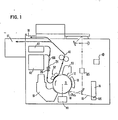
- FIG. 1 An electrophotographic machine capable of using the instant invention is shown in FIG. 1.
- a drum 11 carries upon its surface photoreceptive material 12 which is charged by charge corona 13 to a relatively uniform voltage as drum 11 rotates in direction A.
- the optical system, shown as module 14, generates light rays 15 which strike the moving photoreceptive surface at exposure station 16.
- the latent image produced at exposure station 16 is developed by developer 51 and a transfer is made at transfer station 52 to image receiving material. Development material continuing to reside on the surface of photoreceptor 12 after transfer is cleaned away at cleaning station 53. Drum rotation continues for the production of additional prints.
- FIG. 1 After transfer of the image to the receiving material at transfer station 52, that material is passed through fuser rolls 60 at which the developing material is permanently bonded to the receiving material to produce a print. The print is ultimately deposited at a finishing station 17 or in an exit pocket 18.
- Other machine elements shown in FIG. 1 include drive motor 90, print material supply bins 62 and 63, path 66 along which print receiving material is moved, feeding rolls 20 for moving material along the path, and a sensing unit 21 to be described in detail later herein.
- an optical system 65 for imaging an original document when the machine is used as a copier machine instead of as a printer.
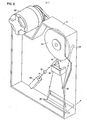
- Optical system module 14 is shown in detail in FIG. 2 where a solid-state laser producing chip and- a collimating lens are housed in assembly 100.
- Laser beam 15 passes from assembly 100 through cylindrical lens 101 to a rotating mirror 102 which is produced with a plurality of facets, such as facet 103, around the periphery of the mirror.
- the laser beam is reflected from a single facet, such as facet 103, in such a manner as to scan through an angle 0.
- each succeeding facet of rotating mirror 102 rotates into position to receive beam 15, another scan through the angle 0 is produced.
- assembly 104 Upon reflection from the rotating mirror facet, the laser beam is passed through assembly 104 at which a toroidal lens and a spherical lens are used to finally shape the beam and to focus it upon the photoreceptive surface 12 shown in FIG. 1. It may be noted that assembly 104 could also be composed of a" combination of a cylindrical and spherical lens if desired.
- a beam-fold mirror 105 is shown in both FIGS. 1 and 2 illustrating the final folding mechanism to direct the laser beam to the photoreceptive surface.
- Motor 106 is provided to drive the rotating mirror 102 while a start-of-scan mirror 107-is provided to direct the laser beam to a start-of-scan detector 108.
- control unit 19 (FIG. 1) which in turn controls the optical unit 14 to provide the needed changes in the position of light rays 15 to maintain the margin 201.
- FIGS. 7A and 7B Flowcharts of the control exercised in control unit 19 to perform this operation are shown in FIGS. 7A and 7B.
- Control unit 19 contains a microprocessor which periodically enters the Sense routine shown in FIG. 7A.
- step 150 is performed to check the input status of paper feed rolls 20. That status is loaded and the updated information stored at step 151. Should there be no change in the status of rolls 20 as determined at decision step 152, the Sense program is exited and return is made to the microprocessor control program. However, if step 152 indicates that the status of rolls 20 has changed, step 153 is performed to determine whether rolls 20 are now active. If the indication is that rolls 20 are now inactive, the Sense routine is exited and return is made to the control program of the microprocessor.
- step 154 is performed to read the data provided by sensors 23-30. That data is then translated at step 155 to produce buffer data as shown in FIG. 7C for presentation to the image generator.
- step 156 an output step is performed to write the translated data to the buffer and set the valid bit showing that the buffer contains data for use by the image generator.
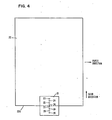
- the Sense routine performs three check operations at steps 157, 158, and 159 to determine that the data which has been sensed and stored in steps 154-156 is reliable. To do this, at step 157 the query is asked whether all sensors 23-30 were on. If so, it indicates that the paper 22 is displaced so far to the left (FIG. 4) that all sensors were left uncovered. As a consequence, the exact position of edge 22A cannot be ascertained by the sensors and therefore the information which has been stored in the buffer is not reliable. In such case, a branch is taken at step 157 to step 160 where an appropriate error bit is set to indicate the error condition.
- step 158 the query is made as to whether all sensors are off. If so, paper 22 is displaced so far to the right (FIG. 4) that all of the sensors 23-30 are covered and therefore the exact position of edge 22A cannot be determined. In such case, the data which has been placed into the buffer is unreliable and a branch is taken at step 158 to step 160 for setting the appropriate bit to indicate the error condition.
- the query is made as to whether a bad sensor is present so as to indicate that the positioning of paper 22 cannot be ascertained and again that the data in the buffer is unreliable. For instance, referring to FIG. 4, suppose that sensor 29 has burned out. In- such case, the paper 22 covers sensors 23-26 showing them as off. Sensors 27 and 28 would be on, the bad sensor 29 would be off and sensor 30 would be on. In such an instance, the presence of the bad sensor is detected and a branch is taken at step 159 to set the appropriate bit at step 160. After the performance of these three check functions, return is made to the control program of the microprocessor. If an error was indicated, it may be logged or other appropriate action taken.
- the control program of the character generator enters the Shift routine shown in FIG. 7B.
- a query is made of the buffer valid bit and if it has been set properly at step 156 and not altered during the check steps 157-159, the Shift routine performs step 171.
- the buffer is read to determine the position of the edge 22A. That data is then multiplied by an appropriate number to obtain the number of pels which the image must be shifted in order to provide the appropriate margin 201. The number used will be determined by the number of pels per inch the particular machine is capable of printing and the spacing between sensors.
- pel means picture element and is basically a small area or dot produced by the laser beam on the photoconductor in accordance with digitized pel information. The pel forms a part of the character being printed.
- the actual starting position of character generation is determined by steps 173 and 174.
- the start position for character generation is set to nominal and at step 174 that position is shifted by the number of pels calculated at step 172.
- the calculations made in FIG. 7B result in beginning the image generation at a point slightly removed in time from the nominal (in the event that step 172 produced a shift number).
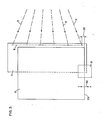
- the rotating mirror 102 will have rotated slightly further and consequently the reflection of image bearing data from facet 103 will be slightly removed in time from nominal. In that manner, the envelope of light rays 15 bearing character data is shifted in the direction B (FIG. 3) thus maintaining the margin 201 for the case where the edge 22A is at a position in the direction B from nominal.
- Another technique is to delay the start of margin generation the required amount.
- FIG. 7C shows a translate table for providing sensed data to character generator control.
- the column headed "Sensor Data” shows eight conditions for the sense unit 21 illustrated in FIG. 4. In that column, a "0" indicates that the sensor is off and a "1" indicates that it is on.
- the column headed "Buffer Data” translates the sensor data for use by the character generator control. For example, when two sensors are on, the sensor data shows in the table as a digital numeric "3".
- the translate table provides a digital signal "2" for this condition. In that manner, the number of sensors "on” is provided to the character generator 'control Shift routine.
- the sensing unit 21 can be placed in a duplex portion of the paper path if desired and in some configurations that may be the only part of the paper path which is of interest. For example, in machines with a very short paper path from an input bin to an output bin, there may be no need to sense the side edge of the sheet during simplex production since the sheet would reach the transfer station very quickly after leaving the input bin. In such a machine, when that print paper is brought back to the transfer station for a duplex operation, the distance is much greater and hence the value of the invention would be found in sensing the side edge of the print receiving paper during a duplex operation.
- edge 22A can be ascertained during machine setup and may not be between sensors 26 and 27 as shown in FIG. 4.
- the exact zero position, or nominal position, of sheet 22 can be found by running a test master and ascertaining where edge 22A provides the nominal. That information can be keyed into the machine through the control panel in order to set the zero position. Also, if zero changes during machine use, the zero position can be adjusted in a similar manner.
Landscapes
- Physics & Mathematics (AREA)
- Engineering & Computer Science (AREA)
- General Physics & Mathematics (AREA)
- General Engineering & Computer Science (AREA)
- Theoretical Computer Science (AREA)
- Optics & Photonics (AREA)
- Dot-Matrix Printers And Others (AREA)
- Handling Of Cut Paper (AREA)
- Accessory Devices And Overall Control Thereof (AREA)
- Laser Beam Printer (AREA)
- Exposure Or Original Feeding In Electrophotography (AREA)
- Handling Of Sheets (AREA)
- Control Or Security For Electrophotography (AREA)
- Combination Of More Than One Step In Electrophotography (AREA)
Applications Claiming Priority (2)
| Application Number | Priority Date | Filing Date | Title |
|---|---|---|---|
| US558232 | 1983-12-05 | ||
| US06/558,232 US4538905A (en) | 1983-12-05 | 1983-12-05 | Electronic image registration |
Publications (3)
| Publication Number | Publication Date |
|---|---|
| EP0144824A2 true EP0144824A2 (de) | 1985-06-19 |
| EP0144824A3 EP0144824A3 (en) | 1985-07-17 |
| EP0144824B1 EP0144824B1 (de) | 1988-07-27 |
Family
ID=24228711
Family Applications (1)
| Application Number | Title | Priority Date | Filing Date |
|---|---|---|---|
| EP84113740A Expired EP0144824B1 (de) | 1983-12-05 | 1984-11-14 | Verfahren und Vorrichtung zum Erzeugen eines gewünschten Randes auf Kopiermaterial in Kopiergeräten |
Country Status (4)
| Country | Link |
|---|---|
| US (1) | US4538905A (de) |
| EP (1) | EP0144824B1 (de) |
| JP (1) | JPS60123873A (de) |
| DE (1) | DE3473066D1 (de) |
Cited By (4)
| Publication number | Priority date | Publication date | Assignee | Title |
|---|---|---|---|---|
| WO1989008871A1 (fr) * | 1988-03-15 | 1989-09-21 | Siemens Aktiengesellschaft | Dispositif de controle du transport de supports d'enregistrement en feuilles dans une machine d'impression par electrophotographie |
| EP0246459A3 (en) * | 1986-05-19 | 1990-01-24 | International Business Machines Corporation | Copier adjustment method and apparatus |
| DE3935231A1 (de) * | 1988-10-24 | 1990-04-26 | Ricoh Kk | Bilderzeugungseinrichtung |
| EP0443587A3 (en) * | 1990-02-23 | 1992-08-12 | Tokyo Electric Co., Ltd. | Line head device |
Families Citing this family (27)
| Publication number | Priority date | Publication date | Assignee | Title |
|---|---|---|---|---|
| US4653008A (en) * | 1984-06-21 | 1987-03-24 | Iwatsu Electric Co., Ltd. | Method of controlling platemaking positions and errors |
| NL8500995A (nl) * | 1985-04-04 | 1986-11-03 | Oce Nederland B V Patents And | Belichtingsinrichting voor bladen. |
| US4755855A (en) * | 1985-05-30 | 1988-07-05 | Kabushiki Kaisha Toshiba | Image forming apparatus with a forming position correcting function |
| JP2536838B2 (ja) * | 1985-08-26 | 1996-09-25 | キヤノン株式会社 | 水平同期信号出力装置 |
| JPH0743563B2 (ja) * | 1985-08-27 | 1995-05-15 | 株式会社東芝 | 画像形成装置 |
| JPH087487B2 (ja) * | 1987-05-26 | 1996-01-29 | キヤノン株式会社 | 画像形成装置 |
| US4956651A (en) * | 1987-07-01 | 1990-09-11 | Minolta Camera Kabushiki Kaisha | Image forming apparatus which sheet detection and timing control |
| JPH02540A (ja) * | 1987-12-17 | 1990-01-05 | Ricoh Co Ltd | 画像記録方法 |
| JP2991433B2 (ja) * | 1988-09-19 | 1999-12-20 | カシオ電子工業株式会社 | 印字装置 |
| US4933778A (en) * | 1988-09-19 | 1990-06-12 | Eastman Kodak Company | Calibration of platen registration edges in copiers |
| US4893135A (en) * | 1988-09-23 | 1990-01-09 | Eastman Kodak Company | Laser printer with position registration enhancement |
| US5271065A (en) * | 1990-09-28 | 1993-12-14 | Xerox Corporation | Electronic printing system for printing signatures |
| US5241474A (en) * | 1991-10-02 | 1993-08-31 | Xerox Corporation | Method of composing signatures |
| US5257040A (en) * | 1991-11-14 | 1993-10-26 | Pitney Bowes Inc. | System for printing asymmetrically positioned pairs of envelopes |
| US5369426A (en) * | 1993-03-31 | 1994-11-29 | Eastman Kodak Company | Method and apparatus for optimization of productivity through the synchronization of a scanner and printer using a pre-scan |
| US5912695A (en) * | 1997-12-12 | 1999-06-15 | Pitney Bowes Inc. | System for printing pairs of envelopes or the like |
| US6118950A (en) * | 1999-06-29 | 2000-09-12 | Hewlett-Packard Company | Duplex image alignment |
| US6753975B1 (en) | 1999-09-10 | 2004-06-22 | Hewlett-Packard Development Company, L.P. | Media mapping for customized imaging in a printer |
| US6799761B2 (en) * | 2000-03-15 | 2004-10-05 | Canon Kabushiki Kaisha | Sheet-position detection device and image forming apparatus including the same |
| JP2001331073A (ja) * | 2000-05-18 | 2001-11-30 | Canon Inc | 画像形成装置及びその制御方法 |
| US6511239B1 (en) | 2000-11-17 | 2003-01-28 | Xerox Corporation | Flyer determination and elimination for side edge electronic registration |
| US6839155B2 (en) | 2001-01-16 | 2005-01-04 | Xerox Corporation | Locating edges of a scanned document |
| US7456995B2 (en) * | 2001-05-30 | 2008-11-25 | Hewlett-Packard Development Company, L.P. | Techniques for aligning images using page characteristics and image shifting |
| KR100580183B1 (ko) * | 2004-01-09 | 2006-05-15 | 삼성전자주식회사 | 스캔영역의 좌우 위치 보정 방법 및 장치 |
| KR101362371B1 (ko) * | 2007-09-13 | 2014-02-12 | 삼성전자주식회사 | 화상형성장치와 그 제전장치 |
| US7914001B2 (en) * | 2008-06-12 | 2011-03-29 | Xerox Corporation | Systems and methods for determining skew contribution in lateral sheet registration |
| US8608273B2 (en) | 2011-03-02 | 2013-12-17 | Ricoh Production Print Solutions | Print data compensation for variations in paper position within a printing system |
Family Cites Families (14)
| Publication number | Priority date | Publication date | Assignee | Title |
|---|---|---|---|---|
| US2566399A (en) * | 1946-12-31 | 1951-09-04 | Time Inc | Lateral register control mechanism for printing presses |
| US3818493A (en) * | 1972-05-22 | 1974-06-18 | Dyk Res Corp Van | High speed xerographic printer |
| US4026647A (en) * | 1972-09-01 | 1977-05-31 | Ricoh Co., Ltd. | Copy sheet feed device |
| US3888579A (en) * | 1974-01-31 | 1975-06-10 | Xerox Corp | Digital controlled document feeder |
| US4046471A (en) * | 1975-11-03 | 1977-09-06 | International Business Machines Corporation | Dual mode electrophotographic apparatus having dual function printing beam |
| JPS5911905B2 (ja) * | 1975-12-18 | 1984-03-19 | キヤノン株式会社 | カヘンバイフクシヤキ |
| US4187024A (en) * | 1977-03-09 | 1980-02-05 | Ricoh Company, Ltd. | Electrostatic copying machine |
| US4231070A (en) * | 1978-12-07 | 1980-10-28 | Texaco Inc. | High speed copying means and method |
| US4310236A (en) * | 1979-10-12 | 1982-01-12 | Eastman Kodak Company | Copy sheet alignment for flash-on-the-fly copiers |
| JPS5723967A (en) * | 1980-07-21 | 1982-02-08 | Canon Inc | Recorder |
| US4348101A (en) * | 1980-09-30 | 1982-09-07 | Sperry Corporation | Duplex printing apparatus |
| US4422751A (en) * | 1981-04-15 | 1983-12-27 | Canon Kabushiki Kaisha | Original feed control unit |
| NL8103440A (nl) * | 1981-07-21 | 1983-02-16 | Oce Nederland Bv | Positiedetectie-eenheid voor een copieerinrichting. |
| EP0110670B1 (de) * | 1982-11-24 | 1988-01-13 | Xerox Corporation | Seitlich verschiebbare Rollvorrichtung |
-
1983
- 1983-12-05 US US06/558,232 patent/US4538905A/en not_active Expired - Lifetime
-
1984
- 1984-11-02 JP JP59230478A patent/JPS60123873A/ja active Granted
- 1984-11-14 DE DE8484113740T patent/DE3473066D1/de not_active Expired
- 1984-11-14 EP EP84113740A patent/EP0144824B1/de not_active Expired
Cited By (4)
| Publication number | Priority date | Publication date | Assignee | Title |
|---|---|---|---|---|
| EP0246459A3 (en) * | 1986-05-19 | 1990-01-24 | International Business Machines Corporation | Copier adjustment method and apparatus |
| WO1989008871A1 (fr) * | 1988-03-15 | 1989-09-21 | Siemens Aktiengesellschaft | Dispositif de controle du transport de supports d'enregistrement en feuilles dans une machine d'impression par electrophotographie |
| DE3935231A1 (de) * | 1988-10-24 | 1990-04-26 | Ricoh Kk | Bilderzeugungseinrichtung |
| EP0443587A3 (en) * | 1990-02-23 | 1992-08-12 | Tokyo Electric Co., Ltd. | Line head device |
Also Published As
| Publication number | Publication date |
|---|---|
| US4538905A (en) | 1985-09-03 |
| EP0144824A3 (en) | 1985-07-17 |
| EP0144824B1 (de) | 1988-07-27 |
| DE3473066D1 (en) | 1988-09-01 |
| JPS60123873A (ja) | 1985-07-02 |
| JPH0432389B2 (de) | 1992-05-29 |
Similar Documents
| Publication | Publication Date | Title |
|---|---|---|
| US4538905A (en) | Electronic image registration | |
| CA1075758A (en) | Dual mode electrophotographic apparatus having dual function printing beam | |
| US4467334A (en) | Laser beam printer | |
| US5099260A (en) | Multiple image forming apparatus | |
| US4445128A (en) | Method and apparatus for compensating for irregular motion | |
| EP0246457B1 (de) | Kompensation beim Drucken feiner Striche | |
| EP0631204A1 (de) | Elektrostatografisches Druckgerät mit mehreren Stationen und Einzelnem durchlauf zum beidseitigen Drucken | |
| EP0422602B1 (de) | Verfahren und Vorrichtung zur Farbbildaufzeichnung | |
| US5404202A (en) | Apparatus for registering images in a xerographic system | |
| US5313252A (en) | Apparatus and method for measuring and correcting image transfer smear | |
| US5285247A (en) | Linear print head image forming apparatus with magnification adjustment | |
| JPS63278463A (ja) | デジタル複写機におけるマルチコピ−方式 | |
| EP0007756A1 (de) | Xerographisches Verfahren und Gerät zur Bildung eines zusammengesetzten Bildes | |
| US5457487A (en) | Color image forming apparatus which times release of each of plural color image signals | |
| US6219085B1 (en) | Method and system for improved performance of adjustable printer clocks in an electrophotographic device | |
| US5512927A (en) | Image forming apparatus having a photosensitive drum rotatable at different speeds | |
| EP0246459B1 (de) | Verfahren und Vorrichtung zur Einstellung eines Kopiergerätes | |
| EP0482708B1 (de) | Druckvorrichtung | |
| US6181887B1 (en) | Control system utilizing virtual belt holes | |
| JP2915925B2 (ja) | 画像形成装置の制御方法 | |
| US6456309B1 (en) | Color image registration based upon belt and raster output scanner synchronization | |
| EP1014147B1 (de) | Rasterabtastvorrichtung und Drucker | |
| US6181357B1 (en) | Method and system for the modification of the timing of a plurality of PEL clocks in an electrophotographic device | |
| US4332465A (en) | Balanced photoconductor usage control system | |
| EP0106337A2 (de) | Laseraufzeichnungsgerät |
Legal Events
| Date | Code | Title | Description |
|---|---|---|---|
| PUAI | Public reference made under article 153(3) epc to a published international application that has entered the european phase |
Free format text: ORIGINAL CODE: 0009012 |
|
| PUAL | Search report despatched |
Free format text: ORIGINAL CODE: 0009013 |
|
| 17P | Request for examination filed |
Effective date: 19841214 |
|
| AK | Designated contracting states |
Designated state(s): DE FR GB |
|
| RHK1 | Main classification (correction) |
Ipc: G03G 15/00 |
|
| AK | Designated contracting states |
Designated state(s): DE FR GB |
|
| 17Q | First examination report despatched |
Effective date: 19870206 |
|
| D17Q | First examination report despatched (deleted) | ||
| GRAA | (expected) grant |
Free format text: ORIGINAL CODE: 0009210 |
|
| AK | Designated contracting states |
Kind code of ref document: B1 Designated state(s): DE FR GB |
|
| REF | Corresponds to: |
Ref document number: 3473066 Country of ref document: DE Date of ref document: 19880901 |
|
| ET | Fr: translation filed | ||
| PLBE | No opposition filed within time limit |
Free format text: ORIGINAL CODE: 0009261 |
|
| STAA | Information on the status of an ep patent application or granted ep patent |
Free format text: STATUS: NO OPPOSITION FILED WITHIN TIME LIMIT |
|
| 26N | No opposition filed | ||
| REG | Reference to a national code |
Ref country code: GB Ref legal event code: IF02 |
|
| PGFP | Annual fee paid to national office [announced via postgrant information from national office to epo] |
Ref country code: DE Payment date: 20031024 Year of fee payment: 20 |
|
| PGFP | Annual fee paid to national office [announced via postgrant information from national office to epo] |
Ref country code: GB Payment date: 20031103 Year of fee payment: 20 |
|
| PGFP | Annual fee paid to national office [announced via postgrant information from national office to epo] |
Ref country code: FR Payment date: 20031120 Year of fee payment: 20 |
|
| PG25 | Lapsed in a contracting state [announced via postgrant information from national office to epo] |
Ref country code: GB Free format text: LAPSE BECAUSE OF EXPIRATION OF PROTECTION Effective date: 20041113 |
|
| REG | Reference to a national code |
Ref country code: GB Ref legal event code: PE20 |