EP0145189A1 - Appareil pour la détection de la fumée - Google Patents
Appareil pour la détection de la fumée Download PDFInfo
- Publication number
- EP0145189A1 EP0145189A1 EP19840307232 EP84307232A EP0145189A1 EP 0145189 A1 EP0145189 A1 EP 0145189A1 EP 19840307232 EP19840307232 EP 19840307232 EP 84307232 A EP84307232 A EP 84307232A EP 0145189 A1 EP0145189 A1 EP 0145189A1
- Authority
- EP
- European Patent Office
- Prior art keywords
- pulse
- detector
- control device
- light source
- flash
- Prior art date
- Legal status (The legal status is an assumption and is not a legal conclusion. Google has not performed a legal analysis and makes no representation as to the accuracy of the status listed.)
- Granted
Links
Images



Classifications
-
- G—PHYSICS
- G08—SIGNALLING
- G08B—SIGNALLING SYSTEMS, e.g. PERSONAL CALLING SYSTEMS; ORDER TELEGRAPHS; ALARM SYSTEMS
- G08B17/00—Fire alarms; Alarms responsive to explosion
- G08B17/10—Actuation by presence of smoke or gases, e.g. automatic alarm devices for analysing flowing fluid materials by the use of optical means
- G08B17/103—Actuation by presence of smoke or gases, e.g. automatic alarm devices for analysing flowing fluid materials by the use of optical means using a light emitting and receiving device
- G08B17/107—Actuation by presence of smoke or gases, e.g. automatic alarm devices for analysing flowing fluid materials by the use of optical means using a light emitting and receiving device for detecting light-scattering due to smoke
Definitions
- the present invention relates to optical air pollution monitoring apparatus and more specifically an early warning fire detection apparatus incorporating a light scatter detection technique.
- the present invention has as its objective to provide apparatus for detection of air pollution and fires and the initiation of control measures at the earliest possible moment whilst minimising false alarms.
- Smoke detectors of the general type to which the present invention relates are disclosed in Australian Patent Specfication Nos. 412479, 415158, 465213 and 482860.
- Specification No. 415158 utilises an intermittently operating light source whilst No. 412479 discloses the use of a pair of light carrying rods.
- Specification No. 465213 discloses the removal of air samples from an air space under surveillance to detect the presence of carbon monoxide.
- Specification No. 482860 discloses the use of a pair of air sampling chambers coupled to a light source and photomultiplier tubes.
- Photomultiplier tube designs have incorporated two sampling chambers in order to provide two channels of operation, the outputs of which are balanced in an attempt to counteract the effects of ageing and temperature drift, and also to overcome flash tube light intensity variations. This is attempted by means of a summing amplifier, where one channel is connected to the inverting input, the other -to the non-inverting input. The resultant output signal is the difference between the two channels.
- this mechanism in fact does nothing to reduce the problems, being based upon a fallacy:
- the present invention relates to the provision of improved electronic circuitry for use in air pollution detection.
- Patent No. 482,860 utilized a photomultiplier tube to detect the extremely low levels of light scattered off low concentrations of airborne smoke. Solid-state detection was considered impossible at room temperatures and at economical cost. As a result of considerable research, solid state circuitry has been developed which appears to have overcome the problems inherent in photomultiplier tube technology. For example, such problems as an extraordinary (10:1) spread in sensitivity from device to device, fragility, ageing, degradation when exposed to bright light, and the need for a special high-voltage power supply of high stability have been met.
- a solid-state detector cell requires a preamplifier of extremely low noise, requiring development of a state-of-the-art design. Therefore detector cell and Xenon flash noise became the dominant, though insignificant source of noise. Temperature compensation is also required, to provide calibration accuracy spanning at least zero to fifty degrees Celsius.
- the detector cell should be small to minimise capacitance. This however, reduces the 'photon capture area' compared with the photomultiplier tube and a focusing lens is employed, with associated mounting hardware. Close attention to the preamplifier design using pulse-amplifier techniques is partly responsible for the noise reduction in the detector of the present invention. Earthing is of course another critical factor, together with a suitable interference-shielding container. In addition, immunity to power supply variations has required special attention.
- the preamplifier, detector cell, optics and housing is preferably supplied as a self-contained separately tested plug-in module.
- a light sensing apparatus including amplifier means comprising pulse amplifiers for producing an output pulse of high amplitude, means for detecting and storing the peak amplitude of said pulse at least until receipt of a further output pulse, said apparatus adapted to receive and amplify signals received from a solid state photo cell subjected to a flashing light source.
- a light sensing apparatus including an amplifier comprising pulse-amplifiers producing an output pulse of high amplitude, an active peak-detector of high accuracy and linearity over a wide range and an active sample-and-hold circuit associated with a summing amplifier, said apparatus adapted to receive and amplify signals received from a solid state photo cell subjected to a flashing light source.
- the detection and storage means comprises a micro-processor for receiving said amplified signals received from said solid state photo cell subjected to said flashing light.
- control means for use in association with a light sensing air pollution detection apparatus including a current measuring means such as a moving-coil meter or an LED (light emitting diode) bargraph display for receiving signals from said light sensing apparatus to indicate air pollution (such as smoke) intensity.
- a current measuring means such as a moving-coil meter or an LED (light emitting diode) bargraph display for receiving signals from said light sensing apparatus to indicate air pollution (such as smoke) intensity.
- three alarm thresholds are set to levels to correspond with desired points on the meter scale, or bargraph display.
- a light sensing apparatus in a pollution detection apparatus including a flash light source, amplifier means for producing an output pulse of high amplitude in response to said light flash, means for detecting and storing the peak amplitude of said output pulse, means for monitoring the flash intensity of said flash light source, means for detecting and storing the peak amplitude of the monitor pulse, divider circuit means for receiving said output and monitor pulses and providing compensation and improving the accuracy of the signal in the detection apparatus.
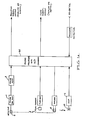
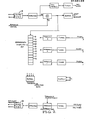
- the detector circuit receives a signal from the solid state detector cell and pulse preamplifier circuit as is described in greater detail in my co-pending patent application No. 31841/84 mentioned above.
- the signal passes to a pulse-amplifier producing an output pulse of high amplitude.
- Gain adjustment of the amplifier 2 provides adjustment of the signal to achieve calibration.
- the calibration offset allows for offset of the effects of remnant background light (which is a fixed component) in the sampling chamber to the point where the signal is independent of the effects of background light.
- FIG. 1A there is shown an alternative arrangement wherein the peak detector 3 and sample-and-hold circuit 4 is replaced by a micro-processor 30 programmed to receive and store the peak amplitude of an output pulse from said pulse amplifier.
- the microprocessor can be used for division of the signal from the monitor amplifier and provides the timing for the flash tube 8.
- the normal sampling rate of the monitored space is approximately 3 seconds however, D.C. stability is sufficient to allow optional sampling rates up to 30 seconds thus allowing extension of Xenon flash tube life to as long as 20 years (suitable for areas of relatively slow potential fire growth).
- circuitry to permit operation from an unregulated 24V DC supply which can include standby batteries (20-28V tolerance), in conformity with most conventional fire alarm systems.
- Wide voltage tolerance provides for greater immunity to cabling voltage-drop.
- circuitry is refined to reduce power consumption to 6 Watts. This further reduces cabling voltage-drop problems.
- the Xenon flash power supply provides the greatest opportunity for this power reduction, through increased efficiency, of a 400V inverter. To maximise consistency of flash brilliance, this supply is tightly regulated and temperature compensated.
- the device includes a Xenon flash tube monitor 10 in the sampling chamber to calibrate or adjust for variations in flash intensity that may result from "flash noise", aging, or temperature.
- divider 12 provides compensation of the signal received from the monitor 10 and amplifier 11 thereby improving the accuracy of the signal in the detector circuit going to the control.
- the divider 12 includes circuitry adapted to convert signals received from the detector 9 and monitor 10 to logarithins then to subtract said logarithins, reconverting the resultant signal by an anti logarithin circuit to a normal signal.
- the divider circuit will remove or compensate for flash intensity variation or temperature variations.
- the alarm threshold of the air flow sensor 7a may be factory preset within the detector. However, it is preferable to provide an analog output of air flow, utilizing an identical output circuit to that used for smoke intensity (another transconductance amplifier).
- the constant-current output in both cases provides complete immunity to errors introduced by cabling losses, whilst a low impedance load followed by low-pass filtering and over-voltage protection within the control unit, overcomes interference induction.
- the alarm threshold can then be set conveniently in the control unit, to a flow rate consistent with the response time required for detection.
- the voltage signal is converted to current by convertor 6 to avoid the effects of losses in the line to the controller which may be at a remote station in the building.
- the current signal from the detector is received and converted to voltage at 13.
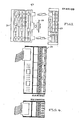
- the controller includes a housing for up to eight (say) individual control cards 20 ( Figure 3) each associated with a detector.
- the housing may be of extruded aluminium rail frame and side plate construction whereby it is adaptable to accommodate from one to eight control cards. Thus, where space is at a premium the size of the housing can be reduced by shortening the rails.
- the control unit provided four output relays namely: Alarm 1, Alarm 2, Alarm 3 and Fail.
- the Fail relay combined the functions of air flow failure and smoke detection failure. Preferably these two functions are split on the basis that they might require a differing response.
- a sixth relay is added to indicate that a test is being performed so that operation of any other relay can be ignored until completion of the test. According to the present invention it is proposed to transfer the six relays to a separate relay interface card 23 which can be driven by all controller cards using a ribbon-cable bus in a "daisy-chain" ccnnection.
- the housing frame accommodates a mixture of ribbon-cable 21 and printed-circuit edge connectors 22.
- This design also facilitates the replacement of any ribbon-cable for one of a different length or configuration, to suit unexpected situations that may arise in the field.
- Figures 3, 4 and 5 depict schematically the control card interconnections with the optional data bus and computer or micro processor (not shown) and a relay interface card 23.
- Calibration and testing of the detector is simplified by adopting a full scale measurement of 5.5 milli-amps.
- An 0.5 milli-amp offset is used to assist in sensing signal loss caused by lamp failure, cable breakage etc.
- Each additional 0.5 mA represents an increment of 0 . 01% pollution e.g. smoke.
- this is translated to one volt offset with one volt major scale divisions and eleven volt full scale.
- the inclusion of a summing amplifier permits subtraction of the one volt offset before presentation of the display and chart-recorder output such that 0-10 volts represents 0-0.10% smoke (0-1000 parts/million).
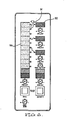
- a gold plated programming pin 31 on a roving lead is coupled to each of the three alarm thresholds 32 providing a convenient and easily viewable means for setting the alarm levels.
- an override circuit ensures that the third alarm threshold automatically defaults to the full-scale smoke level.
- Timers for delaying the operation of each alarm adjustable by means of potentiometers, are located immediately below their relevant alarm lamp, and are accessible without removing the Controller card. Also located on the front of the Controller card are test buttons for detector sensitivity and detector failure. Timer adjustments and testing facilities are hidden and protected behind an escutcheon to prevent tampering.
- a feature of the control unit is the provision of a switch-option to designate the first (left-most) Controller card and its associated Detector as the Reference channel.
- This Reference Detector is adapted to measure the incoming air quality at the make-up air register of an air-conditioning system. To ensure that the Controller would respond only to the net gain in smoke from sources within the building, the output from the Reference Detector can be subtracted, partially or wholly. Even for large installations, only one Reference Detector would be required.
- An additional advantage of the reference channel is the ability to provide a separate "pollution alert" for computer areas and other "clean" environments.
- the setting of alarm thresholds the operation of time delays and air flow detection can be implemented by a micro-processor by projecting a visual output such as a bargraph or numerical display.
- a micro-processor is used in substitution for detectors and controller cards it is feasible to use digital signals methods such as those that conform to RS232 Standard for serial data transmission, as distinct from the analogue method of constant current signals.
- the Controller uses both a red and a green lamp ⁇ to indicate air flow with the addition of an adjustable timer to allow for short term reductions in air flow, which might result from normal air-handling control functions in the building (for example in the case of in-duct detection).
- Matched to this is another pair of lamps for the "Fail" detection circuitry, with a similar timer.
- Particularly large, dual-element rectangular LED lamps have been developed with careful attention to uniform light diffusion, for all displays (17 lamps per Controller). This permitted escutcheon artwork information to be rear-lit by the lamps, for aesthetic appeal and to avoid ambiguity.
- red LED lamps are use;. for each segment.
- the present invention has the adopted philosophy that any alarm condition should be indicated by a red lamp.
- any red lamp seen from a distance would require attention, whether it proved to be one of the three smoke intensity thresholds, the Detector failure alarm or the air flow failure alarm.
- these red lamps are made to flash. Operation of any one of these red lamps indicates the operation of its associated relay.
- Controller card An optional version of the Controller card according to the present invention has been designed. This provides latching of the red alarm lamps and their associated relays, to account for transient conditions which might disappear before an attendant may arrive (especially in a multi-Detector installation).
- a toggle-switch is provided on each Controller card, to mount through the escutcheon. Such a switch is chosen for the obvious nature of its positions. In the "normal” position, all red lamps and their relays would be operable and could latch on. While in the "isolate” position, all red lamps and their relays would reset (unlatch) and would remain isolated (disabled), during which the "test” relay would operate (renamed the "isolate-test” relay). In either switch position the true conditions pertinent to the Detector remain clearly ⁇ displayed because of the bargraph (with its clearly visible programming pins to indicate the alarm thresholds) and the green lamps (indicating the Detector and air flow were correct).
- a data-bus " mother-board" is provided within the control unit to facilitate the connection of a computer, such as a separate building services monitoring computer which is enabled to scan each Controller card to obtain readings of smoke intensity and air flow. In this way it can monitor the entire alarm system and initiate appropriate actions.
- a computer such as a separate building services monitoring computer which is enabled to scan each Controller card to obtain readings of smoke intensity and air flow.
- Its data-logging function permits the automatic compilation of statistics on typical ambient smoke levels and the result of simulated fires, such that alarm thresholds can be optimised.
- the alarm thresholds within the computer can be altered at different times, typically selecting greater sensitivity during hours when a building is unoccupied. It can also activate a sensitivity test or a failure test for each Detector, in conformity with some prearranged schedule.
- Subtraction of the reference signal may also be performed by the computer. This enables the time-related dilution/concentration factors to be taken into account on a zone-by-zone basis.
- a ribbon-cable connector for all chart-recorder outputs. This facilitates connection to a data-logger, multi-pen recorder or to a selector switch.
Landscapes
- Chemical & Material Sciences (AREA)
- Analytical Chemistry (AREA)
- Business, Economics & Management (AREA)
- Emergency Management (AREA)
- Physics & Mathematics (AREA)
- General Physics & Mathematics (AREA)
- Investigating Or Analysing Materials By Optical Means (AREA)
- Fire-Detection Mechanisms (AREA)
Priority Applications (2)
| Application Number | Priority Date | Filing Date | Title |
|---|---|---|---|
| EP89121615A EP0365047B1 (fr) | 1983-10-21 | 1984-10-19 | Dispositif de détection optique de pollution d'air ou de fumée |
| AT84307232T ATE55503T1 (de) | 1983-10-21 | 1984-10-19 | Rauchanzeigegeraet. |
Applications Claiming Priority (3)
| Application Number | Priority Date | Filing Date | Title |
|---|---|---|---|
| AU1975/83 | 1983-10-21 | ||
| AUPG197583 | 1983-10-21 | ||
| AU34537/84A AU577551B2 (en) | 1983-10-21 | 1984-10-19 | Improvements relating to smoke detection apparatus |
Related Child Applications (1)
| Application Number | Title | Priority Date | Filing Date |
|---|---|---|---|
| EP89121615.2 Division-Into | 1984-10-19 |
Publications (2)
| Publication Number | Publication Date |
|---|---|
| EP0145189A1 true EP0145189A1 (fr) | 1985-06-19 |
| EP0145189B1 EP0145189B1 (fr) | 1990-08-08 |
Family
ID=25622926
Family Applications (1)
| Application Number | Title | Priority Date | Filing Date |
|---|---|---|---|
| EP19840307232 Expired EP0145189B1 (fr) | 1983-10-21 | 1984-10-19 | Appareil pour la détection de la fumée |
Country Status (1)
| Country | Link |
|---|---|
| EP (1) | EP0145189B1 (fr) |
Cited By (3)
| Publication number | Priority date | Publication date | Assignee | Title |
|---|---|---|---|---|
| WO1990016053A1 (fr) * | 1989-06-15 | 1990-12-27 | Fire Fighting Enterprises (Uk) Limited | Detecteurs de particules |
| CN113990023A (zh) * | 2021-10-26 | 2022-01-28 | 无锡商业职业技术学院 | 一种用于光电式烟雾探测器的自校准、补偿电路和方法 |
| CN115398203A (zh) * | 2020-03-31 | 2022-11-25 | Msa技术有限公司 | 具有同步闪光检测的开路气体检测器 |
Citations (6)
| Publication number | Priority date | Publication date | Assignee | Title |
|---|---|---|---|---|
| DE2105917A1 (de) * | 1970-02-11 | 1971-08-26 | Shorrock Dev | Rauchanzeigegerat |
| CH560434A5 (fr) * | 1972-08-11 | 1975-03-27 | Chubb Fire Security Ltd | |
| CH580848A5 (fr) * | 1973-11-26 | 1976-10-15 | Pyrotector Inc | |
| DE2632876A1 (de) * | 1975-07-21 | 1977-01-27 | Gen Signal Corp | Rauchdetektor |
| US4266220A (en) * | 1979-07-27 | 1981-05-05 | Malinowski William J | Self-calibrating smoke detector and method |
| US4317113A (en) * | 1979-08-24 | 1982-02-23 | Hochiki Corporation | Photoelectric smoke sensor |
-
1984
- 1984-10-19 EP EP19840307232 patent/EP0145189B1/fr not_active Expired
Patent Citations (6)
| Publication number | Priority date | Publication date | Assignee | Title |
|---|---|---|---|---|
| DE2105917A1 (de) * | 1970-02-11 | 1971-08-26 | Shorrock Dev | Rauchanzeigegerat |
| CH560434A5 (fr) * | 1972-08-11 | 1975-03-27 | Chubb Fire Security Ltd | |
| CH580848A5 (fr) * | 1973-11-26 | 1976-10-15 | Pyrotector Inc | |
| DE2632876A1 (de) * | 1975-07-21 | 1977-01-27 | Gen Signal Corp | Rauchdetektor |
| US4266220A (en) * | 1979-07-27 | 1981-05-05 | Malinowski William J | Self-calibrating smoke detector and method |
| US4317113A (en) * | 1979-08-24 | 1982-02-23 | Hochiki Corporation | Photoelectric smoke sensor |
Cited By (5)
| Publication number | Priority date | Publication date | Assignee | Title |
|---|---|---|---|---|
| WO1990016053A1 (fr) * | 1989-06-15 | 1990-12-27 | Fire Fighting Enterprises (Uk) Limited | Detecteurs de particules |
| GB2242521A (en) * | 1989-06-15 | 1991-10-02 | Fire Fighting Enterprises | Particle detectors |
| GB2242521B (en) * | 1989-06-15 | 1993-07-21 | Fire Fighting Enterprises | Particle detectors |
| CN115398203A (zh) * | 2020-03-31 | 2022-11-25 | Msa技术有限公司 | 具有同步闪光检测的开路气体检测器 |
| CN113990023A (zh) * | 2021-10-26 | 2022-01-28 | 无锡商业职业技术学院 | 一种用于光电式烟雾探测器的自校准、补偿电路和方法 |
Also Published As
| Publication number | Publication date |
|---|---|
| EP0145189B1 (fr) | 1990-08-08 |
Similar Documents
| Publication | Publication Date | Title |
|---|---|---|
| EP0365047B1 (fr) | Dispositif de détection optique de pollution d'air ou de fumée | |
| ES2240874T3 (es) | Aparatos y metodos de tratamiento de datos para un sistema de deteccion de humo. | |
| JP5893860B2 (ja) | 感知器 | |
| GB1099473A (en) | Smoke detection apparatus | |
| US3874795A (en) | Smoke detector | |
| EP0145189B1 (fr) | Appareil pour la détection de la fumée | |
| US3544988A (en) | Picture motion detection system | |
| CN113252525A (zh) | 一种基于β射线和光散射法的颗粒物在线监测系统 | |
| CN208969207U (zh) | 电控板检测系统 | |
| US7825817B2 (en) | Hardwired alarm system with power-on sequence | |
| KR101655827B1 (ko) | 위치확인 기반의 주소형 중계기 및 주소형 화재발신기 | |
| CN211855397U (zh) | 一种可见光、温湿度和有毒气体的多传感器智能监控系统 | |
| JP2000132762A (ja) | 受光量表示ユニット付き光電式分離型感知器及び波形確認端子ユニット付き光電式分離型感知器 | |
| JPS60221897A (ja) | 火災の状態および場所報知方法 | |
| CN206893056U (zh) | 剧院的早期烟雾探测报警系统 | |
| Russell Jr et al. | DESCRIPTION OF FACILITY RADIATION AND CONTAMINATION ALARM SYSTEMS INSTALLED IN RADIOCHEMICAL PROCESSING PILOT PLANT BUILDING 3019 | |
| CN211062148U (zh) | 智能疏散指示系统 | |
| JPS6026173B2 (ja) | 煙感知器 | |
| JPH05266375A (ja) | 表示装置 | |
| CN209784294U (zh) | 一种低氧浓度报警设备 | |
| CN118135729B (zh) | 一种服务器异常诊断和自动处理方法 | |
| CN210660216U (zh) | 一种用于隧道内烟雾浓度的测量预警装置 | |
| JPS609910Y2 (ja) | 火災警報装置 | |
| JP2816632B2 (ja) | 住宅用火災報知設備 | |
| Barr et al. | Alarm System for Radiation Working Level, Fan Operation, and Air Door Position |
Legal Events
| Date | Code | Title | Description |
|---|---|---|---|
| PUAI | Public reference made under article 153(3) epc to a published international application that has entered the european phase |
Free format text: ORIGINAL CODE: 0009012 |
|
| AK | Designated contracting states |
Designated state(s): AT BE CH DE FR GB IT LI LU NL SE |
|
| 17P | Request for examination filed |
Effective date: 19851216 |
|
| 17Q | First examination report despatched |
Effective date: 19880405 |
|
| RAP1 | Party data changed (applicant data changed or rights of an application transferred) |
Owner name: COLE, MARTIN TERENCE |
|
| GRAA | (expected) grant |
Free format text: ORIGINAL CODE: 0009210 |
|
| AK | Designated contracting states |
Kind code of ref document: B1 Designated state(s): AT BE CH DE FR GB IT LI LU NL SE |
|
| PG25 | Lapsed in a contracting state [announced via postgrant information from national office to epo] |
Ref country code: SE Free format text: THE PATENT HAS BEEN ANNULLED BY A DECISION OF A NATIONAL AUTHORITY Effective date: 19900808 Ref country code: NL Effective date: 19900808 Ref country code: LI Effective date: 19900808 Ref country code: IT Free format text: LAPSE BECAUSE OF FAILURE TO SUBMIT A TRANSLATION OF THE DESCRIPTION OR TO PAY THE FEE WITHIN THE PRESCRIBED TIME-LIMIT;WARNING: LAPSES OF ITALIAN PATENTS WITH EFFECTIVE DATE BEFORE 2007 MAY HAVE OCCURRED AT ANY TIME BEFORE 2007. THE CORRECT EFFECTIVE DATE MAY BE DIFFERENT FROM THE ONE RECORDED. Effective date: 19900808 Ref country code: CH Effective date: 19900808 Ref country code: BE Effective date: 19900808 Ref country code: AT Effective date: 19900808 |
|
| REF | Corresponds to: |
Ref document number: 55503 Country of ref document: AT Date of ref document: 19900815 Kind code of ref document: T |
|
| XX | Miscellaneous (additional remarks) |
Free format text: TEILANMELDUNG 89121615.2 EINGEREICHT AM 19/10/84. |
|
| REF | Corresponds to: |
Ref document number: 3482945 Country of ref document: DE Date of ref document: 19900913 |
|
| PG25 | Lapsed in a contracting state [announced via postgrant information from national office to epo] |
Ref country code: LU Free format text: LAPSE BECAUSE OF NON-PAYMENT OF DUE FEES Effective date: 19901031 |
|
| ET | Fr: translation filed | ||
| REG | Reference to a national code |
Ref country code: CH Ref legal event code: PL |
|
| NLV1 | Nl: lapsed or annulled due to failure to fulfill the requirements of art. 29p and 29m of the patents act | ||
| PLBE | No opposition filed within time limit |
Free format text: ORIGINAL CODE: 0009261 |
|
| STAA | Information on the status of an ep patent application or granted ep patent |
Free format text: STATUS: NO OPPOSITION FILED WITHIN TIME LIMIT |
|
| 26N | No opposition filed | ||
| REG | Reference to a national code |
Ref country code: GB Ref legal event code: 732E |
|
| PGFP | Annual fee paid to national office [announced via postgrant information from national office to epo] |
Ref country code: FR Payment date: 19960730 Year of fee payment: 13 |
|
| PGFP | Annual fee paid to national office [announced via postgrant information from national office to epo] |
Ref country code: DE Payment date: 19961107 Year of fee payment: 13 |
|
| REG | Reference to a national code |
Ref country code: GB Ref legal event code: 732E |
|
| PG25 | Lapsed in a contracting state [announced via postgrant information from national office to epo] |
Ref country code: FR Free format text: THE PATENT HAS BEEN ANNULLED BY A DECISION OF A NATIONAL AUTHORITY Effective date: 19971031 Ref country code: DE Free format text: LAPSE BECAUSE OF NON-PAYMENT OF DUE FEES Effective date: 19971031 |
|
| REG | Reference to a national code |
Ref country code: FR Ref legal event code: ST |
|
| PGFP | Annual fee paid to national office [announced via postgrant information from national office to epo] |
Ref country code: GB Payment date: 20011009 Year of fee payment: 18 |
|
| REG | Reference to a national code |
Ref country code: GB Ref legal event code: IF02 |
|
| PG25 | Lapsed in a contracting state [announced via postgrant information from national office to epo] |
Ref country code: GB Free format text: LAPSE BECAUSE OF NON-PAYMENT OF DUE FEES Effective date: 20021019 |
|
| GBPC | Gb: european patent ceased through non-payment of renewal fee |
Effective date: 20021019 |