EP0145202B1 - System zur Prüfung der Rechtschreibung - Google Patents
System zur Prüfung der Rechtschreibung Download PDFInfo
- Publication number
- EP0145202B1 EP0145202B1 EP84307349A EP84307349A EP0145202B1 EP 0145202 B1 EP0145202 B1 EP 0145202B1 EP 84307349 A EP84307349 A EP 84307349A EP 84307349 A EP84307349 A EP 84307349A EP 0145202 B1 EP0145202 B1 EP 0145202B1
- Authority
- EP
- European Patent Office
- Prior art keywords
- word
- spelling
- basic
- entered
- register
- Prior art date
- Legal status (The legal status is an assumption and is not a legal conclusion. Google has not performed a legal analysis and makes no representation as to the accuracy of the status listed.)
- Expired
Links
Images
Classifications
-
- G—PHYSICS
- G06—COMPUTING OR CALCULATING; COUNTING
- G06F—ELECTRIC DIGITAL DATA PROCESSING
- G06F40/00—Handling natural language data
- G06F40/20—Natural language analysis
- G06F40/232—Orthographic correction, e.g. spell checking or vowelisation
Definitions
- the present invention relates to a system for checking the spelling of words.
- the system may be used, for exampe, in a word processor for checking the spelling of entered words.
- a word processor recognizes that if the spelling of the entered word is stored in a memory storing a great number of word spellings, it is established that the spelling is correct. Since the number of the word spellings in a language is vast, it is desired to compress the data of the word spellings to be stored as much as possible.
- a system for checking the spelling of words entered into the system wherein the system has a record which includes correct spellings of a set of basic words and excludes a set of compound words each consisting of a plurality of said basic words and checking means for checking an entered word spelling against said basic word spellings in said record in a predetermined sequence so that a said compound word entered into the system is checked by first seeking to identify correspondence between a basic word spelling held in said record and a first portion of the compound word and, in response to such identification, seeking to identify correspondence between a second as yet unidentified portion of the compound word, and a said basic word spelling held in said record.
- compound words which are made up of basic words in the record can be checked for correct spelling by repeated reference to the record, so that the need for the record to include such compound words is obviated.
- a word entered into the system is stored in a register and, in response to correspondence being identified between a basic word held in said record and a said first portion of a said compound word stored in said register, said first portion of said compound word is removed from said register and the second portion of the compound word remaining in the register is investigated for correspondence with a basic word held in said record.
- the record of correct spellings may be held in a memory device, an address counter means being operative to sequentially select addresses of said memory device so as to cause respective correct basic word spellings to be output in said predetermined sequence to a spelling checking means (4) which checks the entered word spelling against the sequentially output correct basic word spellings.
- the system is preferaby adapted to establish that an entered word spelling is correct if correspondence between said as yet, unidentified part and a said basic word spelling is identified, and that said entered word spelling is incorrect if no such correspondence is identified.
- a basic word memory is provided for storing the spellings of a plurality of basic words from which some compound words can be formed.
- these basic words may include “motor”, “boat”, “car”, “cycle” and the like.
- This memory should not store the compounds which can be formed by composition using these basic words.
- these non-stored compounds based on the basic words “boat”, “car”, and “cycle” may be “motorboat”, “motorcar”, and “motorcycle”. If any of these non-stored compounds is entered as an input word, it is detected that its first five letters "m”, “o”, “t”, “o”, and “r” are stored within the memory as a basic word, and that the remaining letters are also stored in this memory. as another basic word.
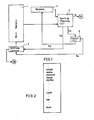
- the word spelling checking system comprises a word memory 1, an address counter 2, a register 3, a spelling checking circuit 4, and a control circuit 5. These circuit elements are operated as explained below:
- This is provided for storing spellings of a set of basic words. Responsive to address information developed by the address counter 2, it develops a spelling of a word corresponding to the address information.
- address information developed by the address counter 2 Responsive to address information developed by the address counter 2, it develops a spelling of a word corresponding to the address information.
- words to be checked are not inflectional, although it may be possible to modify the system to check inflectional words.
- This memory 1 develops successive basic words in response to incrementing of the address counter 2 in alphabetical order.
- the address counter 2 is responsive to a non-equivalent signal S3 from the spelling checking circuit 4 for counting up. It is responsive to a signal S4 from the control circuit 5 for resetting the counting operation to thereby re-start the counting.
- S3 is applied to the address counter 2 for counting up and the counter 2 detects that no relevant words are stored in the word memory 1, the counter 2 develops an error signal S5 indicating that an entered word spelling is incorrect.
- This register 3 has a plurality of letter storage stages and stores an entered word for spelling checking in response to the operation of an input means which enters the word. Responsive to a shift signal S6 from the control circuit 5 the register 3 shifts the letters of the entered word stored in the register toward the left by an instructed number of stages, so that some of the first letters of the entered word overflow from the letter storage stages of the register 3.
- the spelling checking circuit 4 develops an equivalent signal S1.
- the spelling checking circuit 4 sends a signal S2 toward the control circuit 5, the signal S2 representing the number of the matched first letters of the word from the word memory 1.
- the control circuit 5 Based on this signal S2, the control circuit 5 outputs the shift signal S6 to the register 3 to shift all of the stored letters in the register 3 by a number of stages equivalent to this number.
- the circuit 4 develops a non-equivalent signal S3.
- the spelling checking circuit 4 may comprise a plurality of exclusive OR gates and a single AND gate.
- FIG. 2 is a table representative of the typical contents of the word memory 1. The operation of the circuit elements of FIG. 1 will be described with reference to FIG. 2.
- the address counter 2 is started in response to a signal (not shown), so that it selects a first address.
- the word memory 1 develops a first word, for example "zounds".
- This first word is not equivalent to the spelling of the entered word, and the letters of this first word are not equivalent to the first letters of the entered word.
- the spelling checking circuit 4 sends the signal S3 toward the address counter 2, so that the count of the address counter 2 is incremented. Such an operation is repeated word-by-word.
- the spelling checking circuit 4 generates the signal S1, representing that the inputted word has a correct spelling.
- the spelling of the inputted word is checked by the spelling checking circuit 4.
- the address counter 2 selects a specific address for a word "motor” to the word memory 1
- the word memory 1 develops the first word "motor”
- the register 3 develops the inputted word "motorcar”. Since some letters, five in this instance, of the inputted word "motorcar” are contained in the first letters of the word developed by the word memory 1, the spelling checking circuit 4 generates the signal S2 toward the control circuit 5.
- the control circuit 5 sends the signal S6 to the register 3 so that all of the letters in the register 3 are shifted leftwards by the number of the letters "motor", five in this instance.
- all of the letters in the register 3 are left shifted and the letters originally in the five first stages are thereby caused to overflow.
- the register 3 now contains only letters "car” instead of the previous letters "motorcar”.
- the control circuit 5 resets the address counter 2, so that it restarts its address selection sequence.
- the word memory 1 generates a word "car” and then the register 3 outputs the letters "car”
- the spelling checking circuit 4 develops the equivalent signal S1, representing the confirmation of the correct spelling. If the letters "car” were not stored in the word memory 1, the address counter 2 would reach a count corresponding to the final address. In such a case, the counter 2 outputs the error signal S5, representing that the inputted word is not stored in the word memory 1 meaning that the entered word seems to be incorrectly spelt.
- the present invention it is unnecessary for the memory to store any compound words composed from the stored basic words.
- the capacity of the memory can thereby be minimized.
- the language of the words is English
- any other languages can be applied.
- German since German has a great number of compounds, the present invention can be employed usefully.
- English, German, and the like have many conjugations and inflections.
- the present invention is useful to reduce the required word memory capacity because of the avoidance of the need to store the compound words.
- the word processor proceeds with an operation in response to the detection of the spelling checking circuit 4.
Landscapes
- Engineering & Computer Science (AREA)
- Theoretical Computer Science (AREA)
- Health & Medical Sciences (AREA)
- Artificial Intelligence (AREA)
- Audiology, Speech & Language Pathology (AREA)
- Computational Linguistics (AREA)
- General Health & Medical Sciences (AREA)
- Physics & Mathematics (AREA)
- General Engineering & Computer Science (AREA)
- General Physics & Mathematics (AREA)
- Machine Translation (AREA)
- Document Processing Apparatus (AREA)
Claims (5)
Applications Claiming Priority (2)
| Application Number | Priority Date | Filing Date | Title |
|---|---|---|---|
| JP200259/83 | 1983-10-25 | ||
| JP58200259A JPS6091478A (ja) | 1983-10-25 | 1983-10-25 | 単語の綴り検査方式 |
Publications (3)
| Publication Number | Publication Date |
|---|---|
| EP0145202A2 EP0145202A2 (de) | 1985-06-19 |
| EP0145202A3 EP0145202A3 (en) | 1985-07-03 |
| EP0145202B1 true EP0145202B1 (de) | 1988-07-27 |
Family
ID=16421382
Family Applications (1)
| Application Number | Title | Priority Date | Filing Date |
|---|---|---|---|
| EP84307349A Expired EP0145202B1 (de) | 1983-10-25 | 1984-10-25 | System zur Prüfung der Rechtschreibung |
Country Status (3)
| Country | Link |
|---|---|
| EP (1) | EP0145202B1 (de) |
| JP (1) | JPS6091478A (de) |
| DE (1) | DE3473070D1 (de) |
Families Citing this family (6)
| Publication number | Priority date | Publication date | Assignee | Title |
|---|---|---|---|---|
| US4701851A (en) * | 1984-10-24 | 1987-10-20 | International Business Machines Corporation | Compound word spelling verification |
| JPH0821031B2 (ja) * | 1986-10-03 | 1996-03-04 | 株式会社リコー | 言語解析装置 |
| US4829472A (en) * | 1986-10-20 | 1989-05-09 | Microlytics, Inc. | Spelling check module |
| NL9101285A (nl) * | 1991-07-23 | 1993-02-16 | Oce Nederland Bv | Inrichting en werkwijze voor het bepalen van gegevens van samengestelde woorden. |
| US5357431A (en) * | 1992-01-27 | 1994-10-18 | Fujitsu Limited | Character string retrieval system using index and unit for making the index |
| CN102298577A (zh) * | 2011-09-21 | 2011-12-28 | 深圳市万兴软件有限公司 | 一种文本编辑的拼写检测方法及其装置 |
Family Cites Families (4)
| Publication number | Priority date | Publication date | Assignee | Title |
|---|---|---|---|---|
| JPS54139355A (en) * | 1978-04-21 | 1979-10-29 | Agency Of Ind Science & Technol | Word separator |
| JPS57113187A (en) * | 1980-12-19 | 1982-07-14 | Ibm | Method of processing text |
| US4499553A (en) * | 1981-09-30 | 1985-02-12 | Dickinson Robert V | Locating digital coded words which are both acceptable misspellings and acceptable inflections of digital coded query words |
| US4597057A (en) * | 1981-12-31 | 1986-06-24 | System Development Corporation | System for compressed storage of 8-bit ASCII bytes using coded strings of 4 bit nibbles |
-
1983
- 1983-10-25 JP JP58200259A patent/JPS6091478A/ja active Pending
-
1984
- 1984-10-25 EP EP84307349A patent/EP0145202B1/de not_active Expired
- 1984-10-25 DE DE8484307349T patent/DE3473070D1/de not_active Expired
Also Published As
| Publication number | Publication date |
|---|---|
| EP0145202A3 (en) | 1985-07-03 |
| JPS6091478A (ja) | 1985-05-22 |
| DE3473070D1 (en) | 1988-09-01 |
| EP0145202A2 (de) | 1985-06-19 |
Similar Documents
| Publication | Publication Date | Title |
|---|---|---|
| US4383307A (en) | Spelling error detector apparatus and methods | |
| US4499553A (en) | Locating digital coded words which are both acceptable misspellings and acceptable inflections of digital coded query words | |
| US4689768A (en) | Spelling verification system with immediate operator alerts to non-matches between inputted words and words stored in plural dictionary memories | |
| EP1325429B1 (de) | Verfahren zur normalisierung von gross und kleinbuchstaben. | |
| EP0079450A2 (de) | Digitales Datenverarbeitungsverfahren und Wortklassifizierung mittels Musteranalyse | |
| EP0330170B1 (de) | Textverarbeitungseinrichtung für europäische Sprachen mit Rechtschreibungs-Korrekturfunktion | |
| JPS61217863A (ja) | 電子辞書 | |
| US4550278A (en) | Control device | |
| JPS6359660A (ja) | 情報処理装置 | |
| EP0097818B1 (de) | Buchstabierungsprüfungsverfahren und Schreibmaschine, die dieses Verfahren umfasst | |
| EP0145202A2 (de) | System zur Prüfung der Rechtschreibung | |
| US4799191A (en) | Memory saving electronic dictionary system for spell checking based on noun suffix | |
| KR920701905A (ko) | 신호처리장치 및 방법 | |
| US4873628A (en) | Command translating computer | |
| GB2264186A (en) | Database correction and conversion. | |
| EP0539965A2 (de) | Elektronisches Wörterbuch mit einer Zeiger- und Wortkorrektionsdatei | |
| JPS5918730B2 (ja) | 仮名・漢字変換装置 | |
| JP2548706B2 (ja) | 文書処理装置 | |
| AU612263B2 (en) | Method of data retrieval from a data base and a system therefor | |
| JPH0736903A (ja) | 翻訳支援装置 | |
| EP0031497B1 (de) | Drucker mit einer schnellen Tabulieranschlagstange und Verfahren zur Lokalisierung des nachfolgenden Anschlages in einem solchen Drucker | |
| JPS585840A (ja) | 電子式検索装置 | |
| JPH0726763Y2 (ja) | スペルチェック装置 | |
| SU1765848A2 (ru) | Ассоциативное запоминающее устройство | |
| JPH0315222B2 (de) |
Legal Events
| Date | Code | Title | Description |
|---|---|---|---|
| PUAI | Public reference made under article 153(3) epc to a published international application that has entered the european phase |
Free format text: ORIGINAL CODE: 0009012 |
|
| PUAL | Search report despatched |
Free format text: ORIGINAL CODE: 0009013 |
|
| AK | Designated contracting states |
Designated state(s): DE FR GB |
|
| AK | Designated contracting states |
Designated state(s): DE FR GB |
|
| 17P | Request for examination filed |
Effective date: 19851217 |
|
| 17Q | First examination report despatched |
Effective date: 19861010 |
|
| GRAA | (expected) grant |
Free format text: ORIGINAL CODE: 0009210 |
|
| AK | Designated contracting states |
Kind code of ref document: B1 Designated state(s): DE FR GB |
|
| REF | Corresponds to: |
Ref document number: 3473070 Country of ref document: DE Date of ref document: 19880901 |
|
| ET | Fr: translation filed | ||
| PLBE | No opposition filed within time limit |
Free format text: ORIGINAL CODE: 0009261 |
|
| STAA | Information on the status of an ep patent application or granted ep patent |
Free format text: STATUS: NO OPPOSITION FILED WITHIN TIME LIMIT |
|
| 26N | No opposition filed | ||
| REG | Reference to a national code |
Ref country code: GB Ref legal event code: IF02 |
|
| PGFP | Annual fee paid to national office [announced via postgrant information from national office to epo] |
Ref country code: FR Payment date: 20031003 Year of fee payment: 20 |
|
| PGFP | Annual fee paid to national office [announced via postgrant information from national office to epo] |
Ref country code: GB Payment date: 20031022 Year of fee payment: 20 |
|
| PGFP | Annual fee paid to national office [announced via postgrant information from national office to epo] |
Ref country code: DE Payment date: 20031103 Year of fee payment: 20 |
|
| PG25 | Lapsed in a contracting state [announced via postgrant information from national office to epo] |
Ref country code: GB Free format text: LAPSE BECAUSE OF EXPIRATION OF PROTECTION Effective date: 20041024 |
|
| REG | Reference to a national code |
Ref country code: GB Ref legal event code: PE20 |