EP0145220B1 - Procédé de production de polymères de monoallylamine - Google Patents
Procédé de production de polymères de monoallylamine Download PDFInfo
- Publication number
- EP0145220B1 EP0145220B1 EP19840307460 EP84307460A EP0145220B1 EP 0145220 B1 EP0145220 B1 EP 0145220B1 EP 19840307460 EP19840307460 EP 19840307460 EP 84307460 A EP84307460 A EP 84307460A EP 0145220 B1 EP0145220 B1 EP 0145220B1
- Authority
- EP
- European Patent Office
- Prior art keywords
- monoallylamine
- process according
- acid
- inorganic acid
- polymerization
- Prior art date
- Legal status (The legal status is an assumption and is not a legal conclusion. Google has not performed a legal analysis and makes no representation as to the accuracy of the status listed.)
- Expired
Links
- 0 CNN(*(*)=C)O Chemical compound CNN(*(*)=C)O 0.000 description 5
- JHRDEHLFNLLCQS-UHFFFAOYSA-N CC(C)/C(/N)=N\O Chemical compound CC(C)/C(/N)=N\O JHRDEHLFNLLCQS-UHFFFAOYSA-N 0.000 description 1
- YXFVVABEGXRONW-UHFFFAOYSA-N Cc1ccccc1 Chemical compound Cc1ccccc1 YXFVVABEGXRONW-UHFFFAOYSA-N 0.000 description 1
Images

Classifications
-
- C—CHEMISTRY; METALLURGY
- C08—ORGANIC MACROMOLECULAR COMPOUNDS; THEIR PREPARATION OR CHEMICAL WORKING-UP; COMPOSITIONS BASED THEREON
- C08F—MACROMOLECULAR COMPOUNDS OBTAINED BY REACTIONS ONLY INVOLVING CARBON-TO-CARBON UNSATURATED BONDS
- C08F26/00—Homopolymers and copolymers of compounds having one or more unsaturated aliphatic radicals, each having only one carbon-to-carbon double bond, and at least one being terminated by a single or double bond to nitrogen or by a heterocyclic ring containing nitrogen
- C08F26/02—Homopolymers and copolymers of compounds having one or more unsaturated aliphatic radicals, each having only one carbon-to-carbon double bond, and at least one being terminated by a single or double bond to nitrogen or by a heterocyclic ring containing nitrogen by a single or double bond to nitrogen
Definitions
- allyl compounds are polymerized with usual radical initiators only with difficulty and at best, polymers of a low polymerization degree are formed generally in a low yield.
- Processes 1, 2 and 3 described above are concerned with polymerization of monoallylamine using catalysts such as radical initiators, etc.
- the obtained polymers are all viscous and resinous, but no polymer having a high polymerization degree is obtained.
- Process 3 described in the German Offenlegungsschrift is concerned with homopolymerization and copolymerization of monoallylamine hydrochloride.
- the example described therein are all directed to copolymerization of monoallylamine with easily polymerizable vinyl monomers (acrylamide, acrylic acid, acrylic acid esters, acrylonitrile, etc.), except for one example.
- polyallylamine hydrochloride is obtained in a yield of 85%.
- the so obtained polymer is not described either by its form or by polymerization degree; it is merely stated that the polymer is water soluble over the whole pH range.
- a process which comprises polymerizing monoallylamine by gamma rays irradiation or by UV irradiation in the presence of hydrogen peroxide in a protonic acid (phosphoric acid, sulfuric acid, hydrochloric acid) (V. A. Kabanov, et al., Vysokomol. Soed., 18, No. 9, 1957-1962 (1976) and 18, No. 10, 2233-2238 (1976));
- a process which comprises polymerizing monoallylamine, allylcyanide or allyl mercaptan with a variety of irradiation of various radiations (gamma rays, electron rays, x rays, UV rays) in the presence of an inorganic acid or an inorganic acid salt of a metal belonging to Group I or II of the Periodic Table (L. S. Polak, V. A. Kabanov et al., U.S.S.R. Patent 296,423);
- polyallylamine is an extremely interesting polymer for practical purpose and, ' attempts to produce polyallylamine or N-alkyl-substituted derivatives thereof have also been made by chemically modifying other vinyl polymers. Examples of such attempts are shown below:
- a process for synthesis of polyallylamine which comprises reducing polyacrolein oxime (Yoshikazu Hatsuhama, et al., Kogyo Kagaku Zasshi, 64, No 3, 595 (1961));
- a process for obtaining a polymer of-trimethylallyl ammonium chloride which comprises reacting a polymer (molecular weight, about 900) of allyl chloride with trimethylamine (U.S. Patent 4,053,512);
- a process for producing poly-(N,N-dimethylallylamine) which comprises reducing a polymer of N,N-dimelylacrylamide (U.S. Patent supra).
- the present inventors have investigated to develop more effective polymerization initiators and polymerization system, upon polymerization of inorganic acid salts of monoallylamine in a polar solvent, which can provide polymers of a high polymerization degree in a high yield.
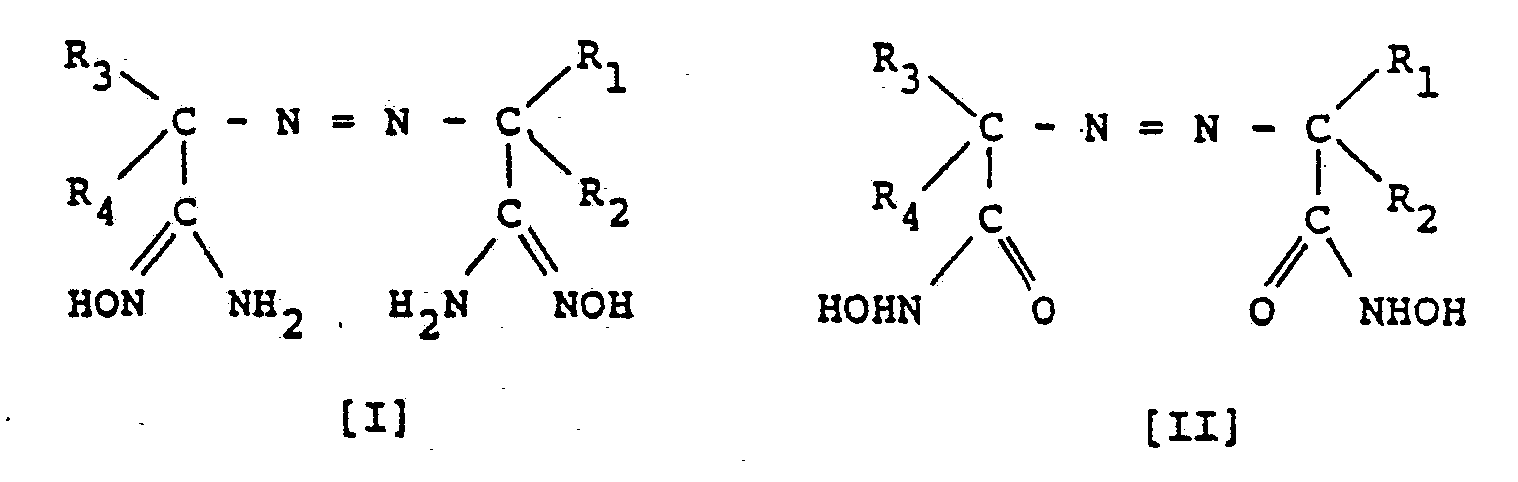
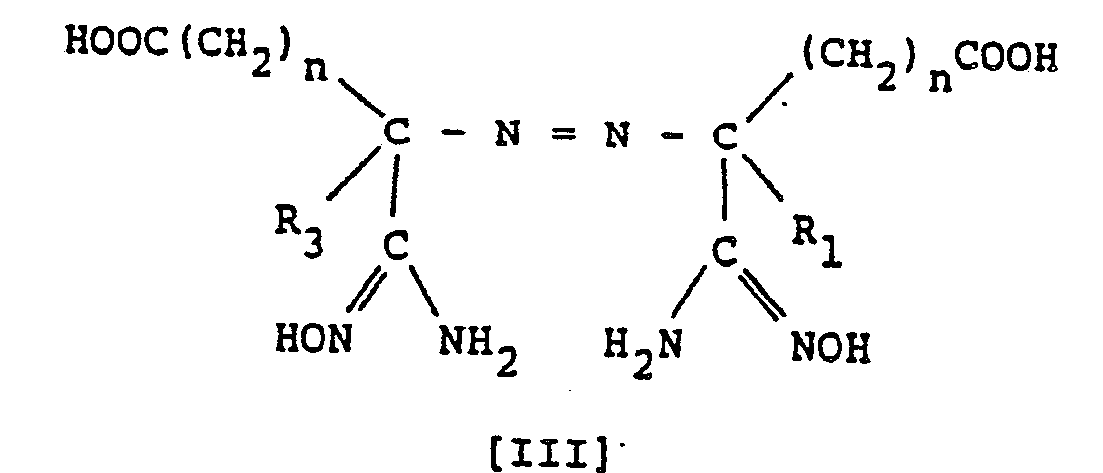
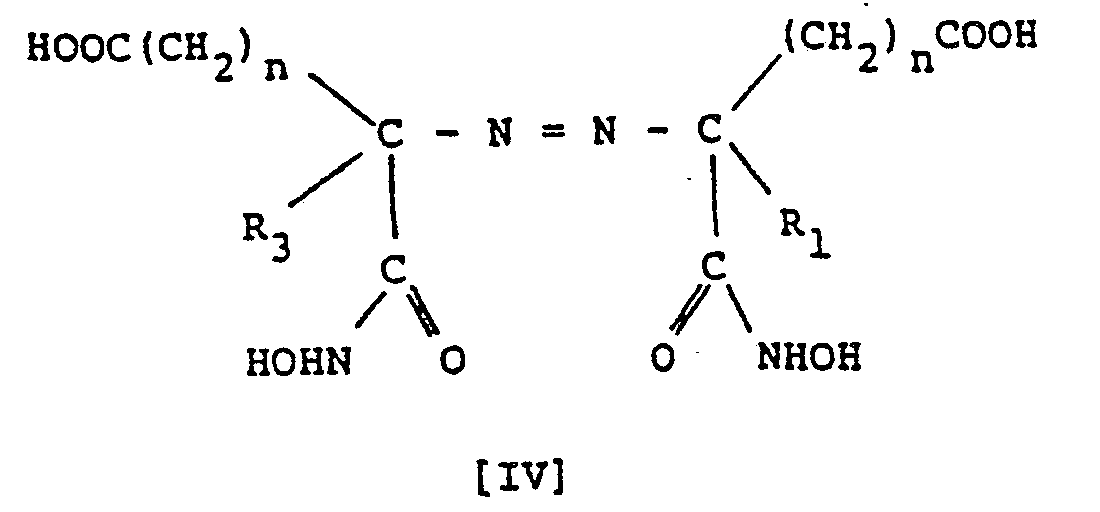
- inorganic acid salts of monoallylamine can easily be polymerized using an azo type initiator selected from azo compounds represented by formulae (I), (II), (III), (IV), (V) and (VI): wherein R 1 , R 2 , R 3 and R 4 each represents, which may be the same or different, a hydrocarbon group; R, and R 2 or/and R 3 and R 4 may be combined to complete a ring together with the carbon-atom attached thereto; R 5 represents a hydrogen atom or an alkyl group; m represents 0 or 1; and n represents 0 or an integer of 1 to 4.
- the present invention relates to a process for producing polymers of monoallylamine which comprises polymerizing inorganic acid salts of monoallylamine in a polar solvent in the presence of the azo type radical initiator selected from the ally compounds represented by the general formulae (I), (II), (III), (IV), (V) and (VI) described above, wherein R 1 through R s , m and n have the same significances as defined above; hereafter the same.
- R 1 through R 4 which may be the same or different, each represent a hydrocarbon group, preferably a straight or branched alkyl group having 1 to 4 carbon atoms, a cycloalkyl group having 3 to 6 carbon atoms (cyclopentane ring, cyclohexane ring, etc.), a phenyl group or a benzyl group, or R 1 and R 2 or R 3 and R 4 may be combined to complete a ring together with the carbon atom attached thereto.
- the preferred alkyl groups which may be straight or branched, have 1 to 4 carbon atoms.
- the azo type radical initiators represented by formulae (I) through (VI) are disimilar to the azo type radical initiator used in the process of Japanese Patent Application KOKAI 201811/83 supra in the following point. Namely, the azo type initiator of the Japanese Patent Application KOKAI 201811/83 contains a nitrogen group which constitutes a strongly basic moiety such as an amidino group or an alkylamino group.
- the nitrogen atom contained in the amidoxime group (formulae (I) and (III)) or the hydroxyamic acid moiety (formulae (11) and (IV)) is markedly weak in its basicity, as compared to the nitrogen atom of the amidino group of the alkylamino group contained in the initiator of the Japanese Patent Application KOKAI 201811/83.
- the azo type radical initiators represented by formulae (III) and (IV) further contain a -COOH group showing a property as an acid.
- the azo type radical initiators represented by formulae (V) and (VI) contain no nitrogen atom other than the azo group; these azo type radical initiators are completely neutral substances and insoluble in water, an aqueous solution of ordinary alkalis or an aqueous solution of ordinarly inorganic acids.
- azo type initiator represented by formula (V) or (VI) to, e.g., monoallylamine hydrochloride, no polymerization substantially occurs (cv. Comparison Example 1 later described).
- inorganic acid salts e.g., zinc chloride, etc.
- inorganic acid salts of monoallylamine which can be employed in the present invention include hydrochloride, sulfate, sulfite, phosphate, etc. Of these salts, the hydrochloride is particularly preferred.
- Polymerization is carried put in a polar solvent, namely, in water, inorganic acids (hydrochloric acid, sulfuric acid, phosphoric acid, polyphosphoric acid, etc.) or an aqueous solution thereof, organic acids (formic acid, acetic acid, propionic acid, lactic acid, etc.) or an aqueous solution thereof, or an alcohol, dimethyl sulfoxide, dimethylformamide, formamide, an aqueous solution of inorganic acid salts (zinc chloride, calcium chloride, magnesium chloride, etc.).
- a polar solvent namely, in water, inorganic acids (hydrochloric acid, sulfuric acid, phosphoric acid, polyphosphoric acid, etc.) or an aqueous solution thereof, organic acids (formic acid, acetic acid, propionic acid, lactic acid, etc.) or an aqueous solution thereof, or an alcohol, dimethyl sulfoxide, dimethylformamide, formamide, an aqueous solution of inorganic acid salt
- the aforesaid inorganic acid salts (e.g., hydrochloride) of monoallylamine may be generally used in the form of isolated crystals.
- a predetermined amount of monoallylamine is added to an aqueous inorganic acid (e.g., hydrochloric acid) solution and then, if necessary the aforesaid inorganic acid salt (e.g., zinc chloride) is directly added to the mixture and, the resulting solution may be provided for polymerization as_ it is.
- an aqueous inorganic acid e.g., hydrochloric acid
- the aforesaid inorganic acid salt e.g., zinc chloride
- inorganic acids or an aqueous solution thereof are used as media for polymerization, needless to say, a predetermined amount of monallylamine is polymerized as it is by adding the same to inorganic acids or an aqueous solution thereof (e.g., hydrochloric acid).
- a predetermined amount of monallylamine is polymerized as it is by adding the same to inorganic acids or an aqueous solution thereof (e.g., hydrochloric acid).
- aqueous solution containing inorganic acid salts for example, zinc chloride, calcium chloride or magnesium chloride.
- An aqueous solution of zinc chloride is particularly preferred.
- the inorganic acid salts be added in a large amount; however, the solubility is different depending upon the solubility of a salt in water or in a solution containing various concentrations of monoallylamine hydrochloride and, it is thus difficult to uniformly define the addition amount in all cases. In any case, however, it is preferred that the inorganic acid salt be contained in an amount of 5 to 500 wt% based on monoallylamine hydrochloride.
- polymers of inorganic acid salts of monoallylamine may be converted, if necessary and desired, to polymers of monoallylamine or polymers of organic acid salts of monoallylamine, in a conventional manner.
- the amount of the azo type initiator employed in the present invention is generally in a range of 0.1 to 10 wt%, preferably in a range of 1 to 6 wt%, based on the inorganic acid salt of monoallylamine.
- Polymerization temperature varies depending upon chemical structure of the initiator but generally ranges from 30 to 100°C, preferably 40 to 70°C. A time required for polymerization is generally within 100 hours.
- the concentration of the starting monomer be as high as possible within its solubility; however, the concentration is generally in a range of 10 to 85 wt%.
- Polymerization is more or less inhibited by the oxygen in the air. It is thus desired that polymerization be carried out in an inert gas such as nitrogen, etc.
- MAA monoallylamine
- Fig. 1 shows representative one 'H-NMR spectra of polymers of monoallylamine obtained using various azo type radical initiators in accordance with the process of the present invention.
- This example shows a process for producing a polymer of monoallylamine comprising polymerization of monoallylamine in phosphoric acid using as an initiator 2,2'-azobis-(2-methyl-propioamidoxime) (hereafter referred to as Initiator 1-1).
- a colorless, transparent viscous solution was obtained.
- the solution was poured into a large quantity of water to preciptate a polymer (polyallylamine-phosphate) in a rice cake form. After thoroughly washing the precipitates with water, the precipitates were dissolved in 550 ml of cone. hydrochloric acid to convert the polyallylamine-phosphate into the hydrochloride.
- the solution was added to a large quantity of methanol and the formed precipitates were taken out by filtration. The precipitates were extracted with methanol using a Soxhlet's extractor to remove the unpolymerized monomer and phosphoric acid.
- the precipitates were dried at 50°C under reduced pressure to obtain 320 g (about 65%) of a polymer.
- the polymer was identified to be polyallylamine hydrochloride (PAA-HCI).
- the number average molecular weight Mn of PAA-HCI determined by measurement of osmotic pressure in an aqueous saline solution was 22000.
- PAA-HCI is freely soluble in water and an aqueous acid solution but insoluble in an organic solvent.
- the viscosity of an aqueous solution of PAA-HCI shows a typical behavior of a polyelectrolyte.
- PAA-HCI When heated in the air, PAA-HCI decomposes at temperatures of 300°C or higher without melting.
- PAA free polyallylamine
- This example shows a process for producing a polymer of monoallylamine comprising polymerization of monoallylamine hydrochloride in an* aqueous solution thereof using as an initiator 2,2'-azobis-(2-methylpropiohydroxamic acid) (hereinafter referred to as Initiator 11-1).
- MAA ⁇ HCl contained about 5% of adsorbed water.
- the thus obtained colorless, transparent viscous solution was added to a large quantity of methanol to precipitate a white polymer.
- the precipitates were taken out by filtration, washed with methanol and then dried at 50°C under reduced pressure to obtain 66 g (about 68%) of PAA-HCI.
- the number average molecular weight Mn of PAA-HCI determined by the measurement of osmotic pressure in an aqueous saline solution was 5500.
- This example shows a process for producing a polymer of monoallylamine comprising polymerization of monoallylamine in phosphoric acid using as an initiator 2,2'-azobis-(2-carboxyethyl-propioamidoxime) (hereafter referred to as Initiator III ⁇ 2).
- the number average molecular weight Mn of PAA-HCI determined by measurement of osmotic pressure in an aqueous saline solution was 22000.
- PAA-HCf is freely soluble in water and an aqueous acid solution but insoluble in an organic solvent.
- the viscosity of an aqueous solution of PAA ⁇ HCl shows a typical behaviour of a high molecular electrolyte.
- PAA-HCI When heated in the air, PAA-HCI decomposes at temperatures of 300°C or higher without melting.
- PAA free polyallylamine
- This example shows a process for producing a polymer of monoallylamine comprising polymerization of monoallylamine hydrochloride in its aqueous solution using as an initiator 2,2'-azobis-(2-carboxyethyl- propiohydroxamic acid) (hereafter referred to as Initiator IV-2).
- MAA-HCI contained about 5% of moisture.
- the thus obtained colorless, transparent viscous solution was added to a large quantity of methanol to precipitate a white polymer.
- the precipitates were taken out by filtration, washed with methanol and then dried at 50°C under reduced pressure to obtain 73 g (about 74.5%) of MAA-HCI.
- the number average molecular weight Mn of PAA-HCI determined by the measurement of osmotic pressure in an aqueous saline solution was 5500.
- This example shows a process for producing a polymer of monoallylamine comprising polymerization of monoallylamine hydrochloride in an aqueous solution of zinc chloride using as an initiator 2,2'-azobis-(methyl 2-methylpropionate) (hereafter referred to as Initiator V-1).
- Initiator V-1 Reagent manufactured by Wako Junyaku Kogyo K.K. was used as it was.
- MAA-HCI contained about 5% of moisture. Water was added to the thus obtained MAA-HCI to make a 85% aqueous solution of MAA-HCI, which was provided for use hereafter.
- the number mean molecular weight Mn of PAA-HCI determined by the measurement of osmotic pressure in an aqueous saline solution was 9800.
- PAA-HCI is freely soluble in water and an aqueous acid solution but insoluble in an organic solvent.
- the viscosity of an aqueous solution of PAA-HCI shows a typical behavior of a high molecular electrolyte.
- PAA-HCI When heated in the air, PAA-HCI decomposes at temperature of 300°C or higher without melting.
- PAA-HCI free PAA was produced from the thus obtained PAA-HCI. That is, 30 g of PAA-HCI was dissolved in 270 g of distilled water and the solution was passed through a strongly basic ion exchange resin (Amberlite (trade mark) IRA-402) to remove hydrochloric acid. Freeze-drying of the filtrate gave 16.5 g of white PAA.
- This PAA is readily soluble in water and in methanol and swells with dimethyl-sulfoxide and with pyridine but is insoluble in ordinary organic solvents. When allowed to stand in the air, this PAA absorbs carbon dioxide and moisture to form the carbonate.
- This example shows a process for producing a polymer of monoallylamine hydrochloride comprising polymerization of monoallylamine hydrochloride in an aqueous solution of zinc chloride using as an initiator 2,2'-azobis-(2-acetoxypropane) (hereafter referred to as Initiator VI-1).
- the polymer was purified in a manner similar to Example 6 to obtain 28.9 g (about 68%) of PAA-HCI.
- the number average molecular weight Mn of PAA-HCI determined by the measurement of osmotic pressure in an aqueous saline solution was 8000.
- PAA-HCI was not obtained substantially in all of Comparison Examples 1a, 1b and 1c, whereas in Example 8, PAA-HCI having a high polymerization degree was obtained in good yield.
- Precipitation was further effected in methanol to isolate the product as PAA-HCI.
- the yield was 0.1 g (6.2%).
- the product showed intrinsic viscosity of ninh 0.5 g/100 ml 1/10 M NaCl being 0.1.
- reaction mixture was refluxed for 3 hours.
- a solution of 0.3 g of AIBN in 50 ml of chlorobenzene was further added to the system.
- the reaction mixture was cooled to 20°C, filtered and washed with ethyl acetate. Thereafter the system was dried at 60°C under reduced pressure to obtain 0.25 g (yield 0.53%) of a yellow hydroscopic product. It was not possible to determine the polymerization degree of the product because the amount of the product produced was small. However, the fact that the product was hydroscopic indicates that the product would have a relatively low polymerization degree.
Landscapes
- Chemical & Material Sciences (AREA)
- Health & Medical Sciences (AREA)
- Chemical Kinetics & Catalysis (AREA)
- Medicinal Chemistry (AREA)
- Polymers & Plastics (AREA)
- Organic Chemistry (AREA)
- Polymerization Catalysts (AREA)
- Addition Polymer Or Copolymer, Post-Treatments, Or Chemical Modifications (AREA)
Claims (16)


Applications Claiming Priority (6)
| Application Number | Priority Date | Filing Date | Title |
|---|---|---|---|
| JP21151183A JPS60104107A (ja) | 1983-11-10 | 1983-11-10 | モノアリルアミンの重合体の製造方法 |
| JP211511/83 | 1983-11-10 | ||
| JP315084A JPS60147409A (ja) | 1984-01-11 | 1984-01-11 | モノアリルアミンの重合体の製造方法 |
| JP3150/84 | 1984-01-11 | ||
| JP48444/84 | 1984-03-14 | ||
| JP4844484A JPS60192715A (ja) | 1984-03-14 | 1984-03-14 | モノアリルアミンの重合体の製造方法 |
Publications (3)
| Publication Number | Publication Date |
|---|---|
| EP0145220A2 EP0145220A2 (fr) | 1985-06-19 |
| EP0145220A3 EP0145220A3 (en) | 1985-10-23 |
| EP0145220B1 true EP0145220B1 (fr) | 1988-06-01 |
Family
ID=27275675
Family Applications (1)
| Application Number | Title | Priority Date | Filing Date |
|---|---|---|---|
| EP19840307460 Expired EP0145220B1 (fr) | 1983-11-10 | 1984-10-30 | Procédé de production de polymères de monoallylamine |
Country Status (2)
| Country | Link |
|---|---|
| EP (1) | EP0145220B1 (fr) |
| DE (1) | DE3471664D1 (fr) |
Families Citing this family (5)
| Publication number | Priority date | Publication date | Assignee | Title |
|---|---|---|---|---|
| EP0242791B1 (fr) * | 1986-04-25 | 1990-06-27 | Ethyl Corporation | Procédé de préparation de polymères de mono-allyl-amine |
| GB2272444B (en) * | 1992-11-13 | 1997-04-02 | Minnesota Mining & Mfg | Flame retardants |
| US6028233A (en) * | 1995-06-08 | 2000-02-22 | Exxon Production Research Company | Method for inhibiting hydrate formation |
| FR2788517B1 (fr) * | 1999-01-15 | 2001-03-16 | Atochem Elf Sa | Procede de preparation d'azoiminoethers et d'esters d'acides azocarboxyliques, et nouveaux esters mixtes d'acides azocarboxyliques |
| WO2019163737A1 (fr) * | 2018-02-23 | 2019-08-29 | 日東紡績株式会社 | Copolymère à base d'allylamine, et procédé de fabrication de celui-ci |
Family Cites Families (2)
| Publication number | Priority date | Publication date | Assignee | Title |
|---|---|---|---|---|
| DE2841033A1 (de) * | 1978-09-21 | 1980-04-03 | Bayer Ag | Verfahren zur herstellung waessriger polymerisatdispersionen |
| US4504640A (en) * | 1982-05-19 | 1985-03-12 | Nitto Boseki Co., Ltd. | Process for producing monoallylamine polymer |
-
1984
- 1984-10-30 EP EP19840307460 patent/EP0145220B1/fr not_active Expired
- 1984-10-30 DE DE8484307460T patent/DE3471664D1/de not_active Expired
Also Published As
| Publication number | Publication date |
|---|---|
| DE3471664D1 (en) | 1988-07-07 |
| EP0145220A3 (en) | 1985-10-23 |
| EP0145220A2 (fr) | 1985-06-19 |
Similar Documents
| Publication | Publication Date | Title |
|---|---|---|
| US4528347A (en) | Process for producing polymers of monoallylamine | |
| US4540760A (en) | Process for producing polymers of monoallylamine | |
| KR890002931B1 (ko) | 모노알린아민 폴리머 제조방법 | |
| US4680360A (en) | Process for producing poly(allylamine) derivatives | |
| CA1233932A (fr) | Preparation de derives de poly(allylamine) | |
| US4812540A (en) | Preparation of polymers of monoallylamine and diallylamine derivatives with azo catalyst | |
| JPH09511786A (ja) | β置換ニトロキシドラジカルの存在下の重合 | |
| JP3439214B2 (ja) | ビニルピリジンおよびアセトキシスチレンから誘導された両性コポリマー | |
| EP0145220A2 (fr) | Procédé de production de polymères de monoallylamine | |
| US4644042A (en) | Polymers of N-substituted secondary monoallylamines and their salts and process for producing the same | |
| EP0190704B1 (fr) | Procédé de préparation de polymères de sels d'acides inorganiques de monoallylamines ou de monoallylamines N-substituées | |
| US4569979A (en) | Process for producing a polymer of an inorganic acid salt of monoallylamine | |
| US5665843A (en) | Allylbiguanide polymer and method of producing same | |
| JPH0256361B2 (fr) | ||
| JPH0257083B2 (fr) | ||
| US3679748A (en) | 2-aminomethyl-1,3-butadiene monomers | |
| JP3570615B2 (ja) | アリルアミン系重合体の製造方法 | |
| JPH0257082B2 (fr) | ||
| JPS60147409A (ja) | モノアリルアミンの重合体の製造方法 | |
| US5210149A (en) | Amphoteric copolymer derived from vinylpyridine and acetoxystyrene | |
| GB1568445A (en) | Free radical polymerisation of ethylenically unsaturated mnomers | |
| CA1261100A (fr) | Methode de preparation de derives de poly(allylamine) | |
| US5232995A (en) | Amphoteric copolymer derived from vinylpyridine and acetoxystyrene | |
| RU2061679C1 (ru) | Соли n-[1,1-r,r-3-диметиламинопропил(поли-1,1-r,r,-7-оксо-4,4-диметил-4,8-диазаоктаметилен)]пропенамидов и способ их получения | |
| SU1257074A1 (ru) | Водорастворимые комплексообразующие полиэлектролиты,обладающие сорбционной способностью к ионам кадми |
Legal Events
| Date | Code | Title | Description |
|---|---|---|---|
| PUAI | Public reference made under article 153(3) epc to a published international application that has entered the european phase |
Free format text: ORIGINAL CODE: 0009012 |
|
| AK | Designated contracting states |
Designated state(s): BE CH DE FR GB LI |
|
| PUAL | Search report despatched |
Free format text: ORIGINAL CODE: 0009013 |
|
| AK | Designated contracting states |
Designated state(s): BE CH DE FR GB LI |
|
| 17P | Request for examination filed |
Effective date: 19851218 |
|
| 17Q | First examination report despatched |
Effective date: 19870320 |
|
| GRAA | (expected) grant |
Free format text: ORIGINAL CODE: 0009210 |
|
| AK | Designated contracting states |
Kind code of ref document: B1 Designated state(s): BE CH DE FR GB LI |
|
| REF | Corresponds to: |
Ref document number: 3471664 Country of ref document: DE Date of ref document: 19880707 |
|
| ET | Fr: translation filed | ||
| PLBE | No opposition filed within time limit |
Free format text: ORIGINAL CODE: 0009261 |
|
| STAA | Information on the status of an ep patent application or granted ep patent |
Free format text: STATUS: NO OPPOSITION FILED WITHIN TIME LIMIT |
|
| 26N | No opposition filed | ||
| PGFP | Annual fee paid to national office [announced via postgrant information from national office to epo] |
Ref country code: FR Payment date: 19890912 Year of fee payment: 6 |
|
| PGFP | Annual fee paid to national office [announced via postgrant information from national office to epo] |
Ref country code: CH Payment date: 19890915 Year of fee payment: 6 |
|
| PGFP | Annual fee paid to national office [announced via postgrant information from national office to epo] |
Ref country code: GB Payment date: 19890930 Year of fee payment: 6 |
|
| PGFP | Annual fee paid to national office [announced via postgrant information from national office to epo] |
Ref country code: DE Payment date: 19891002 Year of fee payment: 6 |
|
| PG25 | Lapsed in a contracting state [announced via postgrant information from national office to epo] |
Ref country code: BE Effective date: 19891031 |
|
| BERE | Be: lapsed |
Owner name: NITTO BOSEKI CO. LTD Effective date: 19891031 |
|
| PG25 | Lapsed in a contracting state [announced via postgrant information from national office to epo] |
Ref country code: GB Effective date: 19901030 |
|
| PG25 | Lapsed in a contracting state [announced via postgrant information from national office to epo] |
Ref country code: LI Effective date: 19901031 Ref country code: CH Effective date: 19901031 |
|
| GBPC | Gb: european patent ceased through non-payment of renewal fee | ||
| PG25 | Lapsed in a contracting state [announced via postgrant information from national office to epo] |
Ref country code: FR Effective date: 19910628 |
|
| REG | Reference to a national code |
Ref country code: CH Ref legal event code: PL |
|
| PG25 | Lapsed in a contracting state [announced via postgrant information from national office to epo] |
Ref country code: DE Effective date: 19910702 |
|
| REG | Reference to a national code |
Ref country code: FR Ref legal event code: ST |