EP0145330A2 - Structure de signal pour transmission de données - Google Patents
Structure de signal pour transmission de données Download PDFInfo
- Publication number
- EP0145330A2 EP0145330A2 EP84307926A EP84307926A EP0145330A2 EP 0145330 A2 EP0145330 A2 EP 0145330A2 EP 84307926 A EP84307926 A EP 84307926A EP 84307926 A EP84307926 A EP 84307926A EP 0145330 A2 EP0145330 A2 EP 0145330A2
- Authority
- EP
- European Patent Office
- Prior art keywords
- signal
- points
- noise
- selecting
- point
- Prior art date
- Legal status (The legal status is an assumption and is not a legal conclusion. Google has not performed a legal analysis and makes no representation as to the accuracy of the status listed.)
- Withdrawn
Links
Images

Classifications
-
- H—ELECTRICITY
- H04—ELECTRIC COMMUNICATION TECHNIQUE
- H04L—TRANSMISSION OF DIGITAL INFORMATION, e.g. TELEGRAPHIC COMMUNICATION
- H04L27/00—Modulated-carrier systems
- H04L27/32—Carrier systems characterised by combinations of two or more of the types covered by groups H04L27/02, H04L27/10, H04L27/18 or H04L27/26
- H04L27/34—Amplitude- and phase-modulated carrier systems, e.g. quadrature-amplitude modulated carrier systems
- H04L27/3405—Modifications of the signal space to increase the efficiency of transmission, e.g. reduction of the bit error rate, bandwidth, or average power
-
- H—ELECTRICITY
- H04—ELECTRIC COMMUNICATION TECHNIQUE
- H04L—TRANSMISSION OF DIGITAL INFORMATION, e.g. TELEGRAPHIC COMMUNICATION
- H04L27/00—Modulated-carrier systems
- H04L27/32—Carrier systems characterised by combinations of two or more of the types covered by groups H04L27/02, H04L27/10, H04L27/18 or H04L27/26
- H04L27/34—Amplitude- and phase-modulated carrier systems, e.g. quadrature-amplitude modulated carrier systems
- H04L27/345—Modifications of the signal space to allow the transmission of additional information
- H04L27/3455—Modifications of the signal space to allow the transmission of additional information in order to facilitate carrier recovery at the receiver end, e.g. by transmitting a pilot or by using additional signal points to allow the detection of rotations
Definitions
- This invention relates to the transmission of digital data in analog form at high speed with a low rate of error due to transmission impairments, including electrical noise.
- the invention provides new signal structures characterised by relatively high immunity to error due to multiplicative noise, as well as additive noise and phase jitter.
- Digital data conventionally is transmitted, as on telephone lines, by sending a carrier signal with analog modulation coded to convey, in every time interval, a set of binary digits.
- a conventional practice sends M bits once per transmission interval, i.e., baud interval, where M is an integer.
- the M bits have 2 M possible values.
- Examples of conventional higher speed transmission rates are 9,600 bps wherein four bits are transmitted in each interval by sending one of sixteen analog values; and 14,400 bps, wherein six bits are transmitted in each interval by sending one of sixty-four analog values.
- Conventional baud rates include 1200; 1600; and 2400 symbols per second.
- DSB-QC double sideband-quadrature carrier modulation
- the coding of the modulation is defined by two analog parameters designated a i and b where (i) is an integer.
- the values of these modulation parameters identify, in each interval, the one analog value being transmitted.
- a i and b where (i) is an integer.
- the values of these modulation parameters identify, in each interval, the one analog value being transmitted.
- the values of the modulation parameters are conventionally plotted as points in a two-coordinate complex plane.
- the set of points for a transmission system is termed a "signal structure", or “signal space”, or “signal constellation”.
- the present invention is a method for determining a quadrature amplitude-modulated data transmission signal structure having the improvement comprising the step of selecting the signals to have substantially uniform low probability of error due to multiplicative noise.
- the present invention is also modem apparatus for data transmission and having a transmission encoder and a receiving decoder, said apparatus having the improvement wherein said encoder converts each of a set of M binary data digits encoded in one of 2 M values of a quadrature amplitude-modulated signal, where M is a positive integer, and provides each said signal to have substantially equal probability of transmission error due to a selected non-zero and finite level of multiplicative noise and a selected non-zero and finite level of additive noise and provides a structure of M said signals with minimal overall probability of said transmission error; and wherein said decoder converts a one of 2 M values of a quadrature amplitude-modulated signal, where said signals are provided with said encoding, to a set of M binary digits.
- high speed data transmission employs a signal structure resistant to impairment by multiplicative noise, as well as by additive noise.
- the signal structure also has substantial immunity to phase jitter.
- Each signal point in the new signal structure has essentially the same low probability of transmission error due to multiplicative noise and to additive noise.
- the points have overall minimal electrical power and accordingly are located at minimal distances from the origin of the complex plane representation.
- Additive noise also termed “white noise”
- Multiplicative noise is a function of signal power.
- the power of multiplicative noise for any signal point is directly related to the square of the distance of that signal point from the origin of the complex coordinate plane. This form of noise accordingly varies with the location of a signal point from the origin of the complex plane.
- Phase jitter is another form of transmission impairment. It causes signal degradation which is related linearly to the distance of a signal point from the coordinate origin.
- One feature of embodiments of the invention is that the signal structure reduces errors due to multiplicative noise and attains relatively good performance relative to additive noise. That is, with this invention one can determine a signal structure that resists degradation by multiplicative noise which also resists degradation by additive noise to nearly the extent as when the signal space is designed with regard only to additive noise. The invention thus provides a large gain in performance relative to multiplicative noise with only a relatively small loss from the optimum performance otherwise available exclusively for additive noise.
- a signal structure is accordingly determined with emphasis on impairment by multiplicative noise as well as by additive noise, and attains an improved overall low error rate.
- a signal structure determined with regard to multiplicative noise and to additive noise in this manner further has a relatively high resistance to degradation due to phase jitter.
- designing a signal structure according to the invention to enhance immunity to multiplicative noise impairment appears to enhance immunity to phase jitter impairment to a degree nearly as high as occurs when the design has greater emphasis exclusively on phase jitter impairments.
- the general placement of the signal points in the complex plane representation locates each point centrally within a circular decision region having an area proportional to the square of the distance of that point from the origin of the complex coordinates.
- This practice provides substantially uniform probability of error due to multiplicative noise for all points in the signal structure.
- all the signal points are packed as closely as possible about the coordinate origin without causing their decision regions to overlap. This dense packing is a standard practice to minimize the probability of error for a given signal-to-noise ratio.
- a signal structure according to embodiments of the invention can be viewed, to a first approximation, as having two subsets of points.
- the points of one subset, located closer to the origin, are in a configuration determined primarily by consideration of additive noise.
- the points of the other subset, i.e., those further from the origin, are located primarily from consideration of multiplicative noise impairment.
- the inner subset contains the signal points which have a power level below the average power for the entire signal constellation; while those points having a power level above the average power are in the outer subset.
- a signal structure determined according to the invention can have symmetrical quadrants, and can be symmetrical in each quadrant about the quadrant bisector, e.g., about the 45° line in quadrant I. This symmetry is not required, but generally facilitates analysis of a transmission system, and facilitates constructing equipment to implement the signal structure.
- the signal structure according to the invention is in significant contrast to prior signal structures.
- the noted U.S. Patent No. 3,877,768 discloses a signal structure in which the signal points are located in a regular circular array, i.e., the points lie on concentric rings centered on the coordinate origin.
- Another known signal structure has signal points located in a regular rectangular array with equally spaced rows and columns; the noted U.S. Patent No. 4,271,527 illustrates this prior configuration in Figure 5.
- the same patent shows a variation of that known structure in which outermost points are relocated to a location closer to a coordinate axis.
- a signal structure according to the invention is of particular significance in reducing errors due to noise in systems having a relatively large number of signal points, generally at least more than eight points.
- a sixteen point signal structure according to the invention performs well and is at least competitive if not superior to prior signal structures.
- a signal structure of one or two further degrees of complexity, i.e., having thirty-two points or sixty-four points, and determined according to the invention to account for multiplicative noise provides superior performance, i.e., lower error rates, than prior signal structures.
- Yet another feature of a signal structure according to the invention is that it can have points in addition to those required to define a digital data bit. Additional signal points are known for control purposes.
- One specific example according to the invention is the provision of synchronizing points in the signal structure.
- a sixty-four point signal structure according to the invention can additionally have eight such synchronizing points, two in each quadrant, for a total of seventy-two points in the composite structure.
- the new signal structure differs from the known regular rectangular array primarily in the outer subset of points. There, points most proximal to either axis are spaced further from that axis than in the conventional rectangular array. Further, points equidistant from both axes are spaced farther outward from the origin in the new signal structure. Other points in the outer subset also are at locations different from those of a rectangular array; the relocation attains a reduction in the density of the points, as contrasted to a conventional rectangular configuration.
- the invention accordingly comprises the several steps and the relation of one or more of such steps with respect to each of the others, and the apparatus having features of construction, combination of elements and arrangements of parts which are adapted to effect such steps, all as exemplified in the following detailed disclosure.
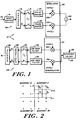
- FIGURE 1 shows a form of DSB-QC modem with which the invention can be practiced for operation with voice-grade telephone lines and which, as conventional, has a transmit section 10a and a receive section lOb.
- the transmit section of the illustrated modem 10 receives binary information to be transmitted on an input line 12, and stores it in an input buffer 14.
- An encoder 16 converts each digital input symbol to two encoded analog signals that define a pair of modulation parameters, designated a i and b.. These parameters define the one point in the signal structure which identifies the input digital symbol.
- the encoder 16 may, for example, be implemented with a look-up table.
- An electronic switch 18 samples the two encoded signals at the selected baud rate 1/T.
- a summing device 24 combines the two amplitude modulated carrier signals to produce a quadrature amplitude' modulated (QAM) output signal, preferably having double sideband modulation of each carrier, ready for transmission to another like terminal.
- QAM quadrature amplitude' modulated
- the receive section 10b of the illustrated modem receives on line 26 a quadrature amplitude modulated (QAM) signal and applies it to a bandpass filter 28 that suppresses unwanted frequency components.
- An equalizer 36 receives the sampled signal components and prepares them for decoding in a decoder 38. The decoder produces the multiple-digit binary symbol which the modulation of the received QAM signal identified.
- FIGURE 2 shows a conventional prior art signal structure having sixteen points arranged in a regular rectangular array with four points in each of four identical quadrants of a complex plane.
- the quadrants are designated with Roman numerals, and the points in each quadrant are designated with the letter(s) and an Arabic number.
- the coordinates of the points are also designated, in this instance, with numerals along each coordinate axis.
- the decision lines for distinguishing each signal point in quadrant I from another point are the coordinate axes and the solid lines d-1 and d-2. Each point in this rectangular pattern is located at the centre of a square decision region bounded by decision lines.
- the encoder 16 in the FIGURE 1 modem 10 when operating with this signal pattern, produces modulation parameters that convert.each four-bit digital input symbol to one of the sixteen points of FIGURE 2. Conversely, the receiver decoder 38 converts the pair of modulation parameters of a received signal to the corresponding four-digit symbol according to this pattern.
- Equation (1) The probability of error which can arise in a data transmission system operating with the signal structure of FIGURE 2 is different if only additive noise is considered, as contrasted to considering both additive and multiplicative noise. This is apparent from a comparison of Equations (1) and (2) below.
- the probability of error for each signal point in the FIGURE 2 structure is inversely proportional to the signal-to-noise ratio at that point.
- the signal-to-noise ratio for any particular point (i), where (i) is an integer, due to additive noise alone (SANR) is expressed in Equation (1), whereas Equation (2) presents the noise ratio (SNR) for the point (i) due to both additive and multiplicative noise.
- SNR noise ratio
- d i is the distance of a point from the decision line
- is the distance from a point in the signal structure to the origin, where the subscript (i) identifies the point and has the value 1, 2, 3 or 4,
- A is the variance of the additive noise
- B is the variance of the multiplicative noise.
- Equation 2 indicates that the signal-to-noise ratio decreases, and correspondingly the probability of error increases, at points located at greater distances from the origin. Further, this increase in probability of error grows with increasing multiplicative noise.
- This invention provides signal structures that take the mulitplicative noise into account.
- the signal structures maximize the signal-to-noise ratio, and hence minimize the probability of error, in the presence of multiplicative noise as well as other impairments such as additive noise.
- the present invention provides a data transmission modem that operates with a signal structure in which the signal-to-noise ratio corresponding to Equation 2 is essentially constant for all points in the signal constellation, and has an overall minimal level, within the practical constraints of the implementing hardware.
- FIGURE 3 shows one of four identical quadrants of a sixteen-point signal configuration determined according to the invention for a signal-to-additive noise ratio (SANR) of 20 dB and a signal-to-multiplicative noise ratio (SMNR) of 19dB.
- the drawing also shows the decision line distances (p) and (q) used in determining the locations of the points in this constellation as now described.
- the signal structure of this invention provides a uniform probability of error for all points and hence solves the above equations for (p) and (q) with any given noise parameters A and B such that
- FIGURE 3 also shows that each signal point determined in the foregoing manner can be viewed as centrally located within a generally circular decision region.
- the approximate radius of the illustrated regions are: unity for the point Sl, (p) for S2 and for S3, and (q) for S4.
- Each radius is proportional, at least to a first approximation, to the distance of the corresponding signal point from the origin.
- the graph of FIGURE 4 shows with curves 40 and 42 how the values of the constellation parameters (p) and (q) change for different values of signal-to-multiplicative noise for a given signal-to-additive noise ratio of 20 dB. Note that (q), and to a lesser extent (p), begin to increase rapidly as the multiplicative noise decreases.
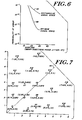
- FIGURE 6 shows with a curve 48 the probability of transmission error for a signal structure determined in the foregoing manner and, with curve 50, for the conventional regular rectangular signal structure.
- the graph shows probability of error as a function of the signal-to-additive noise ratio, with the signal-to-multiplicative noise ratio 19 dB and for a value of peak phase jitter of 5°, without any form of carrier tracking. It is noteworthy that the curves of FIGURE 6 appear similar in individual shape and in differential character to those shown in FIGURE 5.
- FIGURE 7 illustrates this further practice of the invention by showing a signal structure which a modem encoder and decoder can provide for a 14,400 bit per second transmission system operating at a 2400 symbol per second rate.
- the structure which shows the coordinate of each point to the origin, is designed for SMNR of 28 dB and SANR of 30 dB.
- This signal structure has sixty-four points arranged with sixteen points in each of four symmetrical quadrants, of which FIGURE 7 shows quadrant I. There are also two additional points per quadrant, designated S17 and S18 in FIGURE 7, and hence a total of eight additional points, for synchronizing purposes.
- the subset of inner points S1-S9 is arranged substantially in a regular rectangular pattern, whereas the remaining outer subset of points differs from a rectangular pattern and is less densely packed in the manner described above.
- the points of the outer subset are spaced further from either axis than are the points in the inner subset, as well as being spaced further apart from one another.
- a modem 10 as shown in FIGURE 1 can be constructed with known electronic skills to operate with signal structures according to the invention.
- the modem encoder 16 can be constructed to encode binary symbols to signal points according to a signal structure as described and as embodied, for example, in FIGURE 3 and in FIGURE 7.
- the modem decoder 38 can provide the reverse operation.
Landscapes
- Engineering & Computer Science (AREA)
- Computer Networks & Wireless Communication (AREA)
- Signal Processing (AREA)
- Digital Transmission Methods That Use Modulated Carrier Waves (AREA)
- Radio Transmission System (AREA)
- Detection And Prevention Of Errors In Transmission (AREA)
Applications Claiming Priority (2)
| Application Number | Priority Date | Filing Date | Title |
|---|---|---|---|
| US554261 | 1983-11-22 | ||
| US06/554,261 US4660213A (en) | 1983-11-22 | 1983-11-22 | Signal structure for data communication |
Publications (2)
| Publication Number | Publication Date |
|---|---|
| EP0145330A2 true EP0145330A2 (fr) | 1985-06-19 |
| EP0145330A3 EP0145330A3 (fr) | 1986-12-30 |
Family
ID=24212674
Family Applications (1)
| Application Number | Title | Priority Date | Filing Date |
|---|---|---|---|
| EP84307926A Withdrawn EP0145330A3 (fr) | 1983-11-22 | 1984-11-15 | Structure de signal pour transmission de données |
Country Status (4)
| Country | Link |
|---|---|
| US (1) | US4660213A (fr) |
| EP (1) | EP0145330A3 (fr) |
| JP (1) | JPS60134545A (fr) |
| AU (1) | AU3540484A (fr) |
Cited By (2)
| Publication number | Priority date | Publication date | Assignee | Title |
|---|---|---|---|---|
| FR2610462A1 (fr) * | 1986-12-30 | 1988-08-05 | Thomson Csf | Dispositif et procede de modulation amplitude-phase utilisant une pluralite d'emetteurs |
| EP0629069A3 (en) * | 1993-06-04 | 1995-01-04 | Rohde & Schwarz | Qam constellation design. |
Families Citing this family (7)
| Publication number | Priority date | Publication date | Assignee | Title |
|---|---|---|---|---|
| US5412689A (en) * | 1992-12-23 | 1995-05-02 | International Business Machines Corporation | Modal propagation of information through a defined transmission medium |
| US5475713A (en) * | 1993-06-14 | 1995-12-12 | At&T Corp. | Shaped signal spaces in a simultaneous voice and data system |
| US5832041A (en) * | 1994-10-21 | 1998-11-03 | Philips Electronics North America Corporation | 64 QAM signal constellation which is robust in the presence of phase noise and has decoding complexity |
| US8650470B2 (en) | 2003-03-20 | 2014-02-11 | Arm Limited | Error recovery within integrated circuit |
| JP3944221B2 (ja) * | 2005-08-19 | 2007-07-11 | インターナショナル・ビジネス・マシーンズ・コーポレーション | 信号処理装置および方法 |
| KR100768409B1 (ko) | 2006-02-28 | 2007-10-18 | 주식회사 에이로직스 | 디시젼 오차를 줄이기 위한 복조기 및 그 방법 |
| KR100914316B1 (ko) * | 2006-12-14 | 2009-08-27 | 한국전자통신연구원 | 매핑 심볼의 위치를 결정하는 방법, 그리고 이진 신호를변조하는 장치 및 방법 |
Family Cites Families (7)
| Publication number | Priority date | Publication date | Assignee | Title |
|---|---|---|---|---|
| US3887768A (en) * | 1971-09-14 | 1975-06-03 | Codex Corp | Signal structures for double side band-quadrature carrier modulation |
| US3988539A (en) * | 1974-09-16 | 1976-10-26 | Hycom Incorporated | Data transmission system using optimal eight-vector signaling scheme |
| US3955141A (en) * | 1974-10-18 | 1976-05-04 | Intertel, Inc. | Synchronizing circuit for modems in a data communications network |
| JPS5650652A (en) * | 1979-07-31 | 1981-05-07 | Nec Corp | Digital signal transmission system via multiphase/ multivalue modulation wave |
| US4271527A (en) * | 1979-08-31 | 1981-06-02 | Paradyne Corporation | Double side band-quadrature carrier modulation signal structures |
| US4439863A (en) * | 1980-11-28 | 1984-03-27 | Rockwell International Corporation | Partial response system with simplified detection |
| GB2118003B (en) * | 1982-02-02 | 1985-07-31 | Racal Milgo Ltd | Differential encoder and decoder for transmitting binary data |
-
1983
- 1983-11-22 US US06/554,261 patent/US4660213A/en not_active Expired - Fee Related
-
1984
- 1984-11-14 AU AU35404/84A patent/AU3540484A/en not_active Abandoned
- 1984-11-15 EP EP84307926A patent/EP0145330A3/fr not_active Withdrawn
- 1984-11-22 JP JP59246383A patent/JPS60134545A/ja active Pending
Non-Patent Citations (2)
| Title |
|---|
| BELL SYSTEM TECHNICAL JOURNAL, vol. 52, no. 6, July-August 1973, pages 927-965, American Telephone and Telegraph Co., New York, US; G.J. FOSCHINI et al.: "On the selection of a two-dimensional signal constellation in the presence of phase jitter and gaussian noise" * |
| ELEKTROTECHNIK UND MASCHINENBAU, 93rd year, no. 12, December 1976, pages 529-534, Vienna, AT; W. ZANDRA: "Modems zur schnellen Daten}bertragung auf Fernsprechkreisen" * |
Cited By (2)
| Publication number | Priority date | Publication date | Assignee | Title |
|---|---|---|---|---|
| FR2610462A1 (fr) * | 1986-12-30 | 1988-08-05 | Thomson Csf | Dispositif et procede de modulation amplitude-phase utilisant une pluralite d'emetteurs |
| EP0629069A3 (en) * | 1993-06-04 | 1995-01-04 | Rohde & Schwarz | Qam constellation design. |
Also Published As
| Publication number | Publication date |
|---|---|
| AU3540484A (en) | 1985-05-30 |
| EP0145330A3 (fr) | 1986-12-30 |
| US4660213A (en) | 1987-04-21 |
| JPS60134545A (ja) | 1985-07-17 |
Similar Documents
| Publication | Publication Date | Title |
|---|---|---|
| US4660214A (en) | QANI Trellis-coded signal structure | |
| US4271527A (en) | Double side band-quadrature carrier modulation signal structures | |
| US3887768A (en) | Signal structures for double side band-quadrature carrier modulation | |
| KR950011198B1 (ko) | 텔레비젼 정보 통신 방법 및 장치 | |
| US4720839A (en) | Efficiency data transmission technique | |
| US4651320A (en) | Inband coding of secondary data | |
| EP0161264B1 (fr) | Ajustement de phase porteuse par l'utilisation d'un detecteur de phase absolue | |
| US7254167B2 (en) | Constellation-multiplexed transmitter and receiver | |
| CA2054906A1 (fr) | Systeme de communication multi-frequence utilisant le codage differentiel pour obtenir des debits de donnees eleves dans des canaux non egalises | |
| US6553063B1 (en) | Constellation-multiplexed transmitter and receiver | |
| EP0050082A1 (fr) | Système de communication en duplex total pour canaux de parole | |
| EP0086091B1 (fr) | Dispositif et méthode de traitement d'un signal | |
| US4675619A (en) | Multiple quadrature-phase amplitude modulating system capable of reducing a peak amplitude | |
| US3988539A (en) | Data transmission system using optimal eight-vector signaling scheme | |
| US4660213A (en) | Signal structure for data communication | |
| US6487244B1 (en) | System and method for transmitting special marker symbol | |
| Gersho et al. | Multidimensional signal constellations for voiceband data transmission | |
| US4739413A (en) | Video-optimized modulator-demodulator with adjacent modulating amplitudes matched to adjacent pixel gray values | |
| US5521942A (en) | Method for increasing the dynamic range of a signal in a simultaneous voice and data system by the use of overlapping signal point regions and trellis coding | |
| US4644537A (en) | Inband coding of secondary data | |
| EP0675622A2 (fr) | Procédé et système pour la transmission d'un signal vectoriel codé avec réduction de la puissance du signal | |
| EP0630132A2 (fr) | Espaces de signal mises en forme dans un système de parole et données simultané | |
| EP0383349B1 (fr) | Méthode d'agencement des points du signal dans un système de modulation/démodulation QAM | |
| EP1940102B1 (fr) | Procédé de modulation/démodulation, appareil de modulation et appareil de démodulation | |
| US6661849B1 (en) | Multiple payload slicer system with prenormalization integer values |
Legal Events
| Date | Code | Title | Description |
|---|---|---|---|
| PUAI | Public reference made under article 153(3) epc to a published international application that has entered the european phase |
Free format text: ORIGINAL CODE: 0009012 |
|
| AK | Designated contracting states |
Designated state(s): AT BE CH DE FR GB IT LI LU NL SE |
|
| PUAL | Search report despatched |
Free format text: ORIGINAL CODE: 0009013 |
|
| AK | Designated contracting states |
Kind code of ref document: A3 Designated state(s): AT BE CH DE FR GB IT LI LU NL SE |
|
| STAA | Information on the status of an ep patent application or granted ep patent |
Free format text: STATUS: THE APPLICATION IS DEEMED TO BE WITHDRAWN |
|
| 18D | Application deemed to be withdrawn |
Effective date: 19870701 |
|
| RIN1 | Information on inventor provided before grant (corrected) |
Inventor name: JOTIKASTHIRA, CHARAMPORN Inventor name: PAHLAVAN, KAVEH Inventor name: HOLSINGER, JERRY L. |