EP0146089B1 - Kondensator mit mehrfunktionelles Acrylatpolymer enthaltendem Dielektrikum und Herstellungsverfahren - Google Patents
Kondensator mit mehrfunktionelles Acrylatpolymer enthaltendem Dielektrikum und Herstellungsverfahren Download PDFInfo
- Publication number
- EP0146089B1 EP0146089B1 EP84114924A EP84114924A EP0146089B1 EP 0146089 B1 EP0146089 B1 EP 0146089B1 EP 84114924 A EP84114924 A EP 84114924A EP 84114924 A EP84114924 A EP 84114924A EP 0146089 B1 EP0146089 B1 EP 0146089B1
- Authority
- EP
- European Patent Office
- Prior art keywords
- capacitor according
- formula
- carbon atoms
- acid
- polymer
- Prior art date
- Legal status (The legal status is an assumption and is not a legal conclusion. Google has not performed a legal analysis and makes no representation as to the accuracy of the status listed.)
- Expired - Lifetime
Links
- 239000003990 capacitor Substances 0.000 title claims description 85
- 238000004519 manufacturing process Methods 0.000 title claims description 6
- 229920000058 polyacrylate Polymers 0.000 title description 4
- 239000000203 mixture Substances 0.000 claims description 52
- -1 higher monoepoxides Chemical class 0.000 claims description 50
- 125000004432 carbon atom Chemical group C* 0.000 claims description 36
- 150000001875 compounds Chemical class 0.000 claims description 36
- 150000002148 esters Chemical class 0.000 claims description 33
- 239000002253 acid Substances 0.000 claims description 31
- 238000000034 method Methods 0.000 claims description 29
- 229920000642 polymer Polymers 0.000 claims description 28
- 150000001252 acrylic acid derivatives Chemical class 0.000 claims description 25
- NIXOWILDQLNWCW-UHFFFAOYSA-N 2-Propenoic acid Natural products OC(=O)C=C NIXOWILDQLNWCW-UHFFFAOYSA-N 0.000 claims description 19
- NIXOWILDQLNWCW-UHFFFAOYSA-M Acrylate Chemical compound [O-]C(=O)C=C NIXOWILDQLNWCW-UHFFFAOYSA-M 0.000 claims description 19
- 238000000576 coating method Methods 0.000 claims description 18
- SMZOUWXMTYCWNB-UHFFFAOYSA-N 2-(2-methoxy-5-methylphenyl)ethanamine Chemical compound COC1=CC=C(C)C=C1CCN SMZOUWXMTYCWNB-UHFFFAOYSA-N 0.000 claims description 15
- 239000011248 coating agent Substances 0.000 claims description 14
- 125000004386 diacrylate group Chemical group 0.000 claims description 14
- 239000001257 hydrogen Substances 0.000 claims description 13
- 229910052739 hydrogen Inorganic materials 0.000 claims description 13
- 239000000178 monomer Substances 0.000 claims description 12
- 239000004215 Carbon black (E152) Substances 0.000 claims description 11
- 125000001931 aliphatic group Chemical group 0.000 claims description 11
- 238000000151 deposition Methods 0.000 claims description 11
- 229930195733 hydrocarbon Natural products 0.000 claims description 11
- 125000004435 hydrogen atom Chemical group [H]* 0.000 claims description 11
- XAGFODPZIPBFFR-UHFFFAOYSA-N aluminium Chemical compound [Al] XAGFODPZIPBFFR-UHFFFAOYSA-N 0.000 claims description 10
- 229920001577 copolymer Polymers 0.000 claims description 10
- 125000002723 alicyclic group Chemical group 0.000 claims description 9
- 229910052782 aluminium Inorganic materials 0.000 claims description 9
- 230000009467 reduction Effects 0.000 claims description 8
- IISBACLAFKSPIT-UHFFFAOYSA-N bisphenol A Chemical compound C=1C=C(O)C=CC=1C(C)(C)C1=CC=C(O)C=C1 IISBACLAFKSPIT-UHFFFAOYSA-N 0.000 claims description 7
- 150000007942 carboxylates Chemical group 0.000 claims description 7
- 238000010894 electron beam technology Methods 0.000 claims description 7
- 239000000758 substrate Substances 0.000 claims description 7
- 125000002496 methyl group Chemical group [H]C([H])([H])* 0.000 claims description 6
- 229920000647 polyepoxide Polymers 0.000 claims description 6
- 238000002360 preparation method Methods 0.000 claims description 6
- 150000001298 alcohols Chemical class 0.000 claims description 5
- 229920002857 polybutadiene Polymers 0.000 claims description 5
- ZJCCRDAZUWHFQH-UHFFFAOYSA-N Trimethylolpropane Chemical compound CCC(CO)(CO)CO ZJCCRDAZUWHFQH-UHFFFAOYSA-N 0.000 claims description 4
- 125000003118 aryl group Chemical group 0.000 claims description 4
- CIRMGZKUSBCWRL-LHLOQNFPSA-N (e)-10-[2-(7-carboxyheptyl)-5,6-dihexylcyclohex-3-en-1-yl]dec-9-enoic acid Chemical compound CCCCCCC1C=CC(CCCCCCCC(O)=O)C(\C=C\CCCCCCCC(O)=O)C1CCCCCC CIRMGZKUSBCWRL-LHLOQNFPSA-N 0.000 claims description 3
- FHLPGTXWCFQMIU-UHFFFAOYSA-N [4-[2-(4-prop-2-enoyloxyphenyl)propan-2-yl]phenyl] prop-2-enoate Chemical compound C=1C=C(OC(=O)C=C)C=CC=1C(C)(C)C1=CC=C(OC(=O)C=C)C=C1 FHLPGTXWCFQMIU-UHFFFAOYSA-N 0.000 claims description 3
- 150000001732 carboxylic acid derivatives Chemical class 0.000 claims description 3
- OIWOHHBRDFKZNC-UHFFFAOYSA-N cyclohexyl 2-methylprop-2-enoate Chemical group CC(=C)C(=O)OC1CCCCC1 OIWOHHBRDFKZNC-UHFFFAOYSA-N 0.000 claims description 3
- YDKNBNOOCSNPNS-UHFFFAOYSA-N methyl 1,3-benzoxazole-2-carboxylate Chemical compound C1=CC=C2OC(C(=O)OC)=NC2=C1 YDKNBNOOCSNPNS-UHFFFAOYSA-N 0.000 claims description 3
- 229920005862 polyol Polymers 0.000 claims description 3
- 150000003077 polyols Chemical class 0.000 claims description 3
- 125000001495 ethyl group Chemical group [H]C([H])([H])C([H])([H])* 0.000 claims description 2
- 230000000379 polymerizing effect Effects 0.000 claims description 2
- 125000001183 hydrocarbyl group Chemical group 0.000 claims 2
- 239000000243 solution Substances 0.000 description 22
- JOXIMZWYDAKGHI-UHFFFAOYSA-N toluene-4-sulfonic acid Chemical compound CC1=CC=C(S(O)(=O)=O)C=C1 JOXIMZWYDAKGHI-UHFFFAOYSA-N 0.000 description 16
- YXFVVABEGXRONW-UHFFFAOYSA-N Toluene Chemical compound CC1=CC=CC=C1 YXFVVABEGXRONW-UHFFFAOYSA-N 0.000 description 15
- XLYOFNOQVPJJNP-UHFFFAOYSA-N water Substances O XLYOFNOQVPJJNP-UHFFFAOYSA-N 0.000 description 13
- 150000002009 diols Chemical class 0.000 description 12
- 150000007513 acids Chemical class 0.000 description 11
- VLKZOEOYAKHREP-UHFFFAOYSA-N n-Hexane Chemical compound CCCCCC VLKZOEOYAKHREP-UHFFFAOYSA-N 0.000 description 11
- 239000000047 product Substances 0.000 description 9
- 238000010992 reflux Methods 0.000 description 9
- 239000002904 solvent Substances 0.000 description 9
- FAPWRFPIFSIZLT-UHFFFAOYSA-M Sodium chloride Chemical compound [Na+].[Cl-] FAPWRFPIFSIZLT-UHFFFAOYSA-M 0.000 description 8
- 238000005886 esterification reaction Methods 0.000 description 8
- 239000007788 liquid Substances 0.000 description 8
- NWVVVBRKAWDGAB-UHFFFAOYSA-N p-methoxyphenol Chemical compound COC1=CC=C(O)C=C1 NWVVVBRKAWDGAB-UHFFFAOYSA-N 0.000 description 8
- 238000010533 azeotropic distillation Methods 0.000 description 7
- 230000008021 deposition Effects 0.000 description 7
- 239000003989 dielectric material Substances 0.000 description 7
- 230000032050 esterification Effects 0.000 description 7
- 238000001704 evaporation Methods 0.000 description 7
- 230000008020 evaporation Effects 0.000 description 7
- 238000006116 polymerization reaction Methods 0.000 description 7
- 229920006395 saturated elastomer Polymers 0.000 description 7
- XBDQKXXYIPTUBI-UHFFFAOYSA-N dimethylselenoniopropionate Natural products CCC(O)=O XBDQKXXYIPTUBI-UHFFFAOYSA-N 0.000 description 6
- 150000003254 radicals Chemical class 0.000 description 6
- 230000008859 change Effects 0.000 description 5
- 239000000539 dimer Substances 0.000 description 5
- 239000010408 film Substances 0.000 description 5
- WYURNTSHIVDZCO-UHFFFAOYSA-N Tetrahydrofuran Chemical compound C1CCOC1 WYURNTSHIVDZCO-UHFFFAOYSA-N 0.000 description 4
- 239000011888 foil Substances 0.000 description 4
- 238000010438 heat treatment Methods 0.000 description 4
- 239000012280 lithium aluminium hydride Substances 0.000 description 4
- 239000000463 material Substances 0.000 description 4
- 239000011780 sodium chloride Substances 0.000 description 4
- 238000003756 stirring Methods 0.000 description 4
- 125000001424 substituent group Chemical group 0.000 description 4
- LYCAIKOWRPUZTN-UHFFFAOYSA-N Ethylene glycol Chemical compound OCCO LYCAIKOWRPUZTN-UHFFFAOYSA-N 0.000 description 3
- UFHFLCQGNIYNRP-UHFFFAOYSA-N Hydrogen Chemical compound [H][H] UFHFLCQGNIYNRP-UHFFFAOYSA-N 0.000 description 3
- 239000005062 Polybutadiene Substances 0.000 description 3
- KWYUFKZDYYNOTN-UHFFFAOYSA-M Potassium hydroxide Chemical compound [OH-].[K+] KWYUFKZDYYNOTN-UHFFFAOYSA-M 0.000 description 3
- DNIAPMSPPWPWGF-UHFFFAOYSA-N Propylene glycol Chemical compound CC(O)CO DNIAPMSPPWPWGF-UHFFFAOYSA-N 0.000 description 3
- HEMHJVSKTPXQMS-UHFFFAOYSA-M Sodium hydroxide Chemical compound [OH-].[Na+] HEMHJVSKTPXQMS-UHFFFAOYSA-M 0.000 description 3
- 239000003054 catalyst Substances 0.000 description 3
- 238000006243 chemical reaction Methods 0.000 description 3
- 229920001519 homopolymer Polymers 0.000 description 3
- 150000002430 hydrocarbons Chemical group 0.000 description 3
- 238000005984 hydrogenation reaction Methods 0.000 description 3
- 239000004615 ingredient Substances 0.000 description 3
- SLCVBVWXLSEKPL-UHFFFAOYSA-N neopentyl glycol Chemical compound OCC(C)(C)CO SLCVBVWXLSEKPL-UHFFFAOYSA-N 0.000 description 3
- 150000002825 nitriles Chemical group 0.000 description 3
- 150000007519 polyprotic acids Polymers 0.000 description 3
- TYJJADVDDVDEDZ-UHFFFAOYSA-M potassium hydrogencarbonate Chemical compound [K+].OC([O-])=O TYJJADVDDVDEDZ-UHFFFAOYSA-M 0.000 description 3
- 235000019260 propionic acid Nutrition 0.000 description 3
- IUVKMZGDUIUOCP-BTNSXGMBSA-N quinbolone Chemical compound O([C@H]1CC[C@H]2[C@H]3[C@@H]([C@]4(C=CC(=O)C=C4CC3)C)CC[C@@]21C)C1=CCCC1 IUVKMZGDUIUOCP-BTNSXGMBSA-N 0.000 description 3
- 239000010409 thin film Substances 0.000 description 3
- 229940113165 trimethylolpropane Drugs 0.000 description 3
- 238000007740 vapor deposition Methods 0.000 description 3
- MYRTYDVEIRVNKP-UHFFFAOYSA-N 1,2-Divinylbenzene Chemical compound C=CC1=CC=CC=C1C=C MYRTYDVEIRVNKP-UHFFFAOYSA-N 0.000 description 2
- BTOOAFQCTJZDRC-UHFFFAOYSA-N 1,2-hexadecanediol Chemical compound CCCCCCCCCCCCCCC(O)CO BTOOAFQCTJZDRC-UHFFFAOYSA-N 0.000 description 2
- JLIDVCMBCGBIEY-UHFFFAOYSA-N 1-penten-3-one Chemical compound CCC(=O)C=C JLIDVCMBCGBIEY-UHFFFAOYSA-N 0.000 description 2
- APBYMGHYNHBGDX-UHFFFAOYSA-N 12-prop-2-enoyloxyoctadecyl prop-2-enoate Chemical compound CCCCCCC(OC(=O)C=C)CCCCCCCCCCCOC(=O)C=C APBYMGHYNHBGDX-UHFFFAOYSA-N 0.000 description 2
- PFEFOYRSMXVNEL-UHFFFAOYSA-N 2,4,6-tritert-butylphenol Chemical compound CC(C)(C)C1=CC(C(C)(C)C)=C(O)C(C(C)(C)C)=C1 PFEFOYRSMXVNEL-UHFFFAOYSA-N 0.000 description 2
- OZAIFHULBGXAKX-UHFFFAOYSA-N 2-(2-cyanopropan-2-yldiazenyl)-2-methylpropanenitrile Chemical compound N#CC(C)(C)N=NC(C)(C)C#N OZAIFHULBGXAKX-UHFFFAOYSA-N 0.000 description 2
- YMOONIIMQBGTDU-UHFFFAOYSA-N 2-bromoethenylbenzene Chemical class BrC=CC1=CC=CC=C1 YMOONIIMQBGTDU-UHFFFAOYSA-N 0.000 description 2
- JJAWQOCDSLQUEU-UHFFFAOYSA-N 2-prop-2-enoyloxyhexadecyl prop-2-enoate Chemical compound CCCCCCCCCCCCCCC(OC(=O)C=C)COC(=O)C=C JJAWQOCDSLQUEU-UHFFFAOYSA-N 0.000 description 2
- ZWKNLRXFUTWSOY-UHFFFAOYSA-N 3-phenylprop-2-enenitrile Chemical class N#CC=CC1=CC=CC=C1 ZWKNLRXFUTWSOY-UHFFFAOYSA-N 0.000 description 2
- PLLBRTOLHQQAQQ-UHFFFAOYSA-N 8-methylnonan-1-ol Chemical compound CC(C)CCCCCCCO PLLBRTOLHQQAQQ-UHFFFAOYSA-N 0.000 description 2
- KAKZBPTYRLMSJV-UHFFFAOYSA-N Butadiene Chemical compound C=CC=C KAKZBPTYRLMSJV-UHFFFAOYSA-N 0.000 description 2
- MHAJPDPJQMAIIY-UHFFFAOYSA-N Hydrogen peroxide Chemical compound OO MHAJPDPJQMAIIY-UHFFFAOYSA-N 0.000 description 2
- 239000004440 Isodecyl alcohol Substances 0.000 description 2
- RRHGJUQNOFWUDK-UHFFFAOYSA-N Isoprene Chemical compound CC(=C)C=C RRHGJUQNOFWUDK-UHFFFAOYSA-N 0.000 description 2
- CSNNHWWHGAXBCP-UHFFFAOYSA-L Magnesium sulfate Chemical compound [Mg+2].[O-][S+2]([O-])([O-])[O-] CSNNHWWHGAXBCP-UHFFFAOYSA-L 0.000 description 2
- KDLHZDBZIXYQEI-UHFFFAOYSA-N Palladium Chemical compound [Pd] KDLHZDBZIXYQEI-UHFFFAOYSA-N 0.000 description 2
- WCUXLLCKKVVCTQ-UHFFFAOYSA-M Potassium chloride Chemical compound [Cl-].[K+] WCUXLLCKKVVCTQ-UHFFFAOYSA-M 0.000 description 2
- QAOWNCQODCNURD-UHFFFAOYSA-N Sulfuric acid Chemical compound OS(O)(=O)=O QAOWNCQODCNURD-UHFFFAOYSA-N 0.000 description 2
- XSTXAVWGXDQKEL-UHFFFAOYSA-N Trichloroethylene Chemical compound ClC=C(Cl)Cl XSTXAVWGXDQKEL-UHFFFAOYSA-N 0.000 description 2
- DAKWPKUUDNSNPN-UHFFFAOYSA-N Trimethylolpropane triacrylate Chemical compound C=CC(=O)OCC(CC)(COC(=O)C=C)COC(=O)C=C DAKWPKUUDNSNPN-UHFFFAOYSA-N 0.000 description 2
- VZTQQYMRXDUHDO-UHFFFAOYSA-N [2-hydroxy-3-[4-[2-[4-(2-hydroxy-3-prop-2-enoyloxypropoxy)phenyl]propan-2-yl]phenoxy]propyl] prop-2-enoate Chemical compound C=1C=C(OCC(O)COC(=O)C=C)C=CC=1C(C)(C)C1=CC=C(OCC(O)COC(=O)C=C)C=C1 VZTQQYMRXDUHDO-UHFFFAOYSA-N 0.000 description 2
- 230000002378 acidificating effect Effects 0.000 description 2
- 125000005907 alkyl ester group Chemical group 0.000 description 2
- 150000001408 amides Chemical class 0.000 description 2
- 150000008064 anhydrides Chemical class 0.000 description 2
- MPMBRWOOISTHJV-UHFFFAOYSA-N but-1-enylbenzene Chemical class CCC=CC1=CC=CC=C1 MPMBRWOOISTHJV-UHFFFAOYSA-N 0.000 description 2
- WERYXYBDKMZEQL-UHFFFAOYSA-N butane-1,4-diol Chemical compound OCCCCO WERYXYBDKMZEQL-UHFFFAOYSA-N 0.000 description 2
- FUSUHKVFWTUUBE-UHFFFAOYSA-N buten-2-one Chemical compound CC(=O)C=C FUSUHKVFWTUUBE-UHFFFAOYSA-N 0.000 description 2
- 239000000919 ceramic Substances 0.000 description 2
- 239000003795 chemical substances by application Substances 0.000 description 2
- 239000004020 conductor Substances 0.000 description 2
- MWKFXSUHUHTGQN-UHFFFAOYSA-N decan-1-ol Chemical compound CCCCCCCCCCO MWKFXSUHUHTGQN-UHFFFAOYSA-N 0.000 description 2
- ZQMIGQNCOMNODD-UHFFFAOYSA-N diacetyl peroxide Chemical compound CC(=O)OOC(C)=O ZQMIGQNCOMNODD-UHFFFAOYSA-N 0.000 description 2
- POULHZVOKOAJMA-UHFFFAOYSA-N dodecanoic acid Chemical compound CCCCCCCCCCCC(O)=O POULHZVOKOAJMA-UHFFFAOYSA-N 0.000 description 2
- FJKIXWOMBXYWOQ-UHFFFAOYSA-N ethenoxyethane Chemical compound CCOC=C FJKIXWOMBXYWOQ-UHFFFAOYSA-N 0.000 description 2
- 230000002349 favourable effect Effects 0.000 description 2
- 125000002887 hydroxy group Chemical group [H]O* 0.000 description 2
- 239000012535 impurity Substances 0.000 description 2
- 239000003456 ion exchange resin Substances 0.000 description 2
- 229920003303 ion-exchange polymer Polymers 0.000 description 2
- 230000007774 longterm Effects 0.000 description 2
- 239000011104 metalized film Substances 0.000 description 2
- 125000005395 methacrylic acid group Chemical group 0.000 description 2
- 150000004702 methyl esters Chemical class 0.000 description 2
- OMNKZBIFPJNNIO-UHFFFAOYSA-N n-(2-methyl-4-oxopentan-2-yl)prop-2-enamide Chemical compound CC(=O)CC(C)(C)NC(=O)C=C OMNKZBIFPJNNIO-UHFFFAOYSA-N 0.000 description 2
- GLDOVTGHNKAZLK-UHFFFAOYSA-N octadecan-1-ol Chemical compound CCCCCCCCCCCCCCCCCCO GLDOVTGHNKAZLK-UHFFFAOYSA-N 0.000 description 2
- ZQPPMHVWECSIRJ-KTKRTIGZSA-N oleic acid Chemical compound CCCCCCCC\C=C/CCCCCCCC(O)=O ZQPPMHVWECSIRJ-KTKRTIGZSA-N 0.000 description 2
- 235000021313 oleic acid Nutrition 0.000 description 2
- QROGIFZRVHSFLM-UHFFFAOYSA-N prop-1-enylbenzene Chemical class CC=CC1=CC=CC=C1 QROGIFZRVHSFLM-UHFFFAOYSA-N 0.000 description 2
- FZYDVDRIQZXXIW-UHFFFAOYSA-N propanoic acid;prop-2-enoic acid Chemical compound CCC(O)=O.OC(=O)C=C FZYDVDRIQZXXIW-UHFFFAOYSA-N 0.000 description 2
- 229920005989 resin Polymers 0.000 description 2
- 239000011347 resin Substances 0.000 description 2
- 238000007761 roller coating Methods 0.000 description 2
- 150000005846 sugar alcohols Polymers 0.000 description 2
- YLQBMQCUIZJEEH-UHFFFAOYSA-N tetrahydrofuran Natural products C=1C=COC=1 YLQBMQCUIZJEEH-UHFFFAOYSA-N 0.000 description 2
- 229940096522 trimethylolpropane triacrylate Drugs 0.000 description 2
- 229920002554 vinyl polymer Polymers 0.000 description 2
- ALSTYHKOOCGGFT-KTKRTIGZSA-N (9Z)-octadecen-1-ol Chemical compound CCCCCCCC\C=C/CCCCCCCCO ALSTYHKOOCGGFT-KTKRTIGZSA-N 0.000 description 1
- WRIDQFICGBMAFQ-UHFFFAOYSA-N (E)-8-Octadecenoic acid Natural products CCCCCCCCCC=CCCCCCCC(O)=O WRIDQFICGBMAFQ-UHFFFAOYSA-N 0.000 description 1
- ORTVZLZNOYNASJ-UPHRSURJSA-N (z)-but-2-ene-1,4-diol Chemical compound OC\C=C/CO ORTVZLZNOYNASJ-UPHRSURJSA-N 0.000 description 1
- WVAFEFUPWRPQSY-UHFFFAOYSA-N 1,2,3-tris(ethenyl)benzene Chemical compound C=CC1=CC=CC(C=C)=C1C=C WVAFEFUPWRPQSY-UHFFFAOYSA-N 0.000 description 1
- SKYXLDSRLNRAPS-UHFFFAOYSA-N 1,2,4-trifluoro-5-methoxybenzene Chemical compound COC1=CC(F)=C(F)C=C1F SKYXLDSRLNRAPS-UHFFFAOYSA-N 0.000 description 1
- XPXMCUKPGZUFGR-UHFFFAOYSA-N 1-chloro-2-(1,2,2-trichloroethenyl)benzene Chemical class ClC(Cl)=C(Cl)C1=CC=CC=C1Cl XPXMCUKPGZUFGR-UHFFFAOYSA-N 0.000 description 1
- KTZVZZJJVJQZHV-UHFFFAOYSA-N 1-chloro-4-ethenylbenzene Chemical class ClC1=CC=C(C=C)C=C1 KTZVZZJJVJQZHV-UHFFFAOYSA-N 0.000 description 1
- XXCVIFJHBFNFBO-UHFFFAOYSA-N 1-ethenoxyoctane Chemical compound CCCCCCCCOC=C XXCVIFJHBFNFBO-UHFFFAOYSA-N 0.000 description 1
- SDPNMKBPWRAPHY-UHFFFAOYSA-N 1-prop-2-enylazepan-2-one Chemical compound C=CCN1CCCCCC1=O SDPNMKBPWRAPHY-UHFFFAOYSA-N 0.000 description 1
- IGGDKDTUCAWDAN-UHFFFAOYSA-N 1-vinylnaphthalene Chemical compound C1=CC=C2C(C=C)=CC=CC2=C1 IGGDKDTUCAWDAN-UHFFFAOYSA-N 0.000 description 1
- SXZSFWHOSHAKMN-UHFFFAOYSA-N 2,3,4,4',5-Pentachlorobiphenyl Chemical compound C1=CC(Cl)=CC=C1C1=CC(Cl)=C(Cl)C(Cl)=C1Cl SXZSFWHOSHAKMN-UHFFFAOYSA-N 0.000 description 1
- DKCPKDPYUFEZCP-UHFFFAOYSA-N 2,6-di-tert-butylphenol Chemical compound CC(C)(C)C1=CC=CC(C(C)(C)C)=C1O DKCPKDPYUFEZCP-UHFFFAOYSA-N 0.000 description 1
- OEPOKWHJYJXUGD-UHFFFAOYSA-N 2-(3-phenylmethoxyphenyl)-1,3-thiazole-4-carbaldehyde Chemical compound O=CC1=CSC(C=2C=C(OCC=3C=CC=CC=3)C=CC=2)=N1 OEPOKWHJYJXUGD-UHFFFAOYSA-N 0.000 description 1
- 229920000536 2-Acrylamido-2-methylpropane sulfonic acid Polymers 0.000 description 1
- XHZPRMZZQOIPDS-UHFFFAOYSA-N 2-Methyl-2-[(1-oxo-2-propenyl)amino]-1-propanesulfonic acid Chemical compound OS(=O)(=O)CC(C)(C)NC(=O)C=C XHZPRMZZQOIPDS-UHFFFAOYSA-N 0.000 description 1
- HVFZVIHIJNLIED-UHFFFAOYSA-N 2-ethenyl-1-benzofuran Chemical compound C1=CC=C2OC(C=C)=CC2=C1 HVFZVIHIJNLIED-UHFFFAOYSA-N 0.000 description 1
- QQBUHYQVKJQAOB-UHFFFAOYSA-N 2-ethenylfuran Chemical compound C=CC1=CC=CO1 QQBUHYQVKJQAOB-UHFFFAOYSA-N 0.000 description 1
- 125000003903 2-propenyl group Chemical group [H]C([*])([H])C([H])=C([H])[H] 0.000 description 1
- LQJBNNIYVWPHFW-UHFFFAOYSA-N 20:1omega9c fatty acid Natural products CCCCCCCCCCC=CCCCCCCCC(O)=O LQJBNNIYVWPHFW-UHFFFAOYSA-N 0.000 description 1
- KTFJPMPXSYUEIP-UHFFFAOYSA-N 3-benzoylphthalic acid Chemical class OC(=O)C1=CC=CC(C(=O)C=2C=CC=CC=2)=C1C(O)=O KTFJPMPXSYUEIP-UHFFFAOYSA-N 0.000 description 1
- XHULUQRDNLRXPF-UHFFFAOYSA-N 3-ethenyl-1,3-oxazolidin-2-id-4-one Chemical compound C(=C)N1[CH-]OCC1=O XHULUQRDNLRXPF-UHFFFAOYSA-N 0.000 description 1
- ATVJXMYDOSMEPO-UHFFFAOYSA-N 3-prop-2-enoxyprop-1-ene Chemical compound C=CCOCC=C ATVJXMYDOSMEPO-UHFFFAOYSA-N 0.000 description 1
- QSBYPNXLFMSGKH-UHFFFAOYSA-N 9-Heptadecensaeure Natural products CCCCCCCC=CCCCCCCCC(O)=O QSBYPNXLFMSGKH-UHFFFAOYSA-N 0.000 description 1
- HRPVXLWXLXDGHG-UHFFFAOYSA-N Acrylamide Chemical compound NC(=O)C=C HRPVXLWXLXDGHG-UHFFFAOYSA-N 0.000 description 1
- NLHHRLWOUZZQLW-UHFFFAOYSA-N Acrylonitrile Chemical compound C=CC#N NLHHRLWOUZZQLW-UHFFFAOYSA-N 0.000 description 1
- OSDWBNJEKMUWAV-UHFFFAOYSA-N Allyl chloride Chemical compound ClCC=C OSDWBNJEKMUWAV-UHFFFAOYSA-N 0.000 description 1
- 239000004342 Benzoyl peroxide Substances 0.000 description 1
- OMPJBNCRMGITSC-UHFFFAOYSA-N Benzoylperoxide Chemical compound C=1C=CC=CC=1C(=O)OOC(=O)C1=CC=CC=C1 OMPJBNCRMGITSC-UHFFFAOYSA-N 0.000 description 1
- 229920013683 Celanese Polymers 0.000 description 1
- LFQSCWFLJHTTHZ-UHFFFAOYSA-N Ethanol Chemical compound CCO LFQSCWFLJHTTHZ-UHFFFAOYSA-N 0.000 description 1
- 239000005639 Lauric acid Substances 0.000 description 1
- OFOBLEOULBTSOW-UHFFFAOYSA-N Malonic acid Chemical compound OC(=O)CC(O)=O OFOBLEOULBTSOW-UHFFFAOYSA-N 0.000 description 1
- CERQOIWHTDAKMF-UHFFFAOYSA-N Methacrylic acid Chemical compound CC(=C)C(O)=O CERQOIWHTDAKMF-UHFFFAOYSA-N 0.000 description 1
- GYCMBHHDWRMZGG-UHFFFAOYSA-N Methylacrylonitrile Chemical compound CC(=C)C#N GYCMBHHDWRMZGG-UHFFFAOYSA-N 0.000 description 1
- CNCOEDDPFOAUMB-UHFFFAOYSA-N N-Methylolacrylamide Chemical compound OCNC(=O)C=C CNCOEDDPFOAUMB-UHFFFAOYSA-N 0.000 description 1
- WHNWPMSKXPGLAX-UHFFFAOYSA-N N-Vinyl-2-pyrrolidone Chemical compound C=CN1CCCC1=O WHNWPMSKXPGLAX-UHFFFAOYSA-N 0.000 description 1
- AFCARXCZXQIEQB-UHFFFAOYSA-N N-[3-oxo-3-(2,4,6,7-tetrahydrotriazolo[4,5-c]pyridin-5-yl)propyl]-2-[[3-(trifluoromethoxy)phenyl]methylamino]pyrimidine-5-carboxamide Chemical compound O=C(CCNC(=O)C=1C=NC(=NC=1)NCC1=CC(=CC=C1)OC(F)(F)F)N1CC2=C(CC1)NN=N2 AFCARXCZXQIEQB-UHFFFAOYSA-N 0.000 description 1
- QDADQGMWHGQPDW-UHFFFAOYSA-N OS(O)=O.OCl(=O)=O Chemical compound OS(O)=O.OCl(=O)=O QDADQGMWHGQPDW-UHFFFAOYSA-N 0.000 description 1
- 239000005642 Oleic acid Substances 0.000 description 1
- ZQPPMHVWECSIRJ-UHFFFAOYSA-N Oleic acid Natural products CCCCCCCCC=CCCCCCCCC(O)=O ZQPPMHVWECSIRJ-UHFFFAOYSA-N 0.000 description 1
- 235000021314 Palmitic acid Nutrition 0.000 description 1
- 235000021355 Stearic acid Nutrition 0.000 description 1
- ATJFFYVFTNAWJD-UHFFFAOYSA-N Tin Chemical compound [Sn] ATJFFYVFTNAWJD-UHFFFAOYSA-N 0.000 description 1
- BZHJMEDXRYGGRV-UHFFFAOYSA-N Vinyl chloride Chemical compound ClC=C BZHJMEDXRYGGRV-UHFFFAOYSA-N 0.000 description 1
- MUBKMWFYVHYZAI-UHFFFAOYSA-N [Al].[Cu].[Zn] Chemical compound [Al].[Cu].[Zn] MUBKMWFYVHYZAI-UHFFFAOYSA-N 0.000 description 1
- 238000010521 absorption reaction Methods 0.000 description 1
- 150000008065 acid anhydrides Chemical class 0.000 description 1
- 150000001253 acrylic acids Chemical class 0.000 description 1
- 150000008360 acrylonitriles Chemical class 0.000 description 1
- 150000001260 acyclic compounds Chemical class 0.000 description 1
- 125000002015 acyclic group Chemical group 0.000 description 1
- 150000001266 acyl halides Chemical class 0.000 description 1
- 150000001334 alicyclic compounds Chemical class 0.000 description 1
- 150000001338 aliphatic hydrocarbons Chemical class 0.000 description 1
- 239000012670 alkaline solution Substances 0.000 description 1
- 125000003545 alkoxy group Chemical group 0.000 description 1
- 125000000217 alkyl group Chemical group 0.000 description 1
- 239000000956 alloy Substances 0.000 description 1
- 229910045601 alloy Inorganic materials 0.000 description 1
- BHELZAPQIKSEDF-UHFFFAOYSA-N allyl bromide Chemical compound BrCC=C BHELZAPQIKSEDF-UHFFFAOYSA-N 0.000 description 1
- 159000000032 aromatic acids Chemical class 0.000 description 1
- WPYMKLBDIGXBTP-UHFFFAOYSA-N benzoic acid group Chemical group C(C1=CC=CC=C1)(=O)O WPYMKLBDIGXBTP-UHFFFAOYSA-N 0.000 description 1
- 235000019400 benzoyl peroxide Nutrition 0.000 description 1
- 150000001649 bromium compounds Chemical class 0.000 description 1
- INLLPKCGLOXCIV-UHFFFAOYSA-N bromoethene Chemical compound BrC=C INLLPKCGLOXCIV-UHFFFAOYSA-N 0.000 description 1
- 230000001680 brushing effect Effects 0.000 description 1
- 125000000484 butyl group Chemical group [H]C([*])([H])C([H])([H])C([H])([H])C([H])([H])[H] 0.000 description 1
- YTIVTFGABIZHHX-UHFFFAOYSA-N butynedioic acid Chemical compound OC(=O)C#CC(O)=O YTIVTFGABIZHHX-UHFFFAOYSA-N 0.000 description 1
- 150000001721 carbon Chemical group 0.000 description 1
- 229910052799 carbon Inorganic materials 0.000 description 1
- 239000011203 carbon fibre reinforced carbon Substances 0.000 description 1
- 150000001735 carboxylic acids Chemical class 0.000 description 1
- 150000001805 chlorine compounds Chemical class 0.000 description 1
- YACLQRRMGMJLJV-UHFFFAOYSA-N chloroprene Chemical compound ClC(=C)C=C YACLQRRMGMJLJV-UHFFFAOYSA-N 0.000 description 1
- 125000000490 cinnamyl group Chemical group C(C=CC1=CC=CC=C1)* 0.000 description 1
- 239000007859 condensation product Substances 0.000 description 1
- 239000000470 constituent Substances 0.000 description 1
- 238000005260 corrosion Methods 0.000 description 1
- 230000007797 corrosion Effects 0.000 description 1
- 229920006037 cross link polymer Polymers 0.000 description 1
- 230000002950 deficient Effects 0.000 description 1
- 230000001419 dependent effect Effects 0.000 description 1
- 238000010586 diagram Methods 0.000 description 1
- 150000001991 dicarboxylic acids Chemical class 0.000 description 1
- 150000001993 dienes Chemical class 0.000 description 1
- 235000014113 dietary fatty acids Nutrition 0.000 description 1
- 239000003085 diluting agent Substances 0.000 description 1
- 238000007598 dipping method Methods 0.000 description 1
- 230000000694 effects Effects 0.000 description 1
- 229910001651 emery Inorganic materials 0.000 description 1
- 239000000839 emulsion Substances 0.000 description 1
- 238000005538 encapsulation Methods 0.000 description 1
- 238000005516 engineering process Methods 0.000 description 1
- 239000003822 epoxy resin Substances 0.000 description 1
- LDLDYFCCDKENPD-UHFFFAOYSA-N ethenylcyclohexane Chemical compound C=CC1CCCCC1 LDLDYFCCDKENPD-UHFFFAOYSA-N 0.000 description 1
- 150000002170 ethers Chemical class 0.000 description 1
- QUPDWYMUPZLYJZ-UHFFFAOYSA-N ethyl Chemical compound C[CH2] QUPDWYMUPZLYJZ-UHFFFAOYSA-N 0.000 description 1
- 239000000194 fatty acid Substances 0.000 description 1
- 229930195729 fatty acid Natural products 0.000 description 1
- 150000004665 fatty acids Chemical class 0.000 description 1
- 239000000706 filtrate Substances 0.000 description 1
- XUCNUKMRBVNAPB-UHFFFAOYSA-N fluoroethene Chemical compound FC=C XUCNUKMRBVNAPB-UHFFFAOYSA-N 0.000 description 1
- 239000003365 glass fiber Substances 0.000 description 1
- 150000004820 halides Chemical class 0.000 description 1
- LNEPOXFFQSENCJ-UHFFFAOYSA-N haloperidol Chemical compound C1CC(O)(C=2C=CC(Cl)=CC=2)CCN1CCCC(=O)C1=CC=C(F)C=C1 LNEPOXFFQSENCJ-UHFFFAOYSA-N 0.000 description 1
- 125000000623 heterocyclic group Chemical group 0.000 description 1
- SRYDOKOCKWANAE-UHFFFAOYSA-N hexadecane-1,1-diol Chemical compound CCCCCCCCCCCCCCCC(O)O SRYDOKOCKWANAE-UHFFFAOYSA-N 0.000 description 1
- XXMIOPMDWAUFGU-UHFFFAOYSA-N hexane-1,6-diol Chemical compound OCCCCCCO XXMIOPMDWAUFGU-UHFFFAOYSA-N 0.000 description 1
- 238000007037 hydroformylation reaction Methods 0.000 description 1
- 238000007327 hydrogenolysis reaction Methods 0.000 description 1
- 239000012442 inert solvent Substances 0.000 description 1
- 239000003112 inhibitor Substances 0.000 description 1
- 239000003999 initiator Substances 0.000 description 1
- 239000000976 ink Substances 0.000 description 1
- 239000011810 insulating material Substances 0.000 description 1
- 150000008040 ionic compounds Chemical class 0.000 description 1
- 125000000959 isobutyl group Chemical group [H]C([H])([H])C([H])(C([H])([H])[H])C([H])([H])* 0.000 description 1
- QXJSBBXBKPUZAA-UHFFFAOYSA-N isooleic acid Natural products CCCCCCCC=CCCCCCCCCC(O)=O QXJSBBXBKPUZAA-UHFFFAOYSA-N 0.000 description 1
- 125000001449 isopropyl group Chemical group [H]C([H])([H])C([H])(*)C([H])([H])[H] 0.000 description 1
- 150000002576 ketones Chemical class 0.000 description 1
- OYHQOLUKZRVURQ-HZJYTTRNSA-N linoleic acid group Chemical group C(CCCCCCC\C=C/C\C=C/CCCCC)(=O)O OYHQOLUKZRVURQ-HZJYTTRNSA-N 0.000 description 1
- 229910052943 magnesium sulfate Inorganic materials 0.000 description 1
- 235000019341 magnesium sulphate Nutrition 0.000 description 1
- 150000002734 metacrylic acid derivatives Chemical class 0.000 description 1
- FQPSGWSUVKBHSU-UHFFFAOYSA-N methacrylamide Chemical compound CC(=C)C(N)=O FQPSGWSUVKBHSU-UHFFFAOYSA-N 0.000 description 1
- 125000005394 methallyl group Chemical group 0.000 description 1
- JFZUABNDWZQLIJ-UHFFFAOYSA-N methyl 2-[(2-chloroacetyl)amino]benzoate Chemical compound COC(=O)C1=CC=CC=C1NC(=O)CCl JFZUABNDWZQLIJ-UHFFFAOYSA-N 0.000 description 1
- XJRBAMWJDBPFIM-UHFFFAOYSA-N methyl vinyl ether Chemical compound COC=C XJRBAMWJDBPFIM-UHFFFAOYSA-N 0.000 description 1
- 230000004048 modification Effects 0.000 description 1
- 238000012986 modification Methods 0.000 description 1
- 125000002950 monocyclic group Chemical group 0.000 description 1
- GOQYKNQRPGWPLP-UHFFFAOYSA-N n-heptadecyl alcohol Natural products CCCCCCCCCCCCCCCCCO GOQYKNQRPGWPLP-UHFFFAOYSA-N 0.000 description 1
- YPHQUSNPXDGUHL-UHFFFAOYSA-N n-methylprop-2-enamide Chemical compound CNC(=O)C=C YPHQUSNPXDGUHL-UHFFFAOYSA-N 0.000 description 1
- BPCNEKWROYSOLT-UHFFFAOYSA-N n-phenylprop-2-enamide Chemical compound C=CC(=O)NC1=CC=CC=C1 BPCNEKWROYSOLT-UHFFFAOYSA-N 0.000 description 1
- CNPHCSFIDKZQAK-UHFFFAOYSA-N n-prop-2-enylprop-2-enamide Chemical compound C=CCNC(=O)C=C CNPHCSFIDKZQAK-UHFFFAOYSA-N 0.000 description 1
- KKFHAJHLJHVUDM-UHFFFAOYSA-N n-vinylcarbazole Chemical compound C1=CC=C2N(C=C)C3=CC=CC=C3C2=C1 KKFHAJHLJHVUDM-UHFFFAOYSA-N 0.000 description 1
- BDJRBEYXGGNYIS-UHFFFAOYSA-N nonanedioic acid Chemical compound OC(=O)CCCCCCCC(O)=O BDJRBEYXGGNYIS-UHFFFAOYSA-N 0.000 description 1
- VJQGGZWPOMJLTP-UHFFFAOYSA-N octadecane-1,1-diol Chemical compound CCCCCCCCCCCCCCCCCC(O)O VJQGGZWPOMJLTP-UHFFFAOYSA-N 0.000 description 1
- 150000002889 oleic acids Chemical class 0.000 description 1
- 229940055577 oleyl alcohol Drugs 0.000 description 1
- XMLQWXUVTXCDDL-UHFFFAOYSA-N oleyl alcohol Natural products CCCCCCC=CCCCCCCCCCCO XMLQWXUVTXCDDL-UHFFFAOYSA-N 0.000 description 1
- 125000001117 oleyl group Chemical group [H]C([*])([H])C([H])([H])C([H])([H])C([H])([H])C([H])([H])C([H])([H])C([H])([H])C([H])([H])/C([H])=C([H])\C([H])([H])C([H])([H])C([H])([H])C([H])([H])C([H])([H])C([H])([H])C([H])([H])C([H])([H])[H] 0.000 description 1
- 229910052763 palladium Inorganic materials 0.000 description 1
- IPCSVZSSVZVIGE-UHFFFAOYSA-N palmitic acid group Chemical group C(CCCCCCCCCCCCCCC)(=O)O IPCSVZSSVZVIGE-UHFFFAOYSA-N 0.000 description 1
- WLJVXDMOQOGPHL-UHFFFAOYSA-N phenylacetic acid Chemical compound OC(=O)CC1=CC=CC=C1 WLJVXDMOQOGPHL-UHFFFAOYSA-N 0.000 description 1
- 229930015698 phenylpropene Natural products 0.000 description 1
- 230000000704 physical effect Effects 0.000 description 1
- 239000003505 polymerization initiator Substances 0.000 description 1
- 239000001103 potassium chloride Substances 0.000 description 1
- 235000011164 potassium chloride Nutrition 0.000 description 1
- 238000004382 potting Methods 0.000 description 1
- 238000007639 printing Methods 0.000 description 1
- 230000008569 process Effects 0.000 description 1
- 230000002035 prolonged effect Effects 0.000 description 1
- HJWLCRVIBGQPNF-UHFFFAOYSA-N prop-2-enylbenzene Chemical compound C=CCC1=CC=CC=C1 HJWLCRVIBGQPNF-UHFFFAOYSA-N 0.000 description 1
- 125000001436 propyl group Chemical group [H]C([*])([H])C([H])([H])C([H])([H])[H] 0.000 description 1
- WBHHMMIMDMUBKC-XLNAKTSKSA-N ricinelaidic acid Chemical compound CCCCCC[C@@H](O)C\C=C\CCCCCCCC(O)=O WBHHMMIMDMUBKC-XLNAKTSKSA-N 0.000 description 1
- 229960003656 ricinoleic acid Drugs 0.000 description 1
- FEUQNCSVHBHROZ-UHFFFAOYSA-N ricinoleic acid Natural products CCCCCCC(O[Si](C)(C)C)CC=CCCCCCCCC(=O)OC FEUQNCSVHBHROZ-UHFFFAOYSA-N 0.000 description 1
- 125000002914 sec-butyl group Chemical group [H]C([H])([H])C([H])([H])C([H])(*)C([H])([H])[H] 0.000 description 1
- 239000007787 solid Substances 0.000 description 1
- 238000004528 spin coating Methods 0.000 description 1
- 238000005507 spraying Methods 0.000 description 1
- 239000010935 stainless steel Substances 0.000 description 1
- 229910001220 stainless steel Inorganic materials 0.000 description 1
- 239000000126 substance Substances 0.000 description 1
- 239000000725 suspension Substances 0.000 description 1
- 229910052715 tantalum Inorganic materials 0.000 description 1
- GUVRBAGPIYLISA-UHFFFAOYSA-N tantalum atom Chemical compound [Ta] GUVRBAGPIYLISA-UHFFFAOYSA-N 0.000 description 1
- 125000000999 tert-butyl group Chemical group [H]C([H])([H])C(*)(C([H])([H])[H])C([H])([H])[H] 0.000 description 1
- CIHOLLKRGTVIJN-UHFFFAOYSA-N tert‐butyl hydroperoxide Chemical compound CC(C)(C)OO CIHOLLKRGTVIJN-UHFFFAOYSA-N 0.000 description 1
- 239000011135 tin Substances 0.000 description 1
- 229910052718 tin Inorganic materials 0.000 description 1
- 230000007704 transition Effects 0.000 description 1
- 125000004417 unsaturated alkyl group Chemical group 0.000 description 1
- 238000007738 vacuum evaporation Methods 0.000 description 1
- 125000000391 vinyl group Chemical group [H]C([*])=C([H])[H] 0.000 description 1
- 238000005406 washing Methods 0.000 description 1
- 239000004711 α-olefin Substances 0.000 description 1
Images


Classifications
-
- H—ELECTRICITY
- H01—ELECTRIC ELEMENTS
- H01G—CAPACITORS; CAPACITORS, RECTIFIERS, DETECTORS, SWITCHING DEVICES, LIGHT-SENSITIVE OR TEMPERATURE-SENSITIVE DEVICES OF THE ELECTROLYTIC TYPE
- H01G4/00—Fixed capacitors; Processes of their manufacture
- H01G4/002—Details
- H01G4/018—Dielectrics
- H01G4/06—Solid dielectrics
- H01G4/08—Inorganic dielectrics
-
- H—ELECTRICITY
- H01—ELECTRIC ELEMENTS
- H01B—CABLES; CONDUCTORS; INSULATORS; SELECTION OF MATERIALS FOR THEIR CONDUCTIVE, INSULATING OR DIELECTRIC PROPERTIES
- H01B3/00—Insulators or insulating bodies characterised by the insulating materials; Selection of materials for their insulating or dielectric properties
- H01B3/18—Insulators or insulating bodies characterised by the insulating materials; Selection of materials for their insulating or dielectric properties mainly consisting of organic substances
- H01B3/30—Insulators or insulating bodies characterised by the insulating materials; Selection of materials for their insulating or dielectric properties mainly consisting of organic substances plastics; resins; waxes
-
- C—CHEMISTRY; METALLURGY
- C08—ORGANIC MACROMOLECULAR COMPOUNDS; THEIR PREPARATION OR CHEMICAL WORKING-UP; COMPOSITIONS BASED THEREON
- C08F—MACROMOLECULAR COMPOUNDS OBTAINED BY REACTIONS ONLY INVOLVING CARBON-TO-CARBON UNSATURATED BONDS
- C08F22/00—Homopolymers and copolymers of compounds having one or more unsaturated aliphatic radicals each having only one carbon-to-carbon double bond, and at least one being terminated by a carboxyl radical and containing at least one other carboxyl radical in the molecule; Salts, anhydrides, esters, amides, imides or nitriles thereof
- C08F22/10—Esters
- C08F22/1006—Esters of polyhydric alcohols or polyhydric phenols, e.g. ethylene glycol dimethacrylate
-
- C—CHEMISTRY; METALLURGY
- C08—ORGANIC MACROMOLECULAR COMPOUNDS; THEIR PREPARATION OR CHEMICAL WORKING-UP; COMPOSITIONS BASED THEREON
- C08F—MACROMOLECULAR COMPOUNDS OBTAINED BY REACTIONS ONLY INVOLVING CARBON-TO-CARBON UNSATURATED BONDS
- C08F222/00—Copolymers of compounds having one or more unsaturated aliphatic radicals, each having only one carbon-to-carbon double bond, and at least one being terminated by a carboxyl radical and containing at least one other carboxyl radical in the molecule; Salts, anhydrides, esters, amides, imides, or nitriles thereof
- C08F222/10—Esters
- C08F222/1006—Esters of polyhydric alcohols or polyhydric phenols
- C08F222/102—Esters of polyhydric alcohols or polyhydric phenols of dialcohols, e.g. ethylene glycol di(meth)acrylate or 1,4-butanediol dimethacrylate
-
- C—CHEMISTRY; METALLURGY
- C08—ORGANIC MACROMOLECULAR COMPOUNDS; THEIR PREPARATION OR CHEMICAL WORKING-UP; COMPOSITIONS BASED THEREON
- C08F—MACROMOLECULAR COMPOUNDS OBTAINED BY REACTIONS ONLY INVOLVING CARBON-TO-CARBON UNSATURATED BONDS
- C08F222/00—Copolymers of compounds having one or more unsaturated aliphatic radicals, each having only one carbon-to-carbon double bond, and at least one being terminated by a carboxyl radical and containing at least one other carboxyl radical in the molecule; Salts, anhydrides, esters, amides, imides, or nitriles thereof
- C08F222/10—Esters
- C08F222/1006—Esters of polyhydric alcohols or polyhydric phenols
- C08F222/102—Esters of polyhydric alcohols or polyhydric phenols of dialcohols, e.g. ethylene glycol di(meth)acrylate or 1,4-butanediol dimethacrylate
- C08F222/1025—Esters of polyhydric alcohols or polyhydric phenols of dialcohols, e.g. ethylene glycol di(meth)acrylate or 1,4-butanediol dimethacrylate of aromatic dialcohols
-
- C—CHEMISTRY; METALLURGY
- C08—ORGANIC MACROMOLECULAR COMPOUNDS; THEIR PREPARATION OR CHEMICAL WORKING-UP; COMPOSITIONS BASED THEREON
- C08F—MACROMOLECULAR COMPOUNDS OBTAINED BY REACTIONS ONLY INVOLVING CARBON-TO-CARBON UNSATURATED BONDS
- C08F222/00—Copolymers of compounds having one or more unsaturated aliphatic radicals, each having only one carbon-to-carbon double bond, and at least one being terminated by a carboxyl radical and containing at least one other carboxyl radical in the molecule; Salts, anhydrides, esters, amides, imides, or nitriles thereof
- C08F222/10—Esters
- C08F222/1006—Esters of polyhydric alcohols or polyhydric phenols
- C08F222/103—Esters of polyhydric alcohols or polyhydric phenols of trialcohols, e.g. trimethylolpropane tri(meth)acrylate
-
- H—ELECTRICITY
- H01—ELECTRIC ELEMENTS
- H01B—CABLES; CONDUCTORS; INSULATORS; SELECTION OF MATERIALS FOR THEIR CONDUCTIVE, INSULATING OR DIELECTRIC PROPERTIES
- H01B3/00—Insulators or insulating bodies characterised by the insulating materials; Selection of materials for their insulating or dielectric properties
- H01B3/18—Insulators or insulating bodies characterised by the insulating materials; Selection of materials for their insulating or dielectric properties mainly consisting of organic substances
- H01B3/30—Insulators or insulating bodies characterised by the insulating materials; Selection of materials for their insulating or dielectric properties mainly consisting of organic substances plastics; resins; waxes
- H01B3/44—Insulators or insulating bodies characterised by the insulating materials; Selection of materials for their insulating or dielectric properties mainly consisting of organic substances plastics; resins; waxes vinyl resins; acrylic resins
-
- H—ELECTRICITY
- H01—ELECTRIC ELEMENTS
- H01B—CABLES; CONDUCTORS; INSULATORS; SELECTION OF MATERIALS FOR THEIR CONDUCTIVE, INSULATING OR DIELECTRIC PROPERTIES
- H01B3/00—Insulators or insulating bodies characterised by the insulating materials; Selection of materials for their insulating or dielectric properties
- H01B3/18—Insulators or insulating bodies characterised by the insulating materials; Selection of materials for their insulating or dielectric properties mainly consisting of organic substances
- H01B3/30—Insulators or insulating bodies characterised by the insulating materials; Selection of materials for their insulating or dielectric properties mainly consisting of organic substances plastics; resins; waxes
- H01B3/44—Insulators or insulating bodies characterised by the insulating materials; Selection of materials for their insulating or dielectric properties mainly consisting of organic substances plastics; resins; waxes vinyl resins; acrylic resins
- H01B3/447—Insulators or insulating bodies characterised by the insulating materials; Selection of materials for their insulating or dielectric properties mainly consisting of organic substances plastics; resins; waxes vinyl resins; acrylic resins from acrylic compounds
-
- H—ELECTRICITY
- H01—ELECTRIC ELEMENTS
- H01G—CAPACITORS; CAPACITORS, RECTIFIERS, DETECTORS, SWITCHING DEVICES, LIGHT-SENSITIVE OR TEMPERATURE-SENSITIVE DEVICES OF THE ELECTROLYTIC TYPE
- H01G4/00—Fixed capacitors; Processes of their manufacture
- H01G4/002—Details
- H01G4/018—Dielectrics
- H01G4/06—Solid dielectrics
- H01G4/14—Organic dielectrics
- H01G4/18—Organic dielectrics of synthetic material, e.g. derivatives of cellulose
Definitions
- This invention relates to electrical capacitors. More particularly, it relates to novel capacitors having polyfunctional acrylate polymer dielectrics, and a method for making them.
- Said structure comprises successive conductive layers which are offset so as to define a central capacitance region of stacked isolated extending layers, a coating of dielectric deposited on each of said layers so that the layers in the capacitance region are substantially spaced and separated by said coating of dielectric, said coating deposition being controlled so as to slope toward cutoff lines spaced substantially from two separated portions of the central capacitor region, said layer deposition extending beyond said cutoff lines so that successive layers fuse into spaced apart terminal portions, and said cutoff line spacing being sufficient to cause the uppermost dielectric coating of said capacitor to have a horizontal dimension from the capacitor region to the terminal portion to accept a final layer deposition.
- the disclosure of said application is incorporated by reference herein.
- a principal object of the present invention is to provide novel capacitors having improved resin dielectrics, and a method for making them as is defined in claims 1-35.
- a further object is to provide such capacitors which are capable of use over a wide range of conditions and in a wide variety of applications.
- a further object is to provide capacitors in which the dielectric has a low dissipation factor and a relatively low degree of capacitance change over a wide temperature range and a wide variety of operating conditions.
- Still another object is to provide polymeric dielectric materials useful in thin film capacitors.
- Still another object is to provide ester monomers which are easy to deposit as thin film, said films being subsequently polymerizable by irradiation or the like to form layers useful is dielectrics in thin film capacitors.
- the present invention includes capacitors comprising two electrodes arated by a dielectric member, said dielectric member comprising a polymer of at least one polyfunctional acrylate having the formula wherein: R1 is a hydrocarbon or substituted hydrocarbon radical containing at least 4 carbon atoms; R2 is hydrogen or an alkyl radical containing 1-5 carbon atoms; and n is from 2 to 6.
- the electrodes in the capacitors of this invention may be formed of materials and in configurations known in the art.
- Typical conductive materials useful as electrodes are aluminum, copper, zinc, tin, stainless steel and alloys thereof, with aluminum being preferred.
- the dielectric members are, as previously noted, polymers of polyfunctional acrylates having formula I.
- the R1 value is a hydrocarbon or substituted hydrocarbon radical containing at least 4 carbon atoms.
- the types of substituents which are permisable will be apparent to those skilled in the art and generally include substituents having only minor effects on the electrical properties of the molecule. Illustrative substituents of this type are hydroxy, alkoxy, carbalkoxy and nitrile substituents. Most often, however, the R1 value is an unsubstituted hydrocarbon radical.
- the R1 value contains at least 4 carbon atoms. There is no real upper limit to the number of carbon atoms therein; it is within the scope of the invention to use compounds of formula I in which R1 is a polymeric radical containing, for example, as many as 500 and preferably up to about 300 carbon atoms.
- the R1 radical may contain aliphatic, alicyclic or aromatic moieties or a mixture thereof. Preferably, however, all moieties present therein are aliphatic, alicyclic or both.
- R2 value may be hydrogen or an alkyl radical containing 1-5 carbon atoms. Most often, R2 is hydrogen or methyl and especially hydrogen.
- acrylate as used herein embraces both acrylates and ⁇ -substituted acrylates including methacrylates and the like, although the acrylates (i.e. the compounds in which R2 is hydrogen) are usually preferred.
- the value of n may be from 2 to 6, and is most often 2 or 3.
- the compounds of formula I may typically be prepared by esterification of acrylic acid, methacrylic acid or the like, or functional derivatives thereof such as the acid chlorides, anhydrides and lower alkyl esters, with a wide variety of compounds containing the R1 value.
- Illustrative compounds of this type are polyhydroxy compounds and polyepoxides.
- Particularly useful polyfunctional acrylates of formula I are the following:
- Acrylates of aliphatic polyhydroxy compounds containing about 4-20 carbon atoms illustrated by neopentyl glycol, trimethylolpropane, 1,6-hexanediol and ⁇ , ⁇ -diol mixtures having an average chain length of 12-20 carbon atoms.
- Acrylates of polymers having groups capable of reacting with acrylic acid or derivatives thereof are various hydroxy-terminated diene polymers such as polybutadiene, typically having a number average molecular weight within the range of about 1000-5000.
- a number of commercially available polyfunctional acrylates are useful for the preparation of dielectrics in the capacitors of this invention. Among them are the following, many of which are identified by trademarks as indicated: Trimethylolpropane triacrylate. Neopentyl glycol diacrylate. Bisphenol A diacrylate. Celanese "Celrad 3700”, a diacrylate of a diepoxide derived from bisphenol A. "Sartomer SR-349”, a diacrylate of ethoxylated bisphenol A. Sartomer "Chemlink 2000”, a diacrylate of an ⁇ , ⁇ -alkanediol containing an average of 14-15 carbon atoms.
- Illustrative monoacrylates of formula II are cyclohexyl methacrylate and various acrylated derivatives of fatty acids containing such substituents as carbomethoxy or nitrile.
- Typical copolymers of compounds of formulas I and II contain about 10-50% by weight, most often about 15-35%, of compounds of formula II with the balance being compounds of formula I.
- the dielectric member is a polymer of at least one polyfunctional acrylate of formula I in which R2 is hydrogen or methyl, n is from 2 to 4, and R1 is an aliphatic, alicyclic or mixed aliphatic-alicyclic radical having about 10-40 carbon atoms which optionally contains up to about three olefinic linkages, said olefinic linkages being non-conjugated.
- the R1 radical in this preferred subgenus may be aliphatic, alicyclic or mixed aliphatic-alicyclic; it may optionally contain up to about three olefinic linkages which are non-conjugated, and contains about 10-40 carbon atoms.
- Suitable polyhydroxy compounds include straight chain compounds such as hexadecanediol and octadecanediol, with the hydroxy groups being located anywhere on the chain, and branched chain isomers thereof.
- branched chain is meant that at least one carbon atom is present in a branch. Thus, configurations such as HO(CH2)15OH and are unbranched, while are branched.
- a first preferred class of polyhydroxy compounds within this subgenus consists of those characterized by being branched and also by having at least 18 carbon atoms in a single chain; that is, at least 18 carbon atoms are successively bonded without branching.
- Particularly suitable polyfunctional acrylates derived therefrom are those having the formulas wherein r and s are each 7 or 8 and the sum of r and s is 15. They may be obtained, for example, by acrylic acid esterification of the hydroformylation products of oleic acid, as disclosed in U.S. Patent 4,243,818.
- Another suitable compound is 1,12-octadecanediol diacrylate, formed by hydrogenolysis of ricinoleic acid followed by esterification.
- polyhydroxy compounds are novel single compounds and mixtures, especially mixtures, in which R1 is at least one aliphatic or alicyclic radical containing about 20-40 carbon atoms and optionally up to about three non-conjugated olefinic linkages. At least about 40%, and preferably at least about 50%, of the total number of R1 radicals therein are alicyclic.
- the polyhydroxy compounds may be entirely alicyclic or may be mixtures of acyclic and alicyclic compounds satisfying these percentage limitations.
- dimer acid linoleic acid dimer
- Empol 1010 linoleic acid dimer
- esters of formulas V, VI and VII, their corresponding free acids, and similar polycarboxylic acids and esters may be reduced by known methods, such as by hydrogen in the presence of a hydrogenation catalyst or by lithium aluminum hydride, to produce diols useful for preparation of the polyfunctional acrylates.
- the reduction product may be saturated or may contain olefinic linkages.
- lithium aluminum hydride reduction normally will not affect olefinic linkages while some hydrogenation methods (e.g., in the presence of a palladium catalyst) will reduce them to saturated linkages.
- polyhydroxy compounds within this first preferred class may be prepared by reduction of various acrylic acid-unsaturated fatty acid condensation products. These polyhydroxy compounds may be illustrated by the formula wherein m may be, for example, from 3 to 5, p may be from 7 to 9 and the sum of m and p is 12.
- a typical commercially available dicarboxylic acid which may be reduced to a diol of formula XI is sold under the trade designation "Westvaco 1550 Diacid"; it has the formula and is an adduct of linoleic and acrylic acids. It is also described in Kirk-Othmer, op. cit. , at p. 779.
- a second preferred class of polyhydroxy compounds consists of 1,2-alkanediols in which R1 has the formula wherein R4 is an alkyl radical containing about 8-28 carbon atoms.
- R4 radicals are 1-octyl, 2-methylheptyl, 1-nonyl, 2,3-dimethylheptyl, 1-decyl, 2-dodecyl, 1-tetradecyl, 1-octadecyl, 1-eicosyl and 1-docosyl.
- Radicals having the formula R5CH2, wherein R5 is an alkyl and especially a straight chain alkyl radical having about 7-27 and most often about 9-17 carbon atoms, are preferred as R4.
- the dielectric is a polymer of novel mixtures of esters having formulas I and wherein R6 is an aliphatic hydrocarbon radical containing about 1-20 carbon atoms and free from acetylenic and polymerizable ethylenic unsaturation and m is less than n and is from 1 to 3; at least about 50% of the carboxylate moieties in said compositions having the formula
- Such polymers have low dissipation factors over a still wider temperature range than those described hereinabove.
- ester mixtures include mixed esters containing both acrylate moieties and carboxylate moieties derived from a carboxylic acid of the formula R6COOH in which R6 contains about 2-19 carbon atoms and is free from acetylenic and polymerizable ethylenic unsaturation.
- the R6 groups are preferably alkyl radicals, especially those containing 1-7 and most often 2-4 carbon atoms.
- Illustrative carboxylic acids of this type are acetic, propionic, butyric, 2-ethylhexanoic, lauric, palmitic, stearic and oleic acids.
- the capacitors of this invention are frequently produced by a method which includes vapor deposition of monomers, followed by polymerization to form the dielectric member.
- Vapor deposition conditions for the above-described ester mixtures are optimized when the carboxylate moieties are substantially similar in their contributions to the volatility of the ester mixture. Therefore, it is most preferred that R5 be of a size and molecular weight similar to that of the corresponding moiety in the acrylate radical, and specifically that R5 be the ethyl radical, that is, that R5COOH be propionic acid.
- carboxylate moieties in these ester mixtures at least about 50%, usually about 65-99% and preferably about 70-90%, have formula XV. Thus, a major proportion of the carboxylate moieties are polymerizable.
- the alcohol and acids may typically be reacted in a suitable solvent, typically in the presence of a small amount of an acidic esterification catalyst such as sulfuric acid, p-toluenesulfonic acid, acidic ion exchange resins or acidified clays.
- an acidic esterification catalyst such as sulfuric acid, p-toluenesulfonic acid, acidic ion exchange resins or acidified clays.
- a stoichiometric excess of the acids is used, the ratio of equivalents of acid to diol typically being between about 1.1:1 and about 4:1. Any excess acid may be removed by washing with aqueous alkaline solutions after esterification.
- esters of the formula in the previously described ester mixtures it is preferred to prepare such mixtures by reacting the polyhydroxy compound sequentially with the two acids. This may be done in either order; it is somewhat preferred to react first with the acrylic acid.
- the mole ratio of acrylic acid to the other acid is at least 1:1, most often about 1.65-1.99:1 and preferably about 1.7-1.9:1. Because there is some degree of uncertainty about the exact proportions of the various esters in such mixtures, it is also appropriate to define said mixtures in terms of the sequential method for their preparation.
- the esterification reaction is ordinarily carried out at about 50-200°C, most often about 60-150°C. It is often preferred to incorporate in the esterification mixture a minor amount of a polymerization inhibitor such as p-methoxyphenol, 2,6-di-t-butylphenol or 2,4,6-tri-t-butylphenol.
- a polymerization inhibitor such as p-methoxyphenol, 2,6-di-t-butylphenol or 2,4,6-tri-t-butylphenol.
- the acids may be replaced by functional derivatives thereof such as the corresponding acyl halides, lower alkyl esters or amides, with suitable modification of the reaction conditions.
- Example 13 Following a procedure similar to that of Example 13, a liquid diacrylate was prepared from a commercially available diol which was in turn prepared by hydrogenation of a methyl ester of linoleic acid dimer, and whose principal components have formulas VIII, IX and X wherein the broken lines represent predominantly single bonds.
- polyfunctional acrylates and ester mixtures may be polymerized under free-radical conditions, either alone or in the presence of other monomers.
- polymer includes addition homopolymers and copolymers with one or more other monomers. Polymers of the novel polyfunctional acrylates and ester mixtures are another aspect of the invention.
- Polymerization by the free-radical method may be effected in bulk, solution, suspension or emulsion, by contacting the monomer or monomers with a polymerization initiator either in the absence or presence of a diluent at a temperature of about 0-200°C.
- Suitable initiators include benzoyl peroxide, tertiary butyl hydroperoxide, acetyl peroxide, hydrogen peroxide, azobisisobutyronitrile, persulfate-bisulfite, persulfate-sodium formaldehyde sulfoxylate, chlorate-sulfite and the like.
- polymerization may be effected by irradiation techniques, as by ultraviolet, electron beam or plasma irradiation.
- polymerizable compounds can be used to form copolymers with the polyfunctional acrylates and ester mixtures. They include the following:
- the acrylates and ester mixtures disclosed herein form crosslinked polymers.
- they are adapted to the production of heat-resistant polymeric films.
- the polymers of this invention are useful, for example, in the preparation of corrosion-resistant coatings and as ingredients for printing inks. They are also useful as insulating materials in certain electrical applications; for example, as potting compositions and as encapsulation resins.
- the polymers are particularly useful as dielectric compositions in capacitors, because of their adaptability to the production of capacitors with high efficiency and with a low dissipation factor over a very wide temperature range.
- the ester mixtures previously described, while the invention is not dependent on any theory of operation, it is believed that the R6 groups therein act as plasticizing agents, causing a lowering of phase transition points of some kind at which there is a change in the conductivity properties of the polymer, and which otherwise may appear at temperatures generally in the vicinity of -20° to -30°.
- a preferred subgenus of the polymers of this invention from the standpoint of use as dielectric members for capacitors consists of polymers in which all of the units are derived from the polyfunctional acrylates or ester mixtures of this invention. Also contemplated are copolymers of said polyfunctional acrylates or ester mixtures with other mono- and polyacrylates.
- suitable monoacrylates are those of higher monohydroxy alcohols such as isodecyl alcohol or of higher monoepoxides, the term "higher" denoting at least 8 carbon atoms.
- the preferred copolymers are those with polyfunctional acrylates previously disclosed herein, such as those of trimethylolpropane, neopentyl glycol, polybutadiene-derived polyols and polyepoxides.
- the copolymers are typically prepared from blends comprising about 25-75% by weight of the polyfunctional acrylates or ester mixtures of this invention, with the balance being other acrylates.
- FIG. 1 there is shown in schematic form a capacitor comprising lower electrode 10 which may be aluminum foil, a dielectric coating 11 of a polyfunctional acrylate polymer which may be formed by deposition of one of the above-described acrylate compositions on the surface of electrode 10 by, for example, vacuum evaporation or roller coating and suitable polymerization, and upper electrode 12 which is a thin metallized layer of aluminum deposited on dielectric film 11.
- Leads 13 nd 14 are respectively attached to lower and upper electrodes 10 and 12.
- Another aspect of the present invention is a method of making a capacitor, said method comprising the steps of forming on a substrate a dielectric coating of a polymer of at least one polyfunctional acrylate as previously described and depositing an electrode layer on said dielectric coating.
- the coating may be produced by applying the polymer, optionally in solution in a substantially inert solvent, by conventional means such as flowing, spraying, dipping, brushing, roller coating, spin coating, drawing down or the like, followed by evaporation of any solvent used. It is usually preferred, however, to apply a polyfunctional acrylate monomer film and subsequently polymerize it by one of the methods previously described.
- the use of electron beam polymerization is particularly preferred since such a process very rapidly polymerizes the monomer composition without the need for additional curing agents, and thus leads to economical production of very thin coatings.
- the substrate is itself a conductive material which may serve as an electrode, whereupon the two electrodes and the dielectric coating separating them may constitute the entire capacitor.
- Figure 4 of the drawing is an illustrative flow diagram of this embodiment which is also illustrated by the following example.
- Uniform prototype capacitors were produced by drawing down layers of the compositions of Examples 1-11 on an aluminum foil substrate, polymerizing said monomer layer by contact with an electron beam, and depositing a metallic aluminum layer thereon.
- the thickness of the aluminum foil electrode was 12.5 microns, that of the dielectric layer was 3-6 microns and that of the deposited aluminum electrode was 300-500 Angstroms (0.03-0.05 micron).
- the areas of the prototype capacitors were about 1 square inch.
- the dissipation factors of said capacitors were measured at 60 Hz. using an AC bridge.
- Figures 2 and 3 graphically depict the relationship between temperature and dissipation factor for typical prototype capacitors prepared as described above in which the polyfunctional acrylate compositions of Examples 1 and 2, respectively, were respectively polymerized by 15- and 10-megarad electron beams to form the dielectric coatings. As is apparent, the dissipation factors remained well below 0.3% from 30° to 130°C.
- Table III lists the dissipation factors at various temperatures of other typical capacitors made as described above, using the previously described polyfunctional acrylate compositions.
- TABLE III Example Electron beam, megarads Dissipation factor, % 30°C 100°C 120°C 125°C 165°C 3 15 1.55 --- 0.25 ---- ---- 4 10 1.05 --- 0.95 ---- ---- 5 8 ---- 0.9 ---- ---- ---- 6 10 0.65 --- 1.35 ---- ---- 7 10 0.65 --- 1.40 ---- ---- 8 10 0.80 --- 0.85 ---- ---- 9 10 0.80 --- 0.85 ---- 1.10 10 16 0.60 --- 0.95 ---- ---- 11 15 0.80 --- ---- 1.10 ----
- alternating electrode layers and dielectric coatings are deposited as described in the aforementioned , simultaneously filed application our ref.: 10398-36CA-03594/36CA-03570.
- the capacitors thus produced have particularly advantageous properties, such as high efficiency,capability of operation at high temperatures, long term electronic stability, favorable failure mode and versatility over a wide range of capacitances.
- the following examples illustrate some of the advantageous properties of such capacitors.
- the substrate was aluminum foil about 50 microns thick. Alternate dielectric (thickness about 1 micron) and electrode (thickness about 200-500 Angstroms) layers were deposited.
- the dielectric layers were formed by evaporation of the product of Example 12 at 375°C and deposition on an electrode surface maintained at 24°C, followed by electron beam-initiated polymerization, and the electrode layers by vapor deposition of aluminum.
- the finished capacitor contained 1000 layers each of dielectric and deposited electrode.
- the dissipation factor thereof measured at 60 Hz. over a 30-150°C temperature range, varied from a maximum of 3.10% at 30°C to a minimum of 0.300% at 150°C.
- a capacitor was prepared as described in Example 23, except that dielectric was a polymer of the product of Example 17, said product was deposited by evaporation at 400°C and deposition at 48°C, the thickness of the electrode layers was 300-500 Angstroms and the capacitor contained 200 layers each of dielectric and deposited electrode.
- the dissipation factor thereof measured at 100 Hz. over a 30-130°C temperature range, varied from a maximum of 2.8% at 30°C to a minimum of 0.7% at 90-130°C.
- capacitors of this invention are characterized by versatility of application, typically including extremely low dissipation factors at both high and low temperatures.
- Prototype capacitors were produced as described in Example 22 from the product of Example 19 and a corresponding diacrylate.
- the dissipation factor of the test capacitor prepared from the product of Example 1 varied from a minimum of 0.3% at 30°C to a maximum of 1.45% at 150°C.
- the dissipation factor of the capacitor prepared from the diacrylate varied from a maximum of 2.7% at 30°C to a minimum of 0.15% at 130°C.
- capacitors containing the polymers of this invention as dielectrics are characterized by versatility of application, frequently including extremely low dissipation factors at both high and low temperatures and low capacitance change over a wide range of temperatures.
- the present invention is applicable to wound roll and other known types of capacitors.
- the dielectric coating in suitable cases may be a self-supporting film, instead of being adherently deposited on the electrode substrate.
Landscapes
- Chemical & Material Sciences (AREA)
- Power Engineering (AREA)
- Health & Medical Sciences (AREA)
- Medicinal Chemistry (AREA)
- Polymers & Plastics (AREA)
- Organic Chemistry (AREA)
- Engineering & Computer Science (AREA)
- Chemical Kinetics & Catalysis (AREA)
- Physics & Mathematics (AREA)
- Spectroscopy & Molecular Physics (AREA)
- Microelectronics & Electronic Packaging (AREA)
- Manufacturing & Machinery (AREA)
- Inorganic Chemistry (AREA)
- Addition Polymer Or Copolymer, Post-Treatments, Or Chemical Modifications (AREA)
- Organic Insulating Materials (AREA)
- Macromonomer-Based Addition Polymer (AREA)
- Fixed Capacitors And Capacitor Manufacturing Machines (AREA)
Claims (35)
- Kondensator mit zwei Elektroden, die durch ein dielektrisches Element getrennt sind, wobei das dielektrische Element ein Polymer mit mindestens einem mehrfunktionellen Akrylat aufweist und das die Formel

R¹ ein Kohlenwasserstoff- oder substituiertes Kohlenwasserstoff-Radikal ist, das mindestens 4 Kohlenstoffatome aufweist,
R² ein Wasserstoffatom oder ein Alkylradikal mit 1 bis 5 Kohlenstoffatomen ist, und
n zwischen 2 und 6 liegt. - Kondensator nach Anspruch 1, bei dem R² ein Wasserstoffatom oder eine Methylgruppe ist und der Wert von n 2 oder 3 beträgt.
- Kondensator nach einem der Ansprüche 1 bis 2, wobei das mehrfunktionelle Akrylat aus einer aliphatischen Polyhydroxy-Verbindung, die ungefähr 4 bis 20 Kohlenstoffatome aufweist, einem Polymer, das über Gruppen verfügt, die fähig sind, mit Akrylsäure oder deren Derivaten zu reagieren und ein mittleres Zahlenmolekulargewicht im Bereich von ungefähr 1000 bis 5000 aufweist, oder einem aromatischen Diepoxid oder Polyepoxid abgeleitet ist.
- Kondensator nach einem der Ansprüche 1 bis 3, bei dem das mehrfunktionelle Akrylat aus der Gruppe aus Trimethylolpropan-Triakrylat, Neopentyl-Glykol-Diakrylat, Bisphenol-A-Diakrylat, Diakrylaten von Diepoxiden, die vom Bisphenol-A und äthoxylierten Derivaten abgeleitet sind, Diakrylaten von α,w-Alkanediolen, die eine mittlere Anzahl von 12 bis 20 Kohlenstoffatomen aufweisen, und Diakrylaten von Butadien-Harzen, die ein mittleres Zahlenmolekulargewicht von ungefähr 3000 aufweisen.
- Kondensator nach einem der Ansprüche 1 bis 4, bei dem das Polymer aus einem Gemisch aus mehrfunktionellen Akrylaten hergestellt wird.
- Kondensator nach einem der Ansprüche 1 bis 4, bei dem das Polymer ein Kopolymer ist, das aus einem Gemisch aus mindestens einer Verbindung nach Formel I und mit mindestens einem Monoakrylat der Formel:

- Kondensator nach Anspruch 6, bei dem das Monoakrylat Zyklohexyl-Methylakrylat ist.
- Kondensator nach Anspruch 1, bei dem das besagte dielektrische Element ein Polymer mit mindestens einem mehrfunktionellem Akrylat nach der Formel I ausgestattet ist, wobei:
R¹ ein aliphatisches, alizyklisches oder gemischtes aliphatisch-alizyklisches Radikal mit ungefähr 10 bis 40 Kohlenstoffatomen ist, und das optionell bis zu drei nicht-konjugierte olefinierte Verbindungen aufweisen kann,
R² ein Wasserstoffatom oder eine Methylgruppe oder ein Gemisch von diesen mit mindestens einem Ester ist, der die Formel hat:
R⁶ ein aliphatisches Kohlenwasserstoff-Radikal mit 2 bis 20 Kohlenstoffatomen und frei von acetylenischen und polymerisierbaren äthylenischen Ungesättigtheiten ist,
n eine Zahl zwischen 2 und 4 ist, und
m kleiner als n ist und zwischen 1 und 3 liegt,
und mindestens 50 Prozent der Karboxylatkomponenten in den genannten Verbindungen die Formel
- Kondensator nach einem der Ansprüche 1 bis 8, bei dem die Elektroden aus Aluminium bestehen.
- Kondensator nach Anspruch 9, bei dem das dielektrische Element ein Polymer ist, bei dem alle Einheiten von dem besagten mehrfunktionellen Akrylat der Formel I abgeleitet sind.
- Kondensator nach Anspruch 9, bei dem das dielektrische Element ein Kopolymer des besagten mehrfunktionellen Akrylats mit mindestens einem der Akrylate von höheren Monohydroxy-Alkoholen, höheren Monoepoxiden, Polyolen und Polyepoxiden ist.
- Kondensator nach einem der Ansprüche 8 bis 11, bei dem R¹ mindestens 18 Kohlenstoffatome in einer einzelnen Kette aufweist.
- Kondensator nach Anspruch 12, bei dem R¹ ein verzweigtes Kettenradikal ist.
- Kondensator nach Anspruch 13, bei dem das mehrfunktionelle Akrylat eine der folgenden Formeln aufweist:
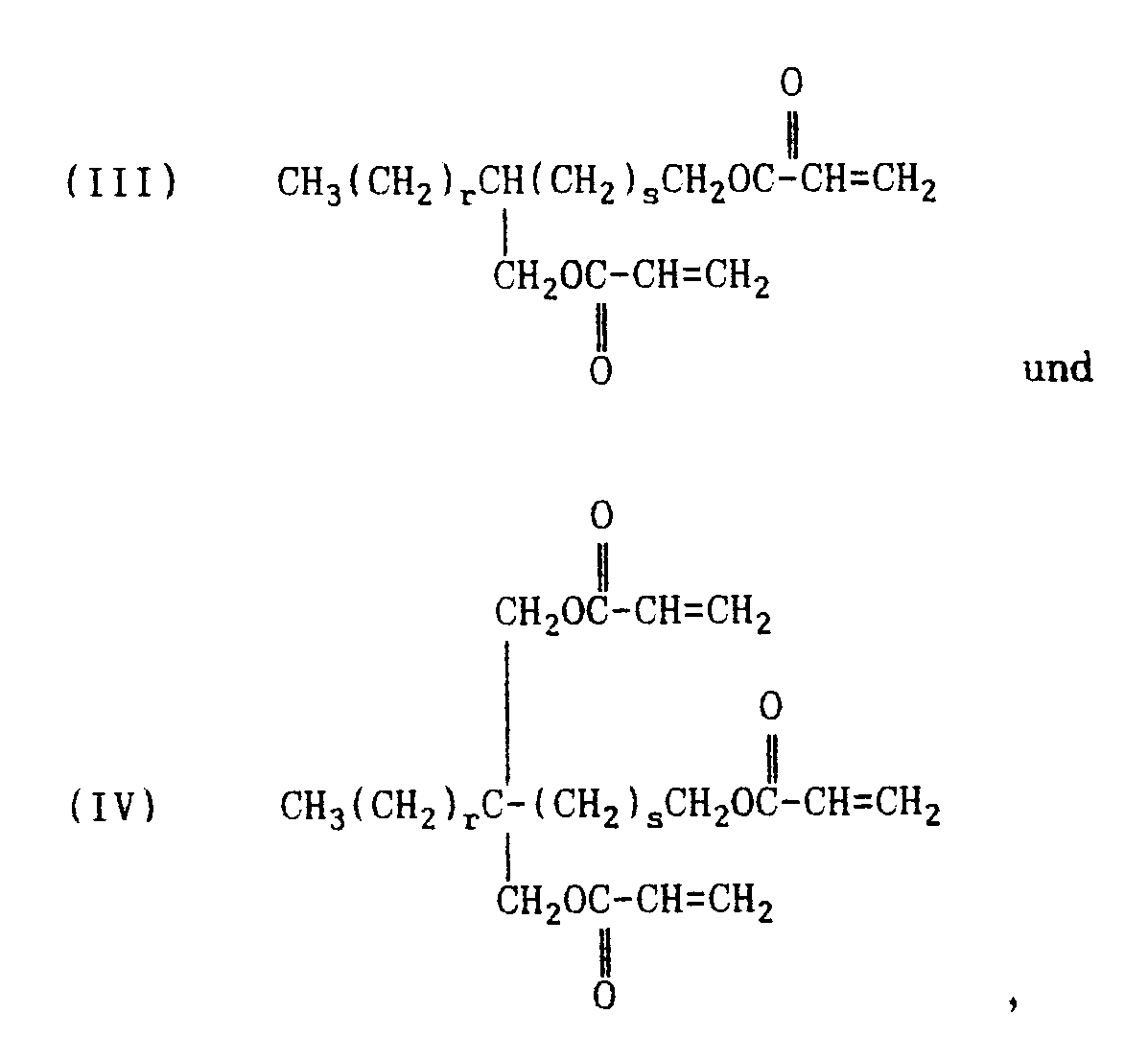
- Kondensator nach Anspruch 14, bei dem das mehrfunktionelle Akrylat die Formel IV hat.
- Kondensator nach Anspruch 8, bei dem R¹ mindestens ein aliphatisches oder alizyklisches Radikal mit ungefähr 20 bis 40 Kohlenstoffatomen und optionell bis zu drei nicht-konjugierte olefinierte Verbindungen aufweisen kann, wobei mindestens ungefähr 40 Prozent der besagten R¹-Radikale alizyklische Komponenten aufweisen.
- Kondensator nach Anspruch 8, bei dem R¹ von mindestens einer Polyhydroxy-Verbindung abgeleitet ist, die durch Reduktion von mindestens einer zugehörigen Polykarbonsäure oder dem zugehörigen Ester hergestellt ist.
- Kondensator nach Anspruch 17, bei dem die Polykarbonsäure das Dimer der Linolsäure ist.
- Kondensator nach Anspruch 18, bei dem die Polyhydroxy-Verbindung der Formel

- Kondensator nach Anspruch 1 und Anspruch 8, bei dem R¹ die Formel

- Kondensator nach einem der Ansprüche 1 bis 20, bei dem R² ein Wasserstoffatom ist.
- Kondensator nach Anspruch 21, bei dem R⁴ die Formel R⁵CH₂ aufweist, wobei R⁵ ein Alkyl-Radikal ist.
- Kondensator nach Anspruch 22, bei dem R⁵ eine gerade Kette von Alkylradikalen ist, die 9 bis 17 Kohlenstoffatome aufweist.
- Kondensator nach Anspruch 23, bei dem R⁴ eine n-Tetradezylgruppe ist.
- Kondensator nach Anspruch 1 und Anspruch 8, bei dem das dielektrische Element ein Polymer ist, bei dem alle Einheiten Derivate aus einem Gemisch aus Estern der Formeln I und XIV sind.
- Kondensator nach Anspruch 25, bei dem ungefähr 70 bis 90 Prozent der Karboxylatanteile die Formel XV haben.
- Verfahren zur Herstellung eines Kondensators nach einem der Ansprüche 1 bis 26, welches die Verfahrensschritte umfaßt des Ausbildens einer dielektrischen Beschichtung von einem Polymer von mindestens einem mehrfunktionellen Akrylat gemäß einem der besagten Ansprüche auf einem Substrat und des Ablagerns einer Elektrodenschicht auf der dielektrischen Beschichtung.
- Verfahren nach Anspruch 27, bei dem die dielektrische Beschichtung in dem Auftragen des mehrfunktionellen Monomerfilms und des nachfolgenden Polymerisierens des Films besteht.
- Verfahren nach Anspruch 28, bei dem der besagte Monomerfilm durch einen Elektronenstrahl polymerisiert wird.
- Verfahren zur Herstellung eines Kondensators gemäß Anspruch 25, bei dem auf einem Substrat eine dielektrische Beschichtung eines Polymers aus einem Gemisch von Estern gemäß dem besagten Anspruch besteht, und daß eine Elektrodenschicht auf dem Dielektrikum abgelagert wird, wobei die Vorbereitung der Estermischung gemäß Anspruch 25 die nachgenannten aufeinanderfolgenden Reaktionen in einer beliebigen Reihenfolge umfaßt,
einer Polyhydroxy-Verbindung mit der Formel R¹(OH)n, wobei R¹ ein aliphatisches, alizyklisches oder gemischtes aliphatischesalizyklisches Radikal ist, das ungefähr 10 bis 40 Kohlenstoffatome aufweist und das optionell bis zu drei nicht-konjugierte olefinierte Verbindungen aufweisen kann, wobei n zwischen 2 und 4 liegt, mit
einer ersten Karbonsäure, die die Formel
einer zweiten Karbonsäure, die die Formel R⁶COOH aufweist oder ein funktionales Derivat von dieser ist, wobei R⁶ ein aliphatisches Kohlenwasserstoff-Radikal ist, das ungefähr 2 bis 20 Kohlenstoffatome aufweist und frei von Acetylen- und polymerisierbaren Ätyhlen-Ungesättigtheiten ist,
wobei das Mol-Verhältnis der besagten ersten zu der besagten zweiten Säure mindestens 1:1 beträgt. - Verfahren nach Anspruch 30, bei dem R² ein Wasserstoffatom und R⁶ eine Äthylgruppe ist.
- Verfahren nach Anspruch 31, bei dem R¹ ein sich verzweigendes Kettenradikal mit wenigstens 18 Kohlenstoffatomen in einer einzigen Kette ist.
- Verfahren nach Anspruch 32, bei dem R¹ die Formel

- Verfahren nach Anspruch 33, bei dem die Polyhydroxyverbindung zuerst mit der besagten ersten Säure und danach mit der besagten zweiten Säure reagiert.
- Verfahren nach Anspruch 34, bei dem das Molverhältnis der ersten Säure zu der zweiten Säure ungefähr 1,7-1,9:1 beträgt.
Applications Claiming Priority (10)
| Application Number | Priority Date | Filing Date | Title |
|---|---|---|---|
| US562893 | 1983-12-19 | ||
| US562894 | 1983-12-19 | ||
| US06/562,873 US4499520A (en) | 1983-12-19 | 1983-12-19 | Capacitor with dielectric comprising poly-functional acrylate polymer and method of making |
| US06/562,871 US4490774A (en) | 1983-12-19 | 1983-12-19 | Capacitors containing polyfunctional acrylate polymers as dielectrics |
| US562871 | 1983-12-19 | ||
| US06/562,893 US4533710A (en) | 1983-12-19 | 1983-12-19 | 1,2-Alkanediol diacrylate monomers and polymers thereof useful as capacitor dielectrics |
| US06/562,872 US4513349A (en) | 1983-12-19 | 1983-12-19 | Acrylate-containing mixed ester monomers and polymers thereof useful as capacitor dielectrics |
| US562873 | 1983-12-19 | ||
| US06/562,894 US4515931A (en) | 1983-12-19 | 1983-12-19 | Polyfunctional acrylate monomers and polymers thereof useful as capacitor dielectrics |
| US562872 | 1990-08-03 |
Publications (3)
| Publication Number | Publication Date |
|---|---|
| EP0146089A2 EP0146089A2 (de) | 1985-06-26 |
| EP0146089A3 EP0146089A3 (en) | 1987-04-22 |
| EP0146089B1 true EP0146089B1 (de) | 1992-08-05 |
Family
ID=27541911
Family Applications (1)
| Application Number | Title | Priority Date | Filing Date |
|---|---|---|---|
| EP84114924A Expired - Lifetime EP0146089B1 (de) | 1983-12-19 | 1984-12-07 | Kondensator mit mehrfunktionelles Acrylatpolymer enthaltendem Dielektrikum und Herstellungsverfahren |
Country Status (4)
| Country | Link |
|---|---|
| EP (1) | EP0146089B1 (de) |
| JP (1) | JPH0640443B2 (de) |
| KR (1) | KR850004334A (de) |
| DE (1) | DE3485857T2 (de) |
Families Citing this family (9)
| Publication number | Priority date | Publication date | Assignee | Title |
|---|---|---|---|---|
| EP0338540B1 (de) * | 1988-04-20 | 1994-08-10 | Kuraray Co., Ltd. | Trimethylolheptane und ihre Anwendung |
| JPH03236349A (ja) * | 1990-02-13 | 1991-10-22 | Arakawa Chem Ind Co Ltd | 二官能性(メタ)アクリル酸エステルおよびその製造法 |
| AU1960095A (en) * | 1994-03-16 | 1995-10-03 | Lion Corporation | Monomer mixture and process for producing the same |
| EP0946953A1 (de) | 1996-12-18 | 1999-10-06 | Medtronic, Inc. | Kondensatoren mit hoher energiedichte und verbindungen zur verwendung in deren herstellung |
| JP2005100659A (ja) * | 2000-01-14 | 2005-04-14 | Matsushita Electric Ind Co Ltd | 強誘電体材料あるいは高誘電体材料又はこれらを用いた半導体記憶装置及びその製造方法 |
| KR100459871B1 (ko) * | 2002-05-23 | 2004-12-03 | 주식회사 에너랜드 | 전지 또는 콘덴서용 비수전해질의 조성물 |
| US12456584B2 (en) | 2022-07-11 | 2025-10-28 | Rubycon Corporation | Thin film polymer laminated capacitor and manufacturing method therefor |
| WO2025004686A1 (ja) * | 2023-06-30 | 2025-01-02 | ルビコン株式会社 | 薄膜高分子積層コンデンサ及びその製造方法 |
| WO2025183177A1 (ja) * | 2024-03-01 | 2025-09-04 | ルビコン株式会社 | 薄膜高分子積層コンデンサ、及びその製造方法 |
Family Cites Families (6)
| Publication number | Priority date | Publication date | Assignee | Title |
|---|---|---|---|---|
| GB629998A (en) * | 1946-10-17 | 1949-10-03 | British Thomson Houston Co Ltd | Improvements in and relating to electric capacitors and dielectric material therefor |
| GB872539A (en) * | 1956-10-25 | 1961-07-12 | Standard Telephones Cables Ltd | Method of manufacture of capacitors |
| FR2377079A1 (fr) * | 1977-01-11 | 1978-08-04 | Thomson Csf | Materiau dielectrique plastique a forte permittivite, procede de fabrication et produits d'utilisation dudit materiau |
| US4243818A (en) * | 1979-10-04 | 1981-01-06 | Henkel Corporation | High molecular weight products |
| JPS5722021A (en) * | 1980-07-15 | 1982-02-04 | Diafoil Co Ltd | Biaxially-elongated polyester film useful as dielectric of capacitor |
| US4329419A (en) * | 1980-09-03 | 1982-05-11 | E. I. Du Pont De Nemours And Company | Polymeric heat resistant photopolymerizable composition for semiconductors and capacitors |
-
1984
- 1984-12-07 EP EP84114924A patent/EP0146089B1/de not_active Expired - Lifetime
- 1984-12-07 DE DE8484114924T patent/DE3485857T2/de not_active Expired - Lifetime
- 1984-12-17 JP JP59266077A patent/JPH0640443B2/ja not_active Expired - Lifetime
- 1984-12-18 KR KR1019840008059A patent/KR850004334A/ko not_active Withdrawn
Also Published As
| Publication number | Publication date |
|---|---|
| KR850004334A (ko) | 1985-07-11 |
| DE3485857D1 (de) | 1992-09-10 |
| JPS60157106A (ja) | 1985-08-17 |
| JPH0640443B2 (ja) | 1994-05-25 |
| DE3485857T2 (de) | 1992-12-10 |
| EP0146089A3 (en) | 1987-04-22 |
| EP0146089A2 (de) | 1985-06-26 |
Similar Documents
| Publication | Publication Date | Title |
|---|---|---|
| US4515931A (en) | Polyfunctional acrylate monomers and polymers thereof useful as capacitor dielectrics | |
| US4490774A (en) | Capacitors containing polyfunctional acrylate polymers as dielectrics | |
| US4499520A (en) | Capacitor with dielectric comprising poly-functional acrylate polymer and method of making | |
| US4513349A (en) | Acrylate-containing mixed ester monomers and polymers thereof useful as capacitor dielectrics | |
| US4533710A (en) | 1,2-Alkanediol diacrylate monomers and polymers thereof useful as capacitor dielectrics | |
| EP0146089B1 (de) | Kondensator mit mehrfunktionelles Acrylatpolymer enthaltendem Dielektrikum und Herstellungsverfahren | |
| US4586111A (en) | Capacitor with dielectric comprising a polymer of polyacrylate polyether pre-polymer | |
| CN116218008B (zh) | 一种聚丙烯金属化薄膜及金属化薄膜电容器 | |
| DE3686218T3 (de) | Oberflächenmetallisierter geformter Harzgegenstand. | |
| US3214622A (en) | Electroluminescent lamp with high dielectric constant thermoplastic phosphor-bearing matrix | |
| CN119547167B (zh) | 薄膜高分子层叠电容器及其制造方法 | |
| EP0168773B1 (de) | Polymerisierbares 3-Aroyloxyphenylcarbamat, Herstellungsverfahren und Verwendung | |
| EP0242462B1 (de) | Kondensator mit einem Polymer von einem Polyacrylat-Polyäther-Vorpolymer als Dielektrikum | |
| CN112366085B (zh) | 一种薄膜电容器及其生产工艺 | |
| WO2025004686A1 (ja) | 薄膜高分子積層コンデンサ及びその製造方法 | |
| EP0129244B2 (de) | Kunststoff-Dielektrikum | |
| DE2519589A1 (de) | Beschichtetes produkt, wasserdispersionslack zur herstellung desselben und verfahren zur herstellung des wasserdispersionslacks | |
| KR940004939B1 (ko) | 캐패시터(capacitor) | |
| GB2159826A (en) | Stabilization of polyfunctional acrylate compositions against premature anaerobic polymerization | |
| JPS62256421A (ja) | ジアクリレートポリエーテルプレポリマーのポリマーからなる誘電体を有するコンデンサ | |
| EP2390271A1 (de) | Cyanharz-Polymer für eine dielektrische Folie, Herstellungsverfahren und zugehöriger Artikel | |
| JPS6040176B2 (ja) | 積層型金属化フィルム蓄電器 | |
| DE1950593C3 (de) | Elektrischer Kondensator | |
| EP0221450B1 (de) | Verfahren zur Herstellung eines elektrischen Kondensators mit langer Lebensdauer | |
| JP3441425B2 (ja) | コンデンサ |
Legal Events
| Date | Code | Title | Description |
|---|---|---|---|
| PUAI | Public reference made under article 153(3) epc to a published international application that has entered the european phase |
Free format text: ORIGINAL CODE: 0009012 |
|
| AK | Designated contracting states |
Designated state(s): DE FR GB IT NL SE |
|
| RIN1 | Information on inventor provided before grant (corrected) |
Inventor name: O'DONNELL, TIMOTHY WILLIAM Inventor name: OLSON, DANIEL ROBERT Inventor name: CICHANOWSKI, STANLEY WILLIAM |
|
| RAP1 | Party data changed (applicant data changed or rights of an application transferred) |
Owner name: SFE TECHNOLOGIES |
|
| PUAL | Search report despatched |
Free format text: ORIGINAL CODE: 0009013 |
|
| AK | Designated contracting states |
Kind code of ref document: A3 Designated state(s): DE FR GB IT NL SE |
|
| RAP1 | Party data changed (applicant data changed or rights of an application transferred) |
Owner name: SPECTRUM CONTROL, INC. |
|
| 17P | Request for examination filed |
Effective date: 19871015 |
|
| 17Q | First examination report despatched |
Effective date: 19900710 |
|
| GRAA | (expected) grant |
Free format text: ORIGINAL CODE: 0009210 |
|
| AK | Designated contracting states |
Kind code of ref document: B1 Designated state(s): DE FR GB IT NL SE |
|
| PG25 | Lapsed in a contracting state [announced via postgrant information from national office to epo] |
Ref country code: SE Free format text: THE PATENT HAS BEEN ANNULLED BY A DECISION OF A NATIONAL AUTHORITY Effective date: 19920805 Ref country code: NL Effective date: 19920805 Ref country code: IT Free format text: LAPSE BECAUSE OF FAILURE TO SUBMIT A TRANSLATION OF THE DESCRIPTION OR TO PAY THE FEE WITHIN THE PRESCRIBED TIME-LIMIT;WARNING: LAPSES OF ITALIAN PATENTS WITH EFFECTIVE DATE BEFORE 2007 MAY HAVE OCCURRED AT ANY TIME BEFORE 2007. THE CORRECT EFFECTIVE DATE MAY BE DIFFERENT FROM THE ONE RECORDED. Effective date: 19920805 |
|
| REF | Corresponds to: |
Ref document number: 3485857 Country of ref document: DE Date of ref document: 19920910 |
|
| EN | Fr: translation not filed | ||
| PG25 | Lapsed in a contracting state [announced via postgrant information from national office to epo] |
Ref country code: FR Effective date: 19921224 |
|
| NLV1 | Nl: lapsed or annulled due to failure to fulfill the requirements of art. 29p and 29m of the patents act | ||
| PLBE | No opposition filed within time limit |
Free format text: ORIGINAL CODE: 0009261 |
|
| STAA | Information on the status of an ep patent application or granted ep patent |
Free format text: STATUS: NO OPPOSITION FILED WITHIN TIME LIMIT |
|
| 26N | No opposition filed | ||
| REG | Reference to a national code |
Ref country code: FR Ref legal event code: ST |
|
| REG | Reference to a national code |
Ref country code: GB Ref legal event code: IF02 |
|
| PGFP | Annual fee paid to national office [announced via postgrant information from national office to epo] |
Ref country code: GB Payment date: 20031203 Year of fee payment: 20 |
|
| PGFP | Annual fee paid to national office [announced via postgrant information from national office to epo] |
Ref country code: DE Payment date: 20031218 Year of fee payment: 20 |
|
| PG25 | Lapsed in a contracting state [announced via postgrant information from national office to epo] |
Ref country code: GB Free format text: LAPSE BECAUSE OF EXPIRATION OF PROTECTION Effective date: 20041206 |
|
| REG | Reference to a national code |
Ref country code: GB Ref legal event code: PE20 |