EP0146197A2 - Abtrennung von Halbleiterplättchen von einem Trägerfilm - Google Patents
Abtrennung von Halbleiterplättchen von einem Trägerfilm Download PDFInfo
- Publication number
- EP0146197A2 EP0146197A2 EP84201904A EP84201904A EP0146197A2 EP 0146197 A2 EP0146197 A2 EP 0146197A2 EP 84201904 A EP84201904 A EP 84201904A EP 84201904 A EP84201904 A EP 84201904A EP 0146197 A2 EP0146197 A2 EP 0146197A2
- Authority
- EP
- European Patent Office
- Prior art keywords
- adhesive
- film
- support film
- wafer
- microns
- Prior art date
- Legal status (The legal status is an assumption and is not a legal conclusion. Google has not performed a legal analysis and makes no representation as to the accuracy of the status listed.)
- Withdrawn
Links
Images

Classifications
-
- H—ELECTRICITY
- H10—SEMICONDUCTOR DEVICES; ELECTRIC SOLID-STATE DEVICES NOT OTHERWISE PROVIDED FOR
- H10P—GENERIC PROCESSES OR APPARATUS FOR THE MANUFACTURE OR TREATMENT OF DEVICES COVERED BY CLASS H10
- H10P72/00—Handling or holding of wafers, substrates or devices during manufacture or treatment thereof
- H10P72/04—Apparatus for manufacture or treatment
- H10P72/0442—Apparatus for placing on an insulating substrate, e.g. tape
-
- B—PERFORMING OPERATIONS; TRANSPORTING
- B28—WORKING CEMENT, CLAY, OR STONE
- B28D—WORKING STONE OR STONE-LIKE MATERIALS
- B28D5/00—Fine working of gems, jewels, crystals, e.g. of semiconductor material; apparatus or devices therefor
- B28D5/0058—Accessories specially adapted for use with machines for fine working of gems, jewels, crystals, e.g. of semiconductor material
- B28D5/0082—Accessories specially adapted for use with machines for fine working of gems, jewels, crystals, e.g. of semiconductor material for supporting, holding, feeding, conveying or discharging work
-
- H—ELECTRICITY
- H10—SEMICONDUCTOR DEVICES; ELECTRIC SOLID-STATE DEVICES NOT OTHERWISE PROVIDED FOR
- H10P—GENERIC PROCESSES OR APPARATUS FOR THE MANUFACTURE OR TREATMENT OF DEVICES COVERED BY CLASS H10
- H10P50/00—Etching of wafers, substrates or parts of devices
-
- H—ELECTRICITY
- H10—SEMICONDUCTOR DEVICES; ELECTRIC SOLID-STATE DEVICES NOT OTHERWISE PROVIDED FOR
- H10P—GENERIC PROCESSES OR APPARATUS FOR THE MANUFACTURE OR TREATMENT OF DEVICES COVERED BY CLASS H10
- H10P72/00—Handling or holding of wafers, substrates or devices during manufacture or treatment thereof
- H10P72/50—Handling or holding of wafers, substrates or devices during manufacture or treatment thereof for positioning, orientation or alignment
-
- H—ELECTRICITY
- H10—SEMICONDUCTOR DEVICES; ELECTRIC SOLID-STATE DEVICES NOT OTHERWISE PROVIDED FOR
- H10P—GENERIC PROCESSES OR APPARATUS FOR THE MANUFACTURE OR TREATMENT OF DEVICES COVERED BY CLASS H10
- H10P72/00—Handling or holding of wafers, substrates or devices during manufacture or treatment thereof
- H10P72/70—Handling or holding of wafers, substrates or devices during manufacture or treatment thereof for supporting or gripping
- H10P72/74—Handling or holding of wafers, substrates or devices during manufacture or treatment thereof for supporting or gripping using temporarily an auxiliary support
- H10P72/7402—Wafer tapes, e.g. grinding or dicing support tapes
-
- H—ELECTRICITY
- H10—SEMICONDUCTOR DEVICES; ELECTRIC SOLID-STATE DEVICES NOT OTHERWISE PROVIDED FOR
- H10P—GENERIC PROCESSES OR APPARATUS FOR THE MANUFACTURE OR TREATMENT OF DEVICES COVERED BY CLASS H10
- H10P72/00—Handling or holding of wafers, substrates or devices during manufacture or treatment thereof
- H10P72/70—Handling or holding of wafers, substrates or devices during manufacture or treatment thereof for supporting or gripping
- H10P72/74—Handling or holding of wafers, substrates or devices during manufacture or treatment thereof for supporting or gripping using temporarily an auxiliary support
- H10P72/7402—Wafer tapes, e.g. grinding or dicing support tapes
- H10P72/7404—Wafer tapes, e.g. grinding or dicing support tapes the wafer tape being a laminate of three or more layers, e.g. including additional layers beyond a base layer and an uppermost adhesive layer
-
- H—ELECTRICITY
- H10—SEMICONDUCTOR DEVICES; ELECTRIC SOLID-STATE DEVICES NOT OTHERWISE PROVIDED FOR
- H10W—GENERIC PACKAGES, INTERCONNECTIONS, CONNECTORS OR OTHER CONSTRUCTIONAL DETAILS OF DEVICES COVERED BY CLASS H10
- H10W46/00—Marks applied to devices, e.g. for alignment or identification
-
- H—ELECTRICITY
- H10—SEMICONDUCTOR DEVICES; ELECTRIC SOLID-STATE DEVICES NOT OTHERWISE PROVIDED FOR
- H10P—GENERIC PROCESSES OR APPARATUS FOR THE MANUFACTURE OR TREATMENT OF DEVICES COVERED BY CLASS H10
- H10P72/00—Handling or holding of wafers, substrates or devices during manufacture or treatment thereof
- H10P72/70—Handling or holding of wafers, substrates or devices during manufacture or treatment thereof for supporting or gripping
- H10P72/74—Handling or holding of wafers, substrates or devices during manufacture or treatment thereof for supporting or gripping using temporarily an auxiliary support
- H10P72/7416—Handling or holding of wafers, substrates or devices during manufacture or treatment thereof for supporting or gripping using temporarily an auxiliary support used during dicing or grinding
-
- Y—GENERAL TAGGING OF NEW TECHNOLOGICAL DEVELOPMENTS; GENERAL TAGGING OF CROSS-SECTIONAL TECHNOLOGIES SPANNING OVER SEVERAL SECTIONS OF THE IPC; TECHNICAL SUBJECTS COVERED BY FORMER USPC CROSS-REFERENCE ART COLLECTIONS [XRACs] AND DIGESTS
- Y10—TECHNICAL SUBJECTS COVERED BY FORMER USPC
- Y10S—TECHNICAL SUBJECTS COVERED BY FORMER USPC CROSS-REFERENCE ART COLLECTIONS [XRACs] AND DIGESTS
- Y10S156/00—Adhesive bonding and miscellaneous chemical manufacture
- Y10S156/918—Delaminating processes adapted for specified product, e.g. delaminating medical specimen slide
- Y10S156/93—Semiconductive product delaminating, e.g. delaminating emiconductive wafer from underlayer
-
- Y—GENERAL TAGGING OF NEW TECHNOLOGICAL DEVELOPMENTS; GENERAL TAGGING OF CROSS-SECTIONAL TECHNOLOGIES SPANNING OVER SEVERAL SECTIONS OF THE IPC; TECHNICAL SUBJECTS COVERED BY FORMER USPC CROSS-REFERENCE ART COLLECTIONS [XRACs] AND DIGESTS
- Y10—TECHNICAL SUBJECTS COVERED BY FORMER USPC
- Y10T—TECHNICAL SUBJECTS COVERED BY FORMER US CLASSIFICATION
- Y10T156/00—Adhesive bonding and miscellaneous chemical manufacture
- Y10T156/10—Methods of surface bonding and/or assembly therefor
- Y10T156/1052—Methods of surface bonding and/or assembly therefor with cutting, punching, tearing or severing
- Y10T156/1062—Prior to assembly
- Y10T156/1075—Prior to assembly of plural laminae from single stock and assembling to each other or to additional lamina
-
- Y—GENERAL TAGGING OF NEW TECHNOLOGICAL DEVELOPMENTS; GENERAL TAGGING OF CROSS-SECTIONAL TECHNOLOGIES SPANNING OVER SEVERAL SECTIONS OF THE IPC; TECHNICAL SUBJECTS COVERED BY FORMER USPC CROSS-REFERENCE ART COLLECTIONS [XRACs] AND DIGESTS
- Y10—TECHNICAL SUBJECTS COVERED BY FORMER USPC
- Y10T—TECHNICAL SUBJECTS COVERED BY FORMER US CLASSIFICATION
- Y10T156/00—Adhesive bonding and miscellaneous chemical manufacture
- Y10T156/11—Methods of delaminating, per se; i.e., separating at bonding face
-
- Y—GENERAL TAGGING OF NEW TECHNOLOGICAL DEVELOPMENTS; GENERAL TAGGING OF CROSS-SECTIONAL TECHNOLOGIES SPANNING OVER SEVERAL SECTIONS OF THE IPC; TECHNICAL SUBJECTS COVERED BY FORMER USPC CROSS-REFERENCE ART COLLECTIONS [XRACs] AND DIGESTS
- Y10—TECHNICAL SUBJECTS COVERED BY FORMER USPC
- Y10T—TECHNICAL SUBJECTS COVERED BY FORMER US CLASSIFICATION
- Y10T156/00—Adhesive bonding and miscellaneous chemical manufacture
- Y10T156/19—Delaminating means
Definitions
- the present invention relates to a process which is useful in the fabrication of semiconductor chips.
- the present invention relates to removal of a chip/ adhesive combination from the polymer support film without residual adhesive remaining on the support film. Substantially all of the conductive adhesive remains with the chip for use in later bonding steps if a heating step precedes the dicing operation. The heating step improves the adhesive/wafer attachment, thereby providing the desired release characteristics between the film and the adhesive.
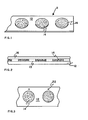
- the dicing film 11 of the present invention comprises a polymer support film 12 with one surface 13 which is substantially free of a release coating, and, attached to the surface 13, a suitable pattern of conductive adhesive 14 to receive semiconductor wafers 15 for later dicing (not shown).
- the carrier film 12 needs to have sufficient support for the selected adhesive pattern while allowing such operations as oven drying. It needs to provide support, for example, for the cut chip after the dicing operation.
- the surface 13 must allow for pick-up of the conductive adhesive/chip combination after the dicing operation without causing injury to the adhesive.
- the conductive adhesive 14 must have a sufficient level of conductivity, should have good smoothness to allow for full surface contact between it and the wafer and needs to be either dried or partially cured to a suitably tacky state and held in such a state for use at the wafer attachment stage. It needs to have a sufficient degree of co- hesiveness to allow for its stripping from the support film without destruction of its physical integrity and also to allow stripping of an optional cover film therefrom.
- the conductive adhesive should have a suitable degree of thickness, e.g., from about 6 to about 40 microns to impart proper adhesion and electrical requirements for grounding the chip to the ground plane.
- the present invention enables one to place the chip/adhesive combination in a chip carrier such that the adhesive supports the chip but does not cover any substantial area outside its support area. This allows for a more compact configuration for the necessary wires bonding the chip to the carrier, without increasing the possibility of short circuits arising due to close proximity of wire and conductive adhesive.
- the polymer forming support film 12 must also, upon heating as will be described later, have an enhanced release characteristic between it and the conductive adhesive so as to allow for clean separation of adhesive and polymer film without any appreciable residual adhesive remaining on the film.
- Polyolefin films such as polypropylene, are one preferred choice.
- the thickness of the support film can range from about 25 to about 150 microns, with a thickness of 75 - 150 microns being preferred. Films having the preferred, greater thicknesses of 75 -150 microns allow for a somewhat greater degree of safety in view of possible variation in the actual manufacturing tolerances in the dicing operation. An excessively thin film, if cut entirely through due to inherent variations in the manufacturing process, would not provide the needed support for the wafer.
- Attached to the exposed surface 13 of the support film is a suitable pattern of conductive adhesive 14 to form a point of attachment for the semiconductor wafers 15 that are to be diced.
- the conductive adhesive pattern can comprise a series of circular adhesive marks of a suitable size (e.g., about 2.54 - 15.2 cm.) to approximate the diameter of the wafer to be mounted thereon.
- the thickness of the adhesive can range from about 5 microns to about 40 microns.
- Suitable conductive adhesive compositions which can be utilized include those adhesive materials which are loaded with fillers to meet.conductivity requirements (e.g., 2% to about 75%, by weight of a suitable conductive material).
- Representative conductive materials include finely divided conductive metals (e.g., aluminum, copper, silver, gold, palladium), or carbon black.
- Representative adhesive materials which can form a matrix for the conductive materials include polyimide, acrylic, epoxy, silicones, and various modified polymeric materials to meet desired thermal and conductivity requirements.
- the dicing film product 11 of the present invention also includes a suitable release liner 16 over the exposed surface of the adhesive to protect it from contamination and/or damage (e.g., inadvertent destruction of the preferred, substantially flat upper surface).
- a suitable release liner 16 over the exposed surface of the adhesive to protect it from contamination and/or damage (e.g., inadvertent destruction of the preferred, substantially flat upper surface).
- release coated paper can be employed as the release liner material.
- the release liner can have a lesser release characteristic than the surface 13.
- Figures 4-6 illustrate in a schematic manner in which the dicing film of the present invention can be used.
- Figure 4 shows a pivotal vacuum plate assembly about to pick up a semiconductor wafer from an array 19 of stacked wafers 15.
- Figure 5 illustrates the configuration of an electric eye 20 guided vacuum plate 21 in aligning wafer and adhesive in response to the registration mark 22 on the film 12.
- Figure 6 illustrates the wafer attachment step and also illustrates the prior stripping of the release liner 16 from the conductive adhesive 14/dicing film 12 combination.
- a suitable commercially available wafer mounter e.g., Model 366 from Kulicke and Soffa Industries, Inc.).
- the dicing film of the present invention can be formed using conventional lamination and printing operations.
- the pattern of conductive adhesive can be applied to the dried release layer surface by appropriate printing procedures (e.g., rotary or flat bed screen printing) and then the adhesive is transferred to the support film 12 by lamination. If a release liner is desired over the exposed surface of the adhesive, it can also be applied by conventional lamination procedures.
- the heating step of the present process which improves the release characteristics at the support film surface 13/conductive adhesive 14 interface, is carried out on the wafer/adhesive/film composite prior to the dicing step.
- This heating step can take place for about 0.25 min. to about 3 min. at temperatures of from about 45°C. to about 70°C.
- cool air can be used on the carrier film side to optimize die release.
- the heating step which is described for use herein aids in wetting out of the adhesive and improves the adhesion between the wafer and the adhesive so that the adhesive will bond substantially more aggressively to the wafer than to the support film. This will insure clean removal of the adhesive with the wafer, as desired.
- This Example illustrates the inferior results obtained when the process of the present invention is not followed.
- the general procedure used to form each of the samples that were tested involved screen printing of a suitable adhesive pattern (i.e., a succession of circles having a diameter of about 7.6 cm. and a thickness of about 25.4 microns)onto release coated paper.
- the release coated paper was 42 pound weight semi-bleached kraft paper.
- the adhesive was a silver modified polyimide (P-1011 brand from Epoxy Technology, Inc.). The resulting laminate was then oven dried for 25 minutes at about 67.2°C. and then cooled to room temperature.
- the laminate made by the foregoing procedure was passed through a pressure nip with the selected support film such that the adhesive pattern faced the support film to laminate the adhesive pattern thereto. Sufficient pressure was used to effect such transfer and the composite was heated to about 67.2°C. for one minute.
- the support film selected for use in this Example was 127 micron thick polypropylene (N-400 brand from Hercules) that contained no release coating on the side to which the adhesive pattern was laminated.
- the same type of paper originally used in the screen printing of the adhesive was used as a cover sheet for the exposed surface of the adhesive pattern.
- This cover sheet was fed with the adhesive/ support film laminate through two pressure nips so that the release coating and exposed surface of the adhesive pattern were brought together under sufficient pressure to bond the release paper and laminate.
- the type of laminate described above was then tested (after removal of the cover sheet) to determine if the adhesive separated readily from the support film.
- the following procedure was used. A silicon wafer was affixed to the adhesive by action of a squeegee to eliminate air entrapment. After attachment had been completed, an attempt was made by hand to remove the wafer and its attached adhesive cleanly from the support film.
- This Example illustrates the process of the present invention.
- Comparative Example 1 The procedure described in Comparative Example 1 was utilized with the exception that the bonded combination of wafer and adhesive/support film laminate was heated for one minute at about 67.2°C. prior to attempting to remove the wafer from the adhesive pattern. When the attempt to remove the wafer was made, substantially all of the adhesive cleanly released from the support film with the wafer.
Landscapes
- Engineering & Computer Science (AREA)
- Mechanical Engineering (AREA)
- Dicing (AREA)
- Die Bonding (AREA)
- Adhesives Or Adhesive Processes (AREA)
- Adhesive Tapes (AREA)
Applications Claiming Priority (2)
| Application Number | Priority Date | Filing Date | Title |
|---|---|---|---|
| US06/562,899 US4664739A (en) | 1983-12-19 | 1983-12-19 | Removal of semiconductor wafers from dicing film |
| US562899 | 1983-12-19 |
Publications (2)
| Publication Number | Publication Date |
|---|---|
| EP0146197A2 true EP0146197A2 (de) | 1985-06-26 |
| EP0146197A3 EP0146197A3 (de) | 1986-12-30 |
Family
ID=24248262
Family Applications (1)
| Application Number | Title | Priority Date | Filing Date |
|---|---|---|---|
| EP84201904A Withdrawn EP0146197A3 (de) | 1983-12-19 | 1984-12-18 | Abtrennung von Halbleiterplättchen von einem Trägerfilm |
Country Status (5)
| Country | Link |
|---|---|
| US (1) | US4664739A (de) |
| EP (1) | EP0146197A3 (de) |
| JP (1) | JPS60136331A (de) |
| KR (1) | KR850005148A (de) |
| PH (1) | PH21462A (de) |
Cited By (7)
| Publication number | Priority date | Publication date | Assignee | Title |
|---|---|---|---|---|
| EP0423648A1 (de) * | 1989-10-20 | 1991-04-24 | Fujitsu Limited | Plättchen-Verarbeitung |
| EP0412741A3 (en) * | 1989-08-08 | 1991-11-27 | Nec Corporation | Conductive adhesive sheet used in semiconductor device manufacture |
| WO1992007455A1 (de) * | 1990-10-15 | 1992-04-30 | Miroslav Tresky | Vorrichtung zum entfernen defekter bauteile aus schaltungen |
| EP0510706A3 (en) * | 1991-04-26 | 1993-01-20 | Sumitomo Electric Industries, Ltd. | Apparatus for peeling semiconductor substrate |
| WO2003085702A1 (de) * | 2002-04-04 | 2003-10-16 | Georg Rudolf Sillner | Verfahren zum verarbeiten von elektrischen bauelementen, insbesondere von halbleiterchips, sowie vorrichtung zum durchführen des verfahrens |
| CN107442943A (zh) * | 2016-05-16 | 2017-12-08 | 株式会社迪思科 | 扩展片 |
| CN111217140A (zh) * | 2020-01-08 | 2020-06-02 | 歌尔股份有限公司 | 感应取料装置及其取料方法 |
Families Citing this family (29)
| Publication number | Priority date | Publication date | Assignee | Title |
|---|---|---|---|---|
| PH25206A (en) * | 1985-12-12 | 1991-03-27 | Lintec K K | Control apparatus for reducing adhesive force of adhesive agent adhering between semiconductor wafer and substrate |
| US5030308A (en) * | 1986-07-14 | 1991-07-09 | National Starch And Chemical Investment Holding Corporation | Method of bonding a semiconductor chip to a substrate |
| US4793883A (en) * | 1986-07-14 | 1988-12-27 | National Starch And Chemical Corporation | Method of bonding a semiconductor chip to a substrate |
| US4826553A (en) * | 1987-06-18 | 1989-05-02 | The United States Of America As Represented By The Secretary Of The Air Force | Method for replicating an optical element |
| US4921564A (en) * | 1988-05-23 | 1990-05-01 | Semiconductor Equipment Corp. | Method and apparatus for removing circuit chips from wafer handling tape |
| US5154793A (en) * | 1988-09-27 | 1992-10-13 | General Electric Company | Method and apparatus for removing components bonded to a substrate |
| US5123986A (en) * | 1989-08-10 | 1992-06-23 | Casio Computer Co., Ltd. | Conductive connecting method |
| US5106450A (en) * | 1990-12-20 | 1992-04-21 | International Business Machines Corporation | Dry film resist transport and lamination system for semiconductor wafers |
| US5258236A (en) * | 1991-05-03 | 1993-11-02 | Ibm Corporation | Multi-layer thin film structure and parallel processing method for fabricating same |
| JP3467611B2 (ja) * | 1995-09-29 | 2003-11-17 | 日本テキサス・インスツルメンツ株式会社 | 半導体装置の製造方法 |
| KR100471936B1 (ko) * | 1996-06-04 | 2005-09-09 | 미쓰비시 마테리알 가부시키가이샤 | 웨이퍼의세정·박리방법및장치 |
| US5757073A (en) * | 1996-12-13 | 1998-05-26 | International Business Machines Corporation | Heatsink and package structure for wirebond chip rework and replacement |
| JP2000349101A (ja) * | 1999-06-07 | 2000-12-15 | Lintec Corp | 転写用テープおよびその使用方法 |
| US6723620B1 (en) * | 1999-11-24 | 2004-04-20 | International Rectifier Corporation | Power semiconductor die attach process using conductive adhesive film |
| US6426552B1 (en) | 2000-05-19 | 2002-07-30 | Micron Technology, Inc. | Methods employing hybrid adhesive materials to secure components of semiconductor device assemblies and packages to one another and assemblies and packages including components secured to one another with such hybrid adhesive materials |
| DE10140827B4 (de) * | 2001-08-21 | 2004-07-29 | Infineon Technologies Ag | Vorrichtung zum Debonden von Dünnwafern |
| US6652707B2 (en) | 2002-04-29 | 2003-11-25 | Applied Optoelectronics, Inc. | Method and apparatus for demounting workpieces from adhesive film |
| US6806544B2 (en) * | 2002-11-05 | 2004-10-19 | New Wave Research | Method and apparatus for cutting devices from conductive substrates secured during cutting by vacuum pressure |
| US6960813B2 (en) * | 2002-06-10 | 2005-11-01 | New Wave Research | Method and apparatus for cutting devices from substrates |
| US6580054B1 (en) * | 2002-06-10 | 2003-06-17 | New Wave Research | Scribing sapphire substrates with a solid state UV laser |
| JP4107417B2 (ja) * | 2002-10-15 | 2008-06-25 | 日東電工株式会社 | チップ状ワークの固定方法 |
| TWI248244B (en) * | 2003-02-19 | 2006-01-21 | J P Sercel Associates Inc | System and method for cutting using a variable astigmatic focal beam spot |
| JP4283596B2 (ja) * | 2003-05-29 | 2009-06-24 | 日東電工株式会社 | チップ状ワークの固定方法 |
| WO2005061227A1 (ja) * | 2003-12-24 | 2005-07-07 | Teijin Limited | 積層体 |
| JP4275522B2 (ja) * | 2003-12-26 | 2009-06-10 | 日東電工株式会社 | ダイシング・ダイボンドフィルム |
| JP4443962B2 (ja) * | 2004-03-17 | 2010-03-31 | 日東電工株式会社 | ダイシング・ダイボンドフィルム |
| KR100943799B1 (ko) * | 2006-09-12 | 2010-02-23 | 닛토덴코 가부시키가이샤 | 다이싱·다이본드 필름 |
| US20130256286A1 (en) * | 2009-12-07 | 2013-10-03 | Ipg Microsystems Llc | Laser processing using an astigmatic elongated beam spot and using ultrashort pulses and/or longer wavelengths |
| CN102639280A (zh) * | 2009-12-07 | 2012-08-15 | Jp赛席尔联合股份有限公司 | 激光加工及切割系统与方法 |
Family Cites Families (6)
| Publication number | Priority date | Publication date | Assignee | Title |
|---|---|---|---|---|
| US3600246A (en) * | 1968-05-17 | 1971-08-17 | Rca Corp | Method of making laminated semiconductor devices |
| GB1299177A (en) * | 1969-01-17 | 1972-12-06 | Ciba Geigy Uk Ltd | Reinforced composites |
| FR2081250A1 (en) * | 1970-03-23 | 1971-12-03 | Silec Semi Conducteurs | Abrasive jet cutting of semiconductor slices - using resin mask |
| US3963551A (en) * | 1974-03-05 | 1976-06-15 | Stromberg-Carlson Corporation | Method for bonding semiconductor chips |
| JPS5542326U (de) * | 1978-09-12 | 1980-03-18 | ||
| JPS59105327A (ja) * | 1982-12-08 | 1984-06-18 | Toshiba Corp | 半導体素子の半田付け方法 |
-
1983
- 1983-12-19 US US06/562,899 patent/US4664739A/en not_active Expired - Fee Related
-
1984
- 1984-11-06 KR KR1019840006939A patent/KR850005148A/ko not_active Abandoned
- 1984-11-27 JP JP59248846A patent/JPS60136331A/ja active Granted
- 1984-12-05 PH PH31535A patent/PH21462A/en unknown
- 1984-12-18 EP EP84201904A patent/EP0146197A3/de not_active Withdrawn
Cited By (8)
| Publication number | Priority date | Publication date | Assignee | Title |
|---|---|---|---|---|
| EP0412741A3 (en) * | 1989-08-08 | 1991-11-27 | Nec Corporation | Conductive adhesive sheet used in semiconductor device manufacture |
| EP0423648A1 (de) * | 1989-10-20 | 1991-04-24 | Fujitsu Limited | Plättchen-Verarbeitung |
| WO1992007455A1 (de) * | 1990-10-15 | 1992-04-30 | Miroslav Tresky | Vorrichtung zum entfernen defekter bauteile aus schaltungen |
| EP0510706A3 (en) * | 1991-04-26 | 1993-01-20 | Sumitomo Electric Industries, Ltd. | Apparatus for peeling semiconductor substrate |
| US5240546A (en) * | 1991-04-26 | 1993-08-31 | Sumitomo Electric Industries, Ltd. | Apparatus for peeling semiconductor substrate |
| WO2003085702A1 (de) * | 2002-04-04 | 2003-10-16 | Georg Rudolf Sillner | Verfahren zum verarbeiten von elektrischen bauelementen, insbesondere von halbleiterchips, sowie vorrichtung zum durchführen des verfahrens |
| CN107442943A (zh) * | 2016-05-16 | 2017-12-08 | 株式会社迪思科 | 扩展片 |
| CN111217140A (zh) * | 2020-01-08 | 2020-06-02 | 歌尔股份有限公司 | 感应取料装置及其取料方法 |
Also Published As
| Publication number | Publication date |
|---|---|
| KR850005148A (ko) | 1985-08-21 |
| JPS60136331A (ja) | 1985-07-19 |
| US4664739A (en) | 1987-05-12 |
| JPH0334853B2 (de) | 1991-05-24 |
| PH21462A (en) | 1987-10-28 |
| EP0146197A3 (de) | 1986-12-30 |
Similar Documents
| Publication | Publication Date | Title |
|---|---|---|
| US4664739A (en) | Removal of semiconductor wafers from dicing film | |
| US4961804A (en) | Carrier film with conductive adhesive for dicing of semiconductor wafers and dicing method employing same | |
| EP0134606B1 (de) | Trägerfilm mit leitendem Klebstoff zum Schneiden von Halbleiterscheiben | |
| US5158818A (en) | Conductive die attach tape | |
| US5049434A (en) | Pre-patterned device substrate device-attach adhesive transfer system | |
| JP4261356B2 (ja) | 半導体パッケージを製造する方法 | |
| US6007920A (en) | Wafer dicing/bonding sheet and process for producing semiconductor device | |
| KR970009574B1 (ko) | 다이 접합용 접착 제이프 | |
| KR100520333B1 (ko) | 칩의제조방법및그제조를위한점착시트 | |
| EP0786802B1 (de) | Schicht zum Abtrennen von Halbleiterscheiben bzw. zum Kontaktverbinden und Verfahren zum Herstellen eines Halbeiterbauelements | |
| JP3521099B2 (ja) | ダイシング用リングフレームへの接着剤の付着防止用粘着シートおよび該粘着シートを備えたウェハ加工用シート | |
| EP0253444B1 (de) | Verfahren zum Verbinden eines Halbleiterchips mit einem Substrat | |
| KR100655035B1 (ko) | 반도체 장치의 제조방법 | |
| JPS6181641A (ja) | 装置基板への装置取付用テ−プと方法他 | |
| JP4180206B2 (ja) | 半導体装置の製造方法 | |
| EP0150882B1 (de) | Leitendes Band zur Befestigung von Halbleiterchips | |
| JP2004349728A (ja) | カプセル化電子部品、特に集積回路の製造方法 | |
| JP2011171688A (ja) | 接着フィルム付き電子部品の製造方法および実装体の製造方法 | |
| WO2005062374A1 (en) | Dicing/die bonding film and method of manufacturing the same | |
| JP4343493B2 (ja) | 半導体チップの積層方法 | |
| JPH10233373A (ja) | チップ体の製造方法および該製造方法に用いられる粘着シート | |
| US7262114B2 (en) | Die attaching method of semiconductor chip using warpage prevention material | |
| JP2003324112A (ja) | 半導体装置の製造方法 | |
| US20240222181A1 (en) | Carrier for reversibly immobilizing a device | |
| JP4045674B2 (ja) | Icチップの接続方法 |
Legal Events
| Date | Code | Title | Description |
|---|---|---|---|
| PUAI | Public reference made under article 153(3) epc to a published international application that has entered the european phase |
Free format text: ORIGINAL CODE: 0009012 |
|
| AK | Designated contracting states |
Designated state(s): DE FR GB IT NL |
|
| PUAL | Search report despatched |
Free format text: ORIGINAL CODE: 0009013 |
|
| AK | Designated contracting states |
Kind code of ref document: A3 Designated state(s): DE FR GB IT NL |
|
| 17P | Request for examination filed |
Effective date: 19870629 |
|
| RAP1 | Party data changed (applicant data changed or rights of an application transferred) |
Owner name: NATIONAL STARCH AND CHEMICAL CORPORATION |
|
| 17Q | First examination report despatched |
Effective date: 19900730 |
|
| STAA | Information on the status of an ep patent application or granted ep patent |
Free format text: STATUS: THE APPLICATION IS DEEMED TO BE WITHDRAWN |
|
| 18D | Application deemed to be withdrawn |
Effective date: 19910703 |
|
| RIN1 | Information on inventor provided before grant (corrected) |
Inventor name: AURICHIO, JOSEPH ANTHONY |