EP0146201A1 - Matériau d'électrode d'oxyde de manganèse rechargeable - Google Patents
Matériau d'électrode d'oxyde de manganèse rechargeable Download PDFInfo
- Publication number
- EP0146201A1 EP0146201A1 EP84305352A EP84305352A EP0146201A1 EP 0146201 A1 EP0146201 A1 EP 0146201A1 EP 84305352 A EP84305352 A EP 84305352A EP 84305352 A EP84305352 A EP 84305352A EP 0146201 A1 EP0146201 A1 EP 0146201A1
- Authority
- EP
- European Patent Office
- Prior art keywords
- electrode
- manganese oxide
- bismuth
- lead
- improved
- Prior art date
- Legal status (The legal status is an assumption and is not a legal conclusion. Google has not performed a legal analysis and makes no representation as to the accuracy of the status listed.)
- Granted
Links
- AMWRITDGCCNYAT-UHFFFAOYSA-L hydroxy(oxo)manganese;manganese Chemical compound [Mn].O[Mn]=O.O[Mn]=O AMWRITDGCCNYAT-UHFFFAOYSA-L 0.000 title claims abstract description 110
- 239000007772 electrode material Substances 0.000 title claims abstract description 76
- NUJOXMJBOLGQSY-UHFFFAOYSA-N manganese dioxide Chemical compound O=[Mn]=O NUJOXMJBOLGQSY-UHFFFAOYSA-N 0.000 claims abstract description 89
- 229910052797 bismuth Inorganic materials 0.000 claims abstract description 39
- JCXGWMGPZLAOME-UHFFFAOYSA-N bismuth atom Chemical compound [Bi] JCXGWMGPZLAOME-UHFFFAOYSA-N 0.000 claims abstract description 38
- 239000000203 mixture Substances 0.000 claims abstract description 33
- 229910001385 heavy metal Inorganic materials 0.000 claims abstract description 16
- 239000000463 material Substances 0.000 claims description 63
- 238000002156 mixing Methods 0.000 claims description 6
- 229910052751 metal Inorganic materials 0.000 claims description 3
- 239000002184 metal Substances 0.000 claims description 3
- 230000003750 conditioning effect Effects 0.000 claims description 2
- 150000003839 salts Chemical class 0.000 claims description 2
- 238000007599 discharging Methods 0.000 claims 1
- 239000000376 reactant Substances 0.000 abstract description 5
- OKTJSMMVPCPJKN-UHFFFAOYSA-N Carbon Chemical compound [C] OKTJSMMVPCPJKN-UHFFFAOYSA-N 0.000 description 17
- 238000000053 physical method Methods 0.000 description 15
- WMWLMWRWZQELOS-UHFFFAOYSA-N bismuth(III) oxide Inorganic materials O=[Bi]O[Bi]=O WMWLMWRWZQELOS-UHFFFAOYSA-N 0.000 description 12
- 230000001351 cycling effect Effects 0.000 description 9
- 239000003349 gelling agent Substances 0.000 description 9
- 238000000034 method Methods 0.000 description 9
- 239000000843 powder Substances 0.000 description 9
- 238000012360 testing method Methods 0.000 description 9
- 229910002804 graphite Inorganic materials 0.000 description 8
- 239000010439 graphite Substances 0.000 description 8
- 239000004570 mortar (masonry) Substances 0.000 description 8
- 239000000243 solution Substances 0.000 description 8
- AUNJHDYOJMRMKW-UHFFFAOYSA-M O=[Bi+].[O-2].[OH-].[Mn+2] Chemical compound O=[Bi+].[O-2].[OH-].[Mn+2] AUNJHDYOJMRMKW-UHFFFAOYSA-M 0.000 description 5
- GOPYZMJAIPBUGX-UHFFFAOYSA-N [O-2].[O-2].[Mn+4] Chemical compound [O-2].[O-2].[Mn+4] GOPYZMJAIPBUGX-UHFFFAOYSA-N 0.000 description 4
- 150000001875 compounds Chemical class 0.000 description 4
- 239000011572 manganese Substances 0.000 description 4
- BASFCYQUMIYNBI-UHFFFAOYSA-N platinum Chemical compound [Pt] BASFCYQUMIYNBI-UHFFFAOYSA-N 0.000 description 4
- HEMHJVSKTPXQMS-UHFFFAOYSA-M Sodium hydroxide Chemical compound [OH-].[Na+] HEMHJVSKTPXQMS-UHFFFAOYSA-M 0.000 description 3
- 239000002253 acid Substances 0.000 description 3
- 238000007792 addition Methods 0.000 description 3
- 229910000416 bismuth oxide Inorganic materials 0.000 description 3
- 238000006243 chemical reaction Methods 0.000 description 3
- 239000002003 electrode paste Substances 0.000 description 3
- HTUMBQDCCIXGCV-UHFFFAOYSA-N lead oxide Chemical compound [O-2].[Pb+2] HTUMBQDCCIXGCV-UHFFFAOYSA-N 0.000 description 3
- 238000004519 manufacturing process Methods 0.000 description 3
- 150000007513 acids Chemical class 0.000 description 2
- 239000011230 binding agent Substances 0.000 description 2
- 230000015572 biosynthetic process Effects 0.000 description 2
- 239000003792 electrolyte Substances 0.000 description 2
- 229910000464 lead oxide Inorganic materials 0.000 description 2
- WPBNNNQJVZRUHP-UHFFFAOYSA-L manganese(2+);methyl n-[[2-(methoxycarbonylcarbamothioylamino)phenyl]carbamothioyl]carbamate;n-[2-(sulfidocarbothioylamino)ethyl]carbamodithioate Chemical compound [Mn+2].[S-]C(=S)NCCNC([S-])=S.COC(=O)NC(=S)NC1=CC=CC=C1NC(=S)NC(=O)OC WPBNNNQJVZRUHP-UHFFFAOYSA-L 0.000 description 2
- 238000002360 preparation method Methods 0.000 description 2
- 229910052708 sodium Inorganic materials 0.000 description 2
- 239000011734 sodium Substances 0.000 description 2
- XLYOFNOQVPJJNP-UHFFFAOYSA-N water Substances O XLYOFNOQVPJJNP-UHFFFAOYSA-N 0.000 description 2
- OYPRJOBELJOOCE-UHFFFAOYSA-N Calcium Chemical compound [Ca] OYPRJOBELJOOCE-UHFFFAOYSA-N 0.000 description 1
- 229920002134 Carboxymethyl cellulose Polymers 0.000 description 1
- RWSOTUBLDIXVET-UHFFFAOYSA-N Dihydrogen sulfide Chemical compound S RWSOTUBLDIXVET-UHFFFAOYSA-N 0.000 description 1
- DGAQECJNVWCQMB-PUAWFVPOSA-M Ilexoside XXIX Chemical compound C[C@@H]1CC[C@@]2(CC[C@@]3(C(=CC[C@H]4[C@]3(CC[C@@H]5[C@@]4(CC[C@@H](C5(C)C)OS(=O)(=O)[O-])C)C)[C@@H]2[C@]1(C)O)C)C(=O)O[C@H]6[C@@H]([C@H]([C@@H]([C@H](O6)CO)O)O)O.[Na+] DGAQECJNVWCQMB-PUAWFVPOSA-M 0.000 description 1
- VVQNEPGJFQJSBK-UHFFFAOYSA-N Methyl methacrylate Chemical compound COC(=O)C(C)=C VVQNEPGJFQJSBK-UHFFFAOYSA-N 0.000 description 1
- 229910002640 NiOOH Inorganic materials 0.000 description 1
- 229920005372 Plexiglas® Polymers 0.000 description 1
- ZLMJMSJWJFRBEC-UHFFFAOYSA-N Potassium Chemical compound [K] ZLMJMSJWJFRBEC-UHFFFAOYSA-N 0.000 description 1
- BQCADISMDOOEFD-UHFFFAOYSA-N Silver Chemical compound [Ag] BQCADISMDOOEFD-UHFFFAOYSA-N 0.000 description 1
- UCKMPCXJQFINFW-UHFFFAOYSA-N Sulphide Chemical compound [S-2] UCKMPCXJQFINFW-UHFFFAOYSA-N 0.000 description 1
- 239000004809 Teflon Substances 0.000 description 1
- 229920006362 Teflon® Polymers 0.000 description 1
- HCHKCACWOHOZIP-UHFFFAOYSA-N Zinc Chemical compound [Zn] HCHKCACWOHOZIP-UHFFFAOYSA-N 0.000 description 1
- 230000002378 acidificating effect Effects 0.000 description 1
- 239000012670 alkaline solution Substances 0.000 description 1
- 229910052782 aluminium Inorganic materials 0.000 description 1
- XAGFODPZIPBFFR-UHFFFAOYSA-N aluminium Chemical compound [Al] XAGFODPZIPBFFR-UHFFFAOYSA-N 0.000 description 1
- NUVIWMRYHSSRHP-UHFFFAOYSA-N bismuth;oxolead Chemical compound [Bi].[Pb]=O NUVIWMRYHSSRHP-UHFFFAOYSA-N 0.000 description 1
- 229910052791 calcium Inorganic materials 0.000 description 1
- 239000011575 calcium Substances 0.000 description 1
- 229910052799 carbon Inorganic materials 0.000 description 1
- 239000001768 carboxy methyl cellulose Substances 0.000 description 1
- 235000010948 carboxy methyl cellulose Nutrition 0.000 description 1
- 239000008112 carboxymethyl-cellulose Substances 0.000 description 1
- 229940105329 carboxymethylcellulose Drugs 0.000 description 1
- 239000004568 cement Substances 0.000 description 1
- 239000013078 crystal Substances 0.000 description 1
- 238000002425 crystallisation Methods 0.000 description 1
- 230000008025 crystallization Effects 0.000 description 1
- TYIXMATWDRGMPF-UHFFFAOYSA-N dibismuth;oxygen(2-) Chemical compound [O-2].[O-2].[O-2].[Bi+3].[Bi+3] TYIXMATWDRGMPF-UHFFFAOYSA-N 0.000 description 1
- 238000001035 drying Methods 0.000 description 1
- 230000005611 electricity Effects 0.000 description 1
- 238000000921 elemental analysis Methods 0.000 description 1
- 238000004146 energy storage Methods 0.000 description 1
- 238000001914 filtration Methods 0.000 description 1
- 229910000037 hydrogen sulfide Inorganic materials 0.000 description 1
- 230000006872 improvement Effects 0.000 description 1
- 150000002500 ions Chemical class 0.000 description 1
- WABPQHHGFIMREM-AKLPVKDBSA-N lead-210 Chemical compound [210Pb] WABPQHHGFIMREM-AKLPVKDBSA-N 0.000 description 1
- 229910052748 manganese Inorganic materials 0.000 description 1
- IPJKJLXEVHOKSE-UHFFFAOYSA-L manganese dihydroxide Chemical compound [OH-].[OH-].[Mn+2] IPJKJLXEVHOKSE-UHFFFAOYSA-L 0.000 description 1
- MIVBAHRSNUNMPP-UHFFFAOYSA-N manganese(II) nitrate Inorganic materials [Mn+2].[O-][N+]([O-])=O.[O-][N+]([O-])=O MIVBAHRSNUNMPP-UHFFFAOYSA-N 0.000 description 1
- 150000002736 metal compounds Chemical class 0.000 description 1
- 230000008520 organization Effects 0.000 description 1
- 229910052697 platinum Inorganic materials 0.000 description 1
- 229910052700 potassium Inorganic materials 0.000 description 1
- 239000011591 potassium Substances 0.000 description 1
- 230000008569 process Effects 0.000 description 1
- 229910052709 silver Inorganic materials 0.000 description 1
- 239000004332 silver Substances 0.000 description 1
- 238000003892 spreading Methods 0.000 description 1
- 230000007480 spreading Effects 0.000 description 1
- 239000000126 substance Substances 0.000 description 1
- 238000005406 washing Methods 0.000 description 1
- 229910052725 zinc Inorganic materials 0.000 description 1
- 239000011701 zinc Substances 0.000 description 1
Images

Classifications
-
- H—ELECTRICITY
- H01—ELECTRIC ELEMENTS
- H01M—PROCESSES OR MEANS, e.g. BATTERIES, FOR THE DIRECT CONVERSION OF CHEMICAL ENERGY INTO ELECTRICAL ENERGY
- H01M10/00—Secondary cells; Manufacture thereof
- H01M10/24—Alkaline accumulators
-
- C—CHEMISTRY; METALLURGY
- C01—INORGANIC CHEMISTRY
- C01G—COMPOUNDS CONTAINING METALS NOT COVERED BY SUBCLASSES C01D OR C01F
- C01G45/00—Compounds of manganese
- C01G45/12—Complex oxides containing manganese and at least one other metal element
- C01G45/1221—Manganates or manganites with trivalent manganese, tetravalent manganese or mixtures thereof
-
- C—CHEMISTRY; METALLURGY
- C01—INORGANIC CHEMISTRY
- C01G—COMPOUNDS CONTAINING METALS NOT COVERED BY SUBCLASSES C01D OR C01F
- C01G45/00—Compounds of manganese
- C01G45/12—Complex oxides containing manganese and at least one other metal element
- C01G45/1221—Manganates or manganites with trivalent manganese, tetravalent manganese or mixtures thereof
- C01G45/1242—Manganates or manganites with trivalent manganese, tetravalent manganese or mixtures thereof of the type (Mn2O4)-, e.g. LiMn2O4 or Li(MxMn2-x)O4
-
- H—ELECTRICITY
- H01—ELECTRIC ELEMENTS
- H01M—PROCESSES OR MEANS, e.g. BATTERIES, FOR THE DIRECT CONVERSION OF CHEMICAL ENERGY INTO ELECTRICAL ENERGY
- H01M4/00—Electrodes
- H01M4/02—Electrodes composed of, or comprising, active material
- H01M4/36—Selection of substances as active materials, active masses, active liquids
- H01M4/48—Selection of substances as active materials, active masses, active liquids of inorganic oxides or hydroxides
- H01M4/50—Selection of substances as active materials, active masses, active liquids of inorganic oxides or hydroxides of manganese
-
- C—CHEMISTRY; METALLURGY
- C01—INORGANIC CHEMISTRY
- C01P—INDEXING SCHEME RELATING TO STRUCTURAL AND PHYSICAL ASPECTS OF SOLID INORGANIC COMPOUNDS
- C01P2004/00—Particle morphology
- C01P2004/80—Particles consisting of a mixture of two or more inorganic phases
- C01P2004/82—Particles consisting of a mixture of two or more inorganic phases two phases having the same anion, e.g. both oxidic phases
-
- C—CHEMISTRY; METALLURGY
- C01—INORGANIC CHEMISTRY
- C01P—INDEXING SCHEME RELATING TO STRUCTURAL AND PHYSICAL ASPECTS OF SOLID INORGANIC COMPOUNDS
- C01P2006/00—Physical properties of inorganic compounds
- C01P2006/40—Electric properties
-
- Y—GENERAL TAGGING OF NEW TECHNOLOGICAL DEVELOPMENTS; GENERAL TAGGING OF CROSS-SECTIONAL TECHNOLOGIES SPANNING OVER SEVERAL SECTIONS OF THE IPC; TECHNICAL SUBJECTS COVERED BY FORMER USPC CROSS-REFERENCE ART COLLECTIONS [XRACs] AND DIGESTS
- Y02—TECHNOLOGIES OR APPLICATIONS FOR MITIGATION OR ADAPTATION AGAINST CLIMATE CHANGE
- Y02E—REDUCTION OF GREENHOUSE GAS [GHG] EMISSIONS, RELATED TO ENERGY GENERATION, TRANSMISSION OR DISTRIBUTION
- Y02E60/00—Enabling technologies; Technologies with a potential or indirect contribution to GHG emissions mitigation
- Y02E60/10—Energy storage using batteries
Definitions
- This specification is directed to a development in rechargeable manganese oxide electrode materials.
- the development is one which results in a rechargeable manganese oxide electrode materials making such materials initially rechargeable up to about 90% of its theoretical two electron capacity. After 260 cycles, the electrode still retains above 50% of its theoretical two electron capacity.
- the manganese dioxide electrode has found wide application as a primary battery.
- One of the applications of such an electrode is in batteries used for a flashlight.
- the use of a flashlight is characteristic for an energy storage problem on a small scale; chemically stored energy is converted into electricity at will. We pay a high price for this conversion convenience.
- the throw-away battery may cost ten times the energy it stores simply to manufacture the battery. This is an important economic point of view considering that billions of these types of throw-away batteries are produced yearly throughout the world.
- manganese dioxide cells of the alkaline version can be recharged a limited number of times so long as the cells are not discharged on their discharge cycle more than about 15% of their two electron capacity. Normally these cells can be recharged at this very reduced fraction of their two electron capacity only about 50 cycles or so. Thus, it is known that certain manganese dioxide cells of the alkaline version can be recharged for approximately 50 cycles or so if the reactant (manganese dioxide) utilization does not exceed about 15% of the two electron capacity.
- Rechargeable manganese oxide electrodes of our invention can be discharged a substantially greater amount than known cells in the discharge/recharge cycle and at the same time survive a significant number of cycles more than the presently known cells.
- U.S. patent 4,286,589 did disclose an alkaline manganese dioxide cell which can be repeatedly recharged from a discharged state. This cell is made by chemically contacting the manganese dioxide with free negative ions of at least one weak acid that does not, in conditions prevailing in the cell, form salts with the manganese, the crystals of which contain water of crystallization.
- suitable weak acids were silicic, carbonic, boric, cyanic and acidic acids, and hydrogen sulfide.
- This invention relates to rechargeable manganese oxide electrode materials.
- Any one of the improved manganese oxide electrode materials is a material which can be cycled to greater discharge depths while being recharged from such discharge depths many times more than any previously known manganese oxide electrode material.
- our improved manganese oxide electrode material is characterized in that a heavy metal selected from the group comprising bismuth, lead, and mixtures of bismuth and lead is included as an active element in the electrode material.
- the included bismuth, lead, and mixtures of bismuth and lead in the manganese oxide electrode material is "active" within our definition in that the presence of the heavy metal vastly improves rechargeability and improves the depth from which the electrode material can be recharged as well as the number of times that the electrode material may be recharged.
- the materials are characterized in the following manner.
- Each of the improved manganese oxide electrode materials is characterized in that a heavy metal selected from the group consisting of bismuth, lead, and mixtures of bismuth and lead is included as an active element in the electrode material, the heavy metal initially being in a form not reacted with the manganese oxide electrode material which may consist, for example, of various forms of Mn0 2 -or Birnessite.
- the improved manganese oxide electrode material is prepared by what we call a "physical method" in which the heavy metal is mixed .with the manganese oxide, but not chemically reacted therewith prior to utilization of the electrode material in a cell.
- each one of the improved manganese oxide electrode materials is characterized in that it is made in the following manner.
- a manganese oxide containing material is mixed with other electrode forming materials and with a metal compound in which the metal is a heavy metal selected from the group of heavy metals consisting of bismuth, lead, and mixtures of bismuth and lead.
- the electrode forming materials are formed into an electrode.
- the electrode is formed into a cell. After formation of the cell, the cell is electrically charged and discharged, for a few conditioning cycles. The cell so formed can be charged and recharged for a substantial percentage of its two electron capacity for a number of cycles substantially greater than previously known materials.
- the manganese oxide electrode material has certain advantageous characteristics. These advantageous characteristics are that the number of cycles the electrode can undergo maintaining high reactant utilization is substantially greater than it was observed for any previously known manganese dioxide rechargeable electrode materials. Such advantages will be pointed in greater detail hereinbelow.
- This example will show the invention in the improved manganese oxide electrode material by illustrating a material in which bismuth is included as an active element in a manganese dioxide electrode material.
- the material illustrated is prepared by a physical method.
- Electrodes 25 parts by weight of manganese dioxide (International Common Sample No. 1), after being ground for 18 hours in a pestle and mortar, was mixed with 10 parts by weight of Bi 2 0 3 and 1800 parts by weight of graphite (SP-1) powder in a spex-mixer mill for approximately 10 minutes.
- the electrode paste was obtained by adding 1280 parts by weight of 9M KOH solution containing 4% by weight of an organic gelling agent to the dry powder and mixing for an additional five minutes. Electrodes were prepared from this material by sandwiching approximately 200 mg of the paste between two platinum gauze current collectors, themselves being sandwiched between two sheets of Celgard No. 3401 separators. The so-formed electrode (0.75" in diameter) was further wrapped in two additional sheets of Celgard No.
- Electrode 3401 separator and epoxyed on one side with Epoweld 3673 cement.
- the electrode was inserted into a 0.75" diameter (I.D.) Teflon tube, pressed at about 10 pounds per square inch pressure, and allowed to cure for 24 hours at room temperature.
- the so-produced electrode was cycled at 0.5 mV/sec in the range -0.6V to +0.2V (with respect to a Hg/HgO electrode).
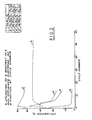
- curve No. 1 The results of this cycling of the test electrode are shown in Figure 1 as curve No. 1.
- This curve shows that during the initial cycling of the electrode, its percentage of utilization based on 2e- actually increases.
- the curve also shows that when bismuth is used in the manganese dioxide electrode of material this Example 1, the improved material may be recycled a substantial number of times in excess of the 50 cycles and may be discharged in its highly cycled state to about 40% or more of its two electron capacity. This is substantially greater than any known rechargeable manganese dioxide electrode material which, for example, may be recycled at a maximum of only about 50 times at a discharge utilization of approximately 15% of its two electron capacity.
- This example will show the invention in the improved manganese oxide electrode material by illustrating a material in which lead is included as an active element in a manganese dioxide electrode material.
- the material illustrated is also prepared by a physical. method.
- This example will show the invention in the improved manganese oxide electrode material by illustrating a material in which bismuth is included as an active element in a manganese dioxide electrode material.
- the material illustrated is also prepared by a physical method.
- a modified electrode was prepared by spreading 0.935 grams of the paste made in the manner described above in a 1" x 1" x 0.020" cavity of a 3" x 3" plexiglass sheet.
- the paste was covered with three layers of Celgard No. 3401 separator, which layers were in turn covered with a sheet of pellon paper which separated the improved manganese dioxide electrode from a NiO/NiOOH counterelectrode.
- This flat cell was cycled at 0.5 mV/sec in the range -0.6V to +0.2V (with respect to a Hg/HgO electrode) in a flat cell.
- This example will show the invention in the improved manganese oxide electrode material by illustrating a material in which bismuth is included as an active element in a manganese dioxide electrode material.
- the material illustrated is also prepared by a physical method.
- the manganese dioxide used in this example is a beta manganese dioxide which is a different form than the gamma manganese dioxide used in the first three examples.
- This example will show the invention in the improved manganese oxide electrode material by illustrating material in which the bismuth is included as an active element in a manganese dioxide electrode material.
- the material illustrated is also prepared by a physical method.
- the type of manganese dioxide used, however, is a rho phase manganese dioxide.
- This example will show the invention in the improved manganese oxide electrode material by illustrating a material in which the bismuth is included as an active element in a manganese dioxide electrode material.
- the material illustrated is also prepared by a physical method.
- the purpose of this example is to illustrate that when no heavy metal addition of the type described above is made to an International Common Sample No. 1 of manganese dioxide, the utilization and recharge capabilities of the cell of extremely poor.
- Example 1 The procedure of Example 1 is carried out, except that there is no mixing cf any elements with the manganese dioxide.
- the manganese dioxide is used as described in the latter portion of Example 1 n order to manufacture an electrode which is subsequently made into a cell.
- the manganese dioxide used was gamma manganese dioxide (International Common Sample No. 1).
- This example will show the invention in the improved manganese oxide electrode material by illustrating a matorial in which both bismuth and lead are included as an active element in a manganese dioxide electrode material.
- the material illusurated is also prepared by a physical method.
- the purpose of this example is to illustrate that when no heavy metal addition of the type described above is made to a Birnessite sample, the utilization and recharge capabilities of the cell are extremely poor.
- NaMn x Oy compound The preparation of NaMn x Oy compound is described in detail in our aforementioned copending application U.S. Serial No. , filed on even date herewith, which application is hereby incorporated by reference.
- Mn(OH)2 formed by a reaction of Mn(N0 3 ) 2 with excess NaOH at 0-3°C was oxidized by 0 2 in a strong alkaline solution at 0-3°C for five or more hours followed by filtering, thorough washing with water, and drying at 65°C. Elemental analysis of the compound gave 48.8% Mn and 6.2% Na.
- NaMn x Oy so formed was then ground and mixed with graphite powder of twice the weight. The mixture then was milled. The mixture was then pressed at a pressure of 10 tons to form a disc of 1.2 cm diamter..
- a cell was formed using the so-formed disc as a cathode, platinum wire as an anode, and 9M KOH as an electrolyte. This cell was tested as constant current density of lma/0.02g of disc weight. The discharge/charge was cycled between running voltages of -0.5 to 0.5V against a HgO/Hg reference electrode. This cell used a Flex-Sil microporous rubber as the separator. The results of running this material are shown in Figure 2 as curve 1. This material, without any lead or bismuth additions, showed poor recharge capabilities.
- This example will show the invention in the improved manganese oxide electrode material by illustrating a material in which bismuth is included as an active element in a Birnessite material.
- the material illustrated is prepared by a physical method.
- Example 9 The preparation of NaMn x Oy compound has been described in Example 9. Weighed amounts of the so-formed material, along with Bi 2 0 3 in a Mn:Bi mole ratio equal to 5.6, were mixed and ground in a mortar and pestle. Thereafter, the materials were mixed with graphite powder of twice the weight and milled.. The mixture was pressed at a pressure of 10 tons to form a disc of 1.2 cm diameter. Cells were formed using these discs as a cathode, platinum wire as an anode, and 9M KOH as an electrolyte. The so-formed cells were tested at constant current density of lma/0.02g of disc weight. The discharge/charge was cycled between running voltages of -0.5 to 0.5V against an HgO/Hg reference electrode. Flex-Sil microporous rubber was used as the separator. The results of the testing of the cell is shown in Figure 2 as curve 2.
- the curve shows that when bismuth is used in the Birnessite material, the improved material may be recycled a substantial number of times and may be discharged in its highly cycled state to a substantial proportion of its two electron capacity.
- This example will show the invention in the improved manganese oxide electrode material by illustrating a material in which bismuth is included as an active element in a Birnessite material.
- the material illustrated is prepared by a physical method.
- Birnessite was prepared as described in Example 9. 51 parts by weight of Birnessite that has been ground for 18 hours in a pestle and mortar was mixed with 14 parts by weight of Bi 2 0 3 (Mn:Bi molar ratio equals 7) and 5013 parts by weight of graphite (SP-1) in a spex-mixer mill for approximately 10 minutes. 3083 parts by weight of 9M KOH solution containing 4% by weight of an organic gelling agent was added to this dry powder and mixed for an additional five minutes to obtain a paste. The electrode was made from this paste as discussed in Example 9 and tested for rechargeability in the manner described in Example 9. The resulting data is identified in Figure 2 as curve 3.
- This example will show the invention in the improved manganese oxide electrode material by illustrating a material in which lead is included as an active element in a Birnessite electrode material.
- the material illustrated is prepared by a physical method.
- the electrode is prepared as described in Example 10, except for Bi 2 0 3 which was replaced by PbO in a Nm:Pb mole ratio of 4.2.
- the data resulting from testing of a cell having such an electrode contained therein is shown in Figure 2 as curve 4.
- This example will show the invention in the improved manganese oxide electrode material by illustrating a material in which bismuth is included as an active element in a Birnessite electrode material.
- the material illustrated is prepared by a physical method.
- organic binder and/or gelling agent is also used in formation of the manganese dioxide electrode material.
- the organic gelling agent is made up of 4% by weight of carboxy methyl cellulose in 96% by weight of 9M KOH.
Landscapes
- Chemical & Material Sciences (AREA)
- Organic Chemistry (AREA)
- Inorganic Chemistry (AREA)
- Chemical Kinetics & Catalysis (AREA)
- Electrochemistry (AREA)
- General Chemical & Material Sciences (AREA)
- Engineering & Computer Science (AREA)
- Manufacturing & Machinery (AREA)
- Battery Electrode And Active Subsutance (AREA)
- Inorganic Compounds Of Heavy Metals (AREA)
Applications Claiming Priority (2)
| Application Number | Priority Date | Filing Date | Title |
|---|---|---|---|
| US52147483A | 1983-08-08 | 1983-08-08 | |
| US521474 | 1983-08-08 |
Publications (2)
| Publication Number | Publication Date |
|---|---|
| EP0146201A1 true EP0146201A1 (fr) | 1985-06-26 |
| EP0146201B1 EP0146201B1 (fr) | 1988-06-15 |
Family
ID=24076870
Family Applications (1)
| Application Number | Title | Priority Date | Filing Date |
|---|---|---|---|
| EP84305352A Expired EP0146201B1 (fr) | 1983-08-08 | 1984-08-07 | Matériau d'électrode d'oxyde de manganèse rechargeable |
Country Status (3)
| Country | Link |
|---|---|
| EP (1) | EP0146201B1 (fr) |
| JP (1) | JPS6059658A (fr) |
| DE (1) | DE3472185D1 (fr) |
Cited By (7)
| Publication number | Priority date | Publication date | Assignee | Title |
|---|---|---|---|---|
| EP0136173A3 (fr) * | 1983-09-29 | 1986-04-16 | Ford Motor Company Limited | Pile bioxyde de manganèse-zinc rechargeable |
| WO1992014273A1 (fr) * | 1991-02-11 | 1992-08-20 | Rbc Universal Ltd. | Procede de production d'un materiau de dioxyde de manganese rechargeable modifie, composes et materiau d'electrode |
| DE4438784A1 (de) * | 1993-10-20 | 1995-04-27 | Litronik Batterietechnologie G | Galvanische Zelle |
| AU659631B2 (en) * | 1991-01-24 | 1995-05-25 | Rbc Universal Ltd. | Method of preparing a rechargeable modified manganese-containing material by electrolytic deposition and related material |
| US5587258A (en) * | 1994-10-19 | 1996-12-24 | Litronik Batterietechnologie Gmbh & Co. | Galvanic cell having improved cathode |
| US5660953A (en) * | 1993-12-17 | 1997-08-26 | The University Of Ottawa | Rechargeable manganese dioxide cathode |
| CN110867578A (zh) * | 2019-11-21 | 2020-03-06 | 江苏理工学院 | 一种钠离子电池及其制备方法和应用 |
Citations (2)
| Publication number | Priority date | Publication date | Assignee | Title |
|---|---|---|---|---|
| US4268589A (en) * | 1977-12-08 | 1981-05-19 | Imatra Paristo Oy | Cell having improved rechargeability |
| US4384029A (en) * | 1980-07-10 | 1983-05-17 | Varta Batterie Aktiengesellschaft | Rechargeable galvanic element |
Family Cites Families (6)
| Publication number | Priority date | Publication date | Assignee | Title |
|---|---|---|---|---|
| JPS526959A (en) * | 1975-07-04 | 1977-01-19 | Hitachi Ltd | High speed fuse |
| JPS5212899A (en) * | 1975-07-21 | 1977-01-31 | Omron Tateisi Electronics Co | Oil film detector |
| US4075292A (en) * | 1976-06-01 | 1978-02-21 | Bayer Aktiengesellschaft | Production of O,O-dialkyl-phosphorochloridothionates |
| JPS541011A (en) * | 1977-06-03 | 1979-01-06 | Nec Corp | Floating head slider |
| JPS561466A (en) * | 1979-06-15 | 1981-01-09 | Matsushita Electric Ind Co Ltd | Manganese-dioxide-lithium battery |
| JPS5755065A (en) * | 1980-09-19 | 1982-04-01 | Sanyo Electric Co Ltd | Positive electrode of non-aqueous electrolyte cell |
-
1984
- 1984-08-07 JP JP59165542A patent/JPS6059658A/ja active Pending
- 1984-08-07 DE DE8484305352T patent/DE3472185D1/de not_active Expired
- 1984-08-07 EP EP84305352A patent/EP0146201B1/fr not_active Expired
Patent Citations (2)
| Publication number | Priority date | Publication date | Assignee | Title |
|---|---|---|---|---|
| US4268589A (en) * | 1977-12-08 | 1981-05-19 | Imatra Paristo Oy | Cell having improved rechargeability |
| US4384029A (en) * | 1980-07-10 | 1983-05-17 | Varta Batterie Aktiengesellschaft | Rechargeable galvanic element |
Non-Patent Citations (2)
| Title |
|---|
| CHEMICAL ABSTRACTS, vol. 44, no. 14, July 25, 1950, Columbus Ohio, USA A.D. WADSLEY "A hydrous manganese oxide with exchange properties" abstract no. 6327h * |
| CHEMICAL ABSTRACTS, vol. 45, no. 1, January 10, 1951, Columbus, Ohio, USA A.D. WADSLEY "Synthesis of some hydrated manganese minerals" abstract no. 503a * |
Cited By (9)
| Publication number | Priority date | Publication date | Assignee | Title |
|---|---|---|---|---|
| EP0136173A3 (fr) * | 1983-09-29 | 1986-04-16 | Ford Motor Company Limited | Pile bioxyde de manganèse-zinc rechargeable |
| AU659631B2 (en) * | 1991-01-24 | 1995-05-25 | Rbc Universal Ltd. | Method of preparing a rechargeable modified manganese-containing material by electrolytic deposition and related material |
| WO1992014273A1 (fr) * | 1991-02-11 | 1992-08-20 | Rbc Universal Ltd. | Procede de production d'un materiau de dioxyde de manganese rechargeable modifie, composes et materiau d'electrode |
| KR100272299B1 (ko) * | 1991-02-11 | 2000-11-15 | 케인쓸러, 라메쉬 씨 | 재충전 가능한 변형된 이산화망간 전극 물질의 제조방법 |
| DE4438784A1 (de) * | 1993-10-20 | 1995-04-27 | Litronik Batterietechnologie G | Galvanische Zelle |
| DE4438784C2 (de) * | 1993-10-20 | 1998-02-19 | Litronik Batterietechnologie G | Hermetisch geschlossene galvanische Zelle für ein implantierbares Gerät, deren Verwendung und Verfahren zur Herstellung der Zelle |
| US5660953A (en) * | 1993-12-17 | 1997-08-26 | The University Of Ottawa | Rechargeable manganese dioxide cathode |
| US5587258A (en) * | 1994-10-19 | 1996-12-24 | Litronik Batterietechnologie Gmbh & Co. | Galvanic cell having improved cathode |
| CN110867578A (zh) * | 2019-11-21 | 2020-03-06 | 江苏理工学院 | 一种钠离子电池及其制备方法和应用 |
Also Published As
| Publication number | Publication date |
|---|---|
| EP0146201B1 (fr) | 1988-06-15 |
| JPS6059658A (ja) | 1985-04-06 |
| DE3472185D1 (en) | 1988-07-21 |
Similar Documents
| Publication | Publication Date | Title |
|---|---|---|
| AU659636B2 (en) | Method of making rechargeable modified manganese dioxide electrode material | |
| US5601952A (en) | Lithium-Manganese oxide electrode for a rechargeable lithium battery | |
| US4451543A (en) | Rechargeable zinc/manganese dioxide cell | |
| US5952124A (en) | Rechargeable electrochemical cell with modified manganese oxide positive electrode | |
| CA1310362C (fr) | Cellule electrochimique rechargeable a electrolyte alkakin et cathode zinc-dioxyde de manganese, a capacite amelioree | |
| JPH02262242A (ja) | リチウムアノードを有する再充電形電気化学電池のカソード物質の製造方法 | |
| US4268589A (en) | Cell having improved rechargeability | |
| EP0573040A1 (fr) | Electrode positive pour accumulateur au lithium et sa méthode de production et un accumulateur au lithium à électrolyte non-aqueux l'utilisant | |
| US5660953A (en) | Rechargeable manganese dioxide cathode | |
| WO2003044879A2 (fr) | Pile alcaline | |
| US4076909A (en) | Alkaline lead battery | |
| US4520005A (en) | Method of making a compound | |
| EP1290740B1 (fr) | Materiaux de cathode pour des batteries de piles | |
| US6740452B2 (en) | Process of forming a negative battery paste | |
| US4584252A (en) | Insertion compounds of graphite with improved performances and electrochemical applications of those compounds | |
| CN101317287B (zh) | 容量衰减减缓和循环寿命改善的可再充电碱性锰电池 | |
| EP0146201A1 (fr) | Matériau d'électrode d'oxyde de manganèse rechargeable | |
| EP1775787B1 (fr) | Méthode de production pour materiau activ de cathode pour une batterie alcaline | |
| EP0138316B1 (fr) | Matériau d'électrode de dioxyde de manganèse rechargeable | |
| US6960409B2 (en) | High discharge rate alkaline battery | |
| CA1055566A (fr) | Accumulateur a equilibrage de charge | |
| CA1218515A (fr) | Preparation d'un compose | |
| US7081235B2 (en) | Cathode materials for primary batteries | |
| JP2553624B2 (ja) | ペースト式カドミウム負極 | |
| JPH0578148B2 (fr) |
Legal Events
| Date | Code | Title | Description |
|---|---|---|---|
| PUAI | Public reference made under article 153(3) epc to a published international application that has entered the european phase |
Free format text: ORIGINAL CODE: 0009012 |
|
| AK | Designated contracting states |
Designated state(s): DE FR GB IT |
|
| 17P | Request for examination filed |
Effective date: 19851007 |
|
| 17Q | First examination report despatched |
Effective date: 19860605 |
|
| R17C | First examination report despatched (corrected) |
Effective date: 19870309 |
|
| GRAA | (expected) grant |
Free format text: ORIGINAL CODE: 0009210 |
|
| AK | Designated contracting states |
Kind code of ref document: B1 Designated state(s): DE FR GB IT |
|
| ITF | It: translation for a ep patent filed | ||
| REF | Corresponds to: |
Ref document number: 3472185 Country of ref document: DE Date of ref document: 19880721 |
|
| ET | Fr: translation filed | ||
| PLBE | No opposition filed within time limit |
Free format text: ORIGINAL CODE: 0009261 |
|
| STAA | Information on the status of an ep patent application or granted ep patent |
Free format text: STATUS: NO OPPOSITION FILED WITHIN TIME LIMIT |
|
| 26N | No opposition filed | ||
| ITTA | It: last paid annual fee | ||
| PGFP | Annual fee paid to national office [announced via postgrant information from national office to epo] |
Ref country code: GB Payment date: 19940727 Year of fee payment: 11 |
|
| PGFP | Annual fee paid to national office [announced via postgrant information from national office to epo] |
Ref country code: DE Payment date: 19940823 Year of fee payment: 11 |
|
| PGFP | Annual fee paid to national office [announced via postgrant information from national office to epo] |
Ref country code: FR Payment date: 19941025 Year of fee payment: 11 |
|
| PG25 | Lapsed in a contracting state [announced via postgrant information from national office to epo] |
Ref country code: DE Effective date: 19950725 |
|
| PG25 | Lapsed in a contracting state [announced via postgrant information from national office to epo] |
Ref country code: GB Effective date: 19950807 |
|
| GBPC | Gb: european patent ceased through non-payment of renewal fee |
Effective date: 19950807 |
|
| PG25 | Lapsed in a contracting state [announced via postgrant information from national office to epo] |
Ref country code: FR Effective date: 19960430 |
|
| REG | Reference to a national code |
Ref country code: FR Ref legal event code: ST |