EP0146579B1 - Verfahren zur behandlung von kautschuk - Google Patents
Verfahren zur behandlung von kautschuk Download PDFInfo
- Publication number
- EP0146579B1 EP0146579B1 EP84902036A EP84902036A EP0146579B1 EP 0146579 B1 EP0146579 B1 EP 0146579B1 EP 84902036 A EP84902036 A EP 84902036A EP 84902036 A EP84902036 A EP 84902036A EP 0146579 B1 EP0146579 B1 EP 0146579B1
- Authority
- EP
- European Patent Office
- Prior art keywords
- rubber
- sapa
- cure
- cationic surfactant
- diamino
- Prior art date
- Legal status (The legal status is an assumption and is not a legal conclusion. Google has not performed a legal analysis and makes no representation as to the accuracy of the status listed.)
- Expired - Lifetime
Links
- 229920001971 elastomer Polymers 0.000 title claims abstract description 110
- 239000005060 rubber Substances 0.000 title claims abstract description 107
- 238000000034 method Methods 0.000 title claims description 32
- 230000008569 process Effects 0.000 title claims description 28
- XLOMVQKBTHCTTD-UHFFFAOYSA-N Zinc monoxide Chemical compound [Zn]=O XLOMVQKBTHCTTD-UHFFFAOYSA-N 0.000 claims abstract description 52
- 239000011787 zinc oxide Substances 0.000 claims abstract description 26
- 239000000945 filler Substances 0.000 claims abstract description 24
- QIQXTHQIDYTFRH-UHFFFAOYSA-N octadecanoic acid Chemical compound CCCCCCCCCCCCCCCCCC(O)=O QIQXTHQIDYTFRH-UHFFFAOYSA-N 0.000 claims abstract description 20
- -1 fatty acid salts Chemical class 0.000 claims abstract description 19
- 125000000217 alkyl group Chemical group 0.000 claims abstract description 4
- 239000000203 mixture Substances 0.000 claims description 48
- VYPSYNLAJGMNEJ-UHFFFAOYSA-N Silicium dioxide Chemical compound O=[Si]=O VYPSYNLAJGMNEJ-UHFFFAOYSA-N 0.000 claims description 26
- 239000003093 cationic surfactant Substances 0.000 claims description 25
- 150000001875 compounds Chemical class 0.000 claims description 18
- 239000000377 silicon dioxide Substances 0.000 claims description 13
- 238000002156 mixing Methods 0.000 claims description 12
- NINIDFKCEFEMDL-UHFFFAOYSA-N Sulfur Chemical compound [S] NINIDFKCEFEMDL-UHFFFAOYSA-N 0.000 claims description 10
- 239000005864 Sulphur Substances 0.000 claims description 10
- 239000012190 activator Substances 0.000 claims description 10
- 238000010438 heat treatment Methods 0.000 claims description 5
- 150000001450 anions Chemical class 0.000 claims description 4
- ZQPPMHVWECSIRJ-KTKRTIGZSA-N oleic acid Chemical compound CCCCCCCC\C=C/CCCCCCCC(O)=O ZQPPMHVWECSIRJ-KTKRTIGZSA-N 0.000 claims description 4
- 230000001419 dependent effect Effects 0.000 claims description 3
- MTNDZQHUAFNZQY-UHFFFAOYSA-N imidazoline Chemical compound C1CN=CN1 MTNDZQHUAFNZQY-UHFFFAOYSA-N 0.000 claims description 3
- 229940049964 oleate Drugs 0.000 claims description 3
- VTXWSJAEIWTHCL-DJNDIFCPSA-N (z)-octadec-9-enoic acid;n'-[(z)-octadec-9-enyl]propane-1,3-diamine Chemical compound CCCCCCCC\C=C/CCCCCCCC(O)=O.CCCCCCCC\C=C/CCCCCCCC(O)=O.CCCCCCCC\C=C/CCCCCCCCNCCCN VTXWSJAEIWTHCL-DJNDIFCPSA-N 0.000 claims description 2
- NZPIQKUHZVXACL-KHPPLWFESA-N 1-[2-[(z)-octadec-9-enyl]-4,5-dihydroimidazol-1-yl]ethanol Chemical compound CCCCCCCC\C=C/CCCCCCCCC1=NCCN1C(C)O NZPIQKUHZVXACL-KHPPLWFESA-N 0.000 claims description 2
- BNGLZYYFFZFNDJ-UHFFFAOYSA-N 2-(2-heptadec-1-enyl-4,5-dihydroimidazol-1-yl)ethanol Chemical group CCCCCCCCCCCCCCCC=CC1=NCCN1CCO BNGLZYYFFZFNDJ-UHFFFAOYSA-N 0.000 claims description 2
- 244000068988 Glycine max Species 0.000 claims description 2
- 235000010469 Glycine max Nutrition 0.000 claims description 2
- 239000002253 acid Substances 0.000 claims description 2
- POULHZVOKOAJMA-UHFFFAOYSA-M dodecanoate Chemical compound CCCCCCCCCCCC([O-])=O POULHZVOKOAJMA-UHFFFAOYSA-M 0.000 claims description 2
- IPCSVZSSVZVIGE-UHFFFAOYSA-M hexadecanoate Chemical compound CCCCCCCCCCCCCCCC([O-])=O IPCSVZSSVZVIGE-UHFFFAOYSA-M 0.000 claims description 2
- 229940082005 hydrogenated tallow acid Drugs 0.000 claims description 2
- 239000003112 inhibitor Substances 0.000 claims description 2
- 229940070765 laurate Drugs 0.000 claims description 2
- 229910000464 lead oxide Inorganic materials 0.000 claims description 2
- TUFJPPAQOXUHRI-KTKRTIGZSA-N n'-[(z)-octadec-9-enyl]propane-1,3-diamine Chemical compound CCCCCCCC\C=C/CCCCCCCCNCCCN TUFJPPAQOXUHRI-KTKRTIGZSA-N 0.000 claims description 2
- 125000004433 nitrogen atom Chemical group N* 0.000 claims description 2
- YEXPOXQUZXUXJW-UHFFFAOYSA-N oxolead Chemical compound [Pb]=O YEXPOXQUZXUXJW-UHFFFAOYSA-N 0.000 claims description 2
- 229910044991 metal oxide Inorganic materials 0.000 claims 2
- 150000004706 metal oxides Chemical class 0.000 claims 2
- 239000004014 plasticizer Substances 0.000 abstract description 24
- 238000012545 processing Methods 0.000 abstract description 24
- 235000021355 Stearic acid Nutrition 0.000 abstract description 16
- OQCDKBAXFALNLD-UHFFFAOYSA-N octadecanoic acid Natural products CCCCCCCC(C)CCCCCCCCC(O)=O OQCDKBAXFALNLD-UHFFFAOYSA-N 0.000 abstract description 16
- 239000008117 stearic acid Substances 0.000 abstract description 16
- 239000006185 dispersion Substances 0.000 abstract description 9
- 230000000704 physical effect Effects 0.000 abstract description 9
- 239000004094 surface-active agent Substances 0.000 abstract description 8
- 235000014113 dietary fatty acids Nutrition 0.000 abstract description 6
- 239000000194 fatty acid Substances 0.000 abstract description 6
- 229930195729 fatty acid Natural products 0.000 abstract description 6
- 238000004073 vulcanization Methods 0.000 abstract description 6
- 239000003795 chemical substances by application Substances 0.000 abstract description 4
- 238000010057 rubber processing Methods 0.000 abstract description 4
- 150000003335 secondary amines Chemical class 0.000 abstract description 4
- 150000004665 fatty acids Chemical class 0.000 abstract description 3
- 238000011065 in-situ storage Methods 0.000 abstract description 3
- 230000032683 aging Effects 0.000 abstract description 2
- 125000002091 cationic group Chemical group 0.000 abstract description 2
- 244000043261 Hevea brasiliensis Species 0.000 description 28
- 229920003052 natural elastomer Polymers 0.000 description 28
- 229920001194 natural rubber Polymers 0.000 description 28
- 239000003921 oil Substances 0.000 description 23
- 229920003048 styrene butadiene rubber Polymers 0.000 description 23
- 239000002174 Styrene-butadiene Substances 0.000 description 22
- 230000000694 effects Effects 0.000 description 20
- 239000000654 additive Substances 0.000 description 19
- 238000009472 formulation Methods 0.000 description 16
- 238000002474 experimental method Methods 0.000 description 13
- 238000010058 rubber compounding Methods 0.000 description 13
- 239000006057 Non-nutritive feed additive Substances 0.000 description 12
- 230000000996 additive effect Effects 0.000 description 12
- 229920000459 Nitrile rubber Polymers 0.000 description 11
- 230000009467 reduction Effects 0.000 description 9
- 238000007906 compression Methods 0.000 description 8
- 230000006835 compression Effects 0.000 description 8
- 238000001125 extrusion Methods 0.000 description 8
- 239000006229 carbon black Substances 0.000 description 7
- 230000001965 increasing effect Effects 0.000 description 7
- 238000011835 investigation Methods 0.000 description 7
- 239000002480 mineral oil Substances 0.000 description 6
- 239000000126 substance Substances 0.000 description 6
- 239000000080 wetting agent Substances 0.000 description 6
- MQIUGAXCHLFZKX-UHFFFAOYSA-N Di-n-octyl phthalate Chemical compound CCCCCCCCOC(=O)C1=CC=CC=C1C(=O)OCCCCCCCC MQIUGAXCHLFZKX-UHFFFAOYSA-N 0.000 description 5
- GSEJCLTVZPLZKY-UHFFFAOYSA-N Triethanolamine Chemical compound OCCN(CCO)CCO GSEJCLTVZPLZKY-UHFFFAOYSA-N 0.000 description 5
- 238000007792 addition Methods 0.000 description 5
- 230000035882 stress Effects 0.000 description 5
- 230000009471 action Effects 0.000 description 4
- 230000004913 activation Effects 0.000 description 4
- 239000007788 liquid Substances 0.000 description 4
- 238000001878 scanning electron micrograph Methods 0.000 description 4
- RWSOTUBLDIXVET-UHFFFAOYSA-N Dihydrogen sulfide Chemical compound S RWSOTUBLDIXVET-UHFFFAOYSA-N 0.000 description 3
- 230000001133 acceleration Effects 0.000 description 3
- 239000010692 aromatic oil Substances 0.000 description 3
- 239000007859 condensation product Substances 0.000 description 3
- 239000007822 coupling agent Substances 0.000 description 3
- 230000003111 delayed effect Effects 0.000 description 3
- 239000000806 elastomer Substances 0.000 description 3
- 239000004615 ingredient Substances 0.000 description 3
- 230000007246 mechanism Effects 0.000 description 3
- 235000010446 mineral oil Nutrition 0.000 description 3
- 238000000465 moulding Methods 0.000 description 3
- 230000002829 reductive effect Effects 0.000 description 3
- 229920003051 synthetic elastomer Polymers 0.000 description 3
- 239000005061 synthetic rubber Substances 0.000 description 3
- 238000012360 testing method Methods 0.000 description 3
- MYRTYDVEIRVNKP-UHFFFAOYSA-N 1,2-Divinylbenzene Chemical compound C=CC1=CC=CC=C1C=C MYRTYDVEIRVNKP-UHFFFAOYSA-N 0.000 description 2
- MHKLKWCYGIBEQF-UHFFFAOYSA-N 4-(1,3-benzothiazol-2-ylsulfanyl)morpholine Chemical compound C1COCCN1SC1=NC2=CC=CC=C2S1 MHKLKWCYGIBEQF-UHFFFAOYSA-N 0.000 description 2
- PIICEJLVQHRZGT-UHFFFAOYSA-N Ethylenediamine Chemical compound NCCN PIICEJLVQHRZGT-UHFFFAOYSA-N 0.000 description 2
- 239000002216 antistatic agent Substances 0.000 description 2
- 230000008901 benefit Effects 0.000 description 2
- 238000006243 chemical reaction Methods 0.000 description 2
- 230000000052 comparative effect Effects 0.000 description 2
- 239000003431 cross linking reagent Substances 0.000 description 2
- 150000004985 diamines Chemical class 0.000 description 2
- 239000002270 dispersing agent Substances 0.000 description 2
- 230000008030 elimination Effects 0.000 description 2
- 238000003379 elimination reaction Methods 0.000 description 2
- 230000002708 enhancing effect Effects 0.000 description 2
- 150000002462 imidazolines Chemical class 0.000 description 2
- 238000001000 micrograph Methods 0.000 description 2
- 239000012764 mineral filler Substances 0.000 description 2
- 229920001084 poly(chloroprene) Polymers 0.000 description 2
- 150000003141 primary amines Chemical class 0.000 description 2
- 230000004044 response Effects 0.000 description 2
- 238000010074 rubber mixing Methods 0.000 description 2
- 150000003839 salts Chemical class 0.000 description 2
- 238000010998 test method Methods 0.000 description 2
- 238000009736 wetting Methods 0.000 description 2
- WRIDQFICGBMAFQ-UHFFFAOYSA-N (E)-8-Octadecenoic acid Natural products CCCCCCCCCC=CCCCCCCC(O)=O WRIDQFICGBMAFQ-UHFFFAOYSA-N 0.000 description 1
- ZNRLMGFXSPUZNR-UHFFFAOYSA-N 2,2,4-trimethyl-1h-quinoline Chemical compound C1=CC=C2C(C)=CC(C)(C)NC2=C1 ZNRLMGFXSPUZNR-UHFFFAOYSA-N 0.000 description 1
- LQJBNNIYVWPHFW-UHFFFAOYSA-N 20:1omega9c fatty acid Natural products CCCCCCCCCCC=CCCCCCCCC(O)=O LQJBNNIYVWPHFW-UHFFFAOYSA-N 0.000 description 1
- QSBYPNXLFMSGKH-UHFFFAOYSA-N 9-Heptadecensaeure Natural products CCCCCCCC=CCCCCCCCC(O)=O QSBYPNXLFMSGKH-UHFFFAOYSA-N 0.000 description 1
- 239000004215 Carbon black (E152) Substances 0.000 description 1
- RPNUMPOLZDHAAY-UHFFFAOYSA-N Diethylenetriamine Chemical compound NCCNCCN RPNUMPOLZDHAAY-UHFFFAOYSA-N 0.000 description 1
- 229920001875 Ebonite Polymers 0.000 description 1
- 239000004610 Internal Lubricant Substances 0.000 description 1
- OYHQOLUKZRVURQ-HZJYTTRNSA-N Linoleic acid Chemical compound CCCCC\C=C/C\C=C/CCCCCCCC(O)=O OYHQOLUKZRVURQ-HZJYTTRNSA-N 0.000 description 1
- 239000005642 Oleic acid Substances 0.000 description 1
- ZQPPMHVWECSIRJ-UHFFFAOYSA-N Oleic acid Natural products CCCCCCCCC=CCCCCCCCC(O)=O ZQPPMHVWECSIRJ-UHFFFAOYSA-N 0.000 description 1
- 229920002873 Polyethylenimine Polymers 0.000 description 1
- UCKMPCXJQFINFW-UHFFFAOYSA-N Sulphide Chemical compound [S-2] UCKMPCXJQFINFW-UHFFFAOYSA-N 0.000 description 1
- 230000002159 abnormal effect Effects 0.000 description 1
- 230000002378 acidificating effect Effects 0.000 description 1
- 229920006397 acrylic thermoplastic Polymers 0.000 description 1
- 230000002411 adverse Effects 0.000 description 1
- 125000005667 alkyl propylene group Chemical group 0.000 description 1
- 150000001412 amines Chemical class 0.000 description 1
- 125000003118 aryl group Chemical group 0.000 description 1
- 230000015572 biosynthetic process Effects 0.000 description 1
- 125000003178 carboxy group Chemical group [H]OC(*)=O 0.000 description 1
- 150000001732 carboxylic acid derivatives Chemical class 0.000 description 1
- 150000001735 carboxylic acids Chemical class 0.000 description 1
- 230000015556 catabolic process Effects 0.000 description 1
- 150000001768 cations Chemical class 0.000 description 1
- 230000001427 coherent effect Effects 0.000 description 1
- 230000008878 coupling Effects 0.000 description 1
- 238000010168 coupling process Methods 0.000 description 1
- 238000005859 coupling reaction Methods 0.000 description 1
- 238000004132 cross linking Methods 0.000 description 1
- 238000005520 cutting process Methods 0.000 description 1
- 125000004122 cyclic group Chemical group 0.000 description 1
- 230000003247 decreasing effect Effects 0.000 description 1
- 230000007547 defect Effects 0.000 description 1
- 125000004427 diamine group Chemical group 0.000 description 1
- 238000010494 dissociation reaction Methods 0.000 description 1
- 230000005593 dissociations Effects 0.000 description 1
- 230000000499 effect on compression Effects 0.000 description 1
- 150000002148 esters Chemical class 0.000 description 1
- 238000011156 evaluation Methods 0.000 description 1
- 239000000835 fiber Substances 0.000 description 1
- 239000012530 fluid Substances 0.000 description 1
- 229920001973 fluoroelastomer Polymers 0.000 description 1
- 125000003055 glycidyl group Chemical group C(C1CO1)* 0.000 description 1
- 230000005484 gravity Effects 0.000 description 1
- 229930195733 hydrocarbon Natural products 0.000 description 1
- 150000002430 hydrocarbons Chemical class 0.000 description 1
- 230000007062 hydrolysis Effects 0.000 description 1
- 238000006460 hydrolysis reaction Methods 0.000 description 1
- 230000002209 hydrophobic effect Effects 0.000 description 1
- RWSOTUBLDIXVET-UHFFFAOYSA-M hydrosulfide Chemical compound [SH-] RWSOTUBLDIXVET-UHFFFAOYSA-M 0.000 description 1
- 238000010348 incorporation Methods 0.000 description 1
- 230000006698 induction Effects 0.000 description 1
- 229910052500 inorganic mineral Inorganic materials 0.000 description 1
- 150000002500 ions Chemical class 0.000 description 1
- QXJSBBXBKPUZAA-UHFFFAOYSA-N isooleic acid Natural products CCCCCCCC=CCCCCCCCCC(O)=O QXJSBBXBKPUZAA-UHFFFAOYSA-N 0.000 description 1
- 235000020778 linoleic acid Nutrition 0.000 description 1
- OYHQOLUKZRVURQ-IXWMQOLASA-N linoleic acid Natural products CCCCC\C=C/C\C=C\CCCCCCCC(O)=O OYHQOLUKZRVURQ-IXWMQOLASA-N 0.000 description 1
- 230000014759 maintenance of location Effects 0.000 description 1
- 238000004519 manufacturing process Methods 0.000 description 1
- 239000000463 material Substances 0.000 description 1
- 238000002844 melting Methods 0.000 description 1
- 230000008018 melting Effects 0.000 description 1
- 229910052751 metal Inorganic materials 0.000 description 1
- 239000002184 metal Substances 0.000 description 1
- 238000003801 milling Methods 0.000 description 1
- 239000011707 mineral Substances 0.000 description 1
- 239000000178 monomer Substances 0.000 description 1
- 230000000269 nucleophilic effect Effects 0.000 description 1
- 150000004986 phenylenediamines Chemical class 0.000 description 1
- 229920003229 poly(methyl methacrylate) Polymers 0.000 description 1
- 229920000642 polymer Polymers 0.000 description 1
- 235000013824 polyphenols Nutrition 0.000 description 1
- 238000002360 preparation method Methods 0.000 description 1
- 230000001737 promoting effect Effects 0.000 description 1
- 230000002787 reinforcement Effects 0.000 description 1
- 230000003014 reinforcing effect Effects 0.000 description 1
- 230000000717 retained effect Effects 0.000 description 1
- 230000002441 reversible effect Effects 0.000 description 1
- 238000013040 rubber vulcanization Methods 0.000 description 1
- 238000004626 scanning electron microscopy Methods 0.000 description 1
- 230000035945 sensitivity Effects 0.000 description 1
- 239000007787 solid Substances 0.000 description 1
- 238000010186 staining Methods 0.000 description 1
- 239000003760 tallow Substances 0.000 description 1
- ISXSCDLOGDJUNJ-UHFFFAOYSA-N tert-butyl prop-2-enoate Chemical compound CC(C)(C)OC(=O)C=C ISXSCDLOGDJUNJ-UHFFFAOYSA-N 0.000 description 1
- FAGUFWYHJQFNRV-UHFFFAOYSA-N tetraethylenepentamine Chemical compound NCCNCCNCCNCCN FAGUFWYHJQFNRV-UHFFFAOYSA-N 0.000 description 1
- 239000011800 void material Substances 0.000 description 1
- 238000010792 warming Methods 0.000 description 1
- 150000003751 zinc Chemical class 0.000 description 1
Images


Classifications
-
- C—CHEMISTRY; METALLURGY
- C08—ORGANIC MACROMOLECULAR COMPOUNDS; THEIR PREPARATION OR CHEMICAL WORKING-UP; COMPOSITIONS BASED THEREON
- C08K—Use of inorganic or non-macromolecular organic substances as compounding ingredients
- C08K5/00—Use of organic ingredients
- C08K5/16—Nitrogen-containing compounds
Definitions
- This invention relates to a process for treating rubber utilising certain classes of cationic surfactants in the form of surface active plasticiser accelerators (hereinafter referred to as SAPA).
- SAPA surface active plasticiser accelerators
- plasticisers such as acrylics and phenolics
- the presence of a plasticiser in a rubber reduces the strength of its vulcanisate to a greater or lesser degree.
- the relative effect of different plasticisers on strength reduction in a rubber mix is commonly used to assess its compatibility or efficiency.
- changes in strength properties due to the presence of a plasticiser cannot be measured.
- Other properties often used to assess plasticiser compatibility and effectiveness are:- staining, colour stability, ageing resistance, volatility from the rubber during processing, curing and service; fluid extractability and retention of flexibility at low temperatures. This investigation concerns the effect of a cationic surfactant as a rubber compounding ingredient.
- Cationic surfactants comprising the fatty acid salts of primary amines have been mixed with rubber in an attempt to improve flow characteristics, and the release and strength properties of rubber.
- the use of these primary amines has proved unsatisfactory for a number of reasons including scorching where the scorch properties of the rubber are very poor.
- Chemical Abstracts Vol. 73, 1970 No. 131774k discloses that the vulcanisation of natural rubber may be enhanced by incorporating ethylenediamine or derivatives thereof such as C17H35.CO.NH(CH2)2.NH2.HOOC. C17 H35.
- EPO 0,005,617 A discloses rubber compounds incorporating an amine salt of a carboxylic acid which crosslinks with a glycidyl monomer to produce a hard rubber.
- US 3,502,612 discloses the use of amines, including imidazoline, for preserving phenylene diamine antiozonant in rubber.
- US 3,369,004 discloses a process for vulcanising rubber wherein an activator comprising a 1,2-substituted imidazoline is used to activate a primary cure accelerator.
- EP-A-76,197 discloses an additive for elastomers containing silica-based mineral fillers.
- the additive molecule has at one end a moiety which has an affinity for the silica mineral filler and at another end a moiety which has an affinity for the elastomer chains.
- One class of additives disclosed in this publication are the condensation products of polyethylene amines such as ethylene diamine, diethylene triamine and tetraethylene pentamine with long-chain carboxylic acids such as oleic acid and linoleic acid. These condensation products are stated to be analysed as mixtures of alkyl amides and imidazolines.
- a number of rubber formulations are disclosed which incorporate such additives and which possess improved dynamic properties, as well as accelerated vulcanisation and greater tensile strength.
- all the formulations disclosed incorporate conventional amounts of zinc oxide/stearic acid cure activator and also conventional amounts of a conventional organic cure accelerator.
- the amount of condensation product additive is less than the amount of organic cure accelerator and in all the Examples including Example 4, the additive differs significantly from the additives employed in the present invention.
- the present invention provides a process for treating rubber comprising mixing the rubber with a cationic surfactant and curing the mixture, said cationic surfactant comprising an imidazoline having only two nitrogen atoms in the molecule or a carboxylate salt of an N-alkyl alkylene diamine, said mixture optionally containing a conventional organic cure accelerator and optionally containing a conventional cure activator system, wherein the amount of said cationic surfactant is greater than or equal to the amount (if any) of said conventional organic cure accelerator.
- the invention stems from a recognition that by using the above additives, the amounts of conventional cure activator and accelerator may be reduced or may even be dispensed with.
- Said cationic surfactant may for example be 1(2-hydroxyethyl)-2-heptadecenyl imidazoline or 1-hydroxyethyl-2-oleyl imidazoline.
- the cationic surfactant is a carboxylate salt
- it is preferably of the general formula: [R(NH2)(CH2)3NH3]2+.2R1COO ⁇ wherein R and R1 are long chain alkyl groups.
- R1COO ⁇ is stearate, laurate, palmitate, oleate, the anion of soya acid or the anion of hydrogenated tallow acid.
- the cation of said formula is N-COCO-1,3,diaminopropane; N-tallow-1,3 diamino propane; or N-oleyl-1,3-diamino propane.
- the carboxylate salt of said formula is preferably N-tallow-1,3-diamino-propane dioleate; N-stearic-1,3-diamino-propane distearate; or N-oleyl-1,3-diamino-propane dioleate.
- the process of the invention may be used in the manufacture of moulded rubber articles such as tyres for example.
- the mixture of rubber and cationic surfactant may be vulcanised by heating in the presence of sulphur or a sulphur donating compound.
- the rubber prepared in each case is generally banded on a rubber mixing two roll mill in the conventional temperature range 30 o to 100 o C, but more usually at approximately 50 o C.
- the SAPA and other small chemical compounds together with 1/3 of the filler content are then added to the rubber and dispersed.
- the remaining filler and any other processing oil, if any, are then added and also dispersed.
- the step is followed by the addition and dispersion of sulphur.
- the mix is refined at least six times.
- the treatment of the rubber SAPA dissociates at higher temperatures used for vulcanisation, that is greater than 140 o C, to form, for example, a secondary amine, which functions as an organic accelerator of cure.
- Test methods are conventional, as far as possible, and based on BS, ASTM or ISO rubber test method procedures.
- the mixing procedure used are as follows:-
- This compound has the ability to partially dissociate on heating into some of its primary components and it is this property which is considered to account for its simultaneous multiplicity of uses as a rubber processing aid, cure rate activator and accelerator, and as a surface active plasticiser that enhances filler reinforcement of rubber by means of the mechanism disclosed above.
- SAPA SAPA was examined in some common synthetic rubbers for its effect on processing and properties and the results are now systematically given and commented upon.
- the SBR mixes containing SAPA possessed markedly superior flow and processing properties to their controls by producing undistorted stress free test specimen sheets when compression moulded from a cold thick round blank (of 10mm thickness) by the simple application of pressure.
- the equivalent control rubber all gave moulded sheets possessing defects due to flow problems.
- SAPA cure activation effect of SAPA in an all-silica filled rubber where it out-performs the standard activator triethanolamine
- both SAPA and triethanolamine (TEA) in a silica filled SBR give the same state of cure, as determined by an oscillating disc rheometer (ODR).
- ODR oscillating disc rheometer
- SAPA increases the tensile strength (50%), elongation at break (39%) and the tear strength (17%) over the conventional TEA containing silica SBR; compression set is inferior.
- SAPA gives about the same physical properties in a carbon black filled SBR as does a standard aromatic oil (see Table 3 and Figure 2) but gives substantially better release for metal surfaces.
- Table 9 demonstrates the effect of first introducing ZnO and then later stearic acid into a rubber mix containing only sulphur as a curative and from which the conventional accelerators have been omitted. It can be seen that when no ZnO and stearic acid is present a mix with 1.5 phr of SAPA has a scorch time of 15' and an optimum (t90) cure time of 22'. Introducing 1 phr of ZnO increases the scorch time from 15' to 100' and the t90 cure time from 22' to 42'; further additions of ZnO (mixes A and B) and later stearic acid (mix B) have little to no effect on further extensions of scorch time or t90 curing time. The inclusion of the ZnO results in some reduction of tensile strength.
- the cationic surfactant was exemplified above by N-tallow-1,3-diamino propane dioleate ( SAPA), however, it can also take the form of an N-alkyl propylene diamine (R(NH2) (CH2) 3NH3)2+2(R1COO ⁇ ) where R and R1 are long chain alkyl groups and R1 is stearic acid or it can be in the form of an aliphatic diamine as represented by N-tallow-1,3-diamino-propane dioleate, for example.
- SAPA N-tallow-1,3-diamino propane dioleate
- the salt of the diamine functions as an internal processing aid and a filler-rubber surfactant enabling wetting to take place between the rubber (hydrophobic)/filler (hydrophilic) interfaces.
- dissociation takes place forming a secondary amine vulcanisation accelerator R NH2(CH2)3NH2 and a fatty acid 2 R1 COOH as an internal mould release agent and cure rate contoller.
- the surfactant may take the form of the salt of an alkyl propylene diamine, shown as (R NH2(CH2)3NH3)2+2(RCOO) ⁇ which on heating in the presence of the zinc oxide (or lead oxide) is represented by (RCOO)2Zn + H2O + R NH(CH2) n NH2 where the zinc salt of the fatty acid which acts as a retarder (being acidic) to the diamine accelerator produced, and the diamine acts as an accelerator of cure.
- ZnO is thought to react with H2S, considered to be produced during all sulphur type cures, hence causing a decrease in the quantity of the hydrogen sulphide normally available and required to produce the nucleophilic hydrosulphide, sulphide, or sulphite ions; these ions are considered essential to effect the hydrolysis of the cyclic chain of sulphur, enabling it to function as a crosslinking agent in rubber. Hence a reduction in their availability due to H2S reacting with ZnO would account for cure retardation.
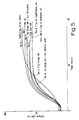
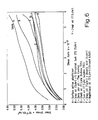
- Table 11 and Figure 5 illustrate the effect on compression set of SAPA (3 phr) compared with zero oil and other common rubber mineral based processing oils (7.5p) and mineral oil/processing aid combinations (5p + 5p). It is obvious from these results that the SAPA containing compound reaches a higher state of cure than the non-oil and oil and oil/processing aid formulations as shown by the ODR of Figure 5, and that this observation is confirmed by the lower compression set data for SAPA mixes of Table 11. SAPA containing mixes have a compression set value about 12% better (i.e. 25.5%) than the non-oil containing control which has the next best value of 30% compression set. Both SAPA and non-oil formulations are superior to all oil containing formulations.
- a further point of interest is that the density (S.G.) of SAPA mixes was less than that of all other indicating relatively low volume cost potential.
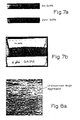
- Figure 7 also demonstrates use of SAPA as a processing aid in both black and silica filled mixes. It is self-evident that the inclusion of SAPA in the formulation has resulted in a considerable reduction in the otherwise rough surfaces of both of the extrudates. However, SAPA is found particularly effective as a flow additive in the silica filled mix turning on otherwise unprocessable rubber with a compound possessing satisfactory flow.
- SAPA is a particularly effective flow additive for turning "difficult to flow" silica filled rubber mixes into readily processed materials; an additional advantage is that as SAPA, when heated, decomposes and produces in situ a secondary amine then high silica containing formulations can use much lower quantities of accelerators whilst still attaining the same cure state.
- the mixing parameters of the oil, oil + processing aid, and SAPA rubber mixes were all found to be similar in nature with respect to mixing time, electrical power consumption, and total work input as a result of the mixing operation.
- a special feature observed is that the Mooney viscosity of the SAPA mixes is 8 points greater than the zero oil mixes and 8-14 points, greater than the oil and oil/processing aid mixes. This is considered to indicate that as a result of the heat generated in the rubber by mixing, the SAPA is undergoing or promoting a chemical reaction between itself and the rubber mix which results in an increase in Mooney viscosity.
- SAPA is, to some extent, functioning as a coupling agent between the filler and the rubber and, or, perhaps as a surfactant between the filler and the rubber.
- the proposal that SAPA acts as a coupling agent is also based on the observation that all SAPA mixes possess higher modulus values than their oil containing controls (e.g. see Table 7).
- Table 13 gives the extrusion processability measured by capillary rheometer; the results apparently show that the use of SAPA as an alternative to mineral oils for processing purposes give unvulcanised rubber with higher green strength as indicated by an extrusion shear stress of 351 kNm ⁇ 2 for SAPA mixes compared with a range of 243-278 for the more conventional rubber mixes: this confirms the earlier observation of SAPA mixes possessing higher Mooney viscosity which is now reflected in the higher shear stress needed for extrudates.
- Table 14 gives Garvey Die data for all SAPA mineral oil, and mineral oil plus processing oil mixes. All this data confirms the excellent processability of SAPA mixes compared with the conventional rubber formulations demonstrating that no abnormal or adverse processing phenomenon result from the use of SAPA as a rubber compounding ingredient.
- SAPA as a dispersant in Natural Rubber (an example of a strain crystallisable rubber)
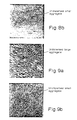
- the micrograph (a) clearly shows lumps of undispersed filler aggregates whilst in (b) the number of undispersed aggregates is considerably reduced.
- the tensile strength of the SAPA containing mix is ca. 20% greater than its non-SAPA containing comparison. (Formulation: Nr100, FEF Black 50, Aromatic Oil 5, Flectol H 2, CBS 0.5, Suphur 2)
- SAPA as a filler wetting agent in SBR (an example of a non-strain crystallisable rubber)
- SAPA has demonstrated multiple functions when used as a rubber compounding additive in various rubbers. In all the classes of rubber examined it functioned as an excellent processing aid or flow additive at low proportions (ca. 0.5 - 2.0 phr). With certain rubbers such as NR, and N/SBR blends in both unfilled and filler reinforced compounds it increases Mooney viscosity and hence green strength; in other rubbers such as SBR, CR and NBR it functions as a flow additive only and does not increase the green strength. SAPA is universal in its effect as a processing flow additive with all common rubbers; it also provides excellent roll release and mould release properties.
- SAPA physical properties of vulcanisates of non-polar rubbers such as NR, NR/SBR blends are all increased by the inclusion of SAPA with increases typically between 15-30% of the control mixes based on conventional oils or other flow additives. SAPA is observed to be particulary effective when used in precipitated silica reinforced SBR rubber (see Table 3) where it outperforms Tea.
- SAPA also can function as a cure rate promoter; rubber mixes based on the conventional organic accelerator/zinc oxide/stearic and acceleration system can be further accelerated by the inclusion of 0.5 - 2.0 phr of SAPA in the formulation enabling if desired, the proportion of organic accelerator to be reduced.
- the SAPA will function as an accelerator system in its own right enabling fast curing formulations to be obtained without the presence of any organic acclerator (e.g. CBS/zinc oxide/stearic acid combination (Table 8). Delayed action curing of SAPA mixes (i.e. longer scorch times) can be obtained by using combinations of SAPA with zinc oxide e.g. 2p of SAPA + 0.5 p ZnO (Table 9).
- the process of the invention enables the cationic surfactant to perform a multipurpose role by combining the functions of internal processing aid and mould release agent, accelerator, and, filler-rubber coupling/wetting agent properties which enhance the strength of rubber vulcanisates.
Landscapes
- Chemical & Material Sciences (AREA)
- Health & Medical Sciences (AREA)
- Chemical Kinetics & Catalysis (AREA)
- Medicinal Chemistry (AREA)
- Polymers & Plastics (AREA)
- Organic Chemistry (AREA)
- Compositions Of Macromolecular Compounds (AREA)
- Processes Of Treating Macromolecular Substances (AREA)
Claims (20)
- Verfahren zur Behandlung von Kautschuk, bei dem der Kautschuk mit einem kationischen Netzmittel gemischt wird und die Mischung vulkanisiert wird, wobei das kationische Netzmittel ein Imidazolin aufweist, das nur zwei Stickstoffatome im Molekül besitzt, oder ein Carboxylatsalz eines N-Alkyl-alkylendiamins, wobei die Mischung wahlweise einen herkömmlichen organischen Vulkanisationsbeschleuniger enthält und wahlweise ein herkömmliches Vulkanisatïonsaktivierungssystem, dadurch gekennzeichnet, daß die Menge des kationischen Netzmittels (gegebenenfalls) größer ist oder gleich der Menge des herkömmlichen organischen Vulkanisationsbeschleunigers.
- Verfahren nach Anspruch 1, dadurch gekennzeichnet, daß das kationische Netzmittel 1(2-Hydroxyethyl)-2-heptadecenylimidazolin oder 1-Hydroxyethyl-2-oleylimidazolin ist.
- Verfahren nach Anspruch 1, dadurch gekennzeichnet, daß das kationische Netzmittel ein Carboxylatsalz eines Alkyl-alkylendiamins ist und dem Kautschuk in Verbindung mit einem Metalloxid als Vulkanisationsverzögerer zugegeben wird.
- Verfahren nach Anspruch 3, dadurch gekennzeichnet, daß das Metalloxid Zinkoxid oder Bleioxid ist.
- Verfahren nach einem der Ansprüche 1, 3 und 4, dadurch gekennzeichnet, daß das kationische Netzmittel ein Carboxylatsalz ist mit der allgemeinen Formel:
[R(NH₂)(CH₂)₃NH₃]²⁺ . 2 R₁COO⁻
wobei R und R₁ langkettige Alkylgruppen sind. - Verfahren nach Anspruch 5, dadurch gekennzeichnet, daß R₁COO⁻ Stearat, Laurat, Palmitat, Oleat, das Anion von Sojasäure oder das Anion von hydrierter Talgsäure ist.
- Verfahren nach einem der Ansprüche 1, 3, 4, 5 und 6, dadurch gekennzeichnet, daß das kationische Netzmittel ein Carboxylatsalz von N-Kokos-1,3-diaminopropan; N-Talg-1,3-diaminopropan; oder N-Oleyl-1,3-diaminopropan ist.
- Verfahren nach Anspruch 7, dadurch gekennzeichnet, daß das Carboxylatsalz N-Talg-1,3-diaminopropandioleat; N-Stearin-1,3-diaminopropandistearat; oder N-Oleyl-1,3-diaminopropandioleat ist.
- Verfahren nach einem der vorhergehenden Ansprüche, dadurch gekennzeichnet, daß ein Füllstoff in dem Kautschuk enthalten ist.
- Verfahren nach einem der vorhergehenden Ansprüche, dadurch gekennzeichnet, daß der Kautschuk vulkanisiert wird durch Erhitzen in Gegenwart von Schwefel oder einer Schwefel liefernden Verbindung.
- Verfahren nach einem der vorhergehenden Ansprüche, dadurch gekennzeichnet, daß der Kautschuk ein NK oder SBK oder ein NK/SBK-Kautschuk ist.
- Verfahren nach Anspruch 11, dadurch gekennzeichnet, daß der Kautschuk ein NK/SBK-Kautschuk ist und das kationische Netzmittel in einem Anteil von 1 bis 3 phr vorhanden ist.
- Verfahren nach einem der vorhergehenden Ansprüche, dadurch gekennzeichnet, daß kein vorvulkanisationshemmstoff verwendet wird.
- Verfahren nach Anspruch 11 in Abhängigkeit von Anspruch 9, dadurch gekennzeichnet, daß der Kautschuk ein SBK-Kautschuk ist, der mit abgeschiedenem Siliziumdioxid verstärkt ist.
- Verfahren nach einem der vorhergehenden Ansprüche, dadurch gekennzeichnet, daß die Mischung bei 50°C ± 5°C verarbeitet wird.
- Verfahren nach einem der vorhergehenden Ansprüche, dadurch gekennzeichnet, daß die Mischung bei 150°C vulkanisiert wird.
- Verfahren nach einem der vorhergehenden Ansprüche, dadurch gekennzeichnet, daß das kationische Netzmittel der einzige Vulkanisationsaktivator und/oder vulkanisationsbeschleuniger in dieser Mischung ist.
- Eine Kautschukbahn, die mit einem Verfahren gemäß den vorhergehenden Ansprüchen hergestellt wird.
- Ein Kautschukformteil, das mit einem Verfahren nach einem der Ansprüche 1 bis 17 hergestellt wird.
- Ein Kautschukformteil nach Anspruch 19, welches ein Reifen ist.
Priority Applications (1)
| Application Number | Priority Date | Filing Date | Title |
|---|---|---|---|
| AT84902036T ATE66011T1 (de) | 1983-05-16 | 1984-05-16 | Verfahren zur behandlung von kautschuk. |
Applications Claiming Priority (2)
| Application Number | Priority Date | Filing Date | Title |
|---|---|---|---|
| GB838313398A GB8313398D0 (en) | 1983-05-16 | 1983-05-16 | Surface active plasticiser |
| GB8313398 | 1983-05-16 |
Publications (2)
| Publication Number | Publication Date |
|---|---|
| EP0146579A1 EP0146579A1 (de) | 1985-07-03 |
| EP0146579B1 true EP0146579B1 (de) | 1991-08-07 |
Family
ID=10542798
Family Applications (1)
| Application Number | Title | Priority Date | Filing Date |
|---|---|---|---|
| EP84902036A Expired - Lifetime EP0146579B1 (de) | 1983-05-16 | 1984-05-16 | Verfahren zur behandlung von kautschuk |
Country Status (4)
| Country | Link |
|---|---|
| EP (1) | EP0146579B1 (de) |
| DE (1) | DE3484894D1 (de) |
| GB (1) | GB8313398D0 (de) |
| WO (1) | WO1984004530A1 (de) |
Families Citing this family (7)
| Publication number | Priority date | Publication date | Assignee | Title |
|---|---|---|---|---|
| DE3788903T2 (de) * | 1986-07-01 | 1994-07-28 | Bridgestone Corp | Kautschukmischung. |
| MY102412A (en) * | 1986-12-11 | 1992-06-17 | Nitto Electric Ind Co | Mold cleaning composition, sheet for cleaning mold, and method for cleaning mold using said cleaning sheet. |
| MY101701A (en) * | 1986-12-23 | 1991-12-31 | Nitto Electric Ind Co | Mold-releasing sheet and method for applying mold- releasing agent onto mold surface using said sheet. |
| EP1081187B1 (de) * | 1999-08-27 | 2004-02-18 | Bridgestone Corporation | Kautschukzusammensetzung die Siliziumdioxid oder Silikat und ein Aminsalz enthält |
| JP2005523967A (ja) * | 2002-04-23 | 2005-08-11 | ピレリ・プネウマティチ・ソチエタ・ペル・アツィオーニ | 高度の耐磨耗性を有するタイヤ、タイヤに使用されるトレッドバンドおよびエラストマー組成物 |
| IT1404243B1 (it) | 2011-01-21 | 2013-11-15 | Soremartec Sa | Procedimento per il confezionamento di un prodotto in un involucro ermetico di materiale in foglio |
| CN115667410A (zh) * | 2020-06-08 | 2023-01-31 | 哈利玛化成株式会社 | 轮胎用橡胶改性剂和轮胎用橡胶组合物 |
Family Cites Families (5)
| Publication number | Priority date | Publication date | Assignee | Title |
|---|---|---|---|---|
| BE632355A (de) * | 1962-05-17 | 1900-01-01 | ||
| US3369004A (en) * | 1965-11-12 | 1968-02-13 | Nalco Chemical Co | Vulcanization process |
| US3502612A (en) * | 1967-05-29 | 1970-03-24 | Universal Oil Prod Co | Rubber stabilized with mixtures of a phenylene diamine and a different amine compound |
| US4281085A (en) * | 1978-05-12 | 1981-07-28 | Japan Synthetic Rubber Company, Ltd. | Rubber compound capable of giving a vulcanized rubber having a high modulus of elasticity |
| FR2513645A1 (fr) * | 1981-09-30 | 1983-04-01 | Rhone Poulenc Chim Base | Nouvel additif applicable au renforcement des polymeres et notamment des elastomeres avec les charges minerales |
-
1983
- 1983-05-16 GB GB838313398A patent/GB8313398D0/en active Pending
-
1984
- 1984-05-16 DE DE8484902036T patent/DE3484894D1/de not_active Expired - Lifetime
- 1984-05-16 EP EP84902036A patent/EP0146579B1/de not_active Expired - Lifetime
- 1984-05-16 WO PCT/GB1984/000168 patent/WO1984004530A1/en not_active Ceased
Non-Patent Citations (1)
| Title |
|---|
| CHEMICAL ABSTRACTS, vol. 73, no. 26, 28 Dec 1970, Columbus, OH (US); V.I.LUZAN et al.: "Vulcanization of natural rubber in the presence of ethylenediamine and its derivatives", p. 34, no. 131774k * |
Also Published As
| Publication number | Publication date |
|---|---|
| WO1984004530A1 (en) | 1984-11-22 |
| DE3484894D1 (de) | 1991-09-12 |
| GB8313398D0 (en) | 1983-06-22 |
| EP0146579A1 (de) | 1985-07-03 |
Similar Documents
| Publication | Publication Date | Title |
|---|---|---|
| US4659754A (en) | Dispersions of fibres in rubber | |
| EP0231731B1 (de) | Kautschukmischungen | |
| EP3385316B1 (de) | Kautschukzusammensetzung und reifen mit lauffläche mit oxidiertem russ | |
| US4410656A (en) | Method for rubber treatment | |
| US4499243A (en) | Method of treating diene rubber with amino- and hydroxy aryl compounds | |
| US3923712A (en) | Metal oxide paste dispersions and use as curing agents | |
| EP0146579B1 (de) | Verfahren zur behandlung von kautschuk | |
| EP0469778B1 (de) | Methode und Zusammensetzung zur Verbesserung der Verarbeitbarkeit von Kautschuk und Kunststoffen | |
| US4434266A (en) | Method for rubber treatment and the rubber thus treated | |
| Hayichelaeh et al. | Utilization of palm oil as an alternative processing oil in carbon black-filled natural rubber compounds | |
| US4157320A (en) | Rubber processing aid | |
| CA1152448A (en) | Process for vulcanizing in the ultrahigh-frequency field a rubber composition containing the usual vulcanizing agents and additives | |
| EP3385092B1 (de) | Kautschukzusammensetzung und reifen mit lauffläche mit oxidiertem russ | |
| JP4227420B2 (ja) | ゴム組成物及びそれを用いた航空機用またはリニアモーターカー用の空気入りラジアルタイヤ | |
| US4150014A (en) | Vulcanizates containing siliceous fillers | |
| WO2023013779A1 (ja) | タイヤ用ゴム組成物及びタイヤ | |
| JP4944330B2 (ja) | ゴム配合物およびその製造法 | |
| CA1257317A (en) | Bushing | |
| US20180327573A1 (en) | Rubber with silica and triethanolamine and tire with component | |
| JP7296414B2 (ja) | 防振ゴム組成物および防振ゴム | |
| US2582829A (en) | Production of rubber products | |
| KR100332684B1 (ko) | 활성아연화를 적용한 타이어용 고무조성물 | |
| KR20010114036A (ko) | 실리카용 분산제를 적용한 타이어용 실리카 고무조성물 | |
| Dasgupta et al. | Improved polymer–filler interaction with an ecofriendly processing aid. Part 1 | |
| KR102458481B1 (ko) | 판상형 마그네슘 실리케이트 함유 타이어 트레드용 고무 조성물 및 이를 이용한 타이어 |
Legal Events
| Date | Code | Title | Description |
|---|---|---|---|
| PUAI | Public reference made under article 153(3) epc to a published international application that has entered the european phase |
Free format text: ORIGINAL CODE: 0009012 |
|
| AK | Designated contracting states |
Designated state(s): AT BE DE FR GB LU NL SE |
|
| 17P | Request for examination filed |
Effective date: 19850425 |
|
| RAP1 | Party data changed (applicant data changed or rights of an application transferred) |
Owner name: LOUGHBOROUGH CONSULTANTS LIMITED |
|
| RIN1 | Information on inventor provided before grant (corrected) |
Inventor name: HEPBURN, CLAUDE |
|
| 17Q | First examination report despatched |
Effective date: 19861124 |
|
| GRAA | (expected) grant |
Free format text: ORIGINAL CODE: 0009210 |
|
| AK | Designated contracting states |
Kind code of ref document: B1 Designated state(s): AT BE DE FR GB LU NL SE |
|
| REF | Corresponds to: |
Ref document number: 66011 Country of ref document: AT Date of ref document: 19910815 Kind code of ref document: T |
|
| REF | Corresponds to: |
Ref document number: 3484894 Country of ref document: DE Date of ref document: 19910912 |
|
| ET | Fr: translation filed | ||
| PLBE | No opposition filed within time limit |
Free format text: ORIGINAL CODE: 0009261 |
|
| STAA | Information on the status of an ep patent application or granted ep patent |
Free format text: STATUS: NO OPPOSITION FILED WITHIN TIME LIMIT |
|
| 26N | No opposition filed | ||
| EPTA | Lu: last paid annual fee | ||
| REG | Reference to a national code |
Ref country code: GB Ref legal event code: 732E |
|
| EAL | Se: european patent in force in sweden |
Ref document number: 84902036.7 |
|
| REG | Reference to a national code |
Ref country code: FR Ref legal event code: TP |
|
| NLS | Nl: assignments of ep-patents |
Owner name: BRITISH TECHNOLOGY GROUP LTD. TE LONDEN, GROOT-BRI |
|
| PGFP | Annual fee paid to national office [announced via postgrant information from national office to epo] |
Ref country code: LU Payment date: 19960401 Year of fee payment: 13 |
|
| PGFP | Annual fee paid to national office [announced via postgrant information from national office to epo] |
Ref country code: SE Payment date: 19960410 Year of fee payment: 13 |
|
| PGFP | Annual fee paid to national office [announced via postgrant information from national office to epo] |
Ref country code: FR Payment date: 19960416 Year of fee payment: 13 |
|
| PGFP | Annual fee paid to national office [announced via postgrant information from national office to epo] |
Ref country code: GB Payment date: 19960426 Year of fee payment: 13 |
|
| PGFP | Annual fee paid to national office [announced via postgrant information from national office to epo] |
Ref country code: AT Payment date: 19960528 Year of fee payment: 13 |
|
| PGFP | Annual fee paid to national office [announced via postgrant information from national office to epo] |
Ref country code: NL Payment date: 19960531 Year of fee payment: 13 Ref country code: BE Payment date: 19960531 Year of fee payment: 13 |
|
| PGFP | Annual fee paid to national office [announced via postgrant information from national office to epo] |
Ref country code: DE Payment date: 19960731 Year of fee payment: 13 |
|
| PG25 | Lapsed in a contracting state [announced via postgrant information from national office to epo] |
Ref country code: LU Free format text: LAPSE BECAUSE OF NON-PAYMENT OF DUE FEES Effective date: 19970516 Ref country code: GB Effective date: 19970516 Ref country code: AT Effective date: 19970516 |
|
| PG25 | Lapsed in a contracting state [announced via postgrant information from national office to epo] |
Ref country code: SE Effective date: 19970517 |
|
| PG25 | Lapsed in a contracting state [announced via postgrant information from national office to epo] |
Ref country code: BE Effective date: 19970531 |
|
| BERE | Be: lapsed |
Owner name: BRITISH TECHNOLOGY GROUP LTD Effective date: 19970531 |
|
| PG25 | Lapsed in a contracting state [announced via postgrant information from national office to epo] |
Ref country code: NL Effective date: 19971201 |
|
| GBPC | Gb: european patent ceased through non-payment of renewal fee |
Effective date: 19970516 |
|
| PG25 | Lapsed in a contracting state [announced via postgrant information from national office to epo] |
Ref country code: FR Free format text: LAPSE BECAUSE OF NON-PAYMENT OF DUE FEES Effective date: 19980130 |
|
| EUG | Se: european patent has lapsed |
Ref document number: 84902036.7 |
|
| NLV4 | Nl: lapsed or anulled due to non-payment of the annual fee |
Effective date: 19971201 |
|
| PG25 | Lapsed in a contracting state [announced via postgrant information from national office to epo] |
Ref country code: DE Free format text: LAPSE BECAUSE OF NON-PAYMENT OF DUE FEES Effective date: 19980203 |
|
| REG | Reference to a national code |
Ref country code: FR Ref legal event code: ST |