EP0146736B1 - Rettungsgerät mit einer gasdichten Umhüllung - Google Patents
Rettungsgerät mit einer gasdichten Umhüllung Download PDFInfo
- Publication number
- EP0146736B1 EP0146736B1 EP84113277A EP84113277A EP0146736B1 EP 0146736 B1 EP0146736 B1 EP 0146736B1 EP 84113277 A EP84113277 A EP 84113277A EP 84113277 A EP84113277 A EP 84113277A EP 0146736 B1 EP0146736 B1 EP 0146736B1
- Authority
- EP
- European Patent Office
- Prior art keywords
- life
- opening
- saving equipment
- jacket
- enclosure
- Prior art date
- Legal status (The legal status is an assumption and is not a legal conclusion. Google has not performed a legal analysis and makes no representation as to the accuracy of the status listed.)
- Expired
Links
- 239000006260 foam Substances 0.000 claims description 27
- 229920005830 Polyurethane Foam Polymers 0.000 claims description 4
- 239000011496 polyurethane foam Substances 0.000 claims description 4
- 239000011148 porous material Substances 0.000 claims description 2
- 238000012856 packing Methods 0.000 description 4
- 239000002985 plastic film Substances 0.000 description 2
- 229920006255 plastic film Polymers 0.000 description 2
- 238000005452 bending Methods 0.000 description 1
- 230000000694 effects Effects 0.000 description 1
- 239000000463 material Substances 0.000 description 1
- 238000000034 method Methods 0.000 description 1
- 238000004806 packaging method and process Methods 0.000 description 1
- 230000001681 protective effect Effects 0.000 description 1
- 239000007787 solid Substances 0.000 description 1
- 125000006850 spacer group Chemical group 0.000 description 1
Images

Classifications
-
- B—PERFORMING OPERATIONS; TRANSPORTING
- B63—SHIPS OR OTHER WATERBORNE VESSELS; RELATED EQUIPMENT
- B63C—LAUNCHING, HAULING-OUT, OR DRY-DOCKING OF VESSELS; LIFE-SAVING IN WATER; EQUIPMENT FOR DWELLING OR WORKING UNDER WATER; MEANS FOR SALVAGING OR SEARCHING FOR UNDERWATER OBJECTS
- B63C9/00—Life-saving in water
- B63C9/22—Devices for holding or launching life-buoys, inflatable life-rafts, or other floatable life-saving equipment
Definitions
- the invention relates to a rescue device, which is arranged in a gas-tight, flexible, under vacuum envelope.
- Rescue tools are often kept in a gas-tight, flexible envelope that is under vacuum because they take up so much less space.
- the rescue device such as a parachute or an inflatable rescue device such as a life jacket, a life raft, a lifeboat or the like is compressed into a solid and very compact package by the external pressure on the casing.
- the volume of the packaged rescue device can be reduced to a third of the volume that would be achieved without vacuum when packing carefully.
- the advantage of fixed packaging is that individual packing layers, that is to say individual layers of the folded rescue device, cannot move relative to one another; the vacuum-packed package is rather very dimensionally stable.
- inflatable rescue equipment such as life jackets, life rafts, lifeboats and the like, are normally stored together with a compressed gas surface, so that they can be inflated quickly if necessary by actuating the valve of the compressed gas bottle.
- the rescue device pulls a pulling element.
- the covering is torn open at a predetermined breaking point, so that the covering fills with air, the parachute takes on a looser pack and can therefore be pulled out of the covering.
- this pulling out can also take place automatically, for example when dropping loads from aircraft.
- an inflatable rescue device is to be used, the valve of the compressed gas bottle is actuated with the aid of a pulling element which can be gripped from outside the casing. When the rescue device is inflated, the envelope bursts as a result of the pressure and the rescue device is thus free.
- the wrapper is usually a relatively thin plastic film. It is therefore necessary to handle the package consisting of the rescue device and wrapping very carefully. If this package rubs against any objects or comes into contact with sharp edges, the wrapping will be damaged, so that the vacuum will disappear and you will no longer be sure that the rescue device is in perfect condition. This applies in particular since the envelope forms relatively sharp edges due to the effect of the vacuum.
- the object of the invention is to improve a device of the type mentioned in the introduction so that the casing is better protected against damage.
- the solution according to the invention consists in that the covering is surrounded by a rigid foam jacket provided with an opening, which rests on the covering in a form-fitting manner.
- the whole package is rigid in this way. Any sharp edges or the like that the package comes into contact with can at most only slightly damage the exterior of the rigid foam shell, but not the wrapping. There is also no risk of the package being damaged by rubbing the package on any objects.
- the entire package with the rescue device and wrapping also has a correspondingly greater inherent stability, so that damage to the rescue device or wrapping due to the package bending during transport or storage can be avoided. In this way, it is only possible to apply the principle of the vacuum-wrapped envelope to larger life rafts and the like.
- the rigid foam jacket is provided with an opening, the condition of the covering and thus the vacuum can be checked through this opening at any time.
- the rescue device is in particular a vacuum-packed protective umbrella, it can be pulled out without any problems as if from a previously known covering, if the covering and / or the hard foam jacket are provided with one or more predetermined breaking points near the opening and if a pulling element for pulling out the Rescue device with simultaneous opening of the casing and / or rigid foam jacket is arranged in the region of the opening.
- the rescue device can be pulled out of the package in exactly the same way as is the case with previously known vacuum-packed rescue devices. There is therefore no need to adapt to the rescue device according to the invention or to get used to or retrain operating or user personnel.
- the rigid foam jacket usually consists of a very easily breaking material, so that special predetermined breaking points in the hard foam jacket are often not necessary at all.
- the opening in the rigid foam jacket could also be made so large that the parachute can be pulled out without destroying the rigid foam jacket.
- the valve for inflating the rescue device to be opened from outside the casing is provided that a pulling element for valve actuation of the pressurized gas bottle in the area the opening is arranged, the valve can be actuated particularly easily; it is then not necessary to tear off or destroy part of the hard foam jacket. If the rescue device is inflated after the valve has been actuated, the resulting excess pressure not only destroys the relatively thin covering, but also blows open the hard foam jacket, so that the rescue device is released.
- the wrapping or the question of whether it is still under vacuum can be determined on a more or less flat surface of the wrapping through this opening, where the question of It is better to check for leaks than at a point where the casing is enclosed by a handle.
- a moisture indicator can be seen, which is arranged within the inner envelope. If moisture is displayed here, it is immediately apparent that the vacuum no longer exists.
- the rigid foam jacket can consist of a polyurethane foam.
- An open-pore and semi-hard polyurethane foam has proven to be particularly advantageous, which is mixed from two components and reacts within about 90 seconds and fully cures within three minutes.
- An essential merit of the invention is to have found a casing in the form of the rigid foam casing which, on the one hand, reliably protects the contents and, on the other hand, flakes off when the rescue device is inflated. Until now it was believed that these demands could not be met at the same time.
- a thicker wrapping film could improve the protection of the content; it would then be uncertain whether this wrapping film actually bursts open in the desired way. So far, one was forced to keep the package with the wrapping film in a very elaborate padded bag for safe storage, which also had to be opened when the device was activated. In addition to the corresponding costs and the additional opening forces required for the pannier, there is also the problem that the damage to the thin wrapping film cannot be reliably prevented in this way either.
- the life raft 1 is connected in the folded state to a compressed gas bottle 2 via a valve 3, which can be opened by actuating a handle 4, so that the life raft 1 is inflated.
- Life raft and compressed gas bottle are in an envelope 5, e.g. a thin largely special gas-impermeable plastic film that is evacuated and therefore tightly encloses the life raft 1 and the compressed gas bottle 2.
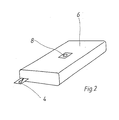
- the flexible covering 5 is in turn surrounded by a rigid foam jacket 6 in a form-fitting manner. This rigid foam jacket has an opening at 7, from which a part of the casing 5 with the handle 4 for the valve 3 of the compressed gas bottle 2 protrudes.
- the hard foam jacket 6 has a further opening 8, through which the casing 5 can be checked by touching whether the casing is still under vacuum.
- a moisture meter can be attached there within the envelope, which indicates if moisture has entered the envelope 5 and the latter is therefore no longer under vacuum.
- the arrangement of FIG. 1 can be produced by placing the entire arrangement on spacers 9, e.g. can consist of foam, is placed in a mold and then the space between the wall of the mold and the envelope 5 is foamed. After the foam has hardened, the assembly can then be removed from the mold and used.
- spacers 9 e.g. can consist of foam
Landscapes
- Engineering & Computer Science (AREA)
- Mechanical Engineering (AREA)
- Ocean & Marine Engineering (AREA)
- Packages (AREA)
- Buffer Packaging (AREA)
- Emergency Lowering Means (AREA)
Description
- Die Erfindung betrifft ein Rettungsgerät, das in einer gasdichten, flexiblen, unter Vakuum stehenden Umhüllung angeordnet ist.
- Rettungsgeräte werden häufig in einer gasdichten, flexiblen Umhüllung, die unter Vakuum steht, aufbewahrt, da sie so viel weniger Platz benötigen. Durch das Vakuum wird das Rettungsgerät wie zum Beispiel ein Fallschirm oder ein aufblasbares Rettungsgerät wie eine Schwimmweste, eine Rettungsinsel, ein Rettungsboot oder dergleichen durch den auf der Umhüllung lastenden Aussendruck zu einem festen und sehr kompakten Paket zusammengedrückt. Dabei kann das Volumen des verpackten Rettungsgerätes bis auf ein Drittel desjenigen Volumens verringert werden, das bei sorgfältigem Einpacken ohne Vakuum zu erreichen wäre. Ausserdem besteht der Vorteil der festen Verpackung darin, dass sich einzelne Packlagen, das heisst einzelne Schichten des zusammengefalteten Rettungsgerätes nicht relativ zueinander verschieben können; das vakuumverpackte Paket ist vielmehr sehr formstabil.
- Andererseits werden aufblasbare Rettungsgeräte, wie zum Beispiel Schwimmwesten, Rettungsinseln, Rettungsboote und dergleichen normalerweise mit einer Druckgasflache zusammen aufbewahrt, so dass sie im Bedarfsfalle durch Betätigung des Ventils der Druckgasflasche schnell aufgeblasen werden können. Selbstverständlich ist es dabei erforderlich, in regelmässigen Abständen zu prüfen, ob die Anordnung noch intakt ist. So müsste einmal gerpüft werden, ob nicht Druck aus der Druckgasflasche entwichen ist. Andererseits müsste geprüft werden, ob das Rettungsgerät nicht möglicherweise durch äussere Beschädigung ein Leck aufweist.
- Um das Packvolumen zu reduzieren, eine stabile Packlage zu erzielen und umständliche, regelmässige Prüfvorgänge zu vermeiden, ist es bekannt, das Rettungsgerät mit der Druckgasflasche mit einer unter Vakuum stehenden Umhüllung zu versehen und aufzubewahren (DE-PS 3 036 796). Solange wie diese Umhüllung noch unter Vakuum steht, kann man sicher sein, dass das Rettungsgerät nicht beschädigt ist und auch die Druckgasflasche noch Gas enthält. Ist nämlich das Rettungsgerät durch einen äusseren spitzen Gegenstand beschädigt worden, so ist die Umhüllung genauso beschädigt, so dass sie ihr Vakuum verliert. Entweicht andererseits Druckgas aus der Druckgasflasche, so kann in der Umhüllung kein Vakuum mehr vorhanden sein. Die Abwesenheit des Vakuums kann aber leicht dadurch festgestellt werden, dass die Umhüllung das Rettungsgerät nicht mehr eng umschliesst, sondern das Paket weich wird und je nach Umfang des Lecks früher oder später die Umhüllung lose von demselben herabhängt.
- Soll das Rettungsgerät benutzt werden, so zieht man an einem Zugelement. Im Falle des Fallschirms wird dadurch die Umhüllung an einer Sollbruchstelle aufgerissen, so dass sich die Umhüllung mit Luft füllt, der Fallschirm eine lockerere Packung annimmt und daher aus der Umhüllung herausgezogen werden kann. Selbstverständlich kann dieses Herausziehen zum Beispiel beim Abwerfen von Lasten aus Flugzeugen auch automatisch erfolgen. Soll ein aufblasbares Rettungsgerät benutzt werden, so betätigt man das Ventil der Druckgasflasche mit Hilfe eines Zugelementes, das von ausserhalb der Umhüllung ergriffen werden kann. Wenn das Rettungsgerät aufgeblasen wird, platzt dabei infolge des Drucks die Umhüllung und gilt so das Rettungsgerät frei.
- Die Umhüllung ist normalerweise eine verhältnismässig dünne Kunststoffolie. Es ist daher ein sehr sorgfältiger Umgang des aus Rettungsgerät und Umhüllung bestehenden Pakets notwendig. Scheuert dieses Paket gegen irgendwelche Gegenstände oder kommt es mit scharfen Kanten in Berührung, so wird die Umhüllung beschädigt, so dass das Vakuum verschwindet und man nicht mehr sicher ist, ob das Rettungsgerät im einwandfreien Zustand ist. Dies gilt insbesondere, da die Umhüllung aufgrund der Wirkung des Vakuums verhältnismässig scharfe Kanten bildet.
- Die Aufgabe der Erfindung besteht darin, ein Gerät der eingangs genannten Art so zu verbessern, dass die Umhüllung besser gegen Beschädigung geschützt ist.
- Die erfindungsgemässe Lösung besteht darin, dass die Umhüllung von einem mit einer Öffnung versehenen Hartschaummantel umgeben ist, der an der Umhüllung formschlüssig anliegt.
- Das ganze Paket hat auf diese Weise eine starre Form. Irgendwelche scharfen Kanten od. dergleichen, an die das Paket stösst, können höchstens das Äussere des Hartschaummantels leicht beschädigen, nicht aber die Umhüllung. Es besteht auch nicht die Gefahr, dass die Umhüllung durch Scheuern des Pakets an irgendwelchen Gegenständen beschädigt wird.
- Das gesamte Paket mit Rettungsgerät und Umhüllung hat, wenn der Hartschaummantel genügend stabil ist, auch eine entsprechend grössere Eigenstabilität, so dass Beschädigungen von Rettungsgerät oder Umhüllung aufgrund von Durchbiegen des Pakets bei Transport oder Lagerung vermieden werden können. Auf diese Weise wird es erst möglich, das Prinzip der unter Vakuum stehenden Umhüllung auch bei grösseren Rettungsinseln und dergleichen anzuwenden.
- Da der Hartschaummantel mit einer Öffnung versehen ist, kann durch diese Öffnung jederzeit der Zustand der Umhüllung und damit des Vakuums geprüft weerden.
- Ist das Rettungsgerät insbesondere ein vakuumverpackter Fa!ischirm, so kann dieser vöiiig problemlos wie aus einer vorbekannten Umhüllung herausgezogen werden, wenn die Umhüllung und/oder der Hartschaummantel in der Nähe der Öffnung mit einer oder mehreren Sollbruchstellen versehen sind und wenn ein Zugelement zum Herausziehen des Rettungsgeräts bei gleichzeitigem Öffnen von Umhüllung und/oder Hartschaummantel im Bereich der Öffnung angeordnet ist. Das Rettungsgerät kann so auf die genau gleiche Weise aus dem Paket herausgezogen werden, wie dies bei vorbekannten vakuumverpackten Rettungsgeräten der Fall ist. Es ist also keine Anpassung an das erfindungsgemässe Rettungsgerät oder keine Umgewöhnung oder Umschulung von Bedienungs- oder Benutzungspersonal notwendig. Der Hartschaummantel besteht dabei normaierweise aus einem sehr leicht aufbrechenden Material, so dass besondere Sollbruchstellen im Hartschaummantel häufig gar nicht erforderlich sind. Andererseits könnte aber auch die Öffnung im Hartschaummantel so gross gemacht werden, dass hier der Fallschirm problemlos ohne Zerstörung des Hartschaummantels herausgezogen werden kann.
- Ist bei einem aufblasbaren Rettungsgerät wie Schwimmweste, Rettungsinsel, Rettungsboot oder dergleichen, das zusammen mit einer Druckgasflasche in der Umhüllung angeordnet ist, deren Ventil zum Aufblasen des Rettungsgeräts von ausserhalb der Umhüllung zu öffnen ist, vorgesehen, dass ein Zugelement zur Ventilbetätigung der Druckgasflasche im Bereich der Öffnung angeordnet ist, kann das Ventil besonders leicht betätigt werden; es muss dann nicht erst ein Teil des Hartschaummantels abgerissen oder zerstört werden. Wenn nach der Ventilbetätigung das Rettungsgerät aufgeblasen wird, so wird durch den entstehenden Überdruck nicht nur die verhältnismässig dünne Umhüllung zerstört, sondern auch der Hartschaummantel aufgesprengt, so dass das Rettungsgerät frei wird.
- Wenn ein Teil der Umhüllung mit der Handhabe zur Ventilbetätigung aus dem Hartschaummantel herausragt, kann an diesem Teil der Umhüllung geprüft werden, ob die Umhüllung noch unter Vakuum steht.
- Ist aber eine weitere Öffnung im Hartschaummantel zum Prüfen der Umhüllung der Anordnung vorgesehen, so kann durch diese Öffnung die Umhüllung bzw. die Frage, ob sie noch unter Vakuum steht, an einer mehr oder weniger ebenen Fläche der Umhüllung festgestellt werden, wo die Frage der Dichtheit besser zu prüfen ist als an einer Stelle, an der die Umhüllung von einer Handhabe umschlossen ist. Durch diese Öffnung kann auch z.B. eine Feuchtigkeitsanzeige sichtbar sein, die innerhalb der inneren Umhüllung angeordnet ist. Wird hier Feuchtigkeit angezeigt, so ist sofort ersichtlich, dass das Vakuum nicht mehr besteht.
- Der Hartschaummantel kann aus einem Polyurethanschaum bestehen.
- Als besonders vorteilhaft hat sich ein offenporiger und halbharter Polyurethanschaum erwiesen, der aus zwei Komponenten gemischt wird und innerhalb von etwa 90 Sekunden reagiert und innerhalb von drei Minuten voll aushärtet.
- Ein wesentliches Verdienst der Erfindung ist es, in Form des Hartschaummantels eine Ummantelung gefunden zu haben, die einerseits den Inhalt sicher schützt, andererseits beim Aufblasen des Rettungsgeräts von selbst abplatzt. Bisher war man der Ansicht, diese Forderungen könnten nicht gleichzeitig erfüllt werden.
- Man könnte zwar durch eine dickere Umhüllungsfolie den Schutz des Inhalts verbessern; es wäre dann aber unsicher, ob diese Umhüllungsfolie auch tatsächlich in gewünschter Weise aufplatzt. Bisher war man daher gezwungen, zur sicheren Aufbewahrung das Paket mit der Umhüllungsfolie in einer sehr aufwendigen abgepolsterten Tasche aufzubewahren, die beim Aktivieren des Gerätes ebenfalls aufgesprengt werden musste. Neben den entsprechenden Kosten und den zusätzlich erforderlichen Öffnungskräften für die Packtasche tritt auch noch das Problem auf, dass auch auf diese Weise die Beschädigung der dünnen Umhüllungsfolie nicht sicher verhindert werden kann.
- Die Erfindung wird im folgenden anhand einer vorteilhaften Ausführungsform beispielsweise unter Bezugnahme auf die beigefügten Zeichnungen beschrieben. Es zeigen:
- Fig. 1 in schematischer Darstellung im Querschnitt ein erfindungsgemässes Rettungsgerät mit Umhüllung und Hartschaummantel, und
- Fig. 2 eine perspektivische Ansicht des Geräts der Fig. 1.
- Wie aus Fig. 1 ersichtlich ist, ist die Rettungsinsel 1 in zusammengefaltetem Zustand mit einer Druckgasflasche 2 über ein Ventil 3 verbunden, das durch Betätigung einer Handhabe 4 geöffnet werden kann, so dass die Rettungsinsel 1 aufgeblasen wird. Rettungsinsel und Druckgasflasche befinden sich in einer Umhüllung 5, z.B. einer dünnen weitgehend speziell gasundurchlässigen Kunststoffolie, die evakuiert ist und daher die Rettungsinsel 1 und die Druckgasflasche 2 eng umschliesst. Die flexible Umhüllung 5 wiederum wird von einem Hartschaummantel 6 formschlüssig umgeben. Dieser Hartschaummantel weist bei 7 eine Öffnung auf, aus der ein Teil der Umhüllung 5 mit der Handhabe 4 für das Ventil 3 der Druckgasflasche 2 herausragt. Ausserdem weist der Hartschaummantel 6 eine weitere Öffnung 8 auf, durch die durch Betasten der Umhüllung 5 geprüft werden kann, ob die Umhüllung noch unter Vakuum steht. Ausserdem kann dort innerhalb der Umhüllung ein Feuchtigkeitsmesser angebracht sein, der anzeigt, falls Feuchtigkeit in die Umhüllung 5 eingedrungen ist und diese daher nicht mehr unter Vakuum steht.
- Die Anordnung der Fig. 1 kann dadurch hergestellt werden, dass nach Anbringen der evakuierten Umhüllung 5 die ganze Anordnung auf Abstandshalter 9, die z.B. aus Schaumstoff bestehen können, in eine Form gestellt wird und anschliessend der Raum zwischen Wand der Form und Umhüllung 5 ausgeschäumt wird. Nach dem Erhärten des Schaums kann die Anordnung dann aus der Form entfernt und verwendet werden.
Claims (6)
Applications Claiming Priority (2)
| Application Number | Priority Date | Filing Date | Title |
|---|---|---|---|
| DE3341163A DE3341163C1 (de) | 1983-11-14 | 1983-11-14 | Rettungsgeraet mit einer gasdichten Umhuellung |
| DE3341163 | 1983-11-14 |
Publications (2)
| Publication Number | Publication Date |
|---|---|
| EP0146736A1 EP0146736A1 (de) | 1985-07-03 |
| EP0146736B1 true EP0146736B1 (de) | 1987-04-01 |
Family
ID=6214293
Family Applications (1)
| Application Number | Title | Priority Date | Filing Date |
|---|---|---|---|
| EP84113277A Expired EP0146736B1 (de) | 1983-11-14 | 1984-11-05 | Rettungsgerät mit einer gasdichten Umhüllung |
Country Status (5)
| Country | Link |
|---|---|
| US (1) | US4666413A (de) |
| EP (1) | EP0146736B1 (de) |
| DD (1) | DD229934A5 (de) |
| DE (1) | DE3341163C1 (de) |
| DK (1) | DK154624C (de) |
Families Citing this family (13)
| Publication number | Priority date | Publication date | Assignee | Title |
|---|---|---|---|---|
| FR2617690B1 (fr) * | 1987-07-09 | 1989-11-24 | Aerazur Efa | Procede et trousse de conditionnement pour vetement isothermique a volume apparent important |
| SE463145B (sv) * | 1989-08-22 | 1990-10-15 | Ingf Gaveco Ab | Foerfarande och anordning foer att bibringa en flexibel foerpackning minimal volym samt foerpackning utfoerd i enlighet daermed |
| GB2318097B (en) * | 1995-07-29 | 1999-01-06 | Peter Cronin Gordon | Liferaft packaging |
| GB9515611D0 (en) * | 1995-07-29 | 1995-09-27 | Gordon Peter C | Liferaft packaging |
| US5820431A (en) * | 1996-05-30 | 1998-10-13 | Biesecker Douglas A | Deployment mechanism for pocket-sized, emergency flotation device |
| US6644596B1 (en) | 2001-12-21 | 2003-11-11 | Air Cruisers Company | Deployment system for inflatable structures |
| US6641445B1 (en) | 2002-02-15 | 2003-11-04 | Air Cruisers Company | Deployment arrangement for inflatable structures |
| US6902453B2 (en) | 2002-05-15 | 2005-06-07 | Switlik Parachute Company, Inc. | High security opening apparatus for hermetically sealed containers |
| US7047966B2 (en) * | 2004-07-06 | 2006-05-23 | Stewart Robert E | Lifesaving floatation and breathing device |
| DK200401209A (da) * | 2004-08-09 | 2006-02-10 | Viking Life Saving Equip As | Beholder til opbevaring af oppustelig redningsflåde |
| US7434600B1 (en) | 2004-12-02 | 2008-10-14 | Air Cruisers Company | Pressurized actuator system for inflatable structures |
| US7644739B1 (en) | 2004-12-02 | 2010-01-12 | Air Cruisers Company | Pressurized actuation system for inflatable structures |
| CN102358408A (zh) * | 2011-08-30 | 2012-02-22 | 上海海事大学 | 一种水上便携式应急自救腰带及其使用方法 |
Citations (1)
| Publication number | Priority date | Publication date | Assignee | Title |
|---|---|---|---|---|
| DE3036796A1 (de) * | 1980-09-30 | 1982-04-15 | Ballonfabrik See- und Luftausrüstung GmbH + Co KG, 8900 Augsburg | Vorrichtung zum ueberpruefen der unversehrtheit und einsatzfaehigkeit von in bereitschaft befindlichen rettungsgeraeten |
Family Cites Families (6)
| Publication number | Priority date | Publication date | Assignee | Title |
|---|---|---|---|---|
| US3557518A (en) * | 1968-06-05 | 1971-01-26 | Berkline Corp | Method of packaging fragile articles |
| US3584815A (en) * | 1969-06-25 | 1971-06-15 | Stencel Aero Eng Corp | Method and means for opening vacuumized parachute package |
| US3712568A (en) * | 1971-03-01 | 1973-01-23 | Budd Co | Vacuumized container for a parachute |
| US3986220A (en) * | 1975-07-07 | 1976-10-19 | Johnson Clarence S | Shark screen |
| FR2417305A1 (fr) * | 1978-02-17 | 1979-09-14 | Suas Claude | Dispositif de detresse a l'usage des naufrages ou accidentes |
| US4457730A (en) * | 1981-07-20 | 1984-07-03 | Gulf & Western Manufacturing Company | Vacuum packaged inflatable flotation device |
-
1983
- 1983-11-14 DE DE3341163A patent/DE3341163C1/de not_active Expired
-
1984
- 1984-11-05 EP EP84113277A patent/EP0146736B1/de not_active Expired
- 1984-11-12 DD DD84269347A patent/DD229934A5/de not_active IP Right Cessation
- 1984-11-13 DK DK538284A patent/DK154624C/da not_active IP Right Cessation
- 1984-11-14 US US06/671,345 patent/US4666413A/en not_active Expired - Fee Related
Patent Citations (1)
| Publication number | Priority date | Publication date | Assignee | Title |
|---|---|---|---|---|
| DE3036796A1 (de) * | 1980-09-30 | 1982-04-15 | Ballonfabrik See- und Luftausrüstung GmbH + Co KG, 8900 Augsburg | Vorrichtung zum ueberpruefen der unversehrtheit und einsatzfaehigkeit von in bereitschaft befindlichen rettungsgeraeten |
Also Published As
| Publication number | Publication date |
|---|---|
| DD229934A5 (de) | 1985-11-20 |
| EP0146736A1 (de) | 1985-07-03 |
| DK154624B (da) | 1988-12-05 |
| DK154624C (da) | 1989-05-08 |
| DE3341163C1 (de) | 1985-07-18 |
| DK538284A (da) | 1985-05-15 |
| DK538284D0 (da) | 1984-11-13 |
| US4666413A (en) | 1987-05-19 |
Similar Documents
| Publication | Publication Date | Title |
|---|---|---|
| EP0146736B1 (de) | Rettungsgerät mit einer gasdichten Umhüllung | |
| DE69623566T2 (de) | Vakuumverpackte notrutsche | |
| DE1299404B (de) | Vorrichtung zum Schutz vor Stosswellen | |
| EP0439086A1 (de) | Zusammenkuppelbares, aufblasbares Verpackungsmaterial | |
| DE102016012963A1 (de) | Verpackungsverfahren und Transportverpackung | |
| DE69408723T2 (de) | System zum stossfesten Verpacken | |
| DE4134093C2 (de) | Verfahren zur Begasung eines Gebäudeinnenraums | |
| DE7710770U1 (de) | Vorrichtung zum aufblasen des schwimmkoerpers eines rettungsgeraetes | |
| DE3607126C2 (de) | ||
| DE60213145T2 (de) | Pneumatische Schwimmvorrichtung, insbesondere Rettungsinsel, mit einer venturiachtigen Aufblasvorrichtung | |
| DE2125923C3 (de) | Vorrichtung zum Schutz von Fahrzeuginsassen bei Unfällen | |
| DE8332705U1 (de) | Rettungsgerät mit einer gasdichten Umhüllung | |
| DE4129384A1 (de) | Transportbehaelter | |
| DE4123558C1 (en) | Packaging container for impact or pressure sensitive objects - has foam cushion(s) inside air impermeable outer jacket, acting on latter with valve open | |
| DE909299C (de) | Verpackung fuer unter Vakuum aufzubewahrende Gegenstaende, insbesondere Atemschutzgeraete | |
| DE3036796C2 (de) | Vorrichtung zum Überprüfen der Unversehrtheit und Einsatzfähigkeit von in Bereitschaft befindlichen Rettungsgeräten | |
| DD155805A1 (de) | Sprungkissen fuer rettungszwecke | |
| CH658437A5 (de) | Vorrichtung zum evakuieren und verschliessen von waren, insbesondere lebensmittel enthaltenden beuteln oder huellen. | |
| DE2237104B2 (de) | Zusammenfaltbare Notausrüstung mit Verpackungssack | |
| DE69521482T2 (de) | Schnell auslegbare Ölsperre | |
| DE19635931B4 (de) | Verpackungselement und ein solches aufweisende Verpackung | |
| DD231934B1 (de) | Aufblasbares rettungsfloss, insbesondere fuer yachten | |
| DE3705167A1 (de) | Aufblasbarer folienbeutel fuer verpackungszwecke | |
| DE3240072C2 (de) | Vorrichtung zum Aufbewahren von in Bereitschaft befindlichen Rettungsgeräten, sowie Verfahren zur Herstellung derselben | |
| EP0515870B1 (de) | Luftreinigungspatrone mit einem dehnbaren Folienbeutel für die Füllung |
Legal Events
| Date | Code | Title | Description |
|---|---|---|---|
| PUAI | Public reference made under article 153(3) epc to a published international application that has entered the european phase |
Free format text: ORIGINAL CODE: 0009012 |
|
| AK | Designated contracting states |
Designated state(s): FR GB IT |
|
| ITCL | It: translation for ep claims filed |
Representative=s name: UFFICIO TECNICO ING. A. MANNUCCI |
|
| EL | Fr: translation of claims filed | ||
| 17P | Request for examination filed |
Effective date: 19851213 |
|
| 17Q | First examination report despatched |
Effective date: 19860625 |
|
| GRAA | (expected) grant |
Free format text: ORIGINAL CODE: 0009210 |
|
| AK | Designated contracting states |
Kind code of ref document: B1 Designated state(s): FR GB IT |
|
| ITF | It: translation for a ep patent filed | ||
| ET | Fr: translation filed | ||
| PLBE | No opposition filed within time limit |
Free format text: ORIGINAL CODE: 0009261 |
|
| STAA | Information on the status of an ep patent application or granted ep patent |
Free format text: STATUS: NO OPPOSITION FILED WITHIN TIME LIMIT |
|
| 26N | No opposition filed | ||
| ITTA | It: last paid annual fee | ||
| PGFP | Annual fee paid to national office [announced via postgrant information from national office to epo] |
Ref country code: GB Payment date: 19971211 Year of fee payment: 14 |
|
| PGFP | Annual fee paid to national office [announced via postgrant information from national office to epo] |
Ref country code: FR Payment date: 19971230 Year of fee payment: 14 |
|
| PG25 | Lapsed in a contracting state [announced via postgrant information from national office to epo] |
Ref country code: GB Free format text: LAPSE BECAUSE OF NON-PAYMENT OF DUE FEES Effective date: 19981105 |
|
| GBPC | Gb: european patent ceased through non-payment of renewal fee |
Effective date: 19981105 |
|
| PG25 | Lapsed in a contracting state [announced via postgrant information from national office to epo] |
Ref country code: FR Free format text: LAPSE BECAUSE OF NON-PAYMENT OF DUE FEES Effective date: 19990730 |
|
| REG | Reference to a national code |
Ref country code: FR Ref legal event code: ST |