EP0146797A1 - 2-Aminothiophenverbindungen - Google Patents
2-Aminothiophenverbindungen Download PDFInfo
- Publication number
- EP0146797A1 EP0146797A1 EP84114308A EP84114308A EP0146797A1 EP 0146797 A1 EP0146797 A1 EP 0146797A1 EP 84114308 A EP84114308 A EP 84114308A EP 84114308 A EP84114308 A EP 84114308A EP 0146797 A1 EP0146797 A1 EP 0146797A1
- Authority
- EP
- European Patent Office
- Prior art keywords
- formula
- alkyl
- aminothiophenes
- radicals
- compounds
- Prior art date
- Legal status (The legal status is an assumption and is not a legal conclusion. Google has not performed a legal analysis and makes no representation as to the accuracy of the status listed.)
- Granted
Links
- GLQWRXYOTXRDNH-UHFFFAOYSA-N thiophen-2-amine Chemical class NC1=CC=CS1 GLQWRXYOTXRDNH-UHFFFAOYSA-N 0.000 title claims abstract description 13
- 150000001875 compounds Chemical class 0.000 claims abstract description 18
- 125000000217 alkyl group Chemical group 0.000 claims abstract description 8
- 238000002360 preparation method Methods 0.000 claims abstract description 7
- 125000003342 alkenyl group Chemical group 0.000 claims abstract description 4
- 125000003710 aryl alkyl group Chemical group 0.000 claims abstract description 4
- 125000003118 aryl group Chemical group 0.000 claims abstract description 4
- 239000000987 azo dye Substances 0.000 claims abstract description 4
- 125000000753 cycloalkyl group Chemical group 0.000 claims abstract description 4
- 125000001072 heteroaryl group Chemical group 0.000 claims abstract description 4
- 125000000623 heterocyclic group Chemical group 0.000 claims abstract description 4
- 239000000543 intermediate Substances 0.000 claims abstract description 3
- NINIDFKCEFEMDL-UHFFFAOYSA-N Sulfur Chemical compound [S] NINIDFKCEFEMDL-UHFFFAOYSA-N 0.000 claims description 14
- 125000001997 phenyl group Chemical group [H]C1=C([H])C([H])=C(*)C([H])=C1[H] 0.000 claims description 14
- 238000000034 method Methods 0.000 claims description 10
- 238000006243 chemical reaction Methods 0.000 claims description 9
- 125000002496 methyl group Chemical group [H]C([H])([H])* 0.000 claims description 9
- 229910052799 carbon Inorganic materials 0.000 claims description 7
- 229910052739 hydrogen Inorganic materials 0.000 claims description 4
- 125000001424 substituent group Chemical group 0.000 claims description 4
- 125000004769 (C1-C4) alkylsulfonyl group Chemical group 0.000 claims description 3
- 125000001797 benzyl group Chemical group [H]C1=C([H])C([H])=C(C([H])=C1[H])C([H])([H])* 0.000 claims description 3
- 125000006297 carbonyl amino group Chemical group [H]N([*:2])C([*:1])=O 0.000 claims description 3
- 125000003178 carboxy group Chemical group [H]OC(*)=O 0.000 claims description 3
- 125000003373 pyrazinyl group Chemical group 0.000 claims description 3
- HIXDQWDOVZUNNA-UHFFFAOYSA-N 2-(3,4-dimethoxyphenyl)-5-hydroxy-7-methoxychromen-4-one Chemical compound C=1C(OC)=CC(O)=C(C(C=2)=O)C=1OC=2C1=CC=C(OC)C(OC)=C1 HIXDQWDOVZUNNA-UHFFFAOYSA-N 0.000 claims description 2
- 238000006000 Knoevenagel condensation reaction Methods 0.000 claims description 2
- 239000004480 active ingredient Substances 0.000 claims description 2
- 125000003277 amino group Chemical group 0.000 claims description 2
- 238000010276 construction Methods 0.000 claims description 2
- 125000004122 cyclic group Chemical group 0.000 claims description 2
- 125000000664 diazo group Chemical group [N-]=[N+]=[*] 0.000 claims description 2
- 239000000975 dye Substances 0.000 claims description 2
- RTZKZFJDLAIYFH-UHFFFAOYSA-N ether Substances CCOCC RTZKZFJDLAIYFH-UHFFFAOYSA-N 0.000 claims description 2
- 125000002887 hydroxy group Chemical group [H]O* 0.000 claims description 2
- 239000013543 active substance Substances 0.000 abstract 1
- LFQSCWFLJHTTHZ-UHFFFAOYSA-N Ethanol Chemical compound CCO LFQSCWFLJHTTHZ-UHFFFAOYSA-N 0.000 description 20
- -1 cyclic acyl radical Chemical class 0.000 description 17
- ZMANZCXQSJIPKH-UHFFFAOYSA-N Triethylamine Chemical compound CCN(CC)CC ZMANZCXQSJIPKH-UHFFFAOYSA-N 0.000 description 15
- 229910052717 sulfur Inorganic materials 0.000 description 10
- 239000011593 sulfur Substances 0.000 description 10
- 239000000203 mixture Substances 0.000 description 8
- 229930192474 thiophene Natural products 0.000 description 8
- 239000000047 product Substances 0.000 description 7
- 238000001816 cooling Methods 0.000 description 6
- 150000003577 thiophenes Chemical class 0.000 description 5
- YTPLMLYBLZKORZ-UHFFFAOYSA-N Thiophene Chemical compound C=1C=CSC=1 YTPLMLYBLZKORZ-UHFFFAOYSA-N 0.000 description 4
- 125000004178 (C1-C4) alkyl group Chemical group 0.000 description 3
- GJXFDOPCWOTFQZ-UHFFFAOYSA-N 1-(3-phenyl-1,2,4-oxadiazol-5-yl)propan-2-one Chemical compound O1C(CC(=O)C)=NC(C=2C=CC=CC=2)=N1 GJXFDOPCWOTFQZ-UHFFFAOYSA-N 0.000 description 3
- 0 C*(C)*C(N=C(C(SC1N)=C(C)C1C#N)OC)=N Chemical compound C*(C)*C(N=C(C(SC1N)=C(C)C1C#N)OC)=N 0.000 description 3
- OKKJLVBELUTLKV-UHFFFAOYSA-N Methanol Chemical compound OC OKKJLVBELUTLKV-UHFFFAOYSA-N 0.000 description 3
- LYCAIKOWRPUZTN-UHFFFAOYSA-N ethylene glycol Natural products OCCO LYCAIKOWRPUZTN-UHFFFAOYSA-N 0.000 description 3
- 150000003254 radicals Chemical class 0.000 description 3
- 239000011541 reaction mixture Substances 0.000 description 3
- 238000005406 washing Methods 0.000 description 3
- WYURNTSHIVDZCO-UHFFFAOYSA-N Tetrahydrofuran Chemical compound C1CCOC1 WYURNTSHIVDZCO-UHFFFAOYSA-N 0.000 description 2
- 150000001555 benzenes Chemical class 0.000 description 2
- 125000004432 carbon atom Chemical group C* 0.000 description 2
- BULLHNJGPPOUOX-UHFFFAOYSA-N chloroacetone Chemical compound CC(=O)CCl BULLHNJGPPOUOX-UHFFFAOYSA-N 0.000 description 2
- BADXJIPKFRBFOT-UHFFFAOYSA-N dimedone Chemical compound CC1(C)CC(=O)CC(=O)C1 BADXJIPKFRBFOT-UHFFFAOYSA-N 0.000 description 2
- 238000001035 drying Methods 0.000 description 2
- ZIUSEGSNTOUIPT-UHFFFAOYSA-N ethyl 2-cyanoacetate Chemical compound CCOC(=O)CC#N ZIUSEGSNTOUIPT-UHFFFAOYSA-N 0.000 description 2
- WGCNASOHLSPBMP-UHFFFAOYSA-N hydroxyacetaldehyde Natural products OCC=O WGCNASOHLSPBMP-UHFFFAOYSA-N 0.000 description 2
- 238000002955 isolation Methods 0.000 description 2
- CUONGYYJJVDODC-UHFFFAOYSA-N malononitrile Chemical compound N#CCC#N CUONGYYJJVDODC-UHFFFAOYSA-N 0.000 description 2
- 150000007530 organic bases Chemical class 0.000 description 2
- 239000002904 solvent Substances 0.000 description 2
- 125000003944 tolyl group Chemical group 0.000 description 2
- XLYOFNOQVPJJNP-UHFFFAOYSA-N water Substances O XLYOFNOQVPJJNP-UHFFFAOYSA-N 0.000 description 2
- IJUDUPSHUGIGMT-IHWYPQMZSA-N (z)-3-aminobut-2-enethioamide Chemical compound C\C(N)=C\C(N)=S IJUDUPSHUGIGMT-IHWYPQMZSA-N 0.000 description 1
- RYHBNJHYFVUHQT-UHFFFAOYSA-N 1,4-Dioxane Chemical compound C1COCCO1 RYHBNJHYFVUHQT-UHFFFAOYSA-N 0.000 description 1
- PLFXOSWXFMGIBN-UHFFFAOYSA-N 1-(1,3-thiazol-2-yl)propan-2-one Chemical compound CC(=O)CC1=NC=CS1 PLFXOSWXFMGIBN-UHFFFAOYSA-N 0.000 description 1
- JXRBVYOYLGXZFB-UHFFFAOYSA-N 1-(3-phenyl-2h-oxadiazol-5-yl)propan-2-one Chemical compound N1OC(CC(=O)C)=CN1C1=CC=CC=C1 JXRBVYOYLGXZFB-UHFFFAOYSA-N 0.000 description 1
- IBHZKYPBOUXOHA-UHFFFAOYSA-N 1-(oxadiazol-4-yl)propan-2-one Chemical class CC(=O)CC1=CON=N1 IBHZKYPBOUXOHA-UHFFFAOYSA-N 0.000 description 1
- ZVHMIWRFRSWEEX-UHFFFAOYSA-N 2-(2-hydroxycyclohex-3-en-1-ylidene)propanedinitrile Chemical compound OC1C=CCCC1=C(C#N)C#N ZVHMIWRFRSWEEX-UHFFFAOYSA-N 0.000 description 1
- POAOYUHQDCAZBD-UHFFFAOYSA-N 2-butoxyethanol Chemical compound CCCCOCCO POAOYUHQDCAZBD-UHFFFAOYSA-N 0.000 description 1
- MLIREBYILWEBDM-UHFFFAOYSA-M 2-cyanoacetate Chemical compound [O-]C(=O)CC#N MLIREBYILWEBDM-UHFFFAOYSA-M 0.000 description 1
- USFZMSVCRYTOJT-UHFFFAOYSA-N Ammonium acetate Chemical compound N.CC(O)=O USFZMSVCRYTOJT-UHFFFAOYSA-N 0.000 description 1
- 239000005695 Ammonium acetate Substances 0.000 description 1
- LDRIRYJWXFDIEJ-UHFFFAOYSA-N C1(=CC=CC=C1)CC(CC=1N=NOC1)=O Chemical compound C1(=CC=CC=C1)CC(CC=1N=NOC1)=O LDRIRYJWXFDIEJ-UHFFFAOYSA-N 0.000 description 1
- UEEJHVSXFDXPFK-UHFFFAOYSA-N N-dimethylaminoethanol Chemical compound CN(C)CCO UEEJHVSXFDXPFK-UHFFFAOYSA-N 0.000 description 1
- 150000001298 alcohols Chemical class 0.000 description 1
- 229940043376 ammonium acetate Drugs 0.000 description 1
- 235000019257 ammonium acetate Nutrition 0.000 description 1
- 150000005840 aryl radicals Chemical class 0.000 description 1
- 238000009835 boiling Methods 0.000 description 1
- 235000013877 carbamide Nutrition 0.000 description 1
- 125000003917 carbamoyl group Chemical group [H]N([H])C(*)=O 0.000 description 1
- 239000003054 catalyst Substances 0.000 description 1
- 239000007795 chemical reaction product Substances 0.000 description 1
- 238000007796 conventional method Methods 0.000 description 1
- 239000013078 crystal Substances 0.000 description 1
- 125000000113 cyclohexyl group Chemical group [H]C1([H])C([H])([H])C([H])([H])C([H])(*)C([H])([H])C1([H])[H] 0.000 description 1
- 125000001511 cyclopentyl group Chemical group [H]C1([H])C([H])([H])C([H])([H])C([H])(*)C1([H])[H] 0.000 description 1
- 229960002887 deanol Drugs 0.000 description 1
- 125000004989 dicarbonyl group Chemical group 0.000 description 1
- HPNMFZURTQLUMO-UHFFFAOYSA-N diethylamine Chemical compound CCNCC HPNMFZURTQLUMO-UHFFFAOYSA-N 0.000 description 1
- 238000009792 diffusion process Methods 0.000 description 1
- 239000012972 dimethylethanolamine Substances 0.000 description 1
- 150000002170 ethers Chemical class 0.000 description 1
- 125000001495 ethyl group Chemical group [H]C([H])([H])C([H])([H])* 0.000 description 1
- 238000001914 filtration Methods 0.000 description 1
- 125000002541 furyl group Chemical group 0.000 description 1
- 229940083124 ganglion-blocking antiadrenergic secondary and tertiary amines Drugs 0.000 description 1
- 150000002334 glycols Chemical class 0.000 description 1
- 229910052736 halogen Inorganic materials 0.000 description 1
- 150000002391 heterocyclic compounds Chemical class 0.000 description 1
- 125000004435 hydrogen atom Chemical group [H]* 0.000 description 1
- 239000012948 isocyanate Substances 0.000 description 1
- 150000002513 isocyanates Chemical class 0.000 description 1
- 238000004519 manufacturing process Methods 0.000 description 1
- HZAXFHJVJLSVMW-UHFFFAOYSA-N monoethanolamine hydrochloride Natural products NCCO HZAXFHJVJLSVMW-UHFFFAOYSA-N 0.000 description 1
- GNVRJGIVDSQCOP-UHFFFAOYSA-N n-ethyl-n-methylethanamine Chemical compound CCN(C)CC GNVRJGIVDSQCOP-UHFFFAOYSA-N 0.000 description 1
- 238000006053 organic reaction Methods 0.000 description 1
- 150000004866 oxadiazoles Chemical class 0.000 description 1
- 150000003141 primary amines Chemical class 0.000 description 1
- BDERNNFJNOPAEC-UHFFFAOYSA-N propan-1-ol Chemical compound CCCO BDERNNFJNOPAEC-UHFFFAOYSA-N 0.000 description 1
- 239000000376 reactant Substances 0.000 description 1
- 238000001953 recrystallisation Methods 0.000 description 1
- 238000010992 reflux Methods 0.000 description 1
- HYHCSLBZRBJJCH-UHFFFAOYSA-M sodium hydrosulfide Chemical compound [Na+].[SH-] HYHCSLBZRBJJCH-UHFFFAOYSA-M 0.000 description 1
- 150000003512 tertiary amines Chemical class 0.000 description 1
- YLQBMQCUIZJEEH-UHFFFAOYSA-N tetrahydrofuran Natural products C=1C=COC=1 YLQBMQCUIZJEEH-UHFFFAOYSA-N 0.000 description 1
- RAOIDOHSFRTOEL-UHFFFAOYSA-N tetrahydrothiophene Chemical class C1CCSC1 RAOIDOHSFRTOEL-UHFFFAOYSA-N 0.000 description 1
- 150000003672 ureas Chemical class 0.000 description 1
Classifications
-
- C—CHEMISTRY; METALLURGY
- C07—ORGANIC CHEMISTRY
- C07D—HETEROCYCLIC COMPOUNDS
- C07D409/00—Heterocyclic compounds containing two or more hetero rings, at least one ring having sulfur atoms as the only ring hetero atoms
- C07D409/02—Heterocyclic compounds containing two or more hetero rings, at least one ring having sulfur atoms as the only ring hetero atoms containing two hetero rings
- C07D409/04—Heterocyclic compounds containing two or more hetero rings, at least one ring having sulfur atoms as the only ring hetero atoms containing two hetero rings directly linked by a ring-member-to-ring-member bond
-
- C—CHEMISTRY; METALLURGY
- C07—ORGANIC CHEMISTRY
- C07D—HETEROCYCLIC COMPOUNDS
- C07D333/00—Heterocyclic compounds containing five-membered rings having one sulfur atom as the only ring hetero atom
- C07D333/50—Heterocyclic compounds containing five-membered rings having one sulfur atom as the only ring hetero atom condensed with carbocyclic rings or ring systems
- C07D333/52—Benzo[b]thiophenes; Hydrogenated benzo[b]thiophenes
- C07D333/62—Benzo[b]thiophenes; Hydrogenated benzo[b]thiophenes with hetero atoms or with carbon atoms having three bonds to hetero atoms with at the most one bond to halogen, e.g. ester or nitrile radicals, directly attached to carbon atoms of the hetero ring
- C07D333/68—Carbon atoms having three bonds to hetero atoms with at the most one bond to halogen
-
- C—CHEMISTRY; METALLURGY
- C07—ORGANIC CHEMISTRY
- C07D—HETEROCYCLIC COMPOUNDS
- C07D413/00—Heterocyclic compounds containing two or more hetero rings, at least one ring having nitrogen and oxygen atoms as the only ring hetero atoms
- C07D413/02—Heterocyclic compounds containing two or more hetero rings, at least one ring having nitrogen and oxygen atoms as the only ring hetero atoms containing two hetero rings
- C07D413/04—Heterocyclic compounds containing two or more hetero rings, at least one ring having nitrogen and oxygen atoms as the only ring hetero atoms containing two hetero rings directly linked by a ring-member-to-ring-member bond
-
- C—CHEMISTRY; METALLURGY
- C07—ORGANIC CHEMISTRY
- C07D—HETEROCYCLIC COMPOUNDS
- C07D413/00—Heterocyclic compounds containing two or more hetero rings, at least one ring having nitrogen and oxygen atoms as the only ring hetero atoms
- C07D413/14—Heterocyclic compounds containing two or more hetero rings, at least one ring having nitrogen and oxygen atoms as the only ring hetero atoms containing three or more hetero rings
-
- C—CHEMISTRY; METALLURGY
- C07—ORGANIC CHEMISTRY
- C07D—HETEROCYCLIC COMPOUNDS
- C07D417/00—Heterocyclic compounds containing two or more hetero rings, at least one ring having nitrogen and sulfur atoms as the only ring hetero atoms, not provided for by group C07D415/00
- C07D417/02—Heterocyclic compounds containing two or more hetero rings, at least one ring having nitrogen and sulfur atoms as the only ring hetero atoms, not provided for by group C07D415/00 containing two hetero rings
- C07D417/04—Heterocyclic compounds containing two or more hetero rings, at least one ring having nitrogen and sulfur atoms as the only ring hetero atoms, not provided for by group C07D415/00 containing two hetero rings directly linked by a ring-member-to-ring-member bond
Definitions
- Suitable alkyl radicals are those with 1 to 12 carbon atoms.
- Suitable alkenyl radicals are those with 2-5 carbon atoms.
- Suitable cycloalkyl radicals are cyclopentyl and cyclohexyl.
- Suitable aralkyl radicals are C 1 -C 3 alkylphenyl radicals which can be substituted in the phenyl nucleus, for example by Cl, C 1 -C 4 alkyl or C 1 -C 4 alkoxy.
- Suitable aryl radicals are phenyl radicals, which can be substituted in a corresponding manner.
- Suitable hetaryl radicals are 5- or 6-membered quasi-aromatic, N-, O- and / or S-containing heterocyclic radicals, which can optionally be substituted, for example, by C 1 -C 4 alkyl or phenyl or fused to a benzene nucleus.
- Preferred compounds of the formula I are those of the formulas wherein the radicals mentioned have the general and special meanings given above.
- the new connections are accessible by various methods.
- the compounds of the formulas VI-VIII are either known or can easily be prepared by methods known per se.
- reaction conditions of the reactions characterized by the presence of sulfur are also known per se.
- Primary, secondary and preferably tertiary amines are essentially suitable as organic bases.
- the choice of bases can vary according to economic Considerations, since no effects can be observed within the groups of primary, secondary and tertiary amines.
- Trimethyl-, triethyl-, tripropyl-, dimethylethyl-, diethylmethylamine or dimethylethanolamine are therefore preferred.
- Particularly suitable solvents for the reaction are alcohols, glycols, glycol ethers or ethers.
- methanol, ethanol, propanol, glycol, methyl, ethyl or butyl glycol and also tetrahydrofuran or dioxane may be mentioned.
- the new compounds of the formula I are valuable intermediates for the preparation of active ingredients in the field of pharmacy and crop protection by reacting these compounds, for example with isocyanates, to give the corresponding ureas.
- the new aminothiophenes are very particularly suitable as diazo components for the construction of azo dyes, for example for the production of low-density blue-green azo dye bodies for the photographic color diffusion process (see, for example, US Pat. No. 4,346,161).
- reaction of the compounds of the formulas V with VI in the presence of sulfur is advantageously carried out using almost stoichiometric amounts of the reactants in the organic inert medium, if appropriate in the presence of a catalyst.
- the reaction is expediently carried out by initially introducing the compounds of the formulas VI and VII and the sulfur in finely divided form in a solvent and then adding an organic base at the lowest possible temperature. The temperature is then increased and preferably kept between 30 ° and boiling temperature (reflux temperature).
- reaction product can then be isolated by conventional methods, e.g. by filtering, optionally washing and / or recrystallization.
- acetonyloxadiazoles used in Examples 2-10 can be converted analogously into the corresponding 3-carboxylic ester thiophenes.
- the thiophenes of Examples 12-23 can also be prepared by reacting corresponding acetonylthiazole instead of phenylacetonyloxadiazole with sulfur and malodinitrile or cyanoacetate according to the information in Examples 1 and 11.
Landscapes
- Chemical & Material Sciences (AREA)
- Organic Chemistry (AREA)
- Plural Heterocyclic Compounds (AREA)
- Heterocyclic Carbon Compounds Containing A Hetero Ring Having Oxygen Or Sulfur (AREA)
- Heterocyclic Carbon Compounds Containing A Hetero Ring Having Nitrogen And Oxygen As The Only Ring Hetero Atoms (AREA)
Abstract
Description
- Gegenstand der Erfindung sind 2-Aminothiophene der allgemeinen Formel

- R für CN, COOX oder CONXY,
- X für H, Alkyl, Alkenyl, Cycloalkyl, Aryl, Aralkyl,
- R2 für Hetaryl oder - gemeinsam mit dem Rest R1- einen cyclischen Acylrest der Formel
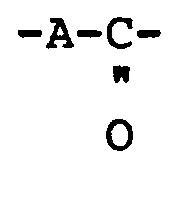
- A für die restlichen Glieder eines mit der Position des Substituenten R1 verknüpfen Carbo- oder Heterocyclus und
- Y für H oder Alkyl stehen, wobei die vorstehend genannten cyclischen und acyclischen Reste durch nichtionische Substituenten, insbesondere solchen, wie sie in der Farbstoffchemie üblich sind, S03H oder COOH substituiert sein können.
- Geeignete Alkylreste sind solche mit 1 - 12 C-Atomen.
- Geeignete Alkenylreste sind solche mit 2 - 5 C-Atomen.
- Geeignete Cycloalkylreste sind Cyclopentyl und Cyclohexyl.
- Geeignete Aralkylreste sind C1-C3-Alkylphenylreste, die im Phenylkern z.B. durch Cl, C1-C4-Alkyl oder C1-C4-Alkoxy substituiert sein können.
- Geeignete Arylreste sind Phenylreste, die in entsprechender Weise substituiert sein können.
- Geeignete Hetaryl-Reste sind 5- oder 6-gliedrige quasiaromatische, N-, O- und/oder S-haltige heterocyclische Reste, die gegebenenfalls beispielsweise durch C1-C4-Alkyl oder Phenyl substituiert oder durch einen Benzolkern anneliert sein können.
- Bevorzugte Verbindungen der Formel I sind solche der Formeln

- Besonders bevorzugte Verbindungen der Formel 1 sind solche der Formeln

- R' CN, C1-C4-Alkoxycarbonyl, CONH2, CONH-Cl-C4-Alkyl oder CON(C1-C4-Alkyl),
- R3 Pyridyl-2(-3 oder -4), Pyrimidyl-2(oder -4), Pyrazinyl, Pyridazolyl-3(oder -4), Thiazolyl-2(oder -4), Benzthiazolyl-2, Oxazolyl-2, Benzoxazolyl-2, 1,3,4-Oxdiazolyl-2, 1,2,4-Triazolyl-3, Imidazolyl-2, Benzimidazolyl-2 oder 1,2,4-Oxdiazolyl-3(oder -5), wobei die Reste weiter substituiert sein können, beispielsweise die monocyclischen Reste durch Methyl oder Phenyl und die bicyclischen Reste im Benzolkern durch Methyl, Cl, Br, N0 2 oder C1-C4-Alkylsulfonyl, R4 H, C1-C4-Alkyl, Benzyl, Phenyl oder Tolyl,
- R5, R 6, R7 und R8 H, C1-C4-Alkyl, Phenyl oder -Furyl (die beiden letzteren jedoch insgesamt nur einmal)
- R5 mit R6 und/oder R7 mit R8 jeweils gemeinsam einen ankondensierten Benzolring bilden können.
- Ganz besonders bevorzugt sind Verbindungen der Formeln I - V, worin R bzw. R' CN bedeutet.
- Unter diesen sind wieder solche Typen der angegebenen Formeln bevorzugt,
- worin entweder
- a) R1 = H oder Methyl und R3 = ein 1,2,4-Oxdiazolylrest oder
- b) R5 - R8 = ein Wasserstoffatom bedeuten.
- Die neuen Verbindungen sind nach verschiedenen Verfahren zugänglich.
- Ein allgemein anwendbares Verfahren zur Herstellung der Verbindungen der Formel I ist dadurch gekennzeichnet, daß man Verbindungen, die in einer ihrer tautomeren Formen der Formel

- R1 und R2 die obengenannte Bedeutung haben und
- Z für eine Hydroxyl-, Ether- oder Amingruppe steht,
- Diejenigen Verbindungen der Formel I, worin R1 und R2 gemeinsam den Rest -A-CO- bilden, gewinnt man zweckmäßigerweise dadurch,
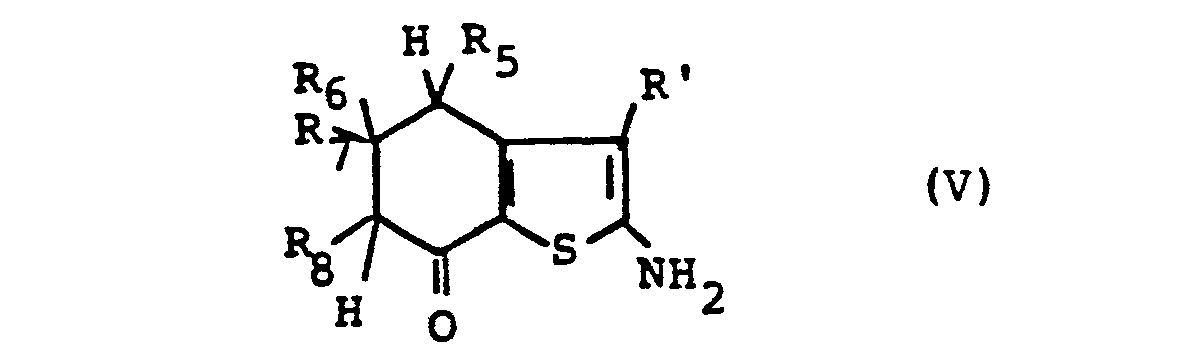
daß man Verbindungen, die in einer ihrer tautomeren Formen der Formel
- Die Verbindungen der Formeln VI - VIII sind entweder bekannt oder nach an sich bekannten Methoden leicht herstellbar.
- Auch die Reaktionsbedingungen der-durch die Gegenwart des Schwefels gekennzeichneten Umsetzungen sind an sich bekannt.
- In diesem Zusammenhang wird z.B. auf die folgende Literatur verwiesen.
- Bücher: H.D. Hartough "Thiophene and Its Derivatives" und "Compounds with Condensed Thiophene Rings", beide aus der Serie "The Chemistry of Heterocyclic Compounds", Interscience Publishers Inc., New York 1952.
- Die Arbeiten von Gewald (et al.) Z.Chem. 7 (1967), Heft 5, 186; Chem. Berichte 101 (1068), 1933; Chem. Berichte 98, (1965), 3571; Z.Chem. 2, (1962), 305. D.E.Wolf et al. "The Preparation of Thiophenes and Tetrahydrothiophenes", Organic Reactions 6, (1951), 410 - 468.
- Als organische Basen kommen im wesentlichen primäre, sekundäre und vorzugsweise tertiäre Amine in Betracht. Die Auswahl der Basen kann sich nach wirtschaftlichen Gesichtspunkten richten, da vom Effekt her gesehen innerhalb der Gruppen primärer, sekundärer und terti- ärer Amine keine Unterschiede zu beobachten sind. Bevorzugt sind daher beispielsweise Trimethyl-, Triethyl-, Tripropyl-, Dimethylethyl-, Diethylmethylamin oder Dimethylethanolamin.
- Als Lösungsmittel für die Reaktion eignen sich insbesondere Alkohole, Glykole, Glykolether oder Ether. Im einzelnen seien beispielsweise Methanol, Ethanol, Propanol, Glykol, Methyl-, Ethyl- oder Butylglykol sowie Tetrahydrofuran oder Dioxan genannt.
- Einzelheiten der Reaktionsführung können den Beispielen entnommen werden, in denen sich Angaben über Teile und Prozente, sofern nicht anders vermerkt, auf das Gewicht beziehen.
- Die neuen Verbindungen der Formel I sind wertvolle Zwischenprodukte zur Herstellung von Wirkstoffen auf dem Gebiet der Pharmazie und des Pflanzenschutzes, indem man diese Verbindungen beispielsweise mit Isocyanaten zu den entsprechenden Harnstoffen umsetzt.
- Ganz besonders geeignet sind jedoch die neuen Aminothiophene als Diazokomponenten zum Aufbau von Azofarbstoffen, beispielsweise zur Herstellung von nebendichtearmen blaugrünen Azofarbstoffkörpern für das fotografische Farbdiffusionsverfahren (vgl. z.B. US-PS 4 346 161).
- Die Umsetzung der Verbindungen der Formeln V mit VI in Gegenwart von Schwefel, wird vorteilhaft unter Verwendung von nahezu stöchiometrischen Mengen der Reaktionsteilnehmer im organischen inerten Medium, gegebenenfalls in Gegenwart eines Katalysators durchgeführt.
- Zweckmäßigerweise nimmt man die Umsetzung so vor, daß man die Verbindungen der Formeln VI und VII sowie den Schwefel in feinverteilter Form in einem Lösungsmittel vorlegt und dann eine organische Base bei möglichst niedriger Temperatur, zutropft. Anschließend wird die Temperatur erhöht und vorzugsweise zwischen 30° und Siedetemperatur (Rückflußtemperatur) gehalten.
- Nach beendeter Umsetzung kann dann das Reaktionsprodukt nach an sich üblichen Methoden isoliert werden, z.B. durch Filtrieren, gegebenenfalls Waschen und/oder Umkristallisieren.
- 20 Teile 3-Phenyl-5-acetonyl-1,2,4-oxadiazol und 7 Teile Malodinitril und 3,2 g Teile Schwefel werden in 80 Teilen Ethanol vorgelegt. Unter Kühlung mit einem Wasserbad werden 20 Teile Triethylamin zugetropft. Man läßt 1 Stunde bei Raumtemperatur nachrühren und kocht dann 2 Stunden am Rückfluß. Nach Abkühlen auf Raumtemperatur werden die ausgefallenen Kristalle isoliert, mit Ethanol gewaschen und im Vakuum getrocknet. Man erhält 23 Teile Produkt der Formel
-

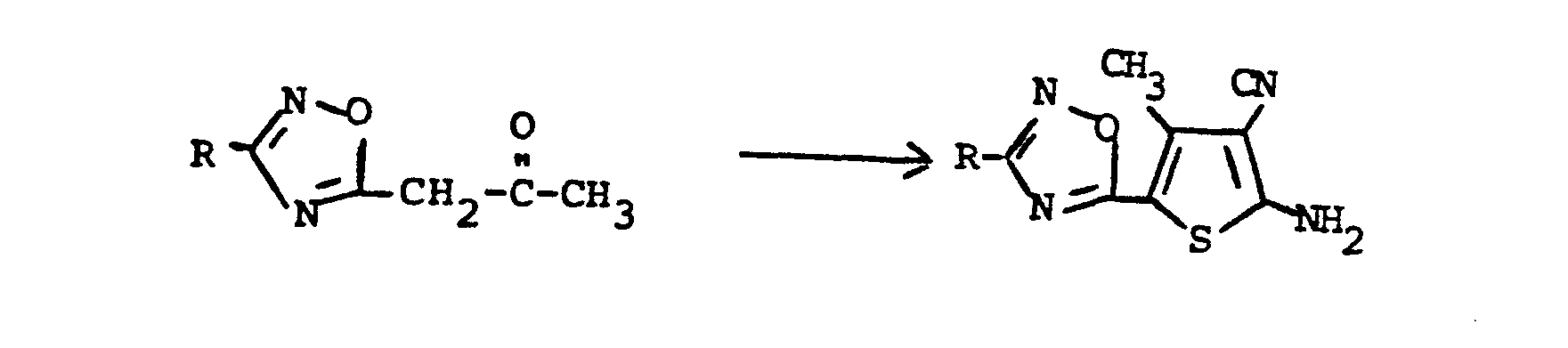

- 10 Teile 3-Phenyl-5-acetonyl-1,2,4-oxadiazol und 6 Teile Cyanessigsäureethylester und 1,6 Teile Schwefel werden in 80 Teile Ethanol vorgelegt. Unter Kühlung gibt man 10 Teile Diethylamin zu und läßt 1 h nachrühren. Dann wird das Reaktionsgemisch 2 h am Rückfluß gekocht. Nach dem Abkühlen wird das kristalline Produkt isoliert, mit Ethanol gewaschen und getrocknet.
- Man erhält 8 Teile Produkt der Formel

- Analog lassen sich die in den Beispielen 2 - 10 eingesetzten Acetonyloxadiazole in die entsprechenden 3-Carbonester-thiophene überführen.
- 117 Teile ß-Amino-thiocrotonsäureamid werden in 250 Teilen Ethanol mit 95 Teilen Chloraceton 30 Minuten am Rückfluß gekocht. Danach wird auf Raumtemperatur abgekühlt. Sodann werden 32 Teile Schwefel und 66 Teile Malodinitril zugegeben und unter Kühlung 200 Teile Triethylamin zugetropft. Dann wird das Reaktionsgemisch 2 h am Rückfluß gekocht. Nach Abkühlen auf Raumtemperatur erhält man nach Isolieren, Waschen mit Ethanol und Trocknen 150 Teile Produkt der Formel
-

- Es wird wie in Beispiel 12 gearbeitet jedoch werden statt Malodinitril 120 Teile Cyanessigsäureethylester eingesetzt. Man erhält 120 Teile Produkt der Formel

- Arbeitet man nach den Angaben der Beispiele 12 und 13 setzt jedoch anstelle von Chloraceton die in folgender Tabelle aufgeführten Halogenketone ein, so erhält man die entsprechenden Thiophene

- Die Thiophene der Beispiele 12 - 23 können auch hergestellt werden, indem man nach den Angaben der Beispiele 1 und 11 entsprechende Acetonylthiazolt an Stelle des Phenyl-acetonyl-oxadiazols mit Schwefel und Malodinitril oder Cyanessigester umsetzt.
- Arbeitet man nach Angaben der Beispiele 1 und 11, ersetzt jedoch das 3-Phenyl-5-acetonyl-oxadiazol durch ein in folgender Tabelle aufgeführten acetonylsubstituierten Heterocyclus, so werden entsprechend heterocyclisch substituierte Thiophene erhalten.


- 16 Teile (Dicyanomethylen)-3-hydroxy-l-cyclohexen und 3,2 Teile Schwefel werden in 80 Teilen Ethanol vorgelegt. Nach Zugabe von 20 Teilen Triethylamin wird das Reaktionsgemisch 2 Stunden am Rückfluß gekocht. Man engt am Rotationsverdampfer zur Trockne ein, verrührt den Rückstand mit einer Mischung aus 100 Teilen Wasser und 30 Teilen Natriumhydrogensulfidlösung. Nach Isolieren, Waschen und Trocknen erhält man 10 Teile eines Produktes der Formel
-

- 140 Teile Dimedon und 67 Teile Malodinitril werden mit 40 Teilen Ammoniumacetat in 800 Teilen Ethanol 1 Stunde am Rückfluß gekocht. Man kühlt ab auf 20°, gibt 32 Teile Schwefel und 150 Teile Triethylamin zu und erhitzt 3 Stunden am Rückfluß, destilliert 500 Teile Ethanol/Triethylamin-Gemisch ab, läßt kalt werden, isoliert, wäscht und trocknet. Es werden 80 g Produkt der Formel

- Arbeitet man nach den Angaben des Beispiel 51, setzt jedoch an Stelle von Dimedon die in folgender Tabelle aufgeführten Dicarbonylverbindungen ein, so erhält man entsprechende Thiophene.

bedeuten,
und
mit Verbindungen der Formel

Claims (10)


bilden,


bedeuten,
und


in einer ihrer tautomeren Formen der Formel

mit Verbindungen der Formel


Priority Applications (1)
| Application Number | Priority Date | Filing Date | Title |
|---|---|---|---|
| EP90107116A EP0385515B1 (de) | 1983-12-07 | 1984-11-27 | 2-Aminothiophenverbindungen |
Applications Claiming Priority (2)
| Application Number | Priority Date | Filing Date | Title |
|---|---|---|---|
| DE19833344294 DE3344294A1 (de) | 1983-12-07 | 1983-12-07 | 2-aminothiophenverbindungen |
| DE3344294 | 1983-12-07 |
Related Child Applications (1)
| Application Number | Title | Priority Date | Filing Date |
|---|---|---|---|
| EP90107116.7 Division-Into | 1984-11-27 |
Publications (2)
| Publication Number | Publication Date |
|---|---|
| EP0146797A1 true EP0146797A1 (de) | 1985-07-03 |
| EP0146797B1 EP0146797B1 (de) | 1991-09-11 |
Family
ID=6216297
Family Applications (2)
| Application Number | Title | Priority Date | Filing Date |
|---|---|---|---|
| EP84114308A Expired - Lifetime EP0146797B1 (de) | 1983-12-07 | 1984-11-27 | 2-Aminothiophenverbindungen |
| EP90107116A Expired - Lifetime EP0385515B1 (de) | 1983-12-07 | 1984-11-27 | 2-Aminothiophenverbindungen |
Family Applications After (1)
| Application Number | Title | Priority Date | Filing Date |
|---|---|---|---|
| EP90107116A Expired - Lifetime EP0385515B1 (de) | 1983-12-07 | 1984-11-27 | 2-Aminothiophenverbindungen |
Country Status (3)
| Country | Link |
|---|---|
| EP (2) | EP0146797B1 (de) |
| JP (1) | JPH0633250B2 (de) |
| DE (3) | DE3344294A1 (de) |
Cited By (2)
| Publication number | Priority date | Publication date | Assignee | Title |
|---|---|---|---|---|
| EP1581213A4 (de) * | 2002-12-18 | 2008-11-19 | Cytovia Inc | 3,5-disubstituierte 1,2,4 -oxadiazole und analoga zuraktivierung von caspase und einleitung von apoptose und ihre verwendung |
| EP1406632A4 (de) * | 2001-06-08 | 2009-11-04 | Cytovia Inc | Substituierte 3-aryl-5-aryl- 1,2,4 -oxadiazole und analoga als aktivatoren von caspases und apoptose-induktoren und ihre verwendung |
Citations (4)
| Publication number | Priority date | Publication date | Assignee | Title |
|---|---|---|---|---|
| FR2128234A1 (en) * | 1971-03-12 | 1972-10-20 | Centre Etd Ind Pharma | Compsns contg 2-amino-4,5,6,7-tetrahydrobenzo (b) thiophen - -3-carboxamide - with analgesic,sedative,antitussive and diuretic act |
| DE2553621A1 (de) * | 1974-12-05 | 1976-06-10 | Ici Ltd | Verfahren zur herstellung von 2-amino- 3-cyanothiophenen |
| US3963750A (en) * | 1973-08-09 | 1976-06-15 | Beecham Group Limited | Thiophene derivatives |
| US3989505A (en) * | 1975-06-23 | 1976-11-02 | Hawaiian Sugar Planters' Association | Use of polycyclic thiophene compounds as ripeners for sugarcane |
Family Cites Families (1)
| Publication number | Priority date | Publication date | Assignee | Title |
|---|---|---|---|---|
| DE3344295A1 (de) * | 1983-12-07 | 1985-06-20 | Agfa-Gevaert Ag, 5090 Leverkusen | Farbfotografisches aufzeichnungsmaterial mit einem farbabspalter fuer blaugruene farbstoffe, ein mit diesen farbstoffen erzeugtes farbbild und die farbstoffe selbst |
-
1983
- 1983-12-07 DE DE19833344294 patent/DE3344294A1/de not_active Withdrawn
-
1984
- 1984-11-27 EP EP84114308A patent/EP0146797B1/de not_active Expired - Lifetime
- 1984-11-27 EP EP90107116A patent/EP0385515B1/de not_active Expired - Lifetime
- 1984-11-27 DE DE3486306T patent/DE3486306D1/de not_active Expired - Fee Related
- 1984-11-27 DE DE8484114308T patent/DE3485056D1/de not_active Expired - Lifetime
- 1984-12-03 JP JP59254256A patent/JPH0633250B2/ja not_active Expired - Lifetime
Patent Citations (4)
| Publication number | Priority date | Publication date | Assignee | Title |
|---|---|---|---|---|
| FR2128234A1 (en) * | 1971-03-12 | 1972-10-20 | Centre Etd Ind Pharma | Compsns contg 2-amino-4,5,6,7-tetrahydrobenzo (b) thiophen - -3-carboxamide - with analgesic,sedative,antitussive and diuretic act |
| US3963750A (en) * | 1973-08-09 | 1976-06-15 | Beecham Group Limited | Thiophene derivatives |
| DE2553621A1 (de) * | 1974-12-05 | 1976-06-10 | Ici Ltd | Verfahren zur herstellung von 2-amino- 3-cyanothiophenen |
| US3989505A (en) * | 1975-06-23 | 1976-11-02 | Hawaiian Sugar Planters' Association | Use of polycyclic thiophene compounds as ripeners for sugarcane |
Cited By (2)
| Publication number | Priority date | Publication date | Assignee | Title |
|---|---|---|---|---|
| EP1406632A4 (de) * | 2001-06-08 | 2009-11-04 | Cytovia Inc | Substituierte 3-aryl-5-aryl- 1,2,4 -oxadiazole und analoga als aktivatoren von caspases und apoptose-induktoren und ihre verwendung |
| EP1581213A4 (de) * | 2002-12-18 | 2008-11-19 | Cytovia Inc | 3,5-disubstituierte 1,2,4 -oxadiazole und analoga zuraktivierung von caspase und einleitung von apoptose und ihre verwendung |
Also Published As
| Publication number | Publication date |
|---|---|
| DE3344294A1 (de) | 1985-06-20 |
| DE3485056D1 (de) | 1991-10-17 |
| EP0385515A1 (de) | 1990-09-05 |
| EP0146797B1 (de) | 1991-09-11 |
| JPH0633250B2 (ja) | 1994-05-02 |
| JPS60139687A (ja) | 1985-07-24 |
| EP0385515B1 (de) | 1994-04-13 |
| DE3486306D1 (de) | 1994-05-19 |
Similar Documents
| Publication | Publication Date | Title |
|---|---|---|
| EP0713488B1 (de) | [1,3,4]triazolo[1,5-al]pyridine als zwischenprodukte für die synthese von farbstoffen | |
| EP0413226B1 (de) | [1,2,4] Triazolo [1,5-a]pyridine | |
| EP0193885B1 (de) | Thiophenderivate | |
| DE2655009A1 (de) | Isoxazolderivate, verfahren zu ihrer herstellung und diese verbindungen enthaltende mittel | |
| EP0305322B1 (de) | Isoxazol-Beta-carbolin-Derivate | |
| DE2818947A1 (de) | Verfahren zur herstellung von harnstoffderivaten | |
| CH636098A5 (de) | 1,3-dithietan-2-carbonsaeuren sowie verfahren zu ihrer herstellung. | |
| DE1670679A1 (de) | Verfahren zur Herstellung von Benzoxazin-Derivaten | |
| DE68921418T2 (de) | Imidazochinoxaline und ihre Herstellung. | |
| EP0307361B1 (de) | Verfahren zur Herstellung von Carbodiimiden | |
| EP0146797B1 (de) | 2-Aminothiophenverbindungen | |
| EP0010652B1 (de) | Neue 4-Chloroxazole, Verfahren zu deren Herstellung und deren Verwendung in photoleitenden Schichten in der Elektrophotographie und als optische Aufheller | |
| EP0004897B1 (de) | Verfahren zur Herstellung von in 2-Stellung substituierten Triazolen-1,2,3 | |
| DE2429195A1 (de) | 2-amino-pyrazolo eckige klammer auf 3,4-d eckige klammer zu thiazole | |
| DE2529434B2 (de) | Farbstoffe der cumarinreihe und ihre verwendung | |
| CH411906A (de) | Verfahren zur Herstellung neuer 1,3,4-Thiadiazole | |
| DE2204767A1 (de) | Benzoxazol - 2 - yl - substituierte 1.3.4 - thia - und - oxadiazole | |
| DE19712411A1 (de) | Verfahren zur Herstellung von 1,3-disubstituierten 2-Nitroguanidinen | |
| JPS62255491A (ja) | カルバモイルオキシチオフエン誘導体 | |
| AT229884B (de) | Verfahren zur Herstellung neuer organischer Phosphorverbindungen | |
| EP0943661B1 (de) | Chromophore Verbindungen und Verfahren zu ihrer Herstellung | |
| DE2147013A1 (de) | Antimikrobiell wirksame nitrofuranderivate und verfahren zur herstellung derselben | |
| EP0197189A2 (de) | 1,3,4-Thiadiazolderivate, Verfahren zu ihrer Herstellung und diese Verbindungen enthaltende Arzneimittel | |
| DE1670139A1 (de) | Verfahren zur Herstellung von 3-(5-Nitrofuryl-2)-s-triazolo[4.3-a]pyridin-Derivaten | |
| AT382149B (de) | Verfahren zur herstellung von syn-isomeren von thioessigsaeureestern |
Legal Events
| Date | Code | Title | Description |
|---|---|---|---|
| PUAI | Public reference made under article 153(3) epc to a published international application that has entered the european phase |
Free format text: ORIGINAL CODE: 0009012 |
|
| 17P | Request for examination filed |
Effective date: 19841127 |
|
| AK | Designated contracting states |
Designated state(s): CH DE FR GB LI |
|
| RTI1 | Title (correction) | ||
| 17Q | First examination report despatched |
Effective date: 19881216 |
|
| GRAA | (expected) grant |
Free format text: ORIGINAL CODE: 0009210 |
|
| AK | Designated contracting states |
Kind code of ref document: B1 Designated state(s): CH DE FR GB LI |
|
| XX | Miscellaneous (additional remarks) |
Free format text: TEILANMELDUNG 90107116.7 EINGEREICHT AM 27/11/84. |
|
| REF | Corresponds to: |
Ref document number: 3485056 Country of ref document: DE Date of ref document: 19911017 |
|
| GBT | Gb: translation of ep patent filed (gb section 77(6)(a)/1977) | ||
| EN | Fr: translation not filed | ||
| PG25 | Lapsed in a contracting state [announced via postgrant information from national office to epo] |
Ref country code: FR Effective date: 19920131 |
|
| PLBE | No opposition filed within time limit |
Free format text: ORIGINAL CODE: 0009261 |
|
| STAA | Information on the status of an ep patent application or granted ep patent |
Free format text: STATUS: NO OPPOSITION FILED WITHIN TIME LIMIT |
|
| 26N | No opposition filed | ||
| REG | Reference to a national code |
Ref country code: FR Ref legal event code: ST |
|
| PGFP | Annual fee paid to national office [announced via postgrant information from national office to epo] |
Ref country code: DE Payment date: 19981010 Year of fee payment: 15 |
|
| PGFP | Annual fee paid to national office [announced via postgrant information from national office to epo] |
Ref country code: CH Payment date: 19981112 Year of fee payment: 15 |
|
| PGFP | Annual fee paid to national office [announced via postgrant information from national office to epo] |
Ref country code: GB Payment date: 19981127 Year of fee payment: 15 |
|
| PG25 | Lapsed in a contracting state [announced via postgrant information from national office to epo] |
Ref country code: GB Free format text: LAPSE BECAUSE OF NON-PAYMENT OF DUE FEES Effective date: 19991127 |
|
| PG25 | Lapsed in a contracting state [announced via postgrant information from national office to epo] |
Ref country code: LI Free format text: LAPSE BECAUSE OF NON-PAYMENT OF DUE FEES Effective date: 19991130 Ref country code: CH Free format text: LAPSE BECAUSE OF NON-PAYMENT OF DUE FEES Effective date: 19991130 |
|
| REG | Reference to a national code |
Ref country code: CH Ref legal event code: PL |
|
| GBPC | Gb: european patent ceased through non-payment of renewal fee |
Effective date: 19991127 |
|
| PG25 | Lapsed in a contracting state [announced via postgrant information from national office to epo] |
Ref country code: DE Free format text: LAPSE BECAUSE OF NON-PAYMENT OF DUE FEES Effective date: 20000901 |