EP0146825A2 - Elektrostatischer Tonerabstosser für ein elektrophotographisches Gerät - Google Patents
Elektrostatischer Tonerabstosser für ein elektrophotographisches Gerät Download PDFInfo
- Publication number
- EP0146825A2 EP0146825A2 EP84114583A EP84114583A EP0146825A2 EP 0146825 A2 EP0146825 A2 EP 0146825A2 EP 84114583 A EP84114583 A EP 84114583A EP 84114583 A EP84114583 A EP 84114583A EP 0146825 A2 EP0146825 A2 EP 0146825A2
- Authority
- EP
- European Patent Office
- Prior art keywords
- toner
- electrostatic
- accordance
- drum
- repeller
- Prior art date
- Legal status (The legal status is an assumption and is not a legal conclusion. Google has not performed a legal analysis and makes no representation as to the accuracy of the status listed.)
- Ceased
Links
- 239000000428 dust Substances 0.000 title claims abstract description 16
- 230000001846 repelling effect Effects 0.000 claims abstract description 7
- 239000012141 concentrate Substances 0.000 claims abstract 2
- 108091008695 photoreceptors Proteins 0.000 claims description 6
- RYGMFSIKBFXOCR-UHFFFAOYSA-N Copper Chemical compound [Cu] RYGMFSIKBFXOCR-UHFFFAOYSA-N 0.000 claims description 5
- 229910052802 copper Inorganic materials 0.000 claims description 5
- 239000010949 copper Substances 0.000 claims description 5
- 230000005684 electric field Effects 0.000 claims description 2
- 230000002093 peripheral effect Effects 0.000 claims 2
- 108020003175 receptors Proteins 0.000 claims 1
- 239000000463 material Substances 0.000 abstract description 6
- 239000002245 particle Substances 0.000 description 9
- 239000011324 bead Substances 0.000 description 8
- 238000010410 dusting Methods 0.000 description 3
- 239000004677 Nylon Substances 0.000 description 2
- 230000008901 benefit Effects 0.000 description 2
- 239000011521 glass Substances 0.000 description 2
- 230000005012 migration Effects 0.000 description 2
- 238000013508 migration Methods 0.000 description 2
- 229920001778 nylon Polymers 0.000 description 2
- 230000000712 assembly Effects 0.000 description 1
- 238000000429 assembly Methods 0.000 description 1
- 239000012876 carrier material Substances 0.000 description 1
- 230000000694 effects Effects 0.000 description 1
- 238000005367 electrostatic precipitation Methods 0.000 description 1
- 238000001125 extrusion Methods 0.000 description 1
- 230000003287 optical effect Effects 0.000 description 1
- 239000000843 powder Substances 0.000 description 1
- 238000005728 strengthening Methods 0.000 description 1
- 230000000007 visual effect Effects 0.000 description 1
- 239000002699 waste material Substances 0.000 description 1
Images

Classifications
-
- G—PHYSICS
- G03—PHOTOGRAPHY; CINEMATOGRAPHY; ANALOGOUS TECHNIQUES USING WAVES OTHER THAN OPTICAL WAVES; ELECTROGRAPHY; HOLOGRAPHY
- G03G—ELECTROGRAPHY; ELECTROPHOTOGRAPHY; MAGNETOGRAPHY
- G03G15/00—Apparatus for electrographic processes using a charge pattern
- G03G15/06—Apparatus for electrographic processes using a charge pattern for developing
- G03G15/08—Apparatus for electrographic processes using a charge pattern for developing using a solid developer, e.g. powder developer
- G03G15/0896—Arrangements or disposition of the complete developer unit or parts thereof not provided for by groups G03G15/08 - G03G15/0894
- G03G15/0898—Arrangements or disposition of the complete developer unit or parts thereof not provided for by groups G03G15/08 - G03G15/0894 for preventing toner scattering during operation, e.g. seals
Definitions
- the present invention relates to electrographic apparatus and to automatic means for preventing toner dust from migrating from the developer station to other parts of the apparatus.
- Electrographic printer apparatus which utilize two-component toners i.e. toner plus carrier beads ; generally operate the magnetic brush or toner applicator roll at a higher rotative rate than those systems which employ single component toners since the quantity of toner is much less with the two component system.
- All toner material consists of extremely fine powder-like material which can become airborne. Toner particles in a two component system are lighter in weight and non-magnetic whereas in a single component system the toner particles are heavier and hence cannot drift as readily in air and are magnetic so they can be held to the applicator roll by its negative field. The problem of toner migration due to the air turbulence created by the movement of the toner-carrier particles thus becomes a particular problem.
- Brush-like seals at the edges of the rotatable photoreceptor drum tend to limit the ambient dust to a certain degree. Still, there is sufficient migration of the toner dust to other portions of the apparatus to produce unwanted deposits on bearings, moving parts such as gear trains, etc., and onto the copy itself making for unreliable and relatively dirty apparatus.
- toner material with the carrier material (usually nonconductive beads) to form the developer generates a triboelectric charge.
- the carrier beads usually have a (positive) +V e charge while the toner particles have a (negative) -V e charge.
- Electrostatic attraction and replusion are well known phenomena. Electrostatic preciptators are used industrially to capture and remove all manner of waste products from the stack and flue effluent.
- the present invention makes use of the repulsive effect of electrostatics.
- a pair of substantially similar conducting and electrostatically charged members albeit carrying a - V e (negative) charge, are arranged in spaced apart ' relation to the photoreceptor recording drum of an electrophotographic apparatus.
- the charged members are disposed across the width of the drum and adjacent to the developer station (or unit) in the apparatus.
- Dielectric support members maintain the charged electrostatic elements in close proximity (but not touching) to the drum surface.
- a spacing of a few ten thousandths of an inch is sufficient to effectively seal the area adjacent the drum and toner station against dust.
- Application of a negative potential to the electrostatic charged members causes the negatively charged toner dust to be completely repelled from the area adjacent to each electrostatic member.
- the present invention comprises a pair of conductive (e.g. copper) elongated, thin, strips mounted to respective dielectric, molded members.
- the two assemblies are positioned adjacent to but separated from the periphery of the photoreceptor drum of an electrophotographic printer. So as to prevent the electrical field produced by the adjacent positively charged corotron from attracting toner dust a shunt or ground in the form of a grounded conductive member secured to the lowermost of the two electrostatic repeller members effectively shunts or grounds the field lines from the corotron preventing negatively charged toner from being attracted to the corotron.
- conductive e.g. copper
- This arrangement completely eliminates the toper dusting problem and keeps the area around the photoreceptor drum clean and assuring more legible copy.
- the present invention relates to reprographic electrophotographic apparatus of the type described and claimed in USSN 429,861 filed September 30, 1982 in the name of Richard C. Fedder for "Toner Concentration Sensor For Electrographic Apparatus" assigned to the same assignee as the present invention.
- dry copying apparatus in order to produce clean, clear, crisp, black printing (copy) on white paper for example, to a line definition generally acceptable to the eye as regular or standard printing, it is necessary to employ an extremely fine dry powder toner material.
- the subject apparatus also utilizes what is characterized as a two component developer i.e. a finely powdered toner and larger carrier beads.
- the carrier beads acquire a positive (+V e ) charge while the toner material acquires a negative (-V e ) charge.
- some toner particles remain uncharged or go free to produce an ambient dust which migrates at random to all parts of the surrounding atmosphere and hardware.
- the problem is solved by utilizing the phenomenon of attraction and replusion i.e. like charges repel one another while unlike changes attract.
- the present invention is seen to include a rotatable photoreceptor drum 10 having a photoconductive surface 12 for receiving a visual image of information or data thereon.
- a rotatable photoreceptor drum 10 having a photoconductive surface 12 for receiving a visual image of information or data thereon.
- corotrons 14 The other corotron to the right of the first is not shown since it forms no part of this invention.
- L-shaped glass filled nylon lower bar member 20 Located to the left and above the corotron 14, secured as by bolts 16 to the extrusion hardware frame 18, is an L-shaped glass filled nylon lower bar member 20. Member 20 is arranged to extend (from side to side) across the drum 10 in very close but noncontacting proximity thereto. Adjacent to but above and separated from the lower bar member 20 is an upper L-shaped glass filled nylon bar member 22.
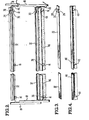
- Each bar member 20 and 22 is provided with a elongated fairly wide channel or groove 24 extending from end to end of the respective member.
- One end of each member 20 and 22 is provided with a substantially rectangular aperture 26, which will be explained shortly.
- An opposite integral portion of each bar member 20 and 22 is provided with a plurality of attachment holes 28 arranged in spaced apart relation on a thickened or raised land portion 30. The latter portion 30 extends from end to end of each bar strengthening element for retaining the attachment bolts 16.
- the two mounting-support members 20 and 22 are otherwise identical in cross section, only their physical orientation is different.
- the upper member 22 is angled as seen in Figure 1 so as to take advantage of the available hardware to which it is physically attached.
- the lower member 20 is likewise situated to enable its attachment to available hardware structure. Since no corotron is used above the member 22 there is no need for a second shunt (to be described shortly) as is used with the lower member 22.
- An elongated, relatively thin, conductive copper strip 32 one end of which is provided with an integral bent tang 34, Figure 2 including an attachement hole 36, is seated in the longitudinal groove or channel 24 in respective members 20 and 22.
- the bent tang 34 is received within the rectangular aperture 26.
- the physical mounting arrangement of the two members 20 and 22 is such that the flat planar facing portion of each copper strip 32 is generally oriented toward the surface of drum 10 with the strip 32 of lower member 20 being substantially parallel to the drum surface.
- the two (upper and lower) electrostatic repelling devices 20 and 22 are disposed relative to a magnetic brush development roller member 38 mounted in close but non contacting proximity to drum 10.
- the outer shell 39 of member 38 rotates past a plurality of internally disposed fixed magnets (not shown) to carry developer 40 (toner plus carrier) from a source (not shown) upwardly by the rotatable magnet member 38 into surface contact with drum 10 as members 10 and 38 are rotated during machine operation.
- the shell of member 38 carries a B+ potential charge of approximately 300 volts.
- the drum 10 is provided with a B+ potential of 750-800 volts.
- the two electrostatic repeller devices are each provided with a negative potential of approximately - 1200 volts over leads 44 from a source (not shown).
- a corotron 14, disposed below and to the right of roll 38 is maintained at a B+ potential of 4500 to 6000 volts over lead 48, from a source (not shown).
- the present invention utilizes a shunt member 46, e.g. a copper strip, bent out of the main plane into a v-shape as seen in Figure 1. Attachment notches 48 are provided along its length so as to secure member 46 to the lower member 20 as by bolts 16. Shunt member 46 is coextensive with lower repeller member 32 attached as shown to the frame 18 which is at ground potential.
- a shunt member 46 e.g. a copper strip
- This structural arrangement effectively directs or shunts the lines of force from corotron 14 to ground thus preventing any ambient toner dust from spreading.outwardly away from the brush area 42 overcoming the dusting problem.
- optical density of the print is enhanced by the concentration of toner adjacent the printing area on drum 10.
Landscapes
- Physics & Mathematics (AREA)
- General Physics & Mathematics (AREA)
- Dry Development In Electrophotography (AREA)
- Magnetic Brush Developing In Electrophotography (AREA)
- Cleaning In Electrography (AREA)
- Control Or Security For Electrophotography (AREA)
Applications Claiming Priority (2)
| Application Number | Priority Date | Filing Date | Title |
|---|---|---|---|
| US55652983A | 1983-11-30 | 1983-11-30 | |
| US556529 | 1983-11-30 |
Publications (2)
| Publication Number | Publication Date |
|---|---|
| EP0146825A2 true EP0146825A2 (de) | 1985-07-03 |
| EP0146825A3 EP0146825A3 (de) | 1986-12-30 |
Family
ID=24221727
Family Applications (1)
| Application Number | Title | Priority Date | Filing Date |
|---|---|---|---|
| EP84114583A Ceased EP0146825A3 (de) | 1983-11-30 | 1984-11-30 | Elektrostatischer Tonerabstosser für ein elektrophotographisches Gerät |
Country Status (4)
| Country | Link |
|---|---|
| EP (1) | EP0146825A3 (de) |
| JP (1) | JPS61500568A (de) |
| CA (1) | CA1229373A (de) |
| WO (1) | WO1985002471A1 (de) |
Family Cites Families (8)
| Publication number | Priority date | Publication date | Assignee | Title |
|---|---|---|---|---|
| US2987660A (en) * | 1955-06-06 | 1961-06-06 | Haloid Xerox Inc | Xerographic charging |
| US3937570A (en) * | 1971-06-03 | 1976-02-10 | Xerox Corporation | Cloud suppression in an electrostatic copying apparatus |
| US4168901A (en) * | 1975-01-21 | 1979-09-25 | Canon Kabushiki Kaisha | Developer housing sealing device for electrophotography |
| DE2816621C3 (de) * | 1978-04-17 | 1980-10-09 | Lumoprint Zindler Kg (Gmbh & Co), 2000 Hamburg | Dichtungsanordnung in einer Entwicklungsvorrichtung eines Kopiergeräte |
| US4338880A (en) * | 1978-09-19 | 1982-07-13 | Minolta Camera Kabushiki Kaisha | Magnetic brush development apparatus for use in electrophotographic copying machine |
| JPS5664365A (en) * | 1979-10-30 | 1981-06-01 | Ricoh Co Ltd | Developing device |
| US4387982A (en) * | 1981-07-01 | 1983-06-14 | Xerox Corporation | Charged particle containment apparatus |
| US4697914A (en) * | 1982-06-30 | 1987-10-06 | Xerox Corporation | Toner containment method and apparatus |
-
1984
- 1984-11-21 JP JP59504400A patent/JPS61500568A/ja active Granted
- 1984-11-21 WO PCT/US1984/001925 patent/WO1985002471A1/en not_active Ceased
- 1984-11-27 CA CA000468748A patent/CA1229373A/en not_active Expired
- 1984-11-30 EP EP84114583A patent/EP0146825A3/de not_active Ceased
Also Published As
| Publication number | Publication date |
|---|---|
| CA1229373A (en) | 1987-11-17 |
| EP0146825A3 (de) | 1986-12-30 |
| WO1985002471A1 (en) | 1985-06-06 |
| JPS61500568A (ja) | 1986-03-27 |
| JPH0222950B2 (de) | 1990-05-22 |
Similar Documents
| Publication | Publication Date | Title |
|---|---|---|
| US5179414A (en) | Apparatus for developing an image on a photoconductive surface | |
| US4788570A (en) | Thin film developing device | |
| US4506975A (en) | Cleaning device | |
| JP2598131B2 (ja) | 画像形成装置 | |
| GB2055695A (en) | Imaging surface discharge and cleaning apparatus for electrophotographic copier | |
| JPS6256975A (ja) | 電子写真現像装置の密閉装置 | |
| US5754926A (en) | Charging device | |
| EP0853259B1 (de) | Elektrostatisches Aufzeichnungssystem unter Verwendung eines dielektrischen Bandes | |
| JPH034277A (ja) | 画像形成装置 | |
| CA1229373A (en) | Electrostatic dust repeller for electrophotographic apparatus | |
| JPH0814736B2 (ja) | 記録装置 | |
| US6430383B1 (en) | Image transferring device and image forming apparatus including the same | |
| US4977415A (en) | Electrostatic recording head, image recording apparatus, developing agent supplying device, display device and method of producing electrostatic recording head | |
| JP2632940B2 (ja) | 転写装置 | |
| US3771184A (en) | Printing apparatus | |
| JP3180995B2 (ja) | 画像形成方法 | |
| JP2003145825A (ja) | 画像形成装置 | |
| JPH04329154A (ja) | 画像形成装置 | |
| JP2500912B2 (ja) | 電子写真装置 | |
| JPS627542B2 (de) | ||
| JP2962622B2 (ja) | 画像形成装置 | |
| JPH06210892A (ja) | 静電記録装置 | |
| JPH05346720A (ja) | 帯電装置 | |
| JPH05346722A (ja) | 帯電装置 | |
| JPH04255878A (ja) | 現像装置 |
Legal Events
| Date | Code | Title | Description |
|---|---|---|---|
| PUAI | Public reference made under article 153(3) epc to a published international application that has entered the european phase |
Free format text: ORIGINAL CODE: 0009012 |
|
| AK | Designated contracting states |
Designated state(s): BE DE FR GB IT NL SE |
|
| 17P | Request for examination filed |
Effective date: 19860103 |
|
| PUAL | Search report despatched |
Free format text: ORIGINAL CODE: 0009013 |
|
| AK | Designated contracting states |
Kind code of ref document: A3 Designated state(s): BE DE FR GB IT NL SE |
|
| RAP1 | Party data changed (applicant data changed or rights of an application transferred) |
Owner name: UNISYS CORPORATION |
|
| 17Q | First examination report despatched |
Effective date: 19871217 |
|
| STAA | Information on the status of an ep patent application or granted ep patent |
Free format text: STATUS: THE APPLICATION HAS BEEN REFUSED |
|
| 18R | Application refused |
Effective date: 19890211 |
|
| RIN1 | Information on inventor provided before grant (corrected) |
Inventor name: FEDDER, RICHARD C. Inventor name: KASU, ABDULLATIF M. Inventor name: THOMPSON, AUBREY E. Inventor name: ROBSON THOMAS |