EP0147035A2 - Produit papier-polymère - Google Patents
Produit papier-polymère Download PDFInfo
- Publication number
- EP0147035A2 EP0147035A2 EP84307608A EP84307608A EP0147035A2 EP 0147035 A2 EP0147035 A2 EP 0147035A2 EP 84307608 A EP84307608 A EP 84307608A EP 84307608 A EP84307608 A EP 84307608A EP 0147035 A2 EP0147035 A2 EP 0147035A2
- Authority
- EP
- European Patent Office
- Prior art keywords
- polymer
- composition
- cellulose fibers
- monomer
- paper
- Prior art date
- Legal status (The legal status is an assumption and is not a legal conclusion. Google has not performed a legal analysis and makes no representation as to the accuracy of the status listed.)
- Withdrawn
Links
Images

Classifications
-
- D—TEXTILES; PAPER
- D21—PAPER-MAKING; PRODUCTION OF CELLULOSE
- D21H—PULP COMPOSITIONS; PREPARATION THEREOF NOT COVERED BY SUBCLASSES D21C OR D21D; IMPREGNATING OR COATING OF PAPER; TREATMENT OF FINISHED PAPER NOT COVERED BY CLASS B31 OR SUBCLASS D21G; PAPER NOT OTHERWISE PROVIDED FOR
- D21H17/00—Non-fibrous material added to the pulp, characterised by its constitution; Paper-impregnating material characterised by its constitution
-
- D—TEXTILES; PAPER
- D21—PAPER-MAKING; PRODUCTION OF CELLULOSE
- D21H—PULP COMPOSITIONS; PREPARATION THEREOF NOT COVERED BY SUBCLASSES D21C OR D21D; IMPREGNATING OR COATING OF PAPER; TREATMENT OF FINISHED PAPER NOT COVERED BY CLASS B31 OR SUBCLASS D21G; PAPER NOT OTHERWISE PROVIDED FOR
- D21H17/00—Non-fibrous material added to the pulp, characterised by its constitution; Paper-impregnating material characterised by its constitution
- D21H17/03—Non-macromolecular organic compounds
- D21H17/05—Non-macromolecular organic compounds containing elements other than carbon and hydrogen only
- D21H17/18—Non-macromolecular organic compounds containing elements other than carbon and hydrogen only forming new compounds in situ, e.g. within the pulp or paper, by chemical reaction with itself, or other added substances, e.g. by grafting on the fibres
- D21H17/19—Non-macromolecular organic compounds containing elements other than carbon and hydrogen only forming new compounds in situ, e.g. within the pulp or paper, by chemical reaction with itself, or other added substances, e.g. by grafting on the fibres by reactions only involving carbon-to-carbon unsaturated bonds
-
- Y—GENERAL TAGGING OF NEW TECHNOLOGICAL DEVELOPMENTS; GENERAL TAGGING OF CROSS-SECTIONAL TECHNOLOGIES SPANNING OVER SEVERAL SECTIONS OF THE IPC; TECHNICAL SUBJECTS COVERED BY FORMER USPC CROSS-REFERENCE ART COLLECTIONS [XRACs] AND DIGESTS
- Y10—TECHNICAL SUBJECTS COVERED BY FORMER USPC
- Y10T—TECHNICAL SUBJECTS COVERED BY FORMER US CLASSIFICATION
- Y10T428/00—Stock material or miscellaneous articles
- Y10T428/249921—Web or sheet containing structurally defined element or component
- Y10T428/249953—Composite having voids in a component [e.g., porous, cellular, etc.]
- Y10T428/249962—Void-containing component has a continuous matrix of fibers only [e.g., porous paper, etc.]
- Y10T428/249964—Fibers of defined composition
- Y10T428/249965—Cellulosic
Definitions
- the present invention is directed to a paper-polymer product including cellulose fibers, in which the polymer is dispersed within the fiber structure of the cellulose fibers. More particularly, the invention is directed to such a product in which the void spaces of the fibrous web are substantially free from the polymer.
- a product can be used in place of plain paperboard or pulpboard in making containers.
- U.S. Patent No. 4,051,214 describes a method for controlling monomer loss during production of a fiber-thermoplastic matrix.
- a fibrous web of less than 0.63 mm (1/4 inch) thickness is saturated with a liquid, vinyl monomer and a free radical initiator is polymerized under controlled conditions.
- Lines 51-6U of column 3 of the patent indicate that it is necessary for the voids of the fibrous web to hold the liquid monomer.
- U.S. Patent No. 4,271,227 describes a transparent, non-stratified, three dimensional resin reinforced fibrous sheet. Monomers of the Formula I set forth in column 4 of the patent are used to fill voids in the sheet of fibrous material as described at line 2 of column 5 of the patent.
- a fibrous web including cellulose fibers.
- the web is treated with a liquid, non-polar vinyl monomer in an amount so that the monomer stays within the fiber structure of the cellulose fibers, while the open spaces of the web remain substantially free of the monomer.
- the monomer then is polymerized, leaving a structure in which polymer is present within or at the surface of the structure of the cellulose fibers, while the open spaces of the web remain free from the polymer, thus preserving the essential fibrous nature of the web.
- the present invention is based on the discovery that polar cellulose fibers will absorb and uniformly diffuse even highly non-polar monomers throughout their structures. This diffusion is independent of the moisture content of the cellulose fibers, even up to saturation levels in a sheet of paper. For example, if one end of a paper strip is immersed in a monomer solution, rapid wicking occurs up the paper strip until the paper becomes saturated. The rate of the wicking process is independent of the water content of the paper, even between a totally dry paper strip and one which has been placed in a 100% humidity environment, where the paper has a moisture content of 15-16% and might be expected to act as if it were a surface covered by a sheet of water.
- the wicking continues until the void space in the paper strip is totally filled. If the end of the strip is removed after a short immersion time, spreading will continue as long as evaporation of the monomer is prevented, and it has been discovered that the non-polar monomer will remain within the fiber structure of the cellulose fibers, leaving the void spaces of the web substantially free from monomer, and consequently substantially free from polymer after polymerization.
- the present invention is useful for a wide variety of materials, so long as cellulose fibers are included.
- Such-materials include paper, paperboard, cardboard, corrugated cardboard and pulpboard.
- Blended materials such as cellulose-polymer blends, also are contemplated.
- the polymer within the fiber structure is formed from a liquid, non-polar vinyl monomer. Examples of such monomers include acrylates and styrenic monomers such as styrene, p-chlorostyrene and p-methylstyrene. These three styrene monomers are preferred.
- the product of the present invention shows improved wet-strength retention over untreated products.
- the product of the present invention is somewhat more brittle than an untreated product.
- the amount of polymer with respect to the amount of cellulose fibers will vary, depending upon the specific desired application. If dry strength is not particularly important while wet strength is, relatively large amounts of polymer will be used. If less wet strength retention is required and less brittleness is desired, smaller amounts of polymer will be used. It is expected that if the amount of polymer is more than about 40% of the weight of the cellulose fibers, polymer will begin to fill the voids of the web, thus undesirably destroying the fibrous nature of the web.
- the amount of polymer is less than about 2.5% of the weight of the cellulose fibers, the properties of the product treated with the polymer will not be much different from those of the untreated product.
- the preferred range is about 3-30%.
- the polymerization should be carried out in a sealed container. In this manner, very little monomer is lost from the fibers during polymerization. Thus, the amount of monomer added should be virtually the same as the amount of polymer desired.
- the polymerization proceeds within the fibers in a manner similar to known polymerizations outside of the fibers.
- polymerization conditions such as time, temperature, initiator and initiator concentration, can be selected from those currently in use, depending upon the product desired. It is preferred that the conditions be selected to provide a polymer having a number average molecular weight of at least 50,000 or a weight average molecular weight of at least 100,000. A number average of molecular weight of at least 100,000 is preferred.
- Para-methylstyrene monomer containing t-butyl peracetate initiator was spotted onto blotterboard or paper sheets at various add-on levels, and the materials were placed in capped bottles to allow the monomer to distribute itself uniformly. Dye was used to determine when uniform coverage had been achieved. The bottles then were blown out with nitrogen and placed in an oven overnight at 105-110oC for polymerization.
- the amount of the initiator was about 0.5%.
- the molecular weight of the polymerized monomer was believed to be 500,000-700,000 weight average and 100,000-120,000 number average. This molecular weight is within the known desirable molecular weight range for poly-paramethylstyrene.
- In-situ polymerization would be inexpensive since the monomer impregnation is simple and polymerization would be relatively simple, and could be carried out under conventional polymerization conditions.
- This technique of polymerization could be carried out on a large scale by spraying the paper or other fibrous web with a mixture of monomer and initiator and winding it into a roll. The roll could be wrapped with a plastic sheet and then placed in an oven for a period of time to finish the polymerization. At the moderate add on levels of monomer, the reaction should be easily controlled, despite the thermic nature of the polymerization. Any problems with odors from polymerization by-products can be controlled by passing the sheet through an oven or over a hot roll.
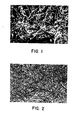
- the distribution of in-situ polymerized polymer in a paper matrix was evaluated by polymerizing p-chlorostyrene at a 22% level in a paper sheet and observing the distribution of the polymer in the resulting composition by a combination of scanning electron microscopy (sem) and X-ray spectral mapping of chlorine atoms.
- the sem photographs (Figs. 1 and 3) show relatively little change in the fiber pattern and suggest that the bulk of the polymer is in the interior of the fibers, although there are a few areas that suggest aggregates of polymer exterior to the fibers.
- the chlorine mappings (Figs. 2 and 4) show a broad distribution of the polymer throughout the pulp matrix, with some areas of the fiber appearing to have a higher concentration of polymer at the surface of the fiber.
Landscapes
- Chemical & Material Sciences (AREA)
- Chemical Kinetics & Catalysis (AREA)
- General Chemical & Material Sciences (AREA)
- Paper (AREA)
- Nonwoven Fabrics (AREA)
- Treatments For Attaching Organic Compounds To Fibrous Goods (AREA)
Applications Claiming Priority (2)
| Application Number | Priority Date | Filing Date | Title |
|---|---|---|---|
| US566987 | 1983-12-30 | ||
| US06/566,987 US4503117A (en) | 1983-12-30 | 1983-12-30 | Paper-polymer product |
Publications (2)
| Publication Number | Publication Date |
|---|---|
| EP0147035A2 true EP0147035A2 (fr) | 1985-07-03 |
| EP0147035A3 EP0147035A3 (fr) | 1985-07-31 |
Family
ID=24265292
Family Applications (1)
| Application Number | Title | Priority Date | Filing Date |
|---|---|---|---|
| EP84307608A Withdrawn EP0147035A3 (fr) | 1983-12-30 | 1984-11-05 | Produit papier-polymère |
Country Status (5)
| Country | Link |
|---|---|
| US (1) | US4503117A (fr) |
| EP (1) | EP0147035A3 (fr) |
| JP (1) | JPS60167992A (fr) |
| AU (1) | AU3495084A (fr) |
| ZA (1) | ZA848520B (fr) |
Cited By (2)
| Publication number | Priority date | Publication date | Assignee | Title |
|---|---|---|---|---|
| WO1997018350A1 (fr) * | 1994-07-29 | 1997-05-22 | Minnesota Mining And Manufacturing Company | Articles en papier satures par un polymere |
| US6586082B1 (en) | 1995-11-15 | 2003-07-01 | 3M Innovative Properties Company | Polymer-saturated paper articles |
Families Citing this family (4)
| Publication number | Priority date | Publication date | Assignee | Title |
|---|---|---|---|---|
| US4613524A (en) * | 1986-01-27 | 1986-09-23 | The Dow Chemical Company | Open-cell composition and method of making same |
| US4647498A (en) * | 1986-01-27 | 1987-03-03 | The Dow Chemical Company | Open-cell composition and method of making same |
| WO2002055774A2 (fr) * | 2000-11-14 | 2002-07-18 | Weyerhaeuser Co | Produit cellulosique reticule forme par un procede d'extrusion |
| JP7142586B2 (ja) * | 2019-02-06 | 2022-09-27 | 株式会社スギノマシン | セルロース繊維乾燥体、セルロース繊維樹脂複合体、成形体 |
Family Cites Families (12)
| Publication number | Priority date | Publication date | Assignee | Title |
|---|---|---|---|---|
| US1686497A (en) * | 1927-03-25 | 1928-10-02 | Acme Aluminum Foundry Company | Securing means for detachable handles |
| US2289339A (en) * | 1938-08-20 | 1942-07-14 | Joseph B Brennan | Method for making electric devices |
| GB527043A (en) * | 1939-03-29 | 1940-10-01 | Distillers Co Yeast Ltd | Improvements in or relating to the manufacture of impregnated paper |
| GB607769A (en) * | 1943-09-09 | 1948-09-06 | James Bayley Butler | Improvements in and relating to the treatment of fibrous materials especially the treatment of documents such as maps |
| US2717841A (en) * | 1951-01-09 | 1955-09-13 | Owens Corning Fiberglass Corp | Bonded glass fiber product and method of making same |
| US3081143A (en) * | 1959-08-04 | 1963-03-12 | American Cyanamid Co | Stiff, strong paper |
| FR1224366A (fr) * | 1960-08-09 | 1960-06-23 | Foundry Equipment Ltd | Perfectionnements aux dispositifs d'alimentation pour machine à mouler de fonderie |
| US3825007A (en) * | 1972-01-07 | 1974-07-23 | R Rand | Pledgets |
| US4051214A (en) * | 1976-01-30 | 1977-09-27 | Weyerhaeuser Company | Method of controlling monomer loss during the production of a fiber-thermoplastic matrix by in situ bulk polymerization |
| US4148949A (en) * | 1976-02-02 | 1979-04-10 | Weyerhaeuser Company | Method of increasing polymerization reaction rates in the production of a fiber-thermoplastic matrix by in situ bulk polymerization |
| US4271227A (en) * | 1979-04-26 | 1981-06-02 | Andrews Paper & Chemical Co., Inc. | Transparent fibrous sheets and process for making |
| US4349616A (en) * | 1979-12-28 | 1982-09-14 | Ricoh Co., Ltd. | Disazo pigment containing electrophotographic element |
-
1983
- 1983-12-30 US US06/566,987 patent/US4503117A/en not_active Expired - Fee Related
-
1984
- 1984-10-31 ZA ZA848520A patent/ZA848520B/xx unknown
- 1984-11-02 AU AU34950/84A patent/AU3495084A/en not_active Abandoned
- 1984-11-05 EP EP84307608A patent/EP0147035A3/fr not_active Withdrawn
- 1984-12-26 JP JP59282110A patent/JPS60167992A/ja active Pending
Cited By (3)
| Publication number | Priority date | Publication date | Assignee | Title |
|---|---|---|---|---|
| WO1997018350A1 (fr) * | 1994-07-29 | 1997-05-22 | Minnesota Mining And Manufacturing Company | Articles en papier satures par un polymere |
| US5853642A (en) * | 1994-07-29 | 1998-12-29 | Minnesota Mining And Manufacturing Company | Process for the in-line polymerization of olefinic monomers |
| US6586082B1 (en) | 1995-11-15 | 2003-07-01 | 3M Innovative Properties Company | Polymer-saturated paper articles |
Also Published As
| Publication number | Publication date |
|---|---|
| US4503117A (en) | 1985-03-05 |
| ZA848520B (en) | 1986-06-25 |
| AU3495084A (en) | 1985-07-04 |
| EP0147035A3 (fr) | 1985-07-31 |
| JPS60167992A (ja) | 1985-08-31 |
Similar Documents
| Publication | Publication Date | Title |
|---|---|---|
| US4966652A (en) | Increasing the stiffness of paper | |
| US5134179A (en) | Composite fiberboard and process of manufacture | |
| US20040221976A1 (en) | Paper articles exhibiting water resistance and method for making same | |
| RU2694755C2 (ru) | Применение упрочняющей композиции для увеличения размерной стабильности во влажных условиях изделия из прессованной волокнистой массы | |
| EP1010807B1 (fr) | Polymères pour l'utilisation comme revêtements de protection | |
| BRPI0821336B1 (pt) | Papel de base para materiais de revestimento decorativos e papel decorativo ou material de revestimento decorativo | |
| US3085026A (en) | Impregnated corrugated paperboard and process of making same | |
| NO166358B (no) | Storsekk med forbedret bunn og topp. | |
| US4271227A (en) | Transparent fibrous sheets and process for making | |
| EP0147035A2 (fr) | Produit papier-polymère | |
| WO2000028141A1 (fr) | Compositions ameliorant les proprietes de resistance physique et la resistance a l'humidite de produits de papier | |
| JPH02127590A (ja) | 製紙機械用織物を変性する方法 | |
| US3674632A (en) | Process for moisture stabilizing cellulosic sheet material using a polyoxyalkylene glycol and a polyoxyethylene-oxypropylene glycol block polymer | |
| PL198822B1 (pl) | Dekoracyjny papier podłożowy i jego zastosowanie | |
| US4612251A (en) | Paper sheet having a very high proportion of latex, process for preparing same and applications thereof particularly as a substitution product for impregnated glass webs | |
| US6565709B1 (en) | Process for producing dimensionally stable release liner and product produced thereof | |
| CN100552132C (zh) | 纸质改进剂 | |
| GB1593331A (en) | Method for the treatment of paper and cardboard to make them water and water vapour resistant | |
| US3989416A (en) | Dense paper and method of manufacturing | |
| JP2816845B2 (ja) | 製紙用表面サイズ剤組成物及び表面サイジング方法 | |
| US3007825A (en) | Emulsion | |
| DE69413536T2 (de) | Behandlung von zellulosematerial | |
| US3264170A (en) | Polyacrylonitrile paper and methods for the manufacture thereof | |
| McMillin | Wood chemical composition as related to properties of handsheets made from loblolly pine refiner groundwood | |
| CA1291303C (fr) | Methode pour accoitre la rigidite du papier, et papier ainsi produit |
Legal Events
| Date | Code | Title | Description |
|---|---|---|---|
| PUAI | Public reference made under article 153(3) epc to a published international application that has entered the european phase |
Free format text: ORIGINAL CODE: 0009012 |
|
| PUAL | Search report despatched |
Free format text: ORIGINAL CODE: 0009013 |
|
| AK | Designated contracting states |
Designated state(s): BE DE FR GB IT NL |
|
| AK | Designated contracting states |
Designated state(s): BE DE FR GB IT NL |
|
| 17P | Request for examination filed |
Effective date: 19860102 |
|
| 17Q | First examination report despatched |
Effective date: 19870305 |
|
| STAA | Information on the status of an ep patent application or granted ep patent |
Free format text: STATUS: THE APPLICATION IS DEEMED TO BE WITHDRAWN |
|
| 18D | Application deemed to be withdrawn |
Effective date: 19870916 |
|
| RIN1 | Information on inventor provided before grant (corrected) |
Inventor name: MURRAY, JAMES GORDON |