EP0147760B1 - Lubrifiant liquide du type émulsion pour la déformation de métal, procédé pour la préparation du lubrifiant et procédé pour la déformation avec le lubrifiant - Google Patents
Lubrifiant liquide du type émulsion pour la déformation de métal, procédé pour la préparation du lubrifiant et procédé pour la déformation avec le lubrifiant Download PDFInfo
- Publication number
- EP0147760B1 EP0147760B1 EP84115601A EP84115601A EP0147760B1 EP 0147760 B1 EP0147760 B1 EP 0147760B1 EP 84115601 A EP84115601 A EP 84115601A EP 84115601 A EP84115601 A EP 84115601A EP 0147760 B1 EP0147760 B1 EP 0147760B1
- Authority
- EP
- European Patent Office
- Prior art keywords
- weight
- parts
- liquid lubricant
- lubricant
- metal forming
- Prior art date
- Legal status (The legal status is an assumption and is not a legal conclusion. Google has not performed a legal analysis and makes no representation as to the accuracy of the status listed.)
- Expired - Lifetime
Links
- 239000010687 lubricating oil Substances 0.000 title claims description 78
- 239000000839 emulsion Substances 0.000 title claims description 49
- 229910052751 metal Inorganic materials 0.000 title claims description 44
- 239000002184 metal Substances 0.000 title claims description 44
- 239000000314 lubricant Substances 0.000 title claims description 41
- 238000000034 method Methods 0.000 title claims description 16
- 238000004519 manufacturing process Methods 0.000 title claims description 8
- 239000002245 particle Substances 0.000 claims description 47
- 239000003995 emulsifying agent Substances 0.000 claims description 34
- 238000003756 stirring Methods 0.000 claims description 33
- 150000003014 phosphoric acid esters Chemical class 0.000 claims description 28
- 230000001050 lubricating effect Effects 0.000 claims description 26
- 239000000203 mixture Substances 0.000 claims description 22
- 239000002480 mineral oil Substances 0.000 claims description 14
- 235000010446 mineral oil Nutrition 0.000 claims description 14
- 239000003921 oil Substances 0.000 claims description 14
- 229920000193 polymethacrylate Polymers 0.000 claims description 10
- WCYCLRZMWNHMFD-UHFFFAOYSA-N bis(8-methylnonyl) hydrogen phosphite Chemical compound CC(C)CCCCCCCOP(O)OCCCCCCCC(C)C WCYCLRZMWNHMFD-UHFFFAOYSA-N 0.000 claims description 8
- UZEFVQBWJSFOFE-UHFFFAOYSA-N dibutyl hydrogen phosphite Chemical compound CCCCOP(O)OCCCC UZEFVQBWJSFOFE-UHFFFAOYSA-N 0.000 claims description 8
- FYOYCZHNDCCGCE-UHFFFAOYSA-N diphenyl hydrogen phosphite Chemical compound C=1C=CC=CC=1OP(O)OC1=CC=CC=C1 FYOYCZHNDCCGCE-UHFFFAOYSA-N 0.000 claims description 8
- 125000005741 alkyl alkenyl group Chemical group 0.000 claims description 7
- 125000000217 alkyl group Chemical group 0.000 claims description 7
- 125000003118 aryl group Chemical group 0.000 claims description 7
- 229920001577 copolymer Polymers 0.000 claims description 7
- CERQOIWHTDAKMF-UHFFFAOYSA-M Methacrylate Chemical compound CC(=C)C([O-])=O CERQOIWHTDAKMF-UHFFFAOYSA-M 0.000 claims description 6
- 229920002367 Polyisobutene Polymers 0.000 claims description 6
- 229920000089 Cyclic olefin copolymer Polymers 0.000 claims description 5
- 125000005250 alkyl acrylate group Chemical group 0.000 claims description 5
- 239000000178 monomer Substances 0.000 claims description 5
- 150000003443 succinic acid derivatives Chemical class 0.000 claims description 5
- 238000012935 Averaging Methods 0.000 claims description 3
- 238000004945 emulsification Methods 0.000 claims description 2
- 230000001804 emulsifying effect Effects 0.000 claims description 2
- 150000008065 acid anhydrides Chemical class 0.000 claims 4
- 239000003795 chemical substances by application Substances 0.000 description 22
- BNMJSBUIDQYHIN-UHFFFAOYSA-N butyl dihydrogen phosphate Chemical compound CCCCOP(O)(O)=O BNMJSBUIDQYHIN-UHFFFAOYSA-N 0.000 description 13
- 239000006185 dispersion Substances 0.000 description 11
- 239000002253 acid Substances 0.000 description 9
- -1 phosphorus compound Chemical class 0.000 description 8
- 230000009467 reduction Effects 0.000 description 8
- 230000000052 comparative effect Effects 0.000 description 7
- 238000011156 evaluation Methods 0.000 description 7
- 239000007788 liquid Substances 0.000 description 7
- 229910019142 PO4 Inorganic materials 0.000 description 6
- 238000000576 coating method Methods 0.000 description 6
- 238000004090 dissolution Methods 0.000 description 6
- 150000002148 esters Chemical class 0.000 description 6
- 238000002156 mixing Methods 0.000 description 6
- 239000010452 phosphate Substances 0.000 description 6
- 229910052698 phosphorus Inorganic materials 0.000 description 6
- 229910000831 Steel Inorganic materials 0.000 description 5
- 239000000654 additive Substances 0.000 description 5
- 230000000694 effects Effects 0.000 description 5
- 238000005191 phase separation Methods 0.000 description 5
- 239000011574 phosphorus Substances 0.000 description 5
- 239000010959 steel Substances 0.000 description 5
- XLYOFNOQVPJJNP-UHFFFAOYSA-N water Substances O XLYOFNOQVPJJNP-UHFFFAOYSA-N 0.000 description 5
- OAICVXFJPJFONN-UHFFFAOYSA-N Phosphorus Chemical compound [P] OAICVXFJPJFONN-UHFFFAOYSA-N 0.000 description 4
- 230000000996 additive effect Effects 0.000 description 4
- 239000011248 coating agent Substances 0.000 description 4
- 238000001125 extrusion Methods 0.000 description 4
- NBIIXXVUZAFLBC-UHFFFAOYSA-K phosphate Chemical compound [O-]P([O-])([O-])=O NBIIXXVUZAFLBC-UHFFFAOYSA-K 0.000 description 4
- 230000006641 stabilisation Effects 0.000 description 4
- 238000011105 stabilization Methods 0.000 description 4
- 238000012360 testing method Methods 0.000 description 4
- LFQSCWFLJHTTHZ-UHFFFAOYSA-N Ethanol Chemical compound CCO LFQSCWFLJHTTHZ-UHFFFAOYSA-N 0.000 description 3
- 239000011521 glass Substances 0.000 description 3
- 238000005461 lubrication Methods 0.000 description 3
- 229920000642 polymer Polymers 0.000 description 3
- 230000002035 prolonged effect Effects 0.000 description 3
- 238000010008 shearing Methods 0.000 description 3
- 239000007787 solid Substances 0.000 description 3
- 239000000725 suspension Substances 0.000 description 3
- 239000004711 α-olefin Substances 0.000 description 3
- RTZKZFJDLAIYFH-UHFFFAOYSA-N Diethyl ether Chemical compound CCOCC RTZKZFJDLAIYFH-UHFFFAOYSA-N 0.000 description 2
- BPQQTUXANYXVAA-UHFFFAOYSA-N Orthosilicate Chemical compound [O-][Si]([O-])([O-])[O-] BPQQTUXANYXVAA-UHFFFAOYSA-N 0.000 description 2
- NBIIXXVUZAFLBC-UHFFFAOYSA-N Phosphoric acid Chemical compound OP(O)(O)=O NBIIXXVUZAFLBC-UHFFFAOYSA-N 0.000 description 2
- 239000005864 Sulphur Substances 0.000 description 2
- 229910052783 alkali metal Inorganic materials 0.000 description 2
- 150000001340 alkali metals Chemical class 0.000 description 2
- 229910052782 aluminium Inorganic materials 0.000 description 2
- XAGFODPZIPBFFR-UHFFFAOYSA-N aluminium Chemical compound [Al] XAGFODPZIPBFFR-UHFFFAOYSA-N 0.000 description 2
- 150000001412 amines Chemical class 0.000 description 2
- 230000015572 biosynthetic process Effects 0.000 description 2
- 125000004432 carbon atom Chemical group C* 0.000 description 2
- 150000001768 cations Chemical class 0.000 description 2
- 238000006243 chemical reaction Methods 0.000 description 2
- 239000010696 ester oil Substances 0.000 description 2
- JEIPFZHSYJVQDO-UHFFFAOYSA-N iron(III) oxide Inorganic materials O=[Fe]O[Fe]=O JEIPFZHSYJVQDO-UHFFFAOYSA-N 0.000 description 2
- 239000003209 petroleum derivative Substances 0.000 description 2
- 239000004033 plastic Substances 0.000 description 2
- 229920003023 plastic Polymers 0.000 description 2
- 238000002360 preparation method Methods 0.000 description 2
- 239000000047 product Substances 0.000 description 2
- 150000003839 salts Chemical class 0.000 description 2
- 238000004062 sedimentation Methods 0.000 description 2
- 239000000344 soap Substances 0.000 description 2
- 239000003381 stabilizer Substances 0.000 description 2
- 229910001220 stainless steel Inorganic materials 0.000 description 2
- 239000010935 stainless steel Substances 0.000 description 2
- 150000003900 succinic acid esters Chemical class 0.000 description 2
- RINCXYDBBGOEEQ-UHFFFAOYSA-N succinic anhydride Chemical compound O=C1CCC(=O)O1 RINCXYDBBGOEEQ-UHFFFAOYSA-N 0.000 description 2
- KZNICNPSHKQLFF-UHFFFAOYSA-N succinimide Chemical compound O=C1CCC(=O)N1 KZNICNPSHKQLFF-UHFFFAOYSA-N 0.000 description 2
- 238000011282 treatment Methods 0.000 description 2
- 238000009736 wetting Methods 0.000 description 2
- WRIDQFICGBMAFQ-UHFFFAOYSA-N (E)-8-Octadecenoic acid Natural products CCCCCCCCCC=CCCCCCCC(O)=O WRIDQFICGBMAFQ-UHFFFAOYSA-N 0.000 description 1
- QGLWBTPVKHMVHM-KTKRTIGZSA-N (z)-octadec-9-en-1-amine Chemical compound CCCCCCCC\C=C/CCCCCCCCN QGLWBTPVKHMVHM-KTKRTIGZSA-N 0.000 description 1
- AWQFNUMHFNEWGS-UHFFFAOYSA-N 2-methylprop-1-ene;styrene Chemical group CC(C)=C.C=CC1=CC=CC=C1 AWQFNUMHFNEWGS-UHFFFAOYSA-N 0.000 description 1
- LQJBNNIYVWPHFW-UHFFFAOYSA-N 20:1omega9c fatty acid Natural products CCCCCCCCCCC=CCCCCCCCC(O)=O LQJBNNIYVWPHFW-UHFFFAOYSA-N 0.000 description 1
- OZFLRNPZLCUVFP-UHFFFAOYSA-N 8-methylnonyl dihydrogen phosphate Chemical compound CC(C)CCCCCCCOP(O)(O)=O OZFLRNPZLCUVFP-UHFFFAOYSA-N 0.000 description 1
- QSBYPNXLFMSGKH-UHFFFAOYSA-N 9-Heptadecensaeure Natural products CCCCCCCC=CCCCCCCCC(O)=O QSBYPNXLFMSGKH-UHFFFAOYSA-N 0.000 description 1
- OKTJSMMVPCPJKN-UHFFFAOYSA-N Carbon Chemical compound [C] OKTJSMMVPCPJKN-UHFFFAOYSA-N 0.000 description 1
- ZAMOUSCENKQFHK-UHFFFAOYSA-N Chlorine atom Chemical compound [Cl] ZAMOUSCENKQFHK-UHFFFAOYSA-N 0.000 description 1
- RYGMFSIKBFXOCR-UHFFFAOYSA-N Copper Chemical compound [Cu] RYGMFSIKBFXOCR-UHFFFAOYSA-N 0.000 description 1
- 239000005642 Oleic acid Substances 0.000 description 1
- ZQPPMHVWECSIRJ-UHFFFAOYSA-N Oleic acid Natural products CCCCCCCCC=CCCCCCCCC(O)=O ZQPPMHVWECSIRJ-UHFFFAOYSA-N 0.000 description 1
- 239000004793 Polystyrene Substances 0.000 description 1
- NINIDFKCEFEMDL-UHFFFAOYSA-N Sulfur Chemical compound [S] NINIDFKCEFEMDL-UHFFFAOYSA-N 0.000 description 1
- 150000007513 acids Chemical class 0.000 description 1
- 150000003973 alkyl amines Chemical class 0.000 description 1
- 125000005233 alkylalcohol group Chemical group 0.000 description 1
- 229910000147 aluminium phosphate Inorganic materials 0.000 description 1
- 150000001408 amides Chemical class 0.000 description 1
- 239000003963 antioxidant agent Substances 0.000 description 1
- 230000003078 antioxidant effect Effects 0.000 description 1
- 239000002585 base Substances 0.000 description 1
- 239000002199 base oil Substances 0.000 description 1
- 235000015278 beef Nutrition 0.000 description 1
- KGBXLFKZBHKPEV-UHFFFAOYSA-N boric acid Chemical compound OB(O)O KGBXLFKZBHKPEV-UHFFFAOYSA-N 0.000 description 1
- 239000004327 boric acid Substances 0.000 description 1
- 230000001680 brushing effect Effects 0.000 description 1
- FJTUUPVRIANHEX-UHFFFAOYSA-N butan-1-ol;phosphoric acid Chemical compound CCCCO.OP(O)(O)=O FJTUUPVRIANHEX-UHFFFAOYSA-N 0.000 description 1
- 150000004649 carbonic acid derivatives Chemical class 0.000 description 1
- 150000001732 carboxylic acid derivatives Chemical class 0.000 description 1
- 238000005266 casting Methods 0.000 description 1
- 125000002091 cationic group Chemical group 0.000 description 1
- 239000000919 ceramic Substances 0.000 description 1
- 239000007795 chemical reaction product Substances 0.000 description 1
- 239000000460 chlorine Substances 0.000 description 1
- 229910052801 chlorine Inorganic materials 0.000 description 1
- 229910052804 chromium Inorganic materials 0.000 description 1
- VNTLIPZTSJSULJ-UHFFFAOYSA-N chromium molybdenum Chemical compound [Cr].[Mo] VNTLIPZTSJSULJ-UHFFFAOYSA-N 0.000 description 1
- 238000005097 cold rolling Methods 0.000 description 1
- 238000010276 construction Methods 0.000 description 1
- 229910052802 copper Inorganic materials 0.000 description 1
- 239000010949 copper Substances 0.000 description 1
- 230000007797 corrosion Effects 0.000 description 1
- 238000005260 corrosion Methods 0.000 description 1
- 238000005536 corrosion prevention Methods 0.000 description 1
- 230000006866 deterioration Effects 0.000 description 1
- 238000010586 diagram Methods 0.000 description 1
- VJHINFRRDQUWOJ-UHFFFAOYSA-N dioctyl sebacate Chemical compound CCCCC(CC)COC(=O)CCCCCCCCC(=O)OCC(CC)CCCC VJHINFRRDQUWOJ-UHFFFAOYSA-N 0.000 description 1
- 238000007598 dipping method Methods 0.000 description 1
- 238000009826 distribution Methods 0.000 description 1
- 238000001035 drying Methods 0.000 description 1
- 238000003912 environmental pollution Methods 0.000 description 1
- 239000010419 fine particle Substances 0.000 description 1
- 230000009969 flowable effect Effects 0.000 description 1
- 239000000446 fuel Substances 0.000 description 1
- 239000003502 gasoline Substances 0.000 description 1
- 239000010439 graphite Substances 0.000 description 1
- 229910002804 graphite Inorganic materials 0.000 description 1
- 230000005484 gravity Effects 0.000 description 1
- 238000010438 heat treatment Methods 0.000 description 1
- 238000005098 hot rolling Methods 0.000 description 1
- 150000004679 hydroxides Chemical class 0.000 description 1
- 230000002401 inhibitory effect Effects 0.000 description 1
- 238000010409 ironing Methods 0.000 description 1
- QXJSBBXBKPUZAA-UHFFFAOYSA-N isooleic acid Natural products CCCCCCCC=CCCCCCCCCC(O)=O QXJSBBXBKPUZAA-UHFFFAOYSA-N 0.000 description 1
- QPPQHRDVPBTVEV-UHFFFAOYSA-N isopropyl dihydrogen phosphate Chemical compound CC(C)OP(O)(O)=O QPPQHRDVPBTVEV-UHFFFAOYSA-N 0.000 description 1
- 208000037805 labour Diseases 0.000 description 1
- PBOSTUDLECTMNL-UHFFFAOYSA-N lauryl acrylate Chemical compound CCCCCCCCCCCCOC(=O)C=C PBOSTUDLECTMNL-UHFFFAOYSA-N 0.000 description 1
- 229910052748 manganese Inorganic materials 0.000 description 1
- 239000000463 material Substances 0.000 description 1
- 238000005555 metalworking Methods 0.000 description 1
- 125000002496 methyl group Chemical group [H]C([H])([H])* 0.000 description 1
- 229910052750 molybdenum Inorganic materials 0.000 description 1
- CWQXQMHSOZUFJS-UHFFFAOYSA-N molybdenum disulfide Chemical compound S=[Mo]=S CWQXQMHSOZUFJS-UHFFFAOYSA-N 0.000 description 1
- 229910052982 molybdenum disulfide Inorganic materials 0.000 description 1
- 238000006386 neutralization reaction Methods 0.000 description 1
- 150000002823 nitrates Chemical class 0.000 description 1
- 150000002825 nitriles Chemical class 0.000 description 1
- ZQPPMHVWECSIRJ-KTKRTIGZSA-N oleic acid Chemical compound CCCCCCCC\C=C/CCCCCCCC(O)=O ZQPPMHVWECSIRJ-KTKRTIGZSA-N 0.000 description 1
- 230000003287 optical effect Effects 0.000 description 1
- 230000003647 oxidation Effects 0.000 description 1
- 238000007254 oxidation reaction Methods 0.000 description 1
- 150000008301 phosphite esters Chemical class 0.000 description 1
- 150000003018 phosphorus compounds Chemical class 0.000 description 1
- 239000000088 plastic resin Substances 0.000 description 1
- 229920000058 polyacrylate Polymers 0.000 description 1
- 229920001083 polybutene Polymers 0.000 description 1
- 229920005862 polyol Polymers 0.000 description 1
- 229920000098 polyolefin Polymers 0.000 description 1
- 150000003077 polyols Chemical class 0.000 description 1
- 229920000137 polyphosphoric acid Polymers 0.000 description 1
- 229920002223 polystyrene Polymers 0.000 description 1
- 239000000843 powder Substances 0.000 description 1
- 230000002265 prevention Effects 0.000 description 1
- 238000012545 processing Methods 0.000 description 1
- 230000009257 reactivity Effects 0.000 description 1
- 239000011347 resin Substances 0.000 description 1
- 229920005989 resin Polymers 0.000 description 1
- 238000005070 sampling Methods 0.000 description 1
- 238000007493 shaping process Methods 0.000 description 1
- 229920002545 silicone oil Polymers 0.000 description 1
- 238000005507 spraying Methods 0.000 description 1
- 230000000087 stabilizing effect Effects 0.000 description 1
- 229960002317 succinimide Drugs 0.000 description 1
- 150000003467 sulfuric acid derivatives Chemical class 0.000 description 1
- 239000003760 tallow Substances 0.000 description 1
- 239000010723 turbine oil Substances 0.000 description 1
- 239000002699 waste material Substances 0.000 description 1
Images


Classifications
-
- C—CHEMISTRY; METALLURGY
- C10—PETROLEUM, GAS OR COKE INDUSTRIES; TECHNICAL GASES CONTAINING CARBON MONOXIDE; FUELS; LUBRICANTS; PEAT
- C10M—LUBRICATING COMPOSITIONS; USE OF CHEMICAL SUBSTANCES EITHER ALONE OR AS LUBRICATING INGREDIENTS IN A LUBRICATING COMPOSITION
- C10M161/00—Lubricating compositions characterised by the additive being a mixture of a macromolecular compound and a non-macromolecular compound, each of these compounds being essential
-
- C—CHEMISTRY; METALLURGY
- C10—PETROLEUM, GAS OR COKE INDUSTRIES; TECHNICAL GASES CONTAINING CARBON MONOXIDE; FUELS; LUBRICANTS; PEAT
- C10M—LUBRICATING COMPOSITIONS; USE OF CHEMICAL SUBSTANCES EITHER ALONE OR AS LUBRICATING INGREDIENTS IN A LUBRICATING COMPOSITION
- C10M129/00—Lubricating compositions characterised by the additive being an organic non-macromolecular compound containing oxygen
- C10M129/86—Lubricating compositions characterised by the additive being an organic non-macromolecular compound containing oxygen having a carbon chain of 30 or more atoms
- C10M129/92—Carboxylic acids
-
- C—CHEMISTRY; METALLURGY
- C10—PETROLEUM, GAS OR COKE INDUSTRIES; TECHNICAL GASES CONTAINING CARBON MONOXIDE; FUELS; LUBRICANTS; PEAT
- C10M—LUBRICATING COMPOSITIONS; USE OF CHEMICAL SUBSTANCES EITHER ALONE OR AS LUBRICATING INGREDIENTS IN A LUBRICATING COMPOSITION
- C10M133/00—Lubricating compositions characterised by the additive being an organic non-macromolecular compound containing nitrogen
- C10M133/52—Lubricating compositions characterised by the additive being an organic non-macromolecular compound containing nitrogen having a carbon chain of 30 or more atoms
- C10M133/56—Amides; Imides
-
- C—CHEMISTRY; METALLURGY
- C10—PETROLEUM, GAS OR COKE INDUSTRIES; TECHNICAL GASES CONTAINING CARBON MONOXIDE; FUELS; LUBRICANTS; PEAT
- C10M—LUBRICATING COMPOSITIONS; USE OF CHEMICAL SUBSTANCES EITHER ALONE OR AS LUBRICATING INGREDIENTS IN A LUBRICATING COMPOSITION
- C10M137/00—Lubricating compositions characterised by the additive being an organic non-macromolecular compound containing phosphorus
- C10M137/02—Lubricating compositions characterised by the additive being an organic non-macromolecular compound containing phosphorus having no phosphorus-to-carbon bond
- C10M137/04—Phosphate esters
-
- C—CHEMISTRY; METALLURGY
- C10—PETROLEUM, GAS OR COKE INDUSTRIES; TECHNICAL GASES CONTAINING CARBON MONOXIDE; FUELS; LUBRICANTS; PEAT
- C10M—LUBRICATING COMPOSITIONS; USE OF CHEMICAL SUBSTANCES EITHER ALONE OR AS LUBRICATING INGREDIENTS IN A LUBRICATING COMPOSITION
- C10M143/00—Lubricating compositions characterised by the additive being a macromolecular hydrocarbon or such hydrocarbon modified by oxidation
-
- C—CHEMISTRY; METALLURGY
- C10—PETROLEUM, GAS OR COKE INDUSTRIES; TECHNICAL GASES CONTAINING CARBON MONOXIDE; FUELS; LUBRICANTS; PEAT
- C10M—LUBRICATING COMPOSITIONS; USE OF CHEMICAL SUBSTANCES EITHER ALONE OR AS LUBRICATING INGREDIENTS IN A LUBRICATING COMPOSITION
- C10M145/00—Lubricating compositions characterised by the additive being a macromolecular compound containing oxygen
- C10M145/02—Macromolecular compounds obtained by reactions only involving carbon-to-carbon unsaturated bonds
- C10M145/10—Macromolecular compounds obtained by reactions only involving carbon-to-carbon unsaturated bonds containing monomers having an unsaturated radical bound to a carboxyl radical, e.g. acrylate
- C10M145/12—Macromolecular compounds obtained by reactions only involving carbon-to-carbon unsaturated bonds containing monomers having an unsaturated radical bound to a carboxyl radical, e.g. acrylate monocarboxylic
- C10M145/14—Acrylate; Methacrylate
-
- C—CHEMISTRY; METALLURGY
- C10—PETROLEUM, GAS OR COKE INDUSTRIES; TECHNICAL GASES CONTAINING CARBON MONOXIDE; FUELS; LUBRICANTS; PEAT
- C10M—LUBRICATING COMPOSITIONS; USE OF CHEMICAL SUBSTANCES EITHER ALONE OR AS LUBRICATING INGREDIENTS IN A LUBRICATING COMPOSITION
- C10M149/00—Lubricating compositions characterised by the additive being a macromolecular compound containing nitrogen
- C10M149/02—Macromolecular compounds obtained by reactions only involving carbon-to-carbon unsaturated bonds
- C10M149/10—Macromolecular compounds obtained by reactions only involving carbon-to-carbon unsaturated bonds containing monomers having an unsaturated radical bound to a nitrogen-containing hetero ring
-
- C—CHEMISTRY; METALLURGY
- C10—PETROLEUM, GAS OR COKE INDUSTRIES; TECHNICAL GASES CONTAINING CARBON MONOXIDE; FUELS; LUBRICANTS; PEAT
- C10M—LUBRICATING COMPOSITIONS; USE OF CHEMICAL SUBSTANCES EITHER ALONE OR AS LUBRICATING INGREDIENTS IN A LUBRICATING COMPOSITION
- C10M2205/00—Organic macromolecular hydrocarbon compounds or fractions, whether or not modified by oxidation as ingredients in lubricant compositions
-
- C—CHEMISTRY; METALLURGY
- C10—PETROLEUM, GAS OR COKE INDUSTRIES; TECHNICAL GASES CONTAINING CARBON MONOXIDE; FUELS; LUBRICANTS; PEAT
- C10M—LUBRICATING COMPOSITIONS; USE OF CHEMICAL SUBSTANCES EITHER ALONE OR AS LUBRICATING INGREDIENTS IN A LUBRICATING COMPOSITION
- C10M2205/00—Organic macromolecular hydrocarbon compounds or fractions, whether or not modified by oxidation as ingredients in lubricant compositions
- C10M2205/02—Organic macromolecular hydrocarbon compounds or fractions, whether or not modified by oxidation as ingredients in lubricant compositions containing acyclic monomers
-
- C—CHEMISTRY; METALLURGY
- C10—PETROLEUM, GAS OR COKE INDUSTRIES; TECHNICAL GASES CONTAINING CARBON MONOXIDE; FUELS; LUBRICANTS; PEAT
- C10M—LUBRICATING COMPOSITIONS; USE OF CHEMICAL SUBSTANCES EITHER ALONE OR AS LUBRICATING INGREDIENTS IN A LUBRICATING COMPOSITION
- C10M2205/00—Organic macromolecular hydrocarbon compounds or fractions, whether or not modified by oxidation as ingredients in lubricant compositions
- C10M2205/02—Organic macromolecular hydrocarbon compounds or fractions, whether or not modified by oxidation as ingredients in lubricant compositions containing acyclic monomers
- C10M2205/022—Ethene
-
- C—CHEMISTRY; METALLURGY
- C10—PETROLEUM, GAS OR COKE INDUSTRIES; TECHNICAL GASES CONTAINING CARBON MONOXIDE; FUELS; LUBRICANTS; PEAT
- C10M—LUBRICATING COMPOSITIONS; USE OF CHEMICAL SUBSTANCES EITHER ALONE OR AS LUBRICATING INGREDIENTS IN A LUBRICATING COMPOSITION
- C10M2205/00—Organic macromolecular hydrocarbon compounds or fractions, whether or not modified by oxidation as ingredients in lubricant compositions
- C10M2205/04—Organic macromolecular hydrocarbon compounds or fractions, whether or not modified by oxidation as ingredients in lubricant compositions containing aromatic monomers, e.g. styrene
-
- C—CHEMISTRY; METALLURGY
- C10—PETROLEUM, GAS OR COKE INDUSTRIES; TECHNICAL GASES CONTAINING CARBON MONOXIDE; FUELS; LUBRICANTS; PEAT
- C10M—LUBRICATING COMPOSITIONS; USE OF CHEMICAL SUBSTANCES EITHER ALONE OR AS LUBRICATING INGREDIENTS IN A LUBRICATING COMPOSITION
- C10M2205/00—Organic macromolecular hydrocarbon compounds or fractions, whether or not modified by oxidation as ingredients in lubricant compositions
- C10M2205/14—Synthetic waxes, e.g. polythene waxes
-
- C—CHEMISTRY; METALLURGY
- C10—PETROLEUM, GAS OR COKE INDUSTRIES; TECHNICAL GASES CONTAINING CARBON MONOXIDE; FUELS; LUBRICANTS; PEAT
- C10M—LUBRICATING COMPOSITIONS; USE OF CHEMICAL SUBSTANCES EITHER ALONE OR AS LUBRICATING INGREDIENTS IN A LUBRICATING COMPOSITION
- C10M2207/00—Organic non-macromolecular hydrocarbon compounds containing hydrogen, carbon and oxygen as ingredients in lubricant compositions
- C10M2207/10—Carboxylix acids; Neutral salts thereof
- C10M2207/12—Carboxylix acids; Neutral salts thereof having carboxyl groups bound to acyclic or cycloaliphatic carbon atoms
- C10M2207/129—Carboxylix acids; Neutral salts thereof having carboxyl groups bound to acyclic or cycloaliphatic carbon atoms having hydrocarbon chains of thirty or more carbon atoms
-
- C—CHEMISTRY; METALLURGY
- C10—PETROLEUM, GAS OR COKE INDUSTRIES; TECHNICAL GASES CONTAINING CARBON MONOXIDE; FUELS; LUBRICANTS; PEAT
- C10M—LUBRICATING COMPOSITIONS; USE OF CHEMICAL SUBSTANCES EITHER ALONE OR AS LUBRICATING INGREDIENTS IN A LUBRICATING COMPOSITION
- C10M2207/00—Organic non-macromolecular hydrocarbon compounds containing hydrogen, carbon and oxygen as ingredients in lubricant compositions
- C10M2207/28—Esters
- C10M2207/287—Partial esters
-
- C—CHEMISTRY; METALLURGY
- C10—PETROLEUM, GAS OR COKE INDUSTRIES; TECHNICAL GASES CONTAINING CARBON MONOXIDE; FUELS; LUBRICANTS; PEAT
- C10M—LUBRICATING COMPOSITIONS; USE OF CHEMICAL SUBSTANCES EITHER ALONE OR AS LUBRICATING INGREDIENTS IN A LUBRICATING COMPOSITION
- C10M2209/00—Organic macromolecular compounds containing oxygen as ingredients in lubricant compositions
- C10M2209/02—Macromolecular compounds obtained by reactions only involving carbon-to-carbon unsaturated bonds
- C10M2209/08—Macromolecular compounds obtained by reactions only involving carbon-to-carbon unsaturated bonds containing monomers having an unsaturated radical bound to a carboxyl radical, e.g. acrylate type
- C10M2209/084—Acrylate; Methacrylate
-
- C—CHEMISTRY; METALLURGY
- C10—PETROLEUM, GAS OR COKE INDUSTRIES; TECHNICAL GASES CONTAINING CARBON MONOXIDE; FUELS; LUBRICANTS; PEAT
- C10M—LUBRICATING COMPOSITIONS; USE OF CHEMICAL SUBSTANCES EITHER ALONE OR AS LUBRICATING INGREDIENTS IN A LUBRICATING COMPOSITION
- C10M2215/00—Organic non-macromolecular compounds containing nitrogen as ingredients in lubricant Compositions
- C10M2215/24—Organic non-macromolecular compounds containing nitrogen as ingredients in lubricant Compositions having hydrocarbon substituents containing thirty or more carbon atoms, e.g. nitrogen derivatives of substituted succinic acid
- C10M2215/28—Amides; Imides
-
- C—CHEMISTRY; METALLURGY
- C10—PETROLEUM, GAS OR COKE INDUSTRIES; TECHNICAL GASES CONTAINING CARBON MONOXIDE; FUELS; LUBRICANTS; PEAT
- C10M—LUBRICATING COMPOSITIONS; USE OF CHEMICAL SUBSTANCES EITHER ALONE OR AS LUBRICATING INGREDIENTS IN A LUBRICATING COMPOSITION
- C10M2217/00—Organic macromolecular compounds containing nitrogen as ingredients in lubricant compositions
- C10M2217/02—Macromolecular compounds obtained from nitrogen containing monomers by reactions only involving carbon-to-carbon unsaturated bonds
- C10M2217/028—Macromolecular compounds obtained from nitrogen containing monomers by reactions only involving carbon-to-carbon unsaturated bonds containing monomers having an unsaturated radical bound to a nitrogen-containing hetero ring
-
- C—CHEMISTRY; METALLURGY
- C10—PETROLEUM, GAS OR COKE INDUSTRIES; TECHNICAL GASES CONTAINING CARBON MONOXIDE; FUELS; LUBRICANTS; PEAT
- C10M—LUBRICATING COMPOSITIONS; USE OF CHEMICAL SUBSTANCES EITHER ALONE OR AS LUBRICATING INGREDIENTS IN A LUBRICATING COMPOSITION
- C10M2217/00—Organic macromolecular compounds containing nitrogen as ingredients in lubricant compositions
- C10M2217/06—Macromolecular compounds obtained by functionalisation op polymers with a nitrogen containing compound
-
- C—CHEMISTRY; METALLURGY
- C10—PETROLEUM, GAS OR COKE INDUSTRIES; TECHNICAL GASES CONTAINING CARBON MONOXIDE; FUELS; LUBRICANTS; PEAT
- C10M—LUBRICATING COMPOSITIONS; USE OF CHEMICAL SUBSTANCES EITHER ALONE OR AS LUBRICATING INGREDIENTS IN A LUBRICATING COMPOSITION
- C10M2223/00—Organic non-macromolecular compounds containing phosphorus as ingredients in lubricant compositions
- C10M2223/02—Organic non-macromolecular compounds containing phosphorus as ingredients in lubricant compositions having no phosphorus-to-carbon bonds
- C10M2223/04—Phosphate esters
-
- C—CHEMISTRY; METALLURGY
- C10—PETROLEUM, GAS OR COKE INDUSTRIES; TECHNICAL GASES CONTAINING CARBON MONOXIDE; FUELS; LUBRICANTS; PEAT
- C10M—LUBRICATING COMPOSITIONS; USE OF CHEMICAL SUBSTANCES EITHER ALONE OR AS LUBRICATING INGREDIENTS IN A LUBRICATING COMPOSITION
- C10M2223/00—Organic non-macromolecular compounds containing phosphorus as ingredients in lubricant compositions
- C10M2223/02—Organic non-macromolecular compounds containing phosphorus as ingredients in lubricant compositions having no phosphorus-to-carbon bonds
- C10M2223/04—Phosphate esters
- C10M2223/042—Metal salts thereof
-
- C—CHEMISTRY; METALLURGY
- C10—PETROLEUM, GAS OR COKE INDUSTRIES; TECHNICAL GASES CONTAINING CARBON MONOXIDE; FUELS; LUBRICANTS; PEAT
- C10N—INDEXING SCHEME ASSOCIATED WITH SUBCLASS C10M RELATING TO LUBRICATING COMPOSITIONS
- C10N2040/00—Specified use or application for which the lubricating composition is intended
- C10N2040/20—Metal working
- C10N2040/24—Metal working without essential removal of material, e.g. forming, gorging, drawing, pressing, stamping, rolling or extruding; Punching metal
-
- C—CHEMISTRY; METALLURGY
- C10—PETROLEUM, GAS OR COKE INDUSTRIES; TECHNICAL GASES CONTAINING CARBON MONOXIDE; FUELS; LUBRICANTS; PEAT
- C10N—INDEXING SCHEME ASSOCIATED WITH SUBCLASS C10M RELATING TO LUBRICATING COMPOSITIONS
- C10N2040/00—Specified use or application for which the lubricating composition is intended
- C10N2040/20—Metal working
- C10N2040/241—Manufacturing joint-less pipes
-
- C—CHEMISTRY; METALLURGY
- C10—PETROLEUM, GAS OR COKE INDUSTRIES; TECHNICAL GASES CONTAINING CARBON MONOXIDE; FUELS; LUBRICANTS; PEAT
- C10N—INDEXING SCHEME ASSOCIATED WITH SUBCLASS C10M RELATING TO LUBRICATING COMPOSITIONS
- C10N2040/00—Specified use or application for which the lubricating composition is intended
- C10N2040/20—Metal working
- C10N2040/242—Hot working
-
- C—CHEMISTRY; METALLURGY
- C10—PETROLEUM, GAS OR COKE INDUSTRIES; TECHNICAL GASES CONTAINING CARBON MONOXIDE; FUELS; LUBRICANTS; PEAT
- C10N—INDEXING SCHEME ASSOCIATED WITH SUBCLASS C10M RELATING TO LUBRICATING COMPOSITIONS
- C10N2040/00—Specified use or application for which the lubricating composition is intended
- C10N2040/20—Metal working
- C10N2040/243—Cold working
-
- C—CHEMISTRY; METALLURGY
- C10—PETROLEUM, GAS OR COKE INDUSTRIES; TECHNICAL GASES CONTAINING CARBON MONOXIDE; FUELS; LUBRICANTS; PEAT
- C10N—INDEXING SCHEME ASSOCIATED WITH SUBCLASS C10M RELATING TO LUBRICATING COMPOSITIONS
- C10N2040/00—Specified use or application for which the lubricating composition is intended
- C10N2040/20—Metal working
- C10N2040/244—Metal working of specific metals
-
- C—CHEMISTRY; METALLURGY
- C10—PETROLEUM, GAS OR COKE INDUSTRIES; TECHNICAL GASES CONTAINING CARBON MONOXIDE; FUELS; LUBRICANTS; PEAT
- C10N—INDEXING SCHEME ASSOCIATED WITH SUBCLASS C10M RELATING TO LUBRICATING COMPOSITIONS
- C10N2040/00—Specified use or application for which the lubricating composition is intended
- C10N2040/20—Metal working
- C10N2040/244—Metal working of specific metals
- C10N2040/245—Soft metals, e.g. aluminum
-
- C—CHEMISTRY; METALLURGY
- C10—PETROLEUM, GAS OR COKE INDUSTRIES; TECHNICAL GASES CONTAINING CARBON MONOXIDE; FUELS; LUBRICANTS; PEAT
- C10N—INDEXING SCHEME ASSOCIATED WITH SUBCLASS C10M RELATING TO LUBRICATING COMPOSITIONS
- C10N2040/00—Specified use or application for which the lubricating composition is intended
- C10N2040/20—Metal working
- C10N2040/244—Metal working of specific metals
- C10N2040/246—Iron or steel
-
- C—CHEMISTRY; METALLURGY
- C10—PETROLEUM, GAS OR COKE INDUSTRIES; TECHNICAL GASES CONTAINING CARBON MONOXIDE; FUELS; LUBRICANTS; PEAT
- C10N—INDEXING SCHEME ASSOCIATED WITH SUBCLASS C10M RELATING TO LUBRICATING COMPOSITIONS
- C10N2040/00—Specified use or application for which the lubricating composition is intended
- C10N2040/20—Metal working
- C10N2040/244—Metal working of specific metals
- C10N2040/247—Stainless steel
Definitions
- EP-A-0 146 140 which is a related European patent application
- This invention relates to an emulsion type lubricant for metal forming, which can form a lubricating film on a metal surface by virtue of the heat generated by deformation or friction during the metal forming such as cold forming, to a process for preparing said lubricant and also to a process for metal forming with said lubricant.
- a lubricant for medal forming must have a satisfactory lubricating ability up to an elevated temperature caused by deformation, friction, etc. and also to increasing new surface area of a workpiece created by the metal formation.
- the lubricants so far proposed for this purpose are water-soluble or water-insoluble liquid lubricants containing mineral oil or synthetic oil or their mixture as the major component and further containing a semi-solid lubricant such as metal soap, beef tallow, etc., a sulfurbased, chlorine-based, or phosphorus-based extreme pressure agent, or a solid lubricant such as graphite, molybdenum disulfide, etc.
- lubricants can be used, without any problem, for the metal forming with low reduction of area, but in the case of high reduction of area which produces a higher temperature or a higher surface pressure, or in the case of forming products of complicated shapes, their load-carrying capacity, heat resistance, etc. are not satisfactory, resulting in galling.
- For the lubrication for larger plastic deformation, or forming products of complicated shapes it has been so far proposed to plate a workpiece surface with a soft metal, such as copper, etc., or to coat a workpiece surface with a plastic resin film.
- a treating process comprising a series of such steps as defatting-water washing-acid pickling-phosphate treatment-water washing-neutralization treatment-metal soap lubrication treatment-heat drying of a workpiece is also well known.
- FR-A-2,289,601 discloses a lubricant composition for use in metal shaping, especially hot and cold rolling of steel and aluminum and casting of aluminum which lubricant comprises a major amount of a mineral oil, an important amount of a pentaerythritoltetraester, a small amount of a phosphorus compound as well as an emulsifier.
- the phosphorus compounds are oxides or acids of phosphorus although phosphoric acid esters are also mentioned as useful for the intended purpose.
- GB-A 965,445 discloses a composition as an additive for petroleum products such as polymers, fuel, resins, gasoline, transformer oil and turbine oil in order to achieve stabilization, oxidation prevention and corrosion prevention of the petroleum products.
- the additives described therein are not directly used as a lubricant for metal forming. Any teaching with respect to a specific particle size of phosphoric acid esters cannot be derived from said document.
- DE-A 2,145,296 describes a mixture consisting of a sulphur compound and a phosphate ester as an additive to metal working compositions.
- the compositions disclosed in said document are clear solutions, wherein the additive is not present is a dispersed state. Furthermore, the compositions require the sulphur containing component to achieve the desired combination of good characteristics.
- DE-A 2,222,181 relates to a process for lubricating wherein a lubricating oil is used which has been supplemented by specific polystyrene based polymers. Any further additive being identical or similar to phosphoric acid esters according to the present invention cannot be derived from said document.
- a lubricant for cold forming which is prepared by reaction of a multivalent metal cation, orthophosphate, and alkyl alcohol or alkylaryl alcohol having 10 to 36 carbon atoms, and which has a water content of not more than 20% by weight has been proposed (Japanese Patent Publication kokai (Laid-open) No.
- These lubricants show good results in drawing processing of pipes, etc., but fail to meet the requirements for forming steel workpieces with high reduction of area.
- An object of the present invention is to provide an emulsion type, substantially water-free, liquid lubricant for metal forming, which can have an excellent lubricating ability and a good heat resistance even under high reductions of area which produces a higher temperature and a higher pressure at the sliding interface between a tool and a workpiece, and can give a distinguished formability during the cold forming, where an extreme pressure agent is stably dispersed.
- Another object of the present invention is to provide a process for preparing an emulsion-type, liquid lubricant for metal forming, where an extreme pressure agent is stably dispersed.
- object of the present invention is to provide a process for metal forming in a very simple manner in forming a lubricating film, using an emulsion-type substantially water-free, liquid lubricant for metal forming, which can have an excellent lubricating ability and a good heat resistance even under high reductions of area which produces a higher temperature and a higher pressure, and can give a distinguished formability during the cold forming.
- the present invention relates to a substantially water-free emulsion type liquid lubricant for metal forming, consisting essentially of
- the invention also relates to a process for preparing a substantially water-free emulsion type liquid lubricant for metal forming, which comprises emulsifying a mixture consisting essentially of
- the invention relates to a process for metal forming by applying a lubricant for metal forming to the surface of a metallic workpiece (1) or the working surface of a die (3) or both and forming a lubricating film on the surface by virtue of heat generated during the metal forming, wherein the lubricant is a substantially water-free, emulsion type liquid lubricant according to any of claims 1 to 6 with the proviso that in the general formula n is 2.
- a lubricating film having a good heat resistance and a good lubricating ability is formed on the surface of a metallic workpiece by virtue of the heat generated by deformation, or friction during the metal forming only by 20 wetting the surface of a metallic workpiece such as a steel workpiece, or the surface of a die with an emulsion-type substantially water-free, liquid lubricant for metal forming, which essentially consists of a lubricating oil, an emulsifying agent and at least one phosphoric acid ester selected from dibutyl hydrogen phosphite, diphenyl hydrogen phosphite, diisodecyl hydrogen phosphite and phosphate esters represented by the following general formula (1): wherein R is alkyl, alkylalkenyl or aryl and n is an integer of 1 or 2, where the phosphoric acid esters have an average particle size of 0.3 to 120 ⁇ m, preferably 0.5 to 80 ⁇
- a dispersion stability of phosphoric acid esters in an emulsion type liquid lubricant for metal forming which comprises a lubricating oil, phosphoric acid ester selected from phosphate esters and dibutyl hydrogen phosphite, diphenyl hydrogen phosphite and diisodecyl hydrogen phosphite, and an emulsifying agent, is much improved by mixing by means of a high speed mixer having an agitating or stirring blade or blades having a large number of fine perforations or mesh-like perforations to adjust the particle size of the phosphoric acid ester.
- the lubricating oil for use in the present invention is the ordinary, commercially available lubricating oil, including, for example, mineral oil, synthetic oil such as ester oil, ether oil, silicone oil and fluorinated oil, and their mixtures.
- the phosphoric acid ester represented by the general formula (1) includes, for example, dibutyl hydrogen phosphite, diphenyl hydrogen phosphite, diisodecyl hydrogen phosphite, monobutyl phosphate, monoisodecyl phosphate, or mono- and di-alkyl mixtures such as methyl acid phosphate, isopropyl acid phosphate, butyl acid phosphate.
- emulsifying agents for uniformly dispersing these extreme pressure agents in a mineral oil, a synthetic oil or their mixed oil (A) at least one of polymethacrylate, polyisobutylene, olefin copolymer, polyalkylstyrene, and (B) at least one of the so called polymeric succinic acid derivatives such as polybutenyl succinic acid anhydride prepared by maleinizing polybutene, polybutenyl succinimide, or polybutenyl succinic acid ester prepared by reaction of polybutenyl succinic acid anhydride with an amine or an alcohol, and copolymers of long chain alkyl acrylate or methacrylate with methacrylate monomers containing a polar group such as amine, amide, iminimide, nitrile, etc. are used at the same time in the present invention.
- polymeric succinic acid derivatives such as polybutenyl succinic acid anhydride prepared by maleinizing polybut
- the present emulsion type, liquid lubricant can have a good effect of preventing a die and a metallic work-piece from their direct contact during the metal forming, whereby articles of complicated shape or parts with a higher reduction of area can be formed and also dimensional precision of the formed parts can be considerably improved.
- the particle size of the extreme pressure agent is not more than 120 ⁇ m. Particularly when a practically stable period as emulsion stability, for example, at least 30 days, is taken into account, it is desirable that the particle size of the extreme pressure agent is not more than 80 ⁇ m.
- the present invention it is preferable to use at least 2, more preferably 2 to 30 parts by weight of the phosphoric acid ester represented by the general formula (1) per 100 parts by weight of the lubricating oil. Below 2 parts by weight, the formation of a lubricating film is deteriorated, so that no sufficient formability can be obtained and sometimes galling occurs. Above 30 parts by weight, no better effect can be obtained, and thus the excessive addition is not economical.
- the emulsifying agent (A) it is preferable to use at least 2 parts by weight of the emulsifying agent (A) and 0.04 to 5 parts by weight of the emulsifying agent (B) per 100 parts by weight of the lubricating oil.
- An excessive amount of the emulsifying agent (A) will not deteriorate the formability, whereas more than 5 parts by weight of the emulsifying agent (B) will deteriorate the formability and thus is not preferable.
- the present liquid lubricant can be put into service only by wetting the surface of a metallic workpiece or a die for metal forming with the present liquid lubricant according to the well known method, for example, by spraying, brushing, roll coating, etc., followed by metal forming, or can be also attained by heating either the present liquid lubricant or the metallic workpiece and dipping the metallic workpiece into the lubricant, thereby forming a lubricating film on the surface of metallic workpiece.
- a metallic workpiece is dipped into the present liquid lubricant heated to at least 50°C for 0.5-10 minutes, for example, 100°C for 0.5 minutes, whereby a lubricating film having a lubricating effect equivalent or superior to that of the conventional phosphate film and a high rust-proof effect on the metallic workpiece can be very readily formed.
- the present invention can considerably shorten the lubricating film-forming process.
- An antioxidant for preventing deterioration of the present liquid lubricant, a rust proof agent for preventing a metallic workpiece from rust, etc. can be added to the present liquid lubricant, so far as they are not in ranges to deteriorate the desired lubricating effect of the present invention.
- an emulsion or a suspension is prepared by uniformly dispersing mutually insoluble liquid themselves or a liquid and a solid, the stability of a dispersion state of a dispersoid is practically important. Generally, the phase separation of the dispersoid is suppressed with an emulsion stabilizer, a dispersion stabilizer, etc.
- a specific emulsifying agent is also used, as described above, to stabilize the emulsion, but the lubricating ability is influenced by some emulsifying agent, and thus it is not preferable to add a large amount of an emulsifying agent to a lubricating oil.
- dispersion can be also stabilized by giving a strong shearing force to a dispersion, for example, by a high speed mixer, etc., thereby reducing the particle size of dispersoid, but much reduced particle size also has an influence on the formability, and thus the stabilization by shearing force has a problem.
- the present invention provides a process for preparing an emulsion type, liquid lubricant having a good dispersion stability of phosphoric acid ester as a dispersoid, where the emulsion stability can be improved only with stirring by means of a stirring apparatus provided with a special stirring blade.
- Shape, dimension, etc. of the stirring blades of stirring apparatuses such as the ordinary high speed mixer, etc. have been so far studied for the purpose of making a liquid flowable or shearing a liquid, so that the studies have been concentrated on the types of stirring blades as classified into so called propeller type, turbine type and paddle type (the paddle type refers to the type of at least two stirring blades provided on one and same shaft on different levels in contrast to the propeller type), and improvements of their shapes have been so far made.
- propeller type turbine type and paddle type
- the paddle type refers to the type of at least two stirring blades provided on one and same shaft on different levels in contrast to the propeller type
- improvements of their shapes have been so far made.
- these stirring blades have been proposed only in view of the mixing efficiency, and no consideration has been given yet to preparation of a dispersion of dispersoid having relatively uniform particle sizes as desired in the present invention. In actual tests of the conventional stirring blades, it has been impossible to obtain the desired dispersion.
- mixing is carried out with a high-speed-mixer having a stirring blade with a large number of fine perforations or mesh-like perforations, and particularly, according to the invention, a wiremesh having perforations having the opening sizes of about 0.14g to 2 mm (mesh sizes of 10 to 100 mesh) is employed.
- the number of revolution per minute of the blade is preferably 140 to 700 rpm.
- liquid lubricant When the present emulsion type, liquid lubricant is prepared with a mixer having a stirring blade with a uniform wiremesh shown in Fig. 4 according to one embodiment of the present invention, a liquid lubricant having a good emulsion stability, in which the particle sizes of the dispersed phosphoric acid ester are relatively uniform, can be obtained. Its principle has not been clarified yet, but it seems that the fine perforation provided on the stirring blade works as a kind of sieve to the dispersoid, making the particle sizes of dispersoid uniform.
- Fig. 1 is a side view of a workpiece used for evaluation of the properties of lubricants.
- Fig. 2 is a vertical cross-sectional view of an extrusion die used for evaluation of the properties of lubricants.
- Fig. 3 is a diagram showing influences of particle size of dispersoid phosphoric acid ester in liquid lubricants according to Examples.
- Fig. 4 is a schematic view showing one embodiment of a stirring blade of a mixer used in the preparation of the present emulsion type, liquid lubricant.
- Fig. 5 is a schematic view of a mixer used in the present invention.
- the lubricants were then placed into test tubes and left standing at room temperature (25° to 27°C).
- the emulsion stability was evaluated by measuring the time until which the phase separation started to occur. The results of evaluation are also shown in Table 1. The emulsion stability was evaluated to be better, if the time until the lubricating oil and the extreme pressure agent started to separate from each other, that is, until the phase separation started to occur, was longer.
- Lubricants for Comparative Examples 1 to 4 had a basic composition consisting of 100 parts by weight of mineral oil having a viscosity of 56 mm2/sec at 40°C as a base oil, and 26.7 parts by weight of monobutyl phosphate as an extreme pressure agent, to which 5 parts by wieght of the following emulsifying agent was added.
- liquid lubricants containing polymethacrylate and polybutenyl succinic acid ester as emulsifying agents had no phase separation for a longer time than those of Comparative Examples, and thus had a distinguished emulsion stability.
- the average particle size of monobytyl phosphate as a dispersoid of the emulsion type, liquid lubricants was 50 ⁇ m, which was determined by sampling a small amount of the thus prepared lubricants into glass dishes and visually measuring the size with an optical microscope.
- the emulsion stability was the time measured until a phase separation started to occur while keeping a glass test tube containing a sample of the liquid lubricant constant at a predetermined temperature in a thermostat.
- JIS Japanese Industrial Standard G 4105: C: 0.13 - 0.18 wt.%, Si: 0.15 - 0.35 wt.%, Mn: 0.60 - 0.85
- the workpieces 1 were subjected to metal forming by forward extrusion with an ultra-hard die 3 with an extrusion angle of 120° and an extrusion diameter of 5 mm (reduction of area: 75%) and a punch 2 , as shown in Fig. 2 to evaluate the formability of the lubricants.
- the results of evaluation are shown in Table 2.
- a band heater 5 was provided around the die 4 to elevate the die temperature stagewise, for example, by 5 to 10°C for each stage, and 30 workpieces 1 of each Example, to which the lubricants were applied, were subjected to metal forming, and maximum die temperatures up to which no galling developed on the surfaces of workpieces after the metal forming were measured.
- the surface of workpiece was measured by a X-ray microanalyzer to determine the phosphorus concentration.
- the present emulsifying agents had a good formability without inhibiting the reactivity of the extreme pressure agent to the metallic workpiece, and also good lubricating films were formed on the surface of metallic workpiece after the forming.
- Example 2 Added to the same mineral oil as used in Example 1 were polyisobutylene (PARATONE R 108, made by Exxon Chem. Corp., U.S.A.), polyolefin polymer (PARATONE R 707, made by Exxon Chem.
- PARATONE R 108 polyisobutylene
- PARATONE R 707 polyolefin polymer
- the lubricants were also applied to steel plates (SPCE), 200 mm in diameter and 8 mm thick, and the plates were subjected to deep drawing into cup forms, 140 mm in inner diameter and 7 mm thick (ironing ratio: 12.5%). It was found that good formability was obtained with each lubricant.
- a good emulsion stability can be obtained when the average particle size of dispersoid is 120 ⁇ m or less, preferably 80 ⁇ m or less, and a good formability can be obtained, when the average particle size of dispersoid is at least 0.3 ⁇ m, preferably 0.5 to 140 ⁇ m.
- the lubricant of Example 94 has an emulsion stability equal to that of Comparative Example 5, even if the average particle size of Example 94 is 6 times as large as that of Comparative Example 5.
- Comparative Example 6 has a poor emulsion stability due to the broad particle size distribution, even if Comparative Example 6 has nearly equal average particle size.
- stainless steel is preferable as a material of construction for the stirring blade.
- Stirring blades of glass, plastics, ceramics, etc. can be also used.
- the conventional stirring tank can be used substantially as such, but higher uniformization of particle size can be obtained by providing a cylinder 15 made from a wiremesh plate having an equal mesh size near the stirring blade 12 of the present invention, as shown in Fig. 5.
Landscapes
- Chemical & Material Sciences (AREA)
- Chemical Kinetics & Catalysis (AREA)
- General Chemical & Material Sciences (AREA)
- Oil, Petroleum & Natural Gas (AREA)
- Organic Chemistry (AREA)
- Lubricants (AREA)
Claims (14)
- Lubrifiant liquide de type émulsion essentiellement anhydre pour façonnage de métal, constitué essentiellement de(a) une huile lubrifiante,(b) au moins un ester d'acide phosphorique, et(c) un agent émulsifiant,dans lequel le composant (b) est choisi parmi le phosphite acide de diphényle, le phosphite acide de diisodécyle, le phosphite acide de dibutyle et les esters de phosphate représentés par la formule générale (1)

- Lubrifiant liquide de type émulsion essentiellement anhydre selon la revendication 1, dans lequel l'huile lubrifiante est une huile minérale, une huile synthétique ou leur mélange.
- Lubrfiant liquide de type émulsion essentiellement anhydre selon la revendication 1 ou 2, dans lequel l'agent émulsifiant contient (A) au moins un composé choisi parmi un polyméthacrylate, un isobutylène, un copolymère d'oléfine, ou un polyalcoylstyrène, et (B) au moins un composé choisi parmi un anhydride d'acide polybuténylsuccinique, les dérivés polymères d'acide succinique et les copolymères d'acrylate d'alcoyle et de monomères méthacrylates ayant un groupe polaire.
- Lubrifiant liquide de type émulsion essentiellement anhydre selon la revendication 3, qui contient au moins 2 parties en poids de l'agent émulsifiant (A) et de 0,04 à 5 parties en poids de l'agent émulsifiant (B) pour 100 parties en poids de l'huile lubrifiante.
- Lubrifiant liquide de type émulsion essentiellement anhydre selon l'une quelconque des revendications 1 à 4, qui contient au moins 2 parties en poids de l'ester d'acide phosphorique pour 100 parties en poids d'huile lubrifiante.
- Lubrifiant liquide de type émulsion essentiellement anhydre pour façonnage du métal, qui comprend :(a) 100 parties en poids d'une huile lubrifiante ayant une viscosité de 50 à 200 mm²/seconde, à 40°C,(b) de 20 à 30 parties en poids d'au moins un ester d'acide phosphorique du groupe représenté par le phosphite acide de dibutyle, le phosphite acide de diphényle, le phosphite acide de diisodécyle et la formule générale (1)
 (c) au moins deux parties en poids d'au moins un des corps suivants (A) polyméthacrylate, polyisobutylène, copolymère d'oléfine et de polyalcoylstyrène et (B) 0,04 à 5 parties en poids d'au moins un composé choisi parmi un anhydride d'acide polybuténylsuccinique, les dérivés polymères d'acide succinique, et les copolymères d'acrylate d'alcoyle et de monomères méthacrylates ayant un groupe polaire, où ledit composant (b) est dispersé dans ladite huile lubrifiante en employant un mélangeur à grande vitesse ayant une lame d'agitation comportant un grand nombre de perforations ayant une taille d'ouverture d'environ 0,149 mm à 2 mm (100 à 10 mesh) afin de fournir des particules dispersées ayant une taille particulaire de 0,3 à 120 µm en moyenne.
 - Procédé de préparation d'un lubrifiant liquide de type émulsion essentiellement anhydre pour façonnage du métal, dans lequel on émulsifie un mélange constitué essentiellement de(a) une huile lubrifiante,(b) au moins un ester d'acide phosphorique du groupe représenté par le phosphite acide de dibutyle, le phosphite acide de diphényle, le phosphite acide de diisodécyle et par la formule générale (1)
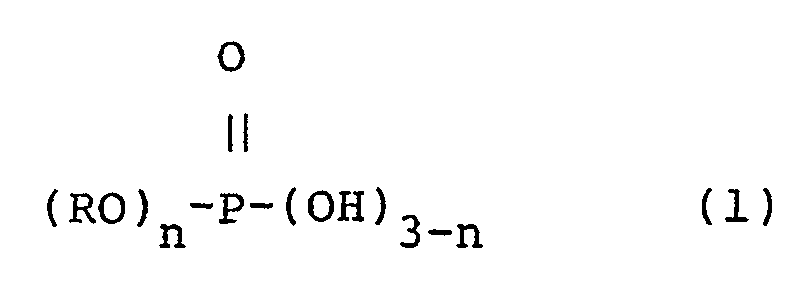 (c) un agent émulsifiant,
avec un mélangeur à grande vitesse ayant une lame d'agitation comportant un grand nombre de perforations ayant une taille d'ouverture d'environ 0,149 mm à 2 mm (100 à 10 mesh). - Procédé selon la revendication 7, dans lequel l'agent émulsifiant contient (A) au moins un composé choisi parmi le polyméthacrylate, le polyisobutylène, les copolymères d'oléfine et le polyalcoylstyrène et (B) au moins un composé choisi parmi un anhydride d'acide polybuténylsuccinique, les dérivés polymères d'acide succinique et les copolymères d'acrylate d'alcoyle et de monomères méthacrylates ayant un groupe polaire.
- Procédé selon la revendication 7 ou 8, qui contient au moins deux parties en poids de l'ester d'acide phosphorique pour 100 parties en poids de l'huile lubrifiante.
- Procédé selon l'une quelconque des revendications 7 à 9, qui contient au moins deux parties en poids de l'agent émulsifiant (A) et de 0,04 à 5 parties en poids de l'agent émulsifiant (B) pour 100 parties en poids de l'huile lubrifiante.
- Procédé selon la revendication 7, dans lequel le mélange comprend :(a) 100 parties en poids d'une huile lubrifiante ayant une viscosité de 50 à 200 mm²/seconde à 40°C,(b) 20 à 30 parties en poids d'un ester d'acide phosphorique du groupe représenté par le phosphite acide de diphényle, le phosphite acide de diisodécyle, le phosphite acide de dibutyle et la formule générale (1)
 (c) au moins deux parties en poids d'au moins un des corps suivants (A) polyméthacrylate, polyisobutylène, copolymère d'oléfine et de polyalcoylstyrène, et (B) 0,04 à 5 parties en poids d'au moins un composé choisi parmi un anhydride d'acide polybuténylsuccinique, les dérivés polymères d'acide succinique, et les copolymères d'acrylate d'alcoyle et de monomère méthacrylates ayant un groupe polaire ; et dans lequel l'émulsification est conduite avec un mélangeur à grande vitesse ayant une lame d'agitation à grillage métallique comme lame d'agitation avec un grand nombre de perforations d'une taille d'ouverture d'environ 0,149 à 2 mm (100 à 10 mesh).
 - Procédé de façonnage du métal par application d'un lubrifiant pour façonnage du métal à la surface d'une pièce usinée métallique (1) ou à la surface d'usinage d'un moule (3) ou des deux et formation d'une pellicule lubrifiante à la surface en vertu de la chaleur générée pendant le façonnage du métal, dans lequel le lubrifiant est un lubrifiant liquide de type émulsion essentiellement anhydre selon l'une quelconque des revendications 1 à 6, sous réserve que dans la formule générale n soit égal à 2.
- procédé selon la revendication 12, dans lequel au moins la pièce usinée métallique (1), le moule (3) ou le lubrifiant liquide est chauffé et le lubrifiant liquide est appliqué à la pièce usinée métallique (1) ou au moule (3) ou les deux, puis l'on procède au façonnage du métal.
- Procédé selon la revendication 13, dans lequel le lubrifiant liquide est appliqué tout en étant chauffé à une température d'au moins 50°C pendant au moins ½ minute.
Applications Claiming Priority (4)
| Application Number | Priority Date | Filing Date | Title |
|---|---|---|---|
| JP23782683A JPH0246080B2 (ja) | 1983-12-19 | 1983-12-19 | Reikantanzoyojunkatsuyu |
| JP237826/83 | 1983-12-19 | ||
| JP36061/84 | 1984-02-29 | ||
| JP59036061A JPS60181198A (ja) | 1984-02-29 | 1984-02-29 | 金属の冷間鍛造加工法 |
Publications (3)
| Publication Number | Publication Date |
|---|---|
| EP0147760A2 EP0147760A2 (fr) | 1985-07-10 |
| EP0147760A3 EP0147760A3 (en) | 1986-09-10 |
| EP0147760B1 true EP0147760B1 (fr) | 1991-04-03 |
Family
ID=26375074
Family Applications (1)
| Application Number | Title | Priority Date | Filing Date |
|---|---|---|---|
| EP84115601A Expired - Lifetime EP0147760B1 (fr) | 1983-12-19 | 1984-12-17 | Lubrifiant liquide du type émulsion pour la déformation de métal, procédé pour la préparation du lubrifiant et procédé pour la déformation avec le lubrifiant |
Country Status (4)
| Country | Link |
|---|---|
| US (1) | US4657685A (fr) |
| EP (1) | EP0147760B1 (fr) |
| KR (1) | KR870001546B1 (fr) |
| DE (1) | DE3484392D1 (fr) |
Families Citing this family (10)
| Publication number | Priority date | Publication date | Assignee | Title |
|---|---|---|---|---|
| DE3534226C1 (de) * | 1985-09-26 | 1987-04-23 | Mobil Oil Deutschland | Wassermischbarer Kuehlschmierstoff |
| MY101125A (en) * | 1985-12-23 | 1991-07-31 | Kao Corp | Gel-like emulsion and o/w emulsions obtained from gel-like emulsion |
| US5030323A (en) * | 1987-06-01 | 1991-07-09 | Henkel Corporation | Surface conditioner for formed metal surfaces |
| US4859351A (en) * | 1987-06-01 | 1989-08-22 | Henkel Corporation | Lubricant and surface conditioner for formed metal surfaces |
| US5279677A (en) * | 1991-06-17 | 1994-01-18 | Coral International, Inc. | Rinse aid for metal surfaces |
| JP3130103B2 (ja) * | 1991-12-26 | 2001-01-31 | 東レ・ダウコーニング・シリコーン株式会社 | アルミニウムダイキヤスト用離型剤組成物 |
| DE19750780C2 (de) * | 1997-11-10 | 2001-11-08 | Sms Demag Ag | Arbeitsverfahren zum Aufbringen einer definierten Oberflächenrauheit auf ein Metallband |
| US6387724B1 (en) | 1999-02-26 | 2002-05-14 | Dynamics Research Corporation | Method of fabricating silicon-on-insulator sensor having silicon oxide sensing surface |
| WO2005028887A1 (fr) * | 2003-09-16 | 2005-03-31 | Ntn Corporation | Roulement a aiguilles du type coque, structure de support pour arbre principal de compresseur, et structure de support pour section d'entrainement d'une pompe a piston |
| EP1715204A4 (fr) * | 2004-02-12 | 2011-12-21 | Ntn Toyo Bearing Co Ltd | Roulement a aiguilles type cartouche, palier arbre de compresseur, et support d entra nement de pompe piston |
Family Cites Families (10)
| Publication number | Priority date | Publication date | Assignee | Title |
|---|---|---|---|---|
| FR1247722A (fr) * | 1959-02-09 | 1960-12-02 | Ici Ltd | Procédé d'agitation de liquides avec des solides ou des gaz |
| NL131056C (fr) * | 1959-12-31 | |||
| US3242075A (en) * | 1962-04-09 | 1966-03-22 | Acheson Ind Inc | High temperature lubricant |
| GB1162443A (en) * | 1966-11-10 | 1969-08-27 | Mobil Oil Corp | Additives for Organic Lubricants. |
| GB1365943A (en) * | 1970-09-16 | 1974-09-04 | Gaf Corp | Metalworking additive and composition and process for making the same |
| BE791942R (fr) * | 1971-05-05 | 1973-05-28 | Sun Oil Co Pennsylvania | Lubrification par |
| GB1520422A (en) * | 1974-10-31 | 1978-08-09 | Exxon Research Engineering Co | Industrial lubricant |
| US4185485A (en) * | 1978-06-30 | 1980-01-29 | Mobil Oil Corporation | Lubricant compositions for can forming |
| US4260502A (en) * | 1979-06-07 | 1981-04-07 | Nalco Chemical Company | Synthetic drawing and ironing lubricant |
| US4612127A (en) * | 1983-09-28 | 1986-09-16 | Hitachi, Ltd. | Lubricant for metal forming and process for metal forming |
-
1984
- 1984-12-17 EP EP84115601A patent/EP0147760B1/fr not_active Expired - Lifetime
- 1984-12-17 DE DE8484115601T patent/DE3484392D1/de not_active Expired - Lifetime
- 1984-12-18 KR KR1019840008049A patent/KR870001546B1/ko not_active Expired
- 1984-12-19 US US06/683,639 patent/US4657685A/en not_active Expired - Fee Related
Also Published As
| Publication number | Publication date |
|---|---|
| EP0147760A2 (fr) | 1985-07-10 |
| EP0147760A3 (en) | 1986-09-10 |
| DE3484392D1 (de) | 1991-05-08 |
| KR870001546B1 (ko) | 1987-09-02 |
| KR850004263A (ko) | 1985-07-11 |
| US4657685A (en) | 1987-04-14 |
Similar Documents
| Publication | Publication Date | Title |
|---|---|---|
| CA1039704A (fr) | Enductions lubrifiantes a teneur de resine | |
| EP0147760B1 (fr) | Lubrifiant liquide du type émulsion pour la déformation de métal, procédé pour la préparation du lubrifiant et procédé pour la déformation avec le lubrifiant | |
| US4636321A (en) | Water soluble lubricant | |
| CA2258638C (fr) | Lubrifiant aqueux pour le faconnage plastique a froid des metaux | |
| US6194357B1 (en) | Waterborne lubricant for the cold plastic working of metals | |
| US5616544A (en) | Water soluble metal working fluids | |
| JP2000309793A (ja) | 金属材料塑性加工用水系潤滑剤 | |
| US5307660A (en) | New water based lubricant composition for cold impact extrusion of spark plug bodies or other metal parts and process | |
| KR20120098409A (ko) | 금속재료의 수성 소성가공용 윤활제 조성물 | |
| US5368757A (en) | Lubrication for cold forming of metals | |
| EP3385344A1 (fr) | Film lubrifiant pour plaques d'acier inoxydable, et plaques d'acier inoxydable lubrifiées | |
| US5340486A (en) | Lubricant compositions for use in diecasting of metals and process | |
| EP0146140B1 (fr) | Procédé pour façonner du métal | |
| CA1061321A (fr) | Lubrifiants pour l'usinage des metaux | |
| US4160370A (en) | Water emulsifiable lubricant and coolant | |
| EP0073306B1 (fr) | Lubrifiants pour usinage à froid et procédé d'application | |
| JPS62241994A (ja) | 金属材料の冷間塑性加工用油状潤滑剤 | |
| CN107382927A (zh) | 一种润滑油性剂及其合成方法和应用 | |
| DE68924075T2 (de) | Schmiermittelzubereitung für heizwalzen von stahl. | |
| JPH0246080B2 (ja) | Reikantanzoyojunkatsuyu | |
| GB2054640A (en) | Hot-forming of metals lubricant | |
| SU910739A1 (ru) | Смазка дл холодной обработки металлов давлением | |
| SU958480A1 (ru) | Смазка дл холодной обработки металлов давлением | |
| JPS5821489A (ja) | 金属管の冷間乃至温間加工用潤滑剤 | |
| JPH1161167A (ja) | 冷間圧延油組成物 |
Legal Events
| Date | Code | Title | Description |
|---|---|---|---|
| PUAI | Public reference made under article 153(3) epc to a published international application that has entered the european phase |
Free format text: ORIGINAL CODE: 0009012 |
|
| 17P | Request for examination filed |
Effective date: 19841224 |
|
| AK | Designated contracting states |
Designated state(s): CH DE FR GB IT LI NL SE |
|
| PUAL | Search report despatched |
Free format text: ORIGINAL CODE: 0009013 |
|
| AK | Designated contracting states |
Kind code of ref document: A3 Designated state(s): CH DE FR GB IT LI NL SE |
|
| 17Q | First examination report despatched |
Effective date: 19880308 |
|
| GRAA | (expected) grant |
Free format text: ORIGINAL CODE: 0009210 |
|
| AK | Designated contracting states |
Kind code of ref document: B1 Designated state(s): CH DE FR GB IT LI NL SE |
|
| REF | Corresponds to: |
Ref document number: 3484392 Country of ref document: DE Date of ref document: 19910508 |
|
| ET | Fr: translation filed | ||
| ITF | It: translation for a ep patent filed | ||
| PLBE | No opposition filed within time limit |
Free format text: ORIGINAL CODE: 0009261 |
|
| STAA | Information on the status of an ep patent application or granted ep patent |
Free format text: STATUS: NO OPPOSITION FILED WITHIN TIME LIMIT |
|
| 26N | No opposition filed | ||
| EAL | Se: european patent in force in sweden |
Ref document number: 84115601.1 |
|
| PGFP | Annual fee paid to national office [announced via postgrant information from national office to epo] |
Ref country code: FR Payment date: 19960918 Year of fee payment: 13 |
|
| PGFP | Annual fee paid to national office [announced via postgrant information from national office to epo] |
Ref country code: GB Payment date: 19960924 Year of fee payment: 13 |
|
| PGFP | Annual fee paid to national office [announced via postgrant information from national office to epo] |
Ref country code: SE Payment date: 19960925 Year of fee payment: 13 |
|
| PGFP | Annual fee paid to national office [announced via postgrant information from national office to epo] |
Ref country code: NL Payment date: 19960926 Year of fee payment: 13 |
|
| PGFP | Annual fee paid to national office [announced via postgrant information from national office to epo] |
Ref country code: CH Payment date: 19961025 Year of fee payment: 13 |
|
| PGFP | Annual fee paid to national office [announced via postgrant information from national office to epo] |
Ref country code: DE Payment date: 19961231 Year of fee payment: 13 |
|
| PG25 | Lapsed in a contracting state [announced via postgrant information from national office to epo] |
Ref country code: GB Free format text: LAPSE BECAUSE OF NON-PAYMENT OF DUE FEES Effective date: 19971217 |
|
| PG25 | Lapsed in a contracting state [announced via postgrant information from national office to epo] |
Ref country code: SE Free format text: LAPSE BECAUSE OF NON-PAYMENT OF DUE FEES Effective date: 19971218 |
|
| PG25 | Lapsed in a contracting state [announced via postgrant information from national office to epo] |
Ref country code: LI Free format text: LAPSE BECAUSE OF NON-PAYMENT OF DUE FEES Effective date: 19971231 Ref country code: FR Free format text: THE PATENT HAS BEEN ANNULLED BY A DECISION OF A NATIONAL AUTHORITY Effective date: 19971231 Ref country code: CH Free format text: LAPSE BECAUSE OF NON-PAYMENT OF DUE FEES Effective date: 19971231 |
|
| PG25 | Lapsed in a contracting state [announced via postgrant information from national office to epo] |
Ref country code: NL Free format text: LAPSE BECAUSE OF NON-PAYMENT OF DUE FEES Effective date: 19980701 |
|
| GBPC | Gb: european patent ceased through non-payment of renewal fee |
Effective date: 19971217 |
|
| REG | Reference to a national code |
Ref country code: CH Ref legal event code: PL |
|
| NLV4 | Nl: lapsed or anulled due to non-payment of the annual fee |
Effective date: 19980701 |
|
| PG25 | Lapsed in a contracting state [announced via postgrant information from national office to epo] |
Ref country code: DE Free format text: LAPSE BECAUSE OF NON-PAYMENT OF DUE FEES Effective date: 19980901 |
|
| EUG | Se: european patent has lapsed |
Ref document number: 84115601.1 |
|
| REG | Reference to a national code |
Ref country code: FR Ref legal event code: ST |