EP0147862A1 - Optischer Wellenlängen-Multiplexer-Demultiplexer mit optischen Fasern - Google Patents
Optischer Wellenlängen-Multiplexer-Demultiplexer mit optischen Fasern Download PDFInfo
- Publication number
- EP0147862A1 EP0147862A1 EP84116408A EP84116408A EP0147862A1 EP 0147862 A1 EP0147862 A1 EP 0147862A1 EP 84116408 A EP84116408 A EP 84116408A EP 84116408 A EP84116408 A EP 84116408A EP 0147862 A1 EP0147862 A1 EP 0147862A1
- Authority
- EP
- European Patent Office
- Prior art keywords
- fiber
- face
- wavelength
- optical signal
- connecting fiber
- Prior art date
- Legal status (The legal status is an assumption and is not a legal conclusion. Google has not performed a legal analysis and makes no representation as to the accuracy of the status listed.)
- Withdrawn
Links
- 230000003287 optical effect Effects 0.000 title claims abstract description 88
- 239000000835 fiber Substances 0.000 claims abstract description 235
- 239000013307 optical fiber Substances 0.000 claims abstract description 23
- 230000002457 bidirectional effect Effects 0.000 claims abstract description 19
- 230000008878 coupling Effects 0.000 claims description 8
- 238000010168 coupling process Methods 0.000 claims description 8
- 238000005859 coupling reaction Methods 0.000 claims description 8
- 230000005540 biological transmission Effects 0.000 description 13
- VYPSYNLAJGMNEJ-UHFFFAOYSA-N Silicium dioxide Chemical compound O=[Si]=O VYPSYNLAJGMNEJ-UHFFFAOYSA-N 0.000 description 6
- 238000009826 distribution Methods 0.000 description 6
- 239000003822 epoxy resin Substances 0.000 description 6
- 229920000647 polyepoxide Polymers 0.000 description 6
- 239000000377 silicon dioxide Substances 0.000 description 3
- 238000001914 filtration Methods 0.000 description 2
- 230000037431 insertion Effects 0.000 description 2
- 238000003780 insertion Methods 0.000 description 2
- 238000005253 cladding Methods 0.000 description 1
- 239000011248 coating agent Substances 0.000 description 1
- 238000000576 coating method Methods 0.000 description 1
- 238000000151 deposition Methods 0.000 description 1
- 238000010586 diagram Methods 0.000 description 1
- 230000002452 interceptive effect Effects 0.000 description 1
- 238000004519 manufacturing process Methods 0.000 description 1
- 238000005457 optimization Methods 0.000 description 1
- 230000035515 penetration Effects 0.000 description 1
- 230000002093 peripheral effect Effects 0.000 description 1
- 230000001902 propagating effect Effects 0.000 description 1
- 238000000926 separation method Methods 0.000 description 1
- 230000008054 signal transmission Effects 0.000 description 1
Images


Classifications
-
- G—PHYSICS
- G02—OPTICS
- G02B—OPTICAL ELEMENTS, SYSTEMS OR APPARATUS
- G02B6/00—Light guides; Structural details of arrangements comprising light guides and other optical elements, e.g. couplings
- G02B6/24—Coupling light guides
- G02B6/26—Optical coupling means
- G02B6/28—Optical coupling means having data bus means, i.e. plural waveguides interconnected and providing an inherently bidirectional system by mixing and splitting signals
- G02B6/293—Optical coupling means having data bus means, i.e. plural waveguides interconnected and providing an inherently bidirectional system by mixing and splitting signals with wavelength selective means
- G02B6/29379—Optical coupling means having data bus means, i.e. plural waveguides interconnected and providing an inherently bidirectional system by mixing and splitting signals with wavelength selective means characterised by the function or use of the complete device
- G02B6/2938—Optical coupling means having data bus means, i.e. plural waveguides interconnected and providing an inherently bidirectional system by mixing and splitting signals with wavelength selective means characterised by the function or use of the complete device for multiplexing or demultiplexing, i.e. combining or separating wavelengths, e.g. 1xN, NxM
-
- G—PHYSICS
- G02—OPTICS
- G02B—OPTICAL ELEMENTS, SYSTEMS OR APPARATUS
- G02B6/00—Light guides; Structural details of arrangements comprising light guides and other optical elements, e.g. couplings
- G02B6/24—Coupling light guides
- G02B6/26—Optical coupling means
- G02B6/28—Optical coupling means having data bus means, i.e. plural waveguides interconnected and providing an inherently bidirectional system by mixing and splitting signals
- G02B6/2804—Optical coupling means having data bus means, i.e. plural waveguides interconnected and providing an inherently bidirectional system by mixing and splitting signals forming multipart couplers without wavelength selective elements, e.g. "T" couplers, star couplers
- G02B6/2817—Optical coupling means having data bus means, i.e. plural waveguides interconnected and providing an inherently bidirectional system by mixing and splitting signals forming multipart couplers without wavelength selective elements, e.g. "T" couplers, star couplers using reflective elements to split or combine optical signals
-
- G—PHYSICS
- G02—OPTICS
- G02B—OPTICAL ELEMENTS, SYSTEMS OR APPARATUS
- G02B6/00—Light guides; Structural details of arrangements comprising light guides and other optical elements, e.g. couplings
- G02B6/24—Coupling light guides
- G02B6/26—Optical coupling means
- G02B6/28—Optical coupling means having data bus means, i.e. plural waveguides interconnected and providing an inherently bidirectional system by mixing and splitting signals
- G02B6/293—Optical coupling means having data bus means, i.e. plural waveguides interconnected and providing an inherently bidirectional system by mixing and splitting signals with wavelength selective means
- G02B6/29346—Optical coupling means having data bus means, i.e. plural waveguides interconnected and providing an inherently bidirectional system by mixing and splitting signals with wavelength selective means operating by wave or beam interference
- G02B6/29361—Interference filters, e.g. multilayer coatings, thin film filters, dichroic splitters or mirrors based on multilayers, WDM filters
- G02B6/29368—Light guide comprising the filter, e.g. filter deposited on a fibre end
Definitions
- the present invention relates to a unidirectional or bidirectional optical multiplexer-demultiplexer of at least three wavelengths by using optical fibers.
- bidirectional optical link systems are used in many fields such as for example telematics, telephone transmissions or cable television networks in which a central station communicates with peripheral stations constituted by transmitting apparatuses. -receiving subscribers.
- the multiplexing of these wavelengths is carried out at one of the bevelled fiber ends by a wavelength distribution in the connecting fiber while their demultiplexing is carried out at the other beveled end of the fiber by a wavelength selection by means of dielectric multilayer interference filters deposited on the intermediate fibers.
- the multiplexing-demultiplexing of the wavelengths is carried out as previously using two intermediate optical fibers coupled at each beveled end to the roof of the fiber. connection, one of the intermediate fibers having a bidirectional direction and each of them carrying an interference filter.
- such a three-channel multiplexing-demultiplexing device is a very difficult practical embodiment in that it is technologically difficult to bevel as perfectly as possible the ends of an optical fiber in the form of a roof. Consequently, the manufacturing cost of such a device is relatively high.
- the object of the present invention is to produce, in a simple and inexpensive manner, an optical multiplexer-demultiplexer essentially with three channels, coupling in a particularly satisfactory manner both from the optical point of view and from the mechanical point of view at least three intermediate optical fibers with the same end of a connecting fiber.
- This embodiment does not require any complicated bevelling, is suitable for both a unidirectional and bidirectional connection, and is in a compact form, that is to say compact.
- the invention relates to a multiplexer-demultiplexer of at least three wavelengths comprising an optical fiber of connection at each end of which are optically coupled at least three intermediate fibers transmitting each an optical signal of a given wavelength.
- This multiplexer-demulatiplexer is charac terized in that each end of the connecting fiber is bevelled at a given angle and is coupled to a first intermediate fiber also bevelled at one of its ends so that their respective longitudinal axes are distinct, in that a second intermediate fiber is coupled to the beveled end of the first intermediate fiber, in that a third intermediate fiber is attached to the cylindrical wall of the connecting fiber by optical means of refractive index adapted to that of each of these two fibers, and in that interference filters are deposited on the beveled ends of the connecting fiber and of the first intermediate fiber in order to carry out the wavelength multiplexing-demultiplexing.
- the multiplexer-demultiplexer according to the invention is similar to that described above, by specifying that the first and second intermediate fibers each transmit an optical signal from one of the forward wavelengths and the third intermediate fiber transmits an optical signal of the return wavelength.
- the optical coupling between the connecting fiber and each of the first and second intermediate fibers is made maximum for an intersection of the respective longitudinal axes of the connecting fiber and the first intermediate fiber at a given angle.
- a multiplexer of n different wavelengths ⁇ 1 to 2 ... ⁇ n is shown at 10 and at 20 the associated demultiplexer, for example for a cable distribution system on a single main optical fiber 30 called link or transmission.
- the optical link is unidirectional or monodirectional when the optical fiber 30 transmits in one direction, from the multiplexer 10 to the demultiplexer 20, the light signals at the n wavelengths ⁇ 1 ⁇ 2 ... ⁇ n emitted by light emitting diodes, such as for example laser diodes or light-emitting diodes (not shown) and received by photodetector diodes, such as for example avalanche photodiodes or PIN type photodiodes (not shown).
- light emitting diodes such as for example laser diodes or light-emitting diodes (not shown)
- photodetector diodes such as for example avalanche photodiodes or PIN type photodiodes (not shown).
- the link is said to be bidirectional when the optical fiber 30 transmits in one direction, as before, the light signals at the n wavelengths said to go ⁇ 1 ⁇ 2 ... ⁇ n and in the other direction a or several so-called return wavelengths, only one of which has been represented at ⁇ 0 in FIG. 1, the latter being emitted by a light emitting diode (not shown) coupled to the demultiplexer 20 and received by a photodetector diode (not shown) coupled to multiplexer 10.
- the multiplexing-demultiplexing device as shown in FIG. 1 is bidirectional with (n + 1) channels or transmission channels, that is to say with n forward channels for the video signal transmission at wavelengths ⁇ 1 ⁇ 2 ... ⁇ n and at a return channel for the transmission of an additional signal, such as for example a remote control signal, at wavelength ⁇ 0 .
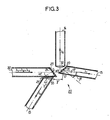
- FIGS. 2 and 3 respectively represent the multiplexer 10 and the associated demultiplexer 20 according to the invention for a unidirectional optical link with three channels using intermediate optical fibers.
- the three different wavelengths used ⁇ 1 , ⁇ 2 and ⁇ 3 are equal, for example, to 0.78 ⁇ m, 0.86 ⁇ m and 1.3 ⁇ m respectively.
- the connecting fiber 30 is a silica fiber of the multimode type with an index gradient whose core 30a has a diameter for example equal to 50 ⁇ m and whose optical cladding 30b has a diameter for example equal to 125 ⁇ m.
- the optical fiber 30 is therefore a 50/125 ⁇ m fiber for which the digital aperture is of the order of 0.19.
- the connecting fiber 30 has an entry face 11 which is bevelled at a given angle formed between its longitudinal axis XX 'and the normal NN' at its entry face.
- This angle a is chosen so as to increase the value of the acceptance angle of the multimode fiber 30 and to achieve a compromise between low insertion losses and minimum crosstalk.
- the multiplexer 10 comprises three intermediate or junction optical fibers identified at 13, 14 and 15, with respective longitudinal axes YY ', ZZ' and UU ', optically coupled to the connection fiber 30, and each transmitting one of the three wavelengths ⁇ 1 , ⁇ 2 and ⁇ 3 .
- These three intermediate fibers are, for example, of the same type as the binding fiber, that is to say 50/125 ⁇ m silica fibers with a numerical index gradient of the order of 0.19.
- the intermediate fiber 13 transmitting an optical signal at the wavelength ⁇ 1 has an output face 16 called the wavelength emission face which is bevelled at a given angle ⁇ , for example equal to 30 °, formed between its axis YY 'and the normal MM' at its exit face.
- the respective bevelled faces 11 and 16 of the fibers 30 and 13 are coupled to each other so that their respective optical axes XX 'and YY' are distinct, thus achieving an off-center fiber structure: the optical axes XX 'and YY' can be either parallel not confused either secants.
- the bevelled faces of the two off-center fibers 30 and 13 shown in FIG. 2 are arranged in inclinations opposite to each other, forming what is called a model of prism in the air.
- the bevelled faces of these two fibers can also be parallel, forming what is called a model with parallel faces.
- the intermediate fiber 14 transmitting an optical signal at wavelength 1 2 is optically coupled to the connecting fiber 30 via the fiber 13. More specifically, the intermediate fiber 14 has an outlet face 17 of cross section which is coupled as much as possible to the bevelled face 16 of the intermediate fiber 13 by means of focusing means constituted for example by a microlens 18 attached to the exit face of the fiber 14.
- the intermediate fiber 13 carries on its bevelled face 16 optical filtering means constituted for example by a dielectric multilayer interference filter 20 designed so as to operate in transmission for the wavelength ⁇ and in reflection for the length d wave ⁇ 2 , so that this filter produces the multiplexing of the two wavelengths ⁇ 1 and ⁇ 2 by wavelength distribution and generates an optical signal at output at the two wavelengths ⁇ 1 + ⁇ 2 which is intended to penetrate by refraction into the connecting fiber 30 by its bevelled face 11.
- optical filtering means constituted for example by a dielectric multilayer interference filter 20 designed so as to operate in transmission for the wavelength ⁇ and in reflection for the length d wave ⁇ 2 , so that this filter produces the multiplexing of the two wavelengths ⁇ 1 and ⁇ 2 by wavelength distribution and generates an optical signal at output at the two wavelengths ⁇ 1 + ⁇ 2 which is intended to penetrate by refraction into the connecting fiber 30 by its bevelled face 11.
- the fiber 13 is positioned spatially with respect to the connecting fiber 30 so that the maximum light energy at the length wave ⁇ 1 is injected into the bonding fiber, and on the other hand the fiber 14 is arranged relative to the fiber 13 so that the maximum of light energy at the wavelength ⁇ 2 once reflected on the bevelled face of the fiber 13 is injected into the connecting fiber.
- This optimization of the coupling is obtained for an intersection of the respective optical axes XX 'and YY' of the two fibers 30 and 13 at an angle ⁇ , for example equal to 30 °, for a certain distance x in a direction orthogonal to the axis of the connecting fiber between the respective centers O and O 'of the bevelled faces of the fibers 30 and 13, as well as for a certain distance y in a direction parallel to the axis of the connecting fiber between these same centers O and O'.
- the choice of the angle ⁇ and of the coasts x and y makes it possible to inject by refraction the maximum of light energy at the two wavelengths ⁇ 1 + ⁇ 2 into the connecting fiber 30 and to keep guided at l inside the latter the optical signal at these two wavelengths propagating therein.
- the coast is also defined therein in order to be able to meet the criterion of compactness of the multiplexer, by making it possible to arrange the intermediate fiber 14 between the connecting fiber 30 and the fiber 13 while being coupled as much as possible to the latter as a function of its bevel angle ⁇ , and this without increasing the losses.
- the intermediate fiber 15 transmitting an optical signal at the wavelength ⁇ 3 is optically coupled to the connecting fiber 30 by being attached to the cylindrical wall of the latter. More specifically, the intermediate fiber 15 has an outlet face 22 which is fixed to the wall lateral of the connecting fiber by means of optical index adapters intended to ensure optical continuity between these two fibers so as to allow the optical signal at the wavelength ⁇ 3 to penetrate into the connecting fiber.
- These index adapter means consist for example of a layer of epoxy resin 23 having an index adapted to that of each of the two fibers 15 and 30, that is to say equal to or very close to each of these.
- that of the epoxy resin is chosen to be equal to 1.47.
- one begins by depositing the epoxy resin 23 on the side wall of the connecting fiber 30, and then comes the intermediate fiber 15 thereon.
- one begins by coating the exit face of the intermediate fiber 15 with epoxy resin 23, then the assembly is brought to the side wall of the connecting fiber 30.
- the intermediate fiber 15 is positioned relative to the connecting fiber 30 so that the optical signal at the wavelength ⁇ 3 , after penetration into the connecting fiber, comes to be reflected on the bevelled face II of the fiber of bond and remains guided inside it during its propagation.
- optical filtering means constituted for example by a dielectric multilayer interference filter 25 deposited on the bevelled face of the fiber 30.
- This filter 25 is designed to operate in transmission for the two wavelengths previously multiplexed ⁇ 1 and ⁇ 2 and in reflection for the wavelength ⁇ 3 , so that it produces the multiplexing of the three wavelengths ⁇ 1 , ⁇ 2 and ⁇ 3 in the connecting fiber 30 by wavelength distribution. Consequently, the fiber 30 transmits an optical signal at the three multiplexed wavelengths ⁇ 1 + X 2 + ⁇ 3 .
- the bevel angle a of the connecting fiber 30 is such that the optical signal at the wavelength ⁇ 3 , after reflection on the bevelled face 11 of the connecting fiber, remains guided therein.
- good performance of the multiplexer has been obtained by the Applicant for a bevel angle equal to either 45 ° or 22 °.
- the outlet face 22 of the intermediate fiber 15 is a cross section thereof, the fiber 13 being arranged perpendicular to the longitudinal axis of the connecting fiber.
- This unidirectional multiplexing of the three wavelengths ⁇ 1 , ⁇ 2 and ⁇ 3 corresponds to a demultiplexing of these same wavelengths, carried out by means of the associated demultiplexer 20 shown in FIG. 2b and which is designed in a completely quite similar to the multiplexer described with reference to Figure 2.
- the associated demultiplexer 20 shown in FIG. 2b and which is designed in a completely quite similar to the multiplexer described with reference to Figure 2.
- the connecting fiber 30 has an outlet face 27 which is bevelled at an angle equal to or different from the angle defined on the multiplexing side, while the three intermediate fibers 13, 14 and 15 have respective input faces intended to each receive one of the three wavelengths ⁇ 1 , ⁇ 2 and ⁇ 3 : the input face 31 of the intermediate fiber 13 is bevelled as before at an angle ⁇ 'equal or different of the angle ⁇ defined on the multiplexing side, the entry face 32 of the fiber 14 is of straight section and carries a micro-lens, and the entry face 33 of the fiber 15 is either of cross section for an angle of bevel a 'equal to 45 ° or beveled at an angle Y ' equal to or different from Y defined on the multiplexing side for a bevel angle a 'different from 45 °.
- the bevelled face 27 of the connecting fiber carries the same interference filter 25 playing the role of selection means and which is designed to transmit the two wavelengths ⁇ 1 and ⁇ 2 and to reflect the length wave ⁇ 3 .
- the filter 25 generates at the output of the bevelled face of the connecting fiber 30 the optical signal at the two wavelengths ⁇ 1 + ⁇ 2 , while the optical signal at the wavelength ⁇ 3 after reflection by the filter crosses the side wall of the connecting fiber 30 and enters the fiber 15 by passing through the epoxy resin 23 of suitable index.
- the bevel angle a ′ of the connecting fiber 30 is such that the optical signal at the wavelength ⁇ 3 once reflected by the filter 25 and after reception by the fiber 15 remains guided in the latter.
- dielectric multilayer interference filter (not shown) between the epoxy resin 23 and the input face of the intermediate fiber 15.
- This filter is designed so to operate in transmission for the wavelength ⁇ 3 and in reflection for the two wavelengths ⁇ 1 and ⁇ 2 , thus making it possible to avoid any rejection of the first two channels onto the third, and therefore to reduce crosstalk.
- the bevelled face 31 of the intermediate fiber 13 carries the same interference filter 20 which is designed to transmit the wavelength ⁇ 1 and to reflect the wavelength ⁇ 2 .
- the filter 20 receives by refraction the optical signal at the two wavelengths ⁇ 1 + ⁇ 2 at the output of the connecting fiber 30, and after selection by the filter 20, the optical signal at the wavelength ⁇ 1 is received by the intermediate fiber 13 inside which the signal remains guided, while the optical signal at wavelength 1 2 is received by the intermediate fiber 14 in which the signal propagates by being guided there.
- FIGS. 4 and 5 respectively represent the multiplexer 10 and the associated demultiplexer 20, according to the invention, for a bidirectional link with three channels or channels, two of which go and one return.
- the two forward channels of this interactive link transmit the two different wavelengths ⁇ 1 equal for example to 0.86 ⁇ m, and ⁇ 2 equal for example to 1.3 ⁇ m, while the return channel transmits the wavelength ⁇ 0 different from the other two and equal for example to 0.78 ⁇ m.
- the multiplexer-demultiplexer for this bidirectional link will not be described in detail since it is produced in a manner analogous to the unidirectional multiplexer-demultiplexer described above with reference to FIGS. 2 and 3.
- the bevelled face of the connecting fiber 30 serves both as an input face for the two forward wavelengths ⁇ 1 and ⁇ 2 and as an output face for the return wavelength ⁇ 0 .
- the interference filter 20 carried by the bevelled face of the intermediate fiber 13 is designed as above and ensures the multiplexing of the two wavelengths of going ⁇ 1 + ⁇ 2 by wavelength distribution, while the interference filter 25 carried by the bevelled input-output face of the connecting fiber 30 ensures on the one hand the transmission of the optical signal at the two wavelengths to go into the connecting fiber and on the other hand the reflection of the optical signal at the return wavelength ⁇ 0 .
- this optical signal at the return wavelength, ⁇ 0 leaves the connecting fiber by its side wall and is received by the intermediate fiber 15 to propagate there.
- the bevel angle a of the connecting fiber 30 is such that the optical signal at the return wavelength ⁇ 0 once reflected by the filter 25 and after reception by the fiber 15 remains guided in the latter.
- the bevelled face of the connecting fiber 30 serves both as an output face for the two wavelengths going multiplexed ⁇ 1 + ⁇ 2 and the input face for the return wavelength ⁇ 0 .
- the interference filter 25 carried by the bevelled exit-entry face of the connecting fiber 30 is designed as above and ensures on the one hand the transmission of the two wavelengths of going ⁇ 1 + ⁇ 2 and on the other hand the reflection of the return wavelength ⁇ 0 entering through the side wall of the connecting fiber 30.
- the bevel angle a l of the connecting fiber 30 is such that the optical signal at the wavelength of return ⁇ 0 once reflected by the filter 25 remains guided in the connecting fiber.
- the optical signal at the two forward wavelengths ⁇ 1 + ⁇ 2 is received by refraction by the filter 20 carried by the bevelled face of the intermediate fiber 13.
- This filter 20 is designed as above and ensures on the one hand the transmission of the optical signal at the first go wavelength ⁇ 1 in the intermediate fiber 11 and on the other hand the reflection of the optical signal at the second go wavelength ⁇ 2 which is received by the intermediate fiber 14 to propagate there by remaining guided.
- the interference filter 20 performs the separation by selectivity of the two wavelengths of going ⁇ 1 and ⁇ 2 .
Landscapes
- Physics & Mathematics (AREA)
- General Physics & Mathematics (AREA)
- Optics & Photonics (AREA)
- Optical Communication System (AREA)
- Optical Couplings Of Light Guides (AREA)
- Light Guides In General And Applications Therefor (AREA)
Applications Claiming Priority (2)
| Application Number | Priority Date | Filing Date | Title |
|---|---|---|---|
| FR8400035 | 1984-01-03 | ||
| FR8400035A FR2560470B1 (fr) | 1984-01-03 | 1984-01-03 | Multiplexeur-demultiplexeur optique de longueurs d'onde utilisant des fibres optiques |
Publications (1)
| Publication Number | Publication Date |
|---|---|
| EP0147862A1 true EP0147862A1 (de) | 1985-07-10 |
Family
ID=9299803
Family Applications (1)
| Application Number | Title | Priority Date | Filing Date |
|---|---|---|---|
| EP84116408A Withdrawn EP0147862A1 (de) | 1984-01-03 | 1984-12-27 | Optischer Wellenlängen-Multiplexer-Demultiplexer mit optischen Fasern |
Country Status (4)
| Country | Link |
|---|---|
| US (1) | US4630255A (de) |
| EP (1) | EP0147862A1 (de) |
| JP (1) | JPS60169812A (de) |
| FR (1) | FR2560470B1 (de) |
Cited By (1)
| Publication number | Priority date | Publication date | Assignee | Title |
|---|---|---|---|---|
| US4793679A (en) * | 1987-04-20 | 1988-12-27 | General Electric Company | Optical coupling system |
Families Citing this family (18)
| Publication number | Priority date | Publication date | Assignee | Title |
|---|---|---|---|---|
| US4765706A (en) * | 1986-07-29 | 1988-08-23 | American Telephone And Telegraph Co., At&T Bell Labs. | Optical communications system including a directional coupler |
| US4784452A (en) * | 1986-08-01 | 1988-11-15 | Ensign-Bickford Optics Co. | Optical fiber coupler |
| US4973169A (en) * | 1987-06-24 | 1990-11-27 | Martin Marietta Corporation | Method and apparatus for securing information communicated through optical fibers |
| US4904043A (en) * | 1988-06-15 | 1990-02-27 | American Telephone And Telegraph Company, At&T Bell Laboratories | Optical data link dual wavelength coupler |
| US4989932A (en) * | 1989-03-03 | 1991-02-05 | Lt Industries | Multiplexer for use with a device for optically analyzing a sample |
| US5031984A (en) * | 1990-01-17 | 1991-07-16 | Alcatel Na | Optical fiber electro-optical module |
| US5287423A (en) * | 1991-01-31 | 1994-02-15 | L. T. Industries, Inc. | Multiplexer for use with a device for optically analyzing a sample |
| US5129022A (en) * | 1991-02-04 | 1992-07-07 | Eastman Kodak Company | Method and apparatus for providing reference signals from points along an optical fiber transmission path |
| US5164588A (en) * | 1991-02-04 | 1992-11-17 | Eastman Kodak Company | Method and apparatus for sensing ambient conditions at locations along an optical fiber transmission path |
| US5263111A (en) * | 1991-04-15 | 1993-11-16 | Raychem Corporation | Optical waveguide structures and formation methods |
| US5210590A (en) * | 1992-02-18 | 1993-05-11 | L. T. Industries, Inc. | Rapid scanning spectrographic analyzer |
| US5355237A (en) * | 1993-03-17 | 1994-10-11 | The United States Of America As Represented By The Administrator Of The National Aeronautics And Space Administration | Wavelength-division multiplexed optical integrated circuit with vertical diffraction grating |
| US5808763A (en) * | 1995-10-31 | 1998-09-15 | Jds Fitel Inc. | Optical demultiplexor |
| US5796885A (en) * | 1996-05-09 | 1998-08-18 | Gonthier; Francois | 3×3 waveguide coupler for bidirectional dual wavelength transmission and signal sampling and method for making the same |
| USD443252S1 (en) | 2000-06-02 | 2001-06-05 | Corning Cable Systems Llc | Wall mount housing |
| CN1507574A (zh) * | 2001-05-23 | 2004-06-23 | �����ɷ� | 用于自至少二光学资料频道传送及或接收光学讯号之电光学模块 |
| JP4796950B2 (ja) * | 2006-02-03 | 2011-10-19 | 日本碍子株式会社 | 光デバイス |
| JP4796951B2 (ja) * | 2006-02-03 | 2011-10-19 | 日本碍子株式会社 | 光デバイス |
Citations (1)
| Publication number | Priority date | Publication date | Assignee | Title |
|---|---|---|---|---|
| FR2334967A1 (fr) * | 1975-12-09 | 1977-07-08 | Labo Electronique Physique | Dispositif optique pour l'injection d'energie rayonnante dans une fibre optique et le couplage de plusieurs fibres |
Family Cites Families (4)
| Publication number | Priority date | Publication date | Assignee | Title |
|---|---|---|---|---|
| JPS5611409A (en) * | 1979-07-11 | 1981-02-04 | Fujitsu Ltd | Optical branching circuit |
| JPS5635105A (en) * | 1979-08-31 | 1981-04-07 | Fujitsu Ltd | Optical fiber branching filter |
| US4452505A (en) * | 1980-04-02 | 1984-06-05 | International Telephone And Telegraph Corporation | Bidirectional coupler for communication over a single fiber |
| DE3135312A1 (de) * | 1980-11-27 | 1982-07-01 | Licentia Patent-Verwaltungs-Gmbh, 6000 Frankfurt | "optisches verzweigungsglied" |
-
1984
- 1984-01-03 FR FR8400035A patent/FR2560470B1/fr not_active Expired
- 1984-12-26 JP JP59282001A patent/JPS60169812A/ja active Pending
- 1984-12-27 EP EP84116408A patent/EP0147862A1/de not_active Withdrawn
- 1984-12-31 US US06/687,897 patent/US4630255A/en not_active Expired - Fee Related
Patent Citations (1)
| Publication number | Priority date | Publication date | Assignee | Title |
|---|---|---|---|---|
| FR2334967A1 (fr) * | 1975-12-09 | 1977-07-08 | Labo Electronique Physique | Dispositif optique pour l'injection d'energie rayonnante dans une fibre optique et le couplage de plusieurs fibres |
Non-Patent Citations (3)
| Title |
|---|
| APPLIED OPTICS, vol. 20, no. 18, 15 septembre 1981, pages 3128-3135, New York, US; G. WINZER et al.: "Single-mode and multimode all-fiber directional couplers for WDM * |
| CONFERENCE EUROPEENNE SUR LES COMMUNICATIONS OPTIQUES, 21-24 septembre 1982, pages 305-314, Cannes, FR; G. WINZER: "Multiplexage de longueurs d'ondes - Situation et tendances" * |
| OPTICS LETTERS, vol. 5, no. 7, juillet 1980, pages 321-322, Optical Society of America, New York, US; E. MIYAUCHI et al.: "Compact wavelength multiplexer using optical-fiber pieces * |
Cited By (1)
| Publication number | Priority date | Publication date | Assignee | Title |
|---|---|---|---|---|
| US4793679A (en) * | 1987-04-20 | 1988-12-27 | General Electric Company | Optical coupling system |
Also Published As
| Publication number | Publication date |
|---|---|
| JPS60169812A (ja) | 1985-09-03 |
| FR2560470B1 (fr) | 1986-04-11 |
| FR2560470A1 (fr) | 1985-08-30 |
| US4630255A (en) | 1986-12-16 |
Similar Documents
| Publication | Publication Date | Title |
|---|---|---|
| EP0138698B1 (de) | Optischer Wellenlängen-Multiplexer-Demultiplexer für bidirektionale Verbindung | |
| EP0121482B1 (de) | Wellenlängenmultiplexer/-demultiplexer und Verfahren zur Herstellung einer solchen Vorrichtung | |
| EP0147862A1 (de) | Optischer Wellenlängen-Multiplexer-Demultiplexer mit optischen Fasern | |
| FR2595477A1 (fr) | Circuit optique de demultiplexage/multiplexage | |
| FR2502347A1 (fr) | Multiplexeur/demultiplexeur optique utilisant des filtres a interferences | |
| FR2537733A1 (fr) | Dispositif guide d'ondes optique | |
| FR2553951A1 (fr) | Dispositif de memorisation d'informations dans un systeme de transmission par fibre optique | |
| FR2530392A1 (fr) | Dispositif a isolement optique pour multiplexage ou demultiplexage de longueurs d'onde | |
| FR2549243A1 (fr) | Coupleur directif a composants associes pour ondes lumineuses | |
| FR2499723A1 (fr) | Distributeur optique | |
| FR2477287A2 (fr) | Repartiteur optique multiple de la lumiere, procede de realisation d'un filtre interferentiel pour un tel repartiteur et mise en oeuvre de ce repartiteur | |
| FR2834565A1 (fr) | Dispositif pour faire entrer des signaux optiques dans un guide d'ondes de lumiere et/ou pour les en faire sortir | |
| FR2629219A1 (fr) | Coupleur de fibres optiques en etoile et de type actif | |
| FR2779535A1 (fr) | Multiplexeur compact | |
| FR2685498A1 (fr) | Dispositif optique a couplage de proximite entre deux guides d'onde integres d'encombrement reduit et composant d'optique integre en faisant application. | |
| EP1058138A1 (de) | Multiplexer/Demultiplexer mit drei Wellenleitern | |
| FR2505056A1 (fr) | Dispositif coupleur-extracteur de signal optique | |
| FR2556480A1 (fr) | Coupleur bidirectionnel optique actif | |
| FR2661513A3 (fr) | Aiguillage optique a fibres. | |
| EP0200613B1 (de) | Optischer Multiplexer/Demultiplexer und Verfahren zu dessen Herstellung | |
| FR2731573A1 (fr) | Multiplexeur-demultiplexeur de longueurs d'onde optique | |
| EP1509794B1 (de) | Optische filtrierungseinrichtung | |
| EP0559551A1 (de) | Optischer Koppler mit hoher Übersprechdämpfung | |
| FR2532766A1 (fr) | Dispositif de couplage optique | |
| EP0166291A1 (de) | Verfahren zur Verzweigung von Lichtenergie und seine Verwendung für optisches Schalten |
Legal Events
| Date | Code | Title | Description |
|---|---|---|---|
| PUAI | Public reference made under article 153(3) epc to a published international application that has entered the european phase |
Free format text: ORIGINAL CODE: 0009012 |
|
| AK | Designated contracting states |
Designated state(s): BE CH DE FR GB IT LI NL |
|
| 17P | Request for examination filed |
Effective date: 19860102 |
|
| 17Q | First examination report despatched |
Effective date: 19870225 |
|
| STAA | Information on the status of an ep patent application or granted ep patent |
Free format text: STATUS: THE APPLICATION IS DEEMED TO BE WITHDRAWN |
|
| 18D | Application deemed to be withdrawn |
Effective date: 19870708 |
|
| RIN1 | Information on inventor provided before grant (corrected) |
Inventor name: FOLCKE, GEORGES Inventor name: GOUALI, MOHAMED |