EP0148106A2 - Elektrischer Miniaturstecker - Google Patents
Elektrischer Miniaturstecker Download PDFInfo
- Publication number
- EP0148106A2 EP0148106A2 EP84630209A EP84630209A EP0148106A2 EP 0148106 A2 EP0148106 A2 EP 0148106A2 EP 84630209 A EP84630209 A EP 84630209A EP 84630209 A EP84630209 A EP 84630209A EP 0148106 A2 EP0148106 A2 EP 0148106A2
- Authority
- EP
- European Patent Office
- Prior art keywords
- terminal
- connector
- terminals
- construction
- locking means
- Prior art date
- Legal status (The legal status is an assumption and is not a legal conclusion. Google has not performed a legal analysis and makes no representation as to the accuracy of the status listed.)
- Granted
Links
Images



Classifications
-
- H—ELECTRICITY
- H01—ELECTRIC ELEMENTS
- H01R—ELECTRICALLY-CONDUCTIVE CONNECTIONS; STRUCTURAL ASSOCIATIONS OF A PLURALITY OF MUTUALLY-INSULATED ELECTRICAL CONNECTING ELEMENTS; COUPLING DEVICES; CURRENT COLLECTORS
- H01R13/00—Details of coupling devices of the kinds covered by groups H01R12/70 or H01R24/00 - H01R33/00
- H01R13/40—Securing contact members in or to a base or case; Insulating of contact members
- H01R13/42—Securing in a demountable manner
- H01R13/436—Securing a plurality of contact members by one locking piece or operation
- H01R13/4364—Insertion of locking piece from the front
-
- H—ELECTRICITY
- H01—ELECTRIC ELEMENTS
- H01R—ELECTRICALLY-CONDUCTIVE CONNECTIONS; STRUCTURAL ASSOCIATIONS OF A PLURALITY OF MUTUALLY-INSULATED ELECTRICAL CONNECTING ELEMENTS; COUPLING DEVICES; CURRENT COLLECTORS
- H01R13/00—Details of coupling devices of the kinds covered by groups H01R12/70 or H01R24/00 - H01R33/00
- H01R13/40—Securing contact members in or to a base or case; Insulating of contact members
- H01R13/42—Securing in a demountable manner
- H01R13/422—Securing in resilient one-piece base or case, e.g. by friction; One-piece base or case formed with resilient locking means
- H01R13/4223—Securing in resilient one-piece base or case, e.g. by friction; One-piece base or case formed with resilient locking means comprising integral flexible contact retaining fingers
Definitions
- the invention relates to electrical connectors and more particularly to diminutive electrical connectors. More particularly still, the invention relates to improved diminutive electrical connectors of the type in which the connector body includes a resilient arm with terminal-locking projection and a separate locking member for maintaining the projection in terminal-locking engagement.
- a connector which overcomes the aforementioned problem and enjoys considerable popularity is of the type in which the connector body is formed of a molded plastic material and includes an integral resilient arm having a terminal-locking projection thereon. A separate locking member is provided for installation in the connector body to maintain the projection on the resilient arm in locking engagement with the terminal.
- a good example of this type of connector configuration is disclosed in U.S. Patent No. 3,686,619 for "Electrical Connector Construction" by McCardell et al and assigned to the same assignee as the present invention. It is this type of connector and terminal pin locking arrangement to which the present invention applies.
- Such connectors typically include a plurality of electrically conductive paths, ranging from as few as two, to as many as ten or twenty or even more. With such numbers of conductive paths and the desire to make the respective connector as small as possible, the center spacing between adjacent sockets or pins may be on the order of only several millimeters. Such close spacing of the terminals makes it difficult to mold a connector body having a series of resilient terminal-locking arms freely spaced from one another and yet to also provide separating or occluding walls within the connector body between those arms. This limitation arises because of the extremely small size of molding core elements that would be required to provide the relatively small or narrow spaces or voids between the resilient arm and successive occluding wall.
- openings may in and of themselves create another problem, particularly if they exist in the female connector. Specifically, the existence of such openings laterally adjacent to the female connector socket and extending to the mating face of the connector create so-called "windows".
- the male terminal pins might then enter a window rather than the female socket terminal. This problem may arise even if the female and male connector bodies are relatively aligned, if a male terminal pin is slightly deformed or skewed. In the event a terminal pin does enter or is deflected into a window rather than the female terminal, the terminal may be damaged and/or the desired electrical connection may be imperfect or nonexistent.
- an improved diminutive electrical connector construction for supporting a terminal, particularly a female-type terminal, having between its ends a recess and including a body having an opening therein for the accommodation of the terminal.
- One side of the opening is constituted by a resilient arm having a projection thereon extending inwardly of the opening a distance to be received in the recess of the terminal when the latter is accommodated in the body opening.
- the body opening which accommodates the terminal is part of a larger cavity in the body and into which the resilient arm extends.
- the cavity in the connector body is laterally adjacent to the resilient arm and the terminal and extends forwardly to the mating surface of the connector body and is relatively extensive such that a relatively large window is formed laterally adjacent to the terminal.
- a locking member is carried by the connector body in a position to prevent movement of the projection in a direction outwardly of the body opening.
- the locking member includes a first portion which extends along each resilient arm in proximity therewith to provide the requisite prevention of movement of the projection and it includes a second flange-type portion configured to provide a closure near the mating face of the connector body for the window adjacent the terminal.
- the front surface of the locking means flange is substantially at or forward of the front end of the terminal.
- the connector typically includes a plurality of female terminals arrayed side-by-side in a row in closely spaced relation and extending into the body cavity.
- the locking member may additionally include ribs extending rearwardly from its flange portion and positioned in the spaces between adjacent terminals to maintain their separation.
- the connector body is provided with a lip at its forward mating surface which extends upwardly across its width such that it defines a partial closure for the window adjacent each terminal.
- the connector body lip and the lock member flange are configured to have respective abutting edges which extend substantially along a line which intersects the centerlines of the side-by-side arrayed terminals.
- the abutting edges of the body lip and the locking member flange each include complemental openings therethrough for complementally defining respective openings in registry with the respective terminals for affording passsage of a male terminal therethrough.
- Each opening defined by the complemental openings in the edges of the abutting lock member flange and body lip include a boundary surface which is inclined inwardly in the rearward direction for guiding the male terminal into alignment with the female terminal.
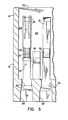
- a diminutive electrical connector constructed in accordance with the invention is illustrated in the embodiment of the female connector 10 of Fig. 1 and other figures.
- a male connector 12 suitable for operative connection with the female connector 10 is illustrated in Figs. 10 and 11 and in broken line in Fig. 12.
- the pair of connectors 10 and 12 are molded and formed of a resilient, electrically insulating material such as nylon or the like and are adapted to be assembled with one another in end-to-end relation. Such end to end relation may include some telescoping overlapping of the male and female connector body parts.
- the male connector 12 comprises a body 14 having a skirt 15 at its forward end which surrounds a chamber 16.
- the female connector 10 comprises a body 18 having a forward end portion 19 of such size as to fit snuggly within the chamber 16 of male connector 12.
- the forwardmost region of the forward end portion 19 of connector 10 will be hereinafter referred to as the mating face 20 thereof.
- the body 18 of connector 10 has a pair of ribs 21 adapted to be accommodated in aligning grooves 22 provided in the skirt 15 of connector 12 for the reception of the ribs 21 so as to facilitate the proper joining of the connectors 10 and 12.
- the skirt 15 of connector 12 is provided with a keeper rib 23 on its underside for releasably fitting into a longitudinally extending slot 24 formed in a keeper flange 25 depending from and extending forwardly beneath the undersurface of the body 18 of connector 10 so as to releasably lock the connectors 10 and 12 in assembled relation.
- the bodies may be locked in assembled relation in any conventional manner.
- the connectors 10 and 12 are of the pin and socket type, with connector 10 being provided with a plurality (in this instance 11) of female-type socket terminals 26 and the connector 12 being provided with a corresponding number of male-type pin terminals 27.
- the pin terminals 27 are typically of circular cross section and the socket terminals 26 may similarly be of circular cross section or, as in the illustrated embodiment, may be of rectilinear cross section.
- the pin terminals 27 are rigidly molded into the body 14 of connector 12, however, it will be appreciated that other mounting configurations might be employed for that connector.
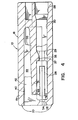
- the body 18 has a row of parallel openings 28 extending forwardly from a large cavity 11 extending across the rear end thereof to a large common cavity 29 in the forward end of the body via a passage or opening 30.
- the connector 10 includes eleven such rear openings 28, arranged in alignment across the width of the connector and closely spaced on 4 millimeter, or preferably 2.5 millimeter centers.
- the cavity 29 occupies most of the forward end portion 19 of connector 10 such that the front mating face 20 of connector body 18 is substantially open.
- the cavity 29 in connector body 18 extends most of the height and width of the connector and extends rearwardly thereinto from the mating surface a significant distance, as for instance, two-thirds of its depth.
- each resilient arm 31 forms an extension of the upper surface of the connecting passage 30 and includes a projection 32 extending downwardly from the undersurface of the arm between its ends which extends radially or laterally inwardly of the associated extension of the passage or opening 30.
- the forward surface of the projection 32 is substantially normal to the longitudinal extent of the arm 31 whereas the trailing or rearward surface of that projection is inclined.
- Each of the arms 31 has a similar projection 32 which extends into the associated extension of passage opening 30.
- Each resilient arm 31 is relatively narrow, being only approximately the width of a corresponding socket-type terminal 26 which it overlies. Each resilient arm 31 is sufficiently thin in the vertical direction to provide the requisite degree of flexibility. Further, each resilient arm 31 is spaced downwardly from the connector body surface defining the top wall of cavity 29 to form therebetween a respective slot 33. Because adjacent arms 31 are relatively closely spaced, being less than about 2 millimeters between edges, and it would be difficult to provide an intermediate wall or blockage member, the entirety of that spacing remains void as part of the cavity 29. The two exceptions to the maintenance of a complete void between adjacent resilient arms 31 occur between the first two arms and the last two arms where respective detent projections 35 extend downwardly from the connector body surface defining the top wall of cavity 29 for a purpose to be hereinafter described.
- Each socket terminal 26 has a tubular body of generally square cross section and is sized to accommodate snugly a respective pin terminal 27.
- the socket terminal 26 has a recess or neck 37 of reduced cross section between its ends. The shoulders in the periphery of the socket terminal 26 which form a recess 37 are relatively abrupt.
- the rearward end of the socket terminal 26 is fastened to an insulated conductive wire 38.
- the longitudinal positioning of the recess 37 in socket terminal 26 and the projection 32 on resilient arm 31 are such that the projection 32 will extend into the terminal recess 37 when the terminal is operatively positioned in the connector in respective openings 28, 30.
- Each socket terminal 26 is installed in the connector body 18 in the manner generally described in the aforementioned U.S. Patent No. 3,686,619. Specifically, the socket terminal is inserted forwardly through the rear opening 28 in body 18 and thence on through the passage opening 30. As the forward end of the terminal 26 engages the projection 32 on resilient arm 31, the arm will be deflected upwardly into the slot 33 so as to enable the projection 32 to move outwardly of the passage 30. As the terminal 26 continues to move through passage 30, the neck recess will reach the projection 32 whereupon the inherent resilience of the arm 31 will restore the latter, with a snap action which may be felt, to its normal, unstressed condition in which the projection 32 is accommodated in the neck recess 37.
- a large, generally rectangular, grommet 39 is housed in rear cavity 11 to seal the terminals 26 from the environment.
- a locking wedge or block 40 constructed in accordance with the invention is used to prevent outward deflection of the arms 31 and their projections 32.
- the locking block 42 is of a resilient, electrically insulating material, such as nylon or the like.
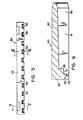
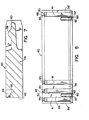
- the locking block 40 seen in Figs. 5-9 as well as other figures, spans the width of cavity 29 in connector body 18.
- the locking block 40 is of generally rectilinear configuration and in addition to spanning the width of cavity 29, is of such depth as to extend from the mating face 20 inwardly to or nearly to the back limits of the cavity 29 and is of such vertical thickness as to extend from the top of the cavity 29 downwardly to a line formed by the centers of the socket terminals 26.
- the locking block 40 is provided with a series of respective recesses 41 extending longitudinally in the undersurface thereof which accommodate the respective terminal 26 and associated resilient arm 31 therewithin below a resulting wedge-shaped portion 42.
- the recesses 41 extend forwardly in the the locking block 40 from the rear end thereof to a position near but spaced rearwardly from the front face of the locking block.
- the thickness of the resulting wedge-shaped portion 42 of block 40 is selected to be snuggly received within the slot 33 above a respective resilient arm 31 for retaining that arm and its projection 32 in detenting engagement with the terminal 26 in a known manner.
- the front or forward portions of the locking block 40 are further configured to provide a closure for so-called “windows” which otherwise might exist laterally adjacent to the socket terminals 26 as a result of the broad extent of cavity 29 particularly in the region between the mating-face ends of the terminals 26 and the connector's mating face 20 itself.
- the forward end of locking block 40 is configured to provide a closure flange 46 which is substantially continuous across the width of cavity 29 and from the centerline of the socket terminals 26 upward to the top of cavity 29.
- a series of small, longitudinally-extending openings 48 are formed along and extend through the lower edge of flange 46 to permit passage of the pin terminals 27 of the corresponding male connector 12 into the respective socket terminals 26.
- the surfaces 50 which extend rearwardly from the front surface of locking block 40 for defining the openings 48 are chamfered or inclined toward the centers of the respective socket terminals 26 to guide the pin terminals 27 into alignment with the centers of the socket terminals 26 during coupling of the connectors 10 and 12.
- an upwardly extending lip 52 extends across the forward end of connector body 18 of connector 10 to provide a limited closure member for the forward end of cavity 29 along the region below the line or plane formed by the centerlines of the respective socket terminals 26.
- a series of longitudinally extending openings 54 are formed along and extend through the upper edge of lip 52 in alignment with the openings 48 of the closure flange 48 of block 40.
- the surfaces 55 extending rearward from the front face of the lip 52 which define the openings 54 are chamfered or inclined inwardly toward the centerline of the socket terminals 26 so as to be complemental with the chamfered surfaces 50 of the closure flange 46 and cooperate in guiding the insertion of pin terminals 27 into socket terminals 26.
- closure flange 46 of locking block 40 might be extended downwardly sufficiently to replace the need for lip 52 while retaining its function as a closure for "windows" which might otherwise exist.
- the described configuration of the preferred embodiment provides the advantages of being relatively easier to mold and also affords the mating face 20 of connector 10 with a desirable degree of rigidity and integrity.
- the remaining distance between successive adjacent recesses 41 comprise ribs 56 extending longitudinally rearward from the closure flange portions 46 at the front face of locking block 40.
- the ribs 56 serve to provide structural integrity to the combination of the female connector body 18 and locking block 40 and further serve to electrically isolate the socket terminals 26 from one another by providing extensions to the side walls of the terminal-housing passage 30. Similar ribs 56' also exist at the opposite ends of block 40, as seen in Fig. 8.
- the locking block 40 is provided with a pair of resiliently supported, upwardly extending detenting tangs 58 for detented engagement with the projections 35 extending downwardly into the cavity 29 from the connector body 18.
- the detenting tangs 28 are supported on respective resilient fingers 60 formed by slots 62 extending forwardly into the rear face of locking block 40.
- a pair of slots 64 extending rearwardly and down into the locking block 40 at its upper corner and near its opposite ends define respective shoulders or surfaces 66 which may be engaged by a tool such as a screwdriver for removing the locking block from the connector body 18.
- the locking block 40 is inserted into the front face of the cavity 29 in connector body 18 such that the wedge-shaped portions 42 of the block are snuggly received in the respective slots 33 above the resilient arms 31.
- the locking block 40 is inserted into connector body 18 until limited by engagement of the forward end of the respective resilient arms 31 with the rear-facing surfaces 68 formed by the recesses 41.
- the dimensioning of the connector body 18 and the locking block 40 is such that the front surface of the closure flange portion 46 of the locking block is at or preferably forwardly of the front end of the socket terminals 26.
- such closure is provided forwardly of the terminal ends and the inclinded surfaces 50, 56 may engage and guide the pin terminals before they arrive at the front end of the socket terminals 27.
- the connectors 10 and 12 may be joined to one another in end-to-end relation by relatively inserting the forward end 19 of the body 18 into the chamber 16 of the body 14.
- the complemental chamfered surfaces 50, 56 of the terminal openings 48, 54 assist in aligning and guiding the pin terminals 27 relatively into the socket terminals 26.
- the keeper rib 23 of connector 12 is retainedly captured in slot 24 of connector 10 to prevent their inadvertent uncoupling.
- Figure 12 illustrates connectors 10 and 12 in fully coupled relationship.
- a gasket (not shown) may occupy the space between the mating face of connector 10 and the base of chamber 16 in connector 12.
Landscapes
- Connector Housings Or Holding Contact Members (AREA)
- Coupling Device And Connection With Printed Circuit (AREA)
- Details Of Connecting Devices For Male And Female Coupling (AREA)
Applications Claiming Priority (2)
| Application Number | Priority Date | Filing Date | Title |
|---|---|---|---|
| US06/566,000 US4602837A (en) | 1983-12-27 | 1983-12-27 | Diminutive electrical connector |
| US566000 | 1983-12-27 |
Publications (3)
| Publication Number | Publication Date |
|---|---|
| EP0148106A2 true EP0148106A2 (de) | 1985-07-10 |
| EP0148106A3 EP0148106A3 (en) | 1987-01-07 |
| EP0148106B1 EP0148106B1 (de) | 1990-05-23 |
Family
ID=24261021
Family Applications (1)
| Application Number | Title | Priority Date | Filing Date |
|---|---|---|---|
| EP84630209A Expired EP0148106B1 (de) | 1983-12-27 | 1984-12-20 | Elektrischer Miniaturstecker |
Country Status (6)
| Country | Link |
|---|---|
| US (1) | US4602837A (de) |
| EP (1) | EP0148106B1 (de) |
| JP (1) | JPS60158576A (de) |
| CA (1) | CA1228903A (de) |
| DE (1) | DE3482356D1 (de) |
| ES (1) | ES292755Y (de) |
Cited By (3)
| Publication number | Priority date | Publication date | Assignee | Title |
|---|---|---|---|---|
| DE3633358A1 (de) * | 1986-10-01 | 1988-04-14 | Daut & Rietz Trw | Kontaktfedergehaeuse fuer steckverbinder |
| EP0220394A3 (de) * | 1985-10-23 | 1988-10-19 | Grote & Hartmann GmbH & Co. KG | Elektrischer Stecker |
| FR2697686A1 (fr) * | 1992-10-30 | 1994-05-06 | Sylea | Dispositif de raccordement électrique. |
Families Citing this family (6)
| Publication number | Priority date | Publication date | Assignee | Title |
|---|---|---|---|---|
| US4684188A (en) * | 1986-02-03 | 1987-08-04 | General Motors Corporation | Electrical connector assembly |
| JPH066469Y2 (ja) * | 1986-02-12 | 1994-02-16 | アンプ インコ−ポレ−テッド | コネクタキット |
| JPH07105246B2 (ja) * | 1988-12-09 | 1995-11-13 | 矢崎総業株式会社 | コネクタの端子係止構造 |
| US5716233A (en) * | 1995-11-30 | 1998-02-10 | Itt Corporation | Contact position assurance device |
| US5730624A (en) * | 1995-11-30 | 1998-03-24 | Itt Corporation | Secondary contact lock arrangement |
| JP5508927B2 (ja) * | 2010-04-22 | 2014-06-04 | 日本航空電子工業株式会社 | コネクタ及び防水コネクタ |
Family Cites Families (3)
| Publication number | Priority date | Publication date | Assignee | Title |
|---|---|---|---|---|
| US3686619A (en) * | 1970-08-19 | 1972-08-22 | Essex International Inc | Electrical connector construction |
| US3937545A (en) * | 1974-12-23 | 1976-02-10 | Ford Motor Company | Waterproof electrical connector |
| US4343523A (en) * | 1980-05-27 | 1982-08-10 | Ford Motor Company | Printed circuit board edge connector |
-
1983
- 1983-12-27 US US06/566,000 patent/US4602837A/en not_active Expired - Lifetime
-
1984
- 1984-12-13 CA CA000470039A patent/CA1228903A/en not_active Expired
- 1984-12-20 EP EP84630209A patent/EP0148106B1/de not_active Expired
- 1984-12-20 DE DE8484630209T patent/DE3482356D1/de not_active Expired - Lifetime
- 1984-12-24 ES ES1984292755U patent/ES292755Y/es not_active Expired
- 1984-12-26 JP JP59281951A patent/JPS60158576A/ja active Pending
Cited By (4)
| Publication number | Priority date | Publication date | Assignee | Title |
|---|---|---|---|---|
| EP0220394A3 (de) * | 1985-10-23 | 1988-10-19 | Grote & Hartmann GmbH & Co. KG | Elektrischer Stecker |
| DE3633358A1 (de) * | 1986-10-01 | 1988-04-14 | Daut & Rietz Trw | Kontaktfedergehaeuse fuer steckverbinder |
| FR2697686A1 (fr) * | 1992-10-30 | 1994-05-06 | Sylea | Dispositif de raccordement électrique. |
| EP0597744A1 (de) * | 1992-10-30 | 1994-05-18 | Société Anonyme SYLEA | Elektrische Verbindungsvorrichtung |
Also Published As
| Publication number | Publication date |
|---|---|
| DE3482356D1 (de) | 1990-06-28 |
| ES292755U (es) | 1986-12-16 |
| EP0148106B1 (de) | 1990-05-23 |
| US4602837A (en) | 1986-07-29 |
| CA1228903A (en) | 1987-11-03 |
| JPS60158576A (ja) | 1985-08-19 |
| EP0148106A3 (en) | 1987-01-07 |
| ES292755Y (es) | 1987-08-01 |
Similar Documents
| Publication | Publication Date | Title |
|---|---|---|
| US6638108B2 (en) | Connector with plural housings accommodated in a casing | |
| US4758182A (en) | Electric connector | |
| US6004158A (en) | Electrical connector with secondary locking plates | |
| EP0232521B1 (de) | Flachbaubuchse | |
| EP0971442B1 (de) | Elektrischer Verbinder mit seitlicher Verriegelung | |
| US5252096A (en) | Connector | |
| US7114997B2 (en) | Electrical connector | |
| US6244910B1 (en) | Electrical box contact with stress limitation | |
| EP0488298B1 (de) | Verbinder mit Kontaktdistanzierplatte mit gleichförmiger seitlicher Kraft | |
| JP3301329B2 (ja) | コネクタ | |
| JPH0522351B2 (de) | ||
| US5542851A (en) | Electrical connector with improved grounding | |
| AU591635B2 (en) | Electrical connector | |
| US6129574A (en) | Connector having a construction for preventing an erroneous assembling of a connector housing and a cover | |
| US4602837A (en) | Diminutive electrical connector | |
| JP2581477Y2 (ja) | コネクタ | |
| JP2995934B2 (ja) | 接続コネクタ | |
| JP3311228B2 (ja) | 端子係止具付きコネクタ | |
| US5071372A (en) | Connector with contact spacer plate having tapered channels | |
| US6132252A (en) | Electrical connector with locking of the contact terminals | |
| JPH08264223A (ja) | 電気コネクタ | |
| JPH11135178A (ja) | コネクタソケット | |
| US6682366B2 (en) | Connector | |
| US6589080B2 (en) | Terminal fitting and a connector | |
| JP2542133B2 (ja) | コネクタ |
Legal Events
| Date | Code | Title | Description |
|---|---|---|---|
| PUAI | Public reference made under article 153(3) epc to a published international application that has entered the european phase |
Free format text: ORIGINAL CODE: 0009012 |
|
| AK | Designated contracting states |
Designated state(s): DE FR GB IT SE |
|
| PUAL | Search report despatched |
Free format text: ORIGINAL CODE: 0009013 |
|
| AK | Designated contracting states |
Kind code of ref document: A3 Designated state(s): DE FR GB IT SE |
|
| 17P | Request for examination filed |
Effective date: 19870427 |
|
| 17Q | First examination report despatched |
Effective date: 19880718 |
|
| GRAA | (expected) grant |
Free format text: ORIGINAL CODE: 0009210 |
|
| RAP1 | Party data changed (applicant data changed or rights of an application transferred) |
Owner name: UNITED TECHNOLOGIES AUTOMOTIVE, INC. |
|
| AK | Designated contracting states |
Kind code of ref document: B1 Designated state(s): DE FR GB IT SE |
|
| ET | Fr: translation filed | ||
| REF | Corresponds to: |
Ref document number: 3482356 Country of ref document: DE Date of ref document: 19900628 |
|
| ITF | It: translation for a ep patent filed | ||
| PLBE | No opposition filed within time limit |
Free format text: ORIGINAL CODE: 0009261 |
|
| STAA | Information on the status of an ep patent application or granted ep patent |
Free format text: STATUS: NO OPPOSITION FILED WITHIN TIME LIMIT |
|
| 26N | No opposition filed | ||
| ITTA | It: last paid annual fee | ||
| PGFP | Annual fee paid to national office [announced via postgrant information from national office to epo] |
Ref country code: FR Payment date: 19931110 Year of fee payment: 10 |
|
| PGFP | Annual fee paid to national office [announced via postgrant information from national office to epo] |
Ref country code: SE Payment date: 19931116 Year of fee payment: 10 Ref country code: GB Payment date: 19931116 Year of fee payment: 10 |
|
| PGFP | Annual fee paid to national office [announced via postgrant information from national office to epo] |
Ref country code: DE Payment date: 19931122 Year of fee payment: 10 |
|
| PG25 | Lapsed in a contracting state [announced via postgrant information from national office to epo] |
Ref country code: GB Effective date: 19941220 |
|
| PG25 | Lapsed in a contracting state [announced via postgrant information from national office to epo] |
Ref country code: SE Effective date: 19941221 |
|
| EAL | Se: european patent in force in sweden |
Ref document number: 84630209.9 |
|
| GBPC | Gb: european patent ceased through non-payment of renewal fee |
Effective date: 19941220 |
|
| PG25 | Lapsed in a contracting state [announced via postgrant information from national office to epo] |
Ref country code: FR Effective date: 19950831 |
|
| PG25 | Lapsed in a contracting state [announced via postgrant information from national office to epo] |
Ref country code: DE Effective date: 19950901 |
|
| EUG | Se: european patent has lapsed |
Ref document number: 84630209.9 |
|
| REG | Reference to a national code |
Ref country code: FR Ref legal event code: ST |