EP0148604A1 - Process for recovery of copper inhibitors in the recovery of CO2 from flue gases - Google Patents
Process for recovery of copper inhibitors in the recovery of CO2 from flue gases Download PDFInfo
- Publication number
- EP0148604A1 EP0148604A1 EP84308653A EP84308653A EP0148604A1 EP 0148604 A1 EP0148604 A1 EP 0148604A1 EP 84308653 A EP84308653 A EP 84308653A EP 84308653 A EP84308653 A EP 84308653A EP 0148604 A1 EP0148604 A1 EP 0148604A1
- Authority
- EP
- European Patent Office
- Prior art keywords
- solution
- copper
- bed
- alkanolamine
- carbon
- Prior art date
- Legal status (The legal status is an assumption and is not a legal conclusion. Google has not performed a legal analysis and makes no representation as to the accuracy of the status listed.)
- Withdrawn
Links
- RYGMFSIKBFXOCR-UHFFFAOYSA-N Copper Chemical compound [Cu] RYGMFSIKBFXOCR-UHFFFAOYSA-N 0.000 title claims abstract description 70
- 239000010949 copper Substances 0.000 title claims abstract description 70
- 229910052802 copper Inorganic materials 0.000 title claims abstract description 69
- 239000003112 inhibitor Substances 0.000 title claims abstract description 17
- 238000011084 recovery Methods 0.000 title claims abstract description 13
- 239000003546 flue gas Substances 0.000 title claims abstract description 11
- 238000000034 method Methods 0.000 title claims description 38
- 230000008569 process Effects 0.000 title claims description 32
- OKTJSMMVPCPJKN-UHFFFAOYSA-N Carbon Chemical compound [C] OKTJSMMVPCPJKN-UHFFFAOYSA-N 0.000 claims abstract description 102
- 229910052799 carbon Inorganic materials 0.000 claims abstract description 45
- CURLTUGMZLYLDI-UHFFFAOYSA-N Carbon dioxide Chemical compound O=C=O CURLTUGMZLYLDI-UHFFFAOYSA-N 0.000 claims abstract description 32
- 229910002092 carbon dioxide Inorganic materials 0.000 claims abstract description 32
- 239000001569 carbon dioxide Substances 0.000 claims abstract description 14
- UGFAIRIUMAVXCW-UHFFFAOYSA-N Carbon monoxide Chemical compound [O+]#[C-] UGFAIRIUMAVXCW-UHFFFAOYSA-N 0.000 claims abstract description 9
- XEEYBQQBJWHFJM-UHFFFAOYSA-N Iron Chemical compound [Fe] XEEYBQQBJWHFJM-UHFFFAOYSA-N 0.000 claims description 34
- 239000002904 solvent Substances 0.000 claims description 30
- 239000007789 gas Substances 0.000 claims description 21
- 239000007857 degradation product Substances 0.000 claims description 20
- 229910052742 iron Inorganic materials 0.000 claims description 17
- 238000005260 corrosion Methods 0.000 claims description 15
- 230000007797 corrosion Effects 0.000 claims description 15
- HZAXFHJVJLSVMW-UHFFFAOYSA-N 2-Aminoethan-1-ol Chemical compound NCCO HZAXFHJVJLSVMW-UHFFFAOYSA-N 0.000 claims description 12
- QVGXLLKOCUKJST-UHFFFAOYSA-N atomic oxygen Chemical compound [O] QVGXLLKOCUKJST-UHFFFAOYSA-N 0.000 claims description 9
- 229910052760 oxygen Inorganic materials 0.000 claims description 9
- 239000001301 oxygen Substances 0.000 claims description 9
- 230000015556 catabolic process Effects 0.000 claims description 8
- 238000006731 degradation reaction Methods 0.000 claims description 8
- NWUYHJFMYQTDRP-UHFFFAOYSA-N 1,2-bis(ethenyl)benzene;1-ethenyl-2-ethylbenzene;styrene Chemical compound C=CC1=CC=CC=C1.CCC1=CC=CC=C1C=C.C=CC1=CC=CC=C1C=C NWUYHJFMYQTDRP-UHFFFAOYSA-N 0.000 claims description 4
- 239000003456 ion exchange resin Substances 0.000 claims description 4
- 229920003303 ion-exchange polymer Polymers 0.000 claims description 4
- 238000001816 cooling Methods 0.000 claims description 3
- 230000004907 flux Effects 0.000 claims description 3
- JPVYNHNXODAKFH-UHFFFAOYSA-N Cu2+ Chemical compound [Cu+2] JPVYNHNXODAKFH-UHFFFAOYSA-N 0.000 claims description 2
- 239000003957 anion exchange resin Substances 0.000 claims description 2
- 229910001431 copper ion Inorganic materials 0.000 claims description 2
- 238000010438 heat treatment Methods 0.000 claims description 2
- 230000003134 recirculating effect Effects 0.000 claims description 2
- 150000003464 sulfur compounds Chemical class 0.000 claims description 2
- 230000000717 retained effect Effects 0.000 claims 1
- 238000001914 filtration Methods 0.000 description 16
- 150000001412 amines Chemical class 0.000 description 13
- 238000005342 ion exchange Methods 0.000 description 9
- 238000006722 reduction reaction Methods 0.000 description 8
- 150000003839 salts Chemical class 0.000 description 8
- 239000006096 absorbing agent Substances 0.000 description 7
- 230000009467 reduction Effects 0.000 description 7
- MUBZPKHOEPUJKR-UHFFFAOYSA-N Oxalic acid Chemical compound OC(=O)C(O)=O MUBZPKHOEPUJKR-UHFFFAOYSA-N 0.000 description 6
- BDAGIHXWWSANSR-UHFFFAOYSA-N formic acid Substances OC=O BDAGIHXWWSANSR-UHFFFAOYSA-N 0.000 description 6
- 239000000047 product Substances 0.000 description 6
- XLYOFNOQVPJJNP-UHFFFAOYSA-N water Substances O XLYOFNOQVPJJNP-UHFFFAOYSA-N 0.000 description 6
- 239000002250 absorbent Substances 0.000 description 5
- 230000002745 absorbent Effects 0.000 description 5
- 229920001467 poly(styrenesulfonates) Polymers 0.000 description 5
- 239000011347 resin Substances 0.000 description 5
- 229920005989 resin Polymers 0.000 description 5
- CDBYLPFSWZWCQE-UHFFFAOYSA-L Sodium Carbonate Chemical compound [Na+].[Na+].[O-]C([O-])=O CDBYLPFSWZWCQE-UHFFFAOYSA-L 0.000 description 4
- 239000000356 contaminant Substances 0.000 description 4
- 239000007788 liquid Substances 0.000 description 4
- 238000012986 modification Methods 0.000 description 4
- 230000004048 modification Effects 0.000 description 4
- 238000007747 plating Methods 0.000 description 4
- 239000007787 solid Substances 0.000 description 4
- OSWFIVFLDKOXQC-UHFFFAOYSA-N 4-(3-methoxyphenyl)aniline Chemical compound COC1=CC=CC(C=2C=CC(N)=CC=2)=C1 OSWFIVFLDKOXQC-UHFFFAOYSA-N 0.000 description 3
- HEMHJVSKTPXQMS-UHFFFAOYSA-M Sodium hydroxide Chemical compound [OH-].[Na+] HEMHJVSKTPXQMS-UHFFFAOYSA-M 0.000 description 3
- RAHZWNYVWXNFOC-UHFFFAOYSA-N Sulphur dioxide Chemical compound O=S=O RAHZWNYVWXNFOC-UHFFFAOYSA-N 0.000 description 3
- 239000002253 acid Substances 0.000 description 3
- 238000004821 distillation Methods 0.000 description 3
- 235000019253 formic acid Nutrition 0.000 description 3
- 229910052751 metal Inorganic materials 0.000 description 3
- 239000002184 metal Substances 0.000 description 3
- 238000007254 oxidation reaction Methods 0.000 description 3
- 238000010525 oxidative degradation reaction Methods 0.000 description 3
- 150000003141 primary amines Chemical class 0.000 description 3
- 238000000746 purification Methods 0.000 description 3
- 230000008929 regeneration Effects 0.000 description 3
- 238000011069 regeneration method Methods 0.000 description 3
- 229920006395 saturated elastomer Polymers 0.000 description 3
- 238000010977 unit operation Methods 0.000 description 3
- QGZKDVFQNNGYKY-UHFFFAOYSA-N Ammonia Chemical compound N QGZKDVFQNNGYKY-UHFFFAOYSA-N 0.000 description 2
- DHMQDGOQFOQNFH-UHFFFAOYSA-N Glycine Chemical compound NCC(O)=O DHMQDGOQFOQNFH-UHFFFAOYSA-N 0.000 description 2
- AEMRFAOFKBGASW-UHFFFAOYSA-N Glycolic acid Chemical compound OCC(O)=O AEMRFAOFKBGASW-UHFFFAOYSA-N 0.000 description 2
- FAPWRFPIFSIZLT-UHFFFAOYSA-M Sodium chloride Chemical compound [Na+].[Cl-] FAPWRFPIFSIZLT-UHFFFAOYSA-M 0.000 description 2
- 238000010521 absorption reaction Methods 0.000 description 2
- 238000006243 chemical reaction Methods 0.000 description 2
- 239000003245 coal Substances 0.000 description 2
- 238000002485 combustion reaction Methods 0.000 description 2
- 150000001879 copper Chemical class 0.000 description 2
- 150000004699 copper complex Chemical class 0.000 description 2
- 230000003413 degradative effect Effects 0.000 description 2
- -1 for example Chemical class 0.000 description 2
- 239000000446 fuel Substances 0.000 description 2
- 230000006872 improvement Effects 0.000 description 2
- 238000011068 loading method Methods 0.000 description 2
- VNWKTOKETHGBQD-UHFFFAOYSA-N methane Chemical compound C VNWKTOKETHGBQD-UHFFFAOYSA-N 0.000 description 2
- 239000000203 mixture Substances 0.000 description 2
- 235000006408 oxalic acid Nutrition 0.000 description 2
- 230000003647 oxidation Effects 0.000 description 2
- 230000001590 oxidative effect Effects 0.000 description 2
- 239000011236 particulate material Substances 0.000 description 2
- 239000013618 particulate matter Substances 0.000 description 2
- 229910000029 sodium carbonate Inorganic materials 0.000 description 2
- GCLGEJMYGQKIIW-UHFFFAOYSA-H sodium hexametaphosphate Chemical compound [Na]OP1(=O)OP(=O)(O[Na])OP(=O)(O[Na])OP(=O)(O[Na])OP(=O)(O[Na])OP(=O)(O[Na])O1 GCLGEJMYGQKIIW-UHFFFAOYSA-H 0.000 description 2
- VWDWKYIASSYTQR-UHFFFAOYSA-N sodium nitrate Chemical compound [Na+].[O-][N+]([O-])=O VWDWKYIASSYTQR-UHFFFAOYSA-N 0.000 description 2
- 238000001179 sorption measurement Methods 0.000 description 2
- CHRJZRDFSQHIFI-UHFFFAOYSA-N 1,2-bis(ethenyl)benzene;styrene Chemical compound C=CC1=CC=CC=C1.C=CC1=CC=CC=C1C=C CHRJZRDFSQHIFI-UHFFFAOYSA-N 0.000 description 1
- APCLRHPWFCQIMG-UHFFFAOYSA-N 4-(5,6-dimethoxy-1-benzothiophen-2-yl)-4-oxobutanoic acid Chemical compound C1=C(OC)C(OC)=CC2=C1SC(C(=O)CCC(O)=O)=C2 APCLRHPWFCQIMG-UHFFFAOYSA-N 0.000 description 1
- VYZAMTAEIAYCRO-UHFFFAOYSA-N Chromium Chemical compound [Cr] VYZAMTAEIAYCRO-UHFFFAOYSA-N 0.000 description 1
- 239000005749 Copper compound Substances 0.000 description 1
- 239000004471 Glycine Substances 0.000 description 1
- UFHFLCQGNIYNRP-UHFFFAOYSA-N Hydrogen Chemical compound [H][H] UFHFLCQGNIYNRP-UHFFFAOYSA-N 0.000 description 1
- 229940125791 MSA-2 Drugs 0.000 description 1
- 101710162106 Merozoite surface antigen 2 Proteins 0.000 description 1
- NINIDFKCEFEMDL-UHFFFAOYSA-N Sulfur Chemical compound [S] NINIDFKCEFEMDL-UHFFFAOYSA-N 0.000 description 1
- 230000002378 acidificating effect Effects 0.000 description 1
- 150000007513 acids Chemical class 0.000 description 1
- 229910021529 ammonia Inorganic materials 0.000 description 1
- 125000000129 anionic group Chemical group 0.000 description 1
- 150000001450 anions Chemical class 0.000 description 1
- 238000000137 annealing Methods 0.000 description 1
- 238000013459 approach Methods 0.000 description 1
- 230000015572 biosynthetic process Effects 0.000 description 1
- 238000009835 boiling Methods 0.000 description 1
- 239000006227 byproduct Substances 0.000 description 1
- 239000002738 chelating agent Substances 0.000 description 1
- 239000007795 chemical reaction product Substances 0.000 description 1
- 229910052804 chromium Inorganic materials 0.000 description 1
- 239000011651 chromium Substances 0.000 description 1
- 238000009833 condensation Methods 0.000 description 1
- 230000005494 condensation Effects 0.000 description 1
- 235000009508 confectionery Nutrition 0.000 description 1
- 229940116318 copper carbonate Drugs 0.000 description 1
- 150000001880 copper compounds Chemical class 0.000 description 1
- GEZOTWYUIKXWOA-UHFFFAOYSA-L copper;carbonate Chemical compound [Cu+2].[O-]C([O-])=O GEZOTWYUIKXWOA-UHFFFAOYSA-L 0.000 description 1
- 230000003247 decreasing effect Effects 0.000 description 1
- 238000013461 design Methods 0.000 description 1
- 238000010586 diagram Methods 0.000 description 1
- 230000003292 diminished effect Effects 0.000 description 1
- 238000004090 dissolution Methods 0.000 description 1
- 230000000694 effects Effects 0.000 description 1
- 238000002474 experimental method Methods 0.000 description 1
- 150000004675 formic acid derivatives Chemical class 0.000 description 1
- 125000000524 functional group Chemical group 0.000 description 1
- 229910052739 hydrogen Inorganic materials 0.000 description 1
- 239000001257 hydrogen Substances 0.000 description 1
- 238000010348 incorporation Methods 0.000 description 1
- 159000000014 iron salts Chemical class 0.000 description 1
- 238000004519 manufacturing process Methods 0.000 description 1
- 239000003345 natural gas Substances 0.000 description 1
- 150000007524 organic acids Chemical class 0.000 description 1
- 235000005985 organic acids Nutrition 0.000 description 1
- 239000007800 oxidant agent Substances 0.000 description 1
- 239000002245 particle Substances 0.000 description 1
- 238000002161 passivation Methods 0.000 description 1
- 230000002093 peripheral effect Effects 0.000 description 1
- 239000011148 porous material Substances 0.000 description 1
- 238000001556 precipitation Methods 0.000 description 1
- 238000012545 processing Methods 0.000 description 1
- 238000010992 reflux Methods 0.000 description 1
- 238000009877 rendering Methods 0.000 description 1
- 230000000630 rising effect Effects 0.000 description 1
- 239000011780 sodium chloride Substances 0.000 description 1
- 239000004317 sodium nitrate Substances 0.000 description 1
- 235000010344 sodium nitrate Nutrition 0.000 description 1
- 239000012265 solid product Substances 0.000 description 1
- 239000007858 starting material Substances 0.000 description 1
- 239000000126 substance Substances 0.000 description 1
- 239000011593 sulfur Substances 0.000 description 1
- 229910052717 sulfur Inorganic materials 0.000 description 1
- 238000012546 transfer Methods 0.000 description 1
Images


Classifications
-
- B—PERFORMING OPERATIONS; TRANSPORTING
- B01—PHYSICAL OR CHEMICAL PROCESSES OR APPARATUS IN GENERAL
- B01D—SEPARATION
- B01D53/00—Separation of gases or vapours; Recovering vapours of volatile solvents from gases; Chemical or biological purification of waste gases, e.g. engine exhaust gases, smoke, fumes, flue gases, aerosols
- B01D53/14—Separation of gases or vapours; Recovering vapours of volatile solvents from gases; Chemical or biological purification of waste gases, e.g. engine exhaust gases, smoke, fumes, flue gases, aerosols by absorption
- B01D53/1493—Selection of liquid materials for use as absorbents
-
- B—PERFORMING OPERATIONS; TRANSPORTING
- B01—PHYSICAL OR CHEMICAL PROCESSES OR APPARATUS IN GENERAL
- B01D—SEPARATION
- B01D53/00—Separation of gases or vapours; Recovering vapours of volatile solvents from gases; Chemical or biological purification of waste gases, e.g. engine exhaust gases, smoke, fumes, flue gases, aerosols
- B01D53/14—Separation of gases or vapours; Recovering vapours of volatile solvents from gases; Chemical or biological purification of waste gases, e.g. engine exhaust gases, smoke, fumes, flue gases, aerosols by absorption
- B01D53/1456—Removing acid components
- B01D53/1475—Removing carbon dioxide
-
- Y—GENERAL TAGGING OF NEW TECHNOLOGICAL DEVELOPMENTS; GENERAL TAGGING OF CROSS-SECTIONAL TECHNOLOGIES SPANNING OVER SEVERAL SECTIONS OF THE IPC; TECHNICAL SUBJECTS COVERED BY FORMER USPC CROSS-REFERENCE ART COLLECTIONS [XRACs] AND DIGESTS
- Y02—TECHNOLOGIES OR APPLICATIONS FOR MITIGATION OR ADAPTATION AGAINST CLIMATE CHANGE
- Y02C—CAPTURE, STORAGE, SEQUESTRATION OR DISPOSAL OF GREENHOUSE GASES [GHG]
- Y02C20/00—Capture or disposal of greenhouse gases
- Y02C20/40—Capture or disposal of greenhouse gases of CO2
Definitions
- Flue gas normally will be at or near atmospheric pressure and contains about 6-10 percent CO 2 and about 2-5 percent oxygen. Sulfur dioxide may be an additional contaminant if the fuel source is coal instead of sweet or commercial natural gas.
- the principal solvent used in the removal of CO 2 from flue gas during the aforesaid period employed an aqueous monoethanolamine (MEA) solution in the concentration range of 5-12 percent.
- MEA monoethanolamine
- Some processes were able to extend the in-service time by operating the dilute MEA solution and passing a small portion of the solution to a side stream reclamation still to remove the contaminants. Such processes still did remove some of the oxidative degradation products as a bottom product while taking substantially the MEA and water as an overhead product for recycle.
- the side stream still operated on a 2-3 percent side stream. This approach was not particularly successful because the degradation products were removed only to a limited extent in the side stream reclaimer.
- degradation products continued to be produced at a higher rate than normally found in the process due to the higher temperatures (temperatures above those encountered in the regenerator) necessary for operating the reclaimer still. Removal of the degradation or reaction products also favors shifting the reaction equilibrium for increased reaction rate.
- a further technique utilized copper salts as an inhibitor and is disclosed in US 2,377,966. This method was used in the above mentioned systems that did not include the use of a reclaimer in the operation. Copper was only moderately successful as a corrosion inhibitor even at the low C0 2 loadings and low concentrations of alkanolamine. Precipitation of elemental copper was a serious limitation of this process and resulted in enhanced corrosion due to galvanic attack in the peripheral area of the deposited copper metal. This system was operated much the same way that the uninhibited aqueous MEA solution first mentioned was utilized, in that when the system became sufficiently degraded the entire solution was dumped, the internals of the plant cleaned, fresh alkanolamine charged back to the system, and the system put back in service. The length of time the system remained on stream was again unpredictable.
- the actual amount of copper used can be any amount of copper greater than 5 parts of copper per million parts of solution into which the carbon dioxide and, if present, sulfur--containing acid gases (e.g. S0 2 with trace amounts of other sulfur compounds, H 2 S, COS, and the like) are absorbed.
- sulfur--containing acid gases e.g. S0 2 with trace amounts of other sulfur compounds, H 2 S, COS, and the like
- the effluent (rich solvent) from the contactor is withdrawn from the bottom of the contactor and cross-exchanged with solvent (lean solvent) which has been heated to release the absorbed acid gases, in this case to produce a carbon dioxide and sulfur lean solvent.
- solvent lean solvent
- the rich solvent after heat exchange with the lean solvent is delivered to a stripper or regenerator wherein the rich solvent is contacted with rising vapors from the lower end of the stripper.
- the liquid in the lower end of the stripper is circulated through a reboiler wherein conventionally it is heated to about 240°F to 260°F (115°C to 126.5°C) and returned to the lower portion of the stripper or reboiler surge tank. A portion of the bottoms (non-lean solvent) drawn off the stripper or reboiler surge tank is then returned to the absorption column.
- the above procedure surprisingly effectively removes ionic iron and solvent degradation products. This allows sufficient ionic copper in solution to abate corrosion, minimizes the formation of degradation products, and maintains substantially the efficiency of the alkanolamine solution.
- activated carbon treatment can remove certain of the degradation products both by adsorption and/or absorption and its inherent filtering effects mechanically removes some of the particulate material to obtain an improvement when compared to the earlier described processes. It however has been found advantageous to couple mechanical filtration both before and after activated carbon treatment to extend the life of the carbon bed and collect the insoluble iron.
- Ion-exchange treatment may also be employed to remove some of the degradation products, with or without either mechanical filtrations or activated carbon treatment, but the bed must be cleaned more often to avoid plugging with insoluble iron or other solid degradation products when filtration is not employed at least ahead of the exchanger.
- mechanical filtration is preferred to keep at a low level the insoluble iron and/or solid degradation products from plugging the bed.
- the use of one or both filtration mediums as the only treatment will improve the operation of the process but not to the same degree as operating on the three unit operations, i.e., mechanical filtration, activated carbon treatment, and ion-exchange.
- the piping in US 4,477,419 is modified to enable the carbon beds to be treated with cool lean absorbent after they become nearly saturated as a result of passing the hot lean absorbent through the bed to remove the copper containing contaminants.
- the solvent which has been treated through the carbon bed is returned to the hot lean stream from the stripper and recycled through the process.
- the carbon bed nears its saturated capacity, with respect to adsorption of copper (e.g., copper complex) the passage of hot lean solution is stopped and a cool lean stream of solution is passed through the carbon bed and surprisingly the copper complex on the carbon is redissolved into the lean solution.
- This lean solution may be reintroduced into the lean streams at any point between the stripper lean solution bottoms and the lean solution inlet to the absorber.
- the most advantageous manner of carrying out the present invention is to introduce a portion of the hot lean solution from the stripper, into contact with a carbon bed prior to any treatment as described in US 4,477,419, therein reducing the soluble copper in the hot lean and delivering the vented solution to a reclaimer.
- the hot, now substantially copper free, solution can be reclaimed and returned to the process.
- This scheme may be made without departing from the spirit of the invention.
- Further another mode comprises employing a filter down stream from the carbon bed.
- the carbon bed may be operated in a manner that any elemental copper will pass out of the bed (e.g., the bed becomes saturated and solid copper is washed free by the hot solution without redissolution) and be collected on a filter which, when its filtering capacity is reached, will be switched from the carbon bed to cool lean solution for pickup of the elemental copper in the same manner as aforedescribed with the copper dissolution from the carbon bed.
- any elemental copper will pass out of the bed (e.g., the bed becomes saturated and solid copper is washed free by the hot solution without redissolution) and be collected on a filter which, when its filtering capacity is reached, will be switched from the carbon bed to cool lean solution for pickup of the elemental copper in the same manner as aforedescribed with the copper dissolution from the carbon bed.
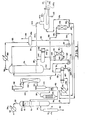
- Figure 1 is a schematic diagram of a typical commercial operation showing the association of the conventional contactor 16 with the stripper 74, with the activated carbon bed 48, mechanical filters 42 and 44, and ion-exchange bed 34 of US 4,477,419 as modified to incorporate the essence of the present invention
- Figures 2 and 3 illustrate modifications in the manner of piping the aspect of the present invention to illustrate the flexibility of the present invention.
- 10 represents an inlet line for the flue gas to be treated.
- a knock--out drum 12 with drain line 32 is provided to collect liquid condensates.
- line 14 leads the flue gases into absorber 16 which has a plurality of trays 18 and a demister 20.
- the effluent gases from the absorber 16 are led by line 22 optionally to a condensor 24 and to outlet line 26.
- Recirculating alkanolamine solution is led by line 36 into the absorber 16 and the rich amine solution, i.e., amine containing absorbed C0 2 , leaves the absorber by exit line 30 and thence to the inlet of pump 68.
- the rich amine solution flows through the cross exchanger 58 and via line 64 to the inlet of the stripper 74 wherein the rich amine is heated and stripped of carbon dioxide.
- the gases containing C0 2 are removed through outlet 78 where they flow through a condensor 80 and then by line 82 to a condensate collector 86.
- the CO 2 gas in essence purged free of water is removed by line 84 and the condensate is removed by line 88 and consists of a reflux for reuse by passing it through a pump 90 and line 94 back to the stripper 74.
- an outlet line 112 which leads the alkanolamine solution to the inlet of the reboiler 100.
- the heated solution recirculates back to the stipper by line 98- Steam (here described but other sources of heat may be used) lines 102 and 104 provide an inlet and an outlet for the steam to heat the reboiler 100.
- a portion of heated lean alkanolamine solution is withdrawn by line 108 from line 112 and where the solution is recirculated by pump 70 and the associated lines 120 and 72 to the heat exchanger 58.
- a portion of the lean alkanolamine solution can be withdrawn by line 114 and oxidized with an oxygen containing gas such as air in the oxidizing unit 116.
- Line 118 is provided to return the oxidized solution back to the main line 120.
- Oxidizing gases are provided by inlet 92 and the used gases are removed by an outlet (not shown).
- the alkanolamine solution flows by outlet line 60 to line 56 then to an amine cooler 54 and thence by line 40 to a cartridge filter 42 for removal of fine particulates. From the filter 42 the solution goes by line 46 to an activated carbon bed 48 and thence by line 50 to a second cartridge filter 44 for the removal of carbon fines.
- Line 52 is provided to lead the solution back to the absorber by line 36. If desired, part or all of the solution can be passed by line 33 to an ion-exchange bed 34 for further purification of the solution prior to reuse. It is to be understood that in the above description the necessary valves and controls have not been illustrated in order to clearly point out the invention. It is also understood that some of the solution may and preferably does by-pass the filtration/purification section through line 38.
- Figure 1 which illustrate the present invention are (1) a line 130 is connected to the lean solution withdraw line 112 from the stripper 74 to lead the hot lean solution to the inlet of a carbon bed 138.
- a line 136 carries the solution which has contacted the carbon bed to the reclaimer 137 which has heating means 137a fed with steam from line 131 and a condensate line 132 to carry away the steam condensate from the reclaimer heat system.
- the reclaimer has a distillation column 137b through which the water and amine vapors are passed to rectify them for return to the stripper column 74 via line 140 to line 98.
- line 130 Associated with line 130 is a line which, when activated by appropriate valving 139, will provide cool lean solution from the outlet of amine cooler 54 to the carbon bed 138 for recovery, by redissolution, of the copper on the carbon.
- the outlet line 136 from the carbon bed is connected to a line 135 via valve 142 to return the lean solution after redissolution of the copper recovered from the carbon bed to the cold side of exchanger 54.
- Associated with each of lines 130, 134, 135, and 136 are three way valves 139 and 142 to allow switching of the various streams from one to the other as the carbon bed is first used as a reducing and elemental copper collecting media then as a source of reintroduction of copper into the system via redissolution in cool lean solution.
- Figure 2 illustrates a variation in the piping so as to employ two carbon beds to provide a continuous treatment of hot lean solution in one bed to remove copper while simultaneously recovering copper from the other bed by contact with cool lean solution and thus return the copper to the system.
- Figure 3 illustrates the variation whereby the carbon bed is used substantially only for reduction of the copper form in the hot lean solution to a form compatible with collection on a filter, the flow of hot solution carrying with it out of the bed the copper which is collected on a filters 145 or 145a. These latter filters are operated alternately on collection and redissolution in the same manner as the carbon beds in the previous description accompanying Figure 3. Otherwise the systems operate in the same manner as described with reference to Figure 1.
- Figure 4 represents a combination of the treatment illustrated in Figures 2 and 3.
- the inhibitor of choice for this particular system is ionic copper introduced as any salt soluble in the alkanolamine solution in a concentration greater than 5 ppm by weight based on the total solution.
- the preferred soluble salt. is copper carbonate.
- the preferred range is between 50 ppm and 750 ppm and the most preferred range is between 100 ppm and 500 ppm copper, however it is not implied that greater concentrations of copper are not effective since concentrations in excess of 2000 ppm have been successfully used. It has been shown by both laboratory data and pilot plant data that passivation of the corrosion process can be achieved and maintained even in concentrations less than 50 ppm if the copper is present in the ionic form. Likewise, it has been established that between about 5-80 percent concentration of MEA can be effectively inhibited against corroding the metal components of the system by maintaining a proper level of ionic copper in the treating solution.
- Alkanolamine concentration -- from 5 to 80 percent solutions of alkanolamine may be employed with reduced corrosion and reduced solvent degradation resulting in improved life of solvent, that is, longer periods between turnarounds or unscheduled down times to replace the solvent.
- Primary, secondary, and tertiary alkanolamines, or mixtures thereof, may be employed.
- the preferred alkanolamine being monoethanolamine of from 25 to 50 percent by weight. It has been found from pilot plant data that the incorporation of the present invention results in little or no downtime occasioned by corrosion and/or necessity to replace the solvent for at least periods of two to four years.
- Temperature control of the stripper It has been found that the reduction of active copper ion content, in for example, monoethanolamine, is greatly accelerated above 150°F (66°C) and that reboiler bulk temperatures of from 240°F (116°C) to 260°F (127°C) and above are conducive to excessive reduction of copper particularly increased residence times. It is preferable to maintain the reboiler bulk temperature at or below 240°F (116°C) to 260°F (127°C). Also it is desirable to employ a maximum heat transfer flux of less than 10,000 BTU and preferably less than 6,000 BTU per square foot per hour. Higher heat flux and/or residence times will, of course, function but will contribute to a higher rate of copper depletion and thus loss of operability of the overall system.
- the activated carbon treaters in conjunction with mechanical filters are utilized for the passage of alkanolamine solution through, first, a mechanical filter operating in, for example, the 10-75 micrometer range, preferably in the 25-50 micrometer range for protection of the activated carbon treater which is located immediately downstream.
- the activated carbon treater will operate to some extent on any of a variety of activated carbons, however, it has been found that the most efficient removal for a broad range of degradation products and capacity coupled with longevity of the activated carbon rests with the coal based activated carbons. Allowable bed pressure drop usually determines carbon particle size. A preferred size is in the 12-40 mesh (0.425-1.70 mm) range such as CALGON F-400 or its equivalent.
- the carbon treatment removes certain of the degradative products of the alkanolamine which are suspected to be strong iron chelators. Examples of these products are higher molecular weight organic acids. It is reported that these acids are produced from formic acid, generated as a degradation product of the alkanolamines, and oxalic acid which is the further degradation product of formic acid and for- mates and/or glycine and glycolic acid.
- the primary function of the mechanical filter down stream of the activated carbon bed is to recover insoluble iron and other particulate material that may be released during the activated carbon function.
- the pore openings may range from 1 to 50 micrometers with the preferred range being between 5 to 25 micrometers.
- a secondary function is to collect activated carbon fines thus protecting downstream equipment.
- the solvent stream is activated carbon treated and filtered full flow or as a partial side stream utilizing 0.025 bed volume per minute to 1 bed volume per minute.
- the preferred rate is 0.1--0.2 bed volume per minute.
- the present invention likewise has been surprisingly improved by minimizing both activated carbon bed and solvent temperatures to a 150°F (66°C) maximum. Operation in this mode improves the capacity and improves the selectivity for particular degradation species. Due to the relatively low temperature requirements for most efficient operation, it is advantageous to place the activated carbon treater and mechanical filters downstream of the amine cooler just prior to introduction of the lean solution to the absorber.
- Ion-Exchange -- Heat stable salts of a number of varieties and from a number of sources are continually produced and/or inadvertently added to alkanolamine systems, especially those processing oxygen-containing gas streams.
- the majority of these salts such as, for example, sodium chloride, amine oxalate, and sodium nitrate are of a type which are not effectively removed by activated carbon and/or mechanical filtration.
- solvent reclamation by distillation This method is not recommended as it depletes the inhibitor level (Cu is not carried over in the distillation process) and unless controlled very carefully can cause increased solvent degradation.
- the present invention preferably utilizes ion-exchange to remove the anionic portion of the heat stable salt. This is accomplished by passage of the contaminated solvent through any of the number of strong base anion-exchange resins of the styrenedivinylbenzene type which have a quaternary amine as their functional group, i.e., DOWEX * 1, DOWEX * 2, DOWEX * MSA-l, DOWEX* MSA-2 ( * Trademark of The Dow Chemical Company).
- the anions present in solution displace the hydroxide groups present on the resin and are removed from solution. After the resin is spent (its exchange capacity fully utilized) the resin may be discarded or regenerated with a sodium hydroxide solution of essentially any concentration, the preferred concentration being 2-5N.
- the regeneration effluent, containing the unwanted salts, is then discarded and the resin ready for reuse.
- Exemplary of such ion exchange treatment was the treatment of 100 ml of a foul 30 percent MEA solution from the plant which had 300 ppm copper inhibitor and which was carbon treated.
- the solution was treated by passing it downflow through a 25-ml packed column of DOWEX 1 (OH - form) at 5 cm 3 /min and 78°F (26°C). After discarding the hold-up volume of water, the alkanolamine solution was collected and a sample of both the starting material and resin bed effluent were analyzed for heat stable salt content.
- Inhibitor Regeneration -- Regeneration of inhibitor is not normally required as long as the conditions taught by this invention are followed specifically. However, if by improper plant design or non-adherance to the conditions set forth herein, copper metal or copper compounds are formed by the reduction of the copper, this inhibitor exhibits the surprising capability of regenerability.
Landscapes
- Chemical & Material Sciences (AREA)
- Engineering & Computer Science (AREA)
- Analytical Chemistry (AREA)
- General Chemical & Material Sciences (AREA)
- Oil, Petroleum & Natural Gas (AREA)
- Chemical Kinetics & Catalysis (AREA)
- Gas Separation By Absorption (AREA)
- Treating Waste Gases (AREA)
- Carbon And Carbon Compounds (AREA)
- Organic Low-Molecular-Weight Compounds And Preparation Thereof (AREA)
- Removal Of Specific Substances (AREA)
Applications Claiming Priority (2)
| Application Number | Priority Date | Filing Date | Title |
|---|---|---|---|
| US56070683A | 1983-12-12 | 1983-12-12 | |
| US560706 | 1983-12-12 |
Publications (1)
| Publication Number | Publication Date |
|---|---|
| EP0148604A1 true EP0148604A1 (en) | 1985-07-17 |
Family
ID=24238995
Family Applications (1)
| Application Number | Title | Priority Date | Filing Date |
|---|---|---|---|
| EP84308653A Withdrawn EP0148604A1 (en) | 1983-12-12 | 1984-12-12 | Process for recovery of copper inhibitors in the recovery of CO2 from flue gases |
Country Status (9)
| Country | Link |
|---|---|
| EP (1) | EP0148604A1 (da) |
| JP (1) | JPS60501756A (da) |
| KR (1) | KR850700116A (da) |
| AU (1) | AU556991B2 (da) |
| BR (1) | BR8407218A (da) |
| DK (1) | DK359885D0 (da) |
| NO (1) | NO853159L (da) |
| WO (1) | WO1985002555A1 (da) |
| ZA (1) | ZA849557B (da) |
Cited By (4)
| Publication number | Priority date | Publication date | Assignee | Title |
|---|---|---|---|---|
| EP1970115A3 (en) * | 2007-03-14 | 2010-04-21 | Mitsubishi Heavy Industries, Ltd. | CO2 recovery system and waste-product removing method |
| WO2012032410A2 (en) | 2010-08-24 | 2012-03-15 | Ccr Technologies, Ltd. | Process for recovery of processing liquids |
| US9815025B2 (en) | 2014-03-13 | 2017-11-14 | Fluor Technologies Corporation | Removal of metals from CO2 capture solvents |
| EP3369472A4 (en) * | 2015-10-27 | 2019-08-21 | Mitsubishi Heavy Industries Engineering, Ltd. | METHOD AND SYSTEM FOR RECOVERING SAUREM GAS AND METHOD AND SYSTEM FOR ANALYSIS OF EISENIONS |
Families Citing this family (3)
| Publication number | Priority date | Publication date | Assignee | Title |
|---|---|---|---|---|
| JP2597055B2 (ja) * | 1991-10-09 | 1997-04-02 | 関西電力株式会社 | 燃焼ガス中の炭酸ガスの回収方法及び装置 |
| US5342366A (en) * | 1992-02-19 | 1994-08-30 | Biomet, Inc. | Surgical instruments for hip revision |
| DK2300127T3 (da) * | 2008-06-23 | 2015-07-06 | Basf Se | Absorptionsmiddel og fremgangsmåde til fjernelse af sure gasser fra væskestrømme, navnlig fra røggasser |
Citations (1)
| Publication number | Priority date | Publication date | Assignee | Title |
|---|---|---|---|---|
| US4477419A (en) * | 1983-03-03 | 1984-10-16 | The Dow Chemical Company | Process for the recovery of CO2 from flue gases |
-
1984
- 1984-12-06 BR BR8407218A patent/BR8407218A/pt unknown
- 1984-12-06 JP JP85500103A patent/JPS60501756A/ja active Pending
- 1984-12-06 WO PCT/US1984/001995 patent/WO1985002555A1/en not_active Ceased
- 1984-12-06 KR KR1019850700160A patent/KR850700116A/ko not_active Ceased
- 1984-12-06 AU AU37463/85A patent/AU556991B2/en not_active Ceased
- 1984-12-07 ZA ZA849557A patent/ZA849557B/xx unknown
- 1984-12-12 EP EP84308653A patent/EP0148604A1/en not_active Withdrawn
-
1985
- 1985-08-07 DK DK359885A patent/DK359885D0/da not_active Application Discontinuation
- 1985-08-09 NO NO853159A patent/NO853159L/no unknown
Patent Citations (1)
| Publication number | Priority date | Publication date | Assignee | Title |
|---|---|---|---|---|
| US4477419A (en) * | 1983-03-03 | 1984-10-16 | The Dow Chemical Company | Process for the recovery of CO2 from flue gases |
Cited By (8)
| Publication number | Priority date | Publication date | Assignee | Title |
|---|---|---|---|---|
| EP1970115A3 (en) * | 2007-03-14 | 2010-04-21 | Mitsubishi Heavy Industries, Ltd. | CO2 recovery system and waste-product removing method |
| US8137441B2 (en) | 2007-03-14 | 2012-03-20 | Mitsubishi Heavy Industries Ltd. | CO2 recovery system and waste-product removing method |
| WO2012032410A2 (en) | 2010-08-24 | 2012-03-15 | Ccr Technologies, Ltd. | Process for recovery of processing liquids |
| EP2608871B1 (en) * | 2010-08-24 | 2021-03-24 | CCR Technologies, Ltd. | Process for recovery of processing liquids |
| US9815025B2 (en) | 2014-03-13 | 2017-11-14 | Fluor Technologies Corporation | Removal of metals from CO2 capture solvents |
| US10532317B2 (en) | 2014-03-13 | 2020-01-14 | Fluor Technologies Corporation | Removal of metals from CO2 capture solvents |
| EP3369472A4 (en) * | 2015-10-27 | 2019-08-21 | Mitsubishi Heavy Industries Engineering, Ltd. | METHOD AND SYSTEM FOR RECOVERING SAUREM GAS AND METHOD AND SYSTEM FOR ANALYSIS OF EISENIONS |
| US10668427B2 (en) | 2015-10-27 | 2020-06-02 | Mitsubishi Heavy Industries Engineering, Ltd. | Acid gas recovery method and system and iron ion analysis method and system |
Also Published As
| Publication number | Publication date |
|---|---|
| JPS60501756A (ja) | 1985-10-17 |
| AU556991B2 (en) | 1986-11-27 |
| WO1985002555A1 (en) | 1985-06-20 |
| ZA849557B (en) | 1986-08-27 |
| AU3746385A (en) | 1985-06-26 |
| DK359885A (da) | 1985-08-07 |
| DK359885D0 (da) | 1985-08-07 |
| BR8407218A (pt) | 1985-11-26 |
| NO853159L (no) | 1985-08-09 |
| KR850700116A (ko) | 1985-10-25 |
Similar Documents
| Publication | Publication Date | Title |
|---|---|---|
| US4477419A (en) | Process for the recovery of CO2 from flue gases | |
| US4624839A (en) | Process for the recovery of CO2 from flue gases | |
| KR100464840B1 (ko) | 산소 함유 혼합물로부터 이산화탄소를 회수하는 방법 | |
| CN101400428B (zh) | 用于从酸气捕获设备脱除盐的离子交换剂的再生 | |
| US5756058A (en) | Process for purifying sulfur oxides-containing gas | |
| EP1059109B1 (en) | Carbon dioxide recovery with composite amine blends | |
| US6334886B1 (en) | Removal of corrosive contaminants from alkanolamine absorbent process | |
| WO2002064238A1 (en) | Carbon dioxide recovery plant | |
| MXPA00005732A (es) | Sistema para recuperar dioxido de carbono de un suministro escaso | |
| WO2006136016A1 (en) | Waste gas treatment process including removal of mercury | |
| JPH03151051A (ja) | 廃アルカノールアミンの再活性化に用いた酸性カチオン交換樹脂の再生方法 | |
| CA1212522A (en) | Process for the recovery of co.sub.2 from flue gases | |
| EP0013151A1 (en) | Process for maintaining the performance of aqueous hindered amine scrubbing liquid in acid gas scrubbing | |
| EP0148604A1 (en) | Process for recovery of copper inhibitors in the recovery of CO2 from flue gases | |
| CA1142735A (en) | Regenerating alkanolamine desulfurizer solution | |
| EP0636118B1 (en) | Reclamation of alkanolamine solutions | |
| US6551570B1 (en) | Hydrogen sulfide removal process | |
| JP3604395B2 (ja) | アミン溶媒処理系における溶媒劣化および腐食を最小限にする方法 | |
| MXPA97002676A (en) | Method for minimizing the solvent degradation and corrosion in amident treatment systems | |
| RU2087181C1 (ru) | Способ удаления кислотных газов, таких, как сероводород и/или двуокись углерода | |
| US4292286A (en) | Process for selective removal of cyclic urea from hindered amine gas treating solution | |
| US4690740A (en) | Method for maintaining effective corrosion inhibition in gas scrubbing plant | |
| KR102398277B1 (ko) | 산성가스 함유 배가스로부터 산성가스를 제거하는 배가스 정제장치 및 방법 | |
| US5422009A (en) | Removal of calcium from amine solutions | |
| KR20200065393A (ko) | 산성가스 정제장치 및 정제방법 |
Legal Events
| Date | Code | Title | Description |
|---|---|---|---|
| PUAI | Public reference made under article 153(3) epc to a published international application that has entered the european phase |
Free format text: ORIGINAL CODE: 0009012 |
|
| AK | Designated contracting states |
Designated state(s): DE FR GB IT SE |
|
| 17P | Request for examination filed |
Effective date: 19860107 |
|
| 17Q | First examination report despatched |
Effective date: 19860627 |
|
| STAA | Information on the status of an ep patent application or granted ep patent |
Free format text: STATUS: THE APPLICATION IS DEEMED TO BE WITHDRAWN |
|
| 18D | Application deemed to be withdrawn |
Effective date: 19861108 |
|
| RIN1 | Information on inventor provided before grant (corrected) |
Inventor name: WOLCOTT, RICHARD ALAN Inventor name: PEARCE, ROSCOE LAMONT Inventor name: PAULEY, CHARLES RICHARD |