EP0149634B1 - Verfahren zur definierten verknüpfung doppelhelikaler dna-fragmente mittels einer linker-dna sowie als linker-dna geeingnete oligonucleotide - Google Patents
Verfahren zur definierten verknüpfung doppelhelikaler dna-fragmente mittels einer linker-dna sowie als linker-dna geeingnete oligonucleotide Download PDFInfo
- Publication number
- EP0149634B1 EP0149634B1 EP84902585A EP84902585A EP0149634B1 EP 0149634 B1 EP0149634 B1 EP 0149634B1 EP 84902585 A EP84902585 A EP 84902585A EP 84902585 A EP84902585 A EP 84902585A EP 0149634 B1 EP0149634 B1 EP 0149634B1
- Authority
- EP
- European Patent Office
- Prior art keywords
- dna
- sequence
- complementary
- sequences
- formula
- Prior art date
- Legal status (The legal status is an assumption and is not a legal conclusion. Google has not performed a legal analysis and makes no representation as to the accuracy of the status listed.)
- Expired
Links
Images
Classifications
-
- C—CHEMISTRY; METALLURGY
- C12—BIOCHEMISTRY; BEER; SPIRITS; WINE; VINEGAR; MICROBIOLOGY; ENZYMOLOGY; MUTATION OR GENETIC ENGINEERING
- C12N—MICROORGANISMS OR ENZYMES; COMPOSITIONS THEREOF; PROPAGATING, PRESERVING, OR MAINTAINING MICROORGANISMS; MUTATION OR GENETIC ENGINEERING; CULTURE MEDIA
- C12N15/00—Mutation or genetic engineering; DNA or RNA concerning genetic engineering, vectors, e.g. plasmids, or their isolation, preparation or purification; Use of hosts therefor
Definitions
- the invention relates to a method for the defined linking of double helical DNA fragments via cohesive ends with the features specified in claim 1.
- the invention further relates to a double helical linker DNA of the formula 1 given in claim 1, in which R 1 , R 2 , X and n are as defined above.
- the method or the linker DNA of the invention can be used for a targeted change in the genetic material.
- Restriction linkers are known (Scheller et al., Science Vol. 196, (1977), 177 and have long been used in molecular biology and genetic engineering. They have in common that the recognition region for the restriction endonuclease lies in the central part of the oligonucleotide sequence and in is usually flanked in the 5 'and 3' terminal region by G / C-rich sequences.
- Complementary means complementary in the sense of Watson and Crick.
- “Mirror-image complementary” means that two sequences are complementary when one is read from left to right and the other from right to left.
- DNA fragment at the linkage point for the linker DNA has a 5'-phosphate group. If the phosphate group is missing in the first or second DNA fragment, the oligonucleotide I must have a 5'-phosphate group.
- R 1 is one of the possible by combining the four nucleotides A, T, C and G, not in itself is complementary tetranucleotide sequences, the sequences shown in Table 1 result. If R 1 is one of the non-self-complementary pentanucleotides possible by combining the four nucleotides A, T, C and G (in view of the odd number of nucleotides, pentanucleotide sequences are exclusively not self-complementary), analog permutation gives the im individual non-reproduced possible sequences, e.g. B.
- the combination possibilities for self-complementary or not self-complementary hexanucleotides can also be obtained from the nucleotides A, T, C and G by appropriate permutation, for. B.
- R 1 is a non-self-complementary tetra- or penta- or a self-complementary or not self-complementary hexanucleotide sequence
- R 2 must have the sequence complementary to R 1 with the same chain length , e.g. B.
- a ribonucleotide must be present in the spacer X in order to produce cohesive ends if either R 1 or R 2 have a ribonucleotide; however, a ribonucleotide in spacer X is not required if R 1 and R 2 each contain a ribonucleotide.
- R 1 and R 2 may contain 5 'or 3' ribonucleotides, the particular positioning of the ribonucleotide determining the chain length of the transferred cohesive end.
- T * ribothymidine
- U * ribouridine
- restriction endonucleases of classes II and 111 A list and description of restriction endonucleases of classes II and 111 is contained in the company publication "Restriction Endonucleases” by Boehringer Mannheim GmbH, 1981; this publication also contains restriction endonucleases of classes II and III which can be used for the process of the invention but are not mentioned by name in the following description.
- the method of the invention can be used to transfer 1, 2, 3, 4, 5 or 6, preferably 4, nucleotide-containing cohesive ends to the first DNA, nucleotides from the spacer group X not being transferred as well. However, as will be shown later using an example, it is also possible to transfer one or more nucleotides from the spacer X to the first DNA, with suitable positioning a ribonucleotide in group X.
- N denotes the nucleotides A, T, G and / or C or A * , T * , G * , C * and / or U * forming the residues R 1
- X denotes the oligonucleotide grouping defined above with 2-30 Nucleotide units.
- the cleavage positions according to four cleavage variants a, b, c and d are shown by arrows, which will be discussed in the following.
- the cleavage is carried out by means of class II or III restriction endonucleases and leads to the formation of a cohesive end on the foreign DNA which has the same nucleotide number as the group R1 or R2 of the linker DNA.
- the cohesive end is generated at the 5 'or 3' end of the foreign DNA.
- the cleavage takes place by means of bases or RNA-sen, therefore presupposes that ribonucleotides A * , T * , C *, G * or U * are present at the cleavage positions, whereby it should be noted that the cleavage is always at the 3'- End of the ribonucleotide.
- the cohesive end is generated at the 5 'or 3' end of the foreign DNA; furthermore the positioning of the ribonucleotides determines the chain length (1-6) of the transferred cohesive end.
- the cohesive end can only come from the nucleotides of groups R 1 and R 2 ; however, nucleotides can also be transferred from the spacer region.
- the first DNA fragment which has a cohesive end
- the first DNA fragment can be converted with an adapter DNA which is known per se and has cohesive ends of different restriction specificity, before being linked to the second DNA fragment.
- an adapter DNA which is known per se and has cohesive ends of different restriction specificity
- oligonucleotides of the general formula IR 1 and R 2 mean sequences of the general formula II, ie, for example the central recognition region of restriction endonucleases of classes II and III, and (X) n represents a short spacer region
- these oligonucleotides can be used to help of ligases, in particular T 4 polynucleotide ligase, incorporate recognition regions for restriction endonucleases into genetic material (DNA).
- the oligonucleotides of formula 1 allow the original genetic information to be recovered in unchanged form after coupling and cloning. This is achieved in that the restriction endonuclease signal sequence including the cohesive part is located at the two ends of the oligonucleotide.
- example 1 illustrates the advantages that can be achieved with an oligonucleotide of the invention of the formula d- (AATTGGAATT).
- the genetic information (1st DNA) after coupling it with the oligonucleotide of the invention or the linker DNA, cleavage to produce a cohesive end, coupling to a second DNA (vector -DNA) with a complementary cohesive end, cloning, re-cleavage and cleavage of the cohesive end is unchanged.
- N is one of the nucleotides A, C, G and T; N 'means the complementary nucleotides A, C, G and T.
- R 1 is a sequence of the formula III
- R 2 is a sequence of the formula IV with the definitions given there for A, C, G and T or A * , C * , G * and T * and N and N 'mean
- the sequences of R 1 and R 2 read from left to right, are identical except for the complementary nucleotides N and N'.
- Oligonucleotides I GTCACCGGTGAC (signal sequence for Bst Ell)
- the first DNA (foreign DNA) has a terminal GC base pair, so that the cohesive ends specific for Hind III cannot be introduced directly.
- the Bam HI linker and then a Bam HI / Hind III adapter DNA are therefore used to achieve the desired goal (adapter DNA can be defined as short DNA with cohesive ends of different restriction specificity):
- a procedure according to Example 8 ultimately enables the introduction of each cohesive end regardless of which terminal base pair carries the first DNA, the first DNA being able to be retained unchanged in accordance with the inventive concept.
- ribonucleotides can be incorporated at defined positions of the oligonucleotide.
- the restriction endonuclease-specific cohesive ends can also be introduced without using the restriction endonuclease. This is illustrated by the following examples 9 and 13.
- the phosphate residue of the internucleotide bond remains on the ribonucleotide.
- a 2 ', 3'-cis-diol grouping is created which is cleaved in a known manner by periodate treatment and likewise leads to the elimination of the ribonucleotide in a known manner under mild alkaline conditions.
- the 3'-terminal deoxyribonucleotide is released by renewed phosphatase treatment. It can be advantageous to carry out this step later in a reaction sequence in order to keep this cohesive end "protected" by the 3'-phosphate residue.
- ribonucleotide positions can be selected such that only one of the two DNA strands is given a defined alkali-labile breaking point, or the other strand can be cut by the corresponding restriction endonuclease. This is explained in the following using two examples:
- R 1 is a non-self-complementary tetra- or pentanucleotide sequence or a self-complementary or non-self-complementary hexanucleotide sequence of the formula V, VI or VII according to the main claim (with the further definitions given there);
- R 2 is always a mirror image to R 1 complementary sequence of the same length with 4, 5 or 6 nucleotides.
- R 1 and / or R 2 has a 5'- or 3'-terminal ribonucleotide, with a further ribonucleotide possibly being provided in the spacer (X) n .
- the length of the cohesive end can be influenced and the cohesive end can be directed to either the 3 'or 5' end of the first DNA (foreign DNA).
- the spacer (X) n contained in the oligonucleotide of the formula represents short oligonucleotide sequences which are selected as necessary spacers taking into account the nucleotides necessary for the restriction endonuclease recognition region and the required stability of the double-stranded DNA which forms by self-complementarity.
- the central tetranucleotide sequence is formed only by the AT base pairs, which impart little stability, as is the case, for example, with the Eco RI linker
- the stability be increased by extending the spacer, e.g. B.
- the following embodiment relates to the production and use according to the invention of an oligonucleotide of the invention of the formula d (GATCCGGATC).
- C carrier 10 ⁇ mol of N-benzoylated C, covalently bound to Controlled Pore Glass (CPG), are successively mixed with 100 ⁇ moles of the N-protected, 5 'activated by MSNT (1.5 equivalents / PO-) - dimethoxytritylated deoxynucleoside-3 '- (2-chlorophenyl) phosphodiester T, A, G, G, C, C, T, A and G implemented.
- CPG Controlled Pore Glass
- a reaction cycle includes condensation (45 ') in pyridine, washing with pyridine, capping with acetic anhydride / pyridine (10'), washing with pyridine, CH 2 CI 2 / MeOH (7: 3) and cleavage of the dimethoxytrityl group with saturated ZnBr 2 in CH 2 Cl 2 / methanol (7: 3) for 10 'and washing with CH 2 CI 2 / MeOH (7: 3) and pyridine.
- the average condensation yield is 90 - 95%.
- the purified material is characterized in the usual way by polyacrylamide gel electrophoresis (20%, 7M urea) and comparison with a homo-oligo-dT chain length standard and by sequencing either according to Maxam-Gilbert or according to the "mobility shift" method.
- pBR 322 is linearized with Bal I (TGG1CCA) in the usual way and the DNA is provided with the blunt G C end in this way.
- the ligation is carried out in 66 mM Tris-HCl (pH 7.6), 6.6 mM MgCl 2 , 10 mM dithiothreitol, 0.4 mM ATP and 4 units of T4 ligase per 20 ⁇ l reaction volume.
- the linker is used in a 50-fold excess over the terms.
- the ligation time is 24 h at 10 ° C.
- Agarose gel electrophoresis shows conversion of the linear pB R 322 DNA into circular DNA under ligation conditions under which only cohesive but not blunt ends are ligated.
Landscapes
- Health & Medical Sciences (AREA)
- Life Sciences & Earth Sciences (AREA)
- Engineering & Computer Science (AREA)
- Genetics & Genomics (AREA)
- Wood Science & Technology (AREA)
- Biomedical Technology (AREA)
- Organic Chemistry (AREA)
- Biotechnology (AREA)
- General Engineering & Computer Science (AREA)
- Chemical & Material Sciences (AREA)
- Zoology (AREA)
- Bioinformatics & Cheminformatics (AREA)
- Biophysics (AREA)
- Microbiology (AREA)
- Plant Pathology (AREA)
- Molecular Biology (AREA)
- Biochemistry (AREA)
- General Health & Medical Sciences (AREA)
- Physics & Mathematics (AREA)
- Saccharide Compounds (AREA)
- Measuring Or Testing Involving Enzymes Or Micro-Organisms (AREA)
Description
- Die Erfindung betrifft ein Verfahren zur definierten Verknüpfung doppelhelikaler DNA-Fragmente über kohäsive Enden mit den im Anspruch 1 angegebenen Merkmalen. Die Erfindung betrifft weiterhin eine doppelhelikale Linker-DNA der im Anspruch 1 angegebenen Formel 1, in der Rl , R2, X und n wie oben definiert sind. Das Verfahren bzw. die Linker-DNA der Erfindung kann für eine gezielte Veränderung des Erbmaterials verwendet werden.
- Restriktions-Linker sind bekannt (Scheller et al., Science Bd. 196, (1977), 177 und werden seit langem in der Molekularbiologie und Gentechnologie verwendet. Ihnen ist gemeinsam, daß die Erkennungsregion für die Restriktionsendonuclease im zentralen Teil der Oligonucleotidsequenz liegt und in der Regel im 5' - und 3'- endständigen Bereich von G-/C-reichen Sequenzen flankiert wird. Im folgenden werden zwei Beispiele für bekannte Linker-Sequenzen gegeben:
-

- Die Nachteile dieser Linker sollen im folgenden an einem Beispiel erläutert werden. Nach Ligation dieser Linker an DNA mit Hilfe von T4-Polynucleotidligase wird durch diese Linker das Erbmaterial (DNA) unweigerlich und irreversibel verändert, da nach dem "Schneiden" mit der entsprechenden Restriktionsendonuclease (gegebenenfalls nach erfolgter Klonierung etc.) auch nach Anwenden einer einzelstrangspezifischen Endo-/Exonuclease, ein Teil der angekoppelten Linkernucleotide an der DNA verbleiben:
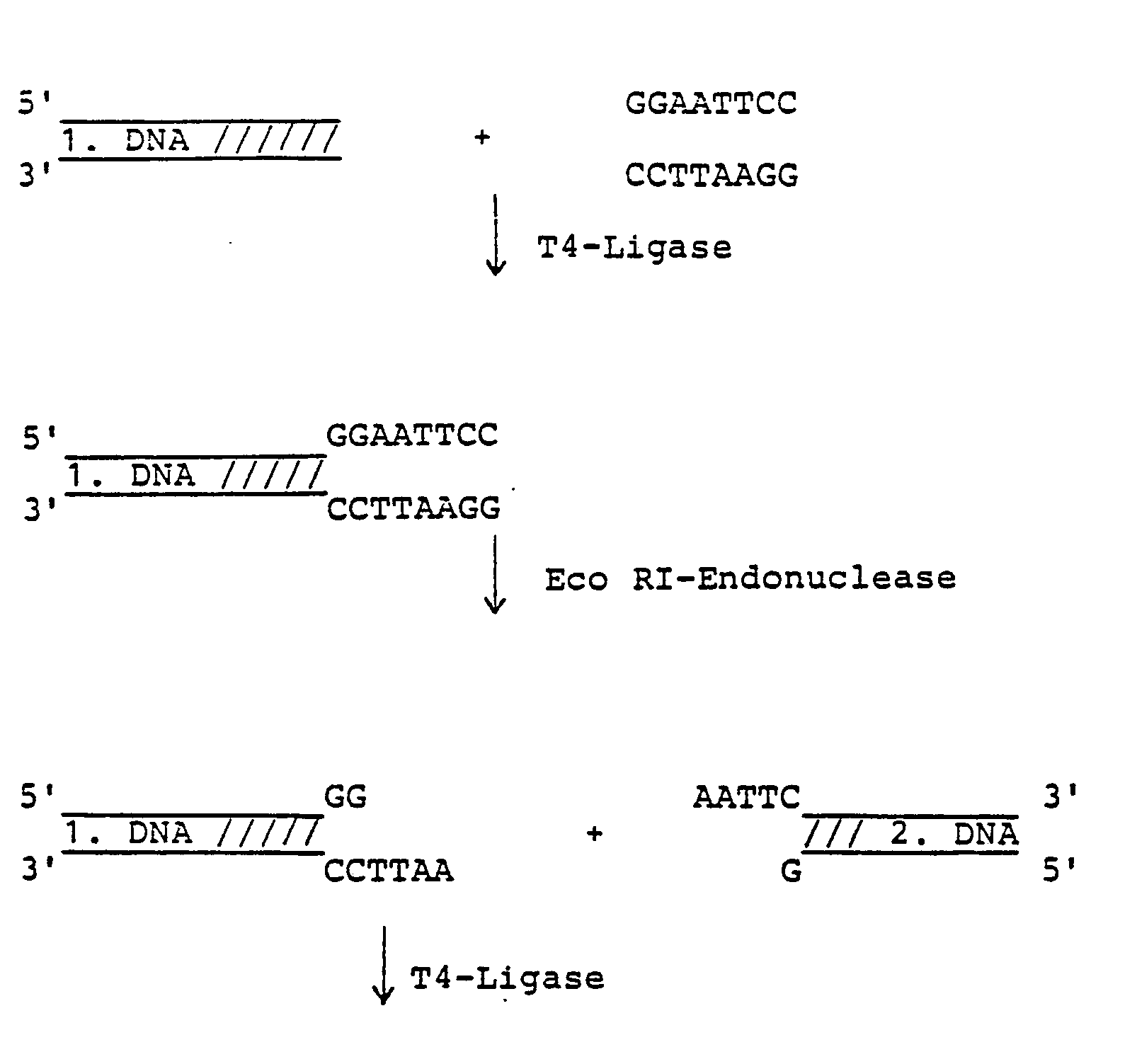

- Es wird deutlich, daß bei diesem Beispiel gemäß dem Stand der Technik die ursprüngliche DNA um 2 GC-Basenpaare verlängert wurde.
- Die Nachteile des bekannten Verfahrens können mit dem Verfahren bzw. der Linker-DNA der Erfindung vermieden werden, da sie ermöglichen, die ursprüngliche Erbinformation in unveränderter Weise zurückzugewinnen. Die Merkmale des Verfahrens der Erfindung ergeben sich aus dem kennzeichnenden Teil des Anspruchs 1.
- Der hier verwendete Begriff "komplementär" bedeutet komplementär im Sinne von Watson und Crick. "Spiegelbildlich komplementär" bedeutet, daß zwei Sequenzen komplementär sind, wenn die eine von links nach rechts und die andere von rechts nach links gelesen wird.
- Die Oligonucleotide 1 weisen normalerweise ebenso wie die ersten und zweiten DNA-Fragmente am 5' -Ende eine Phosphatgruppe auf; fehlt diese am Oligonucleotid I, ist lediglich dafür zu sorgen, daß das 1. bzw.
- 2. DNA-Fragment an der Verknüpfungsstelle für die Linker-DNA eine 5'-ständige Phosphatgruppe aufweist. Fehlt die Phosphatgruppe im ersten oder zweiten DNA-Fragment, muß das Oligonucleotid I eine 5'-Phosphatgruppe aufweisen.
- Wenn R1 eine der durch Kombination der vier Nucleotide A, T, C und G möglichen, nicht in sich selbst komplementären Tetranucleotidsequenzen ist, ergeben sich die aus Tabelle 1 ersichtlichen Sequenzen. Wenn R1 eine der durch Kombination der vier Nucleotide A, T, C und G möglichen, nicht in sich selbst komplementären Pentanucleotide ist (in Anbetracht der ungeraden Nucleotidzahl sind Pentanucleotidsequenzen ausschließlich nicht in sich selbst komplementär), erhält man durch analoge Permutation die hier im einzelnen nicht wiedergegebenen möglichen Sequenzen, z. B.

- Sinngemäß können auch durch entsprechende Permutation die Kombinationsmöglichkeiten für in sich selbst oder nicht in sich selbt komplementäre Hexanucleotide aus den Nucleotiden A, T, C und G erhalten werden, z. B.

- Für die hier angesprochenen Fälle, daß R1 eine nicht in sich selbst komplementäre Tetra- oder Penta- oder eine in sich oder nicht in sich selbst komplementäre Hexanucleotidsequenz ist, gilt, daß R2 die zu R1 spiegelbildlich komplementäre Sequenz mit gleicher Kettenlänge aufweissen muß, z. B.

- Weiterhin gilt für diese Fälle, daß entweder R1 oder R2 ein einziges Ribonucleotid enthalten muß, und zwar in den endständigen Positionen 3' oder 5', oder gegebenenfalls auch X ein 3'- oder 5'-endständiges Ribonucleotid enthält, z. B.
- (5′)C*ACAGC*TGTG(3′),
- Es gilt die Regel, daß zur Erzeugung kohäsiver Enden in dem Spacer X ein Ribonucleotid vorhanden sein muß, wenn entweder R1 oder R2 ein Ribonucleotid aufweisen; ein Ribonucleotid im Spacer X ist dagegen nicht erforderlich, wenn R1 und R2 je ein Ribonucleotid enthalten.
- Es ist jedoch auch möglich, daß R1 und R2 5'- oder 3'-ständige Ribonucleotide enthalten, wobei die jeweilige Positionierung des Ribonucleotids bestimmt, welche Kettenlänge das übertragene kohäsive Ende aufweist.
- Weiterhin gilt, daß T* (Ribothymidin) durch das gleichwirkende U* (Ribouridin) ersetzt sein kann.
- Eine Aufzählung und Beschreibung von Restriktionsendonucleasen der Klassen II und 111 ist in der Firmenschrift "Restriction Endonucleases" der Boehringer Mannheim GmbH, 1981, enthalten; diese Veröffentlichung enthält auch Restriktionsendonucleasen der Klassen II und III, die für das Verfahren der Erfindung verwendbar sind, in der folgenden Beschreibung jedoch nicht namentlich genannt werden.
- Mit dem Verfahren der Erfindung lassen sich 1, 2, 3, 4, 5 oder 6, vorzugsweise 4, Nucleotide aufweisende kohäsive Enden auf die erste DNA übertragen, wobei Nucleotide aus der Spacer-Gruppe X nicht mit übertragen werden. Es ist jedoch auch möglich, wie später an einem Beispiel gezeigt wird, aus dem Spacer X ein oder mehrere Nucleotide mit auf die erste DNA zu übertragen, und zwar bei geeigneter Positionierung eines Ribonucleotids in der Gruppe X.
- Die Ausbildung der kohäsiven Enden an der 1. DNA erfolgt durch Spaltung des aus der 1. DNA und der Linker-DNA erhaltenen Reaktionsproduktes, das in allgemeiner Schreibweise wie im Schema I dargestellt werden kann (am Schluß der Beschreibung).
- Im Schema 1 bedeutet N die die Reste R1 bildenden Nucleotide A, T, G und/oder C bzw. A*, T*, G*, C* und/oder U*, und X die oben definierte Oligonucleotidgruppierung mit 2 - 30 Nucleotideinheiten. Weiterhin sind mit Pfeilen die Spaltungspositionen gemäß vier Spaltungsvarianten a, b, c und d dargestellt, auf die im folgenden eingegangen wird.
- Die Spaltung erfolgt mittels Restriktionsendonucleasen der Klassen II bzw. III und führt zu der Ausbildung eines kohäsiven Endes an der Fremd-DNA, das die gleiche Nucleotidzahl aufweist wie die Gruppe R1 bzw. R2 der Linker-DNA. Je nach Spezifität der Endonuclease wird das kohäsive Ende am 5-' oder 3'-Ende der Fremd-DNA erzeugt.
- Die Spaltung erfolgt mittels Basen bzw. RNA-sen, setzt somit voraus, daß an den Spaltungspositionen Ribonucleotide A*, T*, C*, G* oder U* vorhanden sind, wobei zu beachten ist, daß die Spaltung immer am 3'-Ende des Ribonucleotids erfolgt. Je nach Positionierung der Ribonucleotide wird das kohäsive Ende am 5'-oder 3'-Ende der Fremd-DNA erzeugt; weiterhin bestimmt die Positionierung der Ribonucleotide die Kettenlänge (1 - 6) des übertragenen kohäsiven Endes. Das kohäsive Ende kann ausschließlich aus den Nucleotiden der Gruppen R1 und R2 stammen; es können jedoch zusätzlich noch Nucleotide aus der Spacerregion übertragen werden.
- Gemäß einer weiteren vorteilhaften Ausführungsform der Erfindung kann man das ein kohäsives Ende aufweisende, erste DNA-Fragment vor der Verknüpfung mit dem zweiten DNA-Fragment mit einer an sich bekannten, kohäsive Enden unterschiedlicher Restriktionsspezifizität aufweisenden Adapter-DNA umsetzen. Auch für diese Variante wird später noch ein Beispiel gegeben.
- Das Verfahren der Erfindung wird im folgenden anhand von bevorzugten Beispielen näher erläutert.
- Wenn in den Oligonucleotiden der allgemeinen Formel I R1 und R2 Sequenzen der allgemeinen Formel II bedeuten, d.h. z. B. die zentrale Erkennungsregion von Restriktionsendonucleasen der Klassen II und III, und (X)n eine kurze Spacerregion darstellt, lassen sich mit diesen Oligonucleotiden mit Hilfe von Ligasen, insbesondere T4-Polynucleotidligase Erkennungsregionen für Restriktionsendonucleasen in genetisches Material (DNA) einbauen. Dabei gestatten es die Oligonucleotide der Formel 1, daß nach erfolgter Kopplung und Klonierung die ursprüngliche Erbinformation in unveränderter Form zurückgewonnen wird. Dies wird dadurch erreicht, daß sich die den kohäsiven Teil beinhaltende Signalsequenz der Restriktionsendonuclease an den beiden Enden des Oligonucleotids befindet.
- Das folgende Beispiel 1 verdeutlicht die Vorteile, die mit einem Oligonucleotid der Erfindung der Formel d-(AATTGGAATT) erreichbar sind.


- Es wird deutlich, daß mit dem Verfahren bzw. dem Oligonucleotid der Erfindung die Erbinformation (1. DNA) nach Kopplung derselben mit dem Oligonucleotid der Erfindung bzw. der Linker-DNA, Spaltung unter Erzeugung eines kohäsiven Endes, Kopplung an eine zweite DNA (Vektor-DNA) mit einem komplementären kohäsiven Ende, Klonieren, erneute Spaltung und Abspaltung des kohäsiven Endes in unveränderter Form zurückerhalten wird.
- Die Einführung Endonuclease-spezifischer kohäsiver Enden gemäß der Erfindung hängt vom endständigen Basenpaar der ersten DNA ab. Einige Beispiele für die vier möglichen Basenkonstellationen sollen das Verfahren der Erfindung weiterhin erläutern:
- Oligonucleotide I: AATTCGAATT (Signalsequenz für Eco RI)

- GATCCGGATC (Signalsequenz für Bam HI)
- GTACCGGTAC (Signalsequenz für Kpn I)
- TCGACGTCGA (Signalsequenz für Sal I)
- AGCTCGAGCT (Signalsequenz für Sac I/Sst I)
- Oligonucleotide I: GATCTAGATC (Signalsequenz für Bgl II)

- TCGATATCGA (Signalsequenz für Cla I)
- AGCTTAAGCT (Signalsequenz für Hind III)
- AATTTAAATT (Signalsequenz für Aha III)
- Oligonucleotide I: TGCAGCTGCA (Signalsequenz für Pst I)

- GATCGCGATC (Signalsequenz für Pvn I)
- TCGAGCTCGA (Signalsequenz für Xho I)
- Oligonucleotide 1: GATCATGATC (Signalsequenz für Bcl I)

- GTAGATCTAG (Signalsequenz für Xba I)
- Für die Beispiele 1 - 5 ist die Kenntnis des endständigen Basenpaares der ersten DNA (Fremd-DNA) erforderlich. Demgegenüber genügt für einige Restriktionsendonucleasen das Vorhandensein der selbst komplementären Tetranucleotidsequenz, so daß diese Linker gemäß dem Verfahren der Erfindung für jede Fremd-DNA verwendet werden können, gleichgültig, welches endständige Basenpaar dort vorliegt, d.h. nach Ankopplung einiger der Oligonucleotide der Erfindung wird immer das kohäsive Ende der entsprechenden Restriktions endonuclease erzeugt. Im folgenden werden hierfür einige Beispiele gegeben.
- Oligonucleotide I: GATCCGGATC (Signalsequenz für Mbol /Sau 3 A)

- TCGAGCTCGA (Signalsequenz für Taq I)
- AATTCGAATT (Signalsequenz für Eco RI*)
- AGCTCGAGCT (Signalsequenz für Alu I)
- N ist eines der Nucleotide A, C, G und T; N' bedeutet das jeweils dazu komplementäre Nucleotid A, C, G und T.
- Im folgenden wird ein Beispiel für den Einsatz eines Oligonucleotids gegeben, in dem R1 eine Sequenz der Formel III und R2 eine Sequenz der Formel IV mit den dort angegebenen Definitionen für A, C, G und T bzw. A*, C*, G* und T* sowie N und N' bedeuten, wobei die Sequenzen von R1 und R2, von links nach rechts gelesen, bis auf die zueinander komplementären Nucleotide N und N', identisch sind.
-

- Falls aufgrund des gegebenen endständigen Basenpaares der Fremd-DNA nicht direkt die gewünschten kohäsiven Enden erzeugt werden können, gelingt dies in einem zwischen den Spaltungs- und Verknüpfungsschritt eingeschalteten zusätzlichen Verfahrensschritt. Im nachfolgenden Beispiel 8 besitzt die erste DNA (Fremd-DNA) ein endständiges GC-Basenpaar, so daß die für Hind III spezifischen kohäsiven Enden nicht direkt eingeführt werden können. Es wird daher zunächst der Bam HI-Linker und danach eine Bam HI- /Hind III-Adapter-DNA verwendet, um das gewünschte Ziel zu erreichen (Adapter-DNA kann als kurze DNA mit kohäsiven Enden unterschiedlicher Restriktionsspezifität definiert werden):
-

- Eine Verfahrensführung gemäß Beispiel 8 ermöglicht letztlich die Einführung jedes kohäsiven Endes unabhängig davon, welches endständige Basenpaar die erste DNA trägt, wobei entsprechend dem erfindungsgemäßen Konzept die erste DNA unverändert zurückerhalten werden kann.
- Gemäß einer weiteren Variante des Verfahrens bzw. der Oligonucleotide der Erfindung können an definierten Positionen des Oligonucleotids Ribonucleotide eingebaut werden. Erfindungsgemäß können die Restriktionsendonuclease-spezifischen kohäsiven Enden auch ohne Verwendung der Restriktionsendonuclease eingeführt werden. Dies wird an den folgenden Beispielen 9 und 13 erläutert.
-

-

- In den Beispielen 9 und 10 werden, ebenso wie in der folgenden Beschreibung, Ribonucleotide durch * gekennzeichnet.
- Durch den Einbau eines Ribonucleotids wird innerhalb der DNA eine definierte alkalilabile Position geschaffen, wie sich aus dem folgenden Reaktionsschema ergibt:

- Dabei verbleibt der Phosphatrest der Internucleotidbindung am Ribonucleotid. Nach Behandlung mit Phosphatase wird eine 2', 3'-cis-Diolgruppierung geschaffen, die durch Perjodatbehandlung in bekannter Weise gespalten und ebenfalls in bekannter Weise unter milden alkalischen Bedingungen zur Eliminierung des Ribonucleotids führt. Zum Schluß wird durch erneute Phosphatasebehandlung das 3'-terminale Desoxyribonucleotid freigesetzt. Es kann vorteilhaft sein, diesen Schritt erst später in einer Reaktionssequenz durchzuführen, um dieses kohäsive Ende durch den 3'-Phosphatrest "geschützt" zu behalten.
- Ein weiterer Vorteil dieser Verfahrensvariante liegt darin, daß die Ribonucleotidpositionen so gewählt werden können, daß jeweils nur einer der beiden DNA-Stränge eine definierte alkalilabile Bruchstelle erhalten, bzw. der jeweils andere Strang durch die entsprechende Restriktionsendonuclease geschnitten werden kann. Dies wird im folgenden an zwei Beispielen erläutert:
-

-

- Das Verfahren der Erfindung ermöglicht auch die Einführung von kohäsiven Enden, die nicht selbst komplementär sind. In diesem Falle ist R1 eine nicht in sich selbst komplementäre Tetra- oder Pentanucleotidsequenz oder eine in sich selbst oder nicht in sich selbst komplementäre Hexanucleotidsequenz der Formel V, VI bzw. VII gemäß dem Hauptanspruch (mit den dort angegebenen weiteren Definitionen); R2 ist stets eine zu R1 spiegelbildlich komplementäre Sequenz gleicher Länge mit 4, 5 oder 6 Nucleotiden. Wie weiter oben ausgeführt wurde, weist R1 und/oder R2 ein 5'- oder 3'-endständiges Ribonucleotid auf, wobei gegebenenfalls in dem Spacer (X)n ein weiteres Ribonucleotid vorzusehen ist.
- In Abhängigkeit davon, wo die Ribonucleotide positioniert sind, kann - bei gleicher Nucleotidsequenz - die Länge des kohäsiven Endes beeinflußt werden und das kohäsive Ende entweder an das 3'- oder 5'-Ende der ersten DNA (Fremd-DNA) dirigiert werden.
- Die folgenden Beispiele erläutern diese Verfahrensvariante:
-

-

-

-

- Durch geeignete Positionierung der Ribonucleotide ist auch bei dieser Verfahrensvariante möglich, die alkalilabile Bruchstelle in jeweils nur einem der beiden DNA-Stänge einzuführen. Dies ermöglicht z. B. bei ringförmiger, doppelsträngiger, entweder die Isolierung des Minus-oder des Plus-Stranges.
- Das folgende Beispiel verdeutlicht, daß mit Oligonucleotiden 1, in denen R1 und R2 in sich selbst oder nicht in sich selbst komplementäre Hexanucleotidsequenzen sind, kohäsive Enden erzeugt werden können, die, in Abhängigkeit von der Positionierung von Ribonucleotiden in den Resten R1, R2 bzw. X, Kettenlängen von 1 - 6 Nucleotiden aufweisen.
-

- Die vorstehenden Beispiele offenbaren die große Flexibilität des Verfahrens der Erfindung, das immer dann von Vorteil ist, wenn DNA-Fragmente irreversibel miteinander verkoppelt werden sollen oder wenn sich die Anwendung von Restriktionsendonucleasen verbietet, weil das Vorhandensein interner Signalsequenzen sehr wahrscheinlich ist. Dies ist bei hochmolekularen DNA-Fragmenten, z.B. zur Etablierung einer Genbank, fast immer der Fall.
- Der in dem Oligonucleotid der Formel enthaltene Spacer (X)n stellt kurze Oligonucleotidsequenzen dar, die als notwendiger Spacer unter Berücksichtigung der für die Restriktionsendonuclease-Erkennungsregion notwendigen Nucleotide und der erforderlichen Stabilität der durch Selbstkomplementarität sich bildenden doppelsträngigen DNA ausgewählt wird. Wird die zentrale Tetranucleotidsequenz nur durch die wenig Stabilität vermittelnden AT-Basenpaare gebildet, wie z.B. beim Eco RI-Linker
-

- Dadurch kann eine weitere Erkennungsregion für eine Restriktionsendonuclease eingeführt werden, z. B. für X = CCCGGG hat der Eco RI-Linker die Formel


- Hier wird nicht nur mit dem Linker die Eco RI-Signalsequenz in eine Fremd-DNA eingeführt, die GC als endständiges Basenpaar besitzt, sondern auch noch die recht seltene Erkennungssequenz für Smal/Xmal.
- Das folgende Ausführungsbeispiel betrifft die Herstellung und erfindungsgemäße Anwendung eines Oligonucleotids der Erfindung der Formel d(GATCCGGATC).
- Herstellung von d(GATCCGGATC) (vgl. Tetrahedron Let. 1983.747)
- 100 mg C-Träger (10 µMol N-benzoyliertes C, kovalent gebunden an "Controlled Pore Glass" (CPG), werden nacheinander mit je 100 µMol der durch MSNT (1,5 Äquivalente/PO-) aktivierten N-geschützten, 5'-dimethoxytritylierten Desoxynucleosid-3'-(2-chlorphenyl)-phosphodiester T, A, G, G, C, C, T, A und G umgesetzt. Ein Reaktionszyklus umfaßt Kondensation (45') in Pyridin, Waschen mit Pyridin, Capping mit Essigsäureanhydrid/Pyridin (10'), Waschen mit Pyridin, CH2CI2/MeOH (7 : 3) und Abspalten der Dimethoxytritylgruppe mit gesättigtem ZnBr2 in CH2Cl2/Methanol (7 : 3) für 10' und Waschen mit CH2CI2/MeOH (7 : 3) sowie Pyridin.
- Die durchschnittlichen Kondensationsausbeuten liegen bei 90 - 95 %.
- Nach der letzten Kondensation erfolgt Abspaltung der 2-Chlor-Phenylgruppe durch Behandeln mit Oximatreagenz (vgl. Tetrahedron Let. 1978, 2727),
- 3 ml, für 24 h, Abspaltung vom Träger und Entfernung der N-Arylgruppen durch Behandlung mit konzentriertem wässrigem Ammoniak, 12 h bei 50°C. Nach dem Einengen und 5-facher Extraktion mit je 5 ml CHCI3 wird die wässrige Lösung durch Anionaustauschchromatographie an DEAE-Cellulose in der üblichen Weise gereinigt (vgl. Liebigs Ann. 1978,839 und Tetrahedron Let. 1983, 747).
- Das gereinigte Material wird in üblicher Weise durch Polyacrylamidgelelektrophorese (20 %, 7M Harnstoff) und Vergleich mit einem Homo-oligo-dT-Kettenlängenstandard und durch Sequenzierung entweder nach Maxam-Gilbert oder nach der "mobility shift"-Methode charakterisiert.
- Um das Ligationssubstrat zu erhalten, wird pBR 322 mit Bal I (TGG1CCA) in üblicher Weise linearisiert und auf diese Weise die DNS mit dem stumpfen GC-Ende versehen. Die Ligation erfolgt in 66 mM Tris-HCI (pH 7,6), 6,6 mM MgCl2, 10 mM Dithiothreitol, 0,4 mM ATP und 4 Einheiten T4-Ligase pro 20 µl Reaktionsvolumen. Der Linker wird im 50-fachen Überschuß über die Termini verwendet. Die Ligationsdauer beträgt 24 h bei 10° C.
- Anschließend wird mit Bam HI in der üblichen Weise inkubiert; die entstandenen Bam HI-kohäsiven Enden werden in gleicher Weise wie oben angegeben, jedoch mit lediglich 0,02 Einheiten T4-Ligase, pro 20 µl ligiert. Die Reaktionsdauer beträgt 1 h bei 22° C.
- Die Agarosegelelektrophorese zeigt Umwandlung der linearen pB R 322-DNS in circuläre DNS unter Ligationsbedingungen, unter denen nur kohäsive, nicht jedoch stumpfe Enden ligiert werden.


wobei R1 = C*ACA, R2 = TGTG und X = GC* bedeuten und die Ribonucleotide durch markiert sind.
Claims (3)


Priority Applications (2)
| Application Number | Priority Date | Filing Date | Title |
|---|---|---|---|
| DE8484902585T DE3474566D1 (en) | 1983-07-22 | 1984-06-28 | Process for the definite cross-linking of double helix dna fragments by means of a linkage dna as well as oligonucleotides used as linkage dna |
| AT84902585T ATE37900T1 (de) | 1983-07-22 | 1984-06-28 | Verfahren zur definierten verknuepfung doppelhelikaler dna-fragmente mittels einer linker-dna sowie als linker-dna geeingnete oligonucleotide. |
Applications Claiming Priority (2)
| Application Number | Priority Date | Filing Date | Title |
|---|---|---|---|
| DE19833326520 DE3326520A1 (de) | 1983-07-22 | 1983-07-22 | Verfahren zur definierten verknuepfung doppelhelikaler dna-fragmente mittels einer linker-dna sowie als linker-dna geeignete oligonucletide |
| DE3326520 | 1983-07-22 |
Publications (2)
| Publication Number | Publication Date |
|---|---|
| EP0149634A1 EP0149634A1 (de) | 1985-07-31 |
| EP0149634B1 true EP0149634B1 (de) | 1988-10-12 |
Family
ID=6204698
Family Applications (1)
| Application Number | Title | Priority Date | Filing Date |
|---|---|---|---|
| EP84902585A Expired EP0149634B1 (de) | 1983-07-22 | 1984-06-28 | Verfahren zur definierten verknüpfung doppelhelikaler dna-fragmente mittels einer linker-dna sowie als linker-dna geeingnete oligonucleotide |
Country Status (7)
| Country | Link |
|---|---|
| EP (1) | EP0149634B1 (de) |
| JP (1) | JPH0665302B2 (de) |
| AT (1) | ATE37900T1 (de) |
| AU (1) | AU3107084A (de) |
| DE (2) | DE3326520A1 (de) |
| IT (1) | IT1198887B (de) |
| WO (1) | WO1985000621A1 (de) |
Cited By (3)
| Publication number | Priority date | Publication date | Assignee | Title |
|---|---|---|---|---|
| US7074563B2 (en) | 1995-03-17 | 2006-07-11 | Sequenom, Inc. | Mass spectrometric methods for detecting mutations in a target nucleic acid |
| US7858560B2 (en) | 2001-07-16 | 2010-12-28 | Caprotec Bioanalytics Gmbh | Capture compounds, collections thereof and methods for analyzing the proteome and complex compositions |
| US9034798B2 (en) | 2003-01-16 | 2015-05-19 | Caprotec Bioanalytics Gmbh | Capture compounds, collections thereof and methods for analyzing the proteome and complex compositions |
Families Citing this family (3)
| Publication number | Priority date | Publication date | Assignee | Title |
|---|---|---|---|---|
| JPH01117789A (ja) * | 1987-10-29 | 1989-05-10 | Ajinomoto Co Inc | Dna欠失用化合物、それに使用するオリゴマーおよびその使用方法 |
| CA2119927A1 (en) * | 1991-09-27 | 1993-04-01 | Michael Y.-X. Ma | Duplex-forming polynucleotide conjugates |
| DE102016215127A1 (de) | 2016-08-12 | 2018-02-15 | Seleggt Gmbh | Eieruntersuchungseinrichtung |
Family Cites Families (4)
| Publication number | Priority date | Publication date | Assignee | Title |
|---|---|---|---|---|
| US4321365A (en) * | 1977-10-19 | 1982-03-23 | Research Corporation | Oligonucleotides useful as adaptors in DNA cloning, adapted DNA molecules, and methods of preparing adaptors and adapted molecules |
| EP0036258A3 (de) * | 1980-03-14 | 1982-02-10 | Cetus Corporation | Verfahren zur Herstellung von Aspartam |
| IL59690A (en) * | 1980-03-24 | 1983-11-30 | Yeda Res & Dev | Production of bovine growth hormone by microorganisms and modified microorganisms adapted to produce it |
| IE52122B1 (en) * | 1980-08-25 | 1987-06-24 | Univ California | Somatostatin or somatostatin precursors |
-
1983
- 1983-07-22 DE DE19833326520 patent/DE3326520A1/de not_active Withdrawn
-
1984
- 1984-06-28 DE DE8484902585T patent/DE3474566D1/de not_active Expired
- 1984-06-28 WO PCT/EP1984/000196 patent/WO1985000621A1/de not_active Ceased
- 1984-06-28 EP EP84902585A patent/EP0149634B1/de not_active Expired
- 1984-06-28 JP JP59502513A patent/JPH0665302B2/ja not_active Expired - Lifetime
- 1984-06-28 AU AU31070/84A patent/AU3107084A/en not_active Abandoned
- 1984-06-28 AT AT84902585T patent/ATE37900T1/de not_active IP Right Cessation
- 1984-07-18 IT IT09460/84A patent/IT1198887B/it active
Cited By (4)
| Publication number | Priority date | Publication date | Assignee | Title |
|---|---|---|---|---|
| US7074563B2 (en) | 1995-03-17 | 2006-07-11 | Sequenom, Inc. | Mass spectrometric methods for detecting mutations in a target nucleic acid |
| US7419787B2 (en) | 1995-03-17 | 2008-09-02 | Sequenom, Inc. | Mass spectrometric methods for detecting mutations in a target nucleic acid |
| US7858560B2 (en) | 2001-07-16 | 2010-12-28 | Caprotec Bioanalytics Gmbh | Capture compounds, collections thereof and methods for analyzing the proteome and complex compositions |
| US9034798B2 (en) | 2003-01-16 | 2015-05-19 | Caprotec Bioanalytics Gmbh | Capture compounds, collections thereof and methods for analyzing the proteome and complex compositions |
Also Published As
| Publication number | Publication date |
|---|---|
| WO1985000621A1 (fr) | 1985-02-14 |
| IT1198887B (it) | 1988-12-21 |
| JPS60501838A (ja) | 1985-10-31 |
| JPH0665302B2 (ja) | 1994-08-24 |
| ATE37900T1 (de) | 1988-10-15 |
| IT8409460A0 (it) | 1984-07-18 |
| DE3474566D1 (en) | 1988-11-17 |
| AU3107084A (en) | 1985-03-04 |
| DE3326520A1 (de) | 1985-01-31 |
| EP0149634A1 (de) | 1985-07-31 |
Similar Documents
| Publication | Publication Date | Title |
|---|---|---|
| DE69330162T2 (de) | VERFAHREN ZUR SYNTHESE VOLLSTÄNDIGER cDNA, VERFAHREN ZUR HERSTELLUNG VON INTERMEDIATEN UND ZUR HERSTELLUNG EINES REKOMBINANTEN VEKTORS, DER DIE VOLLSTÄNDIGE cDNA ENTHÄLT | |
| DE69731234T2 (de) | METHODE FÜR DIE HERSTELLUNG EINER cDNA-BANK AUS KOMPLETTEN cDNAS. | |
| EP0967274B1 (de) | Verfahren zur Herstellung von hantelförmigen DNA-Molekülen als Expressionskonstrukte | |
| DE69432586T2 (de) | Methode zum generieren von einzelsträngigen dna molekülen | |
| DE69316205T2 (de) | Verfahren und reagens zur spaltung und entschützen von oligonukleotide | |
| DE69011101T2 (de) | Methoden zur in vitro-dna-amplifikation, zum genomischen klonieren und zur genkartierung. | |
| DE69725866T2 (de) | Festphasen-synthese | |
| EP1314783A1 (de) | Nukleinsäure-Linker und deren Verwendung in der Gensynthese | |
| EP0669395A2 (de) | 3'-RNA-Markierung mit Terminaler Transferase | |
| EP0597076B1 (de) | Simultane sequenzierung von nukleinsäuren | |
| DE69819998T2 (de) | Verfahren zur chemischen Synthese von Oligonukleotiden | |
| EP0593901B2 (de) | Oligoribonucleotid- und Ribozym-Analoga mit terminalen 3'-3'-bzw.5'-5'-Verknüpfungen | |
| EP1047706A2 (de) | Verfahren zur synthese von nucleinsäuremolekülen | |
| DE69534217T2 (de) | Verfahren zur hemmung von nichtspezifischer hybridisierung in primerverlängerungsreaktionen | |
| DE69500303T2 (de) | Methode zur sequenzierung kurzer oligonukleotide | |
| WO1985000621A1 (fr) | Procede de reticulation definie de fragments d'adn a double helice au moyen d'un adn de liaison ainsi que d'oligonucleotides servant d'adn de liaison | |
| DE69131848T2 (de) | Modulation der genexpression durch eingreifen in die rna sekundärstruktur | |
| DE60119173T2 (de) | Methode zur analyse von oligonukleotidanaloga | |
| WO2003022858A2 (de) | Verfahren zum screenen von inhibitoren für die protein-protein-wechselwirkung sowie ribozyme hierzu | |
| WO1994029443A1 (de) | Analyse von rna sequenzen mittels pcr | |
| DE3534359C1 (de) | Vektoren und deren Verwendung zur Herstellung von cDNA-Genbanken | |
| DE3801987A1 (de) | Traeger zur chemischen oder/und enzymatischen umsetzung von nukleinsaeuren oder nukleinsaeurefragmenten an festphasen | |
| DE4332463A1 (de) | Verfahren zur spezifischen Klonierung von Nukleinsäuren | |
| DE3431023C2 (de) | ||
| EP1772523A2 (de) | Polymerase-Kettenreaktionsverfahren unter Einsatz einer DNA-Polymerase mit Proofreading-Eigenschaften |
Legal Events
| Date | Code | Title | Description |
|---|---|---|---|
| PUAI | Public reference made under article 153(3) epc to a published international application that has entered the european phase |
Free format text: ORIGINAL CODE: 0009012 |
|
| 17P | Request for examination filed |
Effective date: 19850304 |
|
| AK | Designated contracting states |
Designated state(s): AT BE CH DE FR GB LI LU NL SE |
|
| 17Q | First examination report despatched |
Effective date: 19861112 |
|
| RAP1 | Party data changed (applicant data changed or rights of an application transferred) |
Owner name: BIOSYNTECH BIOCHEMISCHE SYNTHESETECHNIK GMBH |
|
| RIN1 | Information on inventor provided before grant (corrected) |
Inventor name: KOESTER, HUBERT |
|
| D17Q | First examination report despatched (deleted) | ||
| GRAA | (expected) grant |
Free format text: ORIGINAL CODE: 0009210 |
|
| AK | Designated contracting states |
Kind code of ref document: B1 Designated state(s): AT BE CH DE FR GB LI LU NL SE |
|
| REF | Corresponds to: |
Ref document number: 37900 Country of ref document: AT Date of ref document: 19881015 Kind code of ref document: T |
|
| REF | Corresponds to: |
Ref document number: 3474566 Country of ref document: DE Date of ref document: 19881117 |
|
| GBT | Gb: translation of ep patent filed (gb section 77(6)(a)/1977) | ||
| ET | Fr: translation filed | ||
| PG25 | Lapsed in a contracting state [announced via postgrant information from national office to epo] |
Ref country code: LU Free format text: LAPSE BECAUSE OF NON-PAYMENT OF DUE FEES Effective date: 19890630 |
|
| PLBE | No opposition filed within time limit |
Free format text: ORIGINAL CODE: 0009261 |
|
| STAA | Information on the status of an ep patent application or granted ep patent |
Free format text: STATUS: NO OPPOSITION FILED WITHIN TIME LIMIT |
|
| 26N | No opposition filed | ||
| PGFP | Annual fee paid to national office [announced via postgrant information from national office to epo] |
Ref country code: FR Payment date: 19900517 Year of fee payment: 7 |
|
| PGFP | Annual fee paid to national office [announced via postgrant information from national office to epo] |
Ref country code: AT Payment date: 19900518 Year of fee payment: 7 |
|
| PGFP | Annual fee paid to national office [announced via postgrant information from national office to epo] |
Ref country code: DE Payment date: 19900521 Year of fee payment: 7 Ref country code: CH Payment date: 19900521 Year of fee payment: 7 |
|
| PGFP | Annual fee paid to national office [announced via postgrant information from national office to epo] |
Ref country code: SE Payment date: 19900522 Year of fee payment: 7 Ref country code: LU Payment date: 19900522 Year of fee payment: 7 |
|
| PGFP | Annual fee paid to national office [announced via postgrant information from national office to epo] |
Ref country code: BE Payment date: 19900528 Year of fee payment: 7 |
|
| PGFP | Annual fee paid to national office [announced via postgrant information from national office to epo] |
Ref country code: GB Payment date: 19900601 Year of fee payment: 7 |
|
| PGFP | Annual fee paid to national office [announced via postgrant information from national office to epo] |
Ref country code: NL Payment date: 19900630 Year of fee payment: 7 |
|
| PG25 | Lapsed in a contracting state [announced via postgrant information from national office to epo] |
Ref country code: GB Effective date: 19910628 Ref country code: AT Effective date: 19910628 |
|
| PG25 | Lapsed in a contracting state [announced via postgrant information from national office to epo] |
Ref country code: SE Effective date: 19910629 |
|
| PG25 | Lapsed in a contracting state [announced via postgrant information from national office to epo] |
Ref country code: LI Effective date: 19910630 Ref country code: CH Effective date: 19910630 Ref country code: BE Effective date: 19910630 |
|
| BERE | Be: lapsed |
Owner name: BIOSYNTECH BIOCHEMISCHE SYNTHESETECHNIK G.M.B.H. Effective date: 19910630 |
|
| PG25 | Lapsed in a contracting state [announced via postgrant information from national office to epo] |
Ref country code: NL Effective date: 19920101 |
|
| NLV4 | Nl: lapsed or anulled due to non-payment of the annual fee | ||
| GBPC | Gb: european patent ceased through non-payment of renewal fee | ||
| PG25 | Lapsed in a contracting state [announced via postgrant information from national office to epo] |
Ref country code: FR Effective date: 19920228 |
|
| REG | Reference to a national code |
Ref country code: CH Ref legal event code: PL |
|
| PG25 | Lapsed in a contracting state [announced via postgrant information from national office to epo] |
Ref country code: DE Effective date: 19920401 |
|
| REG | Reference to a national code |
Ref country code: FR Ref legal event code: ST |
|
| EUG | Se: european patent has lapsed |
Ref document number: 84902585.3 Effective date: 19920109 |