EP0149708A2 - Kasettendichtung - Google Patents
Kasettendichtung Download PDFInfo
- Publication number
- EP0149708A2 EP0149708A2 EP84108716A EP84108716A EP0149708A2 EP 0149708 A2 EP0149708 A2 EP 0149708A2 EP 84108716 A EP84108716 A EP 84108716A EP 84108716 A EP84108716 A EP 84108716A EP 0149708 A2 EP0149708 A2 EP 0149708A2
- Authority
- EP
- European Patent Office
- Prior art keywords
- swirl
- outer ring
- ribs
- sealing surfaces
- cassette seal
- Prior art date
- Legal status (The legal status is an assumption and is not a legal conclusion. Google has not performed a legal analysis and makes no representation as to the accuracy of the status listed.)
- Granted
Links
Images

Classifications
-
- F—MECHANICAL ENGINEERING; LIGHTING; HEATING; WEAPONS; BLASTING
- F16—ENGINEERING ELEMENTS AND UNITS; GENERAL MEASURES FOR PRODUCING AND MAINTAINING EFFECTIVE FUNCTIONING OF MACHINES OR INSTALLATIONS; THERMAL INSULATION IN GENERAL
- F16J—PISTONS; CYLINDERS; SEALINGS
- F16J15/00—Sealings
- F16J15/16—Sealings between relatively-moving surfaces
- F16J15/32—Sealings between relatively-moving surfaces with elastic sealings, e.g. O-rings
- F16J15/3204—Sealings between relatively-moving surfaces with elastic sealings, e.g. O-rings with at least one lip
- F16J15/3232—Sealings between relatively-moving surfaces with elastic sealings, e.g. O-rings with at least one lip having two or more lips
-
- F—MECHANICAL ENGINEERING; LIGHTING; HEATING; WEAPONS; BLASTING
- F16—ENGINEERING ELEMENTS AND UNITS; GENERAL MEASURES FOR PRODUCING AND MAINTAINING EFFECTIVE FUNCTIONING OF MACHINES OR INSTALLATIONS; THERMAL INSULATION IN GENERAL
- F16J—PISTONS; CYLINDERS; SEALINGS
- F16J15/00—Sealings
- F16J15/16—Sealings between relatively-moving surfaces
- F16J15/32—Sealings between relatively-moving surfaces with elastic sealings, e.g. O-rings
- F16J15/3248—Sealings between relatively-moving surfaces with elastic sealings, e.g. O-rings provided with casings or supports
- F16J15/3252—Sealings between relatively-moving surfaces with elastic sealings, e.g. O-rings provided with casings or supports with rigid casings or supports
- F16J15/3256—Sealings between relatively-moving surfaces with elastic sealings, e.g. O-rings provided with casings or supports with rigid casings or supports comprising two casing or support elements, one attached to each surface, e.g. cartridge or cassette seals
Definitions
- the invention relates to a cassette seal, consisting of an outer ring with at least two sealing surfaces axially delimiting it, an inner ring with two flanges axially encompassing the outer ring, which bear against the sealing surfaces under elastic prestressing and of which at least one swirl groove is distributed uniformly over the circumference for return conveyance of leakage liquid or foreign bodies.
- the invention has for its object to develop a cassette seal that no longer has the disadvantages indicated above.
- the cassette seal should be easy and inexpensive to manufacture and guarantee an excellent sealing result over long periods of time at the highest shaft speeds.
- a cassette seal of the type mentioned is proposed according to the invention, which is characterized in that the sealing surfaces of the outer ring have a mutual distance, which increases with increasing distance from the axis of rotation, that the flange is completely penetrated by the swirl grooves that the swirl grooves are arranged radially outside the sealing surface and that swirl ribs are attached between the swirl grooves, which have a decreasing thickness in the projecting area.
- the flanges of the inner ring Due to the mutual distance between the sealing surfaces of the outer ring, which increases in the radial direction, it is no longer necessary to give the flanges of the inner ring a distance from one another which increases in the radial direction. Rather, the flanges can run parallel to one another and, for example, be assigned to the axis of rotation at a right angle. Designs in which the flanges have an increasingly increasing spacing outwards are also possible. This greatly facilitates the manufacture of the inner ring and allows, for example, machining manufacturing processes to be used.
- the swirl grooves consist of notches that penetrate the flanges completely. They are evenly distributed over the circumference and at the same time limit the swirl ribs arranged in the spaces. The latter have in the projecting area, i.e. in the radial direction outwards, an increasingly decreasing thickness. The flow area of the flanks is reduced to the same extent, which means that the swirl ribs are able to withstand the liquid film flowing in from the direction of the outer ring. Permanent deformations on the swirl ribs are therefore not to be feared in the proposed design even after a long period of operation.
- the liquid film flowing in from the direction of the outer ring is, as it were, separated, the larger volume fraction not required for lubricating the sealing surface being conveyed away from the dynamic sealing zone and back into the sealed space.
- This effect is particularly evident when the swirl ribs in the projecting area have a thickness that decreases in the direction of the associated sealing surface.
- the inside of the swirl ribs is thus formed in this case by a surface which continuously complements the surface lying on the sealing surface and without a sudden change in direction.
- the swirl ribs and the swirl grooves can be delimited on the outside by a self-contained, continuous surface which encloses the axis of rotation essentially parallel to its extension in a sinusoidal manner.
- the swirl ribs are characterized by a particularly high mechanical resistance, which favors the avoidance of deformations under operating conditions.
- the swirl ribs are delimited in the circumferential direction by radial surfaces that are parallel to the axis.
- the production in this case is much simpler than in the one mentioned above. It is particularly suitable for applications in which deposits from the sealed medium must be expected in the area of the sealing zone.
- the swirl ribs should have a sharp edge on the outside as much as possible in order to ensure that the oil film flowing in from the direction of the outer ring is separated as evenly as possible.
- the prerequisite for the effect of such a separation is, however, the avoidance of deformations that occur during operation.
- a certain minimum thickness is therefore also necessary in the region of the outer end edge of the swirl ribs, which, however, generally does not exceed a value of 0.5 for PTFE and 0.8 mm for rubber.
- the position of the edge generally stabilizes after a short operating time at a very short distance from the associated sealing surface. This can be, for example, a few millimeters. It ensures continuous lubrication of the sealing surface under operating conditions and at the same time the return of excess liquid to the sealed space.
- the proposed cassette seal is characterized by an almost complete freedom from wear and by the almost complete avoidance of deposits in the area of the dynamic sealing zone.
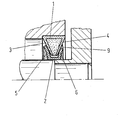
- the cassette seal shown in Figure 1 consists of the outer ring 1 made of PTFE and the inner ring 2 made of rubber.
- the outer ring has a symmetrical triangular profile and is delimited on both sides in the axial direction by sealing surfaces 3 and 4.
- the flank angle between the sealing surfaces is 60 °.
- the inner ring has a U-shaped shape with flanges 5 and 6 extending parallel to one another. It is knotted into the outer ring 1 in the manner shown, the two flanges 5, 6 being spread apart in the axial direction and being flush with the sealing surfaces 3 , 4 create. There is a radial distance between the inner diameter of the outer ring and the groove base between the two flanges 5, 6 of the inner ring, as a result of which there is a relative displacement between the inner ring and the outer ring in the radial direction is easily possible.
- the axially parallel surface connecting the flanges 5, 6 in the groove has a greater axial extension than the directly opposite surface of the outer ring. It can be additionally loaded by a coil spring, which favors the static fixing of the inner ring on the mile.
- the inner diameter of the inner ring 2 is dimensioned such that the rotary movement of the sealed machine part 7 is transmitted without further notice.
- the inner ring 2 lies with its flanges 5, 6 slidingly against the sealing surfaces 3, 4 of the outer ring 1.
- Inner ring 2 and outer ring 1 are thus always optimally assigned to one another in the axial direction. Axial relative movements of the sealed machine part 7 are also compensated for automatically.
- the flange 6 facing the sealed medium 8 is delimited on the outside by swirl ribs 9 which are evenly distributed over the circumference.
- the swirl ribs 9 are delimited in the circumferential direction by radial surfaces running parallel to the axis, on the side facing away from the outer ring 1 by a conical surface and on the side facing the outer ring 1 by a surface which continuously extends the sealing surface.
- the outer ring consists of a deep-drawn steel sheet which is filled with a lubricant on the inside, for example with a mixture of graphite and PTFE powder.
- the outer ring is continuously open on the inside.
- the inner ring 2 is made of PTFE. It also has a U-shaped profile due to its manufacture, with flanges 5 and 6 extending parallel to one another. When inserted into the outer ring 1, the V-shaped profile shown and the required elastic pressure between the flanges 5, 6 and the sealing surfaces result 3, 4.
- the flange 6 is provided on the outside with swirl ribs 9. These are separated from one another by swirl grooves evenly distributed over the circumference.
- the swirl ribs and the swirl grooves are delimited on the outside by a self-contained, continuous surface which encloses the axis of rotation essentially parallel to its extension, in a manner similar to a sinus curve.
- the boundary surface of the swirl ribs 9 facing away from the outer ring 1 is also beveled in the projecting area in the direction of the sealing surface 4.
- the surface delimiting the swirl ribs on the opposite side forms a continuous extension of the surface of the flange 6 resting on the sealing surface 4. This surface and the surface of the swirl ribs 9 described above, facing away from the outer ring 1, delimit one another almost at a sharp edge at the most outer point.
- the cassette seal shown in Figure 2 is characterized by particularly good emergency running properties. These are required when normal operation includes occasional dry running. This affects the necessary cooling and lubrication of the dynamic sealing zone. In the proposed embodiment, it leads to heating of the lubricant stored in the outer ring. This reduces its viscosity and reaches the sealing surfaces 3, 4 via the opening arranged on the inner diameter of the outer ring. This effectively prevents a further rise in temperatures.
Landscapes
- Engineering & Computer Science (AREA)
- General Engineering & Computer Science (AREA)
- Mechanical Engineering (AREA)
- Sealing Devices (AREA)
- Mechanical Sealing (AREA)
- Sealing With Elastic Sealing Lips (AREA)
Abstract
Description
- Die Erfindung betrifft eine Kassettendichtung, bestehend aus einem Außenring mit wenigstens zwei ihn axial begrenzenden Dichtflächen, einem Innenring mit zwei den Außenring axial umgreifenden Flanschen, die unter einer elastischen Vorspannung an den Dichtflächen anliegen und von denen wenigstens einer gleichmäßig auf dem Umfang verteilte Drallnuten zur Rückförderung von Leckflüssigkeit oder Fremdkörpern aufweist.
- Eine solche Kassettendichtung wird in der US-PS 4 094 518 beschrieben. Die Drallrippen und Drallnuten sind dabei im unmittelbaren Bereich der eigentlichen Dichtfläche angeordnet, was dazu führt, daß Leckflüssigkeit bei Wellenstillstand durch die Drallnuten hindurch auf die Außenseite der Dichtung gelangen kann, was nicht erwünscht ist. Die beiden Flansche des Innenringes haben außerdem im innenliegenden Bereich einen größeren axialen Abstand voneinander als im außenliegenden Bereich. Die Herstellung setzt insofern die Verwendung aufwendiger Formwerkzeuge voraus, insbesondere auch im Hinblick auf die erforderliche präzise Ausbildung der Drallrippen auf der Innenseite des sich solcherart im Inneren erweiternden Hohlraumes des Innenringes.
- Der Erfindung liegt die Aufgabe zugrunde, eine Kassettendichtung zu entwickeln, die die vorstehend angegebenen Nachteile nicht mehr aufweist. Die Kassettendichtung soll leicht und kostengünstig herstellbar sein und über lange Zeiträume bei höchsten Wellendrehzahlen ein ausgezeichnetes Abdichtungsergebnis gewährleisten.
- Zur Lösung dieser Aufgabe wird erfindungsgemäß eine Kassettendichtung der eingangs genannten Art vorgeschlagen, die dadurch gekennzeichnet ist, daß die Dichtflächen des Außenringes einen gegenseitigen Abstand haben, der sich mit zunehmendem Abstand von der Rotationsachse vergrößert, daß der Flansch von den Drallnuten ganz durchdrungen ist, daß die Drallnuten radial außerhalb der Dichtfläche angeordnet sind und daß zwischen den Drallnuten Drallrippen angebracht sind, die im vorspringenden Bereich eine sich vermindernde Dicke haben.
- Durch den sich in radialer Richtung vergrößernden gegenseitigen Abstand der Dichtflächen des Außenringes ist es nicht mehr notwendig, den Flanschen des Innenringes einen sich in radialer Richtung nach innen zunehmend vergrößernden Abstand voneinander zu geben. Die Flansche können vielmehr parallel zueinander verlaufen und beispielsweise der Rotationsachse unter einem rechten Winkel zugeordnet sein. Auch Ausführungen, in denen die Flansche herstellungsbedingt einen sich nach außen zunehmend vergrößernden Abstand aufweisen, sind möglich. Die Herstellung des Innenringes wird hierdurch stark erleichtert und erlaubt es beispielsweise, spanabhebende Herstellungsverfahren anzuwenden.
- Zur Gewährleistung der erforderlichen Anpressung der Flansche an die zugehörigen Dichtflächen des Außenringes ist es erforderlich, den Flankenwinkel zwischen den Dichtflächen des Außenringes und deren gegenseitigem Abstand an die maßlichen Relationen des Innenringes anzupassen. Besondere Schwierigkeiten sind hiermit nicht verbunden, es ist jedoch zu berücksichtigen, daß eine besonders hohe Anpressung zwischen den Flanschen und den zugehörigen Dichtflächen bei der vorgeschlagenen Ausführung insofern nicht erforderlich ist, als betriebsbedingt auftretende Fliehkräfte das Abdichtuhgsergebnis maßgeblich unterstützen. Bei Wellenstillstand kann eine Leckage ohnehin nicht auftreten, weil der Flansch radial innerhalb der Drallnuten mit einer kontinuierlich durchgehenden Fläche an der Dichtfläche anliegt.
- Die Drallnuten bestehen bei der vorgeschlagenen Kassettendichtung aus Einkerbungen, die die Flansche ganz durchdringen. Sie sind gleichmäßig auf dem Umfang verteilt und begrenzen zugleich die in den Zwischenräumen angeordneten Drallrippen. Letztere haben im vorspringenden Bereich, d.h. in radialer Richtung nach außen, eine sich zunehmend vermindernde Dicke. Die Anströmfläche der Flanken ist in gleichem Maße reduziert, wodurch die Drallrippen dem aus Richtung des Außenringes nachströmenden Flüssigkeitsfilm ausgezeichnet zu widerstehen vermögen. Bleibende Deformierungen an den Drallrippen sind daher bei der vorgeschlagenen Ausführung auch nach längerer Betriebszeit nicht zu befürchten. Der aus Richtung des Außenringes anströmende Flüssigkeitsfilm wird gleichsam aufgetrennt, wobei der nicht zur Schmierung der Dichtfläche benötigte, größere Volumenanteil von der dynamischen Dichtungszone weg und zurück in den abgedichteten Raum gefördert wird. Dieser Effekt tritt besonders deutlich dann in Erscheinung, wenn die Drallrippen im vorspringenden Bereich eine sich in Richtung der zugehörigen Dichtfläche vermindernde Dicke haben. Die Innenseite der Drallrippen wird somit in diesem Falle durch eine Fläche gebildet, die die an der Dichtfläche anliegende Fläche kontinuierlich und ohne sprunghafte Richtungsänderung ergänzt.
- Die Drallrippen und die Drallnuten können außenseitig durch eine in sich geschlossene, kontinuierliche Fläche begrenzt werden, die die Rotationsachse im wesentlichen parallel zu deren Erstreckung sinuskurvenähnlich umschließt. Die Drallrippen zeichnen sich bei einer solchen Ausführung durch eine besonders große mechanische Widerstandsfähigkeit aus, was die Vermeidung von Deformationen unter Betriebsbedingungen begünstigt.
- Die Strömungsbedingungen in den Drallnuten sind klar definiert. Auch eine kavitationsbedingte Schädigung der Drallrippen ist daher nicht ohne weiteres zu befürchten.
- Nach einer anderen Ausgestaltung wird vorgeschlagen, daß die Drallrippen in Umfangsrichtung durch achsparallele Radialflächen begrenzt sind. Die Herstellung ist in diesem Falle wesentlich einfacher als in dem vorstehend angesprochenen. Sie eignet sich insbesondere für Anvendungsfälle, in denen mit Ablagerungen aus dem abgedichteten Medium im Bereich der Dichtzone gerechnet werden muß.
- Die Drallrippen sollen möglichst auf der Außenseite scharfkantig begrenzt sein, um eine möglichst gleichmäßige Auftrennung des aus Richtung des Außenringes anströmenden Ölfilmes zu gewährleisten. Voraussetzung für den Effekt einer solchen Auftrennung ist jedoch die Vermeidung von betriebsbedingt auftretenden Deformationen. Auch im Bereich der außenseitigen Abschlußkante der Drallrippen ist deshalb eine gewisse Mindestdicke nötig, die jedoch bei PTFE einen Wert von 0,5, bei Gummi von 0,8 mm im allgemeinen nicht überschreitet. Die Position der Kante stabilisiert sich im allgemeinen nach kurzer Betriebszeit in einem sehr geringen Abstand von der zugehörigen Dichtfläche. Dieser kann beispielsweise wenige Zehritelmillimeter betragen. Er gewährleistet eine kontinuierliche Schmierung der Dichtfläche unter Betriebsbedingungen und zugleich die Rückführung überschüssiger Flüssigkeit in den abgedichteten Raum.
- Die vorgeschlagene Kassettendichtung zeichnet sich durch eine nahezu vollständige Verschleißfreiheit aus sowie durch die nahezu vollständige Vermeidung von Ablagerungen im Bereich der dynamischen Dichtungszone.
- Sie ist darüber hinaus zuverlässig auch dann, wenn hohe und häufig wechselnde Drehzahlen der abgedichteten Welle auftreten. Die gute Leichtgängigkeit begünstigt die Erzielung eines großen Anwendungsspektrums.
- In der in der Anlage beigefügten Zeichnung sind zwei beispielhafte Ausführungen der vorgeschlagenen Kassettendichtung in halbgeschnittener Darstellung wiedergegeben. Sie werden nachfolgend beschrieben:
- Figur 1 nimmt Bezug auf eine in eine Kühlwasserpumpe eingebaute Kassettendichtung
- Figur 2 nimmt Bezug auf eine Ausführung ähnlich derjenigen nach Figur 1, die verbesserte Notlaufeigenschaften aufweist.
- Die in Figur 1 gezeigte Kassettendichtung besteht aus dem Außenring 1 aus PTFE und aus dem Innenring 2 aus Gummi. Der Außenring hat ein symmetrisches Dreiecksprofil , und wird in axialer Richtung beiderseits durch Dichtflächen 3 und 4 begrenzt. Der Flankenwinkel zwischen den Dichtflächen beträgt 60 °.
- Der Innenring hat herstellungsbedingt eine U-förmige Gestalt mit sich parallel zueinander erstreckenden Flanschen 5 und 6. Er wird in der dargestellten Weise in den Außenring 1 eingeknüpft, wobei die beiden Flansche 5, 6 in axialer Richtung auseinandergepreizt werden und sich oberflächeneben an die Dichtflächen 3, 4 anlegen. Zwischen dem Innendurchmesser des Außenringes und dem Nutgrund zwischen den beiden Flanschen 5, 6 des Innenringes ist ein radialer Abstand vorhanden, wodurch eine Relativverlagerung zwischen dem Innenring und dem Außenring in radialer Richtung ohne weiteres möglich ist. Die die Flanschen 5, 6 in der Nute verbindende, achsparallele Fläche hat eine größere axiale Erst.reckung als die unmittelbar gegenüberliegende Fläche des Außenringes. Sie kann durch eine Ringwendelfeder zusätzlich belastet werden, was die statische Festlegung des Innenringes auf der Meile begünstigt.
- Der Innendurchmesser des Innenringes 2 ist so bemessen, daß die Drehbewegung des abgedichteten Maschinenteiles 7 ohne weiteres übertragen wird. Der Innenring 2 liegt infolgedessen mit seinen Flanschen 5, 6 gleitend an den Dichtflächen 3, 4 des Außenringes 1 an.
- Für den Einbau der Kassettendichtung erübrigen sich spezielle Justiermaßnahmen insofern, als sich der Innenring relativ leicht in axialer Richtung auf der Oberfläche des abgedichteten Maschinenteiles 7 verschieben läßt.
- Innenring 2 und Außenring 1 sind dadurch in axialer Richtung stets einander in optimaler Weise zugeordnet. Auch axiale Relativbewegungen des abgedichteten Maschinenteiles 7 werden dadurch selbsttätig ausgeglichen.
- Der dem abgedichteten Medium 8 zugewandte Flansch 6 wird außenseitig durch Drallrippen 9 begrenzt, die gleichmäßig auf dem Umfang verteilt sind.
- Die Drallrippen 9 werden in Umfangsrichtung durch achsparallel verlaufende Radialflächen begrenzt, auf der von dem Außenring 1 abgewandten Seite durch eine Kegelfläche und auf der dem Außenring 1 zugewandten Seite durch eine die Dichtfläche stetig verlängernde Fläche.
- Letztere und die von dem Außenring abgewandte Begrenzungsfläche begrenzen einander in einer scharfen Kante. Diese veist unter Betriebsbedingungen einen Abstand von der Dichtfläche 4 auf, der etwa ein Zehntelmillimeter beträgt.
- Die Ausführung nach Figur 2 ist äußerlich derjenigen nach Figur 1 sehr ähnlich. Der Außenring besteht jedoch in diesem Falle aus einem tiefgezogenen Stahlblech, das im Inneren mit einem Schmierstoff gefüllt ist, beispielsveise mit einem Gemisch aus Graphit und PTFE-Pulver. Der Außenring ist innenseitig durchgehend geöffnet.
- Der Innenring 2 besteht aus PTFE. Er weist ebenso herstellungsbedingt ein U-förmiges Profil auf mit sich parallel zueinander erstreckenden Flanschen 5 und 6. Während des Einfügens in den Außenring 1 ergibt sich das dargestellte, V-förmige Profil sowie die erforderliche elastische Anpressung zwischen den Flanschen 5, 6 und den Dichtflächen 3, 4.
- Der Flansch 6 ist auf der Außenseite mit Drallrippen 9 versehen. Diese sind durch gleichmäßig auf dem Umfang verteilte Drallnuten voneinander getrennt. Die Drallrippen und die Drallnuten werden außenseitig durch eine in sich geschlossene, kontinuierliche Fläche begrenzt, die die Rotationsachse im wesentlichen parallel zu deren Erstreckung, sinuskurvenähnlich umschließt. Die von dem Außenring 1 abgewandte Begrenzungsfläche der Drallrippen 9 ist auch in diesem Falle im vorspringenden Bereich abgeschrägt in Richtung der Dichtfläche 4. Die die Drallrippen auf der gegenüberliegenden Seite begrenzende Fläche bildet eine kontinuierliche Verlängerung der an der Dichtfläche 4 anliegenden Fläche des Flansches 6. Diese Fläche und die davor beschriebene, von dem Außenring 1 abgewandte Fläche der Drallrippen 9,begrenzen einander an dem am weitesten außen liegenden Punkt nahezu in einer scharfen Kante.
- Die in Figur 2 gezeigte Kassettendichtung zeichnet sich durch besonders gute Notlaufeigenschaften aus. Diese werden dann benötigt, wenn der normale Betrieb ein gelegentliches Trockenlaufen mitumfaßt. Die notwendige Kühlung und Schmierung der dynamischen Abdichtungszone wird dadurch beeinträchtigt. Sie führt bei der vorgeschlagenen Ausführung zu einer Erwärmung des in dem Außenring gespeicherten Schmierstoffes. Dieser vermindert dadurch seine Viskosität und gelangt über die am Innendurchmesser des Außenringes angeordnete Öffnung auf die Dichtflächen 3, 4. Ein weiteres Ansteigen der Temperaturen wird dadurch wirksam verhindert.
Claims (5)
Priority Applications (1)
| Application Number | Priority Date | Filing Date | Title |
|---|---|---|---|
| AT84108716T ATE46753T1 (de) | 1984-01-21 | 1984-07-23 | Kasettendichtung. |
Applications Claiming Priority (2)
| Application Number | Priority Date | Filing Date | Title |
|---|---|---|---|
| DE3402108A DE3402108C2 (de) | 1984-01-21 | 1984-01-21 | Kassettendichtung |
| DE3402108 | 1984-01-21 |
Publications (3)
| Publication Number | Publication Date |
|---|---|
| EP0149708A2 true EP0149708A2 (de) | 1985-07-31 |
| EP0149708A3 EP0149708A3 (en) | 1987-05-20 |
| EP0149708B1 EP0149708B1 (de) | 1989-09-27 |
Family
ID=6225603
Family Applications (1)
| Application Number | Title | Priority Date | Filing Date |
|---|---|---|---|
| EP84108716A Expired EP0149708B1 (de) | 1984-01-21 | 1984-07-23 | Kasettendichtung |
Country Status (3)
| Country | Link |
|---|---|
| EP (1) | EP0149708B1 (de) |
| AT (1) | ATE46753T1 (de) |
| DE (2) | DE3402108C2 (de) |
Cited By (1)
| Publication number | Priority date | Publication date | Assignee | Title |
|---|---|---|---|---|
| DE4038620A1 (de) * | 1990-11-14 | 1992-05-21 | Heinz Konrad Prof Dr I Mueller | Wellendichtung |
Family Cites Families (5)
| Publication number | Priority date | Publication date | Assignee | Title |
|---|---|---|---|---|
| US2245475A (en) * | 1939-04-21 | 1941-06-10 | American Felt Co | Fluid seal |
| FR83859E (fr) * | 1963-02-13 | 1964-10-31 | Moteurs Baudouin Soc D | Système d'étanchéité au passage d'un arbre au travers d'une cloison |
| US4094518A (en) * | 1975-08-27 | 1978-06-13 | Flavell Proprietary Limited | Shaft seal |
| DE3150472C2 (de) * | 1981-12-19 | 1983-12-08 | Fa. Carl Freudenberg, 6940 Weinheim | Radialwellendichtring |
| DE3320855C1 (de) * | 1983-06-09 | 1984-08-16 | Fa. Carl Freudenberg, 6940 Weinheim | Dichtung |
-
1984
- 1984-01-21 DE DE3402108A patent/DE3402108C2/de not_active Expired
- 1984-07-23 DE DE8484108716T patent/DE3479917D1/de not_active Expired
- 1984-07-23 AT AT84108716T patent/ATE46753T1/de not_active IP Right Cessation
- 1984-07-23 EP EP84108716A patent/EP0149708B1/de not_active Expired
Cited By (1)
| Publication number | Priority date | Publication date | Assignee | Title |
|---|---|---|---|---|
| DE4038620A1 (de) * | 1990-11-14 | 1992-05-21 | Heinz Konrad Prof Dr I Mueller | Wellendichtung |
Also Published As
| Publication number | Publication date |
|---|---|
| DE3479917D1 (en) | 1989-11-02 |
| DE3402108C2 (de) | 1986-02-20 |
| EP0149708A3 (en) | 1987-05-20 |
| ATE46753T1 (de) | 1989-10-15 |
| EP0149708B1 (de) | 1989-09-27 |
| DE3402108A1 (de) | 1985-08-01 |
Similar Documents
| Publication | Publication Date | Title |
|---|---|---|
| EP0123724B1 (de) | Dichtung | |
| DE2319168A1 (de) | Gleitpaarung fuer drehbewegung mit einem gleitpartner aus gummi oder einem kunststoff-elastomer - insbesondere fuer radial-wellendichtringe | |
| EP0230503B1 (de) | Wellendichtung | |
| DE3526424C1 (de) | Radialwellendichtring und Verfahren zu seiner Herstellung | |
| DE112007003017B4 (de) | Abdichtvorrichtung und Verfahren zum Herstellen dieser Vorrichtung | |
| EP0033963B1 (de) | Radialwellendichtring | |
| EP0082239B1 (de) | Radialwellendichtring | |
| DE69819602T2 (de) | Radialwellendichtung | |
| EP0086250A1 (de) | Kassettendichtung | |
| EP0362468A1 (de) | Wellendichtung | |
| EP0091983B1 (de) | Kassettendichtung | |
| DE4032921C2 (de) | Hochleistungsgasdruckfeder | |
| DE3440797A1 (de) | Radialwellendichtring | |
| EP0798498B1 (de) | Radialwellendichtring mit drehrichtungsunabhängiger Förderwirkung | |
| DE3019874C2 (de) | Wellendichtung für eine hydraulische Maschine | |
| EP0156942B1 (de) | Dichtung | |
| DE3521525C1 (de) | Dichtungsanordnung | |
| EP0187891B1 (de) | Radialwellendichtring | |
| EP0149708B1 (de) | Kasettendichtung | |
| EP0128241B1 (de) | Dichtung | |
| EP0369131B1 (de) | Radialwellendichtring | |
| DE202005006553U1 (de) | Radialwellendichtring | |
| DE4401567C1 (de) | Wellendichtung | |
| EP0187890A2 (de) | Radialwellendichtring | |
| DE4038620A1 (de) | Wellendichtung |
Legal Events
| Date | Code | Title | Description |
|---|---|---|---|
| PUAI | Public reference made under article 153(3) epc to a published international application that has entered the european phase |
Free format text: ORIGINAL CODE: 0009012 |
|
| AK | Designated contracting states |
Designated state(s): AT BE CH DE FR GB IT LI LU NL SE |
|
| PUAL | Search report despatched |
Free format text: ORIGINAL CODE: 0009013 |
|
| AK | Designated contracting states |
Kind code of ref document: A3 Designated state(s): AT BE CH DE FR GB IT LI LU NL SE |
|
| 17P | Request for examination filed |
Effective date: 19870408 |
|
| 17Q | First examination report despatched |
Effective date: 19880614 |
|
| ITF | It: translation for a ep patent filed | ||
| GRAA | (expected) grant |
Free format text: ORIGINAL CODE: 0009210 |
|
| AK | Designated contracting states |
Kind code of ref document: B1 Designated state(s): AT BE CH DE FR GB IT LI LU NL SE |
|
| REF | Corresponds to: |
Ref document number: 46753 Country of ref document: AT Date of ref document: 19891015 Kind code of ref document: T |
|
| ET | Fr: translation filed | ||
| REF | Corresponds to: |
Ref document number: 3479917 Country of ref document: DE Date of ref document: 19891102 |
|
| GBT | Gb: translation of ep patent filed (gb section 77(6)(a)/1977) | ||
| PLBE | No opposition filed within time limit |
Free format text: ORIGINAL CODE: 0009261 |
|
| STAA | Information on the status of an ep patent application or granted ep patent |
Free format text: STATUS: NO OPPOSITION FILED WITHIN TIME LIMIT |
|
| 26N | No opposition filed | ||
| ITTA | It: last paid annual fee | ||
| PGFP | Annual fee paid to national office [announced via postgrant information from national office to epo] |
Ref country code: SE Payment date: 19940617 Year of fee payment: 11 |
|
| PGFP | Annual fee paid to national office [announced via postgrant information from national office to epo] |
Ref country code: GB Payment date: 19940624 Year of fee payment: 11 |
|
| PGFP | Annual fee paid to national office [announced via postgrant information from national office to epo] |
Ref country code: LU Payment date: 19940630 Year of fee payment: 11 |
|
| PGFP | Annual fee paid to national office [announced via postgrant information from national office to epo] |
Ref country code: CH Payment date: 19940705 Year of fee payment: 11 |
|
| PGFP | Annual fee paid to national office [announced via postgrant information from national office to epo] |
Ref country code: DE Payment date: 19940708 Year of fee payment: 11 |
|
| PGFP | Annual fee paid to national office [announced via postgrant information from national office to epo] |
Ref country code: AT Payment date: 19940711 Year of fee payment: 11 |
|
| PGFP | Annual fee paid to national office [announced via postgrant information from national office to epo] |
Ref country code: FR Payment date: 19940714 Year of fee payment: 11 |
|
| EPTA | Lu: last paid annual fee | ||
| PGFP | Annual fee paid to national office [announced via postgrant information from national office to epo] |
Ref country code: NL Payment date: 19940731 Year of fee payment: 11 |
|
| PGFP | Annual fee paid to national office [announced via postgrant information from national office to epo] |
Ref country code: BE Payment date: 19940809 Year of fee payment: 11 |
|
| EAL | Se: european patent in force in sweden |
Ref document number: 84108716.6 |
|
| PG25 | Lapsed in a contracting state [announced via postgrant information from national office to epo] |
Ref country code: DE Effective date: 19950315 |
|
| PG25 | Lapsed in a contracting state [announced via postgrant information from national office to epo] |
Ref country code: LU Free format text: LAPSE BECAUSE OF NON-PAYMENT OF DUE FEES Effective date: 19950723 Ref country code: GB Effective date: 19950723 Ref country code: AT Effective date: 19950723 |
|
| PG25 | Lapsed in a contracting state [announced via postgrant information from national office to epo] |
Ref country code: SE Effective date: 19950724 |
|
| PG25 | Lapsed in a contracting state [announced via postgrant information from national office to epo] |
Ref country code: LI Effective date: 19950731 Ref country code: CH Effective date: 19950731 Ref country code: BE Effective date: 19950731 |
|
| BERE | Be: lapsed |
Owner name: FIRMA CARL FREUDENBERG Effective date: 19950731 |
|
| PG25 | Lapsed in a contracting state [announced via postgrant information from national office to epo] |
Ref country code: NL Effective date: 19960201 |
|
| REG | Reference to a national code |
Ref country code: CH Ref legal event code: PL |
|
| GBPC | Gb: european patent ceased through non-payment of renewal fee |
Effective date: 19950723 |
|
| NLV4 | Nl: lapsed or anulled due to non-payment of the annual fee |
Effective date: 19960201 |
|
| EUG | Se: european patent has lapsed |
Ref document number: 84108716.6 |
|
| PG25 | Lapsed in a contracting state [announced via postgrant information from national office to epo] |
Ref country code: FR Effective date: 19960430 |
|
| REG | Reference to a national code |
Ref country code: FR Ref legal event code: ST |
|
| REG | Reference to a national code |
Ref country code: FR Ref legal event code: ST |
|
| REG | Reference to a national code |
Ref country code: FR Ref legal event code: ST |