EP0149792B1 - Méthode pour traiter des solutions aqueuses avec des résines échangeuses de cation faiblement acides - Google Patents
Méthode pour traiter des solutions aqueuses avec des résines échangeuses de cation faiblement acides Download PDFInfo
- Publication number
- EP0149792B1 EP0149792B1 EP84115303A EP84115303A EP0149792B1 EP 0149792 B1 EP0149792 B1 EP 0149792B1 EP 84115303 A EP84115303 A EP 84115303A EP 84115303 A EP84115303 A EP 84115303A EP 0149792 B1 EP0149792 B1 EP 0149792B1
- Authority
- EP
- European Patent Office
- Prior art keywords
- exchange resin
- cation exchange
- bed
- resins
- acidic cation
- Prior art date
- Legal status (The legal status is an assumption and is not a legal conclusion. Google has not performed a legal analysis and makes no representation as to the accuracy of the status listed.)
- Expired
Links
- 230000002378 acidificating effect Effects 0.000 title claims description 74
- 229920005989 resin Polymers 0.000 title claims description 47
- 239000011347 resin Substances 0.000 title claims description 47
- 238000000034 method Methods 0.000 title claims description 35
- 239000007864 aqueous solution Substances 0.000 title claims description 6
- 150000001768 cations Chemical class 0.000 title description 9
- QGZKDVFQNNGYKY-UHFFFAOYSA-N Ammonia Chemical compound N QGZKDVFQNNGYKY-UHFFFAOYSA-N 0.000 claims description 120
- 239000003729 cation exchange resin Substances 0.000 claims description 110
- NWUYHJFMYQTDRP-UHFFFAOYSA-N 1,2-bis(ethenyl)benzene;1-ethenyl-2-ethylbenzene;styrene Chemical compound C=CC1=CC=CC=C1.CCC1=CC=CC=C1C=C.C=CC1=CC=CC=C1C=C NWUYHJFMYQTDRP-UHFFFAOYSA-N 0.000 claims description 86
- 229910021529 ammonia Inorganic materials 0.000 claims description 59
- 239000003957 anion exchange resin Substances 0.000 claims description 39
- 239000000243 solution Substances 0.000 claims description 28
- 239000002253 acid Substances 0.000 claims description 24
- 229910001415 sodium ion Inorganic materials 0.000 claims description 18
- XLYOFNOQVPJJNP-UHFFFAOYSA-N water Chemical group O XLYOFNOQVPJJNP-UHFFFAOYSA-N 0.000 claims description 17
- 150000001412 amines Chemical class 0.000 claims description 14
- 238000005498 polishing Methods 0.000 claims description 14
- 239000007788 liquid Substances 0.000 claims description 13
- 229910021645 metal ion Inorganic materials 0.000 claims description 12
- 239000012535 impurity Substances 0.000 claims description 9
- 125000004435 hydrogen atom Chemical group [H]* 0.000 claims description 6
- 239000002002 slurry Substances 0.000 claims description 6
- 239000000203 mixture Substances 0.000 claims description 5
- 239000002245 particle Substances 0.000 claims description 4
- FKNQFGJONOIPTF-UHFFFAOYSA-N Sodium cation Chemical compound [Na+] FKNQFGJONOIPTF-UHFFFAOYSA-N 0.000 claims description 3
- SMZOUWXMTYCWNB-UHFFFAOYSA-N 2-(2-methoxy-5-methylphenyl)ethanamine Chemical compound COC1=CC=C(C)C=C1CCN SMZOUWXMTYCWNB-UHFFFAOYSA-N 0.000 claims description 2
- 229920001577 copolymer Polymers 0.000 claims description 2
- 239000012608 weak cation exchange resin Substances 0.000 claims description 2
- NIXOWILDQLNWCW-UHFFFAOYSA-N 2-Propenoic acid Natural products OC(=O)C=C NIXOWILDQLNWCW-UHFFFAOYSA-N 0.000 claims 1
- 150000003839 salts Chemical class 0.000 claims 1
- 229920001467 poly(styrenesulfonates) Polymers 0.000 description 35
- 229940023913 cation exchange resins Drugs 0.000 description 31
- 239000011734 sodium Substances 0.000 description 23
- DGAQECJNVWCQMB-PUAWFVPOSA-M Ilexoside XXIX Chemical compound C[C@@H]1CC[C@@]2(CC[C@@]3(C(=CC[C@H]4[C@]3(CC[C@@H]5[C@@]4(CC[C@@H](C5(C)C)OS(=O)(=O)[O-])C)C)[C@@H]2[C@]1(C)O)C)C(=O)O[C@H]6[C@@H]([C@H]([C@@H]([C@H](O6)CO)O)O)O.[Na+] DGAQECJNVWCQMB-PUAWFVPOSA-M 0.000 description 22
- 229910052708 sodium Inorganic materials 0.000 description 21
- 239000003456 ion exchange resin Substances 0.000 description 20
- 229920003303 ion-exchange polymer Polymers 0.000 description 20
- 230000008929 regeneration Effects 0.000 description 16
- 238000011069 regeneration method Methods 0.000 description 16
- 238000005342 ion exchange Methods 0.000 description 14
- FAPWRFPIFSIZLT-UHFFFAOYSA-M Sodium chloride Chemical compound [Na+].[Cl-] FAPWRFPIFSIZLT-UHFFFAOYSA-M 0.000 description 10
- 230000000694 effects Effects 0.000 description 10
- 150000002500 ions Chemical class 0.000 description 9
- 229920001429 chelating resin Polymers 0.000 description 8
- 238000000926 separation method Methods 0.000 description 8
- 150000001450 anions Chemical class 0.000 description 7
- 239000000463 material Substances 0.000 description 7
- 238000012360 testing method Methods 0.000 description 7
- HEMHJVSKTPXQMS-UHFFFAOYSA-M Sodium hydroxide Chemical compound [OH-].[Na+] HEMHJVSKTPXQMS-UHFFFAOYSA-M 0.000 description 6
- 230000007797 corrosion Effects 0.000 description 6
- 238000005260 corrosion Methods 0.000 description 6
- 230000007423 decrease Effects 0.000 description 5
- -1 hydrogen ions Chemical class 0.000 description 5
- 230000002829 reductive effect Effects 0.000 description 5
- 239000011780 sodium chloride Substances 0.000 description 5
- QAOWNCQODCNURD-UHFFFAOYSA-N Sulfuric acid Chemical compound OS(O)(=O)=O QAOWNCQODCNURD-UHFFFAOYSA-N 0.000 description 4
- 239000007787 solid Substances 0.000 description 4
- 230000008961 swelling Effects 0.000 description 4
- VEXZGXHMUGYJMC-UHFFFAOYSA-N Hydrochloric acid Chemical compound Cl VEXZGXHMUGYJMC-UHFFFAOYSA-N 0.000 description 3
- 229920002125 Sokalan® Polymers 0.000 description 3
- 238000011001 backwashing Methods 0.000 description 3
- 229910052739 hydrogen Inorganic materials 0.000 description 3
- 239000001257 hydrogen Substances 0.000 description 3
- 238000000746 purification Methods 0.000 description 3
- 239000012492 regenerant Substances 0.000 description 3
- MYRTYDVEIRVNKP-UHFFFAOYSA-N 1,2-Divinylbenzene Chemical compound C=CC1=CC=CC=C1C=C MYRTYDVEIRVNKP-UHFFFAOYSA-N 0.000 description 2
- XTEGARKTQYYJKE-UHFFFAOYSA-M Chlorate Chemical compound [O-]Cl(=O)=O XTEGARKTQYYJKE-UHFFFAOYSA-M 0.000 description 2
- VEXZGXHMUGYJMC-UHFFFAOYSA-M Chloride anion Chemical compound [Cl-] VEXZGXHMUGYJMC-UHFFFAOYSA-M 0.000 description 2
- QGZKDVFQNNGYKY-UHFFFAOYSA-O ammonium group Chemical group [NH4+] QGZKDVFQNNGYKY-UHFFFAOYSA-O 0.000 description 2
- 238000007796 conventional method Methods 0.000 description 2
- 230000003247 decreasing effect Effects 0.000 description 2
- 150000002148 esters Chemical class 0.000 description 2
- 125000000524 functional group Chemical group 0.000 description 2
- ISWSIDIOOBJBQZ-UHFFFAOYSA-N phenol group Chemical group C1(=CC=CC=C1)O ISWSIDIOOBJBQZ-UHFFFAOYSA-N 0.000 description 2
- DPEYHNFHDIXMNV-UHFFFAOYSA-N (9-amino-3-bicyclo[3.3.1]nonanyl)-(4-benzyl-5-methyl-1,4-diazepan-1-yl)methanone dihydrochloride Chemical compound Cl.Cl.CC1CCN(CCN1Cc1ccccc1)C(=O)C1CC2CCCC(C1)C2N DPEYHNFHDIXMNV-UHFFFAOYSA-N 0.000 description 1
- SQKIRAVCIRJCFS-UHFFFAOYSA-N 1,2-bis(ethenyl)benzene;2-methylprop-2-enoic acid Chemical compound CC(=C)C(O)=O.C=CC1=CC=CC=C1C=C SQKIRAVCIRJCFS-UHFFFAOYSA-N 0.000 description 1
- TXDYWJDYXZCRAN-UHFFFAOYSA-N 1,2-bis(ethenyl)benzene;prop-2-enoic acid Chemical compound OC(=O)C=C.C=CC1=CC=CC=C1C=C TXDYWJDYXZCRAN-UHFFFAOYSA-N 0.000 description 1
- CHRJZRDFSQHIFI-UHFFFAOYSA-N 1,2-bis(ethenyl)benzene;styrene Chemical compound C=CC1=CC=CC=C1.C=CC1=CC=CC=C1C=C CHRJZRDFSQHIFI-UHFFFAOYSA-N 0.000 description 1
- 229920002972 Acrylic fiber Polymers 0.000 description 1
- VHUUQVKOLVNVRT-UHFFFAOYSA-N Ammonium hydroxide Chemical compound [NH4+].[OH-] VHUUQVKOLVNVRT-UHFFFAOYSA-N 0.000 description 1
- LSNNMFCWUKXFEE-UHFFFAOYSA-M Bisulfite Chemical compound OS([O-])=O LSNNMFCWUKXFEE-UHFFFAOYSA-M 0.000 description 1
- OYPRJOBELJOOCE-UHFFFAOYSA-N Calcium Chemical compound [Ca] OYPRJOBELJOOCE-UHFFFAOYSA-N 0.000 description 1
- 229920000742 Cotton Polymers 0.000 description 1
- WQZGKKKJIJFFOK-GASJEMHNSA-N Glucose Natural products OC[C@H]1OC(O)[C@H](O)[C@@H](O)[C@@H]1O WQZGKKKJIJFFOK-GASJEMHNSA-N 0.000 description 1
- UFHFLCQGNIYNRP-UHFFFAOYSA-N Hydrogen Chemical compound [H][H] UFHFLCQGNIYNRP-UHFFFAOYSA-N 0.000 description 1
- FYYHWMGAXLPEAU-UHFFFAOYSA-N Magnesium Chemical compound [Mg] FYYHWMGAXLPEAU-UHFFFAOYSA-N 0.000 description 1
- CERQOIWHTDAKMF-UHFFFAOYSA-N Methacrylic acid Chemical compound CC(=C)C(O)=O CERQOIWHTDAKMF-UHFFFAOYSA-N 0.000 description 1
- 239000004677 Nylon Substances 0.000 description 1
- 240000007930 Oxalis acetosella Species 0.000 description 1
- 235000008098 Oxalis acetosella Nutrition 0.000 description 1
- 239000004743 Polypropylene Substances 0.000 description 1
- OFOBLEOULBTSOW-UHFFFAOYSA-N Propanedioic acid Natural products OC(=O)CC(O)=O OFOBLEOULBTSOW-UHFFFAOYSA-N 0.000 description 1
- 230000002411 adverse Effects 0.000 description 1
- 125000003277 amino group Chemical group 0.000 description 1
- 239000000908 ammonium hydroxide Substances 0.000 description 1
- 239000011324 bead Substances 0.000 description 1
- 239000011575 calcium Substances 0.000 description 1
- 229910052791 calcium Inorganic materials 0.000 description 1
- 150000001732 carboxylic acid derivatives Chemical class 0.000 description 1
- 238000006243 chemical reaction Methods 0.000 description 1
- ZCDOYSPFYFSLEW-UHFFFAOYSA-N chromate(2-) Chemical compound [O-][Cr]([O-])(=O)=O ZCDOYSPFYFSLEW-UHFFFAOYSA-N 0.000 description 1
- 230000001143 conditioned effect Effects 0.000 description 1
- 239000000356 contaminant Substances 0.000 description 1
- 230000001276 controlling effect Effects 0.000 description 1
- 239000003431 cross linking reagent Substances 0.000 description 1
- 230000002328 demineralizing effect Effects 0.000 description 1
- 229910003460 diamond Inorganic materials 0.000 description 1
- 239000010432 diamond Substances 0.000 description 1
- 238000010494 dissociation reaction Methods 0.000 description 1
- 230000005593 dissociations Effects 0.000 description 1
- 238000010828 elution Methods 0.000 description 1
- STVZJERGLQHEKB-UHFFFAOYSA-N ethylene glycol dimethacrylate Chemical compound CC(=C)C(=O)OCCOC(=O)C(C)=C STVZJERGLQHEKB-UHFFFAOYSA-N 0.000 description 1
- 238000001704 evaporation Methods 0.000 description 1
- 230000008020 evaporation Effects 0.000 description 1
- 239000012527 feed solution Substances 0.000 description 1
- 238000001914 filtration Methods 0.000 description 1
- 239000008103 glucose Substances 0.000 description 1
- 230000005484 gravity Effects 0.000 description 1
- 235000000396 iron Nutrition 0.000 description 1
- 230000000670 limiting effect Effects 0.000 description 1
- 239000011777 magnesium Substances 0.000 description 1
- 229910052749 magnesium Inorganic materials 0.000 description 1
- VZCYOOQTPOCHFL-UPHRSURJSA-N maleic acid Chemical compound OC(=O)\C=C/C(O)=O VZCYOOQTPOCHFL-UPHRSURJSA-N 0.000 description 1
- 239000011976 maleic acid Substances 0.000 description 1
- 238000004519 manufacturing process Methods 0.000 description 1
- 238000005259 measurement Methods 0.000 description 1
- 229910000069 nitrogen hydride Inorganic materials 0.000 description 1
- 229920001778 nylon Polymers 0.000 description 1
- 230000003204 osmotic effect Effects 0.000 description 1
- XNQULTQRGBXLIA-UHFFFAOYSA-O phosphonic anhydride Chemical compound O[P+](O)=O XNQULTQRGBXLIA-UHFFFAOYSA-O 0.000 description 1
- XRBCRPZXSCBRTK-UHFFFAOYSA-N phosphonous acid Chemical compound OPO XRBCRPZXSCBRTK-UHFFFAOYSA-N 0.000 description 1
- 229920001155 polypropylene Polymers 0.000 description 1
- 229910001414 potassium ion Inorganic materials 0.000 description 1
- 125000001453 quaternary ammonium group Chemical group 0.000 description 1
- 238000011084 recovery Methods 0.000 description 1
- 230000001105 regulatory effect Effects 0.000 description 1
- 239000012508 resin bead Substances 0.000 description 1
- 230000000717 retained effect Effects 0.000 description 1
- 230000002441 reversible effect Effects 0.000 description 1
- 239000012266 salt solution Substances 0.000 description 1
- 238000012216 screening Methods 0.000 description 1
- 230000035939 shock Effects 0.000 description 1
- 239000000126 substance Substances 0.000 description 1
- 125000001424 substituent group Chemical group 0.000 description 1
- 238000010557 suspension polymerization reaction Methods 0.000 description 1
- 229920003002 synthetic resin Polymers 0.000 description 1
- 239000000057 synthetic resin Substances 0.000 description 1
- 230000002277 temperature effect Effects 0.000 description 1
- 238000004448 titration Methods 0.000 description 1
- 238000000954 titration curve Methods 0.000 description 1
- VZCYOOQTPOCHFL-UHFFFAOYSA-N trans-butenedioic acid Natural products OC(=O)C=CC(O)=O VZCYOOQTPOCHFL-UHFFFAOYSA-N 0.000 description 1
- 239000011800 void material Substances 0.000 description 1
Images


Classifications
-
- B—PERFORMING OPERATIONS; TRANSPORTING
- B01—PHYSICAL OR CHEMICAL PROCESSES OR APPARATUS IN GENERAL
- B01J—CHEMICAL OR PHYSICAL PROCESSES, e.g. CATALYSIS OR COLLOID CHEMISTRY; THEIR RELEVANT APPARATUS
- B01J47/00—Ion-exchange processes in general; Apparatus therefor
- B01J47/02—Column or bed processes
- B01J47/04—Mixed-bed processes
-
- B—PERFORMING OPERATIONS; TRANSPORTING
- B01—PHYSICAL OR CHEMICAL PROCESSES OR APPARATUS IN GENERAL
- B01J—CHEMICAL OR PHYSICAL PROCESSES, e.g. CATALYSIS OR COLLOID CHEMISTRY; THEIR RELEVANT APPARATUS
- B01J39/00—Cation exchange; Use of material as cation exchangers; Treatment of material for improving the cation exchange properties
- B01J39/04—Processes using organic exchangers
- B01J39/07—Processes using organic exchangers in the weakly acidic form
Definitions
- the present invention relates to a method for treating aqueous solutions by ion exchange using a weakly acidic cation exchange resin, alone or in combination with one or more strongly basic anion or strongly acidic cation exchange resins, to remove ammonia and other volatile amines along with corrosion products and metal ion leakage from a solution while substantially reducing the quantity of acid required to regenerate the weakly acidic cation exchange resin.
- Ion exchange can be defined as the reversible interchange of ions between a solid (an ion exchange resin) and a liquid (usually an aqueous solution) in which there is no permanent change in the structure of the solid.
- Ion exchange resins are synthetic resins containing active substituents (usually sulfonic, carboxylic, phenolic, phosphonous, phosphonic or substituted amino groups) that give the resin the property of combining with or exchanging ions between the resin and a solution.
- active substituents usually sulfonic, carboxylic, phenolic, phosphonous, phosphonic or substituted amino groups
- a cation exchange resin with active sulfonic groups in the hydrogen form will exchange its hydrogen ions with, for example, the sodium, calcium, magnesium and other metal ions present in water.
- the customary procedure is to pass the liquid through a bed of the ion exchange resin, which is a granular and porous solid and has only a limited capacity for exchanging ions.
- the resin can be regenerated with an acid, preferably a strong acid, which removes the accumulated metal ions.
- the cation exchange resin takes on an equivalent amount of hydrogen ions in exchange, thus restoring itself to the original hydrogen form.
- the acid generally used for this regeneration is dilute sulfuric acid. Hydrochloric acid is also an excellent, but usually more expensive, regenerant.
- An anion exchange resin can be regenerated with a strong base, such as sodium hydroxide.
- GB-A-2 004 262 i.e. concerns a process for removing chromate irons from an aqueous chlorate rich solution by passing the solution through a bed of an anion exchange resin in the chloride form and a weak cation exchange resin in the conditioned hydrogen form.
- the anion exchange resin of this reference can be a weak or a strong base resin; from the standpoint of a more quantitative recovery during regeneration a weak base anion exchange resin is preferred.
- GB-A-1 048 943 discloses the treatment of solutions of sugar or glucose by passing the solutions through a mixed bed of a weakly acidic cation exchange resin and an anion exchange resin.
- FR-A-2 480 736 describes a process for purifying condensates from turbine systems containing ammonia by passing the condensates through a bed of two layers of ion exchange resins, the upper layer consisting of a cation exchange resin and the lower layer of a mixed bed of cation and anion exchange resins, thereby pretreating the solution with the cation exchange resin to remove ammonia.
- FR-A-2 026 296 discloses a process for demineralizing water by passing it through a first bed containing a mixture of a weakly acidic cation exchange resin and a strongly acidic cation exchange resin and then through a mixed bed containing a weakly basic and a strongly basic ion exchange resin and a strongly acidic cation exchange resin. It is essential that the water be extremely pure to avoid any adverse effects on the surfaces of blades, boilers and pipes of the high pressure steam system. Since it is desired to produce water that is free of any residue upon evaporation, the cation exchange resin should preferably be in the hydrogen form, and the anion exchange resin should be in the hydroxide form.
- the term "bed” refers to a layer of filtration or ion exchange material, such as a column of ion exchange resin beads or a precoat layer, which has been deposited on a filter support including a filter screen, an annular filter cartridge, a film, a deep or shallow bed and the like. In general, a shallow bed is preferred over a deep bed so that the pressure drop within the bed is minimized.
- a particular problem with mixed bed ion exchange systems of the type conventionally employed is the production of ion "leakage", particularly sodium ion leakage.
- the term “leakage” refers to any ions that are not removed from the water by the ion exchange resin and, thus are permitted to "leak” past the ion exchange resin.
- the term “leakage” also refers to any undesired ions, such as sodium, which are introduced into the water by elution of ions from the ion exchange resin which have not been removed during regeneration.
- the leakage problem arises primarily from the difficulty of obtaining perfect separation of the anion and cation exchange resins in the bed before regeneration of the ion exchange resins.
- separation refers to the bulk classification of ion exchange resins within a single vessel or zone. As is familiar to those skilled in the art, such separation is usually accomplished by passing water upwardly through the ion exchange resins. This stream of water stratifies the mixture of the ion exchange resins by carrying the less dense strongly basic anion exchange resin to the top of the separation vessel, while the more dense weakly acidic cation exchange resin remains in the bottom portion of the vessel.
- the leakage problem is aggravated when substances such as ammonium hydroxide, ammonia or volatile amines are added even in trace amounts to the steam of a high pressure boiler or turbine system as is conventional to minimize corrosion.
- the ammonium ions gradually convert the cation exchange resin to the ammonium form and promote the release of sodium ions.
- the amines often appear in the condensate and reduce the capacity of the cation exchange resin to remove corrosion products and traces of ions produced by leakage from the condensate.
- the present invention relates to a method for polishing recirculated condensate from turbine systems by ion exchange using a weakly acidic cation exchange resin and a strongly basic anion exchange resin to remove ammonia and other volatile amines along with corrosion products and metal ion leakage from a solution while substantially reducing acid consumption in regeneration of the cation exchange resin.
- weakly acidic cation exchange resin refers to a resin having an apparent dissociation constant of ionization constant (pK a ) between about 3.5 and 5.8 as measured by conventional methods. [See, for example, Fisher et al., J. Phys. Chem., 60, 1030 (1956)].
- strongly acidic cation exchange resin refers to a resin having a pK a less than about 3.5.
- the volatile amines removed from a solution passed through a mixed bed formed according to the present invention should have a pK b less than about 5.0.
- the method comprises:
- the liquid can then be passed to a mixed bed comprising a strongly acidic cation exchange resin and a strongly basic anion exchange resin for treatment in a conventional manner under condensate polishing conditions.
- the weakly acidic cation exchange resin can be regenerated with a lower quantity of a dilute acid solution than would be required to regenerate a strongly acid cation exchange resin used under similar conditions.
- the method comprises:
- a bed is formed having a first layer of a weakly acidic cation exchange resin and a second layer of a mixture of an anion exchange resin and a strongly acidic cation exchange resin.
- the first layer is positioned above the second layer in the same vessel.
- the anion exchange resin is preferably in the strongly basic form and is so described herein, but a relatively weakly basic anion exchange resin can also be used.
- a weakly acidic cation exchange resin of the present invention has a density less than that of a typical strongly acidic cation exchange resin but greater than that of a typical strongly basic anion exchange resin.
- a porous support means can be precoated with a slurry comprising one or more of the above cation and anion exchange resins in a finely divided state to form a precoat layer. Thereafter the liquid can be passed through the precoat layer and the porous support means for purification.
- the porous support means can comprise a tubular or annular filter element, filter screen or filter bed.
- the precoat support means includes wound layers of yarn or other strand material including nylon, orlon, polypropylene, cotton and the like. The precoating step is accomplished as set forth in U.S. Patent No. 3,779,386 to Ryan, which patent is assigned to the assignee of the present invention and which is incorporated herein by reference.
- the cation exchange resin is in the hydrogen form.
- weakly acidic cation exchange resins have been prepared by a variety of procedures and encompass a large number of functional groups and structures. Functional groups can include carboxylic, phenolic, phosphonous and phosphonic entities of a rather wide range of acid strength.
- the most common weakly acidic cation exchange resins are those prepared by reacting an unsaturated carboxylic acid such as acrylic, methacrylic or maleic acid with a crosslinking agent such as divinylbenzene or ethylene dimethacrylate. Normally, an ester of the acid is used in the suspension polymerization process, and the acid ester is subsequently hydrolyzed.
- the anion exchange resin of the present invention is preferably strongly basic and in the hydroxide form, with the ratio by dry weight of anion exchange resin to cation exchange resin being between 3 to 1 and 1 to 3.
- Operation of a mixed bed system according to the present invention reduces the quantity of acid required to regenerate the weakly acidic cation exchange resin and the strongly basic anion exchange resin by a factor of more than 3 and minimizes the degree of sodium leakage relative to a mixed bed system comprising a strongly acidic cation exchange resin and a strongly basic anion exchange resin.
- the total concentration of metal ion impurities remaining in the effluent after passage through the bed is less than about 10 parts per billion.
- the concentration of sodium ions in the effluent is less than about 1 part per billion which, depending on the influent concentration of sodium ions, represents better than ninety percent removal.
- weakly acidic cation exchange resins are effective in the present method.
- the following description includes the criteria for selecting the proper weakly acidic cation exchange resins for use in the present invention from a number of commercially available resins.
- weakly acidic cation exchange resins can be employed in a mixed bed or a precoat filter system including a strongly basic anion exchange resin to remove ammonia and other volatile amines along with corrosion products and metal ion leakage, and can be completely regenerated with only a slight excess of acid.
- Strongly acidic cation exchange resins such as sulfonated styrene-divinylbenzene copolymer products, on the other hand, require a relatively large excess of acid for regeneration and, unless completely regenerated, such resins are prone to metal ion leakage and, in particular, sodium leakage.
- weakly acidic cation exchange resins have been used to remove ammonia from various solutions having ammonia concentrations in excess of hundreds and thousands parts per million (ppm).
- ppm parts per million
- a cation exchange resin In selecting the proper cation exchange resin for removing ammonia and volatile amines from condensates, a cation exchange resin must have an acidity that is sufficiently low to permit regeneration with high efficiency but sufficiently high so as to effectively remove ammonia.
- the acidity of an ion exchange resin is usually expressed in terms of its pK a value; i.e. the negative logarithm of the ionization constant, K a , of the cation exchange resin and can be expressed as follows:
- the ionization constant K a is a measure of the degree of ionization of the acid form of the cation exchange resin. The greater the value of the ionization constant, the greater is the acid strength. Of course, as the ionization constant increases, the pK a will decrease. Hence, in terms of pK a , a cation exchange resin with as high a pK a as possible should be used provided the resin is still able to remove ammonia and volatile amines at elevated temperatures as high as 59.4 to 64.9°C (140-150 0 F).
- the pK a of the weakly acidic cation exchange resin should be less than a value of about 5.8.
- a non-halogenated derivative of a carboxylic acid-type weakly acidic cation exchange resin usually exhibits a pK a greater than about 5.0.
- a halogenated derivative of a carboxylic acid-type weakly acidic cation exchange resin exhibit pK a greater than about 4.0. If the pK a of the resin is significantly greater than about 5.8, the process will not operate efficiently.
- the weakly acidic cation exchange resin of the present invention should have a pK a from about 3.5 to about 5.8.
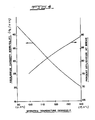
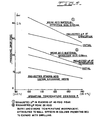
- temperature plays a significant role in the method of the present invention. As the temperature is increased, the overall operating capacity of the resin is decreased but the utilization of the equilibrium capacity is increased. These data can be used to ascertain the temperature above which use of the present method would be impractical. From the following examples, it can be seen that the present method can be operated efficiently at temperatures as high as 93.3°C (200°F). In preferred practice, the present method is performed at a temperature in the range of about 45.6 to 59.4°C (115-140°F).
- Three weakly acidic cation exchange resins and one strongly acidic cation exchange resin were evaluated for ammonia removal capacity under typical condensate polishing conditions; specifically, at a relatively high flow rate, low inlet concentration of impurities and elevated temperature.
- the three weakly acidic resins evaluted in this example were Duolite C-464 macroporous (Diamond Shamrock Chemical Co., Cleveland, Ohio), Amberlite IRC-84 gel (Rohm and Haas Co., Philadelphia, Pennsylvania) and Dowex MWC-1 macroporous (Dow Chemical Co., Midland, Michigan), are representative acrylic acid-divinylbenzene type cation exchange resins having pK a s less than about 5.8. These resins were selected on the basis of excellent osmotic shock resistance and high capacity. Additional weakly acidic cation exchange resins that are suitale for use in the present invention include Lewatit CNP (Bayer, West Germany) and lonac CC (lonac Chemical Co., Birmingham, NJ).
- Dowex HGR W2 (Dow Chemical Co., Midland, Michigan) was selected for comparison purposes as a typical strongly acidic styrene-divinylbenzene type cation exchange resin having sulfonic acid active groups.
- Other suitable strongly acidic cation exchange resins include Dowex HGR-S (Dow Chemical Co., Midland, Michigan), Amberlite IR-120 (Rohm and Haas Co., Philadelphia, PA) and lonac C-267 (lonac Chemical Co., Birmingham, NJ).
- Dilute sulfuric acid (4-5% by weight) was used to regenerate each resin at a dosage approximately equal to four times (4x) the stoichiometric amount necessary for complete regeneration of the resin, except in three tests as shown in Table 1 in which 1.2x the stoichiometric amount was tested.
- Regeneration was done manually, using a separatory funnel to gravity feed the regenerant for a contact time of at least one hour.
- Each resin was rinsed at 3.76 I/min/0.093 m 2 (1 gpm/ft 2 ), and the effluent was monitored using a Beckman conductivity bridge and a flow-through cell.
- Capacities were calculated from run length, influent ammonia and effluent ammonia as determined by conductivity measurements. Calculated equilibrium capacities were verified where possible by determining the mass balance on spent regenerant using ammonia electrode and back titration techniques. 1. Resins were subjected to one exhaustion/regeneration cycle prior to testing, except for Duolite C-464 which was not precycled. Each resin was used as received from the manufacturer with no screening or backwashing.
- Table 2 lists the results obtained for ammonia removal with the cation exchange resins under the foregoing conditions of low inlet concentration, relatively high flow rate and elevated temperature.
- the exchange capacity, pressure drop (AP) and run length were determined for each resin.
- the subheading "Break” refers to the breakthrough point which is the time (usually expressed in hours) during operation of the bed at which some of the material to be adsorbed by the resin passes through the entire depth of the bed without being adsorbed and appears in the effluent. After the breakthrough point, the effluent concentration of the material to be adsorbed by the resin increases with time until it equals the concentration of that material at the inlet of the bed. At this time, the entire bed has a sorbed-phase concentration in equilibrium with the effluent concentration, and the bed is referred to as being exhausted.
- the subheading "Break” refers to the breakthrough ion exchange capacity (equivalents per liter) of the resin tested.
- Duolite C-464 which had a low breakthrough capacity, 20 kgr/28.3 I (approximately 36% of the total exchange sites), did not rinse down after regeneration and was eliminated from further testing. High capacities were retained after 120% regeneration of both Amberlite IRC-84 and Dowex MWC-1 and both resins showed reasonable conductivity upon rinse down.
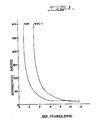
- Figure 1 is a comparison of representative Dowex MWC-1 and Dowex HGR W2 rinse curves.
- Dowex MWC-1 required a greater rinse volume (about 2.5 bed volumes) than Dowex HGR W2 (about 1.7 bed volumes) to effect an effluent conductivity of 100 micromhos, the two curves were very similar after 6 bed volumes of rinse.
- the rinse volume requirement to achieve an effluent conductivity less than 10 micromhos was about 7.5 bed volumes for Dowex MWC-1 and about 8.5 bed volumes for Dowex HGR W2.
- the high capacities obtained for both resins at 59.4°C (140°F), compared to the capacities obtained at 31.9°C (90°F), may be due either to the lower area flow rate which would mask the temperature effect observed in a later testings or to inaccurately controlled flow rate throughout the preliminary testing.
- the flow rate was regulated with a control valve and was verified with a flow meter, so that the flow rate remained relatively constant during each run.
- Sodium removal was evaluated in Runs 10 and 11, with influent and effluent sodium being measured with an Orion SLED analyzer. The effect of temperature was determined over the range of 37.4 to 59.4°C (100° to 140°F).
- Table 4 lists the results obtained with Dowex MWC-1 over the temperature range 37.4 to 59.4°C (100 to 140°F). As previously indicated, a higher flow rate (189 I/min/0.093 m 2 , 50 gpm/ft 2 ) was used in these runs as compared to the runs of Example 1. Ammonia influent, however, remained the same at 2 ppm and the pH of the ammonia feed solution was 9.6. Sodium removal was also investigated.
- the mixed bed system was operated under the same conditions and influent ammonia concentrations as those described in Example 2 and was evaluated for ammonia and sodium removal capacity.
- the weakly acidic cation exchange resin should comprise at least 25 percent (dry weight) of the total bed volume. As in Example 2, the bed height was 91.4 cm (36 inches). However, 50 ppb Na feed using a sodium chloride solution was employed.
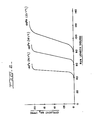
- Sodium leakage was about 0.5 ppb ( ⁇ 0.1) until the sodium breakthrough point was reached at about 60 hours. That was long after the ammonia breakthrough point which occurred at 40 hours. Ammonia leakage during the run was estimated to be 6 ppb or less based on the effluent conductivity.
- the effluent conductivity at 24°C was 0.12 ps prior to the ammonia breakthrough point with a cation conductivity at 0.06 ⁇ s and an anion conductivity unchanged at 0.12 ⁇ s. This indicates that no measurable chloride (anion) leakage took place but that some ammonia leakage occurred.
- a mixed bed ion exchange system including a weakly acidic cation exchange resin having a pK a less than about 5.8 (for example, Dowex MWC-1) and a strongly basic anion exchange resin substantially removes impurities including ammonia and metal ions from a solution under condensate polishing conditions.
- a single bed ion exchange system including the above weakly acidic cation exchange resin when used to pretreat condensate before passage through a conventional mixed bed, also substantially removes impurities including ammonia and metal ions from a solution under condensate polishing conditions. Those results would not be expected by one of ordinary skill in the art of ion exchange.
- the quantity of acid required to regenerate the cation exchange resin of the bed was reduced by a factor of at least 3 relative to the quantity of acid required to regenerate the cation exchange resin of a mixed bed comprising a mixture of strongly acidic cation and strongly basic anion exchange resins or a single bed comprising a strongly acidic cation exchange resin.
- the resins can be easily separated before regeneration by passage of a dilute salt solution (for example, a 10 percent sodium chloride solution) through the bed.
- a weakly acidic cation exchange resin according to the present invention and a strongly basic anion exchange resin can also be combined in an aqueous slurry and used to form a precoat filter as described in U.S. Patent Nos. 3,250,703 and 3,779,386, which are assigned to the assignee of the present application and which is incorporated herein by reference.
- Such a precoat filter effectively removes ammonia and other volatile amines along with corrosion products and metal ions when used under the temperature conditions described above for the operation of a mixed bed system.
- a precoat filter is usually used at a low rate of less than 37.9 I/min/0.093 m 2 (10 gallons per minute per square foot).
Landscapes
- Chemical & Material Sciences (AREA)
- Organic Chemistry (AREA)
- Chemical Kinetics & Catalysis (AREA)
- Treatment Of Water By Ion Exchange (AREA)
Claims (13)
Applications Claiming Priority (4)
| Application Number | Priority Date | Filing Date | Title |
|---|---|---|---|
| US06/561,458 US4568466A (en) | 1983-12-13 | 1983-12-13 | Method for pretreating aqueous solutions with weakly acidic cation exchange resins |
| US561458 | 1983-12-13 | ||
| US06/560,814 US4548717A (en) | 1983-12-13 | 1983-12-13 | Method for treating aqueous solutions with weakly acidic cation exchange resins |
| US560814 | 1983-12-13 |
Publications (3)
| Publication Number | Publication Date |
|---|---|
| EP0149792A2 EP0149792A2 (fr) | 1985-07-31 |
| EP0149792A3 EP0149792A3 (en) | 1986-04-16 |
| EP0149792B1 true EP0149792B1 (fr) | 1989-06-21 |
Family
ID=27072475
Family Applications (1)
| Application Number | Title | Priority Date | Filing Date |
|---|---|---|---|
| EP84115303A Expired EP0149792B1 (fr) | 1983-12-13 | 1984-12-12 | Méthode pour traiter des solutions aqueuses avec des résines échangeuses de cation faiblement acides |
Country Status (5)
| Country | Link |
|---|---|
| EP (1) | EP0149792B1 (fr) |
| AU (1) | AU574745B2 (fr) |
| CA (1) | CA1247761A (fr) |
| DE (1) | DE3478740D1 (fr) |
| MX (1) | MX164558B (fr) |
Families Citing this family (6)
| Publication number | Priority date | Publication date | Assignee | Title |
|---|---|---|---|---|
| AT393114B (de) * | 1989-06-08 | 1991-08-26 | Chemiefaser Lenzing Ag | Verfahren zur abtrennung von aminen |
| CA2027453C (fr) * | 1989-10-20 | 2000-08-22 | Hideo Kawazu | Matieres servant a l'extraction d'impuretes en suspension et autres usages de ces matieres |
| US5308876A (en) * | 1989-10-20 | 1994-05-03 | Ebara Corporation | Materials for removing suspended impurities and use thereof |
| US7758757B2 (en) | 2007-10-19 | 2010-07-20 | E. I. Du Pont De Nemours And Company | Method for removing hydrazine compounds |
| FR3021551A1 (fr) * | 2014-06-03 | 2015-12-04 | Arkema France | Procede d'elimination d'ions metalliques dans une solution organique visqueuse |
| US20170362097A1 (en) * | 2016-06-16 | 2017-12-21 | Kurion, Inc. | System and method for controlling performance of aqueous hazardous waste capture |
Family Cites Families (6)
| Publication number | Priority date | Publication date | Assignee | Title |
|---|---|---|---|---|
| GB1048943A (en) * | 1964-06-25 | 1966-11-23 | Permutit Co Ltd | Ion-exchange processes and apparatus |
| US3475330A (en) * | 1967-12-05 | 1969-10-28 | Continental Products Of Texas | Methods of removing and reclaiming ammonia ions from water |
| FR2026297A1 (en) * | 1968-12-16 | 1970-09-18 | Crane Co | Water demineralisation using an excharge - resins |
| US3985648A (en) * | 1974-06-27 | 1976-10-12 | Almag Pollution Control Corporation | Method and system for purifying liquid |
| CA1112379A (fr) * | 1977-09-13 | 1981-11-10 | Jesse G. Grier | Extraction des ions chromates en solution aqueuse de chromates |
| FR2480736A1 (fr) * | 1980-04-17 | 1981-10-23 | Degremont |
-
1984
- 1984-12-04 CA CA000469334A patent/CA1247761A/fr not_active Expired
- 1984-12-10 AU AU36460/84A patent/AU574745B2/en not_active Ceased
- 1984-12-12 DE DE8484115303T patent/DE3478740D1/de not_active Expired
- 1984-12-12 EP EP84115303A patent/EP0149792B1/fr not_active Expired
- 1984-12-13 MX MX20371984A patent/MX164558B/es unknown
Also Published As
| Publication number | Publication date |
|---|---|
| MX164558B (es) | 1992-08-28 |
| DE3478740D1 (en) | 1989-07-27 |
| AU3646084A (en) | 1985-06-20 |
| EP0149792A2 (fr) | 1985-07-31 |
| EP0149792A3 (en) | 1986-04-16 |
| CA1247761A (fr) | 1988-12-28 |
| AU574745B2 (en) | 1988-07-14 |
Similar Documents
| Publication | Publication Date | Title |
|---|---|---|
| US4479877A (en) | Removal of nitrate from water supplies using a tributyl amine strong base anion exchange resin | |
| US4564455A (en) | Three component resin system and method for purifying aqueous solutions | |
| US3382169A (en) | Process for deionizing aqueous solutions | |
| US4853130A (en) | Method for purifying liquids | |
| US4547291A (en) | Method for treating aqueous solutions with weakly acidic cation exchange resins | |
| US4548717A (en) | Method for treating aqueous solutions with weakly acidic cation exchange resins | |
| US4568466A (en) | Method for pretreating aqueous solutions with weakly acidic cation exchange resins | |
| EP0149792A2 (fr) | Méthode pour traiter des solutions aqueuses avec des résines échangeuses de cation faiblement acides | |
| US4818773A (en) | Alkylaminophosphonic chelating resins, their preparation and use in purifying brines | |
| EP0087934B1 (fr) | Résines chélatantes alkylaminophosphoniques, leur préparation et utilisation pour purifier des saumures | |
| US3501401A (en) | Condensation purification process | |
| US2962438A (en) | Ion exchange process for water purification | |
| RU2060231C1 (ru) | Ионообменная смола в качестве полимерного адсорбента и способ адсорбирования и удаления загрязнений | |
| US4927796A (en) | Compositions for purifying liquids | |
| US4172783A (en) | Condensate purification process by use of dilute clear lime solution | |
| JP2003230840A (ja) | イオン交換体の回生方法及び陰イオン交換体の回生剤 | |
| Myers et al. | Synthetic-resin ion exchangers in water purification | |
| US3709818A (en) | Condensate polishing | |
| JP2000009703A (ja) | アニオン交換樹脂の性能評価方法 | |
| Tiger et al. | Demineralizing solutions by a two-step ion exchange process | |
| US4198295A (en) | Process for increasing the exchange yield in ion exchange processes | |
| US3585127A (en) | Method for treating water by ion exchange | |
| US4163717A (en) | Removal of silica from mixed bed demineralizer | |
| JP4505103B2 (ja) | 陽イオン交換樹脂の性能評価方法及び該方法を用いた水処理系の管理方法 | |
| US3232867A (en) | Removal of anionic surfactants from liquids |
Legal Events
| Date | Code | Title | Description |
|---|---|---|---|
| PUAI | Public reference made under article 153(3) epc to a published international application that has entered the european phase |
Free format text: ORIGINAL CODE: 0009012 |
|
| AK | Designated contracting states |
Designated state(s): DE FR GB IT SE |
|
| PUAL | Search report despatched |
Free format text: ORIGINAL CODE: 0009013 |
|
| RHK1 | Main classification (correction) |
Ipc: B01J 47/04 |
|
| AK | Designated contracting states |
Kind code of ref document: A3 Designated state(s): DE FR GB IT SE |
|
| 17P | Request for examination filed |
Effective date: 19860828 |
|
| 17Q | First examination report despatched |
Effective date: 19870805 |
|
| GRAA | (expected) grant |
Free format text: ORIGINAL CODE: 0009210 |
|
| AK | Designated contracting states |
Kind code of ref document: B1 Designated state(s): DE FR GB IT SE |
|
| ITF | It: translation for a ep patent filed | ||
| REF | Corresponds to: |
Ref document number: 3478740 Country of ref document: DE Date of ref document: 19890727 |
|
| EN | Fr: translation not filed | ||
| PLBE | No opposition filed within time limit |
Free format text: ORIGINAL CODE: 0009261 |
|
| STAA | Information on the status of an ep patent application or granted ep patent |
Free format text: STATUS: NO OPPOSITION FILED WITHIN TIME LIMIT |
|
| 26N | No opposition filed | ||
| PGFP | Annual fee paid to national office [announced via postgrant information from national office to epo] |
Ref country code: FR Payment date: 19901215 Year of fee payment: 7 |
|
| ITTA | It: last paid annual fee | ||
| PGFP | Annual fee paid to national office [announced via postgrant information from national office to epo] |
Ref country code: DE Payment date: 19910131 Year of fee payment: 7 |
|
| PG25 | Lapsed in a contracting state [announced via postgrant information from national office to epo] |
Ref country code: DE Effective date: 19920901 |
|
| EAL | Se: european patent in force in sweden |
Ref document number: 84115303.4 |
|
| PGFP | Annual fee paid to national office [announced via postgrant information from national office to epo] |
Ref country code: SE Payment date: 19981207 Year of fee payment: 15 |
|
| PGFP | Annual fee paid to national office [announced via postgrant information from national office to epo] |
Ref country code: GB Payment date: 19981218 Year of fee payment: 15 |
|
| PG25 | Lapsed in a contracting state [announced via postgrant information from national office to epo] |
Ref country code: GB Free format text: LAPSE BECAUSE OF NON-PAYMENT OF DUE FEES Effective date: 19991212 |
|
| PG25 | Lapsed in a contracting state [announced via postgrant information from national office to epo] |
Ref country code: SE Free format text: LAPSE BECAUSE OF NON-PAYMENT OF DUE FEES Effective date: 19991213 |
|
| GBPC | Gb: european patent ceased through non-payment of renewal fee |
Effective date: 19991212 |
|
| EUG | Se: european patent has lapsed |
Ref document number: 84115303.4 |
|
| PG25 | Lapsed in a contracting state [announced via postgrant information from national office to epo] |
Ref country code: FR Free format text: LAPSE BECAUSE OF FAILURE TO SUBMIT A TRANSLATION OF THE DESCRIPTION OR TO PAY THE FEE WITHIN THE PRESCRIBED TIME-LIMIT Effective date: 20001231 |
|
| PG25 | Lapsed in a contracting state [announced via postgrant information from national office to epo] |
Ref country code: FR Free format text: LAPSE BECAUSE OF FAILURE TO SUBMIT A TRANSLATION OF THE DESCRIPTION OR TO PAY THE FEE WITHIN THE PRESCRIBED TIME-LIMIT Effective date: 19911231 |