EP0150167A2 - Profileisen - Google Patents
Profileisen Download PDFInfo
- Publication number
- EP0150167A2 EP0150167A2 EP85870008A EP85870008A EP0150167A2 EP 0150167 A2 EP0150167 A2 EP 0150167A2 EP 85870008 A EP85870008 A EP 85870008A EP 85870008 A EP85870008 A EP 85870008A EP 0150167 A2 EP0150167 A2 EP 0150167A2
- Authority
- EP
- European Patent Office
- Prior art keywords
- profile
- section
- profile according
- branches
- substantially cruciform
- Prior art date
- Legal status (The legal status is an assumption and is not a legal conclusion. Google has not performed a legal analysis and makes no representation as to the accuracy of the status listed.)
- Withdrawn
Links
- 229910000831 Steel Inorganic materials 0.000 title claims abstract description 6
- 239000010959 steel Substances 0.000 title claims abstract description 6
- 238000005192 partition Methods 0.000 claims description 15
- 229910052751 metal Inorganic materials 0.000 claims description 9
- 239000002184 metal Substances 0.000 claims description 9
- 230000003014 reinforcing effect Effects 0.000 claims description 7
- 239000012815 thermoplastic material Substances 0.000 claims description 7
- 238000001125 extrusion Methods 0.000 claims description 6
- 238000004519 manufacturing process Methods 0.000 claims description 6
- 229910052782 aluminium Inorganic materials 0.000 claims description 4
- XAGFODPZIPBFFR-UHFFFAOYSA-N aluminium Chemical compound [Al] XAGFODPZIPBFFR-UHFFFAOYSA-N 0.000 claims description 4
- 229910045601 alloy Inorganic materials 0.000 claims description 3
- 239000000956 alloy Substances 0.000 claims description 3
- 239000002984 plastic foam Substances 0.000 claims description 3
- 238000000429 assembly Methods 0.000 description 4
- 230000000712 assembly Effects 0.000 description 4
- 239000000463 material Substances 0.000 description 4
- 239000004567 concrete Substances 0.000 description 3
- 238000009413 insulation Methods 0.000 description 3
- 244000027321 Lychnis chalcedonica Species 0.000 description 2
- 238000010276 construction Methods 0.000 description 2
- 230000000694 effects Effects 0.000 description 2
- XLYOFNOQVPJJNP-UHFFFAOYSA-N water Substances O XLYOFNOQVPJJNP-UHFFFAOYSA-N 0.000 description 2
- 229910000838 Al alloy Inorganic materials 0.000 description 1
- 229910001335 Galvanized steel Inorganic materials 0.000 description 1
- 229920005830 Polyurethane Foam Polymers 0.000 description 1
- 230000001154 acute effect Effects 0.000 description 1
- 238000004873 anchoring Methods 0.000 description 1
- 239000011324 bead Substances 0.000 description 1
- 238000005452 bending Methods 0.000 description 1
- 230000000295 complement effect Effects 0.000 description 1
- 230000007797 corrosion Effects 0.000 description 1
- 238000005260 corrosion Methods 0.000 description 1
- 238000007599 discharging Methods 0.000 description 1
- 238000009826 distribution Methods 0.000 description 1
- 239000006260 foam Substances 0.000 description 1
- -1 for example Substances 0.000 description 1
- 230000004927 fusion Effects 0.000 description 1
- 239000008397 galvanized steel Substances 0.000 description 1
- 230000008595 infiltration Effects 0.000 description 1
- 238000001764 infiltration Methods 0.000 description 1
- 238000009434 installation Methods 0.000 description 1
- 239000011810 insulating material Substances 0.000 description 1
- 150000002739 metals Chemical class 0.000 description 1
- 238000000034 method Methods 0.000 description 1
- 230000004048 modification Effects 0.000 description 1
- 238000012986 modification Methods 0.000 description 1
- 239000004033 plastic Substances 0.000 description 1
- 229920003023 plastic Polymers 0.000 description 1
- 239000004417 polycarbonate Substances 0.000 description 1
- 229920000515 polycarbonate Polymers 0.000 description 1
- 229920000582 polyisocyanurate Polymers 0.000 description 1
- 239000011495 polyisocyanurate Substances 0.000 description 1
- 229920002635 polyurethane Polymers 0.000 description 1
- 239000004814 polyurethane Substances 0.000 description 1
- 239000011496 polyurethane foam Substances 0.000 description 1
- 239000011150 reinforced concrete Substances 0.000 description 1
- 238000005096 rolling process Methods 0.000 description 1
- 125000006850 spacer group Chemical group 0.000 description 1
- 239000000126 substance Substances 0.000 description 1
- 239000002023 wood Substances 0.000 description 1
Images




Classifications
-
- E—FIXED CONSTRUCTIONS
- E04—BUILDING
- E04C—STRUCTURAL ELEMENTS; BUILDING MATERIALS
- E04C3/00—Structural elongated elements designed for load-supporting
- E04C3/02—Joists; Girders, trusses, or trusslike structures, e.g. prefabricated; Lintels; Transoms; Braces
- E04C3/04—Joists; Girders, trusses, or trusslike structures, e.g. prefabricated; Lintels; Transoms; Braces of metal
- E04C3/06—Joists; Girders, trusses, or trusslike structures, e.g. prefabricated; Lintels; Transoms; Braces of metal with substantially solid, i.e. unapertured, web
- E04C3/07—Joists; Girders, trusses, or trusslike structures, e.g. prefabricated; Lintels; Transoms; Braces of metal with substantially solid, i.e. unapertured, web at least partly of bent or otherwise deformed strip- or sheet-like material
-
- E—FIXED CONSTRUCTIONS
- E04—BUILDING
- E04C—STRUCTURAL ELEMENTS; BUILDING MATERIALS
- E04C2/00—Building elements of relatively thin form for the construction of parts of buildings, e.g. sheet materials, slabs, or panels
- E04C2/02—Building elements of relatively thin form for the construction of parts of buildings, e.g. sheet materials, slabs, or panels characterised by specified materials
- E04C2/08—Building elements of relatively thin form for the construction of parts of buildings, e.g. sheet materials, slabs, or panels characterised by specified materials of metal, e.g. sheet metal
-
- E—FIXED CONSTRUCTIONS
- E04—BUILDING
- E04C—STRUCTURAL ELEMENTS; BUILDING MATERIALS
- E04C3/00—Structural elongated elements designed for load-supporting
- E04C3/02—Joists; Girders, trusses, or trusslike structures, e.g. prefabricated; Lintels; Transoms; Braces
- E04C3/04—Joists; Girders, trusses, or trusslike structures, e.g. prefabricated; Lintels; Transoms; Braces of metal
- E04C2003/0404—Joists; Girders, trusses, or trusslike structures, e.g. prefabricated; Lintels; Transoms; Braces of metal beams, girders, or joists characterised by cross-sectional aspects
- E04C2003/0408—Joists; Girders, trusses, or trusslike structures, e.g. prefabricated; Lintels; Transoms; Braces of metal beams, girders, or joists characterised by cross-sectional aspects characterised by assembly or the cross-section
- E04C2003/0413—Joists; Girders, trusses, or trusslike structures, e.g. prefabricated; Lintels; Transoms; Braces of metal beams, girders, or joists characterised by cross-sectional aspects characterised by assembly or the cross-section being built up from several parts
-
- E—FIXED CONSTRUCTIONS
- E04—BUILDING
- E04C—STRUCTURAL ELEMENTS; BUILDING MATERIALS
- E04C3/00—Structural elongated elements designed for load-supporting
- E04C3/02—Joists; Girders, trusses, or trusslike structures, e.g. prefabricated; Lintels; Transoms; Braces
- E04C3/04—Joists; Girders, trusses, or trusslike structures, e.g. prefabricated; Lintels; Transoms; Braces of metal
- E04C2003/0404—Joists; Girders, trusses, or trusslike structures, e.g. prefabricated; Lintels; Transoms; Braces of metal beams, girders, or joists characterised by cross-sectional aspects
- E04C2003/0426—Joists; Girders, trusses, or trusslike structures, e.g. prefabricated; Lintels; Transoms; Braces of metal beams, girders, or joists characterised by cross-sectional aspects characterised by material distribution in cross section
- E04C2003/043—Joists; Girders, trusses, or trusslike structures, e.g. prefabricated; Lintels; Transoms; Braces of metal beams, girders, or joists characterised by cross-sectional aspects characterised by material distribution in cross section the hollow cross-section comprising at least one enclosed cavity
-
- E—FIXED CONSTRUCTIONS
- E04—BUILDING
- E04C—STRUCTURAL ELEMENTS; BUILDING MATERIALS
- E04C3/00—Structural elongated elements designed for load-supporting
- E04C3/02—Joists; Girders, trusses, or trusslike structures, e.g. prefabricated; Lintels; Transoms; Braces
- E04C3/04—Joists; Girders, trusses, or trusslike structures, e.g. prefabricated; Lintels; Transoms; Braces of metal
- E04C2003/0404—Joists; Girders, trusses, or trusslike structures, e.g. prefabricated; Lintels; Transoms; Braces of metal beams, girders, or joists characterised by cross-sectional aspects
- E04C2003/0426—Joists; Girders, trusses, or trusslike structures, e.g. prefabricated; Lintels; Transoms; Braces of metal beams, girders, or joists characterised by cross-sectional aspects characterised by material distribution in cross section
- E04C2003/0439—Joists; Girders, trusses, or trusslike structures, e.g. prefabricated; Lintels; Transoms; Braces of metal beams, girders, or joists characterised by cross-sectional aspects characterised by material distribution in cross section the cross-section comprising open parts and hollow parts
-
- E—FIXED CONSTRUCTIONS
- E04—BUILDING
- E04C—STRUCTURAL ELEMENTS; BUILDING MATERIALS
- E04C3/00—Structural elongated elements designed for load-supporting
- E04C3/02—Joists; Girders, trusses, or trusslike structures, e.g. prefabricated; Lintels; Transoms; Braces
- E04C3/04—Joists; Girders, trusses, or trusslike structures, e.g. prefabricated; Lintels; Transoms; Braces of metal
- E04C2003/0404—Joists; Girders, trusses, or trusslike structures, e.g. prefabricated; Lintels; Transoms; Braces of metal beams, girders, or joists characterised by cross-sectional aspects
- E04C2003/0443—Joists; Girders, trusses, or trusslike structures, e.g. prefabricated; Lintels; Transoms; Braces of metal beams, girders, or joists characterised by cross-sectional aspects characterised by substantial shape of the cross-section
- E04C2003/0478—X-shaped
Definitions
- the present invention relates to the art of the carpenter and more particularly to a hollow section suitable for building work.
- the present invention aims to remedy this shortcoming by providing prefabricated construction elements offering advantages in the fields of the passable span, the lightness of the structures, the flexibility of implementation as structural elements and partitions and the weather protection.
- the profile of the invention lends itself to assemblies with identical profiles or complementary profiles and with interlocking upper (ridge) or lower (seat) assembly elements.
- the profile of the invention can receive a layer of thermal and / or acoustic insulation inside and / or outside over an anti layer corrosion.
- the profile is in a box, it can house various pipes.
- the lateral members for assembling the sections to one another form a joint cover and a channel for discharging runoff water.
- the subject of the invention is a box profile having a substantially cruciform cross section, characterized in that two opposite branches of the substantially cruciform section each carry a longitudinal wing established over the entire length of the profile and folded parallel to the median plane passing through the two branches of the substantially cruciform section so as to provide, between itself and the branch which carries it, a groove suitable for receiving a wing carried by a juxtaposed profile.
- the longitudinal wing of a branch of the substantially cruciform section is folded in the same direction as the longitudinal wing of the other branch of the substantially cruciform section and according to a second embodiment, l 'longitudinal wing of a branch of the substantially cruciform section is folded in the opposite direction to that of the longitudinal wing of the other branch of the substantially cruciform section.
- At least one of the branches of the substantially cruciform section carries one or more longitudinal ribs established over the entire length of the profile and / or at least one of the branches of the substantially cruciform section carries one or more longitudinal grooves established on the entire length of the profile, the ribs and / or grooves having a contour designed for a particular function, such as receiving the fixa tions of a false ceiling or simply increase the stiffness of the branch in question.
- At least one of the two other branches of the substantially cruciform section has two opposite faces which are not parallel to the median plane of the profile common to these same two other branches.
- these two opposite non-parallel faces converge towards the center of the substantially cruciform section.
- the box profile according to the invention can be produced from steel sheet (in particular from galvanized steel sheet), by bending or rolling to the desired profile.
- steel sheet in particular from galvanized steel sheet
- thermoplastic materials for example: polycarbonate
- transparent or translucent plastic materials for example: polycarbonate
- This can be a metal box section, for example of rectangular or cruciform section, or any other suitable section.
- the box sections according to the invention are obtained by extrusion of aluminum or its alloys, or of thermoplastic materials, it is advantageous for the wings and the walls themselves to have longitudinal channels, for the purpose of lightening. .
- These longitudinal channels can be filled with plastic foam, for example polyurethane or polyisocyanurate foam, which has the effect of improving sound and thermal insulation.
- plastic foam for example polyurethane or polyisocyanurate foam, which has the effect of improving sound and thermal insulation.
- the invention also relates to a method for the production of self-supporting partitions; these partitions are obtained by assembling side by side box sections of the invention as described above, by engaging each wing of each section in the grooves of the juxtaposed sections.
- the substantially cruciform cross-sectional box section profile according to the invention from which it can be considered that all the others derive by modification, has in substance a cross section in Greek and exists in two embodiments.
- Fig. 1 is a view of the hollow cross section of the basic section 1 of the invention in its first embodiment, which has four equal branches 2, 3, 4 and 5, among which the branches 3 and 5 carry the first wing 6 and the second a wing 7, established over the entire length of the profile 1 and folded down, one in the same direction as the other, parallel to the median plane 8 (indicated in dotted lines) passing through the two other branches 2 and 4 , so as to provide, with the carrying branch 3 or 5, a groove suitable for receiving a wing carried by a juxtaposed profile.
- the distance from the bottom of the grooves to the free edges 9 and 10 of the respective wings 6 and 7 is less than the thickness of the respective branches 3 and 5, to allow an assembly flush with the contiguous sections.
- Fig. 2 is a view of two elementary profiles 11 and 12, the assembly of which composes the profile 1 of FIG. 1.
- the elementary profile 11 consists of seven sections 13 to 19, among which the sections 13 and 14 form a part of the wing 7 and its branch 5 (see also Fig. 1), the sections 15, 16 and 17 form the branch 4 and the sections 18 and 19 form a part of the wing 6 and of its branch 3 (see also Fig. 1.).
- the elementary profile 12 is made up of nine sections 20 to 28, among which the sections 20, 21 and 22 form the remaining part of the wing 7 and of its branch 5 (see also Fig. 1), the sections 23, 24 and 25 form the branch 2 and the sections 26, 27 and 28 form the remaining part of the wing 6 and of its branch 3 (see also Fig. 1).
- the two elementary profiles 11 and 12 form the profile 1 by interlocking and are joined by weld beads or rows of weld spots or any other suitable means where the free edges of the panels 13 and 20 meet. sections 19 and 28 forming the free edges 9 and 10 of the wings 6 and 7.
- Fig. 3 is a view of the hollow cross section of the basic section 29 of the invention in its second embodiment, which has four equal branches 2, 3, 4 and 5, among which the branches 3 and 5 carry the first one wing 6 and the second a wing 7 established over the entire length of the profile 29 and folded one in the opposite direction to that of the other parallel to the median plane 8 (indicated in dotted lines) which is common to the other two wings 2 and 4 so as to provide, with the carrying branch 3 or 5, a groove suitable for receiving a wing carried by a juxtaposed profile.
- the distance from the bottom of the grooves to the free edges 9 and 10 of the respective wings 6 and 7 is less than the thickness of the respective legs 3 and 5, to allow assem - bly flush contiguous sections.
- Fig. 4 is a view of the two elementary profiles 30 and 31, the assembly of which composes the profile 29 in FIG. 3.
- the elementary profile 30 is composed of eight sections 13 to 20, among which the sections 13 and 14 form a part of the wing 7 and of its branch 5 (see also Fig. 3), the sections 15, 16 and 17 form the branch 4 and the sections 18, 19 and 20 form a part of the wing 6 and of its branch 3 (see also Fig. 3).
- the elementary profile 31 consists of eight sections 21 to 28 among which the sections 21, 22 and 23 form the remaining part of the wing 7 and of its branch 5 (see also Fig. 3), the sections 24, 25 and 26 form the branch 2 and the sections 27 and 28 form the remaining part of the wing 6 and of its branch 3 (see also Fig. 3).
- the two elementary profiles 30 and 31 form the profile 29 by interlocking and are joined together like the elementary profiles 11 and 12 of the profile 1 by constituting the free edges 9 and 10 of the wings 6 and 7.
- profile 29 is in fact formed of two identical elementary profiles, one being rotated 180 ° relative to the other.
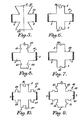
- Fig. 5 is a view of the hollow cross section of a profile 32 in which two opposite branches 3 and 5 are the same as in the base type of one or the other embodiment and the two other branches 33 and 34 have opposite faces not parallel to the median plane 8 of the profile common to these same branches, the opposite non-parallel faces being convergent in the direction of the cruciform section.
- the section of the profile is thus half in Greek cross and half in Maltese cross.
- Fig. 6 is a view of the hollow cross section of a profile 35 in which the two opposite branches 2 and 4 comprise grooves 36 and 37 with rectangular section formed in the sides 16 and 24 of the elementary profiles.
- Fig. 7 is a view similar to FIG. 6 of a profile 38 in which grooves 39 and 40 of semi-circular section are provided in the same way in the branches 2 and 4.
- Fig. 8 is a view similar to FIG. 6 of a profile 41 in which V-shaped grooves 42 to 45 are formed in the opposite faces of the branches 2 and 4.
- Fig. 9 is a view similar to FIG. 6 of a profile 46 in which ribs of semi-circular section 47 to 54 are carried by the faces opposite branches 2, 3, 4 and 5.
- Fig. 10 is a view similar to FIG. 6 of a profile 55 in which grooves 36 and 37 with a square section are formed in the branches 2 and 4 and ribs with a square section 56 to 59 are carried by the opposite faces of the branches 3 and 5.
- Fig. 11 is a view of the hollow cross section of a section 60, the branch 33 of which has the form of a branch of the Maltese cross and the branches 3, 4 and 5 of which have the form of a branch of the Greek cross; the branch 4 comprising a dovetail rib 61 formed in the pan 16.
- the profiles 60 lend themselves to juxtaposition in a pre-slab on which can be poured concrete in which the profiles 60 are anchored by their branch 33, while the dovetail ribs 61 allow to suspend a false ceiling. It should be noted that in the present case, if the section 60 does not derive from the basic type of the second embodiment, it is necessary to provide a set of sections 60 whose wings 6 and 7 are raised and a set of sections 60 whose wings 6 and 7 are folded down.
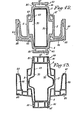
- Fig. 12 is a section through a box section 62 derived from the first embodiment of the invention, obtained by extrusion, for example of aluminum or aluminum alloys or a thermoplastic material.
- This profile 62 has a cruciform section, comprising four branches 2, 3, 4 and 5, and two wings 64 and 65 carried by each of the branches 3 and 5.
- the box 62 is made of thermoplastic material, it can advantageously be reinforced by a metal core, which is, as illustrated in FIG. 12, a box section of rectangular section 63.
- the wings 64 and 65 of the extruded profile 62 have longitudinal channels 66; likewise, the walls of the extruded profile 62 have longitudinal channels 67.
- the extruded profile 68 can also be reinforced by a metal core, which is, in the illustrated case, a box profile of cruciform section 69.
- the wings 64, 65 and the walls of the profile 68 have longitudinal channels 66, 67.
- the longitudinal channels 66, 67 as well as the spaces 70 between the metal reinforcing profiles and the walls of the extruded profile can be filled with insulating material (plastic foam), such as for example, polyurethane foam, which has the effect advantageous to improve the sound and thermal insulation of the partition made with such profiles.
- insulating material plastic foam
- polyurethane foam such as for example, polyurethane foam
- an extruded profile 62, 63 comprising a metallic core by reducing this core to two parallel flat profiles arranged vertically along the walls of the extruded profile, parallel to the wings 64, 65, and spaced and maintained by spacers, without affecting the rigidity of the extruded profile.
- Fig. 14 is a perspective view of an assembly assembly element 71 which consists of a beam body 72 carrying, on both sides, tenons 73 which are received in profiles 29.
- the beam body 72 is box-shaped and has a segment 74 of reduced section which is received in the next beam body of the complete roof.
- the ridge assemblies are produced by means of pairs of tenons 73 joined in a false square by an articulation pierced with a hole perpendicular to the plane delimited by each pair of tenons, so that a tie rod can be threaded in these aligned holes.
- the false square mounting obviously allows an arbitrary value for the angle at the ridge.
- Fig. 15 is a perspective view of a seat assembly element 75 in the shape of a right triangle, the extended hypotenuse of which forms a tenon 76 situated in alignment with the profiles 1.
- the seat element 75 is brought by its side 77 to the rest of the building directly or via a distribution plate. It goes without saying that in this case the section 1 (or 29) stops against the leg 78 or is notched to more completely cover the element 75. Furthermore, the acute angles of the right triangle must be chosen from after the angle at the ridge. According to a variant, the seat element 75 is free of leg 78, the remaining parts being articulated to each other, which ensures universality of mounting.
- Figs. 16 to 19 are sections of various finishing elements intended for finishing a partition, for example a roof as shown in FIG. 20, produced with the profile of FIG. 13.
- the section 79 of FIG. 16 is an attachment extension intended to be hooked to the upper part of the upper branch 2 of the profile 68 of the invention, so that the ribs 80 engage in the grooves 81 of the upper branch 2 (Fig. 20 ).
- the hanging attachment 79 will play the role of a rafter supporting the laths (not shown) of a roof frame, for example.
- the profiles of the invention allow the realization of roofs and freestanding partitions, but also lend themselves to the realization of roofs with a more traditional appearance; for example, a self-supporting roof can be covered with traditional elements such as tiles, etc.
- the profile 82 of FIG. 17 is a lateral finishing element which is fixed on the wing 64 of a profile 68 situated at the end of a partition, for example of a roof (Fig. 20).
- This profile 82 is held in place by a deformable wing 83 which bears on a wing 64 of the profile and by a rib 84 which takes place in a groove 85 of the profile 68.
- Profile 86 of FIG. 18 is a lower lateral closure profile, which hooks to the side of the lower branch 4 of the profile 68; this profile 86 is held in place, on the one hand, by a rib 87 which takes place in a groove 81 of the branch 4 of the profile 68, and, on the other hand, by the lower edge of the profile 82 previously put in place .
- Profile 86 is intended to cover the upper edge of a wall 88 (Fig. 20), and to protect it against water infiltration, in particular by means of a rib 89 extending downwards.
- the profile 86 further comprises a rib 90 parallel to the plane of the partition, which is inserted between the wall 88 and the said partition (Fig. 20).
- the section 91 of FIG. 19 is intended for finishing the interior surface of the partition made with the profiles 68; the section 91 takes place in the space between two successive lower branches 4 of two neighboring sections 68 and comprises two opposite ribs 92 and 93, located in the extension of one another and extending in opposite directions.
- the ribs 92 and 93 ensure, with the rib 90 of the profile 86, the continuity of the interior surface of the partition (Fig. 20), the edge of the rib 92 of a profile 91 being contiguous with the edge of the rib 90 of the lower lateral closure section 86, and the edge of the opposite nevure 93 of said section 91 being contiguous to the edge of the rib 92 of the following section 91.
- finishing profiles 79, 82, 86 and 91 are preferably made of thermoplastic material.
- contiguous profiles can alternatively be mounted so as to leave gaps which are filled in turn by non-load-bearing profiles.
- the latter also carry wings similar to the wings 6 and 7 and oriented as a function of the presentation of the wings of the section 1 or 29.
- the non-bearing sections can be made of any material possibly transparent and can also be in a box. In the latter case, they can be equipped with solar collectors.
Landscapes
- Engineering & Computer Science (AREA)
- Architecture (AREA)
- Civil Engineering (AREA)
- Structural Engineering (AREA)
- Rod-Shaped Construction Members (AREA)
- Roof Covering Using Slabs Or Stiff Sheets (AREA)
- Joining Of Building Structures In Genera (AREA)
Applications Claiming Priority (2)
| Application Number | Priority Date | Filing Date | Title |
|---|---|---|---|
| FR8400758A FR2558188B1 (fr) | 1984-01-18 | 1984-01-18 | Profile en caisson pour la realisation de toitures et planchers |
| FR8400758 | 1984-01-18 |
Publications (2)
| Publication Number | Publication Date |
|---|---|
| EP0150167A2 true EP0150167A2 (de) | 1985-07-31 |
| EP0150167A3 EP0150167A3 (de) | 1986-07-23 |
Family
ID=9300253
Family Applications (1)
| Application Number | Title | Priority Date | Filing Date |
|---|---|---|---|
| EP85870008A Withdrawn EP0150167A3 (de) | 1984-01-18 | 1985-01-17 | Profileisen |
Country Status (2)
| Country | Link |
|---|---|
| EP (1) | EP0150167A3 (de) |
| FR (1) | FR2558188B1 (de) |
Cited By (1)
| Publication number | Priority date | Publication date | Assignee | Title |
|---|---|---|---|---|
| GB2497099A (en) * | 2011-11-30 | 2013-06-05 | Terry Came | Construction element and module formed from the element |
Family Cites Families (4)
| Publication number | Priority date | Publication date | Assignee | Title |
|---|---|---|---|---|
| GB1088995A (en) * | 1963-10-25 | 1967-10-25 | Raffaele Biffani | Structural member for building construction |
| CH442870A (de) * | 1966-01-24 | 1967-08-31 | Mueller Hermann | Profilschienen-Verbindung |
| DE2054434A1 (de) * | 1970-11-05 | 1972-07-13 | Röhm GmbH, 6100 Darmstadt; Rau KG, 6920 Sinsheim | Verfahren zur Herstellung von wasserdicht verlegbaren Hohlprofilplatten |
| IT1185751B (it) * | 1980-03-18 | 1987-11-12 | Armando Rodorigo | Pannelli scatolati metallici portanti ad accoppiamento continuo per costruzione di pareti e/o coperture piane o curve portanti per prefabbricati civili industriali navali e aeronautici |
-
1984
- 1984-01-18 FR FR8400758A patent/FR2558188B1/fr not_active Expired
-
1985
- 1985-01-17 EP EP85870008A patent/EP0150167A3/de not_active Withdrawn
Cited By (1)
| Publication number | Priority date | Publication date | Assignee | Title |
|---|---|---|---|---|
| GB2497099A (en) * | 2011-11-30 | 2013-06-05 | Terry Came | Construction element and module formed from the element |
Also Published As
| Publication number | Publication date |
|---|---|
| FR2558188B1 (fr) | 1987-07-17 |
| FR2558188A1 (fr) | 1985-07-19 |
| EP0150167A3 (de) | 1986-07-23 |
Similar Documents
| Publication | Publication Date | Title |
|---|---|---|
| CH641227A5 (fr) | Panneau de construction isolant. | |
| BE1011185A5 (fr) | Ossature de batiment. | |
| WO2009074657A1 (fr) | Systeme de construction complet permettant le montage rapide de bâtiment, comprenant un element de construction avec ses accessoires et leurs procedes d'assemblage | |
| WO2023067438A1 (fr) | Poutre ou poteau d'un système de construction | |
| EP0152145B1 (de) | Platte für den Bau eines Hauses im Baukastensystem | |
| EP2576933B1 (de) | Kartonbauelement und konstruktionsverfahren unter verwendung solcher elemente | |
| EP2005011B1 (de) | Ein in einen bestimmten winkel vorgeformtes und durch rücksprünge begrenztes steckelement umfassende eckanordnung | |
| FR2558188A1 (fr) | Profile en caisson pour la realisation de toitures et planchers | |
| EP2489809B1 (de) | Verfahren zur Herstellung eines Strukturelements, und so hergestellte Elemente | |
| FR2478165A1 (fr) | Procede et dispositifs pour construire un mur isolant | |
| FR2497858A1 (fr) | Element porteur pour la construction de plafonds ou de toits | |
| EP0440567A1 (de) | Einzelne und doppelte Träger und Pfosten, bestehend aus der Zusammensetzung von Z-Trägern, die insbesondere die Realisierung eines Rahmens oder einer Kniestütze für den Bau eines Gebäudes erlauben | |
| EP0826840A1 (de) | Bauzelle | |
| FR2790021A1 (fr) | Poutre de construction en bois comportant au moins une reservation verticale pour l'insertion d'un isolant | |
| FR2573110A1 (fr) | Procede de construction d'un batiment a ossature legere avec parement exterieur, brique destinee a ce parement, paroi et ossature realisees selon ce procede. | |
| EP0127542B1 (de) | Modularer wärmeisolierender Baublock mit einer Verkleidung und Verfahren zum Herstellen eines Gebäudes | |
| FR2653800A1 (fr) | Petits composants nouveaux de construction. | |
| FR2799780A1 (fr) | Elements de coffrage perdu pour la coulee du beton | |
| FR2695152A1 (fr) | Ensemble d'éléments de construction et procédé de contruction. | |
| FR2900173A1 (fr) | Ensemble d'elements calibres en beton utilisable pour les constructions | |
| FR2763352A1 (fr) | Systeme de montage d'un revetement constitue de panneaux juxtaposes pour former un parement de facade de batiment | |
| FR2520413A1 (fr) | Panneau-mur autoporteur pour murs interieurs et exterieurs de constructions | |
| CA2163987A1 (fr) | Panneau mur porteur sandwich, profile pour un tel panneau, construction comportant de tels panneaux | |
| OA22106A (fr) | Poutre ou poteau d'un système de construction. | |
| FR2751007A1 (fr) | Construction de type garage realisee par assemblage de panneaux en beton arme prefabriques |
Legal Events
| Date | Code | Title | Description |
|---|---|---|---|
| PUAI | Public reference made under article 153(3) epc to a published international application that has entered the european phase |
Free format text: ORIGINAL CODE: 0009012 |
|
| AK | Designated contracting states |
Designated state(s): AT BE CH DE FR GB IT LI LU NL SE |
|
| PUAL | Search report despatched |
Free format text: ORIGINAL CODE: 0009013 |
|
| AK | Designated contracting states |
Kind code of ref document: A3 Designated state(s): AT BE CH DE FR GB IT LI LU NL SE |
|
| STAA | Information on the status of an ep patent application or granted ep patent |
Free format text: STATUS: THE APPLICATION IS DEEMED TO BE WITHDRAWN |
|
| 18D | Application deemed to be withdrawn |
Effective date: 19870124 |