EP0150373A2 - Amortisseur de vibrations - Google Patents
Amortisseur de vibrations Download PDFInfo
- Publication number
- EP0150373A2 EP0150373A2 EP84115099A EP84115099A EP0150373A2 EP 0150373 A2 EP0150373 A2 EP 0150373A2 EP 84115099 A EP84115099 A EP 84115099A EP 84115099 A EP84115099 A EP 84115099A EP 0150373 A2 EP0150373 A2 EP 0150373A2
- Authority
- EP
- European Patent Office
- Prior art keywords
- vibration damper
- mass elements
- damper according
- absorber system
- vibration
- Prior art date
- Legal status (The legal status is an assumption and is not a legal conclusion. Google has not performed a legal analysis and makes no representation as to the accuracy of the status listed.)
- Withdrawn
Links
Images
Classifications
-
- G—PHYSICS
- G10—MUSICAL INSTRUMENTS; ACOUSTICS
- G10K—SOUND-PRODUCING DEVICES; METHODS OR DEVICES FOR PROTECTING AGAINST, OR FOR DAMPING, NOISE OR OTHER ACOUSTIC WAVES IN GENERAL; ACOUSTICS NOT OTHERWISE PROVIDED FOR
- G10K11/00—Methods or devices for transmitting, conducting or directing sound in general; Methods or devices for protecting against, or for damping, noise or other acoustic waves in general
- G10K11/16—Methods or devices for protecting against, or for damping, noise or other acoustic waves in general
- G10K11/162—Selection of materials
- G10K11/165—Particles in a matrix
-
- F—MECHANICAL ENGINEERING; LIGHTING; HEATING; WEAPONS; BLASTING
- F16—ENGINEERING ELEMENTS AND UNITS; GENERAL MEASURES FOR PRODUCING AND MAINTAINING EFFECTIVE FUNCTIONING OF MACHINES OR INSTALLATIONS; THERMAL INSULATION IN GENERAL
- F16F—SPRINGS; SHOCK-ABSORBERS; MEANS FOR DAMPING VIBRATION
- F16F7/00—Vibration-dampers; Shock-absorbers
- F16F7/10—Vibration-dampers; Shock-absorbers using inertia effect
- F16F7/104—Vibration-dampers; Shock-absorbers using inertia effect the inertia member being resiliently mounted
Definitions
- the invention relates to a vibration damper for absorbing bending and longitudinal waves, consisting of mass elements and springs, which are connected to the object to be damped.
- the invention has for its object to find a device and a method for damping bending and longitudinal waves in components - in particular shells - which allows sound attenuation of 20 dB / wavelength even lower frequencies.
- the object is achieved in that individual elastic elements are connected via springs, vibration-damping composite materials as springs, while maintaining at least partially three rotational and three translational degrees of freedom to an absorber system, with a large number of mass elements per dimension of a wavelength of the damped Vibration are arranged in a spatial structure.
- the absorber system Since the position of the mass elements can be set arbitrarily in space, as long as they are connected to one another or at the contact surface with the object to be dampened by an elastic composite material, the absorber system has rotational and translational degrees of freedom, so that the vibrations react forces on the object generate, which lead to a strong damping of the transverse transverse waves to the surface by converting part of the vibration energy within the elastic composite material into heat.
- attenuation of 20 dB / m and more can be achieved even in the low-frequency range for plates of almost any thickness.
- the number of mass elements should be more than 20, preferably more than 50.
- the absorber system with the smaller masses and the stiffer spring properties resulted in better damping values. Based on the same total mass of the absorber system, the number of individual oscillators must increase with increasing frequency. It was also found that with the same frequency and the same basis weight of the absorber system, the damping increases roughly proportionally to the number of individual oscillators - but only if the mass elements or spring constants are in the optimal range for this frequency.
- the mass elements have a regular structure.
- different mass elements are arranged in an irregular structure.
- a wide range of frequencies can be obtained be dampened.
- a high frequency tuning can be achieved by using an absorber system with a small thickness and / or light mass elements, while large thicknesses with heavy mass elements are particularly suitable for low frequencies.
- a step-by-step construction is advantageous for economic reasons, in which the sum of the mass elements per unit of space increases as the source of interference is approached.
- Broadband damping occurs particularly when the absorber system - starting with the object - consists of a damping layer consisting of many small and heavy mass elements with a stiff composite, a damping layer made of light mass elements with a relatively stiff composite and an outer damping layer made of light mass elements there is a soft composite layer.
- the mass elements consist of minerals with dimensions greater than 2 mm, in particular greater than 6 mm.
- Minerals in the form of natural gravel or broken rock are available inexpensively and, after prior sorting by sifting, allow any structure to be put together in a predetermined manner, whereby degrees of freedom in the desired directions can be promoted by preferential arrangement of the mostly geometrically uneven pebbles.
- the elastic composite material has a modulus of elasticity of approximately 300 N / mm 2 and a loss factor of approximately 0.3.
- the mass elements can be more or less rigidly connected to one another in order to transfer the energy from the vibrating object into the resonance oscillator. It is advantageous here to additionally optimize the adaptation by appropriately selecting an elastic modulus greater than 500 N / mm 2 , the spring stiffness of the composite material also increasing with increasing bending rigidity of the shell of the vibrating object.
- the loss factor should be 0.1 in order to convert as much of the vibration energy as possible into heat.
- solid bodies are arranged distributed within the elastic composite material.
- the absorber system consists of a spatially continuous structure.
- the continuous structure is not very susceptible to dirt and can also be adapted to complicated spatial shapes when manufactured on the housing.
- the absorber system consists of individual bodies.
- At least a part of the absorber system is connected to the vibrating object via rigid brackets.
- the forces from the vibrating object are transmitted to the absorber system by resonance.
- the forces from the bending or longitudinal waves are passed on by coupling into the mass element which is connected to and connected to one another via vibration-damping substances and which, owing to the at least three rotational and translational degrees of freedom, execute movements which lead to reaction forces on the object to be damped and lead to heat development in the elastic fabric.
- the forces are influenced by appropriate masses of the mass elements and the suspension of the material.
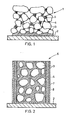
- an absorber system 1 in which 2 mass elements 3 of minerals (pebbles) are arranged on a vibrating object, these with the object 2, and at least in certain areas with each other, by an elastic composite material 4 in the form a curing plastic resin are connected, in which 5 cork is partially stored as a solid.
- a single body 6 which consists of a can 7 attached to the object made of sheet metal.
- the inner wall of the can 7 is lined with an elastic material 8 made of mineral wool.
- the core space is poured out with a mixture 9 of minerals (split, gravel) as mass elements 3 and bitumen as an elastic composite material 4, which hardens after cooling.
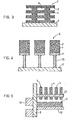
- a continuous absorber system 1 which can be adapted well to the course of the shell of the object 2, is drawn.
- the mass elements 3 made of steel balls are embedded in an elastic composite material 4 made of PUR, the absorber system 1 being divided by individual or continuous cavities 9.
- rods 10 with plates 11 are attached to the object for low-frequency tuning, which in turn carry the absorber system 1 made of mass elements 3, coupled by elastic composite material 4.
- the object to be damped is provided with welded, rigid plates as a holder 12, which, depending on the broadband conveyed, have a continuous or several individual bodies 6 as absorber systems 1, the cross-sectional expansions 13 being arranged to reflect the longitudinal waves.
Landscapes
- Engineering & Computer Science (AREA)
- General Engineering & Computer Science (AREA)
- Physics & Mathematics (AREA)
- Acoustics & Sound (AREA)
- Multimedia (AREA)
- Mechanical Engineering (AREA)
- Vibration Prevention Devices (AREA)
- Buildings Adapted To Withstand Abnormal External Influences (AREA)
Applications Claiming Priority (2)
| Application Number | Priority Date | Filing Date | Title |
|---|---|---|---|
| DE19833345507 DE3345507A1 (de) | 1983-12-16 | 1983-12-16 | Schwingungsdaempfer |
| DE3345507 | 1983-12-16 |
Publications (2)
| Publication Number | Publication Date |
|---|---|
| EP0150373A2 true EP0150373A2 (fr) | 1985-08-07 |
| EP0150373A3 EP0150373A3 (fr) | 1987-09-23 |
Family
ID=6217095
Family Applications (1)
| Application Number | Title | Priority Date | Filing Date |
|---|---|---|---|
| EP84115099A Withdrawn EP0150373A3 (fr) | 1983-12-16 | 1984-12-10 | Amortisseur de vibrations |
Country Status (2)
| Country | Link |
|---|---|
| EP (1) | EP0150373A3 (fr) |
| DE (1) | DE3345507A1 (fr) |
Cited By (5)
| Publication number | Priority date | Publication date | Assignee | Title |
|---|---|---|---|---|
| EP0171691A3 (en) * | 1984-07-27 | 1987-10-07 | Gosele, Karl - Professor Dr. Ing. | Sound insulation element, constructional element, inset, wall block, finished building fabric, partition wall and their fabrication |
| EP0198649A3 (fr) * | 1985-04-15 | 1988-05-18 | Melles Griot, Irvine Company | Appareil à amortisseur de vibrations |
| EP0985116A4 (fr) * | 1998-04-04 | 2003-06-04 | Sperry Marine Inc | Dispositif accorde de reduction de bruits vibratoires |
| EP2544177A3 (fr) * | 2011-07-08 | 2016-11-02 | Fraunhofer-Gesellschaft zur Förderung der angewandten Forschung e.V. | Absorbeur acoustique en paille mécanique souple |
| IT201700113264A1 (it) * | 2017-10-09 | 2019-04-09 | Milano Politecnico | Dispositivo a modulo per l’isolamento di vibrazioni a bassa frequenza e ad ampio spettro, e relativa struttura periodica |
Families Citing this family (1)
| Publication number | Priority date | Publication date | Assignee | Title |
|---|---|---|---|---|
| GB2212830B (en) * | 1987-11-26 | 1992-07-08 | Matsushita Electric Works Ltd | Vibration-controlling member |
Family Cites Families (5)
| Publication number | Priority date | Publication date | Assignee | Title |
|---|---|---|---|---|
| DE1207651B (de) * | 1964-02-07 | 1965-12-23 | Gruenzweig & Hartmann | Breitbandiger, reflexionsarmer Schallabsorber fuer Fluessigkeits- und Festkoerperschall und Verfahren fuer dessen Herstellung |
| JPS49108808A (fr) * | 1973-02-17 | 1974-10-16 | ||
| FR2238411A5 (en) * | 1973-07-20 | 1975-02-14 | France Etat | Sound-absorbent wall panel - with thin layer of visco-elastic material between rigid layers |
| FR2265146A1 (en) * | 1974-03-22 | 1975-10-17 | Serno Francois Marie K | Sound insulating wall panel - has core of movable elements of varying weight enclosed in separate sleeves |
| DE2629256A1 (de) * | 1976-06-30 | 1978-01-12 | Manfred Dr Boerner | Kunststoffschaum mit einschluessen zur schalldaempfung |
-
1983
- 1983-12-16 DE DE19833345507 patent/DE3345507A1/de not_active Withdrawn
-
1984
- 1984-12-10 EP EP84115099A patent/EP0150373A3/fr not_active Withdrawn
Cited By (6)
| Publication number | Priority date | Publication date | Assignee | Title |
|---|---|---|---|---|
| EP0171691A3 (en) * | 1984-07-27 | 1987-10-07 | Gosele, Karl - Professor Dr. Ing. | Sound insulation element, constructional element, inset, wall block, finished building fabric, partition wall and their fabrication |
| EP0198649A3 (fr) * | 1985-04-15 | 1988-05-18 | Melles Griot, Irvine Company | Appareil à amortisseur de vibrations |
| EP0985116A4 (fr) * | 1998-04-04 | 2003-06-04 | Sperry Marine Inc | Dispositif accorde de reduction de bruits vibratoires |
| EP2544177A3 (fr) * | 2011-07-08 | 2016-11-02 | Fraunhofer-Gesellschaft zur Förderung der angewandten Forschung e.V. | Absorbeur acoustique en paille mécanique souple |
| IT201700113264A1 (it) * | 2017-10-09 | 2019-04-09 | Milano Politecnico | Dispositivo a modulo per l’isolamento di vibrazioni a bassa frequenza e ad ampio spettro, e relativa struttura periodica |
| WO2019072746A1 (fr) * | 2017-10-09 | 2019-04-18 | Politecnico Di Milano | Dispositif de module d'isolation vis-à-vis des vibrations à basse fréquence et à large bande interdite et structure périodique associée |
Also Published As
| Publication number | Publication date |
|---|---|
| DE3345507A1 (de) | 1985-06-27 |
| EP0150373A3 (fr) | 1987-09-23 |
Similar Documents
| Publication | Publication Date | Title |
|---|---|---|
| DE2408028C3 (fr) | ||
| DE19509972C2 (de) | Sandwichplatte | |
| DE3044865C2 (fr) | ||
| DE2701945A1 (de) | Schwingungsdaempfer | |
| EP0095125B1 (fr) | Elément plan pour l'absorption d'ondes sonores | |
| DE2724172A1 (de) | Schallschluckender schichtstoff | |
| WO1995027975A1 (fr) | Amortisseur des vibrations et du bruit | |
| DE1211370B (de) | Luftschalldaemmung dynamisch biegeweicher Schalen, wie Wandschalen, Unterdecken, Tueren, Schallabschirmmungen und Flaechenelement hierfuer | |
| DE3345507A1 (de) | Schwingungsdaempfer | |
| DE3317103C2 (de) | Mitschwingender, volumenändernder Resonator in Form eines Silators | |
| DE2607603A1 (de) | Traeger, insbesondere vlies zur schalldaemmung | |
| DE3225786A1 (de) | Matte mit luftschalldaemmenden und koerperschalldaempfenden eigenschaften | |
| DE4000132C2 (fr) | ||
| DE68913928T2 (de) | Viskoelastischer Dämpfungskörper und das dazugehörige Herstellungsverfahren. | |
| DE2412672C3 (de) | Breitbandiger Schwingungsdämpfer zum Reduzieren von Körperschall | |
| DE4438813B4 (de) | Schalldämmplatte | |
| DE2750439A1 (de) | Schalldaemmende matte | |
| DE3339701A1 (de) | Schalldaemmende und schalldaempfende platte | |
| DE2609872A1 (de) | Schalldaempfer fuer stroemungskanaele | |
| DE2739748A1 (de) | Schallschluckende platte | |
| DE2816345A1 (de) | Vorrichtung zur daempfung der schwingungen von gegenstaenden | |
| DE3314733A1 (de) | Abschirmvorrichtung gegen durch schallfrequenzwellen hervorgerufene schwingungen | |
| DE1869867U (de) | Schalldaemm-trennwand fuer kraftfahrzeuge. | |
| AT232694B (de) | Schwingungsdämpfendes Bau- oder Konstruktionselement | |
| DE2017438A1 (en) | Sound vibration damper |
Legal Events
| Date | Code | Title | Description |
|---|---|---|---|
| PUAI | Public reference made under article 153(3) epc to a published international application that has entered the european phase |
Free format text: ORIGINAL CODE: 0009012 |
|
| AK | Designated contracting states |
Designated state(s): AT DE NL |
|
| PUAL | Search report despatched |
Free format text: ORIGINAL CODE: 0009013 |
|
| AK | Designated contracting states |
Kind code of ref document: A3 Designated state(s): AT DE NL |
|
| 17P | Request for examination filed |
Effective date: 19870806 |
|
| 17Q | First examination report despatched |
Effective date: 19881205 |
|
| STAA | Information on the status of an ep patent application or granted ep patent |
Free format text: STATUS: THE APPLICATION IS DEEMED TO BE WITHDRAWN |
|
| 18D | Application deemed to be withdrawn |
Effective date: 19890418 |
|
| RIN1 | Information on inventor provided before grant (corrected) |
Inventor name: JEHLE, NORBERT |