EP0150435A2 - Procédé continu de préparation de mono- et/ou polyisocyanates organiques - Google Patents
Procédé continu de préparation de mono- et/ou polyisocyanates organiques Download PDFInfo
- Publication number
- EP0150435A2 EP0150435A2 EP84115708A EP84115708A EP0150435A2 EP 0150435 A2 EP0150435 A2 EP 0150435A2 EP 84115708 A EP84115708 A EP 84115708A EP 84115708 A EP84115708 A EP 84115708A EP 0150435 A2 EP0150435 A2 EP 0150435A2
- Authority
- EP
- European Patent Office
- Prior art keywords
- reaction mixture
- phosgene
- weight
- reaction
- organic
- Prior art date
- Legal status (The legal status is an assumption and is not a legal conclusion. Google has not performed a legal analysis and makes no representation as to the accuracy of the status listed.)
- Granted
Links
- 238000000034 method Methods 0.000 title claims abstract description 40
- 229920001228 polyisocyanate Polymers 0.000 title abstract description 5
- 239000005056 polyisocyanate Substances 0.000 title abstract description 5
- 238000004519 manufacturing process Methods 0.000 title description 8
- 239000011541 reaction mixture Substances 0.000 claims abstract description 66
- YGYAWVDWMABLBF-UHFFFAOYSA-N Phosgene Chemical compound ClC(Cl)=O YGYAWVDWMABLBF-UHFFFAOYSA-N 0.000 claims abstract description 50
- 150000001412 amines Chemical class 0.000 claims abstract description 48
- 239000012948 isocyanate Substances 0.000 claims abstract description 29
- 150000002513 isocyanates Chemical class 0.000 claims abstract description 28
- VEXZGXHMUGYJMC-UHFFFAOYSA-N Hydrochloric acid Chemical compound Cl VEXZGXHMUGYJMC-UHFFFAOYSA-N 0.000 claims abstract description 25
- IXCSERBJSXMMFS-UHFFFAOYSA-N hydrogen chloride Substances Cl.Cl IXCSERBJSXMMFS-UHFFFAOYSA-N 0.000 claims abstract description 23
- 229910000041 hydrogen chloride Inorganic materials 0.000 claims abstract description 23
- 229920000768 polyamine Polymers 0.000 claims abstract description 10
- 239000003960 organic solvent Substances 0.000 claims abstract description 7
- 238000010924 continuous production Methods 0.000 claims abstract description 6
- 238000006243 chemical reaction Methods 0.000 claims description 46
- 238000002156 mixing Methods 0.000 claims description 26
- 239000002904 solvent Substances 0.000 claims description 20
- 239000000203 mixture Substances 0.000 claims description 10
- 125000001931 aliphatic group Chemical group 0.000 claims description 6
- 125000003118 aryl group Chemical group 0.000 claims description 6
- NAQMVNRVTILPCV-UHFFFAOYSA-N hexane-1,6-diamine Chemical compound NCCCCCCN NAQMVNRVTILPCV-UHFFFAOYSA-N 0.000 claims description 5
- RLYCRLGLCUXUPO-UHFFFAOYSA-N 2,6-diaminotoluene Chemical compound CC1=C(N)C=CC=C1N RLYCRLGLCUXUPO-UHFFFAOYSA-N 0.000 claims description 3
- FZZMTSNZRBFGGU-UHFFFAOYSA-N 2-chloro-7-fluoroquinazolin-4-amine Chemical compound FC1=CC=C2C(N)=NC(Cl)=NC2=C1 FZZMTSNZRBFGGU-UHFFFAOYSA-N 0.000 claims description 3
- CNPURSDMOWDNOQ-UHFFFAOYSA-N 4-methoxy-7h-pyrrolo[2,3-d]pyrimidin-2-amine Chemical compound COC1=NC(N)=NC2=C1C=CN2 CNPURSDMOWDNOQ-UHFFFAOYSA-N 0.000 claims description 3
- OHKOAJUTRVTYSW-UHFFFAOYSA-N 2-[(2-aminophenyl)methyl]aniline Chemical compound NC1=CC=CC=C1CC1=CC=CC=C1N OHKOAJUTRVTYSW-UHFFFAOYSA-N 0.000 claims description 2
- RNLHGQLZWXBQNY-UHFFFAOYSA-N 3-(aminomethyl)-3,5,5-trimethylcyclohexan-1-amine Chemical compound CC1(C)CC(N)CC(C)(CN)C1 RNLHGQLZWXBQNY-UHFFFAOYSA-N 0.000 claims description 2
- ZZTCPWRAHWXWCH-UHFFFAOYSA-N diphenylmethanediamine Chemical class C=1C=CC=CC=1C(N)(N)C1=CC=CC=C1 ZZTCPWRAHWXWCH-UHFFFAOYSA-N 0.000 claims description 2
- XGJHPGPVESLKKD-UHFFFAOYSA-N 2-ethylbutane-1,4-diamine Chemical compound CCC(CN)CCN XGJHPGPVESLKKD-UHFFFAOYSA-N 0.000 claims 1
- 239000000243 solution Substances 0.000 description 22
- 238000007872 degassing Methods 0.000 description 8
- 239000006227 byproduct Substances 0.000 description 7
- YXFVVABEGXRONW-UHFFFAOYSA-N Toluene Chemical compound CC1=CC=CC=C1 YXFVVABEGXRONW-UHFFFAOYSA-N 0.000 description 6
- 239000007788 liquid Substances 0.000 description 6
- 230000015572 biosynthetic process Effects 0.000 description 5
- 150000001875 compounds Chemical class 0.000 description 5
- 239000000047 product Substances 0.000 description 5
- 230000021715 photosynthesis, light harvesting Effects 0.000 description 4
- CKDWPUIZGOQOOM-UHFFFAOYSA-N Carbamyl chloride Chemical compound NC(Cl)=O CKDWPUIZGOQOOM-UHFFFAOYSA-N 0.000 description 3
- -1 amine hydrochlorides Chemical class 0.000 description 3
- 125000004432 carbon atom Chemical group C* 0.000 description 3
- MVPPADPHJFYWMZ-UHFFFAOYSA-N chlorobenzene Chemical compound ClC1=CC=CC=C1 MVPPADPHJFYWMZ-UHFFFAOYSA-N 0.000 description 3
- 239000007789 gas Substances 0.000 description 3
- 238000012856 packing Methods 0.000 description 3
- RFFLAFLAYFXFSW-UHFFFAOYSA-N 1,2-dichlorobenzene Chemical compound ClC1=CC=CC=C1Cl RFFLAFLAYFXFSW-UHFFFAOYSA-N 0.000 description 2
- OCJBOOLMMGQPQU-UHFFFAOYSA-N 1,4-dichlorobenzene Chemical compound ClC1=CC=C(Cl)C=C1 OCJBOOLMMGQPQU-UHFFFAOYSA-N 0.000 description 2
- PAYRUJLWNCNPSJ-UHFFFAOYSA-N Aniline Chemical compound NC1=CC=CC=C1 PAYRUJLWNCNPSJ-UHFFFAOYSA-N 0.000 description 2
- QUSNBJAOOMFDIB-UHFFFAOYSA-N Ethylamine Chemical compound CCN QUSNBJAOOMFDIB-UHFFFAOYSA-N 0.000 description 2
- BAVYZALUXZFZLV-UHFFFAOYSA-N Methylamine Chemical compound NC BAVYZALUXZFZLV-UHFFFAOYSA-N 0.000 description 2
- HQABUPZFAYXKJW-UHFFFAOYSA-N butan-1-amine Chemical compound CCCCN HQABUPZFAYXKJW-UHFFFAOYSA-N 0.000 description 2
- 235000013877 carbamide Nutrition 0.000 description 2
- PAFZNILMFXTMIY-UHFFFAOYSA-N cyclohexylamine Chemical compound NC1CCCCC1 PAFZNILMFXTMIY-UHFFFAOYSA-N 0.000 description 2
- 238000000354 decomposition reaction Methods 0.000 description 2
- 238000009795 derivation Methods 0.000 description 2
- 238000004821 distillation Methods 0.000 description 2
- XNGIFLGASWRNHJ-UHFFFAOYSA-N phthalic acid Chemical compound OC(=O)C1=CC=CC=C1C(O)=O XNGIFLGASWRNHJ-UHFFFAOYSA-N 0.000 description 2
- 239000003380 propellant Substances 0.000 description 2
- KIDHWZJUCRJVML-UHFFFAOYSA-N putrescine Chemical compound NCCCCN KIDHWZJUCRJVML-UHFFFAOYSA-N 0.000 description 2
- 150000003839 salts Chemical class 0.000 description 2
- 150000003672 ureas Chemical class 0.000 description 2
- 239000008096 xylene Substances 0.000 description 2
- RELMFMZEBKVZJC-UHFFFAOYSA-N 1,2,3-trichlorobenzene Chemical class ClC1=CC=CC(Cl)=C1Cl RELMFMZEBKVZJC-UHFFFAOYSA-N 0.000 description 1
- WZCQRUWWHSTZEM-UHFFFAOYSA-N 1,3-phenylenediamine Chemical compound NC1=CC=CC(N)=C1 WZCQRUWWHSTZEM-UHFFFAOYSA-N 0.000 description 1
- CBCKQZAAMUWICA-UHFFFAOYSA-N 1,4-phenylenediamine Chemical compound NC1=CC=C(N)C=C1 CBCKQZAAMUWICA-UHFFFAOYSA-N 0.000 description 1
- YFOOEYJGMMJJLS-UHFFFAOYSA-N 1,8-diaminonaphthalene Chemical compound C1=CC(N)=C2C(N)=CC=CC2=C1 YFOOEYJGMMJJLS-UHFFFAOYSA-N 0.000 description 1
- YYDRNPOEMZZTPM-UHFFFAOYSA-N 2,4,6-triaminotoluene Chemical compound CC1=C(N)C=C(N)C=C1N YYDRNPOEMZZTPM-UHFFFAOYSA-N 0.000 description 1
- MNNZINNZIQVULG-UHFFFAOYSA-N 2-chloroethylbenzene Chemical compound ClCCC1=CC=CC=C1 MNNZINNZIQVULG-UHFFFAOYSA-N 0.000 description 1
- YBRVSVVVWCFQMG-UHFFFAOYSA-N 4,4'-diaminodiphenylmethane Chemical compound C1=CC(N)=CC=C1CC1=CC=C(N)C=C1 YBRVSVVVWCFQMG-UHFFFAOYSA-N 0.000 description 1
- ADUMIBSPEHFSLA-UHFFFAOYSA-N 4-[bis(4-aminophenyl)methyl]aniline Chemical compound C1=CC(N)=CC=C1C(C=1C=CC(N)=CC=1)C1=CC=C(N)C=C1 ADUMIBSPEHFSLA-UHFFFAOYSA-N 0.000 description 1
- 239000005711 Benzoic acid Substances 0.000 description 1
- WPYMKLBDIGXBTP-UHFFFAOYSA-N Benzoic acid Natural products OC(=O)C1=CC=CC=C1 WPYMKLBDIGXBTP-UHFFFAOYSA-N 0.000 description 1
- ZAMOUSCENKQFHK-UHFFFAOYSA-N Chlorine atom Chemical compound [Cl] ZAMOUSCENKQFHK-UHFFFAOYSA-N 0.000 description 1
- UFHFLCQGNIYNRP-UHFFFAOYSA-N Hydrogen Chemical compound [H][H] UFHFLCQGNIYNRP-UHFFFAOYSA-N 0.000 description 1
- 238000005684 Liebig rearrangement reaction Methods 0.000 description 1
- CTQNGGLPUBDAKN-UHFFFAOYSA-N O-Xylene Chemical compound CC1=CC=CC=C1C CTQNGGLPUBDAKN-UHFFFAOYSA-N 0.000 description 1
- REYJJPSVUYRZGE-UHFFFAOYSA-N Octadecylamine Chemical compound CCCCCCCCCCCCCCCCCCN REYJJPSVUYRZGE-UHFFFAOYSA-N 0.000 description 1
- 229920002396 Polyurea Chemical class 0.000 description 1
- 239000005700 Putrescine Substances 0.000 description 1
- 239000002253 acid Substances 0.000 description 1
- 150000007513 acids Chemical class 0.000 description 1
- 150000001299 aldehydes Chemical class 0.000 description 1
- 150000001448 anilines Chemical class 0.000 description 1
- 150000004945 aromatic hydrocarbons Chemical class 0.000 description 1
- HFACYLZERDEVSX-UHFFFAOYSA-N benzidine Chemical group C1=CC(N)=CC=C1C1=CC=C(N)C=C1 HFACYLZERDEVSX-UHFFFAOYSA-N 0.000 description 1
- 235000010233 benzoic acid Nutrition 0.000 description 1
- KCXMKQUNVWSEMD-UHFFFAOYSA-N benzyl chloride Chemical class ClCC1=CC=CC=C1 KCXMKQUNVWSEMD-UHFFFAOYSA-N 0.000 description 1
- 238000009835 boiling Methods 0.000 description 1
- 229910052799 carbon Inorganic materials 0.000 description 1
- 239000007795 chemical reaction product Substances 0.000 description 1
- 239000000460 chlorine Substances 0.000 description 1
- 229910052801 chlorine Inorganic materials 0.000 description 1
- 238000004140 cleaning Methods 0.000 description 1
- 239000007859 condensation product Substances 0.000 description 1
- 239000000470 constituent Substances 0.000 description 1
- GEQHKFFSPGPGLN-UHFFFAOYSA-N cyclohexane-1,3-diamine Chemical compound NC1CCCC(N)C1 GEQHKFFSPGPGLN-UHFFFAOYSA-N 0.000 description 1
- YQLZOAVZWJBZSY-UHFFFAOYSA-N decane-1,10-diamine Chemical compound NCCCCCCCCCCN YQLZOAVZWJBZSY-UHFFFAOYSA-N 0.000 description 1
- 230000007547 defect Effects 0.000 description 1
- 230000001627 detrimental effect Effects 0.000 description 1
- 229940117389 dichlorobenzene Drugs 0.000 description 1
- 238000010790 dilution Methods 0.000 description 1
- 239000012895 dilution Substances 0.000 description 1
- QFTYSVGGYOXFRQ-UHFFFAOYSA-N dodecane-1,12-diamine Chemical compound NCCCCCCCCCCCCN QFTYSVGGYOXFRQ-UHFFFAOYSA-N 0.000 description 1
- 150000002148 esters Chemical class 0.000 description 1
- 231100000086 high toxicity Toxicity 0.000 description 1
- 239000001257 hydrogen Substances 0.000 description 1
- 229910052739 hydrogen Inorganic materials 0.000 description 1
- 238000002955 isolation Methods 0.000 description 1
- 150000002576 ketones Chemical class 0.000 description 1
- 239000007791 liquid phase Substances 0.000 description 1
- KUDPGZONDFORKU-UHFFFAOYSA-N n-chloroaniline Chemical class ClNC1=CC=CC=C1 KUDPGZONDFORKU-UHFFFAOYSA-N 0.000 description 1
- 150000005002 naphthylamines Chemical class 0.000 description 1
- IOQPZZOEVPZRBK-UHFFFAOYSA-N octan-1-amine Chemical compound CCCCCCCCN IOQPZZOEVPZRBK-UHFFFAOYSA-N 0.000 description 1
- 239000012071 phase Substances 0.000 description 1
- 229920000642 polymer Polymers 0.000 description 1
- 239000004814 polyurethane Substances 0.000 description 1
- 229920002635 polyurethane Polymers 0.000 description 1
- 150000003141 primary amines Chemical class 0.000 description 1
- 238000000746 purification Methods 0.000 description 1
- 238000004064 recycling Methods 0.000 description 1
- 238000010992 reflux Methods 0.000 description 1
- 238000000926 separation method Methods 0.000 description 1
- 239000007858 starting material Substances 0.000 description 1
- 150000004992 toluidines Chemical class 0.000 description 1
- 230000007704 transition Effects 0.000 description 1
- 150000003738 xylenes Chemical class 0.000 description 1
Images
Classifications
-
- C—CHEMISTRY; METALLURGY
- C07—ORGANIC CHEMISTRY
- C07C—ACYCLIC OR CARBOCYCLIC COMPOUNDS
- C07C263/00—Preparation of derivatives of isocyanic acid
- C07C263/10—Preparation of derivatives of isocyanic acid by reaction of amines with carbonyl halides, e.g. with phosgene
Definitions
- part of the reaction solution is circulated at elevated pressure and elevated temperature.
- DE-AS 1 037 444 US 2 822 373
- the phosgene solution is mixed with an amine solution before entering the reaction vessel.
- a certain turbulence must form at the point where the two solutions merge.
- blockages can easily occur in the flow tube, which no longer allow turbulence.
- DE-PS 1 175 666 (GB 827 376) describes a process for the continuous production of isocyanates at elevated pressure in a reaction tube, the starting materials being introduced into the reaction tube at a pressure of more than 3 bar, reacted at an increasing temperature and the Reaction mixture to obtain the isocyanates at the end of the reaction tube are drawn off via an expansion valve. Since the recycled phosgene is not subjected to hydrogen chloride purification, salt formation and deposits occur on the mixing nozzle.
- DE-OS 19 56 777 (US Pat. No. 3,781,320) relates to a mixing device consisting of a chamber and a coaxially arranged rotor equipped with blades, the blade ends of which form a small distance from the inner chamber wall, for the production of organic isocyanates by a one-step process and US 3 887 167). According to this publication, it is not necessary to separate hydrogen chloride from the reaction mixture, since its presence is not detrimental to the process.
- organic isocyanates from primary organic amines and phosgene are continuously produced in an inert organic solvent in one or more reaction vessels containing packing elements, preferably with recycling of the reaction mixture, in the so-called transition flow .
- the relatively simple process enables isocyanates to be produced in a high space-time yield.
- the introduction of the amines into the phosgene-containing reaction solution also presented certain difficulties in this process, since with some amines it is difficult to achieve optimum mixing of the starting components.
- amine hydrochlorides and ureas are formed as by-products, some of which are deposited on the packing and can lead to blockage of the packing columns.
- the object of the present invention was to improve mixing circuit processes for the continuous production of isocyanates, in particular the process according to DE-OS 26 24 285, and to completely or at least partially eliminate existing defects.
- This task was surprisingly achieved by reducing the hydrogen chloride content and increasing the phgenogen content of the reaction mixture.
- the invention thus relates to a process for the continuous production of organic isocyanates by reacting organic amines with phosgene in the presence of organic solvents under pressure at elevated temperature, the reaction mixture being partly circulated, which is characterized in that the hydrogen chloride content of the reaction mixture before the amine addition is equal to or less than 0.5% by weight, preferably 0.01 to 0.4% by weight, based on the total weight of the reaction mixture, and the molar ratio of phosgene to NH 2 group of the organic amines 12 up to 200: 1.
- the process according to the invention can advantageously avoid the intermediate salt formation, essentially suppress the by-product formation and thereby increase the isocyanate concentration in the reactor. This is associated with an energy saving when working up the reaction mixture obtained.
- the phosgenation reactor can be reduced in size in comparison to the cascade process and thus the space-time yields can be increased.
- the resulting hydrogen chloride gas is removed by rectification under high pressure.
- the process according to the invention is generally applicable to the production of organic isocyanates which can be obtained by reacting amines with phosgene.
- organic isocyanates which can be obtained by reacting amines with phosgene.
- aliphatic, cycloaliphatic, aliphatic-aromatic, aromatic, mono-, di- and / or polyisocyanates can be prepared from the corresponding organic mono-, di- and / or polyamines.
- Suitable organic monoamino compounds have the formula R-NH 2 , where R is an optionally substituted, monovalent aliphatic, cycloaliphatic or preferably aromatic radical having 1 to 20, preferably 6 to 12 carbon atoms.
- R is an optionally substituted, monovalent aliphatic, cycloaliphatic or preferably aromatic radical having 1 to 20, preferably 6 to 12 carbon atoms.
- examples include aliphatic monoamines such as methylamine, ethylamine, butylamine, octylamine and stearylamine, cycloaliphatic monoamines such as cyclohexylamine and in particular aromatic monoamines such as aniline, toluidines, naphthylamines, chloroanilines and anisidines.
- di- and polyisocyanates which are technically important for the production of polyurethanes are preferably produced from the corresponding di- and polyamines by the new process.
- Suitable diamino compounds have the formula H 2 N-R'-NH 2 , where R 'is a divalent aliphatic or cycloaliphatic radical having 2 to 18, in particular 4 to 13 carbon atoms or preferably a divalent aromatic radical which consists of one or more aromatic nuclei, which have 6 to 18 carbon atoms, which are linked directly to one another, or optionally via divalent bridging elements, such as -0-, are interconnected.
- the diamino and / or polyamino compounds can be used individually or as mixtures.
- Such aliphatic, cycloaliphatic or in particular aromatic diamino compounds are, for example: 1,4-diaminobutane, 1,6-diamino-hexane, 1,10-diamino-decane, 1,12-diamino-dodecane, 1,4- or 1, 3-diamino-cyclohexane, 4,4'-diamino-dicyclohexyl, 4,4'-, 2,4'-, 2,2'-diamino-dicyclohexylmethane, 3,3'-dimethyl-4,4'-dianinodicyclohexylmethane , 4,4'-diamino-diphenyl, 1,4- or 1,3-phenylenediamine, 1,5- or 1,8-naphthylenediamine, 2,4- or 2,6-toluenediamine and 2,2 ' -, 2,4'- or 4,4'-dia
- suitable polyamines are tri (p-aminophenyl) methane, 2,4,6-triamino-toluene and condensation products which are obtained from optionally substituted aniline derivatives and aldehydes or ketones in the presence of acids, such as polyphenyl-polymethylene polyamines.
- the preferred organic amines used are 1,6-hexamethylene diamine, mixtures of 1,6-hexamethylene, 2-methyl-1,5-pentamethylene and 2-ethyl-1,4-butylene diamine, 3-aminomethyl 3,5,5-trimethylcyclohexylamine, 2,4'-, 4,4'-, 2,2'-diamino-diphenylmethane or mixtures of at least two of the isomers mentioned, 2,4- and 2,6-toluenediamine or mixtures thereof , Polyphenyl-polymethylene-polyamines or mixtures of diamino-diphenylmethanes and polyphenyl-polymethylene-polyamines.
- the process according to the invention is particularly suitable for the production of aromatic di- and / or polyisocyanates from the corresponding amines and is therefore also preferably used for this purpose.
- Gaseous and / or preferably liquid phosgene is used as the other starting component.
- the liquid phosgene can be used as such or in dilution with solvents suitable for phosgenation, e.g. Monochloro-, dichlorobenzene, xylene, toluene and others be implemented.
- solvents suitable for phosgenation e.g. Monochloro-, dichlorobenzene, xylene, toluene and others be implemented.
- the molar ratio of amine to phosgene is expediently such that 12 to 200 mol, preferably 12 to 98 mol and in particular 40 to 80 mol, of phosgene are present in the reaction mixture per NHz group.
- Suitable inert organic solvents are compounds in which the amines and the phosgene are at least partially soluble.
- Chlorinated, aromatic hydrocarbons such as Chlorobenzene, o-dichlorobenzene, p-dichlorobenzene, trichlorobenzenes, the corresponding chlorotoluenes and xylenes, chloroethylbenzene, monochlorodiphenyl, ⁇ - or ß-naphthyl chloride, benzoic acid alkyl esters, phthalic acid dialkyl esters, such as iso-diethyl phthalate, toluene.
- the solvents can be used individually or as mixtures.
- a solvent is advantageously used which has a lower boiling point than the isocyanate to be prepared, so that the solvent can be easily separated from the isocyanate by distillation.
- the amount of solvent is advantageously such that the reaction mixture has an isocyanate content of 4 to 40% by weight, preferably 20 to 30% by weight, based on the total weight of the reaction mixture.
- the amines can be used as such or preferably dissolved in organic solvents.
- amine solutions with an amine content of 5 to 50% by weight, preferably 15 to 35% by weight, based on the total weight of the amine solution, are used in particular.
- the reaction is carried out conveniently at temperatures of 100 to 220 ° C, preferably from 120 to 180 0 C and in a pressure range of 5 to 100 bar, preferably 15 to 50 bar through.
- the temperature used in the process according to the invention is above the decomposition temperature of the carbamyl chloride formed as an intermediate by the reaction of the phosgene with amine.
- An increase in pressure is only subject to technical and possibly safety-related limits, with an increase in yield no longer being achieved with higher pressure.
- the rectification of the separated hydrogen chloride is, however, made considerably easier at high pressure.
- the reaction mixture which consists of solvent, dissolved isocyanate, phosgene, hydrogen chloride and by-products of the phosgenation, is recirculated preferably in a pressure mixing circuit, by means of a circulating pump or, preferably, due to the density differences through natural circulation, the recycled reaction mixture being partly introduced into the mixing and reaction zone via a pump and nozzle.
- Fresh phosgene and, if appropriate, solvent-containing phosgene are mixed into the reaction mixture via the circulating stream, with the fresh phosgene, preferably in liquid form, together with the recycled and purified phosgene from the hydrogen chloride separation being incorporated into the partial stream of the reaction mixture passing through the nozzle according to an advantageous embodiment of the process becomes.
- the amine or preferably the amine solution is introduced into the reaction mixture via the nozzle.
- a volume flow of reaction mixture corresponding to the entire liquid charge is removed from the circuit as a product solution for further processing and isolation of the isocyanate.
- a degassing space in the circuit is required, with the aid of which the hydrogen chloride content of the reaction mixture before the amine addition is less than 0.5% by weight, preferably 0.01 to 0.4% by weight and in particular 0.1 to 0.3% by weight, based on the total weight of the reaction mixture, is reduced.
- the cylindrical part of the apparatus between the nozzle and the degassing space, in which the circulation flow rises vertically has a length of 5 to 25 m, preferably 10 to 15 m, and one of which is almost independent Has an inner diameter of 5 to 150 cm, preferably 10 to 100 cm.
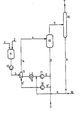
- the circulating pump 18 shown in the figure can then be dispensed with.
- the reaction mixture continuously purified from hydrogen chloride thus advantageously contains 9.5 to 86, preferably 40 to 50 parts by weight of solvent, 4 to 40, preferably 20 to 30 parts by weight of organic isocyanate, per 100 parts by weight of reaction mixture , preferably 20 to 40 parts by weight of phosgene and 0.01 to 0.5, preferably 0.01 to 0 " 4 parts by weight of hydrogen chloride.
- the size of the volume of the reaction circuit is designed so that average residence times of about one minute to one hour, preferably 5 minutes to 0.5 hours, based on the volume flow of the product solution discharged, can be set.
- the reaction mixture is circulated in such an amount that the volume ratio of the total amount of the circulated reaction mixture plus added phosgene plus, if appropriate, is added the solvent-containing phosgene to the amount of amine solution supplied is 300: 1 to 1: 1, preferably 100: 1 to 5: 1.
- the proportion of the reaction mixture consisting of the circulated reaction mixture, supplied phosgene and optionally added solvent-containing phosgene, which is passed through the nozzle can be between 5 and 100% by weight, preferably 10 and 50% by weight, of the total in the reaction circuit make up the given reaction mixture. In extreme cases, the entire reaction mixture can be run through the nozzle. The portion of the reaction mixture passed through the nozzle is greatly accelerated, so that it emerges from the nozzle as a propulsion jet at a high relative speed to the contents of the reaction tube.
- the amine solution is mixed intensively with the reaction mixture in an extremely short time by feeding it up to the nozzle exit point.
- an energy dissipation density of 5 to 1000, preferably 50 to 400 kJ per m of reaction mixture recycled plus amine solution supplied is expediently set in the mixing and reaction zone.
- This energy dissipation density is generated when the portion of the reaction mixture passed through the nozzle is at a nozzle outlet speed of 1 to 60 m / sec, preferably 20 to 40 m / sec, and the amine or the amine solution is at an outlet speed of 0.3 to 30 m / sec, preferably 5 to 20 m / sec through the amine feed pipe to the mixing and reaction zone.
- the mixing and reaction zone is characterized by the accelerated mass flow of the recycled reaction mixture and the amine solution fed in, and the mass flow of the circuit mixed therein, the combined liquid flows having the energy dissipation densities given above.
- the mixing and reaction zone has an average diameter which corresponds to 3 to 30 times, preferably 10 to 25 times the average diameter of the jet of the reaction mixture.
- the mean diameter of the driving jet is to be understood as the diameter of a circle of the same area, which is determined from the cross-sectional areas of the nozzle openings, for example ring or slot nozzles, of the mixing zone.
- the mixing and reaction zone can have a constant cross section or a cross section that changes in the direction of flow.
- the mixing and reaction zone can be designed in various shapes, this shape being expediently adapted to the shape of the nozzle used.
- cone segments or preferably cylindrical tubes are used, provided that the mixing and reaction zone is designed as a cylindrical tube, its length should be 1 to 20 times, preferably 1.5 to 5 times, its diameter.
- its length should be 1 to 20 times, preferably 1.5 to 5 times the hydraulic diameter. Hydraulic diameter is to be understood as the diameter of a cylindrical tube which, with the same throughputs and the same length, shows the same pressure loss as the mixing and reaction zone in question.
- the mixing and reaction zone is part of the reaction circuit volume, the size of which is characterized by the above average residence times.
- the mixing and reaction zone does not necessarily have to be designed as a separate reaction vessel, but can e.g. also designed as a reaction tube and be part of the circuit line system.
- the degassing space for escaping the hydrogen chloride formed in the phosgenation is expediently arranged above the reaction space. If a separate reaction vessel is used as the reaction space, it is advisable to use the upper part of this vessel as the degassing space and to draw off the hydrogen chloride gas containing phosgene and solvent vapors at this point. Instead, however, a separate degassing vessel in the circulation system can also be connected downstream of the reaction space.
- the reaction mixture is circulated via the circulation pump 17, the heat exchanger 19 and the jet nozzle 13 and, if appropriate, the circulation pump 18 , where appropriate solvent-containing phosgene is mixed through the return line 8 and fresh phosgene via the supply line 10 and return line 8 of the reaction mixture.
- the reaction mixture of the circuit line 5 is divided into partial streams 5 'and 5.
- the partial stream 5 is fed directly via the circuit line 5, the circulating pump 17, the heat exchanger 19, enriched with fresh and recirculated phosgene to the nozzle 13 and accelerated strongly in the form of a propellant jet the reaction mixture is sprayed in, while the other partial stream passed via the circuit 5 'is removed via the discharge line 9 isocyanate-containing reaction mixture.
- Amine is fed through feed line 1 and solvent is fed into the mixing container 11 through feed line 2.
- the amine solution is introduced via the metering pump 12 through the feed line 3 and mixed intensively with the reaction mixture in the mixing and reaction zone 14 and brought to reaction.
- the solvent and phosgene are cleaned there and introduced through the return line 8 into the reaction mixture, while the gaseous hydrogen chloride passes over the derivation 7 is discharged.
- the isocyanate-containing reaction mixture prepared by the process according to the invention is drawn off by deriving product solution 9 and worked up to isocyanates using customary cleaning methods.
- the process arrangement can be seen from the figure.
- a pressure mixing circuit 4 5 'was a reaction tube of 100 mm in diameter and one Volume of 160 1 used.
- the degassing room consisted of a container with a volume of 1000 l, which was filled to 5 to 60 vol.-X with reaction mixture.
- the reaction mixture was conveyed via the circulation lines 4, 5 and 5 'according to the natural circulation principle.
- the circulation pump 18 is therefore unnecessary.
- the liquid fresh phosgene was mixed with recycled phosgene via the return line 8 of the reaction mixture between the circulating pump 17 and the heat exchanger 19.
- the reaction mixture of the circulation line 5 was accelerated with a centrifugal pump 17 and injected through a propulsion jet nozzle, which had an inner diameter of 6 to 16 mm and was immersed in the reaction mixture.
- the amine solution is incorporated into the propellant jet through a feed pipe with a diameter of 2 to 4 mm.
- the pressure mixing circuit is charged with phosgene-saturated monochlorobenzene.
Landscapes
- Chemical & Material Sciences (AREA)
- Organic Chemistry (AREA)
- Chemical Kinetics & Catalysis (AREA)
- Organic Low-Molecular-Weight Compounds And Preparation Thereof (AREA)
Applications Claiming Priority (2)
| Application Number | Priority Date | Filing Date | Title |
|---|---|---|---|
| DE19843403204 DE3403204A1 (de) | 1984-01-31 | 1984-01-31 | Verfahren zur kontinuierlichen herstellung von organischen mono- und/oder polyisocyanaten |
| DE3403204 | 1984-01-31 |
Publications (3)
| Publication Number | Publication Date |
|---|---|
| EP0150435A2 true EP0150435A2 (fr) | 1985-08-07 |
| EP0150435A3 EP0150435A3 (en) | 1985-08-21 |
| EP0150435B1 EP0150435B1 (fr) | 1988-03-02 |
Family
ID=6226322
Family Applications (1)
| Application Number | Title | Priority Date | Filing Date |
|---|---|---|---|
| EP84115708A Expired EP0150435B1 (fr) | 1984-01-31 | 1984-12-18 | Procédé continu de préparation de mono- et/ou polyisocyanates organiques |
Country Status (4)
| Country | Link |
|---|---|
| US (1) | US4581174A (fr) |
| EP (1) | EP0150435B1 (fr) |
| CA (1) | CA1234825A (fr) |
| DE (2) | DE3403204A1 (fr) |
Cited By (5)
| Publication number | Priority date | Publication date | Assignee | Title |
|---|---|---|---|---|
| US6576788B1 (en) | 1998-04-21 | 2003-06-10 | Basf Aktiengesellschaft | Method for producing mixtures consisting of diphenylmethane diisocyanates and polyphenylene-polymethylene-polyisocyanates containing a reduced amount of chlorinated secondary products and with a reduced iodine color index |
| WO2004026813A1 (fr) * | 2002-08-20 | 2004-04-01 | Basf Aktiengesellschaft | Phosphogenation gazeuse a des pressions moderees |
| WO2005115974A1 (fr) * | 2004-05-25 | 2005-12-08 | Basf Aktiengesellschaft | Procédé de production d'isocyanates |
| WO2007014936A3 (fr) * | 2005-08-04 | 2007-04-05 | Basf Ag | Procede de production d'isocyanates |
| US7851648B2 (en) | 2002-12-19 | 2010-12-14 | Basf Aktiengesellschaft | Method for the continuous production of isocyanates |
Families Citing this family (13)
| Publication number | Priority date | Publication date | Assignee | Title |
|---|---|---|---|---|
| DE10261187A1 (de) * | 2002-12-20 | 2004-07-08 | Basf Ag | Verfahren zur Herstellung von Isocyanaten |
| DE102004032871A1 (de) | 2004-07-07 | 2006-02-09 | Bayer Materialscience Ag | Verfahren zur Herstellung von Polyisocyanaten durch adiabate Phosgenierung von primären Aminen |
| DE102005043799A1 (de) * | 2005-09-13 | 2007-04-12 | Basf Ag | Verfahren zur Herstellung von Isocyanaten |
| US7547801B2 (en) * | 2006-06-26 | 2009-06-16 | Bayer Materialscience Llc | Process for the continuous preparation of isocyanates |
| US8173833B2 (en) * | 2006-11-07 | 2012-05-08 | Basf Aktiengesellschaft | Method for the production of isocyanates |
| HUE025889T2 (en) * | 2007-01-17 | 2016-05-30 | Basf Se | Process for the preparation of isocyanates |
| EP2014641A3 (fr) * | 2007-06-06 | 2009-03-18 | Huntsman International Llc | Processus de préparation de mélanges de diisocyanates de diphénylméthane et de polyisocyanates de polyméthylène de polyphényle |
| JP5586624B2 (ja) * | 2008-11-26 | 2014-09-10 | ハンツマン・インターナショナル・エルエルシー | イソシアネートの製造方法 |
| CN102070491B (zh) * | 2010-11-26 | 2013-12-18 | 万华化学集团股份有限公司 | 基于成盐光气化反应制备苯二亚甲基二异氰酸酯的方法 |
| HUE045911T2 (hu) | 2015-06-29 | 2020-01-28 | Covestro Deutschland Ag | Eljárás poliizocianátok elõállítására |
| US10851048B2 (en) | 2018-11-13 | 2020-12-01 | Covestro Deutschland Ag | Process for preparing an isocyanate by partly adiabatically operated phosgenation of the corresponding amine |
| US10875827B2 (en) | 2018-11-13 | 2020-12-29 | Covestro Deutschland Ag | Process for preparing an isocyanate by partly adiabatic phosgenation of the corresponding amine |
| CN115397808B (zh) * | 2020-05-15 | 2024-10-11 | 科思创德国股份有限公司 | 运行用于连续制备异氰酸酯的装置的方法 |
Family Cites Families (4)
| Publication number | Priority date | Publication date | Assignee | Title |
|---|---|---|---|---|
| FR1112607A (fr) * | 1954-03-15 | 1956-03-16 | Du Pont | Procédé de préparation d'isocyanates |
| US3781320A (en) * | 1971-02-09 | 1973-12-25 | Du Pont | Process for manufacture of organic isocyanates |
| DE2624285C2 (de) * | 1976-05-31 | 1987-03-12 | Basf Ag, 6700 Ludwigshafen | Verfahren zur kontinuierlichen Herstellung von organischen Isocyanaten |
| DE3121036A1 (de) * | 1981-05-27 | 1982-12-16 | Bayer Ag, 5090 Leverkusen | Verfahren zur kontinuierlicehn herstellung von organischen mono- oder polyisocyanaten |
-
1984
- 1984-01-31 DE DE19843403204 patent/DE3403204A1/de not_active Withdrawn
- 1984-12-18 DE DE8484115708T patent/DE3469521D1/de not_active Expired
- 1984-12-18 EP EP84115708A patent/EP0150435B1/fr not_active Expired
-
1985
- 1985-01-25 US US06/695,196 patent/US4581174A/en not_active Expired - Lifetime
- 1985-01-30 CA CA000473192A patent/CA1234825A/fr not_active Expired
Cited By (9)
| Publication number | Priority date | Publication date | Assignee | Title |
|---|---|---|---|---|
| US6576788B1 (en) | 1998-04-21 | 2003-06-10 | Basf Aktiengesellschaft | Method for producing mixtures consisting of diphenylmethane diisocyanates and polyphenylene-polymethylene-polyisocyanates containing a reduced amount of chlorinated secondary products and with a reduced iodine color index |
| WO2004026813A1 (fr) * | 2002-08-20 | 2004-04-01 | Basf Aktiengesellschaft | Phosphogenation gazeuse a des pressions moderees |
| US7994361B2 (en) | 2002-08-20 | 2011-08-09 | Basf Aktiengesellschaft | Moderate-pressure gas phase phosgenation |
| US7851648B2 (en) | 2002-12-19 | 2010-12-14 | Basf Aktiengesellschaft | Method for the continuous production of isocyanates |
| WO2005115974A1 (fr) * | 2004-05-25 | 2005-12-08 | Basf Aktiengesellschaft | Procédé de production d'isocyanates |
| JP2008500296A (ja) * | 2004-05-25 | 2008-01-10 | ビーエーエスエフ アクチェンゲゼルシャフト | イソシアナートの製造方法 |
| JP4833966B2 (ja) * | 2004-05-25 | 2011-12-07 | ビーエーエスエフ ソシエタス・ヨーロピア | イソシアナートの製造方法 |
| WO2007014936A3 (fr) * | 2005-08-04 | 2007-04-05 | Basf Ag | Procede de production d'isocyanates |
| US7915444B2 (en) | 2005-08-04 | 2011-03-29 | Basf Aktiengesellschaft | Method for producing diisocyanates |
Also Published As
| Publication number | Publication date |
|---|---|
| CA1234825A (fr) | 1988-04-05 |
| EP0150435A3 (en) | 1985-08-21 |
| DE3403204A1 (de) | 1985-08-14 |
| EP0150435B1 (fr) | 1988-03-02 |
| US4581174A (en) | 1986-04-08 |
| DE3469521D1 (en) | 1988-04-07 |
Similar Documents
| Publication | Publication Date | Title |
|---|---|---|
| DE3744001C1 (de) | Verfahren zur kontinuierlichen Herstellung von Mono- oder Polyisocyanaten | |
| EP0150435B1 (fr) | Procédé continu de préparation de mono- et/ou polyisocyanates organiques | |
| EP0065727B1 (fr) | Procédé pour la production en continu de mono-ou polyisocyanates organiques | |
| DE2624285C2 (de) | Verfahren zur kontinuierlichen Herstellung von organischen Isocyanaten | |
| EP0570799B1 (fr) | Procédé de préparation de diisocyanates aromatiques | |
| EP2751073B2 (fr) | Procédé pour la préparation d'isocyanates | |
| EP1935875B1 (fr) | Procédé destiné à la fabrication d'isocyanates en phase gazeuse | |
| EP0289840B1 (fr) | Procédé de préparation de diisocyanates (cyclo)aliphatiques | |
| EP1575904B1 (fr) | Procede de fabrication en continu d'isocyanates | |
| DE19510259C2 (de) | Verfahren zur Herstellung von aliphatischen Polyisocyanaten | |
| EP3950668A1 (fr) | Procédé de production d'isocyanates | |
| DE3212510C2 (fr) | ||
| EP3356324B1 (fr) | Procédé de fabrication d'isocyanates | |
| EP2062876B1 (fr) | Procédé destiné à la fabrication de diisocyanates aromatiques en phase gazeuse | |
| EP1401802B1 (fr) | Procede de production d'isocyanates | |
| EP0716079A1 (fr) | Procédé en continu de préparation d'isocyanates organiques | |
| EP0106138B1 (fr) | Procédé continu pour la phosgénation à chaud d'amines | |
| DE1956777A1 (de) | Mischvorrichtung | |
| DE2747524A1 (de) | Verfahren und vorrichtung zur kontinuierlichen herstellung aromatischer isocyanate | |
| WO2004056760A1 (fr) | Procede de production d'isocyanates (cyclo)aliphatiques | |
| DE2112181A1 (de) | Verfahren zur kontinuierlichen Herstellung von organischen Isocyanaten | |
| DE3540863C1 (en) | Process for preparing hexamethylene diisocyanate | |
| DE1468445C3 (de) | Verfahren zur kontinuierlichen Herstellung aromatischer Isocyanate | |
| DE2911245A1 (de) | Verfahren zur kontinuierlichen herstellung von phthalimid | |
| DE1206888B (de) | Verfahren zur vorzugsweise kontinuierlichen Herstellung aromatischer Isocyanate |
Legal Events
| Date | Code | Title | Description |
|---|---|---|---|
| PUAI | Public reference made under article 153(3) epc to a published international application that has entered the european phase |
Free format text: ORIGINAL CODE: 0009012 |
|
| PUAL | Search report despatched |
Free format text: ORIGINAL CODE: 0009013 |
|
| AK | Designated contracting states |
Designated state(s): BE DE FR GB IT NL |
|
| AK | Designated contracting states |
Designated state(s): BE DE FR GB IT NL |
|
| 17P | Request for examination filed |
Effective date: 19860211 |
|
| 17Q | First examination report despatched |
Effective date: 19861023 |
|
| GRAA | (expected) grant |
Free format text: ORIGINAL CODE: 0009210 |
|
| AK | Designated contracting states |
Kind code of ref document: B1 Designated state(s): BE DE FR GB IT NL |
|
| ITF | It: translation for a ep patent filed | ||
| REF | Corresponds to: |
Ref document number: 3469521 Country of ref document: DE Date of ref document: 19880407 |
|
| GBT | Gb: translation of ep patent filed (gb section 77(6)(a)/1977) | ||
| ET | Fr: translation filed | ||
| PLBE | No opposition filed within time limit |
Free format text: ORIGINAL CODE: 0009261 |
|
| STAA | Information on the status of an ep patent application or granted ep patent |
Free format text: STATUS: NO OPPOSITION FILED WITHIN TIME LIMIT |
|
| 26N | No opposition filed | ||
| ITTA | It: last paid annual fee | ||
| PGFP | Annual fee paid to national office [announced via postgrant information from national office to epo] |
Ref country code: FR Payment date: 19911119 Year of fee payment: 8 |
|
| PGFP | Annual fee paid to national office [announced via postgrant information from national office to epo] |
Ref country code: BE Payment date: 19911211 Year of fee payment: 8 |
|
| PGFP | Annual fee paid to national office [announced via postgrant information from national office to epo] |
Ref country code: GB Payment date: 19911216 Year of fee payment: 8 |
|
| PGFP | Annual fee paid to national office [announced via postgrant information from national office to epo] |
Ref country code: DE Payment date: 19911220 Year of fee payment: 8 |
|
| PGFP | Annual fee paid to national office [announced via postgrant information from national office to epo] |
Ref country code: NL Payment date: 19911231 Year of fee payment: 8 |
|
| PG25 | Lapsed in a contracting state [announced via postgrant information from national office to epo] |
Ref country code: GB Effective date: 19921218 |
|
| PG25 | Lapsed in a contracting state [announced via postgrant information from national office to epo] |
Ref country code: BE Effective date: 19921231 |
|
| BERE | Be: lapsed |
Owner name: BASF A.G. Effective date: 19921231 |
|
| PG25 | Lapsed in a contracting state [announced via postgrant information from national office to epo] |
Ref country code: NL Effective date: 19930701 |
|
| NLV4 | Nl: lapsed or anulled due to non-payment of the annual fee | ||
| GBPC | Gb: european patent ceased through non-payment of renewal fee |
Effective date: 19921218 |
|
| PG25 | Lapsed in a contracting state [announced via postgrant information from national office to epo] |
Ref country code: FR Effective date: 19930831 |
|
| PG25 | Lapsed in a contracting state [announced via postgrant information from national office to epo] |
Ref country code: DE Effective date: 19930901 |
|
| REG | Reference to a national code |
Ref country code: FR Ref legal event code: ST |