EP0150626A2 - Wiedergewinnung von Metall aus Abwasser durch chemische Fällung - Google Patents
Wiedergewinnung von Metall aus Abwasser durch chemische Fällung Download PDFInfo
- Publication number
- EP0150626A2 EP0150626A2 EP84309168A EP84309168A EP0150626A2 EP 0150626 A2 EP0150626 A2 EP 0150626A2 EP 84309168 A EP84309168 A EP 84309168A EP 84309168 A EP84309168 A EP 84309168A EP 0150626 A2 EP0150626 A2 EP 0150626A2
- Authority
- EP
- European Patent Office
- Prior art keywords
- waste water
- reaction tank
- filter means
- manifold
- filter
- Prior art date
- Legal status (The legal status is an assumption and is not a legal conclusion. Google has not performed a legal analysis and makes no representation as to the accuracy of the status listed.)
- Withdrawn
Links
Images


Classifications
-
- C—CHEMISTRY; METALLURGY
- C02—TREATMENT OF WATER, WASTE WATER, SEWAGE, OR SLUDGE
- C02F—TREATMENT OF WATER, WASTE WATER, SEWAGE, OR SLUDGE
- C02F9/00—Multistage treatment of water, waste water or sewage
-
- B—PERFORMING OPERATIONS; TRANSPORTING
- B01—PHYSICAL OR CHEMICAL PROCESSES OR APPARATUS IN GENERAL
- B01D—SEPARATION
- B01D37/00—Processes of filtration
- B01D37/03—Processes of filtration using flocculating agents
-
- B—PERFORMING OPERATIONS; TRANSPORTING
- B01—PHYSICAL OR CHEMICAL PROCESSES OR APPARATUS IN GENERAL
- B01D—SEPARATION
- B01D37/00—Processes of filtration
- B01D37/04—Controlling the filtration
-
- C—CHEMISTRY; METALLURGY
- C02—TREATMENT OF WATER, WASTE WATER, SEWAGE, OR SLUDGE
- C02F—TREATMENT OF WATER, WASTE WATER, SEWAGE, OR SLUDGE
- C02F1/00—Treatment of water, waste water, or sewage
- C02F1/008—Control or steering systems not provided for elsewhere in subclass C02F
-
- C—CHEMISTRY; METALLURGY
- C02—TREATMENT OF WATER, WASTE WATER, SEWAGE, OR SLUDGE
- C02F—TREATMENT OF WATER, WASTE WATER, SEWAGE, OR SLUDGE
- C02F1/00—Treatment of water, waste water, or sewage
- C02F1/52—Treatment of water, waste water, or sewage by flocculation or precipitation of suspended impurities
- C02F1/5236—Treatment of water, waste water, or sewage by flocculation or precipitation of suspended impurities using inorganic agents
-
- C—CHEMISTRY; METALLURGY
- C02—TREATMENT OF WATER, WASTE WATER, SEWAGE, OR SLUDGE
- C02F—TREATMENT OF WATER, WASTE WATER, SEWAGE, OR SLUDGE
- C02F1/00—Treatment of water, waste water, or sewage
- C02F1/52—Treatment of water, waste water, or sewage by flocculation or precipitation of suspended impurities
- C02F1/5272—Treatment of water, waste water, or sewage by flocculation or precipitation of suspended impurities using specific organic precipitants
-
- C—CHEMISTRY; METALLURGY
- C02—TREATMENT OF WATER, WASTE WATER, SEWAGE, OR SLUDGE
- C02F—TREATMENT OF WATER, WASTE WATER, SEWAGE, OR SLUDGE
- C02F1/00—Treatment of water, waste water, or sewage
- C02F1/001—Processes for the treatment of water whereby the filtration technique is of importance
-
- C—CHEMISTRY; METALLURGY
- C02—TREATMENT OF WATER, WASTE WATER, SEWAGE, OR SLUDGE
- C02F—TREATMENT OF WATER, WASTE WATER, SEWAGE, OR SLUDGE
- C02F1/00—Treatment of water, waste water, or sewage
- C02F1/28—Treatment of water, waste water, or sewage by sorption
- C02F1/281—Treatment of water, waste water, or sewage by sorption using inorganic sorbents
-
- C—CHEMISTRY; METALLURGY
- C02—TREATMENT OF WATER, WASTE WATER, SEWAGE, OR SLUDGE
- C02F—TREATMENT OF WATER, WASTE WATER, SEWAGE, OR SLUDGE
- C02F1/00—Treatment of water, waste water, or sewage
- C02F1/52—Treatment of water, waste water, or sewage by flocculation or precipitation of suspended impurities
- C02F1/54—Treatment of water, waste water, or sewage by flocculation or precipitation of suspended impurities using organic material
- C02F1/56—Macromolecular compounds
-
- C—CHEMISTRY; METALLURGY
- C02—TREATMENT OF WATER, WASTE WATER, SEWAGE, OR SLUDGE
- C02F—TREATMENT OF WATER, WASTE WATER, SEWAGE, OR SLUDGE
- C02F2101/00—Nature of the contaminant
- C02F2101/10—Inorganic compounds
- C02F2101/20—Heavy metals or heavy metal compounds
-
- C—CHEMISTRY; METALLURGY
- C02—TREATMENT OF WATER, WASTE WATER, SEWAGE, OR SLUDGE
- C02F—TREATMENT OF WATER, WASTE WATER, SEWAGE, OR SLUDGE
- C02F2209/00—Controlling or monitoring parameters in water treatment
- C02F2209/06—Controlling or monitoring parameters in water treatment pH
Definitions
- the present invention relates, in general, to waste management and pollution control and, in particular, it relates to an apparatus for the recovery of metals from processing effluent.
- the Environmental Protection Agency has issued regulations prohibiting the discharge of metals'in process waste water streams. Many industries producing metal bearing liquid effluents simply do not comply with these regulations and illegally discharge untreated waste effluents into streams and sewers.
- the two major alternative methods for complying with metal discharge regulations by these industries are the storage and transport of untreated, unconcentrated wastes to hazardous waste disposal sites, or, alternatively, on-site treatment. Storage and transport of waste is very expensive for all but the very small volume waste producers.
- On-site treatment is an effective means for ensuring compliance with disposal regulations.
- the most viable chemical techniques for on-site treatment of metal bearing effluents include electrolytic deposition, metallic replacement, ion exchange, chemical reduction and chemical precipitation. While, electrolytic deposition, metallic replacement, ion exchange and chemical reduction are all reasonably effective, chemical precipitation is believed to be the most effective method for metal removal from waste water effluents.
- Two main chemical precipitation methods are known for removing heavy metals from waste water--hydroxide precipitation and sulfide precipitation. Hydroxide precipitation has limitations, however, due to high solubility and amphoteric properties of metal hydroxides. In addition, the technique is not effective in the presence of chelating agents, which are commonly used in metal finishing operations.
- Sulfide precipitation is an alternate method which does not have the shortcomings associated with hydroxide precipitation.
- sulfide precipitation by manual and semi-automatic means has been shown to be a highly effective method of metal recovery from processing effluents. Nevertheless, the method has not been widely used due to certain hazards andlcomplexities which render it commercially impractical.
- the sulfide precipitation method of metal recovery involves a sequence of dynamic chemical reactions and mechanical processes which, when under manual or semi-automatic control, require repeated intervention by an attentive operator. The interventions required by the operator require a significant degree of skill and training.
- the varying methods of metal precipitation uniformly require some degree of exposure to strong chemical reagents, which by their caustic, explosive, or reactive nature may endanger the safety of the operator.
- Chemical precipitation methods now in use also generally employ a chemical fume-hood or open venting system against the possible liberation of hydrogen sulfide, ammonia, or other gases from the process which may adversely affect exposed material, processes, and personnel.
- a system for the chemical precipitation and removal of metals from waste water which includes a fill line and a reaction tank for receiving waste water from that fill line, the waste water having metals dissolved therein.
- the reaction tank receives precipitating reagent and pH balancing reagent.
- a filter means is coupled to the outlet of the reaction tank to receive liquid and precipitated metals therefrom.
- a manifold is provided for receiving the output from the filter means, the manifold being coupled between the output of the filter means and the inlet of the reaction tank. In this manner, liquid and precipitated metals may be recirculated through the manifold, the reaction tank and the filter until such time as suffi-cient metal has been precipitated and filtered from the waste water and.
- the treated effluent is suitable for discharge.
- Situated in the manifold are ion specific and pH specific electrodes.
- the ion specific electrode is responsive to the free heavy metal and sulfur containing precipitant ion content of the waste water from the filter means.
- the sulfur containing precipitant ion content of the treated waste water provides an indication of when the precipitating reaction has been completed.
- the pH specific electrode is responsive to the pH of the waste water.
- the pH of the treated waste water is controlled within a preselected range to avoid the production of toxic and noxious gases.
- a first valve means controls the flow of filtrate through the manifold.
- a second valve means controls the flow of filtrate through a drain line which receives the fully treated effluent.
- a microprocessor control means is provided which is responsive to the ion specific and pH specific electrodes.
- the control means controls both the first and second valve means. Initially, the second valve means is closed which precludes flow of waste water through the drain line while the first valve means is opened thus permitting a recirculating flow through the manifold until the free specific ion content of the treated waste water changes to a predetermined value. Thereafter, the second valve means is opened to permit flow of waste water through the drain line while the first valve means is closed to preclude flow through the manifold.
- control means of the present invention recirculates treated waste water through the reaction tank and the filter means until such time as the final dischargeable filtrate meets a predetermined output metal concentration ' . It has been found that recirculation of the waste water for multiple passes through the filter means reduces output metal concentration to levels previously thought unattainable.
- the filter means includes a diatomaceous earth filter which has proven to be particularly desirable in the present application. Moreover, means are provided which are responsive to the control means for automatically washing the diatomaceous filter means to prevent caking of sludge on the filter means.
- the precipitating reagent utilized in the reaction tank mentioned above includes sodium sulfide, a sulfur containing precipitant such as, but not limited to thioacetamide or a soluble dithiocarbamate salt.
- a flocculating polymer may be added to any of these precipitating reagents for improving filtration efficiency.
- the system of the present invention for removing metals from waste water by chemical precipitation includes a plurality of components including a main reaction tank, a filter means, sensors and a control means. As set forth in detail in the parent application to the present application, all of these components are situated in a cabinet having a control component space for the control means and remaining interior space for the remaining components.
- the system of the present invention is small and compact for ease of installation on-site.
- the present invention will be more fully understood by reference to Fig. 1 of the accompanying drawings which schematically discloses the system 10 for the chemical precipitation and removal of metals from waste water.
- the system 10 preferably includes a holding tank 12 for storing untreated waste water, the waste water having metals dissolved therein.
- the system 10 processes the waste water in the holding tank 12 in a batch-wise operation.
- the system 10 includes a reaction tank shown at-14 which is connected by a fill line 16 to the holding tank 12.
- the reaction tank 14 receives waste water containing dissolved metals from the fill line 16.
- the reaction tank 14 includes an outlet 18 as well as an inlet shown generally at 20.
- the reaction tank in addition to receiving waste water from the fill line 16, also receives precipitating reagent and pH balancing reagent in a manner to be further described below.
- the pH balancing reagent insures that the chemical reactions taking place in the reaction tank 14 are maintained within a predetermined pH range so as to preclude the generation of toxic gases.
- Waste water from the outlet 18 of the reaction tank 14 is directed via a conduit 22 to a filter means shown generally at 24.
- the filter means 24 comprises a diatomaceous earth filter. Waste water from the reaction tank 14 is circulated through the filter means 24 by means of a first fluid circulation means or main system pump 26 situated at an intermediate portion of-the conduit 22.
- the output 28 of the filter means 24 is connected via a manifold 30 to the inlet 20 of the reaction tank 14.
- the manifold 30 includes a first valve means 32 for controlling the flow of waste water through the manifold 30.
- the manifold 30 also includes an ion specific electrode 34 which is responsive to the free ion content of the waste water.
- the manifold 30 still further includes a pH specific electrode 36 which is responsive to the pH of the waste water.
- the ion specific electrode 34 is utilized to determine when the precipitation process carried on in the reaction tank 14 has been completed.
- the pH specific electrode 36 is utilized to control the pH of the waste water so as to preclude the generation of toxic and noxious gas such as hydrogen sulfide.
- a drain line shown generally at 38.
- a second valve means 40 is situated in the drain line 38 to.control the flow of fluid therein.
- a polishing filter means Situated within the drain line 38 is a polishing filter means. In the embodiment shown in Fig. 1, two polishing filters 42 and 44 are shown, each connected in parallel with the other.
- the system 10 for chemical precipitation and removal of metals from waste water shown in Fig. 1 includes a control means or microprocessor controller shown generally at 46.
- the microprocessor controller 46 controls the first and second solenoid valve means 32 and 40. Moreover, the controller 46 is responsive to the ion specific electrode 34 and to the pH specific electrode 36.
- the control means 46 initially controls the second valve means 40 to be situated in a closed position, thereby precluding the flow of waste water through the drain line 38 and through the polishing filters 42 and 44.
- the control means 46 further initially controls the first valve means 32 such that it is in an open position so as to initially permit recirculation of treated waste water from the output 28 of filter means 24 through the manifold 30 to the reaction tank 14.
- control means 46 is effective to close the first valve means 32 and to open the second valve means 40 thereby passing the effluent from the filter means 24 through the polishing filter 42 and 44 to the drain line 38.
- Recirculation of the treated waste water from the filter means 24 results in greatly improved removal of metal precipitates from the resulting effluent.
- metal precipitates For example, in one experiment utilizing a diatomaceous earth filter copper was removed from waste water using a sodium sulfide precipitating reagent. Initially, the waste water contained approximately 3.6 mg/l copper. Table I below indicates the copper level of the effluent from the filter following repeated passes through it.
- the system 10 of the present invention also includes a pH balancing reagent tank 50.
- a first fluid supply means or pump 52 is provided which is coupled to the pH balancing reagent tank 50 and to the reaction tank 14 by a line 53.
- the pump 52 is responsive to the control means 46 such that pH balancing reagent may be directed from the pH balancing reagent tank 52 to reaction tank 14 whenever the pH of the waste water from the filter means 24 is outside a predetermined range as detected by the pH specific electrode 36.
- a precipitating reagent tank 54 containing precipitating reagent to be added to the reaction tank 14.
- a second fluid supply means or pump 56 is provided for adding precipitating reagent from the precipitating reagent tank 54 through a line 58 to the reaction tank 14.
- the pump 56 operates under the control of the control means 46 for adding precipitating reagent to the reaction tank whenever the free specific ion content of the water water from the filter means 24 is outside predetermined limits as detected by the ion specific electrode 34.
- Dithiocarbamates are the preferred precipitating . reagents for use in the present invention. These materials, though more expensive than sodium sulfide, nonetheless possess some unique advantages over sodium sulfide as a precipitant. Among these advantages are the fact that dithiocarbamates are useable over a wider pH range than sodium sulfides without the danger of hydrogen sulfide generation. Moreover, dithiocarbamates are believed to produce a more stable sludge with lower toxicity than sludge produced with sodium sulfide precipitating reagent. It has been found that the ion specific electrode 34 of the present invention, though designed to respond to excess sulfide ion, responds as well to dithiocarbamates.
- the precipitating reagent contained in the precipitating reagent tank may also include a flocculating polymer such as a polyelectrolyte which aids in the filtration efficiency of the filter means 24.
- a flocculating polymer such as a polyelectrolyte which aids in the filtration efficiency of the filter means 24.
- the system 10 may also include level detecting means or sensors shown at 60 and 62 respectively. These level sensing means 60 and 62 project through the walls of the reaction tank 14 so as to detect the liquid level of the contents of the reaction tank.
- the control means 46 is responsive to the liquid level as detected by the level detectors 60 and 62.
- a fourth fluid supply means or pump 64 is provided in the fill line 16.
- the pump 64 is responsive to the control means 46 so as to transfer waste water to be treated from the holding tank 12 to the reaction tank 14 whenever the liquid level detector 60 indicate that the reaction tank 14 is substantially empty.
- the pump 64 is deactivated whenever the reaction tank 14 is substantially filled as detected by the level detector means 62.
- a fourth fluid supply means or pump 66 is provided for washing the filter means 24 with water to prevent the caking of sludge or,the filter.
- the pump 66 like the other pumps described above is responsive to the control means 46 for periodically washing the filter means 24 as required.
- the washing mechanism preferably is accomplished after each filtration cycle.
- an air pump 68 is provided which is coupled to the filter means 24 by a line 70.
- the air pump 68 is also controlled by controller 46. Air is pumped to the filter means 24 simultaneously with water from the pump 66 to aid in sludge removal and filter washing.
- a pressure sensor 72 is provided.
- the pressure sensor 72 detects the input pressure to the filter means 24. When the pressure of the waste water exceeds a predetermined minimum, the controller 46 initiates washing of the filter means.
- a gas sensor 74 is provided.
- the controller 46 is responsive to the sensor output to shut off the system 10 if excess hydrogen sulfide gas is produced.
- Fig. 1 Numerous advantages are achieved by the system 10 shown is Fig. 1.
- One such advantage resides in the fact that the ion specific and pH specific electrodes 34 and 36 are responsive to the condition of the waste water exiting from the output 28 of the filter means 24. It has been found that by so situating the electrodes 34 and 36-these electrodes are substantially precluded from fouling which occurs when the electrodes are located in the conduit 22.
- the control means 46 provides for automatic operation such that the final effluent in the drain line 38 has extremely low dissolved metal concentrations without the generation of toxic or noxious gases and without any substantial operator assistance.
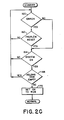
- Figs. 2a-2c the logic employed by the microprocessor-controller 46 will be described in detail.
- Fig. 2a illustrates the operation of the microprocessor when the system 10 is in a normal operating mode.
- Fig. 2b illustrates the operation of the filter cleaning mode and
- Fig. 2c illustrates the standby mode.
- the microprocessor first determines whether the system 10 is in an operative mode. If the system is set to operate, the microprocessor 46 advances to decision block 102 to determine whether the reaction tank 14 is filled. This determination is made on the basis of information received from the level detectors 60 and 62 mentioned above. If the reaction tank 14 is not filled, the microprocessor 46 causes the pump 64 to begin transferring waste water from the holding tank 12 to the reaction tank 14 as indicated by the start fill block 104. When the reaction tank 14 has been filled, the treating process of the present invention begins with the activation of the main system pump 26, as indicated in block 106.
- the microprocessor-controller 46 determines whether the waste water in the reaction tank 14 is pH balanced, as determined by the pH sensitive electrode 36. If the waste water is not in pH balance, pH balancing reagent is transferred from the pH balancing reagent tank 50 to the reaction tank 14 by pump 52 as indicated in block 110. If the waste water is within the pH balance limits, the microprocessor controller 46 next determines at block 112 whether metals have been sufficiently precipitated from the waste water in the reaction tank 14. If not, precipitating reagent from the precipitating reagent tank 54 is directed to the reaction tank 14 by pump 56 as indicated in block 114.
- the microprocessor determines whether final filtering has been completed as indicated in decision block 116. If the final filtering has been completed, it is next determined whether the holding tank 12 is empty, as shown in decision block 118. If the holding tank is empty, the system 10 is reset as shown in decision block 120 and the main system pump 26 is stopped as shown in block 122.
- the microprocessor 46 opens the valve 40 and begins discharge through the drain line 38 as indicated in block 124. Also, at the same time, the microprocessor controller 46 inserts air from the air pump 68 to the filter means 24 to aid in oxidizing excess sulfides.
- the microprocessor 46 determines whether the reaction tank 14 is empty or not in decision block 126. If the reaction tank 14 is empty, the main system pump 26 is shut off and the system readies itself to process the next batch of waste water. If the reaction tank 14 is not empty, the microprocessor 46 determines whether maintenance of the filter means is required. Maintenance is required if a predetermined number of batches have been filtered or alternatively, if a high pressure situation has been detected by the pressure sensor 72 indicating a need to clean the filter means 24 (as indicated in decision block 128).
- Fig. 2b illustrates the operations undertaken if filter maintenance is required. If maintenance of the filter means 24 is required, the system 10 can operate in one of two modes. In the first mode, the diatomaceous earth filter is subjected to a treatment including the injection of both air and water to the filter to increase the filtration efficiency. In a second mode, the sludge laden diatomaceous earth is removed and new diatomaceous earth is added. As indicated at decision block 132, the control means 46 selects between these two modes by first determining whether a predetermined number of cycles through the filter 24 have been made. If less than the number of cycles have been made, the filter means 24 is cleaned without the replacement of diatomaceous earth.
- valve 32 is closed and the wash pump 66 and air pump 68 are turned on. After a predetermined time delay indicated by decision block 134, the valve 32 is reopened and pumps 66 and 68 / are turned off such that the system 10 may be recycled.
- the valve 32 is closed and the wash pump 66 is turned on for a predetermined period of time as indicated by blocks 138 and 140. Thereafter, a diatomaceous earth pump (not shown) begins to pump new diatomaceous earth to the reaction tank 14. At the same time, air from pump 68 is caused to flow to the filter means 24 as indicated at block 150. The diatomaceous earth and air are added for a predetermined time period indicated by delay block 152. Thereafter, sludge is removed from the filter means through an exit port (not shown) as indicated at block 154. After a predetermined time delay ⁇ shown at block 156, the diatomaceous earth which has been inserted to the reaction tank 14 is pumped by the main system pump 26 to the filter means 24 as shown at block 158.
- the microprocessor 46 first ascertains whether any faults or errors have been detected in decision block 160. If an error has been detected, the controller 46 determines whether the operator has corrected and reset the system as shown at block 162. If reset has occurred, or if no error has been detected, the microprocessor 46 determines whether the system has been turned on at block 164. If the system is on, but the holding tank 12 is empty as indicated in decision block 166, the microprocessor controller loops back to the error block 160 and remains in a stand-by mode. However, if the holding tank 12 is empty, the controller is in a normal mode as indicated by block 170 and the system 10 begins to operate as indicated in Fig. 2a above.
Landscapes
- Chemical & Material Sciences (AREA)
- Life Sciences & Earth Sciences (AREA)
- Hydrology & Water Resources (AREA)
- Engineering & Computer Science (AREA)
- Environmental & Geological Engineering (AREA)
- Water Supply & Treatment (AREA)
- Organic Chemistry (AREA)
- Chemical Kinetics & Catalysis (AREA)
- Inorganic Chemistry (AREA)
- Removal Of Specific Substances (AREA)
- Water Treatment By Electricity Or Magnetism (AREA)
Applications Claiming Priority (2)
| Application Number | Priority Date | Filing Date | Title |
|---|---|---|---|
| US566606 | 1983-12-29 | ||
| US06/566,606 US4465593A (en) | 1982-03-23 | 1983-12-29 | Recovery of metal from waste water by chemical precipitation |
Publications (2)
| Publication Number | Publication Date |
|---|---|
| EP0150626A2 true EP0150626A2 (de) | 1985-08-07 |
| EP0150626A3 EP0150626A3 (de) | 1987-09-02 |
Family
ID=24263585
Family Applications (1)
| Application Number | Title | Priority Date | Filing Date |
|---|---|---|---|
| EP84309168A Withdrawn EP0150626A3 (de) | 1983-12-29 | 1984-12-31 | Wiedergewinnung von Metall aus Abwasser durch chemische Fällung |
Country Status (2)
| Country | Link |
|---|---|
| US (1) | US4465593A (de) |
| EP (1) | EP0150626A3 (de) |
Cited By (4)
| Publication number | Priority date | Publication date | Assignee | Title |
|---|---|---|---|---|
| FR2775278A1 (fr) * | 1998-02-24 | 1999-08-27 | Aerospatiale | Procede et installation d'epuration d'effluents |
| WO2001047616A1 (de) * | 1999-12-28 | 2001-07-05 | Seitz-Schenk Filtersystems Gmbh | Verfahren und vorrichtung zur zuführung von filterhilfsmitteln und/oder technischen hilfsstoffen während der filtration |
| GB2386370A (en) * | 2002-03-15 | 2003-09-17 | Ion Entpr Ltd | Water softening apparatus |
| US10968126B2 (en) | 2017-07-07 | 2021-04-06 | Katz Water Tech, Llc | Pretreatment of produced water to facilitate improved metal extraction |
Families Citing this family (40)
| Publication number | Priority date | Publication date | Assignee | Title |
|---|---|---|---|---|
| US4692411A (en) * | 1983-09-06 | 1987-09-08 | Ghose Rabindra N | Separation of specific biological cells by a biochemical filter |
| DE3443033A1 (de) * | 1984-11-26 | 1986-05-28 | Günter 8000 München Schüssler | Verfahren und vorrichtung zur regeneration und behandlung von fluessigkeiten, als mehrkammer-filtersystem mit konstanter filterleistung und rezirkulation von teilstroemen zwischen den einzelnen filterkammern, mit wenigstens einem stau- und reaktionsraum |
| US4655935A (en) * | 1985-10-21 | 1987-04-07 | Pennwalt Corporation | Detoxification of waste water from dithiocarbamate manufacture |
| US4836921A (en) * | 1987-01-30 | 1989-06-06 | Magnaflux Corporation | Waste water treatment apparatus |
| JPS63278539A (ja) * | 1987-05-11 | 1988-11-16 | Tosoh Corp | 液分注装置 |
| DE3729913A1 (de) * | 1987-09-07 | 1989-03-23 | Rrm Energy Gmbh | Verfahren und vorrichtung zur aufarbeitung von hydroxidschlaemmen |
| US4999114A (en) * | 1987-11-02 | 1991-03-12 | Morton International | Method of treating spent dryfilm stripping and developing solutions with a chemical mixture |
| US4857206A (en) * | 1987-11-02 | 1989-08-15 | Tmc Corp. | Method for treating, spent dryfilm stripping and developing solutions |
| US5033271A (en) * | 1987-11-04 | 1991-07-23 | Kent-Moore Corporation | Refrigerant recovery and purification system |
| JPH01313333A (ja) * | 1988-06-13 | 1989-12-18 | Central Glass Co Ltd | 高純度水酸化ニオブまたは水酸化タンタルの製造方法 |
| US5132916A (en) * | 1990-05-21 | 1992-07-21 | Elsag International B.V. | Methodology for ph titration curve estimation for adaptive control |
| GB9115799D0 (en) * | 1991-07-20 | 1991-09-04 | Kodak Ltd | Treatment of photographic effluent |
| US5792342A (en) * | 1992-09-18 | 1998-08-11 | Nutech Environmental Corporation | Apparatus for coordinating chemical treatment of sewage |
| DE4302910C1 (de) * | 1993-02-02 | 1994-09-15 | Straten Guenter | Fällmittel zur Ausfällung von Schwermetallen, ein Verfahren zu dessen Herstellung sowie dessen Verwendung |
| US5328599A (en) * | 1993-03-08 | 1994-07-12 | Nalco Chemical Company | System using sulfide ion-selective electrodes for control of chemical feed of organic sulfide products for metal ion precipitation from waste water |
| US5690817A (en) * | 1994-01-21 | 1997-11-25 | Eastman Kodak Company | Photographic effluent treatment apparatus |
| US6797195B1 (en) | 1995-05-19 | 2004-09-28 | Lawrence Kreisler | Method for recovering and separating metals from waste streams |
| US6270679B1 (en) * | 1995-05-19 | 2001-08-07 | Lawrence Kreisler | Method for recovering and separating metals from waste streams |
| US6254782B1 (en) * | 1995-05-19 | 2001-07-03 | Lawrence Kreisler | Method for recovering and separating metals from waste streams |
| US6274045B1 (en) * | 1995-05-19 | 2001-08-14 | Lawrence Kreisler | Method for recovering and separating metals from waste streams |
| US5647996A (en) * | 1995-06-16 | 1997-07-15 | Ormet Corporation | Groundwater total cyanide treatment method |
| DE19730937B4 (de) * | 1996-07-20 | 2005-06-02 | Leo Putz | Vorrichtung und Verfahren zur Aufbereitung von Regen- und/oder Oberflächenwasser |
| CA2212503C (en) * | 1997-08-07 | 1999-01-19 | William J. Kidd | Domestic water clarifier |
| US6136204A (en) * | 1998-10-21 | 2000-10-24 | Aramark Uniform And Career Apparel, Inc. | Apparatus for treating a process fluid |
| JP2000288560A (ja) * | 1999-04-02 | 2000-10-17 | Hitachi Ltd | 水の浄化処理装置及びその方法 |
| US6454949B1 (en) * | 2000-09-19 | 2002-09-24 | Baffin, Inc. | Highly accelerated process for removing contaminants from liquids |
| US7273561B1 (en) * | 2003-10-21 | 2007-09-25 | Waitaki Research Corporation | Method for determining the chemical dosage required to reduce sulfides in wastewater to acceptable levels |
| US7390416B1 (en) * | 2004-01-26 | 2008-06-24 | American Airlines, Inc. | Method for the removal of metals, including a co-precipitation of molybdenum, from wastewater |
| CA2679704A1 (en) | 2007-03-15 | 2008-09-18 | Medi-Physics, Inc. | Fluid sampling system with an in-line probe |
| US8632742B2 (en) | 2007-12-07 | 2014-01-21 | Nalco Company | Methods of controlling mercury emission |
| US9650267B2 (en) * | 2009-06-29 | 2017-05-16 | Nalco Company | Fluid treatment reactor |
| CN102880199A (zh) * | 2012-09-27 | 2013-01-16 | 东莞市劲升无尘涂装科技有限公司 | 金属喷涂ph值全自动检测监控自动补充药剂系统 |
| US20170113957A1 (en) * | 2015-06-05 | 2017-04-27 | Nicholas Eckelberry | Systems and methods for reduction of total organic compounds in wastewater |
| CN105676919B (zh) * | 2016-01-02 | 2019-01-08 | 北京市勘察设计研究院有限公司 | 基于好氧降解原理治理存量垃圾填埋场的在线控制系统 |
| EP3442677A4 (de) * | 2016-04-13 | 2019-09-25 | Skywell, LLC | System und verfahren für generator von atmosphärischem wasser |
| EP4028612A4 (de) | 2019-09-11 | 2023-11-08 | Hayward Industries, Inc. | Schwimmbeckendruck- und durchflusssteuerungspumpen- und wasserverteilungssysteme und verfahren |
| US11137780B1 (en) | 2021-02-25 | 2021-10-05 | Valve Technologies, LLC | Fluid distribution manifold |
| US11946565B2 (en) | 2021-02-25 | 2024-04-02 | Hayward Industries, Inc. | Valve assembly |
| IT202100008417A1 (it) * | 2021-04-02 | 2022-10-02 | Greengo S R L | Impianto a batch di trattamento chimico-fisico per acque reflue civili o industriali e relativo procedimento |
| US11579636B2 (en) | 2021-04-22 | 2023-02-14 | Hayward Industries, Inc. | Systems and methods for controlling operations of multi-manifold fluid distribution systems |
Family Cites Families (15)
| Publication number | Priority date | Publication date | Assignee | Title |
|---|---|---|---|---|
| US3740331A (en) * | 1971-06-23 | 1973-06-19 | Sybron Corp | Method for precipitation of heavy metal sulfides |
| US3983017A (en) * | 1972-12-01 | 1976-09-28 | Kennecott Copper Corporation | Recovery of metal values from manganese deep sea nodules using ammoniacal cuprous leach solutions |
| US4113619A (en) * | 1973-03-22 | 1978-09-12 | Arrington Co., Inc. | Waste fluid treatment system |
| FR2277910A1 (fr) * | 1974-07-09 | 1976-02-06 | Degremont Sa | Procede pour l'elimination en continu des sels de fer polluant les bains de galvanisation |
| US3984529A (en) * | 1974-08-22 | 1976-10-05 | Shao E Tung | Process for recovering sulfur by removal of sulfur dioxide from gaseous mixtures |
| AU502936B2 (en) * | 1975-01-24 | 1979-08-16 | Alcan Research And Development Limited | Flocculant control in sedimentation |
| US4224148A (en) * | 1975-07-18 | 1980-09-23 | Lindman William E | Galvanic flow system for joint particulate recovery and liquid purification |
| US4217209A (en) * | 1975-08-20 | 1980-08-12 | Bayer Aktiengesellschaft | Process for removing heavy metal sulphides from aqueous systems |
| FR2330654A1 (fr) * | 1975-11-06 | 1977-06-03 | Degremont | Procede et installation pour la regulation automatique de l'extraction des boues d'un appareil de traitement des eaux |
| AU2436177A (en) * | 1976-04-27 | 1978-10-26 | Permutit Co Inc | Colloid-free precipitation of heavy metal sulfides |
| US4156647A (en) * | 1976-05-03 | 1979-05-29 | Nieuwenhuis Garmt J | Process and apparatus for removal of impurities from liquids |
| GB1554834A (en) * | 1977-02-01 | 1979-10-31 | Gst Regeltechnik Gmbh | Method and device for controlled flocculation or coagulation of foreign substances from a liquid |
| US4116834A (en) * | 1977-08-01 | 1978-09-26 | Mine Safety Appliances Company | Apparatus for increasing the pH of waste water |
| US4151080A (en) * | 1978-02-13 | 1979-04-24 | Enviro Development Co., Inc. | System and apparatus for control and optimization of filtration process |
| US4329224A (en) * | 1980-11-14 | 1982-05-11 | General Electric Company | Wastewater treatment process |
-
1983
- 1983-12-29 US US06/566,606 patent/US4465593A/en not_active Expired - Fee Related
-
1984
- 1984-12-31 EP EP84309168A patent/EP0150626A3/de not_active Withdrawn
Cited By (6)
| Publication number | Priority date | Publication date | Assignee | Title |
|---|---|---|---|---|
| FR2775278A1 (fr) * | 1998-02-24 | 1999-08-27 | Aerospatiale | Procede et installation d'epuration d'effluents |
| WO2001047616A1 (de) * | 1999-12-28 | 2001-07-05 | Seitz-Schenk Filtersystems Gmbh | Verfahren und vorrichtung zur zuführung von filterhilfsmitteln und/oder technischen hilfsstoffen während der filtration |
| GB2386370A (en) * | 2002-03-15 | 2003-09-17 | Ion Entpr Ltd | Water softening apparatus |
| GB2386370B (en) * | 2002-03-15 | 2004-02-18 | Ion Entpr Ltd | Fluid treatment apparatus |
| US10968126B2 (en) | 2017-07-07 | 2021-04-06 | Katz Water Tech, Llc | Pretreatment of produced water to facilitate improved metal extraction |
| US11685676B2 (en) | 2017-07-07 | 2023-06-27 | Katz Water Tech, Llc | Pretreatment of produced water to facilitate improved metal extraction |
Also Published As
| Publication number | Publication date |
|---|---|
| US4465593A (en) | 1984-08-14 |
| EP0150626A3 (de) | 1987-09-02 |
Similar Documents
| Publication | Publication Date | Title |
|---|---|---|
| US4465593A (en) | Recovery of metal from waste water by chemical precipitation | |
| US5000858A (en) | Method for removing hexavalent chromium from water | |
| CA1062648A (en) | Liquid waste processing system | |
| US5695645A (en) | Methods for removing silver from spent photoprocessing solution | |
| US5770090A (en) | Method for recovery of heavy metal from waste water | |
| US4427551A (en) | Solids separation and liquid clarification system | |
| US5328599A (en) | System using sulfide ion-selective electrodes for control of chemical feed of organic sulfide products for metal ion precipitation from waste water | |
| US20080035577A1 (en) | System and Method for Treatment of Industrial Wastewater | |
| EP0902759A1 (de) | Methode und vorrichtung zur entfernung von metallionen und/oder von metallionen enthaltenden komplexen aus einer losung | |
| KR101635527B1 (ko) | 가중여재 회수식 자동화 수처리 장치 | |
| LU503889B1 (en) | A desulfurization wastewater treatment system and process | |
| KR101581315B1 (ko) | 물리화학적 폐수처리장치 | |
| US20230249993A1 (en) | Apparatus and methods for treating water for removal of pfas | |
| JPH01270991A (ja) | 水性廃棄物の体積を減少させる装置及び方法 | |
| US5080806A (en) | Decontamination treatment of process water | |
| EP1776190A1 (de) | Pfropfenströmungsregenerationsverfahren | |
| KR101066960B1 (ko) | 침전을 이용한 약주 원심분리방식의 준설퇴적물정화장치 | |
| CN111186941B (zh) | 基于浓度和色度检测的矿井水井下污水处理系统 | |
| JP4064969B2 (ja) | 室内載置型現像廃液処理装置並びに室内型現像廃液処理方法 | |
| CN207498169U (zh) | 用于钛材加工酸洗污水的自动化处理控制系统 | |
| CN111362465A (zh) | 基于流速和pH检测的矿井污水处理系统 | |
| LaPerle | The removal of metals from photographic effluent by sodium sulfide precipitation | |
| CA1214580A (en) | Apparatus and method for copper recovery | |
| US3714039A (en) | Treatment of waste metal processing solution spillage | |
| CN215049268U (zh) | 一种电镀废水处理装置 |
Legal Events
| Date | Code | Title | Description |
|---|---|---|---|
| PUAI | Public reference made under article 153(3) epc to a published international application that has entered the european phase |
Free format text: ORIGINAL CODE: 0009012 |
|
| AK | Designated contracting states |
Designated state(s): DE FR GB |
|
| PUAL | Search report despatched |
Free format text: ORIGINAL CODE: 0009013 |
|
| STAA | Information on the status of an ep patent application or granted ep patent |
Free format text: STATUS: THE APPLICATION HAS BEEN WITHDRAWN |
|
| AK | Designated contracting states |
Kind code of ref document: A3 Designated state(s): DE FR GB |
|
| 18W | Application withdrawn |
Withdrawal date: 19870817 |
|
| RIN1 | Information on inventor provided before grant (corrected) |
Inventor name: WEMHOFF, MARK F. |