EP0150650A2 - Dicke Anstrichzusammensetzungen - Google Patents
Dicke Anstrichzusammensetzungen Download PDFInfo
- Publication number
- EP0150650A2 EP0150650A2 EP84402766A EP84402766A EP0150650A2 EP 0150650 A2 EP0150650 A2 EP 0150650A2 EP 84402766 A EP84402766 A EP 84402766A EP 84402766 A EP84402766 A EP 84402766A EP 0150650 A2 EP0150650 A2 EP 0150650A2
- Authority
- EP
- European Patent Office
- Prior art keywords
- powder
- aluminum
- coating
- particle size
- esd
- Prior art date
- Legal status (The legal status is an assumption and is not a legal conclusion. Google has not performed a legal analysis and makes no representation as to the accuracy of the status listed.)
- Granted
Links
- 239000008199 coating composition Substances 0.000 title claims abstract description 24
- 238000000576 coating method Methods 0.000 claims abstract description 129
- 239000000843 powder Substances 0.000 claims abstract description 123
- XAGFODPZIPBFFR-UHFFFAOYSA-N aluminium Chemical compound [Al] XAGFODPZIPBFFR-UHFFFAOYSA-N 0.000 claims abstract description 112
- 239000002245 particle Substances 0.000 claims abstract description 96
- 229910052782 aluminium Inorganic materials 0.000 claims abstract description 88
- 239000011248 coating agent Substances 0.000 claims abstract description 73
- 239000011230 binding agent Substances 0.000 claims abstract description 37
- 238000009826 distribution Methods 0.000 claims abstract description 36
- ZCDOYSPFYFSLEW-UHFFFAOYSA-N chromate(2-) Chemical compound [O-][Cr]([O-])(=O)=O ZCDOYSPFYFSLEW-UHFFFAOYSA-N 0.000 claims abstract description 29
- 238000005260 corrosion Methods 0.000 claims abstract description 28
- 230000007797 corrosion Effects 0.000 claims abstract description 28
- NBIIXXVUZAFLBC-UHFFFAOYSA-K phosphate Chemical compound [O-]P([O-])([O-])=O NBIIXXVUZAFLBC-UHFFFAOYSA-K 0.000 claims abstract description 22
- 150000003839 salts Chemical class 0.000 claims abstract description 21
- 230000003647 oxidation Effects 0.000 claims abstract description 12
- 238000007254 oxidation reaction Methods 0.000 claims abstract description 12
- 239000007788 liquid Substances 0.000 claims abstract description 9
- -1 molybdate ions Chemical class 0.000 claims abstract description 8
- 230000000717 retained effect Effects 0.000 claims abstract description 7
- 150000002500 ions Chemical class 0.000 claims abstract 2
- 239000000203 mixture Substances 0.000 claims description 56
- 229910052751 metal Inorganic materials 0.000 claims description 42
- 239000002184 metal Substances 0.000 claims description 42
- 239000007921 spray Substances 0.000 claims description 22
- 229910019142 PO4 Inorganic materials 0.000 claims description 21
- 238000000034 method Methods 0.000 claims description 20
- 239000010452 phosphate Substances 0.000 claims description 18
- 230000009974 thixotropic effect Effects 0.000 claims description 8
- XLYOFNOQVPJJNP-UHFFFAOYSA-N water Substances O XLYOFNOQVPJJNP-UHFFFAOYSA-N 0.000 claims description 7
- 239000000919 ceramic Substances 0.000 claims description 6
- MEFBJEMVZONFCJ-UHFFFAOYSA-N molybdate Chemical compound [O-][Mo]([O-])(=O)=O MEFBJEMVZONFCJ-UHFFFAOYSA-N 0.000 claims description 5
- 150000002484 inorganic compounds Chemical class 0.000 claims description 4
- 229910010272 inorganic material Inorganic materials 0.000 claims description 4
- 230000002378 acidificating effect Effects 0.000 claims description 3
- 239000004411 aluminium Substances 0.000 abstract 2
- 230000002902 bimodal effect Effects 0.000 description 22
- 235000021317 phosphate Nutrition 0.000 description 18
- 239000000463 material Substances 0.000 description 15
- 238000012360 testing method Methods 0.000 description 11
- 229910000831 Steel Inorganic materials 0.000 description 10
- 230000008569 process Effects 0.000 description 10
- 239000010959 steel Substances 0.000 description 10
- PXHVJJICTQNCMI-UHFFFAOYSA-N Nickel Chemical compound [Ni] PXHVJJICTQNCMI-UHFFFAOYSA-N 0.000 description 9
- 229910021645 metal ion Inorganic materials 0.000 description 8
- 239000000049 pigment Substances 0.000 description 8
- 239000000243 solution Substances 0.000 description 8
- 239000000758 substrate Substances 0.000 description 8
- 239000004615 ingredient Substances 0.000 description 7
- XLOMVQKBTHCTTD-UHFFFAOYSA-N Zinc monoxide Chemical compound [Zn]=O XLOMVQKBTHCTTD-UHFFFAOYSA-N 0.000 description 6
- 238000007792 addition Methods 0.000 description 6
- 230000000694 effects Effects 0.000 description 6
- 229910001209 Low-carbon steel Inorganic materials 0.000 description 5
- 239000002131 composite material Substances 0.000 description 5
- 238000009472 formulation Methods 0.000 description 5
- 239000007789 gas Substances 0.000 description 5
- 239000007787 solid Substances 0.000 description 5
- XEEYBQQBJWHFJM-UHFFFAOYSA-N Iron Chemical compound [Fe] XEEYBQQBJWHFJM-UHFFFAOYSA-N 0.000 description 4
- NBIIXXVUZAFLBC-UHFFFAOYSA-N Phosphoric acid Chemical compound OP(O)(O)=O NBIIXXVUZAFLBC-UHFFFAOYSA-N 0.000 description 4
- PNEYBMLMFCGWSK-UHFFFAOYSA-N aluminium oxide Inorganic materials [O-2].[O-2].[O-2].[Al+3].[Al+3] PNEYBMLMFCGWSK-UHFFFAOYSA-N 0.000 description 4
- 229910052759 nickel Inorganic materials 0.000 description 4
- 238000012856 packing Methods 0.000 description 4
- 239000002694 phosphate binding agent Substances 0.000 description 4
- 230000009471 action Effects 0.000 description 3
- 230000001464 adherent effect Effects 0.000 description 3
- 230000002411 adverse Effects 0.000 description 3
- 229910045601 alloy Inorganic materials 0.000 description 3
- 239000000956 alloy Substances 0.000 description 3
- 239000008346 aqueous phase Substances 0.000 description 3
- 230000008901 benefit Effects 0.000 description 3
- 238000000280 densification Methods 0.000 description 3
- 239000012530 fluid Substances 0.000 description 3
- 238000007654 immersion Methods 0.000 description 3
- JEIPFZHSYJVQDO-UHFFFAOYSA-N iron(III) oxide Inorganic materials O=[Fe]O[Fe]=O JEIPFZHSYJVQDO-UHFFFAOYSA-N 0.000 description 3
- 239000002923 metal particle Substances 0.000 description 3
- VNWKTOKETHGBQD-UHFFFAOYSA-N methane Chemical compound C VNWKTOKETHGBQD-UHFFFAOYSA-N 0.000 description 3
- 239000002736 nonionic surfactant Substances 0.000 description 3
- 230000001590 oxidative effect Effects 0.000 description 3
- 150000003013 phosphoric acid derivatives Chemical group 0.000 description 3
- 230000000704 physical effect Effects 0.000 description 3
- 239000000047 product Substances 0.000 description 3
- 239000011819 refractory material Substances 0.000 description 3
- 238000004062 sedimentation Methods 0.000 description 3
- 239000012798 spherical particle Substances 0.000 description 3
- 239000008399 tap water Substances 0.000 description 3
- 235000020679 tap water Nutrition 0.000 description 3
- 239000011787 zinc oxide Substances 0.000 description 3
- IJGRMHOSHXDMSA-UHFFFAOYSA-N Atomic nitrogen Chemical compound N#N IJGRMHOSHXDMSA-UHFFFAOYSA-N 0.000 description 2
- CWYNVVGOOAEACU-UHFFFAOYSA-N Fe2+ Chemical compound [Fe+2] CWYNVVGOOAEACU-UHFFFAOYSA-N 0.000 description 2
- UFHFLCQGNIYNRP-UHFFFAOYSA-N Hydrogen Chemical compound [H][H] UFHFLCQGNIYNRP-UHFFFAOYSA-N 0.000 description 2
- VYPSYNLAJGMNEJ-UHFFFAOYSA-N Silicium dioxide Chemical compound O=[Si]=O VYPSYNLAJGMNEJ-UHFFFAOYSA-N 0.000 description 2
- 239000002253 acid Substances 0.000 description 2
- 229910000147 aluminium phosphate Inorganic materials 0.000 description 2
- 238000004458 analytical method Methods 0.000 description 2
- 238000005524 ceramic coating Methods 0.000 description 2
- 238000006243 chemical reaction Methods 0.000 description 2
- KRVSOGSZCMJSLX-UHFFFAOYSA-L chromic acid Substances O[Cr](O)(=O)=O KRVSOGSZCMJSLX-UHFFFAOYSA-L 0.000 description 2
- 239000011247 coating layer Substances 0.000 description 2
- SOCTUWSJJQCPFX-UHFFFAOYSA-N dichromate(2-) Chemical compound [O-][Cr](=O)(=O)O[Cr]([O-])(=O)=O SOCTUWSJJQCPFX-UHFFFAOYSA-N 0.000 description 2
- 238000010891 electric arc Methods 0.000 description 2
- 238000005516 engineering process Methods 0.000 description 2
- QFXZANXYUCUTQH-UHFFFAOYSA-N ethynol Chemical group OC#C QFXZANXYUCUTQH-UHFFFAOYSA-N 0.000 description 2
- 229910021485 fumed silica Inorganic materials 0.000 description 2
- AWJWCTOOIBYHON-UHFFFAOYSA-N furo[3,4-b]pyrazine-5,7-dione Chemical compound C1=CN=C2C(=O)OC(=O)C2=N1 AWJWCTOOIBYHON-UHFFFAOYSA-N 0.000 description 2
- 239000011521 glass Substances 0.000 description 2
- 230000005484 gravity Effects 0.000 description 2
- 229910052734 helium Inorganic materials 0.000 description 2
- 239000001307 helium Substances 0.000 description 2
- SWQJXJOGLNCZEY-UHFFFAOYSA-N helium atom Chemical compound [He] SWQJXJOGLNCZEY-UHFFFAOYSA-N 0.000 description 2
- 239000001257 hydrogen Substances 0.000 description 2
- 229910052739 hydrogen Inorganic materials 0.000 description 2
- 239000011261 inert gas Substances 0.000 description 2
- 229910052742 iron Inorganic materials 0.000 description 2
- 230000001788 irregular Effects 0.000 description 2
- 239000000395 magnesium oxide Substances 0.000 description 2
- CPLXHLVBOLITMK-UHFFFAOYSA-N magnesium oxide Inorganic materials [Mg]=O CPLXHLVBOLITMK-UHFFFAOYSA-N 0.000 description 2
- AXZKOIWUVFPNLO-UHFFFAOYSA-N magnesium;oxygen(2-) Chemical compound [O-2].[Mg+2] AXZKOIWUVFPNLO-UHFFFAOYSA-N 0.000 description 2
- 238000005259 measurement Methods 0.000 description 2
- 150000002736 metal compounds Chemical class 0.000 description 2
- 150000002739 metals Chemical class 0.000 description 2
- 238000002156 mixing Methods 0.000 description 2
- CWQXQMHSOZUFJS-UHFFFAOYSA-N molybdenum disulfide Chemical compound S=[Mo]=S CWQXQMHSOZUFJS-UHFFFAOYSA-N 0.000 description 2
- 229910052982 molybdenum disulfide Inorganic materials 0.000 description 2
- VLAPMBHFAWRUQP-UHFFFAOYSA-L molybdic acid Chemical compound O[Mo](O)(=O)=O VLAPMBHFAWRUQP-UHFFFAOYSA-L 0.000 description 2
- 229920001343 polytetrafluoroethylene Polymers 0.000 description 2
- 239000004810 polytetrafluoroethylene Substances 0.000 description 2
- 239000011253 protective coating Substances 0.000 description 2
- 230000001681 protective effect Effects 0.000 description 2
- 230000008439 repair process Effects 0.000 description 2
- 239000011163 secondary particle Substances 0.000 description 2
- HBMJWWWQQXIZIP-UHFFFAOYSA-N silicon carbide Chemical compound [Si+]#[C-] HBMJWWWQQXIZIP-UHFFFAOYSA-N 0.000 description 2
- 239000002002 slurry Substances 0.000 description 2
- 238000009987 spinning Methods 0.000 description 2
- 238000001694 spray drying Methods 0.000 description 2
- 239000011800 void material Substances 0.000 description 2
- 229910001350 4130 steel Inorganic materials 0.000 description 1
- 229910000838 Al alloy Inorganic materials 0.000 description 1
- 229910016943 AlZn Inorganic materials 0.000 description 1
- 229910001369 Brass Inorganic materials 0.000 description 1
- OKTJSMMVPCPJKN-UHFFFAOYSA-N Carbon Chemical compound [C] OKTJSMMVPCPJKN-UHFFFAOYSA-N 0.000 description 1
- 229910000975 Carbon steel Inorganic materials 0.000 description 1
- BVKZGUZCCUSVTD-UHFFFAOYSA-L Carbonate Chemical compound [O-]C([O-])=O BVKZGUZCCUSVTD-UHFFFAOYSA-L 0.000 description 1
- VYZAMTAEIAYCRO-UHFFFAOYSA-N Chromium Chemical compound [Cr] VYZAMTAEIAYCRO-UHFFFAOYSA-N 0.000 description 1
- 239000004593 Epoxy Substances 0.000 description 1
- 241000264877 Hippospongia communis Species 0.000 description 1
- FYYHWMGAXLPEAU-UHFFFAOYSA-N Magnesium Chemical compound [Mg] FYYHWMGAXLPEAU-UHFFFAOYSA-N 0.000 description 1
- 229910020068 MgAl Inorganic materials 0.000 description 1
- 229910001182 Mo alloy Inorganic materials 0.000 description 1
- 229910000990 Ni alloy Inorganic materials 0.000 description 1
- FAPWRFPIFSIZLT-UHFFFAOYSA-M Sodium chloride Chemical compound [Na+].[Cl-] FAPWRFPIFSIZLT-UHFFFAOYSA-M 0.000 description 1
- HCHKCACWOHOZIP-UHFFFAOYSA-N Zinc Chemical compound [Zn] HCHKCACWOHOZIP-UHFFFAOYSA-N 0.000 description 1
- 229910000611 Zinc aluminium Inorganic materials 0.000 description 1
- 150000007513 acids Chemical class 0.000 description 1
- 229920006397 acrylic thermoplastic Polymers 0.000 description 1
- 239000000654 additive Substances 0.000 description 1
- 239000000853 adhesive Substances 0.000 description 1
- 230000001070 adhesive effect Effects 0.000 description 1
- HXFVOUUOTHJFPX-UHFFFAOYSA-N alumane;zinc Chemical compound [AlH3].[Zn] HXFVOUUOTHJFPX-UHFFFAOYSA-N 0.000 description 1
- WNROFYMDJYEPJX-UHFFFAOYSA-K aluminium hydroxide Chemical compound [OH-].[OH-].[OH-].[Al+3] WNROFYMDJYEPJX-UHFFFAOYSA-K 0.000 description 1
- 238000013459 approach Methods 0.000 description 1
- 239000007864 aqueous solution Substances 0.000 description 1
- 238000005422 blasting Methods 0.000 description 1
- 150000001642 boronic acid derivatives Chemical class 0.000 description 1
- 239000010951 brass Substances 0.000 description 1
- AXCZMVOFGPJBDE-UHFFFAOYSA-L calcium dihydroxide Chemical compound [OH-].[OH-].[Ca+2] AXCZMVOFGPJBDE-UHFFFAOYSA-L 0.000 description 1
- 239000000920 calcium hydroxide Substances 0.000 description 1
- 229910001861 calcium hydroxide Inorganic materials 0.000 description 1
- 229910052799 carbon Inorganic materials 0.000 description 1
- 239000010962 carbon steel Substances 0.000 description 1
- 150000004649 carbonic acid derivatives Chemical class 0.000 description 1
- 150000001768 cations Chemical class 0.000 description 1
- 230000008859 change Effects 0.000 description 1
- 229910052804 chromium Inorganic materials 0.000 description 1
- 239000011651 chromium Substances 0.000 description 1
- 239000012141 concentrate Substances 0.000 description 1
- 238000011109 contamination Methods 0.000 description 1
- 238000005520 cutting process Methods 0.000 description 1
- 230000001351 cycling effect Effects 0.000 description 1
- 230000007423 decrease Effects 0.000 description 1
- 238000001739 density measurement Methods 0.000 description 1
- 238000011161 development Methods 0.000 description 1
- NINOVVRCHXVOKB-UHFFFAOYSA-N dialuminum;dioxido(dioxo)chromium Chemical compound [Al+3].[Al+3].[O-][Cr]([O-])(=O)=O.[O-][Cr]([O-])(=O)=O.[O-][Cr]([O-])(=O)=O NINOVVRCHXVOKB-UHFFFAOYSA-N 0.000 description 1
- 239000006185 dispersion Substances 0.000 description 1
- 229920006332 epoxy adhesive Polymers 0.000 description 1
- 239000002360 explosive Substances 0.000 description 1
- 238000011049 filling Methods 0.000 description 1
- 239000012467 final product Substances 0.000 description 1
- 239000010419 fine particle Substances 0.000 description 1
- 238000010285 flame spraying Methods 0.000 description 1
- 239000002737 fuel gas Substances 0.000 description 1
- XLYOFNOQVPJJNP-UHFFFAOYSA-M hydroxide Chemical compound [OH-] XLYOFNOQVPJJNP-UHFFFAOYSA-M 0.000 description 1
- 150000004679 hydroxides Chemical class 0.000 description 1
- 230000006872 improvement Effects 0.000 description 1
- 230000002401 inhibitory effect Effects 0.000 description 1
- 239000013067 intermediate product Substances 0.000 description 1
- 239000010410 layer Substances 0.000 description 1
- 230000000670 limiting effect Effects 0.000 description 1
- 229910001338 liquidmetal Inorganic materials 0.000 description 1
- XGZVUEUWXADBQD-UHFFFAOYSA-L lithium carbonate Chemical compound [Li+].[Li+].[O-]C([O-])=O XGZVUEUWXADBQD-UHFFFAOYSA-L 0.000 description 1
- 229910052808 lithium carbonate Inorganic materials 0.000 description 1
- FUJCRWPEOMXPAD-UHFFFAOYSA-N lithium oxide Chemical compound [Li+].[Li+].[O-2] FUJCRWPEOMXPAD-UHFFFAOYSA-N 0.000 description 1
- 229910001947 lithium oxide Inorganic materials 0.000 description 1
- 230000007774 longterm Effects 0.000 description 1
- 229910052749 magnesium Inorganic materials 0.000 description 1
- 239000011777 magnesium Substances 0.000 description 1
- VTHJTEIRLNZDEV-UHFFFAOYSA-L magnesium dihydroxide Chemical compound [OH-].[OH-].[Mg+2] VTHJTEIRLNZDEV-UHFFFAOYSA-L 0.000 description 1
- 239000000347 magnesium hydroxide Substances 0.000 description 1
- 229910001862 magnesium hydroxide Inorganic materials 0.000 description 1
- 238000004519 manufacturing process Methods 0.000 description 1
- 239000000155 melt Substances 0.000 description 1
- 238000002844 melting Methods 0.000 description 1
- 230000008018 melting Effects 0.000 description 1
- 229910044991 metal oxide Inorganic materials 0.000 description 1
- 150000004706 metal oxides Chemical class 0.000 description 1
- 229910001463 metal phosphate Inorganic materials 0.000 description 1
- 238000012544 monitoring process Methods 0.000 description 1
- 229910052757 nitrogen Inorganic materials 0.000 description 1
- 229910052755 nonmetal Inorganic materials 0.000 description 1
- 239000003921 oil Substances 0.000 description 1
- 239000005011 phenolic resin Substances 0.000 description 1
- 229920001568 phenolic resin Polymers 0.000 description 1
- 229920003229 poly(methyl methacrylate) Polymers 0.000 description 1
- 229920000728 polyester Polymers 0.000 description 1
- 239000002952 polymeric resin Substances 0.000 description 1
- 229920001296 polysiloxane Polymers 0.000 description 1
- 239000011148 porous material Substances 0.000 description 1
- 238000011417 postcuring Methods 0.000 description 1
- 239000012254 powdered material Substances 0.000 description 1
- 238000004321 preservation Methods 0.000 description 1
- 239000011164 primary particle Substances 0.000 description 1
- 239000003380 propellant Substances 0.000 description 1
- 238000003908 quality control method Methods 0.000 description 1
- 230000009467 reduction Effects 0.000 description 1
- 230000002829 reductive effect Effects 0.000 description 1
- 238000011160 research Methods 0.000 description 1
- 239000012266 salt solution Substances 0.000 description 1
- 239000000523 sample Substances 0.000 description 1
- 238000007560 sedimentation technique Methods 0.000 description 1
- 229910010271 silicon carbide Inorganic materials 0.000 description 1
- 239000011780 sodium chloride Substances 0.000 description 1
- 239000011343 solid material Substances 0.000 description 1
- 239000002904 solvent Substances 0.000 description 1
- 239000000126 substance Substances 0.000 description 1
- 239000000725 suspension Substances 0.000 description 1
- 229920003002 synthetic resin Polymers 0.000 description 1
- ISXSCDLOGDJUNJ-UHFFFAOYSA-N tert-butyl prop-2-enoate Chemical compound CC(C)(C)OC(=O)C=C ISXSCDLOGDJUNJ-UHFFFAOYSA-N 0.000 description 1
- 238000007751 thermal spraying Methods 0.000 description 1
- 229910052725 zinc Inorganic materials 0.000 description 1
- 239000011701 zinc Substances 0.000 description 1
- UGZADUVQMDAIAO-UHFFFAOYSA-L zinc hydroxide Chemical compound [OH-].[OH-].[Zn+2] UGZADUVQMDAIAO-UHFFFAOYSA-L 0.000 description 1
- 229940007718 zinc hydroxide Drugs 0.000 description 1
- 229910021511 zinc hydroxide Inorganic materials 0.000 description 1
Images




Classifications
-
- C—CHEMISTRY; METALLURGY
- C09—DYES; PAINTS; POLISHES; NATURAL RESINS; ADHESIVES; COMPOSITIONS NOT OTHERWISE PROVIDED FOR; APPLICATIONS OF MATERIALS NOT OTHERWISE PROVIDED FOR
- C09D—COATING COMPOSITIONS, e.g. PAINTS, VARNISHES OR LACQUERS; FILLING PASTES; CHEMICAL PAINT OR INK REMOVERS; INKS; CORRECTING FLUIDS; WOODSTAINS; PASTES OR SOLIDS FOR COLOURING OR PRINTING; USE OF MATERIALS THEREFOR
- C09D5/00—Coating compositions, e.g. paints, varnishes or lacquers, characterised by their physical nature or the effects produced; Filling pastes
- C09D5/08—Anti-corrosive paints
- C09D5/10—Anti-corrosive paints containing metal dust
- C09D5/103—Anti-corrosive paints containing metal dust containing Al
-
- C—CHEMISTRY; METALLURGY
- C23—COATING METALLIC MATERIAL; COATING MATERIAL WITH METALLIC MATERIAL; CHEMICAL SURFACE TREATMENT; DIFFUSION TREATMENT OF METALLIC MATERIAL; COATING BY VACUUM EVAPORATION, BY SPUTTERING, BY ION IMPLANTATION OR BY CHEMICAL VAPOUR DEPOSITION, IN GENERAL; INHIBITING CORROSION OF METALLIC MATERIAL OR INCRUSTATION IN GENERAL
- C23C—COATING METALLIC MATERIAL; COATING MATERIAL WITH METALLIC MATERIAL; SURFACE TREATMENT OF METALLIC MATERIAL BY DIFFUSION INTO THE SURFACE, BY CHEMICAL CONVERSION OR SUBSTITUTION; COATING BY VACUUM EVAPORATION, BY SPUTTERING, BY ION IMPLANTATION OR BY CHEMICAL VAPOUR DEPOSITION, IN GENERAL
- C23C22/00—Chemical surface treatment of metallic material by reaction of the surface with a reactive liquid, leaving reaction products of surface material in the coating, e.g. conversion coatings, passivation of metals
- C23C22/73—Chemical surface treatment of metallic material by reaction of the surface with a reactive liquid, leaving reaction products of surface material in the coating, e.g. conversion coatings, passivation of metals characterised by the process
- C23C22/74—Chemical surface treatment of metallic material by reaction of the surface with a reactive liquid, leaving reaction products of surface material in the coating, e.g. conversion coatings, passivation of metals characterised by the process for obtaining burned-in conversion coatings
Definitions
- This invention relates to a thick film aluminum-ceramic composite material which can replace thermal sprayed aluminum as an abradable or machinable, corrosion and oxidation resistant coating for metal and ceramic parts.
- the invention also relates to compositions suitable for making such coatings and to coated parts.
- the coating compositions of this invention comprise a liquid binder, particularly an aqueous binder which comprises chromate and phosphate ions and a type of atomized aluminum powder with an average particle size greater than about 15um and having some population fraction greater than 44 microns in diameter (+325 mesh).
- the invention also provides in another embodiment a coating of enhanced physical properties.
- This composition comprises aluminum powder with an average particle size of 15pm, some fraction of which is +325 mesh, to which is added a quantity of a second grade of smaller aluminum powders possessing an average particle diameter about 0.5 or less that of the diameter of the larger grade.
- the cured film or coating of this composition has improved density and bond strength.
- the aluminum-filled slurry so described will, when thermally cured, produce an aluminum coating possessing adhesion, corrosion resistance and oxidation resistance that are superior to those of a thermal sprayed aluminum coating.
- aluminum is used in describing the powder, it is used to describe a preferred metal, and throughout the description there is intended to include metal powders in general, preferably aluminum.
- compositions (and coatings) which comprise one type (or grade) of metal powder of the larger size, as described above, as designated as unimodal; the compositions (and coatings) which comprise also the second type (or grade) of smaller metal powder, designated as poly- or bimodal.
- thermal spray has been used to describe any process whereby a material is brought to its melting point and sprayed onto a surface to produce a coating. These processes now include: 1) Metallizing or Wire Spray; 2) Arc Wire Spray; 3) Thermo Spray; and 4) Plasma Flame Spray.
- metalizing or "wire spray” are used to describe a type of thermal spraying process which involves the use of metal in wire form.
- the wire is drawn through the gun and nozzle by a pair of powered feed rollers.
- the wire is continually melted in an oxygen-fuel-gas flame and atomized by a compressed air blast which carries the metal particles to the previously prepared surface.
- the individual particles mesh to produce a coating of the desired metal. This meshing action is still not completely understood, but the effect is apparently due to a combination of mechanical interlocking and cementation of the oxides formed during the passage of the particles from the gun nozzle to the sprayed surface.
- arc wire spray metal is melted by an electric arc, which is produced by passing current through two converging metal wires, before being atomized in compressed air.
- Metallizing and arc wire spray are suitable for producing coatings from any material that can be drawn into wire form.
- thermo spray and "plasma flame spray” processes which utilize metals and other materials in powder form.
- these powdered materials are held in a hopper atop the gun and gravity fed into the gun proper where they are picked up by the oxy-acetylene (or hydrogen) gas mixtures and carried to the gun nozzle.
- oxy-acetylene (or hydrogen) gas mixtures are picked up by the oxy-acetylene (or hydrogen) gas mixtures and carried to the gun nozzle.
- oxy-acetylene (or hydrogen) gas mixtures and carried to the gun nozzle.
- they are melted almost instantly due to the extremely high thermal efficiency of the gun and carried to the surface being sprayed by means of a siphon-jet arrangement at the gun nozzle. This also contributes to the thermal efficiency of the thermo spray process.
- Very high deposit efficiencies can be attained (usually well above 90%).
- Thermal-sprayed aluminum coatings can be applied by any of the four methods described above and are used to restore dimensional tolerances on a metal part or to improve its corrosion and oxidation resistance.
- the internal surfaces of a cast aluminum diesel engine turbocharger inlet housing are repaired and recontoured using aluminum or aluminum alloy coatings. Approximately 0.045 inches (1.14mm) of aluminum is thermo sprayed inside the housing, then the part is remachined to original tolerances. This repair is described in detail in the METCO Application Bulletin No. 403, which is incorporated herein by reference.
- thermal sprayed aluminum coatings also make them uniquely suitable as air seals in aircraft turbine engines.
- intake air is accelerated and compressed by the action of thousands of spinning blades. It is essential for efficiency that the air passing through the compressor not be able to slip by the blades through spaces between the blade tips and the inside wall of the compressor case, or slip through spaces between the individual stages (rows) of blades.
- Air loss at blade tips has been eliminated in General Electric's CF-6 engine series by applying about 0.020 inches (0.51mm) of aluminum on the inside of the case.
- the spinning blades gouge or abrade a groove in this plasma flame sprayed coating producing a tight seal between the blade tip and case wall.
- the bond at the thermal sprayed coating/ substrate interface is so sensitive to the condition or characteristics of that interface that it is often difficult to assure good adhesion of the coating to a part.
- the metal or.ceramic surface In order to produce a well-bonded coating, the metal or.ceramic surface must be clean and rough. A clean surface is one free of dirt, oil, moisture and all other contamination. Even the transparent oxide film that forms on a steel part at room temperature is enough to prevent adhesion of the thermal sprayed coating. Therefore, the U.S. Navy Corrosion Control Manual cited above requires that any surface not coated within two hours after blasting must be blasted again before it is coated. As might be expected, the size and severity of the blast profile also affects the tensile bond strength of the coating. Moreover, the temperature of the substrate can be of great consequence. It has been demonstrated that a thermal sprayed coating will adhere much better to a steel part that has been preheated to about 500°F than to one that is at room temperature.
- thermal sprayed aluminum In addition to problems associated with the conditions at the interface, the application of thermal sprayed aluminum is complicated by the fact that the aluminum particles adhere to one another much better than they adhere to the properly prepared substrate. The moment the molten aluminum droplet comes in contact with air, an oxide crust forms on its surface. These oxide films bond very well to one another but do not adhere well to other materials.
- the disparity in the adhesive and cohesive strength of thermal sprayed aluminum, which is shown below in Table 1, is so large that internal stresses can actually cause disbonding or peeling of thick coatings. Consequently, the U.S. Navy Manual cited above requires that no wire-sprayed aluminum coating used aboard ship should exceed'0.010 inch (0.25mm) in thickness.
- the parts are first sprayed with a special nickel - or molybdenum-alloy bond coat to ensure that the thermal sprayed aluminum will not disbond or peel off the part.
- a special nickel - or molybdenum-alloy bond coat to ensure that the thermal sprayed aluminum will not disbond or peel off the part.
- compositions described in '251 Allen comprise aluminum powders that average 5-10 microns in size.
- the coatings of that patent cannot generally be applied at thickness greater than about-0.0015 inch (0.04mm) per cure without significant loss of performance.
- 'coatings as thick as 0.01 inches (0.25mm) or more, produced by applying multiple thin coats of these materials have very poor bond strengths.
- metal filled e.g. aluminum-filled, chromate/phosphate coatings from most of the applications where thermal sprayed aluminum is used, such as those described above.
- the invention described herein provides a tightly adherent, corrosion and oxidation resistant metal, e.g. aluminum, chromate/phosphate coatings that are as thick as 0.100 inch (2.54mm) or more and that can be applied at 0.003 - 0.030 inch (0.08 - 0.76mm) per cure.
- These coatings comprise an aqueous acidic binder, comprising metal chromate, dichromate, or molybdate ions and phosphate ions, which comprises metal powders, like aluminum metal powders, some having an average particle size of at least 15 pm, of which, preferably at least 5% by weight, are greater than 44 microns in diameter (+325 mesh).
- the size distribution of metal particles, e.g. aluminum particles, incorporated into the coating of this invention may be produced by using one or more grades (or types) of powder. However, should two grades of powder be combined to produce the distribution, the average diameter of the smaller grade should be at least less than about one-half, preferably less than about one-tenth, the average particle size of the larger powder grade, and the relative weight ratio of large to small metal, e.g. aluminum, powders should be preferably about 4 to 1.
- Coatings of this invention, containing two powders of differing sizes, in accordance with the criterion described herein are referred to as bimodal coatings and are denser, more adherent, and more corrosion resistant than those produced using a single large grade of powder alone. Such coatings have been referred to as unimodal compositions.
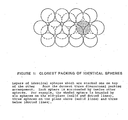
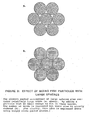
- the idealized coating layer is constituted of four layers of spheres, stacked one on top of the other in the close-packed manner of Figure 1, then obviously the easiest means of producing a thicker coating is to increase the diameter of the spheres. However, as the size of the spheres increases, so also does the size of each void, though the volume fraction of space in the structure remains constant.
- the size of these interstitial voids is especially important in a composite coating such as an aluminum-filled chromate/phosphate material.
- a composite coating such as an aluminum-filled chromate/phosphate material.
- the voids in the coating are very small and the liquid binder fills and seals these spaces to form a dense composite film.
- the voids eventually become so large that the binder (which shrinks as it cures) cannot fill and seal them.
- the coating which had been a composite of small aluminum particles with chromate/phosphate binder filling the interstices between the aluminum, then becomes a composite of large, chromate/phosphate coated aluminum particles, interspersed with voids and open pores.
- Air-atomized grades of aluminum powder are produced by aspirating molten metal through a nozzle into a supersonic stream of air.
- the lower end of the nozzle dips into the bath of molten metal and its upper end terminates in a small orifice.
- a jet of air is passed over the orifice of the nozzle it creates a suction effect, aspirating the liquid metal through the nozzle, into the airstream and disintegrating the molten stream into small, discrete particles.
- the stream of liquid aluminum is broken into individual droplets by the jet of air, each droplet is initially flattened and elongated by the force of the gas stream. Under ideal conditions, these droplets would rapidly contract into a spherical shape in order to minimize surface area and surface energy.
- spherical grades of atomized aluminum are also commercially available, though they are much more expensive than air-atomized material. These spherical powders were developed for use in explosives and rocket propellants where precise control of surface area is essential for control of reaction rates. Spherical powders are produced by aspirating molten aluminum into a jet of a reducing gas, such as hydrogen or an exothermic mixture of combusted methane, or an inert gas, such as helium or nitrogen. These protective atmospheres prevent oxidation of the molten metal surface so that the metal droplet can relax into its equilibrium, spheriodal shape. These grades of gas-atomized aluminum are referred to as "spherical" powders although they never actually achieve perfect sphericity because of the effect of gravity on the molten metal droplet.
- Air-atomized and non-oxidizing gas-atomized powders are typically characterized according to one of the following measured parameters: particle size or average particle diameter, particle size distribution, and particle shape or configuration.
- Particle size the parameter most commonly used to distinguish grades of powder, is generally synonymous with particle diameter; however, particle diameter can only be determined accurately for spherical powders.
- the average diameter of particles in any given powder grade is typically measured using the Fisher Sub Sieve Sizer (ASTM B330).
- ASTM B330 Fisher Sub Sieve Sizer
- This device measures the resistance to air flow through a packed column of powder relative to the resistance to flow through a packed bed of spherical particles of known average diameter.
- the advantage of this technique is that it is simple, fast and economical.
- the process measures a bulk (column) property rather than monitoring individual particles, the average particle diameter determined by the Fisher Sub Sieve Sizer (FSSS) is actually a statistical average rather than a true particle size.
- the particle size is most usefully established by measuring a characteristic property of an irregular particle that can be related to the same property of an ideal regularly shaped particle.
- a sphere as the ideal shape, the size of both air- and non-oxidizing gas-atomized powders can be reliably described as "equivalent to a sphere of diameter (d)," thereby combining the parameters of size and shape in a single variable.
- An unequivocal, reproducible icle-size having one dimension is thus established with this definition.
- the equivalent-spherical diameters (ESD) of aluminum or other metal particles in a particular grade of powder are measured by automated sedimentation equipment such as the Micromeritic SediGraph 5000 E particle size analyzer.
- This device uses low energy X-rays to determine the concentration of particles at various depths in a column of known fluid.
- the laws of hydrodynamics require that the settling rate of a particle in the fluid is related to the mass of the particle.
- the Sedi-Graph determines the population of particles of a particular mass in the powder grade by measuring the density of particles at a given level within the fluid. Since the diameter of an ideal spherical particle is related to its mass by means of its density and volume (i.e.
- each density measurement in the SediGraph corresponds to a population count of particles with a mass that is equivalent to that of a spherical particle having a diameter, d (designated ESD). Therefore, grades of atomized powders are completely characterized by the population size distribution measured by the sedimentation technique and the average ESD (ESD) corresponding to the median value in the distribution.
- both air- and non-oxidizing gas-atomized aluminum powders are described using equivalent spherical diameter (ESD) measurements provided by sedimentation equipment. Additional information regarding analytical test methods for characterizing aluminum powders is provided in the Alcoa pamphlet section PAP917 (FA2D-2) entitled “Quality Control and Analytical Test Methods for Alcoa Aluminum Powders". For additional information about automated sedimentation measurements, see the pamphlet entitled “A Short Course in Fine Particle Technology” provided by Micromeritics Instrument Corporation. These documents are incorporated herein by reference.
- Grades A and C correspond to grades X-81 and X-75 spherical aluminum powders from Alcan Aluminum Corp., Elizabeth, NJ. These powders are produced by atomizing aluminum into a reducing mixture of N 2 , H 2 , CO and CH 4 .
- Grade B is Alcan's MD101 grade of air-atomized powder.
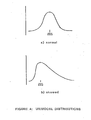
- Each of the grades of aluminum powder shown in Table 2 exhibits either a normal or skewed particle size distribution curve ( Figure 4). These distribution curves possess a single maximum frequency called a "mode” and arc, therefore, termed unimodal distributions. The sums of any two or more of these powder grades also produce a unimodal distribution. Consequently, the coatings of this invention which comprise one or more of these coarser grades are herein referred to as unimodal coatings, as was already referred to above.
- the ESD of the grade of the aluminum used shall preferably exceed at least 15 ⁇ m, more preferably 25um. Furthermore, the quantity of powder exceeding 44pm in diameter, that is that percentage greater than 325 mesh, shall preferably be at least 5% by weight.
- the density of a particulate-filled coating is increased when the interstices between large particles are filled with properly sized, smaller particles. To a limited extent this denser packing may exist in unimodal coatings due to the wide range of particle sizes present in commercial powder grades. In grade A above, for example, about 15% by weight of the aluminum particles are greater than 50pm in diameter and about 12% of the particles are less than the corresponding maximum interstitial size of llum (0.22 x 50pm). Consequently, in a coating comprising Grade A powder only, there may exist more densely packed regions in which small particles occupy interstices between close packed larger ones.
- Densification of the coating layer can increase its corrosion resistance and bond strength; however, in unimodal coatings this effect is localized and limited because a preponderance of particles in the coating do not share a similar ideal size relationship. In fact, when less than about 5 weight percent of the atomized powders are greater than 44pm in diameter (i.e. greater than 325 mesh) even the localized densification effect becomes negligible.
- composition which comprises a powder of a second, smaller particle. This powder effectively fills the interstitial voids.
- Grades a, b and d are spherical-atomized powders. Grades a and b correspond to grades H-3 and H-5 helium atomized powders from Valimet Inc., Stockton, CA. Grade d is Alcan's X-65 reducing gas-atomized aluminum. Grade c is LSA-693 air-atomized powder from Reynolds Metal Co., Louisville, KY.
- bimodal coatings When in accordance with the invention, a coarser, primary powder (such as those in Table 2), is mixed with a finer, secondary powder (such as those in Table 3), the powder which results possesses two peak frequencies or modes in its particle size distribution curve. Such a distribution is termed a bimodal distribution. Therefore, the coatings of this invention which contain both small and large grades- of aluminum powder are herein referred to as bimodal coatings.
- the maximum allowable ratio of secondary diameter to primary diameter is 0.22.
- the size relationships in the twelve possible combinations of powders from Tables 2 and 3 are listed in the following tables (4, 5 and 6). In each table, the idealized maximum allowable size (i.e. 0.22 times the primary powder diameter) is listed as well as the size of each powder grade. Portions of the size distributions of secondary powders that are smaller than this idealized limit are asterisked.
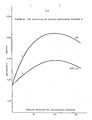
- the relative packing densities that are achievable in bimodal coatings containing blends of these powders can be estimated using a tap density test in which the powders are placed in a graduated cylinder which is then tapped or agitated to encourage the powders to settle into their densest arrangements.
- the tap density then is the mass of powder divided by the final volume that mass occupies in the cylinder and is expressed in terms of grams per cubic centimeter (gm/cc). This testing technique is amplified in ASTM B527 which is incorporated herein by reference.
- the tap densities determined for mixtures of the primary and secondary aluminum powders in the tables above are represented in Figures 5, 6 and 7.
- the tap density is plotted against the weight percent of the secondary powder in the bimodal mixture.
- the ratio of the ESD of the secondary powder to the ESD of the primary powder (designated d/D) is noted beside each curve.
- the bimodal powder distributions in the coatings of this invention are in fact the sum of two distributions, each having a single mode. As long as the population means of these two unimodal distributions are widely separated, the total distribution has two distinct modes and dense packing is possible. As the population means approach one another, the two peaks in the total particle size distribution become less distinct, fewer particles fit easily into interstices, and less densification is achieved. In the extreme, the two size distributions overlap so much that the total distribution begins to resemble the unimodal distribution of a single powder grade.
- the ESD of the primary powder (or powders) exceeds preferably 15pm, more preferably 25pm, and the ratio of the ESD of the smaller powder (or powders) to that of the larger one(s) is at least less than about 0.5, and preferably less than about 0.12. At least about 5% by weight of the primary powder is greater than 44pm in diameter, and the weight percentage of smaller powder(s) in these bimodal coatings is preferably between about 5 and 50%, most preferably between 15 and 25%.
- the powders which are used in the compositions of this invention in accordance with the constraints defined above may comprise either air- or spherical-atomized grades of aluminum. It is also within.the scope of this invention that the suitably sized secondary powder be chosen from a wide range of metallic pigments, such as nickel, or refractories, such as SiC or glass, or even polymeric resins, such as acrylics or polyesters, instead of aluminum in order to incorporate other desirable properties into the coating film. Whenever the term "aluminum” is used herein, it is intended to include alloys of aluminum such as MgAl, AlZn or others that are known.
- compositions of this invention are clearly demonstrated when comparing the physical properties of several coatings which use a chromate/phosphate binder of the type described in '251 Allen and which are embodiments of this invention.
- One embodiment is a unimodal coating comprising Grade C powder only.
- the third coating a preferred embodiment of this invention, contains a mixture of Grades C and a, which consist of 20% grade a by weight. The ratio of the ESD's for these two powders is 0.08.
- the weight of aluminum per unit weight of binder is constant for all the coatings and equal to that of Example 7 in '251 Allen.
- the critical component of this invention is the size and size distribution of the aluminum powders (or other metal powders) used in the compositions, e.g. the primary and/or secondary powders described herein, it will be appreciated that the particular nature of the binder portion of this invention (its ingredients and other variables) is of secondary importance, thus allowing a greater latitude in the selection (and proportions) of the other ingredients of the compositions for the coatings of the invention than permitted heretofore.
- compositions of the invention are constituted or made of aqueous solutions (or are solids as described hereinafter) of a combination of inorganic compounds from the group consisting of phosphoric acid, chromic acid, molybdic acid, and the metal salts of these acids.
- Preferred solutions contain phosphate anion and chromate (or dichromate) and/or molybdate anions.
- phosphate anion and chromate or dichromate
- molybdate anions phosphate anion and chromate
- a great variety of such solutions are known for treatment of metal surfaces. For instance, Kirk and Othmer, Eds., Encyclopedia of Chemical Technology, 2nd ed., vol. 18, Interscience Publishers, a division of John Wiley & Sons, Inc., 1969 (pages 292-303), describes phosphate and chromate coatings.
- the United States patent literature describes coating solutions or dispersions for protective coating of metals, which compositions are suitable for use as components of the compositions of the invention.
- Such suitable compositions are disclosed by the Allen (No. 3,248,251); Brumbaugh (No. 3,869,293) patents referred to above; Collins (No. 3,248,249); Boies (No. 3,081,146); Romig (No. 2,245,609); Helwig (No. 3,967,984); Bennetch (No. 3,443,977); Hirst (No. 3,562,011) patents, and others. These disclosures are incorporated herein by reference.
- Other illustrative patents or literature showing corrosion inhibiting and protective coating compositions of phosphates, mixtures of phosphates and chromates and/or molybdates are known to one skilled in the art and further examples need not be supplied.
- metal ion In the binder of the chromate/phosphate composition used it is not necessary that a metal ion be added.
- a metal salt As is often done, metal ion is inherently supplied to the solution.
- any of the known phosphates, chromates, dichromates or molybdates can be used as the source of metal ion.
- metal ion can be supplied in a form such as metal oxide, hydroxide, carbonate, etc. which will dissolve in acid, i.e.
- metal compounds will illustrate those which can be added to generate the metal ion within the solution, by an acid-base reation, in accordance with the above: magnesium oxide; magnesium hydroxide; zinc oxide, zinc hydroxide; aluminum hydroxide; lithium oxide; lithium carbonate; ana calcium hydroxide.
- Metal compounds which may be added to generate the metal ion in solution are various oxides, hydroxides or carbonates of magnesium, zinc aluminum or others. Such procedures and sources for the metal ions are known and reference may be made to the cited '251 Allen patent, for instance, column 7, lines 26-57, which is incorporated herein by reference.
- thixotropic chromate/phosphate binders In the coatings of the inventions, which by definition contain large aluminum particles, it is advantageous, though not necessary, to use thixotropic chromate/phosphate binders.
- the high viscosity of these binders helps to hold the larger metal pigments in suspension, making the coating more uniform and easier to apply.
- Thixotropic acidic binders of this type may be produced by incorporating certain colloidal aluminas into the chromate/phosphate solution, as disclosed in the copending application Serial No. 485,748, filed April 18, 1983, which is incorporated herein by reference.
- the binder may be thickened by additions of certain amorphous silicas and a nonionic surfactant.
- suitable additives and compositions are disclosed in the copending application Serial No. 06/441,754, filed Nov. 15, 1982, which is incorporated herein by reference.
- the pH of the aqueous chromate/phosphate binder used herein is preferably, but not necessarily, in the range of about 0 to about 3.0, preferably in the range of about 1.5 to about 2.5.
- binders may be used to produce the thick metal-filled films. These include synthetic organic binders such as silicones and phenolic resins and inorganic glasses such as borates and other frits.
- non-metal parts such as ceramics, and other substrates can be coated also.
- the coating can also be applied to any ferrous (iron) or non-ferrous metal or alloy (aluminum, zinc, brass, nickel) which can withstand the temperature required to cure the binder used in the coating composition.
- the coating compositions of this invention therefore, comprise a liquid binder, particularly an aqueous binder containing chromate and phosphate ions, which comprise atomized aluminum powder such that the average particle diameter as expressed in terms of the equivalent spherical diameter is greater than at least 15um, preferably greater than 25pm, and at least.about 5% by weight, preferably about 15%, of the particles in the size distribution are retained on a 325 mesh screen, which is to say that they are greater than 44pm in diameter.
- the particle size distribution may be produced by incorporating one, or more, grades of atomized powder, each having an average ESD (ESD) greater than at least 15pm and each containing at least 5 weight percent of particles that are +325 mesh. Such grades, either singly or in combination, yield a particle size distribution curve with a single maximum or mode, which conforms to the constraints of the invention as described above.
- powders of very different sizes may be combined in a single composition of the invention, such that the resultant particle size distribution curve has two peak frequencies or modes.
- the ESD of the larger (primary) powder(s) only that is called to exceed preferably at least about l5pm, more preferably 25pm, and the ratio of the ESD of the smaller powder to that of the larger one is preferably at least less than about 0.5, more preferably less than about 0.12.
- the ratio of the ESD of the smaller powder to that of the larger one is preferably at least less than about 0.5, more preferably less than about 0.12.
- the amount or smaller (secondary) powder(s) is preferably less than about 50% by weight and more preferably ranges between 15 and 25 weight percent.
- compositions generally, of a powder-like physical appearance and nature.
- These compositions comprise the metal, e.g. aluminum powders described herein and a binder, such as are described herein, which is substantially free of water.
- a binder material may be obtained for instance by removing the aqueous phase (as by spray-drying or other convenient methods from the aqueous binder) or making one without the aqueous phase and admixing all or part of the aluminum powder with the other solid materials. All or part of the dry mixture without the aluminum.powder may be ball milled to a desired particle size.
- the aluminum powders may be admixed with any or all of the non-aqueous components and the aqueous component admixed in part or all of it to form the final or intermediate product.
- These compositions contain ideally all the necessary solids, i.e. powdery components including the aluminum powders.
- the aluminum powder can also be admixed to the other components in part or all of it before use. In the bimodal type, either one of the aluminum powder (or other metal powder) may be admixed at any appropriate time.
- the aqueous composition with all (or a portion of the aluminum powder if not all of it had been already incorporated) may then be added, then the liquid portion (all or partly) removed, as by spray-drying.
- the resulting composition is a dry, crumb-like material.
- This material may be reconstituted or brought to a desired consistency when desired.
- these steps (admixing or removing) a component can be performed in any sequence which is desirable to achieve the objective intended.
- Such non-aqueous compositions are particularly well suited for transporting from one location to or closer to the location where the coating composition is intended to be applied, at which time the aqueous phase will be added together with further aluminum powder, if desired.
- concentrates, i.e. with a high solids content, of the liquid compositions of the invention can likewise be prepared.
- the different components of the blends may be mixed to the compositions contemplated by the invention at any time prior to use providing the blend of aluminum powder in the composition conforms to the parameters described herein.
- a chromate/phosphate binder was prepared of the type described in '251 Allen according to the following formula:
- the weight percentage of secondary powders in this formulation was 20% which was equal to that percentage which produced the maximum density in tap density tests.
- the ratio of average particle diameters was 0.08.
- the corrosion resistance of the bimodal coating was excellent when tested in 5% salt spray per ASTM B117, no matter what the condition of the coating film.
- the postcured coatings and the grit burnished coatings exhibited only slight quantities of white, sacrificial, corrosion products after 500 hours of exposure to the salt fog. There was no red rust on the panels, not even in scribe marks which had been cut through the coating to the surface of the panel.
- the coated one-inch diameter disks were used to determine the tensile bond strength of this bimodal coating in accordance with the method described in ASTM C633. Both sides of the disk were coated with an epoxy adhesive and it was sandwiched between the ends of two one-inch diameter rods, the other ends of which were threaded. The rods and disk were positioned in a fixture so that all were aligned along the same axis and the assembly was heated to cure the epoxy. When cooled, the ends of the rods were threaded into grips in a mechanical testing machine and the specimen was pulled apart at a rate of 0.10 inches per minute.
- the average measured tensile bond strength of the three coated and cured disks was 9800 psi. -Postcuring the coating at 1000 0 F for 90 minutes reduced the bond strength to 9000 psi.
- this bimodal-formulation could be used to repair or restore the surface finish of hardware. This capability was demonstrated on a badly pitted compressor blade from a gas ground turbine unit. Some pits on the airfoil surface of the blade were small (0.010 inches in diameter) but deep (0.080 inches). Others were shallow (0.015 inches) but wide (0.50+ inches in diameter).
- the blade was blasted with clean 90-120 mesh grit at about 40 psi to remove all the corrosion deposits from the pitted areas. Then a coat of the bimodal slurry was spatulated onto the airfoil. This material was forced into the deep pits and smoothed over the shallow ones so that imperfections were completely filled. The coating was allowed to dry overnight at 175°F (79°C) before it was cured at 650°F (343°C).
- the airfoil surface was ground with a belt grinder to restore the blade contour.
- a second coat of. the bimodal coating was sprayed on, cured and ground to produce a smooth, uniform surface.
- a coat of a material containing only fine aluminum like Example 7 in '251 Allen was applied, cured and polished. The result was complete restoration of the contour and finish of the airfoil surfaces of the pitted blade.
- Example 1 The coating in Example 1 was repeated, omitting the fumed silica and nonionic surfactant additions. Tensile bond strengths determined as in Example 1 were calculated to be approximately 9000 psi. Also, mild steel panels when coated with 10-15 mils of the coating showed no signs of corrosion after 500 hours of 5% salt spray exposure per ASTM B117.
- thixotropic coating was prepared by mixing the ingredients in a high speed blender for 10 minutes:
- a thixotropic coating was prepared using only one type of aluminum powder pigment at a level that maintained the same pigment/binder solids ratio as the previous examples. The following ingredients were blended for 10 minutes:
- Tensile bond strengths of the coating were determined per ASTM C633. The bond strength of the coating in an as cured condition averaged about 7200 psi. When the specimens were postcured at 1000 0 F for four hours the tensile.bond strength was determined to be about 6000 psi.
- Example 2 A thixotropic coating similar to Example 1 was made, substituting dispersible alumina for the fumed silica and nonionic surfactant additions.
- the formula is given as follows:
- Example 5 was repeated adding in addition 5 grams of fumed alumina.
- Coated mild steel test panels were scribed with a one inch line through to the substrate.
- the specimens showed excellent corrosion resistance after 500 hours in 5% salt spray.
- Example 2 A coating similar to Example 1 was manufactured. Two air-atomized aluminum powders were used in place of the spherical powders of the first example. The following ingredients were mixed in a high shear blender:
- .Tensile bond strengths for the coating were determined to be approximately 7500 psi.
- the superficial hardness of this coating can be increased by replacing all or part of the Reynolds LSA-693 aluminum with similarly sized particles of a hard refractory material such as silicon carbide (SiC) or a hard cermaic such as aluminum (A1 2 0 3 ).
- a self-lubricating coating can be produced by substituting 5um particles of a lubricious solid such as polytetrafluoroethylene (PTFE) or molybdenum disulfide (MOS 2 ) for the Reynolds aluminum.
- PTFE polytetrafluoroethylene
- MOS 2 molybdenum disulfide
- a coating was prepared using a binder composition of the type disclosed by Wydra (U.S. Patent No. 3,857,717) and given by the following formula:
- the coating contained two aluminum powders in an optimum ratio with respect to tap density. It was mixed in a blender according to the following formula:
- Mild steel test panels when coated with 10 mils of the coating applied in four coats, each cured at 650°F, showed little or no change when immersed in tap water for extended.periods of time.
- a thixotropic coating composition was prepared according to the following:
- the coating exhibited excellent resistance to long term 5% salt water immersion when tested on AISI 1010 steel panels at a thickness of 15 mils.
- binder composition similar to that used Example 1 was prepared, substituting zinc oxide for the magnesium oxide. Suitable zinc oxide was added to achieve a pH of 1.5.
- the binder (binder D) was used in the following coating composition:
- the coating When tested for 500 hours in 5% salt spray per ASTM B117, the coating had no signs of corrosion as applied on 1010 steel test panels at a thickness of 12 mils in four separately cured coats. The coating was cured at 650 o F.
- This formulation was blended at high speed for 10 minutes.
- the thixotropic binder was used to retard settling of the much heavier nickel pigment.
- secondary powders such as atomized iron, chromium or their alloys, can be substituted for or added to the nickel powder specified in this composition.
Landscapes
- Chemical & Material Sciences (AREA)
- Organic Chemistry (AREA)
- Engineering & Computer Science (AREA)
- Materials Engineering (AREA)
- General Chemical & Material Sciences (AREA)
- Wood Science & Technology (AREA)
- Life Sciences & Earth Sciences (AREA)
- Chemical Kinetics & Catalysis (AREA)
- Mechanical Engineering (AREA)
- Metallurgy (AREA)
- Paints Or Removers (AREA)
- Powder Metallurgy (AREA)
- Coating By Spraying Or Casting (AREA)
- Chemical Treatment Of Metals (AREA)
- Polymers With Sulfur, Phosphorus Or Metals In The Main Chain (AREA)
Priority Applications (1)
| Application Number | Priority Date | Filing Date | Title |
|---|---|---|---|
| AT84402766T ATE92541T1 (de) | 1983-12-29 | 1984-12-28 | Dicke anstrichzusammensetzungen. |
Applications Claiming Priority (2)
| Application Number | Priority Date | Filing Date | Title |
|---|---|---|---|
| US06/566,514 US4617056A (en) | 1983-12-29 | 1983-12-29 | Thick coating compositions |
| US566514 | 2000-05-08 |
Publications (3)
| Publication Number | Publication Date |
|---|---|
| EP0150650A2 true EP0150650A2 (de) | 1985-08-07 |
| EP0150650A3 EP0150650A3 (en) | 1985-08-21 |
| EP0150650B1 EP0150650B1 (de) | 1993-08-04 |
Family
ID=24263211
Family Applications (1)
| Application Number | Title | Priority Date | Filing Date |
|---|---|---|---|
| EP84402766A Expired - Lifetime EP0150650B1 (de) | 1983-12-29 | 1984-12-28 | Dicke Anstrichzusammensetzungen |
Country Status (6)
| Country | Link |
|---|---|
| US (1) | US4617056A (de) |
| EP (1) | EP0150650B1 (de) |
| JP (1) | JPS60211059A (de) |
| AT (1) | ATE92541T1 (de) |
| CA (1) | CA1233956A (de) |
| DE (1) | DE3486193T2 (de) |
Cited By (7)
| Publication number | Priority date | Publication date | Assignee | Title |
|---|---|---|---|---|
| EP0264338A3 (en) * | 1986-10-14 | 1989-10-25 | Sermatech International Inc. | Porous coatings, products and method of manufacture |
| EP0273298A3 (en) * | 1986-12-23 | 1990-01-17 | Mtu Muenchen Gmbh | Erosion-resistant coating |
| FR2708625A1 (fr) * | 1993-07-29 | 1995-02-10 | Kawasaki Steel Co | Feuille métallique chromatée à résistance à la corrosion, pouvoir lubrifiant et conductivité électrique améliorés. |
| EP0781861A1 (de) * | 1995-12-29 | 1997-07-02 | Sermatech International Inc. | Überzug für Flugzeuggegenständen aus Aluminium |
| DE10202543A1 (de) * | 2002-01-24 | 2003-08-07 | Basf Coatings Ag | Beschichtungsstoffe und ihre Verwendung zur Herstellung schweißbarer Beschichtungen |
| WO2012173950A1 (en) * | 2011-06-13 | 2012-12-20 | Praxair S.T. Technology, Inc. | Multilayer overlay system for thermal and corrosion protection of superalloy substrates |
| USD1039490S1 (en) | 2022-04-25 | 2024-08-20 | Inductev Inc. | Wireless charging pad |
Families Citing this family (43)
| Publication number | Priority date | Publication date | Assignee | Title |
|---|---|---|---|---|
| US4793968A (en) * | 1982-12-29 | 1988-12-27 | Sermatech International, Inc. | Surface modified powder metal parts and methods for making same |
| US4863516A (en) * | 1987-01-23 | 1989-09-05 | Sermatech International, Inc. | Coating composition |
| US5066540A (en) * | 1987-01-23 | 1991-11-19 | Sermatech International, Inc. | Flake materials in coating compositions |
| JPH0711005B2 (ja) * | 1988-09-09 | 1995-02-08 | 昭和アルミパウダー株式会社 | メタリック顔料用整粒金属粉末及び整粒金属粉末の製造方法 |
| US5116672A (en) * | 1990-02-05 | 1992-05-26 | Sermatech International, Inc. | Organic coatings with ion reactive pigments especially for active metals |
| US5985454A (en) * | 1990-02-05 | 1999-11-16 | Sermatech International Incorporated | Anti-fouling coating for turbomachinery |
| US5370921A (en) * | 1991-07-11 | 1994-12-06 | The Dexter Corporation | Lightning strike composite and process |
| ATE142541T1 (de) | 1991-11-28 | 1996-09-15 | Sermatech Int Inc | Schutzbeschichtung für titangegenstände |
| US5279649A (en) * | 1992-06-01 | 1994-01-18 | Solar Turbines Incorporated | Coating composition and method of forming |
| US5242488A (en) * | 1992-06-01 | 1993-09-07 | Solar Turbines Incorporated | Coating composition and method of forming |
| US5279650A (en) * | 1992-06-01 | 1994-01-18 | Solar Turbines Incorporated | Corrosion resistant seal coat composition and method of forming |
| US6087013A (en) * | 1993-07-14 | 2000-07-11 | Harsco Technologies Corporation | Glass coated high strength steel |
| US5478413A (en) * | 1994-12-27 | 1995-12-26 | Sermatech International, Inc. | Environmentally friendly coating compositions |
| US6150033A (en) * | 1995-06-06 | 2000-11-21 | Sermatech International, Inc. | Environmentally friendly coating compositions, bonding solution, and coated parts |
| US5845547A (en) * | 1996-09-09 | 1998-12-08 | The Sollami Company | Tool having a tungsten carbide insert |
| US6264766B1 (en) * | 1998-11-24 | 2001-07-24 | General Electric Company | Roughened bond coats for a thermal barrier coating system and method for producing |
| US6194507B1 (en) * | 1999-08-30 | 2001-02-27 | Ferro Corporation | Metal filled concentrate |
| DE60045037D1 (de) * | 1999-10-12 | 2010-11-11 | Nat Inst Of Advanced Ind Scien | Hren und vorrichtung zur herstellung |
| DE10001437A1 (de) | 2000-01-15 | 2001-07-19 | Eckart Standard Bronzepulver | Fließ- und pumpfähiges Metallpigment-Halbfabrikat zur Herstellung von Farben und Lacken |
| US6428630B1 (en) | 2000-05-18 | 2002-08-06 | Sermatech International, Inc. | Method for coating and protecting a substrate |
| US6544351B2 (en) | 2001-07-12 | 2003-04-08 | General Electric Company | Compositions and methods for producing coatings with improved surface smoothness and articles having such coatings |
| US20080171211A1 (en) * | 2004-08-03 | 2008-07-17 | Chemetall Gmbh | Method For Protecting A Metal Surface By Means Of A Corrosion-Inhibiting Coating |
| US8101014B2 (en) * | 2004-11-10 | 2012-01-24 | Chemetall Gmbh | Process for coating metallic surfaces with a multicomponent aqueous composition |
| ES2748506T3 (es) * | 2004-11-10 | 2020-03-17 | Chemetall Gmbh | Proceso para producir un recubrimiento de reparación en una superficie metálica recubierta |
| US20060099332A1 (en) | 2004-11-10 | 2006-05-11 | Mats Eriksson | Process for producing a repair coating on a coated metallic surface |
| US7314674B2 (en) * | 2004-12-15 | 2008-01-01 | General Electric Company | Corrosion resistant coating composition, coated turbine component and method for coating same |
| US20080138615A1 (en) | 2005-04-04 | 2008-06-12 | Thomas Kolberg | Method for Coating Metallic Surfaces with an Aqueous Composition and Said Composition |
| WO2006113492A2 (en) * | 2005-04-14 | 2006-10-26 | President And Fellows Of Harvard College | Adjustable solubility in sacrificial layers for microfabrication |
| EP1739231A1 (de) * | 2005-07-02 | 2007-01-03 | M-real Oyj | Gussstreichvorrichtung |
| US7311940B2 (en) * | 2005-11-04 | 2007-12-25 | General Electric Company | Layered paint coating for turbine blade environmental protection |
| US7604867B2 (en) * | 2005-12-20 | 2009-10-20 | General Electric Company | Particulate corrosion resistant coating composition, coated turbine component and method for coating same |
| US7955694B2 (en) * | 2006-06-21 | 2011-06-07 | General Electric Company | Strain tolerant coating for environmental protection |
| US20090098394A1 (en) | 2006-12-26 | 2009-04-16 | General Electric Company | Strain tolerant corrosion protecting coating and tape method of application |
| US8114473B2 (en) * | 2007-04-27 | 2012-02-14 | Toto Ltd. | Composite structure and production method thereof |
| US7789953B2 (en) | 2008-03-28 | 2010-09-07 | Praxair S.T. Technology, Inc. | High temperature resistant coating compositions |
| US8398896B2 (en) * | 2008-09-05 | 2013-03-19 | E I Du Pont De Nemours And Company | Aluminum pastes and use thereof in the production of silicon solar cells |
| KR101865804B1 (ko) * | 2011-12-01 | 2018-06-11 | 삼성전기주식회사 | 전자 소자 내장 인쇄회로기판 및 그 제조방법 |
| EP2650400A1 (de) * | 2012-04-11 | 2013-10-16 | Siemens Aktiengesellschaft | Aluminiumhaltige Schutzschicht gegen Korrosion und Erosion |
| HUE047993T2 (hu) | 2015-04-15 | 2020-05-28 | Henkel Ag & Co Kgaa | Poliamidoamin polimereket tartalmazó vékony korrózióvédõ bevonatok |
| CN106835123B (zh) * | 2017-01-23 | 2019-06-28 | 四川中物红宇科技有限公司 | 一种水能机叶片涂层以及水能机叶片 |
| US20220062352A1 (en) * | 2018-12-03 | 2022-03-03 | Demata Therapeutics, LLC | Compositions for the treatment of conditions |
| WO2021200941A1 (ja) * | 2020-03-31 | 2021-10-07 | パナソニックIpマネジメント株式会社 | 電池パック |
| CN112831199B (zh) * | 2020-12-29 | 2022-08-05 | 成都布雷德科技有限公司 | 叶片耐高温抗冲蚀磷酸盐涂料及其制备和使用方法 |
Family Cites Families (6)
| Publication number | Priority date | Publication date | Assignee | Title |
|---|---|---|---|---|
| US3352814A (en) * | 1963-06-28 | 1967-11-14 | Teleflex Inc | Method for making ceramic bodies |
| US3562011A (en) * | 1968-04-26 | 1971-02-09 | Gen Electric | Insulating coating comprising an aqueous mixture of the reaction product of chromium nitrate and sodium chromate,phosphoric acid and colloidal silica and method of making the same |
| BE787186A (fr) * | 1971-08-06 | 1973-02-05 | Teleflex Inc | Composition de revetement protecteur contre la corrosion |
| US3869293A (en) * | 1971-08-06 | 1975-03-04 | Teleflex Inc | Inorganic coating compositions and a method |
| US4378256A (en) * | 1980-02-06 | 1983-03-29 | The Secretary Of State For Defence In Her Britannic Majesty's Government Of The United Kingdom Of Great Britain And Northern Ireland | Reducing gun erosion by transfer and diffusion coating |
| US4381323A (en) * | 1980-04-28 | 1983-04-26 | Coatings For Industry, Inc. | Low-temperature curing coating composition |
-
1983
- 1983-12-29 US US06/566,514 patent/US4617056A/en not_active Expired - Lifetime
-
1984
- 1984-12-27 JP JP59282145A patent/JPS60211059A/ja active Granted
- 1984-12-28 AT AT84402766T patent/ATE92541T1/de not_active IP Right Cessation
- 1984-12-28 CA CA000471135A patent/CA1233956A/en not_active Expired
- 1984-12-28 EP EP84402766A patent/EP0150650B1/de not_active Expired - Lifetime
- 1984-12-28 DE DE84402766T patent/DE3486193T2/de not_active Expired - Lifetime
Cited By (12)
| Publication number | Priority date | Publication date | Assignee | Title |
|---|---|---|---|---|
| EP0264338A3 (en) * | 1986-10-14 | 1989-10-25 | Sermatech International Inc. | Porous coatings, products and method of manufacture |
| EP0273298A3 (en) * | 1986-12-23 | 1990-01-17 | Mtu Muenchen Gmbh | Erosion-resistant coating |
| FR2708625A1 (fr) * | 1993-07-29 | 1995-02-10 | Kawasaki Steel Co | Feuille métallique chromatée à résistance à la corrosion, pouvoir lubrifiant et conductivité électrique améliorés. |
| BE1009246A5 (fr) * | 1993-07-29 | 1997-01-07 | Kawasaki Steel Co | Feuille metallique chromatee a resistance a la corrosion, pouvoir lubrifiant et conductivite electrique ameliores. |
| US5700561A (en) * | 1993-07-29 | 1997-12-23 | Kawasaki Steel Corporation | Chromated metal sheet having high corrosion resistance with improved lubricity and electric conductivity |
| EP0781861A1 (de) * | 1995-12-29 | 1997-07-02 | Sermatech International Inc. | Überzug für Flugzeuggegenständen aus Aluminium |
| EP0783042A1 (de) * | 1995-12-29 | 1997-07-09 | Sermatech International Inc. | Überzug für Aluminiumgegenständen für den Raumfahrt |
| US6171704B1 (en) | 1995-12-29 | 2001-01-09 | Sermatech International, Inc. | Coating for aerospace aluminum parts |
| DE10202543A1 (de) * | 2002-01-24 | 2003-08-07 | Basf Coatings Ag | Beschichtungsstoffe und ihre Verwendung zur Herstellung schweißbarer Beschichtungen |
| WO2012173950A1 (en) * | 2011-06-13 | 2012-12-20 | Praxair S.T. Technology, Inc. | Multilayer overlay system for thermal and corrosion protection of superalloy substrates |
| US9598775B2 (en) | 2011-06-13 | 2017-03-21 | Praxair S.T. Technology, Inc. | Multilayer overlay system for thermal and corrosion protection of superalloy substrates |
| USD1039490S1 (en) | 2022-04-25 | 2024-08-20 | Inductev Inc. | Wireless charging pad |
Also Published As
| Publication number | Publication date |
|---|---|
| DE3486193T2 (de) | 1993-11-18 |
| ATE92541T1 (de) | 1993-08-15 |
| DE3486193D1 (de) | 1993-09-09 |
| EP0150650B1 (de) | 1993-08-04 |
| JPH0482031B2 (de) | 1992-12-25 |
| US4617056A (en) | 1986-10-14 |
| EP0150650A3 (en) | 1985-08-21 |
| JPS60211059A (ja) | 1985-10-23 |
| CA1233956A (en) | 1988-03-15 |
Similar Documents
| Publication | Publication Date | Title |
|---|---|---|
| US4617056A (en) | Thick coating compositions | |
| US4724172A (en) | Thick coating compositions | |
| US4659613A (en) | Parts coated with thick coating compositions of uni- and polymodal types | |
| EP0142418B1 (de) | Spherische Aluminiumteilchen in Beschichtungen | |
| US4606967A (en) | Spherical aluminum particles in coatings | |
| US9322101B2 (en) | Chromium-free silicate-based ceramic compositions | |
| CA1208989A (en) | Coated part, coating therefor and method of forming same | |
| US3723165A (en) | Mixed metal and high-temperature plastic flame spray powder and method of flame spraying same | |
| US3655425A (en) | Ceramic clad flame spray powder | |
| AU2003229697A2 (en) | Mixture for applying a polymeric corrosion-proof electrically weldable covering and method for producing this covering | |
| US3869293A (en) | Inorganic coating compositions and a method | |
| CN107531574B (zh) | 不含铬酸盐的陶瓷涂层组合物 | |
| US5066540A (en) | Flake materials in coating compositions | |
| GB2356204A (en) | Self-bonding aluminium coated MCrAlY powder | |
| US5279649A (en) | Coating composition and method of forming | |
| US3960545A (en) | Cermet plasma flame spray powder, method for producing same and articles produced therefrom | |
| CA1266766A (en) | Coating composition containing particles of leachable chromate figments | |
| RU2149218C1 (ru) | Состав для покрытий и способ его нанесения | |
| US5486382A (en) | Method for preparing a cermet-coated article | |
| EP4204504A1 (de) | Korrosionsbeständige beschichtungen | |
| Alfintseva et al. | Structural investigations of detonation-deposited tungsten carbide-cobalt coatings | |
| JPS6024364A (ja) | ニッケル系溶射材料の製造方法 | |
| Lee et al. | Wear Behaviors of Plasma-Sprayed Coating Layers in Mo and Co-based Alloy | |
| Satapathy et al. | Tribological behaviour of plasma sprayed redmud-flyash coatings | |
| Casteletti et al. | Stellite Superalloy Powder Deposition on 7075 Aluminum Alloy |
Legal Events
| Date | Code | Title | Description |
|---|---|---|---|
| PUAI | Public reference made under article 153(3) epc to a published international application that has entered the european phase |
Free format text: ORIGINAL CODE: 0009012 |
|
| PUAL | Search report despatched |
Free format text: ORIGINAL CODE: 0009013 |
|
| AK | Designated contracting states |
Designated state(s): AT BE CH DE FR GB IT LI LU NL SE |
|
| AK | Designated contracting states |
Designated state(s): AT BE CH DE FR GB IT LI LU NL SE |
|
| 17P | Request for examination filed |
Effective date: 19860127 |
|
| 17Q | First examination report despatched |
Effective date: 19870713 |
|
| GRAA | (expected) grant |
Free format text: ORIGINAL CODE: 0009210 |
|
| AK | Designated contracting states |
Kind code of ref document: B1 Designated state(s): AT BE CH DE FR GB IT LI LU NL SE |
|
| PG25 | Lapsed in a contracting state [announced via postgrant information from national office to epo] |
Ref country code: SE Effective date: 19930804 Ref country code: NL Effective date: 19930804 Ref country code: LI Effective date: 19930804 Ref country code: IT Free format text: LAPSE BECAUSE OF FAILURE TO SUBMIT A TRANSLATION OF THE DESCRIPTION OR TO PAY THE FEE WITHIN THE PRESCRIBED TIME-LIMIT;WARNING: LAPSES OF ITALIAN PATENTS WITH EFFECTIVE DATE BEFORE 2007 MAY HAVE OCCURRED AT ANY TIME BEFORE 2007. THE CORRECT EFFECTIVE DATE MAY BE DIFFERENT FROM THE ONE RECORDED. Effective date: 19930804 Ref country code: CH Effective date: 19930804 Ref country code: BE Effective date: 19930804 Ref country code: AT Effective date: 19930804 |
|
| REF | Corresponds to: |
Ref document number: 92541 Country of ref document: AT Date of ref document: 19930815 Kind code of ref document: T |
|
| REF | Corresponds to: |
Ref document number: 3486193 Country of ref document: DE Date of ref document: 19930909 |
|
| REG | Reference to a national code |
Ref country code: CH Ref legal event code: PL |
|
| EN | Fr: translation not filed | ||
| PG25 | Lapsed in a contracting state [announced via postgrant information from national office to epo] |
Ref country code: LU Free format text: LAPSE BECAUSE OF NON-PAYMENT OF DUE FEES Effective date: 19931231 |
|
| NLV1 | Nl: lapsed or annulled due to failure to fulfill the requirements of art. 29p and 29m of the patents act | ||
| PLBE | No opposition filed within time limit |
Free format text: ORIGINAL CODE: 0009261 |
|
| STAA | Information on the status of an ep patent application or granted ep patent |
Free format text: STATUS: NO OPPOSITION FILED WITHIN TIME LIMIT |
|
| REG | Reference to a national code |
Ref country code: FR Ref legal event code: R1 |
|
| 26N | No opposition filed | ||
| ET | Fr: translation filed | ||
| REG | Reference to a national code |
Ref country code: FR Ref legal event code: D1 |
|
| REG | Reference to a national code |
Ref country code: FR Ref legal event code: ST |
|
| REG | Reference to a national code |
Ref country code: FR Ref legal event code: R1 |
|
| REG | Reference to a national code |
Ref country code: FR Ref legal event code: D1 |
|
| REG | Reference to a national code |
Ref country code: GB Ref legal event code: IF02 |
|
| PGFP | Annual fee paid to national office [announced via postgrant information from national office to epo] |
Ref country code: FR Payment date: 20031210 Year of fee payment: 20 |
|
| PGFP | Annual fee paid to national office [announced via postgrant information from national office to epo] |
Ref country code: GB Payment date: 20031224 Year of fee payment: 20 |
|
| PGFP | Annual fee paid to national office [announced via postgrant information from national office to epo] |
Ref country code: DE Payment date: 20040108 Year of fee payment: 20 |
|
| PG25 | Lapsed in a contracting state [announced via postgrant information from national office to epo] |
Ref country code: GB Free format text: LAPSE BECAUSE OF EXPIRATION OF PROTECTION Effective date: 20041227 |
|
| REG | Reference to a national code |
Ref country code: GB Ref legal event code: PE20 |