EP0150706A2 - Cotelomere Verbindungen - Google Patents
Cotelomere Verbindungen Download PDFInfo
- Publication number
- EP0150706A2 EP0150706A2 EP85100019A EP85100019A EP0150706A2 EP 0150706 A2 EP0150706 A2 EP 0150706A2 EP 85100019 A EP85100019 A EP 85100019A EP 85100019 A EP85100019 A EP 85100019A EP 0150706 A2 EP0150706 A2 EP 0150706A2
- Authority
- EP
- European Patent Office
- Prior art keywords
- formula
- radical
- hydrogen
- compound
- solution
- Prior art date
- Legal status (The legal status is an assumption and is not a legal conclusion. Google has not performed a legal analysis and makes no representation as to the accuracy of the status listed.)
- Granted
Links
- 150000001875 compounds Chemical class 0.000 title claims abstract description 61
- 150000003839 salts Chemical class 0.000 claims abstract description 43
- 229910052739 hydrogen Inorganic materials 0.000 claims abstract description 42
- 239000001257 hydrogen Substances 0.000 claims abstract description 40
- 238000000034 method Methods 0.000 claims abstract description 27
- 238000005260 corrosion Methods 0.000 claims abstract description 23
- 239000003112 inhibitor Substances 0.000 claims abstract description 23
- 230000007797 corrosion Effects 0.000 claims abstract description 20
- 238000007789 sealing Methods 0.000 claims abstract description 18
- 125000004435 hydrogen atom Chemical group [H]* 0.000 claims abstract description 11
- 230000008569 process Effects 0.000 claims abstract description 11
- 229910052782 aluminium Inorganic materials 0.000 claims abstract description 6
- XAGFODPZIPBFFR-UHFFFAOYSA-N aluminium Chemical compound [Al] XAGFODPZIPBFFR-UHFFFAOYSA-N 0.000 claims abstract description 6
- 239000002270 dispersing agent Substances 0.000 claims abstract description 5
- 239000002245 particle Substances 0.000 claims abstract description 5
- 229920000642 polymer Polymers 0.000 claims abstract description 5
- 150000002431 hydrogen Chemical group 0.000 claims description 19
- 229910052751 metal Inorganic materials 0.000 claims description 14
- 239000002184 metal Substances 0.000 claims description 14
- UFHFLCQGNIYNRP-UHFFFAOYSA-N Hydrogen Chemical compound [H][H] UFHFLCQGNIYNRP-UHFFFAOYSA-N 0.000 claims description 13
- 239000002253 acid Substances 0.000 claims description 12
- 125000000217 alkyl group Chemical group 0.000 claims description 12
- 238000006243 chemical reaction Methods 0.000 claims description 10
- 230000008021 deposition Effects 0.000 claims description 9
- 125000002496 methyl group Chemical group [H]C([H])([H])* 0.000 claims description 9
- 239000003513 alkali Substances 0.000 claims description 8
- 150000001342 alkaline earth metals Chemical class 0.000 claims description 7
- 125000001495 ethyl group Chemical group [H]C([H])([H])C([H])([H])* 0.000 claims description 7
- 125000004029 hydroxymethyl group Chemical group [H]OC([H])([H])* 0.000 claims description 7
- 150000001340 alkali metals Chemical group 0.000 claims description 6
- 229910052784 alkaline earth metal Inorganic materials 0.000 claims description 6
- 239000006185 dispersion Substances 0.000 claims description 6
- 125000002887 hydroxy group Chemical group [H]O* 0.000 claims description 6
- 125000001997 phenyl group Chemical group [H]C1=C([H])C([H])=C(*)C([H])=C1[H] 0.000 claims description 6
- 229910052783 alkali metal Chemical group 0.000 claims description 5
- 238000002360 preparation method Methods 0.000 claims description 5
- QGZKDVFQNNGYKY-UHFFFAOYSA-O Ammonium Chemical compound [NH4+] QGZKDVFQNNGYKY-UHFFFAOYSA-O 0.000 claims description 4
- 125000003178 carboxy group Chemical group [H]OC(*)=O 0.000 claims description 4
- 102000055501 telomere Human genes 0.000 claims description 3
- 108091035539 telomere Proteins 0.000 claims description 3
- 210000003411 telomere Anatomy 0.000 claims description 3
- 125000000218 acetic acid group Chemical group C(C)(=O)* 0.000 claims description 2
- 239000010407 anodic oxide Substances 0.000 claims 1
- 239000002455 scale inhibitor Substances 0.000 abstract description 2
- 239000000243 solution Substances 0.000 description 108
- XLYOFNOQVPJJNP-UHFFFAOYSA-N water Substances O XLYOFNOQVPJJNP-UHFFFAOYSA-N 0.000 description 89
- KWSLGOVYXMQPPX-UHFFFAOYSA-N 5-[3-(trifluoromethyl)phenyl]-2h-tetrazole Chemical compound FC(F)(F)C1=CC=CC(C2=NNN=N2)=C1 KWSLGOVYXMQPPX-UHFFFAOYSA-N 0.000 description 76
- 229910001379 sodium hypophosphite Inorganic materials 0.000 description 76
- 239000000178 monomer Substances 0.000 description 72
- NIXOWILDQLNWCW-UHFFFAOYSA-N 2-Propenoic acid Natural products OC(=O)C=C NIXOWILDQLNWCW-UHFFFAOYSA-N 0.000 description 50
- SMZOUWXMTYCWNB-UHFFFAOYSA-N 2-(2-methoxy-5-methylphenyl)ethanamine Chemical compound COC1=CC=C(C)C=C1CCN SMZOUWXMTYCWNB-UHFFFAOYSA-N 0.000 description 47
- 239000007787 solid Substances 0.000 description 34
- -1 CS-C12 cycloalkyl Chemical group 0.000 description 24
- 150000003254 radicals Chemical class 0.000 description 24
- 238000005481 NMR spectroscopy Methods 0.000 description 22
- 238000004519 manufacturing process Methods 0.000 description 20
- LCPVQAHEFVXVKT-UHFFFAOYSA-N 2-(2,4-difluorophenoxy)pyridin-3-amine Chemical compound NC1=CC=CN=C1OC1=CC=C(F)C=C1F LCPVQAHEFVXVKT-UHFFFAOYSA-N 0.000 description 18
- 239000000203 mixture Substances 0.000 description 18
- CHQMHPLRPQMAMX-UHFFFAOYSA-L sodium persulfate Substances [Na+].[Na+].[O-]S(=O)(=O)OOS([O-])(=O)=O CHQMHPLRPQMAMX-UHFFFAOYSA-L 0.000 description 18
- 239000012153 distilled water Substances 0.000 description 14
- 239000011575 calcium Substances 0.000 description 13
- 239000000126 substance Substances 0.000 description 13
- NEYTXADIGVEHQD-UHFFFAOYSA-N 2-hydroxy-2-(prop-2-enoylamino)acetic acid Chemical compound OC(=O)C(O)NC(=O)C=C NEYTXADIGVEHQD-UHFFFAOYSA-N 0.000 description 12
- 239000000654 additive Substances 0.000 description 12
- 238000001556 precipitation Methods 0.000 description 12
- 239000000047 product Substances 0.000 description 12
- OYPRJOBELJOOCE-UHFFFAOYSA-N Calcium Chemical class [Ca] OYPRJOBELJOOCE-UHFFFAOYSA-N 0.000 description 11
- 229910052791 calcium Inorganic materials 0.000 description 11
- 238000012360 testing method Methods 0.000 description 11
- OMIGHNLMNHATMP-UHFFFAOYSA-N 2-hydroxyethyl prop-2-enoate Chemical class OCCOC(=O)C=C OMIGHNLMNHATMP-UHFFFAOYSA-N 0.000 description 10
- 229910019142 PO4 Inorganic materials 0.000 description 10
- 235000021317 phosphate Nutrition 0.000 description 10
- 150000007513 acids Chemical class 0.000 description 9
- QORWJWZARLRLPR-UHFFFAOYSA-H tricalcium bis(phosphate) Chemical compound [Ca+2].[Ca+2].[Ca+2].[O-]P([O-])([O-])=O.[O-]P([O-])([O-])=O QORWJWZARLRLPR-UHFFFAOYSA-H 0.000 description 9
- GWZMWHWAWHPNHN-UHFFFAOYSA-N 2-hydroxypropyl prop-2-enoate Chemical compound CC(O)COC(=O)C=C GWZMWHWAWHPNHN-UHFFFAOYSA-N 0.000 description 8
- PPBRXRYQALVLMV-UHFFFAOYSA-N Styrene Chemical compound C=CC1=CC=CC=C1 PPBRXRYQALVLMV-UHFFFAOYSA-N 0.000 description 8
- 239000002585 base Substances 0.000 description 8
- 239000011248 coating agent Substances 0.000 description 8
- 239000011541 reaction mixture Substances 0.000 description 8
- 239000011734 sodium Substances 0.000 description 8
- 239000012085 test solution Substances 0.000 description 8
- GSEJCLTVZPLZKY-UHFFFAOYSA-N Triethanolamine Chemical compound OCCN(CCO)CCO GSEJCLTVZPLZKY-UHFFFAOYSA-N 0.000 description 7
- 239000003139 biocide Substances 0.000 description 7
- 239000001506 calcium phosphate Substances 0.000 description 7
- 235000011010 calcium phosphates Nutrition 0.000 description 7
- 229920001577 copolymer Polymers 0.000 description 7
- 238000005520 cutting process Methods 0.000 description 7
- 238000000227 grinding Methods 0.000 description 7
- NBIIXXVUZAFLBC-UHFFFAOYSA-K phosphate Chemical compound [O-]P([O-])([O-])=O NBIIXXVUZAFLBC-UHFFFAOYSA-K 0.000 description 7
- 239000010452 phosphate Substances 0.000 description 7
- VWDWKYIASSYTQR-UHFFFAOYSA-N sodium nitrate Chemical compound [Na+].[O-][N+]([O-])=O VWDWKYIASSYTQR-UHFFFAOYSA-N 0.000 description 7
- VTYYLEPIZMXCLO-UHFFFAOYSA-L Calcium carbonate Chemical compound [Ca+2].[O-]C([O-])=O VTYYLEPIZMXCLO-UHFFFAOYSA-L 0.000 description 6
- RTZKZFJDLAIYFH-UHFFFAOYSA-N Diethyl ether Chemical compound CCOCC RTZKZFJDLAIYFH-UHFFFAOYSA-N 0.000 description 6
- CERQOIWHTDAKMF-UHFFFAOYSA-N Methacrylic acid Chemical class CC(=C)C(O)=O CERQOIWHTDAKMF-UHFFFAOYSA-N 0.000 description 6
- OKKJLVBELUTLKV-UHFFFAOYSA-N Methanol Chemical compound OC OKKJLVBELUTLKV-UHFFFAOYSA-N 0.000 description 6
- HEMHJVSKTPXQMS-UHFFFAOYSA-M Sodium hydroxide Chemical compound [OH-].[Na+] HEMHJVSKTPXQMS-UHFFFAOYSA-M 0.000 description 6
- XXROGKLTLUQVRX-UHFFFAOYSA-N allyl alcohol Chemical compound OCC=C XXROGKLTLUQVRX-UHFFFAOYSA-N 0.000 description 6
- 229910000389 calcium phosphate Inorganic materials 0.000 description 6
- 239000007795 chemical reaction product Substances 0.000 description 6
- 238000001816 cooling Methods 0.000 description 6
- 239000003995 emulsifying agent Substances 0.000 description 6
- 239000000839 emulsion Substances 0.000 description 6
- 238000001704 evaporation Methods 0.000 description 6
- 230000008020 evaporation Effects 0.000 description 6
- 239000000706 filtrate Substances 0.000 description 6
- 239000010802 sludge Substances 0.000 description 6
- PEDCQBHIVMGVHV-UHFFFAOYSA-N Glycerine Chemical compound OCC(O)CO PEDCQBHIVMGVHV-UHFFFAOYSA-N 0.000 description 5
- 229920000388 Polyphosphate Polymers 0.000 description 5
- 239000007864 aqueous solution Substances 0.000 description 5
- 229910052788 barium Inorganic materials 0.000 description 5
- DSAJWYNOEDNPEQ-UHFFFAOYSA-N barium atom Chemical class [Ba] DSAJWYNOEDNPEQ-UHFFFAOYSA-N 0.000 description 5
- 239000003795 chemical substances by application Substances 0.000 description 5
- 238000000576 coating method Methods 0.000 description 5
- 150000002148 esters Chemical class 0.000 description 5
- 239000011521 glass Substances 0.000 description 5
- 239000007788 liquid Substances 0.000 description 5
- 239000001205 polyphosphate Substances 0.000 description 5
- 235000011176 polyphosphates Nutrition 0.000 description 5
- 238000010992 reflux Methods 0.000 description 5
- 239000000725 suspension Substances 0.000 description 5
- WOZHZOLFFPSEAM-UHFFFAOYSA-N 3-butene-1,2,3-tricarboxylic acid Chemical class OC(=O)CC(C(O)=O)C(=C)C(O)=O WOZHZOLFFPSEAM-UHFFFAOYSA-N 0.000 description 4
- LYCAIKOWRPUZTN-UHFFFAOYSA-N Ethylene glycol Chemical compound OCCO LYCAIKOWRPUZTN-UHFFFAOYSA-N 0.000 description 4
- VEXZGXHMUGYJMC-UHFFFAOYSA-N Hydrochloric acid Chemical compound Cl VEXZGXHMUGYJMC-UHFFFAOYSA-N 0.000 description 4
- FYYHWMGAXLPEAU-UHFFFAOYSA-N Magnesium Chemical class [Mg] FYYHWMGAXLPEAU-UHFFFAOYSA-N 0.000 description 4
- 239000002202 Polyethylene glycol Substances 0.000 description 4
- 229920002125 Sokalan® Polymers 0.000 description 4
- 150000001412 amines Chemical class 0.000 description 4
- 230000015572 biosynthetic process Effects 0.000 description 4
- ZCCIPPOKBCJFDN-UHFFFAOYSA-N calcium nitrate Chemical compound [Ca+2].[O-][N+]([O-])=O.[O-][N+]([O-])=O ZCCIPPOKBCJFDN-UHFFFAOYSA-N 0.000 description 4
- 239000000498 cooling water Substances 0.000 description 4
- 238000010790 dilution Methods 0.000 description 4
- 239000012895 dilution Substances 0.000 description 4
- 239000012530 fluid Substances 0.000 description 4
- 238000010438 heat treatment Methods 0.000 description 4
- UQSXHKLRYXJYBZ-UHFFFAOYSA-N iron oxide Inorganic materials [Fe]=O UQSXHKLRYXJYBZ-UHFFFAOYSA-N 0.000 description 4
- 239000011777 magnesium Chemical class 0.000 description 4
- 229910052749 magnesium Inorganic materials 0.000 description 4
- 229920001223 polyethylene glycol Polymers 0.000 description 4
- 229910052708 sodium Inorganic materials 0.000 description 4
- BWYYYTVSBPRQCN-UHFFFAOYSA-M sodium;ethenesulfonate Chemical compound [Na+].[O-]S(=O)(=O)C=C BWYYYTVSBPRQCN-UHFFFAOYSA-M 0.000 description 4
- JAHNSTQSQJOJLO-UHFFFAOYSA-N 2-(3-fluorophenyl)-1h-imidazole Chemical class FC1=CC=CC(C=2NC=CN=2)=C1 JAHNSTQSQJOJLO-UHFFFAOYSA-N 0.000 description 3
- CCJAYIGMMRQRAO-UHFFFAOYSA-N 2-[4-[(2-hydroxyphenyl)methylideneamino]butyliminomethyl]phenol Chemical compound OC1=CC=CC=C1C=NCCCCN=CC1=CC=CC=C1O CCJAYIGMMRQRAO-UHFFFAOYSA-N 0.000 description 3
- HRPVXLWXLXDGHG-UHFFFAOYSA-N Acrylamide Chemical compound NC(=O)C=C HRPVXLWXLXDGHG-UHFFFAOYSA-N 0.000 description 3
- LFQSCWFLJHTTHZ-UHFFFAOYSA-N Ethanol Chemical compound CCO LFQSCWFLJHTTHZ-UHFFFAOYSA-N 0.000 description 3
- WSFSSNUMVMOOMR-UHFFFAOYSA-N Formaldehyde Chemical compound O=C WSFSSNUMVMOOMR-UHFFFAOYSA-N 0.000 description 3
- DGAQECJNVWCQMB-PUAWFVPOSA-M Ilexoside XXIX Chemical compound C[C@@H]1CC[C@@]2(CC[C@@]3(C(=CC[C@H]4[C@]3(CC[C@@H]5[C@@]4(CC[C@@H](C5(C)C)OS(=O)(=O)[O-])C)C)[C@@H]2[C@]1(C)O)C)C(=O)O[C@H]6[C@@H]([C@H]([C@@H]([C@H](O6)CO)O)O)O.[Na+] DGAQECJNVWCQMB-PUAWFVPOSA-M 0.000 description 3
- NINIDFKCEFEMDL-UHFFFAOYSA-N Sulfur Chemical compound [S] NINIDFKCEFEMDL-UHFFFAOYSA-N 0.000 description 3
- XTXRWKRVRITETP-UHFFFAOYSA-N Vinyl acetate Chemical compound CC(=O)OC=C XTXRWKRVRITETP-UHFFFAOYSA-N 0.000 description 3
- 230000002378 acidificating effect Effects 0.000 description 3
- 239000011609 ammonium molybdate Substances 0.000 description 3
- APUPEJJSWDHEBO-UHFFFAOYSA-P ammonium molybdate Chemical compound [NH4+].[NH4+].[O-][Mo]([O-])(=O)=O APUPEJJSWDHEBO-UHFFFAOYSA-P 0.000 description 3
- 235000018660 ammonium molybdate Nutrition 0.000 description 3
- 229940010552 ammonium molybdate Drugs 0.000 description 3
- WPYMKLBDIGXBTP-UHFFFAOYSA-N benzoic acid Chemical compound OC(=O)C1=CC=CC=C1 WPYMKLBDIGXBTP-UHFFFAOYSA-N 0.000 description 3
- QRUDEWIWKLJBPS-UHFFFAOYSA-N benzotriazole Chemical compound C1=CC=C2N[N][N]C2=C1 QRUDEWIWKLJBPS-UHFFFAOYSA-N 0.000 description 3
- 239000012964 benzotriazole Substances 0.000 description 3
- 229910000019 calcium carbonate Inorganic materials 0.000 description 3
- 238000011088 calibration curve Methods 0.000 description 3
- 150000004649 carbonic acid derivatives Chemical class 0.000 description 3
- 239000007810 chemical reaction solvent Substances 0.000 description 3
- 238000004140 cleaning Methods 0.000 description 3
- LDHQCZJRKDOVOX-NSCUHMNNSA-N crotonic acid Chemical compound C\C=C\C(O)=O LDHQCZJRKDOVOX-NSCUHMNNSA-N 0.000 description 3
- LDCRTTXIJACKKU-ARJAWSKDSA-N dimethyl maleate Chemical class COC(=O)\C=C/C(=O)OC LDCRTTXIJACKKU-ARJAWSKDSA-N 0.000 description 3
- 230000000694 effects Effects 0.000 description 3
- 238000005516 engineering process Methods 0.000 description 3
- 230000002401 inhibitory effect Effects 0.000 description 3
- 230000005764 inhibitory process Effects 0.000 description 3
- 235000013980 iron oxide Nutrition 0.000 description 3
- NLYAJNPCOHFWQQ-UHFFFAOYSA-N kaolin Chemical compound O.O.O=[Al]O[Si](=O)O[Si](=O)O[Al]=O NLYAJNPCOHFWQQ-UHFFFAOYSA-N 0.000 description 3
- 238000003754 machining Methods 0.000 description 3
- LVHBHZANLOWSRM-UHFFFAOYSA-N methylenebutanedioic acid Chemical class OC(=O)CC(=C)C(O)=O LVHBHZANLOWSRM-UHFFFAOYSA-N 0.000 description 3
- PNLUGRYDUHRLOF-UHFFFAOYSA-N n-ethenyl-n-methylacetamide Chemical compound C=CN(C)C(C)=O PNLUGRYDUHRLOF-UHFFFAOYSA-N 0.000 description 3
- 239000003921 oil Substances 0.000 description 3
- 230000003287 optical effect Effects 0.000 description 3
- 239000003973 paint Substances 0.000 description 3
- 239000013535 sea water Substances 0.000 description 3
- 235000011121 sodium hydroxide Nutrition 0.000 description 3
- 235000010344 sodium nitrate Nutrition 0.000 description 3
- 239000004317 sodium nitrate Substances 0.000 description 3
- 239000002904 solvent Substances 0.000 description 3
- 239000007858 starting material Substances 0.000 description 3
- 239000000758 substrate Substances 0.000 description 3
- 229910052717 sulfur Inorganic materials 0.000 description 3
- 239000011593 sulfur Substances 0.000 description 3
- HPGGPRDJHPYFRM-UHFFFAOYSA-J tin(iv) chloride Chemical compound Cl[Sn](Cl)(Cl)Cl HPGGPRDJHPYFRM-UHFFFAOYSA-J 0.000 description 3
- LDHQCZJRKDOVOX-UHFFFAOYSA-N trans-crotonic acid Natural products CC=CC(O)=O LDHQCZJRKDOVOX-UHFFFAOYSA-N 0.000 description 3
- 238000005406 washing Methods 0.000 description 3
- YXIWHUQXZSMYRE-UHFFFAOYSA-N 1,3-benzothiazole-2-thiol Chemical compound C1=CC=C2SC(S)=NC2=C1 YXIWHUQXZSMYRE-UHFFFAOYSA-N 0.000 description 2
- KBPLFHHGFOOTCA-UHFFFAOYSA-N 1-Octanol Chemical compound CCCCCCCCO KBPLFHHGFOOTCA-UHFFFAOYSA-N 0.000 description 2
- NZPIQKUHZVXACL-KHPPLWFESA-N 1-[2-[(z)-octadec-9-enyl]-4,5-dihydroimidazol-1-yl]ethanol Chemical compound CCCCCCCC\C=C/CCCCCCCCC1=NCCN1C(C)O NZPIQKUHZVXACL-KHPPLWFESA-N 0.000 description 2
- DREPONDJUKIQLX-UHFFFAOYSA-N 1-[ethenyl(ethoxy)phosphoryl]oxyethane Chemical compound CCOP(=O)(C=C)OCC DREPONDJUKIQLX-UHFFFAOYSA-N 0.000 description 2
- 229920000536 2-Acrylamido-2-methylpropane sulfonic acid Polymers 0.000 description 2
- XHZPRMZZQOIPDS-UHFFFAOYSA-N 2-Methyl-2-[(1-oxo-2-propenyl)amino]-1-propanesulfonic acid Chemical compound OS(=O)(=O)CC(C)(C)NC(=O)C=C XHZPRMZZQOIPDS-UHFFFAOYSA-N 0.000 description 2
- ZWCLEVBHABYQAI-UHFFFAOYSA-N 2-[(4-methylphenyl)sulfonylamino]hexanoic acid Chemical compound CCCCC(C(O)=O)NS(=O)(=O)C1=CC=C(C)C=C1 ZWCLEVBHABYQAI-UHFFFAOYSA-N 0.000 description 2
- IQEKRNXJPCBUAT-UHFFFAOYSA-N 2-[hydroperoxy(hydroxy)phosphoryl]acetic acid Chemical compound OOP(O)(=O)CC(O)=O IQEKRNXJPCBUAT-UHFFFAOYSA-N 0.000 description 2
- KDTZBYPBMTXCSO-UHFFFAOYSA-N 2-phenoxyphenol Chemical compound OC1=CC=CC=C1OC1=CC=CC=C1 KDTZBYPBMTXCSO-UHFFFAOYSA-N 0.000 description 2
- NYUTUWAFOUJLKI-UHFFFAOYSA-N 3-prop-2-enoyloxypropane-1-sulfonic acid Chemical compound OS(=O)(=O)CCCOC(=O)C=C NYUTUWAFOUJLKI-UHFFFAOYSA-N 0.000 description 2
- CYUZOYPRAQASLN-UHFFFAOYSA-N 3-prop-2-enoyloxypropanoic acid Chemical compound OC(=O)CCOC(=O)C=C CYUZOYPRAQASLN-UHFFFAOYSA-N 0.000 description 2
- VNKNGQSQDHUYQT-UHFFFAOYSA-N 4-(prop-2-enoylamino)butane-2-sulfonic acid Chemical compound OS(=O)(=O)C(C)CCNC(=O)C=C VNKNGQSQDHUYQT-UHFFFAOYSA-N 0.000 description 2
- IRLPACMLTUPBCL-KQYNXXCUSA-N 5'-adenylyl sulfate Chemical compound C1=NC=2C(N)=NC=NC=2N1[C@@H]1O[C@H](COP(O)(=O)OS(O)(=O)=O)[C@@H](O)[C@H]1O IRLPACMLTUPBCL-KQYNXXCUSA-N 0.000 description 2
- UXVMQQNJUSDDNG-UHFFFAOYSA-L Calcium chloride Chemical compound [Cl-].[Cl-].[Ca+2] UXVMQQNJUSDDNG-UHFFFAOYSA-L 0.000 description 2
- ZAMOUSCENKQFHK-UHFFFAOYSA-N Chlorine atom Chemical compound [Cl] ZAMOUSCENKQFHK-UHFFFAOYSA-N 0.000 description 2
- IAYPIBMASNFSPL-UHFFFAOYSA-N Ethylene oxide Chemical compound C1CO1 IAYPIBMASNFSPL-UHFFFAOYSA-N 0.000 description 2
- DBVJJBKOTRCVKF-UHFFFAOYSA-N Etidronic acid Chemical compound OP(=O)(O)C(O)(C)P(O)(O)=O DBVJJBKOTRCVKF-UHFFFAOYSA-N 0.000 description 2
- MHAJPDPJQMAIIY-UHFFFAOYSA-N Hydrogen peroxide Chemical compound OO MHAJPDPJQMAIIY-UHFFFAOYSA-N 0.000 description 2
- WOBHKFSMXKNTIM-UHFFFAOYSA-N Hydroxyethyl methacrylate Chemical class CC(=C)C(=O)OCCO WOBHKFSMXKNTIM-UHFFFAOYSA-N 0.000 description 2
- OAICVXFJPJFONN-UHFFFAOYSA-N Phosphorus Chemical compound [P] OAICVXFJPJFONN-UHFFFAOYSA-N 0.000 description 2
- ZLMJMSJWJFRBEC-UHFFFAOYSA-N Potassium Chemical group [K] ZLMJMSJWJFRBEC-UHFFFAOYSA-N 0.000 description 2
- CDBYLPFSWZWCQE-UHFFFAOYSA-L Sodium Carbonate Chemical compound [Na+].[Na+].[O-]C([O-])=O CDBYLPFSWZWCQE-UHFFFAOYSA-L 0.000 description 2
- QAOWNCQODCNURD-UHFFFAOYSA-L Sulfate Chemical compound [O-]S([O-])(=O)=O QAOWNCQODCNURD-UHFFFAOYSA-L 0.000 description 2
- QAOWNCQODCNURD-UHFFFAOYSA-N Sulfuric acid Chemical compound OS(O)(=O)=O QAOWNCQODCNURD-UHFFFAOYSA-N 0.000 description 2
- YSMRWXYRXBRSND-UHFFFAOYSA-N TOTP Chemical compound CC1=CC=CC=C1OP(=O)(OC=1C(=CC=CC=1)C)OC1=CC=CC=C1C YSMRWXYRXBRSND-UHFFFAOYSA-N 0.000 description 2
- WYURNTSHIVDZCO-UHFFFAOYSA-N Tetrahydrofuran Chemical compound C1CCOC1 WYURNTSHIVDZCO-UHFFFAOYSA-N 0.000 description 2
- GWEVSGVZZGPLCZ-UHFFFAOYSA-N Titan oxide Chemical compound O=[Ti]=O GWEVSGVZZGPLCZ-UHFFFAOYSA-N 0.000 description 2
- 150000001253 acrylic acids Chemical class 0.000 description 2
- 230000001476 alcoholic effect Effects 0.000 description 2
- 230000003115 biocidal effect Effects 0.000 description 2
- LLEMOWNGBBNAJR-UHFFFAOYSA-N biphenyl-2-ol Chemical compound OC1=CC=CC=C1C1=CC=CC=C1 LLEMOWNGBBNAJR-UHFFFAOYSA-N 0.000 description 2
- OSGAYBCDTDRGGQ-UHFFFAOYSA-L calcium sulfate Chemical group [Ca+2].[O-]S([O-])(=O)=O OSGAYBCDTDRGGQ-UHFFFAOYSA-L 0.000 description 2
- 150000001768 cations Chemical class 0.000 description 2
- MVQBFZXBLLMXGS-UHFFFAOYSA-N chembl331220 Chemical compound C1=CC=C2C(N=NC=3C4=CC=CC=C4C=C(C=3O)C(=O)O)=C(O)C=C(S(O)(=O)=O)C2=C1 MVQBFZXBLLMXGS-UHFFFAOYSA-N 0.000 description 2
- 239000000460 chlorine Substances 0.000 description 2
- 229910052801 chlorine Inorganic materials 0.000 description 2
- 239000012141 concentrate Substances 0.000 description 2
- 239000007859 condensation product Substances 0.000 description 2
- 239000013068 control sample Substances 0.000 description 2
- 230000006735 deficit Effects 0.000 description 2
- BNIILDVGGAEEIG-UHFFFAOYSA-L disodium hydrogen phosphate Chemical compound [Na+].[Na+].OP([O-])([O-])=O BNIILDVGGAEEIG-UHFFFAOYSA-L 0.000 description 2
- 238000001914 filtration Methods 0.000 description 2
- 239000007789 gas Substances 0.000 description 2
- 235000011187 glycerol Nutrition 0.000 description 2
- 230000002706 hydrostatic effect Effects 0.000 description 2
- WGCNASOHLSPBMP-UHFFFAOYSA-N hydroxyacetaldehyde Natural products OCC=O WGCNASOHLSPBMP-UHFFFAOYSA-N 0.000 description 2
- 159000000014 iron salts Chemical class 0.000 description 2
- VBMVTYDPPZVILR-UHFFFAOYSA-N iron(2+);oxygen(2-) Chemical group [O-2].[Fe+2] VBMVTYDPPZVILR-UHFFFAOYSA-N 0.000 description 2
- 125000001449 isopropyl group Chemical group [H]C([H])([H])C([H])(*)C([H])([H])[H] 0.000 description 2
- 239000012669 liquid formulation Substances 0.000 description 2
- 238000012423 maintenance Methods 0.000 description 2
- FPYJFEHAWHCUMM-UHFFFAOYSA-N maleic anhydride Chemical compound O=C1OC(=O)C=C1 FPYJFEHAWHCUMM-UHFFFAOYSA-N 0.000 description 2
- 238000005555 metalworking Methods 0.000 description 2
- 125000004108 n-butyl group Chemical group [H]C([H])([H])C([H])([H])C([H])([H])C([H])([H])* 0.000 description 2
- 125000004123 n-propyl group Chemical group [H]C([H])([H])C([H])([H])C([H])([H])* 0.000 description 2
- QJGQUHMNIGDVPM-UHFFFAOYSA-N nitrogen group Chemical group [N] QJGQUHMNIGDVPM-UHFFFAOYSA-N 0.000 description 2
- 150000002902 organometallic compounds Chemical class 0.000 description 2
- IZUPBVBPLAPZRR-UHFFFAOYSA-N pentachlorophenol Chemical compound OC1=C(Cl)C(Cl)=C(Cl)C(Cl)=C1Cl IZUPBVBPLAPZRR-UHFFFAOYSA-N 0.000 description 2
- 150000002989 phenols Chemical class 0.000 description 2
- 150000003009 phosphonic acids Chemical class 0.000 description 2
- 150000003013 phosphoric acid derivatives Chemical class 0.000 description 2
- 229910052698 phosphorus Inorganic materials 0.000 description 2
- 239000011574 phosphorus Substances 0.000 description 2
- 239000000049 pigment Substances 0.000 description 2
- 239000004584 polyacrylic acid Substances 0.000 description 2
- 229920001444 polymaleic acid Polymers 0.000 description 2
- 229910052700 potassium Inorganic materials 0.000 description 2
- 230000002265 prevention Effects 0.000 description 2
- 238000005096 rolling process Methods 0.000 description 2
- 150000004760 silicates Chemical class 0.000 description 2
- 238000004611 spectroscopical analysis Methods 0.000 description 2
- 229910052712 strontium Chemical class 0.000 description 2
- CIOAGBVUUVVLOB-UHFFFAOYSA-N strontium atom Chemical class [Sr] CIOAGBVUUVVLOB-UHFFFAOYSA-N 0.000 description 2
- 150000003918 triazines Chemical class 0.000 description 2
- 150000003852 triazoles Chemical class 0.000 description 2
- 238000007514 turning Methods 0.000 description 2
- 239000003643 water by type Substances 0.000 description 2
- 125000004178 (C1-C4) alkyl group Chemical group 0.000 description 1
- JLHMJWHSBYZWJJ-UHFFFAOYSA-N 1,2-thiazole 1-oxide Chemical class O=S1C=CC=N1 JLHMJWHSBYZWJJ-UHFFFAOYSA-N 0.000 description 1
- RYHBNJHYFVUHQT-UHFFFAOYSA-N 1,4-Dioxane Chemical compound C1COCCO1 RYHBNJHYFVUHQT-UHFFFAOYSA-N 0.000 description 1
- IAUGBVWVWDTCJV-UHFFFAOYSA-N 1-(prop-2-enoylamino)propane-1-sulfonic acid Chemical compound CCC(S(O)(=O)=O)NC(=O)C=C IAUGBVWVWDTCJV-UHFFFAOYSA-N 0.000 description 1
- LIKMAJRDDDTEIG-UHFFFAOYSA-N 1-hexene Chemical compound CCCCC=C LIKMAJRDDDTEIG-UHFFFAOYSA-N 0.000 description 1
- AKUNSTOMHUXJOZ-UHFFFAOYSA-N 1-hydroperoxybutane Chemical compound CCCCOO AKUNSTOMHUXJOZ-UHFFFAOYSA-N 0.000 description 1
- KWKAKUADMBZCLK-UHFFFAOYSA-N 1-octene Chemical compound CCCCCCC=C KWKAKUADMBZCLK-UHFFFAOYSA-N 0.000 description 1
- VGVRPFIJEJYOFN-UHFFFAOYSA-N 2,3,4,6-tetrachlorophenol Chemical class OC1=C(Cl)C=C(Cl)C(Cl)=C1Cl VGVRPFIJEJYOFN-UHFFFAOYSA-N 0.000 description 1
- NISAHDHKGPWBEM-UHFFFAOYSA-N 2-(4-nonylphenoxy)acetic acid Chemical compound CCCCCCCCCC1=CC=C(OCC(O)=O)C=C1 NISAHDHKGPWBEM-UHFFFAOYSA-N 0.000 description 1
- VBLZXGQFGDIFIP-UHFFFAOYSA-N 2-(benzenesulfonamido)hexanoic acid Chemical compound CCCCC(C(O)=O)NS(=O)(=O)C1=CC=CC=C1 VBLZXGQFGDIFIP-UHFFFAOYSA-N 0.000 description 1
- IMSODMZESSGVBE-UHFFFAOYSA-N 2-Oxazoline Chemical compound C1CN=CO1 IMSODMZESSGVBE-UHFFFAOYSA-N 0.000 description 1
- CRXGWSUBJAEKGY-UHFFFAOYSA-N 2-[bis(2-hydroxyethyl)amino]ethanol;7-methyloctanoic acid Chemical compound OCCN(CCO)CCO.CC(C)CCCCCC(O)=O CRXGWSUBJAEKGY-UHFFFAOYSA-N 0.000 description 1
- AUHYZQCEIVEMFH-UHFFFAOYSA-N 2-bromopropanamide Chemical class CC(Br)C(N)=O AUHYZQCEIVEMFH-UHFFFAOYSA-N 0.000 description 1
- WFUGQJXVXHBTEM-UHFFFAOYSA-N 2-hydroperoxy-2-(2-hydroperoxybutan-2-ylperoxy)butane Chemical compound CCC(C)(OO)OOC(C)(CC)OO WFUGQJXVXHBTEM-UHFFFAOYSA-N 0.000 description 1
- 125000000954 2-hydroxyethyl group Chemical group [H]C([*])([H])C([H])([H])O[H] 0.000 description 1
- VHSHLMUCYSAUQU-UHFFFAOYSA-N 2-hydroxypropyl methacrylate Chemical class CC(O)COC(=O)C(C)=C VHSHLMUCYSAUQU-UHFFFAOYSA-N 0.000 description 1
- HIWGDJVTAWTBNH-UHFFFAOYSA-N 2-methylidene-5-sulfopentanoic acid Chemical compound OC(=O)C(=C)CCCS(O)(=O)=O HIWGDJVTAWTBNH-UHFFFAOYSA-N 0.000 description 1
- PIWQVBDRRFMUIB-UHFFFAOYSA-N 2-phenoxyundecanoic acid Chemical compound CCCCCCCCCC(C(O)=O)OC1=CC=CC=C1 PIWQVBDRRFMUIB-UHFFFAOYSA-N 0.000 description 1
- AGBXYHCHUYARJY-UHFFFAOYSA-N 2-phenylethenesulfonic acid Chemical compound OS(=O)(=O)C=CC1=CC=CC=C1 AGBXYHCHUYARJY-UHFFFAOYSA-N 0.000 description 1
- PGKQTZHDCHKDQK-UHFFFAOYSA-N 2-phenylethenylphosphonic acid Chemical compound OP(O)(=O)C=CC1=CC=CC=C1 PGKQTZHDCHKDQK-UHFFFAOYSA-N 0.000 description 1
- FRPAVHFNOFSNDR-UHFFFAOYSA-N 3-(2,4-dioxo-1,3-thiazolidin-3-yl)propanoic acid Chemical compound OC(=O)CCN1C(=O)CSC1=O FRPAVHFNOFSNDR-UHFFFAOYSA-N 0.000 description 1
- QOXOZONBQWIKDA-UHFFFAOYSA-N 3-hydroxypropyl Chemical group [CH2]CCO QOXOZONBQWIKDA-UHFFFAOYSA-N 0.000 description 1
- MAGFQRLKWCCTQJ-UHFFFAOYSA-N 4-ethenylbenzenesulfonic acid Chemical class OS(=O)(=O)C1=CC=C(C=C)C=C1 MAGFQRLKWCCTQJ-UHFFFAOYSA-N 0.000 description 1
- SXIFAEWFOJETOA-UHFFFAOYSA-N 4-hydroxy-butyl Chemical group [CH2]CCCO SXIFAEWFOJETOA-UHFFFAOYSA-N 0.000 description 1
- KDVYCTOWXSLNNI-UHFFFAOYSA-N 4-t-Butylbenzoic acid Chemical compound CC(C)(C)C1=CC=C(C(O)=O)C=C1 KDVYCTOWXSLNNI-UHFFFAOYSA-N 0.000 description 1
- LRUDIIUSNGCQKF-UHFFFAOYSA-N 5-methyl-1H-benzotriazole Chemical class C1=C(C)C=CC2=NNN=C21 LRUDIIUSNGCQKF-UHFFFAOYSA-N 0.000 description 1
- XZOYHFBNQHPJRQ-UHFFFAOYSA-N 7-methyloctanoic acid Chemical compound CC(C)CCCCCC(O)=O XZOYHFBNQHPJRQ-UHFFFAOYSA-N 0.000 description 1
- GVNWZKBFMFUVNX-UHFFFAOYSA-N Adipamide Chemical compound NC(=O)CCCCC(N)=O GVNWZKBFMFUVNX-UHFFFAOYSA-N 0.000 description 1
- 229910000838 Al alloy Inorganic materials 0.000 description 1
- 239000005995 Aluminium silicate Substances 0.000 description 1
- VHUUQVKOLVNVRT-UHFFFAOYSA-N Ammonium hydroxide Chemical class [NH4+].[OH-] VHUUQVKOLVNVRT-UHFFFAOYSA-N 0.000 description 1
- 239000005711 Benzoic acid Substances 0.000 description 1
- 239000004342 Benzoyl peroxide Substances 0.000 description 1
- OMPJBNCRMGITSC-UHFFFAOYSA-N Benzoylperoxide Chemical compound C=1C=CC=CC=1C(=O)OOC(=O)C1=CC=CC=C1 OMPJBNCRMGITSC-UHFFFAOYSA-N 0.000 description 1
- BHPQYMZQTOCNFJ-UHFFFAOYSA-N Calcium cation Chemical compound [Ca+2] BHPQYMZQTOCNFJ-UHFFFAOYSA-N 0.000 description 1
- BVKZGUZCCUSVTD-UHFFFAOYSA-L Carbonate Chemical compound [O-]C([O-])=O BVKZGUZCCUSVTD-UHFFFAOYSA-L 0.000 description 1
- IEPRKVQEAMIZSS-UHFFFAOYSA-N Di-Et ester-Fumaric acid Chemical class CCOC(=O)C=CC(=O)OCC IEPRKVQEAMIZSS-UHFFFAOYSA-N 0.000 description 1
- IEPRKVQEAMIZSS-WAYWQWQTSA-N Diethyl maleate Chemical class CCOC(=O)\C=C/C(=O)OCC IEPRKVQEAMIZSS-WAYWQWQTSA-N 0.000 description 1
- QXNVGIXVLWOKEQ-UHFFFAOYSA-N Disodium Chemical compound [Na][Na] QXNVGIXVLWOKEQ-UHFFFAOYSA-N 0.000 description 1
- KCXVZYZYPLLWCC-UHFFFAOYSA-N EDTA Chemical compound OC(=O)CN(CC(O)=O)CCN(CC(O)=O)CC(O)=O KCXVZYZYPLLWCC-UHFFFAOYSA-N 0.000 description 1
- ZFDIRQKJPRINOQ-HWKANZROSA-N Ethyl crotonate Chemical compound CCOC(=O)\C=C\C ZFDIRQKJPRINOQ-HWKANZROSA-N 0.000 description 1
- VVQNEPGJFQJSBK-UHFFFAOYSA-N Methyl methacrylate Chemical class COC(=O)C(C)=C VVQNEPGJFQJSBK-UHFFFAOYSA-N 0.000 description 1
- 229920000881 Modified starch Polymers 0.000 description 1
- 229940123973 Oxygen scavenger Drugs 0.000 description 1
- NBIIXXVUZAFLBC-UHFFFAOYSA-N Phosphoric acid Chemical compound OP(O)(O)=O NBIIXXVUZAFLBC-UHFFFAOYSA-N 0.000 description 1
- 229920002845 Poly(methacrylic acid) Polymers 0.000 description 1
- GOOHAUXETOMSMM-UHFFFAOYSA-N Propylene oxide Chemical compound CC1CO1 GOOHAUXETOMSMM-UHFFFAOYSA-N 0.000 description 1
- 239000004115 Sodium Silicate Substances 0.000 description 1
- 229920002472 Starch Polymers 0.000 description 1
- 229910021626 Tin(II) chloride Inorganic materials 0.000 description 1
- APQHKWPGGHMYKJ-UHFFFAOYSA-N Tributyltin oxide Chemical compound CCCC[Sn](CCCC)(CCCC)O[Sn](CCCC)(CCCC)CCCC APQHKWPGGHMYKJ-UHFFFAOYSA-N 0.000 description 1
- 238000009825 accumulation Methods 0.000 description 1
- 229920006243 acrylic copolymer Polymers 0.000 description 1
- 230000000996 additive effect Effects 0.000 description 1
- 230000001464 adherent effect Effects 0.000 description 1
- 238000004378 air conditioning Methods 0.000 description 1
- 229910001413 alkali metal ion Inorganic materials 0.000 description 1
- 150000001447 alkali salts Chemical class 0.000 description 1
- 239000000956 alloy Substances 0.000 description 1
- 229910045601 alloy Inorganic materials 0.000 description 1
- XYLMUPLGERFSHI-UHFFFAOYSA-N alpha-Methylstyrene Chemical compound CC(=C)C1=CC=CC=C1 XYLMUPLGERFSHI-UHFFFAOYSA-N 0.000 description 1
- WNROFYMDJYEPJX-UHFFFAOYSA-K aluminium hydroxide Chemical compound [OH-].[OH-].[OH-].[Al+3] WNROFYMDJYEPJX-UHFFFAOYSA-K 0.000 description 1
- PNEYBMLMFCGWSK-UHFFFAOYSA-N aluminium oxide Inorganic materials [O-2].[O-2].[O-2].[Al+3].[Al+3] PNEYBMLMFCGWSK-UHFFFAOYSA-N 0.000 description 1
- 235000012211 aluminium silicate Nutrition 0.000 description 1
- 235000011114 ammonium hydroxide Nutrition 0.000 description 1
- 230000002528 anti-freeze Effects 0.000 description 1
- 239000012736 aqueous medium Substances 0.000 description 1
- 125000003710 aryl alkyl group Chemical group 0.000 description 1
- 125000003118 aryl group Chemical group 0.000 description 1
- 239000011324 bead Substances 0.000 description 1
- 230000008901 benefit Effects 0.000 description 1
- 235000010233 benzoic acid Nutrition 0.000 description 1
- 150000001565 benzotriazoles Chemical class 0.000 description 1
- 235000019400 benzoyl peroxide Nutrition 0.000 description 1
- 238000009835 boiling Methods 0.000 description 1
- 239000001110 calcium chloride Substances 0.000 description 1
- 229910001628 calcium chloride Inorganic materials 0.000 description 1
- 229910001424 calcium ion Inorganic materials 0.000 description 1
- 150000004657 carbamic acid derivatives Chemical class 0.000 description 1
- 125000004432 carbon atom Chemical group C* 0.000 description 1
- 125000002057 carboxymethyl group Chemical group [H]OC(=O)C([H])([H])[*] 0.000 description 1
- 239000001913 cellulose Substances 0.000 description 1
- 229920002678 cellulose Polymers 0.000 description 1
- 235000010980 cellulose Nutrition 0.000 description 1
- ZCDOYSPFYFSLEW-UHFFFAOYSA-N chromate(2-) Chemical class [O-][Cr]([O-])(=O)=O ZCDOYSPFYFSLEW-UHFFFAOYSA-N 0.000 description 1
- KRVSOGSZCMJSLX-UHFFFAOYSA-L chromic acid Substances O[Cr](O)(=O)=O KRVSOGSZCMJSLX-UHFFFAOYSA-L 0.000 description 1
- 239000004927 clay Substances 0.000 description 1
- 239000003245 coal Substances 0.000 description 1
- 239000008139 complexing agent Substances 0.000 description 1
- 238000009833 condensation Methods 0.000 description 1
- 230000005494 condensation Effects 0.000 description 1
- 239000002826 coolant Substances 0.000 description 1
- 239000007822 coupling agent Substances 0.000 description 1
- 239000013078 crystal Substances 0.000 description 1
- 239000002173 cutting fluid Substances 0.000 description 1
- 238000010612 desalination reaction Methods 0.000 description 1
- LSXWFXONGKSEMY-UHFFFAOYSA-N di-tert-butyl peroxide Chemical compound CC(C)(C)OOC(C)(C)C LSXWFXONGKSEMY-UHFFFAOYSA-N 0.000 description 1
- 150000004985 diamines Chemical class 0.000 description 1
- 235000014113 dietary fatty acids Nutrition 0.000 description 1
- IEPRKVQEAMIZSS-AATRIKPKSA-N diethyl fumarate Chemical class CCOC(=O)\C=C\C(=O)OCC IEPRKVQEAMIZSS-AATRIKPKSA-N 0.000 description 1
- ZWWQRMFIZFPUAA-UHFFFAOYSA-N dimethyl 2-methylidenebutanedioate Chemical class COC(=O)CC(=C)C(=O)OC ZWWQRMFIZFPUAA-UHFFFAOYSA-N 0.000 description 1
- 235000013870 dimethyl polysiloxane Nutrition 0.000 description 1
- 238000004090 dissolution Methods 0.000 description 1
- 238000004821 distillation Methods 0.000 description 1
- 238000005553 drilling Methods 0.000 description 1
- 230000005611 electricity Effects 0.000 description 1
- 150000002169 ethanolamines Chemical class 0.000 description 1
- 239000003925 fat Substances 0.000 description 1
- 239000000194 fatty acid Substances 0.000 description 1
- 229930195729 fatty acid Natural products 0.000 description 1
- 150000004665 fatty acids Chemical class 0.000 description 1
- 150000002191 fatty alcohols Chemical class 0.000 description 1
- 230000002349 favourable effect Effects 0.000 description 1
- 239000010881 fly ash Substances 0.000 description 1
- 239000006260 foam Substances 0.000 description 1
- 238000009472 formulation Methods 0.000 description 1
- AWJWCTOOIBYHON-UHFFFAOYSA-N furo[3,4-b]pyrazine-5,7-dione Chemical compound C1=CN=C2C(=O)OC(=O)C2=N1 AWJWCTOOIBYHON-UHFFFAOYSA-N 0.000 description 1
- VOZRXNHHFUQHIL-UHFFFAOYSA-N glycidyl methacrylate Chemical compound CC(=C)C(=O)OCC1CO1 VOZRXNHHFUQHIL-UHFFFAOYSA-N 0.000 description 1
- 229910052736 halogen Inorganic materials 0.000 description 1
- 150000002367 halogens Chemical class 0.000 description 1
- XLYOFNOQVPJJNP-ZSJDYOACSA-N heavy water Substances [2H]O[2H] XLYOFNOQVPJJNP-ZSJDYOACSA-N 0.000 description 1
- 150000002391 heterocyclic compounds Chemical class 0.000 description 1
- 229920001519 homopolymer Polymers 0.000 description 1
- 150000002429 hydrazines Chemical class 0.000 description 1
- XLYOFNOQVPJJNP-UHFFFAOYSA-M hydroxide Chemical compound [OH-] XLYOFNOQVPJJNP-UHFFFAOYSA-M 0.000 description 1
- 229910052588 hydroxylapatite Inorganic materials 0.000 description 1
- MTNDZQHUAFNZQY-UHFFFAOYSA-N imidazoline Chemical compound C1CN=CN1 MTNDZQHUAFNZQY-UHFFFAOYSA-N 0.000 description 1
- 150000002462 imidazolines Chemical class 0.000 description 1
- 239000003999 initiator Substances 0.000 description 1
- 239000001034 iron oxide pigment Substances 0.000 description 1
- 150000002576 ketones Chemical class 0.000 description 1
- 239000004816 latex Substances 0.000 description 1
- 229920000126 latex Polymers 0.000 description 1
- 229920005610 lignin Polymers 0.000 description 1
- VTHJTEIRLNZDEV-UHFFFAOYSA-L magnesium dihydroxide Chemical compound [OH-].[OH-].[Mg+2] VTHJTEIRLNZDEV-UHFFFAOYSA-L 0.000 description 1
- 239000000347 magnesium hydroxide Substances 0.000 description 1
- 229910001862 magnesium hydroxide Inorganic materials 0.000 description 1
- 229910052753 mercury Inorganic materials 0.000 description 1
- 150000002739 metals Chemical class 0.000 description 1
- 125000005395 methacrylic acid group Chemical group 0.000 description 1
- JWZXKXIUSSIAMR-UHFFFAOYSA-N methylene bis(thiocyanate) Chemical class N#CSCSC#N JWZXKXIUSSIAMR-UHFFFAOYSA-N 0.000 description 1
- 238000003801 milling Methods 0.000 description 1
- 239000002480 mineral oil Substances 0.000 description 1
- 235000010446 mineral oil Nutrition 0.000 description 1
- 238000002156 mixing Methods 0.000 description 1
- 235000019426 modified starch Nutrition 0.000 description 1
- MEFBJEMVZONFCJ-UHFFFAOYSA-N molybdate Chemical compound [O-][Mo]([O-])(=O)=O MEFBJEMVZONFCJ-UHFFFAOYSA-N 0.000 description 1
- 229910000403 monosodium phosphate Inorganic materials 0.000 description 1
- 235000019799 monosodium phosphate Nutrition 0.000 description 1
- MTPZMWSTPGQBDI-UHFFFAOYSA-N n',n'-dioctadecyldecanediamide Chemical compound CCCCCCCCCCCCCCCCCCN(C(=O)CCCCCCCCC(N)=O)CCCCCCCCCCCCCCCCCC MTPZMWSTPGQBDI-UHFFFAOYSA-N 0.000 description 1
- 229940088644 n,n-dimethylacrylamide Drugs 0.000 description 1
- YLGYACDQVQQZSW-UHFFFAOYSA-N n,n-dimethylprop-2-enamide Chemical compound CN(C)C(=O)C=C YLGYACDQVQQZSW-UHFFFAOYSA-N 0.000 description 1
- 125000001280 n-hexyl group Chemical group C(CCCCC)* 0.000 description 1
- 125000000740 n-pentyl group Chemical group [H]C([H])([H])C([H])([H])C([H])([H])C([H])([H])C([H])([H])* 0.000 description 1
- DVQCXAUFUOFSDW-UHFFFAOYSA-N n-prop-2-enylacetamide Chemical compound CC(=O)NCC=C DVQCXAUFUOFSDW-UHFFFAOYSA-N 0.000 description 1
- PSZYNBSKGUBXEH-UHFFFAOYSA-N naphthalene-1-sulfonic acid Chemical compound C1=CC=C2C(S(=O)(=O)O)=CC=CC2=C1 PSZYNBSKGUBXEH-UHFFFAOYSA-N 0.000 description 1
- 150000002823 nitrates Chemical class 0.000 description 1
- MGFYIUFZLHCRTH-UHFFFAOYSA-N nitrilotriacetic acid Chemical compound OC(=O)CN(CC(O)=O)CC(O)=O MGFYIUFZLHCRTH-UHFFFAOYSA-N 0.000 description 1
- 150000002826 nitrites Chemical class 0.000 description 1
- 239000003129 oil well Substances 0.000 description 1
- 150000007524 organic acids Chemical class 0.000 description 1
- 235000005985 organic acids Nutrition 0.000 description 1
- 150000007530 organic bases Chemical class 0.000 description 1
- 150000001451 organic peroxides Chemical class 0.000 description 1
- 239000012860 organic pigment Substances 0.000 description 1
- 239000003960 organic solvent Substances 0.000 description 1
- 235000010292 orthophenyl phenol Nutrition 0.000 description 1
- 150000003891 oxalate salts Chemical class 0.000 description 1
- 150000002918 oxazolines Chemical class 0.000 description 1
- 230000001590 oxidative effect Effects 0.000 description 1
- 230000036961 partial effect Effects 0.000 description 1
- HVAMZGADVCBITI-UHFFFAOYSA-M pent-4-enoate Chemical compound [O-]C(=O)CCC=C HVAMZGADVCBITI-UHFFFAOYSA-M 0.000 description 1
- XYJRXVWERLGGKC-UHFFFAOYSA-D pentacalcium;hydroxide;triphosphate Chemical compound [OH-].[Ca+2].[Ca+2].[Ca+2].[Ca+2].[Ca+2].[O-]P([O-])([O-])=O.[O-]P([O-])([O-])=O.[O-]P([O-])([O-])=O XYJRXVWERLGGKC-UHFFFAOYSA-D 0.000 description 1
- 239000003208 petroleum Substances 0.000 description 1
- 150000004714 phosphonium salts Chemical class 0.000 description 1
- 150000003014 phosphoric acid esters Chemical class 0.000 description 1
- 229920000435 poly(dimethylsiloxane) Polymers 0.000 description 1
- 229920000141 poly(maleic anhydride) Polymers 0.000 description 1
- 229920002401 polyacrylamide Polymers 0.000 description 1
- 229920002239 polyacrylonitrile Polymers 0.000 description 1
- 229920000151 polyglycol Polymers 0.000 description 1
- 239000010695 polyglycol Substances 0.000 description 1
- 229920001451 polypropylene glycol Polymers 0.000 description 1
- 229920001296 polysiloxane Polymers 0.000 description 1
- 239000011148 porous material Substances 0.000 description 1
- 239000011591 potassium Substances 0.000 description 1
- 235000011118 potassium hydroxide Nutrition 0.000 description 1
- 239000000843 powder Substances 0.000 description 1
- 239000002244 precipitate Substances 0.000 description 1
- 230000001376 precipitating effect Effects 0.000 description 1
- 238000003825 pressing Methods 0.000 description 1
- 238000012545 processing Methods 0.000 description 1
- UIIIBRHUICCMAI-UHFFFAOYSA-N prop-2-ene-1-sulfonic acid Chemical class OS(=O)(=O)CC=C UIIIBRHUICCMAI-UHFFFAOYSA-N 0.000 description 1
- 230000009993 protective function Effects 0.000 description 1
- 238000000746 purification Methods 0.000 description 1
- 150000003856 quaternary ammonium compounds Chemical class 0.000 description 1
- 230000002829 reductive effect Effects 0.000 description 1
- 238000001226 reprecipitation Methods 0.000 description 1
- 229920005989 resin Polymers 0.000 description 1
- 239000011347 resin Substances 0.000 description 1
- 239000000523 sample Substances 0.000 description 1
- 108700004121 sarkosyl Proteins 0.000 description 1
- 229940116351 sebacate Drugs 0.000 description 1
- 238000004062 sedimentation Methods 0.000 description 1
- 229910000029 sodium carbonate Inorganic materials 0.000 description 1
- PXLIDIMHPNPGMH-UHFFFAOYSA-N sodium chromate Chemical compound [Na+].[Na+].[O-][Cr]([O-])(=O)=O PXLIDIMHPNPGMH-UHFFFAOYSA-N 0.000 description 1
- AJPJDKMHJJGVTQ-UHFFFAOYSA-M sodium dihydrogen phosphate Chemical compound [Na+].OP(O)([O-])=O AJPJDKMHJJGVTQ-UHFFFAOYSA-M 0.000 description 1
- KSAVQLQVUXSOCR-UHFFFAOYSA-M sodium lauroyl sarcosinate Chemical compound [Na+].CCCCCCCCCCCC(=O)N(C)CC([O-])=O KSAVQLQVUXSOCR-UHFFFAOYSA-M 0.000 description 1
- 239000011684 sodium molybdate Substances 0.000 description 1
- 235000015393 sodium molybdate Nutrition 0.000 description 1
- TVXXNOYZHKPKGW-UHFFFAOYSA-N sodium molybdate (anhydrous) Chemical compound [Na+].[Na+].[O-][Mo]([O-])(=O)=O TVXXNOYZHKPKGW-UHFFFAOYSA-N 0.000 description 1
- NQXGLOVMOABDLI-UHFFFAOYSA-N sodium oxido(oxo)phosphanium Chemical compound [Na+].[O-][PH+]=O NQXGLOVMOABDLI-UHFFFAOYSA-N 0.000 description 1
- 229960001922 sodium perborate Drugs 0.000 description 1
- NTHWMYGWWRZVTN-UHFFFAOYSA-N sodium silicate Chemical compound [Na+].[Na+].[O-][Si]([O-])=O NTHWMYGWWRZVTN-UHFFFAOYSA-N 0.000 description 1
- 229910052911 sodium silicate Inorganic materials 0.000 description 1
- YKLJGMBLPUQQOI-UHFFFAOYSA-M sodium;oxidooxy(oxo)borane Chemical compound [Na+].[O-]OB=O YKLJGMBLPUQQOI-UHFFFAOYSA-M 0.000 description 1
- 238000002798 spectrophotometry method Methods 0.000 description 1
- 239000012086 standard solution Substances 0.000 description 1
- 239000008107 starch Substances 0.000 description 1
- 235000019698 starch Nutrition 0.000 description 1
- 238000003756 stirring Methods 0.000 description 1
- 239000011550 stock solution Substances 0.000 description 1
- 159000000008 strontium salts Chemical class 0.000 description 1
- 150000003440 styrenes Chemical class 0.000 description 1
- LSNNMFCWUKXFEE-UHFFFAOYSA-L sulfite Chemical class [O-]S([O-])=O LSNNMFCWUKXFEE-UHFFFAOYSA-L 0.000 description 1
- 150000003871 sulfonates Chemical class 0.000 description 1
- 150000003457 sulfones Chemical class 0.000 description 1
- 150000003460 sulfonic acids Chemical class 0.000 description 1
- 150000003467 sulfuric acid derivatives Chemical class 0.000 description 1
- 239000001117 sulphuric acid Substances 0.000 description 1
- 229940066769 systemic antihistamines substituted alkylamines Drugs 0.000 description 1
- 239000001648 tannin Substances 0.000 description 1
- 229920001864 tannin Polymers 0.000 description 1
- 235000018553 tannin Nutrition 0.000 description 1
- YLQBMQCUIZJEEH-UHFFFAOYSA-N tetrahydrofuran Natural products C=1C=COC=1 YLQBMQCUIZJEEH-UHFFFAOYSA-N 0.000 description 1
- AXZWODMDQAVCJE-UHFFFAOYSA-L tin(II) chloride (anhydrous) Chemical compound [Cl-].[Cl-].[Sn+2] AXZWODMDQAVCJE-UHFFFAOYSA-L 0.000 description 1
- 239000004408 titanium dioxide Substances 0.000 description 1
- 238000004448 titration Methods 0.000 description 1
- ZFDIRQKJPRINOQ-UHFFFAOYSA-N transbutenic acid ethyl ester Natural products CCOC(=O)C=CC ZFDIRQKJPRINOQ-UHFFFAOYSA-N 0.000 description 1
- 238000012546 transfer Methods 0.000 description 1
- UCAJPHQTEWYXEA-UHFFFAOYSA-N triazine-4-carboxylic acid Chemical class OC(=O)C1=CC=NN=N1 UCAJPHQTEWYXEA-UHFFFAOYSA-N 0.000 description 1
- 229910000391 tricalcium phosphate Inorganic materials 0.000 description 1
- ZTWTYVWXUKTLCP-UHFFFAOYSA-N vinylphosphonic acid Chemical compound OP(O)(=O)C=C ZTWTYVWXUKTLCP-UHFFFAOYSA-N 0.000 description 1
- NLVXSWCKKBEXTG-UHFFFAOYSA-N vinylsulfonic acid Chemical class OS(=O)(=O)C=C NLVXSWCKKBEXTG-UHFFFAOYSA-N 0.000 description 1
- 239000002918 waste heat Substances 0.000 description 1
- 150000003751 zinc Chemical class 0.000 description 1
- LRXTYHSAJDENHV-UHFFFAOYSA-H zinc phosphate Chemical compound [Zn+2].[Zn+2].[Zn+2].[O-]P([O-])([O-])=O.[O-]P([O-])([O-])=O LRXTYHSAJDENHV-UHFFFAOYSA-H 0.000 description 1
- 229910000165 zinc phosphate Inorganic materials 0.000 description 1
- NDKWCCLKSWNDBG-UHFFFAOYSA-N zinc;dioxido(dioxo)chromium Chemical compound [Zn+2].[O-][Cr]([O-])(=O)=O NDKWCCLKSWNDBG-UHFFFAOYSA-N 0.000 description 1
Classifications
-
- C—CHEMISTRY; METALLURGY
- C23—COATING METALLIC MATERIAL; COATING MATERIAL WITH METALLIC MATERIAL; CHEMICAL SURFACE TREATMENT; DIFFUSION TREATMENT OF METALLIC MATERIAL; COATING BY VACUUM EVAPORATION, BY SPUTTERING, BY ION IMPLANTATION OR BY CHEMICAL VAPOUR DEPOSITION, IN GENERAL; INHIBITING CORROSION OF METALLIC MATERIAL OR INCRUSTATION IN GENERAL
- C23F—NON-MECHANICAL REMOVAL OF METALLIC MATERIAL FROM SURFACE; INHIBITING CORROSION OF METALLIC MATERIAL OR INCRUSTATION IN GENERAL; MULTI-STEP PROCESSES FOR SURFACE TREATMENT OF METALLIC MATERIAL INVOLVING AT LEAST ONE PROCESS PROVIDED FOR IN CLASS C23 AND AT LEAST ONE PROCESS COVERED BY SUBCLASS C21D OR C22F OR CLASS C25
- C23F11/00—Inhibiting corrosion of metallic material by applying inhibitors to the surface in danger of corrosion or adding them to the corrosive agent
- C23F11/08—Inhibiting corrosion of metallic material by applying inhibitors to the surface in danger of corrosion or adding them to the corrosive agent in other liquids
- C23F11/10—Inhibiting corrosion of metallic material by applying inhibitors to the surface in danger of corrosion or adding them to the corrosive agent in other liquids using organic inhibitors
- C23F11/173—Macromolecular compounds
-
- C—CHEMISTRY; METALLURGY
- C02—TREATMENT OF WATER, WASTE WATER, SEWAGE, OR SLUDGE
- C02F—TREATMENT OF WATER, WASTE WATER, SEWAGE, OR SLUDGE
- C02F5/00—Softening water; Preventing scale; Adding scale preventatives or scale removers to water, e.g. adding sequestering agents
- C02F5/08—Treatment of water with complexing chemicals or other solubilising agents for softening, scale prevention or scale removal, e.g. adding sequestering agents
- C02F5/10—Treatment of water with complexing chemicals or other solubilising agents for softening, scale prevention or scale removal, e.g. adding sequestering agents using organic substances
- C02F5/14—Treatment of water with complexing chemicals or other solubilising agents for softening, scale prevention or scale removal, e.g. adding sequestering agents using organic substances containing phosphorus
-
- C—CHEMISTRY; METALLURGY
- C08—ORGANIC MACROMOLECULAR COMPOUNDS; THEIR PREPARATION OR CHEMICAL WORKING-UP; COMPOSITIONS BASED THEREON
- C08F—MACROMOLECULAR COMPOUNDS OBTAINED BY REACTIONS ONLY INVOLVING CARBON-TO-CARBON UNSATURATED BONDS
- C08F2/00—Processes of polymerisation
- C08F2/38—Polymerisation using regulators, e.g. chain terminating agents, e.g. telomerisation
-
- C—CHEMISTRY; METALLURGY
- C08—ORGANIC MACROMOLECULAR COMPOUNDS; THEIR PREPARATION OR CHEMICAL WORKING-UP; COMPOSITIONS BASED THEREON
- C08F—MACROMOLECULAR COMPOUNDS OBTAINED BY REACTIONS ONLY INVOLVING CARBON-TO-CARBON UNSATURATED BONDS
- C08F220/00—Copolymers of compounds having one or more unsaturated aliphatic radicals, each having only one carbon-to-carbon double bond, and only one being terminated by only one carboxyl radical or a salt, anhydride ester, amide, imide or nitrile thereof
- C08F220/02—Monocarboxylic acids having less than ten carbon atoms; Derivatives thereof
- C08F220/04—Acids; Metal salts or ammonium salts thereof
-
- C—CHEMISTRY; METALLURGY
- C25—ELECTROLYTIC OR ELECTROPHORETIC PROCESSES; APPARATUS THEREFOR
- C25D—PROCESSES FOR THE ELECTROLYTIC OR ELECTROPHORETIC PRODUCTION OF COATINGS; ELECTROFORMING; APPARATUS THEREFOR
- C25D11/00—Electrolytic coating by surface reaction, i.e. forming conversion layers
- C25D11/02—Anodisation
- C25D11/04—Anodisation of aluminium or alloys based thereon
- C25D11/18—After-treatment, e.g. pore-sealing
- C25D11/24—Chemical after-treatment
- C25D11/246—Chemical after-treatment for sealing layers
Definitions
- the present invention relates to new cotelomeric compounds, their preparation and their use in the treatment of aqueous systems in order to prevent the corrosion of metals which come into contact with this aqueous system and / or scale deposits from these aqueous systems and / or the dispersion of particles in these aqueous systems.
- Salt precipitation and scale deposits are troublesome and can lead to increased maintenance costs for the good operability of aqueous systems.
- Problems caused by scale deposits include impairments to the fluid flow, difficulty in heat exchange, wear and tear of metal parts, shorter service life of equipment, local occurrence of corrosion, poor effectiveness of corrosion inhibitors and unforeseen shutdown of equipment. These problems can occur in well shafts and oil wells, water pipes, thermal power plants, water desalination plants, plants for Countercurrent osmosis using aqueous systems, heat exchanger systems and systems for transporting substances in an aqueous medium (e.g. fly ash which is produced when coal is burned to produce electricity.)
- an aqueous medium e.g. fly ash which is produced when coal is burned to produce electricity.
- the temperature range in which such systems are operated is large; e.g. Ambient temperature for cooling water and elevated temperatures for thermal power plants.
- additives have been proposed as additives to water or aqueous systems for this purpose, including certain polyphosphates and polycarboxylic acids.
- the polyphosphates have the advantage of forming a soft, brittle scale that can be easily removed from surfaces while the use of certain polycarboxylic acids such as e.g.
- the disadvantage of polyacrylic acids is that they result in a hard, adherent, eggshell-like scale.
- Another problem area is the accumulation of sludge and dirt that settles on the bottom of water tanks and ballast tanks of ships and thus impairs the economy of the maintenance and operation of the ship.
- Cotelomeric compounds have now been found which have a scale-inhibiting action comparable to that of the telomeres from GB 1,458,235 and have excellent dispersing properties for particles and good general corrosion-inhibiting action in aqueous systems.
- the new cotelomeric compounds are also used as sealing protection inhibitors.
- the present invention relates to new cotelomeric compounds of the formula 1 and their salts, in which A is a random polymer radical containing at least one radical of the formula II and at least one radical of formula III different from the radical of formula II and B is hydrogen or a radical A; and wherein m and n are integers, with the sum of m and n an integer from 3-100 and the ratio n: m in the range from 99: 1 to 1:99, so that the resulting telomeres are water-soluble and wherein m and / or n in a radical A can be identical or different from m and / or n in a radical B; R is hydrogen, methyl or ethyl, R 1 is a radical -OX, where X is hydrogen, an alkali metal or an alkaline earth metal,
- R 2 is hydrogen, methyl or a radical -CO 2 R 5 , wherein R 5 is hydrogen or straight-chain or branched C 1 -C 8 -alkyl, which may optionally be substituted by a hydroxyl group.
- R 3 is hydrogen, straight-chain or branched C 1 -C 4 alkyl, hydroxymethyl or a radical -CO 2 R 6 , wherein R 6 is hydrogen, a radical of the formula a radical of the formula - [CH 2 -CH (R 9 ) O] z H, in which Rg is hydrogen, methyl or phenyl and z is an integer from 1-20, or is straight-chain or branched C 1 -C 8 -alkyl, which may optionally be substituted by hydroxy or an S0 3 M group, in which M is hydrogen or an alkali or alkaline earth metal atom.
- R 4 is a radical -CO 2 R 6 , in which R 6 has the meaning described above, straight-chain or branched C 1 -C 8 alkyl, which can optionally be substituted by one or two carboxyl groups, phenyl, acetyl, hydroxymethyl, acetomethyl, SO 3 M, -CH 2 SO 3 M or -PO 3 M 2 , in which M is hydrogen, an alkali or alkaline earth metal atom, a radical -CONR 7 R 8 , in which R 7 and R 8 are identical or different hydrogen, straight-chain or branched G 1 -C 8 alkyl, hydroxymethyl or a residue -CH (OH) CO 2 M, -C (CH 3 ) 2 CH 2 SO 3 M or -C (CH 3 ) 2 CH 2 PO 3 M 2 (with M in the meaning described above), or a radical -N (R 10 ) COCH 3 , in which R 10 is hydrogen or straight-chain or branched C 1 -C 4 -al
- Salts of the cotelomeric compounds of formula 1 are compounds in which some or all of the acidic hydrogen atoms in the acidic compounds of formula I are replaced by alkali metal ions, ammonium ions or quaternary amine radicals. These salts also have good inhibitory activity with regard to the precipitation of insoluble salts from aqueous solutions.
- the compounds of formula I, reaction products containing compounds of formula I and their salts are effective in preventing scale formation and salt precipitation from aqueous solutions.
- the scale-forming salts are derived from calcium, magnesium, barium or strontium cations and sulfate, carbonate, hydroxide, phosphate or silicate anions.
- the compounds of formula I, reaction products containing compounds of formula I and their salts are particularly effective in preventing the deposition of calcium sulfate, magnesium hydroxide, calcium phosphate and calcium carbonate scale and the dispersion of calcium phosphate sludge.
- R 3 and R 10 are C 1 -C 4 alkyl, for example methyl, ethyl, n-propyl, isopropyl and n-butyl.
- R 42 R 59 R 69 R 7 and R8 are C 1 -C 8 alkyl, for example methyl, ethyl, n-propyl, isopropyl, n-butyl, n-pentyl, n-hexyl and n-octyl .
- R 5 or R 6 hydroxy-substituted C 1 -C 8 alkyl, it is for example hydroxymethyl, 2-hydroxyethyl, 2- or 3-hydroxypropyl, 2- or 4-hydroxybutyl, 2- or 6-hydroxyhexyl and 2- or 8-hydroxyoctyl.
- R 4 is carboxy-substituted C 1 -C 8 alkyl, it is, for example, carboxymethyl, carboxyethyl, carboxypropyl or 1,1-dicarboxymethyl.
- X and / or M are alkali metal atoms, they are preferably sodium or potassium atoms; in the case of X and / or M as alkaline earth metal atoms, there are calcium, barium and strontium atoms.
- X is an amine radical, it is, for example, ammonium, -NH (CH 3 ) 3 , -NH (C 2 H 5 ) 3 or -NH (CH 2 CH 2 -OH) 3 .
- R 1 is preferably a radical -OM, where M has the meaning described above.
- Preferred compounds of the formula I are those in which B is a radical A, in which R is hydrogen, R 2 is hydrogen or a radical -COOR 5 , in which R 5 is hydrogen or C 1 -C 8 -alkyl, R 3 is hydrogen or COOR 6 is, with R 6 in the meaning described above, R 4 is a radical -COOR 6 , wherein R 6 is hydrogen or C 1 -C 4 alkyl, which may optionally be substituted by a hydroxyl group, or R 4 G 1 -C 8- alkyl, which may optionally be substituted by one or two carboxyl groups, phenyl, acetomethyl, -S0 3 M or -P0 3 M 2 (with M in the meaning described above), -CONR 7 R 8 (with R and R 8 in the meaning described above) or -N (R 10 ) COCH 3 (with R 10 in the meaning described above) and in which R 1 has the meaning described above and the sum of m and n is 3 to 32.
- the ratio m: n is preferably in the range from 90:10 to 10:90.
- bases with which compounds of the formula I can be reacted to form partial salts or salts are sodium, potassium and ammonium hydroxides and carbonates.
- Organic bases can also be used, e.g. primary, secondary and tertiary alkyl and substituted alkyl amines in which the total number of carbon atoms does not exceed 12, e.g. Triethanolamine.
- the present invention further relates to a process for the preparation of the cotelomeric compounds of the formula I comprising the reaction of n moles of an acid of the formula IV m moles of a compound of formula V wherein R, R 29 R 3 , R 4 , m and n have the meanings described above, with one mole of a compound of formula VI with R 1 in the meaning described above.
- co-monomers of formula V are e.g. Acrylamide, N-hydroxymethylacrylamide, N, N-dimethylacrylamide, N-vinyl-N-methylacetamide, N-allylacetamide, N-acrylamidoglycolic acid, methacrylic acid, methyl methacrylate, 2-hydroxyethyl methacrylate, 2-hydroxypropyl methacrylate, 2-hydroxyethyl acrylate, 2-hydroxypropyl acrylate 2-carboxyethyl acrylate, 3-butene-1,2,3-tricarboxylic acid, dimethyl maleate, diethyl maleate, diethyl fumarate, itaconic acid, dimethyl itaconate, vinyl sulfonic acid, allylsulfonic acid, 4-styrenesulfonic acid, Na or K salt of 3-sulfopropylacrylic acid, acrylamidomethyl-propane-2 -sulfonic acid, vinylphosphonic acid, styrene
- a salt of compound VI can be used, in which the acidic hydrogen atoms are partially or completely replaced by cations which are derived from the salt-forming bases described above.
- reaction is carried out in a solvent which is inert under the reaction conditions and in the presence of a reaction initiator.
- Suitable reaction solvents are e.g. Water, aqueous ethanol or dioxane.
- Suitable reaction triggers are compounds which decompose under the reaction conditions to form free radicals. Examples of such compounds are bisazoisobutyronitrile, organic peroxides such as e.g. Benzoyl peroxide, methyl ethyl ketone peroxide, di-tert-butyl peroxide and monobutyl hydroperoxide, as well as oxidizing substances such as e.g. Hydrogen peroxide, sodium perborate and sodium persulfate.
- the ratio of the reaction components is important because the activity of the products changes accordingly.
- Salts of the compounds of formula I in which the acidic hydrogen atoms are partially or completely replaced by cations derived from the salt-forming bases described above, can be obtained by mixing an aqueous or alcoholic solution of the compound of formula I with an aqueous or alcoholic solution the required base in excess, in the stoichio metric ratio or in deficit. The solvent is removed by evaporation.
- the present invention further relates to a method for treating a partially or completely aqueous system which is in contact with metal surfaces, for preventing scale deposition on the metal surfaces and / or for preventing corrosion of the metal surfaces and / or better dispersibility of solid particles in the aqueous System and / or to prevent the deposition of "sealing smut" from these aqueous systems, which consists in adding to the aqueous system a functionally effective amount of a cotelomeric compound of formula I, as described above, or a salt thereof.
- the amount of compound of formula I used to treat the metal surface e.g. by adding the compound to the aqueous system in contact with the metal surface, depending on the protective function which the compound is to perform.
- the appropriate amount of this compound added to the aqueous system is in the range of 0.1 to 50,000 ppm (or 0.00001 to 5% by weight), preferably 1 to 500 ppm (or 0.0001 to 0.05% by weight) based on the aqueous system.
- the appropriate amount of this compound of formula I is in the range of 1 to 2000 ppm, preferably 1 to 30 ppm, based on the aqueous system.
- the suitable amount of the compound of the formula I which is used as a dispersant according to the invention is 1 to 200 ppm, preferably 2 to 20 ppm.
- much larger amounts of the compound of formula I may be required in the treatment of aqueous sludge, e.g. 0.1 to 5 wt .-% based on the total amount of solids, which can be up to 70 wt .-% of the entire aqueous system.
- a compound of the formula I is used as a “sealing smut” inhibitor in an aqueous sealing solution for sealing oxide layers applied anodically to aluminum surfaces, the suitable amount of the compound of the formula I is in the range from 0.0005 to 0.5 g / 1 of aqueous Sealing solution.
- aqueous systems which can be treated according to the present invention, the following are of particular interest with regard to the combined corrosion protection and scale prevention effect: cooling water systems, steam generation systems, sea water systems, steam generation systems, sea water evaporation systems, hydrostatic cookers, gas washing systems, closed heating systems, cooling systems on an aqueous basis and down-well systems.
- aqueous liquid formulations in mechanical processing technology such as drilling, milling, driving, grooving, pulling, pressing, turning on a lathe, turning, cutting, sawing, grinding, thread cutting or in non-cutting Forming in drawing and rolling processes
- aqueous cleaning systems engine coolants including aqueous glycol antifreeze systems, water / glycol hydraulic fluids and polymer-surface coating systems on an aqueous basis or polymer systems on a solvent basis such as those containing tetrahydrofuran, ketones or alkoxyalkanols.
- inhibitors used according to the invention can be used alone or together with other additives customary in the treatment of aqueous systems.
- further corrosion inhibitors can be used, such as water-soluble zinc salts, phosphates, polyphosphates, phosphonic acids and their salts , such as acetodiphosphonic acid, nitrilotris-methylene-phosphonic acid and methylamino-dimethylenephosphonocarboxylic acids and their salts, for example in German Offenlegungsschrift No. 2,632,774, hydroxyphosphonoacetic acid, 2-phosphonobutane-1,2,4-tricarboxylic acid and those described in British Patent No.
- Chromates such as sodium chromate; Nitrates such as sodium nitrate; Nitrites such as sodium nitrate; Molybdates such as sodium molybdate, tungstates, silicates such as sodium silicate, benzotriazole, bis-benzotriazole or copper-passivating benzotriazole and tolutriazole derivatives or their Mannich base derivatives; N-acylsarcosines; -N-acylimino-diacetic acids, ethanolamines; Fatty amines; Polycarboxylic acids such as polymaleic acid and polyacrylic acid and their alkali salts, copolymers of maleic anhydride such as copolymers of maleic anhydride and sulfonated styrene, copolymers of acrylic acid such as copolymers of acrylic acid with hydroxyalkylated acrylic acid, and substituted derivatives of polymaleic acids and acrylic acids and their salts.
- Chromates such as sodium chromate;
- inhibitors used according to the invention can be used in such exclusively aqueous systems together with further dispersing and / or anti-precipitation agents such as polyacrylic acid (or its salts), phosphinopolycarboxylic acids (as described in British Patent 1,458,235), hydrolyzed polyacrylonitrile, polymethacrylic acid and their salts, polyacrylamide and its copolymers with acrylic and polyacrylic acids, lignin sulfonic acids and their salts, tannin, naphthalenesulfonic acid / formaldehyde condensation products, starch and starch derivatives, cellulose, acrylic acid / lower alkyl hydroxyacrylate copolymers as in U.S. Patent No.
- anti-precipitation agents such as 2-phosphonobutane-I, 2,4-tricarboxylic acid, acetodiphosphonic acid, hydrolyzed polymaleic anhydride and its salts, alkylphosphonic acids, hydroxyphosphonoacetic acid, I-aminoalkyl-l, l-diphosphonic acids and their salts and alkali polyphosphates can also be used.
- precipitating agents such as alkali orthophosphates and carbonates, oxygen scavengers such as alkali sulfites and hydrazines, complexing agents such as nitrilotriacetic acid and its salts, foam-breaking agents such as silicones such as e.g. Polydimethylsiloxanes, distearyl sebacamide, distearyl adipamide and similar products derived from ethylene oxide and / or propylene oxide condensations, addition products of fatty alcohols such as caprylic alcohol and their condensation products with ethylene oxide, and also biocides such as e.g.
- Amines, quaternary ammonium compounds, chlorophenols, sulfur-containing compounds such as sulfones, methylene-bis-thiocyanates and carbamates, isothiazolones, bromopropionamides, triazines, phosphonium compounds, chlorine and chlorine-releasing substances and organometallic compounds such as tributyltin oxide can also be used.
- the treatment according to the invention is used in systems which are not completely aqueous, e.g. aqueous liquids in machining technology, it can e.g. is a cutting or grinding fluid that can be diluted with water.
- the inhibitors according to the invention can be used alone or together with other additives such as e.g. further known corrosion inhibitors and / or high-pressure additives are used.
- Nitrogen-containing substances in particular triethanolamine, are preferred.
- high-pressure additives that can be used in the systems treated according to the invention are sulfur and / or phosphorus and / or halogen-containing compounds such as sulfurized sperm oil, sulfurized fats, tritolyl phosphate, chlorinated paraffins or ethoxylated phosphate esters.
- the ratio of the inhibitor composition to triethanolamine is 2: 1 to 1:20.
- the partially aqueous systems treated according to the invention can also be aqueous surface coating systems, e.g. so-called primer emulsion paints and aqueous powder coating agents for metallic substrates.
- aqueous surface coating systems e.g. so-called primer emulsion paints and aqueous powder coating agents for metallic substrates.
- the aqueous surface coating agents can e.g. Paints, such as styrene / acrylic copolymer emulsion paints, resins, latex, or other water-based polymeric surface coating agents to coat a metallic substrate.
- Paints such as styrene / acrylic copolymer emulsion paints, resins, latex, or other water-based polymeric surface coating agents to coat a metallic substrate.
- the inhibitor composition used according to the invention can be used to prevent rapid rusting of the metal substrate during the application of the surface coating and the subsequent corrosion during use of the coated metal.
- the inhibitor composition can be used alone or in a mixture with other additives such as e.g. known corrosion inhibitors, biocides, emulsifiers and / or pigments are used.
- corrosion inhibitors e.g. those of the type mentioned above under a), b), c) and d) are used.
- biocides for such aqueous systems which can be used together with the compound of the formula I are: phenols, alkylated and halogenated phenols, such as e.g. Pentachlorophenol, o-phenylphenol, o-phenoxyphenol and chlorinated o-phenoxyphenol, as well as salicylanilides, diamines, triazines and organometallic compounds, such as organo mercury and organotin compounds.
- pigments in such aqueous systems together with the compound of formula I, e.g. Titanium dioxide, zinc chromate, iron oxide and organic pigments such as phthalocyanines can be used.
- Products containing cotelomers of formula I can also be used as dispersants and / or anti-clogging agents for common deposits, e.g. Iron oxides and / or iron salts, calcium and magnesium deposits, e.g. their carbonates, sulfates, oxalates and phosphates, as well as sludge, alumina, silicates and clays, as they occur in such waters.
- common deposits e.g. Iron oxides and / or iron salts, calcium and magnesium deposits, e.g. their carbonates, sulfates, oxalates and phosphates, as well as sludge, alumina, silicates and clays, as they occur in such waters.
- the treatment according to the invention can be applied to disperse deposits in aqueous systems which contain 5 to 1500 ppm by weight of calcium ions and / or suspended solids.
- This aspect of the present invention finds particular application in the china clay industry, where it is important to obtain liquid mixtures that do not separate during transportation from the clay pit to the consumer. At high concentrations of suspended solids in these liquid mixtures, it was found that the cotelomers of the formula I disperse the china clay and are valuable "in process” dispersants and grinding aids.
- the treatment according to the invention can also be used to prevent the formation of undesired aluminum hydroxide layers (“sealing smut”) when sealing oxide layers applied anodically to aluminum and its alloys.
- sealing smut undesired aluminum hydroxide layers
- the compound of the formula I as a “sealing smut” inhibitor, can be added to the aqueous sealing solution which serves to seal such oxide layers which have been anodically applied to aluminum (or aluminum alloy) surfaces.
- aqueous sealing solution which serves to seal such oxide layers which have been anodically applied to aluminum (or aluminum alloy) surfaces.
- Such solutions usually have a pH of 4 to 8 and are used at 90-100 ° C.
- Example 1 Cotelomer of acrylic acid and 2-hydroxypropyl acrylate in a ratio of 84.7: 15.3 with sodium hypophosphite in a molar ratio of monomers: sodium hypophosphite of 4: 1.
- a solution of 18.2 g (0.206 mol) of sodium hypophosphite in 70 g of water is heated to 75 ° C.
- a) a solution of 6.37 g of sodium persulfate in 109 g of water and b) a mixture of 54 g (0.75 mol) of acrylic acid and 9.75 g (0.075 mol) of 2-hydroxypropyl acrylate are simultaneously added over 2 hours.
- the reaction mixture is heated to 85 ° C. and kept at this temperature for 90 minutes. 263 g of a water-bright solution with a solids content of 32.9% are obtained.
- Example 2 Cotelomer of acrylic acid and 2-hydroxypropyl acrylate in a ratio of 84.7: 15.3 with sodium hypophosphite in a molar ratio of monomers: sodium hypophosphite of 16: 1.
- the production process is analogous to that in Example 1, with the difference that 4.54 g (0.0516 mol) of sodium hypophosphite, instead of 18.2 g, dissolved in 52 g of water, and that the sodium persulfate is dissolved in 100 g of water.
- Example 3 Cotelomer of acrylic acid and 2-hydroxypropyl acrylate in a ratio of 62.4: 37.6 with sodium hypophosphite in a molar ratio of monomers: sodium hypophosphite of 4: 1.
- Example 1 The production process of Example 1 is used analogously, using the following starting materials.
- Example 4 Cotelomer of acrylic acid and 2-hydroxypropyl acrylate in a ratio of 62.4: 37.6 with sodium hypophosphite in a molar ratio of monomers: sodium hypophosphite of 16: 1.
- Example 1 The production process of Example 1 is used analogously, using the following starting materials.
- Example 5 Cotelomer of acrylic acid and sodium vinyl sulfonate in a ratio of 35.6: 64.4 with sodium hypophosphite in a molar ratio of monomers: sodium hypophosphite of 16: 1.
- a solution of 5.5 g (0.0625 mol) of sodium hypophosphite in 100 g of water is heated to reflux.
- a solution of 10.1 g of sodium persulfate in 100 g of water is added to this solution over 2 hours and b) a mixture of 36 g (0.5 mol) of acrylic acid and 188 g (0.5 mol) of a 35% strength aqueous solution of sodium vinyl sulfonate was added.
- reaction mixture is refluxed for a further 2 hours. Then the reaction apparatus is converted for distillation and the reaction solution is concentrated until the solids content is 51%.
- Example 6 Cotelomer of acrylic acid and N-acrylamidopropanesulfonic acid in a ratio of 41:59 with sodium hypophosphite in a molar ratio of monomers: sodium hypophosphite of 24: 1.
- a solution of 2.75 g (0.03125 mol) sodium hypophosphite in 100 g water is heated to reflux.
- a) a solution of 6.9 g of sodium persulfate in 100 g of water and b) a solution of 36 g (0.5 mol) of acrylic acid and 51.75 g (0.25 mol) of acrylamidopropanesulfonic acid in 150 g of water are simultaneously added over 2 hours. After the addition has ended, the reaction mixture is refluxed for a further 2 hours. 444.5 g of a solution with a solids content of 23.7% are obtained.
- the 31 P - NM R spectroscopic analysis shows signals at 54.2 (monomer P monomer binding) and at 36.0 (HP monomer binding) lower field than H 3 P0 4 .
- Example 7 Cotelomer of acrylic acid and 2-hydroxyethyl acrylate in a ratio of 86.1: 13.9 with sodium hypophosphite in a molar ratio of monomers: sodium hypophosphite of 4: 1.
- a solution of 18.15 g (0.206 mol) of sodium hypophosphite in 70 g of water is heated to 75 ° C.
- a) a solution of 6.27 g of sodium persulfate in 106.9 g of water and b) a mixture of 54 g (0.75 mol) of acrylic acid and 8.7 g (0.075 mol) of 2-hydroxyethyl acrylate are simultaneously added over 2 hours. After the addition is complete, the Temperature increased to 85 ° C and held at this level for 2 hours. 260 g of a pale yellow solution with a solids content of 33% were obtained.
- Example 8 Cotelomer of acrylic acid and 2-hydroxyethyl acrylate in a ratio of 86.1: 13.9 with sodium hypophosphite in a molar ratio of monomers: sodium hypophosphite of 16: 1.
- the production process is analogous to that in Example 7, with the difference that a solution of 4.54 g (0.0516 mol) of sodium hypophosphite in 49 g of water and a solution of 6.27 g of sodium persulfate in 100 g of water are used.
- Example 9 Cotelomer of acrylic acid and 2-hydroxyethyl acrylate in a ratio of 65:35 with sodium hypophosphite in a molar ratio of monomers: sodium hypophosphite of 4: 1.
- the production process is analogous to that in Example 7 with the difference that a solution of 14.7 g (0.167 mol) sodium hypophosphite in 80 g water, 5.53 g sodium persulfate in 73.5 g water, 36 g (0-5 mol) acrylic acid and 19.37 g (0.167 mol) 2-hydroxyethyl acrylate can be used.
- Example 10 Cotelomer of acrylic acid and 2-hydroxyethyl acrylate in a ratio of 65:35 with sodium hypophosphite in a molar ratio of monomers: sodium hypophosphite of 16: 1.
- Example 11 Cotelomer of acrylic acid and acrylamide in a ratio of 70:30 with sodium hypophosphite in a molar ratio of monomers: sodium hypophosphite of 16: 1.
- Example 12 Cotelomer of acrylic acid and acrylamidoglycolic acid in a ratio of 83.2: 16.8 with sodium hypophosphite in a molar ratio of monomers: sodium hypophosphite of 16: 1.
- Example 13 Cotelomer of acrylic acid and styrene in a ratio of 87.4: 12.6 with sodium hypophosphite in a molar ratio of monomers: sodium hypophosphite of 16: 1.
- the manufacturing process is the same as in Example 12, except that the acrylamidoglycolic acid is replaced by 7.8 g of styrene. 219 parts of a milky dispersion are obtained which, after filtration through a glass frit funnel (porosity No. 4), give 218 g of a pale yellow solution with a solids content of 32.5%.
- the 31 P NMR spectroscopic analysis shows signals at 53.2-50.2 (monomer-p-monomer bond) and at 33.0-30.3 (HP-monomer bond) lower field than H 3 PO 4 .
- Example 14 Cotelomer of acrylic acid and dimethyl maleate in a ratio of 83.3: 16.7 with sodium hypophosphite in a molar ratio of monomers: sodium hypophosphite of 16: 1.
- the manufacturing process is the same as in Example 12, except that the acrylamidoglycolic acid is replaced by 10.8 g of dimethyl maleate.
- Example 15 Cotelomer of acrylic acid and crotonic acid in a ratio of 89.3: 10.7 with sodium hypophosphite in a molar ratio of monomers: sodium hypophosphite of 16: 1.
- the production process is the same as in Example 12, except that the acrylamidoglycolic acid is replaced by 6.45 g crotonic acid.
- Example 16 Cotelomer of acrylic acid and ethyl a-hydroxymethylacrylate in a ratio of 85.4: 14.6 with sodium hypophosphite in a molar ratio of monomers: sodium hypophosphite of 16: 1.
- the manufacturing process is the same as in Example 12, except that the acrylamidoglycolic acid is replaced by 9.25 parts of ethyl a-hydroxymethylacrylate.
- Example 17 Cotelomer of acrylic acid and methacrylic acid in a ratio of 89.3: 10.7 with sodium hypophosphite in a molar ratio of monomers: sodium hypophosphite of 16: 1.
- the manufacturing process is the same as in Example 12, except that the acrylamidoglycolic acid is replaced by 5.46 g of methacrylic acid.
- Example 18 Cotelomer of acrylic acid and vinyl acetate in a ratio of 89.3: 10.7 with sodium hypophosphite in a molar ratio of monomers: sodium hypophosphite of 16: 1.
- the production process is the same as in Example 12, except that the acrylamidoglycolic acid is replaced by 6.45 g of vinyl acetate. 219.1 g of a solution with a solids content of 31.6% are obtained.
- the 31 P NMR analysis shows signals at 51-49.9 (monomer P monomer binding) and at 26.7-24.6 (HP monomer binding) lower field than H3P04.
- Example 19 Cotelomer of acrylic acid and allyl alcohol in a ratio of 92.5: 7.5 with sodium hypophosphite in a molar ratio of monomers: sodium hypophosphite of 16: 1.
- the manufacturing process is the same as in Example 12, except that 4.35 g of allyl alcohol is substituted for the acrylamidoglycolic acid. 215.4 g of a solution with a solids content of 31.7% are obtained.
- the 31 P NMR spectroscopic analysis shows signals at 54.8-49.8 (monomer-P-monomer bond) and at 26.9 (HP-monomer bond) lower field than H 3 PO 4 .
- Example 20 Cotelomer of acrylic acid and diethyl vinylphosphonate in a ratio of 81.5: 18.5 with sodium hypophosphite in a molar ratio of monomers: sodium hypophosphite of 16: 1.
- the production process is the same as in Example 12, except that the acrylamidoglycolic acid is replaced by 12.3 g of diethyl vinyl phosphonate. 223.7 g of a solution with a solids content of 33.7% are obtained.
- the 31 P NMR spectroscopic analysis shows signals at 51.6-50 (monomer-p-monomer bond) and at 34.5-32.5 (HP-monomer bond) lower field than H 3 PO 4 .
- Example 21 Cotelomer of acrylic acid and N-hydroxymethylacrylamide in a ratio of 87.7: 12.3 with sodium hypophosphite in a molar ratio of monomers: sodium hypophosphite of 16: 1.
- the manufacturing process is the same as in Example 12, except that the acrylamidoglycolic acid is replaced by 7.57 g of N-hydroxymethylacrylamide.
- Example 22 Cotelomer of acrylic acid and itaconic acid in a ratio of 84.6: 15.4 with sodium hypophosphite in a molar ratio of monomers: sodium hypophosphite of 16: 1.
- the manufacturing process is the same as in Example 12, except that the acrylamidoglycolic acid is replaced by 9.8 g of itaconic acid.
- Example 23 Cotelomer of acrylic acid and sodium vinyl sulfonate in a ratio of 84.7: 15.3 with sodium hypophosphite in a molar ratio of monomers: sodium hypophosphite 16: 1.
- a solution of 4.54 g sodium hypophosphite in 50 g water is heated to 100 ° C.
- a) a solution of 6.37 g of sodium persulfate in 70.7 g of water and b) a mixture of 54 g of acrylic acid and 39 g of a 25% strength aqueous solution of sodium vinyl sulfonate are simultaneously added over 2 hours.
- the reaction mixture is heated to reflux for a further 2 hours, then cooled to room temperature and diluted with 48 g of water.
- Example 24 Cotelomer of acrylic acid and 3-butene-1,2,3-tricarboxylic acid in a ratio of 79.3: 20.7 with sodium hypophosphite in a molar ratio of monomers: sodium hypophosphite of 16: 1.
- 50 g of water heated to 100 ° C. are simultaneously a) a solution of 54.8 g of acrylic acid, 16.9 g of 3-butene-1,2,3-tricarboxylic acid and 5.44 g of sodium hypophosphite in 150 g of water and b) a solution of 4.1 g of sodium persulfate in 150 g of water are added. After the addition is complete, the reaction mixture is refluxed for a further 2 hours and then cooled to room temperature.
- Example 25 Cotelomer of acrylic acid and 2-carboxyethyl acrylate in a ratio of 75:25 with sodium hypophosphite in a molar ratio of monomers: sodium hypophosphite of 16: 1.
- solution a) contains 60 g of acrylic acid, 20 g of 2-carboxyethyl acrylate and 5.3 g of sodium hypophosphite and solution b) contains 1.4 g of sodium persulfate. 399.3 g of a water-bright solution with a solids content of 20.3% are obtained.
- the 31 P NMR spectroscopic analysis shows signals at 46.0 ppm and at 27.1 ppm lower field than H 3 PO 4 .
- Example 26 Cotelomer of acrylic acid and 3-sulfopropylacrylate K salt in a ratio of 75.6: 24.4 with sodium hypophosphite in a molar ratio of monomers: sodium hypophosphite of 16: 1.
- the production process is the same as in Example 24, except that in solution a) the 3-butene-1,2,3-tricarboxylic acid is replaced by 30.9 g of 3-sulfopropylacrylate K salt and solution b) contains 1.5 g of sodium persulfate .
- Example 27 Cotelomer of acrylic acid and a polyethylene glycol ester of methacrylic acid (MW of the polyethylene glycol is 90) in a ratio of 81.8: 18.2 with sodium hypophosphite in a molar ratio of monomers: sodium hypophosphite of 16: 1.
- the manufacturing process is the same as in Example 26, except that the 3-sulfopropylacrylic acid ester K salt is replaced by 14.4 g of the polyethylene glycol methacrylate.
- Example 28 Cotelomer of acrylic acid and acrylamidomethyl-propane-2-sulfonic acid (AMPS monomer) in a ratio of 77.7: 22.3 with sodium hypophosphite in a molar ratio of monomers: sodium hypophosphite of 16: 1.
- AMPS monomer acrylamidomethyl-propane-2-sulfonic acid
- the manufacturing process is the same as in Example 26, except that the 3-sulfopropylacrylic acid ester K salt is replaced with 18.6 g of AMPS monomer. There will be 410.5 g of water obtained bright solution with a solids content of 21.8%.
- the 31 P NMR spectroscopic analysis shows signals at 51.5 ppm and 32.7 ppm lower field than H 3 P0 4 .
- Example 29 Cotelomer of acrylic acid and N-vinyl-N-methylacetamide in a ratio of 87.9: 12.1 with sodium hypophosphite in a molar ratio of monomers: sodium hypophosphite of 16: 1.
- the preparation procedure is the same as in Example 26, except that the 3-sulfopropylacrylic acid ester K salt is replaced by 8.9 g of N-vinyl-N-methylacetamide.
- Example 30 Cotelomer of methacrylic acid and 2-acrylamido-2-methylpropanesulfonic acid in a ratio of 80.6: 19.4 with sodium hypophosphite in a molar ratio of monomers: sodium hypophosphite of 16: 1.
- 50 g of water under reflux conditions are simultaneously a) a solution of 77.4 g of methacrylic acid, 18.6 g of 2-acrylamido-2-methylpropanesulfonic acid, 5.5 g of sodium hypophosphite and 50 g of a 40% aqueous sodium hydroxide solution in 50 g of water and b) a solution of 3 g of sodium persulfate in 10 g of water is added. After the addition has ended, the reaction mixture is refluxed for a further 2 hours and then cooled to room temperature. 426.5 g of a water-bright solution with a solids content of 29.5% are obtained.
- the 31 P NMR spectroscopic analysis shows signals at 41.2 ppm and 27.3-32.8 ppm lower field than H 3 P0 4.
- a 0.1% solution (weight / volume) is made with distilled water.
- a 0.1% solution (weight / volume) is made with distilled water.
- 50 ml of the calcium nitrate solution are placed in a 112 ml glass bottle with a screw cap. This solution is added to the volume of solutions c) and d) that is required to produce the desired concentration of the test substances in the final volume (100 ml) of the test solutions. (1.0 ml of a 0.1% solution of the test substance gives a concentration of 10 ppm in the test solution). 50 ml of solution b) are added and the mixture is shaken. The test solution is then sealed in a bath at a constant temperature of 25 ° C. for 24 hours.
- the percentage of prevention of calcium carbonate precipitation is calculated according to the following equation.
- the blind titer is obtained from test solutions without the addition of scale inhibitors.
- the maximum possible titration value is 7.78, which corresponds to 100% inhibition.
- Examples 33 to 41 Calcium phosphate anti-precipitation test.
- a 0.1% solution (weight / volume) with distilled water is prepared from each of the products from Examples 2, 4, 11, 16, 18, 20, 27, 28 and 29.
- 1.0 ml of a 0.1% solution of the test substance gives a concentration of 10 ppm in the test solution.
- the pH of the desired solution is brought to 8.0 and the bottle is closed and stored in a water bath at 60 ° C. for 24 hours.
- the samples are then removed and filtered hot through 0.22 micron filters.
- the filtrate is cooled to 20 ° C., the pH is measured and the phosphate content is determined using the following spectroscopic method.
- a calibration curve is prepared which indicates the phosphate concentration (in the range from 6 ppm to 1 ppm) of 6 dilutions of the disodium hydrogen phosphate solution.
- the blue color is allowed to develop for at least 4 minutes, then the optical density (OD) is measured at 690 nm in a 4 cm cuvette.
- the value of the control sample is subtracted from the value of the test samples.
- a curve with PO 4 3- in ppm (on the x-axis) against OD (on the y-axis) is plotted.
- the phosphate content of the filtrate is determined by the PO 4 3- in ppm corresponding to the measured OD is read directly from the calibration curve and multiplied by a factor of 2.
- the inhibition of calcium phosphate precipitation in% (I) is calculated according to the following equation. where x is the PO 4 3 content in ppm of the filtrate and y is the PO 4 3 content in ppm of the phosphate-free control filtrate.
- a calcium phosphate suspension is produced by heating a mixture of 18:42 g of CaCl 2 ⁇ 6H 2 O and 32.20 g of Na 3 PO 4 ⁇ 12H 2 O in 16 liters of water from faucet (Manchester UK) at 40 ° C for 2 days, kept in circulation is.
- the pH of this suspension produced is 9.5-10.0 and the calcium phosphate precipitation content is 558 ppm as hydroxyapatite (which includes the original calcium content of the Manchester water and the amount of calcium added).
- a 0.1% solution (weight / volume) is prepared from each test substance in distilled water and 1.0 ml samples of these solutions are transferred to 100 ml of the above suspension in a screw-top glass bottle, which gives an additive concentration of 10 ppm.
- the calcium content (Ca 2+ ) is 222.3 mg / l (including both the calcium content already present in Manchester water and the calcium content added) and the phosphate content (PO 4 3- ) is 503.1 mg / l.
Landscapes
- Chemical & Material Sciences (AREA)
- Organic Chemistry (AREA)
- Chemical Kinetics & Catalysis (AREA)
- Engineering & Computer Science (AREA)
- Medicinal Chemistry (AREA)
- General Chemical & Material Sciences (AREA)
- Metallurgy (AREA)
- Materials Engineering (AREA)
- Polymers & Plastics (AREA)
- Health & Medical Sciences (AREA)
- Mechanical Engineering (AREA)
- Life Sciences & Earth Sciences (AREA)
- Water Supply & Treatment (AREA)
- Hydrology & Water Resources (AREA)
- Environmental & Geological Engineering (AREA)
- Electrochemistry (AREA)
- Preventing Corrosion Or Incrustation Of Metals (AREA)
- Addition Polymer Or Copolymer, Post-Treatments, Or Chemical Modifications (AREA)
- Organic Low-Molecular-Weight Compounds And Preparation Thereof (AREA)
- Paints Or Removers (AREA)
- Polyamides (AREA)
- Polyesters Or Polycarbonates (AREA)
Abstract


Description
- Die vorliegende Erfindung betrifft neue cotelomere Verbindungen, deren Herstellung, sowie deren Verwendung zur Behandlung von wässrigen Systemen, um die Korrosion von Metallen, die in Berührung mit diesem wässrigen System sehen, und/oder Kesselsteinablagerungen aus diesen wässrigen Systemen zu verhindern und/oder die Dispergierung von Partikeln in diesen wässrigen Systemen zu verbessern.
- Die meisten natürlichen Wässer und wässrige Systeme im allgemeinen enthalten gelöste Metallsalze von Calcium, Magnesium, Barium und Strontium. Wird das Wasser oder das wässrige System erhitzt können sich die gelösten Salze in unlösliche Salze umwandeln und als Kesselstein auf den Wärmetransferflächen, die in Berührung mit dem Wasser oder den wässrigen System stehen, abgelagert werden. Wird das Wasser oder das wässrige System auch ohne Erhitzen konzentriert, können ebenfalls unlösliche Salze ausfallen.
- Salzausfällungen und Kesselsteinablagerungen erweisen sich als störend und können erhöhte Unterhaltskosten zur guten Betriebsfähigkeit von wässrigen Systemen verursachen. Zu den durch Kesselsteinablagerungen hervorgerufenen Problemen gehören Beeinträchtigungen des Flüssigkeitsstroms, Erschwerung des Wärmeaustauschs, Verschleiss von Metallteilen, kürzere Lebensdauer von Anlagen, örtliches Auftreten von Korrosion, schlechte Wirksamkeit von Korrosionsinhibitoren und unvorhergesehene Stillegung von Anlagen. Diese Probleme können bei Brunnenschächten und Oelbohrlöchern, Wasserleitungen, thermischen Kraftwerken, Wasserentsalzungsanlagen, Anlagen zur Gegenstrom-Osomose unter Verwendung wässriger Systeme, Wärmetauscheranlagen und Anlagen zum Transport von Stoffen in wässrigem Medium (z.B. Flugasche die bei der Verbrennung von Kohle zur Gewinnung von Elektrizität entsteht.)
- Der Temperaturbereich in dem solche Anlagen betrieben werden ist gross; z.B. Umgebungstemperatur für Kühlwasser und erhöhte Temperaturen für thermische Kraftwerke.
- Eine Möglichkeit, die Nachteile der Kesselsteinablagerung zu überwinden, beinhaltet den Ausbau der Anlage, damit die angereicherten Ablagerungen ausgeräumt werden können. Dieses Verfahren ist kostspielig und verhindert die erneute Kesselsteinbildung nicht. Eine andere Methode beinhaltet die Verwendung von Lösungen starker Basen zur Entfernung vorwiegend von Sulfatkesselsteinen. Es wurde berichtet, dass unter günstigen Bedingungen in Bezug auf Temperatur und Zeit die Behandlung mit Basen die Auflösung des Kesselsteins einleitet, der dann auf mechanische Weise entfernt werden kann. Ein solches Verfahren ist zeitraubend und die Entfernung des Kesselsteins nach der Behandlung oft schwierig.
- Daher besteht in diesem Anwendungsbereich ein Bedürfnis nach einer Zusammensetzung, die dem Wasser oder wässrigen Systemen in sehr kleinen Mengen zugesetzt werden kann und die so einerseits die Menge an unlöslichen Salzen, welche in einem grossen Temperaturbereich ausgefällt werden, vermindert und anderseits die ausgefällten, unlöslichen Salze dispergiert.
- Zusätzlich sollte im Falle einer Kesselsteinbildung dieser auf einfache Weise von Oberflächen mechanisch entfernt werden können.
- Verschiedene Additive wurden als Zusätze zu Wasser oder wäsrigen Systemen zu diesem Zweck vorgeschlagen, darunter gewisse Polyphosphate und Polycarbonsäuren.
- Die Polyphosphate haben den Vorteil, dass sie einen weichen, brüchigen Kesselstein bilden, der leicht von Oberflächen entfernt werden kann, während die Verwendung von gewissen Polycarbonsäuren wie z.B. Polyacrylsäuren den Nachteil hat, dass diese einen harten, anhaftenden, Eierschalen-artigen Kesselstein ergeben.
- Da jedoch, bei Verwendung von Wasserbehandlungs-Verfahren, die die Anwendung von Wärme beinhalten, die Temperaturen erhöht sind und die Polyphosphat-Additive bei hohen Temperaturen leicht hydrolysieren, was zur Ausfällung von unlöslichem Calcium-orthophosphat und andern Calcium-phophaten führen kann, ist deren Nützlichkeit als Folge davon begrenzt.
- In der Britischen Patentschrift No. 1 458 235 wird ein sehr wirksames Verfahren beschrieben zur Verhinderung der Ausfällung von Kesselstein bildenden Calcium-, Magnesium-, Barium- und Strontium-Salzen aus wässrigen Systemen, in dem diesem eine telomere Verbindung der folgenden Formel zugesetzt wird:
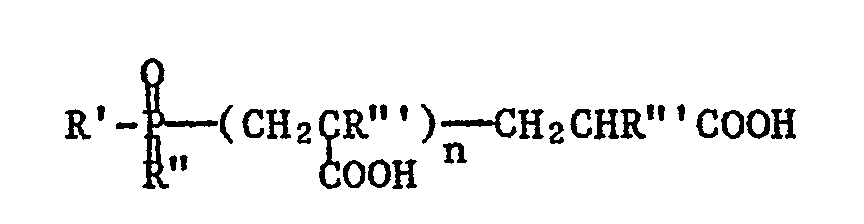

- Weiter gibt es zahlreiche Produktionsanlagen wie z.B. Industrie-Dampfkessel, Kühlwassersysteme, Gaswaschanlagen, Schlammanlagen, wie z.B. Kaolin-Schlammanlagen, wo es wichtig ist, die verschiedenen in Wässern solcher Anlagen vorkommenden Feststoffe in suspendiertem oder dispergiertem Zustand zu erhalten. Falls solche Feststoffe nicht mehr im Wasser suspendiert sind, kann es zur Verstopfung der Anlage kommen z.B. in sogenannten "Once-through"-Kühlsystemen. Im Falle von reichlichem Wasserangebot in der Nähe von Industrieanlagen, wird die Kühlung durch Leiten des Wassers durch Abhitzekessel vorgenommen, wobei das Wasser anschliessend zum Entnahmeort zurückgeleitet wird. Vom ökonomischem Standpunkt her, ist jedoch ein konventionelles Filtrieren des Wassers nicht durchführbar, wegen der grossen Wassermengen, die bei diesem System benötigt werden. Deshalb findet die Bildung von Ablagerungen in der Anlage leicht statt und es ist nötig, den Betrieb periodisch wegen Reinigungsarbeiten einzustellen. Zudem führt die Korrosion der Anlage zur Ablagerung von Eisenoxiden und/oder Eisensalzen, welche, wenn sie nicht sorgfältig kontrolliert wird, zum Stillstand und mechanischem Versagen der Anlage führen.
- Ein weiterer Problembereich ist die Ansammlung von Schlamm und Schmutz, die sich am Boden von Wassertanks und Ballasttanks von Schiffen ablagert und damit die Oekonomie des Unterhalts und des Betriebs des Schiffes beeinträchtigt.
- Ein anderer mit der unerwünschten Ablagerung aus wässrigen Systemen auf Metalloberflächen verbundener Problemkreis ergibt sich während des Versiegelns von anodisch auf Aluminium aufgebrachten Oxidschichten. Bei solchem Versiegeln unter Verwendung von heissem oder kochendem Wasser werden nicht nur die Poren der Oxidschichten versiegelt, sondern es bildet sich auch dicker, samtartiger Ueberzug ("Sealing-smut") über die ganze Oberfläche. Es besteht nun ein Bedarf nach einem verbesserten "Sealing-smut"-Inhibitor.
- Es wurden nun cotelomere Verbindungen gefunden, die Kesselsteininhibierende Wirkung vergleichbar mit derjenigen der Telomeren aus GB 1,458,235 aufweisen und ausgezeichnete Dispergierungseigenschaften für Partikel sowie gute allgemeine Korrosions-inhibierende Wirkung in wässrigen Systemen besitzen. Die neuen cotelomeren Verbindungen finden auch Verwendung als Versiegelungsschutzinhibitoren.
- Die vorliegende Erfindung betrifft neue cotelomere Verbindungen der Formel 1


- Ammonium oder ein Aminrest ist, R2 ist Wasserstoff, Methyl oder ein Rest -CO2R5, worin R5 Wasserstoff oder geradkettiges oder verzweigtes C1-C8-Alkyl ist, das gegebenenfalls durch eine Hydroxylgruppe substituiert sein kann. R3 ist Wasserstoff, geradkettiges oder verzweigtes C1-C4-Alkyl, Hydroxymethyl oder ein Rest -CO2R6, worin R6 Wasserstoff, ein Rest der Formel

- Salze der cotelomeren Verbindungen der Formel 1 sind Verbindungen, worin einige oder alle sauren Wasserstoffatome in den sauren Verbindungen der Formel I durch Alkalimetallionen, Ammoniumionen oder quaternäre Aminradikale ersetzt werden. Diese Salze haben eabenso gute Inhibitorwirksamkeit in Bezug auf die Ausfällung von unlöslichen Salzen aus wässrigen Lösungen.
- Die Verbindungen der Formel I, Reaktionsprodukte enthaltend Verbindungen der Formel I und deren Salze sind wirksam in Bezug auf die Verhinderung der Kesselsteinbildung und der Salzausfälllung aus wässrigen Lösungen. Die Kesselstein-bildenden Salze leiten sich aus Calcium-, Magnesium-, Barium- oder Strontiumkationen und Sulfat-, Carbonat-, Hydroxid-, Phosphat- oder Silicatanionen her.
- Die Verbindungen der Formel I, Reaktionsprodukte enthaltend Verbindungen der Formel I und deren Salze sind besonders wirksam in Bezug auf die Verhinderung der Ablagerung von Calciumsulfat-, Magnesiumhydroxid-, Calciumphosphat- und Calciumcarbonat-Kesselstein und die Dispergierung von Calciumphosphat-Schlamm.
- Sind R3 und R10 C1-C4-Alkyl, so handelt es sich z.B. um Methyl, Ethyl, n-Propyl, Isopropyl und n-Butyl.
- Sind R 42 R 59 R 69 R 7 und R8 C1-C8-Alkyl, so handelt es sich z.B. um Methyl, Ethyl, n-Propyl, Isopropyl, n-Butyl, n-Pentyl, n-Hexyl und n-Octyl.
- Sind R5 oder R6 Hydroxy-substituiertes C1-C8-Alkyl, so handelt es sich z.B. um Hydroxymethyl, 2-Hydroxyethyl, 2- oder 3-Hydroxypropyl, 2- oder 4-Hydroxybutyl, 2- oder 6-Hydroxyhexyl und 2- oder 8-Hydroxyoctyl.
- Ist R4 Carboxy-substituiertes C1-C8-Alkyl, so handelt es sich z.B. um Carboxymethyl, Carboxyethyl, Carboxypropyl oder 1,1-Dicarboxymethyl.
- Sind X und/oder M Alkali-Metallatome, so handelt es sich bevorzugt um Natrium- oder Kalium-Atome; im Fall von X und/oder M als Erdalkali-Metallatome handelt es sich um Calcium-, Barium- und Strontium-Atome. Ist X ein Amin-Rest, so handelt es sich z.B. um Ammonium, -NH(CH3)3, -NH(C2H5)3 oder -NH(CH2CH2-OH)3.
- Vorzugsweise ist B ein Rest A mit der vorstehend beschriebenen Bedeutung und R1 vorzugsweise ein Rest -OM, worin M die vorstehend beschriebene Bedeutung hat.
- Bevorzugte Verbindungen der Formel I sind die, worin B ein Rest A ist, worin R Wasserstoff ist, R2 Wasserstoff oder ein Rest -COOR5, worin R5 Wasserstoff oder C1-C8-Alkyl ist, R3Wasserstoff oder COOR6 ist, mit R6 in der vorstehend beschriebenen Bedeutung, R4 ein Rest -COOR6 ist, worin R6 Wasserstoff oder C1-C4-Alkyl ist, das gegebenenfalls durch eine Hydroxygruppe substituiert sein kann, oder R4 G1-C8-Alkyl, das gegebenenfalls durch eine oder zwei Carboxylgruppen substituiert sein kann, Phenyl, Acetomethyl, -S03M oder -P03 M2 (mit M in der vorstehend beschriebenen Bedeutung), -CONR7R8 (mit R und R8 in der vorstehend beschriebenen Bedeutung) oder -N(R10)COCH3 (mit R10 in der vorstehend beschriebenen Bedeutung) ist und, worin R1 die vorstehend beschriebene Bedeutung hat und die Summe von m und n 3 bis 32 beträgt.
- Bevorzugt ist das Verhältnis m:n im Bereich von 90:10 bis 10:90.
- Beispiele der Basen, mit denen Verbindungen der Formel I umgesetzt werden können zu Teilsalzen oder Salzen, sind Natrium-, Kalium- und Ammonium-Hydroxide und -Carbonate. Gleichermassen können organische Basen verwendet werden, wie z.B. primäre, sekundäre und tertiäre Alkyl- und substituierte Alkylamine, worin die Gesamtzahl der C-Atome 12 nicht übersteigt wie z.B. Triethanolamin.
- Die vorliegende Erfindung betrifft im weiteren ein Verfahren zur Herstellung der cotelomeren Verbindungen der Formel I enthaltend die Umsetzung von n Molen einer Säure der Formel IV


- Beispiele von Co-monomeren der Formel V sind z.B. Acrylamid, N-Hydroxymethylacrylamid, N,N-Dimethylacrylamid, N-Vinyl-N-methylacetamid, N-Allylacetamid, N-Acrylamidoglycolsäure, Methacrylsäure, Methylmethacrylat, 2-Hydroxyethylmethacrylat, 2-Hydroxypropylmethacrylat, 2-Hydroxyethylacrylat, 2-Hydroxypropylacrylat, Maleinsäure, 2-Carboxyethylacrylat, 3-Buten-1,2,3-Tricarbonsäure, Dimethylmaleat, Diethylmaleat, Diethylfumarat, Itaconsäure, Dimethylitaconat, Vinylsulfonsäure, Allylsulfonsäure, 4-Styrolsulfonsäure, Na- oder K-Salz der 3-Sulfopropylacrylsäure, Acrylamidomethyl- propan-2-sulfonsäure, Vinylphosphonsäure, Styrolphosphonsäure, Allylalcohol, Allylacetat, Vinylacetat, Styrol, a-Methylstyrol, Hexen, Octen, N-Acrylamidopropansulfonsäure, Glycidylmethacrylat, Crotonsäure, Ethylcrotonat, Polyethylenglycolester und Polypropylenglycolester der Metharcyl-und Acrylsäuren.
- Andererseits kann ein Salz der Verbindung VI verwendet werden, worin die sauren Wasserstoffatome teilweise oder vollständig durch Kationen ersetzt sind, die sich von den vorstehend beschriebenen, salzbildenden Basen ableiten.
- Die Reaktion wird, wie im US 2,957,931 beschrieben, in einem unter den Reaktionsbedingungen inerten Lösungsmittel und in Gegenwart eines Reaktionsauslösers durchgeführt. Geeignete Reaktionslösungsmittel sind z.B. Wasser, wässriges Ethanol oder Dioxan. Geeignete Reaktionsauslöser sind Verbindungen, die sich unter den Reaktionsbedingungen unter Bildung freier Radikale zersetzen. Beispiele für solche Verbindungen sind Bisazoisobutyronitril, organische Peroxide wie z.B. Benzoylperoxid, Methylethylketonperoxid, Di-tert.-butylperoxid und Monobutylhydroperoxid, sowie oxidierende Stoffe wie z.B. Wasserstoffperoxid, Natriumperborat und Natriumpersulfat.
- Die Produkte diese Verfahrens werden als Lösungen erhalten. Diese können bei vermindertem Druck teilweise oder vollständig eingedampft werden. Die rohen Reaktionsprodukte können als cotelomere Produkte in der erfindungsgemässen Anwendung eingesetzt werden. Jedoch können die Reaktionsprodukte auch gereinigt werden. Die Reinigung kann auf folgende Weise durchgeführt werden.
- 1. Eindampfen des Reaktionslösungsmittels, Lösen des Rückstandes in Wasser, Waschen der Lösung mit einem mit Wasser nichtmischbaren organischen Lösungsmittel wie z.B. Ether und Eindampfen der wässrigen Lösung.
- 2. Eindampfen des Reaktionslösungsmittels, Lösen des Rückstandes in Methanol und erneute Ausfällung durch Zugabe von Ether.
- Falls die Reaktionsprodukte ohne weitere Reinigung verwendet werden, ist das Verhältnis der Reaktionskomponenten wichtig, weil sich die Aktivität der Produkte dementsprechend verändert.
- Salze der Verbindungen der Formel I, worin die sauren Wasserstoffatome teilweise oder vollständig durch Kationen ersetzt sind, die sich von den vorstehend beschriebenen, salzbildenden Basen ableiten, können durch Mischen einer wässrigen oder alkoholischen Lösung der Verbindung der Formel I mit einer wässrigen oder alkoholischen Lösung enthaltend die benötigte Base im Ueberschuss, im stöchiometrischen Verhältnis oder im Unterschuss hergestellt werden. Das Lösungsmittel wird durch Eindampfen entfernt.
- Die genauen Strukturen der durch dieses Verfahren hergestellten Produkte sind nicht vollständig aufgeklärt. NMR-spektroskopische Untersuchungen haben jedoch gezeigt, dass neben nicht umgesetzter Verbindung der Formel VI und polymeren Verbindungen aus einer Säure der Formel IV und Verbindungen der Formel V das Reaktionsprodukt aus dem vorstehend beschriebenen Verfahren noch eine Verbindung der Formel I wie vorstehend beschrieben enthält.
- Die vorliegende Erfindung betrifft im weiteren ein Verfahren zur Behandlung eines teilweise oder ganz wässrigen Systems, das mit Metalloberflächen in Kontakt steht, zur Verhinderung der Kesselsteinablagerung auf den Metalloberflächen und/oder zur Verhinderung der Korrosion der Metalloberflächen und/oder besser Dispergierbarkeit von festen Partikeln im wässrigen System und/oder zur Verhinderung der Ablagerung von "Sealing-Smut" aus diesen wässrigen Systemen, das darin besteht, dass dem wässrigen System eine funktionell wirksame Menge einer cotelomeren Verbindung der Formel I, wie vorstehend beschrieben, oder eines Salzes davon zugesetzt wird.
- In der Praxis ist die Menge an Verbindung der Formel I, die zur Behandlung der Metalloberfläche verwendet wird, z.B. durch Zugabe der Verbindung zu dem in Kontakt mit der Metalloberfläche stehenden wässrigen System, je nach Schutzfunktion verschieden, welche die Verbindung ausüben soll. Bei der Korrossionsschutzbehandlung, gegebenenfalls in Kombination mit der Behandlung zur Verhinderung der Kesselsteinbildung, liegt die geeignete Menge dieser dem wässrigen System zugesetzten Verbindung im Bereich von 0.1 bis 50'000 ppm (oder 0.00001 bis 5 Gew.-%) bevorzugt von 1 bis 500 ppm (oder 0.0001 bis 0.05 Gew.-%) bezogen auf das wässrige System. Für blosse Anti-Kesselstein-Wirkung liegt die geeignete Menge dieser Verbindung der Formel I im Bereich von 1 bis 2000 ppm, bevorzugt 1 bis 30 ppm, bezogen auf das wässrige System.
- Zur Behandlung von meist relativ verdünnten wässrigen Dispersionen beträgt die geeignete Menge der Verbindung der Formel I, die als Dispergiermittel erfindungsgemäss eingesetzt wird, 1 bis 200 ppm, bevorzugt 2 bis 20 ppm. Jedoch können bei der Behandlung von wässrigem Schlamm sehr viel grössere Mengen der Verbindung der Formel I benötigt werden, z.B. 0.1 bis 5 Gew.-% bezogen auf die Gesamtfeststoffmenge, welche bis zu 70 Gew.-% des gesamten wässrigen Systems betragen kann.
- Wird eine Verbindung der Formel I als "Sealing-smut"-Inhibitor in einer wässerigen Versiegelungs-Lösung zur Versiegelung von anodisch auf Aluminiumoberflächen aufgebrachten Oxidschichten verwendet, liegt die geeignete Menge der Verbindung der Formel I im Bereich von 0.0005 bis 0.5 g/1 verwendeter wässriger Versiegelungs-Lösung.
- Hinsichtlich der wässrigen Systeme, welche nach der vorliegenden Erfindung behandelt werden können, sind bezüglich der kombinierten Korrosionsschutz- und Kesselsteinverhinderungs-Wirkung die folgenden von besonderem Interesse: Kühlwassersysteme, Dampferzeugungsanlagen, Meerwassersysteme, Dampferzeugungsanlagen, Meerwasser-Verdampfungsanlagen hydrostatische Kocher, Gaswaschanalgen, geschlossene Heizsysteme, Kühlsysteme auf wässriger Basis und Tiefbohr-Systeme (down-well systems).
- Bezüglich der Korrosionsschutzbehandlung allein sind die folgenden wässrigen Systeme von besonderer Bedeutung: Wässrige Flüssigkeitsformulierungen in der maschinellen Bearbeitungstechnik (wie z.B. Bohren, Fräsen, Auftreiben, Nuten ziehen, Ziehen, Drücken auf der Drehbank, Drehen, Schneiden, Sägen, Schleifen, Gewindeschneiden oder in spanloser Umformung bei Zieh- und Walzvorgängen), wässrige Reinigungssysteme, Motoren-Kühlmittel einschliesslich der wässrigen Glycol-Frostschutzsysteme, Wasser/Glycol-Hydraulikflüssigkeiten und Polymer-Oberflächen-Ueberzugssysteme auf wässriger Basis oder Polymer-Systeme auf Lösungsmittelbasis wie z.B. die, die Tetrahydrofuran, Ketone oder Alkoxyalkanole enthalten.
- Die erfindungsgemäss verwendeten Inhibitoren können allein oder zusammen mit andern bei der Behandlung von wässrigen Systemen üblichen Zusätzen verwendet werden.
- Bei der Behandlung von ausschliesslich wässrigen Systemen, wie z.B. Kühlwassersystemen, Airconditioning-Systemen, Dampferzeugungsanlagen, Meerwasser-Verdampfungsanlagen, hydrostatischen Kochern und geschlossenen Heizungs- oder Kühlsystemen, können weitere Korrosionsinhibitoren verwendet werden, wie z.B. wasserlösliche Zinksalze, Phosphate, Polyphosphate, Phosphonsäuren und ihre Salze, wie z.B. Acetodiphosphonsäure, Nitrilo-tris-methylen-phosphonsäure und Methylamino-dimethylenphosphonocarbonsäuren und ihre Salze wie z.B. in der Deutschen Offenbarungsschrift No. 2,632,774 beschrieben, Hydroxyphosphonoessigsäure, 2-Phosphonobutan-1,2,4-tricarbonsäure und die in der Britischen Patentschrift No. 1,572,406 beschriebenen; Chromate wie z.B. Natriumchromat; Nitrate wie z.B. Natriumnitrat; Nitrite wie z.B. Natriumnitriat; Molybdate wie z.B. Natriummolybdat, Wolframate, Silikate wie z.B. Natriumsilikat, Benztriazol, Bis-benztriazol oder Kupfer passivierende Benztriazol- und Tolutriazolderivate oder deren Mannichbasenderivate; N-Acylsarcosine;-N-Acyl- imino-diessigsäuren, Ethanolamine; Fettamine; Polycarbonsäuren wie z.B. Polymaleinsäure und Polyacrylsäure sowie deren Alkalisalze, Copolymere von Maleinsäureanhydrid wie z.B. Copolymere von Maleinsäureanhydrid und sulfoniertem Styrol, Copolymere der Acrylsäure, wie z.B. Copolymere von Acrylsäure mit hydroxyalkylierter Acrylsäure, sowie substituierte Derivate von Polymaleinsäuren und Acrylsäuren und deren Salze. Im weitern können die erfindungsgemäss verwendeten Inhibitoren in solchen auschliesslich wässrigen Systemen zusammen mit weitern Dispergierungs- und /oder Antifällungsmitteln wie z.B. Polyacrylsäure (oder deren Salze), Phosphinopolycarbonsäuren (wie in der Britischen PS 1,458,235 beschrieben), hydrolysiertes Polyacrylnitril, Polymethacrylsäure und deren Salze, Polyacrylamid und dessen Copolymere mit Acryl und Polyacrylsäuren, Ligninsulfonsäuren und deren Salze, Tannin, Naphthalinsulfonsäure/-Formaldehyd Kondensationsprodukte, Stärke und Stärkederivate, Cellulose, Acrylsäure/Niederalkyl-hydroxyacrylat-Copolymere wie in der US-Patentschrift No. 4,029,577 beschrieben, Styrol/Maleinsäureanhydrid-Copolymere und Styrolsulfonsäure-Homopolymere wie z.B. in der US Patentschrift 4,374,733 beschrieben und Kombinationen davon, verwendet werden.
- Spezifische Antifällungsmittel wie z.B. 2-Phosphonobutan-I,2,4-tricarbonsäure, Acetodiphosphonsäure, hydrolysiertes Polymaleinanhydrid und seine Salze, Alkylphosphonsäuren, Hydroxyphosphonoessigsäure, I-Aminoalkyl-l,l-diphosphonsäuren und ihre Salze sowie Alkali-Polyphosphate können ebenso verwendet werden.
- Auch Fällungsmittel wie Alkali-Orthophosphate und Carbonate, Sauerstoffänger, wie Alkalisulfite und Hydrazine, Komplexierungsmittel, wie Nitrilotriessigsäure und deren Salze, Schaum-brechende Mittel, wie Silikone wie z.B. Polydimethylsiloxane, Distearylsebacamid, Distearyladipamid und ähnliche von Ethylenoxid-und/oder Propylenoxidkondensationen abgeleitete Produkte, Additionsprodukte von Fettalkoholen, wie Caprylalkohle und deren Kondensationsprodukte mit Ethylenoxid, ferner Biocide wie z.B. Amine, quaternäre Ammoniumverbindungen, Chlorphenole, schwefelhaltige Verbindungen, wie Sulfone, Methylen-bis-thiocyanate und -Carbamate, Isothiazolone, Brompropionamide, Triazine, Phosphoniumverbindungen, Chlor und Chlor abgebende Stoffe und Organometallverbindungen wie Tributyl-zinnoxid können zusätzlich eingesetzt werden.
- Im Falle des Einsatzes der erfindungsgemässen Behandlung in nicht vollständig wässrigen Systemen, wie z.B. wässrige Flüssigkeiten in der maschinellen Bearbeitungstechnik, kann es sich z.B. um eine mit Wasser verdünnbare Schneide- oder Schleifflüssigkeit handeln.
- Bei den erfindungsgemässen wässrigen Flüssigkeiten in der maschinellen Bearbeitungstechnik handelt es sich z.B. um Formulierungen für die Metallbearbeitung. Unter Metallbearbeitung soll Auftreiben, Nuten ziehen, Ziehen, Drücken auf der Drehbank, Schneiden, Schleifen, Bohren, Fräsen, Drehen, Sägen, spanlose Umformung oder Walzen verstanden werden. Beispiele für mit Wasser verdünnbare Schneide-oder Schleifflüssigkeiten, in welche die Korrosionsinhibitor-Zusammensetzung eingearbeitet werden kann sind:
- a) Wässrige Konzentrate eines oder mehrerer Korrosionsinhibitoren und gegebenenfalls eines oder mehrerer Verschleissschutzadditive, die in Verdünnungen von 1:50 bis 1:100 üblicherweise als Schleifflüssigkeiten eingesetzt werden.
- b) Polyglykole enthaltend Biocide, Korrosionsinhibitoren und Verschleissschutzadditive, welche in Verdünnungen von 1:20 bis 1:40 bei Schneidevorgängen und in Verdünnungen von 1:60 bis 1:80 für Schleifvorgänge eingesetzt werden.
- c) Halbsynthetische Schneideflüssigkeiten ähnlich wie unter b), die aber zusätzlich noch 10 bis 25 % Oel und genügend Emulgator enthaltend um das mit Wasser verdünnte Produkt halbdurchsichtig zu machen.
- d) Ein emulgierbares Mineralölkonzentrat enthaltend z.B. Emulgatoren, Korrosionsinhibitoren, Hochdruck- und Verschleissschutzadditive, Biocide, Schaumbrecher, Kupplungsvermittel und weitere Stoffe, welches im allgemeinen mit Wasser im Verhältnis von 1:10 bis 1:50 verdünnt eine weisse opaleszierende Emulsion ergibt.
- e) Ein Produkt ähnlich wie unter d), enthaltend weniger Oel und mehr Emulgator, welches bei einer Verdünnung im Bereich von 1:50 bis 1:100 eine halbdurchsichtige Emulsion für Schneide- und Schleifzwecke ergibt.
- Für diese teilweise wässrigen Systeme, worin die wässrige Systemkomponente eine wässrige Flüssigkeitsformulierung zur maschinellen Bearbeitung ist, können die erfindungsgemässen Inhibitoren allein oder zusammen mit andern Additiven wie z.B. weitern bekannten Korrosionsinhibitoren und/oder Hochdruck-Additiven eingesetzt werden.
- Beispiele anderer Kossosionsinhibitoren, welche in diesen wässrigen Systemen zusammen mit der erfindungsgemäss eingesetzten Inhibitor- zusammensetzung verwendet werden können, sind folgende:
- a) Organische Säuren, ihre Ester, Ammonium- Amin-, Alkanolamin- und Metallsalze wie z.B. Benzoesäure, p-tert.-Butyl-benzoesäure, Di-Na-sebacat, Triethanolaminlaurat, Isononansäure, Triethanolaminsalz der p-Toluol-sulfonamidocapronsäure, Triethanolaminsalz der Benzol-sulfonamidocapronsäure, Triethanolaminsalze der 5-Ketocarbonsäureabkömmlinge, wie sie in der Europäischen Patentschrift No. 41 927 beschrieben sind, Natrium-N-Lauroyl-sarcosinat oder Nonylphenoxyessigsäure.
- b) Stickstoffhaltige Stoffe wie die folgenden: Fettsäurealkanolamide, Imidazoline wie z.B. 1-Hydroxy-ethyl-2-oleyl-imidazoline, Oxazoline, Triazole wie z.B. Benztriazole oder deren Mannich-Basen-Derivate, Triethanolamine, Fettamine, anorganische Salze wie z.B. Natriumnitrat, und die in der Europäischen Patentanmeldung No. 46 139 beschriebenen Carboxy-Triazinverbindungen.
- c) Phosphorhaltige Stoffe wie die folgenden:
- Aminphosphate, Phosphonsäuren oder anorganische Salze wie z.B. Na-Dihydrogenphosphat der Zinkphosphat.
- d) Schwefelhaltige Verbindungen wie die folgenden:
- Natrium-, Calcium- oder Barium-Petrolsulfonate, oder heterocyclische Verbindungen wie z.B. Na-Mercaptobenzthiazol.
- Stickstoffhaltige Stoffe insbesondere Triethanolamin werden bevorzugt.
- Beispiele für Hochdruckadditive, die in den erfindungsgemäss behandelten Systemen verwendet werden können sind Schwefel und/oder Phosphor und/oder Halogen enthaltende Verbindungen wie geschwefeltes Spermöl, geschwefelte Fette, Tritolylphosphat, chlorierte Paraffine oder ethoxylierte Phosphatester.
- Wird Triethanolamin in den erfindungsgemäss behandelten Systemen verwendet, so beträgt das Verhältnis der Inhibitorzusammensetzung zu Triethanolamin 2:1 bis 1:20.
- Die teilweise wässrigen erfindungsgemäss behandelten Systeme können auch wässrige Oberflächenbeschichtungssysteme sein, z.B. sogenannte Primer-Emulsionsfarben und wässrige Pulver-Beschichtungsmittel für metallische Substrate.
- Die wässrigen Oberflächenbeschichtungsmittel können z.B. Anstrichfarben sein, wie Styrol/Acryl-Copolymer-Emulsionsfarben, Harze, Latex oder andere polymere Oberflächenbeschichtungsmittel auf wässriger Basis, um ein metallisches Substrat zu beschichten.
- Die erfindungsgemäss benutzte Inhibitor-Zusammensetzung kann verwendet werden, um das Schnellrosten des Metallsubstrats während der Auftragung der Oberflächen-Beschichtung und die nachfolgende Korrosion während der Benutzung des beschichteten Metalls zu verhindern.
- In den erfindungsgemäss behandelten, wässrigen Oberflächenbeschichtungssystemen kann die Inhibitorzusammensetzung allein oder in Mischung mit andern Additiven wie z.B. bekannten Korrosionsinhibitoren, Biociden, Emulgatoren und/oder Pigmenten verwendet werden.
- Als weitere bekannte Korrosionsinhibitoren können z.B. solche der im Vorangehenden unter a), b), c) und d) genannten Art eingesetzt werden.
- Als Beispiele von Biociden für derartige wässrige Systeme, die zusammen mit der Verbindung der Formel I eingesetzt werden können, seien genannt: Phenole, alkylierte und halogenierte Phenole, wie z.B. Pentachlorphenol, o-Phenylphenol, o-Phenoxyphenol und chloriertes o-Phenoxyphenol, ferner Salicylanilide, Diamine, Triazine und metallorganische Verbindungen, wie Organoquecksilber- und OrganozinnVerbindungen.
- Als Pigmente können in derartigen, wässrigen Systemen zusammen mit der Verbindung der Formel I, z.B. Titandioxid, Zinkchromat, Eisenoxid und organische Pigmente, wie Phthalocyanine, eingesetzt werden.
- Produkte, enthaltend Cotelomere der Formel I, können auch als Dispergiermittel und/oder Antiverstopfungsmittel für gewöhnliche Ablagerungen, wie z.B. Eisenoxide und/oder Eisensalze, Calcium- und Magnesiumablagerungen, wie z.B. deren Carbonate, Sulfate, Oxalate und Phosphate, sowie Schlamm, Tonerde, Silikate und Tone, wie sie in solchen Wässern vorkommen, eingesetzt werden.
- Im besonderen kann die erfindungsgemässe Behandlung bei dispersen Ablagerungen in wässrigen Systemen angewendet werden, worin 5 bis 1500 Gewichts-ppm Calciumionen und/oder suspendierte Feststoffe enthalten sind.
- Dieser Aspekt der vorliegenden Erfindung findet seine besondere Anwendung in der Porzellanerde-Industrie, wo es wichtig ist, Flüssiggemische zu erhalten, die sich nicht während des Transports von der Tongrube zum Verbraucher entmischen. Bei hohen Konzentrationen an suspendierten Feststoffen in diesen Flüssig-Gemischen wurde gefunden, dass die Cotelomere der Formel I die Porzellanerde dispergieren und wertvolle "in Prozess" Dispergiermittel und Mahlhilfsmittel darstellen.
- Die erfindungsgemässe Behandlung kann auch zur Verhinderung der Bildung von unerwünschten Aluminiumhydroxid Schichten ("Sealing-Smut") beim Versiegeln von anodisch auf Aluminium und dessen Legierungen aufgebrachten Oxidschichten eingesetzt werden.
- So kann die Verbindung der Formel I, als "Sealing Smut"-Inbibitor der wässerigen Versiegelungslösung, die zur Versiegelung solcher anodisch auf Aluminium-(oder Aluminiumlegierungs-)oberflächen aufgebrachten Oxidschichten dient, zugesetzt werden. Solche Lösungen haben normalerweise einen pH-Wert von 4 bis 8 und werden bei 90-100°C eingesetzt.
- .Beispiel 1: Cotelomer aus Acrylsäure und 2-Hydroxypropylacrylat im Verhältnis 84.7:15.3 mit Natriumhypophosphit im Molverhältnis Monomere:Natriumhypophosphit von 4:1.
- Eine Lösung von 18.2 g (0.206 Mol) Natriumhypophosphit in 70 g Wasser wird auf 75°C erhitzt. Zu dieser Lösung werden über 2 Stunden gleichzeitig a) eine Lösung von 6.37 g Natriumpersulfat in 109 g Wasser und b) eine Mischung von 54 g (0.75 Mol) Acrylsäure und 9.75 g (0.075 Mol) 2-Hydroxypropylacrylat zugegeben. Nach Beendigung der Zugabe wird das Reaktionsgemisch auf 85°C erhitzt und während 90 Minuten bei dieser Temperatur gehalten. Es werden 263 g einer wasserhellen Lösung mit einem Feststoffgehalt von 32.9 % erhalten.
- Beispiel 2: Cotelomer aus Acrylsäure und 2-Hydroxypropylacrylat im Verhältnis 84.7:15.3 mit Natriumhypophosphit im Molverhältnis Monomere:Natriumhypophosphit von 16:1.
- Das Herstellungsverfahren ist analog zu dem in Beispiel 1 mit dem Unterschied, dassd 4.54 g (0.0516 Mol) Natriumhypophosphit, an Stelle von 18.2 g, in 52 g Wasser gelöst, eingesetzt wird und das Natriumpersulfat in 100 g Wasser gElöst ist.
- Es werden 221 g einer blassgelben Lösung mit einem Feststoffgehalt von 33.1 % erhalten.
- Beispiel 3: Cotelomer aus Acrylsäure und 2-Hydroxypropylacrylat im Verhältnis von 62.4:37.6 mit Natriumhypophosphit im Molverhältnis Monomere:Natriumhypophosphit von 4:1.
- Das Herstellungsverfahren von Beispiel 1 wird, unter Einsetzung folgender Edukte, analog angewandt.
- 17.6 g (0.2 Mol) Natriumhypophosphit gelöst in 100 g Wasser 6.82 g Natriumpersulfat, gelöst in 90 g Wasser 43.2 g (0.6 Mol) Acrylsäure und 26 g (0.2 Mol) 2-Hydroxypropylacrylat.
- Es werden 282 g einer wasserhellen Lösung mit einem Feststoffgehalt von 32.4 % erhalten.
- Beispiel 4: Cotelomer aus Acrylsäure und 2-Hydroxypropylacrylat im Verhältnis von 62.4:37.6 mit Natriumhypophosphit im Molverhältnis Monomere:Natriumhypophosphit von 16:1.
- Das Herstellungsverfahren von Beispiel 1 wird, unter Einsetzung folgender Edukte, analog angewandt.
- 4.4 g (0.05 Mol) Natriumhypophosphit, gelöst in 63 g Wasser 6.92 g Natriumpersulfat, gelöst in 100 g Wasser 43.2 g (0.6 Mol) Acrylsäure und 26 g (0.2 Mol) 2-Hydroxypropylacrylat.
- Es werden 241 g einer blassgelben Lösung mit einem Feststoffgehalt von 32.8 % erhalten.
- Beispiel 5: Cotelomer aus Acrylsäure und Natriumvinylsulfonat im Verhältnis von 35.6:64.4 mit Natriumhypophosphit im Molverhältnis Monomere:Natriumhypophosphit von 16:1.
- Eine Lösung von 5.5 g (0.0625 Mol) Natriumhypophosphit in 100 g Wasser wird zum Rückfluss erhitzt. Zu dieser Lösung werden über 2 Stunden a) eine Lösung von 10.1 g Natriumpersulfat in 100 g Wasser und b) eine Mischung von 36 g (0.5 Mol) Acrylsäure und 188 g (0.5 Mol) einer 35%igen wässrigen Lösung von Natriumvinylsulfonat zugegeben.
- Nach Beendigung der Zugabe wird das Reaktionsgemisch während weitern 2 Stunden zum Rückfluss erhitzt. Dann wird die Reaktionsapparatur zum Destillieren umgebaut und die Reaktionslösung eingeengt bis der Feststoffgehalt 51 % beträgt.
- 31P-NMR-spektroskopische Analyse zeigt Signale bei 54.3-47.5 tieferem Feld als H3P04 (Monomer-P-Monomerbindung).
- Beispiel 6: Cotelomer aus Acrylsäure und N-Acrylamidopropansulfonsäure im Verhältnis 41:59 mit Natriumhypophosphit im Molverhältnis Monomere:Natriumhypophosphit von 24:1.
- Eine Lösung von 2.75 g (0.03125 Mol) Natriumhypophosphit in 100 g Wasser wird zum Rückfluss erhitzt. Zu dieser Lösung werden über 2 Stunden gleichzeitg a) eine Lösung von 6.9 g Natriumpersulfat in 100 g Wasser und b) eine Lösung von 36 g (0.5 Mol) Acrylsäure und 51.75 g (0.25 Mol) Acrylamidopropansulfonsäure in 150 g Wasser zugegeben. Nach Beendigung der Zugabe wird das Reaktionsgemisch während weitern 2 Stunden zum Rückfluss erhitzt. Es werden 444.5 g einer Lösung mit einem Feststoffgehalt von 23.7 % erhalten. Die 31 P-NMR-spektroskopische Analyse zeigt Signale bei 54.2 (Monomer-P-Monomerbindung) und bei 36.0 (H-P-Monomerbindung) tieferem Feld als H3 P0 4.
- Beispiel 7: Cotelomer aus Acrylsäure und 2-Hydroxyethylacrylat im Verhältnis 86.1:13.9 mit Natriumhypophosphit im Molverhältnis Monomere:Natriumhypophosphit von 4:1. Eine Lösung von 18.15 g (0.206 Mol) Natriumhypophosphit in 70 g Wasser wird auf 75°C erhitzt. Zu dieser Lösung wird über 2 Stunden gleichzeitig a) eine Lösung von 6.27 g Natriumpersulfat in 106.9 g Wasser und b) eine Mischung von 54 g (0.75 Mol) Acrylsäure und 8.7 g (0.075 Mol) 2-Hydroxyethylacrylat zugegeben. Nach Beendigung der Zugabe wird die Temperatur auf 85°C erhöht und während 2 Stunden auf dieser Höhe gehalten. Es werde 260 g einer blassgelben Lösung mit einem Feststoffgehalt von 33 % erhalten.
- Beispiel 8: Cotelomer aus Acrylsäure und 2-Hydroxyethylacrylat im Verhältnis 86.1:13.9 mit Natriumhypophosphit im Molverhältnis Monomere:Natriumhypophosphit von 16:1.
- Das Herstellungsverfahren ist analog zu dem in Beispiel 7 mit dem Unterschied, dass eine Lösung von 4.54 g (0.0516 Mol) Natriumhypophosphit in 49 g Wasser und eine Lösung von 6.27 g Natriumpersulfat in 100 g Wasser eingesetzt werden.
- So werden 221 g einer blassgelben Lösung mit einem Feststoffgehalt von 33.3 % erhalten.
- Beispiel 9: Cotelomer aus Acrylsäure und 2-Hydroxyethylacrylat im Verhältnis 65:35 mit Natriumhypophosphit im Molverhältnis Monomere:Natriumhypophosphit von 4:1.
- Das Herstellungsverfahren ist analog zu dem in Beispiel 7 mit dem Unterschied, dass eine Lösung von 14.7 g (0.167 Mol) Natriumhypophosphit in 80 g Wasser, 5.53 g Natriumpersulfat in 73.5 g Wasser, 36 g (0.-5 Mol) Acrylsäure und 19.37 g (0.167 Mol) 2-Hydroxyethylacrylat eingesetzt werden.
- Beispiel 10: Cotelomer aus Acrylsäure und 2-Hydroxyethylacrylat im Verhältnis 65:35 mit Natriumhypophosphit im Molverhältnis Monomere:Natriumhypophosphit von 16:1.
- Das Herstellungsverfahren ist analog zu dem von Beispiel 7 unter Einsetzung der folgenden Edukte:
- 3.67 g (0.0418 Mol) Natriumhypophosphit gelöst in 40 g Wasser
- 5.53 g Natriumpersulfat gelöst in 90 g Wasser
- 36 g (0.5 Mol) Acrylsäure und
- 19.37 g (0.167 Mol) 2-Hydroxyethylacrylat.
- Beispiel 11: Cotelomer aus Acrylsäure und Acrylamid im Verhältnis von 70:30 mit Natriumhypophosphit im Molverhältnis Monomere:Natriumhypophosphit von 16:1.
- Zu 150 g Wasser unter Rückfluss werden gleichzeitig über 2 Stunden a) eine Lösung von 151.2 g Acrylsäure 64.8 Teile Acrylamid und 16.5 g Natriumhypophosphit in 450 Teilen Wasser und b) eine Lösung von 4.44 g Natriumpersulfat in 450 g Wasser zugegeben. Nach Beendigung der Zugabe wird das Reaktionsgemisch während weitern 2 Stunden zum Rückfluss erhitzt und anschliessend auf Raumtemperatur abgekühlt. Es werden 1137 g einer wasserhellen Lösung mit einem Feststoffgehalt von 19.9 % erhatlen. Die 31 P-NMR-spektroskopische Analyse zeigt Signale bei 41.2 (Monomer-P-Monomerbindung) und bei 26.1 (H-P-Monomerbindung) tieferem Feld als H3P04.
- Beispiel 12: Cotelomer aus Acrylsäure und Acrylamidoglycolsäure im Verhältnis von 83.2:16.8 mit Natriumhypophosphit im Molverhältnis Monomere: Natriumhypophosphit von 16:1.
- Zu einer Lösung von 4.54 g Natriumhypophosphit in 50 g Wasser bei 100°C werden gleichzeitig über 2 Stunden a) eine Lösung von 6.37 g Natriumpersulfat in 100 Teilen Wasser und b) eine Lösung von 10.9 g Acrylamidoglycolsäure in 54 g Acrylsäure zugegeben. Nach Beendigung der Zugabe wird das Reaktionsgemisch während weiteren 2 Stunden zum Rückfluss erhitzt und anschliessend auf Raumtemperatur abgekühlt.
- Es werden 221 g einer bernsteinfarbigen Lösung mit einem Feststoffgehalt von 32.7 % erhalten. Die 31P-NMR-spektroskopische Analyse zeigt Signale bei 51.2-48.5 (Monomer-P-Monomerbindung) und bei 31.6-24.8 (H-P-Monomerbindung) tieferem Feld als H3PO4.
- Beispiel 13: Cotelomer aus Acrylsäure und Styrol im Verhältnis von 87.4:12.6 mit Natriumhypophosphit im Molverhältnis Monomere:Natriumhypophosphit von 16:1.
- Das Herstellungsverfahren ist das gleiche wie bei Beispiel 12 mit der Ausnahme, dass die Acrylamidoglycolsäure durch 7.8 g Styrol ersetzt werden. Es werden 219 Teile einer milchigen Dispersion erhalten, die nach Filtration durch einen Glasfrittentrichter (Porosität No. 4) 218 g blassgelbe Lösung mit einem Feststoffgehalt von 32.5 % ergeben. Die 31P-NMR-spektroskopische Analyse zeigt Signale bei 53.2-50.2 (Monomer-p-Monomerbindung) und bei 33.0-30.3 (H-P-Monomerbindung) tieferem Feld als H3PO4.
- Beisiel 14: Cotelomer aus Acrylsäure und Dimethylmaleat im Verhältnis von 83.3:16.7 mit Natriumhypophosphit im Molverhältnis Monomere:Natriumhypophosphit von 16:1.
- Das Herstellungsverfahren ist das gleiche wie bei Beispiel 12 mit der Ausnahme, dass die Acrylamidoglycolsäure durch 10.8 g Dimethylmaleat ersetzt wird.
- Es werden 223.4 g einer blassgelben Lösung mit einem Feststoffgehalt von 32.2 % erhalten. Die 31 P-NMR-spektroskopische Analyse zeigt Signale bei 53.3-50.2 (Monomer-P-Monomerbindung) und bei 36.5 (H-P-Monomer-Bindung) tieferem Feld als H3P04.
- Beispiel 15: Cotelomer aus Acrylsäure und Crotonsäure im Verhältnis von 89.3:10.7 mit Natriumhypophosphit im Molverhältnis Monomere:Natriumhypophosphit von 16:1.
- Das Herstellungsverfahren ist das gleiche wie bei Beispiel 12 mit der Ausnahme, dass die Acrylamidoglycolsäure durch 6.45 g Crotonsäure ersetzt wird.
- Es werden 218.7 Teile einer wasserhellen Lösung mit einem Feststoffgehalt von 32.1 % erhalten. Die 31 P-NMR-spektroskopische Analyse zeigt Signale bei 54.4-48.7 (Monomer-P-Monomerbindung) und bei 27.0 (H-P-Monomerbindung) tieferem Feld als H3PO4.
- Beispiel 16: Cotelomer aus Acrylsäure und Ethyl-a-hydroxymethylacrylat im Verhältnis von 85.4:14.6 mit Natriumhypophosphit im Molverhältnis Monomere:Natriumhypophosphit von 16:1.
- Das Herstellungsverfahren ist das gleiche wie bei Beispiel 12 mit der Ausnahme, dass die Acrylamidoglycolsäure durch 9.25 Teile Ethyl-a-hydroxymethylacrylat ersetzt wird.
- Es werden 222.3 g einer klaren Lösung mit einem Feststoffgehalt von 33.0 % erhalten. Die 31P-NMR-spektroskopische Analyse zeigt Signale bei 52.2-49.5 (Monomer-P-Monomerbindung) und bei 27.6-25.7 (H-P-Monomerbindung) tieferem Feld als H3PO4.
- Beispiel 17: Cotelomer aus Acrylsäure und Methacrylsäure im Verhältnis 89.3:10.7 mit Natriumhypophosphit im Molverhältnis Monomere:Natriumhypophosphit von 16:1.
- Das Herstellungsverfahren ist das gleiche wie bei Beispiel 12 mit der Ausnahme, dass die Acrylamidoglycolsäure durch 5.46 g Methacrylsäure ersetzt wird.
- Es werden 218.8 g einer klaren Lösung mit einem Feststoffgehalt von 32.0 % erhalten. Die 31P-NMR-spektroskopische Analyse zeigt Signale bei 51.4-49.8 (Monomer-P-Monomerbindung) und bei 27-25 (H-P-Monomerbindung) tieferem Feld als H3P04.
- Beispiel 18: Cotelomer aus Acrylsäure und Vinylacetat im Verhältnis 89.3:10.7 mit Natriumhypophosphit im Molverhältnis Monomere:Natriumhypophosphit von 16:1.
- Das Herstellungsverfahren ist das gleiche wie bei Beispiel 12 mit der Ausnahme, dass die Acrylamidoglycolsäure durch 6.45 g Vinylacetat ersetzt wird. Es werden 219.1 g einer Lösung mit einem Feststoffgehalt von 31.6 % erhalten. Die 31 P-NMR-spektroskopische Analyse zeigt Signale bei 51-49.9 (Monomer-P-Monomerbidnung) und bei 26.7-24.6 (H-P-Monomerbindung) tieferem Feld als H3P04.
- Beispiel 19: Cotelomer aus Acrylsäure und Allylalkohol im Verhältnis von 92.5:7.5 mit Natriumhypophosphit im Molverhältnis Monomere:Natriumhypophosphit von 16:1.
- Das Herstellungsverfahren ist das gleiche wie in Beispiel 12 mit der Ausnahme, dass die Acrylamidoglycolsäure durch 4.35 g Allylakohol ersetzt wird. Es werden 215.4 g einer Lösung mit einem Feststoffgehalt von 31.7 % erhalten. Die 31P-NMR-spektroskopische Analyse zeigt Signale bei 54.8-49.8 (Monomer-P-Monomer-Bindung) und bei 26.9 (H-P-Monomer-Bindung) tieferem Feld als H3PO4.
- Beispiel 20: Cotelomer aus Acrylsäure und Diethylvinylphosphonat im Verhältnis von 81.5:18.5 mit Natriumhypophosphit im Molverhältnis Monomere:Natriumhypophosphit von 16:1.
- Das Herstellungsverfahren ist das gleiche wie bei Beispiel 12 mit der Ausnahme, dass die Acrylamidoglycolsäure durch 12.3 g Diethylvinylphosphonat ersetzt wird. Es werden 223.7 g einer Lösung mit einem Feststoffgehalt von 33.7 % erhalten. Die 31 P-NMR-spektroskopische Analyse zeigt Signale bei 51.6-50 (Monomer-p-Monomer- bindung) und bei 34.5-32.5 (H-P-Monomerbindung) tieferem Feld als H3PO4.
- Beispiel 21: Cotelomer aus Acrylsäure und N-Hydroxymethylacrylamid im Verhältnis von 87.7:12.3 mit Natriumhypophosphit im Molverhältnis Monomere:Natriumhypophosphit von 16:1.
- Das Herstellungsverfahren ist das gleiche wie bei Beispiel 12 mit der Ausnahme, dass die Acrylamidoglycolsäure durch 7.57 g N-Hydroxymethylacrylamid ersetzt wird.
- Es werden 209.9 g einer Lösung mit einem Feststoffgehalt von 31.4 % erhalten. Die 31P-NMR-spektroskopische Analyse zeigt Signale bei 50.4-47.7 (Monomer-P-Monomerbindung) und bei 26.5-24.5 (H-P-Monomer- bindung) tieferem Feld als H3P04.
- Beispiel 22: Cotelomer aus Acrylsäure und Itaconsäure im Verhältnis 84.6:15.4 mit Natriumhypophosphit im Molverhältnis Monomere:Natriumhypophosphit von 16:1.
- Das Herstellungsverfahren ist das gleiche wie in Beispiel 12 mit der Ausnahme, dass die Acrylamidoglycolsäure durch 9.8 g Itaconsäure ersetzt wird.
- Es werden 218.5 g einer Lösung mit einem Feststoffgehalt von 32.7 % erhalten. Die 31P-NMR-spektrokopische Analyse zeigt Signale bei 50.9-49.5 (Monomer-P-Monomerbindung) und bei 26.0 (H-P-Monomer- bindung) tieferem Feld als H3P04.
- Beispiel 23: Cotelomer aus Acrylsäure und Natriumvinylsulfonat im Verhältnis von 84.7:15.3 mit Natriumhypophosphit im Molverhältnis Monomere:Natriumhypophosphit 16:1.
- Eine Lösung von 4.54 g Natriumhypophosphit in 50 g Wasser wird auf 100°C erhitzt. Zu dieser Lösung werden gleichzeitig über 2 Stunden a) eine Lösung von 6.37 g Natriumpersulfat in 70.7 g Wasser und b) eine Mischung von 54 g Acrylsäure und 39 g einer 25 %-igen wässrigen Lösung von Natriumvinylsulfonat zugegeben. Nach Beendigung der Zugabe wird das Reaktionsgemisch für weitere 2 Stunden zum Rückfluss erhitzt, dann auf Raumtemperatur abgekühlt und mit 48 g Wasser verdünnt.
- Es werden 269.7 g einer Lösung mit einem Feststoffgehalt von 27.3 % erhalten. Die 31P-NMR-spektroskopische Analyse zeigt Signale bei 52.4-49.3 (Monomer-P-Monomerbindung) und bei 27.4.-25.4 (H-P-Monomerbindung) tieferem Feld als H3P04.
- Beispiel 24: Cotelomer aus Acrylsäure und 3-Buten-1,2,3-tricarbonsäure im Verhältnis von 79.3:20.7 mit Natriumhypophosphit im Molverhältnis Monomere:Natriumhypophosphit von 16:1.
- Zu 50 g auf 100°C erhitztem Wasser werden gleichzeitig über 2 Stunden a) eine Lösung von 54.8 g Acrylsäure, 16.9 g 3-Buten-1,2,3-tricarbonsäure und 5.44 g Natriumhypophosphit in 150 g Wasser und b) eine Lösung von 4.1 g Natriumpersulfat in 150 g Wasser zugegeben. Nach Beendigung der Zugabe wird das Reaktionsgemisch für weitere 2 Stunden zum Rückfluss erhitzt und dann auf Raumtemperatur abgekühlt.
- Es werden 503.3 g einer wasserhellen Lösung mit einem Feststoffgehalt von 30.2 % erhalten. Die 31P-NMR-spektroskopische Analyse zeigt Signale bei 48.4 ppm und bei 28.3 ppm tieferem Feld als H3PO4.
- Beispiel 25: Cotelomer aus Acrylsäure und 2-Carboxyethylacrylat im Verhältnis von 75:25 mit Natriumhypophosphit im Molverhältnis Monomere:Natriumhypophosphit von 16:1.
- Das Herstellungsverfahren ist das gleiche wie bei Beispiel 24 mit der Ausnahme, dass Lösung a) 60 g Acrylsäure, 20 g 2-Carboxyethylacrylat und 5.3 g Natriumhypophosphit und Lösung b) 1.4 g Natriumpersulfat enthalten. Es werden 399.3 g einer wasserhellen Lösung mit einem Feststoffgehalt von 20.3 % erhalten. Die 31 P-NMR-spektroskopische Analyse zeigt Signale bei 46.0 ppm und bei 27.1 ppm tieferem Feld als H3PO4.
- Beispiel 26: Cotelomer aus Acrylsäure und 3-Sulfopropylacrylsäureester-K-Salz im Verhältnis von 75.6:24.4 mit Natriumhypophosphit im Molverhältnis Monomere:Natriumhypophosphit von 16:1.
- Das Herstellungsverfahren ist das gleiche wie bei Beispiel 24 mit der Ausnahme, dass in Lösung a) die 3-Buten-1,2,3-Tricarbonsäure durch 30.9 g 3-Sulfopropylacrylsäureester-K-Salz ersetzt wird und Lösung b) 1.5 g Natriumpersulfat enthält.
- Es werden 421.6 einer wasserhellen Lösung mit einem Feststoffgehalt von 21.8 % erhalten. Die 31P-NMR-spektroskopische Analyse zeigt Signale bei 45.5 ppm und 27.2 ppm tieferem Feld als H3PO4.
- Beispiel 27: Cotelomer aus Acrylsäure und einem Polyethylenglykolester von Methacrylsäure (MW des Polyethylenglykols ist 90) im Verhältnis 81.8:18.2 mit Natriumhypophosphit im Molverhältnis Monomere:Natriumhypophosphit von 16:1.
- Das Herstellungsverfahren ist das gleiche wie bei Beispiel 26 mit der Ausnahme, dass das 3-Sulfopropylacrylsäureester-K-Salz durch 14.4 g des Polyethylenglykolmethacrylats ersetzt wird.
- Es werden 440.5 g einer wasserhellen Lösung mit einem Feststoffgehalt von 18.7 % erhalten. Die 31 P-NMR-spektroskopische Analyse zeigt Signale bei 45.8 ppm und 27.0 ppm tieferem Feld als H3P04.
- Beispiel 28: Cotelomer aus Acrylsäure und Acrylamidomethyl-propan-2-sulfonsäure (AMPS-Monomer) im Verhältnis 77.7:22.3 mit Natriumhypophosphit im Molverhältnis Monomere:Natriumhypophosphit von 16:1.
- Das Herstellungsverfahren ist das gleiche wie bei Beispiel 26 mit der Ausnahme, dass das 3-Sulfopropylacrylsäureester-K-Salz durch 18.6 g AMPS-Monomer ersetzt wird. Es werden 410.5 g einer wasserhellen Lösung mit einem Feststoffgehalt von 21.8 % erhalten. Die 31P-NMR-spektroskopisehe Analyse zeigt Signale bei 51.5 ppm und 32.7 ppm tieferem Feld als H3P04.
- Beispiel 29: Cotelomer aus Acrylsäure und N-Vinyl-N-methylacetamid im Verhältnis von 87.9:12.1 mit Natriumhypophosphit im Molverhältnis Monomere:Natriumhypophosphit von 16:1. Das Herstellungsverfahren ist das gleiche wie bei Beispiel 26 mit der Ausnahme, dass das 3-Sulfopropylacrylsäureester-K-Salz durch 8.9 g N-Vinyl-N-methylacetamid ersetzt wird.
- Es werden 431.2 g einer wasserhellen Lösung mit einem Feststoffgehalt von 17.5 % erhalten. Die 31P-NMR-spektroskopisehe Analyse zeigt Signale bei 45.8 ppm und bei 27.0 ppm tieferem Feld als H3PO4.
- Beispiel 30: Cotelomer aus Methacrylsäure und 2-Acrylamido-2-methylpropansulfonsäure im Verhältnis 80.6:19.4 mit Natriumhypophosphit im Molverhältnis Monomere: Natriumhypophosphit von 16:1.
- Zu 50 g Wasser unter Rückflussbedingungen werden gleichzeitig über 30 Minuten a) eine Lösung von 77.4 g Methacrylsäure, 18.6 g 2-Acryl- amido-2-methylpropansulfonsäure, 5.5 g Natriumhypophosphit und 50 g einer 40 %-igen wässrigen Natriumhydroxidlösung in 50 g Wasser und b) eine Lösung von 3 g Natriumpersulfat in 10 g Wasser zugegeben. Nach Beendigung der Zugabe wird das Reaktionsgemisch während weitern 2 Stunden zum Rückfluss erhitzt und anschliessend auf Raumtemperatur abgekühlt. Es werden 426.5 g einer wasserhellen Lösung mit einem Feststoffgehalt von 29.5 % erhalten. Die 31P-NMR-spektroskopische Analyse zeigt Signale bei 41.2 ppm und 27.3-32.8 ppm tieferen Feld als H 3 P0 4.
- Beispiele 31 und 32: Antifällungstest für Calciumcarbonat: NACE-Schwellenwert-Test (NACE: National Association of Corrosion Engineers, GB)
- Die folgenden Lösungen a), b), c) und d) werden hergestellt:
- 1.470 g Ca (N03)2·4H20 werden in destilliertem Wasser gelöst, und die Lösung wird auf 1 Liter gebracht.
- 0.646 g Na2C03 werden in destilliertem Wasser gelöst, und die Lösung wird auf 1 Liter gebracht.
- Eine 0.1 %-ige Lösung (Gewicht/Volumen) wird mit destilliertem Wasser hergestellt.
- Eine 0.1 %-ige Lösung (Gewicht/Volumen) wird mit destilliertem Wasser hergestellt.
- 50 ml der Calciumnitrat-Lösung werden in eine 112 ml Glasflasche gefüllt, die mit einem Schraubdeckel versehen ist. Dieser Lösung wird jenes Volumen der Lösungen c) respektive d) hinzugefügt, das erforderlich ist, um die jeweils gewünschte Konzentration der Testsubstanzen im Endvolumen (100 ml) der Testlösungen zu erzeugen. (so ergibt 1.0 ml einer 0.1 %-igen Lösung der Testsubstanz eine Konzentration von 10 ppm in der Testlösung) 50 ml der Lösung b) werden hinzugegeben, und die Mischung wird geschüttelt. Die TestLösung wird dann verschlossen während 24 Stunden in einem Bad bei einer konstanten Temperatur von 25°C gelagert. 25 ml dieser Testlösung werden danach entzogen, zwei Kristalle Patton und Reeder's Reagens [3-Hydroxy-4(2-hydroxy-4-sulfo-1-naphthylazo)naphthalin-2-carbonsäure] und zwei Perlen Natriumhydroxid zugegeben und geschüttelt. Die resultierende Lösung wird mit einer 0.01 M Standardlösung des Di-Natriumsalzen von EDTA bis zum vollständigen Farbumschlag von rosa nach blau titriert.
- Der Prozentsatz der Verhinderung der Calciumcarbonat-Ausfällung wird nach folgender Gleichung berechnet.

- Der Blindtiter wird aus Testlösungen ohne Zusatz von Kesselstein-Inhibitoren erhalten.
- Der maximal mögliche Titrationswert ist 7.78, was 100 % Inhibition entspricht.
- Die erhaltenen Resultate sind in Tabelle I wiedergegeben.

- Beispiele 33 bis 41: Calciumphosphat-Antiausfällungstest.
- Es werden Lösungen von Calciumchlorid (36.76 g/1 CaCl2·2H2O) und von Di-Natriumhydrogenphosphat (0.9367 g/1 Na2HPO4·2H2O) mit destilliertem Wasser hergestellt.
- Von jedem der Produkte aus den Beispielen 2, 4, 11, 16, 18, 20, 27, 28 und 29 wird eine 0.1 %-ige Lösung (Gewicht/Volumen) mit destilliertem Wasser hergestellt.
- Zu 1800 ml destilliertem Wasser in einem 2 Liter-Messkolben, der vorher mit heisser Chromsäure gereinigt wird, werden 20 ml Calciumchlorid-Lösung und 2 Tropfen konzentrierte Chlorwasserstoffsäure zugegeben. Darauf werden 40 ml Di-Natriumhydrogenphoaphat zugefügt, und das Volumen der Mischung wird mit destilliertem Wasser auf 2 Liter gebracht. 100 ml Proben der resultierenden Lösung werden in eine 112 ml Glasflasche, welche mit einem Schraubdeckel versehen ist, gefüllt. Zu diesen Lösungen wird jenes Volumen der Lösungen der jeweiligen Testsubstanzen zugefügt, das erforderlich ist, die jeweils gewünschte Konzentration der Testsubstanzen im Endvolumen (100 ml) der Testlösung zu erzeugen. (So ergibt 1.0 ml einer 0.1%igen Lösung der Testsubstanz eine Konzentration von 10 ppm in der Testlösung). Der pH-Wert der gewünschten Lösung wird auf 8.0 gebracht und die Flasche verschlossen und in einem Wasserbad bei 60°C während 24 Stunden gelagert. Die Proben werden dann herausgenommen und im heissen Zustand durch 0.22 Mikron-Filter filtriert. Das Filtrat wird auf 20°C abgekühlt, der pH-Wert gemessen und der Phosphatgehalt nach der folgenden spektroskopischen Methode bestimmt.
- Die folgenden Lösungen werden hergestellt.
- A: Ammoniummolybdat-Lösung 25 g Ammoniummolybdat werden in 175 ml destilliertem Wasser gelöst. 280 ml konzentrierte Schwefelsäure (Dichte 1.84) werden vorsichtig, unter Kühlung und Rühren, zu 400 ml destilliertem Wasser gegeben. Nach dem Abkühlen wird die Molybdat-Lösung zugefügt und das Ganze mit destilliertem Wasser auf 100° ml verdünnt.
- B: Zinnchlorid-Lösung 2.5 g Zinnchlorid (SnCl2·2H2O p.a.) werden in 100 ml (126 g) Glycerin gelöst.
- Eine Eichkurve wird hergestellt, die die Phosphatkonzentration (im Bereich von 6 ppm bis 1 ppm) von 6 Verdünnungen der Di-Natriumhydrogenphosphatlösung angibt.
- Die spektrophotometrische Bestimmung des Phosphatgehaltes wird wie folgt vorgenommen:
- 2.5 ml Proben der verdünnten Stammlösungen (für die Eichkurve) oder der Filtrate (aus dem oben beschriebenen Verfahren werden in 50 ml Messkolben übergeführt, die 40 ml destilliertes Wasser und 2 ml Ammoniummolybdat-Lösung enthalten, und das Ganze wird gut gemischt. Zum Schluss werden 5 Tropfen der Zinnchlorid-Lösung zugegeben, auf total 50 ml aufgefüllt und die Mischung gut geschüttelt. Eine Kontrollprobe wird auf gleiche Weise, aber ohne Zugabe von Phosphat, hergestellt.
- Während mindestens 4 Minuten wird die blaue Farbe sich entwickeln gelassen, dann wird die optische Dichte (OD) bei 690 nm in einer 4 cm Küvette gemessen. Der Wert der Kontrollprobe wird vom Wert der Versuchsproben jeweils abgezogen. Zur Eichung wird eine Kurve mit PO4 3- in ppm (auf der x-Achse) gegen OD (auf der y-Achse aufgetragen. Der Phosphatgehalt des Filtrats wird bestimmt, indem der der gemessenen O.D. entsprechende Gehalt an PO4 3- in ppm direkt aus der Eichkurve abgelesen und mit dem Faktor 2 multipliziert wird.
- Die Inhibition der Calciumphosphat-Ausfällung in % (I) wird nach folgender Gleichung berechnet.

- Die Resultate sind in Tabelle II wiedergegeben.

- Eine Calciumphosphatsuspension wird hergestellt, indem eine Mischung von 18.42 g CaCl2·6H2O und 32.20 g Na3PO4·12H2O in 16 Litern Wasser ab Hahn (Manchester GB) bei 40°C während 2 Tagen in Umlauf gehalten wird. Der pH-Wert dieser hergestellten Suspension beträgt 9.5-10.0, und der Calciumphosphat-Ausfällungsgehalt beträgt 558 ppm als Hydroxyapatit (darin ist der ursprüngliche Calciumgehalt des Manchester-Wassers und die zugefügte Calciummenge eingerechnet).
- 100 ml der obigen Suspension werden entnommen und der pH-Wert mit 1 M Chlorwasserstoff säure auf 8.0 eingestellt.
- Eine 0.1 %-ige Lösung (Gewicht/Volumen) wird von jeder Testsubstanz in destilliertem Wasser hergestellt und 1.0 ml Proben dieser Lösungen werden in 100 ml der sich in einer Glasflasche mit Schraubverschluss befindlichen obigen Suspension überführt, was darin eine Additivkonzentration von 10 ppm ergibt. Die optische Dichte dieser Testlösungen wird unmittelbar darauf in einer 4 cm Glasküvette bei einer Wellenlänge von 420 nm gegen destilliertes Wasser gemessen (Zeitpunkt = 0).
- Dann wird die Suspension unter möglichst groaser Ruhe sich setzen gelassen, worauf die optische Dichte erneut nach 90 und 120 Minuten gemessen wird (Zeitpunkt = x).
- Der Calciumgehalt (Ca2+) beträgt 222.3 mg/l (Darin eingerechnet sowohl der im Manchester-Wasser bereits vorhandene Calciumanteil wie auch der zugegebene Calciumanteil) und der Phosphatgehalt (PO4 3-) beträgt 503.1 mg/l.
- Der Prozentsatz an Sedimentationsinhibition I wird nach folgender Gleichung berechnet.

- Die Resultate sind in Tabelle III wiedergegeben.

Claims (17)


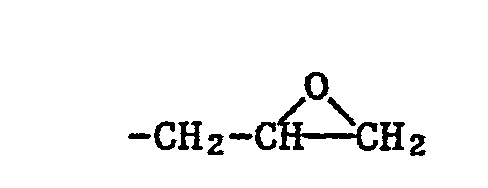

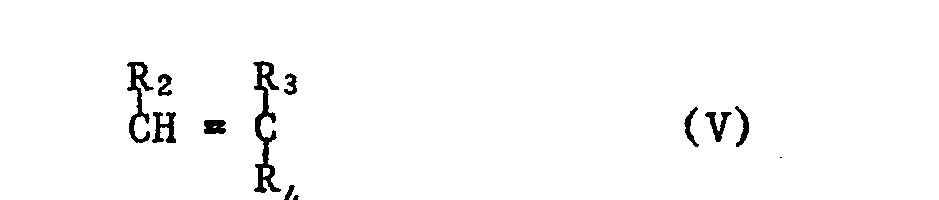

Applications Claiming Priority (2)
| Application Number | Priority Date | Filing Date | Title |
|---|---|---|---|
| GB848400848A GB8400848D0 (en) | 1984-01-13 | 1984-01-13 | Cotelomer compounds |
| GB8400848 | 1984-01-13 |
Publications (3)
| Publication Number | Publication Date |
|---|---|
| EP0150706A2 true EP0150706A2 (de) | 1985-08-07 |
| EP0150706A3 EP0150706A3 (en) | 1987-01-14 |
| EP0150706B1 EP0150706B1 (de) | 1989-05-03 |
Family
ID=10554917
Family Applications (1)
| Application Number | Title | Priority Date | Filing Date |
|---|---|---|---|
| EP85100019A Expired EP0150706B1 (de) | 1984-01-13 | 1985-01-02 | Cotelomere Verbindungen |
Country Status (10)
| Country | Link |
|---|---|
| US (1) | US4681686A (de) |
| EP (1) | EP0150706B1 (de) |
| JP (1) | JPS60174793A (de) |
| AU (1) | AU573300B2 (de) |
| BR (1) | BR8500141A (de) |
| CA (1) | CA1328885C (de) |
| DE (1) | DE3569932D1 (de) |
| ES (1) | ES8601813A1 (de) |
| GB (1) | GB8400848D0 (de) |
| ZA (1) | ZA85263B (de) |
Cited By (10)
| Publication number | Priority date | Publication date | Assignee | Title |
|---|---|---|---|---|
| EP0360746A3 (de) * | 1988-09-21 | 1991-12-27 | Fmc Corporation (Uk) Limited | Phosphonverbindungen |
| EP0405818A3 (en) * | 1989-06-26 | 1992-02-26 | Rohm And Haas Company | Low molecular weight, water-soluble phosphinate and phosphonate-containing polymers, and their preparation |
| EP0488538A1 (de) * | 1990-11-10 | 1992-06-03 | Fmc Corporation (Uk) Limited | Korrosionsverhinderung |
| EP0457378A3 (en) * | 1990-04-18 | 1992-08-26 | Unilever Nv | Hypophosphite-containing cotelomers as antitartar agents |
| EP0509570A1 (de) * | 1991-04-16 | 1992-10-21 | Unilever N.V. | Kombination von Hypophosphiten enthaltenden Cotelomeren und anorganischen Polyphosphatsalzen als Anti-Zahnsteinmittel |
| EP0510831A1 (de) * | 1991-04-25 | 1992-10-28 | Rohm And Haas Company | Monoalkyl Phosphinat und Phosphonat enthaltende Copolymere mit niedrigem Molekulargewicht |
| EP0516346A1 (de) * | 1991-05-31 | 1992-12-02 | Fmc Corporation (Uk) Limited | Telomere |
| US5681479A (en) * | 1991-05-31 | 1997-10-28 | Fmc Corporation (Uk ) Limited | Phosphonic cotelomers and method of use |
| DE4107322B4 (de) * | 1990-03-10 | 2005-10-20 | Great Lakes Chemical Europ | Verfahren zur Behandlung eines wässrigen Meerwasserverdampfungssystems |
| WO2014049081A1 (de) * | 2012-09-28 | 2014-04-03 | Fraunhofer-Gesellschaft zur Förderung der angewandten Forschung e.V. | Verwendung eines polymeren korrosionsinhibitors zur behandlung von anodisierten metalloberflächen |
Families Citing this family (39)
| Publication number | Priority date | Publication date | Assignee | Title |
|---|---|---|---|---|
| CA1244997A (en) * | 1985-08-30 | 1988-11-15 | Calgon Corporation | Acrylic acid/2-acrylamido-2-methylpropyl-sulfonic acid/2-acrylamido-2-methylpropyl phosphonic polymers |
| US4783267A (en) * | 1987-06-29 | 1988-11-08 | Calgon Corporation | Method for stabilizing metal ions |
| US4913823A (en) * | 1988-10-14 | 1990-04-03 | The Mogul Corporation | Process for dissolving and removing scale from aqueous systems |
| GB8911569D0 (en) * | 1989-05-19 | 1989-07-05 | Ciba Geigy Ag | Antifreeze compositions |
| US5023368A (en) * | 1989-06-08 | 1991-06-11 | National Starch And Chemical Investment Holding Corporation | Aminophosphonate-containing polymers |
| US4937002A (en) * | 1989-06-12 | 1990-06-26 | National Starch And Chemical Investment Holding Corporation | Interpolymers for barium sulphate inhibition |
| GB9021261D0 (en) * | 1990-09-29 | 1990-11-14 | Ciba Geigy Ag | Scale inhibition |
| US5194246A (en) * | 1991-04-16 | 1993-03-16 | Chesebrough-Pond's Usa Co., Division Of Conopco, Inc. | Anticalculus oral compositions containing combinations of polymers |
| US5143622A (en) * | 1991-06-05 | 1992-09-01 | Nalco Chemical Company | Phosphinic acid-containing polymers and their use in preventing scale and corrosion |
| US5167828A (en) * | 1991-10-07 | 1992-12-01 | Nalco Chemical Company | Phosphinate-containing polymers for controlling scale in underground petroleum-containing formations and equipment associated therewith |
| US5332494A (en) * | 1992-02-03 | 1994-07-26 | H.E.R.C. Incorporated | Water control system using oxidation reduction potential sensing |
| US5877247A (en) * | 1992-10-05 | 1999-03-02 | Mahar; Robert Crouse | Stable magnesium hydroxide slurries |
| GB9409483D0 (en) * | 1994-05-12 | 1994-06-29 | Fmc Corp Uk Ltd | Scale inhibition process |
| US5549852A (en) * | 1995-02-03 | 1996-08-27 | Rhone-Poulenc Inc. | Polymer composition as detergent builder |
| EP0877076B1 (de) * | 1997-05-09 | 2003-11-12 | Rohm And Haas Company | Wasch- oder Reinigungsmittelzusammensetzungen |
| GB2328440A (en) * | 1997-08-21 | 1999-02-24 | Fmc Corp | Phosphinopolycarboxylic acids comprising sulphonic acid groups and their use as inhibitors of barium sulphate scale |
| US6585933B1 (en) | 1999-05-03 | 2003-07-01 | Betzdearborn, Inc. | Method and composition for inhibiting corrosion in aqueous systems |
| JP3727044B2 (ja) * | 1998-11-10 | 2005-12-14 | 東京応化工業株式会社 | ネガ型レジスト組成物 |
| US6641754B2 (en) * | 2001-03-15 | 2003-11-04 | Betzdearborn Inc. | Method for controlling scale formation and deposition in aqueous systems |
| GB0317208D0 (en) * | 2003-07-23 | 2003-08-27 | Rhodia Cons Spec Ltd | Scale inhibition in water systems |
| JP4157853B2 (ja) * | 2003-08-13 | 2008-10-01 | ローム アンド ハース カンパニー | 硬化性組成物およびバインダーとしての使用 |
| US20050214534A1 (en) * | 2004-03-29 | 2005-09-29 | Adamo Joseph R | Extended curable compositions for use as binders |
| US8076432B2 (en) * | 2004-07-07 | 2011-12-13 | Unichem Technologies, Inc. | Phosphonic compounds and methods of use thereof |
| DE102004041142A1 (de) * | 2004-08-24 | 2006-03-02 | Basf Ag | Verfahren zum Passivieren von metallischen Oberflächen unter Verwendung von Itaconsäure Homo- oder Copolymeren |
| US7727420B2 (en) * | 2005-05-17 | 2010-06-01 | Ppt Research | Corrosion inhibiting compositions |
| US7703530B2 (en) * | 2005-08-10 | 2010-04-27 | Schlumberger Technology Corporation | Scale inhibitors compatible with sandstone acidizing |
| JP5335476B2 (ja) * | 2008-03-14 | 2013-11-06 | ローム アンド ハース カンパニー | ダイズ粉体スラリーおよびそれを提供する方法 |
| US8101700B2 (en) * | 2008-12-31 | 2012-01-24 | Unichem Technologies, Inc. | Phosphonic polymers having a phosphinate backbone and methods of making and using thereof |
| WO2012104401A1 (de) | 2011-02-04 | 2012-08-09 | Basf Se | Niedermolekulare phosphorhaltige polyacrylsäuren und deren verwendung als dispergiermittel |
| CN103347600B (zh) | 2011-02-04 | 2016-04-20 | 巴斯夫欧洲公司 | 低分子量含磷聚丙烯酸及其在输水体系中作为水垢抑制剂的用途 |
| JP5794308B2 (ja) | 2011-10-31 | 2015-10-14 | 東亞合成株式会社 | アクリル酸系重合体の製造方法及びその用途 |
| KR102020088B1 (ko) | 2012-07-23 | 2019-09-09 | 도아고세이가부시키가이샤 | 아크릴산계 중합체 조성물 및 그의 제조 방법, 및 그의 용도 |
| EP2778183B1 (de) * | 2013-03-15 | 2015-04-29 | Rohm and Haas Company | Polymethacrylsäure-Anhydridtelomere |
| BR102014027956B1 (pt) * | 2013-11-22 | 2020-11-17 | Rohm And Haas Company | Composiqao de copolimero, e, método para produzir uma composição de copolímero telomerico |
| JP6348005B2 (ja) * | 2013-12-24 | 2018-06-27 | 株式会社日本触媒 | 結合剤 |
| US20170369371A1 (en) * | 2014-12-22 | 2017-12-28 | Dow Global Technologies Llc | Derivatized polyimides and methods of making and using |
| BR112017012088A2 (pt) * | 2014-12-22 | 2018-01-16 | Dow Global Technologies Llc | polímeros de imida polimetacrílica-ácido e métodos de preparar e usar os mesmos |
| US10221489B2 (en) | 2015-01-23 | 2019-03-05 | Chemtreat, Inc | Compositions and methods for inhibiting corrosion in hydrostatic systems |
| WO2025133658A1 (en) * | 2023-12-21 | 2025-06-26 | Kao Corporation, S.A. | Suspension of mineral material |
Family Cites Families (18)
| Publication number | Priority date | Publication date | Assignee | Title |
|---|---|---|---|---|
| US2957931A (en) * | 1949-07-28 | 1960-10-25 | Socony Mobil Oil Co Inc | Synthesis of compounds having a carbonphosphorus linkage |
| US3709816A (en) * | 1971-07-01 | 1973-01-09 | Calgon Corp | Control of alluvial and other deposits in aqueous systems |
| US3709815A (en) * | 1971-07-01 | 1973-01-09 | Calgon Corp | Boiler water treatment |
| GB1414964A (en) * | 1971-10-19 | 1975-11-19 | English Clays Lovering Pochin | Copolymers and their use in the treatment of materials |
| US3928196A (en) * | 1973-12-05 | 1975-12-23 | Calgon Corp | Inhibition of scale deposition |
| GB1458235A (en) * | 1974-06-11 | 1976-12-08 | Ciba Geigy Uk Ltd | Inhibiting scale formation in aqueous systems |
| US4052160A (en) * | 1975-07-23 | 1977-10-04 | Ciba-Geigy Corporation | Corrosion inhibitors |
| US4015991A (en) * | 1975-08-08 | 1977-04-05 | Calgon Corporation | Low fluid loss cementing compositions containing hydrolyzed acrylamide/2-acrylamido-2-methylpropane sulfonic acid derivative copolymers and their use |
| US4029577A (en) * | 1975-11-17 | 1977-06-14 | Betz Laboratories, Inc. | Polymers for use in water treatment |
| GB1572406A (en) * | 1976-12-24 | 1980-07-30 | Ciba Geigy Ag | Aliphatic phosphonic/carboxylic acid compounds |
| US4207405A (en) * | 1977-09-22 | 1980-06-10 | The B. F. Goodrich Company | Water-soluble phosphorus containing carboxylic polymers |
| DE2848779A1 (de) * | 1978-11-10 | 1980-05-22 | Keller & Bohacek Rostschutz Ge | Mittel zur verhinderung der ausbildung von steinkrusten beim eindampfen von zuckersaeften |
| US4374733A (en) * | 1981-04-01 | 1983-02-22 | Betz Laboratories, Inc. | Method for treating aqueous mediums |
| JPS57177012A (en) * | 1981-04-23 | 1982-10-30 | Sumitomo Chem Co Ltd | Preparation of chelate resin |
| AU1156083A (en) * | 1982-02-25 | 1983-09-08 | Duolite International S.A. | Akylaminophosphonic chelating resins, their preparation and use in purifying brines |
| US4534866A (en) * | 1983-02-17 | 1985-08-13 | Betz Laboratories, Inc. | Deposit control method |
| JPS59173198A (ja) * | 1983-03-22 | 1984-10-01 | Katayama Chem Works Co Ltd | スケ−ル防止剤 |
| US4552665A (en) * | 1984-05-04 | 1985-11-12 | Calgon Corporation | Stabilization of soluble manganese and its reaction products |
-
1984
- 1984-01-13 GB GB848400848A patent/GB8400848D0/en active Pending
-
1985
- 1985-01-02 DE DE8585100019T patent/DE3569932D1/de not_active Expired
- 1985-01-02 EP EP85100019A patent/EP0150706B1/de not_active Expired
- 1985-01-09 AU AU37557/85A patent/AU573300B2/en not_active Ceased
- 1985-01-11 BR BR8500141A patent/BR8500141A/pt not_active IP Right Cessation
- 1985-01-11 ZA ZA85263A patent/ZA85263B/xx unknown
- 1985-01-11 ES ES539486A patent/ES8601813A1/es not_active Expired
- 1985-01-11 CA CA000471913A patent/CA1328885C/en not_active Expired - Fee Related
- 1985-01-14 JP JP60004825A patent/JPS60174793A/ja active Granted
- 1985-07-10 US US06/753,510 patent/US4681686A/en not_active Expired - Lifetime
Cited By (12)
| Publication number | Priority date | Publication date | Assignee | Title |
|---|---|---|---|---|
| EP0360746A3 (de) * | 1988-09-21 | 1991-12-27 | Fmc Corporation (Uk) Limited | Phosphonverbindungen |
| EP0405818A3 (en) * | 1989-06-26 | 1992-02-26 | Rohm And Haas Company | Low molecular weight, water-soluble phosphinate and phosphonate-containing polymers, and their preparation |
| DE4107322B4 (de) * | 1990-03-10 | 2005-10-20 | Great Lakes Chemical Europ | Verfahren zur Behandlung eines wässrigen Meerwasserverdampfungssystems |
| EP0457378A3 (en) * | 1990-04-18 | 1992-08-26 | Unilever Nv | Hypophosphite-containing cotelomers as antitartar agents |
| EP0488538A1 (de) * | 1990-11-10 | 1992-06-03 | Fmc Corporation (Uk) Limited | Korrosionsverhinderung |
| EP0509570A1 (de) * | 1991-04-16 | 1992-10-21 | Unilever N.V. | Kombination von Hypophosphiten enthaltenden Cotelomeren und anorganischen Polyphosphatsalzen als Anti-Zahnsteinmittel |
| EP0510831A1 (de) * | 1991-04-25 | 1992-10-28 | Rohm And Haas Company | Monoalkyl Phosphinat und Phosphonat enthaltende Copolymere mit niedrigem Molekulargewicht |
| EP0516346A1 (de) * | 1991-05-31 | 1992-12-02 | Fmc Corporation (Uk) Limited | Telomere |
| US5376731A (en) * | 1991-05-31 | 1994-12-27 | Fmc Corporation (Uk) Limited | Telomers |
| US5604291A (en) * | 1991-05-31 | 1997-02-18 | Fmc Corporation (Uk) Limited | Telomers |
| US5681479A (en) * | 1991-05-31 | 1997-10-28 | Fmc Corporation (Uk ) Limited | Phosphonic cotelomers and method of use |
| WO2014049081A1 (de) * | 2012-09-28 | 2014-04-03 | Fraunhofer-Gesellschaft zur Förderung der angewandten Forschung e.V. | Verwendung eines polymeren korrosionsinhibitors zur behandlung von anodisierten metalloberflächen |
Also Published As
| Publication number | Publication date |
|---|---|
| BR8500141A (pt) | 1985-08-20 |
| JPS60174793A (ja) | 1985-09-09 |
| GB8400848D0 (en) | 1984-02-15 |
| EP0150706B1 (de) | 1989-05-03 |
| AU573300B2 (en) | 1988-06-02 |
| DE3569932D1 (en) | 1989-06-08 |
| AU3755785A (en) | 1985-07-18 |
| ES539486A0 (es) | 1985-11-16 |
| EP0150706A3 (en) | 1987-01-14 |
| ES8601813A1 (es) | 1985-11-16 |
| ZA85263B (en) | 1985-11-27 |
| US4681686A (en) | 1987-07-21 |
| JPH0557992B2 (de) | 1993-08-25 |
| CA1328885C (en) | 1994-04-26 |
Similar Documents
| Publication | Publication Date | Title |
|---|---|---|
| EP0150706B1 (de) | Cotelomere Verbindungen | |
| JP3284318B2 (ja) | テロマー | |
| DE69212777T2 (de) | Verhinderung von Korrosion und Ablagerungen | |
| JP2942991B2 (ja) | 水性系の処理方法 | |
| DE68924632T2 (de) | Telomerische Verbindung. | |
| EP0074336B1 (de) | Gegen Korrosion und/oder Kesselsteinablagerung inhibierte Systeme | |
| DE2458704A1 (de) | Verfahren zur verhinderung der abscheidung von kesselstein, schlamm und anderen verschmutzungsstoffen in waessrigen systemen | |
| DE68903070T2 (de) | Verfahren zur kesselsteinbekaempfung mittels allylsulfonat-maleinsaeureanhydridpolymeren. | |
| DE69119717T2 (de) | Korrosionsverhinderung | |
| JPS6015413A (ja) | 新規なスケ−ル抑制コポリマ−及びスケ−ル付着を抑制する方法 | |
| DE69303449T2 (de) | Verfahren und Zusammensetzung zur Inhibierung der Ablagerung von Silika und Silikaten | |
| DE68910655T2 (de) | Kesselsteinverhütung. | |
| DE68926840T2 (de) | Phosphonverbindungen | |
| DE2921374C2 (de) | ||
| DE19648843C2 (de) | Melamin-polycarbonsäureamide und ihre Verwendung als Korrosionsschutzmittel | |
| DE69001065T2 (de) | Verhinderung von ablagerungen in waesserigen systemen durch bestimmte phosphonomethylaminoxide. | |
| DE3909075A1 (de) | Neue polymere | |
| EP0025125B1 (de) | Verwendung schwefelhaltiger Hydroxycarbonsäuren als Korrosionsinhibitoren für wässrige Systeme | |
| DE3602481A1 (de) | Wasserbehandlungsverfahren | |
| DE69524967T2 (de) | Korrosionsinhibierende zusammensetzungen | |
| WO2006134140A1 (de) | Verwendung von alkylenoxideinheiten enthaltenden copolymeren als zusatz zu wässrigen systemen | |
| EP0949253B1 (de) | Melamin-azomethin-Derivate und ein diese enthaltendes Korrosionsschutzmittel | |
| DE2815016C2 (de) | Korrosionsinhibitor für Brauchwassersysteme | |
| DE2723834A1 (de) | Umsetzungsprodukte von phosphonocarbonsaeuren mit alkoholen | |
| EP1094133A1 (de) | Methylol-melamin enthaltendes Korrosionsschutzmittel |
Legal Events
| Date | Code | Title | Description |
|---|---|---|---|
| PUAI | Public reference made under article 153(3) epc to a published international application that has entered the european phase |
Free format text: ORIGINAL CODE: 0009012 |
|
| 17P | Request for examination filed |
Effective date: 19850102 |
|
| AK | Designated contracting states |
Designated state(s): BE CH DE FR GB IT LI NL SE |
|
| PUAL | Search report despatched |
Free format text: ORIGINAL CODE: 0009013 |
|
| AK | Designated contracting states |
Kind code of ref document: A3 Designated state(s): BE CH DE FR GB IT LI NL SE |
|
| 17Q | First examination report despatched |
Effective date: 19880627 |
|
| GRAA | (expected) grant |
Free format text: ORIGINAL CODE: 0009210 |
|
| AK | Designated contracting states |
Kind code of ref document: B1 Designated state(s): BE CH DE FR GB IT LI NL SE |
|
| REF | Corresponds to: |
Ref document number: 3569932 Country of ref document: DE Date of ref document: 19890608 |
|
| ITF | It: translation for a ep patent filed | ||
| GBT | Gb: translation of ep patent filed (gb section 77(6)(a)/1977) | ||
| ET | Fr: translation filed | ||
| PLBI | Opposition filed |
Free format text: ORIGINAL CODE: 0009260 |
|
| 26 | Opposition filed |
Opponent name: NATIONAL STARCH AND CHEMICAL CORPORATION Effective date: 19900202 |
|
| NLR1 | Nl: opposition has been filed with the epo |
Opponent name: NATIONAL STARCH AND CHEMICAL CORPORATION |
|
| PLBM | Termination of opposition procedure: date of legal effect published |
Free format text: ORIGINAL CODE: 0009276 |
|
| STAA | Information on the status of an ep patent application or granted ep patent |
Free format text: STATUS: OPPOSITION PROCEDURE CLOSED |
|
| 27C | Opposition proceedings terminated |
Effective date: 19920213 |
|
| ITTA | It: last paid annual fee | ||
| PGFP | Annual fee paid to national office [announced via postgrant information from national office to epo] |
Ref country code: CH Payment date: 19930311 Year of fee payment: 9 |
|
| REG | Reference to a national code |
Ref country code: GB Ref legal event code: 732E |
|
| PG25 | Lapsed in a contracting state [announced via postgrant information from national office to epo] |
Ref country code: LI Effective date: 19940131 Ref country code: CH Effective date: 19940131 |
|
| NLR2 | Nl: decision of opposition | ||
| REG | Reference to a national code |
Ref country code: FR Ref legal event code: TP |
|
| REG | Reference to a national code |
Ref country code: CH Ref legal event code: PL |
|
| NLS | Nl: assignments of ep-patents |
Owner name: FMC CORPORATION (UK) LIMITED TE MANCHESTER, GROOT- |
|
| EAL | Se: european patent in force in sweden |
Ref document number: 85100019.0 |
|
| PGFP | Annual fee paid to national office [announced via postgrant information from national office to epo] |
Ref country code: SE Payment date: 19980108 Year of fee payment: 14 |
|
| PG25 | Lapsed in a contracting state [announced via postgrant information from national office to epo] |
Ref country code: SE Free format text: LAPSE BECAUSE OF NON-PAYMENT OF DUE FEES Effective date: 19990103 |
|
| PGFP | Annual fee paid to national office [announced via postgrant information from national office to epo] |
Ref country code: FR Payment date: 20000112 Year of fee payment: 16 |
|
| PGFP | Annual fee paid to national office [announced via postgrant information from national office to epo] |
Ref country code: NL Payment date: 20000131 Year of fee payment: 16 |
|
| PGFP | Annual fee paid to national office [announced via postgrant information from national office to epo] |
Ref country code: BE Payment date: 20000315 Year of fee payment: 16 |
|
| PG25 | Lapsed in a contracting state [announced via postgrant information from national office to epo] |
Ref country code: BE Free format text: LAPSE BECAUSE OF NON-PAYMENT OF DUE FEES Effective date: 20010131 |
|
| REG | Reference to a national code |
Ref country code: GB Ref legal event code: 732E |
|
| BERE | Be: lapsed |
Owner name: FMC CORP. (UK) LTD Effective date: 20010131 |
|
| PG25 | Lapsed in a contracting state [announced via postgrant information from national office to epo] |
Ref country code: NL Free format text: LAPSE BECAUSE OF NON-PAYMENT OF DUE FEES Effective date: 20010801 |
|
| PG25 | Lapsed in a contracting state [announced via postgrant information from national office to epo] |
Ref country code: FR Free format text: LAPSE BECAUSE OF NON-PAYMENT OF DUE FEES Effective date: 20010928 |
|
| NLV4 | Nl: lapsed or anulled due to non-payment of the annual fee |
Effective date: 20010801 |
|
| REG | Reference to a national code |
Ref country code: FR Ref legal event code: ST |
|
| REG | Reference to a national code |
Ref country code: GB Ref legal event code: IF02 |
|
| PGFP | Annual fee paid to national office [announced via postgrant information from national office to epo] |
Ref country code: GB Payment date: 20040303 Year of fee payment: 20 |
|
| PGFP | Annual fee paid to national office [announced via postgrant information from national office to epo] |
Ref country code: DE Payment date: 20040311 Year of fee payment: 20 |
|
| PG25 | Lapsed in a contracting state [announced via postgrant information from national office to epo] |
Ref country code: GB Free format text: LAPSE BECAUSE OF EXPIRATION OF PROTECTION Effective date: 20050101 |
|
| REG | Reference to a national code |
Ref country code: GB Ref legal event code: PE20 |