EP0150841A2 - Neutronenabsorberplatten mit keramischer Bindung auf Basis Borcarbid und freiem Kohlenstoff - Google Patents
Neutronenabsorberplatten mit keramischer Bindung auf Basis Borcarbid und freiem Kohlenstoff Download PDFInfo
- Publication number
- EP0150841A2 EP0150841A2 EP85100862A EP85100862A EP0150841A2 EP 0150841 A2 EP0150841 A2 EP 0150841A2 EP 85100862 A EP85100862 A EP 85100862A EP 85100862 A EP85100862 A EP 85100862A EP 0150841 A2 EP0150841 A2 EP 0150841A2
- Authority
- EP
- European Patent Office
- Prior art keywords
- finer
- feiner
- mindestens
- weight
- von
- Prior art date
- Legal status (The legal status is an assumption and is not a legal conclusion. Google has not performed a legal analysis and makes no representation as to the accuracy of the status listed.)
- Granted
Links
Classifications
-
- G—PHYSICS
- G21—NUCLEAR PHYSICS; NUCLEAR ENGINEERING
- G21F—PROTECTION AGAINST X-RADIATION, GAMMA RADIATION, CORPUSCULAR RADIATION OR PARTICLE BOMBARDMENT; TREATING RADIOACTIVELY CONTAMINATED MATERIAL; DECONTAMINATION ARRANGEMENTS THEREFOR
- G21F1/00—Shielding characterised by the composition of the materials
- G21F1/02—Selection of uniform shielding materials
- G21F1/06—Ceramics; Glasses; Refractories
-
- C—CHEMISTRY; METALLURGY
- C04—CEMENTS; CONCRETE; ARTIFICIAL STONE; CERAMICS; REFRACTORIES
- C04B—LIME, MAGNESIA; SLAG; CEMENTS; COMPOSITIONS THEREOF, e.g. MORTARS, CONCRETE OR LIKE BUILDING MATERIALS; ARTIFICIAL STONE; CERAMICS; REFRACTORIES; TREATMENT OF NATURAL STONE
- C04B35/00—Shaped ceramic products characterised by their composition; Ceramics compositions; Processing powders of inorganic compounds preparatory to the manufacturing of ceramic products
- C04B35/515—Shaped ceramic products characterised by their composition; Ceramics compositions; Processing powders of inorganic compounds preparatory to the manufacturing of ceramic products based on non-oxide ceramics
- C04B35/56—Shaped ceramic products characterised by their composition; Ceramics compositions; Processing powders of inorganic compounds preparatory to the manufacturing of ceramic products based on non-oxide ceramics based on carbides or oxycarbides
- C04B35/563—Shaped ceramic products characterised by their composition; Ceramics compositions; Processing powders of inorganic compounds preparatory to the manufacturing of ceramic products based on non-oxide ceramics based on carbides or oxycarbides based on boron carbide
-
- C—CHEMISTRY; METALLURGY
- C04—CEMENTS; CONCRETE; ARTIFICIAL STONE; CERAMICS; REFRACTORIES
- C04B—LIME, MAGNESIA; SLAG; CEMENTS; COMPOSITIONS THEREOF, e.g. MORTARS, CONCRETE OR LIKE BUILDING MATERIALS; ARTIFICIAL STONE; CERAMICS; REFRACTORIES; TREATMENT OF NATURAL STONE
- C04B35/00—Shaped ceramic products characterised by their composition; Ceramics compositions; Processing powders of inorganic compounds preparatory to the manufacturing of ceramic products
- C04B35/515—Shaped ceramic products characterised by their composition; Ceramics compositions; Processing powders of inorganic compounds preparatory to the manufacturing of ceramic products based on non-oxide ceramics
- C04B35/56—Shaped ceramic products characterised by their composition; Ceramics compositions; Processing powders of inorganic compounds preparatory to the manufacturing of ceramic products based on non-oxide ceramics based on carbides or oxycarbides
- C04B35/565—Shaped ceramic products characterised by their composition; Ceramics compositions; Processing powders of inorganic compounds preparatory to the manufacturing of ceramic products based on non-oxide ceramics based on carbides or oxycarbides based on silicon carbide
Definitions
- Neutron absorber materials in the form of large-area thin plates based on powdered boron carbide, which is embedded in a solid matrix, and processes for their production are known. Such absorber plates are required in particular for the storage of spent fuel elements from nuclear reactor plants. This includes so-called plastic-bound neutron absorber materials, which consist of boron carbide, optionally thinners and a solid irreversibly hardened phenolic polymer, which is hardened around the boron carbide particles and the thinner particles to form a continuous matrix. Such plates were produced by mixing relatively coarse-grained boron carbide powders and optionally thinners with a phenolic resin in solid or liquid form, shaping the mixture and curing the phenolic resin binder at temperatures up to 200 ° C. without coking.
- Silicon carbide, graphite, amorphous carbon, aluminum oxide and silicon dioxide were mentioned as thinners, which can each be used in the same particle sizes as the boron carbide powder used (cf. EP-A-2227, EP-B-2276, EP-B-2714, EP- B-2715 and corresponding U.S. PSS 4,225,467, 4,287,145, 4,198,322, 4,156,147 and 4,215,883).
- Such neutron absorber materials can indeed be produced in the form of very thin plates from a thickness of 2 mm, but due to the plastic matrix they are not resistant to high temperatures and have the tendency to emit gaseous substances when irradiated.
- keramischstreete neutron absorber materials which consist solely of boron carbide and free carbon
- the boron carbide content can be up to 60 vol .-%
- Such neutron absorber materials have a sufficient mechanical strength with a plate thickness of approximately 5 mm, which can be increased by the addition of graphite.
- a plate thickness of approximately 5 mm
- graphite graphite
- the bending strength at room temperature can be improved, which serves as a measure of the mechanical strength, but these plates are then very susceptible to corrosion. This means that their flexural strength drops under more severe conditions after the corrosion test by heating for several hours in boiling water by more than 50% of the original value.
- neutron absorber materials consist of 40 to 60% by volume of boron carbide + silicon carbide in a B 4 C: SiC ratio of 9: 1 to 1: 9 and 10 to 20% by volume of the free carbon, the rest being pores , with a density of 1.5 to 2.2 g / cm 3 and a flexural strength at room temperature of 20 to 50 N / mm2, measured according to the 3-point method, which, according to the corrosion test, involves heating in boiling water for 3000 hours drops less than 40% of the original value.
- the neutron absorber plates according to the invention consist virtually exclusively of boron, silicon and carbon with a space filling of advantageously up to 40 Vol .-% boron carbide and at least 10 V ol .-% of silicon carbide, in addition to 10 to 20 vol .-% free carbon and the rest of the pore volume .
- This neutron absorber plates with ceramic bond can be produced in a conventional manner by mixing relatively fine-grained ceramic starting powders and optionally graphite powder with a pulverulent organic resin binder and a wetting agent, shaping the mixture under pressure at room temperature, curing the resin binder at temperatures up to 180 0 C and then Coking the shaped plates in the absence of air at temperatures up to about 1000 ° C with controlled temperature increase.
- Phenol-formaldehyde condensation products of the novolak and resole type are advantageously used as powdered organic resin binders, which are practically free of metallic impurities and which are at about 1000 ° C. with the formation of amorphous carbon in about 35 to 50% yield decompose.
- furfural can be used as a wetting agent.
- graphite powder can also be used, advantageously with a particle size of finer 40 .mu.m, which does not interfere with processing in amounts of up to about 10% by weight, based on the total weight of all starting materials.
- the ceramic starting powders boron carbide and silicon carbide and optionally graphite powder, together with the powdery organic resin binder and the wetting agent, are mixed homogeneously in the amounts indicated above until a free-flowing powder is formed.
- This powder is poured into a plate press mold with uniform distribution, for example / in a steel box press mold and pressed with the aid of a hydraulic press under a pressure of 25 to 30 MPa to plates of about 2 to 10 mm thickness at room temperature.
- the plates are removed from the mold, between plates made of an inert carrier material, e.g. B. glass plates stacked and cured at temperatures up to 180 ° C.
- the preformed plates then have to be heated to about 1000 ° C. for thermal degradation or coking of the resin binder.
- the plates are advantageously stacked between graphite plates and in this form with a controlled temperature increase of, for example, 120 ° C./hour. and subjected to the heating process in the absence of air.
- the temperature program required for the heating process depends on the size of the preformed plates. With a plate size of 700 x 500 mm should be within a maximum temperature difference of 100 "C must not be exceeded. This can be achieved, for example, by heating up to a temperature of 1000" C over a period of at least 20 hours and holding at this temperature for at least 4 hours is. The cooling then takes place over a period of 24 hours.
- the neutron absorber plates according to the invention are distinguished from the known materials with a ceramic bond based on pure boron carbide both by a higher mechanical strength at room temperature and by an improved corrosion behavior.
- the use of silicon carbide powder with a higher proportion of fine grains than the boron carbide powder used has proven particularly useful, since this reduces the drop in bending strength after the corrosion test to almost 30%.
- the use of graphite powder is not absolutely necessary to achieve these properties. However, by limiting the amount of the graphite powder to be used, if any, to a maximum of 10% by weight, based on the total weight of all starting materials, the invention can suitable neutron absorber materials in the form of very thin plates from 2 mm thick and from 500 mm edge length can be manufactured dimensionally stable without difficulty during processing.
- these thin plates Due to the good mechanical strength properties, these thin plates are easy to handle and, despite the lower B-area concentration, still offer sufficient security for neutron absorption. In addition, they are resistant to ionizing radiation in the same way as the known plates based on pure boron carbide alone. These thin plates can be used with particular advantage for the so-called “compact storage", which allows the spent fuel assemblies to be arranged as densely as possible, as a result of which the capacity of existing fuel assembly stores can be expanded. /
- the graphite powder was a natural graphite sieve fraction of 40 ⁇ m and finer.
- the bending strength was determined according to the 3-point method with samples measuring 45 x 4.5 x 3.5 mm, a contact distance of 30 mm and a loading speed of 1.8 N / mm 2 x seconds.
- the plates were heated in boiling water for 2000 and 3000 hours, respectively, and then the bending strength was determined again.
- the decrease in bending strength in% relates to the originally measured value at room temperature.
Landscapes
- Engineering & Computer Science (AREA)
- Chemical & Material Sciences (AREA)
- Ceramic Engineering (AREA)
- Manufacturing & Machinery (AREA)
- Materials Engineering (AREA)
- Structural Engineering (AREA)
- Organic Chemistry (AREA)
- Physics & Mathematics (AREA)
- General Engineering & Computer Science (AREA)
- High Energy & Nuclear Physics (AREA)
- Ceramic Products (AREA)
Abstract
- 40 bis 60 Vol.-% Borcarbid + Siliciumcarbid im Verhältnis B4C : SiC von 9 : 1 bis 1 : 9 und
- 10 bis 20 Vol.-% freiem Kohlenstoff, Rest Poren. Sie haben eine Dichte von 1,5 bis 2,2 g/cm3 und eine Biegefestigkeit von 20 bis 50 N/mm2 bei Raumtemperatur, gemessen nach der 3-Punkt-Methode, die nach dem Korrosionstest durch 3000 Stunden Erhitzen in siedendem Wasser um weniger als 40% des ursprünglichen Wertes abfällt. Diese Platten können durch Vermischen von Borcarbidpulver mit mindestens 75 Gew.-% Bor, einem Anteil von B203 von weniger als 0,5 Gew.-% und einer Teilchengrössenverteilung von
- mindestens 95% feiner 90 µm
- mindestens 90% feiner 80 pm
- mindestens 70% feiner 50 µm
- mindestens 50% feiner 30 µm
- mindestens 30% feiner 20 µm
- mindestens 10% feiner 6 µm
- Siliciumcarbidpulver mit einem SiC-Gehalt von mindestens 98 Gew.-%, einem Sauerstoffgehaltvon weniger als 0,5 Gew.-% und einer Teilchengrössenverteilung von
- mindestens 95% feiner 40 µm
- mindestens 90% feiner 30 µm
- mindestens 70% feiner 20 µm
- mindestens 50% feiner 1 µm
- mindestens 30% feiner 7 µm
- mindestens 10% feiner 4 µm
- und gegebenenfalls Graphitpulver mit einem pulverförmigen organischen Harzbindemittel und einem Netzmittel, Formgebung des Gemisches unter Druck bei Raumtemperatur, Aushärten des Harzbindemittels bei Temperaturen bis zu 180°C und anschliessendem Verkoken der geformten Platten unter Luftausschluss bei Temperaturen bis zu etwa 1000°C unter kontrollierter Temperatursteigerung hergestellt werden.
Description
- Neutronenabsorberwerkstoffe in Form von großflächigen dünnen Platten auf Basis von pulverförmigem Borcarbid, das in einer festen Matrix eingebettet ist und Verfahren zu ihrer Herstellung sind bekannt. Derartige Absorberplatten werden insbesondere für die Lagerung ausgebrannter Brennelemente aus Kernreaktoranlagen benötigt. Hierunter fallen sogenannte kunststoffgebundene Neutronenabsorberwerkstoffe, die aus Borcarbid, gegebenenfalls Verdünnern und einem festen irreversibel gehärteten phenolischen Polymerisat bestehen, das um die Borcarbidteilchen und die Verdünnerteilchen herum zu einer kontinuierlichen Matrix gehärtet ist. Solche Platten wurden durch Vermischen von relativ grobkörnigen Borcarbidpulvern und gegebenenfalls Verdünnern mit einem Phenolharz in fester oder flüssiger Form, Formgebung des Gemisches und Aushärten des Phenolharzbindemittels bei Temperaturen bis zu 200°C ohne verkoken hergestellt. Als Verdünner wurden Siliciumcarbid, Graphit, amorpher Kohlenstoff, Aluminiumoxid und Siliciumdioxid genannt, die in jeweils gleichen Teilchengrößen wie das verwendete Borcarbidpulver eingesetzt werden können (vgl. EP-A-2227, EP-B-2276, EP-B-2714, EP-B-2715 und die entsprechenden US-PSS 4 225 467, 4 287 145, 4 198 322, 4 156 147 und 4 215 883). Derartige Neutronenabsorberwerkstoffe können zwar in Form sehr dünner Platten ab 2 mm Dicke hergestellt werden, aufgrund der vorhandenen Kunststoffmatrix sind sie aber nicht hochtemperaturbeständig und haben die Neigung unter Bestrahlung gasförmige Stoffe abzugeben.
- Diese Nachteile zeigen sogenannte keramischgebundene Neutronenabsorberwerkstoffe nicht, die ausschließlich aus Borcarbid und freiem Kohlenstoff bestehen, wobei der Borcarbidanteil bis zu 60 Vol.-% betragen kann, und die durch Vermischen von Borcarbidpulvern einer bestimmten Teilchengrößenverteilung und einem B203-Gehalt von weniger als 0.5 Gew.-% und gegebenenfalls Graphitpulver mit einem.organischen Harzbindemittel und einem Netzmittel, Formgebung des Gemisches unter Druck bei Raumtemperatur, Aushärten des Harzbindemittels bis 180°C und anschließendem Verkoken der geformten Platten unter Luftausschluß bis zu etwa 1000°C hergestellt wurden (vergleiche DE-PS 2 752 040 und US-PS 4 252 691).
- Derartige Neutronenabsorberwerkstoffe haben bei einer Plattendicke ab etwa 5 mm eine ausreichende mechanische Festigkeit, die durch den Zusatz von Graphit gesteigert werden kann. Es wurde jedoch festgestellt, daß bei der Herstellung von; dünneren und größeren Platten mit einer Dicke ab 2 mm und einer Kantenlänge ab 500 mm die mechanische Festigkeit bei Verwendung von reinem Borcarbidpulver allein nicht mehr ausreichend ist. Durch Erhöhung des Feinkornanteils im verwendeten Borcarbidpulver kann zwar die Biegefestigkeit bei Raumtemperatur verbessert werden, die als Maß für die mechanische Festigkeit dient, aber diese Platten sind dann sehr korrosionsanfällig. Hierunter ist zu verstehen, daß ihre Biegefestigkeit unter verschärften Bedingungen nach dem Korrosionstest durch mehrstündiges Erhitzen in siedendem Wasser um mehr als 50 % des ursprünglichen Wertes abfällt. Durch den Zusatz von Graphit in-zur Erhöhung der Festigkeit-ausreichenden Mengen treten indessen Schwierigkeiten bei der Verarbeitung auf, da die extrem hohe Orientierung dieses anisotropen Materials durch die Druckanwendung während der Plattenherstellung die Entlüftung verhindert, was zu Schicht-Rissen führt.Außerdem neigen derartige Platten beim Verkoken,zum Verziehen, d. h. sie sind unter diesen Bedingungen nicht dimensionsstabil.
- Es stellt sich somit die Aufgabe sogenannte keramischgebundene Neutronenabsorberwerkstoffe auf Basis Borcarbid und freiem Kohlenstoff zur Verfügung zu stellen, die insbesondere in Form von sehr dünnen und großflächigen Platten mit einem für die Neutronenabsorption ausreichendem Borgehalt gute mechanische Festigkeitseigenschaften haben, weniger korrosionsanfällig sind und die ohne Schwierigkeiten bei der Verarbeitung dimensionsstabil hergestellt werden können.
- Diese Aufgabe wird erfindungsgemäß durch Neutronenabsorberwerkstoffe gelöst, die aus 40 bis 60 Vol.-% Borcarbid + Siliciumcarbid im Verhältnis B4C: SiC von 9 : 1 bis 1 : 9 und 10 bis 20 Vol.-% des freien Kohlenstoffs, Rest Poren bestehen, mit einer Dichte von 1,5 bis 2,2 g/cm3 und einer Biegefestigkeit bei Raumtemperatur von 20 bis 50 N/mm2, gemessen nach der 3-Punkt-Methode, die nach dem Korrosionstest durch 3000 Stunden Erhitzen in siedendem Wasser um weniger als 40 % des ursprünglichen Wertes abfällt.
- Die erfindungsgemäßen Neutronenabsorberplatten bestehen praktisch ausschließlich aus Bor, Silicium und Kohlenstoff mit einer Raumerfüllung von vorteilhaft bis zu 40 Vol.-% Borcarbid und mindestens 10 Vol.-% Siliciumcarbid, neben 10 bis 20 Vol.-% freiem Kohlenstoff und dem Rest als Porenvolumen.
- Die besten Ergebnisse hinsichtlich Dichte und physikalischer Eigenschaften werden bei Platten erreicht, die eine Raumerfüllung von
- 15 bis 25 Vol.-% Borcarbid
- 25.bis 35 Vol.-% Siliciumcarbid und
- 10 bis 20 Vol.-% des freien Kohlenstoffs,
- Rest Poren
- aufweisen.
- Diese Neutronenabsorberplatten mit keramischer Bindung können in an sich bekannter Weise durch Vermischen von relativ feinkörnigen keramischen Ausgangspulvern und gegebenenfalls Graphitpulver mit einem pulverförmigen organischen Harzbindemittel und einem Netzmittel, Formgebung des Gemisches unter Druck bei Raumtemperatur, Aushärten des Harzbindemittels bei Temperaturen bis zu 1800C und anschließendem Verkoken der geformten Platten unter Luftausschluß bei Temperaturen bis zu etwa 1000°C unter kontrollierter Temperatursteigerung hergestellt werden.
- / Für die Erzielung der gewünschten Eigenschaften ist dabei die Reinheit und Feinheit der verwendeten keramischen Ausgangspulver Borcarbid und Siliciumcarbid von entscheidender Bedeutung. Als Borcarbidpulver können solche mit einer Reinheit von mindestens 98 Gew.-% verwendet werden, worunter zu verstehen ist, daß die Analysensumme von Bor und Kohlenstoff mindestens 98 Gew.-% beträgt, entsprechend einem Borgehalt von 75 bis 79 Gew.-%. Die obere Grenze für B2031 das von der Herstellung her im Borcarbid vorhanden sein kann, liegt bei 0,5 Gew.-%. Metallische Verunreinigungen können bis zu 1,0 Gew.-% insgesamt toleriert werden, Anteile an Fluor- und Chloratomen sollten jedoch Mengen von jeweils 100 ppm nicht übersteigen. Als Maß für die Feinheit des verwendeten Borcarbidpulvers dient die Teilchengrößenverteilung von
- mindestens 95 % feiner 90 µm
- mindestens 90 % feiner 80 um
- mindestens 70 % feiner 50 µm
- mindestens 50 % feiner 30 µm
- mindestens 30 % feiner 20 um
- mindestens 10 % feiner 6 µm
- Als Siliciumcarbidpulver können solche mit einem SiC-Gehalt von mindestens 98 Gew-%, einem Sauerstoffgehalt von höchstens 0,5 Gew.-%, einem Gehalt an metallischen Verunreinigungen insgesamt von höchstens 1,0 Gew.-% und Anteilen an Fluor- und Chloratomen von jeweils weniger als 100 ppm verwendet werden. Als Maß für die Feinheit des verwendeten SiC-Pulvers dient die Teilchengrößenverteilung von
- mindestens 95 % feiner 40 um
- mindestens 90 % feiner 30 um
- mindestens 70 % feiner 20 µm
- mindestens 50 % feiner 10 µm
- mindestens 30 % feiner 7 µm
- mindestens 10 % feiner 4 µm
- Als pulverförmige organische Har zbindemittel werden vorteilhaft Phenol-Formaldehyd-Kondensationsprodukte vom Typ der Novolake und der Resole verwendet, die praktisch frei von metallischen Verunreinigungen sind und die sich bei etwa 1000°C unter Bildung von amorphem Kohlenstoff in etwa 35.bis 50 %iger Ausbeute zersetzen. Als Netzmittel kann beispielsweise Furfurol verwendet werden.
- Gegebenenfalls kann Graphitpulver mitverwendet werden, vorteilhaft mit einer Teilchengröße von feiner 40 um, das in Mengen bis zu etwa 10 Gew.-%, bezogen auf das Gesamtgewicht aller Ausgangsstoffe nicht bei der Verarbeitung stört.
- Die Ausgangsstoffe werden vorteilhaft in folgenden Mengen eingesetzt:
- 20 bis 55 Gew.-% des Borcarbidpulvers
- 55 bis 20 Gew.-% des Siliciumcarbidpulvers
- 0 bis 10 Gew.-% des Graphitpulvers
- 20 bis 12 Gew.-% des organischen Harzbindemittels und
- 5 bis 3 Gew.-% des Netzmittels.
- Für die Durchführung des Verfahrens zur Herstellung der erfindungsgemäßen Neutronenabsorberplatten werden die keramischen Ausgangspulver Borcarbid und Siliciumcarbid und gegebenenfalls Graphitpulver zusammen mit dem pulverförmigen organischen Harzbindemittel und dem Netzmittel in den oben angegebenen Mengen homogen vermischt bis zur Bildung eines rieselfähigen Pulvers. Dieses Pulver wird in eine Plattenpreßform unter gleichmäßiger Verteilung eingefüllt, beispielsweise/in eine Stahlkastenpreßform und mit Hilfe einer hydraulischen Presse unter einem Druck von 25 bis 30 MPa zu Platten von etwa 2 bis 10 mm Dicke bei Raumtemperatur verpreßt. Dann werden die Platten aus der Form entnommen, zwischen Platten aus einem inerten Trägermaterial, z. B. Glasplatten gestapelt und bei Temperaturen bis zu 180°C ausgehärtet. Zum thermischen Abbau bzw. zur Verkokung des Harzbindemittels müssen die vorgeformten Platten dann auf etwa 1000°C erhitzt werden. Hierzu werden die Platten vorteilhaft zwischen Graphitplatten gestapelt und in dieser Form unter kontrollierter Temperatursteigerung von zum Beispiel 120°C /Std. und unter Luftausschluß dem Erhitzungsvorgang unterzogen. Das für den Erhitzungsvorgang erforderliche Temperaturprogramm (Aufheizen - Verweilen - Abkühlen) ist von der Größe der vorgeformten Platten abhängig. Bei einer Plattengröße von 700 x 500 mm sollte innerhalb einer Platte eine maximale Temperaturdifferenz von 100"C nicht überschritten werden. Das kann beispielsweise dadurch erreicht werden, daß das Aufheizen bis zum Erreichen der Temperatur von 1000"C über einen Zeitraum von mindestens 20 Stunden vorgenommen wird und die Haltezeit bei dieser Temperatur mindestens 4 Stunden beträgt. Die Abkühlung erfolgt anschließend über einen Zeitraum von 24 Stunden. Durch die gestapelte Anordnung zwischen den Trägerplatten aus inertem Material, das bei den angewendeten Arbeitstemperaturen weder weich wird noch schmilzt,wird ein Verziehen der Platten während des Aushärtens praktisch vollständig vermieden und während der anschließenden Verkokung schwinden die Platten nur um etwa.l % in der Länge. Nach dem Abkühlen liegen die Platten bereits in der gewünschten Form vor und für die Bearbeitung auf Endmaß ist nur mehr das einfache Abtrennen der Plattenränder erforderlich. /
- Die erfindungsgemäßen Neutronenabsorberplatten zeichnen sich gegenüber den bekannten Werkstoffen mit keramischer Bindung auf Basis von reinem Borcarbid allein sowohl durch eine höhere mechanische Festigkeit bei Raumtemperatur, als auch durch ein verbessertes Korrosionsverhalten aus. Besonders bewährt hat sich dabei der Einsatz von Siliciumcarbidpulver mit einem höheren Feinkornanteil als das verwendete Borcarbidpulver, da hierdurch der Abfall der Biegefestigkeit nach dem Korrosionstest auf nahezu 30 % gesenkt werden kann.
- Für die Erzielung dieser Eigenschaften ist die Mitverwendung von Graphitpulver nicht unbedingt erforderlich. Durch die mengenmäßige Begrenzung des gegebenenfalls mitzuverwendenden Graphitpulvers auf maximal 10 Gew.-%, bezogen auf das Gesamtgewicht aller Ausgangsstoffe,können jedoch die erfindungsgemäßen Neutronenabsorberwerkstoffe in Form von sehr dünnen Platten ab 2 mm Dicke und ab 500 mm Kantenlänge ohne Schwierigkeiten bei der Verarbeitung dimensionsstabil hergestellt werden.
- Aufgrund der guten mechanischen Festigkeitseigenschaften sind diese dünnen Platten gut handhabbar und bieten trotz der geringeren B-Flächenkonzentration noch ausreichende Sicherheit für die Neutronenabsorption. Darüber hinaus sind sie gegen ionisierende Bestrahlung in gleicher Weise beständig wie die bekannten Platten auf Basis von reinem Borcarbid allein. Diese dünnen Platten können mit besonderem Vorteil für die sogenannte "Kompaktlagerung" eingesetzt werden, die eine möglichst dichte Anordnung der ausgebrannten Brennelemente erlaubt, wodurch die Kapazität von bestehenden Brennelementlagern erweitert werden kann. /
- In den folgenden Beispielen wird der Gegenstand der Erfindung näher erläutert. Hierin wurden als keramische Ausgangspulver folgende Pulvertypen verwendet:
- Borcarbidpulver (A) enthielt 77,3 Gew-% B und 0,3 Gew.-% B2O3 und hatte eine Teilchengrößenverteilung von
- 100 % feiner 100 um
- 090 % feiner 60 um
- 70 % feiner 40 um
- 50 % feiner 30 µm
- 30 % feiner 20 µm und
- 20 % feiner 15 um.
- Borcarbidpulver (B) enthielt 78,8 Gew.-% B, 0,24 Gew.-% B2O3 und hatte eine. Teilchengrößenverteilung von
- 100 % feiner 50 um
- 90 % feiner 15 um
- 70 % feiner 10 um
- 50 % feiner 8 um
- 30 % feiner 6 um und
- 20 % feiner 4 µm.
- Siliciumcarbidpulver (C) enthielt 98, 4 Gew . -% SiC und hatte eine Teilchengrößenverteilung von
- 100 % feiner 50 um
- 90 % feiner 15 um
- 70 % feiner 10 um
- 50 % feiner 8 um
- 30 % feiner 5 um und
- 20 % feiner 2 um.
- Das Graphitpulver war eine Naturgraphit-Siebfraktion von 40 um und feiner.
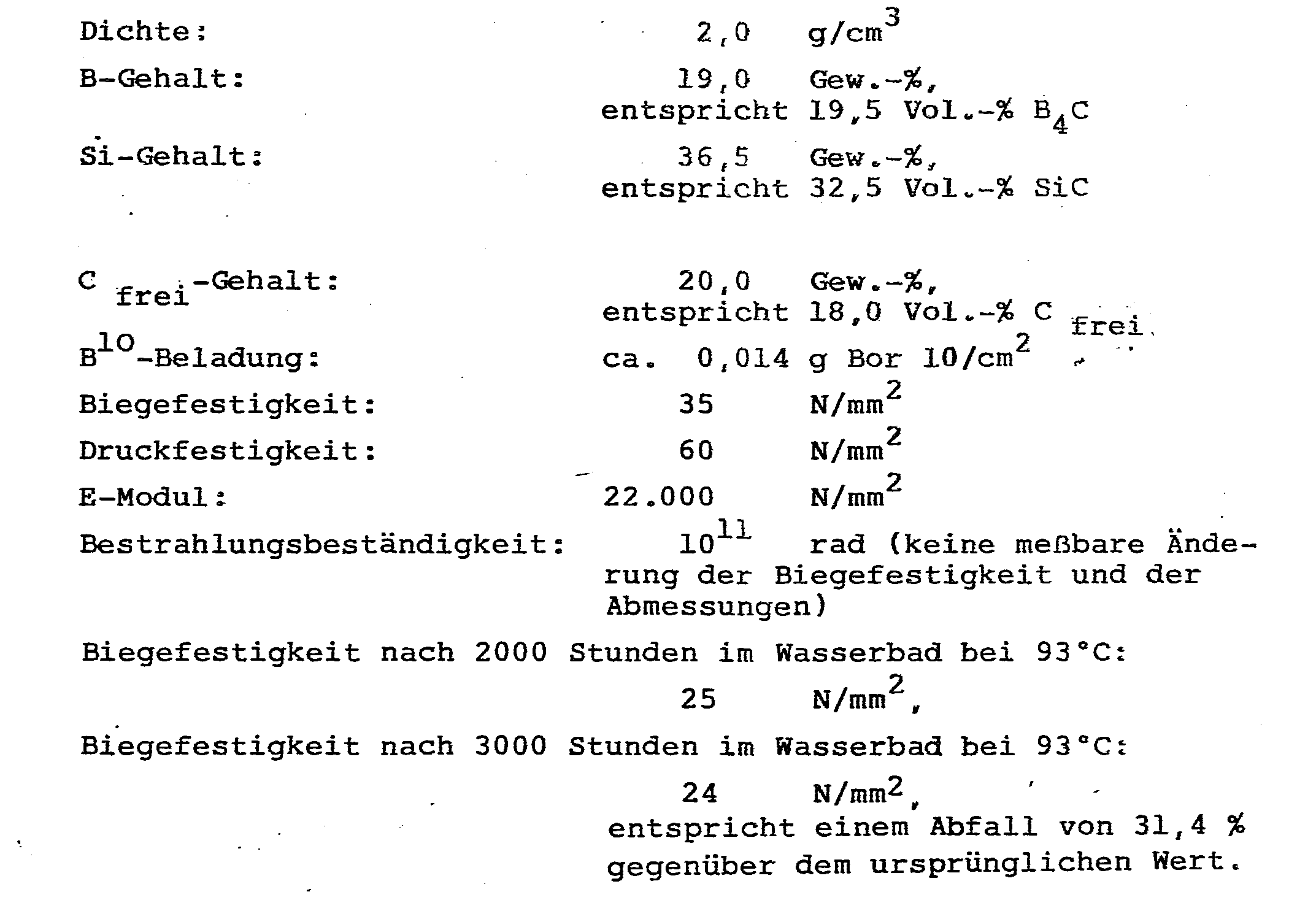
- Die Biegefestigkeit wurde nach der 3-Punkt-Methode mit Proben der Abmessungen 45 x 4,5 x 3,5 mm, einem Auflageabstand von 30 mm und einer Belastungsgeschwindigkeit von 1,8 N/mm 2 x Sekunde bestimmt. Für den Korrosionstest wurden die Platten 2000 bzw. 3000 Stunden in siedendem Wasser erhitzt und dann erneut die Biegefestigkeit bestimmt. Der Abfall der Biegefestigkeit in % bezieht sich auf den ursprünglich gemessenen Wert bei Raumtemperatur.
-
- 28 Gew.-Teile Borcarbidpulver (A),
- 65 Gew.-Teile Siliciumcarbidpulver (C),
- 7 Gew,-Teile Graphitpulver,
- 18 Gew,-Teile Phenolharzpulver und
- 6 Gew,-Teile Furfurol
- Eigenschaften der hergestellten Platten:
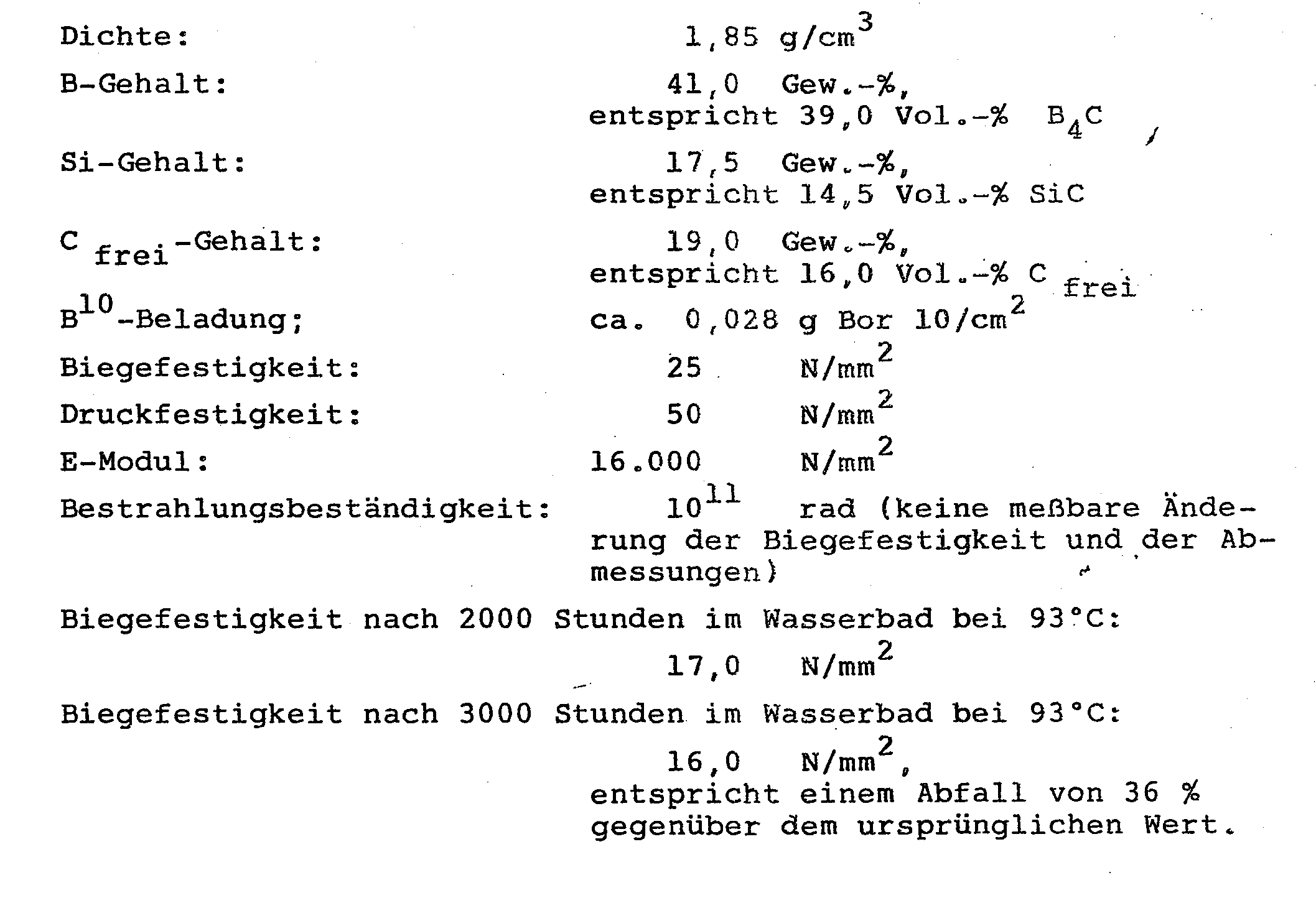
- Unter den gleichen Bedingungen wie in Beispiel 1 beschrieben wurde das folgende homogene Pulvergemisch hergestellt, verpreßt, die Platten ausgehärtet und unter Luftausschluß geglüht:
- 60 Gew.-Teile Borcarbidpulver (B)
- 20 Gew.-Teile Sil.iciumcarbidpulver (C)
- 10 Gew.-Teile Graphitpulver
- 19 Gew.-Teile Phenolharzpulver und
- 6 Gew.-Teile Furfurol.
- Eigenschaften der hergestellten Platten (2 mm):
- Unter den gleichen Bedingungen wie in Beispiel 1 beschrieben wurde das folgende homogene Pulvergemisch hergestellt, verpreßt, die Platten ausgehärtet und unter Luftausschluß geglüht:
- 93 Gew.-Teile Borcarbidpulver (B)
- 7 Gew.-Teile Graphitpulver
- 19 Gew.-Teile Phenolharzpulver und
- 5 Gew.-Teile Furfurol.
- Eigenschaften der hergestellten Platten (2 mm)

wurden homogen vermischt. Das Pulvergemisch wurde zu 2 mm dicken Platten mit einem Preßdruck von 28 MPa verarbeitet. Die Platten wurden zwischen Glasplatten gestapelt und durch Aufheizen in 15 Stunden auf 180°C ausgehärtet. Anschließend wurden die Platten zwischen Graphitplatten gestapelt und unter Luftausschluß auf 1050°C erhitzt, wobei die Aufheizzeit bis zum Erreichen dieser Temperatur 19 Stunden betrug und 7 Stunden konstant gehalten wurde.
Claims (4)
10 bis 20 Vol.-% des freien Kohlenstoffs, Rest Poren bestehen, mit einer Dichte von 1,5 bis 2,2 g/cm und einer Biegefestigkeit von 20 bis 50 N/mm2 bei Raumtemperatur, gemessen nach der 3-Punkt-Methode, die nach dem Korrosionstest durch 3000 Stunden Erhitzen in siedendem Wasser um weniger als 40 % des ursprünglichen Wertes abfällt.
15 bis 25 Vol.-% Borcarbid,
25 bis 30 Vol.-% Siliciumcarbid und
10 bis 20 Vol.-% des freien Kohlenstoffs, Rest Poren, aufweisen.
und Siliciumcarbidpulver mit einem SiC-Gehalt von mindestens 98 Gew.-%, einem Sauerstoffgehalt von weniger als 0,5 Gew.-% und einer Teilchengrößenverteilung von
Applications Claiming Priority (2)
| Application Number | Priority Date | Filing Date | Title |
|---|---|---|---|
| DE3403257 | 1984-01-31 | ||
| DE19843403257 DE3403257A1 (de) | 1984-01-31 | 1984-01-31 | Neutronenabsorberplatten mit keramischer bindung auf basis borcarbid und freiem kohlenstoff |
Publications (3)
| Publication Number | Publication Date |
|---|---|
| EP0150841A2 true EP0150841A2 (de) | 1985-08-07 |
| EP0150841A3 EP0150841A3 (en) | 1988-07-06 |
| EP0150841B1 EP0150841B1 (de) | 1990-08-29 |
Family
ID=6226348
Family Applications (1)
| Application Number | Title | Priority Date | Filing Date |
|---|---|---|---|
| EP85100862A Expired - Lifetime EP0150841B1 (de) | 1984-01-31 | 1985-01-29 | Neutronenabsorberplatten mit keramischer Bindung auf Basis Borcarbid und freiem Kohlenstoff |
Country Status (4)
| Country | Link |
|---|---|
| US (1) | US4684480A (de) |
| EP (1) | EP0150841B1 (de) |
| JP (1) | JPS60170800A (de) |
| DE (2) | DE3403257A1 (de) |
Cited By (1)
| Publication number | Priority date | Publication date | Assignee | Title |
|---|---|---|---|---|
| EP0657402A1 (de) * | 1993-12-10 | 1995-06-14 | Commissariat A L'energie Atomique | Neutronenabsorbierendes Verbundmaterial und Verfahren zu dessen Herstellung |
Families Citing this family (10)
| Publication number | Priority date | Publication date | Assignee | Title |
|---|---|---|---|---|
| SE450857B (sv) * | 1985-02-21 | 1987-08-03 | Asea Ab | Forfarande for uppbyggnad av ljusbagslikstromsugnar eller -skenkar |
| US5894066A (en) * | 1998-01-12 | 1999-04-13 | The United States Of America As Represented By The Secretary Of The Navy | Boron carbride/silicon carbide ceramics |
| US6652801B2 (en) | 2000-03-06 | 2003-11-25 | Gerard E. Parker | Method for producing agglomerated boron carbide |
| US6716782B2 (en) | 2002-08-16 | 2004-04-06 | The Boeing Company | Rigid insulation and method of producing same |
| DE102010000974A1 (de) | 2010-01-18 | 2011-07-21 | ALD Vacuum Technologies GmbH, 63450 | Form-, strahlungs- und temperaturstabiler Körper, geeignet zum Transport und/oder zur Lagerung von radioaktiven Abfällen |
| US8664630B1 (en) * | 2011-03-22 | 2014-03-04 | Jefferson Science Associates, Llc | Thermal neutron shield and method of manufacture |
| CN109942300A (zh) * | 2019-04-01 | 2019-06-28 | 东北大学 | 以砂浆切割废料为原料原位制备碳化硼-碳化硅复合陶瓷的方法 |
| CN111089774B (zh) * | 2019-10-16 | 2022-11-04 | 上海衡益特陶新材料有限公司 | 碳化硼制品的表面腐蚀处理方法、金相试样及其制备方法 |
| CN114920564A (zh) * | 2022-05-07 | 2022-08-19 | 刘峻廷 | 一种高纯碳化硼管式陶瓷过滤膜制备方法 |
| CN118851769B (zh) * | 2024-06-28 | 2025-06-20 | 兰溪泛翌精细陶瓷有限公司 | 一种非镀膜中子吸收球制备方法及中子吸收球 |
Family Cites Families (18)
| Publication number | Priority date | Publication date | Assignee | Title |
|---|---|---|---|---|
| US2988522A (en) * | 1955-11-25 | 1961-06-13 | North American Aviation Inc | Graphite boron neutron shielding |
| BE567962A (de) * | 1956-11-02 | |||
| US3133887A (en) * | 1958-10-06 | 1964-05-19 | Norton Co | Neutron shields and methods of manufacturing them |
| US3153636A (en) * | 1958-10-31 | 1964-10-20 | Carborundum Co | Porous bodies of controlled densities and methods of making them |
| US3126351A (en) * | 1958-12-31 | 1964-03-24 | Hydrated lead borate products | |
| US3096187A (en) * | 1959-08-05 | 1963-07-02 | Berthold C Weber | Silicon-boron-oxygen refractory material |
| US3122513A (en) * | 1960-01-14 | 1964-02-25 | John P Dempsey | Concrete comprising lead matte and calcium aluminate cement |
| US3245880A (en) * | 1963-03-18 | 1966-04-12 | Great Lakes Carbon Corp | Nuclear reactors operating with substantially isotropic graphitized bodies |
| FR1530462A (fr) * | 1967-03-24 | 1968-06-28 | Commissariat Energie Atomique | Procédé de fabrication de produits graphitiques absorbant les neutrons et produits conformes à ceux obtenus par application du procédé |
| US4081284A (en) * | 1976-08-04 | 1978-03-28 | General Electric Company | Silicon carbide-boron carbide sintered body |
| DE2752040C3 (de) * | 1977-11-22 | 1981-10-08 | Elektroschmelzwerk Kempten GmbH, 8000 München | Neutronenabsorberplatten auf Grundlage von Borcarbid und Kohlenstoff und Verfahren zu ihrer Herstellung |
| US4225467A (en) * | 1977-11-25 | 1980-09-30 | The Carborundum Company | Neutron absorbing article and method for manufacture of such article |
| US4198322A (en) * | 1977-12-01 | 1980-04-15 | The Carborundum Company | One-step curing method for manufacture of neutron absorbing plates |
| US4213883A (en) * | 1977-12-30 | 1980-07-22 | The Carborundum Company | Method for manufacture of neutron absorbing articles |
| US4156147A (en) * | 1977-12-30 | 1979-05-22 | The Carborundum Company | Neutron absorbing article |
| US4313973A (en) * | 1978-01-17 | 1982-02-02 | Kennecott Corporation | Method for manufacture of neutron absorbing article |
| DE2855547A1 (de) * | 1978-11-01 | 1980-05-22 | Kempten Elektroschmelz Gmbh | Neutronenabsorberplatten auf grundlage von borcarbid und kohlenstoff und verfahren zu ihrer herstellung (ii) |
| US4293598A (en) * | 1978-11-13 | 1981-10-06 | The Carborundum Company | Method for increasing boron10 contents of neutron absorbing articles |
-
1984
- 1984-01-31 DE DE19843403257 patent/DE3403257A1/de not_active Withdrawn
- 1984-11-13 US US06/670,760 patent/US4684480A/en not_active Expired - Fee Related
- 1984-11-22 JP JP59246361A patent/JPS60170800A/ja active Granted
-
1985
- 1985-01-29 EP EP85100862A patent/EP0150841B1/de not_active Expired - Lifetime
- 1985-01-29 DE DE8585100862T patent/DE3579325D1/de not_active Expired - Lifetime
Cited By (3)
| Publication number | Priority date | Publication date | Assignee | Title |
|---|---|---|---|---|
| EP0657402A1 (de) * | 1993-12-10 | 1995-06-14 | Commissariat A L'energie Atomique | Neutronenabsorbierendes Verbundmaterial und Verfahren zu dessen Herstellung |
| FR2713818A1 (fr) * | 1993-12-10 | 1995-06-16 | Commissariat Energie Atomique | Matériau composite absorbant les neutrons et son procédé de fabrication. |
| US5772922A (en) * | 1993-12-10 | 1998-06-30 | Commissariat A L'energie Atomique | Neutron- absorbing composite material and its production process |
Also Published As
| Publication number | Publication date |
|---|---|
| DE3403257A1 (de) | 1985-08-01 |
| JPH0453279B2 (de) | 1992-08-26 |
| JPS60170800A (ja) | 1985-09-04 |
| US4684480A (en) | 1987-08-04 |
| DE3579325D1 (de) | 1990-10-04 |
| EP0150841B1 (de) | 1990-08-29 |
| EP0150841A3 (en) | 1988-07-06 |
Similar Documents
| Publication | Publication Date | Title |
|---|---|---|
| DE2752040C3 (de) | Neutronenabsorberplatten auf Grundlage von Borcarbid und Kohlenstoff und Verfahren zu ihrer Herstellung | |
| EP0034329B1 (de) | Panzerung | |
| EP0004031B1 (de) | Dichte polykristalline Formkörper aus alpha-Siliciumcarbid und Verfahren zu ihrer Herstellung durch drucklose Sinterung | |
| EP0002067B1 (de) | Verfahren zur Herstellung von polykristallinen dichten Formkörpern aus Borcarbid durch drucklose Sinterung | |
| DE69113966T2 (de) | Verbundpulver aus aluminiumoxyd/metall, cermets daraus und verfahren zu ihrer herstellung. | |
| EP0059860B2 (de) | Wärmedämmender Pressstoff auf der Basis von aus der Flammenhydrolyse gewonnenem mikroporösem Oxidaerogel, sowie Verfahren zu seiner Herstellung, eine daraus hergestellte Folie und ein damit hergestelltes kaschiertes Wärmedämmelement | |
| EP0628525B1 (de) | Verbundwerkstoffe auf der Basis von Borcarbid, Titanborid und elementarem Kohlenstoff sowie Verfahren zu ihrer Herstellung | |
| DE2948977C2 (de) | ||
| EP0150841B1 (de) | Neutronenabsorberplatten mit keramischer Bindung auf Basis Borcarbid und freiem Kohlenstoff | |
| DE1771408A1 (de) | Dichte keramische koerper aus carbiden und verfahren zu ihrer herstellung | |
| DE3932992A1 (de) | Hartmetallische verbundstoffe mittels dispersionslegierung | |
| DE68906740T2 (de) | Metallische Zusammensetzung enthaltend Zinkoxyd-Whisker. | |
| DE3219607A1 (de) | Gesintertes schleifmittel und verfahren zu seiner herstellung | |
| EP0175877B1 (de) | Polygranularer Kohlenstoffkörper und Verfahren zu seiner Herstellung | |
| DE4119695C2 (de) | Aluminiumnitridkörnchen und Verfahren zu deren Herstellung | |
| DE3327101C2 (de) | ||
| DE2917437C2 (de) | Verahren zum Einbinden von radioaktiven und toxischen Abfällen | |
| DE2314384A1 (de) | Dichte siliciumcarbidkoerper und verfahren zu deren herstellung | |
| DE3630369C2 (de) | ||
| EP0204962A1 (de) | Polykristalline Sinterkörper auf Basis von Lanthanhexaborid und Verfahren zu ihrer Herstellung | |
| DE1238833B (de) | Reibwerkstoff, insbesondere fuer Bremsen und Kupplungen | |
| EP0052851B1 (de) | Polykristalliner Formkörper aus Siliziumkarbid und Verfahren zu seiner Herstellung | |
| EP0116851B1 (de) | Polykristalline Sinterkörper auf Basis Europiumhexaborid und Verfahren zu ihrer Herstellung | |
| EP0052850B1 (de) | Verfahren zur Herstellung eines polykristallinen Formkörpers aus Siliziumkarbid | |
| DE3116786A1 (de) | Homogener siliciumcarbid-formkoerper und verfahren zu seiner herstellung |
Legal Events
| Date | Code | Title | Description |
|---|---|---|---|
| PUAI | Public reference made under article 153(3) epc to a published international application that has entered the european phase |
Free format text: ORIGINAL CODE: 0009012 |
|
| 17P | Request for examination filed |
Effective date: 19850129 |
|
| AK | Designated contracting states |
Designated state(s): BE DE FR GB IT NL |
|
| PUAL | Search report despatched |
Free format text: ORIGINAL CODE: 0009013 |
|
| AK | Designated contracting states |
Kind code of ref document: A3 Designated state(s): BE DE FR GB IT NL |
|
| 17Q | First examination report despatched |
Effective date: 19891030 |
|
| GRAA | (expected) grant |
Free format text: ORIGINAL CODE: 0009210 |
|
| ITF | It: translation for a ep patent filed | ||
| AK | Designated contracting states |
Kind code of ref document: B1 Designated state(s): BE DE FR GB IT NL |
|
| REF | Corresponds to: |
Ref document number: 3579325 Country of ref document: DE Date of ref document: 19901004 |
|
| ET | Fr: translation filed | ||
| GBT | Gb: translation of ep patent filed (gb section 77(6)(a)/1977) | ||
| PGFP | Annual fee paid to national office [announced via postgrant information from national office to epo] |
Ref country code: FR Payment date: 19901215 Year of fee payment: 7 |
|
| PGFP | Annual fee paid to national office [announced via postgrant information from national office to epo] |
Ref country code: BE Payment date: 19901227 Year of fee payment: 7 |
|
| PGFP | Annual fee paid to national office [announced via postgrant information from national office to epo] |
Ref country code: GB Payment date: 19910102 Year of fee payment: 7 |
|
| PGFP | Annual fee paid to national office [announced via postgrant information from national office to epo] |
Ref country code: NL Payment date: 19910131 Year of fee payment: 7 |
|
| PGFP | Annual fee paid to national office [announced via postgrant information from national office to epo] |
Ref country code: DE Payment date: 19910205 Year of fee payment: 7 |
|
| PLBE | No opposition filed within time limit |
Free format text: ORIGINAL CODE: 0009261 |
|
| STAA | Information on the status of an ep patent application or granted ep patent |
Free format text: STATUS: NO OPPOSITION FILED WITHIN TIME LIMIT |
|
| 26N | No opposition filed | ||
| PG25 | Lapsed in a contracting state [announced via postgrant information from national office to epo] |
Ref country code: GB Effective date: 19920129 |
|
| PG25 | Lapsed in a contracting state [announced via postgrant information from national office to epo] |
Ref country code: BE Effective date: 19920131 |
|
| BERE | Be: lapsed |
Owner name: ELEKTROSCHMELZWERK KEMPTEN G.M.B.H. Effective date: 19920131 |
|
| PG25 | Lapsed in a contracting state [announced via postgrant information from national office to epo] |
Ref country code: NL Effective date: 19920801 |
|
| NLV4 | Nl: lapsed or anulled due to non-payment of the annual fee | ||
| GBPC | Gb: european patent ceased through non-payment of renewal fee | ||
| PG25 | Lapsed in a contracting state [announced via postgrant information from national office to epo] |
Ref country code: FR Effective date: 19920930 |
|
| PG25 | Lapsed in a contracting state [announced via postgrant information from national office to epo] |
Ref country code: DE Effective date: 19921103 |
|
| REG | Reference to a national code |
Ref country code: FR Ref legal event code: ST |