EP0150986B1 - Fourrure artificielle et procédé pour sa fabrication - Google Patents
Fourrure artificielle et procédé pour sa fabrication Download PDFInfo
- Publication number
- EP0150986B1 EP0150986B1 EP19850300462 EP85300462A EP0150986B1 EP 0150986 B1 EP0150986 B1 EP 0150986B1 EP 19850300462 EP19850300462 EP 19850300462 EP 85300462 A EP85300462 A EP 85300462A EP 0150986 B1 EP0150986 B1 EP 0150986B1
- Authority
- EP
- European Patent Office
- Prior art keywords
- fibers
- artificial fur
- pile
- rising
- needle
- Prior art date
- Legal status (The legal status is an assumption and is not a legal conclusion. Google has not performed a legal analysis and makes no representation as to the accuracy of the status listed.)
- Expired
Links
- 238000004519 manufacturing process Methods 0.000 title claims description 27
- 239000000835 fiber Substances 0.000 claims description 157
- 239000004744 fabric Substances 0.000 claims description 92
- 230000000630 rising effect Effects 0.000 claims description 90
- 230000003806 hair structure Effects 0.000 claims description 85
- 238000000034 method Methods 0.000 claims description 56
- 230000008569 process Effects 0.000 claims description 47
- 239000007788 liquid Substances 0.000 claims description 30
- 238000004080 punching Methods 0.000 claims description 30
- 230000002093 peripheral effect Effects 0.000 claims description 19
- 229920001971 elastomer Polymers 0.000 claims description 14
- 239000000806 elastomer Substances 0.000 claims description 14
- 230000007246 mechanism Effects 0.000 claims description 11
- 125000004122 cyclic group Chemical group 0.000 claims 1
- 239000010408 film Substances 0.000 description 29
- 229920002635 polyurethane Polymers 0.000 description 20
- 239000004814 polyurethane Substances 0.000 description 20
- 239000000243 solution Substances 0.000 description 15
- 229920000728 polyester Polymers 0.000 description 14
- HEMHJVSKTPXQMS-UHFFFAOYSA-M Sodium hydroxide Chemical compound [OH-].[Na+] HEMHJVSKTPXQMS-UHFFFAOYSA-M 0.000 description 12
- 239000000463 material Substances 0.000 description 11
- 238000012545 processing Methods 0.000 description 11
- 239000011159 matrix material Substances 0.000 description 10
- ZWEHNKRNPOVVGH-UHFFFAOYSA-N 2-Butanone Chemical compound CCC(C)=O ZWEHNKRNPOVVGH-UHFFFAOYSA-N 0.000 description 9
- CSCPPACGZOOCGX-UHFFFAOYSA-N Acetone Chemical compound CC(C)=O CSCPPACGZOOCGX-UHFFFAOYSA-N 0.000 description 8
- 238000004043 dyeing Methods 0.000 description 8
- 239000004745 nonwoven fabric Substances 0.000 description 8
- 101100334009 Caenorhabditis elegans rib-2 gene Proteins 0.000 description 7
- 239000000306 component Substances 0.000 description 7
- 230000000694 effects Effects 0.000 description 7
- 241000772415 Neovison vison Species 0.000 description 6
- YXFVVABEGXRONW-UHFFFAOYSA-N Toluene Chemical compound CC1=CC=CC=C1 YXFVVABEGXRONW-UHFFFAOYSA-N 0.000 description 6
- 239000007943 implant Substances 0.000 description 6
- 238000002513 implantation Methods 0.000 description 6
- -1 polybutylene terephthalate Polymers 0.000 description 6
- 238000011084 recovery Methods 0.000 description 6
- 229920001707 polybutylene terephthalate Polymers 0.000 description 5
- 230000009471 action Effects 0.000 description 4
- 238000000576 coating method Methods 0.000 description 4
- 238000009826 distribution Methods 0.000 description 4
- 239000000975 dye Substances 0.000 description 4
- 239000002932 luster Substances 0.000 description 4
- 230000000704 physical effect Effects 0.000 description 4
- 229920005989 resin Polymers 0.000 description 4
- 239000011347 resin Substances 0.000 description 4
- 238000010008 shearing Methods 0.000 description 4
- 235000011121 sodium hydroxide Nutrition 0.000 description 4
- 229920002994 synthetic fiber Polymers 0.000 description 4
- 239000012209 synthetic fiber Substances 0.000 description 4
- 239000004721 Polyphenylene oxide Substances 0.000 description 3
- 239000004793 Polystyrene Substances 0.000 description 3
- XSTXAVWGXDQKEL-UHFFFAOYSA-N Trichloroethylene Chemical group ClC=C(Cl)Cl XSTXAVWGXDQKEL-UHFFFAOYSA-N 0.000 description 3
- 239000007864 aqueous solution Substances 0.000 description 3
- 239000011248 coating agent Substances 0.000 description 3
- 238000013461 design Methods 0.000 description 3
- 238000001035 drying Methods 0.000 description 3
- 230000003803 hair density Effects 0.000 description 3
- 238000005470 impregnation Methods 0.000 description 3
- 230000006872 improvement Effects 0.000 description 3
- 238000002156 mixing Methods 0.000 description 3
- 229920000570 polyether Polymers 0.000 description 3
- 229920002223 polystyrene Polymers 0.000 description 3
- 239000011148 porous material Substances 0.000 description 3
- 230000009467 reduction Effects 0.000 description 3
- 230000002829 reductive effect Effects 0.000 description 3
- 239000002904 solvent Substances 0.000 description 3
- UBOXGVDOUJQMTN-UHFFFAOYSA-N trichloroethylene Natural products ClCC(Cl)Cl UBOXGVDOUJQMTN-UHFFFAOYSA-N 0.000 description 3
- JOYRKODLDBILNP-UHFFFAOYSA-N urethane group Chemical group NC(=O)OCC JOYRKODLDBILNP-UHFFFAOYSA-N 0.000 description 3
- XLYOFNOQVPJJNP-UHFFFAOYSA-N water Substances O XLYOFNOQVPJJNP-UHFFFAOYSA-N 0.000 description 3
- 208000019300 CLIPPERS Diseases 0.000 description 2
- LYCAIKOWRPUZTN-UHFFFAOYSA-N Ethylene glycol Chemical compound OCCO LYCAIKOWRPUZTN-UHFFFAOYSA-N 0.000 description 2
- 239000004952 Polyamide Substances 0.000 description 2
- XUIMIQQOPSSXEZ-UHFFFAOYSA-N Silicon Chemical group [Si] XUIMIQQOPSSXEZ-UHFFFAOYSA-N 0.000 description 2
- 239000000853 adhesive Substances 0.000 description 2
- 230000001070 adhesive effect Effects 0.000 description 2
- 230000032683 aging Effects 0.000 description 2
- 230000015572 biosynthetic process Effects 0.000 description 2
- 230000001680 brushing effect Effects 0.000 description 2
- 238000001311 chemical methods and process Methods 0.000 description 2
- 208000021930 chronic lymphocytic inflammation with pontine perivascular enhancement responsive to steroids Diseases 0.000 description 2
- 230000015271 coagulation Effects 0.000 description 2
- 238000005345 coagulation Methods 0.000 description 2
- 230000001427 coherent effect Effects 0.000 description 2
- 239000002131 composite material Substances 0.000 description 2
- 239000008358 core component Substances 0.000 description 2
- 230000001419 dependent effect Effects 0.000 description 2
- RWSOTUBLDIXVET-UHFFFAOYSA-M hydrosulfide Chemical compound [SH-] RWSOTUBLDIXVET-UHFFFAOYSA-M 0.000 description 2
- 239000000203 mixture Substances 0.000 description 2
- 210000000056 organ Anatomy 0.000 description 2
- 230000036961 partial effect Effects 0.000 description 2
- 239000012466 permeate Substances 0.000 description 2
- 229920002647 polyamide Polymers 0.000 description 2
- 230000002265 prevention Effects 0.000 description 2
- 239000000047 product Substances 0.000 description 2
- 230000002441 reversible effect Effects 0.000 description 2
- 239000004094 surface-active agent Substances 0.000 description 2
- QTBSBXVTEAMEQO-UHFFFAOYSA-N Acetic acid Chemical group CC(O)=O QTBSBXVTEAMEQO-UHFFFAOYSA-N 0.000 description 1
- 239000004215 Carbon black (E152) Substances 0.000 description 1
- 239000004970 Chain extender Substances 0.000 description 1
- 229920002302 Nylon 6,6 Polymers 0.000 description 1
- 239000004372 Polyvinyl alcohol Substances 0.000 description 1
- 239000004902 Softening Agent Substances 0.000 description 1
- NIXOWILDQLNWCW-UHFFFAOYSA-N acrylic acid group Chemical group C(C=C)(=O)O NIXOWILDQLNWCW-UHFFFAOYSA-N 0.000 description 1
- 230000033228 biological regulation Effects 0.000 description 1
- 230000008859 change Effects 0.000 description 1
- 238000006243 chemical reaction Methods 0.000 description 1
- 230000003750 conditioning effect Effects 0.000 description 1
- 238000010276 construction Methods 0.000 description 1
- 230000008602 contraction Effects 0.000 description 1
- 238000005520 cutting process Methods 0.000 description 1
- 238000011161 development Methods 0.000 description 1
- 230000018109 developmental process Effects 0.000 description 1
- 238000010586 diagram Methods 0.000 description 1
- 150000004985 diamines Chemical class 0.000 description 1
- 125000005442 diisocyanate group Chemical group 0.000 description 1
- 230000003292 diminished effect Effects 0.000 description 1
- 150000002009 diols Chemical class 0.000 description 1
- 208000037265 diseases, disorders, signs and symptoms Diseases 0.000 description 1
- 239000000986 disperse dye Substances 0.000 description 1
- 230000002349 favourable effect Effects 0.000 description 1
- 238000005111 flow chemistry technique Methods 0.000 description 1
- 125000001153 fluoro group Chemical group F* 0.000 description 1
- 239000011521 glass Substances 0.000 description 1
- 229930195733 hydrocarbon Natural products 0.000 description 1
- WGCNASOHLSPBMP-UHFFFAOYSA-N hydroxyacetaldehyde Natural products OCC=O WGCNASOHLSPBMP-UHFFFAOYSA-N 0.000 description 1
- 230000001976 improved effect Effects 0.000 description 1
- 238000007689 inspection Methods 0.000 description 1
- 230000002452 interceptive effect Effects 0.000 description 1
- 230000001788 irregular Effects 0.000 description 1
- 238000009981 jet dyeing Methods 0.000 description 1
- 238000010030 laminating Methods 0.000 description 1
- 230000005012 migration Effects 0.000 description 1
- 238000013508 migration Methods 0.000 description 1
- 239000012046 mixed solvent Substances 0.000 description 1
- 239000003960 organic solvent Substances 0.000 description 1
- 229920002239 polyacrylonitrile Polymers 0.000 description 1
- 229920006264 polyurethane film Polymers 0.000 description 1
- 229920005749 polyurethane resin Polymers 0.000 description 1
- 229920002451 polyvinyl alcohol Polymers 0.000 description 1
- 230000001105 regulatory effect Effects 0.000 description 1
- 230000002040 relaxant effect Effects 0.000 description 1
- 230000000452 restraining effect Effects 0.000 description 1
- 238000004826 seaming Methods 0.000 description 1
- 229910052710 silicon Inorganic materials 0.000 description 1
- 239000010703 silicon Substances 0.000 description 1
- 239000004671 silicon softener Substances 0.000 description 1
- 239000000126 substance Substances 0.000 description 1
- 230000008093 supporting effect Effects 0.000 description 1
- 239000004753 textile Substances 0.000 description 1
- 239000010409 thin film Substances 0.000 description 1
- 238000012546 transfer Methods 0.000 description 1
- 238000009732 tufting Methods 0.000 description 1
- 238000009827 uniform distribution Methods 0.000 description 1
- 239000002759 woven fabric Substances 0.000 description 1
Images


Classifications
-
- D—TEXTILES; PAPER
- D04—BRAIDING; LACE-MAKING; KNITTING; TRIMMINGS; NON-WOVEN FABRICS
- D04H—MAKING TEXTILE FABRICS, e.g. FROM FIBRES OR FILAMENTARY MATERIAL; FABRICS MADE BY SUCH PROCESSES OR APPARATUS, e.g. FELTS, NON-WOVEN FABRICS; COTTON-WOOL; WADDING ; NON-WOVEN FABRICS FROM STAPLE FIBRES, FILAMENTS OR YARNS, BONDED WITH AT LEAST ONE WEB-LIKE MATERIAL DURING THEIR CONSOLIDATION
- D04H11/00—Non-woven pile fabrics
- D04H11/08—Non-woven pile fabrics formed by creation of a pile on at least one surface of a non-woven fabric without addition of pile-forming material, e.g. by needling, by differential shrinking
-
- A—HUMAN NECESSITIES
- A41—WEARING APPAREL
- A41H—APPLIANCES OR METHODS FOR MAKING CLOTHES, e.g. FOR DRESS-MAKING OR FOR TAILORING, NOT OTHERWISE PROVIDED FOR
- A41H41/00—Machines or appliances for making garments from natural or artificial fur
- A41H41/005—Machines or appliances for making garments from artificial fur
-
- D—TEXTILES; PAPER
- D10—INDEXING SCHEME ASSOCIATED WITH SUBLASSES OF SECTION D, RELATING TO TEXTILES
- D10B—INDEXING SCHEME ASSOCIATED WITH SUBLASSES OF SECTION D, RELATING TO TEXTILES
- D10B2501/00—Wearing apparel
- D10B2501/04—Outerwear; Protective garments
- D10B2501/044—Fur garments; Garments of fur substitutes
Definitions
- the present invention relates to an.artificial fur and a method of manufacturing the same.
- Furs such as mink as a typical example, have been long appreciated as an excellent clothing material, e.g., for shawls and coats, and as upholstery and architectural decorative materials, such as for sofas, car seats, rugs, and tapestries, because of their excellent touch, luster, hand, and appearance.
- Example of artificial fur manufacturing techniques are disclosed Japanese Unexamined Patent Publication (Kokai) Nos. 56-63057 and 57-121643.
- the artificial fur manufactured according to the former has a rising hair structure formed by simply implanting fibers in an unreinforced ordinary base fabric through a needle punching process, while the artificial fur manufactured according to the latter has a rising hair structure formed by tufting fibers of different lengths in a wavy form.
- the rising pile fibers are standing practically upright over the base fabric and cannot duplicate the lie of the hair and the appearance of a genuine fur, and hence, those artificial furs are readily distinguished visually from genuine furs.
- the artificial furs with such rising hair structures have a disadvantage in that the base fabric is exposed when bent.
- those techniques have an intrinsic problem in that they are able only to produce an artificial fur of reduced hair density, even if they are able to overcome the above-mentioned disadvantages of the artificial furs.
- the present invention provides an artificial fur comprising at least one rising hair structure having, at a surface thereof, pile fibers held by and rising from a base fabric, characterised in that the rising hair structure has pile fibers which lie generally longitudinally thereof, when viewed from above the said surface thereof, pile fibers in widthwise peripheral sections of the rising hair structure having an angle of inclination to the longitudinal direction of the rising hair structure which is greater than that of pile fibers in a central section thereof and pile fibers in outermost peripheral sections of the rising hair structure lying generally at a said angle of inclination of from 10 to 80°C inclusive.
- the angle of inclination of the fibers increased generally progressively from the central to the peripheral sections of the rising hair structure.
- the method of the present invention enables the easy and stable mass production of an artificial fur having surface characteristics featured by the rising pile fibers, exceeding those of the genuine fur, which the prior art could not achieve.
- the fibers of the pile are staple fibers selected among natural fibers or synthetic fibers.
- Staple fibers used as guard hair fibers 1a (designated as “guard fibers” hereinafter) and staple fibers used as underfur fibers 1 b (designated as “under fur fibers” hereinafter) are different from each other in length.
- guard hairfibers 1a are longerthan underfurfibers 1 b.
- the fiber length be of the same general order among the guard hair fibers and among the fur fibers respectively.
- This invention uses the guard hair 1a and the under fur fibers 1 b individually or in combination.
- the range of the ratio of the amount of the guard hair fibers to the total amount of the pile is 20 to 60% by weight, preferably, 30 to 50% by weight, in view of the touch, appearance, hand, and the lie of hair.
- the guard hair fibers 1a may be crimped somewhat; however, straight fibers are preferable, whereas, preferably, the under fur fibers are crimped fibers.
- the preferable mode of crimp is 4 to 10 crimps/25 mm in number and 3 to 8% in percentage crimp.
- Fine crimped fibers having crimps of a number around the lower limit of the range ofthe number of crimps as used as underfur fibers have desirable properties, such as the prevention of the exposure of the base fabric and the improvement of the apparent hair density.
- Straight fibers as designated herein are practically linear fibers having crimps of a number below the range of the number of crimps.
- Fibers used as guard hair fibers 1a are those of approximately 20 to 70 d fineness and 20 to 40 mm fiber length, while fibers used as under fur fibers 1 b are those of approximately 1 to 7 d fineness and 15 to 30 mm fiber length. Further, if necessary, extra-fine fibers of 1 d or less, e.g., 0.1 d N 0.001 d may be used as under fur fibers. However, those values defining the quality of fibers are subject to change depending on the design of an artificial fur to be produced.
- the pile materials may be natural fibers, however, in view of the characteristics of the pile, processing facility, and availability, synthetic fibers are preferable.
- Preferable synthetic fibers are fibers of the polyester group, the polyamide group, the polyacrylonitrile group, and the acetate group.
- those of the polyester group and the polyamide group are preferable in view of the facility in tapering fibers.
- Fibers of the polyester group are particularly preferable, because they can be easily be processed in an alkaline aqueous solution to produce fibers of a beautiful taper form having a pointed tip.
- the fibers of the polyester group the fibers of polybutylene terephthalate are suitable for forming long taper fibers. Fibers of polybutylene terephthalate and nylon 66 have excellent impact resilience, and hence, those fibers are desirable fibers for pile 1, particularly for guard hair fibers 1a.
- fibers of special sections having axial ridges such as fibers of flat cross section or X-shaped cross section, are preferable in view of their resistance to yielding, elasticity, and luster. These fibers are particularly useful for guard hair fibers 1a.
- Fibers tapering at least in one side thereof are preferable for forming the pile 1.
- Tapered guard hair fibers 1a in particular, remarkably improve the touch and hand of the pile.
- Taper fibers are produced by a chemical process in which fibers are dissolved or decomposed, a physical process in which fibers are broken by drawing, or a combination of those processes.
- a chemical process is capable of easily producing taper fibers of preferable fiber characteristics.
- fibers of the polyester group fibers are hydrolyzed and tapered readily by an alkaline aqueous solution by a method, for instance, disclosed in Japanese Unexamined Patent Publication (Kokai) No. 54-38922 or in Japanese Examined Patent Publication (Kokoku) No. 50-40915.
- the term "rising hair structure” (designated as “pile rib” hereinafter) is used herein to designate a longitudinal band 8 of piles 1 of a fixed width having piles 1 extending into a base fabric 3.
- the pile rib 2 formed of piles 1 implanted through the base fabric 3 is a rising hair structure having piles implanted mainly through the needle punching process, in which some of the piles 1 may be gripped in the interior of the base fabric 3.
- the width of the band 8 is optional; however, in view of the surface characteristics provided by the piles 1 (surface variation), the preferable width is 20 cm or less. When the width of the band 8 is 3 to 15 cm in particular, the surface characteristics are conspicuously exhibited.
- the artificial fur may be a structure formed of a single unit pile rib 2 or a structure consisting of a plurality of the unit pile ribs 2 arranged in a continuous arrangement or in an interrupted arrangement.
- the sections not having any pile may be cut off and the unit pile ribs 2 sewn together.
- the arrangement of longer piles 1 in the central area and shorter piles 1 in the peripheral area of the pile rib 2 facilitates forming inclined piles 1 featuring the characteristics of the artificial fur according to the present invention, and hence, such an arrangement of piles 1 is preferable to the arrangement of piles 1 of the same lengths over the pile rib 2 in a widthwise direction X of the rising hair structure.
- the length of the piles in the central area be longer than the length of the piles in the peripheral areas by approximately 10 to 40%, in view of providing the characteristic lie of the hair of the artificial fur according to the present invention.
- Such characteristic lie of the hair is provided also when the central area is greater than the peripheral areas in pile density.
- the pile rib 2 with a pile density of the central area greater than that of the peripheral areas by 20 to 50% is preferable in order to attain the object of the present invention.
- Pile length and pile density are interactive. A suitable combination of pile length and pile density brings about desirable results in this invention.
- the central area corresponds to the central section among three equal sections of the band 8 divided widthwise where the piles are the same in length in the widthwise direction X of the rising hair structure, while where the piles of different lengths are arranged in a triangular form, the central area corresponds to the peak section.
- the central area corresponds to a section where the pile density is high.
- the central area corresponds to the central section among three equal sections.
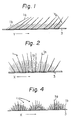
- the inclination of the piles 1 of the band 8 along the longitudinal direction Y, as shown in Fig. 1, is a feature of the artificial fur of the present invention.
- the inclination of the piles 1 remarkably upgrades the luster of the artificial fur.
- the preferable angle of inclination of the pile 1 to the base fabric 3 is an angle within a range of approximately from 40 to 70 degrees. When the angle of inclination is greater than 70 degrees, the appearance of permanent set in fatigue is enhanced. On the other hand, when the angle of inclination is smaller than 40 degrees, the effect of shielding the base fabric 3 and the under fur fibers 1b is diminished and the touch and luster of the artificial fur tends to be deteriorated.
- the piles 1a are inclined generally longitudinally and, as viewed from above the surface, the piles 1 a in the widthwise central section of the band 8 extend in parallel to the longitudinal direction Y of the band 8, the piles in the opposite peripheral sections of the band 8 extend diagonally widthwise with respect to the longitudinal direction Y, and the piles 1a in the outermost sections of the band 8 extend diagonally at angles of 10 to 80 degrees, preferably 20 to 70 degrees, with respect to the longitudinal direction Y as shown in Fig. 3.
- Such a three-dimensional mode of the lie of the hair is an incomparable feature of the artificial fur of the present invention. This feature is produced in the artificial fur formed of a single unit pile rib (Fig.
- FIG. 13 and 14 are photographs of artificial furs embodying the present invention corresponding to the model diagrams of Figs. 3 and 4 respectively, shown for reference. The dark portions in the photographs are shades resulting from the disposition of the artificial furs with respect to the photographic lighting equipment.
- the extension of piles 1 practically in parallel to the longitudinal direction does not necessarily mean that the angle of the pile fiber to the longitudinal direction is zero degrees.
- the objects of the present invention can be attained as long as the piles 1 extend generally along the longitudinal direction even if the piles 1 are inclined slightly with respect to the longitudinal direction.
- the effect of the present invention is conspicuous when the angle of the piles 1 with respect to the longitudinal direction Y is close to zero degrees.
- the angles of extension of all the piles 1 in the peripheral sections need not be the above-mentioned angles; the angles of those piles 1 may increase gradually from the area near the central section in the widthwise direction X of the rising hair structure toward the outermost area where the angle needs to be the above-mentioned angles.
- the angle of extension of the pile 1 is less than 10 degrees, it is hard to produce interference fringes, whereas if it is greater than 80 degrees, irregular interference fringes are produced due to excessive interference between the piles, which is not desirable from the aesthetic viewpoint and in respect of the appearance.
- a high-grade fur formed of a fur such as mink is formed first by cutting a piece of fur into strips, and then the strips of fur are rearranged, through the let-out process.
- the let-out process makes the piles of the fur incline uniformly in parallel to the longitudinal direction, which spoils the beautiful interference fringes and the varied aesthetic surface appearance of a high-grade fur coat, even of mink.
- the artificial fur of the present invention is extremely excellent and not at all the same as mink and fox in respect of the interference fringes of the piles and the varied aesthetic surface appearance.
- a factor permitting such characteristics of the pile arrangement is a rising hair structure which may be formed by implanting piles 1 through the base fabric 3 in bundles.
- piles 1 are implanted by the needle punching process in which a plurality of piles 1 are implanted in bundles in a single stroke needling operation.
- Such a rising hair structure is a characteristic feature of the present invention.
- a plurality of piles 1, irrespective of guard hair fibers 1a or under fur fibers 1b are implanted in a single implantation point (a hole). This structure is an effective factor in the artificial fur of the present invention for satisfying the above mentioned pile arrangement, despite the fur being an artificial article.
- this structure improves the recovery of piles from rubbing against the lie of hair and prevents the falling-off of piles from the base fabric. Furthermore, this structure enables the rising hair structure to be processed in the successive wet treatment for as long a time as necessary for achieving the effect of the wet treatment, without any possibility of damage.
- the recovery from rubbing against the lie of the hair as mentioned herein represents the stability of the pile recovery from a raised position to the original inclined position when rubbed against the lie of the hair. If the recovery from rubbing against the lie of the hair is inferior, the arrangement of the piles is unstable and the piles are liable to be thrown into disorder, which deteriorates the quality of the arrangement of the piles 1 when the artificial fur is worn.
- the structural factors such as the individual implantation of the pile bundles at individual implantation points and the random distribution of the individual pile bundles, also are effective factors prompting the characteristic arrangement of piles. That is, the individual implantation of pile bundles enables the successive wet treatment to completely remove the restraint due to implantation of pile bundles and functions effectively in forming the lie of the hair, while the random distribution of the pile bundles eliminates the uniform distribution of the piles 1 and the artificial appearance of the artificial fur.
- a film 4 of an elastomer is formed at least over one side of the base fabric 3 as illustrated in Figs. 6 and 7 to complete the pile characteristics.
- the provision of the film 4 remarkably improves the pile density, the strength of the artificial fur, and the prevention of the falling-off of the piles.
- Forming the films 4 over both sides of the base fabric enhances the effects of the improvement still further.
- the film 4 may be formed not only so that the film 4 orfilms 4 extend over the surface or the surfaces of the base fabric 3, but may be formed so that part of the film 4 permeates the base fabric 3 or the respective parts of the films 4 permeate the base fabric 3 from both sides of the base fabric 3 and join within the base fabric 3.
- the film 4 need not be a film virtually, but may be a partial distribution of an elastomer over the surface of the base fabric 3 in the form of a film 4. However, it is obvious that forming the film 4 over the surface of the base fabric 3 further improves the specific properties of the base fabric, such as the pile gripping capacity and the strength.
- Forming the film 4 to at least a 1 p thickness, preferably a 10 to 50 p thickness, most preferably a 10 to 30 p thickness, over the surface of the base fabric 3 protects the base fabric 3 from damage due to needle punching, remarkably improves the dimensional stability of the base fabric 3, and enables the base fabric 3 to withstand high pile density.
- An excessively thin film is not capable of providing the above-mentioned effects of the film, whereas an excessively thick film stiffens and spoils the hand of the artificial fur.
- the film 4 has a favourable property for implanting piles by needle punching.
- needles 6 penetrates through the base fabric 3, pores expanded elastically by the needles 6 are formed, and after the needles 6 have been withdrawn, the pores contract elastically. Such elastic contraction of the pores holds the implanted piles 1 firmly.
- the simultaneous improvement of the pile gripping performance and the strength of the fabric 3 enables high-density pile implantation, never before thought of, and enables the reduction of the thickness of the base fabric 3 to the least possible extent, which significantly affects the flexibility of the artificial fur of the present invention.
- the upper limit pile density in implanting piles by needle punching is, at the highest, 200 g/ m 2 , and if piles are implanted excessively in disregard of hand and appearance, the base fabric is destroyed when the pile density is 300 g/ M 2 .
- a pile density as high as 500 g/m 2 or even more than 700 g/m 2 is possible.
- the possible lower limit of a thickness for forming an artificial fur is as small as a thickness corresponding to a unit weight of 50 g/ m 2 .
- Elastomers of the urethane group, the acrylic group, the silicon group, and the fluorine group are suitable materials for the film 4.
- resins of the polyurethane group are preferable as materials of the film of the artificial fur of the present invention, because of their excellent elasticity.
- Exemplary resins of the polyurethane group are various polyether polyurethanes, polyester polyurethanes and polyester polyether polyurethanes. These resins are produced through reactions between long-chain diol (polyester or polyether), diisocyanate, and a chain extender of a low molecular weight (glycol or diamine).
- the base fabric 3 for supporting the piles 1 may be a woven fabric, a knitted fabric, a nonwoven fabric, or a sheet-form material of a combination of those fabrics.
- Nonwoven fabrics, in particular, are suitable materials of the base fabric, because nonwoven fabrics facilitate the adjustment of the hand and appearance of the product and the needle punching operation, and withstand the needle punching action.
- extra-fine fibers of 1 d or less fineness or still extra-fine fibers of 0.1 d or less fineness are preferable.
- Such fibers can be easily produced by the removal of the matrix or the fibrilation of the composite fibers such as microconjugate fibers or fibrillose fibers.
- the matrix is polystyene and the core is polyester.
- the preferable weight per unit area of the base fabric 3 is 50 to 250 g/m 2 in view of the flexibility, preference for lightweight furs, and hand.
- the strength of a base fabric of less than 50 g/m 2 is insufficient, while a base fabric of over 250 g/m 2 gives a hard hand.
- the artificial fur according to the present invention has characteristic properties, such as characteristic appearance and hand and an excellent varied surface, owing to the three-dimensional arrangement of the piles, which have not been realized in the conventional artificial furs, and gives a distinguished impression of a high-grade fur.
- the use of a nonwoven fabric as the base fabric 3 brings about satisfactory results.
- the artificial fur described hereunder employs a nonwoven fabric as the base fabric 3.
- the nonwoven fabric is manufactured through a well-known process, such as the spun-bond process, the needle punching process, or the water punching process.
- the fibers to be used, the weight per unit area, and other conditions are determined by taking into consideration the above-mentioned conditions for the base fabric.
- the film 4 of a suitable elastomer is formed over the surface of the base fabric 3, namely, the nonwoven fabric manufactured through the above mentioned process.
- the direct coating process, the transfer process, the elastomer film laminating process, or the impregnation process is applicable to forming the film 4.
- the application of a solution of the elastomer in the solvent to the surface of the base fabric 3 is the simplest method of forming the film 4 and preferable in view of improved effect of adhesion of the film 4 to the base fabric 3 owing to the permeation of the elastomer solution into the base fabric 3.
- a polyurethane resin for instance, a polyurethane solution of 10 to 30% by weight polyurethane concentration prepared by mixing polyurethane and a solvent, such as dimethyl formaldehyde/methyl ethyl ketone (mixed solvent) is used.
- the preferable viscosity of the solution, in view of film formability is 5,000 to 15,000 cp.
- the film 4 may be formed over one side or over both sides of the base fabric 3.
- piles 1 are implanted on the base fabric 3.
- the piles are implanted through the needle punching process, in which the piles 1 to be implanted are spread over the base fabric 3 and needled with needles 6 for implanting the piles 1.
- a single rising hair structure 8 or a plurality of rising hair structures 8 are formed over the base fabric 3 depending on the type of a needle board 5 employed in the needle punching process.
- a needle board shown in Fig. 9 forms a single rising hair structure 8
- a needle board shown in Fig. 10 forms rising hair structures 8 of a number corresponding to the number of groups of needles.
- the piles 1 piled in areas corresponding to areas on the needle board 5 vacant of needles are not implanted and are removed completely in the following process.
- the length of the implanted pile 1 is dependent on the height of the needle 6 of the needle board, while the pile density is dependent on the density of the needles 6.
- the pile density can be also adjusted by regulating the amount of piles 1 spread over the base fabric 3.
- the pile density is adjusted by the latter from the viewpoint of the properties of the base fabric. For example, when the pile density in the central section of the band needs to be increased, the amount of piles in the central section is increased accordingly.
- the length of piles implanted in the central section in the widthwise direction X needs to be greater than that of piles implanted in the peripheral sections, the length of needles disposed in the corresponding section of the needle board 5 is reduced as compared with needles in the side sections as illustrated in Fig. 10.
- Such specific requirements can be met also by changing the disposition of the base fabric 3.
- the base fabric 3 is fixed on a concave and curviform bed, not shown, and subjected to needle punching using a needle board 5 having needles 6 of the same lengths, the same effects result as mentioned above.
- boundary sections 8 between the adjacent bands 8 of an optional design, such as having no pile 1 or as having a few piles can be easily formed by properly adjusting the length of the needles corresponding to the boundary sections 8.
- the selective decision of the type and the regulation of the amount of the pile 1 to be implanted in the boundary sections 9 is effective depending on the design. Accordingly, a wide artificial fur having a plurality of bands 8 of piles 1 disposed over the base fabric 3 so as to form interference fringes and having short under fur fibers implanted in a high pile density in the boundary sections can be easily produced by adjusting the width of the boundary sections 9 and the length of the piles 1 forming the bands 8.
- the needle punching process may, if necessary, comprise a plurality of stages. For instance, in processing an artificial fur having a plurality of bands 8, a needle board 5 having areas vacant of needles 6 corresponding to the boundary sections 9 is used in the primary needle punching stage, and then a needle board 5 having needles 6 over the entire area thereof is used in the secondary needle punching stage, which improves the efficiency of the needle punching process.
- Ordinary needles 6 are applicable to the needle punching process. Different needles 6 distinguished by the gauge and the morphology of the barb 7 represented by the height of the kick-up 7a, the angle 7b, and the length 7c and the depth 7 d of the throat as illustrated in Figs. 12A, 12B and 12C are arranged selectively in the central area in the widthwise direction X of the rising hair structure and in the peripheral areas of the needle board 5 to implant more guard hair fibers 1a than under fur fibers 1b in the central section of the band 8.
- needles 6 having short kick-ups with a small throat depth 7 d are arranged in the peripheral areas of the needle board 5, more under fur fibers 1b than guard hair fibers 1a are implanted in the central section of the band 8, because such needles 6 have a tendency to implant finer fibers selectively.
- Figure 12 shows exemplary kick-up type barbs 7.
- a barb 7 having a deep cut and a point protruding from the side of the needle stem has a tendency to implant piles 1 of large denier, while a barb 7 having a shallow cut and a point lying flush with the side of the needle stem has a tendency to implant piles 1 of small denier. Such tendencies are enhanced by the gauge accordingly.
- a rising hair structure thus produced is, if necessary, sized with an aqueous paste such as polyvinyl alcohol for temporary fixation.
- this fixation is not essential to the present invention and advantageously may be omitted.
- the rising hair structure is then subjected to shearing to remove the part of the implanted piles projecting from the back of the base fabric 3. After shearing, if necessary, an elastomer solution is applied to the back for the enhanced fixation of the implanted piles. Then, the rising hair structure is subjected to the raising process to raise up the piles I.
- the base fabric 3 is formed of the microconjugate fibers or the fibrillose fibers
- the rising hair structure is subjected to the softening process after shearing to soften the base fabric 3.
- the thickness of the component fibers of the bass fabric 3 is reduced by matrix removal or by fibrilation so that the base fabric 3 is softened.
- the base fabric 3 is formed of composite fibers using polystyrene as the matrix and polyester as the core, for example, a hydrocarbon halide, such as ordinary trichloroethylene, is used for the removal of the matrix.
- the rising hair structure is passed together with a liquid through a restricted space formed in an apparatus as shown in Fig. 8 to the characteristic lie of the hair, which is one of the objects of the present invention.
- This process also is a new process never before applied to the conventional artificial fur manufacturing process.
- a long textile product such as a fabric
- the piles 1 are restrained by the physical actions due to the movement of the rising hair structure, so that the desirable lie of hair is formed.
- These physical actions work more effectively on an objective article of a narrow width than on an objective article of a greater width.
- the objective article undergoes not only the restraining action, but also simultaneous flexing action and relaxing action. Accordingly, the objective article is softened through this process.
- the restricted space is provided with a slit-form or a nozzle-form mechanism 14 as shown in Fig. 8B.
- the objective article passes the slit-form mechanism 14 or the nozzle-form mechanism 14 in a sheet-form or in a rope-form respectively.
- the cross-sectional area in the widthwise direction X of the rising hair structure i.e., the objective article, including the piles (as measured by applying a pressure of 1 g/ cm 2 to the pile surface) is 5 to 60% of the cross-sectional area of the mechanism 14 (area of the space of nozzles or slits).
- the mechanism 14 it is possible to adjust the mechanism 14 so that the dimensional relationship between the mechanism 14 and the rising hair structure is establish. If the above-mentioned dimensional relationship is not satisfied,the movement of the base fabric 3through the mechanism 14 is impeded or the desirable lie of the hair cannot be formed satisfactorily.
- the objective article passes together with the liquid through the restricted space under a fixed restraint.
- the intensive restraint that works on the rising hair structure as the same passes through the restricted space exhibits a dexterous action to lay down the piles 1 in the central section of the rising hair structure in one direction and, simultaneously, to lay down the piles 1 in the rest of the sections diagonally outward with respect to the central section.
- the liquid is an aqueous solution, however, an organic solvent can be used if solvent treatment is required.
- an organic solvent can be used if solvent treatment is required.
- a dye solution or a resin solution is used for the simultaneous dyeing or for the simultaneous resin-finish treatment as the processing liquid of the process.
- a desirable high-velocity liquid is a liquid jet flow of 50 to 300 m/sec velocity.
- a liquid-flow-processing machine is applicable as the processing apparatus 10. More concretely, examples of commercial liquid-flow-dyeing machines applicable to the process are the “Jet Dyeing Machine (Gaston), “Circular” (Hisaka Seisakusho), “Dashline” (Oshima Kikai), and “Massflow” (Masuda Seisakusho).
- the objective articles In processing the objective article on the apparatus 10, the objective articles is looped along the processing passage of the apparatus 10 and the opposite ends of the objective article need to be joined together to place the objective article in the processing passage in an endless loop.
- the endless loop of the objective article is pulled successively into the processing passage by the liquid jet flow and is subjected to repeated restraint processing.
- Figure 8A is a general side elevation of the liquid-flow-dyeing machine.
- a pump 11 supplies the processing liquid heated at a heat exchanger 12 through a nozzle valve 13 to a nozzle 14.
- the liquid is injected through the nozzle 14.
- the dynamic pressure of the injected liquid causes the endless loop of the rising hair structure 15 to move through a lower tube 16 in a counterclockwise direction into a stagnation section 17.
- a driving reel 18 is disposed above the nozzle 14to enable the smooth circulation of the rising hair structure. Also shown in Fig.
- FIG. 8A are a reserve tank 19 for supplying the dye solution and chemicals, an opening 20 for putting the rising hair structure into or taking out the same from the apparatus, a pneumatic valve 21, and an inspection window 22 covered with a pressure-resistant glass plate.
- Figure 8B is an enlarged sectional view of the nozzle 14 of Fig. 8A. After passing the nozzle valve 13, the liquid is injected into the nozzle case 23 through a gap formed between a nozzle boss 24 and a nozzle pipe 25 so that the rising hair structure is moved vertically together with the liquid.
- a conical pipe 26 is provided to guide the rising hair structure for smooth movement. The liquid enters the conical pipe together with the rising hair structure from above the same.
- the processing condition of the process is decided selectively considering the properties of the component fibers of the rising hair structure and the elastomer.
- the liquid of a high temperature may be used; however, ordinarily the desirable temperature of the liquid is, in view of obviating the setting of the piles 1, in the range 30°C to 135°C, preferably, 70°C to 130°C.
- the duration of the treatment may be as long as necessary for achieving the objects of the invention. Ordinarily, the duration is 10 to 120 min, preferably, 30 to 60 min. Excessive duration of treatment can cause setting of the piles 1.
- the temperature of the liquid is, for example, as low as 70°C to 80°C in view of the coming-off of the dye.
- the artificial furthus manufactured according to the present invention has excellent characteristics, such as the excellent lie of the hair and recovery from rubbing againstthe lie of the hair, which have never been possible in the conventional artificial furs and are not at all inferior to genuine furs.
- the present invention also provides a method of stably and easily manufacturing such an excellent artificial fur through mass production.
- a bundle of 3.5 cm diameter of polybutylene terephthalate fibers each of flat X-shaped cross section, 2.5:1 ratio of major axis to minor axis and 30 d filament fineness was wrapped in a sheet of paper and cut in a length of 35 mm. Then, the bundle of fibers was dipped in an aqueous caustic soda solution of 40% concentration and 105°C temperature for 70 min to prepare double tapered guard hair fibers 1a 30 mm in length.
- a bundle 3.5 cm in diameter of polyester fibers of 3 d filament fineness and circular cross section (number of crimps: 6 crimps/25 mm, percentage crimp: 5%) was cut into a 25 mm length. Then, the bundle was treated through the above-mentioned process to prepare double tapered under fur fibers 1b 17 mm in length.
- the guard hair fibers 1 a and the under fur fibers 1 b were dyed black and dark brown respectively. After oiling and drying the fibers, the guard hair fibers 1a and the under fur fibers 1b were well mixed pneumatically at a mixing ratio of 50 to 50.
- a needle punched felt of 150 g/m 2 weight per unit area was produced from microconjugate fibers each consisting of a polyester core component of 0.1 d fineness and polystyene matrix component (matrix-to-core ratio: 50 to 50). Then, the surface of the felt was coated with a film of 50 p thickness of a mixture of 20% polyurethane and 80% dimethyl formaldehyde in wet condition, and the felt was then dried at 80°C for 15 min.
- the other side i.e., the surface not yet coated, was coated with a film of polyurethane in the same manner to finish with a nonwoven base fabric 3 coated with films on both sides.
- Webs of the mixture of the guard hair fibers 1a a and the under fur fibers 1b were spread in a uniform layer of 1500 g/m 2 over the base fabric 3.
- Needles 6 were set up on a needle board 5 along the direction of advancement of the base fabric 3 in a width of 7 cm. Needles 6 of 36 G (FPD-1,15 x 18 x 36 x 3.5, Organ Needle) were set up in the central section of 3 cm width with respect to the width of the needle board 5 and needles 6 of 40 G (FPD-1, 15 x 18 x 40 x 3.5, Organ Needle) were set up in the opposite side sections each of 2 cm width to form needle groups.
- Needles 6 of 36 G FPD-1,15 x 18 x 36 x 3.5, Organ Needle
- the 36 G needle has a needle length of 88.9 mm, 9 barbs, a 100 ⁇ throat depth, and a 50 p pickup height.
- the 40 G needle has a needle length of 88.9 mm, 9 barbs, a 100 p throat depth, and a 50 p pickup height.
- the layer of the guard hair fibers 1a and the under fur fibers 1 b was needle-punched with the needle board 5 to a needle depth of 11 mm and needle-punching density of 400 needles/cm 2 to implant the guard hair fibers 1 a and the under fur fibers 1b.
- a solution containing 20% polyurethane and 80% dimethyl formaldehyde was applied to the back of the base fabric 3 1500 p in thickness by a reverse coater and the coating was subjected to wet coagulation. Then, after buffing the wet type urethane, the polystyrene matrix of the base fabric 3 was removed with trichloroethylene.
- the sectional area of the rising hair structure including the piles 1 along the widthwise direction X as measured by applying a pressure of 1 g/cm 2 to the pile surface was 29 cm 2.
- the rising hair structure was subjected to reduction rinsing and liquid-flow treatment on a "Circular" dyeing machine (Hisaka Seisakusho) equipped with a nozzle having a sectional area of 64 cm 2 in the nozzle space, at 80°C for 30 minutes by using a liquid containing 1 g/I caustic soda, 1 g/I hydrosulfide, and 1 g/I surfactant. Then, after rinsing in hot water, the rising hair structure was dipped in a liquid containing a silicon softening agent for softening treatment. After brushing the pile surface, the rising hair structure was dried. Thus a unit artificial fur having a fur width of 7 cm and a dark mink tone was produced.
- the piles 1 of the unit artificial fur were inclined along the longitudinal direction Y, the piles 1 in the outermost side sections of the fur were extending laterally at an angle of 60 degrees with respect to the longitudinal direction Y, and the piles 1 were inclined generally in a three-dimensional state.
- the exposed base fabrics of ten pieces of the unit artificial furs were cut to form margins for seaming of 5 mm width on both sides of the fur section of each unit artificial fur, and then the unit artificial furs were sewn together with the lie of hair matched to form a wide artificial fur.
- the artificial fur had linear interference fringes along the seam line and a highly aesthetic appearance which cannot be found in the genuine fur.
- a bundle 3.5 cm in diameter of polybutylene terephthalate fibers each of flat X-shaped cross section, 2.5:1 ratio of major axis to minor axis and 40 d filament fineness was wrapped in a sheet of paper and cut to a length of 35 mm. Then, the bundle of fibers was dipped in an aqueous caustic soda solution of 40% concentration and 105°C temperature for 90 minutes to prepare double tapered guard hair fibers 1a 28 mm in length.
- a bundle 3.5 cm in diameter of mixed polybutylene terephthalate fibers of 5 d and 7 d filament fineness having round cross sections mixed in a mixing ratio of 50:50 was wrapped in a sheet of paper and cut to a length of 25 mm. Then the bundle was treated through the above mentioned process to prepare double tapered under fur fibers 1b 17 mm in length. The under fur fibers 1b were finished by oiling.
- the guard hair fibers 1 a and the under fur fibers 1 were opened and mixed pneumatically in a weight ratio of 40:60.
- a needle-punched felt having a 100 g/m 2 weight per unit area was produced from microconjugate fibers (matrix to core ratio: 30:70) each consisting of a core component of 0.25 d polyester filament and a matrix component of polystyrene. After coating the felt with a polyurethane film of 50 p thickness at a wet condition, the felt was dried at 80°C for 20 minutes.
- Webs of the mixed guard hair fibers 1a and under fur fibers 1 b were spread in a uniform layer of 1800 g/m 2 weight per unit area over the coated surface of the base fabric 3.
- a needle board 5 was divided widthwise into sections each including subsections of 2, 3, and 2 cm width, arranged in this order. Needles 6 of 36 G (needle length: 82.9 mm, number of barbs: 9, throat depth: 100 p, pickup height: 50 p) were set up in the subsections 3 cm in width.
- Needles 6 of 38 G were set up in the subsections 2 cm in width.
- the needle depth for subsections 3 cm in width was 11 mm and the needle depth for subsections 2 cm in width was 17 mm.
- the layer of the guard hair fibers 1a and the under fur fibers 1 b was needle-punched with the needle board 5 at a needle-punching density of 420 needles/cm 2 to implant the fibers 1 a and 1 b.
- the rising hair structure was dyed on "Circular" dyeing machine (Hisaka Seisakusho) equipped with a nozzle 14 having a sectional area of the nozzle space of 1963 cm 2 , at 110°C for 60 minutes by using a dye solution containing 15% by weight of Kayalon Polyester Black T (disperse dye, Nippon Kayaku).
- the rising hair structure was subjected to reduction rinsing at 70°C for 30 minutes using a liquid containing 1 g/I caustic soda, 1 g/I hydrosulfide, and 1 g/I surfactant, and rinsed in hot water.
- the rising hair structure was dipped in a liquid containing a silicon softener for softening treatment. Then, after brushing the pile surface, the rising hair structure was dried.
- the piles 1 of the artificial fur were inclined generally in the longitudinal direction Y.
- the lie of the hair of the high sections as viewed from above the surface, expanded from the central section toward the opposite sides thereof, namely toward the adjacent low sections with the piles in the outer sections thereof inclining in greater inclinations with respect to the longitudinal direction Y, and the piles 1 in the outermost sections of the high sections on the opposite sides of the low section extended approximately at an angle of 30 degrees and overlapped each other in the central area of the low section lying between the high sections and formed a linear interference fringe.
- the artificial furs of the present invention are useful as clothing materials, such as for coats and shawls, decorative materials, and architectural decorative materials, such as for sofas, car seats, rugs, and tapestries.
Landscapes
- Engineering & Computer Science (AREA)
- Textile Engineering (AREA)
- Synthetic Leather, Interior Materials Or Flexible Sheet Materials (AREA)
- Treatment Of Fiber Materials (AREA)
- Treatments For Attaching Organic Compounds To Fibrous Goods (AREA)
- Knitting Of Fabric (AREA)
Claims (20)
Applications Claiming Priority (2)
| Application Number | Priority Date | Filing Date | Title |
|---|---|---|---|
| JP10293/84 | 1984-01-25 | ||
| JP1029384A JPS60155781A (ja) | 1984-01-25 | 1984-01-25 | 人工毛皮およびその縫製品 |
Publications (3)
| Publication Number | Publication Date |
|---|---|
| EP0150986A2 EP0150986A2 (fr) | 1985-08-07 |
| EP0150986A3 EP0150986A3 (en) | 1987-08-05 |
| EP0150986B1 true EP0150986B1 (fr) | 1990-04-04 |
Family
ID=11746238
Family Applications (1)
| Application Number | Title | Priority Date | Filing Date |
|---|---|---|---|
| EP19850300462 Expired EP0150986B1 (fr) | 1984-01-25 | 1985-01-24 | Fourrure artificielle et procédé pour sa fabrication |
Country Status (5)
| Country | Link |
|---|---|
| EP (1) | EP0150986B1 (fr) |
| JP (1) | JPS60155781A (fr) |
| CA (1) | CA1245840A (fr) |
| DE (1) | DE3576973D1 (fr) |
| WO (1) | WO1987000876A1 (fr) |
Families Citing this family (2)
| Publication number | Priority date | Publication date | Assignee | Title |
|---|---|---|---|---|
| DE3672189D1 (de) * | 1985-10-11 | 1990-08-02 | Kanebo Ltd | Chinchilla imitierendes kuenstliches pelzwerk. |
| CN113906175B (zh) * | 2019-12-25 | 2022-11-04 | 株式会社钟化 | 绒头布帛及其制造方法 |
Family Cites Families (5)
| Publication number | Priority date | Publication date | Assignee | Title |
|---|---|---|---|---|
| JPS5146801B2 (fr) * | 1973-02-07 | 1976-12-11 | ||
| JPS5931758Y2 (ja) * | 1978-06-09 | 1984-09-07 | 帝人株式会社 | 人造毛皮 |
| JPS5927420B2 (ja) * | 1979-10-25 | 1984-07-05 | 東レ株式会社 | 毛皮調立毛繊維構造物 |
| JPS5756574A (en) * | 1980-09-22 | 1982-04-05 | Toray Industries | Production of leather like pile fabric |
| FI61719C (fi) * | 1981-04-16 | 1983-06-07 | Gruenstein Produkt Ab Oy | Foerfarande att tillverka paelsverk |
-
1984
- 1984-01-25 JP JP1029384A patent/JPS60155781A/ja active Pending
-
1985
- 1985-01-24 CA CA000472755A patent/CA1245840A/fr not_active Expired
- 1985-01-24 DE DE8585300462T patent/DE3576973D1/de not_active Expired - Fee Related
- 1985-01-24 EP EP19850300462 patent/EP0150986B1/fr not_active Expired
- 1985-01-25 WO PCT/JP1985/000030 patent/WO1987000876A1/fr not_active Ceased
Also Published As
| Publication number | Publication date |
|---|---|
| EP0150986A2 (fr) | 1985-08-07 |
| DE3576973D1 (de) | 1990-05-10 |
| WO1987000876A1 (fr) | 1987-02-12 |
| JPS60155781A (ja) | 1985-08-15 |
| CA1245840A (fr) | 1988-12-06 |
| EP0150986A3 (en) | 1987-08-05 |
Similar Documents
| Publication | Publication Date | Title |
|---|---|---|
| US4613529A (en) | Inclined artifical fur and method of manufacturing the same | |
| US4418104A (en) | Fur-like napped fabric and process for manufacturing same | |
| EP0045611B1 (fr) | Matériau synthétique imitant la fourrure et procédé pour sa fabrication | |
| EP0228197B1 (fr) | Tissu à poils à motif et procédé pour le produire | |
| US4415611A (en) | Artificial fur having guard hair fibers and under fur fibers and a method for manufacturing the same | |
| KR101398287B1 (ko) | 피혁 유사 시트 및 그의 제조 방법 | |
| CA1302067C (fr) | Materiau composite en feuilles servant a la fabrication de cuirsynthetique, et procede de production connexe | |
| EP0216520A2 (fr) | Etoffe non tissée et procédé pour la fabriquer | |
| JPS599279A (ja) | 新規なアニリン調異色銀面をもつ人工皮革およびその製造方法 | |
| EP1775374B1 (fr) | Feuille de similicuir et procede de fabrication de celle-ci | |
| IL23704A (en) | Tufted fabrics | |
| HU218618B (hu) | Nemszövött anyag | |
| US4118529A (en) | Suede woven fabric and a process of manufacturing the same | |
| US5049429A (en) | Fur-like pile fabric having conical shaped piles comprising guard hair-like fibers and down hair-like fibers | |
| EP0150986B1 (fr) | Fourrure artificielle et procédé pour sa fabrication | |
| US3695962A (en) | Method of making pile fabrics | |
| EP3845704A1 (fr) | Matériau de base en similicuir, procédé pour sa fabrication, et similicuir gratté | |
| US4232073A (en) | Fibrous sheet materials resembling a deer skin and process for preparing same | |
| JP5098554B2 (ja) | 皮革様シートの製造方法 | |
| JP2006241620A (ja) | ヌバック調皮革様シート状物ならびにその製造方法 | |
| JP4967627B2 (ja) | 皮革様シートおよびその製造方法 | |
| JPS62206075A (ja) | 規則性パタ−ンを有する立毛シ−ト | |
| JP5233783B2 (ja) | 皮革様シート状物の製造方法 | |
| JPS6141375A (ja) | 人工毛皮およびその製造方法 | |
| CA1305602C (fr) | Etoffe presentant une surface en relief d'aspect rebarbatif |
Legal Events
| Date | Code | Title | Description |
|---|---|---|---|
| PUAI | Public reference made under article 153(3) epc to a published international application that has entered the european phase |
Free format text: ORIGINAL CODE: 0009012 |
|
| AK | Designated contracting states |
Designated state(s): DE FR GB IT SE |
|
| PUAL | Search report despatched |
Free format text: ORIGINAL CODE: 0009013 |
|
| AK | Designated contracting states |
Kind code of ref document: A3 Designated state(s): DE FR GB IT SE |
|
| 17P | Request for examination filed |
Effective date: 19871001 |
|
| 17Q | First examination report despatched |
Effective date: 19890315 |
|
| GRAA | (expected) grant |
Free format text: ORIGINAL CODE: 0009210 |
|
| AK | Designated contracting states |
Kind code of ref document: B1 Designated state(s): DE FR GB IT SE |
|
| ITF | It: translation for a ep patent filed | ||
| REF | Corresponds to: |
Ref document number: 3576973 Country of ref document: DE Date of ref document: 19900510 |
|
| ET | Fr: translation filed | ||
| PLBE | No opposition filed within time limit |
Free format text: ORIGINAL CODE: 0009261 |
|
| STAA | Information on the status of an ep patent application or granted ep patent |
Free format text: STATUS: NO OPPOSITION FILED WITHIN TIME LIMIT |
|
| ITTA | It: last paid annual fee | ||
| 26N | No opposition filed | ||
| PGFP | Annual fee paid to national office [announced via postgrant information from national office to epo] |
Ref country code: FR Payment date: 19930111 Year of fee payment: 9 |
|
| PGFP | Annual fee paid to national office [announced via postgrant information from national office to epo] |
Ref country code: GB Payment date: 19930112 Year of fee payment: 9 |
|
| PGFP | Annual fee paid to national office [announced via postgrant information from national office to epo] |
Ref country code: SE Payment date: 19930115 Year of fee payment: 9 |
|
| PGFP | Annual fee paid to national office [announced via postgrant information from national office to epo] |
Ref country code: DE Payment date: 19930209 Year of fee payment: 9 |
|
| PG25 | Lapsed in a contracting state [announced via postgrant information from national office to epo] |
Ref country code: GB Effective date: 19940124 |
|
| PG25 | Lapsed in a contracting state [announced via postgrant information from national office to epo] |
Ref country code: SE Effective date: 19940125 |
|
| GBPC | Gb: european patent ceased through non-payment of renewal fee |
Effective date: 19940124 |
|
| PG25 | Lapsed in a contracting state [announced via postgrant information from national office to epo] |
Ref country code: FR Effective date: 19940930 |
|
| PG25 | Lapsed in a contracting state [announced via postgrant information from national office to epo] |
Ref country code: DE Effective date: 19941001 |
|
| REG | Reference to a national code |
Ref country code: FR Ref legal event code: ST |
|
| EUG | Se: european patent has lapsed |
Ref document number: 85300462.0 Effective date: 19940810 |