EP0151049A2 - Micro-ordinateur à protection de logiciel - Google Patents
Micro-ordinateur à protection de logiciel Download PDFInfo
- Publication number
- EP0151049A2 EP0151049A2 EP85300701A EP85300701A EP0151049A2 EP 0151049 A2 EP0151049 A2 EP 0151049A2 EP 85300701 A EP85300701 A EP 85300701A EP 85300701 A EP85300701 A EP 85300701A EP 0151049 A2 EP0151049 A2 EP 0151049A2
- Authority
- EP
- European Patent Office
- Prior art keywords
- instructions
- microcomputer
- input
- eprom
- instruction
- Prior art date
- Legal status (The legal status is an assumption and is not a legal conclusion. Google has not performed a legal analysis and makes no representation as to the accuracy of the status listed.)
- Withdrawn
Links
Images

Classifications
-
- G—PHYSICS
- G06—COMPUTING OR CALCULATING; COUNTING
- G06F—ELECTRIC DIGITAL DATA PROCESSING
- G06F21/00—Security arrangements for protecting computers, components thereof, programs or data against unauthorised activity
- G06F21/70—Protecting specific internal or peripheral components, in which the protection of a component leads to protection of the entire computer
- G06F21/78—Protecting specific internal or peripheral components, in which the protection of a component leads to protection of the entire computer to assure secure storage of data
- G06F21/79—Protecting specific internal or peripheral components, in which the protection of a component leads to protection of the entire computer to assure secure storage of data in semiconductor storage media, e.g. directly-addressable memories
Definitions
- the present invention relates to the protection of computer software in single chip microcomputers.
- microcomputers Software in microcomputers suffers from the disadvantage that it is difficult to protect from copying and unauthorised use.
- Programs and data for microcomputers are usually stored on magnetic tapes, floppy discs, hard discs or in bubble memories where they can easily be copied, or in sections of the microcomputer such as RAM, ROM, EPROM or EEPROM where they can also be read, by way of an input/output port and then copied.
- software as such cannot be the subject of a granted patent in most countries and the author has either to resort to copyright which is in many cases inadequate, or to the inconvenience of encryption.
- a single chip microcomputer comprising a non-volatile memory store for the instructions of a computer program, a first internal communication channel connecting the store to means for executing program instructions, input/output means for passing data to and from the microcomputer, and a second internal communication channel connecting the input/output means to the means for executing instructions, there being no path, permanent or conditional, for the transfer of instructions between the first and second channels in either direction.
- Each of the said internal communications channels preferably comprises a plurality of parallel connected paths which convey binary information between various parts of the microcomputer. Such a group of paths is commonly known as a bus.
- the first channel is known, following convention, as the instruction or program bus and the second channel is known as the data bus.
- Most single chip microcomputers are constructed with a single data/instruction bus but a single chip microcomputer is known which uses separate data and instruction busses and in which provision is made for connecting the busses conditionally.
- the input/output means is preferably under the control of the instructions held by the non-volatile store when it is impossible to infer the contents of the store by comparing data passing into and out of an input/output means because data is only input and output when the said instructions so dictate.
- the non-volatile memory store may comprise, for example, ROM, EPROM, E 2 ROM, EAROM or EEPROM, or even RAM where means are provided for the connection of an external battery intended to supply current to the RAM permanently.
- the means for executing instructions may comprise an arithmetic logic unit (ALU), and a decode and control unit for receiving program instructions from the store and controlling the ALU and the input/output means in accordance with the instructions.
- the microcomputer may also include RAM and ROM, EPROM, E 2 ROM, EAROM and EEPROM connected to the second internal communication channel.
- instructions for operating the microcomputer are held in an instruction EPROM 10 and conveyed to instruction registers 11 by means of an instruction bus 12.
- the EPROM 10 is provided with an input port shown schematically in Figure 1 as connections 13 to allow loading but it will be appreciated that the connections 13 do not provide a way of entering instructions to the registers 11 except indirectly and by destroying data held in the EPROM.
- Instructions which are usually in the form of operation codes (OP CODES) and Operands in the form of data or data addresses or equivalent, are read in sequence from the EPROM 10 into the registers 11 under the control of a decode and control circuit 14.
- Instructions held in the registers 11 are implemented using an arithmetic logic unit 15 which receives and transmits data by way of a data bus 16.
- Data for use by the ALU 15 may be held by a RAM 18 and an optional EPROM 17.
- Data passing to and from the microcomputer passes by way of an input/output port 19 under the control of the decode and control circuit 14 operating by way of a control line 20. Data passing by way of the port 19 may reach or originate from the ALU 15, the EPROM 17-or the RAM 18.
- the instruction registers and therefore the decode and control unit can only receive instructions from the EPROM 10 there being no connection between the instruction bus 12 and the data bus 16 as there would be in a conventional single chip microcomputer. Therefore no external instructions which would read out the program can reach the EPROM 10. Further it is impossible to obtain instructions stored from the EPROM 10 by way of an output port, since there is no such port coupled to the EPROM. Additionally the input/output port 19 is entirely under the indirect control of instructions in the EPROM 10 so no technique of inferring the contents of this EPROM can be carried out by way of the port 19.
- the only physical presence of instructions in the EPROM 10 is the state of charge on the EPROM gates. Accordingly additional security is obtained because the instructions cannot be read by optical or X-ray methods.
- An opaque insulating coating other than the oxides of chip materials is preferably provided on top of the silicon of the chip forming the microcomputer to make reading the instructions by using voltage contrast techniques in a scanning electron microscope impossible.
- the quartz window normally provided is not required.
- the device is referred to as an EPROM since its construction is otherwise similar to a conventional EPROM rather than a PROM. The latter usually have fusible links whose state can, with difficulty, be observed, revealing the contents stored.
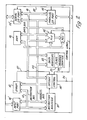
- FIG 2 shows more detail of the single chip microcomputer of Figure 1.
- the EPROM 10 is provided with an input port 10' which replaces the schematic connections 13 and a serial input/output port 19' is also provided.
- Dedicated data registers 22, registers for flags 23 and a program counter 24 are shown explicitly (although they may be regarded in Figure 1 as forming part of the RAM 18).
- An address bus 25 is also shown and an accumulator but the optional EPROM 17 is omitted.
- the microcomputer of Figure 2 may be an integrated circuit encapsulated in a module which is plugged in to, or otherwise connected to, a host.
- the module may have a plug or socket arrangement which is compatible with commonly used host computers.
- the program contained in the microcomputer may comprise several parts each forming an important part of one or more programs run by the host computer.
- the software to be protected is first extracted from the source program and typically consists of a number of important subroutines from various parts of the source program. This software is then reformatted in the assembly language of the microcomputer and entered into the EPROM 10. Entry is by way of the input port 10' and an instruction bus and when entry is to take place a signal is applied to the control portion of the decode and control circuit 14 by way of an external connection 26 and the control portion then applies a write enable signal to the EPROM 10 by way of a connection 27. The control portion also resets the program counter 24 to its lowest address and then the program counter steps through all the addresses of the EPROM locations allowing the EPROM to be loaded by applying synchronous data signals by way of the port 10'.
- the host In operation with a host computer, the host carries out its program until it reaches a point where the first part of the program stored in the EPROM 10 is required. At this time a "handshake" procedure takes place in which typically the host sends a "ready?" signal to the decode and control circuit 14 by way of the data bus 16 and one of the input/output ports 19 or 19'.
- the microcomputer then executes its first instruction which is to send a signal signifying that it is ready back to the host computer from the decode and control circuit 14 by way of the data bus 16.
- Initialisation data is then sent from the host to the RAM 18 and another "handshake" takes place when all the initialisation data has been sent.
- the microcomputer carries out another instruction which causes data from a specified location in the RAM 18 to be passed into the program counter 24, this data being used as the address of the next required instruction in the EPROM 10.
- the host computer can employ a selected part of the program stored in the EPROM 10 by specifying, when initialisation takes place, where the next microcomputer instruction is to be taken from. Instructions are then taken sequentially from the EPROM 10 by way of the bus 12 into the instruction register 11 as the program counter is incremented in the usual way, and operation continues as in the case of the conventional microcomputer. Eventually an instruction will be reached which is at the end of the part of the program to be executed by the microcomputer and this last instruction will initiate further "handshake" signals to hand control back to the host computer.
- Imported Operands are usually only required for jump, call and return instructions where the instruction is conditional on calculation made by the microcomputer itself or the host.
- the decode and control unit may, and usually does, control many other units than those shown; such additional units may include a shifter, and a multiplier.
- any form of single chip microcomputer may be used so long as it is not possible to address storage in the microcomputer holding a program for the operation thereof, or a part of such a program, and obtain the instructions making up the program or part thereof at an output port.
Landscapes
- Engineering & Computer Science (AREA)
- Computer Security & Cryptography (AREA)
- Computer Hardware Design (AREA)
- Theoretical Computer Science (AREA)
- Software Systems (AREA)
- Physics & Mathematics (AREA)
- General Engineering & Computer Science (AREA)
- General Physics & Mathematics (AREA)
- Storage Device Security (AREA)
- Microcomputers (AREA)
Applications Claiming Priority (2)
| Application Number | Priority Date | Filing Date | Title |
|---|---|---|---|
| GB8402795 | 1984-02-02 | ||
| GB8402795 | 1984-02-02 |
Publications (2)
| Publication Number | Publication Date |
|---|---|
| EP0151049A2 true EP0151049A2 (fr) | 1985-08-07 |
| EP0151049A3 EP0151049A3 (fr) | 1989-07-26 |
Family
ID=10555977
Family Applications (1)
| Application Number | Title | Priority Date | Filing Date |
|---|---|---|---|
| EP85300701A Withdrawn EP0151049A3 (fr) | 1984-02-02 | 1985-02-01 | Micro-ordinateur à protection de logiciel |
Country Status (3)
| Country | Link |
|---|---|
| US (1) | US4823308A (fr) |
| EP (1) | EP0151049A3 (fr) |
| GB (1) | GB2154034B (fr) |
Cited By (2)
| Publication number | Priority date | Publication date | Assignee | Title |
|---|---|---|---|---|
| FR2622319A1 (fr) * | 1987-10-27 | 1989-04-28 | Guerri Jean | Support de logiciel a protection contre la copie et dispositif de mise en oeuvre d'un logiciel a protection contre la copie |
| FR2634917A1 (fr) * | 1988-08-01 | 1990-02-02 | Pionchon Philippe | Procede et dispositif de protection d'un logiciel, en particulier contre les copies non autorisees |
Families Citing this family (15)
| Publication number | Priority date | Publication date | Assignee | Title |
|---|---|---|---|---|
| US5014234A (en) * | 1986-08-25 | 1991-05-07 | Ncr Corporation | System with software usage timer and counter for allowing limited use but preventing continued unauthorized use of protected software |
| JPH0752388B2 (ja) * | 1988-08-03 | 1995-06-05 | 三菱電機株式会社 | Icメモリカード |
| US5204840A (en) * | 1989-08-08 | 1993-04-20 | Mazur Jeffrey G | Means and methods for preserving microprocessor memory |
| US5515540A (en) * | 1990-08-27 | 1996-05-07 | Dallas Semiconducter Corp. | Microprocessor with single pin for memory wipe |
| JPH04149652A (ja) * | 1990-10-09 | 1992-05-22 | Mitsubishi Electric Corp | マイクロコンピュータ |
| JP3408552B2 (ja) * | 1991-02-11 | 2003-05-19 | インテル・コーポレーション | 不揮発性半導体メモリをプログラム及び消去する回路とその方法 |
| US5546561A (en) * | 1991-02-11 | 1996-08-13 | Intel Corporation | Circuitry and method for selectively protecting the integrity of data stored within a range of addresses within a non-volatile semiconductor memory |
| US5343524A (en) * | 1991-06-21 | 1994-08-30 | Mu Xiao Chun | Intelligent security device |
| US5265065A (en) * | 1991-10-08 | 1993-11-23 | West Publishing Company | Method and apparatus for information retrieval from a database by replacing domain specific stemmed phases in a natural language to create a search query |
| US5369647A (en) * | 1991-12-16 | 1994-11-29 | Intel Corporation | Circuitry and method for testing a write state machine |
| US5533124A (en) * | 1994-12-07 | 1996-07-02 | Smith; Jeannette K. | Electronic trading card system |
| WO1997004395A1 (fr) * | 1995-07-20 | 1997-02-06 | Dallas Semiconductor Corporation | Procede et appareil permettant la creation de cles de cryptage |
| US6345359B1 (en) * | 1997-11-14 | 2002-02-05 | Raytheon Company | In-line decryption for protecting embedded software |
| US6351814B1 (en) * | 1999-07-21 | 2002-02-26 | Credence Systems Corporation | Field programmable gate array with program encryption |
| DE10360998B4 (de) * | 2003-12-23 | 2008-09-04 | Infineon Technologies Ag | Schutz von Chips gegen Attacken |
Family Cites Families (18)
| Publication number | Priority date | Publication date | Assignee | Title |
|---|---|---|---|---|
| GB209233A (en) * | 1922-10-28 | 1924-01-10 | Robert Abbott Hadfield | Improvements in or relating to springs suitable for use with motor cars and other vehicles |
| US3284776A (en) * | 1961-06-08 | 1966-11-08 | Decca Ltd | Data processing apparatus |
| US3328768A (en) * | 1964-04-06 | 1967-06-27 | Ibm | Storage protection systems |
| US3377624A (en) * | 1966-01-07 | 1968-04-09 | Ibm | Memory protection system |
| US3858182A (en) * | 1972-10-10 | 1974-12-31 | Digital Equipment Corp | Computer program protection means |
| US4181938A (en) * | 1975-10-15 | 1980-01-01 | Tokyo Shibaura Electric Co., Ltd. | Processor device |
| DE2547488C2 (de) * | 1975-10-23 | 1982-04-15 | Ibm Deutschland Gmbh, 7000 Stuttgart | Mikroprogrammierte Datenverarbeitungsanlage |
| US4079454A (en) * | 1976-01-02 | 1978-03-14 | Data General Corporation | Data processing system using read-only-memory arrays to provide operation in a plurality of operating states |
| US4087856A (en) * | 1976-06-30 | 1978-05-02 | International Business Machines Corporation | Location dependence for assuring the security of system-control operations |
| JPS5317240A (en) * | 1976-07-31 | 1978-02-17 | Toshiba Corp | Controller |
| US4124891A (en) * | 1976-11-18 | 1978-11-07 | Honeywell Information Systems Inc. | Memory access system |
| GB1561482A (en) * | 1976-11-18 | 1980-02-20 | Ibm | Protection of data processing system against unauthorised programmes |
| CA1147823A (fr) * | 1978-07-24 | 1983-06-07 | Robert M. Best | Crypto-microprocesseur d'execution de programmes chiffres |
| DE3034581A1 (de) * | 1980-09-13 | 1982-04-22 | Robert Bosch Gmbh, 7000 Stuttgart | Auslesesicherung bei einchip-mikroprozessoren |
| GB2092338B (en) * | 1981-01-31 | 1984-07-18 | Jpm Automatic Machines Ltd | Improvements relating to programmable memories |
| JPS57161946A (en) * | 1981-03-30 | 1982-10-05 | Fujitsu Ltd | Microcomputer with protecting mechanism for memory contents |
| US4514805A (en) * | 1982-02-22 | 1985-04-30 | Texas Instruments Incorporated | Interrupt operation in systems emulator mode for microcomputer |
| GB2116777B (en) * | 1982-03-03 | 1985-07-17 | Casio Computer Co Ltd | Sheet-like compact electronic equipment |
-
1985
- 1985-01-25 US US06/695,194 patent/US4823308A/en not_active Expired - Fee Related
- 1985-02-01 GB GB08502628A patent/GB2154034B/en not_active Expired
- 1985-02-01 EP EP85300701A patent/EP0151049A3/fr not_active Withdrawn
Cited By (3)
| Publication number | Priority date | Publication date | Assignee | Title |
|---|---|---|---|---|
| FR2622319A1 (fr) * | 1987-10-27 | 1989-04-28 | Guerri Jean | Support de logiciel a protection contre la copie et dispositif de mise en oeuvre d'un logiciel a protection contre la copie |
| FR2634917A1 (fr) * | 1988-08-01 | 1990-02-02 | Pionchon Philippe | Procede et dispositif de protection d'un logiciel, en particulier contre les copies non autorisees |
| WO1990001736A1 (fr) * | 1988-08-01 | 1990-02-22 | Philippe Pionchon | Procede et dispositif de protection et d'universalisation d'un logiciel |
Also Published As
| Publication number | Publication date |
|---|---|
| GB8502628D0 (en) | 1985-03-06 |
| US4823308A (en) | 1989-04-18 |
| EP0151049A3 (fr) | 1989-07-26 |
| GB2154034B (en) | 1987-06-17 |
| GB2154034A (en) | 1985-08-29 |
Similar Documents
| Publication | Publication Date | Title |
|---|---|---|
| US4823308A (en) | Microcomputer with software protection | |
| EP0664046B1 (fr) | Memoire a programme reprogrammable a distance s'appliquant a un microcontroleur | |
| US5892826A (en) | Data processor with flexible data encryption | |
| US4236204A (en) | Instruction set modifier register | |
| US5237616A (en) | Secure computer system having privileged and unprivileged memories | |
| US3970999A (en) | Memory expansion apparatus | |
| JP2506061B2 (ja) | マイクロプロセッサおよび少なくとも一つのプログラム可能な読み出し専用メモリを備えるデ―タ担体と外部との間でオペレ―ションを実行する方法 | |
| KR900003591B1 (ko) | 데이터 처리장치 | |
| KR19980071365A (ko) | 메모리 액세스 제어회로 | |
| JPS63145531A (ja) | マイクロプロセッサ | |
| US4434462A (en) | Off-chip access for psuedo-microprogramming in microprocessor | |
| US5758115A (en) | Interoperability with multiple instruction sets | |
| EP0454636B1 (fr) | Procédé pour executer une opération booléene entre deux bits arbitraires de deux registres arbitraires | |
| KR100505106B1 (ko) | 강화된 보안 기능을 갖춘 스마트 카드 | |
| CN102968392A (zh) | 防止存储器转储的微处理器 | |
| US20030120945A1 (en) | Program writable IC card and method thereof | |
| EP0226991B1 (fr) | Dispositif de traitement de données | |
| JPS6042966B2 (ja) | デ−タ処理システム | |
| EP0020972B1 (fr) | Dispositif microprocesseur commandé par programme | |
| US7340575B2 (en) | Method and a circuit for controlling access to the content of a memory integrated with a microprocessor | |
| US5657444A (en) | Microprocessor with secure programmable read only memory circuit | |
| GB2129586A (en) | Improvements in or relating to memory systems | |
| US20020004877A1 (en) | Method and system for updating user memory in emulator systems | |
| US6269429B1 (en) | Microcomputer which writer data to memory based on an interrupt control mode | |
| JPH1153338A (ja) | 半導体集積回路およびその半導体集積回路における外部バスモード選択方法 |
Legal Events
| Date | Code | Title | Description |
|---|---|---|---|
| PUAI | Public reference made under article 153(3) epc to a published international application that has entered the european phase |
Free format text: ORIGINAL CODE: 0009012 |
|
| AK | Designated contracting states |
Designated state(s): DE FR GB NL |
|
| RAP1 | Party data changed (applicant data changed or rights of an application transferred) |
Owner name: NATIONAL RESEARCH DEVELOPMENT CORPORATION |
|
| RIN1 | Information on inventor provided before grant (corrected) |
Inventor name: KNIGHT, MICHAEL JOHN |
|
| 17P | Request for examination filed |
Effective date: 19860120 |
|
| PUAL | Search report despatched |
Free format text: ORIGINAL CODE: 0009013 |
|
| RHK1 | Main classification (correction) |
Ipc: G06F 1/00 |
|
| AK | Designated contracting states |
Kind code of ref document: A3 Designated state(s): DE FR GB NL |
|
| STAA | Information on the status of an ep patent application or granted ep patent |
Free format text: STATUS: THE APPLICATION IS DEEMED TO BE WITHDRAWN |
|
| 18D | Application deemed to be withdrawn |
Effective date: 19891029 |
|
| RIN1 | Information on inventor provided before grant (corrected) |
Inventor name: KNIGHT, MICHAEL JOHN |