EP0152885A2 - Vitrage pour fenêtres, système modulaire pour la fabrication ultérieure d'un tel vitrage et procédé pour la production du vitrage - Google Patents
Vitrage pour fenêtres, système modulaire pour la fabrication ultérieure d'un tel vitrage et procédé pour la production du vitrage Download PDFInfo
- Publication number
- EP0152885A2 EP0152885A2 EP85101398A EP85101398A EP0152885A2 EP 0152885 A2 EP0152885 A2 EP 0152885A2 EP 85101398 A EP85101398 A EP 85101398A EP 85101398 A EP85101398 A EP 85101398A EP 0152885 A2 EP0152885 A2 EP 0152885A2
- Authority
- EP
- European Patent Office
- Prior art keywords
- pane
- intermediate layer
- adhesive
- glazing
- glass
- Prior art date
- Legal status (The legal status is an assumption and is not a legal conclusion. Google has not performed a legal analysis and makes no representation as to the accuracy of the status listed.)
- Ceased
Links
- 238000004519 manufacturing process Methods 0.000 title claims abstract description 12
- 238000000034 method Methods 0.000 title description 14
- 239000011521 glass Substances 0.000 claims abstract description 61
- 239000000853 adhesive Substances 0.000 claims abstract description 49
- 230000001070 adhesive effect Effects 0.000 claims abstract description 49
- 230000005855 radiation Effects 0.000 claims abstract description 14
- 239000010410 layer Substances 0.000 claims description 62
- 229920003023 plastic Polymers 0.000 claims description 7
- 230000003287 optical effect Effects 0.000 claims description 5
- 230000005540 biological transmission Effects 0.000 claims description 3
- 239000003292 glue Substances 0.000 claims description 3
- 239000002356 single layer Substances 0.000 claims description 3
- 230000000704 physical effect Effects 0.000 claims description 2
- 238000007791 dehumidification Methods 0.000 claims 1
- 229920005372 Plexiglas® Polymers 0.000 description 6
- 239000000463 material Substances 0.000 description 6
- 238000004026 adhesive bonding Methods 0.000 description 5
- 239000005336 safety glass Substances 0.000 description 5
- VVQNEPGJFQJSBK-UHFFFAOYSA-N Methyl methacrylate Chemical compound COC(=O)C(C)=C VVQNEPGJFQJSBK-UHFFFAOYSA-N 0.000 description 4
- 238000001723 curing Methods 0.000 description 3
- 238000011161 development Methods 0.000 description 3
- 230000018109 developmental process Effects 0.000 description 3
- 229910052751 metal Inorganic materials 0.000 description 3
- 239000002184 metal Substances 0.000 description 3
- 229910000831 Steel Inorganic materials 0.000 description 2
- 229910052782 aluminium Inorganic materials 0.000 description 2
- XAGFODPZIPBFFR-UHFFFAOYSA-N aluminium Chemical compound [Al] XAGFODPZIPBFFR-UHFFFAOYSA-N 0.000 description 2
- 238000010438 heat treatment Methods 0.000 description 2
- 230000001771 impaired effect Effects 0.000 description 2
- 230000002787 reinforcement Effects 0.000 description 2
- 239000010959 steel Substances 0.000 description 2
- 239000005341 toughened glass Substances 0.000 description 2
- 238000003848 UV Light-Curing Methods 0.000 description 1
- 239000004904 UV filter Substances 0.000 description 1
- 238000011109 contamination Methods 0.000 description 1
- 238000005260 corrosion Methods 0.000 description 1
- 230000007797 corrosion Effects 0.000 description 1
- 230000006735 deficit Effects 0.000 description 1
- 230000000694 effects Effects 0.000 description 1
- 238000005562 fading Methods 0.000 description 1
- 239000005340 laminated glass Substances 0.000 description 1
- 230000035699 permeability Effects 0.000 description 1
- 238000009420 retrofitting Methods 0.000 description 1
- 238000006748 scratching Methods 0.000 description 1
- 230000002393 scratching effect Effects 0.000 description 1
- 239000007787 solid Substances 0.000 description 1
- 238000005728 strengthening Methods 0.000 description 1
- 230000037072 sun protection Effects 0.000 description 1
- 230000000007 visual effect Effects 0.000 description 1
Images
Classifications
-
- E—FIXED CONSTRUCTIONS
- E06—DOORS, WINDOWS, SHUTTERS, OR ROLLER BLINDS IN GENERAL; LADDERS
- E06B—FIXED OR MOVABLE CLOSURES FOR OPENINGS IN BUILDINGS, VEHICLES, FENCES OR LIKE ENCLOSURES IN GENERAL, e.g. DOORS, WINDOWS, BLINDS, GATES
- E06B5/00—Doors, windows, or like closures for special purposes; Border constructions therefor
- E06B5/10—Doors, windows, or like closures for special purposes; Border constructions therefor for protection against air-raid or other war-like action; for other protective purposes
-
- E—FIXED CONSTRUCTIONS
- E06—DOORS, WINDOWS, SHUTTERS, OR ROLLER BLINDS IN GENERAL; LADDERS
- E06B—FIXED OR MOVABLE CLOSURES FOR OPENINGS IN BUILDINGS, VEHICLES, FENCES OR LIKE ENCLOSURES IN GENERAL, e.g. DOORS, WINDOWS, BLINDS, GATES
- E06B3/00—Window sashes, door leaves, or like elements for closing wall or like openings; Layout of fixed or moving closures, e.g. windows in wall or like openings; Features of rigidly-mounted outer frames relating to the mounting of wing frames
- E06B3/54—Fixing of glass panes or like plates
- E06B3/5418—Permanently fixing of an additional unframed pane
Definitions
- the invention relates to glazing for windows, in particular window panes, consisting of an existing single-layer or multi-layer glass pane which remains in its holder and at least one front pane which is attached to the existing glass pane by means of a frame-shaped intermediate layer attached to the outer edge of the existing pane an adhesive is attached.
- the invention relates to a method for producing glazing of the type specified above.
- Glazing of the type mentioned at the outset is already known (DE-OS 30 45 060), which is produced by gluing a front pane onto a pane located in its holder, a frame-shaped intermediate layer made of metal being used. Elastic adhesives are used as adhesives for fastening the intermediate layer and the glass pane. If such glazing is turned from an existing one built glass pane can be produced in this way an insulating glazing, in which no dismantling costs are incurred and part of the material costs is eliminated compared to the case that a new insulating glass pane would be installed.
- the additional glass pane would have to be held in the appropriate position for a long time until the adhesive had hardened, as a result of which the process described above proved to be complex.
- window panes would also be due to the dimensions and greater material thicknesses due to the under Different coefficients of expansion of glass and plexiglass not only cause undesirably large stresses, but above all the forces caused by the weight could not be absorbed by the intermediate layer formed from plexiglass.
- the described method for reworking single-glazed windows in double-glazed windows with the aid of plexiglass spacer strips could lead to largely optically perfect glazing, but the reworking itself is problematic and also limited to smaller windows.
- the known glazing mentioned at the beginning (DE-OS 30 45 060) could avoid some of the disadvantages if the frame-shaped intermediate layer were made of steel, since steel and glass have approximately the same expansion coefficients.
- aluminum is generally used for the intermediate layer. With intermediate layers made of aluminum, much greater forces can be transmitted than through plexiglass, so that panes with larger dimensions can be reworked.
- heating wires could be inserted at the adhesive points. However, inserting such heating wires would be complex and would make the manufacturing process more expensive.
- the invention is based on the object of specifying glazing of the type mentioned at the outset, which can be produced with simple effort, and one To create a kit that allows such glazing in a simple manner, and to provide a method by which this glazing can be produced without much effort.
- the object on which the invention is based is achieved in glazing for windows in that the frame-shaped intermediate layer consists of glass and in that the adhesive is a transparent adhesive which can be quickly hardened by external influences, for example radiation.
- a method for producing such glazing is characterized in that the frame-shaped intermediate layer is first glued onto the existing pane or the front pane with the aid of an adhesive which can be hardened quickly by external action, for example radiation, in such a way that the adhesive is cured rapidly using the external action that the other pane is then glued to the exposed surface of the intermediate layer with the adhesive which is also curable by external action and that the adhesive which is curable by external action is cured.
- the bonding can be carried out easily, quickly and reliably.
- the gluing process is quickly ended by the external influence.
- the liner is made of glass, the one effect of the radiation from the same side both when gluing the intermediate layer and when gluing the additional pane.
- the use of glass-glass bonding creates a connection between the original glass pane and the intermediate layer or between the intermediate layer and the additional glass pane, which can easily absorb the high shear forces. Mechanical stresses when the glass panes are heated can hardly occur, since both the panes and the intermediate layer have the same expansion coefficient.
- the kit according to the invention allows for simple manufacture and easy transport of the parts, which make retrofitting easy.
- the method according to the invention enables the intermediate layer or the front pane to be easily installed without the visual impression of the finished glazing for windows, in particular shop windows of larger dimensions, being impaired.
- a further development of the glazing according to the invention is that existing panes become burglar-resistant by applying one or more additional panes. This happens especially when the superior The pane or the front pane are made of very resistant safety glass and other additional plastic plates or thin impact-resistant materials for burglar resistance are inserted into the space between the panes. Existing multilayer burglar-resistant panes can also be made more burglar-resistant in this way.
- This training is particularly interesting because the window panes of a number of shops (such as jewelry, photo, fur, watch and jewelry stores, but also pharmacies, etc., as well as robbery-prone windows of bank counter systems, conference rooms and the like) already consist of laminated safety glass , but no longer meet today's security needs, especially because the Association of Property Insurers recently established the burglar-resistant classes EH 1-3 and extremely high requirements are placed on the breakthrough strength of the pane. Due to the glazing according to the invention, it is possible, in particular because of the shear-resistant adhesive joint, to have existing security panes installed and to achieve such reinforcement by placing one or more heavy panes in front of or behind it that burglar resistance class 1 or a higher class is achieved.
- the additional glass pane consists of tinted glass or safety glass.
- the front lens is preferably made of tempered glass.
- the glazing according to the invention can be produced particularly advantageously when the curing time can be determined by the action of external radiation, for example ultra-violet radiation.
- the pane or the frame-shaped intermediate layer can then first be fastened in a punctiform manner, and the required curing of the adhesive can then be carried out at the point at which the intermediate layer or the front pane are pressed on.
- the remaining free edge of the existing pane and / or the front pane or panes are reinforced by an elastically glued fixed support.
- the kit is expediently designed so that the existing glass pane, the front pane and the intermediate layer form an airtight space which contains means for dehumidifying.
- the front lens of the kit can advantageously consist of tinted glass, tempered glass or safety glass. There can be several cover plates in the kit. This enables various functions to be achieved for the glazing to be produced by the kit.
- the kit is expediently designed such that the outer edge of the intermediate layer and / or the outer edge of the front pane is close to the device holding the built-in glass pane, but the distance to the holding device ensures the accessibility of the frame.
- a good reinforcement of the glazing results if the kit contains a plastic pane for the space formed by the panes and the intermediate layer. The security against burglary can be increased in that the kit for
- the space formed by the panes and the intermediate layer contains a safety disk with an alarm wire loop.
- Another possibility for strengthening the glazing results from the fact that a wire mesh is provided in the space formed by the panes and the intermediate layer.
- the kit enables solid and permanent glazing if the outer glue points are coated with a mass that has an optical refractive index corresponding to the glass.
- the adhesive is expediently used in the kit as a UV-curing adhesive.
- the remaining free edge of the existing pane and / or the front pane or panes is preferably reinforced by an elastically glued fixed support.
- the inventive method for producing a glazing of the type described is advantageously carried out in that the intermediate layer is first glued to the existing single or multi-layer glass pane, that the adhesive is cured by external action, that the front pane is glued to the intermediate layer and that Adhesive between the intermediate layer and the cover plate is cured by external influences.
- the frame-shaped intermediate layer is first glued to the attachment pane with the aid of an adhesive that can be hardened by external action, that the adhesive is cured by external action such that the attachment disk with the attached intermediate layer to the existing single or multilayer glass pane and that the adhesive between the intermediate layer and the existing glass pane is cured with the help of external influences.
- the process can be carried out quickly when the curing process tion of the adhesive is carried out all around the intermediate layer. In the case of large glazing, it may be advisable to first glue the intermediate layer and one of the panes in a punctiform manner.
- the process can be carried out in a defined manner if an adhesive which cures rapidly by UV light is used.
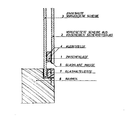
- the existing glass pane 3 is held by a frame or a holder 6.
- a frame-shaped intermediate layer 1 is attached to the glass pane with the aid of an adhesive 4.
- a cover plate 2 is applied to this frame-shaped intermediate layer 1 with the aid of adhesive 4 and glued to the intermediate layer.
- the intermediate layer 1 consists of the same material as the existing glass pane 3 and the front pane 2.
- a transparent adhesive is used as the adhesive 4, which hardens very quickly due to intense external radiation, for example UV radiation.
- the outer edge of the intermediate layer 1 is approximately correct with the outer edge of the front lens 2, but it can be slightly over the outer edge of the Intermediate layer 1 protrude so that a groove is formed between the glass pane 3 and the front pane 2.
- a transparent mass 5 can be provided to seal the adhesive points, which has an optical refractive index that corresponds to that of the glass panes 2 and / or 3.
- the transparent mass 5 is preferably introduced into the groove between the front pane and the existing glass pane.
- a means for dehumidifying the air can be provided in the space between the two glass panes.
- the space between the two panes is preferably filled with dry air or another gas.
- the front pane 2 can consist of tinted or refined glass or also of safety glass.
- the free-standing edge of the pane 3 can be covered with a support, e.g. made of metal, which is fixed by an elastic adhesive.
- This support can also be Z-shaped and then additionally glued to disc 2. In this way, the edge area is considerably strengthened, which could be vulnerable to a targeted attack with an ax or spade.
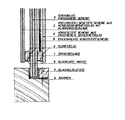
- glazing shown are attached to both sides of the existing pane 3 attachment panes 2, each using an intermediate layer 1.
- the existing pane shown there is multi-layered.
- a plastic disc 8 is introduced in the space between a cover disc and the existing disc.
- the front pane 2 and the intermediate layer 1 represent a kit that receives the appropriate dimensions at the place of manufacture and can be easily installed at the place of the existing pane by the method according to the invention.
- the cover plate 2 expediently contains dimensions which, after being installed, ensure access to the glass retaining strips 7 on the frame 8.
- a plastic pane 8 can be inserted into the space between the two panes 2 and 3, which can only be used in this protected form in the shop window area.
- This plastic is highly impact-resistant, or it can also be designed as a UV filter in order to protect the displayed goods from theft or fading.
- Alarm wire loops can be inserted in the space between the two panes to form safety panes, or it is also possible to insert a latticework.
- the materials set in the space between the two panes are absolutely protected against weather, scratching, corrosion or the like.
- the existing pane is first cleaned. It is then the frame-shaped intermediate layer with the help of a glued quickly to the existing pane by UV radiation. The frame-shaped intermediate layer is held in its position from the outside. The adhesive is then quickly cured using UV radiation. Under certain circumstances, some spots are first cured point-wise, and then cured all around the circumference of the intermediate layer.
- the cover disk 2 is glued to the exposed surface of the intermediate layer with the aid of the adhesive curable by UV radiation, it being initially held in place from the outside. By exposure to UV light, the adhesive is first cured point by point around the entire circumference of the cover plate until the space between the existing plate and cover plate is hermetically sealed.
- the space between the two panes can be filled with dry air or with a gas in order to produce double glazing.
- the intermediate layer can also be attached to the front lens when the front lens is cut, so that only the front lens provided with the intermediate layer then has to be attached to the existing lens.
Landscapes
- Engineering & Computer Science (AREA)
- Civil Engineering (AREA)
- Structural Engineering (AREA)
- Joining Of Glass To Other Materials (AREA)
- Securing Of Glass Panes Or The Like (AREA)
Applications Claiming Priority (2)
| Application Number | Priority Date | Filing Date | Title |
|---|---|---|---|
| DE19843404663 DE3404663C2 (de) | 1984-02-10 | 1984-02-10 | Verglasung für Fenster und Verfahren zur Herstellung der Verglasung |
| DE3404663 | 1984-02-10 |
Publications (2)
| Publication Number | Publication Date |
|---|---|
| EP0152885A2 true EP0152885A2 (fr) | 1985-08-28 |
| EP0152885A3 EP0152885A3 (fr) | 1986-05-07 |
Family
ID=6227283
Family Applications (1)
| Application Number | Title | Priority Date | Filing Date |
|---|---|---|---|
| EP85101398A Ceased EP0152885A3 (fr) | 1984-02-10 | 1985-02-09 | Vitrage pour fenêtres, système modulaire pour la fabrication ultérieure d'un tel vitrage et procédé pour la production du vitrage |
Country Status (2)
| Country | Link |
|---|---|
| EP (1) | EP0152885A3 (fr) |
| DE (1) | DE3404663C2 (fr) |
Cited By (10)
| Publication number | Priority date | Publication date | Assignee | Title |
|---|---|---|---|---|
| GB2241013A (en) * | 1990-01-25 | 1991-08-21 | Alan Jeremy Brookes | Double glazed units |
| WO1996033334A1 (fr) * | 1995-04-21 | 1996-10-24 | Paul Stephen Ennis | Fenetre a vitres brillantes |
| FR2822865A1 (fr) * | 2001-04-02 | 2002-10-04 | Clestra Hauserman Sa | Procede de fabrication de panneaux vitres pour cloisons de separation, et panneau obtenu a l'aide dudit procede |
| EP2685042A1 (fr) * | 2012-07-09 | 2014-01-15 | Chinenny, Dmitriy Aleksandrovich | Élément de fenêtre se composant d'un verre dirigé vers l'extérieur d'un bâtiment et d'un verre dirigé vers l'intérieur d'un bâtiment |
| DE102022002681A1 (de) | 2022-07-24 | 2024-01-25 | Sabine Merkel | Befestigung einer Vorsatzscheibe |
| DE102022002929A1 (de) | 2022-08-11 | 2024-02-22 | Josef Seidl | Befestigungsmittel einer Vorsatzscheibe |
| DE102022003335A1 (de) | 2022-09-11 | 2024-03-14 | Josef Seidl | Befestigung und Abdichtung einer Vorsatzscheibe |
| DE102022003304A1 (de) | 2022-09-08 | 2024-03-14 | Josef Seidl | Vorsatzscheibe mit Leistenelementen |
| DE102022003433A1 (de) | 2022-09-19 | 2024-03-21 | Josef Seidl | Vorsatzscheibe mit Anordnung zur Lufttrocknung |
| DE102022003432A1 (de) | 2022-09-19 | 2024-03-21 | Josef Seidl | Vorsatzscheibe mit Abstandselement |
Families Citing this family (2)
| Publication number | Priority date | Publication date | Assignee | Title |
|---|---|---|---|---|
| DE19755270B4 (de) | 1997-12-12 | 2007-01-25 | Pax Ag | Fenster mit Vorsatzscheibe |
| DE10360826A1 (de) * | 2003-12-23 | 2005-07-28 | Link Gmbh | Klebefolie |
Family Cites Families (15)
| Publication number | Priority date | Publication date | Assignee | Title |
|---|---|---|---|---|
| DE6750551U (fr) * | 1900-01-01 | Homes K | ||
| DE7247199U (de) * | 1974-09-05 | Jenaer Glaswerk Schott & Gen | Mehrscheibenisolierglas | |
| DE1986107U (de) * | 1966-02-25 | 1968-05-30 | Helmut Wilkening | Doppelglasscheibe. |
| DE1278292B (de) * | 1966-05-24 | 1968-09-19 | Niederlassung Vereinigte Glasw | Alarmglasscheibe |
| DE2501096B2 (de) * | 1975-01-13 | 1976-10-28 | Vennemann, Horst, 7180 Crailsheim | Randleiste zur herstellung von isolierglasscheiben, mehrscheiben-isolierglas sowie verfahren zu seiner herstellung |
| CH603981A5 (fr) * | 1976-02-20 | 1978-08-31 | Gutmann Hellmut | |
| DE2619718C2 (de) * | 1976-05-04 | 1985-10-31 | I.C.B.n.V. Internationale Constructie Bedrijven, Heerlen | Isolierverglasung |
| DE7719752U1 (de) * | 1977-06-24 | 1978-02-23 | Koechlin, Kurt, 7880 Saeckingen | Vorsatzscheibe fuer einscheibenverglasungen |
| DE2809682C2 (de) * | 1978-03-07 | 1982-01-28 | Heinz Ing.(Grad.) 6457 Maintal Hapke | Mehrfach verglastes Fenster |
| DE2856317A1 (de) * | 1978-12-27 | 1980-07-10 | Christian Hermann Franke | Verbindungsmittel fuer plattenfoermige gegenstaende, insbesondere fuer die verbindung von glasscheiben |
| DE2946519C2 (de) * | 1979-11-17 | 1983-05-11 | Leo 5000 Köln Wirtz | Fenster mit elektromagnetischer und akustischer Abschirmung |
| DE3014090A1 (de) * | 1980-04-12 | 1981-10-15 | Friedrich 6103 Griesheim Krämer | Modifizierung einfachverglaster fenster in doppelglasfenster |
| DE3045060A1 (de) * | 1980-11-29 | 1982-07-01 | Bernd 6093 Flörsheim Delvo | Scheibeneinfassungsprofil zur herstellung fuer mehrscheiben-isolierglaeser |
| BE886661A (fr) * | 1980-12-15 | 1981-04-01 | Husson Roger | Double vitrage ou survitrage |
| DE8221743U1 (de) * | 1982-07-30 | 1983-01-05 | Iso-Glas Verglasungs- und Produktions-Gesellschaft mbH, 5210 Troisdorf | Isolierglasfenster |
-
1984
- 1984-02-10 DE DE19843404663 patent/DE3404663C2/de not_active Expired
-
1985
- 1985-02-09 EP EP85101398A patent/EP0152885A3/fr not_active Ceased
Cited By (10)
| Publication number | Priority date | Publication date | Assignee | Title |
|---|---|---|---|---|
| GB2241013A (en) * | 1990-01-25 | 1991-08-21 | Alan Jeremy Brookes | Double glazed units |
| WO1996033334A1 (fr) * | 1995-04-21 | 1996-10-24 | Paul Stephen Ennis | Fenetre a vitres brillantes |
| FR2822865A1 (fr) * | 2001-04-02 | 2002-10-04 | Clestra Hauserman Sa | Procede de fabrication de panneaux vitres pour cloisons de separation, et panneau obtenu a l'aide dudit procede |
| EP2685042A1 (fr) * | 2012-07-09 | 2014-01-15 | Chinenny, Dmitriy Aleksandrovich | Élément de fenêtre se composant d'un verre dirigé vers l'extérieur d'un bâtiment et d'un verre dirigé vers l'intérieur d'un bâtiment |
| DE102022002681A1 (de) | 2022-07-24 | 2024-01-25 | Sabine Merkel | Befestigung einer Vorsatzscheibe |
| DE102022002929A1 (de) | 2022-08-11 | 2024-02-22 | Josef Seidl | Befestigungsmittel einer Vorsatzscheibe |
| DE102022003304A1 (de) | 2022-09-08 | 2024-03-14 | Josef Seidl | Vorsatzscheibe mit Leistenelementen |
| DE102022003335A1 (de) | 2022-09-11 | 2024-03-14 | Josef Seidl | Befestigung und Abdichtung einer Vorsatzscheibe |
| DE102022003433A1 (de) | 2022-09-19 | 2024-03-21 | Josef Seidl | Vorsatzscheibe mit Anordnung zur Lufttrocknung |
| DE102022003432A1 (de) | 2022-09-19 | 2024-03-21 | Josef Seidl | Vorsatzscheibe mit Abstandselement |
Also Published As
| Publication number | Publication date |
|---|---|
| DE3404663A1 (de) | 1985-09-05 |
| DE3404663C2 (de) | 1989-03-16 |
| EP0152885A3 (fr) | 1986-05-07 |
Similar Documents
| Publication | Publication Date | Title |
|---|---|---|
| DE68904192T2 (de) | Gebogene dreifachscheiben-verglasung. | |
| DE1646234A1 (de) | Verglasung,mit mehreren Scheiben aus durchsichtigem oder durchscheinendem Material | |
| DE3633620A1 (de) | Waermedaemmendes fenster oder fassadenanordnung im transparenten bereich | |
| DE2250549A1 (de) | Mehrfachscheibe mit zwei glasscheiben und mindestens einer schlagfesten zwischenscheibe | |
| DE2439034C3 (de) | Gegen hitzeeinwirkung widerstandsfaehige verglasung | |
| DE3908983A1 (de) | Glasbauelement fuer eine ganzglasfassade | |
| DE3404663A1 (de) | Verglasung fuer fenster, bausatz zur nachtraeglichen herstellung einer solchen verglasung und verfahren zur herstellung der verglasung | |
| DE3240639C2 (de) | Isolierglaseinheit und Verfahren zu seiner Herstellung | |
| DE3612681C2 (fr) | ||
| DE9411674U1 (de) | Element für eine Fassadenverkleidung | |
| DE2835669A1 (de) | Kraftschluessiger mehrscheibenverbund | |
| DE2950348C2 (fr) | ||
| DE2711888A1 (de) | Isolierglasscheibe | |
| DE2948039A1 (de) | Schutztuer gegen feuer und rauch mit einer verglasung | |
| DE10258377A1 (de) | Mehrscheiben-Isolierverglasung | |
| DE102008031770A1 (de) | Verfahren zur Herstellung einer gebogenen Verbundglasscheibe | |
| DE3049356C2 (de) | Isolierverglasung | |
| CH674541A5 (fr) | ||
| DE202011100312U1 (de) | Brandschutz-Doppelverglasung | |
| DE2904280A1 (de) | Isolierglasscheibe | |
| EP3464771B1 (fr) | Vitrage isolant a haute resistance a la rupture et profile de reception en forme de u | |
| EP0181963A1 (fr) | Vitrage multiple | |
| DE7722183U1 (de) | Sichtscheibe aus panzerglas, insbesondere fuer kraftfahrzeuge | |
| DE2810206A1 (de) | Winkelspiegel fuer gepanzerte fahrzeuge | |
| DE102012103098B4 (de) | Winkelspiegel |
Legal Events
| Date | Code | Title | Description |
|---|---|---|---|
| PUAI | Public reference made under article 153(3) epc to a published international application that has entered the european phase |
Free format text: ORIGINAL CODE: 0009012 |
|
| AK | Designated contracting states |
Designated state(s): CH FR GB LI |
|
| PUAL | Search report despatched |
Free format text: ORIGINAL CODE: 0009013 |
|
| AK | Designated contracting states |
Kind code of ref document: A3 Designated state(s): CH FR GB LI |
|
| 17P | Request for examination filed |
Effective date: 19861016 |
|
| 17Q | First examination report despatched |
Effective date: 19880119 |
|
| STAA | Information on the status of an ep patent application or granted ep patent |
Free format text: STATUS: THE APPLICATION HAS BEEN REFUSED |
|
| 18R | Application refused |
Effective date: 19900720 |
|
| RIN1 | Information on inventor provided before grant (corrected) |
Inventor name: HAHN, THOMAS |