EP0152933B1 - Canon à électrons - Google Patents
Canon à électrons Download PDFInfo
- Publication number
- EP0152933B1 EP0152933B1 EP85101706A EP85101706A EP0152933B1 EP 0152933 B1 EP0152933 B1 EP 0152933B1 EP 85101706 A EP85101706 A EP 85101706A EP 85101706 A EP85101706 A EP 85101706A EP 0152933 B1 EP0152933 B1 EP 0152933B1
- Authority
- EP
- European Patent Office
- Prior art keywords
- electrodes
- auxiliary electrode
- electron
- electron gun
- electrode
- Prior art date
- Legal status (The legal status is an assumption and is not a legal conclusion. Google has not performed a legal analysis and makes no representation as to the accuracy of the status listed.)
- Expired
Links
- 238000010894 electron beam technology Methods 0.000 claims description 40
- 230000005686 electrostatic field Effects 0.000 claims description 8
- 230000002093 peripheral effect Effects 0.000 claims description 6
- 238000000926 separation method Methods 0.000 description 9
- 238000010276 construction Methods 0.000 description 7
- 238000009826 distribution Methods 0.000 description 6
- 239000011521 glass Substances 0.000 description 6
- 238000000034 method Methods 0.000 description 5
- 230000008859 change Effects 0.000 description 4
- 239000000463 material Substances 0.000 description 4
- 230000000694 effects Effects 0.000 description 3
- 238000004519 manufacturing process Methods 0.000 description 3
- 239000000758 substrate Substances 0.000 description 3
- KDLHZDBZIXYQEI-UHFFFAOYSA-N Palladium Chemical compound [Pd] KDLHZDBZIXYQEI-UHFFFAOYSA-N 0.000 description 2
- 201000009310 astigmatism Diseases 0.000 description 2
- 238000010586 diagram Methods 0.000 description 2
- 230000005684 electric field Effects 0.000 description 2
- 230000006872 improvement Effects 0.000 description 2
- 230000003287 optical effect Effects 0.000 description 2
- 125000006850 spacer group Chemical group 0.000 description 2
- OAICVXFJPJFONN-UHFFFAOYSA-N Phosphorus Chemical compound [P] OAICVXFJPJFONN-UHFFFAOYSA-N 0.000 description 1
- KJTLSVCANCCWHF-UHFFFAOYSA-N Ruthenium Chemical compound [Ru] KJTLSVCANCCWHF-UHFFFAOYSA-N 0.000 description 1
- 230000004075 alteration Effects 0.000 description 1
- 239000000919 ceramic Substances 0.000 description 1
- 150000001875 compounds Chemical class 0.000 description 1
- 239000000203 mixture Substances 0.000 description 1
- 229910052763 palladium Inorganic materials 0.000 description 1
- 230000009467 reduction Effects 0.000 description 1
- 229910052707 ruthenium Inorganic materials 0.000 description 1
- 229910001925 ruthenium oxide Inorganic materials 0.000 description 1
- WOCIAKWEIIZHES-UHFFFAOYSA-N ruthenium(iv) oxide Chemical compound O=[Ru]=O WOCIAKWEIIZHES-UHFFFAOYSA-N 0.000 description 1
- 238000003892 spreading Methods 0.000 description 1
- 230000007480 spreading Effects 0.000 description 1
Images








Classifications
-
- H—ELECTRICITY
- H01—ELECTRIC ELEMENTS
- H01J—ELECTRIC DISCHARGE TUBES OR DISCHARGE LAMPS
- H01J29/00—Details of cathode-ray tubes or of electron-beam tubes of the types covered by group H01J31/00
- H01J29/46—Arrangements of electrodes and associated parts for generating or controlling the ray or beam, e.g. electron-optical arrangement
- H01J29/48—Electron guns
- H01J29/50—Electron guns two or more guns in a single vacuum space, e.g. for plural-ray tube
- H01J29/503—Three or more guns, the axes of which lay in a common plane
-
- H—ELECTRICITY
- H01—ELECTRIC ELEMENTS
- H01J—ELECTRIC DISCHARGE TUBES OR DISCHARGE LAMPS
- H01J2229/00—Details of cathode ray tubes or electron beam tubes
- H01J2229/48—Electron guns
- H01J2229/4844—Electron guns characterised by beam passing apertures or combinations
- H01J2229/4848—Aperture shape as viewed along beam axis
- H01J2229/4858—Aperture shape as viewed along beam axis parallelogram
- H01J2229/4865—Aperture shape as viewed along beam axis parallelogram rectangle
- H01J2229/4868—Aperture shape as viewed along beam axis parallelogram rectangle with rounded end or ends
-
- H—ELECTRICITY
- H01—ELECTRIC ELEMENTS
- H01J—ELECTRIC DISCHARGE TUBES OR DISCHARGE LAMPS
- H01J2229/00—Details of cathode ray tubes or electron beam tubes
- H01J2229/48—Electron guns
- H01J2229/4844—Electron guns characterised by beam passing apertures or combinations
- H01J2229/4848—Aperture shape as viewed along beam axis
- H01J2229/4872—Aperture shape as viewed along beam axis circular
-
- H—ELECTRICITY
- H01—ELECTRIC ELEMENTS
- H01J—ELECTRIC DISCHARGE TUBES OR DISCHARGE LAMPS
- H01J2229/00—Details of cathode ray tubes or electron beam tubes
- H01J2229/48—Electron guns
- H01J2229/4844—Electron guns characterised by beam passing apertures or combinations
- H01J2229/4848—Aperture shape as viewed along beam axis
- H01J2229/4875—Aperture shape as viewed along beam axis oval
-
- H—ELECTRICITY
- H01—ELECTRIC ELEMENTS
- H01J—ELECTRIC DISCHARGE TUBES OR DISCHARGE LAMPS
- H01J2229/00—Details of cathode ray tubes or electron beam tubes
- H01J2229/48—Electron guns
- H01J2229/4844—Electron guns characterised by beam passing apertures or combinations
- H01J2229/4848—Aperture shape as viewed along beam axis
- H01J2229/4879—Aperture shape as viewed along beam axis non-symmetric about field scanning axis
-
- H—ELECTRICITY
- H01—ELECTRIC ELEMENTS
- H01J—ELECTRIC DISCHARGE TUBES OR DISCHARGE LAMPS
- H01J2229/00—Details of cathode ray tubes or electron beam tubes
- H01J2229/48—Electron guns
- H01J2229/4844—Electron guns characterised by beam passing apertures or combinations
- H01J2229/4848—Aperture shape as viewed along beam axis
- H01J2229/4896—Aperture shape as viewed along beam axis complex and not provided for
-
- H—ELECTRICITY
- H01—ELECTRIC ELEMENTS
- H01J—ELECTRIC DISCHARGE TUBES OR DISCHARGE LAMPS
- H01J2229/00—Details of cathode ray tubes or electron beam tubes
- H01J2229/96—Circuit elements other than coils, reactors or the like, associated with the tube
- H01J2229/966—Circuit elements other than coils, reactors or the like, associated with the tube associated with the gun structure
Definitions
- the present invention relates to an electron gun for a cathode-ray tube, and more specifically to an electron lens of an electron gun for focusing at least one electron beam, preferably two or more electron beams.
- a cathode-ray tube includes at least one electron gun.
- the electron gun comprises a beam forming section for producing an electron beam and a main lens section for focusing the electron beam on the target.
- the spot diameter on the target should preferably be minimized, depending on the performance of the electron gun. Improvement of the performance of the main lens section is an effective measure for improving the performance of the electron gun.
- the main lens section is chiefly composed of an electrostatic electron lens.
- the electron lens a plurality of electrodes each having an aperture are coaxially arranged so as to be applied with predetermined voltages.
- the lens performance is expected to be improved by the use of a long-focus lens which can produce, without extension of the separation distance of the electrodes, an effect equivalent to that obtained with use of a longer separation distance.
- electrostatic electron lenses for such a cathode-ray tube, including "distributed Einzel lens” disclosed in U.S. Pat. No. 3,895,253 by Schwartz et al., "tripotential lens” disclosed in U.S. Pat. No. 3,995,194 by Blacker et al., "multi-element bipotential lens” disclosed in U.S. Pat. No. 3,932,786 by Campbell, and "single-element bipotential lens” disclosed in U.S.
- electron guns of the following types are conventionally proposed.
- an electron gun for color picture tube disclosed in Japanese Patent Application Disclosure No. 124933/80
- three electron lenses are formed overlapping one another.
- apertures of electrodes are conical.
- projections are formed around three apertures.
- the diameter of each electron lens is increased, so that the lens performance is improved in some measure.
- the separation distance of the electrodes need be increased. This separation distance cannot, however, be increased, since it is influenced by undesired electrostatic fields in the neck.
- the object of the present invention is to provide an electron gun for cathode-ray tube improved in the performance of an electron lens, especially of a main lens section, simple in construction, and easy to manufacture.
- an electron gun for producing and directing at least one electron beam along a beam path, which comprises beam forming means and main lens means for focusing the electron beam.
- the main lens means includes first and second electrodes arranged along the beam path and having an aperture through which the electron beam is passed, and at least one auxiliary electrode means which is located between the first and second electrodes.
- the auxiliary electrode means includes at least one auxiliary electrode, the auxiliary electrode having an aperture through which the electron beam is passed, the aperture of the auxiliary electrode being greater than each of the apertures of the first and second electrodes.
- the electron gun further comprises voltage applying means for respectively applying first, second and auxiliary voltages to the first, second and auxiliary electrodes, the first and second voltages being of different levels. An electrostatic field is formed between the first and second electrodes.
- the auxiliary voltage is higher than the lower one of the first and second voltages, and is lower than the higher one.
- a long-focus lens equivalent to one which may be obtained by increasing the distance between the first and second electrodes is formed between the first and second electrodes.
- FIG. 1 An electron gun according to one embodiment of the present invention applied to a color picture tube will now be described in detail.
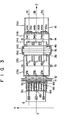
- Figs. 1, 2 and 3 there is shown an in-line electron gun 1.
- direction X is a direction parallel to the in-line direction of the electron gun 1
- direction Y is a direction perpendicular to both direction X and the tube axis
- direction Z is a direction in which the tube axis extends and which is perpendicular to both directions X and Y.
- Fig. 2 is a sectional view of the electron gun 1 taken along a plane containing directions Y and Z
- Fig. 3 is a sectional view of the electron gun 1 taken along a plane containing directions X and Z.
- Figs. 1 As shown in Figs.
- the electron gun 1 comprises a plurality of electrodes and an insulating support means 2 for supporting the electrodes.
- the electrodes include cathodes 9a, 9b and 9c arranged in line, first, second, third and fourth grids 11,12,13 and 14, a convergence electrode 15, and an auxiliary electrode 16 disposed between the third and fourth grids 13 and 14 and greater in size than the same.
- Three heaters 6a, 6b and 6c for generating three electron beams 3a, 3b and 3c are arranged in the cathodes 9a, 9b and 9c, respectively.
- the three electron beams 3a, 3b and 3c generated by the heaters 6a, 6b and 6c in the cathodes 9a, 9b and 9c are passed through the electrodes 11, 12, 13, 16, 14 and 15, and caused to hit against red, green and blue phosphor layers (not shown) of a fluorescent screen as a target.
- the grids 11 to 15 and the convergence electrode 16 have apertures for passing through the electron beams as mentioned later and are unitized.
- the electron gun 1 is formed of two fundamental sections; a crossover spot forming section, which includes a beam forming region, consisting of the cathodes 9 and the first and second grids 11 and 12 and forms a crossover spot, and an accelerating and focusing lens section for focusing electron beams on the screen.
- the crossover spot forming section may also be referred to as a four-pole section, which consists of the cathodes 9 and the first, second, and third grids 11, 12 and 13.
- the accelerating and focusing lens section is normally referred to as a main lens section, which consists of the third and fourth grids 13 and 14.
- the third grid 13 is used in common in the four-pole section and the main lens section.
- the first and second grids 11 and 12 are planar in shape and arranged in close vicinity to each other.
- the third grid 13, which is located close to the second grid 12, is formed of two bathtub-shaped electrodes 23a and 23b which are joined together.
- the fourth grid 14, which is located at a predetermined distance from the third grid 13, is also formed of two bathtub-shaped electrodes 24a and 24b which are joined together.
- the convergence electrode 15 is formed of a single-cup-shaped electrode 25a which is welded to the fourth grid 14.
- Each three apertures are aligned with their adjoining counterparts so as to be arranged along the paths of the individual electron beams.
- the apertures of the first and second grids 11 and 12 are relatively narrow, and the apertures 33a, 33b and 33c of the third grid 13 on the side facing the second grid 12 are greater than those of the first and second grids 11 and 12.
- the apertures 43a, 43b and 43c of the third grid 13 on the side facing the fourth grid 14, which are relativelywide, are equal in diameter to the apertures 34a, 34b and 34c of the fourth grid 14 on the side facing the third grid 13.
- the apertures 35a, 35b and 35c of the convergence electrode 15 are narrower than the 43a, 43b and 43c of the third grid 13 and the apertures 34a, 34b and 34c of the fourth grid 14.
- Control members which are known, for example, by Japanese Patent Disclosure No. 26208/1976, are provided near the apertures 44a and 44c of the convergence electrode 15.
- the auxiliary electrode 16 is formed of two bathtub-shaped electrodes 26a and 26b, and oval shaped apertures 36 and 46 are formed in the bottom faces of the bathtub-shaped electrodes 26a and 26b, respectively.
- Fig. 4 shows a typical example of the bathtub-shaped electrode 26a of the auxiliary electrode 16
- Fig. 5 shows the bathtub-shaped electrode 23b of the third grid 13.
- the length DX of the aperture 36 of the auxiliary electrode 16 in direction X is greater than the distance dx covered by the apertures 43a, 43b and 43c of the third grid 13 arranged in a row in direction X.
- the width DY of the aperture 36 in direction Y is greater than the Y-direction diameter dy of each of the apertures 43a, 43b and 43c.
- a bulb spacer 17 is attached to the outer periphery of the convergence electrode 15.
- the bulb spacer 17 is supplied with a voltage as high as about 25 kV which is applied to an anode terminal (not shown).
- the electron gun 1 constructed in this manner is sealed in a small cylindrical neck 18 which is formed of glass.
- a number of stem pins 19 are arranged on the left-hand end (Fig.1 ) ofthe neck 18. The stem pins 19 supportthe electron gun 1, and voltages for the first to third grids 11, 12 and 13 except for the fourth grid 14and the convergence electrode 15 are externally applied through the stem pins 19.
- the electrodes arranged in the aforesaid manner are supplied with voltages as follows.
- a cut-off voltage of about 150 V is held on the cathodes 9, and a modulation signal is added - to the cut-off voltage.
- the first grid 11 is grounded, while voltages of about 700 V and 6.5 kV are applied to the second third grids 12 and 13, respectively.
- a high anode voltage of about 25 kV is applied to the fourth grid 14, and a voltage intermediate between those of the third and fourth grids 13 and 14 is applied to the auxiliary electrode 16.
- Figs. 6 and 7 show an equipotential distribution of an electron lens in the main lens section with the above-described electrode arrangement.
- Figs. 6 and 7 correspond to Figs. 2 and 3, respectively.
- regions between the apertures 43a, 43b and 43c of the third grid 13 and the apertures 34a, 34b and 34c of the fourth grid 4, as indicated by broken lines, define the diameter of the electron lens.
- Numeral 20 designates equipotential lines. In the regions indicated by broken lines, the equipotential distribution is rarely disturbed. In these regions, moreover, the equipotential distribution is equivalent to that obtained when the separation distance between the third and fourth grids 13 and 14 is wide, and there is no influence of any ambient electrostatic fields.
- Fig. 1 show an equipotential distribution of an electron lens in the main lens section with the above-described electrode arrangement.
- Figs. 6 and 7 correspond to Figs. 2 and 3, respectively.
- FIG. 8 shows an axial potential distribution along line VIII-VIII of Fig. 6.
- the axial potential distribution varies considerably gradually in direction Z.
- the electrooptical magnification and the coefficient of spherical aberration of the electron lens are reduced, so that the performance of the electron lens is greatly improved.
- auxiliary electrode 16 is disposed between the third and fourth grids 13 and 14.
- the auxiliary electrode 16 has an aperture diameter greater than the diameter of the electron lens, that is, the aperture diameter of the third and fourth grids 13 and 14.
- the voltage intermediate between those of the third and fourth grids 13 and 14 is applied to the auxiliary electrode 16. Accordingly, undesired electrostatic fields in the neck 18 are cut off, so that the essential electrostatic field for the electron lens will never be disturbed.
- the electron lens according to the present invention can obtain the same high performance as the type in which the distance between two electrodes is merely increased.
- the auxiliary electrode 16 requires only a single aperture, as compared with the three apertures for each of the other electrodes 11 to 15.
- the electron lens can improve its performance without changing the distances between the respective centers of the three apertures of the other electrodes 11 to 15.
- the sizes of the apertures 36, 46 of the auxiliary electrode 16 must increasingly be wider than the sizes of the apertures 43a, 43b, 43c, 34a, 34b and 34c of the third and fourth grids 13 and 14 as the distance between the third and fourth grids 13 and 14 becomes greater. If the sizes of apertures 36, 46 or the auxiliary electrode 16 is not great enough, the electric field of the electron lens between the third and fourth grids 13 and 14 is disturbed by the potential of the auxiliary electrode 16, so that the beam spot on the target is distorted. This distortion of the beam spot can be corrected by adjusting the potential, position, and aperture shape of the auxiliary electrode 16.
- the sizes of the aperture 36, 46 of the auxiliary electrode 16 are not sufficiently large in both directions X and Y, two substantial quadrupole lenses are formed in the regions between the three circular apertures 43a, 43b, 43c of the third grid 13 and the one bathtub-shaped aperture 36 of the auxiliary electrode 16 and between the apertures 34a, 34b, and 34c of the fourth grid 14 and the other bathtub-shaped aperture 46 of the auxiliary electrode 16. Since the directions in which the electron beams converge or diverge at these quadrupole lenses are opposite to each other, the direction of distortion of the beam spot varies with the voltage of the auxiliary electrode 16. If the voltage of the auxiliary electrode 16 is too low or too high, the shape of the beam spot is horizontally or vertically elongated.
- the beam spot is circular. This proper voltage is a little lower than the voltage intermediate between the respective potential of the third and forth grids 13 and 14. The reason is that lens forces acting on the electron beams are different due to the differences in speed and diameter between the electron beams in the quadrupole lenses, although the directions of the quadrupole lenses act in the opposite direction to the electron lens.
- the distortion of the beam may be corrected by changing the shape of the aperture 36 or 46 of the auxiliary electrode 16.
- the beam distortion may be corrected by adjusting the position of the auxiliary electrode 16, that is, the distances between the third grid 13 and the auxiliary electrode 16 and between the fourth grid 14 and the auxiliary electrode 16.
- this correction may be performed in any other region than the region of the auxiliary electrode 16.
- the electron beam may have astigmatism at the beam generating section so that the astigmatism is canceled in the region of the auxiliary electrode 16.
- the electron gun 1 In a color picture tube, the electron gun 1 must converge the three electron beams on a common point on the target, i.e., a mask or screen. This may be achieved by several methods, including a method in which electron guns on either side are inclined relatively to a central one, a method in which main lens sections or other electron lens sections on either side are inclined relatively to a main lens section or other electron lens section in the center, and a method in which asymmetrical lenses are formed at main lens sections or other electron lens sections on either side. These methods may be directly applied to the present invention. According to the present invention, moreover, the three electron beams can also be converged on a common point on the target through the region of the auxiliary electrode 16.
- a second embodiment of the auxiliary electrode will be described.
- like reference numerals are used to designate like portions as included in the first embodiment shown in Figs. 1 to 3.
- the X-direction diameter DX4 of an auxiliary electrode 126b on the side of the fourth grid 14 is shorter than the X-direction diameter-DX3 of an auxiliary electrode 126a on the side of the third grid 13.
- the electron beams 3a and 3c on either side are slightly deflected toward the central electron beam 3b, so that the three electron beams 3a, 3b and 3c are converged on the target.
- the potential of the auxiliary electrode 126b on the side of the fourth grid 14, on a cross section taken along plane X-Z, has a greater influence on the electron lens than the potential of the auxiliary electrode 126a on the side of the third grid 13, and the former is lower than an average potential in the region, so that the electron beams 3a and 3c are subjected to an inward force.
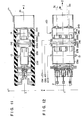
- Figs. 11 and 12 show a third embodiment different from the auxiliary electrode 116 shown in Figs. 9 and 10.
- the electron gun 1 of this embodiment includes two separated auxiliary electrodes 226a and 226b.
- the potentials of the auxiliary electrodes 226a and 226b are intermediate between those of the third and fourth grids 13 and 14.
- the potential of the auxiliary electrode 226b on the side of the fourth grid 14 is a little lower than that of the auxiliary electrode 226a on the side of the third grid 13.
- the three electron beams 3a, 3b and 3c are converged on the target.
- the convergence may be adjusted by suitably changing the length of the two auxiliary electrodes 226a and 226b.
- the voltages of the auxiliary electrodes 16, 116 and 226 are externally applied through the stem pins 19. According to the present invention, however, these voltages may be applied by dividing resistances.
- Figs. 13, 14 and 15 show an example of a resistor 54 subjected to resistance division, embodied in the first embodiment.
- the resistor 54 includes a thin substrate 50 formed of ceramics, and a resistive material 51 and terminal portion 52 are arranged on the substrate 50.
- the resistive material 51 is mainly formed of an oxide compound based on palladium or ruthenium, especially a mixture of ruthenium oxide and glass.
- Fig. 14 is an electric circuit diagram showing the resistor 54.
- a high anode voltage Eb is divided by the resistor 54, and divided voltage is applied to the auxiliary electrode 16.
- the resistor 54 is in the form of a plate. According to the present invention, however, the resistor 54 may be divided in two by the terminal portion 52 connected to the auxiliary electrode 16, or may be formed of a number of resistors. Alternatively, the resistor 54 may be formed by applying the resistive material 51 directly to the outer lateral face of the insulating support frame 2. Naturally, the insulating support means 2 may itself be used as the resistor 54.
- the terminal portion 52 at one end of the resistor 54 is connected to one of the stem pins 19.
- this one-end terminal portion 52 may be connected to the third grid 13 or other grid.
- another terminal portion 52 may be provided between the terminal portion 52 at the one end and the terminal portion 52 connected to the auxiliary electrode 16 so that the fourth terminal portion 52 is connected to the third grid 13.
- the voltage divided by the resistive body 54 is applied to the third grid 13.
- part of the high anode voltage divided by the resistor 54 is applied to the auxiliary electrode 16. Accordingly, it is unnecessary to apply middle or high voltage to the auxiliary electrode 16 through the stem pins 19, so that the voltage-withstand property of the bottom part of the neck portion including the stem pins 19 is improved. Thus, the cathode-ray tube can be offered with high practicability. Also, voltage of the third grid 13 is applied by dividing the resistance of the resistor 54, so that the voltage-withstand property of the neck portion is improved. The convergence of the electron lens can be adjusted to some degree with ease, since the voltage of the third grid 13 can be controlled with a low voltage through the stem pins 19.
- the high anode voltage is lowered substantially to the ground voltage level through the resistor 54 with high resistance, so that undesired spark current produced in the cathode-ray tube can greatly be reduced, and transistors, ICs and other devices arranged out of the cathode-ray tube can be protected against the spark current in the cathode-ray tube.
- the resistor 54 may be made considerably greater in size than a conventional one. Further, the resistor 54 can readily be attached to the electrode support means 2, and the manufacture of the electron gun 1 is very easy. Since the distance across the auxiliary electrode 16 is long, leak current cannot easily flow through the auxiliary electrode 16. Therefore, it is easy to adjust the convergence force of the electron beams 3a, 3b and 3c in directions X and Y and the shape of these beams.
- the electron gun 1 does not always require a number of electrodes and a number of voltages to be applied thereto.
- Use of a single electrode and a single voltage therefor ensures the same effect of the electron lens as is obtained with use of a number of electrodes and voltages.
- the middle voltage to be applied to the auxiliary electrode 16 need not always be obtained by dividing the resistance of the resistor 54, and may also be obtained through one of the stem pins 19.
- the auxiliary electrodes 16, 116 and 216 are disposed between the third and fourth grids 13 and 14 at predetermined distances therefrom. According to the present invention, however, each of the auxiliary electrodes 16, 116, 216 may partially cover one or both of the third and fourth grids 13 and 14.
- Fig. 17 shows an embodiment in which an auxiliary electrode 316 partially covers both the third and fourth grids 13 and 14. In this embodiment, the auxiliary electrode 316 and the third and fourth grids 13 and 14 overlap one another with gaps between them in the radial direction of the neck, so that the influences of undesired electrostatic fields generated from the inner wall of the neck are eliminated thoroughly. Thus, it is possible to completely prevent a change on standing of convergence due to electric charges of the inner wall of the neck which constitutes a drawback of a prior art color picture tube.
- each of a pair of insulating support frames 402 may be divided into two subframes 402a and 402b so that the auxiliary electrode 416 is interposed between them.
- This division of the support frames 402 allows the auxiliary electrode 416 to be maximized in radial size within the inner wall of the neck.
- the separation distance of the third and fourth grids 13 and 14 can be increased.
- the electron lens can be improved in performance, and the distortion of the beam spot can be adjusted with ease.
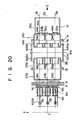
- Figs. 19 and 20 are sectional views of the electron gun 1 of Fig. 18 taken along planes Y-Z and X-Z, respectively.
- Fig. 21 shows one of a pair of components 426a and 426b of the auxiliary electrode 416 of the electron gun 1.
- Fig. 22 shows a modified example of the resistor in which two resistor elements 454a and 454b are arranged in the electron gun 1. The voltage of the auxiliary electrode 416 is obtained by dividing a high anode voltage by means of the resistor elements 454a and 454b.
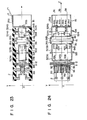
- FIG. 23 to 27 there will be described various embodiments of the electron gun 1 of the present invention which also are applied to a color picture tube and improved for greater aperture of the electron lens.
- third and fourth grids 513 and 514 are so designed that the aperture of the electron lens is greater on their front side.
- wide apertures 543 and 534 are formed in the bottom face portions of a bathtub-electrode 523b of the third grid 513 on the side facing the fourth grid 514 and a bathtub-shaped electrode 524a of the fourth grid 514 on the side facing the third grid 513, respectively.
- FIG. 25 shows the bathtub-shaped electrode 523b of the third grid 513 on the side facing the fourth grid 514.
- the apertures 543 and 534 are each defined by three circular apertures overlapping one another.
- the bathtub-shaped electrode 523b is fitted with planar electrodes 501 and 502 in positions recessed from the bottom face portions of the electrode 523b.
- the bathtub-shaped electrode 524a is fitted with planar electrodes 503 and 504. With this electrode arrangement, three electron lenses formed of the third and fourth grids 513 and 514 overlap one another. Thus, these electron lenses have a lens aperture which is wide in the optical sense.
- the auxiliary electrode 16 formed of two bathtub-shaped electrodes is interposed between the third and fourth grids 513 and 514.
- the electron lens has a long separation distance of the electrodes, as in the first to fifth embodiments, and has a distance optically greater than the lenses of the first to fifth embodiments. Therefore, it produces more distinguished effects.
- Figs. 26 and 27 show modified examples of the bathtub-shaped electrode 523b of the third grid 513 on the side facing the fourth grid 514.
- a bathtub-shaped electrode 623b shown in Fig. 26 has three conical apertures 643a, 643b and 643c spreading with the advance of the electron beams. These apertures 643a, 643b and 643c overlap one another at the bottom.
- the bottom portion of a bathtub-shaped electrode 723b shown in Fig. 27 includes a peripheral rim 701 and a bottom face 702 recessed from the peripheral rim 701. Three apertures 743a, 743b and 743c are formed in the bottom face 702.
- the bathtub-shaped electrode 623b and 723b shown in Figs. 26 and 27 ensure a wide lens aperture for the electron lens of the main lens section.
- the configurations of the bathtub-shaped electrodes 623b and 723b shown in Figs. 26 and 27 may suitably be applied to the bathtub-shaped electrode of the fourth grid 514 on the side facing the third grid 513.
- the construction of the electron lens is based on a bipotential lens which is formed of the third and fourth grids.
- the auxiliary electrode is disposed between the two grids, and has wide apertures.
- the fundamental construction of the electron lens may be of a unipotential, quadripotential or periodic-potential type, as shown in Fig. 28, 29 or 30. Alternatively, it may be of a tripotential type (not shown).
- a number of auxiliary electrodes 616, 716 and 816 are arranged throughout the regions forming electron lenses of those various types.
- auxiliary electrodes 616, 716 and 816 may be arranged in only a main electron lens region without all the electron lens regions.
- a voltage Ec3 of the third grid 13 may be set to about 8 to 9 kV, so that the electron beams scattered from the crossover spot forming region can be used in the best condition at the main lens section.
- three electron guns are arranged in line with one another. According to the present invention, however, three electron guns may be arranged in a delta, or a greater number of electron guns may be arranged in a suitable manner. Also, the present invention may be applied to a cathode-ray tube using a single electron gun.
Landscapes
- Electrodes For Cathode-Ray Tubes (AREA)
Claims (12)
Applications Claiming Priority (6)
| Application Number | Priority Date | Filing Date | Title |
|---|---|---|---|
| JP2861184A JPS60175342A (ja) | 1984-02-20 | 1984-02-20 | 陰極線管用電子銃 |
| JP59028612A JPS60175343A (ja) | 1984-02-20 | 1984-02-20 | 陰極線管用電子銃 |
| JP28611/84 | 1984-02-20 | ||
| JP28612/84 | 1984-02-20 | ||
| JP5944184A JPS60205945A (ja) | 1984-03-29 | 1984-03-29 | 陰極線管用電子銃 |
| JP59441/84 | 1984-03-29 |
Publications (3)
| Publication Number | Publication Date |
|---|---|
| EP0152933A2 EP0152933A2 (fr) | 1985-08-28 |
| EP0152933A3 EP0152933A3 (en) | 1985-09-25 |
| EP0152933B1 true EP0152933B1 (fr) | 1988-03-02 |
Family
ID=27286259
Family Applications (1)
| Application Number | Title | Priority Date | Filing Date |
|---|---|---|---|
| EP85101706A Expired EP0152933B1 (fr) | 1984-02-20 | 1985-02-15 | Canon à électrons |
Country Status (3)
| Country | Link |
|---|---|
| US (1) | US4712043A (fr) |
| EP (1) | EP0152933B1 (fr) |
| DE (1) | DE3561781D1 (fr) |
Cited By (1)
| Publication number | Priority date | Publication date | Assignee | Title |
|---|---|---|---|---|
| DE4024314A1 (de) * | 1989-07-31 | 1991-02-07 | Gold Star Co | Elektronenrohr fuer farbelektrodenstrahlroehren |
Families Citing this family (15)
| Publication number | Priority date | Publication date | Assignee | Title |
|---|---|---|---|---|
| US4833364A (en) * | 1984-04-04 | 1989-05-23 | Hitachi, Ltd. | Electron gun for color picture tubes having uniquely formed lens apertures |
| JPH0656739B2 (ja) * | 1984-07-26 | 1994-07-27 | 株式会社東芝 | 電子銃 |
| JP2581680B2 (ja) * | 1986-10-22 | 1997-02-12 | 株式会社日立製作所 | カラ−ブラウン管用電子銃 |
| US4745331A (en) * | 1987-07-20 | 1988-05-17 | Rca Licensing Corporation | Color picture tube having an inline electron gun with an einzel lens |
| US4737682A (en) * | 1987-07-20 | 1988-04-12 | Rca Corporation | Color picture tube having an inline electron gun with an einzel lens |
| JP2542627B2 (ja) * | 1987-08-05 | 1996-10-09 | 株式会社東芝 | カラ−受像管装置 |
| JP2645063B2 (ja) * | 1988-03-17 | 1997-08-25 | 株式会社東芝 | カラー受像管装置 |
| US5027043A (en) * | 1989-08-11 | 1991-06-25 | Zenith Electronics Corporation | Electron gun system with dynamic convergence control |
| US5077498A (en) * | 1991-02-11 | 1991-12-31 | Tektronix, Inc. | Pinched electron beam cathode-ray tube with high-voltage einzel focus lens |
| KR940006972Y1 (ko) * | 1991-08-22 | 1994-10-07 | 주식회사 금성사 | 칼라수상관용 전자총의 주렌즈 형성 전극 |
| JP3324282B2 (ja) * | 1994-07-11 | 2002-09-17 | 松下電器産業株式会社 | カラー受像管装置 |
| US5847500A (en) * | 1995-03-02 | 1998-12-08 | Hitachi, Ltd. | Electron gun for color cathode ray tube and method of manufacturing the electron gun electrode |
| JPH09320485A (ja) * | 1996-03-26 | 1997-12-12 | Sony Corp | カラー陰極線管 |
| TW414913B (en) | 1997-10-20 | 2000-12-11 | Toshiba Corp | The cathode ray tube |
| JP3926953B2 (ja) | 1999-11-25 | 2007-06-06 | 株式会社東芝 | カラー受像管 |
Family Cites Families (14)
| Publication number | Priority date | Publication date | Assignee | Title |
|---|---|---|---|---|
| NL179967B (nl) * | Bayer Ag | Werkwijze voor het bereiden van een rookbaar materiaal op cellulosebasis, alsmede gevormde rookbare produkten verkregen onder toepassing van dit rookbare materiaal. | ||
| DE2030384A1 (de) * | 1969-06-30 | 1971-01-14 | Sony Corp Tokio | Kathodenstrahlrohre |
| US3895253A (en) * | 1973-10-23 | 1975-07-15 | Zenith Radio Corp | Electron gun having extended field electrostatic focus lens |
| US3995194A (en) * | 1974-08-02 | 1976-11-30 | Zenith Radio Corporation | Electron gun having an extended field electrostatic focus lens |
| US3932786A (en) * | 1974-11-29 | 1976-01-13 | Rca Corporation | Electron gun with a multi-element electron lens |
| US4168452A (en) * | 1976-06-10 | 1979-09-18 | Zenith Radio Corporation | Tetrode section for a unitized, three-beam electron gun having an extended field main focus lens |
| US4124810A (en) * | 1977-06-06 | 1978-11-07 | Rca Corporation | Electron gun having a distributed electrostatic lens |
| US4368405B1 (en) * | 1977-11-22 | 1995-10-24 | Tokyo Shibaura Electric Co | Electron gun for a cathode ray tube |
| JPS553105A (en) * | 1978-06-21 | 1980-01-10 | Hitachi Ltd | Electron gun |
| JPS55159548A (en) * | 1979-05-30 | 1980-12-11 | Toshiba Corp | Electron gun structure |
| US4317065A (en) * | 1980-02-28 | 1982-02-23 | Rca Corporation | Color picture tube having an improved electron gun with expanded lenses |
| US4374341A (en) * | 1980-10-15 | 1983-02-15 | North American Philips Consumer Electronics Corp. | Beam focusing means in a unitized tri-potential CRT electron gun assembly |
| US4429252A (en) * | 1982-02-11 | 1984-01-31 | Rca Corporation | Color picture tube having an expanded focus lens type inline electron gun with improved static convergence |
| US4514661A (en) * | 1982-09-27 | 1985-04-30 | Rca Corporation | Arc-suppression means for an electron gun having a split electrode |
-
1985
- 1985-02-15 EP EP85101706A patent/EP0152933B1/fr not_active Expired
- 1985-02-15 DE DE8585101706T patent/DE3561781D1/de not_active Expired
- 1985-02-19 US US06/702,725 patent/US4712043A/en not_active Expired - Lifetime
Non-Patent Citations (2)
| Title |
|---|
| PATENTS ABSTRACTS OF JAPAN, vol. 4, no. 28(E-1)((510), 8th March 1980, page 120 E 1 & JP-A-55 3105 * |
| PATENTS ABSTRACTS OF JAPAN, vol. 7, no. 239(E-206)(1384), 25th October 1983 & JP-A-58128637 * |
Cited By (1)
| Publication number | Priority date | Publication date | Assignee | Title |
|---|---|---|---|---|
| DE4024314A1 (de) * | 1989-07-31 | 1991-02-07 | Gold Star Co | Elektronenrohr fuer farbelektrodenstrahlroehren |
Also Published As
| Publication number | Publication date |
|---|---|
| US4712043A (en) | 1987-12-08 |
| DE3561781D1 (en) | 1988-04-07 |
| EP0152933A2 (fr) | 1985-08-28 |
| EP0152933A3 (en) | 1985-09-25 |
Similar Documents
| Publication | Publication Date | Title |
|---|---|---|
| EP0152933B1 (fr) | Canon à électrons | |
| CA1177514A (fr) | Tube-image couleur ayant un canon electronique en ligne ameliore avec une lentille de focalisation agrandie | |
| US5608284A (en) | Color cathode ray tube having a low dynamic focus voltage | |
| KR950005112B1 (ko) | 비점수차 프리포커싱 렌즈를 갖춘 인라인 전자총을 갖는 칼라 수상관 | |
| EP0652583B1 (fr) | Tube image couleur à tension de focalisation dynamique réduite | |
| US4168452A (en) | Tetrode section for a unitized, three-beam electron gun having an extended field main focus lens | |
| US4686420A (en) | Electron gun | |
| KR970008566B1 (ko) | 칼라 음극선관용 전자총의 제2그리드 | |
| KR100346964B1 (ko) | 전자총을지닌화상디스플레이장치및그장치에사용되는전자총 | |
| CA2039501C (fr) | Tube image couleur a canon electronique en ligne muni d'un dispositif de reglage de la concentration | |
| US4870321A (en) | Color cathode ray tube | |
| GB2175743A (en) | Cathode-ray tube electron gun having improved screen grid | |
| EP0275191B1 (fr) | Tube image couleur muni d'un canon à trois lentilles | |
| JPH0368501B2 (fr) | ||
| US5325013A (en) | Cathode-ray tube with improved electron gun | |
| JP2692837B2 (ja) | カラー受像管装置 | |
| KR890002362B1 (ko) | 음극선관용 전자총 | |
| CA1058683A (fr) | Section tetrode pour canon electronique unifie a trois faisceaux avec champ etendu de focalisation | |
| JPH0138347B2 (fr) | ||
| JPH0564410B2 (fr) | ||
| JPH01154439A (ja) | カラー受像管装置 | |
| JPH11195389A (ja) | カラー受像管 | |
| JPH01137540A (ja) | カラー受像管 | |
| KR19990038711A (ko) | 칼라 음극선관용 전자총 | |
| JPS6220659B2 (fr) |
Legal Events
| Date | Code | Title | Description |
|---|---|---|---|
| PUAI | Public reference made under article 153(3) epc to a published international application that has entered the european phase |
Free format text: ORIGINAL CODE: 0009012 |
|
| PUAL | Search report despatched |
Free format text: ORIGINAL CODE: 0009013 |
|
| 17P | Request for examination filed |
Effective date: 19850312 |
|
| AK | Designated contracting states |
Designated state(s): DE FR GB |
|
| AK | Designated contracting states |
Designated state(s): DE FR GB |
|
| 17Q | First examination report despatched |
Effective date: 19870511 |
|
| GRAA | (expected) grant |
Free format text: ORIGINAL CODE: 0009210 |
|
| AK | Designated contracting states |
Kind code of ref document: B1 Designated state(s): DE FR GB |
|
| REF | Corresponds to: |
Ref document number: 3561781 Country of ref document: DE Date of ref document: 19880407 |
|
| ET | Fr: translation filed | ||
| PLBE | No opposition filed within time limit |
Free format text: ORIGINAL CODE: 0009261 |
|
| STAA | Information on the status of an ep patent application or granted ep patent |
Free format text: STATUS: NO OPPOSITION FILED WITHIN TIME LIMIT |
|
| 26N | No opposition filed | ||
| REG | Reference to a national code |
Ref country code: GB Ref legal event code: 746 Effective date: 19981007 |
|
| REG | Reference to a national code |
Ref country code: FR Ref legal event code: D6 |
|
| REG | Reference to a national code |
Ref country code: GB Ref legal event code: IF02 |
|
| PGFP | Annual fee paid to national office [announced via postgrant information from national office to epo] |
Ref country code: FR Payment date: 20040210 Year of fee payment: 20 |
|
| PGFP | Annual fee paid to national office [announced via postgrant information from national office to epo] |
Ref country code: GB Payment date: 20040211 Year of fee payment: 20 |
|
| PGFP | Annual fee paid to national office [announced via postgrant information from national office to epo] |
Ref country code: DE Payment date: 20040226 Year of fee payment: 20 |
|
| PG25 | Lapsed in a contracting state [announced via postgrant information from national office to epo] |
Ref country code: GB Free format text: LAPSE BECAUSE OF EXPIRATION OF PROTECTION Effective date: 20050214 |
|
| REG | Reference to a national code |
Ref country code: GB Ref legal event code: PE20 |