EP0152955B1 - Matériau poreux pour le traitement de l'eau et procédé pour sa production - Google Patents
Matériau poreux pour le traitement de l'eau et procédé pour sa production Download PDFInfo
- Publication number
- EP0152955B1 EP0152955B1 EP85101895A EP85101895A EP0152955B1 EP 0152955 B1 EP0152955 B1 EP 0152955B1 EP 85101895 A EP85101895 A EP 85101895A EP 85101895 A EP85101895 A EP 85101895A EP 0152955 B1 EP0152955 B1 EP 0152955B1
- Authority
- EP
- European Patent Office
- Prior art keywords
- water
- porous
- treating
- strand
- resinous
- Prior art date
- Legal status (The legal status is an assumption and is not a legal conclusion. Google has not performed a legal analysis and makes no representation as to the accuracy of the status listed.)
- Expired
Links
- 239000000463 material Substances 0.000 title claims description 66
- 238000000034 method Methods 0.000 title claims description 30
- XLYOFNOQVPJJNP-UHFFFAOYSA-N water Substances O XLYOFNOQVPJJNP-UHFFFAOYSA-N 0.000 claims description 56
- 239000002861 polymer material Substances 0.000 claims description 43
- 239000000203 mixture Substances 0.000 claims description 41
- 239000011159 matrix material Substances 0.000 claims description 36
- 239000004604 Blowing Agent Substances 0.000 claims description 23
- 239000011236 particulate material Substances 0.000 claims description 21
- 229920001169 thermoplastic Polymers 0.000 claims description 19
- 125000002091 cationic group Chemical group 0.000 claims description 16
- 230000002093 peripheral effect Effects 0.000 claims description 15
- 239000011148 porous material Substances 0.000 claims description 12
- VYPSYNLAJGMNEJ-UHFFFAOYSA-N Silicium dioxide Chemical compound O=[Si]=O VYPSYNLAJGMNEJ-UHFFFAOYSA-N 0.000 claims description 11
- 150000001875 compounds Chemical class 0.000 claims description 11
- -1 ethylene, propylene, styrene Chemical class 0.000 claims description 11
- 229920006037 cross link polymer Polymers 0.000 claims description 10
- 229920001577 copolymer Polymers 0.000 claims description 8
- TZCXTZWJZNENPQ-UHFFFAOYSA-L barium sulfate Chemical compound [Ba+2].[O-]S([O-])(=O)=O TZCXTZWJZNENPQ-UHFFFAOYSA-L 0.000 claims description 6
- 238000004132 cross linking Methods 0.000 claims description 6
- 238000005520 cutting process Methods 0.000 claims description 6
- 125000000123 silicon containing inorganic group Chemical group 0.000 claims description 6
- 239000000454 talc Substances 0.000 claims description 6
- 229910052623 talc Inorganic materials 0.000 claims description 6
- 229920001519 homopolymer Polymers 0.000 claims description 5
- 229910010272 inorganic material Inorganic materials 0.000 claims description 5
- 239000000377 silicon dioxide Substances 0.000 claims description 5
- 239000005995 Aluminium silicate Substances 0.000 claims description 4
- KAKZBPTYRLMSJV-UHFFFAOYSA-N Butadiene Chemical compound C=CC=C KAKZBPTYRLMSJV-UHFFFAOYSA-N 0.000 claims description 4
- VTYYLEPIZMXCLO-UHFFFAOYSA-L Calcium carbonate Chemical compound [Ca+2].[O-]C([O-])=O VTYYLEPIZMXCLO-UHFFFAOYSA-L 0.000 claims description 4
- RRHGJUQNOFWUDK-UHFFFAOYSA-N Isoprene Chemical compound CC(=C)C=C RRHGJUQNOFWUDK-UHFFFAOYSA-N 0.000 claims description 4
- CSNNHWWHGAXBCP-UHFFFAOYSA-L Magnesium sulfate Chemical compound [Mg+2].[O-][S+2]([O-])([O-])[O-] CSNNHWWHGAXBCP-UHFFFAOYSA-L 0.000 claims description 4
- GWEVSGVZZGPLCZ-UHFFFAOYSA-N Titan oxide Chemical compound O=[Ti]=O GWEVSGVZZGPLCZ-UHFFFAOYSA-N 0.000 claims description 4
- XLOMVQKBTHCTTD-UHFFFAOYSA-N Zinc monoxide Chemical compound [Zn]=O XLOMVQKBTHCTTD-UHFFFAOYSA-N 0.000 claims description 4
- 235000012211 aluminium silicate Nutrition 0.000 claims description 4
- 229960000892 attapulgite Drugs 0.000 claims description 4
- 239000000378 calcium silicate Substances 0.000 claims description 4
- 229910052918 calcium silicate Inorganic materials 0.000 claims description 4
- OYACROKNLOSFPA-UHFFFAOYSA-N calcium;dioxido(oxo)silane Chemical compound [Ca+2].[O-][Si]([O-])=O OYACROKNLOSFPA-UHFFFAOYSA-N 0.000 claims description 4
- 239000004927 clay Substances 0.000 claims description 4
- GUJOJGAPFQRJSV-UHFFFAOYSA-N dialuminum;dioxosilane;oxygen(2-);hydrate Chemical compound O.[O-2].[O-2].[O-2].[Al+3].[Al+3].O=[Si]=O.O=[Si]=O.O=[Si]=O.O=[Si]=O GUJOJGAPFQRJSV-UHFFFAOYSA-N 0.000 claims description 4
- NLYAJNPCOHFWQQ-UHFFFAOYSA-N kaolin Chemical compound O.O.O=[Al]O[Si](=O)O[Si](=O)O[Al]=O NLYAJNPCOHFWQQ-UHFFFAOYSA-N 0.000 claims description 4
- NUJOXMJBOLGQSY-UHFFFAOYSA-N manganese dioxide Chemical compound O=[Mn]=O NUJOXMJBOLGQSY-UHFFFAOYSA-N 0.000 claims description 4
- 238000002844 melting Methods 0.000 claims description 4
- 230000008018 melting Effects 0.000 claims description 4
- 229910052901 montmorillonite Inorganic materials 0.000 claims description 4
- 229910052625 palygorskite Inorganic materials 0.000 claims description 4
- 239000004593 Epoxy Substances 0.000 claims description 3
- VGGSQFUCUMXWEO-UHFFFAOYSA-N Ethene Chemical compound C=C VGGSQFUCUMXWEO-UHFFFAOYSA-N 0.000 claims description 3
- 239000005977 Ethylene Substances 0.000 claims description 3
- 150000001252 acrylic acid derivatives Chemical class 0.000 claims description 3
- 238000011049 filling Methods 0.000 claims description 3
- UQSXHKLRYXJYBZ-UHFFFAOYSA-N iron oxide Inorganic materials [Fe]=O UQSXHKLRYXJYBZ-UHFFFAOYSA-N 0.000 claims description 3
- 235000013980 iron oxide Nutrition 0.000 claims description 3
- VBMVTYDPPZVILR-UHFFFAOYSA-N iron(2+);oxygen(2-) Chemical class [O-2].[Fe+2] VBMVTYDPPZVILR-UHFFFAOYSA-N 0.000 claims description 3
- 230000001788 irregular Effects 0.000 claims description 3
- LLZRNZOLAXHGLL-UHFFFAOYSA-J titanic acid Chemical compound O[Ti](O)(O)O LLZRNZOLAXHGLL-UHFFFAOYSA-J 0.000 claims description 3
- NLHHRLWOUZZQLW-UHFFFAOYSA-N Acrylonitrile Chemical compound C=CC#N NLHHRLWOUZZQLW-UHFFFAOYSA-N 0.000 claims description 2
- XTXRWKRVRITETP-UHFFFAOYSA-N Vinyl acetate Chemical compound CC(=O)OC=C XTXRWKRVRITETP-UHFFFAOYSA-N 0.000 claims description 2
- BZHJMEDXRYGGRV-UHFFFAOYSA-N Vinyl chloride Chemical compound ClC=C BZHJMEDXRYGGRV-UHFFFAOYSA-N 0.000 claims description 2
- YKTSYUJCYHOUJP-UHFFFAOYSA-N [O--].[Al+3].[Al+3].[O-][Si]([O-])([O-])[O-] Chemical compound [O--].[Al+3].[Al+3].[O-][Si]([O-])([O-])[O-] YKTSYUJCYHOUJP-UHFFFAOYSA-N 0.000 claims description 2
- PNEYBMLMFCGWSK-UHFFFAOYSA-N aluminium oxide Inorganic materials [O-2].[O-2].[O-2].[Al+3].[Al+3] PNEYBMLMFCGWSK-UHFFFAOYSA-N 0.000 claims description 2
- 150000001412 amines Chemical class 0.000 claims description 2
- 150000001414 amino alcohols Chemical class 0.000 claims description 2
- 229910000019 calcium carbonate Inorganic materials 0.000 claims description 2
- 229910052570 clay Inorganic materials 0.000 claims description 2
- QGBSISYHAICWAH-UHFFFAOYSA-N dicyandiamide Chemical class NC(N)=NC#N QGBSISYHAICWAH-UHFFFAOYSA-N 0.000 claims description 2
- 235000014413 iron hydroxide Nutrition 0.000 claims description 2
- NCNCGGDMXMBVIA-UHFFFAOYSA-L iron(ii) hydroxide Chemical class [OH-].[OH-].[Fe+2] NCNCGGDMXMBVIA-UHFFFAOYSA-L 0.000 claims description 2
- 239000012948 isocyanate Substances 0.000 claims description 2
- HCWCAKKEBCNQJP-UHFFFAOYSA-N magnesium orthosilicate Chemical compound [Mg+2].[Mg+2].[O-][Si]([O-])([O-])[O-] HCWCAKKEBCNQJP-UHFFFAOYSA-N 0.000 claims description 2
- 239000000395 magnesium oxide Substances 0.000 claims description 2
- CPLXHLVBOLITMK-UHFFFAOYSA-N magnesium oxide Inorganic materials [Mg]=O CPLXHLVBOLITMK-UHFFFAOYSA-N 0.000 claims description 2
- 239000000391 magnesium silicate Substances 0.000 claims description 2
- 229910052919 magnesium silicate Inorganic materials 0.000 claims description 2
- 235000019792 magnesium silicate Nutrition 0.000 claims description 2
- 229910052943 magnesium sulfate Inorganic materials 0.000 claims description 2
- 235000019341 magnesium sulphate Nutrition 0.000 claims description 2
- AXZKOIWUVFPNLO-UHFFFAOYSA-N magnesium;oxygen(2-) Chemical compound [O-2].[Mg+2] AXZKOIWUVFPNLO-UHFFFAOYSA-N 0.000 claims description 2
- 229920002239 polyacrylonitrile Polymers 0.000 claims description 2
- 125000002924 primary amino group Chemical group [H]N([H])* 0.000 claims description 2
- 150000003242 quaternary ammonium salts Chemical class 0.000 claims description 2
- 239000004408 titanium dioxide Substances 0.000 claims description 2
- 239000011787 zinc oxide Substances 0.000 claims description 2
- 239000011147 inorganic material Substances 0.000 claims 2
- SQNWFKZOFAOCHM-UHFFFAOYSA-N 3-azaniumyl-2-methylprop-2-enoate Chemical class [NH3+]C=C(C)C([O-])=O SQNWFKZOFAOCHM-UHFFFAOYSA-N 0.000 claims 1
- 150000002460 imidazoles Chemical class 0.000 claims 1
- 229920001296 polysiloxane Polymers 0.000 claims 1
- KCTAWXVAICEBSD-UHFFFAOYSA-N prop-2-enoyloxy prop-2-eneperoxoate Chemical class C=CC(=O)OOOC(=O)C=C KCTAWXVAICEBSD-UHFFFAOYSA-N 0.000 claims 1
- 150000003222 pyridines Chemical class 0.000 claims 1
- 150000003248 quinolines Chemical class 0.000 claims 1
- 239000000126 substance Substances 0.000 description 38
- 239000002245 particle Substances 0.000 description 18
- 229920006317 cationic polymer Polymers 0.000 description 9
- 239000000155 melt Substances 0.000 description 7
- RTZKZFJDLAIYFH-UHFFFAOYSA-N Diethyl ether Chemical compound CCOCC RTZKZFJDLAIYFH-UHFFFAOYSA-N 0.000 description 6
- 230000000694 effects Effects 0.000 description 6
- 239000003921 oil Substances 0.000 description 6
- 239000002351 wastewater Substances 0.000 description 6
- OKTJSMMVPCPJKN-UHFFFAOYSA-N Carbon Chemical compound [C] OKTJSMMVPCPJKN-UHFFFAOYSA-N 0.000 description 5
- 230000002708 enhancing effect Effects 0.000 description 5
- PAYRUJLWNCNPSJ-UHFFFAOYSA-N Aniline Chemical compound NC1=CC=CC=C1 PAYRUJLWNCNPSJ-UHFFFAOYSA-N 0.000 description 4
- NEHMKBQYUWJMIP-UHFFFAOYSA-N chloromethane Chemical compound ClC NEHMKBQYUWJMIP-UHFFFAOYSA-N 0.000 description 4
- 239000010419 fine particle Substances 0.000 description 4
- 239000007789 gas Substances 0.000 description 4
- NAQMVNRVTILPCV-UHFFFAOYSA-N hexane-1,6-diamine Chemical compound NCCCCCCN NAQMVNRVTILPCV-UHFFFAOYSA-N 0.000 description 4
- 238000000926 separation method Methods 0.000 description 4
- NIXOWILDQLNWCW-UHFFFAOYSA-M Acrylate Chemical compound [O-]C(=O)C=C NIXOWILDQLNWCW-UHFFFAOYSA-M 0.000 description 3
- PEDCQBHIVMGVHV-UHFFFAOYSA-N Glycerine Chemical compound OCC(O)CO PEDCQBHIVMGVHV-UHFFFAOYSA-N 0.000 description 3
- 238000007664 blowing Methods 0.000 description 3
- 238000006243 chemical reaction Methods 0.000 description 3
- 238000004140 cleaning Methods 0.000 description 3
- 238000000354 decomposition reaction Methods 0.000 description 3
- 238000007865 diluting Methods 0.000 description 3
- 238000002156 mixing Methods 0.000 description 3
- 229920000620 organic polymer Polymers 0.000 description 3
- 229920000768 polyamine Polymers 0.000 description 3
- 229920000642 polymer Polymers 0.000 description 3
- UWFRVQVNYNPBEF-UHFFFAOYSA-N 1-(2,4-dimethylphenyl)propan-1-one Chemical compound CCC(=O)C1=CC=C(C)C=C1C UWFRVQVNYNPBEF-UHFFFAOYSA-N 0.000 description 2
- QGZKDVFQNNGYKY-UHFFFAOYSA-N Ammonia Chemical compound N QGZKDVFQNNGYKY-UHFFFAOYSA-N 0.000 description 2
- 239000004156 Azodicarbonamide Substances 0.000 description 2
- BRLQWZUYTZBJKN-UHFFFAOYSA-N Epichlorohydrin Chemical compound ClCC1CO1 BRLQWZUYTZBJKN-UHFFFAOYSA-N 0.000 description 2
- MHAJPDPJQMAIIY-UHFFFAOYSA-N Hydrogen peroxide Chemical compound OO MHAJPDPJQMAIIY-UHFFFAOYSA-N 0.000 description 2
- PXHVJJICTQNCMI-UHFFFAOYSA-N Nickel Chemical compound [Ni] PXHVJJICTQNCMI-UHFFFAOYSA-N 0.000 description 2
- UIIMBOGNXHQVGW-UHFFFAOYSA-M Sodium bicarbonate Chemical compound [Na+].OC([O-])=O UIIMBOGNXHQVGW-UHFFFAOYSA-M 0.000 description 2
- PPBRXRYQALVLMV-UHFFFAOYSA-N Styrene Chemical compound C=CC1=CC=CC=C1 PPBRXRYQALVLMV-UHFFFAOYSA-N 0.000 description 2
- 238000010521 absorption reaction Methods 0.000 description 2
- 239000000654 additive Substances 0.000 description 2
- 125000002947 alkylene group Chemical group 0.000 description 2
- 125000000129 anionic group Chemical group 0.000 description 2
- 235000019399 azodicarbonamide Nutrition 0.000 description 2
- 150000001767 cationic compounds Chemical class 0.000 description 2
- 239000010779 crude oil Substances 0.000 description 2
- 150000004985 diamines Chemical class 0.000 description 2
- 238000007667 floating Methods 0.000 description 2
- 238000005188 flotation Methods 0.000 description 2
- 239000013505 freshwater Substances 0.000 description 2
- 239000008187 granular material Substances 0.000 description 2
- 230000005484 gravity Effects 0.000 description 2
- 230000002209 hydrophobic effect Effects 0.000 description 2
- 125000002887 hydroxy group Chemical group [H]O* 0.000 description 2
- 230000001965 increasing effect Effects 0.000 description 2
- 239000003999 initiator Substances 0.000 description 2
- 239000011256 inorganic filler Substances 0.000 description 2
- 229910003475 inorganic filler Inorganic materials 0.000 description 2
- FPYJFEHAWHCUMM-UHFFFAOYSA-N maleic anhydride Chemical compound O=C1OC(=O)C=C1 FPYJFEHAWHCUMM-UHFFFAOYSA-N 0.000 description 2
- 229940050176 methyl chloride Drugs 0.000 description 2
- 229920005862 polyol Polymers 0.000 description 2
- 238000001556 precipitation Methods 0.000 description 2
- 238000010298 pulverizing process Methods 0.000 description 2
- 239000007787 solid Substances 0.000 description 2
- 238000003756 stirring Methods 0.000 description 2
- 239000002344 surface layer Substances 0.000 description 2
- 239000010723 turbine oil Substances 0.000 description 2
- HXVJQEGYAYABRY-UHFFFAOYSA-N 1-ethenyl-4,5-dihydroimidazole Chemical compound C=CN1CCN=C1 HXVJQEGYAYABRY-UHFFFAOYSA-N 0.000 description 1
- VILCJCGEZXAXTO-UHFFFAOYSA-N 2,2,2-tetramine Chemical compound NCCNCCNCCN VILCJCGEZXAXTO-UHFFFAOYSA-N 0.000 description 1
- IWSZDQRGNFLMJS-UHFFFAOYSA-N 2-(dibutylamino)ethanol Chemical compound CCCCN(CCO)CCCC IWSZDQRGNFLMJS-UHFFFAOYSA-N 0.000 description 1
- HDPLHDGYGLENEI-UHFFFAOYSA-N 2-[1-(oxiran-2-ylmethoxy)propan-2-yloxymethyl]oxirane Chemical compound C1OC1COC(C)COCC1CO1 HDPLHDGYGLENEI-UHFFFAOYSA-N 0.000 description 1
- KUAUJXBLDYVELT-UHFFFAOYSA-N 2-[[2,2-dimethyl-3-(oxiran-2-ylmethoxy)propoxy]methyl]oxirane Chemical compound C1OC1COCC(C)(C)COCC1CO1 KUAUJXBLDYVELT-UHFFFAOYSA-N 0.000 description 1
- BFSVOASYOCHEOV-UHFFFAOYSA-N 2-diethylaminoethanol Chemical compound CCN(CC)CCO BFSVOASYOCHEOV-UHFFFAOYSA-N 0.000 description 1
- KGIGUEBEKRSTEW-UHFFFAOYSA-N 2-vinylpyridine Chemical compound C=CC1=CC=CC=N1 KGIGUEBEKRSTEW-UHFFFAOYSA-N 0.000 description 1
- UPMLOUAZCHDJJD-UHFFFAOYSA-N 4,4'-Diphenylmethane Diisocyanate Chemical group C1=CC(N=C=O)=CC=C1CC1=CC=C(N=C=O)C=C1 UPMLOUAZCHDJJD-UHFFFAOYSA-N 0.000 description 1
- JHWGFJBTMHEZME-UHFFFAOYSA-N 4-prop-2-enoyloxybutyl prop-2-enoate Chemical compound C=CC(=O)OCCCCOC(=O)C=C JHWGFJBTMHEZME-UHFFFAOYSA-N 0.000 description 1
- NOWKCMXCCJGMRR-UHFFFAOYSA-N Aziridine Chemical compound C1CN1 NOWKCMXCCJGMRR-UHFFFAOYSA-N 0.000 description 1
- 239000004342 Benzoyl peroxide Substances 0.000 description 1
- OMPJBNCRMGITSC-UHFFFAOYSA-N Benzoylperoxide Chemical compound C=1C=CC=CC=1C(=O)OOC(=O)C1=CC=CC=C1 OMPJBNCRMGITSC-UHFFFAOYSA-N 0.000 description 1
- 229920001661 Chitosan Polymers 0.000 description 1
- RPNUMPOLZDHAAY-UHFFFAOYSA-N Diethylenetriamine Chemical compound NCCNCCN RPNUMPOLZDHAAY-UHFFFAOYSA-N 0.000 description 1
- RWSOTUBLDIXVET-UHFFFAOYSA-N Dihydrogen sulfide Chemical class S RWSOTUBLDIXVET-UHFFFAOYSA-N 0.000 description 1
- MWRWFPQBGSZWNV-UHFFFAOYSA-N Dinitrosopentamethylenetetramine Chemical compound C1N2CN(N=O)CN1CN(N=O)C2 MWRWFPQBGSZWNV-UHFFFAOYSA-N 0.000 description 1
- PIICEJLVQHRZGT-UHFFFAOYSA-N Ethylenediamine Chemical compound NCCN PIICEJLVQHRZGT-UHFFFAOYSA-N 0.000 description 1
- 239000005057 Hexamethylene diisocyanate Chemical group 0.000 description 1
- VQTUBCCKSQIDNK-UHFFFAOYSA-N Isobutene Chemical group CC(C)=C VQTUBCCKSQIDNK-UHFFFAOYSA-N 0.000 description 1
- CKLJMWTZIZZHCS-REOHCLBHSA-N L-aspartic acid Chemical compound OC(=O)[C@@H](N)CC(O)=O CKLJMWTZIZZHCS-REOHCLBHSA-N 0.000 description 1
- CERQOIWHTDAKMF-UHFFFAOYSA-M Methacrylate Chemical compound CC(=C)C([O-])=O CERQOIWHTDAKMF-UHFFFAOYSA-M 0.000 description 1
- OPKOKAMJFNKNAS-UHFFFAOYSA-N N-methylethanolamine Chemical compound CNCCO OPKOKAMJFNKNAS-UHFFFAOYSA-N 0.000 description 1
- 239000004952 Polyamide Substances 0.000 description 1
- 239000005062 Polybutadiene Substances 0.000 description 1
- 239000004698 Polyethylene Substances 0.000 description 1
- 239000004721 Polyphenylene oxide Substances 0.000 description 1
- DWAQJAXMDSEUJJ-UHFFFAOYSA-M Sodium bisulfite Chemical compound [Na+].OS([O-])=O DWAQJAXMDSEUJJ-UHFFFAOYSA-M 0.000 description 1
- NINIDFKCEFEMDL-UHFFFAOYSA-N Sulfur Chemical compound [S] NINIDFKCEFEMDL-UHFFFAOYSA-N 0.000 description 1
- GSEJCLTVZPLZKY-UHFFFAOYSA-N Triethanolamine Chemical compound OCCN(CCO)CCO GSEJCLTVZPLZKY-UHFFFAOYSA-N 0.000 description 1
- ZJCCRDAZUWHFQH-UHFFFAOYSA-N Trimethylolpropane Chemical compound CCC(CO)(CO)CO ZJCCRDAZUWHFQH-UHFFFAOYSA-N 0.000 description 1
- DAKWPKUUDNSNPN-UHFFFAOYSA-N Trimethylolpropane triacrylate Chemical compound C=CC(=O)OCC(CC)(COC(=O)C=C)COC(=O)C=C DAKWPKUUDNSNPN-UHFFFAOYSA-N 0.000 description 1
- HCHKCACWOHOZIP-UHFFFAOYSA-N Zinc Chemical compound [Zn] HCHKCACWOHOZIP-UHFFFAOYSA-N 0.000 description 1
- UKLDJPRMSDWDSL-UHFFFAOYSA-L [dibutyl(dodecanoyloxy)stannyl] dodecanoate Chemical compound CCCCCCCCCCCC(=O)O[Sn](CCCC)(CCCC)OC(=O)CCCCCCCCCCC UKLDJPRMSDWDSL-UHFFFAOYSA-L 0.000 description 1
- 239000002253 acid Substances 0.000 description 1
- 229920006322 acrylamide copolymer Polymers 0.000 description 1
- 230000000996 additive effect Effects 0.000 description 1
- LHIJANUOQQMGNT-UHFFFAOYSA-N aminoethylethanolamine Chemical compound NCCNCCO LHIJANUOQQMGNT-UHFFFAOYSA-N 0.000 description 1
- 229910021529 ammonia Inorganic materials 0.000 description 1
- 235000003704 aspartic acid Nutrition 0.000 description 1
- QVGXLLKOCUKJST-UHFFFAOYSA-N atomic oxygen Chemical compound [O] QVGXLLKOCUKJST-UHFFFAOYSA-N 0.000 description 1
- XOZUGNYVDXMRKW-AATRIKPKSA-N azodicarbonamide Chemical compound NC(=O)\N=N\C(N)=O XOZUGNYVDXMRKW-AATRIKPKSA-N 0.000 description 1
- VJRITMATACIYAF-UHFFFAOYSA-N benzenesulfonohydrazide Chemical compound NNS(=O)(=O)C1=CC=CC=C1 VJRITMATACIYAF-UHFFFAOYSA-N 0.000 description 1
- 235000019400 benzoyl peroxide Nutrition 0.000 description 1
- KCXMKQUNVWSEMD-UHFFFAOYSA-N benzyl chloride Chemical compound ClCC1=CC=CC=C1 KCXMKQUNVWSEMD-UHFFFAOYSA-N 0.000 description 1
- 229940073608 benzyl chloride Drugs 0.000 description 1
- OQFSQFPPLPISGP-UHFFFAOYSA-N beta-carboxyaspartic acid Natural products OC(=O)C(N)C(C(O)=O)C(O)=O OQFSQFPPLPISGP-UHFFFAOYSA-N 0.000 description 1
- 230000015572 biosynthetic process Effects 0.000 description 1
- AZPAETVIVPKYDD-UHFFFAOYSA-N bis(oxiran-2-ylmethyl) benzene-1,2-dicarboxylate prop-2-enoic acid Chemical compound C(C=C)(=O)O.C(C=C)(=O)O.C(C1CO1)OC(C=1C(C(=O)OCC2CO2)=CC=CC1)=O AZPAETVIVPKYDD-UHFFFAOYSA-N 0.000 description 1
- 229910052799 carbon Inorganic materials 0.000 description 1
- 239000004359 castor oil Substances 0.000 description 1
- 235000019438 castor oil Nutrition 0.000 description 1
- 239000003153 chemical reaction reagent Substances 0.000 description 1
- 239000000701 coagulant Substances 0.000 description 1
- 238000005345 coagulation Methods 0.000 description 1
- 230000015271 coagulation Effects 0.000 description 1
- 239000008119 colloidal silica Substances 0.000 description 1
- 238000001816 cooling Methods 0.000 description 1
- 239000010730 cutting oil Substances 0.000 description 1
- 230000001419 dependent effect Effects 0.000 description 1
- 230000000368 destabilizing effect Effects 0.000 description 1
- 125000004386 diacrylate group Chemical group 0.000 description 1
- GYZLOYUZLJXAJU-UHFFFAOYSA-N diglycidyl ether Chemical compound C1OC1COCC1CO1 GYZLOYUZLJXAJU-UHFFFAOYSA-N 0.000 description 1
- VAYGXNSJCAHWJZ-UHFFFAOYSA-N dimethyl sulfate Chemical compound COS(=O)(=O)OC VAYGXNSJCAHWJZ-UHFFFAOYSA-N 0.000 description 1
- 238000009826 distribution Methods 0.000 description 1
- 238000005553 drilling Methods 0.000 description 1
- 239000000975 dye Substances 0.000 description 1
- 229920001971 elastomer Polymers 0.000 description 1
- 238000001962 electrophoresis Methods 0.000 description 1
- 230000008030 elimination Effects 0.000 description 1
- 238000003379 elimination reaction Methods 0.000 description 1
- 239000003995 emulsifying agent Substances 0.000 description 1
- UYMKPFRHYYNDTL-UHFFFAOYSA-N ethenamine Chemical compound NC=C UYMKPFRHYYNDTL-UHFFFAOYSA-N 0.000 description 1
- 238000001914 filtration Methods 0.000 description 1
- 239000006260 foam Substances 0.000 description 1
- 235000013305 food Nutrition 0.000 description 1
- ZEMPKEQAKRGZGQ-XOQCFJPHSA-N glycerol triricinoleate Natural products CCCCCC[C@@H](O)CC=CCCCCCCCC(=O)OC[C@@H](COC(=O)CCCCCCCC=CC[C@@H](O)CCCCCC)OC(=O)CCCCCCCC=CC[C@H](O)CCCCCC ZEMPKEQAKRGZGQ-XOQCFJPHSA-N 0.000 description 1
- 150000004820 halides Chemical class 0.000 description 1
- RRAMGCGOFNQTLD-UHFFFAOYSA-N hexamethylene diisocyanate Chemical group O=C=NCCCCCCN=C=O RRAMGCGOFNQTLD-UHFFFAOYSA-N 0.000 description 1
- 239000001257 hydrogen Substances 0.000 description 1
- 229910052739 hydrogen Inorganic materials 0.000 description 1
- 125000004435 hydrogen atom Chemical class [H]* 0.000 description 1
- 238000005342 ion exchange Methods 0.000 description 1
- UBUHAZKODAUXCP-UHFFFAOYSA-N iron(2+);oxygen(2-);hydrate Chemical class O.[O-2].[Fe+2] UBUHAZKODAUXCP-UHFFFAOYSA-N 0.000 description 1
- 150000002513 isocyanates Chemical class 0.000 description 1
- 239000011133 lead Substances 0.000 description 1
- WPBNNNQJVZRUHP-UHFFFAOYSA-L manganese(2+);methyl n-[[2-(methoxycarbonylcarbamothioylamino)phenyl]carbamothioyl]carbamate;n-[2-(sulfidocarbothioylamino)ethyl]carbamodithioate Chemical compound [Mn+2].[S-]C(=S)NCCNC([S-])=S.COC(=O)NC(=S)NC1=CC=CC=C1NC(=S)NC(=O)OC WPBNNNQJVZRUHP-UHFFFAOYSA-L 0.000 description 1
- 229910052751 metal Inorganic materials 0.000 description 1
- 239000002184 metal Substances 0.000 description 1
- 150000002736 metal compounds Chemical class 0.000 description 1
- WSFSSNUMVMOOMR-NJFSPNSNSA-N methanone Chemical compound O=[14CH2] WSFSSNUMVMOOMR-NJFSPNSNSA-N 0.000 description 1
- YDKNBNOOCSNPNS-UHFFFAOYSA-N methyl 1,3-benzoxazole-2-carboxylate Chemical compound C1=CC=C2OC(C(=O)OC)=NC2=C1 YDKNBNOOCSNPNS-UHFFFAOYSA-N 0.000 description 1
- 244000005700 microbiome Species 0.000 description 1
- 239000000178 monomer Substances 0.000 description 1
- ZYWUVGFIXPNBDL-UHFFFAOYSA-N n,n-diisopropylaminoethanol Chemical compound CC(C)N(C(C)C)CCO ZYWUVGFIXPNBDL-UHFFFAOYSA-N 0.000 description 1
- 230000003472 neutralizing effect Effects 0.000 description 1
- 229910052759 nickel Inorganic materials 0.000 description 1
- 125000005245 nitryl group Chemical group [N+](=O)([O-])* 0.000 description 1
- 229910052760 oxygen Inorganic materials 0.000 description 1
- 239000001301 oxygen Substances 0.000 description 1
- 238000010422 painting Methods 0.000 description 1
- 239000008188 pellet Substances 0.000 description 1
- 150000004714 phosphonium salts Chemical class 0.000 description 1
- 239000000049 pigment Substances 0.000 description 1
- 229920000058 polyacrylate Polymers 0.000 description 1
- 229920002647 polyamide Polymers 0.000 description 1
- 229920002857 polybutadiene Polymers 0.000 description 1
- 229920000728 polyester Polymers 0.000 description 1
- 229920005906 polyester polyol Polymers 0.000 description 1
- 229920000570 polyether Polymers 0.000 description 1
- 229920000573 polyethylene Polymers 0.000 description 1
- 229920001223 polyethylene glycol Polymers 0.000 description 1
- 150000003077 polyols Chemical class 0.000 description 1
- USHAGKDGDHPEEY-UHFFFAOYSA-L potassium persulfate Chemical compound [K+].[K+].[O-]S(=O)(=O)OOS([O-])(=O)=O USHAGKDGDHPEEY-UHFFFAOYSA-L 0.000 description 1
- 230000001376 precipitating effect Effects 0.000 description 1
- 238000002360 preparation method Methods 0.000 description 1
- 238000007639 printing Methods 0.000 description 1
- 238000004064 recycling Methods 0.000 description 1
- 239000010731 rolling oil Substances 0.000 description 1
- 239000005060 rubber Substances 0.000 description 1
- 238000012216 screening Methods 0.000 description 1
- 235000017557 sodium bicarbonate Nutrition 0.000 description 1
- 229910000030 sodium bicarbonate Inorganic materials 0.000 description 1
- 229940079827 sodium hydrogen sulfite Drugs 0.000 description 1
- 235000010267 sodium hydrogen sulphite Nutrition 0.000 description 1
- 238000001179 sorption measurement Methods 0.000 description 1
- 239000003381 stabilizer Substances 0.000 description 1
- RWSOTUBLDIXVET-UHFFFAOYSA-O sulfonium Chemical compound [SH3+] RWSOTUBLDIXVET-UHFFFAOYSA-O 0.000 description 1
- 229910052717 sulfur Inorganic materials 0.000 description 1
- 239000011593 sulfur Substances 0.000 description 1
- 229920002994 synthetic fiber Polymers 0.000 description 1
- 239000012209 synthetic fiber Substances 0.000 description 1
- 229920003002 synthetic resin Polymers 0.000 description 1
- 239000000057 synthetic resin Substances 0.000 description 1
- 239000003784 tall oil Substances 0.000 description 1
- PCOJIGGVSYRZSU-UHFFFAOYSA-J titanium(4+);tetrahydroxide;hydrate Chemical compound O.[OH-].[OH-].[OH-].[OH-].[Ti+4] PCOJIGGVSYRZSU-UHFFFAOYSA-J 0.000 description 1
- DVKJHBMWWAPEIU-UHFFFAOYSA-N toluene 2,4-diisocyanate Chemical group CC1=CC=C(N=C=O)C=C1N=C=O DVKJHBMWWAPEIU-UHFFFAOYSA-N 0.000 description 1
- 125000005147 toluenesulfonyl group Chemical group C=1(C(=CC=CC1)S(=O)(=O)*)C 0.000 description 1
- 125000005270 trialkylamine group Chemical group 0.000 description 1
- 229960004418 trolamine Drugs 0.000 description 1
- 239000003981 vehicle Substances 0.000 description 1
- 229920002554 vinyl polymer Polymers 0.000 description 1
- 238000005406 washing Methods 0.000 description 1
- 239000011701 zinc Substances 0.000 description 1
- 229910052725 zinc Inorganic materials 0.000 description 1
Images
Classifications
-
- B—PERFORMING OPERATIONS; TRANSPORTING
- B01—PHYSICAL OR CHEMICAL PROCESSES OR APPARATUS IN GENERAL
- B01J—CHEMICAL OR PHYSICAL PROCESSES, e.g. CATALYSIS OR COLLOID CHEMISTRY; THEIR RELEVANT APPARATUS
- B01J20/00—Solid sorbent compositions or filter aid compositions; Sorbents for chromatography; Processes for preparing, regenerating or reactivating thereof
- B01J20/28—Solid sorbent compositions or filter aid compositions; Sorbents for chromatography; Processes for preparing, regenerating or reactivating thereof characterised by their form or physical properties
- B01J20/28014—Solid sorbent compositions or filter aid compositions; Sorbents for chromatography; Processes for preparing, regenerating or reactivating thereof characterised by their form or physical properties characterised by their form
- B01J20/28026—Particles within, immobilised, dispersed, entrapped in or on a matrix, e.g. a resin
-
- B—PERFORMING OPERATIONS; TRANSPORTING
- B01—PHYSICAL OR CHEMICAL PROCESSES OR APPARATUS IN GENERAL
- B01J—CHEMICAL OR PHYSICAL PROCESSES, e.g. CATALYSIS OR COLLOID CHEMISTRY; THEIR RELEVANT APPARATUS
- B01J20/00—Solid sorbent compositions or filter aid compositions; Sorbents for chromatography; Processes for preparing, regenerating or reactivating thereof
- B01J20/28—Solid sorbent compositions or filter aid compositions; Sorbents for chromatography; Processes for preparing, regenerating or reactivating thereof characterised by their form or physical properties
- B01J20/28002—Solid sorbent compositions or filter aid compositions; Sorbents for chromatography; Processes for preparing, regenerating or reactivating thereof characterised by their form or physical properties characterised by their physical properties
- B01J20/28011—Other properties, e.g. density, crush strength
-
- B—PERFORMING OPERATIONS; TRANSPORTING
- B01—PHYSICAL OR CHEMICAL PROCESSES OR APPARATUS IN GENERAL
- B01J—CHEMICAL OR PHYSICAL PROCESSES, e.g. CATALYSIS OR COLLOID CHEMISTRY; THEIR RELEVANT APPARATUS
- B01J20/00—Solid sorbent compositions or filter aid compositions; Sorbents for chromatography; Processes for preparing, regenerating or reactivating thereof
- B01J20/28—Solid sorbent compositions or filter aid compositions; Sorbents for chromatography; Processes for preparing, regenerating or reactivating thereof characterised by their form or physical properties
- B01J20/28014—Solid sorbent compositions or filter aid compositions; Sorbents for chromatography; Processes for preparing, regenerating or reactivating thereof characterised by their form or physical properties characterised by their form
-
- C—CHEMISTRY; METALLURGY
- C02—TREATMENT OF WATER, WASTE WATER, SEWAGE, OR SLUDGE
- C02F—TREATMENT OF WATER, WASTE WATER, SEWAGE, OR SLUDGE
- C02F1/00—Treatment of water, waste water, or sewage
- C02F1/68—Treatment of water, waste water, or sewage by addition of specified substances, e.g. trace elements, for ameliorating potable water
- C02F1/681—Treatment of water, waste water, or sewage by addition of specified substances, e.g. trace elements, for ameliorating potable water by addition of solid materials for removing an oily layer on water
Definitions
- the present invention relates to a porous water-treating material and a process for producing the same. More particularly, the present invention relates to a water-treating material useful for eliminating organic and/or inorganic substances dispersed, emulsified, and/or dissolved in water in an excellent efficiency and a process for producing the same.
- various methods are known for treating waste-water containing organic substances, especially, oily substances.
- various mechanical water-treating methods are known, such as natural flotation, forced flotation, filtration, and centrifugal gravitational separation methods; electromagnetic methods, for instance, ultrasonic, electrolytic, and electrophoresis separation methods; other physical or chemical methods, for instance, adsorption, absorption, ion-exchange, and coagulation separation methods; and biological separation methods utilizing microorganisms.
- the hydrophobic synthetic fibers or fine synthetic resin structures are mainly used for eliminating floating oily substances or coarsely dispersed oily substances in water.
- Activated carbon in the form of granules is effective to some extent for eliminating finely dispersed oily substances.
- the activated carbon however, adsorbs the oily substances in very small amounts and is less effective for eliminating the emulsified oily substances.
- the water-treating material exhibit a high capability of eliminating the oily substances from water, it is necessary that the water-treating material have a large specific surface area which results in a high contact efficiency of the water-treating material with the oily substances in water.
- the water-treating material be of a porous structure.
- a resinous matrix material consisting essentially of an organic polymer material alone or a blend of an organic polymer material with an inorganic filler.
- This type of porous water-treating material is usually prepared by allowing a plate or large mass made of a resinous mixture of the resinous matrix material with a blowing agent to foam and by dividing the resultant porous plate or mass into pieces having a desired size. The dividing step is carried out by a cutting or pulverizing operation.
- the pulverizing operation should be followed by a screening operation to collect the porous material particles having the desired size. This, however, complicates the process for producing the water-treating material. Also, the resultant water-treating material particles are distributed over a wide range of size. Therefore, it is difficult to collect particles having the desired size at a high efficiency.
- Another disadvantage of the conventional water-treating material is in that it is effective only for eliminating the oily substances floating on the water surface and particles of the oily substances having a relatively large size dispersed in water. That is, a water-treating material effective for eliminating fine particles of the oily substances dispersed or emulsified in water has not yet been formed.
- colloidal particles of the oily substances stably dispersed in water or fine droplet particles of the oily substances or a hydrophobic polymeric substances have negative charges in the surface layer of the particles.
- the stability of the particles of the oily substances is dependent upon the size of the particles and the amount of the electric charges. Therefore, it is necessary that the water-treating material be capable of neutralizing the negative charges and of the destabilizing the particles of the oily substances. That is, it is preferable that the water-treating material be capable of having charges opposite to those of the particles of the oily substances and of absorbing the oily substance particles therewith.
- the water treating material include an organic polymer material capable of absorbing or holding the oily substances therewith and, more preferably, that the water-treating material be porous and have a large surface area.
- the process for eliminating the colloidal or fine particles of the oily substances dispersed or emulsified in water is carried out by using a column filled with a water-treating material.
- the water-treating material be in the form of grains, granules, or pellets.
- the distribution in size of the grains be in a narrow range and the grains be capable of precipitating in water.
- the small vacant spaces formed between the grains in the water-treating materials be resistant to closure by the solid substances in water so that the pressure of the water flowing through the column filled by the water-treating material can be maintained substantially constant and that, if the small vacant spaces are closed, the solid substances can be easily removed from the water-treating material by washing it with water.
- the water-treating material have a high mechanical strength and hardness.
- An object of the present invention is to provide a water-treating material highly useful for eliminating organic and/or inorganic substances dispersed, emulsified, and/or dissolved in water in an excellent efficiency and a process for producing the same.
- Another object of the present invention is to provide a water-treating material effective for clarifying wastewater containing oily substances in the form of fine particles or droplets and a process for producing the same.
- the porous water-treating material of the present invention which comprises cut porous strands each comprising a resinous matrix material consisting essentially of at least one member selected from the group consisting of organic thermoplastic polymer materials and mixtures of at least one organic thermoplastic polymer material with at least inorganic particulate material and each having a number of pores formed therein and connected to each other and an irregularly rugged peripheral surface; the irregular ruggedness being to an extent that, in any cross-sectional profile of each cut porous stand, the ratio of the diameter of a circumscribed circle to that of an inscribed circle in the cross-sectional profile is in the range of from 1.10:1 to 5.00:1, and that in any side projection profile of each cut porous stand observed in a radius direction thereof, the ratio of the distance between a pair of circumscribed lines to that between a pair of inscribed lines in the side projection profile, the circumscribed and inscribed lines being parallel to the longitudinal axis of the cut porous strand, is in the range of from
- the porous water-treating material of the present invention can be produced by a process which comprises the steps of: melt-extruding a resinous mixture of a resinous matrix material consisting essentially of at least one member selected from the group consisting of organic thermoplastic polymer materials and mixtures of at least one organic thermoplastic polymer material with at least one inorganic particulate material, with a blowing agent, through a melt-extruding orifice at a temperature higher than both the melting point of the polymer material and the thermally decomposing point of the blowing agent to provide a strand-shaped stream of the resinous mixture while the decomposed blowing agent causes the strand-shaped stream of the resinous mixture to provide a number of pores formed therein and connected to each other and to have an irregularly rugged peripheral surface; solidifying the resultant porous strand-shaped stream; and during or after the solidifying step, cutting the porous strand-shaped stream or the solidified porous strand into a desired length.
- the porous water-treating material is composed of a number of cut porous strand having a desired length.
- the cut porous strands are composed of a resinous matrix material consisting essentially of at least one member selected from organic thermoplastic polymer materials and mixtures of at least one organic thermoplastic polymer material with at least one inorganic particulate material.
- the organic thermoplastic polymer material is effective as a component of the cut porous strands for adsorbing oily substances in water.
- the inorganic particulate material is effective as a component for enhancing the internal porous structure of the cut porous strands and for increasing the true density of the cut porous strands and, therefore, for enhancing the precipitation property of the cut porous strands in water. Therefore, it is not always required that the inorganic particulate material exhibit a high absorbing activity for the oily substances. It is, however, preferable that the inorganic particulate material be capable of adsorbing the oily substances.
- the inorganic particulate material is preferably used in an amount of 75% or less based on the weight of the resinous matrix material.
- the inorganic particulate material be used in an amount of 20% to 75%, more preferably from 35% to 65%, still more preferably from 40% to 60%, based on the weight of the resinous matrix material.
- the organic thermoplastic polymer material usable for the present invention is preferably selected from homopolymers of ethylene, propylene, styrene, butadiene, isoprene, vinyl chloride, vinyl acetate, and acrylonitrile and copolymers containing at least one of the above-mentioned compounds. It is preferable that the organic thermoplastic polymer material consist of an ethylene homopolymer or a copolymer containing, as a principal component, ethylene.
- elastic homopolymers or copolymers such as rubber are not adequate for the present invention, because when they are contained in the resinous matrix material, they cause the internal porous structure and irregularly rugged peripheral surface of the resultant cut porous strands to be unsatisfactory.
- the inorganic particulate material usable for the present invention preferably includes at least one member selected from inorganic adsorbing materials and inorganic fillers composed of nickel, zinc, lead, manganese, carbon, oxygen, hydrogen, and/or sulfur. That is, the inorganic particulate material preferably includes at least one member selected from calcium carbonate, calcium silicate, magnesium oxide, magnesium sulfate, barium sulfate, iron oxides, iron hydroxides, hydrate iron oxides, titanium dioxide, titanium hydroxide, hydrate titanium hydroxide, alumina, silica, zinc oxide, manganese dioxide, kaolin clay, montmorillonite, talc, and attapulgite.
- the resinous matrix material may contain, as an additional component, an organic cationic polymer material.
- the organic cationic polymer material is effective for enhancing the water-treating activity of the water-treating material, more particularly, for enhancing the elimination activity for negatively-charged droplets of the oily substances and particles of anionic substances in water. It is preferable that the organic cationic polymer material be a cross-linked polymer.
- the organic cationic polymer material may be directly blended with the resinous matrix material. Otherwise, the organic cationic polymer material may be produced within the resinous matrix material by mixing a cationic compound and a cross-linking compound with the resinous matrix material and by reacting the cationic and cross-linking compounds with each other to prepare a cationic cross-linked polymer material in the resinous matrix material before or during the preparation of the cut porous strands.
- the organic cationic cross-linked polymer material is prepared preferably from a cationic component and a cross-linking component.
- the cationic component includes at least one cationic compound selected from amino compounds, for example, ethylenediamine, diethylenetriamine, triethylenetetramine, hexamethylenediamine, vinylamine, ethyleneimine and aniline, amino alcohols, for example, N,N - diethylethanolamine, aminoethylethanol- amine, N - methyl - N,N - diethanolamine, N,N - diisopropylethanolamine, N,N - dibutylethanolamine, N - methylethanolamine, and triethanol amine; dialkylaminoethyl methacrylate; vinylpyridine; dicyan diamide; vinylimidazoline; and the quaternary ammonium salts of the above-mentioned compounds which are cationized with such a reagent as benzyl chloride, dimethyl sulfate or methyl chloride; or another cationic monomers, polymers or copolymers, for example, 2 - hydroxy - 3.
- a polyester polyamine polyamide polyamine, a cationic vinyl lactam/acrylamide copolymer, a cyclized polymer of diallylammonium halide, a half-amide obtained by reacting diamine with copolymers of isobutylene and maleic anhydride, a polycondensate of ammonia and epichlorohydrine, quaternary ammoniates obtained by reacting diamine and methyl chloride with a copolymer of styrene and maleic anhydride, polycondensates of alkylene dichloride and alkylene polyamine, polycondensate of aspartic acid and hexamethylene diamine, polycondensates of aniline and formaldehyde, and polymers known as a cationic high molecular coagulating agent such as chitosan. It is also allowable to use sulfonium compounds such as alkyldimethyl sulfonium compounds such as alkyldimethyl sulfonium
- the cross-linking component may include at least one member selected from epoxy compounds, for example, (poly)ethyleneglycol diglycidyl ether, (poly)propyleneglycol diglycidyl ether, neopentylglycol diglycidyl ether, (di)glycerol polyglycidyl ether, trimethylolpropane polyglycidyl ether, sorbital polyglycidyl ether, and epichlorohydrine; (meth)acrylates, for example, (poly)ethyleneglycoldi(meth)acrylate, tetrahydrofurfuryl(meth)acrylate, 1,4 - butanediol diacrylate, 1,6 - hexanodiol diacrylate, neopentylglycol diacrylate, trimethylolpropane triacrylate, and pentaerithritol acrylate; epoxy acrylates, for example, (di)ethyleneg
- the reaction of the cationic component with the cross-linking component is carried out usually in the presence of a reaction initiator including at least one member selected from hydrogen peroxide, potassium persulfate, sulforous acid, sodium hydrogensulfite, benzoyl peroxide, azobisisobutyl nitryl, amines such as trialkylamine and tetraalkyldiamine, and organic metal compounds such as di-n-butyltin dilaurate.
- a reaction initiator including at least one member selected from hydrogen peroxide, potassium persulfate, sulforous acid, sodium hydrogensulfite, benzoyl peroxide, azobisisobutyl nitryl, amines such as trialkylamine and tetraalkyldiamine, and organic metal compounds such as di-n-butyltin dilaurate.
- a reaction initiator including at least one member selected from hydrogen peroxide, potassium persulfate,
- the amount of the cationic polymer material is not limited to any specific range. However, the cationic polymer material is used preferably in an amount of from 0.1 % to 20%, more preferably from 0.5% to 13%, based on the weight of the resinous matrix material.
- the inorganic particulate material preferably includes a silicon-containing inorganic compound.
- the silicon-containing inorganic compound is preferably selected from silica, aluminum silicate, magnesium silicate, calcium silicate, talc, attapulgite, montmorillonite, and kaolin clay.
- the silicon-containing inorganic compound is used in an amount of from 1.5% to 75%, more preferably from 3.0% to 75%, based on the weight of the resinous matrix material.
- Each cut porous strand of the water-treating material of the present invention has a number of pores formed therein connected to each other and an irregularly rugged peripheral surface.
- cut porous strands have a porosity of from 10% to 60%, more preferably from 20% to 60%.
- the porosity is determined in accordance with the equation:
- p represents a true density of the porous water-treating material measured by a pycnometer
- w represents a dry weight of the porous water-treating material
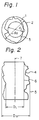
- peripheral surface of the cut porous strands have a number of irregular convexities and concavities, as indicated in Figs. 1 and 2.
- a cross-sectional profile 1 of a cut porous strand of the present invention is circumscribed by a circumscribed circle 2 having a diameter do and is inscribed by an inscribed circle 3 having a diameter d,.
- the ratio of the diameter do to the diameter d must be in the range of from 1.10:1 to 5.00:1, preferably from 1.20:1 to 5.00:1.
- a side projection profile 4 of a cut porous strand of the present invention projected in a radius direction of the cut strand is circumscribed by a pair of circumscribed lines 5 and is inscribed by a pair of inscribed lines 6.
- the circumscribed and inscribed lines 5 and 6 are drawn in parallel to the longitudinal axis 7 of the cut strand.
- the distance between the pair of the circumscribed lines 5 is represented by Do
- the distance between the pair of the inscribed lines 6 is represented by D,.
- the ratio of the distance Do to the distance D must be in the range of from 1.10:1 to 3.00:1, preferably from 1.15:1 to 3.00:1.
- the resultant cut porous strands have an unsatisfactorily poor porous structure and small internal surface area and, thereof, exhibit an unsatisfactorily poor possibility of contacting substances to be eliminated from water and a poor water-treating efficiency.
- the cut porous strands of the present invention have a number of pores formed therein connected to each other and an irregularly rugged peripheral surface, fine particles of substances to be eliminated can contact the surface of the cut porous strands at a high efficiency and, therefore, the cut porous strands of the present invention exhibit an excellent water-clarifying capability.
- the cut porous strands may contain additives, for example, stabilizers, emulsifiers, pigments, or dyestuff.
- the water-treating material of the present invention can be produced by any process.
- the cut porous strands of the present invention are preferably produced by melt-extruding a resinous mixture of the resinous matrix material as mentioned hereinbefore with a blowing agent through an extruding orifice at a temperature higher than both the melting point of the organic thermoplastic polymer material as mentioned hereinbefore, and the thermally decomposing point of the blowing agent so as to form a stream of the resinous mixture in the form of a strand.
- the blowing agent is allowed to thermally decompose in the strand-shaped stream.
- the resultant blowing gas from the blowing agent is released from the strand-shaped stream and, therefore, forms a number of pores in the stream and makes the peripheral surface of the stream irregularly rugged.
- the resultant porous strand-shaped stream is solidified. During or after the solidifying step, the porous strand-shaped stream or the solidified porous strand is cut into desired lengths.
- the blowing agent usable for the process of the present invention preferably includes at least one member selected from organic blowing compounds, for example, azodicarbonamide, benzenesulfonyl hydrazide, toluenesulfonyl hydrazide, and dinitroso-pentamethylenetetramine and inorganic blowing compounds, for example, sodium hydrogen carbonate.
- organic blowing compounds for example, azodicarbonamide, benzenesulfonyl hydrazide, toluenesulfonyl hydrazide, and dinitroso-pentamethylenetetramine and inorganic blowing compounds, for example, sodium hydrogen carbonate.
- the amount of the blowing agent is not limited to any specific value. However, the blowing agent is usually used in an amount of from 0.2% to 5% based on the weight of the resinous matrix material.
- the resinous matrix material is mixed iwth the blowing agent and, optionally, an additive, by using a conventional blender, for example, a V-type blender, drum blender, or a Henschel mixer.
- a conventional blender for example, a V-type blender, drum blender, or a Henschel mixer.
- the resultant resinous mixture is fed into a melt-extruding apparatus.
- a conventional melt-extruder for example, a non-vent type melt-extruder, is used.
- the melt-extruder has at least one melt-extruding orifice having a desired inside diameter, usually, from 0.5 to 5.0 mm.
- the resinous mixture is melted in the melt-extruder at a temperature higher than the melting point of the polymer material and the thermally decomposing point of the blowing agent so as to thermally decompose the blowing agent.
- the particles of the blowing agent are converted to particles of the resultant decomposition gas compressed and sealed up in the melted resinous matrix material under an elevated pressure.
- the melt of the resinous mixture is extruded through the orifice to the atmosphere so as to allow particles of the compressed and sealed decomposition gas to freely expand.
- This phenomenon causes a number of pores to be formed in the resultant stream of the extruded melt of the resinous mixture and to be connected to each other.
- the expanded decomposition gas ruptures the surface layer portion of the stream of the melt when leaving the stream of the melt. This phenomenon results in the formation of an irregularly rugged peripheral surface of the melt stream.
- the resultant melt stream consisting of the remaining resinous matrix material and having a number of pores and an irregularly rugged peripheral surface is solidified by cooling.
- the strand-shaped melt stream of the resinous matrix material or the solidified porous strand is cut into desired lengths.
- the length of the cut porous strands be in the range of from 0.3 time to 3.0 times the inside diameter of the melt-extruding orifice.
- the degrees of porosity and roughness of the peripheral surface of the cut porous strands are variable depending on the type of the organic thermoplastic polymer material, the content of the inorganic particulate material, the content of the blowing agent, the temperature of a cylinder of the melt-extruder, the inside diameter of the melt-extruding orifice, and the draft applied to the stand-shaped the stream of the extruded resinous mixture.
- an elastic polymeric material is used as an organic thermoplastic polymer material
- the content of the inorganic particulate material is small, if the content of the blowing agent is small, or if the draft applied to the strand-shaped stream of the extruded resinous mixture is large, the porosity of the resultant cut porous strands and the degree of roughness of the peripheral surface become unsatisfactorily small. Therefore, the type of the resinous matrix material, the amount of the inorganic particulate material and the blowing agent, the melt-extruding temperature, the inside diameter of the orifice, and the draft to be applied to the strand-shaped melt stream should be determined in consideration of the desired degrees of porosity and roughness.
- the draft is preferably 3.0 times or less, more preferably, 2.0 times or less. Most preferably, no draft is applied to the melt stream of the extruded resinous mixture.
- a plurality of strand-shaped melt streams may be introduced into to a stream of water flowing in the same direction as that of the strand-shaped melt streams and bundled in the water stream.
- the resinous matrix material consists essentially of a thermoplastic polymer material and the resultant strands have a relatively large thickness
- the taking-up operation of the strands can be carried out without difficulty.
- an increase in the content of the inorganic particulate material or a decrease in the thickness of the strands result in increased frequency of breakage of the strands before the solidifying operation is completed. This phenomenon makes the melt-extruding step unstable.
- the strand-shaped streams of the melted resinous matrix material having an irregularly rugged peripheral surface are bundled in a water stream, the strand-shaped streams are brought into contact with each other and partially melt-bounded at the convexities on the peripheral surfaces thereof.
- the partially bonded porous strands can be easily separated from each other by applying a light impact thereto, for example, by cutting the strands by means of a pelletizer.
- the use of the water stream is advantageous in that when some strand-shaped streams are broken, the lower-stream portions of the strand-shaped streams are conveyed by the water stream together with the nonbroken strand-shaped streams and the upperstream portions of the strand-shaped streams are also conveyed by the water stream together with the nonbroken strand-shaped streams, are brought into contact with the non-broken strand-shaped streams, and are partially bounded thereto, and the partially bonded streams are conveyed by the water stream together with the nonbroken streams. That is, all the resultant porous strands are automatically conveyed by the water stream to a taking-up port of the porous strands even if a half number of strands are broken.
- the water-treating material of the present invention is highly effective for eliminating oily substances dispersed and/or emulsified in water. Also, colloidal particles, for example, colloidal silica particles having a negative electric charge and anionic substances are easily eliminated by the water-treating material.
- the resinous matrix material can be firmly bounded to the cationic cross-linked polymer material. Therefore, the resultant water-treating material exhibits an excellent durability over a long period of time.
- the cut porous strands be of a diameter of from 1.0 to 2.00 mm and a length of 0.3 to 6.0 mm.
- the water-treating material of the present invention is effective for adsorbing oil droplets in water and for coalescing the oil droplets and, therefore, is useful for clarifying various types of oily substance- containing water, for example, wastewater containing cutting oil and rolling oil, wastewater from oil-tank cleaning operations, machine cleaning operations, vehicle cleaning operations, painting factories, and food factories, wastewater drained from compressors, ballast water of oil tankers, bilge water, and wastewater from crude oil drilling operations.
- the water-treating material of the present invention is useful for eliminating oily substances from various circulating water for the purpose of recycling.
- a resinous mixture was prepared by blending polyethylene with barium sulfate or talc and a blowing agent consisting of an azodicarbonamide compound (available under trademark "cellmaik CAP500” and make by Sankyo Kasei) in the amounts as indicated in Table 1.
- the resultant resinous mixture was fed into a non-vent type melt-extruder provided with a cylinder having an inside diameter of 30 mm and heated at maximum at a temperature of 170°C and eight circular orifices having an inside diameter of 1.5 mm.
- the resinous mixture was melted in the cylinder and extruded through the eight orifices to form eight streams of the melt of the resinous mixture in the form of strands.
- the strand-shaped melt streams were cool-solidified without applying a draft thereto.
- the resultant solidified porous strands were pelletized to form cut porous strands having a length of about 2 mm.
- the cut porous strands were charged at a height of 200 mm in a 500 ml measuring cylinder.
- the filling density of the cut porous strands was as shown in Table 1.
- the cut porous strands were charged at a height of 800 mm in a column having an inside diameter of 20 mm to provide a water-treating column.
- Testing water containing dispersed oil was passed through the water-treating column at a flow rate of 1.25 I/h (4 m/h) for 200 hours.
- the testing water was prepared by mixing 1 I of fresh water with 4 g of turbine oil made by Maruzen Oil Co., by means of a mixer for 8 minutes and by diluting the mixture with 40 I of fresh water.
- the turbidities of the testing water and the treated water were determined by means of a turbidimeter. The results are shown in Table 2.
- Table 2 also shows the pressure loss of the water-treating column after the water-treating operation for 200 hours.
- Table 2 shows that the water-treating columns of Examples 1 to 4 exhibited excellent water-clarifying activity and a very small pressure loss even after the water-treating operation over 200 hours.
- Example 2 The same procedures as those described in Example 2 were carried out, except that the melt-extruder was provided with a single orifice having an inside diameter of 3.0 mm, and the length of the resultant cut porous strands was 3.0 mm.
- Example 6 In each of Examples 6 to 10, the same procedures as those described in Example 2 were carried out, except that the resinous mixture used had the composition indicated in Table 3. The resultant cut porous strands exhibited the properties shown in Table 3.
- a water-treating column having an inside diameter of 20 mm was filled with the cut porous strands at a height of 800 mm.
- Testing water was prepared by stirring a mixture of 1 I of water with 4 g of arabian light crude oil in a mixer for 5 minutes, by diluting the mixture with 2 I of water, by leaving the diluted mixture at rest in a drum for 20 hours, and by separating and collecting 100 I of the mixture located in the lower portion of the drum.
- the resultant testing water was passed through the water-treating column at a flow rate of 1.25 I/h (4 m/h) for 200 hours.
- the cut porous strands prepared in each of Examples 6 to 8 were respectively subjected to the same water-treating procedures as those described in Examples 6 to 10, except that the testing water was prepared by stirring a mixture of 4 g of turbine oil (produced by Maruzen Oil Co.) and 0.2 g of polyoxyethylenenonylphenylether with 1 I of water by means of a mixer for 8 minutes and by diluting the mixture with 40 I of water and that the water-treating procedures were carried out for 300 hours.
- the testing water was prepared by stirring a mixture of 4 g of turbine oil (produced by Maruzen Oil Co.) and 0.2 g of polyoxyethylenenonylphenylether with 1 I of water by means of a mixer for 8 minutes and by diluting the mixture with 40 I of water and that the water-treating procedures were carried out for 300 hours.
- Table 5 shows that the silicon-containing inorganic compounds, such as silica and talc, in addition to the cationic cross-linked polymer material are highly effective for enhancing the activity of the water-treating material for eliminating emulsified oil.
- Example 14 to 17 the same procedures as those described in Examples 1 to 4 were carried out, except that the resinous mixture was of the composition indicated in Table 6, the non-vent type melt-extruder was provided with a cylinder having an inside diameter of 50 mm and 50 circular orifices each having an inside diameter of 1.5 mm and arranged on two concentric circles, and the extruder melt streams of the resinous mixture were introduced and bundled together in a water stream flowing in the same direction as that of the melt streams.
- the resinous mixture was of the composition indicated in Table 6
- the non-vent type melt-extruder was provided with a cylinder having an inside diameter of 50 mm and 50 circular orifices each having an inside diameter of 1.5 mm and arranged on two concentric circles, and the extruder melt streams of the resinous mixture were introduced and bundled together in a water stream flowing in the same direction as that of the melt streams.
- the solidified strands were pelletized at a length of 2 mm.
- the melt-extruding procedures were continuously carried out for 30 minutes, the extruded strand-shaped melt streams were broken 3 to 6 times. However, the broken strands were taken up together with the other strands without difficulty. After a cutting operation, it was found that 98% of the resultant cut porous strands were separate from each other. Only a few cut porous strands were fuse-bonded to each other to form lumps consisting of two or more cut porous strands.
- Example 14 The resultant cut porous strands were subjected to the same water-treating procedures as those described in Example 1, except that, in Example 14, the top of the column of the cut porous strands was covered with a metal net because the specific gravity of the cut porous strands is smaller than that of water.
- Tables 6 and 7 clearly show that the water-treating materials of the present invention exhibited a high water-clarifying activity even after the water treatment for 200 hours. Also, the pressure loss of the water-treating column was extremely small even after a long period of continuous water treatment.
Landscapes
- Chemical & Material Sciences (AREA)
- Analytical Chemistry (AREA)
- Organic Chemistry (AREA)
- Chemical Kinetics & Catalysis (AREA)
- Dispersion Chemistry (AREA)
- Solid-Sorbent Or Filter-Aiding Compositions (AREA)
- Compositions Of Macromolecular Compounds (AREA)
- Water Treatment By Sorption (AREA)
- Manufacture Of Porous Articles, And Recovery And Treatment Of Waste Products (AREA)
Claims (21)
Applications Claiming Priority (10)
| Application Number | Priority Date | Filing Date | Title |
|---|---|---|---|
| JP3019184A JPS60175590A (ja) | 1984-02-22 | 1984-02-22 | 多孔質含油廃水処理材 |
| JP30191/84 | 1984-02-22 | ||
| JP3148184A JPS60175544A (ja) | 1984-02-23 | 1984-02-23 | 含油廃水処理材 |
| JP31480/84 | 1984-02-23 | ||
| JP59031483A JPS60175543A (ja) | 1984-02-23 | 1984-02-23 | 多孔質水処理材 |
| JP31482/84 | 1984-02-23 | ||
| JP59031480A JPS60176727A (ja) | 1984-02-23 | 1984-02-23 | 多孔質ストランドの引取り方法 |
| JP31481/84 | 1984-02-23 | ||
| JP3148284A JPS60175545A (ja) | 1984-02-23 | 1984-02-23 | 多孔質含油廃水処理材の製法 |
| JP31483/84 | 1984-02-23 |
Publications (3)
| Publication Number | Publication Date |
|---|---|
| EP0152955A2 EP0152955A2 (fr) | 1985-08-28 |
| EP0152955A3 EP0152955A3 (en) | 1986-06-25 |
| EP0152955B1 true EP0152955B1 (fr) | 1988-07-13 |
Family
ID=27521202
Family Applications (1)
| Application Number | Title | Priority Date | Filing Date |
|---|---|---|---|
| EP85101895A Expired EP0152955B1 (fr) | 1984-02-22 | 1985-02-21 | Matériau poreux pour le traitement de l'eau et procédé pour sa production |
Country Status (4)
| Country | Link |
|---|---|
| EP (1) | EP0152955B1 (fr) |
| AU (1) | AU572613B2 (fr) |
| CA (1) | CA1232260A (fr) |
| DE (1) | DE3563692D1 (fr) |
Families Citing this family (6)
| Publication number | Priority date | Publication date | Assignee | Title |
|---|---|---|---|---|
| FR2701864B1 (fr) * | 1993-02-22 | 1995-06-30 | Pont A Mousson | Procédé de fabrication d'un moyen d'adsorption de gaz, moyen d'adsorption et installation d'assainissement correspondants. |
| BR9307006A (pt) * | 1992-09-04 | 1999-02-23 | Pont A Mousson | Processo de produção de um meio de adsorção de gás meio de adsorção e instalação de saneamento correspondentes |
| WO1996001157A1 (fr) * | 1994-07-01 | 1996-01-18 | R. Just Pty. Ltd. | Unite de lavage et de nettoyage |
| WO2020054777A1 (fr) * | 2018-09-14 | 2020-03-19 | Agc株式会社 | Méthode de production de pastilles, pastilles et film d'échange d'ions |
| CN114504880B (zh) * | 2020-11-16 | 2023-04-14 | 清华大学 | 一种疏水改性金属网及其制备方法和用途 |
| CN116870865B (zh) * | 2023-07-18 | 2024-08-20 | 贵州省土壤肥料研究所(贵州省生态农业工程技术研究中心)(贵州省农业资源与环境研究所) | 一种铁锰氧化物生物炭复合材料的制备方法与应用 |
Family Cites Families (5)
| Publication number | Priority date | Publication date | Assignee | Title |
|---|---|---|---|---|
| US3375933A (en) * | 1965-02-01 | 1968-04-02 | Fram Corp | Semi-rigid polymer encapsulated filter medium containing an unencapsulated adsorbent material |
| US4172031A (en) * | 1975-11-04 | 1979-10-23 | The Dow Chemical Company | Separation of oil from water |
| US4061807A (en) * | 1976-02-09 | 1977-12-06 | Shaler Amos J | Adsorbent body and method for making same |
| DE2901335A1 (de) * | 1979-01-15 | 1980-07-31 | Basf Ag | Verfahren zur abtrennung von hydrophoben organischen fluessigkeiten aus wasser |
| JPS57167411A (en) * | 1981-04-03 | 1982-10-15 | Mitsubishi Rayon Co Ltd | Acrylic synthetic fiber and its production |
-
1985
- 1985-02-18 CA CA000474554A patent/CA1232260A/fr not_active Expired
- 1985-02-19 AU AU38951/85A patent/AU572613B2/en not_active Ceased
- 1985-02-21 EP EP85101895A patent/EP0152955B1/fr not_active Expired
- 1985-02-21 DE DE8585101895T patent/DE3563692D1/de not_active Expired
Also Published As
| Publication number | Publication date |
|---|---|
| DE3563692D1 (en) | 1988-08-18 |
| EP0152955A2 (fr) | 1985-08-28 |
| CA1232260A (fr) | 1988-02-02 |
| AU572613B2 (en) | 1988-05-12 |
| AU3895185A (en) | 1985-08-29 |
| EP0152955A3 (en) | 1986-06-25 |
Similar Documents
| Publication | Publication Date | Title |
|---|---|---|
| US4801386A (en) | Process of using a porous water-treating material | |
| US4802985A (en) | Porous water-treating material | |
| US4414111A (en) | Shaped composite adsorbent and a process for preparing the same | |
| EP0069435B1 (fr) | Matériau à base de polymère cationique pour le traitement de l'eau, sa préparation et son utilisation | |
| JPS633652B2 (fr) | ||
| EP0152955B1 (fr) | Matériau poreux pour le traitement de l'eau et procédé pour sa production | |
| JP2001089574A (ja) | ポリビニルアルコール系含水ゲル、その製造方法及び排水処理装置 | |
| US5156767A (en) | Emulsion breaking using alkylphenol-polyethylene oxide-acrylate polymer coated coalescer material | |
| CN101535378A (zh) | 被覆微粒、其制造方法、阳离子吸附剂、及水处理系统 | |
| US3646594A (en) | Process for removal of acidic materials from fluids | |
| EP0864540B1 (fr) | Méthode pour réaliser une réaction biocatalytique | |
| JPH0775711B2 (ja) | 浮遊性造粒物とその製造方法 | |
| US4429065A (en) | Controlled density hydraulic fluids | |
| EP0240983A3 (fr) | Agglomérat compact de particules de latex de polymère | |
| US3564818A (en) | Process for removal of s02 from fluids | |
| EP0829536B1 (fr) | Support pour bioréacteur et procédé de sa préparation | |
| CN108892231B (zh) | 一种生物强化膜反应器制造方法及反应器在焦化废水处理中的用途 | |
| US3851026A (en) | Method of making fluid purification device | |
| JPS58124540A (ja) | 水処理材及びその製造方法 | |
| JPS60175543A (ja) | 多孔質水処理材 | |
| EP0493589B1 (fr) | Destruction par voie catalytique d'anions contenant du soufre et de l'oxygene | |
| JPS6342956B2 (fr) | ||
| EP0547610B1 (fr) | Méthode de préparation de perles de polymères réticulés à grandes dimensions | |
| JPS58128147A (ja) | 水処理材及びその製造方法 | |
| JPH0248296B2 (fr) |
Legal Events
| Date | Code | Title | Description |
|---|---|---|---|
| PUAI | Public reference made under article 153(3) epc to a published international application that has entered the european phase |
Free format text: ORIGINAL CODE: 0009012 |
|
| AK | Designated contracting states |
Designated state(s): DE FR GB |
|
| PUAL | Search report despatched |
Free format text: ORIGINAL CODE: 0009013 |
|
| AK | Designated contracting states |
Kind code of ref document: A3 Designated state(s): DE FR GB |
|
| 17P | Request for examination filed |
Effective date: 19861103 |
|
| 17Q | First examination report despatched |
Effective date: 19870910 |
|
| GRAA | (expected) grant |
Free format text: ORIGINAL CODE: 0009210 |
|
| AK | Designated contracting states |
Kind code of ref document: B1 Designated state(s): DE FR GB |
|
| REF | Corresponds to: |
Ref document number: 3563692 Country of ref document: DE Date of ref document: 19880818 |
|
| ET | Fr: translation filed | ||
| PLBE | No opposition filed within time limit |
Free format text: ORIGINAL CODE: 0009261 |
|
| STAA | Information on the status of an ep patent application or granted ep patent |
Free format text: STATUS: NO OPPOSITION FILED WITHIN TIME LIMIT |
|
| 26N | No opposition filed | ||
| PGFP | Annual fee paid to national office [announced via postgrant information from national office to epo] |
Ref country code: FR Payment date: 19940210 Year of fee payment: 10 |
|
| PGFP | Annual fee paid to national office [announced via postgrant information from national office to epo] |
Ref country code: GB Payment date: 19940211 Year of fee payment: 10 |
|
| PGFP | Annual fee paid to national office [announced via postgrant information from national office to epo] |
Ref country code: DE Payment date: 19940224 Year of fee payment: 10 |
|
| PG25 | Lapsed in a contracting state [announced via postgrant information from national office to epo] |
Ref country code: GB Effective date: 19950221 |
|
| GBPC | Gb: european patent ceased through non-payment of renewal fee |
Effective date: 19950221 |
|
| PG25 | Lapsed in a contracting state [announced via postgrant information from national office to epo] |
Ref country code: FR Effective date: 19951031 |
|
| PG25 | Lapsed in a contracting state [announced via postgrant information from national office to epo] |
Ref country code: DE Effective date: 19951101 |
|
| REG | Reference to a national code |
Ref country code: FR Ref legal event code: ST |