EP0153062A2 - Verfahren für eine abgeschwächte Seigerungserstarrung von Stahl - Google Patents
Verfahren für eine abgeschwächte Seigerungserstarrung von Stahl Download PDFInfo
- Publication number
- EP0153062A2 EP0153062A2 EP85300700A EP85300700A EP0153062A2 EP 0153062 A2 EP0153062 A2 EP 0153062A2 EP 85300700 A EP85300700 A EP 85300700A EP 85300700 A EP85300700 A EP 85300700A EP 0153062 A2 EP0153062 A2 EP 0153062A2
- Authority
- EP
- European Patent Office
- Prior art keywords
- casting
- cooling
- phase
- rate
- temperature
- Prior art date
- Legal status (The legal status is an assumption and is not a legal conclusion. Google has not performed a legal analysis and makes no representation as to the accuracy of the status listed.)
- Granted
Links
Images




Classifications
-
- B—PERFORMING OPERATIONS; TRANSPORTING
- B22—CASTING; POWDER METALLURGY
- B22D—CASTING OF METALS; CASTING OF OTHER SUBSTANCES BY THE SAME PROCESSES OR DEVICES
- B22D11/00—Continuous casting of metals, i.e. casting in indefinite lengths
- B22D11/12—Accessories for subsequent treating or working cast stock in situ
- B22D11/124—Accessories for subsequent treating or working cast stock in situ for cooling
-
- C—CHEMISTRY; METALLURGY
- C21—METALLURGY OF IRON
- C21D—MODIFYING THE PHYSICAL STRUCTURE OF FERROUS METALS; GENERAL DEVICES FOR HEAT TREATMENT OF FERROUS OR NON-FERROUS METALS OR ALLOYS; MAKING METAL MALLEABLE, e.g. BY DECARBURISATION OR TEMPERING
- C21D1/00—General methods or devices for heat treatment, e.g. annealing, hardening, quenching or tempering
- C21D1/84—Controlled slow cooling
Definitions
- the present invention relates to a method for mitigating the solidification segregation of a casting produced by the continuous casting method and a cast ingot produced by the ingot-making method. Such segregation causes surface flaws, cracks, and other material defects in the final steel product.
- direct rolling the casting is not allowed to cool down to room temperature, but is rolled directly after the continuous casting.
- hot-charge rolling the casting is charged in a heating furnace before cooling to room temperature and is then rolled.
- Japanese Unexamined Patent Publication (Kokai) No. 55-84203 proposes a method for suppressing the surface cracks in direct rolling and hot-charge rolling.
- the method proposed by this publication involves subjecting the casting, after its melting and solidification (the primary cooling), to ultraslow cooling during a secondary cooling stage until the initiation of the hot-rolling.
- This publication threw light, by a simulation experiment, on a particular temperature range of from 1300°C to 900°C wherein elements, such as phosphorus, sulfur, oxygen, and nitrogen, detrimental to the hot- workability of steels segregate and precipitate as non-metallic inclusions, and drew attention to the fact that surface cracks frequently occur when the percentage of reduction in area of steel materials becomes less than 60%.
- the method proposed in this publication controls the morphology of the above-mentioned elements precipitated as non-metallic inclusions so as to suppress the hot-cracking of castings.
- Japanese Unexamined Patent Publication No. 55-109503 and No. 55-110724 also disclose to slowly cool the continuous castings prior to the hot-rolling and to directly roll them.
- Japanese Examined Patent Publication (Kokoku) No. 49-6974 discloses a cooling and heating treatment of a continuously cast strand in which the temperature difference between the surface and central liquid of the castings is kept from becoming excessively great.
- a-stabilizing elements P, Si, S, Cr, Nb, V, Mo, or the like
- y-stabilizing elements C, Mn, Ni, or the like
- the present inventors then discovered that the solutes are effectively separated from one another at a particular temperature range.
- This temperature range is either different from the prior art temperatures described above or was not disclosed in the prior art.
- a method for mitigating the solidification segregation of steel characterized in that a casting or cast ingot of the steel is cooled at a rate of 40°C/minute or less in a temperature range where a 6 phase and y phase coexist in the casting or cast ingot, thereby separating a-stabilizing elements and y-stabilizing elements from one another by means of at least one of a peritectic reaction and an Ar4 transformation, which occur during the cooling.
- Figure 1 is a phase diagram of low-carbon steel, for illustrating the cooling of a casting.
- the carbon concentration is in the range of from 0.005% to 0.17%, there is always a temperature region when the 6 phase and y phase coexist.
- a-stabilizing elements such as P, Si, S, Cr, Nb, V, and Mo
- y-stabilizing elements such as Mn and Ni are contained as impurities or additive elements when duplicate segregation of a- and y-stabilizing elements, especially P and Mn, occurs, the segregation particularly seriously influences the qualities of the casting.
- steel is slow-cooled at a rate of 40°C/minutes or less in the time period where a peritectic reaction, and/or Ar4 transformation occurs. That is, the above described transformation and reaction induced during cooling directly after casting or during cooling after heating of the casting are utilized to separate the a-stabilizing elements and y-stabilizing elements from one another.
- the solidification segregation of a casting or ingot in thus mitigated.
- a casting or cast ingot is then cooled at a rate of 30°C/min or more when the temperature of a casting or ingot is lowered to less than the Ar4 transformation point or the temperature range where the phase changes due to the Ar4 transformation occurs.
- slow cooling at the y-phase region is avoided, since the elements which are separated on purpose again uniformly distribute due to diffusion under the slow cooling.
- a repeated heating and cooling operation may be carried out.
- This operation is equally effective for separating the a- and y-stabilizing elements as slow cooling, provided that heating and cooling are repeated within the 6-and y-phase coexistent temperature region or a temperature between this region and the y-phase region and further that the heating rate is higher than the cooling rate.
- a casting is preferably heated at a rate greater than the secondary cooling rate of continuous casting.
- the temperature is held at least 3 minutes at the 6- and y-phase coexistent temperature region.
- the cooling is preferably carried out at a rate as rapid as possible.
- steel having a carbon concentration of between 0.17% and 0.53% undergoes, during the cooling, a change from the liquid (L) phase (region above the curve 1) to the liquid (L) phase plus the ⁇ phase, and, a change from the liquid (L) phase plus the ⁇ phase to the liquid (L) phase plus the y phase at 1495°C (line 3).
- the steel becomes entirely the y phase at a temperature below the line 6.
- a-stabilizing elements such as P, Si, S, and Cr, especially P and S, are collected in the ⁇ phase, i.e., the untransformed ⁇ phase, at a transformation temperature of 1495°C, while y-stabilizing elements such as, C, Mn, Ni, especially Mn, are collected in the y phase.
- the a-stabilizing elements are collected or segregated in a part of the y phase last transformed from the 6 phase. As a result, the segregation sites which exhibit the P concentration peak are separated from those exhibiting the Mn concentration peak and therefore duplicate segregation of P and Mn is avoided.
- the a-stabilizing elements are collected in or segregated in a part of the y phase last transformed from the 6 phase.
- the segregation sites which exhibit the P concentration-peak are separated from those exhibiting the Mn concentration-peak.
- both the peritectic reaction and Ar4 transformation can be utilized for separating the a- and y-stabilizing elements from one another.
- Fig. 3 the relationships between the separation degrees and the time required for the phase changes, i.e., the cooling speed in a practical operation, are shown.
- "7” denotes a cooling speed of 2.7°C/minute
- "8” a cooling speed of 40°C/minute
- "9" a cooling speed of presently used continuous casting machines.at the center of a cast section.
- Mn * and P * indicates the Mn and P concentrations, respectively, in the part of the y phase transformed at the beginning of transformation from the ⁇ phase, in the case of the concentration-separation degree C, , and in the part of the y phase transformed at the end of transformation from the ⁇ phase, in the case of the concentration-separation degree C 2 .
- Mn° and P° are the average concentrations of Mn and P, respectively.
- K i a/b indicates an equilibrium partition coefficient of the component, which is partitioned between the phase "a" and phase "b".
- equilibrium partition coefficients of Mn and P the values given in Table 1 are used.
- 5% is used for each of the area ratios of high Mn and P concentration.
- the separation efficiency utilizing the peritectic reaction and Ar4 transformation is enhanced by repeating the slow cooling procedure. After the temperature is once lowered to a level less than the temperature region of the peritectic reaction and Ar4 transformation, the steel is rapidly heated to elevate the temperature up to the temperature region mentioned above, and the slow cooling in the temperature range of peritectic reaction and Ar4 transformation is resumed. The rapid heating and slow-cooling may be again carried out.
- a heating device controlling the cooling rate of a casting is installed at such a part of the secondary cooling zone of a continuous casting machine of steel that the temperature of the d-phase and liquid-phase interface and the temperature of the 6-phase boundaries in a part of the casting, which part enters the heating device, are not yet lowered to the peritectic temperature and the Ar4 transformation temperature, respectively, and, further, that the casting leaves the heating device at a temperature less than the one at which the transformation of all or a major part of the phase into the y phase is completed.
- All parts of a casting are heated by the heating device to attain the cooling rate of 40°C/minute or less to promote mutual separation of the solutes and to control the surface temperature of a casting in such a manner to complete the transformation of all or a major part of the 6 phase into the y phase at the outlet of the heating device.
- the extent of the y-phase transformation at the outlet of heating device can be determined by the economy of heating by the heating device in relation to the cooling capacity of a continuous casting machine downstream the heating device.
- the surface-temperature control mentioned above allows practical control of the ratio of solidification within a casting and a casting structure.
- the internal structure of a casting varies depending upon the carbon concentration of steel but can be virtually determined by the temperature. That is, the peritectic reaction or Ar4 transformation begins at approximately l500°C and ends at approximately 1400°C.
- the heating device can therefore be installed near the part of the casting where the temperature ranges from approximately 1500°C to 1400°C.
- the temperature of castings should be controlled so that a casting having the solidification degree of 85% or more, particularly 95% or more is cooled at a rate of 40°C/minute or less, since the central segregation is liable to occur at the center of castings solidifying at the solidification degree of 85% or more.
- the solidification degree is used as a supplementary standard for determining the installation point of the heating device.
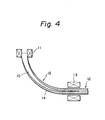
- a mold 11 is primarily cooled by water.
- Reference numeral 12 indicates the secondary cooling zone, in which cooling is carried out with sprayed water.
- a heating device 13 is installed at a part of the casting where the solidification is virtually completed.
- the hatched portion 14 indicates the solidified part of the casting.
- the unsolidified part of the casting is denoted by 15.
- the heating method may be induction heating, electric conduction heating, gas heating, plasma heating, high frequency heating, or the like.
- a conventional soaking device can also be used for treating cast ingots or cut castings. Induction heating, electric conduction heating, gas heating, plasma heating, high frequency heating, or the like may be used as the soaking means.
- the solidification structure of Mn, Si, and P was measured by a two-dimensional electron probe microanalyzer (EPMA) analysis to obtain the characteristic X-ray image of the solidification structure.
- the characteristic X-ray image was processed to indicate the concentration differences in the five stages and is shown in Figs. 6(A), 6(B), and 6(C).
- the 14 mm length of the photographs corresponds to a length of 200 ⁇ m.
- an Mn concentration of from 1.4% to 1.6% is shown by fire-stage shading.
- Fig. 6(B) an Si concentration of from 0.03% to 0.04% is shown by five- stage shading.
- a P concentration of from 0.006% to 0.021% is shown by shading of five stages.
- the concentration of Mn, Si, and P is high in the parts which appear white. The parts where Si and P highly concentrate overlap one another, but are clearly separated from the parts where Mn highly concentrates.
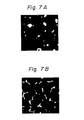
- Figures 7(A) and 7(B) show, by white colored parts, the areas where Mn and P are highly concentrated, i.e. 5%, respectively.
- the 14 mm length of Figs. 7(A) and 7(B) corresponds to 200 ⁇ m.
- Mn and P are clearly separated from one another.
- Example 2 The same steel as in Example 1 was cooled at a rate of 27°C/minute from 1500°C to 1450°C (the heat history is shown by 2 of Fig. 5).
- the separation degrees of Mn and P were measured at the segregation part of the steel.
- the separation degrees in terms of the concentration-separation degrees C 1 and C 2 and the area-separation degree were 0.41, 0.40, and 0.38, respectively.
- a casting having a carbon concentration of 0.30% was cooled at a cooling rate of 30°C/min from 1500°C to 1470°C, heated at a rate of 60°C/min up to 1500°C, and subsequently cooled again by the above cooling. The heating and cooling were repeated once.
- the heat history is shown by 3 of Fig. 5.
- the separation degrees in terms of concentration-separation degrees C 1 and C 2 and the area-separation degree A were 0.32, 0.30, and 0.28, respectively.
- Example 5 The same procedure as in Example 3 was repeated. Then, cooling down to room temperature was carried out at a cooling rate of 4500°C/min. The heat history is shown by 4 of Fig. 5.
- the separation degrees in terms of the concentration-separation degrees C1 and C 2 and the area-separation degree A were 0.40, 0.42, and 0.38, respectively.
- the controlled cooling according to the present invention was carried out in a continuous casting.
- a high-frequency heating device 4 m in length was installed in the secondary cooling zone of the continuous casting machine at a position where the central temperature of a casting (carbon concentration of 0.13%) was decreased to 1490°C, i.e., a position 12 m downstream the meniscus.
- the casting was withdrawn at a speed of 1.0 m/minute and maintained at a surface temperature of approximately 1000°C at the entrance of the heating device.
- the surface temperature of the casting was elevated by the heating device up to 1400°C.
- the cooling rate of the casting was decreased to approximately 20°C/min.
- the solidification ratios of casting were 85% and 100% at the entrance and outlet of the heating device.
- the Mn and P concentrations of the casting continuously cast under the above-described conditions were measured at the central segregation part thereof along the longitudinal direction by means of two-dimensional EPMA analysis.
- the separation degrees of P and Mn at the central segregation part in terms of the concentration-separation degrees C 1 and C 2 and the area-separation degree A were 0.48, 0.52, and 0.50, respectively.
- Low carbon steel containing 0.10% of C was cast into a casting by a conventional continuous casting machine. In order to separate Mn and P from one another at the central segregation part of the casting, it was cooled, after temperature elevation up to 1480°C, down to 1450 0 C at a rate of 10°C/minute and then rapidly cooled down to normal temperature at a rate of 50°C/minute. The two-dimensional EPMA analysis of P and Mn was carried out and the separation degrees were then calculated.
- the P and Mn separation degrees in the neighborhood of the center of the casting were 0.56, 0.74, and 0.80, in terms of C 1 , C 2 , and A, respectively.
- low carbon steel containing 0.10% of carbon was continuously cast by a conventional manner and then soaked at 1250°C for 8 hours.
- the P and Mn separation degrees in the neighborhood of central segregation of the casting were 0.48, 0.58, and 0.52, respectively, in terms of C 1 , C 2 , and A.
Landscapes
- Chemical & Material Sciences (AREA)
- Engineering & Computer Science (AREA)
- Mechanical Engineering (AREA)
- Physics & Mathematics (AREA)
- Thermal Sciences (AREA)
- Crystallography & Structural Chemistry (AREA)
- Materials Engineering (AREA)
- Metallurgy (AREA)
- Organic Chemistry (AREA)
- Continuous Casting (AREA)
Applications Claiming Priority (6)
| Application Number | Priority Date | Filing Date | Title |
|---|---|---|---|
| JP2194184A JPS60166151A (ja) | 1984-02-10 | 1984-02-10 | 鋼の連続鋳造機 |
| JP21940/84 | 1984-02-10 | ||
| JP2194284A JPS60169520A (ja) | 1984-02-10 | 1984-02-10 | 鋳片又は鋳塊の均熱焼鈍方法 |
| JP21941/84 | 1984-02-10 | ||
| JP21942/84 | 1984-02-10 | ||
| JP2194084A JPS60166150A (ja) | 1984-02-10 | 1984-02-10 | 鋼の連続鋳造法 |
Publications (3)
| Publication Number | Publication Date |
|---|---|
| EP0153062A2 true EP0153062A2 (de) | 1985-08-28 |
| EP0153062A3 EP0153062A3 (en) | 1988-06-01 |
| EP0153062B1 EP0153062B1 (de) | 1990-12-05 |
Family
ID=27283637
Family Applications (1)
| Application Number | Title | Priority Date | Filing Date |
|---|---|---|---|
| EP85300700A Expired EP0153062B1 (de) | 1984-02-10 | 1985-02-01 | Verfahren für eine abgeschwächte Seigerungserstarrung von Stahl |
Country Status (3)
| Country | Link |
|---|---|
| US (1) | US4738301A (de) |
| EP (1) | EP0153062B1 (de) |
| DE (1) | DE3580767D1 (de) |
Cited By (3)
| Publication number | Priority date | Publication date | Assignee | Title |
|---|---|---|---|---|
| EP0186512A3 (en) * | 1984-12-28 | 1988-02-10 | Nippon Steel Corporation | Method for controlling solidification segregation of steel |
| CN111774546A (zh) * | 2020-06-17 | 2020-10-16 | 北京科技大学 | 一种改善包晶钢连铸中厚板坯中心偏析与表面裂纹的方法 |
| US11192176B1 (en) | 2020-06-17 | 2021-12-07 | University Of Science And Technology Beijing | Method for improving center segregation and surface crack of continuous casting medium thick slab of peritectic steel |
Families Citing this family (6)
| Publication number | Priority date | Publication date | Assignee | Title |
|---|---|---|---|---|
| CH684936A5 (de) * | 1991-11-29 | 1995-02-15 | Concast Standard Ag | Verfahren und Vorrichtung zum Stranggiessen von Stahl. |
| JPH0688125A (ja) * | 1992-09-09 | 1994-03-29 | Aichi Steel Works Ltd | 連続鋳造片及び鋼塊の熱間加工法 |
| CN102672130B (zh) * | 2012-05-30 | 2013-10-16 | 东北大学 | 一种降低Cr、Mo钢轧材框形偏析的方法 |
| US10960487B2 (en) | 2017-09-21 | 2021-03-30 | United States Steel Corporation | Weldability improvements in advanced high strength steel |
| CN107838390A (zh) * | 2017-10-27 | 2018-03-27 | 舞阳钢铁有限责任公司 | 一种可改善大断面包晶钢连铸坯质量的方法 |
| WO2024076311A1 (en) * | 2022-10-04 | 2024-04-11 | Chiang Mai University | Anodes made from aluminum alloy for aluminum-air batteries |
Family Cites Families (9)
| Publication number | Priority date | Publication date | Assignee | Title |
|---|---|---|---|---|
| DD72871A (de) * | ||||
| CH303720A (de) * | 1949-11-23 | 1954-12-15 | R Jr Wieland Max | Verfahren zum Stranggiessen von Eisen und Eisenlegierungen. |
| FR1057392A (fr) * | 1951-06-25 | 1954-03-08 | Dortmund Horder Hu Ttenunion A | Procédé pour réduire la teneur des aciers en azote |
| SU261660A1 (ru) * | 1967-12-25 | 1977-12-05 | Центральный научно-исследовательский институт черной металлургии им. И.П.Бардина | Устройство дл регулировани теплоотвода от кристаллизующегос непрерывного слитка |
| US3771584A (en) * | 1971-01-08 | 1973-11-13 | Roblin Industries | Method for continuously casting steel billet strands to minimize the porosity and chemical segregation along the center line of the strand |
| JPS5277816A (en) * | 1975-12-24 | 1977-06-30 | Hitachi Ltd | Production of martesitic stainless steel cast steel |
| JPS544224A (en) * | 1977-06-11 | 1979-01-12 | Nippon Steel Corp | Improving method for toughness of steel material |
| JPS566704A (en) * | 1979-06-28 | 1981-01-23 | Nippon Steel Corp | Hot width-gauge control rolling method for cast slab of middle and low carbon steel |
| JPS581012A (ja) * | 1981-06-25 | 1983-01-06 | Nippon Steel Corp | 均質な鋼の製造方法 |
-
1985
- 1985-02-01 EP EP85300700A patent/EP0153062B1/de not_active Expired
- 1985-02-01 DE DE8585300700T patent/DE3580767D1/de not_active Expired - Lifetime
-
1986
- 1986-08-05 US US06/892,475 patent/US4738301A/en not_active Expired - Fee Related
Cited By (5)
| Publication number | Priority date | Publication date | Assignee | Title |
|---|---|---|---|---|
| EP0186512A3 (en) * | 1984-12-28 | 1988-02-10 | Nippon Steel Corporation | Method for controlling solidification segregation of steel |
| US4809765A (en) * | 1984-12-28 | 1989-03-07 | Nippon Steel Corporation | Method for controlling solidification segregation of steel |
| CN111774546A (zh) * | 2020-06-17 | 2020-10-16 | 北京科技大学 | 一种改善包晶钢连铸中厚板坯中心偏析与表面裂纹的方法 |
| US11192176B1 (en) | 2020-06-17 | 2021-12-07 | University Of Science And Technology Beijing | Method for improving center segregation and surface crack of continuous casting medium thick slab of peritectic steel |
| WO2021253591A1 (zh) * | 2020-06-17 | 2021-12-23 | 北京科技大学 | 一种改善包晶钢连铸中厚板坯中心偏析与表面裂纹的方法 |
Also Published As
| Publication number | Publication date |
|---|---|
| EP0153062B1 (de) | 1990-12-05 |
| EP0153062A3 (en) | 1988-06-01 |
| US4738301A (en) | 1988-04-19 |
| DE3580767D1 (de) | 1991-01-17 |
Similar Documents
| Publication | Publication Date | Title |
|---|---|---|
| RU2294386C2 (ru) | Способ изготовления стальной полосы | |
| JP7730446B2 (ja) | 中炭素高マンガンバナジウム含有合金構造用の丸鋼材組織の制御方法 | |
| CN112458356B (zh) | 一种1860MPa级桥梁缆索镀锌钢丝用φ14mm盘条及制备方法 | |
| EP0153062B1 (de) | Verfahren für eine abgeschwächte Seigerungserstarrung von Stahl | |
| US4331196A (en) | Process for producing non-directional electrical steel sheets free from ridging | |
| US4624298A (en) | Method of cooling strands in the continuous casting of steel | |
| RU2307002C2 (ru) | Способ изготовления стальной полосы | |
| EP0186512B1 (de) | Verfahren zum Regeln der Erstarrungsseigerung von Stahl | |
| US5085264A (en) | Process for adjusting the secondary cooling of a machine for continuous casting of metal products | |
| US7591917B2 (en) | Method of producing steel strip | |
| CA1168480A (en) | Prevention method of surface crackings on ni- containing, continuously cast steel products | |
| KR100894041B1 (ko) | 용접봉용 선재의 제조방법 | |
| US4422884A (en) | Method of treating a continuously cast strand formed of stainless steel | |
| CN109913755B (zh) | 一种包晶钢及其制备方法 | |
| JP3039369B2 (ja) | Ni含有鋼の製造方法 | |
| JP3374761B2 (ja) | 連続鋳造鋳片、その連続鋳造方法および厚鋼板の製造方法 | |
| JPS572838A (en) | Production of steel material having uniform internal quality | |
| JPH0568525B2 (de) | ||
| JPS5633156A (en) | Preventing method of surface crack formation in continuously cast slab | |
| JP2001232451A (ja) | 連続鋳造鋳片の直送圧延方法 | |
| JP2593384B2 (ja) | 連続鋳造法 | |
| SU1726113A1 (ru) | Способ непрерывной разливки электротехнической стали | |
| JPS60166151A (ja) | 鋼の連続鋳造機 | |
| KR970007203B1 (ko) | 가공성이 우수한 인장강도 80kg/㎟급 열연강판의 제조방법 | |
| KR100362664B1 (ko) | 미니밀에 의한 일반구조용 열연강판의 제조방법8 |
Legal Events
| Date | Code | Title | Description |
|---|---|---|---|
| PUAI | Public reference made under article 153(3) epc to a published international application that has entered the european phase |
Free format text: ORIGINAL CODE: 0009012 |
|
| AK | Designated contracting states |
Designated state(s): DE FR GB IT |
|
| PUAL | Search report despatched |
Free format text: ORIGINAL CODE: 0009013 |
|
| AK | Designated contracting states |
Kind code of ref document: A3 Designated state(s): DE FR GB IT |
|
| 17P | Request for examination filed |
Effective date: 19880623 |
|
| 17Q | First examination report despatched |
Effective date: 19890712 |
|
| GRAA | (expected) grant |
Free format text: ORIGINAL CODE: 0009210 |
|
| AK | Designated contracting states |
Kind code of ref document: B1 Designated state(s): DE FR GB IT |
|
| ITF | It: translation for a ep patent filed | ||
| ET | Fr: translation filed | ||
| REF | Corresponds to: |
Ref document number: 3580767 Country of ref document: DE Date of ref document: 19910117 |
|
| ITTA | It: last paid annual fee | ||
| PLBE | No opposition filed within time limit |
Free format text: ORIGINAL CODE: 0009261 |
|
| STAA | Information on the status of an ep patent application or granted ep patent |
Free format text: STATUS: NO OPPOSITION FILED WITHIN TIME LIMIT |
|
| 26N | No opposition filed | ||
| PGFP | Annual fee paid to national office [announced via postgrant information from national office to epo] |
Ref country code: GB Payment date: 19950124 Year of fee payment: 11 |
|
| PGFP | Annual fee paid to national office [announced via postgrant information from national office to epo] |
Ref country code: DE Payment date: 19950209 Year of fee payment: 11 |
|
| PGFP | Annual fee paid to national office [announced via postgrant information from national office to epo] |
Ref country code: FR Payment date: 19950210 Year of fee payment: 11 |
|
| PG25 | Lapsed in a contracting state [announced via postgrant information from national office to epo] |
Ref country code: GB Effective date: 19960201 |
|
| GBPC | Gb: european patent ceased through non-payment of renewal fee |
Effective date: 19960201 |
|
| PG25 | Lapsed in a contracting state [announced via postgrant information from national office to epo] |
Ref country code: FR Effective date: 19961031 |
|
| PG25 | Lapsed in a contracting state [announced via postgrant information from national office to epo] |
Ref country code: DE Effective date: 19961101 |
|
| REG | Reference to a national code |
Ref country code: FR Ref legal event code: ST |